

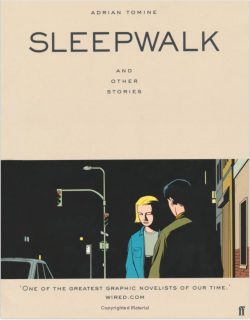

By Adrian Tomine (Drawn & Quarterly Publications 1998/Faber & Faber)
ISBN: 978-1-89659-711-9 (D&Q), 978-0-57123-331-1 (Faber HB)
We often talk of comics and graphic narrative as if it’s one homogenous lump, and as well as doing the medium a tremendous disservice it’s also incredibly misleading. Those people that haughtily declaim “Oh, We Never Watch Television” usually mean they deplore whatever it is you’ve just mentioned, but that their own viewing habits somehow don’t count.
And in a way they’re absolutely correct. For them the term is a group pejorative. But Bake Off is not Eastenders is not The Sky at Night is not Stranger Things. The medium is now a conveyance, the content is a product you can select or decline. Now try that phrase with the concept of comics.
Adrian Tomine draws pictures and tells stories. They are about “Now”, and “I feel that…” and “How does…?” His Spartan monochromatic drawing style works as an ideal camera for his elegiac documentaries. In an art form that too often relies on hyperbole and melodrama – not just for content but for narrative technique – he eschews bravura for insight, telling little tales about the commonplace and the ordinary, showing just how extraordinary and poetic a “realer” life can be. As an exemplar and primer of one of the greatest graphic storytellers of our age (well mine, at least) this is a still his most compelling work, although you (and probably I) might want to reflect and consider 2020’s The Loneliness of the Long-Distance Cartoonist…
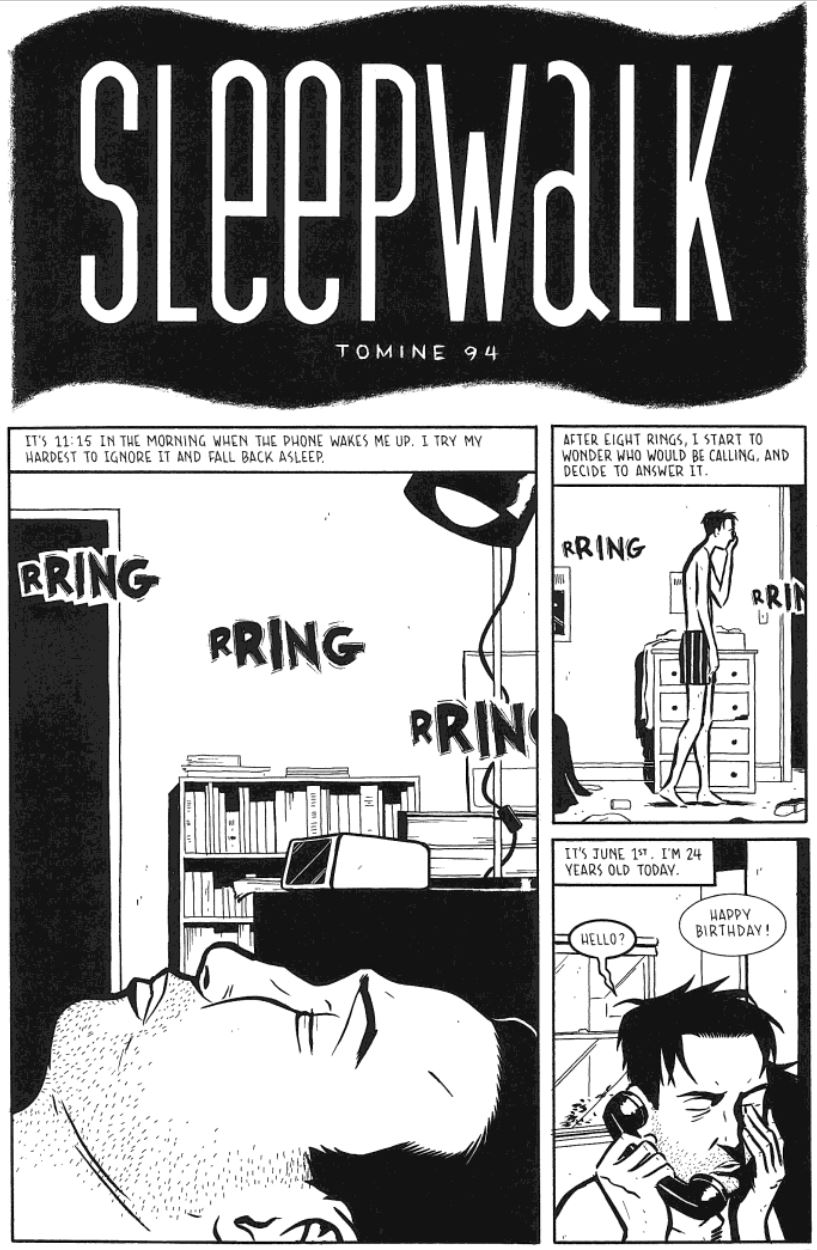
Originally released as issues 1-4 of Optic Nerve, Sleepwalk presented sixteen vignettes of broken hearts and trampled dreams, of uncompromising self-recriminations and day-to-day reminiscences that make us all shrug and think “well, there’s always tomorrow…”
If you read Maus for the scale of Man’s capacity for evil or Stuck Rubber Baby for his ability to change and overcome, then Sleepwalk should access your capacity to empathise and endure. Few comics comment on the Human Condition without taking a strident position. Here’s one that asks you to choose your own, and choose it every single time. Find it. Buy it. Read it.
Think about it. Agitate for one its many past publishers to re-release it…
© 1995, 1996, 1997, 1998 Adrian Tomine. All Rights Reserved.
Yesterday in 1847, pioneering French cartoonist/caricaturist “Grandville” (AKA Jean Ignace Isidore Gérard/Jean-Jacques/J. J. Grandville et al) ended an era by dying…
In 1877, Dutchman of similar status and impact Albert Hahn was born, as was legendary Marvel Comics icon Flo Steinberg in 1939, and in 1950 German satirist (imagine that!) and comics star creator of Werner Rötger Werner Friedrich Wilhelm “Brösel” Feldmann arrived, as did Mutts creator Patrick McDonnell in 1956.
Yesterday in 1972 we lost Cuban star Antonio Rubio in 1972 and US cartoonist Russell Patterson (Mamie), but the day in 1951 saw Davie Law’s Dennis the Menace begin in The Beano, the premiere issue of Japan’s Weekly Shonen Magazine in 1959 and the first episode of Greg Evans’ Luann in 1985.
Today in 1889 Reg’lar Fellers cartoonist Gene Byrnes was born, just like author/artist/inker (Frank McLaughlin (Judomaster, Justice League of America, everything) in 1935.Belgian creator Marcel Denis (Hultrasson) passed away in 2002 and we lost the magnificently macabre Bernie Wrightson (Swamp Thing, Frankenstein, Batman) in 2017. In 1985 UK weekly Buster published the last episode of The Leopard from Lime Street