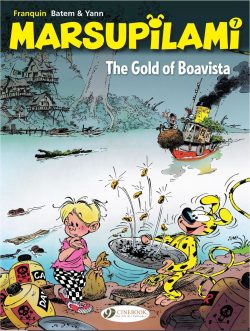
Marsupilami volumes 7 & 8: The Gold of Boavista & The Temple of Boavista


By Yann & Batem, coloured by Cerise and translated by Jerome Saincantin (Cinebook)
ISBN: 978-1-80044-069-2 (Album PB/Digital edition Gold)
ISBN: 978-1 80044-099-9 (Album PB/Digital edition Temple)

Win’s Christmas Gift Recommendation: Mad Monkeyshines with Gallic Aplomb… 9/10

One of Europe’s most popular comic stars is an eccentrically irascible, loyally unpredictable, super-strong, rubber-limbed ball of explosive energy with a seemingly infinite elastic tail. The frantic, frenetic Marsupilami is a wonder of nature and icon of European entertainment originally spun-off from another immortal comedy adventure strip…

When Andre Franquin began crafting eponymous keystone strip Spirou for eponymous flagship publication Le Journal de Spirou, he quickly abandoned the previous format of short complete gags to pioneer longer adventure serials, and began introducing a wide and engaging cast of new characters.

For 1952’s Spirou et les heritiers, he then devised a beguilingly boisterous South American critter and tossed him like an elastic-arsed grenade into the mix. Thereafter – until resigning in 1969 – Franquin constantly added the bombastic little beast to Spirou’s increasingly incredible escapades…

Marsupilami popped up constantly: a phenomenally popular wonder animal who inevitably grew into a solo star of screen, toy store, console games and albums all his own. In 1955 a contractual spat with Dupuis saw Franquin sign up with publishing rivals Casterman for Le Journal de Tintin: collaborating with René Goscinny and old pal Peyo whilst creating raucous gag strip Modeste et Pompon.

Franquin and Dupuis patched things up within days, and he went back to Le Journal de Spirou. In 1957, he co-created Gaston Lagaffe, but was still legally obliged to carry on his Tintin work too. From 1959, writer Greg and background artist Jidéhem assisted, but over the next decade Franquin reached his Spirou limit. In 1969 he quit for good, taking his mystic yellow monkey with him…

Plagued by bouts of depression, Franquin passed away on January 5th 1997, but his legacy remains: a vast body of work that reshaped European comics. Moreover, having learned his lessons about publishers, Franquin retained all rights to Marsupilami and in the late 1980’s began publishing his own adventures of the rambunctious miracle-worker.

He recruited old comrade Greg as scripter and invited commercial artist/illustrator Luc Collin (AKA Batem) to collaborate on – and later monopolise – art duties for the new adventures. In recent years, the commercial world triumphed again and – since 2016 – the universes of Marsupilami and Spirou have reconnected, allowing the old firm to participate in shared exploits of a world created and populated by Franquin.

Graced with a talent for mischief, the Marsupilami is a deviously ingenious anthropoid inhabiting the rainforests of Palombia. One of the rarest animals on Earth, it speaks a language uniquely its own and has a reputation for making trouble and sparking chaos. The species is rare and is fanatically dedicated to its young. Sometimes that takes the form of “tough love”. This behaviour frequently extends to any humans it encounters and “adopts”…

The first of two books telling one tale, L’or de Boavista was released in October 1992. The seventh of 33 solo albums, it was followed a year later by concluding volume Le Temple de Boavista, combining into an edgily gripping comedy drama with much dark and scary social activism underpinning the usual hairy hijinks.

It opens in Palombian capital Chiquito, where children are going missing. No one cared when it was orphans and homeless urchins, but it’s quite different when Donald Maxwell-Trent plays truant and is abducted off the street. He’s spoiled, rich and the son of the US Ambassador…

Tragically, that means nothing to the ruthless thugs who need a constant supply of kids his size and age to work at an illegal, highly polluting goldmine in the jungle upriver. The toxic mess and mercury-made mire these Garimpeiros are creating has incensed and outraged the Marsupilami who now deems them his worst enemies ever…

After another of the yellow terror’s night attacks, overseer Solaria – a slightly older boy with an agenda of his own – helps Donald, now cruelly called “Gordito” by his malnourished comrades, to escape into the green hell. The older boy is only interested in freedom, wealth and returning to the undiscovered tribe he was stolen from, but from his cough may have waited too long to make his break…

Soon brutal gang boss Ingo is in hot pursuit, but his party’s progress is severely hampered by the stalking Marsu – whenever the golden beast isn’t clandestinely helping the fugitives. The furious furry (called by Polombians “El diablo”, and “La catestrofe amarilla”) is then instrumental in linking up the lads with an acceptable resident human…

Transplanted animal trainer Noah keeps his menagerie of friends on a river boat. Appalled by what Solario tells him, Noah resolves to stop the mining but that confrontation does not work out as planned and soon they are all fleeing for their lives up the dreaded Rio Boavista into lethal, legend-drenched “Spatoolah Territory” with dozens of killers on their collective tails…

To Be Concluded…


The dark drama heads into even wilder regions with The Temple of Boavista as relentless pursuit drives our heroes ever deeper into unexplored locales of the mighty tributary. Thankfully the hidden people they meet are mostly friendly, but their heightened state of fear is not ended for long. That night the jungle reverberates with horrific laughter emanating from a gargantuan edifice almost reclaimed by centuries of encroaching trees and vines…

The building is an ancient Zygomaztec temple and in its lee are some very nasty tomb robbers. Zoltan and Zorrino plan on stealing Noah’s floating zoo to carry their latest haul, but haven’t reckoned on the alliance of kids and tribal people, nor whatever is making the dire noises wracking the night with sinister sounds.

… And that’s before Ingo’s Garimpeiros and utterly fed up and furious Marsupilami get involved, or morose millionaire Harold “Buster” Stonelove and his safari guide Rhode Island Smith show up. These “ugly Americans” are looking for the secret of laughter and believe the raucous ruins can supply their answer, when they should be watching the yellow critter with the elastic tail and bad attitude…

As all the competing factions calamitously converge on the temple interior, a remarkable answer to the mirth mystery emerges and in a storm of giggling terror everybody gets jut what they deserve…

These eccentric exploits of the garrulous golden monkey are moodily macabre, furiously funny and pithily pertinent, offering engagingly riotous romps and devastating debacles for wide-eyed kids of every age all over the world. Fancy channelling your inner El Diablo and joining in the fun? It all starts with Hoobee, Hoobah Hoobah…
Marsupilami: The Gold of Boavista Original edition © Dupuis 1992, by Batem & Yann
Marsupilami: Temple of Boavista Original edition © Dupuis, Dargaud-Lombard s.a. 1993, by Batem & Yann, Franquin. All rights reserved. English translations © 2022 Cinebook Ltd.
© Marsu Productions 1992. All rights reserved. English translation © 2022 Cinebook Ltd.

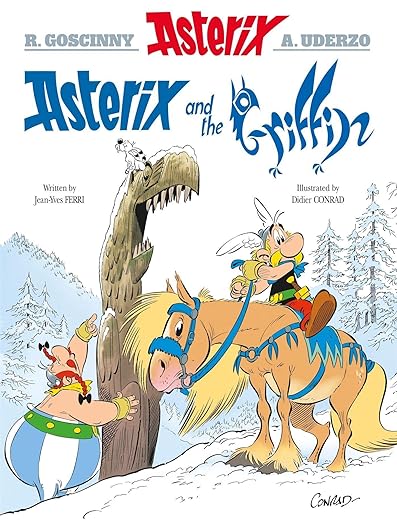
Asterix and the Griffin (volume 39)


By Jean-Yves Ferri & Didier Conrad, coloured by Thierry Mébarki, translated by Adriana Hunter (Sphere)
ISBN: 978-0-7515-8398-4 (Album HB) eISBN: 978-0-7515-8397-7

Win’s Christmas Gift Recommendation: Seasonal Sensations with Gallic Chill… 9/10

Whoops! Missed one!

As we saw a few days ago, Asterix le Gaulois has been around, amazing and amusing the planet since 1959 and become part of the fabric of French life. His exploits have touched billions of people all around the world.

For five and a half decades and for almost all of that time his astounding adventures were the sole preserve of originators René Goscinny and/or Albert Uderzo.

After nearly 15 years dissemination as weekly serials before invariably collected into book-length compilations, in 1974 the 21st saga – Asterix and Caesar’s Gift – was the first to be released as a complete, original album prior to serialisation. Thereafter each new tome was an eagerly anticipated, impatiently awaited treat for legions of devotees. The eager anxiety hadn’t diminished any when Uderzo’s handpicked replacements – scripter Jean-Yves Ferri (Fables Autonomes, La Retour à la terre) and illustrator Didier Conrad (Les Innomables, L’Avatar, Le Piège Malais, Tatum) – settled into the creative role on his retirement in 2009.

Whether an action-packed comedic romp with sneaky, bullying baddies getting their just deserts or a sly satire for older-if-no-wiser heads, these new yarns are just as engrossing as the established canon. As you already know, half of the epics take place in exotic locales throughout the Ancient World, whilst the alternating rest are set in and around Uderzo’s adored Brittany where, circa 50 BC, a little hamlet of cantankerous, proudly defiant warriors and their families resist every effort of the mighty Roman Empire to complete the conquest of Gaul. This one’s solidly of the former variety as our major cast members make it all the way to “barbaricum”: literally beyond the known world…

Although divided by its Roman conquerors into provinces Celtica, Aquitania and Armorica, the very tip of the last-named region stubbornly refuses to be properly pacified. Utterly unable to overrun this last little bastion of Gallic insouciance, the otherwise supreme Roman overlords are reduced to a pointless policy of absolute containment – even though the irksome Gauls come and go as they please…

Thus, a tiny seaside hamlet is permanently hemmed in by heavily fortified garrisons Totorum, Aquarium, Laudanum and Compendium, filled with veteran fighters who would rather be anywhere else on earth than there. The residents couldn’t care less: daily defying, frustrating and often terrorising the world’s greatest military machine by going about their everyday affairs, bolstered by magic potion brewed by resident druid Getafix and the shrewd wits and strategic aplomb of diminutive dynamo Asterix… and his simplistic, supercharged best friend Obelix. And their dog…

In Rome, Julius Caesar is in need of a diversion for his sensation seeking subjects, so when geographer Cartographus claims to have discovered a fabled griffin, the Emperor funds a huge expedition to capture it via legions of soldiers and engineers. The beast resides far to the east in the icy Sarmatian wastes, but the scholar is convinced he can snare it as he has captured a Sarmatian Amazon woman to guide them. Terrifying and seductive, Kalashnikova only sees a chance to return home…

Meanwhile, the frozen lands under discussion have welcomed some familiar friends as Asterix, Obelix and canine wonder Dogmatix escort a very ill (no, no, it’s just a cold, really!) Getafix to the yurt of Fanciakuppov. That cheery shaman had visions of Roman invaders stealing his people’s sacred animal, so his old druid pal has brought a keg of magic potion to resist the incursion. There are, however, a couple of snags…

Firstly, the tribe is proudly matriarchal, with powerful warrior women doing all the fighting. They do it fantastically well, and don’t need help from foreigners – no matter how attractive they might be! – or magic. It’s a good thing too, as local conditions soon render the potion useless and Asterix has to rely on his brains and his giant pal’s innate brawn…

The big guy is quite distracted. Primarily by Dogmatix running away to become a wolf, but also by the obvious attentions of some of the amorous Amazons…

The Roman expedition is led by seasoned centurion Intrepidus, and Cartographus (who naturally has a secret agenda in play) has brought along famed venator (animal-fighting gladiator) Vainglorius, as a specialist to tame the griffin when they find it.

Army morale is low: the commanders squabble constantly, these lands are gloomy, frozen cold, steeped in legends and packed with people and things trying to kill them. Worst of all, when they should be building forts to secure their supply lines, the men are instead fighting each other for the right to guard the prisoner. Aloof, beautiful Kalashnikova disdains and discards them all… and they love it.

When the military monsters capture Fanciakuppov, he is forced to lead the smug raiders to the secret abode of the griffin, but thanks to the hit-&-run tactics of the Gaul-enhanced war women their numbers are so severely depleted, no one thinks they’ll make it back to sunnier climes…

The mission ends in spectacular failure but they do all get to see the fabulous beast before they die…

Packed with hilarious action, genuine chills, potent punning and cartooning delights, this tale provides plenty of pokes at fake news, current affairs, conspiracy theories, a certain global retail/delivery brand, and lands many wry jabs at all sides of the battle of the sexes and role of women in societies ancient and modern.

Asterix and the Griffin is a sure win and another triumphant addition to the magically mythic Gaulish oeuvre for laugh-seekers in general and all devotees of comics.
Original edition © 2021 Les Éditions Albert René. English translation: © 2021 Les Éditions Albert René. All rights reserved.

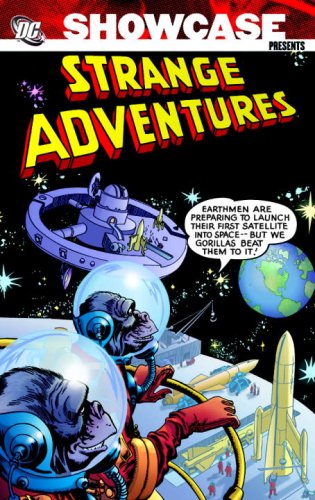
Showcase Presents Strange Adventures volume 1


By John Broome, Otto Binder, Edmond Hamilton, Joe Samachson, Gardner Fox, Dave Wood, Bill Finger, Harry Sharp, Sid Gerson, Ed Herron, Jerry Coleman, Gil Kane, Carmine Infantino, Harry Sharp, Sid Greene, Murphy Anderson, Sy Barry, Joe Giella, Jerry Grandenetti, John Giunta, Joe Kubert & various (DC Comics)
ISBN: 978-1-4012-1544-6 (TPB)

As the 1940s closed, masked mystery-men dwindled in popularity and the American comicbook industry found new heroes. Classic genre titles flourished; resulting in anthologies dedicated to crime, war, westerns and horror dominating most comics publishing. These were augmented by newer fads like funny animal, romance and especially science fiction which, in 1950, finally escaped its glorious thud and blunder/ray guns/bikini babes in giant fishbowl helmets pulp roots – as perfectly epitomised in the uniquely wonderful Golden Age icon Planet Comics. It all came about with the introduction of Strange Adventures.

Packed with short adventures from jobbing SF prose writers offering done-in-one dramas and new heroes such as Chris KL99, Captain Comet, The Atomic Knights and more, the magnificent monthly magazine – supplemented a year later by companion title Mystery in Space – introduced wide-eyed youngsters to a fantastic yet intrinsically rationalist universe and all the potential wonders and terrors it might conceal…

This economical monochrome collection (astonishingly, still no archival collections of this stuff available to modern readers these days; not even via that future-fangled interweb) re-presents stories from the inception of the self-regulatory Comics Code: specifically Strange Adventures #54-73 (cover-dates March 1955 to October 1956, right up to the start of the Silver Age when superheroes successfully returned, offering beguiled readers technological wonderment and the sure-&-certain knowledge there were many and varied somethings “Out There”…

On a thematic note: a general but by no means concrete rule of thumb was the Strange Adventures generally occurred on Earth or were at least Earth-adjacent, whilst – as the name suggests – Mystery in Space offered readers the run of the rest of the universe. Moreover, many plots, gimmicks, maguffins and even art and design would be cleverly recycled for the later technologically-based Silver Age superhero revivals…

This mind-blowing, physics-challenging monochrome colossus opens with the March 1955 issue and four classic vignettes, beginning with ‘The Electric Man!’ by John Broome & Sy Barry, wherein a geologist in search of new power sources accidentally unleashes destructive voltaic beings from the centre of the Earth. As always – and in the grand tradition of pulp sci-fi editor John Campbell – human ingenuity/decency generally solves the assorted crises efficiently and expeditiously…

‘The World’s Mightiest Weakling!’ from Otto Binder, Carmine Infantino & Bernard Sachs, offers a charming yet impossible conundrum after a puny stripling gains incomprehensible mass and density during the course of an experiment, whilst ‘Interplanetary Camera!’ (Binder, Gil Kane & Sachs) grants a photographer a glimpse of the unknown when he finds an alien image recorder and uncovers a plot to destroy Earth.

The issue concludes with another Binder blinder in the taut thriller ‘The Robot Dragnet!’, illustrated by Harry Sharp & Joe Giella, with a rip-roaring romp of rampaging robotic rage.

This tale was actually sequel to an earlier yarn but sufficiently and cleverly recapped so that there’s no confusion or loss of comprehensibility…

Issue #55 led with ‘The Gorilla who Challenged the World’ by Edmond Hamilton & Barry, wherein an ape’s intellect is scientifically enhanced to the point where he becomes a menace to all mankind. So great was his threat that this tale also carried over to the next issue…

During this period baffled editors discovered a bizarre truism: any issue of any title which featured gorillas on the cover ALWAYS resulted in increased sales. Little wonder then that so many DC comics had hairy headliners…

‘Movie Men from Mars!’ (Hamilton, Sharp & Giella) sees our world the unwilling location for cinematographers from the Red Planet. Unfortunately, they’re making a disaster movie…

Joe Kubert’s ‘A World Destroyed!’ offered a fanciful yet gripping explanation for how the asteroid belts between Mars and Jupiter were formed, with that cataclysm theme revisited in ‘The Day the Sun Exploded!’ with Broome, Kane & Sachs depicting a desperate dash by scientists to save Earth from melting. Sid Gerson, Murphy Anderson & Giella wrapped up by revealing the baffling puzzle of ‘The Invisible Spaceman!’

SA #56 opened whimsically with ‘The Fish-Men of Earth!’ (Broome, Infantino & Sachs) as air density goes temporarily askew thanks to invading aliens, before ‘Explorers of the Crystal Moon!’ (Broome, Sharp & Sachs) sees a little boy going for a secret solar safari with visiting extraterrestrials.

Artist Paul Paxton then inadvertently becomes ‘The Sculptor Who Saved the World!’ when future-men ask him to make some highly specific pieces for them: a fast-paced yarn by Broome, Kane & Giella whilst penitent Dr. Jonas Mills corrects his evolutionary error by finally defeating his mutated gorilla in the concluding part of Hamilton & Barry’s simian saga ‘The Jungle Emperor!’

Broome, Sid Greene & Sachs’ ‘The Spy from Saturn!’ opened #57 with a Terran scientist replaced by a perfect impostor, prior to ‘The Moonman and the Meteor!’ (Bill Finger & Barry) positing millionaires and aliens trying to buy or inveigle a fallen star from a humble amateur astronomer for the best and worst of reasons. Binder, Kane & Giella proffer ‘The Riddle of Animal “X”!’ as a small boy finds a pet like no other creature on Earth after which Broome, Infantino & Giella reveal an incredible ancient find to a Uranium prospector and some fugitive convicts desperate enough to try any means of escape in ‘Spaceship Under the Earth!’

Strange Adventures #58 opens with a police chief’s frantic search for a superhuman felon in ‘I Hunted the Radium Man!’ (Dave Wood & Infantino) whilst ‘Prisoner of Two Worlds!’ – Finger & Barry – sees the long-awaited return of genius detective Darwin Jones of The Department of Scientific Investigation. Although an anthology of short stories, the periodical featured numerous returning characters and concepts such as Star Hawkins, Space Museum and others during its run.

Jones debuted in the very first issue, solving fringe science dilemmas for the Federal Government and making 13 appearances over as many years. In this third adventure he assists alien peace-officers in preventing a visiting extraterrestrial taking a commonplace earth object back to his homeworld where it would be a ghastly terror-weapon…

Broome, Kane & Sachs’ ‘Dream-Journey Through Space!’ depicts an ordinary human plucked from Earth to rescue an ancient civilisation from destruction as well as a humble but cunning ventriloquist who saves us all from invasion by invincible aliens in Finger, Greene & Giella’s ‘The Invisible Masters of Earth!’

A young married couple must find a way to prove they aren’t dumb animals on ‘The Ark from Planet X’ (Broome, Greene & Giella) which opened #59, after which ‘The Super-Athletes from Outer Space!’ came to our world to train in a heavier gravity environment and find the galaxy’s greatest sports-coach in a charming tale by Binder, Kane & Sachs. Ed “France” Herron & Infantino then explore the domino theory of cause & effect in ‘Legacy from the Future!’, before Broome & Barry delve into ancient history and doomsday weaponry to discover the secret of our solar system and ‘The World that Vanished!’

SA #60 featured a light-hearted time-travel teaser by Broome, Jerry Grandenetti & Giella concerning historians gathering famous historic personages from ‘Across the Ages!’ before Binder, Kane & Sachs’ ‘The Man Who Remembered 100,000 Years Ago!’ offers terse, tense thrills as lightning provokes ancestral memories of a previous civilisation just in time for a scientist to cancel his unwitting repeat of the self-same experiment which had eradicated them.

Broome, Greene & Sachs then follow the life of a foundling boy who turns out to be an ‘Orphan of the Stars!’, and the issue concludes with a future-set thriller wherein schoolboy Ted Carter wins a place on a multi-species outing to the ‘World at the Edge of the Universe!’ (Binder & Barry).

In #61, ‘The Mirages from Space!’ (Binder, Kane & Sachs) are a portal into a fantastic other world holding the secret of Earth’s ultimate salvation and ‘The Thermometer Man’ – Binder, Greene & Giella – sees a scientist striving to save a stranded Neptunian from melting in the scorching hell of our world. Next, a lighthouse keeper is forced to play smart to counter a Plutonian invasion with ‘The Strange Thinking-Cap of Willie Jones!’ (Herron & Barry).

In conclusion Binder, Greene & Giella’s ‘The Amazing Two-Time Inventions’ has an amateur inventor making fortuitous contact with his counterparts in 3000AD…

Broome, Infantino & Sachs introduced ‘The Fireproof Man’ in SA #62, with his equally astounding dog foiling an alien invasion even as an ordinary handyman falls into another dimension to become a messiah as‘The Emperor of Planet X’ (Broome, Greene & Giella). Binder, Kane & Giella then detail an abortive ‘Invasion from Inner Space!’ before ‘The Watchdogs of the Universe!’ recruit their first human agent in a tantalising tale by Binder, Greene & Giella.

Joe Samachson, Grandenetti & Giella open #63 with ‘I Was the Man in the Moon!’: an intriguing puzzle for an ordinary Joe awakened to find aliens have inexplicably re-sculpted the lunar surface with his face, whilst a Native American forest ranger is Earth’s only hope of translating an alien warning in ‘The Sign Language of Space!’ (Binder, Greene & Giella).

Jerry Coleman, Kane & Giella’s ‘Strange Journey to Earth!’ sees a school teacher deduce an alien’s odd actions and save the world before the issue ends in ‘Catastrophe County, U.S.A.!’ wherein Hamilton, Greene & Giella introduce scientists to the Government’s vast outdoor natural disaster lab…

Sales-boosting simians resurface in #64 as Finger, Infantino & Sachs deliver hostile ‘Gorillas in Space!’ who are anything but, whilst a first contact misunderstanding results in terror and near-death for an Earth explorer lost in ‘The Maze of Mars’ (Binder, Greene & Sachs) and a technological Indiana Jones becomes ‘The Man Who Discovered the West Pole!’ (Binder, Kane & Giella) whilst Samachson & Grandenetti craft a canny tale of planetary peril in ‘The Earth-Drowners!’

For #65 (February 1956) Binder, Greene & Giella’s ‘The Prisoner from Pluto!’ features an alien attempt to warn Earth of imminent Saturnian attack and forced to extreme measures to accomplish his mission. A different kind of cultural upheaval is referenced in quaint-but-clever tale ‘The Rock-and-Roll Kid from Mars!’ (Samachson, Kane & Giella) and a stage mentalist outfoxes genuine telepaths in Binder, Infantino & Sachs’ ‘War of the Mind Readers!’ just before a biologist turns temporary superhero to foil an alien attack in ‘The Man who Grew Wings!’ by Binder, Greene & Giella.

Issue #66 opens with Broome & Infantino’s tale of ‘The Human Battery!’ as an undercover cop suddenly develops incredible power, whilst a guy in a diner mistakenly picks up ‘The Flying Raincoat!’ (Samachson, Greene & Giella) – accidentally averting an insidious clandestine invasion of our world. Binder, Kane & Sachs then see Darwin Jones solve the ‘Strange Secret of the Time Capsule!’ as a metamorphic ‘Man of a Thousand Shapes!’ (Samachson, Infantino & Sachs) proves to have a few secrets of his own…

‘The Martian Masquerader!’ (Strange Adventures #67, by Broome, Kane & Giella) plays clever games as editor Julie Schwartz (AKA “Mr. Black”) is approached by an alien in need of assistance tracking down an ET terrorist, after which Hamilton, Greene & Giella hone in on a subatomic scientist desperate to find his infinitesimal point of origin in ‘Search for a Lost World!’

‘The Talking Flower!’ in chemist Willie Pickens‘ buttonhole is a lost alien who helps him save the world in Samachson, Infantino & Sachs’ charming romance, but the time-travelling travails experienced by archaeologist Roger Thorn after he discovers the Gateway Through the Ages!’ (Hamilton, Greene & Giella) lead only to danger and hard-earned knowledge.

Broome, Infantino & Sachs’ ‘The Man who Couldn’t Drown!’ leads #68: a tale of genetic throwbacks and unfathomable mystery segueing into Samachson, Greene & Giella’s ‘Strange Gift from Space!’ which results in a safer planet for all. A chance chemical discovery then produces a happy salvation in ‘The Balloons That Lifted a City!’ (Samachson, Kane & Giella) and a common thief gets in way over his head after robbing a laboratory in Samachson, Greene & Sachs’ witty ‘The Game of Science!’

SA #69 sees a time-traveller voyage into pre-history and help dawn-age humans overcome ‘The Gorilla Conquest of Earth’ (Broome, Kane & Sachs) whilst the arrival of ‘The Museum from Mars’ (Gardner Fox, Greene & Giella) offers nigh-irresistible temptation and deadly danger to humanity before ‘The Man with Four Minds!’ (Hamilton & Infantino) sees a man with too much knowledge and power eschew it all for normality. ‘The Human Homing Pigeon!’ (Samachson, Greene & Giella) then burns out his own unique gift in the service of his fellows…

The Triple Life of Dr. Pluto!’ (Broome, Greene & Giella in #70) deals with the dangers of a human duplicating ray before Darwin Jones confronts a deadly dilemma when warring aliens both claim to be our friends and ‘Earth’s Secret Weapon!’ (Samachson, Kane & Giella). An early computer falls into the hands of a petty thief with outrageous consequences in ‘The Mechanical Mastermind!’ (Samachson & Infantino) whilst Broome, Greene & Giella’s ‘Menace of the Martian Bubble!’ is foiled by a purely human mind and skills of a stage magician.

Issue #71 features ‘Zero Hour for Earth!’ (Broome & Barry) as a scientist at world’s end sends a time-twisting thought-message back to change future history, whilst invisible thieves of our fissionable resources are thwarted by a scientist with unique visual impairments in ‘Raiders from the Ultra-Violet!’ (Binder, Greene & Giella). Writer Ray Hollis sees a star fall and encounters ‘The Living Meteor!’ (Fox, Kane & Sachs) whilst a guy with a weight problem discovers he has become ‘The Man Who Ate Sunshine!’ in a clever conundrum from Samachson, Grandenetti & Giella.

Strange Adventures #72 starts with a fabulous, self-evident spectacular in ‘The Skyscraper that Came to Life!’ by Broome, Greene & Giella, whilst a shooting star reveals an ancient ‘Puzzle from Planet X!’, promising friendship or doom in a classy yarn by Hamilton, Greene & Sachs.

Gerson & John Giunta’s ‘The Time-Wise Thief!’ provides a salutary moral for a bandit with too much technology and temptation before ‘The Man Who Lived Nine Lifetimes!’ (Binder, Kane & Giella) is aroused from a sleep of ages to save us all from robot invasion…

These flights of fantasy conclude with #73: firstly Broome, Greene & Giella’s ‘The Amazing Rain of Gems!’, wherein a sentient jewel almost beguiles the entire world, whilst humans are hijacked to attend a ‘Science-Fiction Convention on Mars’ (Fox, Kane & Giella) and ‘The Man with Future-Vision!’ (Fox, Infantino & Sachs) discovers knowing what’s coming isn’t necessarily enough…

The imaginative inspiration ends with a clever time-paradox fable in Hamilton, Greene & Giella’s ‘Reverse Rescue of Earth!’

Conceived and edited by the brilliant Julie Schwartz and starring the cream of the era’s writers and artists, Strange Adventures set the standard for mind-boggling all-ages fantasy fiction. With stunning, evocative covers from such stellar art luminaries as Murphy Anderson, Carmine Infantino, Gil Kane and Ruben Moreira, this titanic tome is a perfect portal to other worlds and, in many ways, far better times.

If you dream in steel and plastic, are ready for all AI can do and are agonising and still wondering why you don’t yet own a personal jet-pack, this volume might go some way to assuaging that unquenchable fire for the stars!

Then again, so might a spiffy new collection as part of DC’s Silver Age archive strand…
© 1955, 1956, 2008 DC Comics. All Rights Reserved.

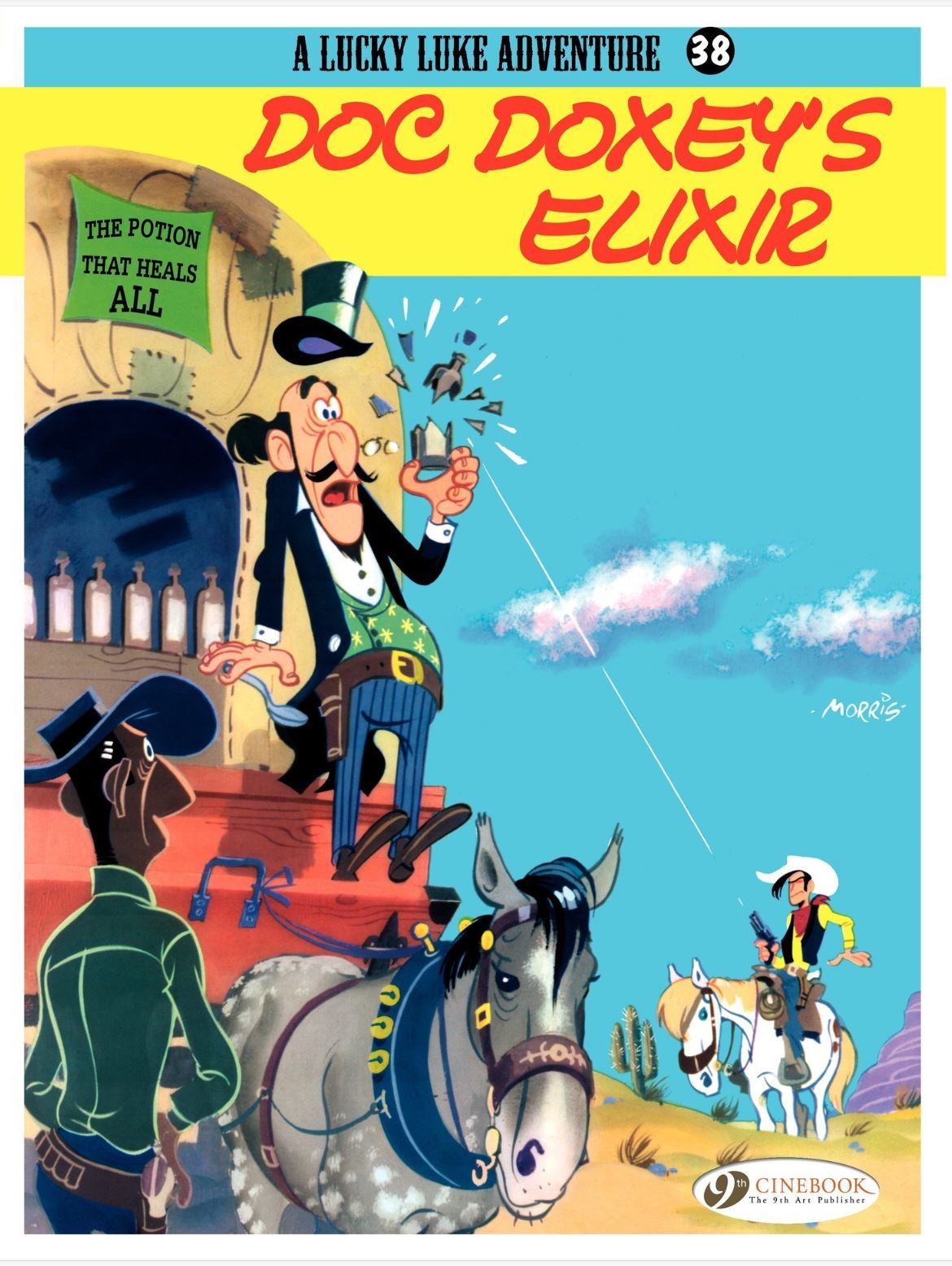
Lucky Luke volume 38 – Doc Doxey’s Elixir


By Morris, translated by Erica Jeffrey (Cinebook)
ISBN: 978-1-84918-141-6 (Album PB/Digital edition)

Doughty, dashing and dependable cowboy “good guy” Lucky Luke is a rangy, implacably even-tempered do-gooder able to “draw faster than his own shadow”. He amiably ambles around the mythic Old West, having light-hearted adventures on his petulant and rather sarcastic wonder-horse Jolly Jumper.

Over nine decades, his exploits have made him one of the top-ranking comic characters in the world, generating upwards of 85 individual albums and spin-off series like Kid Lucky and Ran-Tan-Plan, with sales thus far totalling upwards of 300 million in 30 languages. That renown has translated into a mountain of merchandise, toys, games, animated cartoons, TV shows and live-action movies and even commemorative exhibitions. No theme park yet, but you never know…

Originally the brainchild of Belgian animator, illustrator and cartoonist Maurice de Bévère (“Morris”) and first – officially – seen in Le Journal de Spirous seasonal Annual L’Almanach Spirou 1947, Luke actually sprang to (un-titled) laconic life in mid-1946, before inevitably ambling into his first weekly adventure ‘Arizona 1880’ on December 7th of that year.

Morris was one of “la Bande des quatre”– The Gang of Four – comprising Jijé, Will and Franquin: leading proponents of a fresh, loosely free-wheeling artistic style known as the “Marcinelle School”. It came to dominate Le Journal de Spirou in aesthetic contention with the “Ligne Claire” style favoured by Hergé, E.P. Jacobs and other artists in Le Journal de Tintin. In 1948 said Gang (all but Will) visited America, meeting US creators and sightseeing. Morris stayed for six years, befriended René Goscinny, scored work at newly-formed EC sensation Mad and constantly, copiously, noted and sketched a swiftly vanishing Old West.

Working solo until 1955 (with early script assistance from his brother Louis De Bevere), Morris crafted nine albums – of which today’s was #7 – of affectionate sagebrush spoofery before teaming with old pal and fellow transatlantic émigré Goscinny. With him as regular wordsmith, Luke attained dizzying, legendary heights starting with Des rails sur la Prairie (Rails on the Prairie) which began serialisation on August 25th 1955.

In 1967, the six-gun straight-shooter switched sides, joining Goscinny’s own magazine Pilote in La Diligence (The Stagecoach). Goscinny co-created 45 albums with Morris before his untimely death, whereupon Morris soldiered on both singly and with other collaborators. He went to the Last Roundup in 2001, having drawn fully 70 adventures, plus numerous sidebar sagebrush sagas crafted with Achdé & Laurent Gerra, Benacquista & Pennac, Xavier Fauche, Jean Léturgie, Jacques Pessis and more, all taking their own shot at the venerable vigilante.

Lucky Luke has a long history in Britain, having first pseudonymously amused and enthralled young readers during the late 1950s, syndicated to weekly anthology Film Fun. He later rode back into comics-town in 1967 for comedy paper Giggle, using nom de plume Buck Bingo. And that’s not counting the many attempts to establish him as a book star starting with Brockhampton Press in 1972 and continuing via Knight Books, Hodder Dargaud UK, Ravette Books and Glo’Worm, until Cinebook finally found the right path in 2006.

As L’elixir du Docteur Doxey, today’s yarn spanned December 11th 1952 to 8th October 1953 when originally serialised in LJdS #765-808. The extended serial was then compiled as the seventh annual Lucky Luke album: published in November 1955, with successive volumes launching every year thereafter in that month.

Doc Doxey’s Elixir (entitled “Lucky Luke and Doc Doxey” on the opening page) relates the predatory journeys of a charlatan physician dispensing disgusting and often lethal liquid cure-alls, aided and abetted by his athletic stooge Scraggy. He gulls the public with disguises, near-miraculous instantaneous “recuperations” and equally fast exits.

Their pernicious peregrinations come to an end after poisoning the frontier town of Green Valley, putting dogged do-gooder Lucky on their trail – a long, perilous and relentless pursuit packed with classic and episodic chase gags. Said hunt concludes with the sneaky snake oil peddler behind bars. Of course, he doesn’t stay there long as sequel saga ‘Manhunt’ details his cunning escape, a change of identity – but not modus operandi – and an ultimately unsuccessful plot to murder the wandering cowboy…

Ideal for older kids who have gained a bit of historical perspective and social understanding – although the action and slapstick situations are no more contentious than any Laurel and Hardy film, Chuckle Brothers skit and whatever TikTok clip the waifs of the coming generation (Gen Eric?) titter to – these early exploits are a grand old hoot in the tradition of Destry Rides Again or Support Your Local Sheriff, superbly executed by a master storyteller, and a wonderful introduction to a unique genre for modern kids who might well have missed the romantic allure of the Wild West that never was…
© Dargaud Editeur Paris 1971 by Goscinny & Morris. © Lucky Comics. English translation © 2012 Cinebook Ltd.

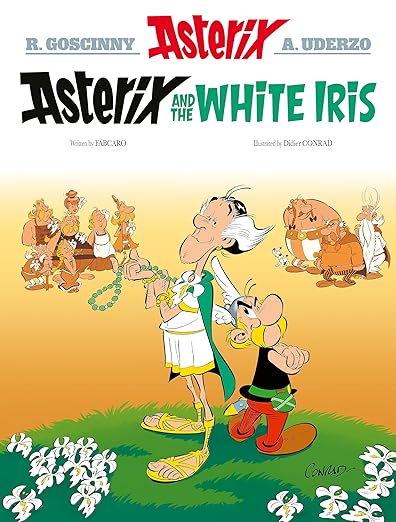
Asterix and the White Iris (volume 40)


By Fabcaro & Didier Conrad, coloured by Thierry Mébarki, translated by Adriana Hunter (Sphere)
ISBN: 978-1-40873-021-8 (Album HB) eISBN: 978-1-4087-3020-1

Win’s Christmas Gift Recommendation: Celebrate the Season in Classical Style… 9/10

Asterix le Gaulois debuted in 1959 and has since become part of the fabric of French life. His exploits have touched billions of people around the world for over sixty years and for almost all of that time his astounding adventures were the sole preserve of originators René Goscinny and Albert Uderzo.

After nearly 15 years dissemination as weekly serials (subsequently collected into book-length compilations), in 1974 the 21st saga – Asterix and Caesar’s Gift – was the first to be released as a complete, original album prior to serialisation. Thereafter each new tome was an eagerly anticipated, impatiently awaited treat for legions of devotees.

The eager anxiety hasn’t diminished even now as L’Iris Blanc sees third scripter Jean-Yves Ferri make way for physicist/novelist/musician/comics writer “Fabcaro” (Like a Steak Machine, Les Marseillais, Mars) – AKA Fabrice Caro – who joins in situ illustrator Didier Conrad (Les Innomables, Tatum, ASTERIX!). Fabcaro & Didier’s first album/40th canonical chronicle of Asterix L’Iris Blanc was released on October 25th 2023, with the English edition hitting shelves and digital emporia as Asterix and the White Iris one day later.

Although divided by its Roman conquerors into provinces Celtica, Aquitania and Armorica, the very tip of the last-named land stubbornly refuses to be properly pacified. The otherwise supreme overlords, utterly unable to overrun this last little bastion of Gallic insouciance, are reduced to a pointless policy of absolute containment – even though the irksome Gauls come and go as they please. Thus, a tiny seaside hamlet is permanently hemmed in by heavily fortified garrisons Totorum, Aquarium, Laudanum and Compendium: packed with seasoned and terrified soldiers who would rather be anywhere else on earth than there…

Those supposedly contained couldn’t care less: daily defying and frustrating the world’s greatest military machine by going about their everyday affairs, bolstered by magic potion brewed by resident druid Getafix and the shrewd wits and strategic aplomb of diminutive dynamo Asterix and the stopping power of his simplistic, supercharged best pal Obelix

As always, action, suspense and comedy are very much in evidence. There’s a healthy helping of satirical lampooning of the generation gap, fads and trends as well as the traditional regional and nationalistic leitmotifs. Whether as an comedic romp with sneaky, bullying baddies getting their just deserts or as a sly and wicked satire for older-if-no-wiser heads, these new yarns are just as engrossing as the established canon.

As you already know, half of the intoxicating epics take place in various exotic locales throughout the Ancient World, whilst the alternating rest are set in and around Uderzo’s adored Brittany circa 50 BC. This one’s a little of both as our major cast members make it all the way to fashionable Lutetia before their current Roman problems are solved…

It all begins in the established traditional manner before we cut to Rome where Julius Caesar is defending his record amidst a miasma of growing unrest and depleted morale that has caused a spike in insubordination and desertions from the army that holds the Empire together.

A potential solution comes from Chief Medical Officer/Lifestyle guru Isivertuus, who has devised a blend of pop psychology, life-coaching and philosophical chicanery he calls “the White Iris.” The poetry-heavy flummery seems capable of bamboozling the gullible – basically anyone but Isivertuus – into modifying their behaviours. The military conman proposes visiting Amorica and convincing its downtrodden, defeatist garrisons that the enemy aren’t indomitable or invincible at all.

Hopeful but cautious, Caesar agrees to the quack working his solution on Totorum camp, and also – just to be sure – destroying that pesky village of rebel Gauls…

At first it all goes quite well, with a combination of recycled adages, meaningless homilies and mental homeopathy lifting military spirits and even – when the charming charlatan starts spouting off to the Gauls themselves – dividing them from each other… not a hard task for such garrulous, combustible and opinionated souls…

Soon, no one’s quarrelling and even Obelix’s beloved wild boars are losing the will to fight, but Isivertuus just cannot close the deal. That’s when he changes tactics and woos Chief Vitalstatistix’s formidable wife away with honied assurances that she deserves a better life in cosmopolitan Lutetia. However, it’s all a ploy to deliver her to Caesar and blackmail the Gauls into surrendering…

Once the heartbroken old Chief gets over the crushing rejection and stifles his maudlin carping, he’s off in hot pursuit with Asterix and the big one going along to keep him out of trouble… and safe from said hostage/bride Impedimenta

Jam-packed with classic laughs, hilarious fights, the usual cameos by the pirates and other old favourites there’s also plenty of contemporary satire: swipes at modern theatre, pop psyche, kick scooters, fusion cuisine, mindfulness and even HS2 before the fun escalates to a crescendo that only proves the truth and power of one old phrase… Amor vincit omnia*.

Asterix and the White Iris is a sure win and another triumphant addition to the mythic canon for laugh-seekers in general and all devotees of comics.
© 2023 HACHETTE LIVRE/GOSCINNY-UDERZO. English translation: © 2023 HACHETTE LIVRE/GOSCINNY-UDERZO

*Love conquers all. Maybe you should read more old books after you get this new one?

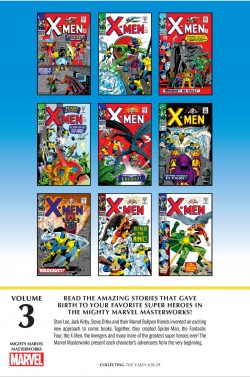
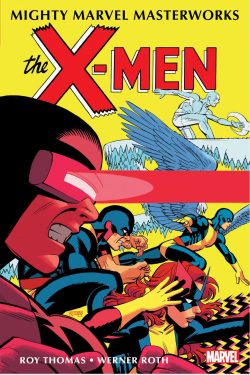
Mighty Marvel Masterworks X-Men volume 3: Divided We Fall


By Roy Thomas, Werner Roth, Dick Ayers, John Tartaglione, Art Simek, Joe Rosen & various (MARVEL)
ISBN: ?978-1-3029-4901-3 (TPB/Digital edition)

Win’s Christmas Gift Recommendation: Celebrate in X-quisite Classical Style… 9/10

These stories are timeless and have been gathered many times so here’s my now-standard advisory on format.

The Mighty Marvel Masterworks line is designed with economy in mind. Classic tales of Marvel – such as the birthday boys and girl on show today – have been an archival book staple since the 1990s, but always in lavish, expensive hardback collectors’ editions. The new tomes are far cheaper, on lower quality paper and smaller, about the size of a paperback book.

Your eyesight might be failing and your hands too big and shaky, but at 152 x 227mm, they’re perfect for kids. If you opt for the digital editions, that’s no issue at all…

Way back in 1963 things really took off for the budding Marvel Comics Group as Stan Lee & Jack Kirby expanded their meagre line of action titles: putting a bunch of relatively new super-heroes (including hot-off-the-presses Iron Man) together as The Avengers; launching a decidedly different war comic in Sgt. Fury and his Howling Commandos and creating a group of alienated heroic teenagers united to fight a rather specific, previously unperceived threat to humanity. Those halcyon days are revisited in this splendid trade paperback/eBook compilation, gathering from May 1966 to February 1967, the contents of X-Men #20-29.

Way back in the summer of 1963, the premiere issue had introduced Cyclops/Scott Summers, Iceman/Bobby Drake, Angel/Warren Worthington III and The Beast/Henry “Hank” McCoy: extremely special students of Professor Charles Xavier. This brilliant, driven, charismatic and wheelchair-bound telepath was dedicated to brokering peace and integration between the masses of humanity and the emergent off-shoot race: human mutants called Homo Superior. The story saw the students welcome newest classmate Jean Grey, who would be codenamed Marvel Girl. She possessed the ability to move objects with her mind.

No sooner has the Professor explained their mission than an actual Evil Mutant – Magneto – singlehandedly took over American missile base Cape Citadel. A seemingly unbeatable threat, the master of magnetism was nonetheless driven off in under 15 minutes by the young heroes on their first combat mission…

These days, young heroes are ten-a-penny, but it should be noted that these kids were among Marvel’s first juvenile super-doers (unless you count Spider-Man or Human Torch Johnny Storm) since the Golden Age, so it’s perhaps unsurprising that in early tales the youngsters regularly benefitted from a little adult supervision, such as is the case in the landmark tale that opens this book…

With Werner Roth & Dick Ayers making the pictures, in X-Men #20, the writing reins were turned over to Roy Thomas, who promptly jumped in guns blazing with ‘I, Lucifer…’: an alien invasion yarn starring Xavier’s arch-nemesis as well as old adversaries Unus the Untouchable and the Blob. Most importantly, it revealed in passing how Professor X lost the use of his legs.

With canny concluding chapter ‘From Whence Comes Dominus?’, Thomas & Roth completely made the series their own: blending juvenile high spirits, classy superhero action and torrid soap opera with beautiful drawing and stirring adventure.

At this time Marvel Comics had a vast and growing following among older teens and college kids, and the youthful Thomas spoke and wrote as they did (or maybe a little better?). Coupled with his easy delight in large casts, this would increasingly make X-Men a most welcoming read for any educated adolescent – like you or me…

As suggested already, X-Men was never one of young Marvel’s top titles, but it found a devout and dedicated following, with the frantic, freakish energy of Jack Kirby’s heroic dynamism comfortably transiting into the slick, sleek attractiveness of Roth as the fierce tension of hunted, haunted juvenile outsider settled into a pastiche of college and school scenarios familiar to the students who were the series’ primary audience.

The action continues with a crafty 2-parter resurrecting veteran Avengers villain Count Nefaria who employs illusion-casting technology and a band of other heroes’ second-string foes (The Unicorn, Porcupine, Plantman, Scarecrow and Eel, if you’re wondering) to hold Washington DC hostage and frame the X-Men for the entire scheme.

‘Divided… We Fall!’ and ‘To Save a City!’ form a fast-paced, old-fashioned Goodies vs. Baddies battle with a decided sting in the tail. Moreover, the tale concludes with Marvel Girl yanked off the team when her parents insist she furthers her education by leaving the Xavier School to attend New York’s Metro University…

Illustrated by Roth & Ayers she is off the team and packed off to college but here visits her old chums to regale them with tales of life outside. Her departure segues neatly into a beloved plot standard – Evil Scientist Grows Giant Bugs – when she enrols and meets an embittered recently-fired professor, leading her erstwhile comrades to confront ‘The Plague of… the Locust!’

Perhaps X-Men #24 isn’t the most memorable tale in the canon but it still reads well and has the added drama of Jean Grey’s departure crystallizing the romantic rivalry for her affections between Cyclops and Angel: providing another deft sop to readers as it enabled many future epics to include Campus life in the action-packed, fun-filled mix…

Somehow Jean still managed to turn up in every issue even as ‘The Power and the Pendant’ (#25, October 1966) finds the boys tracking new menace El Tigre. This South American hunter is visiting New York to steal the second half of a Mayan amulet which willgrant him god-like powers…

Having soundly thrashed the male X-Men, newly-ascended and reborn as Kukulkan, the malign meta returns to Amazonian San Rico to recreate a fallen pre-Columbian empire with the heroes in hot pursuit. The result is a cataclysmic showdown in ‘Holocaust!’ which leaves Angel fighting for his life and deputy leader Cyclops crushed by guilt…

Issue #27 see the return of some old foes in ‘Re-enter: The Mimic!’ as the mesmerising Puppet Master pits power-duplicating Calvin Rankin against a team riven by dissention and ill-feeling, before ‘The Wail of the Banshee!’ sees Rankin join the X-Men in a tale introducing the sonic-powered mutant (eventually to become a valued team-mate and team-leader) as a deadly threat.

This was the opening salvo of an ambitious extended epic featuring a global coalition of sinister, mutant-abductors… Factor Three.

This turbulent tome terminates with John Tartaglione replacing Ayers as regular inker beginning with bright and breezy thriller ‘When Titans Clash!’, wherein the power-duplicating Super-Adaptoid almost turns the entire team into super-slaves before ending the Mimic’s career…

Supplemented by original art – an unused Roth cover for X-Men #25 – these charming idiosyncratic tales are a million miles removed from the angst-ridden, breast-beating, cripplingly convoluted X-brand of today’s Marvel, and in many ways are all the better for it. Superbly rendered, highly readable adventures are never unwelcome or out of favour and it should be remembered that everything here informs so very much of the mutant monolith. These are stories for dedicated fans and the rawest converts. Everyone should have this book.
© 2023 MARVEL

Doug Wildey’s Rio: The Complete Saga


By Doug Wildey (IDW)
ISBN: 978-1-61377-210-2  eISBN: 978-1-62302-476-5

There have been many Western comics over many years created by Americans and other nations. Most were banged out as commercial fodder to feed fashion during periods when mainstream media celebrated a periodic re-emergence of the genre. Rio most definitely ain’t one of those.

Working at his own pace for his own pleasure over long years and virtually isolated from the mainstream comics world, the late Doug Wildey – famed animator (Johnny Quest) and comic strip artist (Outlaw Kid) – produced an iconic and elegiac immortal character.

After a meandering trail of appearances at Eclipse, Comico and Marvel, the wanderer most recently settled at IDW resulting in this glorious collection: far more serious art book than collection of wondrous comics stories.

Almost the entirety of this stupendous compendium is shot from Wildey’s immaculate multi-media original art with corrections, amendments and every instance and evidence of the creator’s interaction with the page left for aficionados to enjoy. No flattening bowdlerisation by the print process here: Think of it as a gallery visit in your hands.

The content comprises all Wildey’s published stories, one entire unpublished tale and a final almost-complete saga he was working on when he died. As he was a rather mercurial cove Wildey skipped about a job, wrapping up pages as whim took him, so the missing parts are there in spirit too: as roughs, sketches, pencils or script and layout designs. It’s a fascinating glimpse of a born raconteur and relentless perfectionist plying his trade. Also included are dozens of sketches, pin-ups and other associated images given weight and context through a loving appreciation by Mark Evanier in his Introduction. What more can a fan want?

Well, obviously, a damned fine read…

An old gunfighter and badman in the heydays of the Wild West, Rio is a rangy loner wandering the country just ahead of creeping civilisation, trying to live the rest of his life as best he can as the end draws near.

The saga began as a serial in early 1980s experiment Eclipse Monthly, during the days of American Comics’ Direct Market revolution. Then it was collected into an album-sized compilation and assorted reprints many times since.

In ‘The Hide Butchers’, the iconically world-weary “tall rider” is engrossed on a tricky and dangerous mission. Offered a full pardon by President Ulysses S. Grant in return for stopping the decimation of the Buffalo herds by “Sporting Special”, Rio is in Wyoming Territory vainly attempting to reason with Railway boss Dorsey. These train excursions – wherein customers could slaughter the animals from the comfort of their seats – nearly wiped out the animals, consequently almost starving to their own extinction Indians who lived off them.

Deemed a threat to profits, Rio is framed for murder by the bigwig’s hirelings – the Grady Parrish gang – and must down a small army of gunmen before he can know any real peace…

His hunt begins in ‘Satan’s Doorstep’ as the trail leads into Apache country and a doomed clash with a cavalry troop led by a glory-obsessed fool who thinks he’s the next Napoleon Bonaparte…

Sole survivor of that desert confrontation, Rio picks up his quarry’s trail in Endsville, Wyoming, before crossing the border to an enslaved Mexican town turned into a ‘Robber’s Roost’ by the bandits he’s chasing. To pass the time, the sadistic brutes play a murderous game with the citizens, but when Rio is captured he deftly turn the tables against them…

Wildey was a master storyteller and a Western Historian of some note. His art graced many galleries and museums, but his greatest achievements are here, where his artistry brings a lost and fabled world briefly back to vibrant life, in spirit as well as look.

Wildey switched over to colour in his own unique style and a more luscious and painterly colour palette, transferring his iconic lone rider from the wilderness to the very borders of the creeping Civilisation he so patently abhorred in a sequel to his original tale of ‘Mr. Howard’s Son’

Finally pardoned by President Grant, Rio is invited to become sheriff of Limestone City, a burgeoning metropolis less than 100 miles from Kansas City yet somehow a town with no crime! Whilst pondering the offer, he finds old friends already living there; two of the most infamous outlaws in history who – with their families – are living quietly as respectable, albeit incognito, citizens of the progressive paradise.

However, after a botched kidnapping and speculative bank raid exposes the retired outlaws, human nature and petty spite lead to disastrous chaos and a spiral of bloody tragedy which the new lawman is ill-equipped and much disinclined to help with…

In ‘Hot Lead for Johnny Hardluck’, Rio meets a young Dutch kid hardened by exploitative mine work who has chanced upon a fortune. After winning a huge diamond at poker the boy heads for San Francisco, unaware the sore loser has hired thieves to restore what he lost at all costs. Happily, Rio is working as stagecoach guard on the route the kid follows, but even after the fireworks are over, the danger and bloodshed isn’t…

Another brush with famous gunmen informs ‘Red Dust in Tombstone’ as Rio meets up with Doc Holliday and his pals the Earp brothers. Trouble is brewing in town and tensions are high, but Wildey smartly shows us a telling side of all concerned that movies have not…

Wrapping the narratives up with a tantalising promise of what might have been, ‘Reprisal’ is an unfinished masterpiece of cowboy lore as the lone rider saunters into a brewing border crisis. Bandits are raiding ranches, but when the wanderer uncovers a scam with soldiers selling gunpowder to outlaws, the situation explosively escalates into savage tragedy…

This wagon train of wonders wraps with an epic visual treat as ‘Doug Wildey’s Rio Gallery’ re-presents covers, evocative colour illustrations, sketches and model sheets to delight every fan of the genre or just great illustration.

Gripping, authentic, and satisfyingly mythic, these tales from a lost master of his subject and his craft are some of the best westerns America has ever produced and some of the most sublime sequential art every set to paper. Go see why pilgrim…
© 2012 Ellen Wildey. All Rights Reserved. Introduction © 2012 Mark Evanier.

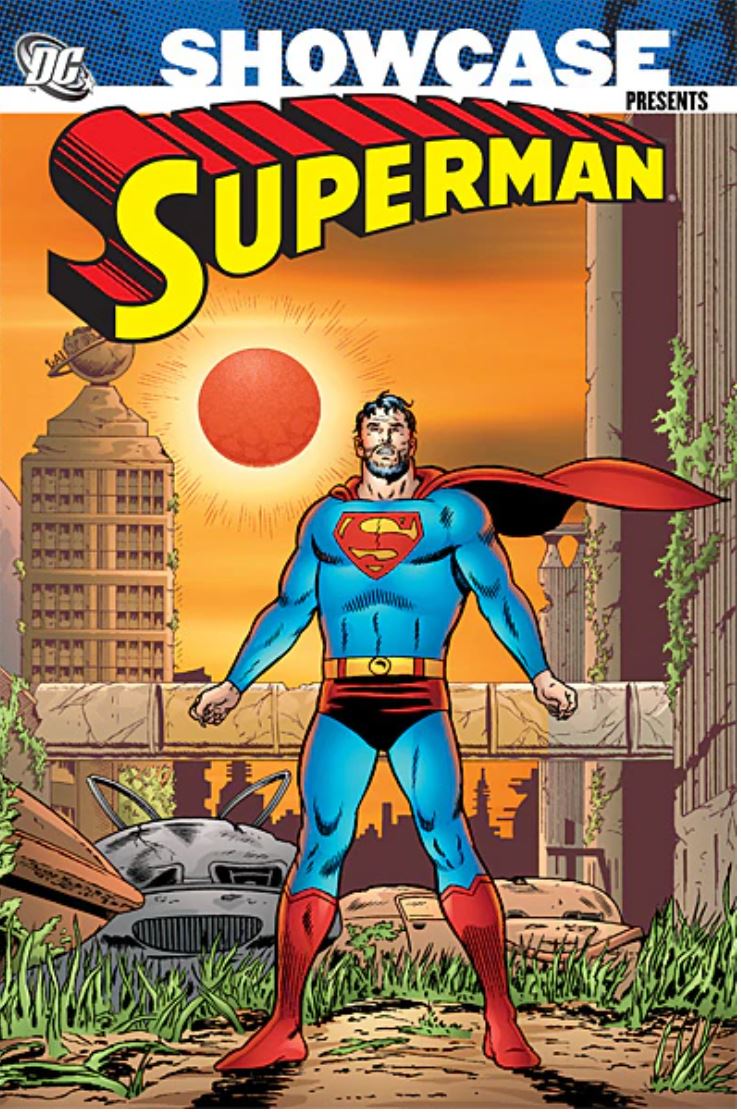
Showcase Presents Superman volume 4


By Edmond Hamilton, Robert Bernstein, Jerry Siegel, Leo Dorfman, Al Plastino, Curt Swan, George Klein & various (DC Comics)
ISBN: 978-1-4012-1847-8 (TPB)

By the time of the stories in this fabulous fourth monochrome compendium Superman was a truly global household name, with the burgeoning mythology of lost Krypton, modern Metropolis and the core cast familiar to most children and many adults.

The Man of Tomorrow was just beginning a media-led burst of revived interest. In the immediate future, television exposure, a rampant merchandising wave thanks to the Batman-led boom in superheroes generally, highly efficient world-wide comics, cartoon, bubble gum cards and especially toy licensing deals would all feed a growing mythology. Everything was in place to keep the Last Son of Krypton a vibrant yet comfortably familiar icon of modern, Space-Age America: particularly constantly evolving, ever-more dramatic and imaginative comicbook stories.

Spanning October 1962 to February 1964 and taken from Action Comics #293-309 and Superman #157-166, here the Man of Tomorrow faces evermore fantastic physical threats and critical personal and social challenges.

AC #293 gets things off to a fine start with Edmond Hamilton & Al Plastino’s ‘The Feud Between Superman and Clark Kent!’ as another exposure to randomly metamorphic Red Kryptonite divides the Metropolis Marvel into a rational but powerless mortal and an aggressive, out of control superhero, determined to continue his existence at all costs…

Superman #157 (November 1962) opens with fresh additions to mythology as ‘The Super-Revenge of the Phantom Zone Prisoner!’ – Hamilton, Curt Swan & George Klein – introduces permanently power-neutralising Gold Kryptonite and Superman’s Zone-o-phone – allowing him to monitor and communicate with the incarcerated inhabitants in a stirring tale of injustice and redemption. Convicted felon Quex-Ul uses it to petition Superman for release since his sentence has been served, and despite reservations our fair-minded hero agrees. However, further investigation reveals Quex-Ul was framed and innocent of any crime, but before Superman can make amends, he must survive a deadly trap the embittered (and partially mind-controlled) parolee had laid for the son of the Zone’s discoverer…

The issue also carried a light-hearted espionage yarn as the Action Ace becomes ‘The Super-Genie of Metropolis!’ (Robert Bernstein & Plastino) as well as ‘Superman’s Day of Doom!’ from Jerry Siegel, Swan & Klein, wherein a little kid saves the hero from a deadly ambush set during a parade in his honour.

Action #294 contains a classic duel between Superman and Lex Luthor in Hamilton & Plastino’s ‘The Kryptonite Killer!’ wherein the sinister scientist makes elemental humanoids to destroy his hated foe, whilst #295’s ‘Superman Goes Wild!’ (Bernstein, Swan & Klein) features an insidious plot by the Superman Revenge Squad to drive him murderously insane.

Issue #158 of his solo title hosted full-length epic ‘Superman in Kandor!’ (Hamilton, Swan & Klein) as raiders from the preserved Kryptonian enclave attack the Man of Steel in ‘Invasion of the Mystery Supermen’, describing him as a traitor to his people. Baffled, Action Ace and Jimmy Olsen infiltrate the Bottle City: creating costumed alter egos Nightwing and Flamebird to become ‘The Dynamic Duo of Kandor!’ By solving the enigma, they save the colony from utter destruction in ‘The City of Super-People!’

Action #296 seemingly offers a man vs. monster saga in ‘The Invasion of the Super-Ants!’ (Hamilton & Plastino) but the gripping yarn has a sharp plot twist and timely warning about nuclear proliferation, before in #297’s ‘The Man Who Betrayed Superman’s Identity!’ (Leo Dorfman, Swan & Klein), veteran newsman Perry White is gulled into solving the world’s greatest mystery after a head injury induces amnesia.

Editor Mort Weisinger was expanding the series’ continuity and building the legend, and realised each new tale was an event adding to a nigh-sacred canon: what he printed was deeply important to the readers. However, as an ideas man he wasn’t going to let that aggregated “history” stifle a good plot, nor would he allow his eager yet sophisticated audience to endure clichéd Deus ex Machina cop-outs which might mar the sheer enjoyment of a captivating concept. Thus “Imaginary Stories” were conceived as a way of exploring non-continuity plots and scenarios, devised at a time when editors felt that entertainment trumped consistency and fervently believed that every comic read was somebody’s first and – unless they were very careful – their last…

Taken from Superman #159, this book’s first Imaginary Novel follows, as ‘Lois Lane, the Super-Maid of Krypton!’ (Hamilton, Swan & Klein) sees a baby girl escape Earth’s destruction by rocketing to another world in ‘Lois Lane’s Flight from Earth!’ Befriending young Kal-El, she grows to become a mighty champion of justice. Clashing with ‘The Female Luthor of Krypton!’ and repeatedly saving the world, Lois tragically endures ‘The Doom of Super-Maid!’ at a time when attitudes apparently couldn’t allow a woman to be stronger than Superman – even in an alternate fictionality…

Dorfman, Swan & Klein’s ‘Clark Kent, Coward!’ leads Action #298 wherein a balloon excursion dumps Jimmy, Lois and the clandestine crusader in a lost kingdom whose queen finds the timid buffoon irresistible. Unfortunately the husky hunks of the hidden land take extreme umbrage at her latest dalliance…

In #160 of his eponymous publication, our hero temporarily loses his powers in ‘The Mortal Superman!’ (Dorfman & Plastino), almost dying in ‘The Cage of Doom!’ before his merely human wits prove sufficient to outsmart a merciless crime syndicate, after which the mood lightens as – fully restored – he becomes ‘The Super-Cop of Metropolis!’ to outwit spies in a classy “why-dunnit” from Siegel, Swan & Klein.

Action #299 reveals the outlandish motives behind ‘The Story of Superman’s Experimental Robots!’ in a truly bizarre tale by Siegel & Plastino, whilst Superman #161 offers an untold tale revealing how he tragically learned the limitations of his powers. In ‘The Last Days of Ma and Pa Kent!’ (Dorfman & Plastino) a vacation time-travel trip led to his foster parents’ demise and only too late did the heartbroken hero learn his actions were not the cause of their deaths. It’s supplemented by ‘Superman Goes to War’ (Hamilton, Swan & Klein) lightening the mood as a war game covered by Daily Planet staff devolves into the real thing after Clark discovers some participants are actually aliens.

Action Comics reached #300 with the May1963 issue ,and to celebrate Hamilton & Plastino crafted brilliantly ingenious ‘Superman Under the Red Sun!’ wherein the Man of Tomorrow is trapped in the far, far future where Earth’s sun has cooled to crimson and his powers fade. The valiant chronal castaway suffers incredible hardship and danger before devising a way home, just in time for #301 and ‘The Trial of Superman!’ – by the same creative team – as the Man of Steel allows himself to be prosecuted for Clark Kent’s murder to save America from a terrible threat.

Dorfman, Swan & Klein’s ‘The Amazing Story of Superman-Red and Superman-Blue!’ (Superman #162) is possibly the most ambitious and influential tale of the entire “Imaginary Tale” sub-genre: a startling utopian classic so well-received that decades later it influenced and flavoured the post-Crisis on Infinite Earths Superman continuity for months. It still does today. The Metropolis Marvel permanently divides into two equal beings in ‘The Titanic Twins!’, who promptly solve all Earth’s problems with ‘The Anti-Evil Ray!’ and similar scientific breakthroughs before both retiring with pride and the girls of their dreams, Lois Lane and Lana Lang (one each, of course) in ‘The End of Superman’s Career!’

There’s no record of who scripted Action #302’s ‘The Amazing Confession of Super-Perry White!’ but Plastino’s slick, beefy art lends great animation to a convoluted tale with the Man of Steel replacing the aging editor to thwart an assassination plot, accidentally giving the impression that podgy Perry is his actual alter ego…

Superman #163 offered crafty mystery in ‘Wonder-Man, the New Hero of Metropolis!’ (Hamilton, Swan & Klein) who almost replaces the Man of Steel, were it not for his tragic foredoomed secret, before ‘The Goofy Superman!’ (Bernstein & Plastino) sees Red K deprive the hero of powers and sanity, resulting in a fortuitous stay in the local Home for the Perpetually Bewildered – since that’s where a cunning mad bomber is secretly hiding out…

In Action #303 Hamilton, Swan & Klein have the infernal mineral transform Superman into ‘The Monster from Krypton!’, almost dying at the hands of the army and a vengeful Supergirl who believes her cousin has been eaten by the dragon he’s become, and #304 hosted ‘The Interplanetary Olympics!’ (Dorfman, Swan & Klein), as Superman deliberately throws the contest and shames Earth…  but only for the best possible reasons!

Courtesy of Hamilton, Swan & Klein in Superman #164 (October 1963) comes classic clash The Showdown Between Luthor and Superman’, pitting the lifelong foes in an unforgettable confrontation on post-apocalyptic planet Lexor – a dead world of lost science and fantastic beasts. ‘The Super-Duel!’ offers a new side to Superman’s previously 2-dimensional arch-enemy and the issue also includes ‘The Fugitive from the Phantom Zone!’ (Siegel & Plastino): a smart vignette with Superman outwitting a foe he can’t beat by playing on his psychological foibles…

Action #305 featured Imaginary Story ‘Why Superman Needs a Secret Identity!’ (Dorfman, Swan & Klein) detailing personal tragedies and disasters following Ma & Pa Kent’s proud and foolish public announcement that their son is an alien Superboy, whilst Superman #165’s ‘Beauty and the Super-Beast!’ and conclusion ‘Circe’s Super-Slave’ (Bernstein, Swan & Klein), see the Man of Steel seemingly helpless against the ancient sorceress. In fact, the whole thing is an elaborate hoax to foil alien invaders of the Superman Revenge Squad. The issue’s third tale, ‘The Sweetheart Superman Forgot!’ (Siegel & Plastino) offers heartbreaking forbidden romance wherein powerless, amnesiac and disabled Superman meets, loves and loses a good woman who wants him purely for himself. When memory and powers return, Clark has no recollection of Sally Selwyn, who’s probably still pining faithfully for him…

Action #306 sees Bernstein & Plastino tweak the Prince and the Pauper in ‘The Great Superman Impersonation!’ as Kent is hired to protect a South American President because he looks enough like Superman to fool potential assassins. Of course it’s all a byzantine con, but by the end who’s conning who?

The reporter’s crime exposés make ‘Clark Kent – Target for Murder!’ in Action #307 (by an unattributed scripter with Swan & Klein) but villainous King Kobra makes the mistake of his life when the hitman he hires turns out to be the intended victim in disguise, after which #308 concentrates on all-out fantasy as ‘Superman Meets the Goliath-Hercules!’ (anonymous & Plastino) after crossing into a parallel universe. Before returning, the Action Ace helps a colossal demigod perform “the Six Labours of King Thebes” in a yarn clearly cobbled together in far too much haste.

Superman #166 (January 1964) features ‘The Fantastic Story of Superman’s Sons’ by Hamilton, Swan & Klein: an Imaginary Tale/solid thriller built on a painful premise – what if only one of Superman’s children inherits his powers? (Sounds a bit familiar now, no?) The saga starts with Jor-El II and Kal-El II’ and the discovery that Kal junior takes after his Earth-born mother. He subsequently grows into a teenager with real emotional problems and, hoping to boost his confidence, dad packs both boys off to Kandor so they’ll be physically equal. Soon the twins find adventure as ‘The new Nightwing and Flamebird!’

However, when a Kandorian menace escapes to the outer world, it’s up to the human son to save Earth following ‘Kal-El II’s Mission to Krypton!’ which wraps everything up in a neat and tidy bundle of escapist fun.

This volume closes with a strange TV tie-in tale from Action Comics #309 as an analogue of This Is Your Life honours Superman by inviting all his friends – even the Legion of Super-Heroes and especially Clark Kent – to ‘The Superman Super-Spectacular!’ (Hamilton, Swan & Klein). With no other option, the hero must share his secret identity with someone new so that they can impersonate him. Although there must be less convoluted ways to allay Lois’ suspicions, this yarn includes perhaps the oddest guest star appearance in comics’ history…

These tales are the comic book equivalent of bubble gum pop music: perfectly constructed, always entertaining, occasionally challenging and never unwelcome. As well as containing some of the most delightful episodes of a pre angst-drenched, cosmically catastrophic DC, these fun, thrilling, mind-boggling and yes, frequently moving all-ages stories also perfectly depict changing mores and tastes that reshaped comics between the safely anodyne 1950s to the seditious, rebellious 1970s, all the while keeping to the prime directive of the industry – “keep them entertained and keep them wanting more”.

I know I certainly do…
© 1962-1964, 2008 DC Comics. All Rights Reserved.

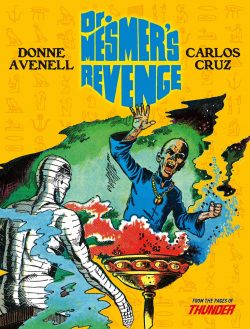
Dr. Mesmer’s Revenge


By Donne Avenelle, Carlos Cruz & José Ortiz (Rebellion Studios)
ISBN: 978-1-78108-687-2 (TPB/Digital edition)

Win’s Christmas Gift Recommendation: Timeless Terror for Kids of Every Land and Vintage… 8/10

It’s time for another sortie down memory lane for us rapidly diminishing oldsters and hopefully a fresh, untrodden path for new fans of the fantastic seeking a typically quirky British comics experience.

This sinister selection delivers another stunning nostalgia-punch from Rebellion’s superb and ever-expanding Treasury of British Comics, collecting seminal shocker and film-fuelled fright fest Dr. Mesmer’s Revenge.

The strip debuted in Lion and Thunder running from October 16th 1971 to October 21st 1972, with this book of the dead also including two epic appearances from the Lion Annuals for 1973 and 1974. The series is a typical example of the manner in which weekly periodicals functioned back then: a solid support trip offering a change of pace from straight action or fantastic adventure as supplemented by comedy pages.

Dr. Mesmer’s Revenge was crafted by British legend Donne Avenell, who began his career before WWII at in the editorial department of Amalgamated Press (which evolved into Fleetway/IPC on household name Radio Fun. Born in Croydon in 1925, Avenell served in the Royal Navy during the war before returning to publishing: editing an AP architectural magazine whilst pursuing writing for radio dramas and romances under a slew of pseudonyms.

He returned to comics in the 1950s, with many contributions to childhood icons like War Picture Library and Lion, directing the sagas of The Spider, The Phantom Viking, Oddball Oates, Adam Eterno and more. He co-wrote major international features like Buffalo Bill, Helgonet (The Saint) and The Phantom for Swedish publisher Semic, created the strip Django and Angel and toiled on assorted Disney strips.

In 1975, with Norman Worker, he co-wrote Nigeria’s Powerman comic which helped launch the careers of Brian Bolland and Dave Gibbons. Avenell was equally at home on newspaper strips such as Axa (1978-1986, drawn by Enrique Romero), Tiffany Jones and Eartha (illustrated by John M. Burns), and worked in television, writing shows like The Saint and their subsequent novelisations. He died in 1996.

Series illustrator Carlos Cruz González was born in 1930 in Andalusia. His large family moved to Malaga when the Spanish Civil War began in 1936, and again to Buenos Aires in 1949. By that time, Carlos was already a professional artist for local newspapers. In South America, whilst working in a flour mill, he moonlighted as a designer at publisher Abril.

In the 1950s he created covers for Idilio, Nocturno and Más Allá, and became fill-in artist on features like Hugo Pratt’s Sargento Kirk before graduating to his own strips like Colt Miller, Indio Suarez and Santos Palma (written by Hector German Oesterheld). Going international he contributed to German periodical Pip and worked on Egmont’s edition of The Phantom.

Moving back to Malaga in the 1960s, Cruz began a 20-year career with Britain’s Fleetway and DC Thomson, drawing war, action, horror, romance and girls’ fiction stories. Prolific and gifted, his strips appeared in many include Battling Boffins in Tiger, Sgt. Rock – Paratrooper (Tiger and Hurricane), Union Jack Jackson (Warlord), Crabbe’s Crusaders, Roamin’ James: Space Pilot! and Mighty McGinty in Buster, Moonie’s Magic Mate and The Pillater Peril in Smash, Eagle’s Blood Fang, Wendy, M.A.S.K. and jewel in the crown Dan Dare.

He also worked in the Spanish market on strips like Juanjo for Trinca, and crafted “Kelly” for Holland’s Tina, and in later years joined the art team on Sweden’s En Hombre Enmascarado. Carlos Cruz died in April 2018.

In the sixties and seventies the British liked their comics characters weird, wild, utterly amoral, flagrantly inept and invariably corrupt to the core. These days it’s a requirement we only demand from and venerate in politicians and public servants. One thing we have adored above all other things is a great, properly flamboyant villain. We always enjoyed a strange, extended love affair with what can only be described as “unconventional” (for which feel free to substitute “weird” or “creepy”) heroes.

So many stars and putative role models of our serials and strips have been outrageous or just plain “off”: self-righteous voyeurs-vigilantes like Jason Hyde, deranged vigilante geniuses like Eric Dolmann, self-absorbed outsiders like Robot Archie, arrogant, morally ambivalent former criminals like The Spider or outright racist supermen such as Captain Hurricane

We also made much of (barely) reformed criminals like Charlie Peace and evil masterminds in the manner of The Dwarf, Black Max, Grimly Feendish, The Snake and today’s particular Menace to Society…

In the respectable English suburb of Blackford stands a strange house. Shaped like a pyramid it has giant cat statues as gates and ancient monuments dotted around the walled estate. Here dwells reclusive Egyptologist Dr. Mesmer and the world is faced with a terrifying crisis from the moment burglars rob his cellar temple of valuable – and arcanely powerful – ancient artefacts…

Outraged, Mesmer unleashes magical 5000-year-old mummy Pharaoh Angor, animated cat-idol Bulbul and sundry other supernatural relics to take back his property, punish the thieves, the dealer who fenced them and all those who bought the items. Only young police constable Tom Stone, and his initially disbelieving superior Inspector Moffat, are aware of what’s really going on…

Over weeks Mesmer’s retaliations and missions revealed incredible feats of horror, until he regained his collection, with the cops always overmatched but scoring some brief victories. As the strip evolved, Mesmer moved beyond righteous indignation, and – after an accidental time-swap – took all concerned back to meet the living pharaoh Angor and his noble enemies. The return to the present saw the doctor change tactics and try to conquer the modern world, with merely mortal gadfly nuisances Stone and Moffat his only opposition…

Once the series concluded, the doctor made a brace of encores in the Lion Annual for 1973 and 1974. The first tale saw how respected archaeologist Dr. Wrath was caught robbing tombs in the Valley of Kings and how his subsequent punishment led to uncovering the mummy of Angor, shattering vengeance inflicted upon his accusers and a little name change. The second yarn sees the power-hungry villain in Dorset, stealing an ancient sun-stone relic and awakening something even mighty mummy Angor cannot defeat…

Moodily chilling and evocatively compelling, Dr. Mesmer’s Revenge is a timeless treat for comics buffs and fear fans: one you’d be well advised to sample soon.
© 1971, 1972, 1973 & 2019 Rebellion Publishing Ltd. All rights reserved.

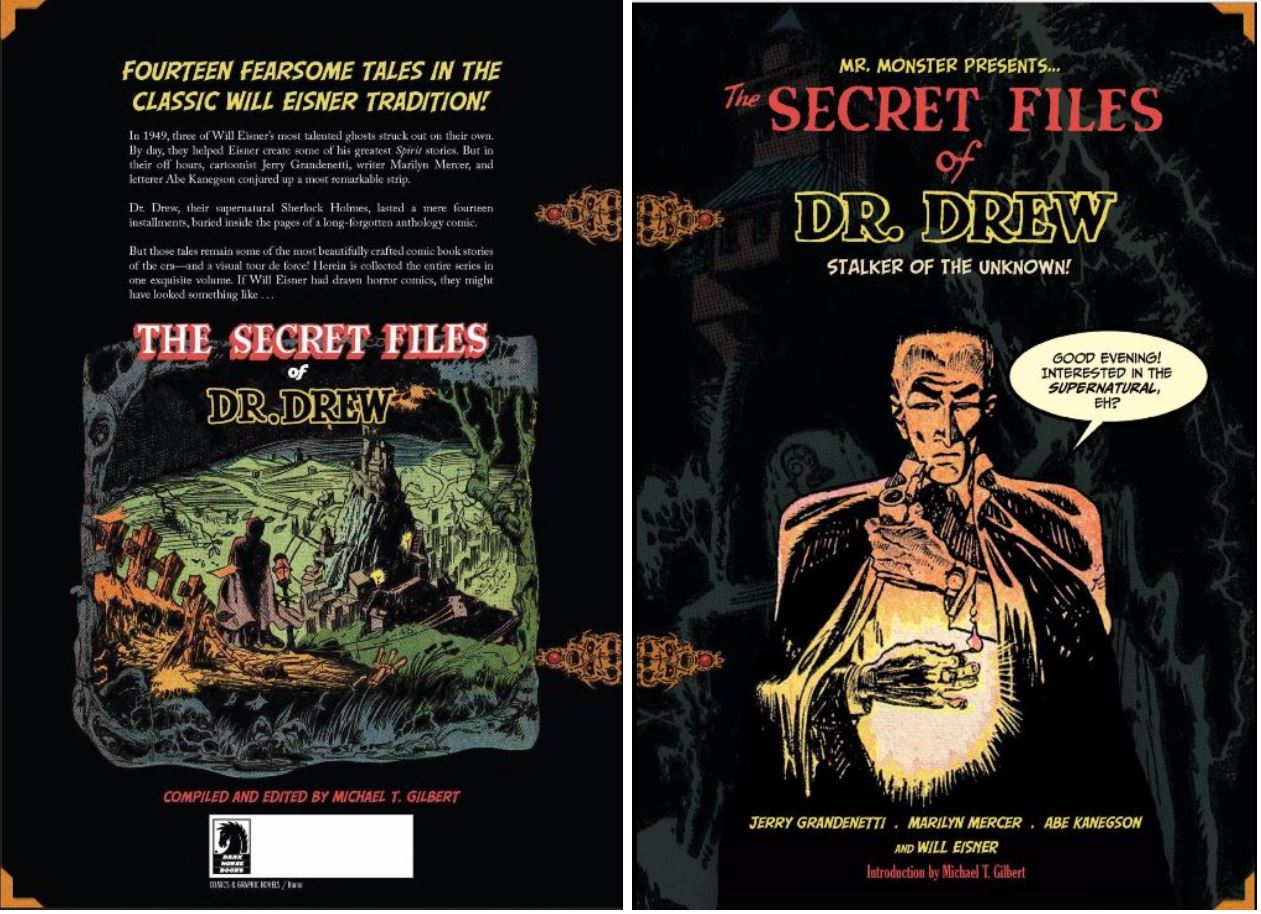
Mr. Monster Presents… The Secret Files of Dr. Drew


By Jerry Grandenetti, Marilyn Mercer, Abe Kanegson with Will Eisner, compiled and edited by Michael T. Gilbert (Dark Horse)
ISBN: 978-1-61655-532-0 (HB) eISBN: 978-1-62115-999-5

Superheroes pretty much carried American comic books in the early years, but after WWII the Fights ‘n’ Tights boom started fading and new kinds of champions from more traditional forms rose to the fore. Simultaneously – as had happened following the end of the Great War – the public’s entertainment appetites turned from patriotic adventure to pedestrian crime and supernatural themes, and funnybooks quickly cashed in on the trend.

In conjunction with dedicated horror anthology titles, regular comics publications also dabbled in monsters (such as The Heap in aviation adventure title Airboy for example – although he had been sloshing around since the early 1940s) and a new kind of two-fisted ghostbuster began manifesting in lots of different publications.

One of the very best was sagacious supernatural sleuth Dr. Desmond Drew, who appeared bimonthly in Ranger Comics from June 1947 to August 1951: helming 14 captivating cases crafted by Will Eisner’s top creative crew: writer Marilyn Mercer, artistic wunderkind Jerry Grandenetti and master calligrapher Abe Kanegson.

Although never a breakout hit or cover feature, the startlingly effective tales – spanning Ranger Comics #47 to 60 – were oft-reprinted before publisher Fiction House finally closed its doors. The yarns had a life-altering effect on modern comics auteur Michael T. Gilbert, who claims these eerie escapades as a major influence on his own Mr. Monster character.

The hows, whens and whys of the Ghostbreaking Guardian – as well as his eventual fate – are investigated in fascinating, abundantly illustrated ‘Introduction: The Secret Files of Dr. Drew!’, scrupulously compiled by Gilbert for this superb archival and that history lesson is the perfect aperitif before the fabulously chilling and enthralling tales are disclosed…

Once you’ve absorbed all there is to know from a fan devoted to sharing his great knowledge, the curious Case Files commence with an arcane parable of greed and vengeance as – preceded by a 2-page cartoon intro from Mr. Monster himself – ‘The Strange Case of the Absent Floor!’ (Ranger #47, June 1949) opens wide…

The “Stalker of the Unknown” was visually based on actor Basil Rathbone in his role of Sherlock Holmes, and debuted sans origin tale: fully-formed with plenty of idiosyncratic baggage to flesh him out. From his foreboding mansion atop brooding Bone Hill, the consulting detective of all things unnatural would sally out in an old-fashioned horse-drawn buggy to tackle ancient horrors in the new Atomic Age: especially in the twisted streets of the city stretched out below his daunting abode…

The initiating escapade sees him rectify a long-standing miscarriage of justice after an elevator operator begs him to investigate an unsuspected floor in the old Wainwright Building: an edifice which never boasted a thirteenth storey until the night an oddly dressed couple boarded his lift…

Incredible peril lurked far closer to home in ‘The Philosopher’s Stone!’ (RC #48, August) since Drew actually owned that potent talisman. However, as he could never get it to work, the doctor had no qualms in lending it to his old friend Gordon Kyle. When Kyle was found instantly aged into decrepitude, a frantic hunt for a remorseless ancient predator begins…

For #49 (October), a young woman paralysed and in utter agony draws the ghostbreaker into battle against a vicious spurned lover employing ‘The Witch’s Doll!’ to gain vengeance, after which ‘The Devil’s Watch!’ (December) pits Drew against his greatest adversary when attempting to deny the Devil a legally-purchased old soul… which just happens to now reside in an innocent young musician…

When ethereal fog heralds a spate of debilitating sickness, victims – all male – are heard to utter ‘The Gypsy Girl!’ (#51, February 1950) before sinking into death. It takes all Drew’s resources to connect the outbreak to a witch-burning three centuries previously, and achieves critical personal importance after he learns his own ancestor was one of the witnesses at Gypsy Anna’s trial. Thankfully, fate and wisdom provide the key to banishing the vengeful spirit in the nick of time…

The hardest part of his struggle against a Balkan bloodsucker haunting a movie set is being dragged out of Bone Hill and flown to Hollywood in ‘The Mark of the Vampire!’ (#52, April) but his clash with bizarre cult ‘The Order of Elusa!’ (Ranger #53, June) proves far more arduous as the primordial murderous sect is located at the bottom of the sea and its immortal wizards almost seduce and corrupt the paranormal paragon with his greatest weakness: ancient, undiscovered, secret knowledge…

When an aqueduct project falters, construction bosses call in the dark detective to dispel a ship full of land-locked phantom buccaneers in ‘The Pirates of Skull Valley!’ (#54, August) before ‘The Curse of the Mandibles!’ (#55, October) finds a desperate client trying to prevent his imminent murder by a spirit which has – over centuries – decimated his entire family. The true culprit behind the string of deaths is even stranger and more incomprehensible than can be imagined…

‘Sabrina the Sorceress!’ (#56, December) is a common criminal charlatan, but when the fake medium is accused of murdering her client she suddenly faces true supernatural terror beside – and despite – Drew, after which the man of mysteries saves an anxious bridegroom from dying at the hands of his spectral bride in ‘Druid Castle!’ (#57, February 1951).

Summoned to the local penitentiary, the thaumic troubleshooter faces body-snatching refugees from the 4th dimension in ‘The Dartbane Horrors!’ (April), before voyaging to Paris to clash with despised rival psychic Salazar whilst solving a string of murders perpetrated by an unworldly fiend who favours ‘The Ancient Reek of Brimstone!’ (June).

The Keeper of Knowledge pauses his comic book crusade in London, bringing a theatrical monster to justice with the assistance of a ghostly actress holding the crucial secret of ‘Sandini’s Trunk!’ (Ranger Comics #60, August 1951).

This fabulous grimoire harbours further delights such as reminiscence-packed reverie ‘The Jerry Grandenetti Interview!’ (conducted by Gilbert before the master draughtsman died in 2010) as well as ‘The Secret Files of The Spirit’s Ghosts!’: a section copiously investigating ‘The Creators!’ and even laying to rest a true enigma of comics history by explaining the abrupt disappearance of Abe Kanegson (who completely dropped off the map in 1950 and was never seen again by his comics colleagues)!

Rendered in the unmistakeable style of classic Eisner’s Spirit episodes, with mature scripting from Marilyn Mercer (who left comics to become a writer, journalist and fashion editor) and Kanegson’s flamboyantly expressive lettering graphics, these are astonishingly compelling comic treasures no fan of the medium or lover of sinister suspense should dismiss. There’s even a selection of Ranger Comics covers and original inked art.

Eerie, gripping and timelessly enthralling, this is a minor masterpiece of monster-mashing comics fiction: one you’d be thrice-damned and really quite accursed to miss.
Mr. Monster Presents… The Secret Files of Dr. Drew™ & © 2014 Michael T. Gilbert. Introduction, Jerry Grandenetti interview and creator biographies © 2014 Michael T. Gilbert. All rights reserved.