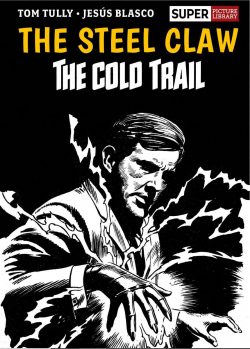
The Steel Claw: The Cold Trail (Super Picture Library)


By Tom Tully & Jesús Blasco & various (Rebellion)
ISBN: 978-1-78618-659-1 (HB/Digital edition)

Another stunning salvo of graphic wonderment from Rebellion’s Treasury of British Comics strand, The Steel Claw: The Cold Trail is a sublimely engaging yarn celebrating an all-but-forgotten sub-strand of the 1960s comics experience.

Until the 1980s, comics in the UK were based on an anthological model, offering variety of genre, theme and character on a weekly – or sometimes fortnightly – basis. Humorous periodicals like DC Thomson’s The Beano were leavened by thrillers like the Q-Bikes, Billy the Cat or General Jumbo whilst rival publisher Amalgamated Press/Fleetway/IPCs comedy comics such as Whizzer and Chips always offered a thriller or two like Wonder Car or Pursuit of the Puzzler.

Similarly, adventure papers like Lion or Valiant always included gag strips such as The Nutts, Grimly Feendish, Mowser and a wealth of similar quick laugh treats. And yes, DCT installed equivalents in The Wizard, Victor, Hotspur and the rest…

Both companies also produced Seasonal Specials, hardcover Annuals and digest-sized anthology publications. DCT still publishes Commando Picture Library and used to sell romance, school dramas and a modern science fiction title (Starblazer) to match their London competitors’ successful paperback book titles.

Those ubiquitous delights included Super Picture Library, War Picture Library, Air Ace Picture Library and Action Picture Library.

These were half-sized, 64-page monochrome booklets with glossy soft-paper covers, but between 1967 and 1968 – at the height of the sixties Spy and Superhero booms – were supplemented by a deluxe, card-cover, 132-page version: The Fleetway Super Library.

As well as the always-popular war option of “Front Line” (starring by turn Maddock’s Marauders or Top-Sergeant Ironside), this line offered a “Secret Agent Series” – alternating cool espionage operatives Johnny Nero and Barracuda – and the “Stupendous” (formerly and briefly “Fantastic”) series which delivered lengthy complete sagas starring either The Spider or The Steel Claw.

These extra exploits came twice a month and ran 13 tales for each, with this spiffy hardback tome replaying the fifth release as crafted by the regular strip creative team of Tom Tully & Jesús Blasco …

British comics had a strange and extended love affair with what can only be described as “unconventional” (for which feel free to substitute “creepy”) heroes. So many of the stars and potential role models of our serials and strips were just plain “off”: self-righteous, moody voyeurs-turned vigilantes like Jason Hyde, sinister masterminds like The Dwarf, deranged geniuses like Eric Dolmann, jingoistic, racist supermen like Captain Hurricane and more often than not (barely) reformed criminals or menaces like Charlie Peace, the morally ambivalent Spider or The Steel Claw

One of the most fondly-remembered British strips of all time is the eerily beautiful Steel Claw: created by Ken Bulmer & Blasco for the debut issue of weekly anthology Valiant. From 1962 to 1973, the stunningly gifted Blasco and his small studio of family members (plus occasional fill-in guest illustrators) thrilled the nation’s children, illustrating the angst-filled adventures of scientist, adventurer, secret agent and even costumed superhero Louis Crandell.

The majority of the character’s caseload was actually scripted by prolific and versatile comics writer Tom Tully (Roy of the Rovers, Heros the Spartan, Dan Dare, House of Dolmann, Janus Stark, Mytek the Mighty, The Wild Wonders, Nipper, Adam Eterno, Johnny Red, Harlem Heroes, Mean Arena, Football Family Robinson and many more).

He followed the precepts of H.G. Wells’ original unseen adversary which had been laid out by science fiction novelist Bulmer, presenting some modern spin on Victorian classic The Invisible Man.

In the 1960s, however, our protagonist acted with evil intent as soon as he fell out of sight of his fellow humans, but not through innate poor character, but because of wild technology accidentally unleashed…

The thrills of the writing are engrossing enough, but the real star of this feature is the artwork: captivating classicist drawing, moody staging and the sheer pristine beauty of all participants making this an absolute pleasure to look at.

Born in Barcelona in 1919, Jesús Monterde Blasco began his phenomenal career in 1935, drawing for Mickey magazine. Barely known now in the English-speaking world, his vastly varied output included Cuto, Anita Diminuta, Los Tres Inseperables, Los Guerilleros, Paul Foran, Tom Berry, Tex Willer, Tallafero, Capitán Trueno and Une Bible en Bande Dessinée for continental and South American audiences. His many UK strips include the lush and lavish Buffalo Bill, sci-fi chiller The Indestructible Man, Billy the Kid and the first Invasion! serial (2000 AD from #1, 1977). He died in October 1995.

What has gone before: Louis Crandell was an embittered man, presumably due to having lost his right hand in a lab accident. After his recovery and its replacement with an articulated steel prosthetic, he returned to work as assistant to venerable boffin Professor Barringer, who was attempting to create a germ-destroying ray.

When that device exploded, Crandell received a monumental electric shock and was bathed in radiation. Rather than killing him, the incident rendered him totally transparent whilst changing his body chemistry. Although he couldn’t stay unseen forever, the bodily mutation permanently affected him, and subsequent electric shocks caused all but his metal hand to disappear.

These were simpler times and there was far less SCIENCE around so please – Kids Of All Ages – do not try this at home!

Whether venal at heart or temporarily deranged, Crandell went on a rampage of terror, even attempting to blow up New York City before finally coming to his senses. Throughout Crandell’s outrages, guilt-fuelled Barringer was in pursuit, resolved to save or stop his former friend…

After he was caught and cured, the invisible man was so globally well known that he was framed by his own therapist. Whilst treating Crandell, Dr. Deutz was also traumatically exposed to Barringer’s ray but instead of invisibility, he gained the power to transform into a bestial ape-man and turned to crime for thrills. He malevolently placed the blame for his own spectacular robberies and assaults on his notorious patient…

On the run but innocent this time, Crandell was saved by the intervention of Barringer’s niece Terry Gray. After weeks of beast-triggered catastrophe and panic in the streets, the Steel Claw was vindicated and proved himself a hero. Despite that, a quiet life was clearly beyond the unseen celebrity, and while seeking anonymity in the Bahamas, he was embroiled in a modern-day pirate’s attempt to hijack an undersea super-weapon and plunder cruise ships…

A wilful recluse, Crandell underwent a gradual shift from victim to reluctant hero: accepting his powers and an elite if danger-ridden role at the fringe of society after he was recruited by a wing of British Intelligence dubbed “Shadow Squad”. The first thing the spooks did was to fake his death and publicly proclaim the Steel Claw was gone forever…

With them, Crandell foiled a deranged super-genius intent on eradicating human life and fought off an alien invasion for which see The Steel Claw: Reign of the Brain).

Crafted at the height of superspy media frenzy ‘The Steel Claw and the Cold Trail’ opens with a bored and idle Crandell taking stock of an improved metal hand and new abilities in first chapter ‘Hot Property’: fine tuning the new prosthesis before he’s given a crucial new mission.

For obvious operational reasons, Britain’s top four atomic scientists have never been allowed to occupy the same space at the same time. Now, however, they must convene in person for a crucial conference, and Shadow One wants Crandell to handle security, over the gents’ protests that he’s not qualified for this sort of mission…

His misgivings prove fatally correct when despite all precautions, the quartet are attacked and killed: frozen into blocks of ice by an assailant and method unknown to science. Thanks to his new ability to generate electrical shocks and magnetic waves, Crandell spectacularly chases and corners the assassin, but both the killer and his bizarre ray-gun are destroyed in the process…

Furious, frustrated and embittered, Crandell is placed on administrative leave and left to stew but he’s soon recalled in chapter 2 as ‘Deep Freeze’ reveals that three of the frozen corpses have been stolen. With the fourth about to be buried imminently, the super-agent heads for the funeral and arrives just in time to interrupt more distinctively-garbed assassins attacking the cortege and swiping the remains.

Employing his invisibility, Crandell tracks the villains to a cargo ship and sneaks aboard, but is eventually captured. To his amazement he learns that the scientists are still alive and that a cunning and cruel turncoat plans to defrost and sell them to a hostile power…

Left to die in the ship’s freezer, The Steel Claw soon ingeniously escapes and – anticipating by decades the movie Die Hard – methodically picks off the mercenary contingent. When the ship returns to dock, only the top traitor escapes…

The plot explodes into all-out action in ‘Slow Thaw’ as, rather than fleeing or hiding, the villain attempts one last bold assault to recapture his valuable cold cargo, resulting in a death duel with his invisible nemesis…

More than any other comics character, the Steel Claw was a barometer for reading fashions. Starting out as a Quatermass-style science fiction cautionary tale, the strip mimicked the trends of the greater world, evolving into a James Bond-style strip with Crandell eventually augmented by outrageous gadgets – and latterly, a masked and costumed super-doer after TV-triggered “Batmania” gripped the nation and the world. When that bubble burst, he resorted to becoming a freelance adventurer, combating eerie menaces and vicious criminals.

This is sheer addictive nostalgia for my generation, but the stories also hold up against anything made for today’s marketplace. Buy it for the kids and read it too; this is a glorious book, and steel yourself for even better yet to come…
© 1967, 2023 Rebellion Publishing IP Ltd. All rights reserved.

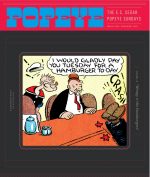
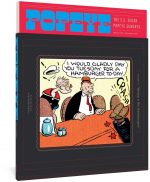
Popeye volume 2: Wimpy and His Hamburgers (The E.C. Segar Popeye Sundays)


By Elzie Crisler Segar with Kevin Huizenga & various (Fantagraphics Books)
ISBN: 978-1- 68396-668-5 (TPB/digital edition)

Popeye embarked in the Thimble Theatre comic feature with the instalment for January 17th 1929. The strip was an unassuming vehicle that had launched on 19th December 1919: one of many newspaper cartoon funnies to parody, burlesque and mimic the era’s silent movie serials. Its more successful forebears included C.W. Kahles’ Hairbreadth Harry or Ed Wheelan’s Midget Movies/Minute Movies – which Thimble Theatre replaced in media mogul William Randolph Hearsts’ papers.

All the above-cited strips employed a repertory company of characters playing out generic adventures based on those expressive cinema antics. Thimble Theatre’s cast included Nana and Cole Oyl, their gawky, excessively excitable daughter Olive, diminutive-but-pushy son Castor and Olive’s sappy, would-be beau Horace Hamgravy.

The series ticked along nicely for a decade: competent, unassuming and always entertaining, with Castor and Ham Gravy (as he became) tumbling through get-rich-quick schemes, frenzied, fear-free adventures and gag situations until September 10th 1928, when explorer uncle Lubry Kent Oyl gave Castor a spoil from his latest exploration of Africa.

It was the most fabulous of all birds – a hand-reared Whiffle Hen – and was the start of something truly groundbreaking…

Whiffle Hens are troublesome, incredibly rare and possessed of fantastic powers, but after months of inspired hokum and slapstick shenanigans, Castor was inclined to keep Bernice – for that was the hen’s name – as a series of increasingly peculiar circumstances brought him into contention with ruthless Mr. Fadewell, world’s greatest gambler and king of the gaming resort dubbed ‘Dice Island’.

Bernice clearly affected and inspired writer/artist E.C. Segar, because his strip increasingly became a playground of frantic, compelling action and comedy during this period…

When Castor and Ham discovered that everybody wanted the Whiffle Hen because she could bestow infallible good luck, they sailed for Dice Island to win every penny from its lavish casinos. Big sister Olive wanted to come along, but the boys planned to leave her behind once their vessel was ready to sail. It was 16th January 1929…

The next day, in the 108th episode of the saga, a bluff, brusquely irascible, ignorant, itinerant and exceeding ugly one-eyed old sailor was hired by the pathetic pair to man the boat they had rented, and the world was introduced to one of the most iconic and memorable characters ever conceived.

By sheer surly willpower, Popeye won readers hearts and minds: his no-nonsense, grumbling simplicity and dubious appeal enchanting the public until, by the end of the tale, the walk-on had taken up full residency. He would eventually make Thimble Theatre his own…

The Sailor Man affably steamed onto the full-colour Sunday Pages forming the meat of this curated collection covering March 6th 1932-November 26th 1933. This paperback prize is the second of four that will contain Segar’s entire Sunday canon: designed for swanky slipcases. Spiffy as that sounds, the wondrous stories are also available in digital editions if you want to think of ecology or mitigate the age and frailty of your spinach-deprived “muskles”…

Elzie Crisler Segar was born in Chester, Illinois on 8th December 1894, son of a handyman. Elzie’s early life was filled with the solid, earnest blue-collar jobs that typified his generation of cartoonists. The younger Segar worked as a decorator and house-painter, and played drums accompanying vaudeville acts at the local theatre and – when the town got a movie house – he played for the silent films. This allowed him to absorb the staging, timing and narrative tricks from close observation of the screen, and would become his greatest assets as a cartoonist. It was whilst working as the film projectionist, aged 18, he decided to draw for his living, and tell his own stories.

Like so many from that “can-do” era, Segar studied art via mail: in this case W.L. Evans’ cartooning correspondence course out of Cleveland, Ohio – from where Jerry Siegel & Joe Shuster would launch Superman upon the world. Segar gravitated to Chicago and was “discovered” by Richard F. Outcault (The Yellow Kid, Buster Brown), arguably the inventor of newspaper comics.

Outcault introduced Segar around at the prestigious Chicago Herald and soon – still wet behind the ears – Segar’s first strip Charley Chaplin’s Comedy Capers debuted on 12th March 1916. Two years, Elzie married Myrtle Johnson and moved to Hearst’s Chicago Evening American to create Looping the Loop. Managing Editor William Curley saw a big future for Segar and promptly packed the newlyweds off to the Manhattan headquarters of the mighty King Features Syndicate.

Within a year Segar was producing Thimble Theatre for the New York Journal. In 1924, Segar created a second daily strip. The 5:15 was a surreal domestic comedy featuring weedy commuter/would-be inventor John Sappo …and his formidable, indomitable wife Myrtle (!).

A born storyteller, Segar had from the start an advantage even his beloved cinema couldn’t match. His brilliant ear for dialogue and accent shone out from his admittedly average melodrama adventure plots, adding lustre to stories and gags he always felt he hadn’t drawn well enough. After a decade or so – and just as cinema caught up with the introduction of “talkies” – he finally discovered a character whose unique sound and individual vocalisations blended with a fantastic, enthralling nature to create a literal superstar.

Incoherent, plug-ugly and stingingly sarcastic, Popeye shambled on stage midway through Dice Island’ and once his very minor part played out, simply refused to leave. Within a year he was a regular. As circulation skyrocketed, he became the star.

In the less than 10 years Segar worked with his iconic sailor-man (January 1929 until the artist’s untimely death on 13th October 1938), the auteur constructed an incredible meta-world of fabulous lands and lost locales, where unique characters undertook fantastic voyages spawned or overcame astounding scenarios and experienced big, unforgettable thrills as well as the small human dramas we’re all subject to.

This was a saga both extraordinary and mundane, which could be hilarious or terrifying – frequently at the same time. For every trip to the rip-roaring Wild West or lost kingdom, there was a brawl between squabbling neighbours, spats between friends or disagreements between sweethearts – any and all usually settled with mightily-swung fists.

Popeye is the first Superman of comics, but he was not a comfortable hero to idolise. A brute who thought with his fists, lacking all respect for authority, he was uneducated, short-tempered and – whenever hot tomatoes batted their eyelashes (or thereabouts) at him – fickle: a worrisome gambling troublemaker who wasn’t welcome in polite society… and wouldn’t want to be.

The mighty marine marvel is the ultimate working-class hero: raw and rough-hewn, practical, with an innate and unshakable sense of what’s fair and what’s not, a joker who wants kids to be themselves – but not necessarily “good” – and someone who takes no guff from anybody. Always ready to defend the weak and with absolutely no pretensions or aspirations to rise above his fellows, he was and will always be “the best of us”…

This current tranche of reprinted classics concentrates on the astounding full-page Sunday outings (here encompassing March 6th 1932 to November 1933, but sadly omits the absurdist Sappo toppers. You’ll need to track down Fantagraphics’ hardback tabloid collections from a decade ago to see those whacky shenanigans…

Since many papers only carried dailies or Sundays, but only occasionally both, a system of differentiated storylines developed early in American publishing, and when Popeye finally made his belated sabbath day move, he was already a well-developed character.

Ham and Castor had been the stars since Thimble Theatre’s Sundays since the ancillary feature began on January 25, 1925; they all but vanished once the mighty matelot stormed that stronghold. From then on, Segar concentrated on gag-based extended dramatic serials Mondays to Saturdays, leaving family-friendly japes for Sundays: an arena perfect for the Popeye-Olive Oyl modern romance to unfold. With this second volume, however, we get to play with Segar’s second greatest character creation: morally maladjusted master moocher J Wellington Wimpy

Preceding the vintage views, this tome offers a lovely laudatory comic strip deconstruction, demystification and appreciation in ‘“Segar’s Wimpy” – An Introduction by Kevin Huizenga’. The experimental fabulist (Glen Ganges in The River At Night, Comix Skool USA, Riverside Companion) probes everything from how different illustrators handle the human dustbin to how Wimpy’s eyes are drawn…

When the wondrous weekend instalments began last volume, we saw Ham Gravy gradually edged out of romancing Olive. From there onwards, done-in-one gag instalments outlined an unlikely but enduring romance which blossomed (withered, bloomed, withered some more, hit cold snaps and early harvests – you get the idea…) as Olive alternately pursued her man and dumped him for better prospects.

To be fair, Popeye always vacillated between ignoring her and moving mountains to impress her. Since she always kept her options open, he spent a lot of time fighting off – quite literally – her other gentlemen callers. A mercurial creature, the militantly maidenly Miss Oyl spent as long trying to stop her beau’s battles (a tricky proposition as he spent time ashore as an extremely successful “sprize fighter”) as civilise her man, yet would mercilessly batter any flighty floozy who cast cow eyes at her devil-may-care suitor…

In those formative episodes, Castor became Popeye’s manager and we revelled in how originally-philanthropic millionaire Mr. Kilph moved from eager backer to demented arch enemy paying any price to see Popeye pummelled. The sailors’ opponents included husky two-fisted Bearcat, Mr. Spar, Kid Sledge, Joe Barnacle, Kid Smack, Kid Jolt, The Bullet, Johnny Brawn, an actual giant dubbed Tinearo and even trained gorilla Kid Klutch.

None were tough enough and Kilph got crazier and crazier…

History repeated itself when a lazy and audaciously corrupt ring referee was introduced as a passing bit player. The unnamed, unprincipled scoundrel kept resurfacing and swiping more of the limelight: graduating from minor moments in extended, trenchant, scathingly witty sequences about boxing and human nature to speaking – and cadging – roles…

Among so many timeless supporting characters, mega moocher J. Wellington Wimpy stands out as the complete antithesis of feisty big-hearted Popeye, but unlike any other nemesis I can think of, this black mirror is not an “emeny” of the hero, but his best – maybe only – friend…

As previously stipulated, the engaging Mr. Micawber-like coward, moocher and conman debuted on 3rd May 1931 as an unnamed referee officiating a bombastic month-long bout against Tinearo. He struck a chord with Segar who made him a (usually unwelcome) fixture. Eternally, infernally ravenous and always soliciting (probably on principle) bribes of any magnitude, we only learned the crook’s name in the May 24th instalment. The erudite rogue uttered the first of many immortal catchphrases a month later.

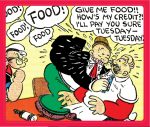
That was June 21st – but “I would gladly pay you Tuesday for a hamburger today” like most phrases everybody knows, actually started as “Cook me up a hamburger, I’ll pay you Thursday”. It was closely followed by my personal mantra “lets you and him fight”…

Now with a new volume and another year, we open with more of the same. The romantic combat between Olive, Popeye and a string of rival suitors continues, resulting in the sailor winning a male beauty contest (by force of arms), and brutally despatching a procession of potential boyfriends.

As hot-&-cold Olive warms to the moocher, there’s more of Wimpy’s ineffable wisdom on show, as he reinvents himself as the final arbiter of (strictly negotiable) judgement…

Whether it’s her beaux or who’s hardest hit by government policies – sailors like Popeye or restaurant owners like Rough-House – Wimpy has opinions he’s happy to share… for a price.

Mr. Kilph turns up again, arranging a bout between Popeye and his new million-dollar robot, but even with Wimpy officiating, the sailor comes up trumps. The moocher briefly becomes our matelot’s best pal, but blows it by putting the moves on Olive after tasting her cooking…

Another aspect of Popeye’s complex character is highlighted in an extended sequence running from May 29th  through July 17th1932, one that secured his place in reader’s hearts.

The sailor was a rough-hewn orphan who loved to gamble and fight. He was proudly not smart and superhumanly powerful, but he was a big-hearted man with an innate sense of decency who hated injustice – even if he couldn’t pronounce it.

When starving waif Mary Ann tries to sell him a flower, Popeye impetuously adopts her, inadvertently taking her from the brutal couple who use her in a begging racket.

Before long the kid is beloved of his entire circle – even Olive – and to support her, Popeye takes on another prize fight: this time with savage Kid Panther and his unscrupulous manager Gimbler

He grows to truly love her and there’s a genuine sense of happy tragedy when he locates her real and exceedingly wealthy parents. Naturally Popeye gives her up…

That such a rambunctious, action-packed comedy adventure serial could so easily turn an audience into sobbing, sentimental pantywaists is a measure of just how great a spellbinder Segar was. Although rowdy, slapstick cartoon violence remained at a premium – family values were different then – Segar’s worldly, socially- probing satire and Popeye’s beguiling (but relative) innocence and lack of experience keeps the entire affair in hilarious perspective whilst confirming him as an unlikely and lovable innocent, albeit one eternally at odds with cops and rich folk…

Following weeks of one-off gags – like Olive improbably winning a beauty contest and a succession of hilarious Wimpy episodes (such as cannily exposing himself to score burgers from embarrassed customers and ongoing problems with sleep-eating) – a triptych of plot strands opens as Miss Oyl engages a psychiatrist to cure Popeye of fighting, even as the sailor discovers Wimpy has such an affinity with lower life forms that he can be used to lure all the flies and sundry other bugs from Rough-House’s diner…

The third strand has further-reaching repercussions. Popeye has been teaching kids to fight and avoid spankings which has understandably sparked a riot of rebellion, bad behaviour and bad eating habits. Now, distraught parents need Popeye to set things right again…

Naturally it goes too far once the hero-worshipping kids start using the sailor-man as a source of alt-fact schooling too…

We constantly see softer sides of the sailor-man as he repeatedly gives away most of what he earns – to widows and “orphinks” – and exposes his crusading core with numerous assaults on bullies, animal abusers and romantic rivals, but when the war of nerves and resources between Wimpy and Rough-House inevitably escalates, Popeye implausibly finds himself as “the responsible adult”.

That means being referee in a brutal and ridiculous grudge match settled in the ring, with all proceeds going to providing poor kids with spinach. The bout naturally settles nothing but does have unintended consequences when the moocher is suddenly reunited with his estranged mother after 15 years…

Tough men are all suckers for a sob story and even Rough-House foolishly amplifies the importance and regard people supposedly feel for the now-homeless little old lady’s larcenous prodigal. It’s a move the moocher can’t help but exploit…

As the Sunday Pages followed a decidedly domestic but rowdily riotous path, the section was increasing given over to – or more correctly, appropriated – by the insidiously oleaginous Wimpy: an ever hungry, intellectually stimulating, casually charming and usually triumphant conman profiting in all his mendicant missions.

Whilst still continuing Popeye’s pugilistic shenanigans , the action of the Sunday strips moved away from him hitting quite so much to alternately being outwitted by the unctuous moocher or saving him from the vengeance of the furious diner-owner and passionately loathing fellow customer George W. Geezil. The soup-slurping cove began as an ethnic Jewish stereotype, but like all Segar’s characters swiftly developed beyond his (now so offensive) comedic archetype into a unique person with his own story… and another funny accent. Geezil was the chief and most vocal advocate for murdering the insatiable sponger…

Wimpy was incorrigible and unstoppable – he even became a rival suitor for Olive Oyl’s unappealingly scrawny favours – and his development owes a huge debt to his creator’s love and admiration of comedian W.C. Fields.

A mercurial force of nature, the unflappable mendicant is the perfect foil for common-man-but-imperfect-hero Popeye. Where the sailor is heart and spirit, unquestioning morality and self-sacrifice, indomitable defiance, brute force and no smarts at all, Wimpy is intellect and self-serving greed, freed from all ethical restraint or consideration, and gloriously devoid of impulse-control.

Wimpy literally took candy from babies and food from the mouths of starving children, yet somehow Segar made us love him. He is Popeye’s other half: weld them together and you have an heroic ideal… (and yes, those stories are all true: Britain’s Wimpy burger bar chain was built from the remnants of a 1950s international merchandising scheme seeking to put a J Wellington Wimpy-themed restaurant in every town and city).

The gags and exploits of the two forces of human nature build riotously in 1933, ever-more funny and increasingly outrageous.

Having driven Rough-House into a nervous collapse, plundered farms, zoos and the aquarium and committed criminal impersonation and actual fraud, Wimpy then relentlessly targets the cook’s business partner Mr. Soppy: bleeding him dry as visiting royalty Prince Wellington of Nazilia

Even being run out of town and beaten so badly that he’s repeatedly hospitalised can’t stop his crafty contortions. He does, however, discover a useful talent: musical gifts that all but enslave his audiences…

Eventually, the master beggar triumphs over all and gets to eat his fill… and must deal with the consequences of his locust-like consumption…

Popeye seems unable to stop him. Half the time he’s helpless with laughter at the moocher’s antics, and when not. there are his major prize fights with 500lb wrestler Squeezo Crushinski and human dinosaur Bullo Oxheart. Naturally Wimpy is referee for both those clashes of the titans and makes out like a bandit…

The only real pause to the seeming dominance of the schemer is when he falls for new diner waitress Lucy Brown. She’s currently spending all her time with manly stud Popeye, but a quiet word with Olive Oyl should have cleared Wimpy’s path.

Should have, but didn’t, and in truth results in Popeye and Olive opening their own eatery in competition with Rough-House, leading to a ruthless cutthroat culinary cold war with the polite parasite reaping the spoils…

The laugh-out-loud antics seem impossible to top, and maybe Segar knew that. He was getting the stand-alone gag-stuff out of his system: clearing the decks and setting the scene for a really big change….

These tales are as vibrant and compelling now as they’ve ever been and comprise a world classic of graphic literature that only a handful of creators have ever matched. Within weeks (or for us, next volume) the Thimble Theatre Sunday page changed forever. In a bold move, the dailies blood-and-thunder adventure serial epics traded places with the Sunday format: transferred to the Technicolor “family pages” splendour where all stops might be pulled out…

Segar famously considered himself an inferior draughtsman – most of the world disagreed and still does – but his ability to weave a yarn was unquestioned, and grew to astounding and epic proportions in these strips. Week after week he was creating the syllabary and graphic lexicon of a brand-new art-form: inventing narrative tricks and beats that generations of artists and writers would use in their own cartoon creations. Despite some astounding successors in the drawing seat, no one has ever bettered Segar’s Popeye.

Popeye is fast approaching his centenary and well deserves his place as a world icon. How many comics characters are still enjoying new adventures 94 years after their first? These volumes are the perfect way to celebrate the genius and mastery of E.C. Segar and his brilliantly flawed superman. These are tales you’ll treasure for the rest of your life and superb books you must not miss…
Popeye volume 2: Wimpy and His Hamburgers is copyright © 2022 King Features Syndicate, Inc./™Hearst Holdings, Inc. This edition © 2022 Fantagraphics Books Inc. Segar comic strips provided by Bill Blackbeard and his San Francisco Academy of Comic Art. “Segar’s Wimpy” © 2022 Kevin Huizenga. All rights reserved.

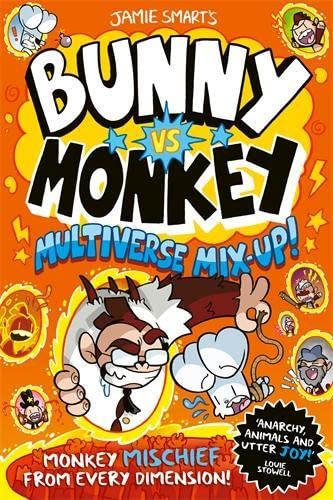
Bunny vs Monkey: Multiverse Mix-Up!


By Jamie Smart & with Sammy Borras (David Fickling Books)
ISBN: 978-1-78845-292-2 (Digest PB)

Bunny vs. Monkey has been a staple of The Phoenix from the first issue in 2012: detailing a madcap vendetta gripping animal archenemies amidst an idyllic arcadia masquerading as more-or-less mundane but critically endangered English woodlands.

Concocted with gleefully inspired mania by cartoonist and novelist Jamie Smart (Fish Head Steve!; Looshkin; Flember), these trendsetting, mindbending yarns have all the tail-biting tension and animal argy-bargy of a uniquely off-kilter magnum opus – not to be confused with the veritable magnificent octopus – although there’s them occasionally popping up too…

It all began yonks ago after an obnoxious little simian slapped down in the wake of a disastrous British space shot. Crashlanding in Crinkle Woods – scant miles from his launch site – lab animal Monkey believed himself the rightful inheritor of a strange new world, despite all efforts from reasonable, sensible, genteel, contemplative forest resident Bunny to dissuade him. For all his patience, propriety and good breeding, the laid-back lepine just could not contain the incorrigible idiot ape, who was – and is – a rude, noise-loving, chaos-creating loutish troublemaker…

Problems are ever-exacerbated by other unconventional Crinkle critters, particularly a skunk – AKA Skunky – who has a mad scientist’s attitude to life and a propensity to build extremely dangerous robots and overly technological super-weapons…

Here – with artistic assistance from design deputy Sammy Borras – the war of nerves and mega-ordnances is rekindled after briefly seeming to be all over. Our unruly assortment of odd bods cluttering up the bucolic paradise had finally picked sides and sorted it all out and – with battles ended – even apparently forgot the ever-encroaching Hyoomanz

Rather than the traditional opening and tales ranked by changing seasons, this titanic trade paperback archive of insanity offers two massive chapters subdivided into short instalments. The astounding new adventure opens in Part One and ‘Pond Life’ wherein a quiet moment of skating in the chilly evening of a New Year is going so well until our apish antagonist renews old dreams of a planet united under his rule and the banner of “Monkeyopia”.

Sadly, the banner is attached to a staff with a really pointy end… and ice is really brittle…

An epoch of bewildering calamity commences when animal alternates from a parallel universe pop in through a portal. On their home plane everyone is evil but even so, their abduction of panuniversal innocent Pig Piggerton goes terribly wrong: stranding the instigator of the ‘Pig Swap’ on the wrong realm…

Meanwhile, Skunky has temporarily got rid of his annoying Monkey mate with some pointless make-work in ‘Snow Fun’ and ‘Evil Pig’ has introduced himself to the other Crinkle critters. Of course, Monkey must prove he’s the most wicked…

With Skunky, Monkey and the transplanted Pig all menacing and recruiting minions, confused Bunny calls on everyone to again ‘Choose Your Side’, but things get a bit out of hand when Metal Steve, Metal E.V.E. and brain-battered, bewildered former stuntman Action Beaver all join in the party games…

Thankfully, Eve allies with the good guys and Bunny affirms that their prime directive is “protecting the woods at all costs”: ‘A Mammoth Task’ made even harder once Skunky and Monkey unleash giant undergrounds monsters…

Dedicated to doom and destruction, the bad boys try – and ultimately fail – to synthesize Mongolian Death molluscs in ‘With Snails & I’ and try to pluck the ‘Big Moon’ out of the night sky before clashing with Evil Pig…

The transplanted transdimensional then meets his counterpart’s best bud Weenie Squirrel and has ‘A Falling Out’ even as Monkey unleashes exploding duplicates in ‘All A-Clone’ before trying his hand at scary documentary making in ‘The Sand-Witch Project’. All that cloning around comes back to bite him in the form of ‘Monkeysaurus’

Desperate for peace and quiet, Bunny, Eve and superfast Ai seek solace and silence in the river, but find only more mad excitement when evil spies get into difficulties and require their ‘Canoooe’, unaware that temporary allies Evil Pig, Skunky and Monkey were messing with serums and animals and had ‘Gone Batty’…

When Skunky tries to upgrade obsolete robotic oaf Metal Steve, reformed Eve is trapped in his bandwidth and is transformed into ‘Eve 2.0’, whilst Evil Pig – still seeking to win over Weenie – instead subverts Steve into ‘Alan the Unicorn’

Existence gets truly meta when godlike human beings abruptly intervene, inadvertently sharing a glimpse behind the cosmic curtains of reality and by inflicting a distressing touch of The Matrix in ‘The First Glitch’ offers our quotidian cast of layered realities a hideous glimpse of what reality really means. Thoroughly re-educated, the bad guys then lose control of another experiment, unleashing shapeshifter ‘Polymorph’ on the easily embarrassed denizens of the Woods.

Fearless and stupid, Monkey discovers a sleeping beast and refuses to listen when everyone tells him ‘Don’t Wake the Bear’…

After too long and portentous an interval, the evil doppelgangers return, banishing their counterparts across many ‘Dimensions’ before ending the multiverse itself. Only Bunny escapes and with the unlikeliest of allies begins exploring ‘The Infinite’ and – thanks to a Portable Dimension Hopper – seeks ways to restore reality and rescue his comrades from the Real World.

That means many appalling experiences including ‘Babysitting’ toddler-versions of all his friends and foes, clashing with ghosts, vampires and Halloween Dimension beings before – as ‘Grumpy Bunny’ – saving a cowboy realm from the perils of a ‘Wilder West’. Bridging warring lava and frost dimensions ‘Of Fire and Ice’ that are also infested with familiar variants of everyone he knew, the thankless quest finally pays off in a commerce dimension ruled by an ‘Office Monkey’ only too glad to be rid of the annoying anarchic duplicate pestering his people and threatening his bottom line…

When the idiot ape eats Bunny’s travel tech, the status quo starts to resettle but by then the voyagers have found a dystopian desert where civilisation has gone ‘Mad to the Max’. Happily, Skunky is there to fix the gadget and get them on their way to the Christmas Dimension, and then out of the land of ‘Ho Ho Oh No’: so lovely that no one ever leaves…

The assembled animals ultimately prove that’s not true, but only at the cost of their ship which is badly hit, leaving them ‘Doomed’ to fall between 9.7 billion dimensions until they unselfishly work together in a team up. As a result they touch down at the Very End of Existence Itself! Stuck in a formless void, only Bunny and Skunky seem able to go on and use the lack of working time to recreate useful bits of what’s been eradicated. Once they rerun ‘The Birth of Science’ it’s not too long before they’re ready to fix everything and open a portal… sparking a massive time loop…

Forewarned by déjà vu, the voyagers overreact and reality goes boink! again, dumping everyone into the dimension of excrement and causing a nasty ‘Pooey Christmas’

It looks like a fresh beginning for all as Part Two opens with ‘A New Start’. The nice animals are having picnics and Skunky and Monkey are building better mecha-weapons, but something’s still not quite right, and when the miscreants unleash transforming terror ‘Octoplops’ the repercussions really aren’t that bad…

Still off his game, cupcake-addicted Monkey is easily exposed as a ‘Thief!’ and Weenie and Pig endure the sheer horror of losing their ‘Ducky’ to a mystery fiend, before an escaped Time Droid goes berserk and generates a ‘Looooooop’ in reality…

Thanks to Transmogrification Pants, Bunny is assaulted by fake friends he never knew in ‘Pants for the Memories’ whilst Skunky, Monkey, the Beaver and Metal Steve are stuck inside their own malfunctioning ‘Chameleotron’: a chaotic debacle that results in Monkey being sucked back into the appalling ‘Poo Dimension’ where he accidentally liberates a fearsome alternate self who is a genuine threat to everyone in Crinkle Woods…

A brief dalliance as superhero ‘Brave Bunny’ quickly palls for our genteel star and ‘Law and Order’ is brutally abused when ultra-efficient Office Monkey begins to modernise and corporatize the green paradise…

Initially set back and hindered by the workforce he has to work with, OM retrenches and debuts his polluting ‘Furps’ engine (don’t ask and don’t breathe in!) before forming a merger with Skunky…

The other critters are all enjoying ‘Lobnut Day!’ and trying to gather the most nuts, but wise up when the apish alternate dimension asset-stripper launches Monkey Corp. and seeks to put all the furry time-wasters ‘To Work’. However, by casually betraying Skunky, Office Monkey has sown the seeds of his own downfall and his ‘Streamlining’ the Woods into a modernistic business park triggers a groundswell of consumer resistance…

After losing a contest and being acclaimed ‘The Worst Inventor’ Skunky joins that rebellion, and ‘Wrong Monkey’ finds him planning to dismantle the corporate stronghold of Monkeytopia, revealing to the astounded woodlanders that the menace is not the annoying idiot they’re used to, but an extradimensional invader…

That said, the mercurial monochrome megamind recruits some alternate selves with his Time-o-tron and he and ‘Father Skunky’ plunge into the vortex void to unmake their current dire situation…

Tragically, all that multiversal mismanagement causes a few ‘Portal Problems’ and an unwise stopover at their starting point (three in one book!) prompts an unexpected self-promotion as  Office Monkey exploits the confusion to become Boss Level and ‘Takeover’ the universe…

Ejected from Reality, archnemesis Bunny is flung into the Poo Dimension where his usual enemy has become ‘King Monkey’. Implausibly, he has a plan to save the day and put everything back the way it was… more or less…

The narrative animal anarchy might have pawsed (not sorry!) for now but there’s more secrets to share thanks to detailed instructions on ‘‘How to Draw Cowboy Monkey!’, ‘How to Draw Hellcage Monkey!’ and ‘How to Draw Office Monkey!’ to wind down from all that angsty parallel peril and future-bending furore…

The zany zenith of absurdist adventure, Bunny vs Monkey is weird, wild wit, brilliantly bonkers invention, potent sentiment and superb cartooning all crammed into one eccentrically excellent package. These tails never fail to deliver jubilant joy for grown-ups of every vintage, even those who claim they only get it for their kids. This is the kind of comic parents beg kids to read to them. Shouldn’t that be you?
Text and illustrations © Jamie Smart 2023. All rights reserved.

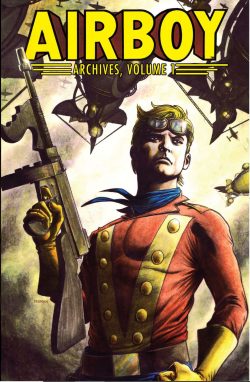
Airboy Archives volume 1


By Chuck Dixon, Tim Truman, Stan Woch, Benn Dunn, Bill Jaaska, Tom Lyle, Larry Elmore, & various (IDW)
ISBN: 978-1-61377-900-2 (TPB) 978-1-62302-641-7 (IDW Digital edition)

Airboy was one of the very best adventure strips of the Golden Age: one with a terrific pedigree and a profound legacy. Created for Hillman Periodicals by the brilliant Charles Biro (Steel Sterling, Crimebuster, the original Daredevil, The Little Wiseguys and landmark genre prototype Crime Does Not Pay number among his many triumphs), it featured a plucky teen and his fabulous super-airplane, affectionately dubbed “Birdie”.

Airboy and Birdie both debuted in the second issue of Air Fighters Comics, cover-dated November 1942 (so Slightly Belated Happy Birthday guys!). The title was packed out with similarly-themed and oddly off-kilter aviator heroes such as Skywolf, The Iron Ace, The Black Angel, The Bald Eagle, The Flying Dutchman, The Flying Fool and a landmark horror proto archetype dubbed The Heap – forerunner of all comic muck monsters…

In December 1945, and after 23 issues, the title was redesignated Airboy Comics and soldiered on until 1953, when Hillman with great foresight got out of the funnybook biz just as hostile clouds of censorship were gathering. In over a dozen years of publication, the boy-warrior had tackled the Axis powers, crooks, aliens, monsters, demons and every possible permutation of sinister threat and horror-tinged terror – even subversive giant rats and conqueror ants!

The gripping scripts – initially the work of Biro and Dick Wood before the latter assumed complete control – took the avenging aviator/soldier-of-fortune all over the world to confront some of the most striking adversaries in comics and often some of the sexiest. The most notable of these was undoubtedly the conflicted Nazi Air Ace known as Valkyrie, who flew the killer skies with a squadron of lethal lovelies codenamed The Airmaidens.

However, as the world and tastes changed, Airboy vanished with many other gaudy comic book champions whose time had run out. Clearly, memories remained fresh for many, no doubt rekindled by a superb popular history series in the early 1970s. The Steranko History of Comics and its effusive chapter on the lethal lad led to a speculative venture reprinting two issues of the early run.

Airboy was also the inspiration for Jetboy – originating lynchpin of the Wild Cards franchise by Howard Waldrop, George R.R. Martin, Melinda M. Snodgrass and their many friends. That began in January 1987 and is still going strong with 30 books as of 2022…

In 1982 comics devotee and champion archivist Ken Pierce had collected early Airboy exploits featuring the voluptuous, absurdly pneumatic Nazi-turned-freedom-fighter Valkyrie, and this apparently inspired budding independent comics company Eclipse to reboot and revive the character …and many of his Hillman comrades.

Always innovative, Eclipse were experimenting at that time with fortnightly (that’s twice a month, non-Brits) comics with half the page count of industry standard books, but at a markedly reduced price. To be honest, at 16 pages of story per issue, it wasn’t that different from the 17-18 pages Marvel and DC had been reduced to working with during the late 1970s…

Airboy premiered at 50¢ a copy in July 1986 and quickly found a vocal, dedicated following. Rereading – in either trade paperback or digital editions – this first archival compilation, it’s easy to see why…

Collecting Airboy #1-16 spanning July 15th 1986 February 27th 1987, this superb, so very Eighties all-action romp opens with a revelatory Introduction by instigator and near-exclusive scripter of the entire resurrected franchise Chuck Dixon who asks and answers ‘Why Airboy?’: detailing the events that led to all-star packager/indie maverick Tim Truman getting involved with one of the biggest and most influential series of that era. With Dixon scripting, Truman co-plotting, editing and pencilling, Tom Yeates inking, Tim Harkins lettering and Ron Courtney applying a then-radical colour palette, the initial 5-issue story arc (collected in 1989 as graphic novel Airboy: The Return of Valkyrie) explodes into action…

Issue #1 begins ‘On the Wings of Death’ as, in California’s Napa Valley, a broken man rails against an unjust fate. David Nelson II is bitter and angry. Not even his teenaged son can bring joy to his life. The boy barely knows and certainly has no warm memories of his dad: an aviation magnate who switched from building civilian planes to forging deadly high-tech weapons for any dictator to buy…

Trained since birth by former Japanese WWII fighter ace and deadly martial artist Saburo Hirota, young Davy has become a brave, confident fighter who cannot imagine why his life has been one of constant combat training.

Suddenly, a horde of assassins attacks the compound and the senior Nelson dies in a hail of bullets. Only then does Davy discover the truth about his father. Once upon a time, the aloof martinet was war veteran and roving hero Airboy: battling against and alongside valiant comrades and piloting a truly unique super-aircraft. Second feature ‘Phoenix’ sees the aging samurai tell of the lost hero and – armed with the truth – Davy Nelson III swears to avenge his father and atone for his own inactions and neglect…

Two weeks later, ‘The Wolf and the Phoenix’ reintroduces WWII legend Skywolf who tangentially enters the saga whilst clearing out South American drug traffickers who have been using his isolated Florida Keys island/US military dump for decommissioned ordnance as a staging post for their enterprise. When Hirota and the kid turn up, it’s not just to share the news of a fallen comrade, but also to reclaim and rebuild the shell that used to be Birdie…

As they reassemble and modify the super plane, stories are told and Davy discovers another shocking truth. His mother was not his father’s true love. Once he loved a beautiful German woman-warrior named Valkyrie. However, for the last thirty years she has been trapped in suspended animation by Misery, a phantasmal being who feeds on evil and steals the souls of lost fliers…

Forced to do the monster’s bidding for three decades – such as providing weapons for South American despots to slaughter and enslave innocents – the old hero had gradually died inside. Now his son is ready to avenge him and free the beautiful sleeper. Soon Skywolf’s drug-dealer problem are connected to the death of the original Airboy, leading them all to tropical Bogantilla and despotic General Orista – one of Nelson Aviation’s biggest customers and a staunch anti-Communist whose regime is proudly supported by the Reagan Administration…

With #3’s ‘Misery Loves Company’, Willie Blyberg began inking Woch as – after a tragic and costly misunderstanding – the reunited Air Fighters ally with rebels resisting Orista’s depredations. It’s been a hard struggle as the dictator army is fully supplied with Nelson’s armaments, backed up by black magic. Ghastly Misery has been extorting the ordnance from his arch foe by threating to kill the comatose Valkyrie: a process that had slowly poisoned the heart and crushed the soul of Davy’s dad. Now, however, the tide is turning…

Months previously, from deep in the Florida Everglades the monstrous bog-creature known as The Heap stirred after decades of inactivity. Something momentous was beginning to unfold and – vaguely remembering a previous life, brave heroes and a diabolical evil – it began shambling southwards…

Now the rebels and yanqui heroes raid the General’s citadel in Gamada Cruz, assisted by the Heap and a local shaman, triumphantly completing their ‘Assault on Villa Miserio’ by rescuing the dormant sleeping beauty, weaking bloody vengeance on Orista and driving off the immortal emotion vampire behind all the death and destruction in concluding chapter ‘Misery Takes A Holiday’ (illustrated by Woch, Blyberg & Emil Novak). Not all the good guys make it back, and most uncomfortably of all the revived captive is unaware that the hero she tries so passionately and amorously to reward is not “her Davy”…

Fast-paced, beautifully illustrated and written with all the gung-ho bravado of a Rambo movie, this tale of liberation and revolution rattles along, a stirring blend of action and supernatural horror that sweeps readers along with it, setting the scene for a tense confrontation in #6 as ‘Back in the USA’ covers the aftermath wherein the time-displaced “aviatrix” seeks to adjust to a strange and frustrating new world and form some kind of relationship with the son of her lost lover…

Hirota leaves them to it: he’s more concerned with another long-term rehabilitation project: helping an old ally from WWII with very different yet eerily similar problems. Davy is trying to cleanse his corporation of the last taint of scandal and corruption only to discover that – thanks to CEO Emil Kronenberg – it has been happily supplying appalling weapons and support to almost every gang, terror group and corrupt regime on the planet. He has no idea that other eyes are upon the aging European: hungry, implacable, vengeful ones…

In #7, Valkyrie accepts a vast wad of cash and heads to New York City to lose herself in hedonism. Inked by Jeff Butler, ‘Partytime’ then sees Davy ambushed by his entire complicit Board and abducted by Kronenberg who resumes the indoctrination experiments he devised back in the camps in Germany. Unluckily for him, whilst losing herself, Valkyrie has impossibly found an old friend from the War who also has not aged a day…

Fellow former Luftwaffe pilot Baron Victor Heller has his own magical secrets to keep but makes a useful ally once Davy’s disappearance galvanises Hirota to enlist Val’s assistance in finding the boy…

Davy’s in big trouble in #8 (illustrated by Woch & Blyberg with colours from “Air Rescue”), trapped ‘Down in the Darkness’ and tortured. The extreme hostile takeover move proves initially unsuccessful and as the next issue hikes the price up to $1.25 and extends the page count, ‘Body Count!’ sees his friends move in for a savage showdown.

Inked by Mark Nelson & coloured by Moondoggies, it was offset by a new back-up series exploring the post war career of Skywolf and other Golden Age Air Fighters characters. Concluding in the next issue, ‘China Hands’ by Dixon, Larry Elmore, Harkins & Steve Oliff/Olyoptics, is set in 1948 as China falls to communist control. Here Link Thorne – AKA The Flying Fool – ferries food and medical supplies to the simple peasants caught up in the political carnage, only to be framed by US spook Jensen of what will become the CIA and imprisoned by Chang Kai Shek’s Nationalist army.

Desperate to help, American freight company owner Riot O’Hara reaches out to aimless drifters Skywolf to spring Thorne. Their rescue attempt is sabotaged by agents of the American government and officially they all die in the attempt… Officially…

With John Nyberg inks, #10 concludes Davy’s rescue and sees Kronenberg at last get what’s coming to him in ‘Tooth and Claw’, even as ‘China Hands part 2’ reveals how Skywolf became the man of mystery we all know and love…

Airboy #11 was written by Truman, with art from Ben Dunn & Hilary Barta. ‘…I Am Birdie’ peers into the past and retells the origin of David Nelson II and his sentient wonder craft whilst Dixon & Bill Jaaska combine for another historical 2-parter starring Skywolf. Set in 1949, ‘I Don’t Need My Grave!’ (with the concluding chapter inked by Jeff Darrow) sees the masked wanderer in Tokyo, resolved to stop criminal upstart Billy Yee, strongarming Riot O’Hara.

Yee wants her to export his drugs to America, but as “sangokujin” (displaced Korean or Chinese foreigners) must work outside Japan’s established criminal hierarchy. That’s proved when Skywolf’s attack is interrupted by members of the Yamataki syndicate and before long Yakuza and Yankee outlaw are united in the same goal. All they have to do is deal with the US soldiers Jensen has set on their tails and it’s clear sailing from then on…

The Airboy story in #10 had ended with a portentous teaser as an aerial assault force devastated Skywolf’s Florida island retreat in 1985. Leading the raid was a bloodthirsty loon dubbed Manic. The saga properly kicks off in #12’s ‘Gone to Texas’ (by Dixon, Woch, Kim DeMulder), as – whilst Hirota counsels former ally The Iron Ace (angrily trapped inside the world’s most advanced full body prosthesis) – Davy and Valkyrie tentatively explore their new normal. Both are understandably disturbed by the thought of renewing her relationship by proxy, switching her avid affection from father to son, but thankfully Skywolf distracts them with his latest problem…

Amidst the rubble of his home is a message from his unseen enemies: the burned body of a cop from the banana republic of the Grand Coronicos Islands…

A hastily arranged meeting brings Davy and Hirota to Galveston, Texas and a frankly hilarious encounter with Skywolf’s older, smarter, tougher, wheelchair-bound mother. She thinks her boy’s an idiot and refuses to call him anything but “Lawrence”, but her advice is welcome and leads to Nelson Aviation fronting Skywolf a new top-of-the-line helicopter gunship for their upcoming visit to the Grand Coronicos…

In #13 Dixon, Woch, Nelson & Steve Haynie craft a chilling ‘Tag-Team’ as Manic and his psycho partner Cowgirl apprise their boss of the situation. The nation is supposedly ruled by avid anti-Communist El Presidente Generalissimo Valasquez, but it’s his wife who has really pulled the strings for much of the last 50 years. The methodical scheme to corner America’s entire drug trade is hers, but that starts unravelling as soon as Davy and Birdie start shooting down drug-filled cargo planes…

The response is swift and savage and teams are despatched by Manic to kill everyone close to Nelson and Skywolf. Of course no drug cabal assassin is a match for Hirota, Valkyrie or Lawrence’s mom…

The drama intensifies in ‘A Barrel Full of Sharks’ (Woch & Nelson) as the intended victims all converge on the Islands for a little payback…

Airboy #13 & 14 also offer a fantastic history mystery by Dixon, Tom Lyle & Romeo Tanghal, as ‘Queen of Yeti Valley’ reveals how Skywolf and the Bald Eagle unite to exfiltrate the British Ambassador’s daughter in the Himalayas and end up saving a lost race from human monsters…

In 15 & 16 the posterior back-ups see supposedly deceased Skywolf sneak back into Texas in 1950 for ‘White Lightning’ (Dixon, Woch & Vern Henkel). Happily anonymous, the outlaw says hi to his ma and puts paid to a preacher opening up a Ku Klux Klan franchise to deal with all them uppity, invasive Mexicans in a deeply satisfying and cathartic dose of bigot-trashing catharsis…

At the fronts and in the Eighties, Airboy and his crew go undercover to infiltrate Puerto Oloroso, poverty stricken capital of the Grand Coronicos Island Chain, inevitably unleashing a ‘Caribbean Rampage’ over the final two episodes in this spectacular opening compilation. By scuttling the scheme to flood America with cut-price coke, Airboy, Hirota, Valkyrie and Skywolf (and his mom) achieve a brief moment of pure Eighties synergy: marrying style, outrageous fashion, ostentation, Contras, drugs, the CIA and always over-the-top action with a spurious motive, and wicked humour in a high octane romp translating the fighting stars of WWII to the era of Airwolf, Nightrider and Miami Vice.

Including stunning covers by Truman, Woch, Dave Stevens, Tex Blaisdell, Paul Gulacy, Flint Henry, Howard Bender, Yeates, John Totleben. Davis Dorman and Ron Randall, this is a true lost delight of sheer escapism well worth tracking down, with the promise of more and even better still to come.
Airboy Archives volume 1. Airboy © 2014 Chuck Dixon. © 2014 Idea and Design Work’s LLC. All rights reserved.

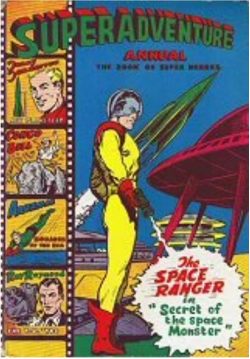
Superadventure Annual 1960-1961


By Jack Miller, Jack Schiff, Joe Millard, Otto Binder, Edmund Hamilton, Robert Bernstein, Gardner Fox, John Forte, Bob Brown, Ramona Fradon, Jim Mooney, Edwin J. Smalle Jr, Howard Sherman, Ruben Moreira, Henry Boltinoff & others (Atlas Publishing & distributing Co./K.G. Murray)
No ISBN:

Before 1959, when DC and other American publishers started exporting directly into the UK, our exposure to their unique brand of fantasy fun came mostly from licensed reprints. British publishers/printers like Len Miller, Alan Class and bought material from the USA – and occasionally, Canada – to fill 68-page monochrome anthologies – many of which recycled the same stories for decades. In Britain we began seeing hardcover Superman Annuals in 1950, Superboy Annuals in 1953, Superadventure Annuals in 1959 and Batman books in 1960. Since then many publishers have carried on the tradition…

Less common were the oddly coloured pamphlets produced by Australian outfit K.G. Murray and exported here in a somewhat sporadic manner. The company also produced sturdily substantial Christmas Annuals which had a huge impact on my earliest years (I strongly suspect my adoration of black-&-white artwork stems from seeing supreme stylists like Curt Swan, Carmine Infantino, Al Plastino, Wayne Boring, Gil Kane or Murphy Anderson utterly uncluttered by flat, limited colour palettes).

This particular tome comes from 1960 whilst a superhero craze was barely bubbling under, allowing us access a wide range of the transitional genre material that fell between the Golden and Silver Ages. Everything in comics was changing and this book offers a delightfully eclectic mix of material far more in keeping with the traditionally perceived interests of British boys than the caped-&-cowled masked madness soon to obsess us all…

This collection is all monochrome, soundly stiff-backed, and sublimely suspense and joyous, and begins with Space Ranger: a relatively new property seen in Showcase #16.

In America, Showcase was a try-out comic designed by DC to launch new series and concepts with minimal commitment of publishing resources. If a new character sold well initially, a regular series would follow. The process had been proved with Frogmen, The Flash, Challengers of the Unknown and Lois Lane, so Editorial Director Irwin Donenfeld urged his editors to create science fiction heroes to capitalise on the twin zeitgeists of the Space Race and the popular fascination with movie monsters and aliens.

Jack Schiff came up with a “masked” crimefighter of the future who premiered in issues #15 & 16 (1958). The hero was Rick Starr: interplanetary businessman who – thanks to incredible gadgets and the assistance of shape-shifting alien pal Cryll and capable Girl Friday Myra Mason – spent his free time battling evil and injustice from his base in a hollow asteroid.

A few months later, the State-side Space Ranger was transported to DC’s science fiction anthology Tales of the Unexpected, beginning with issue #40 (August 1959): holding the lead and cover spot for a 6-year run and enduring frequent revivals and reboots ever since…

Canonically, we start with his third published exploit as ‘The Secret of the Space Monster’ (plot by John Forte, scripted by pulp veteran Edmond Hamilton and illustrated by Bob Brown) sees Rick, Myra and Cryll investigating an impossible void creature and uncovering a band of alien revolutionaries testing novel super-weapons.

Continuity was practically unheard in these DC overseas editions – and I’m pretty sure the editorial staff never gave a monkey’s about reading cohesion. UK spellings and currency were scrupulously re-lettered, but stories were arbitrarily trimmed to fit the page count and layout, making endings unclear or uncertain. However, we loved the sheer eclectic exoticism (we didn’t call it that, though); we were just wide-eyed impressionable grateful kids, okay?

One of the few superheroes to survive the collapse at the end of the Golden Age was a rather nondescript and generally bland looking chap who solved maritime crimes, rescuing fish and people from sub-sea disaster.

Created by Mort Weisinger & Paul Norris in the wake of Timely Comics’ Sub-Mariner, Aquaman first set sail in More Fun Comics #73 (November 1941). Strictly a second stringer for most of his career, the Sea King nevertheless continued on far beyond many stronger features. He was primarily illustrated by Norris, Louis Cazeneuve and Charles Paris, until young Ramona Fradon took over the art chores in 1954, by which time the Sea King had settled into a regular back-up slot in Adventure Comics. All of the salty sagas here are illustrated by her, and limned every single adventure until 1960: indelibly stamping the hero with her unique blend of charm and sleek competence.

At the time this book was released, America’s Aquaman had been refitted. Showcase #4 (1956) rekindled the public’s taste for costumed crime-fighters. As well as re-imagining Golden Age stalwarts, DC updated its hoary survivors. The initial revamp ‘How Aquaman Got His Powers!’ (Adventure #260, May 1959) was the work of Robert Bernstein. That tale set a new origin – offspring of a lighthouse keeper/refugee from undersea Atlantis – and eventually all trappings of the modern superhero followed: themed hideout, sidekick, even super-villains! Moreover, continuity and the concept of a shared universe became paramount.

In this seasonal collection however, he’s still a charming, dedicated seagoing nomad with a tendency to find trouble as in ‘The Ocean of 1,000,000 B.C.’ (Adventure Comics #253, October 1958 by Bernstein & Fradon) where he swims through a time warp and helps a seashore-dwelling caveman against a marauding dragon.

Cartoonist Henry Boltinoff was a prolific and nigh-permanent fixture of DC titles in this period, providing a variety of 2, 1, and 1½ page gag strips to cleanse visual palates and satisfy byzantine US legal directives allowing publishers to sustain cheaper postal shipping rates. He’s here in strength: his gentle humour jibing perfectly with contemporary British tastes, in the first vignette starring space boffin Professor Eureka

Based on Alex Raymond’s newspaper star Jungle Jim, the next feature was very much of its time. Congo Bill debuted in More Fun Comics #56 (June 1940) and adventured there for a year (#67, May 1941) before upgrading to flagship title Action Comics with #37 (June 1941). A solid and reliable B-feature, his global safaris were popular enough to make him a star of his own movie serial and win his own 7-issue series (running from August/September 1954 to August/September 1955). His exploits followed trend slavishly: he faced uprisings, criminals, contemptuous rich wastrels, wars, plagues, evil witch-doctors, mad scientists, monsters, aliens – and every permutation thereof – in his monthly vignettes; gained a sidekick in Action Comics #191 (April 1954) and even evolved into a sort of superhero in Action #224 (January 1957) when he gained the power to body swap with golden gorilla Congorilla. He/they prowled in Action until #261 (February 1960), whereupon the feature moved into Adventure Comics, running from #270-283 (March 1960-April 1961). As comics folk are painfully, incurably nostalgic, the characters have been revived many times since…

Here Congo Bill – with Janu the Jungle Boy open their innings with ‘The Mystery of the Jungle Monuments!’ (Action Comics #206, July 1955) authorially uncredited but illustrated by Edwin J. Smalle, Jr., as they uncover a cunning smuggling plot before equally long-lived space patrolman/interplanetary Coast Guard operative Tommy Tomorrow pops in from the future to solve ‘The Puzzle of the Perilous Planetoid’ – from Action Comics #206 July 1955 and crafted – as were most of his missions – by Otto Binder & Jim Mooney.

The strip was a hugely long-running back-up strip which began in Real Fact Comics #6 (January 1947). Devised by Jack Schiff, George Kashdan, Bernie Breslauer, Virgil Finlay and Howard Sherman, it was a speculative science feature that returned in #8, 13 & 16 before shifting to Action Comics (#127-251, December 1948 to April 1959). Along the way Tommy became a Colonel in the peacekeeping Planeteers organisation…

With superheroes ascending again, he then moved into World’s Finest Comics (#102- 124, June 1959 to March 1962) and endured one final reboot in Showcase #41-42, 44 & 46-47 (1962-1963) before fading from sight and memory until rediscovered and reimagined by later generations…

Here the interstellar star of 2058 (so not long now) and his patrol partner Captain Brent Wood solve a titanic taxonomical conundrum before we switch from fantasy to contemporary showbiz…

When superheroes declined in the early 1950s, Detective Comics shed its costumed cohort for more rationalistic reasoners and grounded champions. One of the most offbeat was Roy Raymond, a TV personality who hosted hit series “Impossible… But True”. Illustrated by Ruben Moreira, it launched in #153 (November 1949): its formulaic yet versatile pattern being that his researchers or members of the public would present weird or “supernatural” items or mysteries for the arch-debunker to inevitably expose as misunderstanding, mistake or, as in this case, criminal fraud…

Produced throughout this book by Jack Miller & Moreira, Roy Raymond, TV Detective introduces ‘The Man with the Magic Camera’ (Detective Comics #246 August 1957) as a tinkerer with an X-ray camera is exposed as a cunning crook after which another Boltinoff Professor Eureka treat segues into Aquaman thriller, ‘The Guinea Pig of the Sea’ (by Joe Millard & Fradon from Adventure Comics #250, July 1958) with the Sea King abducted by a well-intentioned but obsessive researcher fed up with waiting for a moment in the hero’s hectic schedule to open up…

My earlier carping about continuity is confirmed here as Congo Bill and Janu face ‘The Five from the Future’. Crafted by Miller & Sherman, it comes from Action Comics #243 (August 1958) and sees the heroes facing an alien invasion of beasts. It reads well enough as is, but is actually the second part of a continued tale, with the first chapter appearing towards the end of this tome. I pity the little kid trying to make sense of that. Actually, no I don’t: we didn’t care that much – it’s just adults that worry about that instead of great art and fantastic thrills…

If you can find this book, just read part 1 at the back then flip back here, ok?

Tommy Tomorrow then makes a rare mistake by accidentally destroying ‘The Interplanetary Scarecrow’ (Action Comics #245, October 1958) before ending the seasonal menace it was intended to frighten off and – following another Professor Eureka moment – Roy Raymond heads to Africa and encounters ‘The Man who Charmed Wild Beasts’ (Detective Comics #256 June 1958).

Space Ranger is next in his very first tale (from Showcase #15 and seen in the US with a September/October 1958 cover-date). It commenced – without fanfare or origin – the ongoing adventures of the futuristic mystery man – beginning in ‘The Great Plutonium Plot’. Plotted by Gardner Fox, scripted by Hamilton and illustrated by Brown, it begins when Jarko the Jovian space pirate targets ships carrying a trans-uranic element. Rick Starr suspects hidden motives and, as Space Ranger, lays a cunning trap, exposing a hidden mastermind and a lethal ancient device endangering the entire solar system…

Keeping up a theme of times and space ‘At Sea in the Stone Age’ is an anonymously scripted Aquaman yarn limned by Fradon (Adventure Comics #184, January 1953) which sees another watery warp propel the Sea King into the distant past. Once again primordial men need help against ravening sea monsters and the hero is happy to oblige…

Bill and Janu then confront ‘The Riddle of the Roc!’ (illustrated by Sherman from Action Comics #244 September 1958) as crooked diamond prospector Ed Vance finds a giant egg and trains the hatchling into the perfect plundering weapon …until our great white hunter employs his trapping skills…

With his job and reputation on the line, Tommy Tomorrow solves ‘The Mystery of the Three Space Rookies’ (Action #244, September 1958) who are just too good to be true, before tantalising ads and public service announcement ‘The Atom – the Servant of Man’ – by Schiff, Morris Waldinger & Tony Nicolosi? – precede Miller & Fradon’s salty tale of Aquaman’s plight as ‘The Robinson Crusoe of the Sea’ (Adventure Comics #252, September 1958). It begins when a chemical spill makes the Sea King allergic to seawater and offers a charming sequence of clever crisis management by our hero’s octopus pal Topo

Miller & Smalle, Jr. pit Bill and Jungle Boy against ‘The Amazing Army of Apes!’ (Action #219, August 1956) as a soldier seemingly deranged by jungle fever goes on a rampage, after which Colonel Tommy Tomorrow is pressganged into a space tyrant’s retinue to stalk freedom fighters as one of ‘The Hunters of the Future!’ (Binder & Mooney from Action Comics #190 March 1954) and Boltinoff’s Moolah the Mystic has a close encounter on his flying carpet…

Roy Raymond exposes fraud and attempted murder in the case of accident-prone ‘Mr. Disaster’ (Detective #258, August 1958) before one final Space Ranger romp solves ‘The Riddle of the Lost Race’ (Fox, Hamilton & Brown from Showcase #16). The case takes Rick’s team on a whistle-stop tour of the Solar system in pursuit of a vicious criminal and hidden treasures of a long-vanished civilisation…

Aquaman scuppers ‘The Outlaw Navy’ of a modern pirate in a rip-raring romp by Millard & Fradon (Adventure Comics #194, November 1953) and the first part of Congo Bill’s alien adventure finds him and Janu the Jungle Boy facing Venusian marauder Xov on a ‘Safari from Space!’ (Miller & Sherman, Action Comics #242, July 1958). To confirm an old prospector’s bonanza claim Tommy Tomorrow assembles ‘The Strangest Crew in the Universe’ (Action Comics #241 June 1958) before the Superadventuring wraps up with Roy Raymond investigating apparently accursed timber from ‘The Fantastic Forest’ as seen in Detective Comics #260 October 1958). The festivities finish with a quick cartoon lesson in science feature Solar System Sizes!, revealing the wonders of comets and meteors.

Quirky and fun, this is a true delight for oldsters and casual consumers of comics and offers true fans their only real opportunity to see material DC doesn’t seem to care about any more…
© National Periodical Publications, Inc. Published by arrangement with the K.G. Murray Publishing Company, Pty. Ltd., Sydney.

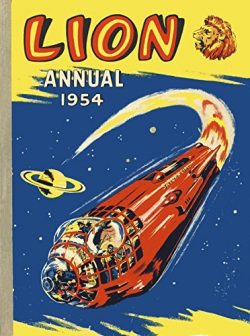
Lion Annual 1954


By Frank S. Pepper, Ron Forbes, Edwin Dale, Ted Cowan, Vernon Crick, & many & various (Amalgamated Press)
No ISBN: Digital edition

The 1950s ushered in a revolution in British comics. With wartime restrictions on printing and paper lifted, a steady stream of new titles emerged from many companies and when The Eagle launched from the Hulton Press in April 1950, the very idea of what weeklies could be altered forever. That kind of oversized prestige package with photogravure colour was exorbitantly expensive however, and when London-based publishing powerhouse Amalgamated Press retaliated with their own equivalent, it was an understandably more economical affair.

I’m assuming they only waited so long before the first issue of Lion launched (cover-dated February 23rd 1952) to see if their flashy rival periodical was going to last. Lion – just like The Eagle – was a mix of prose stories, features and comic strips and even offered its own cover-featured space-farer in Captain Condor – Space Ship Pilot.

Initially edited by Reg Eves, the title ran for 1156 weekly issues until 18th May 1974 when it merged with sister-title Valiant. Along the way, in the approved manner of British comics which subsumed weaker-selling titles to keep popular strips going, Lion absorbed Sun (in 1959) and Champion (1966) before going on to swallow The Eagle in April 1969 before merging with Thunder in 1971. In its capacity as one of the country’s most popular and enduring adventure comics, the last vestiges of Lion finally vanished in 1976 when Valiant was amalgamated with Battle Picture Weekly.

Despite its demise in the mid-70s, there were 30 Lion Annuals between 1953 and 1982, all targeting the lucrative Christmas market, combining a broad variety of original strips with topical and historical prose adventures; sports, science and general interest features; short humour strips and – increasingly in the 1970s – reformatted reprints from IPC/Fleetway’s vast back catalogue.

That’s certainly not the case with this particular item. Forward-dated 1954, but actually published in late 1953, it’s the first counterstrike from AP in the war to own Christmas: a delicious – but occasionally ethno-socially and culturally dated and dubious – dose of traditional comics entertainment. Big on variety, sturdily produced in a starkly potent monochrome, it offers a wide mixed bag of treats to beguile boisterous boys in a rapidly-changing world. What’s especially satisfying is that, current sensibilities notwithstanding, this volume has been digitised and can be bought and read electronically by kids of all vintages today…

I’m sure I don’t need to remind you that these entertainments were produced in good faith with the best of intentions by creators in a culture and at a time very different from ours. Very frequently attitudes and expressions are employed which we now find a little upsetting, but this book is actually one of the better examples of racial, gender and cultural tolerance. Still, even so…

The cornucopia of prose, puzzles, strips and features (all illustrated by artists as photography was too expensive) opens with a rather disturbing but truly lovely painted frontispiece ‘The Redskin Accepts the Challenge’ before a contents page promises astounding wonders to come.

We then rocket into adventure in the future where freedom fighter Captain Condor – by Frank S. Pepper and probably illustrated by original artist Ron Forbes – continues his war against despots running the solar system by solving ‘The Mystery of the Vanished Space-Ship!’ Edwin Dale then provides a prose thriller starring troubleshooter Mr. X, who discovers ‘The Tree that Stopped a Rebellion’ as he traverses the fabled African Veldt…

Presumably scripted by Ted Cowan & illustrated by Barry (R. G. Thomas) Nelson, ‘Sandy Dean’s Prize Guy’ is a comic strip wherein the schoolboy paragon and his chums deal with cheating classmates sabotaging and stealing effigies built to celebrate Guy Fawkes Night. It’s followed by Nigel Dawn’s prose thriller ‘Too Smart for the Atom Spy!’ wherein a schoolboy pigeon fancier foils a cunning espionage plot, after which we segue into a historical action strip credited to George Forrest (Cowan again).

‘The Slaves who Saved the Emperor’ follows two recently escaped British warriors who foil an imperial Roman assassination and is counterbalanced by Tom Stirling’s (E. L. Rosman) humorous text tale ‘Only a Press-Button Champ!’ This sees inventor’s nephew Jingo Jones stir up tons of trouble using his “Invisibliser” to save himself from a bully. Sadly, it also gives his headmaster and a boxing promoter the idea that the skinny runt is a fighting marvel…

‘The Weird Ways of Witch-Doctors Beat the Bush-Rangers’ (possibly by John Donnelly Jr.) shares amazing “facts” about jobbing mages in the post-war world after which John Barnes -AKA Peter O’Donnell – tells prose tale of ‘Chalu the Elephant Boy’ who clears his beloved four-legged co-worker Tooska when the big beast is framed as a murderous rogue animal…

Rex King (A.W. Henderson) delivers comic strip cowboy thrills as cavalry scout exposes a traitor and battles ‘Peril on the Tomahawk Trail’ before ‘Wiz and Lofty – Rescuers of the Kidnapped King’ (by E.L. Rosman as Victor Norman) delivers text thrills and spills as the globetrotting speed merchants stumble into a deadly plot to usurp a kingdom…

Harry Hollinson D.F.C. details and depicts some soon to be commonplace future wonders in speculative feature ‘Scientists Land on the Moon’ after which we pop back to WWII where Edward R. Home-Gall (AKA Edwin Dale) reveals in cartoon form how ‘The Lone Commandos’ scupper hidden Nazi artillery and save British soldiers in ‘Operation Gunfire’ before Vernon Crick shows in prose that ‘Rust’s the Boy for Stunts’: a rousing tale of motorcycle mayhem and skulduggery at a circus’ Wall of Death ride…

A pictorial ‘World-Wide Quiz’ tests your general knowledge before Peter O’Donnell – as Derek Knight – delivers a chilling prose vignette of Arctic endeavour as ‘Tulak Hunts the Polar Terror’, saving lost scientists, capturing murderous outlaws and stalking a killer bear…

A sea strip by A. W. Henderson as Roy Leighton sees schooner skipper Don Watson save pearl divers and solve ‘The Secret of Ju-Ju Island’ whilst Michael Fox’s prose story ‘Mike Merlin – Master of Magic’ details the greatest trick of a schoolboy conjuror before we meet one of British comics’ most enduring stars.

Robot Archie began life as ‘The Jungle Robot’ and his comic strip (by E. George Cowan & Ted/Jim Kearon) reveals how the mechanical marvel becomes the ‘Pal o’ the Pigmies’ before another prose piece by R. G. Thomas sees a western trader and his Native American pal stave off bandits and a hidden tribe of renegades in ‘Rod and the Red Arrow Raiders’

A ‘Picture Parade of Facts from Near and Far’ precedes a text thriller by Hedley Scott (AKA Hedley O’Mant) wherein ‘The Schoolboy Treasure Hunters’ do a bit of digging and uncover presumed pirate gold with a far more modern and sinister provenance, before John Fordice (Colin Robertson) employs the comic strip form to catch ‘The Smash-and-Grab Speedster’, courtesy of consulting crimebuster Brett Marlowe, Detective as he explores the contemporary sporting phenomenon of motorcycle speedway…

Donald Dane’s prose yarn ‘Kurdo of the Strong Arm’ details the fascinating, action-packed saga of a Viking teenager – from ancient Scotland – stranded in North America hundreds of years before Columbus and leads to all those puzzle answers and final cartoon fact file ‘Fishy Tales – But They’re True!’ before a House Ad for weekly Lion – “The King of Picture Story Papers!’ brings us to the back cover and a sponsored treat: early infotainment treat ‘Cadbury’s Car Race puzzle’.

Sadly, many of the creators remain unknown and uncredited, especially the exceptional artists whose efforts adorn the prose stories, but this remains a solid box of delights for any “bloke of a certain age” seeking to recapture his so-happily uncomplicated youth. It also has the added advantage of being far less likely than other (usually unsavoury) endeavours which, although designed to rekindle the dead past, generally lead to divorce…

Before I go, let’s thank Steve Holland at Bear Alley (link please) and all the other dedicated diligent bods researching and excavating the names and other facts for everyone like me to cite and pretend we’re so clever…

A true taste of days gone by, this is a chance for the curious to test bygone tomes and times and I thoroughly recommend it to your house…
© 1955 the Amalgamated Press and latterly IPC. All rights reserved.

The Dandy Book 1972


By many & various (D.C. Thomson & Co.)
ISBN: 978-0-85116-043-6 (HB)

For generations of British fans Christmas means The Beano Book, The Broons, Oor Wullie and making every December 25th magical. There used to be many more DC Thomson titles, but the years have gradually winnowed them away. Thankfully, time means nothing here, so this year I’m concentrating on another Thomson Christmas cracker that made me the man wot I am. As usual my knowledge of the creators involved is woefully inadequate but I’m going to hazard a few guesses anyway, in the hope that someone with better knowledge will correct me whenever I err.

The Dandy comic predated The Beano by eight months, utterly revolutionising the way children’s publications looked and – most importantly – how they were read. Over decades it produced a bevy of household names that delighted millions, with end of year celebrations being bumper bonanzas of the weekly stars in magnificent bumper hardback annuals.

Premiering on December 4th December 1937, The Dandy broke the mould of its hidebound British predecessors by utilising word balloons and captions rather than narrative blocks of text under sequential picture frames. A colossal success, it was followed on July 30th 1938 by The Beano. Together they revolutionised children’s publications. Dandy was the third longest running comic in the world (behind Italy’s Il Giornalino – launched in 1924 – and America’s Detective Comics in March 1937).

Over decades the “terrible twins” spawned countless cartoon stars of unforgettable and beloved household names who delighted generations of avid and devoted readers…

The Christmas Annuals were traditionally produced in the wonderful “half-colour” British publishers used to keep costs down whilst bringing a little spark into our drab and gloomy young lives. The process involved printing sections with only two (of potentially 4) plates, such as blue/Cyan and red/Magenta as seen in this majority of this tome. The versatility and palette range provided was astounding. Even now the technique screams “Holidays” to me and my contemporaries, and this volume uses the technique to stunning effect.

As you can see, the fun-filled action begins on the covers and continues on the reverse, with front-&-back covers and Introduction pages occupied by superstar Korky the Cat (by Charlie Grigg) setting the tone with a sequence of splendid seasonal sight gags.

D.C. Thomson were also extremely adept at combining anarchic, clownish comedy with solid fantasy/adventure tales. The eclectic menu truly opens with some topical environmentalism working as drama in Paddy Brennan’s ‘Guardian of the Red Raider’. Such picture thrillers still came in the traditional captioned format, with blocks of typeset text rather than word balloons. Here, bedridden schoolboy Freddy Gibbon “adopts” a vixen and her cubs, secretly safeguarding them from harm until they can fend for themselves.

From there we revert to the cheeky comfort of simpler times as Dirty Dick – by the incredibly engaging Eric Roberts (no, not the actor) – finds our perennially besmudged and befouled boy on his best and cleanest behaviour in anticipation of a visit from his American penfriend. However, in comics good intentions count for nothing…

Appropriately switching to black and blue plates, we next meet eternal enemies Bully Beef and Chips. Drawn by Jimmy Hughes, the thuggish big kid’s antics invariably proved that a weedy underdog’s brain always trumped brutal brawn, as here where little Chips orchestrates well-deserved payback after Bully forces little lads to play with his dangerously-rigged Christmas crackers…

Hugh Morren’s The Smasher was a lad cut from the same mould as Dennis the Menace and in the first of his contributions carves a characteristic swathe of anarchic destruction, when seeking to join a cowboy movie location shoot,

A quick switch to red & black – and all the tones between – signals the advance of hard-pressed squaddie Corporal Clott (by David Sutherland) who again bears the brunt of cruel misfortune and surly Colonel Grumbly when ordered to provide a slap-up feed for a visiting General…

The prolific Roberts always played a huge part in making these annuals work and next up his signature star Winker Watson hosts double-page picture puzzle ‘Catch the Imps!’: testing mind, eye and vocabulary before Shamus O’Doherty’s Bodger the Bookworm is seduced away from his comfortable reading to play football… with catastrophic repercussions…

Back in black & blue, traditional chaotic school hijinks get a cruel and crazy feudal spin in Ron Spencer’s Whacko! before we stay on topic but jump 500 years to the then-present and a different take on the education crisis. Whilst much comics material was based on school as seen by pupils, George Martin’s Greedy Pigg featured a voracious teacher always attempting to confiscate and scoff his pupils’ snacks. This time, he forsakes tuck boxes and extends his reach to the fodder fed to zoo animals – and gets what he deserves after masquerading as a gorilla…

Unforgivably racist but somehow painfully topical, Hughes’ Wun Tun and Too Tun the Chinese Spies traces the misadventures of badly-briefed oriental agents in old Blighty. Here they get lost in and misunderstand the point of sewers, after which Sutherland’s Desperate Dan offers a range of incidents deriving from the sagebrush superman letting his beard grow out of control.

The daftness drifts into more brilliantly entertaining eco-messaging as Peter Potter’s Otters – by Grigg employing his dramatic style – sees a gamekeeper’s son contrive to rescue a family of river-dwelling “pests” from the community seeking to eradicate them…

Jack Edward Oliver’s My Woozy Dog Snoozy proves utterly useless as a security guard, but does usher in green & black tones to welcome back Korky the Cat, whose clash with a fish farm’s “security guards” segues into a doggerel dotted Zany Zoo feature. An examination of The Smasher’s evolutionary forebears heralds a resumption of blue hues as Roberts delivers another classic Winker Watson yarn that is now sadly drenched in controversy and potential offense.

It begins when the Third Form lads of Greytowers School act on their love of the BBC’s Black and White Minstrel Show (look it up, but be prepared to be appalled before realising just how far we’ve come…): adding a blackface minstrel skit to the Christmas Concert. When chastised and rebuffed by form master Mr. Creep, schoolboy grifter Winker institutes a cunning scheme – worthy of Mission Impossible or Leverage – to make the teacher the butt of a joke and star of the show…

The green scene enjoys one last outing for a lengthy police spoof. Created by John Geering and played strictly for laughs, P.C. Big Ears was an overzealous beat copper with outrageous lugholes whose super-hearing and faithful dog Sniffer helped him crush “crime”. Here the dynamic duo are hot on the trail of a truant schoolboy, but pay a irritating price for their dutiful diligence, after which another light-hearted drama ensues, courtesy of Bill Holroyd.

With premium blue & red plates back in play home-made mechanoid Brassneck kicks off an avalanche of trouble after a service by his inventor. Uncle Sam pal warns the robot-boy’s pal Charley Brand that the automaton might be a little fragile for a while but is blithely unaware how rowdy and boisterous school can be. When a couple of unavoidable buffets trigger wild outbursts, Brassneck’s antics close the school, empty the parks and even cause animal escapes from the zoo before order is finally restored…

Desperate Dan then catches cold and almost decimates the environment in his efforts to get warm and stop sneezing before Korky the Cat suffers the downside of camping, and pint-sized hellion Dinah Mite (drawn by Ron Spencer) tests some possible careers should she ever leave school.

Another blue section opens with animal gags in Jokey Jumbo and Winker Watson puzzle feature ‘It’s as Easy as ABC’ before My Woozy Dog Snoozy compounds his worthlessness when a burglar breaks in.

A switch to red and black sees Corporal Clott suckered by a spiv and become the proud new owner of a lethally destructive vacuum cleaner after he replaces the naff motor with a leftover jet engine. Blue tones are back as George Matin’s big-footed klutz Claude Hopper learns why he’s not cut out for a job waiting tables and Korky the Cat wins a fancy dress competition by being extremely cool…

More red & blue pages picture Dirty Dick at his dustily destructive worst before a switch to yellow & black plates finds Greedy Pigg imitating a tramp to get scrumptious handouts before Wun Tun and Too Tun the Chinese Spies return in another distressingly outdated and inappropriate espionage episode.

Rendered in red and black. Sandy Calder powerfully illustrates Scruffy the Bad-Luck Doggie as ordinary kid Danny Dunlop saves a scrappy mutt from bullies trying to drown it, but takes some time and effort – and a few hard knocks – adjusting to being the owner of a semi-feral delinquent dog…

Sentiment surrenders to surreal silliness and yellow hues as Desperate Dan teaches a dog how to be fierce, before Bodger the Bookworm enflames his family by practising matchstick tricks and Korky successfully poaches a fish in more ways than one, after which black & blue tones detail a pretty Darwinian battle for survival and supremacy amongst alley cats as Boss of the Backyards (by Murray Ball – whose wonderful Footrot Flats strips are just crying out for a modern archival edition) sees a tough newcomer challenge a wild moggy in the kingdom of bins and backstreets…

Dirty Dick is tarred by own insolence – and tar – in a very early example of photobombing and My Woozy Dog Snoozy turns the tables on his longsuffering owner, before P.C. Big Ears finds his own hound complicit in apple scrumping. Corporal Clott then dumps the colonel in a frozen river and Korky again profits from his thieving ways…

Another flush of red & blue captures Bully Beef and Chips causing chaos with a doctor’s play set and Greedy Pigg outsmarted by the dog he borrowed to steal food for him, and true blue drama Bold Ben’s Boulder (by Victor Peon?) has a young boy save his uncle’s fortune and life when Burmese bandits go on a kidnapping spree before one final flush of red & black sees Desperate Dan solve a lighting crisis with a little illuminating larceny…

With Puzzle Answers and the aforementioned Korky endpapers wrapping up proceedings, let’s celebrate another tremendously fun book; with so much merriment on offer I can’t believe this book is 51 years old, and still available through second hand outlets.

The only thing better would by curated archive reissues and digital editions…
© D.C. Thomson & Co., Ltd, 1971.

Merry Christmas Every One!

In keeping with my self-imposed Holidays tradition, here’s another pick of British Annuals selected not just for nostalgia’s sake but because it’s my wife’s house and my rules…

After decades when only American comics and memorabilia were considered collectable or worthy, a resurgence of interest in home-grown material means there’s lots more of this stuff available. So, if you’re lucky enough to stumble across a vintage volume, modern facsimile or even one of the growing number of digital reproductions increasingly cropping up, I hope my words can convince you to expand your comfort zone and try something old…

Still topping my Xmas wish-list are more collections from fans and publishers who have begun to rescue this magical material from print limbo in (affordable and annotated) new collections…

Great writing and art is rotting in boxes and attics or the archives of publishing houses, when it needs to be back in the hands of readers once again. As the tastes of the reading public have never been broader and since a selective sampling of our popular heritage will always appeal to some part of the mass consumer base, let’s all continue rewarding publishers for their efforts and prove that there’s money to be made from these glorious examples of our communal childhood.

These materials were created long ago in a different society for a very different audience. As such much material is inadvertently funny, blatantly racist and/or sexist and pretty much guaranteed to offend somebody sooner or later. Think of it as having to talk to your grandparents about “back when everything was better”…

If you don’t think you can tolerate – let alone enjoy – what’s being discussed here, maybe it’s not the book you need today. Why not look at something else or play a game instead?

Walt Disney’s Donald Duck by Carl Barks volume 11: Christmas For Shacktown


By Carl Barks & various (Fantagraphics Books)
ISBN: 978-1-60699-574-7 (HB/Digital edition)

Win’s Christmas Gift Recommendation: Utter Acme of All-Ages Entertainment… 10/10

Carl Barks was born in Merrill, Oregon in 1901, growing up in the rural areas of the West during some of the leanest times in American history. He tried his hand at many jobs before settling into the profession that chose him. His early life is well-documented elsewhere if you crave detail, but briefly, Barks worked as an animator at Disney’s studio before quitting in 1942 to work in the new-fangled field of comic books.

With studio partner Jack Hannah (another animator turned occasional strip illustrator) Barks adapted a Bob Karp script for a cartoon short into Donald Duck Finds Pirate Gold. It was published in October of that year as Dell Four Color Comics Series II #9 and – although not his first published comics work – was the story that shaped the rest of Barks’ career.

From then until his official retirement in the mid-1960s, he worked in self-imposed seclusion, writing, drawing and devising a vast array of adventure comedies, gags, yarns and covers that gelled into a Duck Universe of memorable and highly bankable characters, including Gladstone Gander (1948), the Beagle Boys (1951), Gyro Gearloose (1952) and Magica De Spell (1961) to supplement Disney’s stable of illustrated actors.

His greatest creation was undoubtedly the crusty, paternalistic, money-mad giga-gazillionaire Scrooge McDuck: world’s wealthiest septuagenarian waterfowl and the harassed, hard-pressed, scene-swiping co-star of this tome.

Whilst producing all that landmark material, Barks was just a working guy, crafting covers, drawing other people’s scripts and contributing his stories to a burgeoning canon of Duck Lore. Only in the 1980s – after Gladstone Publishing began re-packaging his work and other Disney strips – did Barks discover the devoted appreciation he never imagined existed…

So potent were his creations that they inevitably fed back into Disney’s animation output, even though his brilliant comics were produced for licensing company Dell/Gold Key, and not directly for the Disney studio. The greatest tribute was undoubtedly the animated series Duck Tales: heavily based on his Scrooge comics output.

Barks was a fan of wholesome action, unsolved mysteries and epics of exploration, and this led to him perfecting the art and technique of the comedy blockbuster: blending wit, history, science, plucky bravado and sheer wide-eyed wonder into rollicking rollercoaster romps which captivated readers of every age and vintage. Without the Barks expeditions, there would never have been an Indiana Jones

Throughout his working life, Barks was blissfully unaware that his efforts – uncredited by official policy as was all Disney’s strip and comic book output – had been singled out by a rabidly discerning public as being by “the Good Duck Artist”. When some of his most dedicated fans finally tracked him down, Barks’ belated celebrity began.

In 2013 Fantagraphics Books started collecting his Duck materials in carefully curated archival volumes, tracing the output approximately year-by-year in hardback tomes and digital editions that finally did justice to the quiet creator. These will eventually comprise the Complete Carl Barks Disney Library

The physical copies are sturdy and luxurious albums – 193 x 261 mm – that would grace any bookshelf, with volume 5 – Walt Disney’s Donald Duck: “Christmas on Bear Mountain” (for reasons irrelevant here) acting as debut release and showcasing works from 1947. Today we’re revisiting 1951-1952, with volume 11 offering another landmark Seasonal tale that critically reshaped the supposedly throwaway, 2-dimensional miser into the richly rounded character beloved by billions…

It begins eponymously with Bark’s most enduring creation in top form. The elder McDuck had debuted in ‘Christmas on Bear Mountain’ (Four Color #178, December 1947): a handy comedy foil stemming from a Yuletide tale of woe and joy. He was a miserly relative who seethed in opulent isolation, hating everybody and meanly opting to share the gloom by tormenting his nephew Donald and his junior houseguests Huey, Louie and Dewey – by gifting them his mountain cabin for the Holidays. Scrooge schemed, intent on terrorising them in a bear costume, but fate had other ideas…

After the tale ended Barks realised that although the old coot was creepy, menacing and money-mad, he was also energetic and oddly lovable – and thus far too potentially valuable to be misspent or thrown away. Further appearances proved that he was right and his expedient maguffin was undoubtedly his greatest cartoon creation. The Downy Dodecadillionaire returned often, eventually expanding to fill all available space in tales set in the scenic metropolis of Duckburg.

Here. shifted slightly out of publishing chronology – because McDuck is not about wasting time or money – we open eponymously with the lead tale from Four Color #367. Cover-dated January 1952, ‘A Christmas For Shacktown’ begins as Donald’s nephews take a detour through the bad side of town and realise they cannot allow all the poverty-stricken children they see endure a festive season without food or toys…

Their discussion also inspires Daisy Duck, who resolves to organise a solution, and before long her women’s club is tapping Duckburg’s citizens for contributions. Daisy herself asks Donald – who’s experiencing a personal cashflow crisis and can’t afford his own Yule celebrations – who might make up her final $50 shortfall. When the nephews suggest Scrooge McDuck, Donald is reluctantly despatched to beg a donation, and does not relish the conversation…

That last 50 bucks is to buy turkeys and provide the joyless waifs with a train set, but after a titanic tussle, Donald can only get the skinflint to agree to $25… and that’s only for the food, not silly fripperies like toys…

Rapidly regrouping, Donald and Daisy are overwhelmed when the nephews hand over their savings and tell their “Unca Donald” to similarly donate the money put aside for their presents, but it’s still not enough and the trio then head off to shovel snow from sidewalks to make up the difference.

Ashamed and emboldened, Donald resolves to get what’s needed from Scrooge, embarking upon a series of increasingly wild stunts – including recruiting despicable rival Gladstone Gander – that culminates in disaster when Scrooge’s overloaded money vault collapses under the weight of its own reserves, plunging his entire fortune into the bowels of the Earth.

Confronted with penury, the despondent tycoon is saved by Donald and the boys who devise a means of retrieving the loot which gives the miser a new perspective on the value of toys: a view that rightly translates into Shacktown enjoying the best Christmas ever…

A month prior to that yarn, anthological Walt Disney Comics & Stories #135 (cover-dated December 1951) featured The Big Bin on Killmotor Hill’ wherein the old money magnate debuted his monolithic money bin, and invites Donald and the boys to inspect it… if they can get past all his baroque and byzantine security measures. Sadly, the visit also inspires the dastardly Beagle Boys to try to empty it…

WDC&S #136 (January 1952) then finds Donald suffering a braggart’s boasts again as his despised super-lucky rival recounts ‘Gladstone’s Usual Good Year’. Driven to distraction, Donald resorts to cheating just to raise his own spirits and something very unlikely occurs…

For #137, Donald and the nephews head to the mountains after he sells a song. Sadly, ‘The Screaming Cowboy’ is a particularly annoying tune that Donald smugly plays on every juke box in the region: the ominously named Avalanche Valley…

Scrooge returned in (WDC&S #138 March 1952), acting in a most uncharacteristic manner as ‘Statuesque Spendthrifts’ revealed him locked in financial combat with the proudly philanthropic Maharajah of Howduyustan to prove who was truly “the richest man in the world”. The battle revolved around who could donate the most ornate, ostentatious and gaudy monument of Duckburg’s founder…

When Huey, Dewey & Louie’s latest hobby – racing pigeons – inspires Donald’s disdain, the mean Unca attempts to sabotage and gaslight them, but learns his lesson when ‘Rocket Wing Saves the Day’ (WDC&S #139, April) after he has an accident…

The family – and even outrageous inventor Gyro Gearloose – are united in WDC&S #140, working to uncover annoying wastrel ‘Gladstone’s Terrible Secret’, and the chaos-creating boffin is back in #141, much to Donald’s dismay and the nephews’ delight: upsetting the natural order with machines giving beasts human attributes in ‘The Think Box Bollix’

Four Color #408 (July/August 1952) was an All-Donald/All Barks affair and opens with a brace of single page gags, starting with ‘Full-Service Windows’ as the wily retailer finds a cheap and easy way to clean his shop front and compounding interest with ‘Rigged-Up Roller’ (alternately called ‘Rigged Up Lawn’) wherein the nephews must find a new way to keep the yard maintained…

The main event was extended action adventure ‘The Golden Helmet’ wherein bored museum guard Donald stops a suspicious individual poking about in a Viking longship and uncovers a hidden deerskin map. It reveals how explorer Olaf the Blue discovered America in 901 AD, and left a golden helmet which confirms when and how the nation was born.

The museum authorities are exultant… but only until the meddler returns with his lawyer Sharky. Azure Blue claims to be the descendant of Olaf and invokes the ancient “code of discovery” law. It dictates that as proof of the event, the helmet also confers ownership of the continent on the heirs… but only if Azure finds it first…

Almost resenting his earlier dreams of adventure, Donald recruits his nephews and dashes off with the museum curator to Labrador. They are all intent on saving Americans from becoming Blue’s slaves: battling deadly weather, constant misfortune and the machinations of Azure and Sharky in a superb action romp anticipating, Dan Brown, The Librarian and the National Treasure screen franchise…

The fun finishes with Donald’s Nephews ‘Awash in Success’ beside a faulty drinking fountain, counterbalanced by a Donald and Scrooge single from Four Color #422, (cover-dated September/October 1952) with the money-wise miser benefitting from bulk buying in ‘Stable Prices’.

Back on track and sampling Walt Disney Comics & Stories (#142, July 1952) sees Donald drag the kids on a ‘Houseboat Holiday’ to keep their summer vacation pranks and hijinks at a manageable level. Instead, he finds himself at the centre of a storm of freak calamities and life-threatening disasters. Its only marginally less fraught one month later when he takes them to the desert as ‘Gemstone Hunters’ and is bamboozled by cunning fraudsters and again humiliated by Gladstone…

The remainder of Four Color #422 follows, opening with a follow-up action excursion. In ‘The Gilded Man’ avid stamp collector Donald believes he’s tracked down a hugely valuable item and heads for British Guiana, with the nephews in tow and Gladstone hot on his trail.

The quest is for fabled El Dorado, and the jungle trek ultimately leads them to victory of a sort after exposing the secrets of the ancient golden god…

Two more one-pagers wrap up the issue: detailing correct precautions for saving a cat in ‘Armored Rescue’ before adapting an old idea to avoid social commitments in ‘Crafty Corner’

Scrooge stole the spotlight again in WDC&S #144 (September) as another storage crisis in his vault compelled the old bird to try and learn a new trick. In an effort to make room, he hires insanely profligate Donald to share the secret of ‘Spending Money’ but is far from satisfied with what he learns…

The story portion of this tome terminates with the remainder of Four Color #367, with ‘Treeing Off’ showing how the nephews brighten up the Christmas decorating, after which Donald pays the price for presumption with mistletoe in ‘Christmas Kiss’ and the boys have the last word when adapting modern science to list writing in ‘Projecting Desires’ (AKA ‘Stamp-Sized Christmas List’).

The comics are augmented by a sublime Cover Gallery proving the Master’s gift for visual one-liners in Four Color (volume II) 367, 408 & 422, and Walt Disney Comics & Stories#135-144 which intercut context, commentary and validation in ‘Story Notes’ for each Duck tale gathered here. Following Donald Ault’s essay ‘Carl Barks: Life Among the Ducks’, ‘Biographies’ then introduces commentators Ault, R, Fiore, Craig Fischer, Jared Gardner, Rich Kreiner, Ken Parille, Stefano Priarone and Matthias Wivel and why they’re saying all those nice and informative things. We close as ever with an examination of provenance in ‘Where Did These Duck Stories First Appear?’

Carl Barks was one of the greatest exponents of comic art the world has ever seen, with almost all his work featuring Disney’s Duck characters: reaching and affecting untold billions across the world. You might be late to the party but don’t be scared: it’s never too late to climb aboard the Barks Express.

Walt Disney’s Donald Duck “A Christmas For Shacktown” © 2012 Disney Enterprises, Inc. All contents © 2015 Disney Enterprises, Inc. unless otherwise noted. All rights reserved.


Jack Kirby’s Kamandi – The Last Boy on Earth! Omnibus/Kamandi – The Last Boy on Earth! by Jack Kirby volume 1


By Jack Kirby, Gerry Conway, Mike Royer, D. Bruce Berry & various (DC Comics)
ISBN: 978-1-4012-7469-6 (Omnibus HB) (volume 1 TPB/Digital edition)

Win’s Christmas Gift Recommendation: Epic – if not Prophetic – Entertainment… 10/10

This book is huge and heavy: 191 x 56 x 280 mm, 880 slick pages and topping the scales at 2.75 kilos – that’s more than six pounds! Believe it or not, it’s actually worth every second of time you spend on it, but be warned that you’ll need strong arms and sturdy wrists to get the best out of it…

Jack Kirby (28th August 1917 – 6th February 1994) was – and nearly 30 years after his death, remains – the most important single influence in the history of American comics. There are innumerable accounts of and testaments to what the man has done and meant, and you should read those if you are at all interested in our medium.

Kirby was a man of vast imagination who translated big concepts into astoundingly potent and accessible symbols for generations of fantasy fans. If you were exposed to Kirby as an impressionable child you were his for life. To be honest, that probably applies whatever age you jump aboard the “Kirby Express”…

For those of us who grew up with Jack, his are the images which furnish and clutter our interior mindsets. Close your eyes and think “robot” and the first thing that pops up is a Kirby creation. Every fantastic, futuristic city in our heads is crammed with his chunky, towering spires. Because of Jack we all know what the bodies beneath those stony-head statues on Easter Island look like, we are all viscerally aware that you can never trust great big aliens parading around in their underpants and, most importantly, we know how cavemen dressed and carnosaurs clashed…

Synonymous with larger than life characters and vast cosmic imaginings, Jack “King” Kirby was an astute, spiritual man who had lived through poverty, prejudice, gangsterism, the Depression and World War II. He experienced Pre-War privation, Post-War optimism, Cold War paranoia, political cynicism and the birth and death of peace-seeking counter-cultures, but always looked to the future while understanding human nature intimately.

In the late 1930s, it took a remarkably short time for Kirby and his creative collaborator Joe Simon to become the wonder-kid dream-team of the new-born comic book industry. Together they produced a year’s worth of influential monthly Blue Bolt, dashed off Captain Marvel Adventures (#1) for overstretched Fawcett, and – after Martin Goodman appointed Simon editor at Timely Comics – launched a host of iconic characters including Red Raven, Marvel Boy, Mercury/Hurricane, The Vision, Young Allies and million-selling mega-hit Captain America.

When Goodman failed to make good on his financial obligations, Simon & Kirby were snapped up by National/DC, who welcomed them with open arms and a fat chequebook. Bursting with ideas the staid industry leaders were never really comfortable with, the pair were initially an uneasy fit, and awarded two moribund strips to play with until they found their creative feet: Sandman and Manhunter.

They turned both around virtually overnight and, once safely established and left to their own devices, switched to the “Kid Gang” genre they had pioneered at Timely. Joe & Jack created wartime sales sensation Boy Commandos and Homefront iteration The Newsboy Legion before being called up to serve in the war they had been fighting on comic pages since 1940.

Once demobbed, they returned to a very different funnybook business, and soon after left National to create their own little empire…

Simon & Kirby ushered in the first American age of mature comics – not just by inventing the Romance genre, but with all manner of challenging modern material about real people in extraordinary situations before seeing it all disappear again in less than eight years.

After years of working for others, Simon & Kirby established their own publishing house: making comics for a far more sophisticated audience, only to find themselves in a sales downturn and awash in public hysteria generated by an anti-comicbook pogrom. Their small stable of magazines – generated for an association of companies known as Prize, Crestwood, Pines, Essenkay and Mainline Comics – blossomed and as quickly wilted when the industry contracted throughout the 1950s, but had left future generations fascinating ventures such as Boys’ Ranch, Bullseye, Crime Does Not Pay, Black Magic, Boy Explorers, Fighting American and the entire genre of Romance Comics…

Hysterical censorship-fever spearheaded by US Senator Estes Kefauver and opportunistic pop psychologist Dr. Frederic Wertham led to witch-hunting Senate hearings. Caving in, most publishers adopted a castrating straitjacket of draconian self-regulatory rules. Crime and Horror titles produced under the aegis and emblem of the Comics Code Authority were sanitised and anodyne affairs in terms of mature themes, political commentary, shock and gore even though the market’s appetite for suspense and the uncanny was still high. Crime comics vanished as adult sensibilities challenging an increasingly stratified and oppressive society were suppressed. Suspense and horror were dialled back to the level of technological fairy tales and whimsical parables…

Simon left the business for advertising, but Jack soldiered on, taking his skills and ideas to safer, more conventional, less experimental companies. As the panic abated, Kirby returned briefly to DC Comics, working on bread-&-butter anthological mystery tales and revamping Green Arrow (at that time a back-up feature in Adventure Comics and World’s Finest Comics) whilst concentrating on his passion project: newspaper strip Sky Masters of the Space Force.

During that period Kirby also re-packaged a super-team concept that had been kicking around in his head since he and Joe had closed their innovative, ill-timed ventures. At the end of 1956, Showcase #6 premiered the Challengers of the Unknown

After three more test issues they won their own title with Kirby in command for the first eight. Then a legal dispute with Editor Jack Schiff exploded and the King was gone…

He found fresh fields and an equally hungry new partner in Stan Lee at the ailing Atlas Comics outfit (which had once been mighty Timely) and launched a revolution in comics storytelling…

After more than a decade of a continual innovation and crowd-pleasing wonderment, Kirby felt increasingly stifled. His efforts had transformed the dying publisher into industry-pioneer Marvel, but that success had left him feeling trapped in a rut. Thus, he moved back to DC and generated another tidal wave of sheer imagination and pure invention. The result was experimental adult magazines Spirit World and In the Days of the Mob and a stunning reworking of Superman’s Pal Jimmy Olsen – and by extension, all DC continuity. The latter was a prelude to his landmark Fourth World Saga (Forever People, New Gods and Mister Miracle): the very definition of something game-changing and far too far ahead of its time…

Kirby instinctively grasped the fundamentals of pleasing his audience and always strived diligently to combat the appalling prejudice regarding the comics medium – especially from industry insiders and professionals who despised the “kiddies world” they felt trapped in. After his controversial, grandiose Fourth World titles were cancelled, Kirby explored other projects that would stimulate his own vast creativity yet still appeal to a market growing ever more fickle. These included science fictional survival saga Kamandi, supernatural stalwart The Demon, traditional war stories starring established DC team The Losers, OMAC: One Man Army Corps and even a new Sandman – co-created with old pal Joe Simon.

However, although ideas kept coming (Atlas, Kobra, a new Manhunter and Dingbats of Danger Street), once again editorial disputes took up too much of his time. Reluctantly, he left again, choosing to believe in promises of more creative freedom elsewhere…

As early as 1974, worn down by a lack of editorial support and with his newest creations inexplicably tanking, Kirby considered a return to Marvel, but – ever the consummate professional – scrupulously carried out every detail of an increasingly onerous and emotionally unrewarding DC contract. Although The Demon was cancelled after 16 issues and he needed another title to maintain his Herculean commitments (Jack was legally obliged to deliver 15 completed pages of art and story per week!) Kamandi – The Last Boy on Earth had found a solid and faithful audience. It also provided further scope to explore big concepts as seen in thematic companion OMAC: One Man Army Corps. Both series gave Kirby’s darkest assumptions and prognostications free rein, and his “World That’s Coming” has proved far too close to the World we’re frantically trying to fix or escape from today…

Kirby’s return to Marvel in 1976 was much hyped and eagerly anticipated at the time, but again proved controversial. New works like The Eternals and Devil Dinosaur found friends rapidly, but his return to earlier – continuity-locked – creations Captain America and Black Panther divided the fanbase.

Kirby was never slavishly wedded to what had come before, and preferred, in many ways, to treat his stints on titles as a “Day One”: a policy increasing at odds with the close-continuity demanded by a strident faction of the readership…

There’s no need for any of that here as DC’s interconnected universe takes a distant back seat to amazement, adventure and satirical commentary for most of Kirby’s tenure…

This frankly monstrous hardback collection gathers arguably his boldest, most bombastic and certainly most successful 1970s DC creation: collecting Kamandi – The Last Boy on Earth #1-40 (cover-dated October/November 1972- April 1976): every issue Kirby was involved with, but not the 19 issues that staggered on after under lesser creative lights once he had returned to Marvel…

Preceded by inker/letterer Mike Royer’s Introduction ‘When Kirby Called!’ and supported by more ancillary features at the end, the magic opens with the introduction of ‘The Last Boy on Earth!’ as he explores a shattered world that has grown from the rubble of Mankind’s achievements and mistakes…

A signature of the series was large panels and vistas, particularly spectacular and breathtaking double-page spreads on pages 2-3 of almost every episode: adding an aspect of wide-screen cinematic bravura. It’s especially effective here as a capable, well-armed teenager paddles through the sunken ruins of New York City. The explorer has recently emerged from total isolation in a hermetically sealed bunker designated “Command D”, where he was schooled by his grandfather and constantly viewed a vast library of 1970s microfilm and news recordings. The boy calls himself “Kamandi”…

Having obliviously sat out the seemingly overnight decline and fall of humanity – in which atomic armageddon clearly played a major but not exclusive role, the boy mentally catalogues unbelievable and incomprehensible change on every level resulting from the mysterious catastrophe now called “The Great Disaster”…

This world is nothing like his education promised. Wreckage and mutant monsters abound, the very geography has altered and humans have somehow devolved into savage, non-verbal beasts hunted and exploited by a number of animal species who have gained intellect comparable to his own… and the power of speech. Most of them are engaged in wars for dominance, fuelled by territorial aggression and fostered by the scavenged remnants of humanity’s technologies…

When the boy returns to the bunker, he finds it has finally been breached and his grandfather is dead at the hands of opportunistic wolves far too much like men. Shocked, furious and now utterly alone, Kamandi ruthlessly fights his way out and sets off to find what else is out there in this scary new world…

When he reaches the remains of the New Jersey Turnpike, the boy stumbles into the new political reality when he is captured by mounted cavalry tigers (horses appear to be one species that never made the evolutionary leap to intellectual comprehension and personal autonomy).

A formal army of conquest, the tigers devotedly serve charismatic leader Great Caesar, who plans to unite Earth AD (“After Disaster”) under his militant banner. Here that means crushing a force of gun-toting leopards, but – well aware that their liege-lord is obsessed with weird devices and strange phenomena from the past – they make time to send the weird “talking animal” back to ‘The Royal City Kennels!’

It’s a mixed blessing all around. The human is preened and pampered but also kicked around by smug tiger soldiers, before he discovers Caesar’s greatest secret. The warrior king has recovered an atomic missile and made “the warhead” the central focus of a martial cult, and is outraged when Kamandi recognises and tries to destroy it…

In the aftermath, the troublesome boy is surrendered to the care of the conqueror’s chief scientist. A dog named Doctor Canus, he plays a deep game: advising the tiger army over recovered artefacts, whilst keeping huge secrets from his paymasters. The biggest one immeasurably lifts Kamandi’s crushed spirits when the dog introduces another talking human he’s sheltering…

However, although he’s rational, erudite and friendly, Ben Boxer isn’t exactly human!

The utterly jam-packed first issue also provides a map of what the Americas have become in ‘Kamandi’s Continent’ after which the series advanced to a monthly schedule with the second issue, as the young wanderer encounters more terrifying wonders in ‘Year of the Rat!’

Supplemented at the end by Kirby’s editorial codicil ‘The Great Earth Cataclysm Syndrome!’, this tale sees Ben and the boy escape Great Caesar’s compound when the stranger displays a secret power. Ben and his missing companions are nuclear mutants who can transition from flesh & blood to organic steel by internal fission, and after overpowering their tiger guards they flee together in a submersible vehicle. As they search the sunken remains of New York City for missing mutants Steve and Renzi, they are attacked by the avaricious evolved rats who took them and the flying craft they came in…

The rats are the ultimate scavenger society, stockpiling humanity’s detritus and exploiting whatever they understand of it. Once they add their two new captives to the pile, Ben and Kamandi react, explosively breaking free and escaping with Boxer’s rescued comrades in their reclaimed “Traveller”…

Great Caesar’s main opposition is a nation of militant gorillas, and #3 introduces them when the Traveller’s southward flight to the mutants’ home of “Tracking Site” pauses to survey what was once Nevada. When Kamandi is separated from the mutants and caught up in an animal round-up, he’s taken to a vast city to be broken for service…

As Ben, Steve and Renzi discover a monster-infested space museum and encounter ‘The Thing that Grew on the Moon!’, recalcitrant Kamandi is rebelling against brutal animal trainer Chaku the Mighty before fleeing into the rubble of Las Vegas where all concerned parties converge for a spectacular showdown…

Issue #4 finds the humans seeking to replenish supplies in the aftermath, only to be separated again when tiger scouts clash with the gorillas. In an extended skirmish Kamandi is captured by the simians, only to stage a mass animal breakout and liberate a tiger in ‘The Devil’s Arena!’ However, Prince Tuftan, son of Great Caesar, seems quite happy to stay a prisoner as the two armies clash. He has his eyes on a lost weapon of the ancients, but it’s one Kamandi cannot allow to fall into any militarist’s paws…

Despite Kamandi’s act of humanitarian sabotage, Tuftan allies with the weird talking animal seeking safety as the battle reaches appalling heights of bloodshed. Recaptured by gorillas, the last boy frees more caged humans and meets one who has the rudiments of speech and enough intellect to follow him and Tuftan as they make a break for friendly lines.

There are none for humans and when they reach the Tigers ‘Killing Grounds!’, the grudge-bearing emperor makes the boy battle an enraged gorilla warrior in a deathmatch…

When Tuftan sabotages that moment of entertainment, Kamandi becomes a state problem until the regrouped gorillas counterattack. With slaughter for all the only prospect, the boy buys his own life by suggesting an honourable compromise to be determined by fate and ‘The One-Armed Bandit!’

Given his freedom and a fast car, Kamandi rides away and into tragedy with the evermore loquacious girl who calls herself ‘Flower!’ but they are soon captured again. This time it’s lions; however their fate seems to be a blessing as Sultin and his Rangers relocate the strange animals to The Sanctuary: a wildlife preserve in what used to be Texas, where humans can live their days in peace and security. Sadly, the place is a target for poachers and Kamandi’s chance for love and companionship with his own kinds ends in shocking tragedy and grief when a pair of pumas break through the cordon looking for a little fun with guns…

A new direction and increased social commentary comes in #7’s ‘This is the World of Kamandi The Last Boy on Earth!’ Kirby was a skilled cultural bandit and sampler: swiping and recycling contemporary and classic tropes and memes. Here he recasts the story of Kong with Kamandi as Fay Wray and giant mutant ape named Tiny as a beast with passions too big to save him…

It begins as the grieving boy buries Flower and wins the approval and confidence of Sultin. The lion is not only a ranger but a prominent member of a civilised society dubbed the United States of Lions. They trace their rise back to the fabled days of “Washington Zuu” and consider themselves custodians of Earth AD: protecting fabulous anomalies like talking animals…

Sultin’s biggest problem at the moment is Tiny: a simpleminded, skyscraper sized ape that the neighbouring gorilla armies worship as “the Fetish”. Now, as another surprise raid finally frees the beast, Tiny rampages through the region and is besotted and captivated by a small, golden-haired animal…

Although initially rescued, Kamandi is later recaptured by Tiny who terrorises the city of New Capitol until the lions move in with their latest innovation, petrol driven bi-planes…

The satire reaches new heights in #8 as ‘Beyond Reason’ finds the Last Boy and Sultin debating why the ancients made so many statues and images of dressed up animals. As Kamandi examines a museum filled with dead presidents, he grows increasingly angry, but only truly loses control after encountering local leash laws and discovering that Lions use human as pets, service and security beasts…

A creature of rare sensitivity, Sultin realises there’s no place for his friend in society and sets the boy free deep in the wilds where the wanderer can be himself. Roaming mankind’s ruins and follies the boy is soon in trouble again but survives his first encounter with talking bears thanks to ‘The Return of Ben Boxer’ and his nuclear kin…

After months of mystery the lad finally arrives at ‘Tracking Site!’: eagerly anticipating seeing the last refuge of rational educated human-kind. As their ship is attacked by ravenous, super-evolved bats (graced with a stunning Kirby photomontage) Kamandi learns that his hopes were too high as the NASA built experimental base is populated primarily by robots, except for a telepathic freak dubbed ‘Murdering Misfit!!’ – who mind-controls Ben, Renzi and Steve – and a deadly sentient ‘Killer Germ!’

The morticoccus strain wants to eradicate all life, and almost gets its wish when the bats at last broach the walls. With the atomic brothers freed in the ensuing chaos and the Misfit temporarily stymied by Kamandi, the origin of all the post-human beings is revealed before a brilliant flash of inspiration saves the planet in a masterstroke of technological sleight of hand…

An extended storyline begins in #11 as Kamandi is separated from his friends and plucked out of the Atlantic Ocean by an organisation of scavengers led by a ruthless capitalist. This plutocrat is a sentient snake, and the Sacker’s Co roams the world plundering old tech and exploiting new species like ‘The Devil!’ When his flagship “acquires” Kamandi, the leopards who man it are quick to add the talking beast to the inventory alongside their huge mystery cargo, but by the time they dock, the boy has broken free and formed a powerful bond with the huge mutant grasshopper…

The drama intensifies in ‘The Devil and Mister Sacker!’ as Kamandi plunders the merchant mogul’s department store for weapons, prior to trying to ride away on the fast-reacting, long-leaping beast he’s named Kliklak. However, he changes his mind when caught again and meeting Sacker and his favourite pet. Spirit is the spitting image of Flower and also speaks: not too surprising as they came from the same litter and were raised together before Flower escaped…

As the humans grieve her death together, Sacker has an idea and starts to groom the newcomer for a certain purpose he has in mind…

The snake has been domesticating humans for years and many of them talk. He uses them in sporting events and his prize is a brutal pedigreed oaf trained to kill and ride. Dubbed Bull Bantam, he resents the spark between Spirit and the new boy and plans to kill the kid in Sacker’s forthcoming race meet/arm show…

After once more failing to escape, Kamandi is forced to ride in a deadly death-race: the grand finale in a mass spectacle drawing thousands of prospective clients and the only event able to enforce a truce between tigers, leopards lions, gorillas and sundry other warring species…

The ‘Hell at Hialeah!’ climaxes in a duel with Bantam and another heartbreaking loss for the Last Boy as his Devil is grievously injured and Kamandi must deliver the ultimate release to his beloved pet…

As tensions escalate, a sudden reunion with Canus and Tuftan in ‘Winner Take All!’ is the only thing saving the argumentative human from being euthanized as a dangerous maverick…

Like all science/speculative fiction, Kamandi was never about the future but firmly honed in on contemporary culture. When our hero rides off with Tuftan and the tigers, he stumbles into another pointless hunt for misunderstood myths as the cats continue their mission to uncover ‘The Watergate Secrets!’ These legendary tapes have sustained a level of divine mystery over years, but when the searchers actually find them, Kirby delivers awry twist that will have readers howling…

Cover-dated April 1974, Kamandi #16 sees D. Bruce Berry assist (and eventually replace) Royer on inks and letters as the staggering secret of the animals’ evolutionary leap is revealed, when the wanderers find ‘The Hospital!’ where an obsessed medic explores animal intelligence.

Located in what was Washington DC, and using the lost note of Dr. Michael Grant, ape surgeon Dr. Hanuman experiments on lab humans, resolved to unlock the secrets of brain stimulant Cortexin.

As the night of the Great Disaster seems to play out again, Hanuman himself is somehow trapped as events terrifyingly replay according to Grant’s writing, with him as the doomed researcher and a super-bright beast called Kamandi as the liberator of his test animals and accidental vector and disseminator of a chemical that boosted intellect in everything it contaminated…

Escaping Hanuman’s lab, the Last Boy is scooped up by gorillas in need of a really smart beast for a pest control problem. Shipped across country, Kamandi is dumped underground to destroy ‘The Human Gophers of Ohio!’ stealing all their supplies, but instead leads the devolved humans against the apes until their war calls forth an unstoppable creature which can only be described as ‘The Eater!!’

Kamandi #19 and 20 highlight a much-referenced and often-revisited theme in Kirby’s oeuvre as – one of the few survivors of the monster mash above – the Last Boy stumbles into an entire city of normal humans just like those of his microfilm viewing youth. However, the thugs, molls, mobsters and mooks comprising ‘The Last Gang in Chicago!’ harbour a cruel secret and fatal flaw that cannot survive the determination of obsessed gorilla Sergeant Ugash who won’t rest until Kamandi is dead.  When his commandos invade the bizarre animal-run city, it leads to combat, calamity and ‘Slaughter on Michigan Avenue!’

The horrible ‘Truth!’ of Chicago is exposed in the concluding episode as Kamandi and Ugash are forced to cooperate to escape ‘The Electric Chair!!!’: leaving the lonely boy more broken and alone than ever…

Exploring a rocky shore, Kamandi meets a new ally in ‘The Fish!’, as dolphin and his service human enlist the boys aid in a vital mission. The cetacean’s subsurface civilisation is at war with ancestral enemies the Killer Whales and the foe has perfected the ultimate warrior who patrols the seas and slays at will. When not fighting off marauding sea monsters, the dolphins are steadily failing to stop ‘The Red Baron’, even with the aid of Ben Boxer and his atomic brothers.

They had been recruited after their crash into the sea, and have been aiding in exploring the vast territories behind a radiation barrier isolating what used to be Canada. Now as Kamandi rapidly befriends and loses dolphin pals, the steely trio enact a dangerous plan. It works and ends the hunter, but in the aftermath ‘Kamandi and Goliath!’ sees both sides in the eternal sea war forced to face its cost…

Adrift and possibly the sole survivor, Kamandi washes ashore and meets a troupe of performers taking shelter in a ramshackle old mansion. Schooled in human history, the boy recognises it as a classical haunted house, especially after strange lights and cruel poltergeist phenomena targets elderly monkey Flim-Flam and his three trained and gifted humans…

Terrified but always rational, Kamandi deduces who and what is really going on in ‘The Exorcism!’ before joining Flim-Flam’s ‘Freak Show!’ The ensemble is soon enriched by Ben, Steve and Renzi, but an invasion of monsters forces a rapid evacuation of their shore sanctuary: a retreat that takes them to ‘The Heights of Abraham!’ and the mystery land where Kliklak came from…

The region has been utterly transformed by the Great Disaster, and is a paradise of nature run riot. Sadly this ‘Dominion of the Devils’ is under assault by the Sacker Company, who are harvesting its fauna and destroying its flora in a rabid quest for profit…

The wanderers disgusted first response to stop the atrocity is only halted by the arrival of a ‘Mad Marine!’ in #27: a “Brittanek” bulldog, who is advance guard to an armed force from what was once Europe. These guardians are sworn to ‘Enforce the Atlantic Testament!’, marshalling animal armies to rout sacker and restore this new world’s order. Of course that means immense blood, sacrifice and gallant stupidity on the part of the professional soldier, but Ben and Kamandi have no scruples in stopping Sacker’s forces by any means necessary…

Cover-dated May 1975, Kamandi #29 quickly achieved cult status by apparently confirming the strip’s status as part of a greater DC Universe. An alternate argument can be found in Bruce Timm’s Afterword at the end of this book…

It sees Ben and Kamandi stumble upon a cult of gorillas awaiting the return of a mighty warrior who could leap over tall building, bend metal in his hands and was faster than a speeding bullet. The high priest held in trust the fabled champion’s suit of blue and red cape, waiting the day when a being would emulate his deeds and claim his birth right.

Outraged at gorillas appropriating humanity’s greatest cultural myth, Kamandi convinces Ben to become a Man of Steel and reclaim the garments of the ‘Mighty One!’

Dystopian catastrophe is amped up by cosmic intrigue in #30 as the pair are then scooped up by an extraterrestrial stranded for ages on Earth. ‘U.F.O. The Wildest Trip Ever!’ offers more clues as to how man fell as the pair are dumped on a beach overflowing with human artefacts retrieved from across the globe. However, as ‘The Door!’ to another world opens and the collections starts to vanish, Ben and Kamandi discover a suitcase atom bomb that has been primed to detonate since the night of the Great Disaster.

They barely get clear in time but the bomb shatters the portal, trapping the extremely angry alien far from home even as Boxer absorbs too much radiation and is warped by ‘The Gulliver Effect!’: which reduces him to a mindless metal colossus, just as Tuftan and Canus appear, exploiting a savage sea battle with the gorillas to look for their lost friends…

As that war bloodily expands, the dog doctor establishes contact with energy force ‘Me!’ even as Kamandi manipulates the giant into driving off the gorilla flotilla. When the ape navy resumes its assault, going after the mixed bag of tigers, dogs, humans and unknowns on the beach, the energy alien drives off the simians.

Issue #32 was a giant-sized special that also reprinted the first issue and offered other extras, which here manifests as photo-feature/interview ‘Jack Kirby – A Man with a Pencil’ by Steve Sherman and a new, extended and double-page map of ‘Earth A.D.’, before we resume our abnormal service in #33.

In the enforced calm, Canus helps the stranger build a physical body in ‘Blood and Fire!’: items seen in great abundance offshore as Tuftan’s tigers and the gorillas mercilessly resume hostilities…

By this time Kirby was riding out his contract and #34 (October 1975) saw him relinquish cover duties and the editor’s blue pencil. From this issue on Joe Kubert drew the front images and Gerry Conway edited whilst the King concentrated on the interiors, introducing flamboyant, inquisitive and emotionally volatile ‘Pretty Pyra!’ – who promptly soared off to investigate the sea battle.

Whilst “she” was distracted, Kamandi and Canus unwisely tried to pilot her ship and stop the fight, but instead ended up in space where they encountered a Cold War holdover who had become a living horror. Moreover, ‘The Soyuz Survivor!’ was determined to carry out his doomsday scenario instructions, so it was a good thing that Pyra came looking for them…

Returning to Earth, the voyagers landed in ex-Mexico and found respite of sorts in ‘The Hotel!’ The resort was still a valued destination but now ran on Darwinian principles administered by jaguars. Visitors could stay where they wanted and do what they wished, until some other person of groups took it from them. When Kamandi witnessed a tribe of humans driven off, he used simple cunning to set crocodiles and wolves at each other’s throats…

Cover-dated January 1976, ‘The Crater People’ was Jack’s final script, disclosing how the Last Boy stayed to shepherd the hotel humans when Canus and Pyra took off for more exploring. However, he was soon captured again, this time by what appeared to be normal technologically astute humans. They were anything but…

Initially beguiled into joining them, Kamandi soon learned they were also mutants: living at a hyper-rapid pace and dying of old age by age five. They were harvesting wild human DNA in search of the secret of their longevity and saw this intelligent, normal-aging homo sapiens from the old world as a genetic goldmine. If only they’d been completely honest with him, instead of trying to exploit the boy via honeytrap Arna

Kamandi #38 February 1976) was scripted by Conway and Royer returned as inker with the story splitting focus between the plight of the crater people who overstepped their bounds and drove the appalled last boy away whilst in space, ‘Pyra Revealed’ revealed the truth about her world and her mission…

Frantic fugitives, Kamandi and Arna were captured by intelligent lobsters and imprisoned in ‘The Airquarium’ run by a coalition of crustaceans, molluscs and sea snails, just as Canus and Pyra returned to terra firma and met a nation of saurian. All this time, tigers and gorillas had been engaging at sea and obliviously continued doing so, even as Kamandi engineered a mass breakout to liberate all the undersea playthings of the lobster league…

Issue #40 concluded Kirby’s involvement entirely, with the pencils for ‘The Lizard Lords of Los Lorraine!’, wherein Kamandi & Arna and Canus & Pyra were gulled into stealing a heat-generating ‘Sun Machine’ for rival factions (lizards and donkeys!) seeking absolute control of the rain forest region. Fast-paced but innocuous, it ended with the unlikely rivals reunited again and ready for fresh, non-Kirby adventures.

Rounding out this paper monolith are those aforementioned extra: an ‘Afterword by Bruce Timm’ discussing the title’s role and reach, and ‘Mother Box Files’ reprinting pertinent pages from Who’s Who in the DC Universe (illustrated by Kirby & Greg Theakston), before an absolute hoard of un-inked story pages and covers reveal why ‘The Art of Jack Kirby’ is just so darn great. It all ends with a bunch of ‘Biographies’

For sheer fun and thrills, nothing in comics can match the inspirational joys of prime Jack Kirby. This is what words and picture were meant for and if you love them you must read this.

© 1972, 1973, 1974, 1975, 1976, 2018, 2022 DC Comics. All Rights Reserved.

Should you opt for a less strenuous mode of entertainment, the first 20 tales in this Omnibus have been recently released in a trade paperback and digital edition.

Entitled Kamandi by Jack Kirby volume 1 and © 1972, 1973, 1974, 2022 DC Comics. All Rights Reserved., it’s as wonderful an experience without the need for a chiropractor or steroids. As always the internet is your friend here, so go wild guys, gals, gorillas and whatnots…