Jack Kirby’s The Losers


By Jack Kirby with D. Bruce Berry & Mike Royer (DC Comics)
ISBN: 978-184856-194-6 (HB)

There’s a glorious profusion of Jack Kirby material around these days but much of the best and rarest stuff is still – unforgivably – somehow hard to access. This astounding collection of his too-brief run on DC war comic Our Fighting Forces is, for far too many, an unknown delight. You can still find it in the original 2009 hardback edition, but as far as I know, there’s neither digital or even an English-language trade paperback edition to satisfy the desires of fans lacking an infinite bank balance…

Famed for his larger than life characters and gigantic, cosmic imaginings, the King was a decent, spiritual man from another generation, and one who had experienced human horror and bravery as an ordinary grunt during World War II. Whether in the world-weary verité of his 1950s collaborations with Joe Simon or the flamboyant bravado of his Marvel creation Sgt. Fury, Kirby’ combat comics always looked and felt real: grimy, tired, battered yet indomitable.

In 1974, with his newest creations inexplicably not setting any sales records at DC, and while he tentatively pondered a return to Marvel, Jack took over the creative chores on a well-established and compelling but always floundering series that had run in Our Fighting Forces since 1970.

The Losers were an elite unit of American warriors cobbled together by amalgamating three pre-existing war series that had reached the end of their solo star roads. Gunner and Sarge (supplemented by “the Fighting Devil Dog” Pooch) were Pacific-based Marines; debuting in All-American Men of War #67, (March 1959) and running for 50 issues in Our Fighting Forces (#45-94, May 1959 to August 1965), whilst Captain Johnny Cloud – Navaho Ace and native American fighter pilot – shot down his first bogie in All-American Men of War #82 (December 1960). He flew solo until issue #115 (1966).

The final component of the Land/Air/Sea team was filled by Captain Storm, a disabled PT Boat commander (he had a wooden leg) who had his own 18-issue title from 1964 to 1967. All three series were created by comics warlord Robert Kanigher.

The characters had all pretty much passed their sell-by dates when they teamed-up as guest-stars in a Haunted Tank tale in 1969 (G.I. Combat #138 October), but these “Losers” found a new resonance together in the relevant, disillusioned, cynical Vietnam years (and beyond) when their somewhat nihilistic, doom-laden anti-hero group adventures took the lead spot in Our Fighting Forces #123 (January/February 1970). Once again written primarily by Kanigher, the episodes were graced with art from such giants as Ken Barr, Russ Heath, Sam Glanzman, John Severin, Ross Andru and Joe Kubert.

With the tagline “even when they win, they lose” the team saw action all over the globe, winning critical acclaim and a far-too-small, passionate following. In an inexplicable dose of company politics, the discontented Kirby was abruptly given complete control of the series with #151 (November 1974).

His radically different approach was highly controversial at the time but the passage of years has allowed a fairer appraisal and whilst never really in tune with the aesthetic of DC’s other war-books, the King’s run was a spectacular and singularly intriguing examination of the human condition under the worst of all possible situations.

The combat frenzy kicks off in ‘Kill Me with Wagner’ as the Losers infiltrate a French village to rescue a concert pianist before the Nazis can capture her. The hapless propaganda pawn has one tremendous advantage… nobody knows what she looks like.

As with most of this series, a feeling of inevitable, onrushing Gotterdammerung permeates the tale: a sense that worlds are ending and new one’s a-coming. The action culminates in a catastrophic wave of destruction that is pure Kirby magic…

Most of DC’s war titles sported Kubert covers, but #152 featured the first in a startling sequence of hypnotic Kirby illustrations, almost abstract in delivery, to introduce the team to the no-hope proposition of ‘A Small Place in Hell!’ as they find themselves the advance guard for an Allied push, but dropped in the wrong town: one that has not been cleared…

The spectacular action here is augmented by a potent 2-page Kirby fact feature: Sub-machine guns of WWII, and it should be noted and commended that this collection is also peppered with un-inked Kirby pencilled pages and roughs.

Our Fighting Forces #153 is one of those stories that made traditionalists squeak. Behind another Kirby cover, the story of ‘Devastator vs. Big Max’ veers dangerously close to science fiction, but the admittedly eccentric plan to destroy a giant German rail-mounted super-cannon isn’t any stranger than many schemes actual Boffins dreamed up to disinform the enemy during the actual conflict, actually…

That yarn – with two beautiful info-pages on military uniforms and insignia – is followed by a superb parable about personal honour. A bombastic Kirby cover segues into the team’s deployment to the Pacific to remove a Japanese officer whose devotion to ‘Bushido’ has inspired superhuman loyalty and resistance to surrender among his men. The means used to remove him are far from clean or creditable…

Bracketed by 2 pages on war vehicles plus a wonderful pencil cover-rough, and two more on artillery pieces and the pencils for the cover to that issue, ‘The Partisans!’ (OFF #155) takes the Losers into very dark territory indeed, before the team return to America for ‘Good-bye Broadway… Hello Death!’, wherein the lads experience the home-front joys of New York whilst hunting for a notorious U-Boat commander. Naturally there’s more to the story than first appears…

This fast-paced thriller is complemented by a history of battle headgear and another pencilled rough. Issues #157 and 158 comprise a 2-part saga concerning theft, black marketeering and espionage featuring truly unique personage ‘Panama Fattie!’ Her criminal activities almost alter the course of the war; and conclude in the highly charged ‘Bombing Out on the Panama Canal’ with accompanying pages on ships, subs and Nazi super-planes.

Behind the last Kirby cover (#159), ‘Mile-a-Minute Jones!’ details a smaller-scaled duel between a black runner who embarrassed the Nazis at the 1936 Olympics and the Nazi ubermensch he defeated, reigniting on the battlefield with the Losers relegated to subordinate roles.

Kubert and Ernie Chan handled the three remaining covers of this run, an indication that Kirby’s attentions were being diverted elsewhere, but the stories remain powerful and deeply personal explorations of combat. In ‘Ivan’ (OFF #160) the Losers go undercover, impersonating German soldiers on the Eastern Front, and have an unpleasant encounter with Russian Nazi sympathizers whose appetite for atrocity surpasses anything they have ever seen before (supplemented by a 2-page tanks feature) whilst the hellish jungles of the Burma campaign prove an unholy backdrop for traumatic combat shocker ‘The Major’s Dream.’

The volume and Kirby’s DC war work ends with a sly tribute to his 1942 co-creation the Boy Commandos. ‘Gung-Ho!’sees young Gunner training a band of war orphans in Marine tactics only to find fun turn to dire necessity when Germans overrun their “safe” position. This is an optimistic, all-out action romp ending on a note of hope and anticipation, even as the King made his departure for pastures not-so-new. From issue #163 Kanigher resumed the story reins, with artists like Jack Lehti, Ric Estrada and George Evans illustrating, and the Losers returned to their pre-Kirby style and status, with readers hardly acknowledging the detour into another kind of war.

Jack Kirby is unique and uncompromising. If you’re not a fan or simply not prepared to see for yourself what all the fuss has been about then no words of mine will change your mind. That doesn’t alter the fact that his work from 1939 onwards shaped the entire American comics scene, affected the lives of billions of readers and thousands of creators in all areas of artistic endeavour around the world for generations, and which still garners new fans and apostles from the young and naive to the most cerebral of intellectuals. Jack’s work is instantly accessible, irresistibly visceral and deceptively deep whilst being simultaneously mythic and human.

These tales of purely mortal heroism are in many ways the most revealing, honest and insightful of Jack’s incredibly vast accumulated works, and even the true devotee often forgets their very existence. As Neil Gaiman’s introduction succinctly declaims, “they are classic Kirby… and even if you don’t like war comics, you may be in for a surprise…”

You really don’t want to miss that, do you?
© 2009 DC Comics. All Rights Reserved.

Blackjack: Second Bite of the Cobra


By Alex Simmons & Joe Bennett (Dover Comics & Graphic Novels)
ISBN: 978-0-486-79852-3 (TPB)

Here in the west nearly 150 years of popular publishing – and its spin-off art forms film, radio, TV and especially comics – has generated a legion of legendary (if human-scaled) action adventurers. These larger than life characters have been called Pulp Heroes and their playground is all of human history and every tomorrow…

Whether you prefer Ivanhoe and Prince Valiant, Allan Quatermain, Sir Percy Blakeney, Richard Hannay, El Borak, Bulldog Drummond, Doc Savage, Mack Bolan, James Bond, Jason Bourne or even Indiana Jones, a succession of steely-eyed, immensely powerful men – and even the occasional woman – have girdled the globe righting wrongs and inspiring millions of dreamers. Although some few had friends, colleagues or assistants of colour, I can’t think of a single leading man who was black…

That all began to change in 1957 when Chester Himes began writing his tales of brutal, uncompromising cops Coffin Ed Johnson and Gravedigger Jones in the Harlem Detective novels… but then again, he was writing them from exile in France.

America’s history of Jim Crow laws and institutionalised racism throughout the media had driven him away from his birthland and long ago stifled the hopes and aspirations of generations of African-Americans looking for a hero all their own.

That started changing in the radical 1960s, when flunky stereotypes and dumb bad-guy representations began to give way to thoughtful portrayals of fully-feeling human beings, intelligent moral champions and powerful, vital, independent heroes – thanks to the efforts of the same media empires which had for so long censored any such image.

Sadly, one look at today’s News tells us America still has some way to go. And of course, for most of that time Britain has been no better…

That’s a rather longwinded and pompous way of recommending a splendid release from Dover’s superb line of lost and rescued graphic gems: a revived edition and a compelling modern classic of the Good Old, Bad Old Days, resurrected in a softcover or digital collection to astound and enthral all lovers of epic bravado and red-handed justice, packed with the usual extras and bonus material.

Preceded with a Foreword from Joe Illidge and the author’s exhilarating Introduction ‘The Past: A Good Time for a Dark Hero’ and bookended by an effusive Afterword by agent David Colley, you can experience a world of dangerous extremes perfectly realised by Brazilian-born illustrator Joe Bennett (X-Men, 52, Supreme).

Alex Simmons is an award-winning African-American author, playwright, comicbook scripter and educator who has produced innumerable strips, games, shows and art-events all over the world. He’s worked for Marvel, DC, Disney, Archie and others and is a passionate advocate for and champion of equality and racial issues.

In 1996 he finally fulfilled a childhood dream by creating a black character as an equal to and worthy of the fictional meta-kingdom of all his childhood heroes as cited above. Following a cruelly recognisable usual pattern, however, the saga of Arron Day AKA Blackjack proved to be a monster hit everywhere… except America…

Following the first two miniseries from Dark Angel Productions, Blackjack adapted to tough times in the comic biz by moving online as both prose and comics forms and through a serial in “Blaxploitation” magazine Bad AzzMofo. In 2001, there was even an audio adventure – Blackjack: Retribution – recorded in front of a live audience at the Museum of TV and Radio in New York City.

Now, with the first epic extravaganza compiled into one scorching saga, action fans have a chance for another bite of the cherry. During the Great War, Matthew “Mad Dog” Day found fame and a little prosperity as a soldier-of-fortune fighting all over the world; attaining the respect and acclaim no North Carolina negro could have by staying in America…

One particularly savage commission from a thankless Egyptian government sent him into the Sahara and pitted him and his fellow mercenaries against diabolical, nigh-messianic rebel Farouk Tea a la Af’a, know to insurgents everywhere as The Cobra.

After a climactic battle between eternal, implacable foes the Arab raider paid him the ultimate mark of disrespect by not bothering to kill him and his remaining comrades before vanishing back into the trackless wastes…

Back in Cairo days later, the foreign survivors were publicly castigated by an ungrateful populace and Mad Dog’s young son learned a harsh lesson. Arron knew who was truly to blame however and swore one day he would meet the Cobra…

Years passed and in 1923 the boy and his sister learned another salutary lesson when their parents were murdered by unknown assassins in Spain. By 1935 Arron has surpassed his father and become a globetrotting man of wealth and means by way of his own martial talents. Gripped by a keen sense of justice and never one to shy away from conflict or confrontation, he has used that money to challenge the American Way by buying a palatial home on Manhattan’s West Side, flying in the face of hostility and outright bigotry, even from the city police …

However, setting up home and aggravating the powers-that-be suddenly loses its appeal when a cable from Cairo arrives. Old uncle Silas – a white man who was Mad Dog’s trusted lieutenant – has learned the Cobra is back and up to his old murderous tricks…

And so begins a spectacular, ferociously gripping duel in the desert as Blackjack hunts for the man who shamed his father – and might well have had him killed – encountering and outwitting corrupt rulers, suspect capitalists hungry for the region’s as yet untapped riches, and gangs of thugs.

Ferreting out the demon from his past accompanied by a trusted band of comrades and lethal new recruit Maryam, Blackjack blazes his way across the war-torn region to meet his promised nemesis and settle forever the family business so long delayed…

As spectacular as Lawrence of Arabia, as fast-paced as The Mummy (1999) and as satisfyingly suspenseful as Hidalgo, this is pure pulp experience no lover of the genre should miss.
Story text © 1995 Alex Simmons. Illustrations © 1995, 1996 Joe Bennett. Cover art © 2015 Scott Hanna. All other material © 2015 its respective owners. All rights reserved.

750cc Down Lincoln Highway


By Bernard Chambaz & Barroux, translated by Joe Johnson (NBM)
ISBN: 978-1-68112-245-8 (TPB)

For such a young country, there’s an astounding amount of vibrant – almost self-perpetuating – mythology underpinning America. Cowboys, Indians, colonialism, Manifest Destiny, gangsterism, Hollywood, food, Rock ‘n’ Roll and even names and places have permeated the imagination of the world. This last even created its own sub-genre: tales of travel and introspection ranging from Kerouac’s On the Road to Thelma and Louise via almost half the “Buddy movies” ever made.

Somehow, these stories always seem to particularly resonate with non-Americans. Scottish, French and Italian consumers are especially partial to westerns and Belgians adore period gangster and tales set in the golden age of Los Angeles. I must admit that during my own times stateside there was always a little corner of my head that ticked off places I’d seen or heard of in film, TV or comics (Mann(Grauman)’s Chinese Theatre, Central Park, Daly Plaza, Empire State Building) or uniquely American moments and activities (pretzel cart, bag of potato chips bigger than my head, bar fight) as I experienced them myself. That’s the true magic of modern legends.

It’s also the theme driving this beautiful travelogue depicting life imitating art…

Available in oversized (288 x 214 mm) paperback and digital formats, 750cc Down Lincoln Highway reveals how a French competitor in the New York Marathon takes a cathartic life detour after getting a “Dear John” text from his apparently no-longer significant other an hour before the start.

Understandably deflated, he hits a bar, discovers bourbon and strikes up a conversation with one of life’s great survivors…

Ed‘s barfly philosophy hits home – as does his description and potted history of the Lincoln Highway – and before long our narrator has hired a motorbike and decided to cross the USA down the historic route from East Coast to West…

Rendered in a dreamy, contemplative wash of greytones, his ride becomes a shopping list of transitory experiences confirming – and occasionally debunking – the fictive America inside his head and his preconceptions of the people who live there.

Putting concrete sounds, tastes, sights and smells to such exotic ports of call as Weehawken, Princeton, Trenton, Philadelphia, Gettysburg, Pittsburgh, Zulu, Fort Wayne, Chicago, Dekalb, Mississippi, Central City, Cheyenne, Salt Lake City, Eureka, Reno, Lake Tahoe, Berkeley and so many other places before reaching the highway’s end at Poteau Terminus, the rider regains his life’s equilibrium and gets on with the rest of his life, happy that the trip and the anonymous people he met have rewarded him with perspective and fresh hope…

Backed up by an extensive map of the trip and garnished with suitable quotes from Abraham Lincoln, this is quite literally all about the journey, not the destination…

Written by award-winning novelist, poet and historian Bernard Chambaz (L’Arbre de vies, Kinopanorama), this beguiling excursion is realised by multimedia artist and illustrator Barroux (Where’s the Elephant?, In the Mouth of the Wolf) and serves as a potent reminder of the power names and supposition can exert on our collective unconsciousness.

It’s also a superbly engaging, warmly inviting graphic meander to a mutual destination no armchair traveller should miss.
750cc Down Lincoln Highway is published on February 17th 2020 and is available for pre-order now. For more information and other great reads go to NBM Publishing at nbmpub.com

Poppy! and the Lost Lagoon


By Matt Kindt & Brian Hurtt (Dark Horse Books)
ISBN: 978-1-61655-943-4 (PB) eISBN: 978-1-63008-465-3

Remember when adventure was an exclusively male preserve and icky girls weren’t allowed? No? Good, because then you can’t be persuaded to avoid books like this one and miss out on a superb, joyous treat!

Crafted by Matt Kindt (Pistolwhip, Revolver, Suicide Squad, Mind MGMT) & Brian Hurtt (The Damned, Shadow Roads, The Sixth Gun – and why haven’t I reviewed that yet?) this all-ages fantasy shares one of the incredible exploits and proves the prodigious pedigree of young Poppy Pepperton, latest globe-girdling explorer of a valiant dynasty to challenge the unknown and push back the frontiers of knowledge in search of Lost Things…

It all begins as Poppy and her aged sidekick Colt Winchester (inherited from her long-missing grandfather, the incredible explorer Pappy Pepperton and now acting as her legal guardian, if not particularly responsible adult) arrive back in New York City for yet another fractious confrontation with their extremely odd sponsor and employer.

Ramses (AKA Tut) is a millennia-old Egyptian wizard in the body of an 8-year old boy, but his capacity for fun and mischief is curtailed since he is inescapably trapped in his own apartment. The young sage provides resources and even new missions in return for vicariously sharing the adventurers’ wild life – sometimes through the eyes of his cat Krums, if he can convince his employees to include it in the entourage. He also gets to keep most of the loot they bring back…

Tonight, he grants them the latest prophecy of the Sacred Shrunken Mummy Head in his possession, catapulting our dynamic duo into a fresh and terrifying case that might just explain many of the still-unsolved mysteries of Poppy’s eccentric forebear…

Taking ship for Europe, the courageous couple begin their search for the long-lost Love Fish (as cited in Pepperton’s Incomplete Compendium of Lost Things volume 16), stirring up uncomfortable memories for Colt of the last time he visited the twin cities of Old and New Macadamia… and how he was responsible for the tragic separation of the perpetually paired passionate piscids…

Poppy only learns the appalling truth after her elderly guardian is confronted by an old flame at the Aquafica Exotica in Old Macadamia. Apparently way back then, he and Pappy Pepperton’s blundering search for a fabled Gigantipus and treatment of one of the Love Fish caused untold ecological upheaval: forcing a country-sized cephalopod to flee the lagoon and relocate elsewhere. The detrimental effects of that blunder still blighted geologically shattered Macadamia…

In a maritime excursion that took in giant turtles, subsea kingdoms, floating islands and even stranger locales, the gallants strove for ages before eventually admitting defeat. Now Poppy – armed only with her courage, “typographic memory” (unable to forget anything she’s ever read), puzzle-solving abilities and a futuristic super-ship manned by a dedicated crew – swears to set things right…

The only thing that might impact upon her success is an incomprehensibly huge monster and the aquatic civilisation currently living in the city on its head and the sinister robotic figure surreptitiously dogging her every step…

Packed with brilliant innovation and inspired settings, Poppy! blends wild whimsy with sly wit, rollicking action with subversive satire and emotional warmth with potent suspense, combining traditionally familiar quest drama with cunningly incorporated games and tests (the answers kindly included at the end) to produce a decidedly memorable addition to the ranks of Indiana Jones, Von Doogan and Lara Croft.
Poppy! ™ & © 2016 Matt Kindt & Brian Hurtt. All rights reserved.

Smash! Annual 1975


By many and various (IPC Magazines, Ltd)
SBN: 85037-166-X

Smash! launched with a cover-date of February 5th 1966: an ordinary Odhams anthology weekly which was quickly re-badged as a Power Comic at the end of the year; combining home-grown funnies and British originated thrillers with resized US strips to capitalise on the American superhero bubble created by the Batman TV series.

Power Comics was a sub-brand used by Odhams to differentiate those periodicals which contained reprinted American superhero material from the company’s regular blend of sports, war, western, adventure and humour comics – such as Buster, Valiant, Lion or Tiger.

During the Swinging Sixties the Power weeklies did much to popularise the budding Marvel universe characters in this country, which was still poorly served by distribution of the original American imports.

The increasingly expensive American reprints were dropped in 1969 and Smash! was radically retooled with the traditional mix of action, sport and humour strips. Undergoing a full redesign, it was relaunched on March 15th 1969 with all-British material and finally disappeared into Valiant in April 1971 after 257 issues.

However, the Seasonal specials remained a draw until October 1975 when Smash Annual 1976 properly ended the era. From then on, the Fleetway brand had no room for the old guard – except as re-conditioned reprints in cooler, more modern books…

As I’ve monotonously repeated, Christmas Annuals were forward-dated so this monumental mix of shock, awe and haw-haw was probably being put together between spring and September 1974, combining new strip or prose stories of old favourites with remastered reprints from other Fleetway-owned comics and a wealth of general interest fact features.

Here then, following a contents page/cast pin-up double page spread of the Swots and Blots, the festive fun kicks off with a promise of trouble to come – and a modicum of editorial fourth wall-busting – from ‘Bad Penny’ with what today seems a rather uncomfortable photo spread featuring chimps in human dress entitled ‘Monkey Music Tricks’…

Devised by Barrie Mitchell and unbelievably popular, ‘His Sporting Lordship’ was a light-hearted everyman comedy drama and one of the most popular strips of the era. Debuting in Smash!, in 1969 Henry Nobbins survived the merger with Valiant and only retired just before the comic itself did.

Cover-featured Nobbins was only a common labourer when he unexpectedly inherited £5,000,000 and the title Earl of Ranworth. Unfortunately, he couldn’t touch the cash until he restored the family’s sporting reputation… by winning all the championships, prizes and awards that his forebears had held in times past…

Further complicating the issue was rival claimant Parkinson who, with henchman Fred Bloggs, constantly tried to sabotage his attempts. Luckily the new Earl was ably assisted by canny, cunning butler Jarvis…

With art (possibly?) by Douglas Maxted, this red-&-black-hued romp is his last ever appearance as the unlikely toff and his capable manservant attempt a sporting double – in ballooning and knitting – despite the scurrilous efforts of the skulking nemeses…

The first of a series of puzzle pages is next as ‘Smash Quiz No. 1’ asks questions on sporting subjects after which a prose tale of ‘Master of the Marsh’ (illustrated by the Solano Lopez studio) sees enigmatic hermit/P.E. teacher Patchman taking his pack of hooligans and rabble-rousers on an exchange trip to America, after which gags return in a perilous sub-sea lark for the crew of ‘Ghost Ship’ (by Sid Burgon?) and a nasty dose of civic pride causes carnage amidst the ongoing class war on Reg Parlett’s ‘Consternation Street’.

Also splitting sides and tickling ribs is Leo Baxendale’s ‘The Swots and the Blots’ – with a cataclysmic snowy guest shot from minxish Penny – whilst Fool who Fell to Earth ‘Monty Muddle’ (originally Milkiway – The Man from Mars in Buster) explores Earthlings’ obsession with digging holes.

Prose fact-feature ‘Fishing Can be Fun’ – illustrated by Ted Andrews and with photos – leads to history vignette ‘Pursuit in the Snow’ detailing an alpine pursuit during WWII before we enjoy a true gem of British comics suspense.

Written by Scott Goodall with Ken Mennell and Chris Lowder, ‘Cursitor Doom’ is the unquestioned masterpiece of Eric Bradbury – one of our greatest ever stylists. The strip is a darkly brooding Gothic thriller quite unlike anything else in comics then or since. If pushed, I’ll liken it most to William Hope Hodgson’s Karnacki the Ghost Breaker novelettes – although that’s more for flavour than anything else and even that doesn’t really cover it.

Doom is a fat, bald, foul-tempered, cape-wearing know-it-all who is also humanity’s last-ditch defence against the forces of darkness. With his strapping and rugged young assistant Angus McCraggan and Scarab, a trained raven (or is it, perhaps, something more?), Doom crushes without mercy any threat to humanity’s wellbeing. Here, that’s the sudden rising of ancient pagan gods animating the nations flora and imbuing it with a taste for blood…

Refreshing ourselves with more laughs, a brace of animal antics in Stan McMurtry’s ‘Percy’s Pets’ segues neatly into chilling chuckles in Leo Baxendale’s ‘The Haunts of Headless Harry’…

Globe trotting journalist/adventurer Simon Test barely survives the diabolical ‘Revenge!’ of mad millionaire boffin Jabez Coppenger: a breathtaking thriller courtesy of Angus Allen & Bradbury, after which ‘Smash Hits’ doles out a double helping of single-panel gags and ‘Wacker’ (originally Elmer when first seen in Buster) finds the oaf trying out the job of lorry driver in a riotous romp from Roy Wilson, before we pause once more for intellectual stimulation as ‘Smash Quiz No. 2’ tests our affinity ‘For Motorcars’…

A full-colour section begins and ends with a brace of strips starring smug know-it-all ‘Big ‘Ead’ (another Buster ex-pat, limned by Nadal), bookending a lengthy photo-feature on model railways dubbed ‘Weeny Wonders’ before monochrome returns with ‘Smash Quiz No. 3 (For Animals)’ and another Baxendale (or maybe the legendary Mike Brown? You should look him up…) clash between ‘The Swots and the Blots’: a seasonal shocker as the kids perform a panto…

Another historical photo-feature on the British NRA and the shooting range at ‘Bisley’ follows, after which the spooks of the ‘Ghost Ship’ clash with a seagoing saurian and ‘Sam’s Spook’ gets his adopted mortal into more trouble before ‘Storm Hero’ tantalises in text with the tale of a daring cliff rescue.

‘Percy’s Pets’ (McMurtry or possibly Cyril Price) sees a skunk save the day before ‘Giants of Sport’ offers a roundup of contemporary legends and triumphs and ‘The Swots and the Blots’ indulge again in their own class war and thus won’t join us for ‘Smash Quiz No. 4 – For Soldiers’…

Returning to full-colour, Victorian escapologist and showman ‘Janus Stark’ involves himself in a police hunt for a fantastic band of thieves only to discover all is not as it seems…

Stark was a fantastically innovative and successful strip. Created by Jack Legrand, and written by Tom Tully for the 1969 relaunch of Smash!, the majority of the art was from Francisco Solano Lopez’s Argentinean studio (including stints by Francisco Fuentes-Man, Juan García Quirós and Tom Kerr). The eerie moodiness well-suited the saga of a foundling who grew up in a grim orphanage to become the greatest escapologist of the Steam Age.

The Man with Rubber Bones also had his own ideas about Justice, and would joyously sort out scoundrels the Law couldn’t or wouldn’t touch. A number of creators worked on this feature, which survived until the downsizing of Fleetway’s comics division in 1975 – and even beyond – as Stark escaped oblivion when the series was continued in France – even unto Stark’s eventual death and succession by his son!

Back in black & white for the final stages, ‘Smash Quiz No. 5’ tests For Hobbies, ‘Big ‘Ead’ goes skiing and photo-essay‘Clowning Around’ clues us in on everything we need to know about making kids laugh and some adults scream.

‘The World-Wide Wanderers’ were a literally international team of footballers drawn from many different countries – talk about prophetic! – who here star in prose yarn ‘Five-A-Side’ as acrimony and resentment between attack and defence divides the team, with unexpected benefits for a local charity before everything ends with ‘It’s Bad Penny Again’ as the tiny terror learns a painful lesson…

As my knowledge of British creators from this time is so woefully inadequate, I wouldn’t be surprised if I’ve misattributed and besmirched the good names of Leo Baxendale, Gordon Hogg, Stan McMurtry, Graham Allen, Mike Lacey, Terry Bave, Artie Jackson and numerous international artists anonymously utilised throughout this period. Even more so the unsung authors responsible for much of the joy in my early life – and certainly the childhoods of millions of others…

Christmas simply wasn’t right without a heaping helping of these garish, wonder-stuffed compendia offering a vast variety of stories and scenarios. Today’s celebrity, TV and media tie-in packages simply can’t compete, so why not track down a selection of brand-old delights with proven track record and guaranteed staying power…?
© IPC Magazines, Ltd. 1974.

Tintin and the Picaros


By Hergé and Studios Hergé, translated by Leslie Lonsdale-Cooper & Michael Turner (Egmont)
ISBN: 978-1-40520-823-9 (HB) 978-1-405206-35-8 (Album PB)

Win’s Christmas Gift Recommendation: A Great British Tradition of Belgian Origin. Gotta Get ‘Em All… 10/10

Georges Prosper Remi, AKA Hergé, created an eternal masterpiece of graphic literature with his tales of a plucky boy reporter and entourage of iconic associates. Singly, and later with assistants including Edgar P. Jacobs, Bob de Moor, Roger Leloup and other supreme stylists of the Hergé Studio, he created 23 timeless yarns (initially serialised in instalments for a variety of newspaper periodicals) which have since grown beyond their pop culture roots to attain the status of High Art and international cultural icons.

On leaving school in 1925, Remi began working for conservative Catholic newspaper Le Vingtiéme Siécle where he fell under the influence of its Svengali-esque editor Abbot Norbert Wallez. A devoted boy scout, one year later the artist was producing his first strip series – The Adventures of Totor – for the monthly Boy Scouts of Belgium magazine. By 1928 Remi was also in charge of producing the contents of the Le Vingtiéme Siécle weekly children’s supplement Le Petit Vingtiéme.

While he was illustrating The Adventures of Flup, Nénesse, Poussette and Cochonette – written by the staff sports reporter – Wallez required his compliant creative cash-cow to concoct a new and contemporary adventure series. Perhaps a young reporter who roamed the world, doing good whilst displaying solid Catholic values and virtues?

The rest is history…

Some of that history is quite dark: During the Nazi Occupation of Belgium, Le Vingtiéme Siécle was closed down and Hergé was compelled to move his supremely popular strip to daily newspaper Le Soir (Brussels’ most prominent French-language periodical, and thus appropriated and controlled by the Nazis).

He diligently toiled on for the duration, but following Belgium’s liberation was accused of collaboration and even of being a Nazi sympathiser. It took the intervention of Belgian Resistance war hero Raymond Leblanc to dispel the cloud over Hergé, which he did by simply vouching for the cartoonist through words and deeds.

Leblanc provided cash to create a new magazine – Le Journal de Tintin – which he published and managed. The anthology comic swiftly achieved a huge weekly circulation, allowing Remi and his studio team to remaster past tales: excising material dictated by the Fascist invaders to ideologically shade the wartime adventures. The post-war modernising exercises also improved and updated the great tales, just in time for Tintin to become a global phenomenon, both in books and as an early star of animated TV adventure.

With the war over and his reputation restored, Hergé entered the most successful period of his artistic career. He had mastered his storytelling craft, possessed a dedicated audience eager for his every effort and was finally able to say exactly what he wanted in his work, free from fear or censure, if not his personal demons and declining health…

The greatest sign of this was not substantially in the comics tales – although Hergé continued to tinker with the form of his efforts – but rather in how long the gaps were between new exploits. The previous romp had finished serialisation in 1967 and was collected as an album in 1968. It was eight years before Tintin et les Picaros was simultaneously serialised in Belgium and France in Tintin-l’Hebdoptmiste magazine (from 16th September 1975 to April 13th 1976) but at least the inevitable book collection came out almost immediately upon completion in 1976.

Tintin and the Picaros is in all ways the concluding adventure, as many old characters and locales from previous tales make one final appearance. A partial sequel to The Broken Ear it finds Bianca Castafiore implausibly arrested for spying in Central American republic San Theodoros with Tintin, Haddock and Calculus eventually lured to her rescue.

Insidious Colonel Sponsz – last seen in The Calculus Affair – is the Bordurian Military Advisor to the Government of usurper General Tapioca, and has used his position to exact revenge on the intrepid band who humiliated him in his own land. When the Tintin and company escape into the jungles during a murder attempt they soon link up with their old comrade Alcazar, who now leads a band of Picaro guerrillas dedicated to restoring him to power.

South American revolutions were all the rage in the 1970s – even Woody Allen made one the subject of a movie – and Hergé’s cast had been involved with this one on and off since 1935. With the welcome return of anthropologist Doctor Ridgewell and the hysterical Arumbayas, and even an improbable action role (of sorts) for obnoxious insurance salesman and comedy foil Jolyon Wagg, the doughty band bring about the final downfall of Tapioca in a thrilling and bloodless coup during Carnival time, thanks to a hilarious comedy maguffin (initially targeting dipsomaniac Haddock) that turns out to be a brilliant piece of narrative misdirection by the author.

Sly, subtle, thrilling and warmly comforting, this tale was generally slated when first released but with the perspective of intervening decades can be seen as a most fitting place to end the Adventures of Tintin… but only until you pick up another volume and read them again – as you indubitably will.
Tintin and the Picaros: artwork © 1976 by Editions Casterman, Paris & Tournai. Text © 1976 Egmont UK Limited. All rights reserved.

Adventures of Tintin: Flight 714 to Sydney


By Hergé, Bob De Moor, Roger Leloup and others, translated by Leslie Lonsdale-Cooper & Michael Turner (Egmont UK/Methuen/Little Brown Books)
ISBN: 978-1-40520-821-5 (HB) 978-0-31635-837-8 (Album PB)

Win’s Christmas Gift Recommendation: A Great British Tradition of Belgian Origin. Gotta Get ‘Em All… 10/10

Georges Prosper Remi, AKA Hergé, created an eternal masterpiece of graphic literature with his tales of a plucky boy reporter and entourage of iconic associates. Singly, and later with assistants including Edgar P. Jacobs, Bob de Moor, Roger Leloup and other supreme stylists of the Hergé Studio, he created 23 timeless yarns (initially serialised in instalments for a variety of newspaper periodicals) which have since grown beyond their pop culture roots to attain the status of High Art and international cultural icons.

On leaving school in 1925, Remi began working for conservative Catholic newspaper Le Vingtiéme Siécle where he fell under the influence of its Svengali-esque editor Abbot Norbert Wallez. A devoted boy scout, one year later the artist was producing his first strip series – The Adventures of Totor – for monthly Boy Scouts of Belgium magazine. By 1928 Remi was in charge of producing the contents of the newspaper’s weekly children’s supplement Le Petit Vingtiéme.

While he was illustrating The Adventures of Flup, Nénesse, Poussette and Cochonette – written by the staff sports reporter – Wallez required his compliant creative cash-cow to concoct a new and contemporary adventure series. Perhaps a young reporter who roamed the world, doing good whilst displaying solid Catholic values and virtues?

The rest is history…

Some of that history is quite dark: During the Nazi Occupation of Belgium, Le Vingtiéme Siécle was closed down and Hergé was compelled to move his supremely popular strip to daily newspaper Le Soir (Brussels’ most prominent French-language periodical, and thus appropriated and controlled by the Nazis).

He diligently toiled on for the duration, but following Belgium’s liberation was accused of collaboration and even of being a Nazi sympathiser. It took the intervention of Belgian Resistance war-hero Raymond Leblanc to dispel the cloud over Hergé, which he did by simply vouching for the cartoonist through words and deeds.

Leblanc provided cash to create a new magazine – Le Journal de Tintin – which he published and managed. The anthology comic swiftly achieved a huge weekly circulation, allowing Remi and his studio team to remaster past tales: excising material dictated by the Fascist invaders to ideologically shade the wartime adventures. These modernising post-war exercises also generally improved and updated the great tales, just in time for Tintin to become a global phenomenon, both in books and as an early star of animated TV adventure.

With the war over and his reputation restored, Hergé entered the most successful period of his artistic career. He had mastered his storytelling craft, possessed a dedicated audience eager for his every effort and was finally able to say exactly what he wanted in his work, free from fear or censure, if not his personal demons and declining health…

The greatest sign of this was not substantially in the comics tales – although Hergé continued to tinker with the form of his efforts – but rather in how long the gaps were between new exploits. The last romp had finished serialisation in September 1962 and been collected as an album in 1963. Vol 714 pour Sydney began its weekly run in Le Journal de Tintin #936 – 27th September 1966 – and concluded in #997, cover-dated November 28th 1967. The inevitable book collection came in May 1968.

Flight 714 To Sydney appears to be a return to classic adventure, but conceals some ironic modernist twists, opening with our heroes hurriedly en route to Australia. During an intrigue-redolent stopover at Djakarta, Tintin, Captain Haddock and Professor Calculus are inveigled (almost duped) into joining unconventional and somewhat unpleasant aviation tycoon Laszlo Carreidas on his personal supersonic prototype. The petty-minded multi-millionaire obviously has some ulterior design but cannot be dissuaded.

However, due to the type of coincidence that plagues our heroes, that plane has been targeted by the villainous outlaw Rastapopoulos whose gang hijack the aircraft and land it on a desolate Pacific island. The former criminal mastermind has a crazy scheme to siphon off Carreidas’ fortune but has lost a lot of his old sinister efficiency…

After many ploys and countermoves between the opposing forces, and with danger a constant companion, the prisoners escape the villain’s clutches only to discover that the Island is volcanic and conceals a fantastic ancient secret that dwarfs the threat of mere death and penury before escalating to a spectacular climax no reader will ever forget…

Although full of Hergé’s trademark slapstick humour, there is also a sly undercurrent of self-examination that highlights the intrinsic futility of the criminals’ acts. As time has passed, the murderous human monsters have all been exposed as foolish, posturing and largely ineffectual.

Nevertheless, the yarn is primarily an extremely effective, suspenseful action thriller with science fiction roots as the author plays with the multifarious strands of international research then in vogue which led to Erich von Däniken’s Chariots of the Gods and other lesser known tracts of cod science.

Once more the supernormal plays a large part in proceedings – but not as a malign force – and this time science and rationality, not the supernatural, are the basis of the wonderment. Flight 714 To Sydney is slick, compelling and astoundingly engaging: a true epic escapade no fan of fun could fail to adore.
Flight 714 To Sydney: artwork © 1968 Casterman, Paris & Tournai. Text © 1968 Egmont UK Limited. All rights reserved.

Adventures of Tintin: The Castafiore Emerald


By Hergé, Bob De Moor, Roger Leloup and others, translated by Leslie Lonsdale-Cooper & Michael Turner (Egmont UK)
ISBN: 978-1-40520-820-8(HB) 978-1-40520-632-7(Album PB)

Win’s Christmas Gift Recommendation: A Great British Tradition of Belgian Origin. Get ‘Em All… 10/10

Georges Prosper Remi, known all over the world as Hergé, created a timeless masterpiece of graphic literature with his tales of a plucky boy reporter and entourage of iconic associates.

Singly, and later with assistants including Edgar P. Jacobs, Bob de Moor and other supreme stylists of the Hergé Studio, he created 23 timeless yarns (initially serialised in instalments for a variety of newspaper periodicals) which have grown beyond their pop culture roots to attain the status of High Art.

On leaving school in 1925, Remi began working for conservative Catholic newspaper Le Vingtiéme Siécle where he fell under the influence of its Svengali-esque editor Abbot Norbert Wallez. A devoted boy scout, one year later the artist was producing his first strip series – The Adventures of Totor – for monthly Boy Scouts of Belgium magazine. By 1928 Remi was in charge of producing the contents of the newspaper’s weekly children’s supplement Le Petit Vingtiéme.

While he was illustrating The Adventures of Flup, Nénesse, Poussette and Cochonette written by the staff sports reporter – Wallez required his compliant creative cash-cow to concoct a new and contemporary adventure series. Perhaps a young reporter who roamed the world, doing good whilst displaying solid Catholic values and virtues?

The rest is history…

Some of that history is quite dark: During the Nazi Occupation of Belgium, Le Vingtiéme Siécle was closed down and Hergé was compelled to move his supremely popular strip to daily newspaper Le Soir (Brussels’ most prominent French-language periodical, and thus appropriated and controlled by the Nazis).

He diligently toiled on for the duration, but following Belgium’s liberation was accused of collaboration and even of being a Nazi sympathiser. It took the intervention of Belgian Resistance war-hero Raymond Leblanc to dispel the cloud over Hergé, which he did by simply vouching for the cartoonist through words and deeds.

Leblanc provided cash to create a new magazine – Le Journal de Tintin – which he published and managed. The anthology comic swiftly achieved a weekly circulation in the hundreds of thousands, which allowed Remi and his growing studio team to remaster past tales: excising material dictated by the Fascist occupiers and reluctantly added to ideologically shade the wartime adventures. These modernising post-war exercises also generally improved and updated the great tales, just in time for Tintin to become a global phenomenon.

With the war over and his reputation restored, Hergé entered the most successful period of his artistic career. He had mastered his storytelling craft, possessed a dedicated audience eager for his every effort and was finally able to say exactly what he wanted in his work, free from fear or censure.

Sadly, Hergé’s personal life was less satisfactory, but although plagued by physical and mental health problems, the travails only seemed to enhance his storytelling abilities…

Le Bijoux de la Castafiore was serialised in Le Journal de Tintin from 4th July 1961 to September 4th 1962 with the inevitable book collection released in 1963. For the first time, The English edition was published in the same years as its European original…

The Castafiore Emerald is quite a departure from the eerie bleak thriller that preceded it (Tintin in Tibet) and the general run of globetrotting tales. The resolution of that icy escapade seemed to have purged much of the turmoil and trauma from the artist’s psyche.

His production rate – but not the quality – slowed to a leisurely crawl as he became a world traveller himself, visiting America, Taiwan and many other places he had featured in the exploits of his immortal boy reporter. Fans would wait fifteen years for these last three adventures to be done.

When the blithely unstoppable operatic grand dame Bianca Castafiore imposes herself on Captain Haddock at Marlinspike Hall – complete with fawning entourage and a swarm of reporters in hot pursuit – she turns the place upside down, destroying the irascible mariner’s peace-of-mind.

A flighty force of nature claiming to crave isolation and quiet recuperation, the Diva floods Marlinspike with anxiety, just as Tintin and the Captain are attempting to win fair treatment for a roving band of gipsies (let’s call them Roma now, shall we?).

Much to the chagrin of the irascible mariner, when the pride of Castafiore’s fabulous jewels is stolen, events take a constantly escalating, surreal and particularly embarrassing turn before Tintin finally solves the case through calm, cool deduction.

Unlike the rest of the canon, this tale is restricted – like a drawing room mystery – to one locale: the impressive house and grounds inherited by Haddock as inhabited by a hilarious cast of regulars including acerbic, long-suffering butler Nestor and deranged genius Professor Calculus. It reads very much like an Alfred Hitchcock sparkling thriller from the 1950s: Light, airy, even frothy in places, with the emphasis always on laughs…

There are no real villains but plenty of diabolical happenstance generating slapstick action and wry humour while affording Hergé plenty of opportunities to take pot-shots at the media, Society – High and low – and even the then-pervasive and ever-growing phenomenon of television itself.

The tale was published in 1961. It would be five years until the next one.

At least you don’t have to wait: this comics masterpiece can – and should – be yours as soon as possible.
The Castafiore Emerald: artwork © 1963 by Casterman, Paris & Tournai. Text © 1963 Methuen & Co Ltd. All rights reserved.

James Bond: Hammerhead


By Andy Diggle, Luca Casalanguida & various (Dynamite Entertainment)
ISBN: 978-1-52410-322-4 (HB) 978-1-52410-713-0 (TPB)

Win’s Christmas Gift Recommendation: Epic Blockbuster Entertainment… 10/10

James Bond is the ultimate secret agent. You all know that and have – thanks to the multi-media empire that has grown up around Ian Fleming’s novel creation – your own vision of what he looks like and what he does. That’s what dictates how you respond to every new movie, game or novel.

Amongst those various iterations are some exceedingly enjoyable comicbook and newspaper strip versions detailing the further exploits of 007 which have never truly found the appreciation they rightly deserve. This collection – available in hardback trade paperback and digital iterations – is probably one of them. It originates from 2017, compiling a 6-issue miniseries from licensing specialists Dynamite Entertainment.

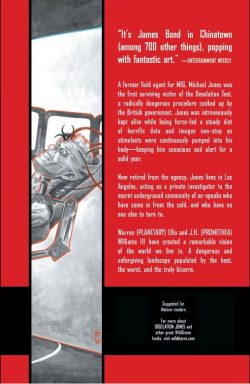
Their fabulously engaging take on the veteran antihero was originally redefined by Warren Ellis & illustrator Jason Masters, who jettisoned decades of gaudy paraphernalia that had accumulated around the ultimate franchise star, opting instead for a stripped-down, pared-back, no-nonsense agent who is all business. Successive creative teams have maintained that sleek, swift efficiency and at last Andy (The Losers, Green Arrow: Year One, Shadowland, Gamekeeper, Uncanny) Diggle: a British writer seemingly born to extend the adventures of 007.

Deftly and effectively handling the stunning visuals is Luca Casalanguida whose art – in combination with colourist Chris Blythe and letterer Simon Bowland – stirs wonderfully potent echoes of illustrator Yaroslav Horak who made the original newspaper strip such a heady delight.

This high-tech terrorism tale opens with Bond in Venezuela, bloodily failing his assignment to capture lethal hacker-for-hire Saxon and gather intel on enigmatic terrorist Kraken. Hauled – after the opening credits, of course – back to MI6 HQ in Vauxhall Cross, London, the agent is suitably carpeted by M before being fobbed off with a babysitting job.

His charge is Lord Bernard Hunt, a British Arms magnate currently upgrading the UK’s tired old Trident Nuclear arsenal. Hunt’s company is also a major exporter of cutting-edge weaponry, and Bond is to shadow him at an arms fair in Dubai…

Thankfully there’s compensation of a sort as the gunsmith’s luscious daughter Victoria is also the firm’s Vice President. A dedicated patriot and anglophile, “Tory” finds plenty of ways to amuse the bodyguard: everything from a guided tour of the company’s new super toy – a colossal rail gun dubbed Hammerhead – to drinking and games…

Tragically, Kraken is again one step ahead of Bond and the mission goes disastrously wrong…

Meanwhile back in Blighty, an attack on a Hunt helicopter in Scotland results in the loss of a mothballed Trident warhead…

With Tory’s help, Bond is soon on the track of the suspected perpetrators. After a great deal of research, battle and bloodshed, a trail leads to Yemeni smuggler Karim Malfakhar. However, despite being responsible for most of the bodycount, Bond is not content with how the mission is unfolding. Something is not right…

Black Crannog is Hunt’s Nuclear Reprocessing Facility: a sea platform in the Outer Hebrides where Tory welcomes M, Miss Moneypenny and Defence Secretary Simon Wallis to discuss the crisis. When Kraken springs a trap, not all of them survive…

Happily, in the interim, Bond has put all the piece together correctly and is heading for the rig in a Royal Navy Ballistic Missile Submarine with a full team of SBS (Special Boat Service) commandos. As Kraken proudly initiates the final stage of a plan to nuke London and usher in a new era of warfare, Bond makes another spectacular last-ditch assault to save the day and kill his latest foe.

Luckily, Black Crannog is literally packed with super weapons…

Offering all the traditional Bond set-pieces such as exotic locales, spectacular chases and astoundingly protracted fight sequences, this is a rousing mystery romp fans will adore, supported by a gallery of eye-catching variant covers by Francesco Francavilla, Robert Hack & Ron Salas, plus art features detailing Casalanguida’s process from layout to finished line art and character design sketches.

This riotous espionage episode is fast, furious and impeccably stylish: in short, another ideal James Bond thriller, that will leave you both shaken and stirred…
© 2017 Ian Fleming Publications, Ltd. James Bond and 007 are ™ Danjaq LLC, used under license by Ian Fleming Publications, Ltd. All rights reserved.

The Simon & Kirby Library: Horror!


By Joe Simon, Jack Kirby, Mort Meskin, Bill Draut, Martin Stein, Ben Oda, George Roussos, Vic Donahue, Bill Walton, Harry Lazarus, Jim Infantino, Bruno Premiani, John Prentice, Jerry Grandenetti, Ernie Schroeder and various (Titan Books)
ISBN13: 978-1-84856-959-1 (HB)

There’s some magnificent vintage Jack Kirby material around these days but tragically a lot of it hasn’t made the jump to digital yet. One such tragic omission is Titan Books’ splendidly sumptuous Simon & Kirby Library: gathering that iconic team’s groundbreaking genre contributions. Today, let’s look at one of the most compelling: a compendium of mystery, suspense and the supernatural…

Kirby’s collaborations with fellow industry pioneer Joe Simon always produced dynamite concepts, unforgettable characters, astounding stories and huge sales no matter what avenues they pursued, blazing trails for so many others to follow and always reshaping the very nature of American comics with their innovations and sheer quality.

Comic books started slowly in 1933, until the creation of superheroes like Superman unleashed a torrent of creative imitation and invented a new genre. Implacably vested in the Second World War, the Mystery Man swept all before him (very occasionally her or it) until the troops came home and older genres supplanted the Fights ‘n’ Tights crowd.

Although new kids kept up the buying, much of the previous generation also retained their four-colour habit, but increasingly sought more mature themes in the reading matter. The war years altered the psychology of society and a more world-weary, cynical reading public came to see that all the fighting and dying hadn’t really changed anything. Their chosen forms of entertainment – film and prose as well as comics – increasingly reflected this.

Western, War and Crime comics, madcap teen comedy and anthropomorphic funny animal features were immediately resurgent, Simon & Kirby introduced Romance comics in 1947 even as pulp-style Science Fiction began to spread. In the real world, another global revival of spiritualism and interest in the supernatural – possibly provoked by the monstrous losses of the recent conflict (just as had happened in the 1920s, following WWI) – led to a wave of increasingly impressive, evocative and even shocking horror comics.

There were grisly, gory and paranormal paragons previously, including a pantheon of ghosts, monsters and wizards draped in costumed hero trappings (The Spectre, Mr. Justice, The Heap, Frankenstein, Sargon the Sorcerer, Zatara, Dr. Fate and dozens of others), but these had been victims of circumstance: the Unknown as convenient power source for super-heroics.

Now the focus shifted to ordinary mortals thrown into a world beyond their ken with the intention of unsettling, not vicariously empowering, the reader…

Practically every publisher jumped on the monumentally popular juggernaut, but B & I (which became the magical one-man-band Richard E. Hughes’ American Comics Group) launched the first regularly published horror comic in the autumn of 1948. Adventures Into the Unknown was technically pipped by Avon whose impressive single issue release Eerie debuted and closed in January 1947. They wised up late and launched a regular series in 1951…

By this time Classics Illustrated had already long milked the literary end of the medium with adaptations of The Headless Horseman, Dr. Jekyll and Mr. Hyde (both 1943), The Hunchback of Notre Dame (1944) and Frankenstein (1945) among others.

It was at this time that Joe Simon and Jack Kirby identified another “mature market” gap for the line of magazines they autonomously packaged for publishers Crestwood/Prize/Essenkay to supplement Headline Comics, Justice Traps the Guilty, Police Trap, Young Romance and their other anthologies.

They too saw the sales potential for macabre material, resulting in the superb and eerily seminal Black Magic (launched with an October/November 1950 cover-date) and boldly obscure psychological drama anthology Strange World of Your Dreams in 1952.

Marvel had jumped on the bloody bandwagon early, but National/DC Comics only reluctantly bowed to the inevitable, launching a comparatively strait-laced short story title that nevertheless became one of their longest-running and most influential titles with the December 1951/January 1952 launch of The House of Mystery.

Soon after, a hysterical censorship scandal led to witch-hunt Hearings (see the Senate Subcommittee on Juvenile Delinquency, April-June 1954) which panicked most comics publishers into adopting a castrating straitjacket of self-regulatory rules…

Just like today, America back then cast about wildly looking for external contaminants rather than internal causes for a perceived shift in social attitudes and youthful rebellion: happily settling on bloodthirsty comics about crime or horror, drenched in unwholesome salacious sex, as the reason their children were talking back, acting up and staying out late.

S&K didn’t do those kinds of comicbooks but they got tarred – and metaphorically feathered too – in the media-fuelled frenzy…

This striking full-colour hardback begins with the essay ‘That Old Black Magic’ by series editor Steve Saffel; delineating the history of the title and tone of the times whilst ‘Simon and Kirby’s Little Shop of Horror’ details the workings of the small but prolific studio of rotating artists who augmented the output of the named stars: creators such as Mort Meskin, Bill Draut, Martin Stein, Ben Oda, George Roussos, Vic Donahue, Bill Walton, Jim Infantino, Bruno Premiani, John Prentice, Jerry Grandenetti and more…

With vast output across many titles, S&K simply couldn’t produce every story and many yarns here are ghosted by other hands, although each and every one does begin with a stunning Kirby splash panel.

As with all their titles, Simon & Kirby offered themed material tweaked by their own special sensibilities. Black Magic – and the Mort Meskin-inspired The Strange World of Your Dreams – eschewed cheap shocks, mindless gore and goofy pun-inspired twist-endings in favour of dark, oppressive suspense soaked in psychological paralysis and inexplicable unease: Tension over Teasing…

The stories presented fantastic situations and, too frequently for comfort, there were no happy endings, pat cosmic justice or calming explanations: sometimes The Unknown just blew up in your face and you survived or didn’t… but never whole or unchanged.

The compendium of bleak cartoon cavortings commences with ‘Last Second of Life!’ (from volume 1 #1, October-November 1950) wherein a rich man obsesses over what the dying see at the final breath, but learns to regret the unsavoury lengths he goes to in finding out, after which ‘The Scorn of the Faceless People!’ (#2 December 1950-January 1951) relates the meaning behind a chilling nightmare.

It’s not hard to believe this one must have prompted the creation of the spin-off Strange World of Your Dreams. Issue #2 also provided a chilling report on a satanic vestment dubbed ‘The Cloak!’ whilst an impossible love in the icy wastes of Canada ended with ‘A Silver Bullet for Your Heart!’ in #3 (February-March 1951).

Issue #4 provided ‘Voodoo on Tenth Avenue’ as a disgruntled wife went too far in her quest to get rid of her man, whilst in #5 ‘The World of Spirits’ recounted the uncanny predictions of Emanuel Swedenborg in a brief fact feature before #6 described psychic connection and a ‘Union with the Dead!’ and a ravaged mariner survived meeting ‘The Thing in the Fog!’ (#7) – an encounter with the legendary Flying Dutchman…

Black Magic #8 (December 1951-January 1952) details the sacrifice a woman made to save her man from ‘Donovan’s Demon!’ (mostly illustrated by Bob McCarty) whilst ‘Dead Man’s Lode!’ (#10 March 1952 – the series now being monthly) related a ghostly experience in an old mine and ‘The Girl Who Walked on Water!’ in #11 showed the immense but fragile power of self-belief…

Meskin & Roussos illustrated #12’s ‘A Giant Walks the Earth!’ as a downed pilot lost his best friend to a roving colossus in India, after which the utterly chilling and unforgettable ‘Up There!’ kicks off three stories from the landmark 13th issue…

The saga of a beguiling siren of the upper stratosphere is followed by ‘A Rag – a Bone and a Hank of Hair!’ (Meskin) and a walking pile of trash that learned to love, whilst ‘Visions of Nostradamus!’ (by Al Eadeh) tracks and interprets the prognosticator’s predictions.

‘The Angel of Death!’ in #15 outlines a horrific medical mystery and ‘Freak!’ (#17, possibly by Bill Draut) exposes a country doctor’s deepest shame.

Black Magic #18 (November 1952) is another multi-threat issue. ‘Nasty Little Man!’ gets my vote for scariest horror art job of all time as three hobos discover to their everlasting regret why you shouldn’t pick on short old men with Irish accents…

‘Come Claim My Corpse’ (Martin Stein?) offers a short, sharp, shocker wherein a convict discovers too late the flaw in his infallible escape plan, before an investigator tracing truck-wreckers learns of ‘Detour Lorelei on Highway 52’ (McCarty)…

‘Sammy’s Wonderful Glass!’ in #19 (December 1952) shows the tragic outcome of a retarded lummox whose favourite toy can expose men’s souls, after which two shorts from #20 (January 1953) follow. ‘Birth After Death’ retells the true story of how Sir Walter Scott‘s mother survived premature burial, whilst ‘Oddities in Miniature: The Strangest Stories Ever Told!’ offers half a dozen uncanny tales on one page.

Issue #21 provided ‘The Feathered Serpent’ in which an American archaeologist uncovers the truth about an ancient god, before #22 (March 1953) slips into sci-fi morality play mode with UFO yarn ‘The Monsters on the Lake!’, and ‘Those Who Are About to Die!’ from #23 sketches out the tale of a painter who can predict imminent doom…

A brace of tales from #24 (May 1953) begins with a scholar who attempts to contact the living ‘After I’m Gone!’, complemented by half-page fact feature ‘Strange Predictions’ (Harry Lazarus) after which ‘Strange Old Bird!’ is the first of three stories from the (again bimonthly) Black Magic #25 (June/July 1953).

In this gently eerie thriller, a little old lady gets the gift of life from her tatty old feathered friend, whilst ‘The Human Cork!’ precis’ the life of literally unsinkable Angelo Faticoni, before a man without a soul escapes the morgue to become ‘A Beast in the Streets!’

There’s a similar surfeit of sinister riches from #26, beginning with ‘Fool’s Paradise!’, wherein a cheap bag-snatcher makes a deal with the devil, even as ‘The Sting of Scorpio!’ sees a rude sceptic wish she’d never taunted a fortune teller.

‘The Strange Antics of the Mystic Mirror!’ terrified nurses in a major metropolitan hospital and ‘Demon Wind!’ (Kirby inked by Premiani) finds a brash Yankee learning the efficacy of a primitive tribe’s justice system…

‘The Cat People’ (#27) mesmerise and forever mark an unwary tourist in rural Spain, and the same issue exposes a seductive Scottish supernatural shindig hosted by ‘The Merry Ghosts of Campbell Castle’, whilst #28 finds an unwilling organ donor reclaiming his “property” in ‘An Eye for an Eye!’ The same issue reveals with mordant wit how a mummy returns to make his truly beloved ‘Alive After Five Thousand Years!’…

From an issue cited during those anti-comic book Senate Hearings, ‘The Greatest Horror of Them All!’ (#29 March-April 1954) tells of a freak hidden amongst freaks, before Black Magic #30 exposes the appalling secret of ‘The Head of the Family!’ (Kirby & Premiani) whilst #31 provides both alien invasion horror ‘Slaughter-House!’ and a cautionary tale of a child raised by beasts in ‘Hungry as a Wolf!’ (Ernie Schroeder).

‘Maniac!’ from #32 is another artistic tour de force and a tale much “homaged” in later years, detailing how a loving brother stops villagers taking his simple-minded sibling away, before the Black Magic section concludes with a terrifying fable of atomic radiation and mutated sea creatures in ‘Lone Shark’ from #33 (November/December 1954).

With the sagacious, industry-hip, quality-conscious Simon & Kirby undoubtedly seeing the writing on the wall, their uniquely macabre title was wisely cancelled in 1954, not long before the Comics Code came into effect. A bowdlerised version was relaunched in 1957, long after they had dissolved their partnership and moved into different areas of the industry.

However, the eerie treats don’t end yet, as a short but sublime sampling from their other mystery title is appended here.

We Will Buy Your Dreams‘ discusses features and stories from abortive, revolutionary title The Strange World of Your Dreams: inspired by studio-mate Mort Meskin’s vivid night terrors. The premise involves parapsychologist Richard Temple explaining and analysing storied nightmares with pictorially dramatised dreams sent in by readers.

The too short comics section begins with ‘Send Us Your Dreams’ from #1 (August 1952); a “typical” insecurity nightmare and the chilling ‘I Talked with my Dead Wife!’, whilst #2 (September/October) provides a trio of taught traumatic tales. ‘The Girl in the Grave!’ is a scary wedding scenario in the ‘You Sent Us This Dream!’ sector, before ‘Send Us Your Dreams’ sees Dr. Tempe describe the extent of self-preservation imagery…

‘The Woman in the Tower!’ comes from #3 (November/December), detailing typical symbolism whilst ‘You Sent Us this Dream’ from the same issue explains away a nightmare climb up an unending tower…

Capping off everything is a spectacular Cover Gallery, reprinting Black Magic #1-33, and a stunning unpublished cover; performing the same service for The Strange World of Your Dreams #1-4, plus the unpublished #5, just to make our lives utterly complete.

The Simon & Kirby Library: Horror! is a gigantic compendium of classic dark delights that perfectly illustrates the depth and scope of their influence and innovation and readily displays the sheer bombastic panache and artistic virtuosity they brought to everything they did. This is a worthy, welcome introduction to their unique comics contributions, and needs the relative immortality of electronic iterations.

It would be far less grim on your hands and wrists, too…
© 2014 Joseph H. Simon and the Estate of Jack Kirby. All Rights Reserved.