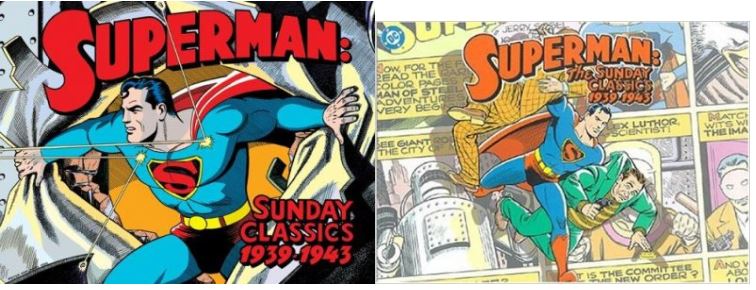
Superman Sunday Classics Strips 1-183 (1939-1943)


By Jerry Siegel & Joe Shuster & the Superman Studio (DC/Kitchen Sink Press: Sterling Publishing Co. Inc.)
ISBN: 978-1-40273-786-2 (Sterling) 978-1-56389-472-5(DC/KS)

It’s indisputable that the American comic book industry – if it existed at all – would have been an utterly unrecognisable thing without Superman. Jerry Siegel & Joe Shuster’s unprecedented invention was rapturously adopted by a desperate and joy-starved generation, quite literally giving birth to a genre if not an actual art form.

Within three years of his 1938 debut, the intoxicating blend of breakneck, breathtaking action and wish-fulfilment that epitomised the early Man of Tomorrow spawned an impossible army of imitators. The original’s antics and variations grew to encompass cops-and-robbers crime-busting, socially reforming dramas, science fiction fantasies, and whimsical comedy. Once the war in Europe and the East ensnared America, patriotic relevance for a host of gods, heroes and monsters exploded: all dedicated to exuberant, eye-popping excess and vigorous dashing derring-do.

In comicbook terms Superman was master of the world. Moreover, whilst transforming the shape of the fledgling funnybook industry, the Metropolis Marvel relentlessly expanded into all areas of the entertainment media. Although we all think of the Cleveland boys’ iconic invention as the epitome and acme of comicbook creation, the truth is that very soon after his debut in Action Comics #1, the Man of Steel became a fictional multimedia monolith in the same league as Popeye, Tarzan, Sherlock Holmes and Mickey Mouse.

We parochial and possessive comics fans too often regard our purest, most powerful icons in purely graphic narrative terms, but the likes of Batman, Spider-Man, The Avengers and their hyperkinetic kind long ago outgrew four-colour origins and are now fully mythologized media creatures instantly familiar in mass markets, across all platforms and age ranges…

Far more people have seen or heard an actor as Superman than have ever read his comicbooks. The globally syndicated newspaper strips alone reached untold millions, and by the time his 20th anniversary rolled around at the very start of what we know as the Silver Age of Comics, Superman was a thrice-weekly radio serial regular and starred in an astounding animated cartoon series, two films, on TV and a prose novel by George Lowther.

He was a perennial sure-fire success for toy, game, puzzle and apparel manufacturers and had just ended that first smash live-action television presence. In his future were three more shows (Superboy, Lois & Clark and Smallville), a stage musical, a string of blockbuster movie franchises and an almost seamless succession of games, bubble gum cards and TV cartoons beginning with The New Adventures of Superman in 1966 and continuing ever since. Even his superdog Krypto got in on the small-screen act…

Although pretty much a spent force these days, for the majority of the last century the newspaper comic strip was the Holy Grail that all American cartoonists and graphic narrative storytellers hungered for. Syndicated across the country – and often the planet – it was seen by millions, if not billions, of readers and generally accepted as a more mature and sophisticated form of literature than comic-books. It also paid better.

And rightly so: some of the most enduring and entertaining characters and concepts of all time were created to lure readers from one particular paper to another and many of them grew to be part of a global culture.

Mutt and Jeff, Flash Gordon, Dick Tracy, Buck Rogers, Charlie Brown and so many more escaped their humble tawdry newsprint origins to become meta-real: existing in the minds of earthlings from Albuquerque to Zanzibar. Most of them still do…

However it was considered something of a risky double-edged sword when a comicbook character became so popular that it swam against the tide (after all, weren’t the funny-books invented just to reprint the strips in cheap accessible form?) to become a genuinely mass-entertainment syndicated serial strip.

Superman was the first comic book star to make that leap – six months after exploding out of Action Comics – with only a few ever successfully following. Wonder Woman, Batman (eventually) and teen icon Archie Andrews made the jump in the 1940s with only a handful like Spider-Man, Howard the Duck and Conan the Barbarian doing so since.

The Superman daily newspaper comic strip launched on 16th January 1939, supplemented by a full-colour Sunday page from November 5th of that year. Originally crafted by Siegel & Shuster – whose primary focus switched immediately from comic books to the more prestigious and lucrative tabloid iteration – and their hand-picked studio (Paul Cassidy, Leo Nowak, Dennis Neville, John Sikela, Ed Dobrotka, Paul J. Lauretta & Wayne Boring), the mammoth daily grind soon required the additional talents of Jack Burnley and supplementary writers including Whitney Ellsworth, Jack Schiff & Alvin Schwartz.

This superb collection – doubly out-of-print and still not available digitally, despite its superb quality and sublime content – opens with an Introduction by contemporary Super-Scribe Roger Stern. He effusively recaps the sensation and spotlights his creators, before we see the first 19 complete tales of the primal powerhouse in stunning full colour stupendously unfold.

Whether in pamphlet or local periodical, these tales of the modern Hercules exploded into the consciousness of the world. No one had ever seen a fictionalised hero throw all the rules of physics away and burst into unstoppable, improbable action on every page. In fact, editors and publishers’ greatest concern was that the implausible antics would turn off audiences. Clearly, they could not have been more wrong…

Thus early episodes simply establish the set-up of an Alien Wonder among us, masquerading as an extremely puny human at a “great metropolitan newspaper”… when not crushing evil as his flamboyant alter-ego. These stories are all about constant action and escalating spectacle, displaying the incredible power of a bombastic, heroic man of the people…

On the first Sunday in November 1939 the parade of marvels commenced with a single introductory page describing Superman’s origins in ‘The Man of Tomorrow’ followed seven days later by initial adventure ‘Twenty-Four Hours to Ruin’ which found the Action Ace in a non-stop rush of blood and thunder, saving a logging concern from sabotage and hostile takeover by gangsters.

Crime segued into scientific fantasy when Superman saved ‘The Mindless Slaves of Dr. Grout’ from forced labour as the villain fomented a coup against America…

Inklings of true comic book themes and more complex storylines arrived as Clark Kent and Lois Lane were despatched to investigate the ‘Giants of Doom Valley’: discovering a race of hostile subterranean invaders for Superman to discourage, before ‘Assassins and Spies’ took them into the most pressing concern of the era after agents of a foreign power spread sedition and terror on America’s shores to bolster a European war.

A mysterious mastermind then employed super-science, coercion, abduction and giant insects to ensure ‘The Chosen’ carried out his plans of global financial dominance before a more bucolic tale saw Superman helping Lois escape fatal consequences as ‘The Dangerous Inheritance’ left her with 5,000 acres of seemingly worthless scrubland. Not everyone agreed with the assessment and the Man of Steel was never busier…

Woe in the wilderness gave way to big city bombast as ‘The Bandit Robots of Metropolis’ caused carnage in search of cash, pushing the Man of Steel to his physical and intellectual limits and priming him for a landmark clash against ‘Luthor, Master of Evil’ who turns the weather into a weapon in his escalating war against mankind.

A cunning murderer sought to frame a professional automobile driver in ‘Death Race’ whilst a high-tech propaganda campaign almost destabilised the city when ‘The Committee for a New Order’ pirated the airwaves. Crushing their campaign of terror, Superman was embroiled in a blistering battle against vile enemy agents who knew Lois was his Achilles’ Heel…

Another corporate assault on trade is exposed when freight drivers are poisoned by crooks trying to ‘Destroy All Trucks’ of a businessman’s rivals, after which a mirage-making super-villain pillages Metropolis until her galvanic guardian saw through ‘The Image’…

When Clark’s ‘Arson Evidence’ convicts an innocent man, his other self moves Heaven and Earth to exonerate the jailbird and ferret out the true fire-fiend, after which – it being almost three years since his debut – Superman spent two weeks reminding old readers and informing new ones why and how he was ‘The Champion of Democracy’.

To a large extent mention of World War II was kept to a minimum on the Action Ace’s funny pages, but now ‘The Superman Truck’ – detailing how a prototype military transport was relentlessly targeted by saboteurs – plunged right in to conflict with a subplot about a reluctant taxi driver enlisting in the Army Transport Corps. Tracing his induction and training, this yarn was a cunningly-conceived weekly ad and plea for appropriately patriotic readers to enlist…

Military motifs continued as a ship full of diplomats and war correspondents was set afire by an incendiary madman allied to in-over-their-heads Fifth Columnists. It’s not long before ‘The Blaze’ is in critical timberland, acting on his own deranged impulses and leaving the Metropolis Marvel with the huge job of saving America’s war effort…

Showbiz raised its glamorous head when Clark and Lois were sent to cover the morale-boosting ‘Hollywood Victory Caravan’ tour, only to stumble into backbiting, sabotage, intrigue and murder at the hands of Nazi infiltrators.

Wrapping up the vintage spills and thrills is another fervent comics call to arms as Superman – and Clark – take a well-intentioned but lazy and perpetually backsliding wastrel in hand. How he is shepherded through aviator ‘Cadet Training’ to a useful existence as a warrior of Democracy is a rousing wonder to behold.

Supplementing the gloriously rip-roaring, pell-mell adventure are spellbinding extra features including ‘How Superman Would End World War II’ (first seen in the February 27th 1940 issue of mainstream icon Look magazine), promo ads and a 1942 ‘Superman Pinup’.

This specific Sterling Publishing volume is a reissue of the 1999 DC/Kitchen Sink co-production, but either edition offers timeless wonders and mesmerising excitement for lovers of action and fantasy. If you love the era or just crave simpler stories from less angst-wracked times, these yarns are perfect comics reading, and this a book you simply must have.
Superman and all related names, characters and elements are ™ & © DC Comics © 2006. All rights reserved.
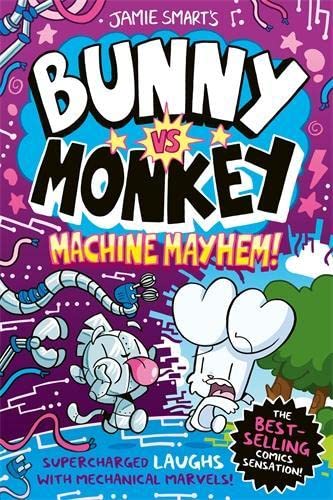
Bunny vs Monkey: Machine Mayhem!


By Jamie Smart, with Sammy Borras (David Fickling Books)
ISBN: 978-1-78845-297-7 (TPB)

Bunny vs. Monkey has been a staple of The Phoenix since the very first issue in 2012: recounting a madcap vendetta gripping animal arch-enemies set amidst an idyllic arcadia masquerading as more-or-less mundane but critically endangered English woodlands.

Concocted with gleefully gentle mania by cartoonist, comics artist and novelist Jamie Smart (Fish Head Steve!; Looshkin; Flember), these trendsetting, mind-bending yarns have been wisely retooled as graphic albums available in remastered, double-length digest editions such as this one. Now brilliantly beach-ready comes a handy pocket paperback edition to consult when the surf’s all unsanitary and there’s sand or sandwiches in the Gameboy…

The tail-biting tension and animal argy-bargy began yonks ago after an obnoxious little anthropoid plopped down after a disastrous British space shot. Crashlanding in Crinkle Woods – scant miles from his launch site – lab specimen Monkey believed himself the rightful owner of his strange new world, despite all efforts from reasonable, sensible, contemplative resident Bunny to dissuade him. For all his patience, propriety and genteel good breeding, the laid-back lepine just could not contain the incorrigible idiot ape, who was – and still is – a rude, noise-loving, chaos-creating troublemaker…

Problems are exacerbated by other unconventional Crinkle creatures, particularly a skunk called Skunky who has a mad scientist’s attitude to life and a gift for building robots and super-weapons…

With artistic assistance from design deputy Sammy Borras, the saga resumes with the war of nerves and mega-ordnances apparently over. The unruly assortment of critters cluttering up the bucolic paradise had finally picked sides and the battles at last ended. They even seemingly forgot the ever-encroaching Hyoomanz…

Following a double-page pin-up of the ever-expanding cast, this archive of anarchic insanity opens in the traditional manner: divided into seasonal outbursts, and starting with a querulous teaser tale as Spring begins in ‘D.I.Whyyyy?’

As the animals gather to help Bunny repair his much-abused house, universal innocents Pig Piggerton and Weenie squirrel – more keen than skilled – realise that cheese is not a suitable substitute for wallpaper paste, plaster or cement…

Despite the subsequent collapse, times are good and very peaceful since the awful ape went away and Ai (an Aye-aye) acts quickly to keep it that way when Bunny feels nostalgic for the old days. Sadly, somebody’s listening and brings in a ‘Makeshift Monkey!’ – until the real deal returns in ‘The Little Monkey Who Cried…’

Before long Skunky is back too and everyone’s fleeing for their lives from deadly underground tentacles, but life quickly slips into its old pattern… until obsolescence rears its ugly head and cyborg gator Metal Steve is pronounced ‘Out of Warranty’: left to wither on Skunky’s scrapheap…

Back and still bad, Monkey briefly inflicts himself on Bunny and wrecks the joint again in ‘The Housemate’ after which our mercurial monochrome megamind constructs a replacement for the gone gator: triggering ‘Robot Rampage’ when infinitely superior mechanoid Metal E.V.E. lay down her own law…

Falling foul of another near-lethal prank the silly simian is scientifically resurrected and evolved in ‘Curse of the Monkey’ only to trip on his own incompetence and barely escape a fishy final fate in ‘Toilet Run!’

A close call with humans in ‘Bunny vs Monkey Jellybeans!’ precedes piratical pretenders Weenie and Pig’s ‘A Dangerous Voyage’, before Monkey endures his own Journey into the Unknown. As “The Most Brilliant Animal in the Woods” Skunky convinces his erstwhile ally to shrink down and explore the inner cerebellum of brain-battered, bewildered ex-stuntman Action Beaver for ‘The Lost Memory’ of a misplaced ultimate weapon, which is what probably inspires him to make his own, after entering a competition and prematurely unleashing his ‘Winning Entry’…

Metal E.V.E. is forming her own plans but they have to wait a bit as she’s ‘Keepin’ Busy’ with some domestic chores in Skunky’s lab, but it’s not long until Summer begins and the woods are imperilled by subterranean invasion from new menace ‘Roland T. Mole’…

Hijinks in parallel dimensions herald the arrival of doomsayer ‘Skunky?’ as the forgotten stuntman stumbles with catastrophic consequences into his ancestral homeland in ‘Beaverville’. Monkey meanwhile creates unexpected carnage but precious little terror with super-cute kaiju ‘Rofl Axolotl’ before being painfully reminded how dangerous the woods can be in ‘So Beautiful’…

After a brief and deceptive flirtation with ‘The Dark Arts’, the hairy halfwit returns to science by creating little golden minions, but his ‘Gloobs’ prove too smart for servitude, so instead embraces high fashion in ‘C’est Chic!’ Utterly uncaring, Weenie and Pig go about their business until a ‘A New Friend’ almost breaks up the partnership. The swiftly-developing relationship of ‘Weenie and Winnie’ seems set to end the good old days, but another robotic invasion sets the world to rights in ‘Just Checking’…

A reality-altering beast threatens in ‘Wishful Thinking’ and the entire woods go all French just as aliens invade in ‘L’Honk Honk’ before Monkey & Skunky explore artisanal dining in ‘Eat Up!’, with appalling consequences for their customers, after which Ai and Monkey discover uncanny ‘Night Lights’ in the deep dark woods…

The season concludes with Metal E.V.E. getting ahead by installing crucial ‘Upgrades’ and inadvertently making contact with an unsuspected predecessor just as Autumn opens with ‘Bumblesnatch’ and pig & squirrel enjoying super-powers-inducing chewing gum whilst Crinkle Woods is catapulted into a different kind of chaos when broached by pet pooch ‘Fluffy’…

When ‘The Summoning’ invokes some pretty indifferent forest gods, Skunky lodges with over-accommodating Bunny, who is soon sucked into unwanted adventure ‘Down Below’ and unearths E.V.E.’s brave new world. Hopeless old ally Metal Steve then runs amok with nano-bots and spawns unlikely armageddon beast ‘Pig-Kira!’

Once that menace vanishes into vapour, the mostly organic animals unite to formulate ‘Some Kind of Plan’ for fighting E.V.E. – all except ‘Nurse Monkey’ who’s keen to explore other lifestyles – before reenlisting in ‘Roll Up! Roll Up!’ with a barmy spinning machine. It has no chance of easing their plight but will probably end their lives before she does…

The crusade pauses for Weenie’s birthday and the hunt for ‘The Best Present in the World’, but restarts again when E.V.E. crashes the party with ‘Something to Say’ about the “rise of the machines” and end of all flesh…

Skunky’s response is yet another monster, but giant mecha-hedgehog ‘Thunderball!’ is easily overcome, and as so-distractable Monkey goes wild among the fallen leaves in ‘Leaf it Alone’, the machine rise begins in ‘Nahhhhh!’…

Sadly, Metal E.V.E. makes a big mistake then, spilling Monkey’s drink and kicking the conflict to an unprecedented new level…

Pausing for Weenie, Pig, Ai and Bunny to share some ‘Scary Stories’ around a nighttime campfire, the constant crisis enters a new phase when the ghost of local legend Fantastic Le Fox manifests, even as our ape oaf is transformed into E.V.E.’s ‘Metal Monkey’…

Le Fox is ‘An Old Friend’ resolved to help the animals survive and his strategic advice is welcome, but the turning point comes in ‘Clash of the Robots’ as Metal Monkey and Steve duel, even as their mecha-mistress takes full charge, unleashing DNA-altering microbots that put the fleshy freedom fighters to flight in ‘Uh-Oh-Nano!’

Winter sets in and hostilities suddenly cease as all concerned succumb to the temptation of chucking ‘Snowballs’ and the end gets nigher in a wave of robotic attacks triggered by ‘Metal Mania’. Yet again, everything pauses as Christmas provides a moment to unwrap ‘Presents’ but – drenched in seasonal spirit – ‘An Unlikely Hero’ dares to bring the message of the moment right to the robot queen. The act unwittingly changes the course of history in the woods, leaving only some ‘Tidying Up’ to restore everything to what passes for normal…

The animal anarchy might have ended for now, but there’s more secrets to share thanks to detailed instructions on ‘How to Draw Metal Steve’ and ‘How to Draw Metal E.V.E.’ to wind down from all that angsty furore…

The zany zenith of absurdist adventure, Bunny vs Monkey is weird wit, brilliant invention, potent sentiment and superb cartooning all crammed into one eccentrically excellent package. These tails never fail to deliver jubilant joy for grown-ups of every vintage, even those who claim they only get it for their kids. This is the kind of comic parents beg kids to read to them. Shouldn’t that be you?
Text and illustrations © Jamie Smart 2022. All rights reserved.
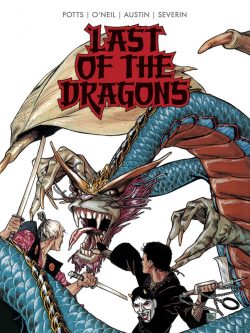
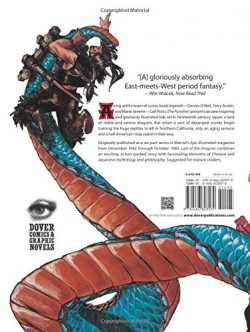
Last of the Dragons


By Carl Potts, Denny O’Neil, Terry Austin, Marie Severin & various (Dover Comics & Graphic Novels)
ISBN: 978-0-486-80357-9 (TPB/Digital edition)

The creative renaissance in comics during the 1980s resulted in some utterly wonderful stand-alone sagas which shone briefly and brightly – within what was still a largely niche industry – before passing from view as the business and art form battled spiralling costs, declining readerships and the perverse and pervasive attitude in the wider world that comic books were a ghetto and the natural province of mutants, morons and farm animals (I’m paraphrasing).

Unlike today, way back then the majority of grown-ups considered superheroes adolescent power fantasies or idle wish-fulfilment for the uneducated or disenfranchised, so an entertainment industry perceived as largely made up of men in tights hitting each other got very little notice in the wider world of popular fiction.

That all changed with the rise of comics’ Direct Sales Market. With its carefully targeted approach to selling, specialist vendors in dedicated emporia had leeway to allow frustrated creators to cut loose and experiment with other genres – and even formats.

All the innovation back then led inexorably to today’s high-end, thoroughly respectable graphic novel market which – with suitable and fitting circularity – is now gathering and re-circulating many breakthrough tales from those times, and not as poorly distributed serials but in satisfyingly complete stand-alone proper books.

Marvel was the unassailable front-runner in purveying pamphlet fiction back then, outselling all rivals and monopolising the lucrative licensed properties market (like Star Wars and Indiana Jones) which had once been the preserve of the Whitman/Dell/Gold Key colossus. This boosted a zeitgeist which proved that for open-minded readers, superheroes were not the only fruit…

As the Direct Sales market hit an early peak, Marvel unleashed its own rights-friendly creator-owned fantasy periodical in response to overwhelming success amongst older readers of Heavy Metal magazine. Lush, slick and lavish, HM had even brought a new, music-&- literature based audience to graphic narratives…

That response was Epic Illustrated: an anthological magazine offering stunning art and an anything-goes attitude – unhindered by the censorious Comics Code Authority – which saw everything from adaptations of Moorcock’s Elric and Harlan Ellison novellas to ‘The Last Galactus Story’, the debuts of comic book stars-in-the-making like Vanth Dreadstar and Cholly and Flytrap, plus numerous close-ended sagas which would become forerunners of today’s graphic novel industry.

These serialised yarns of finite duration included Rick Veitch’s Abraxas and the Earthman, Claremont & Bolton’s Marada the She-Wolf and a fabulously enchanting East-meets-West period fantasy entitled Last of the Dragons…

The fable was conceived by then-newcomer Carl Potts, who plotted and pencilled a globe-trotting drama for Denny O’Neil to script, before inker Terry Austin and colourist Marie Severin finished the art for Jim Novak to inscribe with a flourish of typographical verve.

The stylish opus ran intermittently in Epic Illustrated #15 through #20 (October 1982 to the end of 1983) and was collected in 1988 as a Marvel Graphic Novel under the Epic Comics aegis in the expansively extravagant, oversized European Album format: a square, high-gloss package which delivered so much more bang-per-buck than a standard comic.

Thankfully Dover retained those generous visual proportions for their glorious 2016 edition which begins with ‘The Sundering’: opening in grudgingly-changing feudal Japan of the late 19th century where aged master swordsman Masanobu peacefully meditates in the wilderness…

His Zen-like calm and solemn contemplation are callously shattered by a callow, arrogantly aggressive warrior who rudely attacks a beautiful dragon basking nearby in the sun. These magnificent reptiles are gentle, noble creatures, but the foolish samurai is hungry for glory and soon takes his bloody trophy…

After the arrogant victor has left, Masonobu meets Ho-Kan, a priestly caretaker of Dragons. The youth is overcome with horror and misery at such brutal sacrilege, but worse is to come. When the tearful cleric heads back to his temple home, he stumbles upon a corrupt faction of his brother monks covertly conditioning young forest Wyrms; shockingly brutalising them to deny their true natures and kill on (human) command…

‘The Vision’ sees traumatised Ho-Kan returned to the temple too late: ambitious, reactionary monk Shonin has returned from a journey to the outer world gripped by an appalling revelation. He has divined that the quiescent Dragons must be used to preserve Japan from outside influence – especially the insidious changes threatened by the encroaching white man’s world. In fact he has already been training the creatures to be his shock-troops…

When the elders object, Shonin’s zealots slaughter all the protesting monks before embarking for the barbarous wilds of America where they will breed and train an army of killer lizards in the lap of and under the very noses of the enemy. Ho-Kan is one of precious few of the pious to escape the butchery and vows to stop the madness somehow…

A meditative vision shows him Takashi: a half-breed boy whose Christian sailor father abandoned him. The juvenile outcast was eventually adopted by the Iga ninja clan and became a great fighter. Somehow he holds the key to defeating Shonin…

‘The Departure’ sees Ho-Kan hire the Iga to stop the corrupted monks but, when he tries to enlist Masanobu, Shonin’s acolytes capture him. Under torture all is revealed, and the debauched clerics trick the sword-master into fighting the ninjas for them. After despatching all but Takashi, the monks “invite” Masanobu to join them in the West. The elderly swordsman has no idea the saurian beasts he guards are hopelessly degraded monsters now.

‘The Arrival’ sees the monks and their hidden cargo sailing for California, unaware that an enigmatic “half-breed” has enlisted on a ship closely following. Sole surviving Iga ninja Takashi is bound in his duty and hungry for vengeance. He will not be denied…

When the priests disembark on a remote bay on the American coast their plan to slaughter the sailors and Masanobu goes badly awry after a baby dragon escapes. In the ensuing melee the aged warrior realises the true state of play and flees into the forests.

The First Nation tribes of the Californian forests are helpless before the martial arts and war-dragons of Shonin, until – in ‘The Meeting’ – they meet vengeful Takashi hot on the dragon-lords’ trail. After proving his prowess in combat by defeating the indigenous fighters, he joins with the braves, stalking the monks until they encounter Masanobu who is also determined to end this dishonourable travesty once and for all…

All of which results in a tumultuous and breathtakingly spectacular climax in ‘The Decision’ as the disparate factions collide, clashing one last time to forever decide the fate of a nation, the nature of a species and the future of heroes…

Rounding out this superb resurrection is a splendid and informative treasure trove of extra features comprising creator biographies, sample script pages, art breakdowns layouts, pencilled pages, promo art and portfolio illustrations and an effulgent, fondly reminiscent, informative Afterword from Potts – then embroiled in the laborious process of transferring Last of the Dragons from page to screen…

In its small way, this sublimely engaging pioneering prototype martial arts fantasy did much to popularise and normalise the Japanese cultural idiom at a time of great tumult and transition in the comics business but more important than that, it still reads superbly well today.

This is a magically compelling tale for fantasy fans and mature readers: an utterly delightful cross-genre romp to entice newcomers and comics neophytes whilst simultaneously beguiling dedicated connoisseurs and aficionados renewing an old acquaintance.
© 1982, 1988, 2015 Carl Potts. All rights reserved.

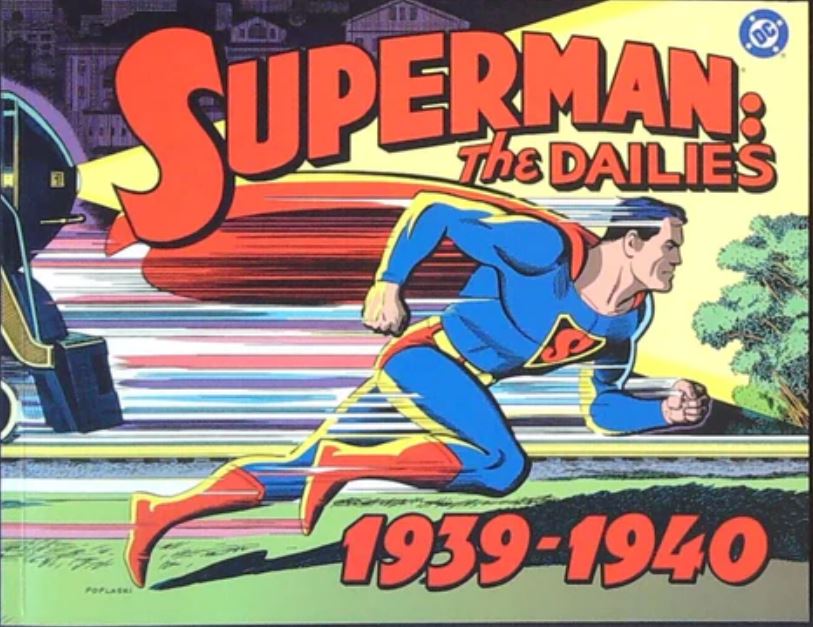
Superman: The Dailies 1939-1940


By Jerry Siegel & Joe Shuster with Paul Cassidy (DC/Kitchen Sink Press)
ISBN: 978-1-56389-460-2 (TPB)

It’s indisputable that the American comic book industry – if it existed at all – would have been an utterly unrecognisable thing without Superman. Jerry Siegel & Joe Shuster’s unprecedented invention was rapturously adopted by a desperate and joy-starved generation, quite literally giving birth to a genre if not an actual art form.

Within three years of his 1938 debut, the intoxicating blend of breakneck, breathtaking action and wish-fulfilment that epitomised the early Man of Tomorrow spawned an impossible army of imitators. The original’s antics and variations grew to encompass cops-and-robbers crime-busting, socially reforming dramas, science fiction fantasies, and whimsical comedy. Once the war in Europe and the East ensnared America, patriotic relevance for a host of gods, heroes and monsters exploded: all dedicated to exuberant, eye-popping excess and vigorous dashing derring-do.

In comic book terms Superman was master of the world. Moreover, whilst transforming the shape of the fledgling funnybook industry, the Metropolis Marvel relentlessly expanded into all areas of the entertainment media. Although we all think of the Cleveland boys’ iconic invention as the epitome and acme of comicbook creation, the truth is that very soon after his debut in Action Comics #1, the Man of Steel became a fictional multimedia monolith in the same league as Popeye, Tarzan, Sherlock Holmes and Mickey Mouse.

We parochial and possessive comics fans too often regard our purest, most powerful icons in purely graphic narrative terms, but the likes of Batman, Spider-Man, The Avengers and their hyperkinetic kind long ago outgrew four-colour origins and are now fully mythologized media creatures instantly recognisable globally across all platforms and age ranges…

Far more people have seen or heard an actor as Superman than have ever read his comic books. The globally syndicated newspaper strips alone reached untold millions, and by the time his 20th anniversary rolled around, Superman was a thrice-weekly radio serial regular and starred in an astounding animated cartoon series, two films, on TV and a prose novel by George Lowther.

He was a perennial sure-fire success for toy, game, puzzle and apparel manufacturers and had just ended that first smash live-action television presence. In his future were three more shows (Superboy, Lois & Clark and Smallville), a stage musical, a string of blockbuster movie franchises and an almost seamless succession of games, bubble gum cards and TV cartoons beginning with The New Adventures of Superman in 1966 and continuing ever since. Even his super-dog Krypto got in on the small-screen act…

Although pretty much a spent force these days, for the majority of the last century the newspaper comic strip was the Holy Grail that all American cartoonists and graphic narrative storytellers hungered for. Syndicated across the country – and often the planet – it was seen by millions, if not billions, of readers and generally accepted as a more mature and sophisticated form of literature than comic books. It also paid better.

And rightly so: some of the most enduring and entertaining characters and concepts of all time were created to lure readers from one particular paper to another and many of them grew to be part of a global culture.

Mutt and Jeff, Flash Gordon, Dick Tracy, Buck Rogers, Charlie Brown and so many more escaped their humble tawdry newsprint origins to become meta-real: existing in the minds of earthlings from Albuquerque to Zanzibar. Most of them still do…

However it was considered something of a risky double-edged sword when a comicbook character became so popular that it swam against the tide (after all, weren’t the funny-books invented just to reprint the strips in cheap accessible form?) to become a genuinely mass-entertainment syndicated serial strip.

Superman was the first comic book star to make that leap – six months after exploding out of Action Comics – with only a few ever successfully following. Wonder Woman, Batman (eventually) and teen icon Archie Andrews made the jump in the 1940s with only a handful like Spider-Man, Howard the Duck and Conan the Barbarian doing so since.

The Superman daily newspaper strip launched on 16th January 1939, and was eventually supplemented by a full-colour Sunday page from November 5th of that so momentous year. Originally crafted by Siegel & Shuster – whose primary focus switched immediately from comic books to the more prestigious and lucrative tabloid iteration – and their hand-picked studio (including Paul Cassidy, Leo Nowak, Dennis Neville, John Sikela, Ed Dobrotka, Paul J. Lauretta & Wayne Boring), the mammoth grind soon required the additional talents of Jack Burnley and even co-writers like Whitney Ellsworth, Jack Schiff & Alvin Schwartz.

This superb collection from 1999 – long overdue for re-release, especially in this anniversary year! – opens with an Introduction by James Vance, declaring ‘A Job for Superman’ before effusively recapping the overnight sensation conception, reviewing his antecedents and regaling us with the acts of his creators (and assistants like Cassidy).

Then we see the first 10 tales (nine and a half actually) of the primal powerhouse in all-action monochrome. Wisely and boldly, the first serial – ‘Superman Comes to Earth’ (16th – 28th January 1939) only depicts the Man of Tomorrow on the last of the 12 daily episodes. Instead, Siegel & Shuster took readers to doomed planet Krypton for the first time and revealed how desperate scientist Jor-L and wife Lora were thwarted in their attempts to save the population from their own indifference and ignorance and compelled in desperation to save their newborn son by sending him away in a prototype test rocket aimed at planet Earth. Almost as an afterthought, the last strip reveals how the infant was found, adopted, raised and now operates in secret as vigilante do-gooder Superman…

Whether in pamphlet or local periodical, these tales of the modern Hercules exploded into the consciousness of the world. No one had ever seen a fictionalised hero throw all the rules of physics away and burst into unstoppable, improbable action on every page and panel. In fact, editors and publishers’ greatest concern was that the implausible antics would turn off audiences. Clearly, they could not have been more wrong…

That’s only one reason why the indomitable champion confronted problems and issues every reader was familiar with. Second adventure ‘War on Crime’ (30th January – 18th February) combined social activism and civic corruption as the mighty Man of Tomorrow begins his crusading career by rescuing ten men trapped in a vault. In fact he only saves eight and realises that he needs to be in a place where information can reach him instantly. Thus Clark Kent applies for a job at The Daily Star and stumbles into a deadly case of graft, gangsterism and high-level corruption ferreted out by dynamic reporter Lois Lane. After Superman cleans up the racketeers, the shy unassuming new guy confirms his position by scooping Lois to the first interview with the mysterious costumed vigilante…

A boxing drama follows as the Man of Steel saves a derelict from suicide and uncovers a tragic case of match-fixing and shattered dreams. ‘The Comeback of Larry Trent’ (20th February – 18th March) begins with Superman masquerading as the supposedly finished former heavyweight champion in a whirlwind tour of spectacular bouts, whilst training and rehabilitating the stumblebum to reclaim his title personally in the big championship match. Of course, the Action Ace is on hand when Trent’s crooked manager tries to dope him a second time…

Lois begins her own rise to stardom when she’s relegated to the lonely hearts and lovelorn section, turning up a sinister case of a blackmailed husband entrapped by ‘Jewel Smugglers’ (20th March – April 1st) victimising refugees fleeing war in Europe. Naturally, Superman is lurking in the shadows, ready to handle any necessary roughness required…

A string of fatalities on a construction site takes the hero into the sordid depths of capitalism in ‘Skyscraper of Death’ (3rd – 29th April) as he tackles a saboteur and exposes a ruthless businessman happy to kill innocent workers to destroy a rival, after which ‘The Most Deadly Weapon’ (1st May – 10th June) reflects the tone of the times in a chilling tale of espionage and realpolitik. When Kent interviews Professor Runyan about his deadly new poison gas, the chemist is kidnapped and murdered by spies from a foreign nation. In hot pursuit, Kent discovers the plot was instigated by an arms dealer profiteering from an ongoing civil war and calls in his other – true – self to recover (and ultimately destroy) the formula, punish the perpetrators and even spectacularly force both sides to make peace…

Early episodes never stinted on action and increasingly ingenious ways of displaying Superman’s miraculous abilities. The plan was to simply establish the set-up of an Alien Wonder among us, masquerading as an extremely puny human at a “great metropolitan newspaper” when not crushing evil as his flamboyant alter-ego. These stories are all about constant action and escalating spectacle, displaying the incredible power of a bombastic, heroic man of the people…

Heralding longer stories and more evocative plots, Siegel returned to social crusading for ‘Superman and the Runaway’ (12th June – 22nd July), as the Man of Steel recues orphan Frankie Dennis from imminent destruction and discovers a tale of shocking corruption and abuse at the State Orphanage the boy would rather die than return to. Realising this is no job for Superman, Kent enlists Lois and Frankie to expose monstrous, murderous Superintendent Lyman, but severely underestimates the grafter’s ruthlessness…

Romance taints the air next as ‘Royal Deathplot’ (24th July – 11th November) finds Superman foiling a plan to literally torpedo the diplomatic mission of visiting dignitaries King Boru and Princess Tania of Rangoria. His epic and breathtaking sea battle against a submarine is only the tip of an iceberg of trouble as Superman – and even briefly Kent – find favour in the eyes of the princess, even as elements in the royals’ own embassage continually seek their destruction. Far from impressed, but hot on a scoop, Lois sticks close and plays fifth wheel and rival to super-smitten Tania until the Man of Steel can foil the plot, crush the sinister mad scientist behind it and stabilise the political situation at home and abroad…

Historians might be interested to know that during this yarn, the use of art assistant Cassidy became markedly more noticeable. Other than handling character faces himself, Shuster was happy for the other artists to express themselves in how Siegel’s scripts were interpreted…

Major events were in store both for the hero and the whole of humanity and ‘Underworld Politics’ (13th November – 16th December) signalled the closing of a chapter. Simple cathartic super-deeds would soon take a back seat to grander designs, but only after the tale of how Superman – and especially Lois – destroyed the seemingly impregnable party machine of crooked political boss Mike Hennessey. That well-connected unworthy thought he could terrorise and even murder a crusading new District Attorney, but he was so very wrong…

After his fall Lois thought she had the front page sewed up, but didn’t figure on World War being declared in Europe…

This initial volume of pioneering paper perils begins a saga of sabotage and ‘Unnatural Disasters’ (18th December 1939 – January 6th 1940) as a mysterious gang blow up a dam and then poison the reservoir. Moments too late in each instance, all Superman can do is save what lives he can and determine to avenge the dead…

To Be Continued…

Offering timeless wonders and mesmerising excitement for lovers of action and fantasy, the early Superman is beyond compare. If you love the era or just crave simpler stories from less angst-wracked times, these yarns are perfect comics reading, and this a book you simply must see.
Superman: The Dailies volume 1 copublished by DC Comics and Kitchen Sink Press. Covers, introduction and all related names, characters and elements are ™ & © DC Comics 1998, 1999. All Rights Reserved.

Beowulf – First Comics Graphic Novel #1


By Jerry Bingham, with Ken Bruzenak (First Comics)
ISBN: 978-0-915419-00-5 (Album PB)

The mid-1980s were a great time for comics creators. It was as if an entire new industry had opened up with the proliferation of the Direct Sales market and dedicated specialist retail outlets; new companies were experimenting with format and content, and punters had a bit of spare cash to play with. Moreover, much of the “kid’s stuff” stigma had finally abated and the US was catching up to the rest of the world in acknowledging that sequential narrative might just be an actual art-form…

Many new companies began competing for the attention and cash of punters who had grown accustomed – or resigned – to getting their four-colour kicks from DC, Marvel Archie and/or Harvey Comics. European and Japanese styled material had been creeping in but by 1983 a host of young companies such as WaRP Graphics, Pacific, Eclipse, Capital, Now, Comico, Dark Horse, First and many others had established themselves and were making impressive inroads.

New talent, established stars and fresh ideas all found a thriving forum to try something a little different both in terms of content and format. Chicago based First Comics was an early frontrunner, with Frank Brunner’s Warp, Mike Grell’s Starslayer and Jon Sable, Freelance and Howard Chaykin’s landmark American Flagg!, as well as an impressive line of titles targeting a more sophisticated audience.

In 1984 they followed Marvel and DC’s lead with a line of impressive, European-styled over-sized graphic albums featuring new and out-of-the-ordinary comics sagas (see Time Beavers, Mazinger and two volumes of Time2 to see just how bold, broad and innovative the material could be). The premier release was a stunning – subsequently award-winning (1985 Kirby Award for Best Graphic Album) – fantasy epic by Jerry Bingham.

Beowulf is a thrilling, compulsive and intensely visceral visualisation of the Anglo-Saxon epic poem committed to parchment sometime between the 8th and 11th century AD, and recently the subject of numerous screen iterations and re-interpretations.

Need a plot summary? Long ago in the far North, noble King Hrothgar built a mighty mead-hall for heroes, thereby incurring the malignant enmity of the monster Grendel. This beast ruthlessly and relentlessly raided the citadel, slaughtering many noble warriors every night. After a dozen years of horror, a valiant band of heroes led by Beowulf, Prince of the Geats, came to their aid, seeking glory and fame through battle…

The clash of Beowulf and Grendel is spectacularly handled as is the succeeding exploit wherein the stalking horror’s demonic mother comes seeking revenge and drags the warrior prince to her hideous lair beneath an icy lake, but the most effective and moving chapter is the very human-scaled Twilight of the Gods as, after 50 years ruling his Geatish kingdom, worn and elderly Beowulf goes to his final glorious battle, dying heroically whilst destroying a ravening firedrake which threatens to eradicate his people: the only proper end for a Northman Hero…

Bingham’s raw, fiercely realistic art-style perfectly captures the implacable sense of doom and by employing Prince Valiant’s text block-&-picture format he endows the tale with a grandeur frequently as mythic as Hal Foster’s strip masterpiece, whilst leaving the art gloriously free of distracting word-balloons.

Letterer/calligrapher Ken Bruzenak’s particular facility perfectly enhances the artistic mood by carefully integrating captions filled with Bingham’s free-verse transliterations of the original 3182-lines-long poem into a classic interpretation of the epic. This is a wonderful and worthy piece of work that will delight any fan of the medium. Let’s bring it back pretty please?

And for a perfect all-ages prose telling of the timeless tale I also heartily recommend Rosemary Sutcliff’s magnificent Beowulf: Dragonslayer: first released in 1961 and captivatingly illustrated by Charles Keeping. It is still readily available and one of the books that changed my life.
© 1984 First Comics, Inc. All rights reserved.

The Mercenary – The Definitive Editions volume 1 & 2


By Vicente Segrelles, translated by Mary McKee (NBM)
ISBN: 978-1-68112-124-6 (HB/Digital edition vol 1) ISBN: 978-1-68112-124-6 (HB/Digital edition vol 2)

Born in Barcelona in 1940, Vicente Segrelles Sacristán is a renowned illustrator of magazines and book covers on three continents and the creator of one of the world’s most popular graphic novel series. His first comics album El Mercenario (The Mercenary) was released in 1982: introducing an itinerant knight-for-hire fighting his way through a fantastic world of science and sorcery, usually on the back of a flying dragon.

Rendered initially in lush oil-paints (before graduating to creating art digitally from 1998 onwards), these epic tales blend visual realism and accuracy with fable, myth, historical weaponry, contemporary technology and classical science fiction themes. These fantastic scenes are screened through the visual lens of a trained architect and engineer. Fourteen albums were released between 1982-2003, most of them seen by English-language readers through the auspices of publisher NBM.

Hugely in demand for his painted covers since the 1970s, Segrelles has created book covers for the works of H. Rider Haggard, Poul Anderson, Roger Zelazny, Alistair McLean, G. F. Unger, Desmond Bagley, Andre Norton, Joel Rosenberg, Charles DeLint, C.H. Guenter, Jason Dark, Terry Pratchett and a host of others. European prose readers may also know him as the cover artist of Italian science fiction magazine Urania.

Volume 1 – The Cult of the Sacred Fire

Segrelles came to comics relatively late in his career and the reasons for that can be learned in a prodigious “behind-the-scenes” section at the back of this stunning remastered reissue.

Originally serialised in Spanish magazine Cimoc in 1980, El Mercenario was one of the earliest European series NBM published in English and to celebrate 40 years in business the company rereleased the series in fabulous oversized (314 x 236 mm) remastered hardcover albums to once more set the world alight. If you prefer, you could instead pick up a thoroughly modern digital edition.

What’s it about?: in the mediaeval world, a region of Central Asia lies all but undiscovered. The Land of Eternal Clouds is an isolate region where life has taken a different turn at the highest mountain levels. Here bat-like reptilian fliers – “dragons” – abound and humans have made them beasts of burden. This setting is the backdrop to introduce a nameless action hero and problem-solver who is engaged in this premier tome by the puissant potentate of one super-cumulus city-state to rescue his queen from vile abductors…

Riding a gigantic bat-winged lizard, the nameless Mercenary plucks the unfortunate lady from peril and defeats the dragon-riding guards who give chase… but only at great personal and financial cost.

Happily, the wary warrior has made contingency plans and – even after they go awry following a clash with a predatory beast – is smart enough to build a mechanical flyer to replace the ones he has lost to this ill-fated mission…

This initial yarn is actually a triptych of three interrelated vignettes, and the second begins once the hero-for-hire returns the comely bride to her rich but old and flabby husband. Safely re-ensconced in the lap of luxury, she repays her dutiful saviour for spurning her amorous attentions by accusing him of assaulting her…

Despite escaping to his hastily-constructed contraption, it is not enough to keep him airborne and slowly the sell-sword plunges into the swirling cloud mass from which no man has ever returned…

Crashing to earth, he finds a wholly undiscovered world, where an old sage with a handy potion soothes his wounds and allows him to breathe better in air that cloys and clogs his lungs like soup. The Mercenary soon returns the favour after the oldster shares his woes, revealing that the family have also suffered a recent kidnapping. This time a young woman has been taken by a mystery group demanding a strange  ransom: all the alcohol the village contains…

Soon, the tireless adventurer has broached the cage in which the latest abductee hangs above certain death, only to find himself also a captive. This time it’s inside a colossal and all-but-invisible floating city ruled by mysterious cloaked figures claiming to be the Cult of the Sacred Fire…

Before long the doughty champion has discerned the incredible – but rational – secret behind all the seemingly supernatural phenomena and set the city on a course of appalling destruction and personal vengeance using all the strength, training and raw ingenuity he’s blessed with…

Fascinating background and behind-the-scenes delights abound in ‘Meet Vicente Segrelles’, relating his life and career and breaking down his working methodology. That includes how this volume and The Mercenary series came into being, liberally augmented with a wealth of illustrations from the artist’s early days, discarded paintings and drawings and a wealth of detail-shots taken from the story that precedes it.

Volume 2: The Formula

The second volume of The Mercenary’s majestic exploits begins to build an internal continuity with the introduction of a recurring villain. Requiring an aerial escort to The Great Plain, Claust the alchemist hires our soldier of fortune as bodyguard. The savant is petty and obnoxious and utter discretion is expected and enforced…

The reason becomes clear after the perilous journey leads to a hidden monastery where the Great Master shames the celebrated sage in front of his hireling. Apparently, all Claust’s great scientific discoveries were actually purchased from the hidden citadel and his glittering reputation is an unearned sham. Moreover, the cult leader now knows what kind of tyrant the alchemist is and cuts him off from any new wonders…

Shamed and enraged, Claust attacks the Great Master, steals the sage society’s most prized formula and flees for his life…

Clearly an honourable man and complete patsy, The Mercenary is then hired by the aggrieved wise men and despatched to retrieve the formula, accompanied by the enclave’s top lawkeeper: mysterious metal-shod knight Nan-Tay…

Instantly and instinctively over-competitive, the pursuers slowly bond as they stalk the fugitive carrying the most dangerous and deadly weapon in the world. Edging ever closer, they learn with horror why no one has ever exposed Claust before, and what fate the manic mage intended for his latest bodyguard…

Ambushed and overwhelmed, the hunters are eventually imprisoned in Claust’s keep whilst he rashly and too-rapidly combines the elements of the weapon he has stolen. He is unaware that Nan-Tay’s all-encompassing armour encloses an incredible secret and is utterly unprepared when the hunters break free. It’s only by sheerest chance that the alchemist escapes the cataclysm his theft and their liberation triggers…

Epic and enthralling, the adventure is augmented by a hefty, fact-&-picture-packed ‘Making of…’ feature, which opens with ‘Meet Vicente Segrelles’ before ‘Beginning the Hard Work’ shares character profiles and sumptuous preparatory paintings and story studies.

The creator’s thinking in devising distanced weaponry to be used by dragon-riders and its connections to WWI ordnance also features, as do sections on crossbow and armour designs, ancient artillery and the the role of gunpowder in The Mercenary’s world.

Although sometimes considered a little static, Segrelles’ vibrant, classical realism set a benchmark for illustrative narrative that has inspired generations of artists and millions of readers. This landmark series is a long overdue and welcome returnee to our bookshelves and seems certain to garner a whole new legion of fans and admirers.
© 2015 Vicente Segrelles. English Translation © 2017 NBM for the English Translation.

For more information and other great reads see http://www.nbmpub.com/

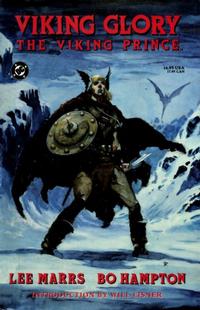
Viking Glory: The Viking Prince


By Lee Marrs & Bo Hampton, lettered by Tracey Hampton-Munsey (DC Comics)
ISBN: 978-1-56389-001-7 (HB) 978-1-56389-007-9 (TPB)

During the intentionally anodyne mid-1950s, when superheroes languished in a seemingly inescapable trough, comic book companies looked to different forms of leading men for their action heroes. Following movie trends, in 1955 writer/editor Robert Kanigher devised an adventure comic entitled The Brave and the Bold featuring historical action strips.

Illustrated by Russ Heath, The Golden Gladiator was set in the declining days of Imperial Rome. Courtesy of veteran draughtsman Irv Novick, Silent Knight fought injustice in post-Norman Invasion Britain and the already-legendary Joe Kubert limned the increasingly astounding and uncanny exploits of a valiant young Norseman dubbed the Viking Prince.

This last strip appeared in all but one issue (#6), before eventually taking over the entire comic, until the burgeoning superhero resurgence of the Silver Age saw B&B metamorphose into a try-out title from its 25th issue.

Those fanciful, “Hollywood-styled” Viking sagas are some of the finest fantasy comics of all time and long overdue for a definitive archival collection of their own. Star character Jon has long been a fan-favourite, regularly returning in DC’s war titles and guest-starring in such varied venues as Sgt. Rock and Justice League of America.

This beautiful, vital and enchanting tale was released to very little fanfare or editorial support in 1991, yet remains a worthy sequel to those early strips and is also long overdue for revival and re-issue…

Scripter Lee Marrs (Pudge: Girl Blimp, Wimmen’s Comix, Wonder Woman, Zatanna, Pre-teen, Dirty-Gene Kung Fu Kangaroos, Indiana Jones) took all the advances in our historical knowledge since the 1950s and blended them with the timeless basics of a Classical Edda to entrancing effect. Amidst a culture vibrantly brought to full life by her words and hyper-realist Bo Hampton’s awesome skill with a paintbrush, Marrs took a passionate but reserved traditional archetype and remade him as a fiery young hero of devastating charm, brimming with the boisterous vigour of his mythic breed, before confronting him with his worst nightmare.

In 10th century Scandinavia, Jon Rolloson – heir to Jarl Rollo of Gallund – is an ideal Northman’s son: fast, tough, fearless and irresistible to all the village maidens. However, the greatest horror of his 16 years has finally come for him: an arranged marriage for political advantage. He must leave his home and the Viking life to wed a “Civilised” princess. His joyous days are all done…

Princess Asa of Hedeby is a young beauty every inch his match in vigour and vitality, but also as composed and smart as he is coarse and oafish. Sadly, someone is stealthily seeking to thwart the match, even though Jon’s boorishness is enough to give both fathers cause to reconsider. Following the first meeting, only the Viking Prince’s rash vow to recover a lost rune treasure and slay a fearsome dragon preserves the bargain. The wedding will proceed… once he has found and killed Ansgar, the vilest of all Fire-Wyrms, and not perished in the process…

As well as being a superb scripter of comics, Marrs is an underground cartoonist legend, animator and computer artist who assisted Hal Foster on that other sword-wielding epic Prince Valiant. Her grasp of human character – especially comedically – elevates this classic tale of romantic endeavour into a multi-faceted gem of captivating quality. Hampton has created some of the best drawn or painted comics in the medium (like Legend of Sleepy Hollow, Verdilak, Swamp Thing, Moon Knight, Greylore, Demons of Sherwood, Batman: Castle of the Bat, The Once and Future Tarzan) and this book is probably still the very best of them.

One of the most accomplished and enjoyable historical romances ever produced in comic form, Viking Glory deserves to be on every fan’s bookshelf. Let’s hope that it’s on DC’s shortlist for a swift re-release in both printed parchment and aetheric electrons…
© 1991 DC Comics. All Rights Reserved.

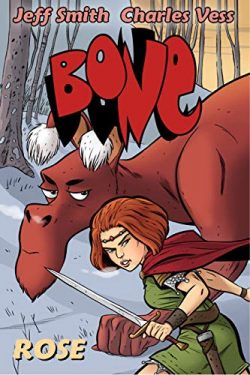
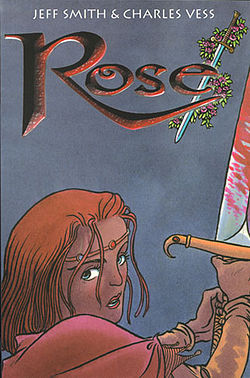
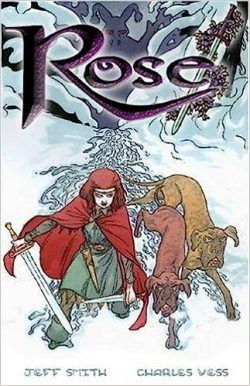
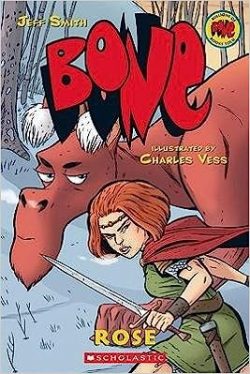
Rose


By Jeff Smith & Charles Vess (Cartoon Books/Scholastic)
ISBN: 978-1-88896-311-3 (Cartoon Books) also available in TPB, HB and digital edition

In Bone Jeff Smith (Tuki, RASL) created a fully-realised fantasy milieu with which to tell an astounding magical epic as much Tex Avery and Walt Kelly as J. R. R. Tolkien or the Brothers Grimm. Once the prime series was firmly up and running, much of the rich and textured back-story of that incredible world was further fleshed out and filled in by the author in collaboration with top-flight fantasy illustrator Charles Vess (Stardust, Spider-Man, Sandman) in an enchanting dark fable simply entitled Rose.

Many years ago the Harvestar princesses ‘Briar and Rose’ learned the origins of the world and its creatures. When the land was fresh and reality was still closely linked to the world of dreams, primal dragon Mim kept the balance between them.

However, when the malevolent spirit called Lord of the Locusts possessed her, the reptilian original dreamer went mad and began destroying everything. Mim’s own dragon children were forced to battle her and after horrendous, blood-soaked clashes ultimately triumphed by turning her to stone, thereby burying the rapacious Locust Lord forever. From debris and carnage the valley was created…

Rose is a gifted but inattentive young student, blessed with a great affinity for The Dreaming World, but her elder sister Briar’s “Dreaming Eye” is blind. Most people assume that when the time comes, it is Rose who will inherit the throne and role of the People’s protector…

That day seems not far off when their father tells them that they must depart for Old Man’s Cave and their graduation test. For years these sisters were schooled by mystic philosophers The Disciples of Venu, destined to become Veni-Yan-Cari or “Awakened Ones”, strong in the ways of the Dreaming Arts. Even so, the girls never imagined the day to take up their responsibilities would come so soon…

‘Our Brightest Hope’ opens with the sagacious Great Red Dragon discussing the siblings with the mystic Headmaster. However, the gravest news concerns the river dragon Balsaad who may have turned down an old, dark but painfully familiar path…

At dawn a small party of soldiers led by Palace Guard Captain Lucius Down escorts the girls on their trip with Rose, as always, bringing along her valiant talking hounds Cleo and Euclid. As they set off, Briar is even more acerbic and crabby than usual… until Rose is overwhelmed by one of her “gitchy” premonitions. The feeling is strong, disorienting but brief and maybe simply caused by the distracting proximity of the astonishingly hunky Lucius…

The feelings persist throughout the trip and when overly cautious Captain Down discovers one of the giant rat-creatures known as “Hairy Men” stalking the party, he drives it off with little fuss and forgets all about it.

Soon, the pilgrims are ensconced at an inn in the village of Oak Bottom, where years before the sisters stayed as toddlers: enjoying simple, open hospitality. Rose’s interest in Lucius is clear to all, and aspects of her awakening gifts manifest with embarrassing frequency. Oddly, the noble Captain seems bizarrely concerned with the comfort of ‘The Ice Queen’ Briar…

When the girls at last are safely deposited with their tutors at the cave in ‘We Ask, Teach’, the surly elder lass seems determined to be difficult. She constantly challenges the sages at all points and Rose again feels sympathy for her sibling’s lack of the Family’s hereditary powers.

Later, Rose has a disturbing dream where she and the dogs respond to a small dragon’s pleas for help and rescue it from a river. The scenes suddenly become nightmarish as she is drawn into a dark cavern by a monstrous giant insect which has smothered her mother and father with fiercely clinging locusts…

Shaken and anxious, Rose skips school to play with Euclid and Cleo, but annoyingly encounters the scolding Red Dragon who chides her for neglecting her responsibilities. However, as she rides back, the dogs spot a figure they believe is Briar, heading up a remote path. Following, a terrifying apparition orders them to ‘Turn Back’ as a storm of grasshoppers attacks. Undaunted, Rose and her loyal hounds persevere and are ambushed by the dragon of her dream, grown to colossal size and bristling with mocking ferocity…

‘Balsaad’ is only driven off after a brutal struggle in which Rose severs his hand with her sword. The chastened princess then rushes to her tutors to inform them, but is intercepted by Briar who warns Rose not to tell of her dream and its real-world repercussions in ‘The Warning’…

With the season’s first snows falling, Rose is summoned to ‘The Cave’ and questioned by the Headmaster. Admitting to having encountered the rogue dragon ravaging the countryside, she also heeds her beloved elder sister, withholding the full truth and denying any knowledge of or pertinent dreams about the creature or its dreaded “Emancipator”.

Even whilst suspecting her elders already know the truth, Rose trusts in her sister and sticks to her story before confiding that she is going out into the blizzard to destroy Balsaad…

Her faith in Briar is badly shaken, however, when she accidentally spots the beguiled Lucius sneaking into her elder sister’s room…

As the heartbroken Rose marches ‘Into the Night’ – accompanied by Euclid and Cleo – she discovers a nocturnal gathering of the usually timid Hairy Men, moving towards an irresistible rendezvous at some silent command. The nearby hamlet is being eradicated by the rampant Balsaad until he too responds when ‘The Master Calls’, reaffirming his commitment to the hidden Emancipator’s scheme to free the Lord of the Locusts in ‘The Pact’.

At last given license to destroy all humans – and those pesky dogs – Balsaad roars off whilst Rose, Euclid and Cleo again encounter the Red Dragon in ‘Frozen’. The antediluvian Scarlet Sage – unable to dissuade the indomitable Princess – regretfully advises how to defeat the beast as well as the hideous sacrifice Rose must enact to make things right…

At ‘Midnight’, Lucius and his men are ambushed by rabid ranks of rat creatures, leaving just Rose and the dogs to save Oak Bottom in an epic battle against the black river-wyrm and his manipulative master. Just as the benevolent Red Dragon predicted, for Rose to fulfil ‘The Promise’, the tragic princess must abandon all her hopes, dreams and aspirations before reluctantly destroying the greatest love of her life…

Far darker in tone than the series it spun off from, the saga of Rose merges classic mythic themes and borrowed legends to deliver a deeply moving parable about family, duty and responsibility, enchantingly realised by one of the world’s greatest fantasy illustrators.

Lovely, thrilling and unforgettable entertainment for anybody with an ounce of imagination…
Rose is TM & © 2000, 2001, 2002 Jeff Smith. All rights reserved.

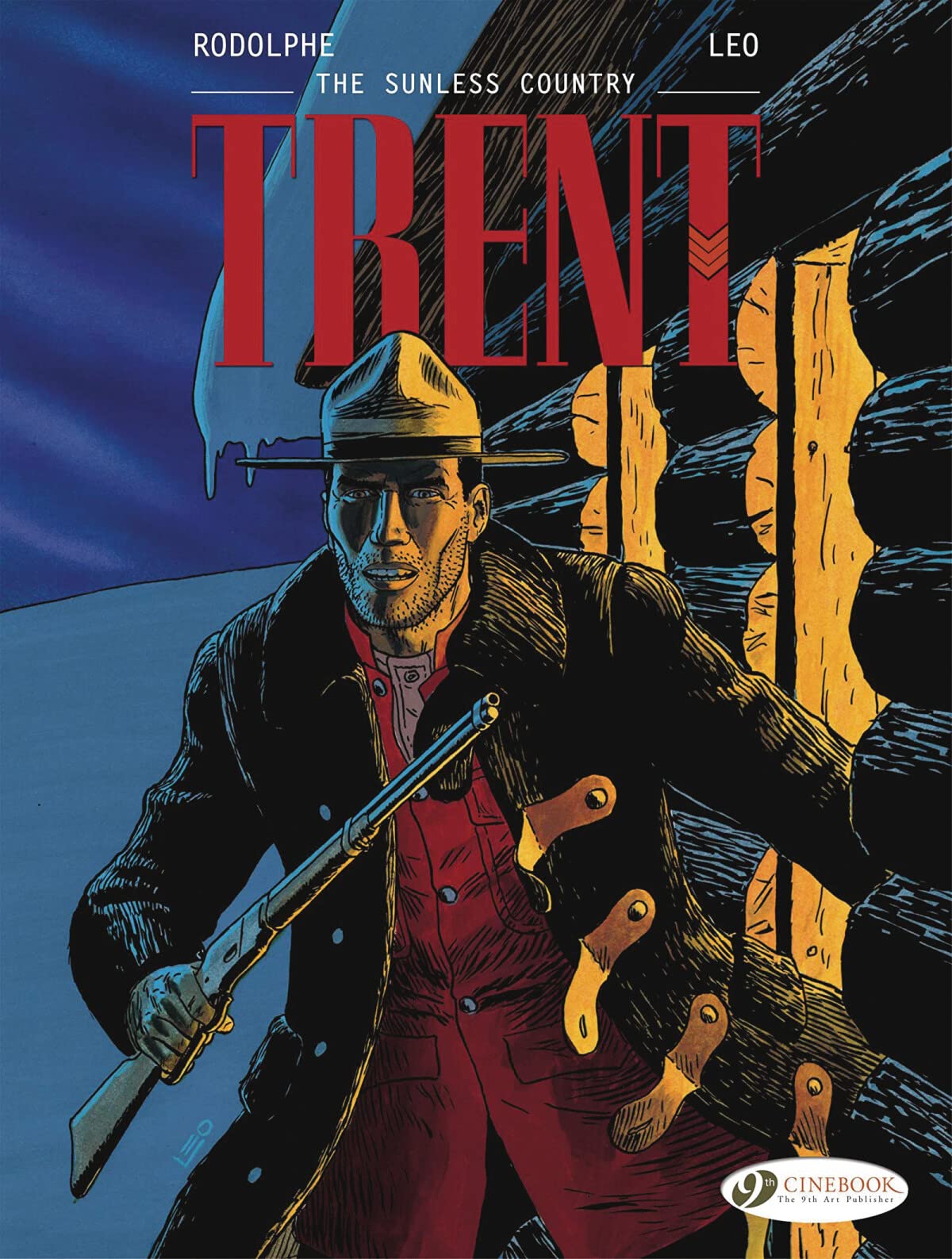
Trent volume 6: The Sunless Country


By Rodolphe & Léo, coloured by Marie-Paule Alluard, translated by Jerome Saincantin (Cinebook)
ISBN: 978-1-84918-396-3 (Album PB/Digital edition)

Continental audiences adore the mythologised American experience, both in Big Sky Wild Westerns and later eras of crime dramas. They also have a profound historical connection to the northernmost parts of the New World, generating many great graphic extravaganzas…

Born in Rio de Janeiro on December 13th 1944, “Léo” is artist/storyteller Luiz Eduardo de Oliveira Filho. After attaining a degree in mechanical engineering from Puerto Alegre in 1968, he was a government employee for three years until forced to flee the country because of his political views.

Whilst military dictators ran Brazil, he lived in Chile and Argentina before illegally returning to his homeland in 1974. He worked as a designer and graphic artist in Sao Paulo whilst creating his first comics art for O Bicho magazine, and in 1981 migrated to Paris to pursue a career in Bande Dessinée. He found work with Pilote and L’Echo des Savanes as well as more advertising and graphic design jobs, until the big break came and Jean-Claude Forest (Bébé Cyanure, Charlot, Barbarella) invited him to draw stories for Okapi.

This led to regular illustration work for Bayard Presse and, in 1988, Léo began an association with scripter/scenarist Rodolphe D. Jacquette – AKA Rodolphe. The prolific, celebrated writing partner had been a giant of comics since the 1970s: a Literature graduate who left teaching and running libraries to create poetry, criticism, novels, biographies, children’s stories and music journalism.

On meeting Jacques Lob in 1975, Jacquette expanded his portfolio: writing for many artists in magazines ranging from Pilote and Circus to à Suivre and Métal Hurlant. Amongst his most successful endeavours are Raffini (with Ferrandez) and L’Autre Monde (with Florence Magnin), but his triumphs in all genres and age ranges are far too numerous to list here.

In 1991 “Rodolph” began working with Léo on a period adventure of the “far north” starring a duty-driven loner. Taciturn, introspective, bleakly philosophical and pitilessly driven, Royal Canadian Mounted Police sergeant Philip Trent premiered in L’Homme Mort, forging a lonely path through the 19th century Dominion. He starred in eight moving, hard-bitten, love-benighted, beautifully realised albums until 2000, with the creative collaboration sparking later fantasy classics Kenya, Centaurus and Porte de Brazenac…

Cast very much in the pattern perfected by Jack London and John Buchan, Trent is a man of few words, deep thoughts and unyielding principles who gets the job done whilst stifling the emotional turmoil boiling within him: the very embodiment of “still waters running deep”…

Le Pays sans soleil was the 6th saga, debuting in 1998, offering an arduous, chillingly bleak examination of family and duty with the Mountie going slowly mad amidst the extremes of human existence. Posted to the arctic circle where night lasts for weeks, he’s been left behind by fellow officers Charlie and Vaughan, as they conduct an inspection of the region.

Manning the outpost – a simple log cabin and ever-expanding graveyard – Trent whiles away the relentless, timeless, unending gloom of interminable hours by keeping his journal and wondering when his own sanity will sunder. If he hadn’t been blessed with canine company (he’s called “Dog”) the peacekeeper would be completely crazy by now…

Darkness and unyielding environment call to him like a siren, and as he continually returns to the latest grave – occupied by RCMP officer Sergeant James McBruce – Trent again wonders if he can hold out until daylight or his colleagues come back…

Whenever he feels most embattled Trent recalls the last visit with Agnes when – after years of second-guessing, procrastination and prevarication – he finally declared his love for the widow… and she accepted his proposal of marriage.

Years previously, he had saved Agnes St. Yves – but not her beloved brother – and was given a clear invitation from her: one he never acted upon. Eventually, Philip made a his decision and travelled across the country with marriage in mind, only to learn she had stopped waiting and wed someone else.

More time elapsed and they met again when her husband was killed during an horrific murder spree. The ball was again in Philip’s court and once more he fumbled it through timidity, indecision and inaction. He retreated into duty, using work to evade commitment and the risk of rejection…

His dreamlike reverie is suddenly shattered when Dog hears an intruder. In the icy darkness outside Trent finds a dying native whose last words reveal someone else is lost in the wastes, slowly expiring in an igloo…

Fired by duty and threat to life, Mountie and mutt brave the ebony vastness and eventually find the frozen bolthole. At first glance, they’re too late: only the body of a native woman is there. Dog, however keeps worrying the corpse, and Trent finds it is wrapped around a still living baby. A white baby…

Wracked by mystery and with no proper food for the infant, Trent improvises from his cobbled-together stores before setting out to walk back to civilisation with the orphan but his trek due south towards the sun and warmth soon becomes complicated. Dogging his tracks is an enigmatic stranger, maintaining a steady pace yet never stopping. At the moment Trent first sees a sunrise, the stalker strikes, using that moment of joyous release to swoop in and steal the child.

The kidnapper correctly assessed that the weary officer could not catch him, but completely misjudged how Dog would react to a threat to his “family”…

One mystery is solved and an even greater one – fraught with misapprehension and mistake – then unfolds as the baby snatcher – white journalist James Dunwood – explains that the child is his daughter Mary Little Moon and the woman in the igloo must have been his wife Four Rivers…

As they trek south, Dunwood explains how both had been abducted from the camp of Cree chief Old Storm. After a reporting assignment turned personal, James had relinquished his career for love. He joined the First Nations tribe, but his romantic idyl was shattered when white trader Duncan started selling booze to the Indians and fomented war when Old Storm intervened.

In retaliation, Duncan and his renegades abducted Four Rivers and her newborn, heading north with Dunwood in pursuit. He never quite caught up as they pushed ever deeper into polar regions… and now his beloved was gone.

James couldn’t be more wrong, and as his tragic tale closes, Trent is left holding the baby. He is determined to make things right for Mary Little Moon – and this time, there’s a modicum of happy news to ameliorate the horrors and injustice the Mountie usually wades through in pursuit of justice…

Moreover, as he unravels the morass of confusion and solves the crimes, Philip bonds with the child. Worst of all, upon returning her to the proper guardians, he meets someone who makes him briefly forget all about Agnes…

Another beguilingly introspective voyage of internal discovery, where environment and locale are as much lead characters as hero and villain, The Sunless Country delivers action, endeavour, suspense and poignant drama in a compelling epic to delight all fans of widescreen cinematic entertainment.
Original edition © Dargaud Editeur Paris 1998 by Rodolphe & Leo. All rights reserved. English translation © 2017 Cinebook Ltd.

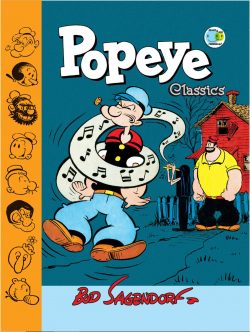
Popeye Classics volume 9: The Sea Hag’s ‘Magic Flute’ and More!


By Bud Sagendorf, edited and designed by Craig Yoe (Yoe Books/IDW Publishing)
ISBN: 978-1-63140-772-7 (HB) eISBN: 978-1-68406-092-4

How many cartoon classics can you think of still going after a century? Here’s one…

There are a few fictional personages to enter communal world consciousness – and fewer still from comics – but this grizzled, bluff, uneducated, visually impaired old tar with a speech impediment is possibly the most well-known of that august bunch.

Elzie Crisler Segar was born in Chester, Illinois on 8th December 1894. His father was a general handyman, and the boy’s early life was filled with the solid, dependable blue-collar jobs that typified the formative years of his generation of cartoonists. Segar worked as a decorator, house-painter and also played drums; accompanying vaudeville acts at the local theatre.

When the town got a movie-house, Elzie played silent films, absorbing all the staging, timing and narrative tricks from keen observation of the screen. Those lessons would become his greatest assets as a cartoonist. It was while working as the film projectionist, at age 18, that he decided to become a cartoonist and tell his own stories.

Like so many others in those hard times, he studied art via mail, specifically W.L. Evans’ cartooning correspondence course out of Cleveland, Ohio, before gravitating to Chicago where he was “discovered” by Richard F. Outcault – regarded as the inventor of modern newspaper comic strips with The Yellow Kid and Buster Brown. The celebrated pioneer introduced Segar around at the prestigious Chicago Herald. Still wet behind the ears, the kid’s first strip, Charley Chaplin’s Comedy Capers, debuted on 12th March 1916.

In 1918, Segar married Myrtle Johnson and moved to William Randolph Hearst’s Chicago Evening American to create Looping the Loop, where Managing Editor William Curley foresaw a big future for Segar and promptly packed the newlyweds off to New York: HQ of the mighty King Features Syndicate. Within a year Segar was producing Thimble Theatre, (launching December 19th 1919) in the New York Journal: a smart pastiche of cinema and knock-off of movie-inspired features like Hairbreadth Harry and Midget Movies, with a repertory of stock players acting out comedies, melodramas, comedies, crime-stories, chases and especially comedies for vast daily audiences. It didn’t stay that way for long…

The core cartoon cast included parental pillars Nana & Cole Oyl; their lanky, cranky, highly-strung daughter Olive; diminutive-but-pushy son Castor and the homely ingenue’s plain and (so very) simple occasional boyfriend Horace Hamgravy (latterly, plain Ham Gravy).

Thimble Theatre had already run for a decade when, on January 17th 1929, a brusque, vulgar “sailor man” shambled into the daily ongoing saga of hapless halfwits. Nobody dreamed the giddy heights that stubbornly cantankerous walk-on would reach…

In 1924, Segar created a second daily strip. Surreal domestic comedy The 5:15 featured weedy commuter/aspiring inventor John Sappo and his formidable spouse Myrtle. It endured – in one form or another – as a topper/footer-feature accompanying the main Sunday page throughout Segar’s career, survived his untimely death, and eventually became the trainee-playground of Popeye’s second great humour stylist – Bud Sagendorf.

After Segar’s premature passing in 1938, Doc Winner, Tom Sims, Ralph Stein and Bela Zambouly all took on the strip as the Fleischer Studio’s animated features brought Popeye to the entire world, albeit a slightly variant vision of the old salt of the funny pages. Sadly, none had the eccentric flair and raw inventiveness that had put Thimble Theatre at the forefront of cartoon entertainments. And then, finally, Bud arrived…

Born in 1915, Forrest “Bud” Sagendorf was barely 17 when his sister – who worked in the Santa Monica art store where Segar bought his drawing supplies – introduced the kid to the master cartoonist who became his teacher and employer as well as a father-figure. In 1958, after years on the periphery, Sagendorf finally took over the strip and all the merchandise design, becoming Popeye’s prime originator…

With Sagendorf as main man, his loose, rangy style and breezy scripts brought the strip itself back to the forefront of popularity and made reading it cool and fun all over again. Bud wrote and drew Popeye in every graphic arena for 24 years. When he died in 1994, his successor was controversial “Underground” cartoonist Bobby London.

Bud had been Segar’s assistant and apprentice, and in 1948 became exclusive writer/artist of Popeye’s comic book exploits. That venture launched in February of that year: a regular title published by America’s unassailable king of periodical licensing, Dell Comics.

On his debut, Popeye was a rude, crude brawler: a gambling, cheating, uncivilised ne’er-do-well, but was soon revered as the ultimate working-class hero. Raw and rough-hewn, he was also practical, with an innate, unshakable sense of what’s fair and what’s not: a joker who wanted kids to be themselves – but not necessarily “good”. Above all else he was someone who took no guff from anyone…

Naturally, as his popularity grew, Popeye mellowed somewhat. He was still ready to defend the weak and had absolutely no pretensions or aspirations to rise above his fellows, but the shocking sense of dangerous unpredictability and comedic anarchy he initially provided was sorely missed… except in Sagendorf’s sagas…

Collected here are Popeye #40-44, crafted by irrepressible “Bud” and collectively spanning April-June 1957 to April-June 1958. The stunning, nigh stream-of-consciousness slapstick sagas and nautical nuttiness are preceded by a treasure-stuffed treatise on ‘The Big Guy who Hates Popeye!’, as Fred M. Grandinetti details all you need to know about archetypal “heavy” Bluto. The lecture on the thug of many names is backed up by character and model sheets from animated appearances, comic book covers, and numerous comic excepts. Also emergent are strip precursors and alternate big bullies, original strip art from Sagendorf and London, plus a kind-of guest shot from Jackson Beck – the meaty matelot’s on-screen voice…

Sadly missing the usual ‘Society of Sagendorks’ briefing by inspired aficionado, historian and publisher Craig Yoe, and the ever-tantalising teasers of ephemera and merchandise of ‘Bud Sagendorf Scrapbooks’, we instead plunge straight back into ceaseless sea-savoured voyages of laughter, surreal imagination and explosive thrills with quarterly comic book #40, opening with a monochrome inside front cover gag concerning the sailor’s ward Swee’Pea and his fondness for digging in the dirt, before ‘Thimble Theatre presents Popeye the Sailor in The Mystery of the “Magic Flute!”’ once more pits the mariner marvel against the ghastly and nefarious Sea Hag.

Here she unleashes an army of agents to locate and secure a mystic talisman safeguarded by Popeye. With it, she can rid the world of her great enemy…

With the family house overrun, impetuous elder Poopdeck Pappy unthinkingly hands over the wishing whistle and instantly Popeye is whisked into a pit with lions, thugs and Bluto all lined up to kill him. It doesn’t work out well for any of them…

‘Popeye the Sailor and Eugene the Jeep’ then reintroduces another of Segar’s uniquely wonderful cartoon cryptids. The little marvel had originally debuted on March 20th 1936: a fantastic 4th dimensional beast with incredible powers whom Olive and Wimpy use to get very rich, very quickly. Of course, they quickly lost it all betting on the wrong guy in another of Segar’s classic and hilarious set-piece boxing matches between Popeye and yet another barely-human pugilist…

This time he pops up after Olive and the old salt clash over setting an engagement date, and Wimpey suggests asking the Jeep’s advice. Instantly he materialises, and the question is nervously asked. The response is ambiguous and draws nothing but trouble…

Prose filler ‘Ol’ Blabber Mouth’ tells how a parrot accidentally causes all his friends to be captured by pet trade hunters before we arrive at the ever-changing back-up feature. Sappo – now reduced to gullible foil and hapless landlord to the world’s worst lodger – endured the ethics-free experiments of Professor O.G. Wotasnozzle “The Professor with the Atomic Brain”.

Callously and constantly inflicting the brunt of his genius on the poor schmuck, here the boffin seizes top billing with The Brain of O.G. Wotasnozzle, building a robot replica of his landlord and running rings around the sap in ‘Double Double Who’s Got Trouble’…

The issue ends with an endpaper monochrome gag with Popeye and the precious “infink” disputing bedtimes and a colour back cover jape with them disastrously fishing…

Issue #41 (July-September) opens with ‘Popeye the Sailor in Spinach Soap!’ as the sailor battles Olive’s new beau. He looks just like Bluto, but has one advantage the sailor cannot match …a steady job!

In response, the money-disdaining matelot calls his secret weapon and Wimpey takes charge of Popeye’s savings – a million bucks – all so that he can set up a business to employ the sailor man…

An engaging Micawber-like coward, cad and conman, the insatiably ravenous J. Wellington Wimpy debuted in the newspaper strip on May 3rd 1931 as an unnamed, decidedly partisan referee in one of Popeye’s pugilistic bouts. Scurrilous, aggressively humble and scrupulously polite, the devious oaf struck a chord and Segar made him a fixture. Preternaturally hungry, ever-keen to solicit bribes and a cunning coiner of many immortal catchphrases – such as “I would gladly pay you Tuesday for a hamburger today” and “Let’s you and him fight” – Wimpy was the perfect foil for our straight-shooting action hero and increasingly stole the entire show… and anything else unless it was very heavy or extremely well nailed down.

Full of good intentions but unable to control himself, Wimpey naturally embezzles it all and fobs off his pal with a get-rich-scheme. However when Popeye starts selling his vegetable-based cleanser door to door he soon finds his old tactics are enough to wash that man out of Olive’s hair…

Co-starring Popeye, Swee’Pea and the Jeep!, ‘Sucker Gold!’ sees the cowboy-obsessed kid head for the desert and perilous Apache Mountain to be a prospector. Happily, with Eugene along for the ride his safety and prosperity are assured…

The story of Bradley fills the prose section this revealing how the ‘Horse Student’ was kicked out of human high school, after which O.G. Wotasnozzle! thinks himself into an invulnerable, inert state and the authorities resort to explosives to wake him up, before the back cover finds Popeye giving his kid a (kind-of) haircut…

Cover-dated October-December, Popeye #42 opens with the main event as the entire cast is caught on ‘Trap Island!’ as The Sea Hag and her hefty hench-lout target them from her mobile mechanised islet, before using doppelgangers to lure the sailor into ultimately useless death traps. Even her monster spinach-fuelled gorilla Smash is helpless before the power of spinach inside Popeye…

Popeye then discovers Swee’Pea can get into trouble anywhere, anytime when he sends him to fetch ‘Today’s Paper!’ Through no fault of his own the mighty mite ends up trapped in a weather balloon, a target of the air force, 2300 miles from home in Harbor City, a blood enemy of angry Indian Chief Rock’n’roll and locked in a missile, before dutifully bringing back that pesky periodical…

A duck with a speech impediment finds his purpose in prose yarn ‘Big Toot’ prior to Sappo giving O.G. Wotasnozzle the push. Typically, the toxic tenant terrorises every prospective replacement for his lodgings and the status quo is reluctantly re-established…

Another endpaper monochrome gag sees Popeye and Olive experiencing a little car trouble before Popeye #43 (cover-dated January-March 1958) opens in mono with another dig at Swee’Pea and his shovel whilst main event ‘Mind over Muscles!’ finds Popeye in high spirits and utterly oblivious to Sea Hag’s sinister surveillance. As the sailor eagerly anticipates his annual physical exam, she sends in her Sonny Boy – AKA Bluto disguised as a physician – to undermine his confidence and poison his mind with the notion that spinach is killing him. However, even doctor’s orders can’t make him give up his green cuisine and everyone gets what they deserve in the end…

‘Popeye and Swee’Pea in “The Voyage!”’ finds the sailor man sent on a dangerous mission to an island of “wild savages” with his boy outrageously left behind and babysat by Poopdeck Pappy. The infernal infink’s unhappy state is swiftly shifted by capricious fate though, and his soapbox boat is caught by wind, tide and a welcoming whale. When Popeye finally arrives, there’s a big little surprise awaiting him…

Prose parable ‘Diet!’ reveals what happens when Mrs. Smith declares the family is going vegetarian and pet dog Winky disagrees, after which O.G. Wotasnozzle apparently mends his ways and declares himself ‘“A Friend to Man” or “Be Kind to Sappo Week!”’ Sadly, even his best intentions and domestic inventions are severely hazardous to his landlord’s health – and the town’s wellbeing…

Concluding with an endpaper monochrome gag seeing Popeye severely tested by the kid’s bath time and a spot of gardening brings us to the last happy hurrah as Popeye #44 (April-June 1958) opens with black & white wisdom and Wimpy showing Olive the only way to Popeye’s heart…

Full-colour feature ‘Popeye meets “Orbert”’ embraces a wider-screened, more dynamic illustration style for Sagendorf as occasional amorous arch rival Bluto makes another play for Olive. Whilst he and Popeye enjoy their violent clash, Swee’Pea opens the box Bluto brought and unleashes a strangely alien flying beast. When its odd orbits kayo the blustering brute, Swee’Pea christens it Orbert. Soon they are inseparable and its ability to grant wishes have turned the kid into a bully and tyrant, and it’s time for some stern parenting …and spinach…

Sappo’s détente with O.G. Wotasnozzle is still in play but comes under extreme pressure when the Prof joins a quiet day’s fishing, and starts devising ways to make the pastime more efficient…

‘Specks’ reflects in prose upon the life of short-sighted fish George, before Popeye and Swee’Pea star in self-proclaimed “horrible story” ‘Follow the Leader!’ as spies kidnap the kid and try to make him tell where Popeye’s pirate gold is stashed. The map he eventually draws them only leads to trouble and the issue and this volume wrap up on a monochrome end gag proving Swee’Pea’s punch is a powerful as his wits…

Outrageous and side-splitting, these universally appealing yarns are evergreen examples of narrative cartooning at its most absurd and inspirational. Over the last nine decades Thimble Theatre’s most successful son and his family have delighted readers and viewers around the world. This book is simply one of many, but each is sure-fire, top-tier entertainment for all those who love lunacy, laughter, frantic fantasy and rollicking adventure. If that’s you, add this compendium of wonder to your collection.
Popeye Classics volume 9 © 2016 Gussoni-Yoe Studio, Inc. All Rights Reserved. Popeye © 2016 King Features Syndicate. ™ Heart Holdings Inc.