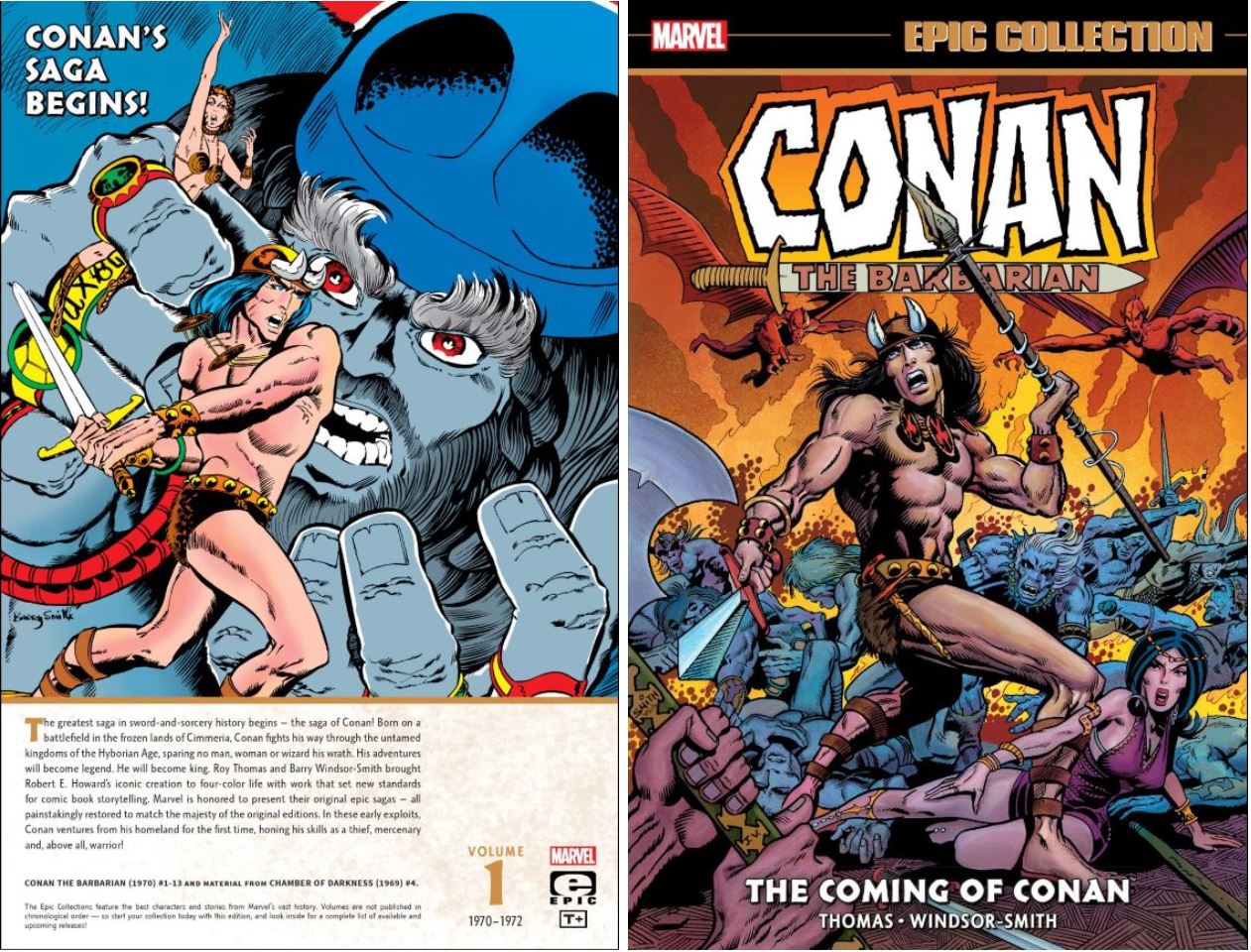
Conan the Barbarian Epic Collection volume 1: The Coming of Conan (1970-1972)


By Roy Thomas & Barry Windsor-Smith with John Jakes, Gil Kane, Dan Adkins, Sal Buscema, Frank Giacoia, Tom Palmer, Tom Sutton, “Diverse Hands”, Marie Severin, John Romita Sr. & various (MARVEL)
ISBN: 978-1-3029-2555-0 (TPB/Digital edition)

This book includes Discriminatory Content produced in less enlightened times.

Win’s Christmas Gift Recommendation: Because We Believe in Blockbusters… 9/10

During the 1970’s the US comic book industry opened up after more than 15 years of cautiously calcified publishing practises that had come about as a reaction to censorious oversight of its self- inflicted Comics Code Authority. This body was created to keep the publishers’ product wholesome after the industry suffered their very own McCarthy-style Witch-hunt during the 1950s.

One of the first genres revisited was Horror/Mystery comics and from that sprang pulp masterpiece Conan the Cimmerian, via a tale in anthology Chamber of Darkness #4, whose hero bore no little thematic resemblance to the Barbarian. It was written by Roy Thomas and drawn by Barry (Windsor-) Smith, a recent Marvel find, and one who was gradually breaking out of the company’s all-encompassing Jack Kirby house-style.

Despite some early teething problems – including being cancelled and reinstated in the same month – the comic book adventures of Robert E. Howard’s brawny warrior became as big a success as the revived prose paperbacks which had heralded a world flowering in tales of fantasy and the supernatural.

After decades away, the brawny brute recently eventually to the aegis of Marvel. Designated “the Original Marvel Years” (due to the character’s sojourn with other publishers/intellectual properties rights holders), this bombastic tome of groundbreaking action fantasy yarns re-presents the contents of Conan the Barbarian #1-13 plus that trailblazing short story, cumulatively spanning cover-dates April 1970 to January 1972. Digitally remastered and available as a trade paperback or eBook, these are the absorbing arcane adventures that sparked a revolution in comics and a franchising empire in my youth, and are certainly good enough to do so again. They are also astonishingly readable…

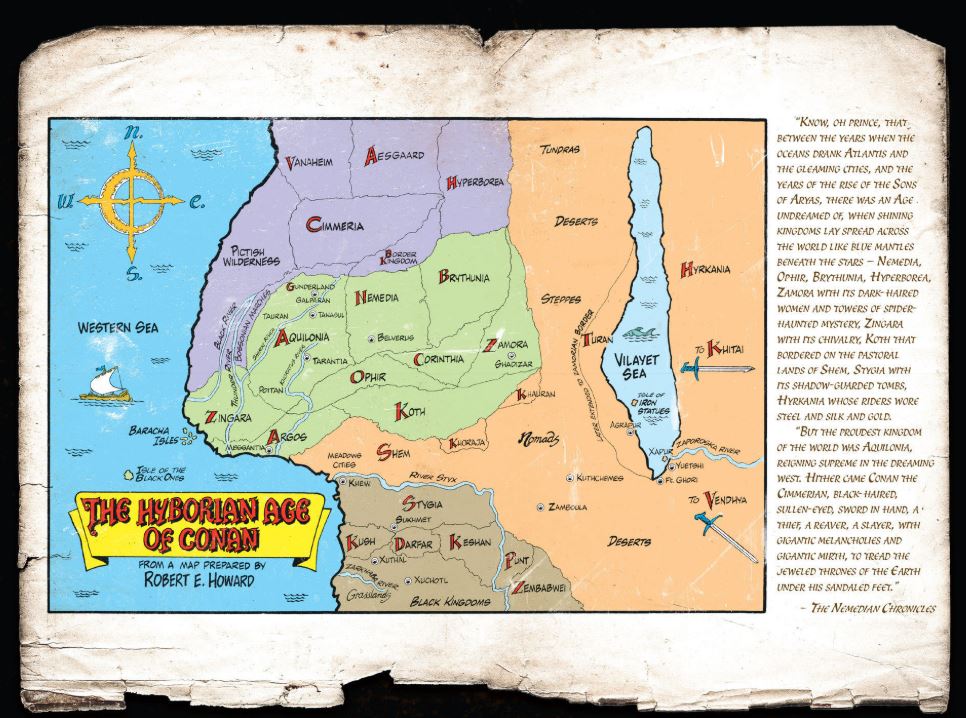
The drama begins most fittingly after a glimpse at a classic map of ‘The Hyborean Age of Conan’ plus an accompanying quote I’m sure every devoted acolyte already knows by heart, after which that precursor romp sets the scene.

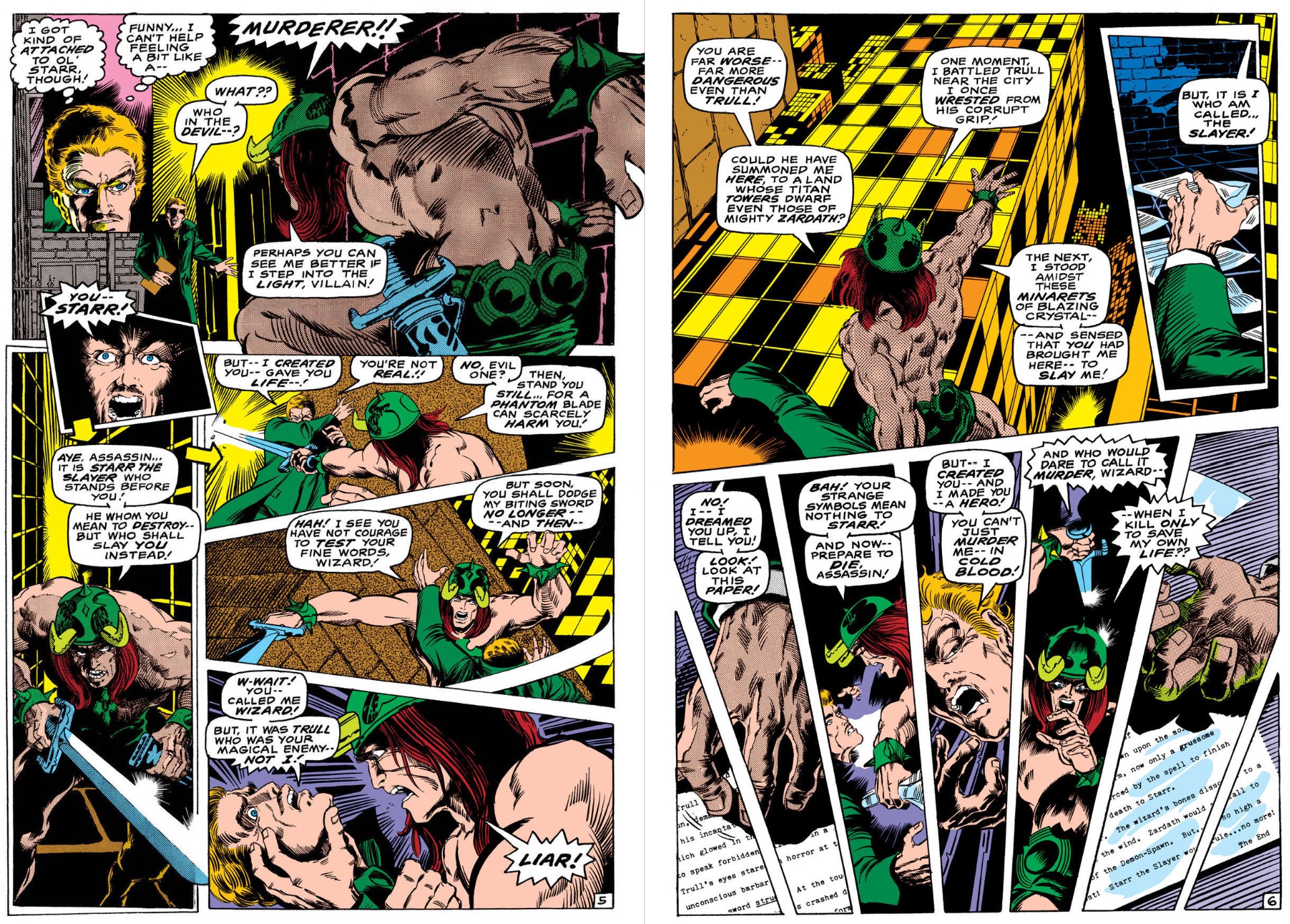
Set in modern America, ‘The Sword and the Sorcerers!’ primes the pump with the tale of a successful writer who foolishly decides to kill off his most beloved character Starr the Slayer: a barbarian so beloved that he has taken on a life of his own and is determined to do whatever is necessary to keep it…

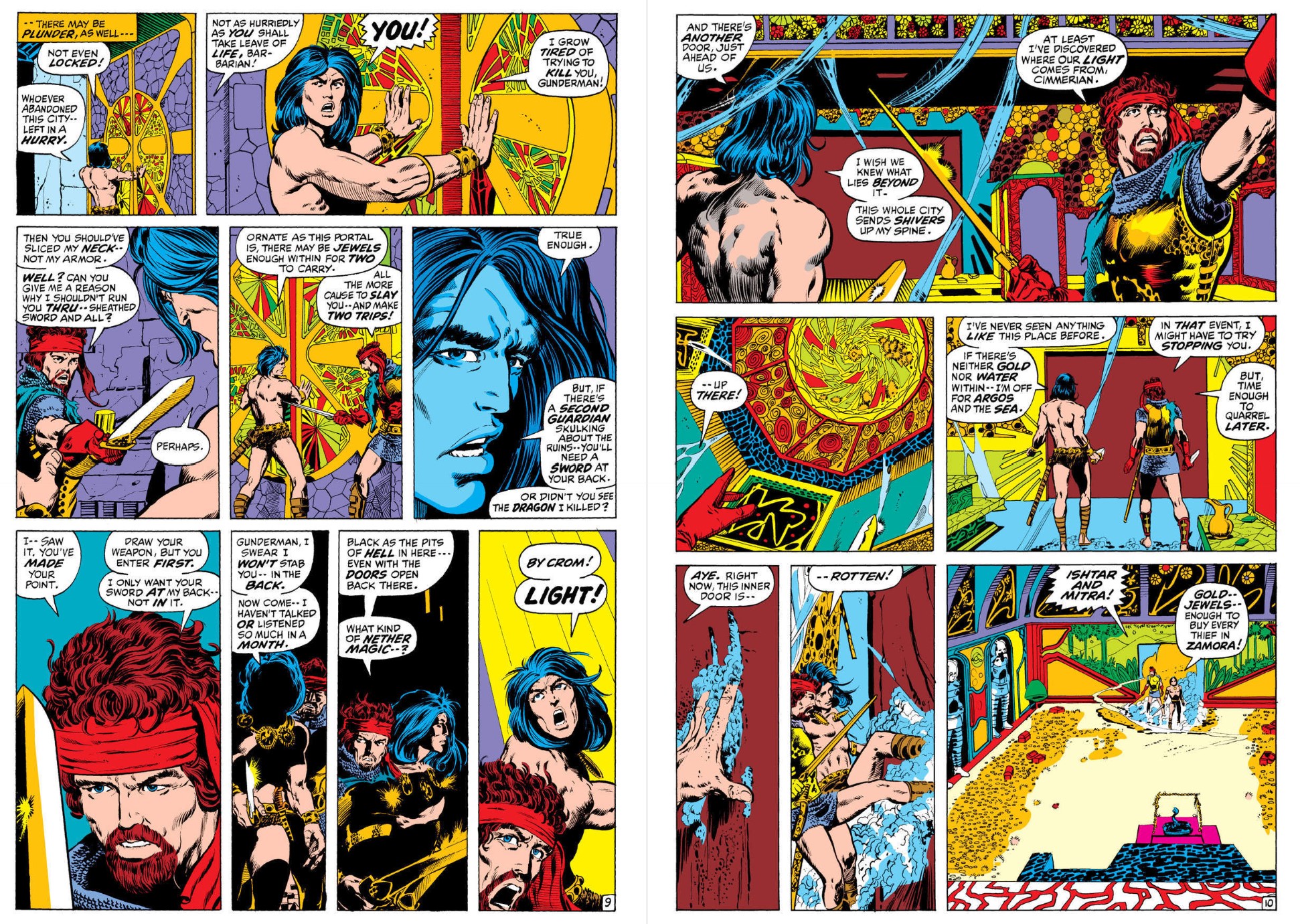
After that we are catapulted back in time approximately 12,000 years into a forgotten age of terrors and wonders as scripter Thomas broadly follows Howard’s life path for young Conan of Cimmeria, beginning with the still teenaged warrior’s meeting with a clairvoyant wizard who predicts a regal destiny in ‘The Coming of Conan’ (inked by Dan Adkins), through brief but brutal enslavement in ‘The Lair of the Beastmen’ (Sal Buscema finishes), before experiencing a minor Ragnarok and witnessing ‘The Twilight of the Grim Grey God!’

An aura of lyrical cynicism grows to balance the wealth of mystical menaces and brooding horror as the wanderer becomes a professional thief and judge of human foibles in ‘The Tower of the Elephant’. Conan’s softer side is revealed in CtB #5 after meeting bewitching ‘Zukala’s Daughter’ (Frank Giacoia inks) and liberating a wizard-plagued town. Buscema returned for ‘Devil Wings over Shadizar’, wherein the warrior lad tackles a welter of antediluvian terrors, with both Adkins & Sal B applying their pens and brushes to expose ‘The Lurker Within’ – based on Howard’s magnificent chiller The God in the Bowl – after which tomb raider Conan crushes zombies and dinosaurs in ‘The Keepers of the Crypt’ (inked by Toms Palmer & Sutton)…

Thomas’s avowed plan was to closely follow Conan’s established literary career from all-but-boyhood to his eventual crowning as King of Aquilonia, adding to and adapting Howard’s prose works and that of his posthumous collaborators on the way. This agenda led to some of the best, freshest comics of the decade. The results of (not-yet-Windsor-) Smith’s search for his own graphic style led to unanimous acclaim and many awards for the creative duo.

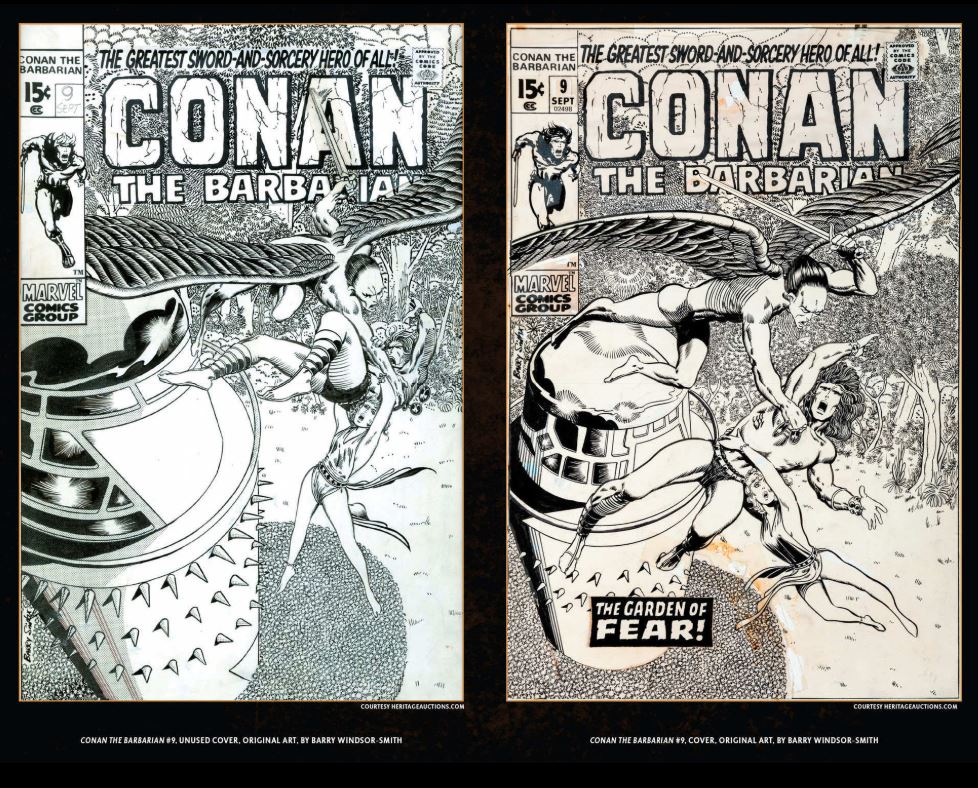
By issue #9 the character had taken the comics world by storm and any threat of cancelation was long gone. ‘The Garden of Fear’ – adapted by Thomas & Smith, with inks by Sal B from Howard’s short story – features a spectacular battle with a primordial survivor in a lost valley before the wanderer returns to big city life, and learns too late to ‘Beware the Wrath of Anu!’

This god-slaying bout is mere prelude to another classic Howard adaptation, ‘Rogues in the House’: an early masterpiece of action and intrigue benefitting from a temporary doubling in page count.

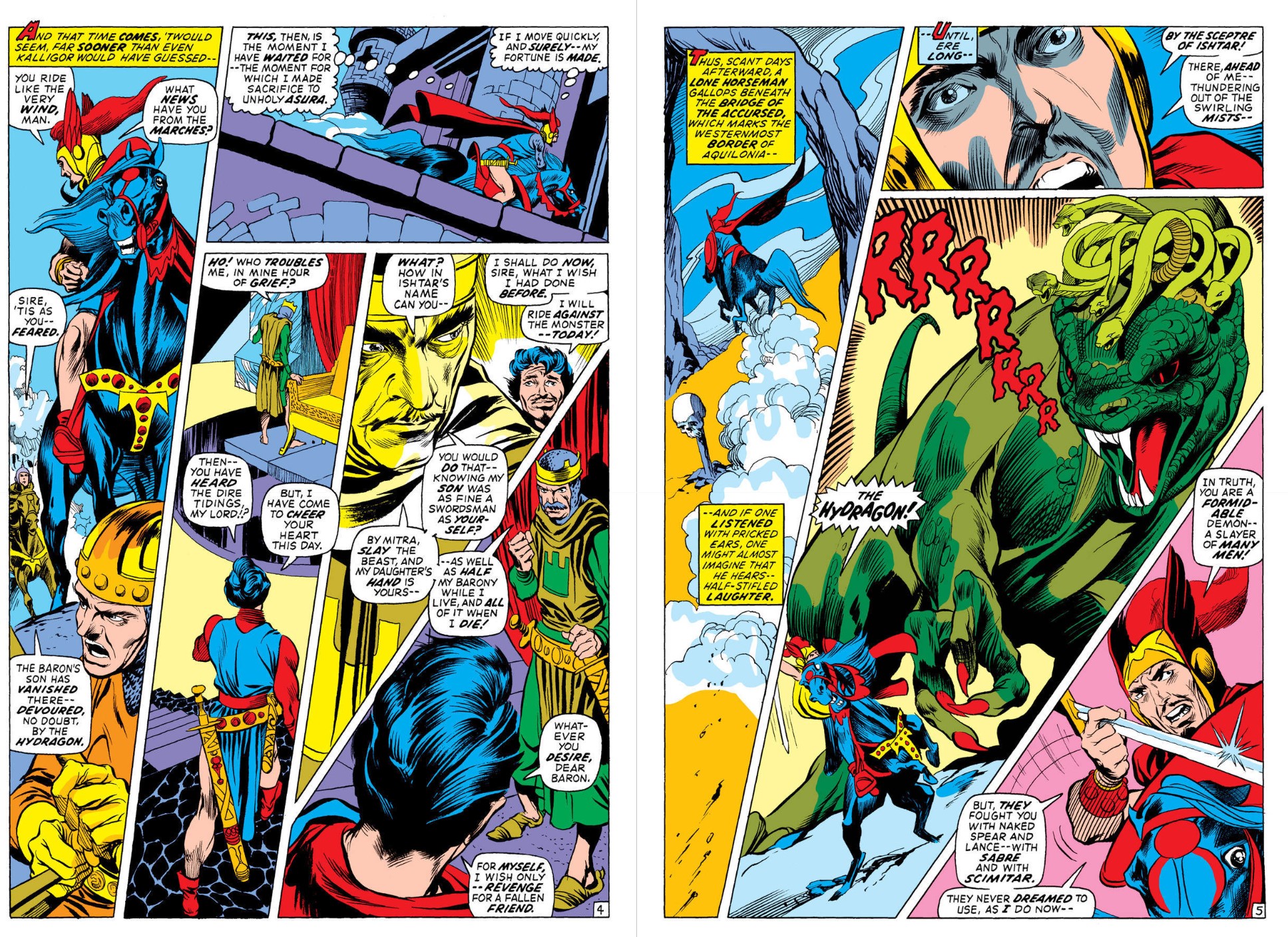
‘Dweller in the Dark’ is an all-original yarn of monsters and maidens, notable because artist Smith inked his own pencils, and indications of his detailed fine-line illustrative style can be seen for the first time. An added bonus in that issue was a short back-up yarn by Thomas & Gil Kane with “Diverse Hands” called in to ink ‘The Blood of the Dragon!’: telling of a very different Hyborian hero getting what he deserves…

Fantasy author John Jakes plotted the final tale in this initial outing as ‘Web of the Spider-God’ offers a sardonic drama of the desert with the surly Cimmerian battling thirst, tyranny. pompous priests and a big, big bug in a riotous romp finished off by Thomas, Smith & Buscema.

Adding value to the treasury is a vast bonus section which includes pencilled cover art (used and unused); Thomas’ original script breakdowns as annotated by the artist; extracts from Marvelmania (the company’s first in-house fanzine); unused illustrations, house ads and Marvel bulletin items; cover roughs, concepts and finished art by Marie Severin & Gil Kane; Jakes’ plot synopsis and many pages of original art from the tales collected herein.

Also on show are cover galleries of the Marvel Books reprint paperback line and the Conan Classic comics series – all by Windsor-Smith – plus even before-&-after alterations demanded by the Comics Code Authority on the still contentious and controversial title.

These re-mastered epics are a superb way to enjoy some of US comics’ most influential and enjoyable blockbuster moments. They should have a place carved out on your bookshelf.
© 2020 Conan Properties International, LLC (“CPI”).

Herrrrge’s AdVentures of TinnnnTinn! (well, some of them) were largely drawn by Bob deMoor, who was born today in 1925, as was the wonderful Michael Zulli in 1952. Have you read The Puma Blues: The Complete Collection in One Volume?

In 1982 today, mangaka Katsuhiro Otomo saw the first episode of his astounding Akira epic published.

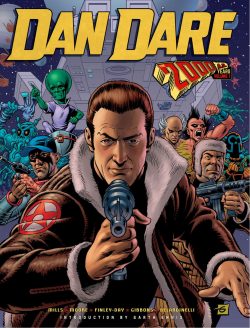
Dan Dare: The 2000 A.D. Years volume 1


By Pat Mills, Gerry Finley-Day, Steve Moore, Ken Armstrong, Kelvin Gosnell, Garry Leach, Dave Gibbons, Brian Bolland, Massimo Belardinelli, Ian Kennedy, Bill Nuttall, Jack Potter, Peter Knight, John Aldrich, J. Swain, Tony Jacobs, Tom Frame & various (Rebellion)
ISBN: 978-1-78108 349-9 (Album HB/Digital edition)

This book includes Discriminatory Content produced in less enlightened times.

Win’s Christmas Gift Recommendation: Pure & Superhero Sensationalism… 9/10

If you’ll permit a personal question: How old are you?

The answer will pretty much determine your reaction to this book…

Launching on April 14th 1950 and running until April 26th 1969, Eagle was the most influential comic of post-war Britain, and possibly in our nation’s history. It was the brainchild of a Southport vicar, the Reverend Marcus Morris, who was increasingly concerned about the detrimental effects of American comic books on British children and wanted a good, solid, middle-class Christian antidote.

A huge number of soon-to-be prominent creative figures worked on the weekly, and although “Pilot of the Future” Dan Dare is rightly revered as the star, the other strips were almost as popular at the time, with many rivalling the lead in quality and entertainment value according to the mores and developing tastes of that hope-filled, luxury-rationed, fresh-faced generation.

At its peak, the original Eagle sold close to a million copies a week, but inevitably, changing tastes and a game of “musical owners” killed the title. In 1960, Hulton sold out to Odhams, who became Longacre Press. A year later they were bought by The Daily Mirror Group who evolved into IPC. In cost cutting exercises many later issues carried cheap(er) Marvel Comics reprints rather than British-originated material. It took time, but those Yankee Cultural Incursionists won out in the end. In 1969, with the April 26th issue Eagle was subsumed into cheap ‘n’ cheerful iron clad anthology Lion, eventually disappearing altogether. Successive generations have revived the title, but not the success. Never as popular, a revived second iteration ran from 27th March 1982 to January 1994 (having switched from weekly to monthly release in May 1991). Naturally when Eagle enjoyed its Second Coming the Pilot of the Future returned to his true home…

So as we celebrate 75 years of post-empire adventuresome wonderment, let’s just be clear on one thing. It’s Dan & Digby we all recall most fondly but we’ll take what we can get…

There’s precious little that I can say about Dan Dare that hasn’t been said before and better. What I will say is that everything you’ve heard is true. Vintage strips by Frank Hampson and his team of dedicated artists are a high point in world, let alone British comics, ranking beside Tintin, Asterix, Tetsuwan Atomu, Lone Wolf & Cub and the best of Kirby, Adams, Toth, Noel Sickles, Milt Caniff, Roy Crane, Carl Barks and Elzie Segar. If you don’t like this stuff, there’s probably nothing any of us can do to change your mind, and all we can do is hope you never breed…

Breakneck pace, truly astonishing high concepts underpinned by hard science balanced with nonstop action leavened with wholesome music hall larks and some of the most beautiful and powerful art ever to grace a comic page makes Hampson’s hero immortal and as much a magical experience now as it was in 1950. Many companies have kept the legend alive in curated collections over the decades, so go read this 2018 Titan edition combining material from three of their 2004-2009 hardback collections.

Now, though, we’re not taking about that guy, but seeing how he was regenerated and modified for a far different Britian under a different kind of cosh…

A wellspring of unleashed and unruly creativity, Britain’s last great comic sensation could be described as a combination of the other two, combining the futuristic milieu and thrills of Dan Dare and Eagle with the terrifying anarchy and irreverent absurdity of Dennis the Menace and his rowdy pals in Beano. In February 1977, with Britain not feeling so great a science-fiction weekly anthology was launched. The creative and editorial staff had high hopes and aspirations for 2000 A.D. but the guys paying them were simply content to ride out the movie-inspired boom and ready to cancel after the first six months to a year. They were ready for decades, but sales never dipped enough for that axe to fall, no matter what those art and story boys perpetrated…

The trendy ultra-dystopian atmosphere that had led to the creation of Mega-City One’s finest was also used to flavour the revival of the comic’s intended big gun and prime property. And his constant evolution as seen here in the weekly material from 2000 A.D. #1-23 and 28-51, plus additional action from 2000 A.D. Summer Special 1977, 2000 A.D. Sci-Fi Special 1978, 2000 A.D. Annual 1978 & Dan Dare Annual 1979.

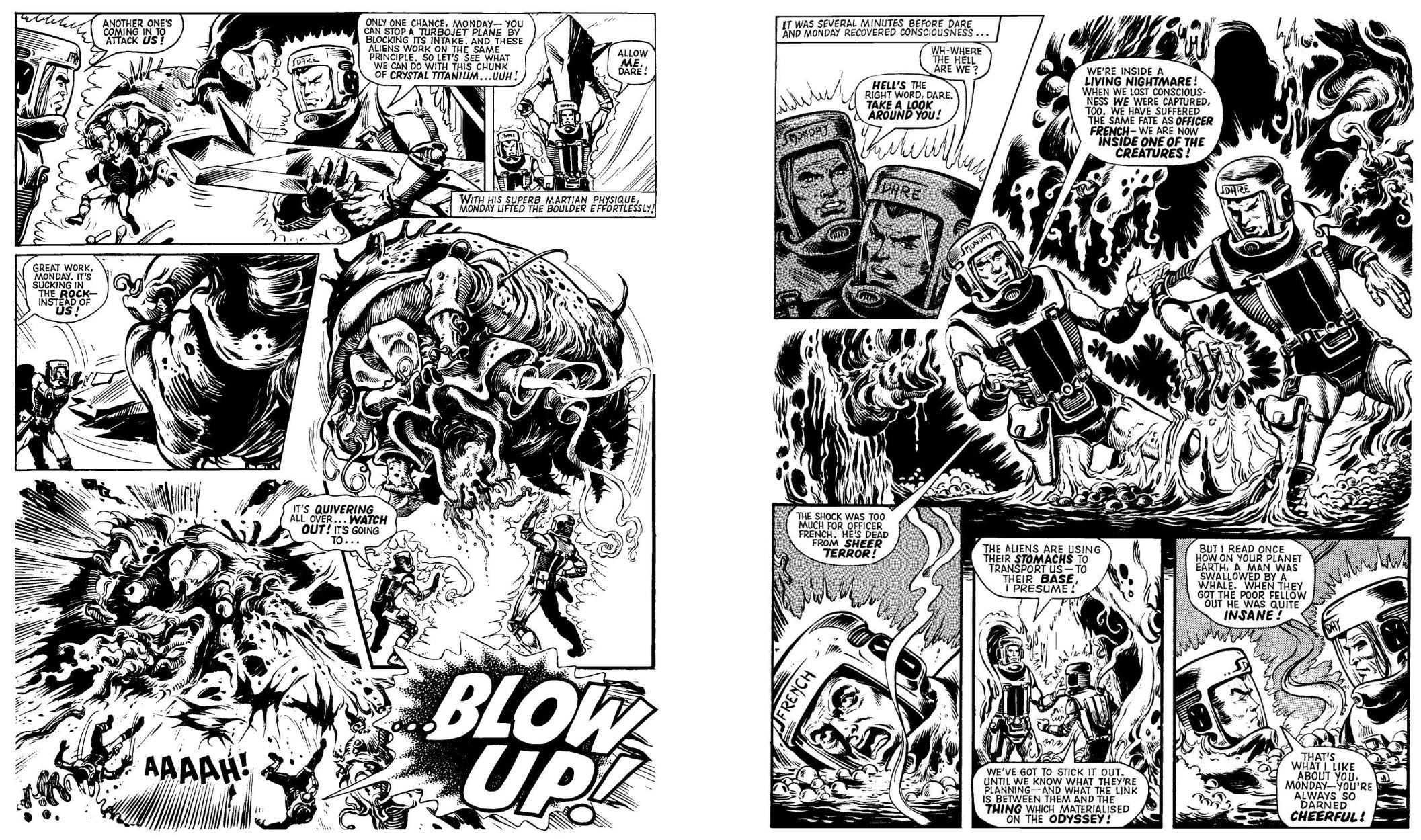
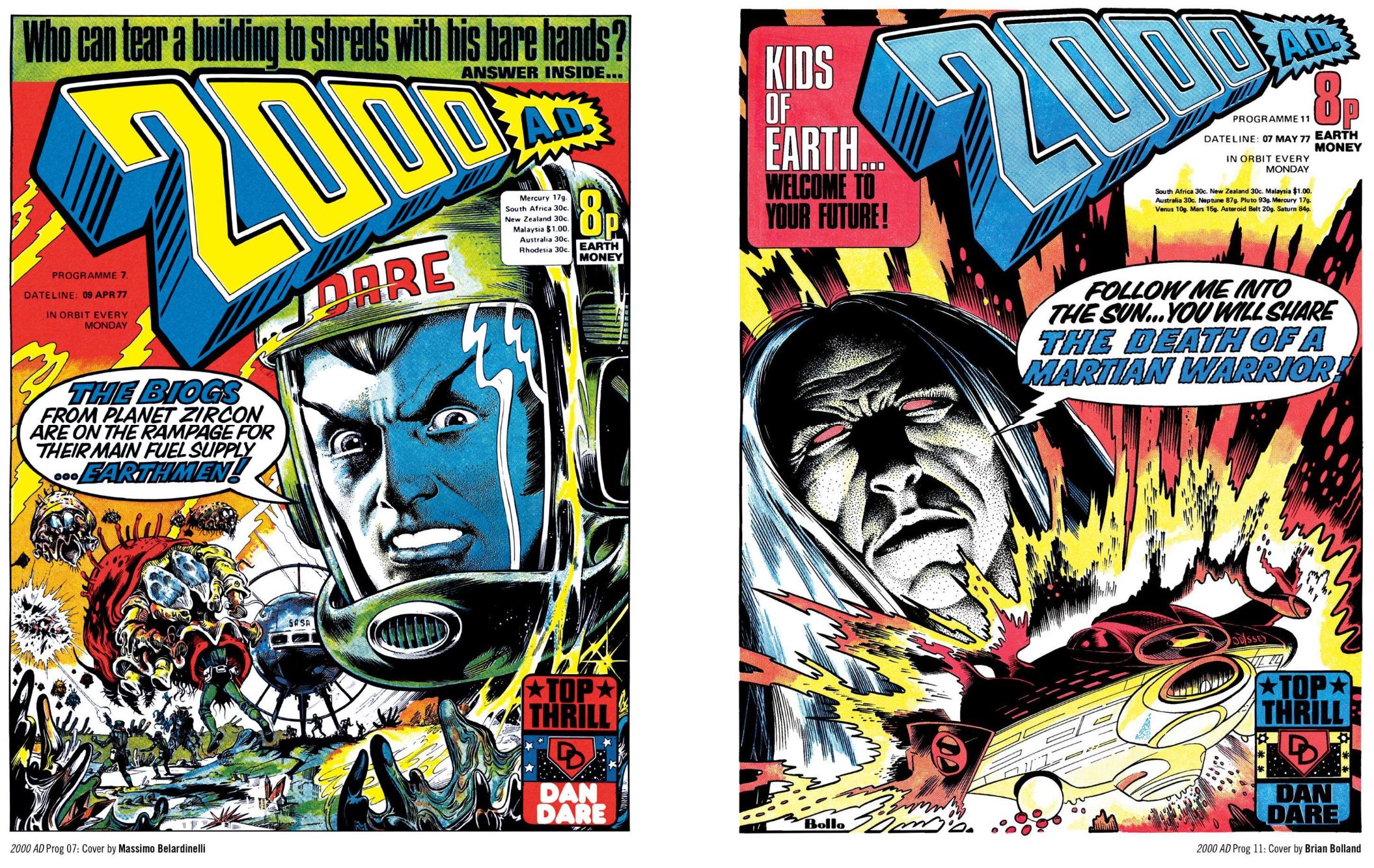
‘Introduction – This was our Dan Dare’ by Garth Ennis recounts the Hows and some Whys of the resurrection and radicalization from steadfast pilot to “Space Hyper-Hero”. The serial episodes #1-11 (scripted by Ken Armstrong, Pat Mills & Kelvin Gosnell, with Massimo Belardinelli illustrating and letterers Bill Nuttall, Jack Potter & Peter Knight) opened in 2177 AD as freighter Sirius is ferried to a space museum. When it is suddenly destroyed by an inimical alien force emerging from Jupiter’s Red Spot, the sole survivor is its career-spacer captain Dan Dare

The disaster brings the hardworking, diligent officer into conflict with SASA (Solar, Astronautical and Space Administration) penpusher the Solar Fleet Controller based in Lunaciti who charges Dare with negligence and tries to court martial him. After all, everyone knows there’s no life on Jupiter…

Refusing to back down, Dare explosively escapes and goes on the run, stowing away on Jupiter-bound cruiser Odyssey…

Each episode began on the prized centre spread, offering artists intriguing layout options and full colour in the otherwise monochrome periodical and here every instalment is reinforced with text feature ‘Dan Dare – My Part in his Revival’ (parts 1-9 as provided by Pat Mills to fanzine Spaceship Away).

Unfolding at breakneck pace, the tale sees him gradually win over sceptical Martian martinet and ship Captain Mr. Monday just as the hostile force attacks again, hurling appalling biological units against the aghast crew. A total convert now, Monday puts all his resources into discovering who and what is behind the attacks, leading to a brain-busting away mission into the red spot and surface of supermassive world where vile invaders The Biogs are set to test the resistance of solar system races and if their potential worthiness to become fuel for them…

The result is staggering stellar warfare with the bio-beasts eventually repelled by Dare’s resistance and an astounding sacrifice by Monday…

Scene set and scenario established, the serial kicked into even higher gear when Steve Moore assumed scripting chores for ‘Hollow World’ (#12-23, illustrated by Belardinelli and lettered by Peter Knight, John Aldrich, Nuttall, J. Swain, Tony Jacob & Tom Frame). This time working spacer Dare ships out on freighter Titan 1 C., only to have the vessel captured as they escape the Milky Way galaxy and end up inside a planet inside a red sun inside the Magellanic cloud…

The culprits are the barbaric Skath and their monstrous piratical mutant ruler The Two of Verath. However the biggest shock is that they are grudgingly served by Dare’s ancient enemy The Mekon, now reduced to toiling for his own survival. The little goblin is astounded to discover how his supposedly long-dead enemy is still around and so different looking (and so will you be!) but happily sets to torturing Dare and the crew for answers.

Inevitably Dare escapes and the old enemies renew their personal war, but it’s an unequal contest as the Mekon betrays The Two, seizes control of the Skath and unleashes hell and banditry against humanity and its allies…

Although Dan and his surviving crew escape back home, they are disbelieved by SASA officialdom. The war that follows is catastrophic and results in further betrayal and death across the universe…

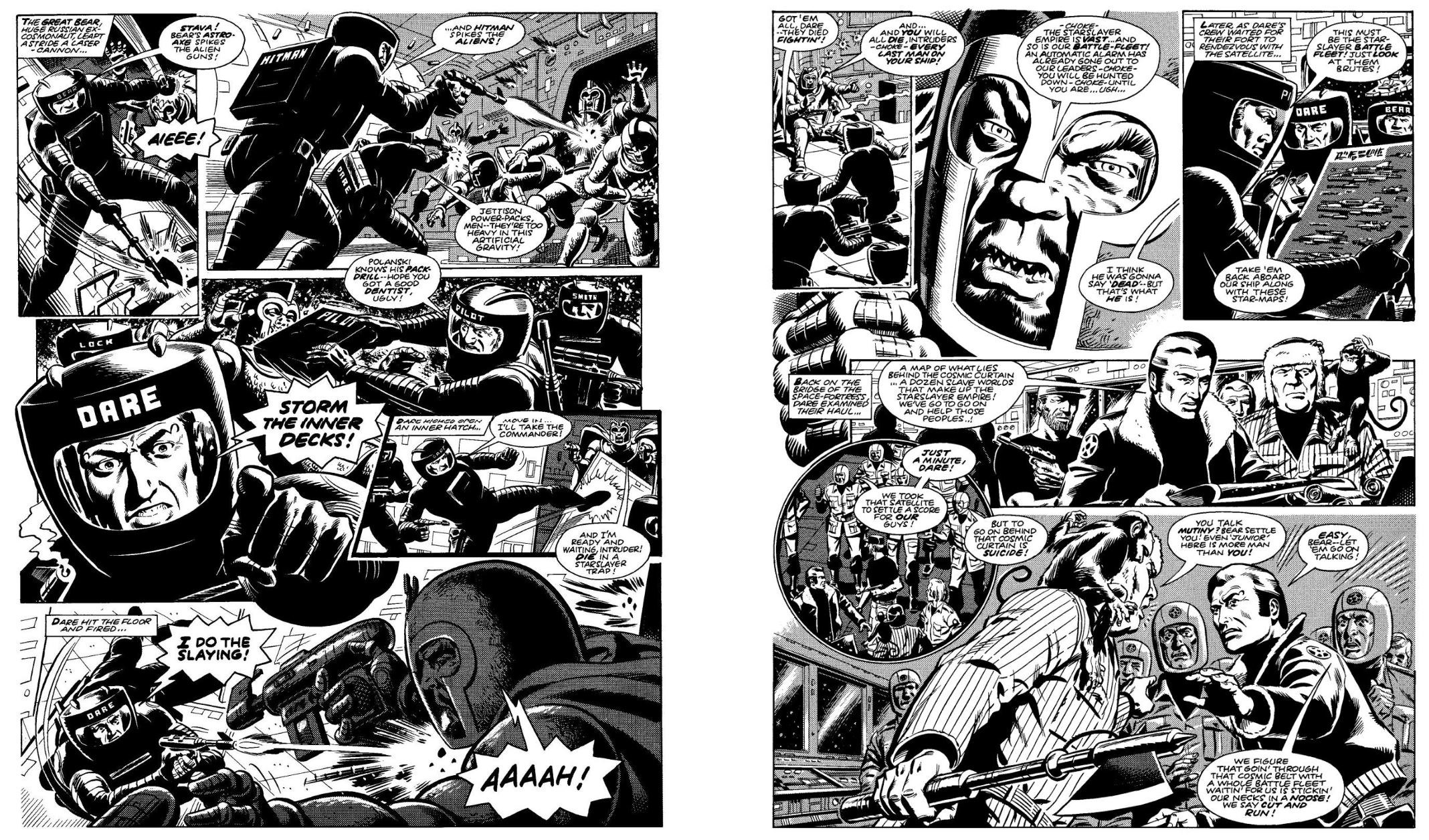
Gerry-Finley-Day took over with 2000 AD #28 as Dave Gibbons & Brian Bolland introduced a new supporting cast in ‘Legion’ (#283). Now an acknowledged troubleshooter and problem solver, Dare is asked by SASA to find out why so many colonists have vanished in the region dubbed “the Lost Worlds”. Accepting the commission, Dare’s first stop is rag-tag satellite Topsoil to brutally and cunningly “recruit” the most violent scum in space: fight-crazed bruisers like Great Bear, hired killers like Hit-Man and lethal survivors like cashiered pilot Polanski

Packed aboard a deadly flying space fortress, the appalling unappealing argonauts dive into danger, pitting the crew against space bugs, malignant dust devils, seductive space sirens, vampires and cosmic slavers as they methodically catalogue what killed all those colonists across a region of the void that simply does not love mankind…

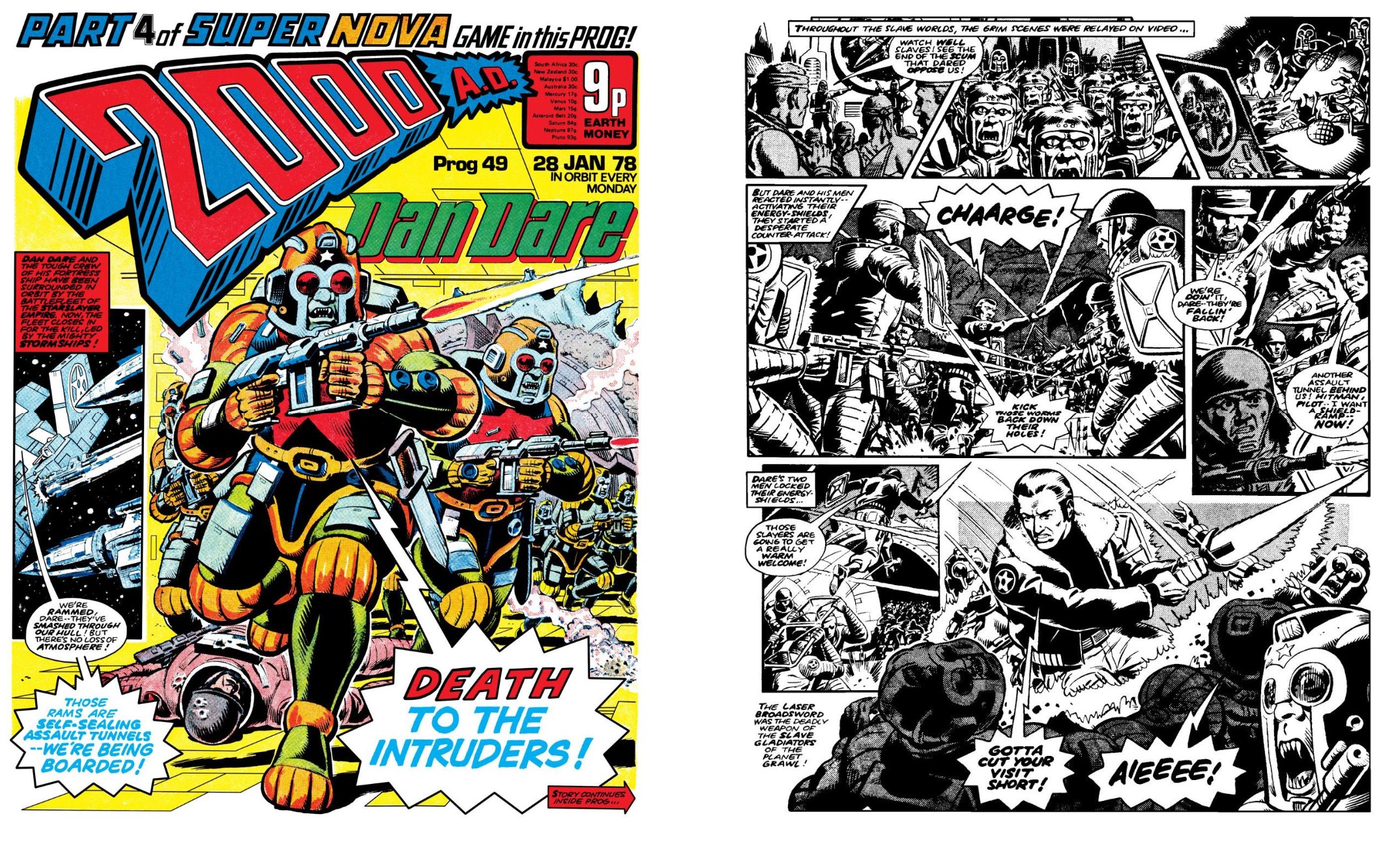
Casualties were high and the sentient terrors of ‘Greenworld’ (#34-35) cost them plenty, but did provide one new volunteer – a “monkey” dubbed Haley Junior – in advance of lengthy epic ‘Star Slayer’ (#36-51). This found the searchers clashing with an intergalactic empire of savage marauders, liberating slaves on a dozen worlds and ultimately overthrowing the terrifying Dark Lord. In the course of that cosmic quest Dan Dare scored the front cover spot every week – just like he had in the old days of the readers’ dads…

Although the mission pauses here, a section of Bonus Strips follows, supported throughout the book by numerous classic cutaway diagrams of Dare’s vehicles by Gibbons. Sadly a lot of credits have been lost, as with the untitled first tale, taken from 2000 AD Summer Special 1977 wherein Dare and his crew are hurled into an antimatter dimension by invaders seeking to make Earth fuel for a journey home, after which Belardinelli limns anonymous full colour clash with the devil ‘Dan Dare and the Curse of Mytax’ (2000 AD Annual 1978) as the spaceman outwits a meddling vicious godling who can warp reality.

From 2000 AD Sci-Fi Special 1978, ‘Visco’ – written and painted in grey-tones by Garry Leach (& lettered by John Aldrich) – finds Dare traversing Mars’ icy Uchronian wastes and stumbling across a lethal science project that bends minds and breaks existence… until he demonstrates what old-fashioned willpower can do…

The last two tales come from The Dan Dare Annual 1979 and begin with an untitled proper romp by writer unknown, fabulously painted by legendary illustrator Ian Kennedy.

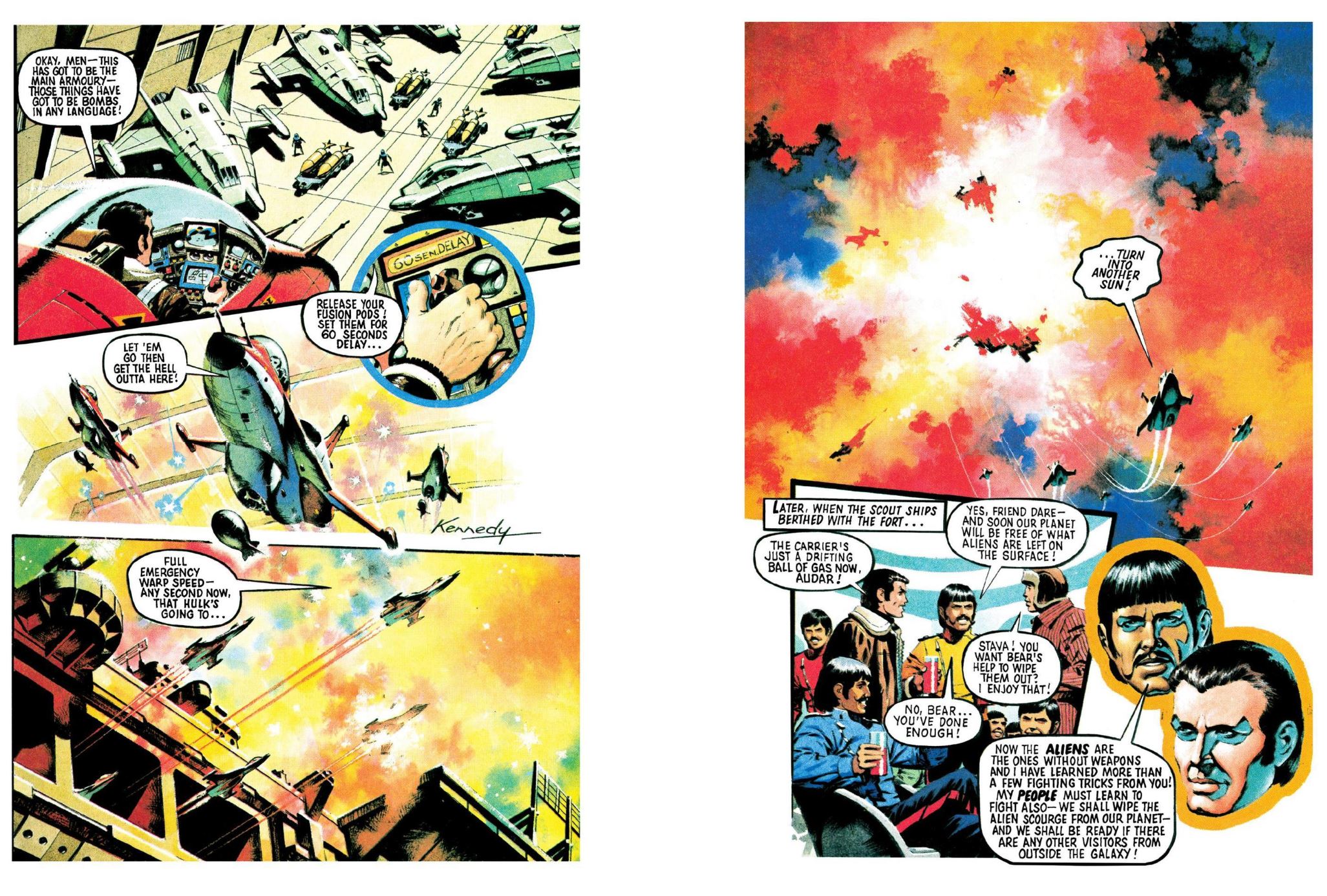
Set on the Fortress exploring The Lost Worlds, here Dare and crew come to the aid of a planet invaded by evil invaders in the biggest starship ever encountered, and prove yet again that it’s not about size, but what you do with it…

The strip wonders close with a monochrome and anonymous treat revealing just what happened to the Pilot of the Future in his last original era clash with the Mekon. ‘Dan Dare: The 2000 A.D. Origin’ traces that final battle through to the aftermath as Earth sought to preserve something of its greatest hero, and what happened next… or at least eventually…

This initial collection then concludes with a stunning cover gallery and biographies.

Epic, bombastic and eternally gratifying, this a treat three generations (at least) can get stuck into, highlighting what made Britain Great in the least obnoxious way anyone could imagine. Come get some!
© 1977, 1978, 1979, 2015, Rebellion/AS. All Rights Reserved.

Believe it or don’t, today in 1918 cartoonist Robert Ripley debuted his fact-panel Ripley’s Believe or Not. One year later Elzie Segar launched Thimble Theatre. Boy, dem wuz the days, huh?

Here in 1952 Leo Baxendale debuted Minnie the Minx in The Beano.

Less celebratory though, in 2001 we lost arch teen cartoonist Dan DeCarlo and in 2006 Golden Age Superman, Batman and Starman illustrator Jack Burnley.

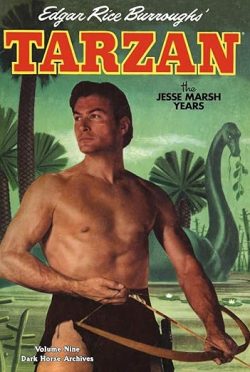
Edgar Rice Burroughs’ Tarzan: The Jesse Marsh Years Volume Nine


By Gaylord DuBois & Jesse Marsh (Dark Horse Books)
ISBN: 978-1-59582-649-7 (HB)

This book includes Discriminatory Content produced in less enlightened times.

Win’s Christmas Gift Recommendation: Primal fantasy Adventure… 8/10

I don’t know an awful lot about Jesse Marsh, other than that he was born on 27th July 1907 and died far too young: on April 28th 1966 from diabetic complications at the height of a TV Tarzan revival he was in large part responsible for. What I do know, however, is that to my unformed, pre-fanboy, kid’s mentality, his drawings were somehow better than most of the other artists and that every other kid who read comics in my school disagreed with me.

There’s a phrase we used at 2000 AD that summed it up: “Artist’s artist”, which usually meant someone whose fan-mail divided equally into fanatical raves and bile-filled hate-mail. It seems there are some makers of comic strips that many readers simply don’t get.

It isn’t about the basic principles or artistic quality or even anything tangible – although you’ll hear some cracking justifications: “I don’t like his feet” (presumably the way he draws them) and “it just creeps me out” being my two favourites. Never forget in the 1980s DC were told by the Comics Code Authority that Kevin O’Neill’s entire style and manner of Drawing was unacceptable to American readers!

I got Jesse Marsh. He was another Disney animator (beginning in 1939) who moved sideways – in 1945 – to become a full-time narrative illustrator for the studio’s comic book licensee Whitman Publishing. Marsh never looked back and became the go-to guy for other ERB adaptations such as John Carter of Mars.

Situated on the West Coast, Western’s Dell/Gold Key imprints rivalled DC and Marvel at the height of their powers, and the licensee famously never capitulated to the wave of anti-comics hysteria that resulted in the crippling self-censorship of the 1950s. No Dell Comics ever displayed a Comics Code Authority symbol on the cover – they never needed to…

Marsh jobbed around adapted movie properties – mostly westerns like Gene Autry – until 1948 when Dell introduced the first all-new Tarzan comic book. The newspaper strip had run since 1929 and all previous funnybook releases had featured expurgated and modified reprints of those adventures. That all changed with Dell Four Color Comic #134 (February 1947) which featured a lengthy, captivating tale of the Ape-Man scripted by Robert P. Thompson, who also wrote both the Tarzan radio show and the aforementioned syndicated strip (as you can see in Tarzan and the Adventurers).

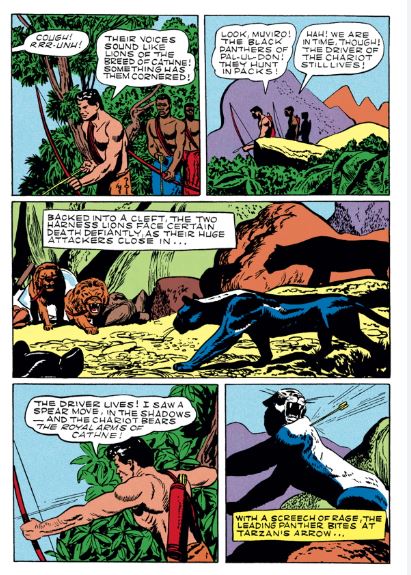
The comic was very much in the Burroughs tradition: John Clayton, Lord Greystoke and his friend Paul D’Arnot aid a young woman in rescuing her lost father from a hidden tribe ruled over by a monster. The engrossing yarn was made magical by the simple, underplayed magic of a heavy brush line and absolutely unmatched design sense. Marsh was unique in the way he positioned characters in space, using primitivist forms and hidden shapes to augment his backgrounds, and as the man was a fanatical researcher, his trees, rocks, and constructions were 100% accurate. His animals and natives, especially children and women, were all distinct and recognisable; not the blacked-up stock figures in grass skirts even the greatest artists so often resorted to.

He also knew when to draw big and draw small: the internal dynamism of his work is spellbinding. His Africa became mine, and of course the try-out comic book was an instant hit. Marsh and Thompson’s Tarzan returned with two tales in Dell Four Color Comic #161, cover-dated August 1947. This was a remarkable feat: Four Colour was a catch-all title showcasing in rotation literally hundreds of different licensed properties, often as many as ten separate issues per month. So rapid a return engagement meant pretty solid sales figures…

Bolstered by a healthy and extremely popular film franchise and those comics strips, within six months, bimonthly Tarzan #1 was released (January/February 1948). It was a swansong for Thompson, but another unforgettable classic for Marsh – and the first of an unbroken run that would last until 1965: over 150 consecutive issues. Moreover there were also spin-offs featuring other ERB character adaptations and gigantic specials like the Annual that opens this collected volume.

Prior to that, the collection – reprinting material from 1953 from Edgar Rice Burroughs’ Tarzan #44-46 and monumental bonus book Tarzan’s Jungle Annual #2 – opens with Foreword ‘Looking for Jesse Marsh’: a heartfelt appreciation and appraisal of the secretive genius by publisher Dan Nadel, packed with information about the enigmatic master. Then, cover-dated August 1953 and on sale from 16th July, that colossal bonus book delivers a painted cover by Morris Gollub (not featuring then current big screen Tarzan Lex Barker) in advance of a beguiling trip to an Africa that never was…

A monochrome Jungle World frontispiece revels in an idyllic quiet moment for the Ape-Man and faithful pachyderm pal Tantor, before main event ‘Tarzan in the Valley of Towers’ transports the Jungle Lord and pilot/scientist Professor Alexander MacWhirtle to a distant unexplored region in aid of a girl who sent a plea for help in a tiny parachute woven from spider-webs…

As always this yarn (and everything else including puzzles) was written by Gaylord DuBois. Editor and prolific scripter (Lone Ranger, Lost in Space, Turok, Son of Stone, Brothers of the Spear and many more) he was Marsh’s creative collaborator for nearly 20 years.

Flying into the great desert, Tarzan and “Professor Mac” soon find Heather Day laid out as a sacrifice on a towering limestone altar, left for giant carnivorous bats by debased humans who have turned themselves into flying/gliding predators in their image. The battle to overthrow the petty tyrants of the sky takes them from the highest peaks to deepest subterranean depths, but inevitably Tarzan triumphs and returns Hearther to the outer world.

Back then, entertainment was full on and informative, so this Annual was packed with fact and activity features. First up, and still all Marsh in vision, is potted travelogue ‘Jungle Trails’ augmented by a simple method for ‘Making Maps’ and a clever rebus message from Tarzan to his ‘Jungle Village’. Then it’s back to action as ‘Tarzan and the Cannibals of Kando-Mor’ finds the Ape-Man and his Waziri friend Chief Muviro traversing the fearsome Great Swamp when the party is captured by man-eating men. Their escape brings the wanders fully into Burroughs’ rich fantasy-scape as they discover another isolated and embattled outpost of lost land Pal-Ul-Don (introduced in 8th novel Tarzan the Terrible) and befriend the buffalo-worshipping Gallugos. The event is quite timely as the ever-encroaching cannibals have almost completed their extended scheme to eliminate the cow-lovers…

Almost…

Illustrated sheet music provides long-distance lessons for ‘Dancing Feet’ to cavort at a ‘Moonlight Marriage’ ceremony, whilst ‘Happy Warrior’ shares the secrets of kite-making before ‘Boy Stands by a Friend’ offers another intimate peek at the formative years of Greystoke’s African family when Boy – later called Korak – and ape pal Zorok stow away on a riverboat and nearly end up as zoo exhibits. ‘Letters from Boy’ to the readers feature next, as ‘Jungle Hunt’ details how to make an inner tube popgun and water canteens, prior to an adventure with elephants as ‘The Troubles of Tantor’ seen the herd patriarch go to extraordinary lengths to rescue wayward calves captured by angry farmers.

Picture essays detail the secrets of MacWhirtle’s plane and the domain of dinosaurs in ‘Boys Air Adventure to the Valley of Monsters’ after which a touch of old-fashioned racial profiling describes native characteristics in ‘Jungle Tribes’ and ‘Jungle Woman’ before embracing romance as final story ‘Tarzan Trails the Brothers of the Barracuda’ sees the Ape-Man reunite shipwrecked and separated young lovers by hunting down the slave traders who have seized and sought to sell her…

Wrapping up with a load of lexicons, ‘Jungle Language: Swahili-English’ and ‘Jungle Language: Ape-English’ provides illustrated dictionaries that come in handy for the puzzle pages and crossword, before monochrome endpiece ‘Jungle World’ explores the violent existence of bugs and minibeasts.

Cover-dated May 1953, Edgar Rice Burroughs’ Tarzan #44 sees the Jungle Lord enjoying a quiet ride over vast hidden Pal-Ul-Don on his giant eagle Argus when he saves a tiny shepherd from a vulture as big as the mighty raptor Tarzan rides. In ‘Tarzan and the Little Spearmen’ this good deed soon sours. Coro of Saparta is grateful and desperate and happy in turn as the benevolent giant and his equally immense pal Muviro hunt down the ferocious carrion feeders who find living little people more tasty than corpses. Sadly, the interaction sparks civil war between the farming fraternity and now-unemployed spearman clan who used to defend them, especially after Tarzan teaches them the high-tech marvel of archery…

Pathos and nostalgia hit hard in second saga ‘Tarzan and the Strange Balu’ as a she-ape finds a human baby and replaces her own dead newborn with him. Poor, grieving Kalahari will not surrender the infant, leaving the Ape-Man in a double bind: finding the child’s real family and saving the mother surrogate from heartbreak…

The task is made even harder but more gratifying when Tarzan discovers vile slavers have been transporting a white woman to market…

The issue ends with a stunning pinup of Argus and a GIANT-giant vulture and contemporary house ad before ERBT #45 (June 1953) opens with ‘Tarzan and the Haunted Plantations’ wherein the Ape-Man visits old friend Chief Buto and learns his warrior comrade is plagued by devils and ghosts. A little careful investigation then reveals the fields where his people hire out as croppers are coveted by a bandit with knowledge of unexploited resources beneath that fruitful dirt, and Razan devises a sneaky scheme…

‘Boy and the Shamba Raider’ again focuses on the exploits of Korak-to-come as the kid and his pal Dombie take executive action to trap rogue water buffalo raiding crops and attacking workers. They wouldn’t have had to if the adult warriors had listened to them in the first place…

Epic fantasy follows in ‘Tarzan Returns to Cathne’ when the Jungle Man and Waziri’s Pal-Ul-Don explorations bring them into conflict with sabretooth tigers attacking the war-lions of Queen Elaine of Cathne. The staunch friend and ally is a fugitive now as her husband King Jathon is gone and usurper Timon rules. The madman is unstoppable and seeks to conquer sister city Athne, but Tarzan has other ideas and the wits to implement them…

The issues closes with another house ad and ‘Tarzan’s World’ pinup of the Dangina (Cape Hunting Dog) before we segue into final entry Tarzan #46 .

Dated July 1953 it begins with ‘Tarzan Defends a City’ as the Ape-Man and not-dead Jathon (surprise!) trek back to Cathne with super-colossal war lion Goliath, only to find the citadel under siege by crocodile-riding Terribs from the Great Swamp. Things look bleak until the Gallugos – freshly fled from the cannibal Kando-Mors – arrive and turn the muddy tide. All they want in return is land to build their new city…

Back in regular Africa, ‘Boy Faces the Fangs of the Mamba’ after Matusi witchdoctor Ungali – having failed to kill Tarzan – frames his annoying spawn Boy for theft and orchestrates a lethal trial by snake. Sadly for the villain, Ape-Man arrives just in time…

This titanic tome terminates with whimsical mystery ‘Tarzan and the Treasure of the Apes’ as brutal unscrupulous white hunters discover the great apes dubbed “mangani” are all bedecked in priceless jewels. Ruthlessly stalking the vain bedazzled beasts the safari killers even manage to wound Tarzan, before he convinces the apes to surrender their “pretty stones” in favour of something better: something edible.

The Jungle King then delivers a unique judgement that might not look like justice but truly is nothing but…

Although these are tales from a far-off, simpler time they have lost none of their passion, inclusivity and charm, whilst the artistic virtuosity of Jesse Marsh looks better than ever. Perhaps this time a few more people will “get” him…
Edgar Rice Burroughs® Tarzan®: The Jesse Marsh Years volume 9 © 1953, 2011, Edgar Rice Burroughs Inc. Tarzan ® Edgar Rice Burroughs Inc. All rights reserved.

In 1952 Jack of all comics trades Keith Giffen was born. We haven’t reviewed Ambush Bug, Legion of Super-Heroes or his Doom Patrol yet, so why not recall gleeful glory days with Justice League International volume 1?

In 1978 screen writer and comics luminary Robert Kirkman was born. You probably know him best for Walking Dead volume 1: Days Gone Bye.

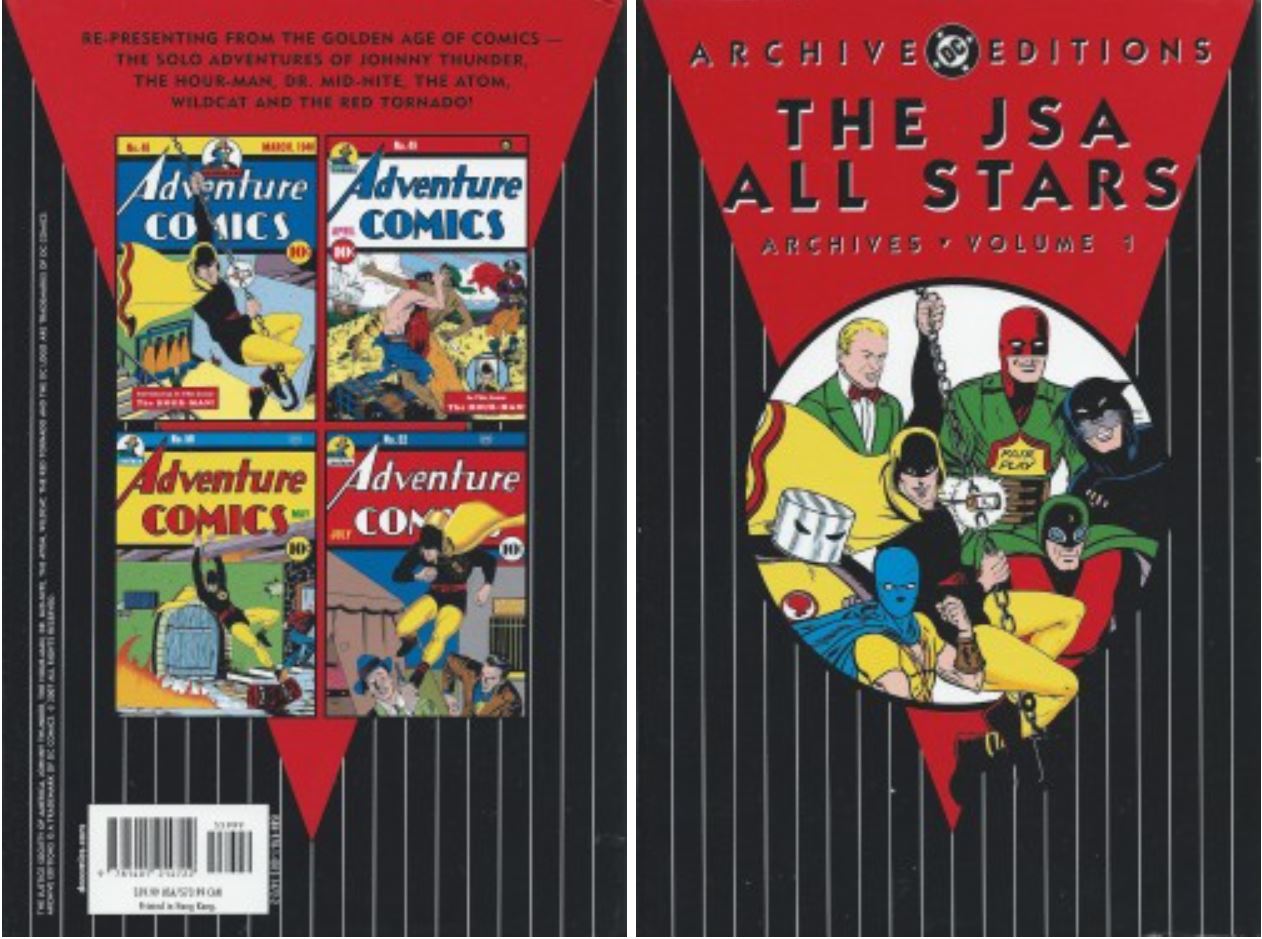
The JSA All Stars Archives volume 1


By John Wentworth, Ken Fitch, Bill O’Connor, Sheldon Mayer, Charles Reizenstein, Bill Finger, Stan Aschmeier, Bernard Baily, Ben Flinton & Leonard Sansone, Howard Purcell, Hal Sharp, Irwin Hasen & various (DC Comics)
ISBN: 978-1-4012-1472-2 (HB)

This book includes Discriminatory Content produced in less enlightened times.

Win’s Christmas Gift Recommendation: Golden Aged but Evergreen Enjoyment …8/10

In the JSA’s anniversary year, here’s yet another DC classic collection long overdue for revival and digital return. Until then – and if you can find it – this hardback will make a perfect present for you or yours…

After the actual invention of the comic book superhero – indisputably Action Comics’ debut of Superman in June 1938 – the most significant event in the industry’s history was the combination of individual sales-points into a group. Thus what seems blindingly obvious to us with the benefit of four-colour hindsight was proven: consumers couldn’t get enough of garishly-hued mystery men and combining a multitude of characters inevitably increases readership. Plus, of course, a mob of superheroes is just so much cooler than one… or one-and-a-half if there’s a sidekick involved…

The creation of the Justice Society of America in 1941 (with copies of All-Star Comics #3 going on sale today waaay back then) utterly changed the shape of the budding business. However, before that team could unite they had to be popular enough to qualify, and this superb hardcover sampler gathers the debut adventures of a septet of beloved champions who never quite made it into the first rank but nonetheless scored enough to join the big team and maintain their own solo spots for much of the Golden Age of American Comics.

Whilst most favoured 1940s stalwarts all won their own DC Archive collections (some even making it into digital modern editions this century), this particular tome bundles a bunch of lesser lights – or at least those who never found as much favour with modern fans and revivalists – and features the first 5 appearances of 7 of the JSA‘s “secondary” mystery men: all solid supporting acts in their own anthology homes but who were potentially so much more…

Gathered here are short, sharp, stirring tales from Flash Comics #1-5; Adventure Comics #48-52; All-American Comics #19-29 and Sensation Comics #1-5, collectively spanning January 1940 to May 1942. They are preceded a sparkling, informative and appreciative Foreword by Golden Age aficionado and advocate Roy Thomas… himself enjoying an anniversary today so a very happy 85th birthday to you, sir!

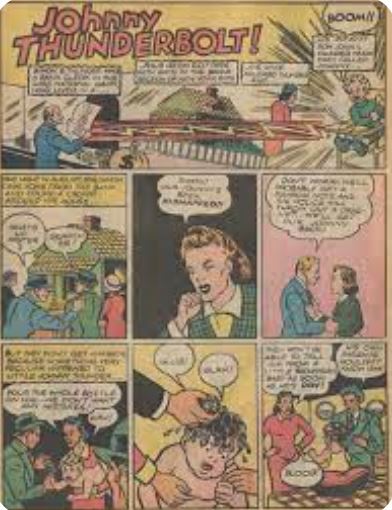
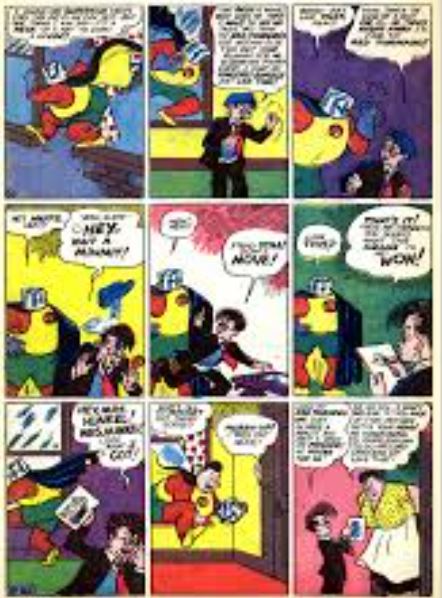
The vintage vim & vigour begins with a character equally adored and reviled in modern times. Johnny Thunderbolt – as he was originally dubbed – was an honest, well-meaning, courageous soul who was also a grade A idiot. However, what he lacked in smarts he made up for with sheer luck, unfailing pluck and the unconscious (at least at first) control of an irresistible magic force.

The series was played for action-packed laughs, but there was no getting away from it: Johnny was, quite frankly, a simpleton in oblivious control of an ultimate weapon. At least his electric genie was more plausible than an egomaniacal orange-toned cretin in control of America’s nuclear arsenal…

John Wentworth & Stan Aschmeier introduced the happy sap in ‘The Kidnapping of Johnny Thunder’ from January 1940’s Flash Comics #1: a fantastic origin detailing how, decades previously, the infant seventh son of a seventh son in America was abducted by priests from mystical island Badhnisia. The child was to be raised as the long-foretold wielder of a fantastic magical weapon, all by voicing the eldritch command “Cei-U” – which sounds to western ears awfully like “say, you”…

However, ancient enemies on neighbouring isle Agolea started a war before ceremonial indoctrination could be completed and at age seven the lad, through that incomprehensible luck, returned to his parents to be raised in relative normality of the Bronx. Everything was fine until Johnny’s 17th birthday, when the rite finally came to fruition and – amid bizarre weather conditions – Badhnisians cultists intensified the search for their living weapon.

By the time they tracked him down, he was working in a department store and had recently picked up the habit of blurting out the phrase “say you.” It generally resulted in something very strange happening. One example being a bunch of strange “Asiatics” attacking him and being blown away by a mysterious pink tornado…

Pattern set, each month Johnny looked for gainful employment, stumbled into a crime or crisis where his voluble temperament resulted in an inexplicable unnatural phenomenon that solved the problem but left him no better off. It was a winning theme that lasted until 1947, by which time the Force had resolved into a wisecracking thunderbolt-shaped humanoid genie, while Johnny was ousted from his own strip by sexy new crimebuster Black Canary.

Flash Comics #2 featured ‘Johnny Becomes a Boxer’. Upon stepping in to save a girl from bullies, Johnny somehow convinces vivacious Daisy Darling to be his girlfriend. He then becomes Heavyweight Champion, leading to his implausibly winning a fixed bout in #3’s ‘Johnny versus Gunpowder Glantz’. Only now, Daisy refuses to marry a brute who lives by hitting others. The solution came in ‘Johnny Law’ when kidnappers attempt to abduct Daisy’s dad. Following his sound thrashing of the thugs, and at his babe’s urging, Johnny then joins the FBI. This tantalising taste of times past concludes with ‘G-Man Johnny’ (#5 May 1940) as the kid’s first case involves him in a bank raid and results in his own dad being taken hostage…

Although he eventually joined the JSA, and despite affable, good-hearted bumbling carrying him through the war, shifting peace-time fashions found no room for a hapless hero anymore, and when he encountered a sultry masked female Robin Hood who stole from crooks, the writing was on the wall. Nevertheless, fortuitously imbecilic (and remarkably Millennial in outlook and prospects) Johnny Thunder is fondly regarded by many modern fans, still having much to say and a decidedly different way of saying it…

Ken Fitch & Bernard Baily’s Hourman was a far more serious proposition. He actually had a shot at stardom and began by supplanting The Sandman as cover feature in Adventure Comics #48 (March 1940). Here, his exploits run through #52 (July) establishing the unique and gripping methodology which made him such a favourite of later, more sophisticated fans.

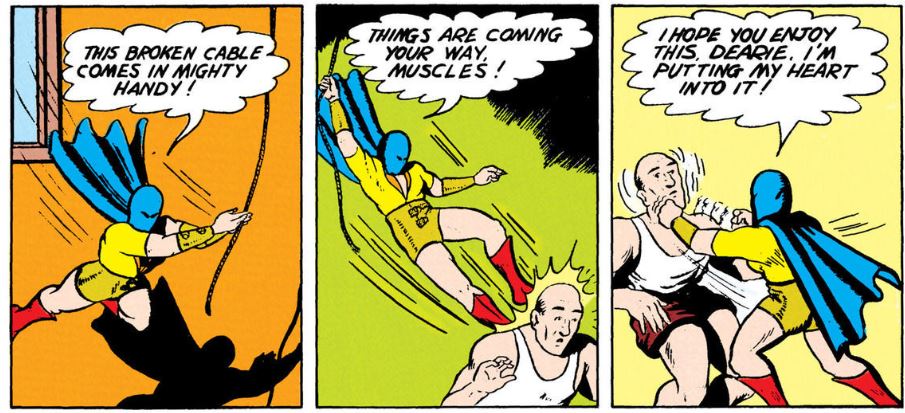
In an era where origins were never as important as action, mood and spectacle, ‘Presenting Tick-Tock Tyler, the Hour-Man’ begins with a strange classified ad offering assistance to any person in need. Chemist Rex Tyler had invented Miraclo: a drug super-energising him for 60 minutes at a time, and his first case sees him help a wife whose man is being dragged back into criminal endeavours by poverty and bad friends. Then ‘The Disappearance of Dr. Drew’ finds Tyler locating a missing scientist kidnapped by thugs before ‘The Dark Horse’ has the Man of the Hour crush a crooked, murderous bookie who swipes both horse and owner before a key race. Mad science and a crazy doctor employing ‘The Wax-Double Killers’ adds scary thrills and supervillain cachet for our timely hero to handle, and ‘The Counterfeit Hour-Man’ concludes the offerings here as he again defeats Dr. Snegg in a scurrilous scheme to frame the hooded hero.

Hourman always looked great and his adventures developed into tight and compulsive affairs, but as simply another strong, fast, tough masked guy, he never caught on and eventually timed out at the beginning of 1943 with Adventure #83.

Our third second string star is Calvin College student Al Pratt: a diminutive but determined kid fed up with being bullied by jocks. Al remade himself by effort and willpower into a pint-sized, two-fisted mystery man ready for anything. One of the longest lasting Golden Age greats, The Mighty Atom was created by writer Bill O’Connor and rendered by Ben Flinton & Leonard Sansone. He debuted in All-American Comics #19 and, after an impressive run there, transferred to Flash Comics in February 1947. The Atom sporadically appeared until the last issue – #104, cover-dated February 1949 – and made his final bow in the last JSA tale (All Star Comics #57) in 1951.

The cases here span AAC #19-23 (October 1940 – February 1941), beginning by ‘Introducing the Mighty Atom’ as the bullied scholar hooks up with down-&-out trainer Joe Morgan, whose radical methods soon have the kid at the very peak of physical condition and well able to take care of himself. However, when Al’s hoped-for girlfriend Mary is kidnapped, the lad eschews fame and potential sporting fortune to bust her loose, thereafter opting for clandestine extracurricular activities….

The Atom sported a costume for his second adventure, going into ‘Action at the College Ball’ to foil a hold-up before tackling ‘The Monsters from the Mine’ – actually enslaved victims of a scientific maniac intent on conquest. The college environment offered plentiful plot opportunities and in ‘Truckers War’ the hero crushes hijackers who bankrupt a fellow student and football star’s father. These episodes conclude with ‘Joe’s Appointment’ as Al’s trainer is framed for spying by enemy agents and needs a little atomic assistance…

Although we think of the Golden Age as a superhero wonderland, the true watchword was variety. Flagship anthology All-American Comics offered everything from slapstick comedy to aviation adventure on its four-colour pages and one of the very best humour strips featured semi-autobiographical exploits of Scribbly Jibbet: a boy who wanted to draw.

Created by actual comics wonderboy Sheldon Mayer, Scribbly: Midget Cartoonist debuted in AAC #1 (April 1939) and built a sterling rep for himself beside star reprint features including Mutt and Jeff and all-new adventure serial Hop Harrigan, Ace of the Airways. However, when contemporary fashions demanded a humorous look at mystery men, in #20 (November 1940) Mayer’s comedy feature evolved into a delicious spoof of the trend as Scribbly’s formidable landlady Ma Hunkel decided to do something about crime in her neighbourhood… so she dressed up as a husky male masked hero.

‘The Coming of the Red Tornado’ sees her don cape, woollen longjohns and a saucepan for aN identity-obscuring helmet to crush gangster/kidnapper Tubb Torponi. The mobster had made the mistake of snatching Ma’s terrible nipper Sisty and Scribbly’s little brother Dinky (who would later become her masked sidekicks), so Ma was determined to see justice done…

An ongoing serial rather than specific episodes, the dramedy concluded in ‘The Red Tornado to the Rescue’, with irate, inept cops deciding to pursue the mysterious new vigilante, with the ‘Search for the Red Tornado’ only making them look (more) stupid. With the scene set for outrageous parody ‘The Red Tornado Goes Ape’ pits the parochial masked manhunter against a zoo full of critters before the superb, sublime silly selection ends with ‘Neither Man nor Mouse’ (All-American Comics #24) with the hero apparently retiring and crime resurging – until Dinky & Sisty become crime- crunching duo The Cyclone Kids

A far more serious and sustainable contender debuted in the next AAC issue, joining the growing horde of grim masked avengers. Delivered by Charles Reizenstein & Aschmeier in All-American Comics #25 (April 1941), ‘Dr. Mid-Nite: How He Began’ reveals how surgeon Charles McNider is blinded by criminals but subsequently discovers he can see perfectly in darkness. Becoming an outspoken criminologist, the maimed medico devises blackout bombs and other night paraphernalia to also wage secret war on gangsters, aided only by his new pet owl Hooty

After bringing his own assailant to justice, the good doctor smashes river pirates protected by corrupt politicians in ‘The Waterfront Mystery’ and rescues innocent men blackmailed into serving criminals’ sentences in jail in ‘Prisoners by Choice’ (#27, illustrated by Howard Purcell). With Aschmeier’s return, Mid-Nite crushes aerial wreckers using ‘The Mysterious Beacon’ to down bullion planes and then smashes ‘The Menace of King Cobra’: a secret society leader lording it over copper mine workers.

The Master of Darkness also lasted until the era’s end and appeared in that last JSA story. Since his 1960s return he’s become one of the most resilient and mutable characters in DC’s pantheon of Golden Age revivals, whereas the next nearly-star was an almost forgotten man for decades. Of course his nineties reboot successor is a big shot screen star now…

When Sensation Comics launched (on sale from November 5th 1941) all eyes were rightly glued to uniquely eye-catching Wonder Woman who hogged all the covers and unleashed a wealth of unconventional adventures every month. However, like all anthologies of the era, her exploits were balanced by other features. Sensation #1-5 (cover-dates January to May 1942) also featured a pugnacious fighter who was the quintessence of manly prowess and a quiet, sedate fellow problem-solver who was literally a master of all trades.

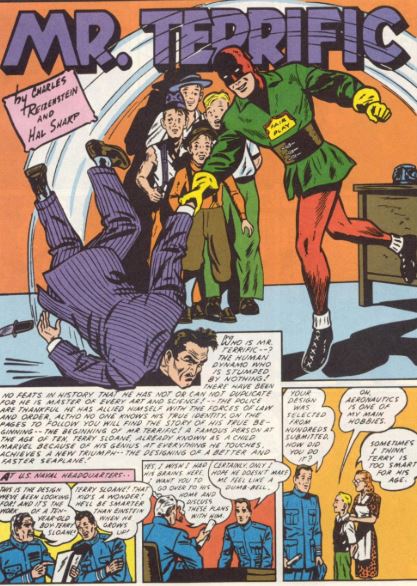
Crafted by Reizenstein & Hal Sharp, ‘Who is Mr. Terrific?’ introduced physical and mental prodigy Terry Sloane who so excelled at everything he touched, that by the time of the opening tale he was planning his own suicide to escape terminal boredom. Happily, on a very high bridge he found Wanda Wilson, a girl with the same idea. By saving her, Sloane found purpose: crushing the kinds of criminals who had driven her to such despair…

Actively seeking out villainy of every sort, he performs ‘The One-Man Benefit Show’ after thugs sabotage performers, travels to the republic of Santa Flora to expose ‘The Phony Presidente’ and helps a rookie cop pinch an “untouchable” gang boss in ‘Dapper Joe’s Comeuppance’. Sloan’s last showing here sees him at his very best, carefully rooting out political corruption and exposing ‘The Two Faces of Caspar Crunch’

Closing out this stunning hardback extravaganza is another quintet from Sensation #1-5, this time by Bill Finger & Irwin Hasen: already established stars for their work on Batman and Green Lantern.

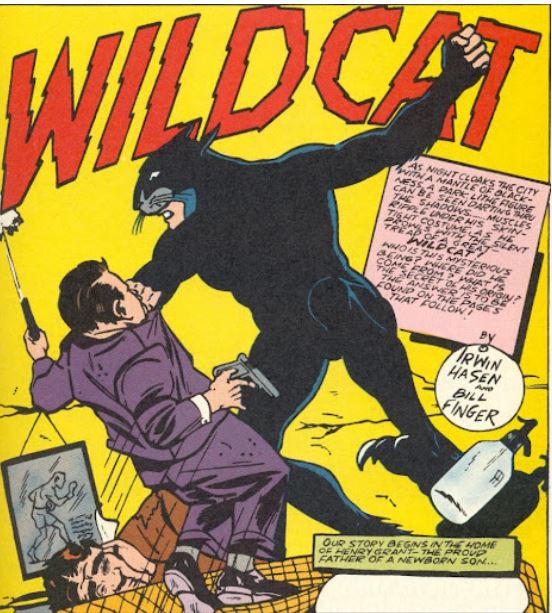
‘This is the Story of Wildcat’ premieres one the era’s most impressive lost treasures and a genuine comic book classic in the tale of Ted Grant: a boxer framed for the murder of his best friend. Inspired by a kid’s hero-worship of Green Lantern, Grant clears his name by donning a feline mask and costume and ferociously stalking the true killers. Finger & Hasen captured everything which made for perfect rollercoaster adventure in their explosive sports-informed yarns. Mystery, drama and action unfolded unabated in sequel ‘Who is Wildcat?’ as Ted retires his masked identity to compete for the vacant world boxing title, but cannot let innocents suffer as crime and corruption befoul the city. ‘The Case of the Phantom Killers’ sees Wildcat stalk mobsters seemingly striking from beyond the grave, before his adventures alter forever with the introduction of hard-hitting hillbilly hayseed ‘Stretch Skinner, Dee-teca-tif!’ He came to the big city to be a private eye and instead became Grant’s foil, manager and crimebusting partner. The capsule comic craziness then concludes for now with a rousing case of mistaken identity and old-fashioned framing, as Wildcat saves his new pal from a murdering gambler in ‘Chips Carder’s Big Fix’…

These eccentric early adventures might not suit some modern fans’ tastes but they stand as an impressive and joyous introduction to the fantastic worlds and exploits of the World’s oldest if not always greatest superheroes. If you have an interest in the way things were or just hanker for simpler times, less complicated and angsty fun, this may well be a book you’ll cherish forever…
© 1940, 1941, 1942, 2007 DC Comics, Inc. All Rights Reserved.

Also Today, in 1901 Roy Crane was born. His Wash Tubbs, Captain Easy and Buz Sawyer all shaped the way comics evolved and deserve your attention. In 1923 Belgian cartoonist Paul (Corentin) Cuvelier was born. You can celebrate the birthday of Marjane Satrapi who joined the world in 1969 by checking out Persepolis – The Story of a Childhood & Persepolis 2 – The Story of a Return or recall the wonders of C.C. Beck who died today in 1989 just by heading to The Shazam! Archives volume 1. Better yet, you could skip my blather and just read the actual books I’m plugging…

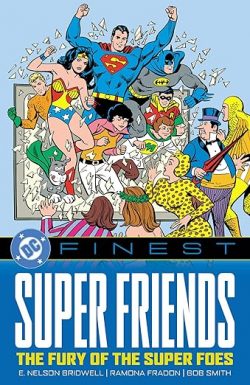
DC Finest: Super Friends – The Fury of the Super Foes


By E. Nelson Bridwell, Denny O’Neil, Ramona Fradon, Kurt Schaffenberger, Ric Estrada, Alex Toth, Joe Orlando, Bob Smith, Vince Colletta with Dick Giordano, Curt Swan & Geoge Klein & various (DC Comics)
ISBN: 978-1-79950-316-3 (TPB)

This book contains Discriminatory Content produced during less enlightened times.

Win’s Christmas Gift Recommendation: Evergreen Superhero Sagas For All… 9/10

Once upon a time comics were primarily created with kids in mind. Whilst I’d never advocate exclusively going back to those days, the modern industry has for the longest time sinned by not fully addressing the needs and tastes of younger fans these days. By that I mean less tie-ns and more accessible standard stoires like Marvel Adventures material or this stuff here.

Happily, DC has latterly been rectifying the situation with new and – most importantly for old geeks like me – remastered, repackaged age-appropriate gems from their vast back catalogue.

A superb case in point of all-ages comics done right is this tome celebrating the joys of childhood when comics and TV shows were interchangeable in kids’ head. It was all one great big dangerous fun world to save or conquer…

DC Finest: Super Friends:- The Fury of the Super Foes gathers comic book tales spun off from a hugely popular Saturday Morning TV Cartoon show: one that, thanks to the canny craftsmanship and loving invention of lead scripter E. Nelson Bridwell, became an integral and unmissable component of the greater pre Crisis on Infinite Earths DC Universe.

It was also one of the most universally thrilling and satisfying superhero titles of the period: featuring the smart, witty, straightforward adventures people my age grew up with, produced during a period when the entire industry was increasingly losing itself in colossal continued storylines and bombastic, convoluted, soap opera melodrama.It’s something all creators should have tattooed on their foreheads: sometimes all you really want is a smart plot well illustrated, sinister villains well-smacked, a solid resolution and early bed…

TV show Super Friends ran (under various iterations) from 1973 to 1986; starring primarily Superman, Batman and Robin, Wonder Woman, Aquaman and a brace of studio-originated kids as student crimebusters. The cast was supplemented by guest stars from the DCU on a case by case basis. The animated series made the transition to print as part of the publisher’s 1976 foray into “boutiqued” comics which saw titles with a television connection cross-marketed as DC TV Comics.

Child-friendly Golden Age comic book revival Shazam!- the Original Captain Marvel had been adapted into a successful live action series and its Saturday Morning silver screen stablemate The Secrets of Isis consequently reversed the process to become a comic book. With the additions of hit comedy show Welcome Back Kotter and animated blockbuster Super Friends four-colour format, DC had a neat outreach imprimatur tailor-made to draw viewers into the magic word of funnybooks.

At least that was the plan: with the exception of Super Friends none of the titles lasted more than ten issues beyond their launch…

This massive mega-extravaganza collects Super Friends #1-26 (spanning November 1976 to November 1979), includes promo comic Aquateers Meet the Super Friends and reprints material from Limited Collectors’ Edition #C-41 and C-46.

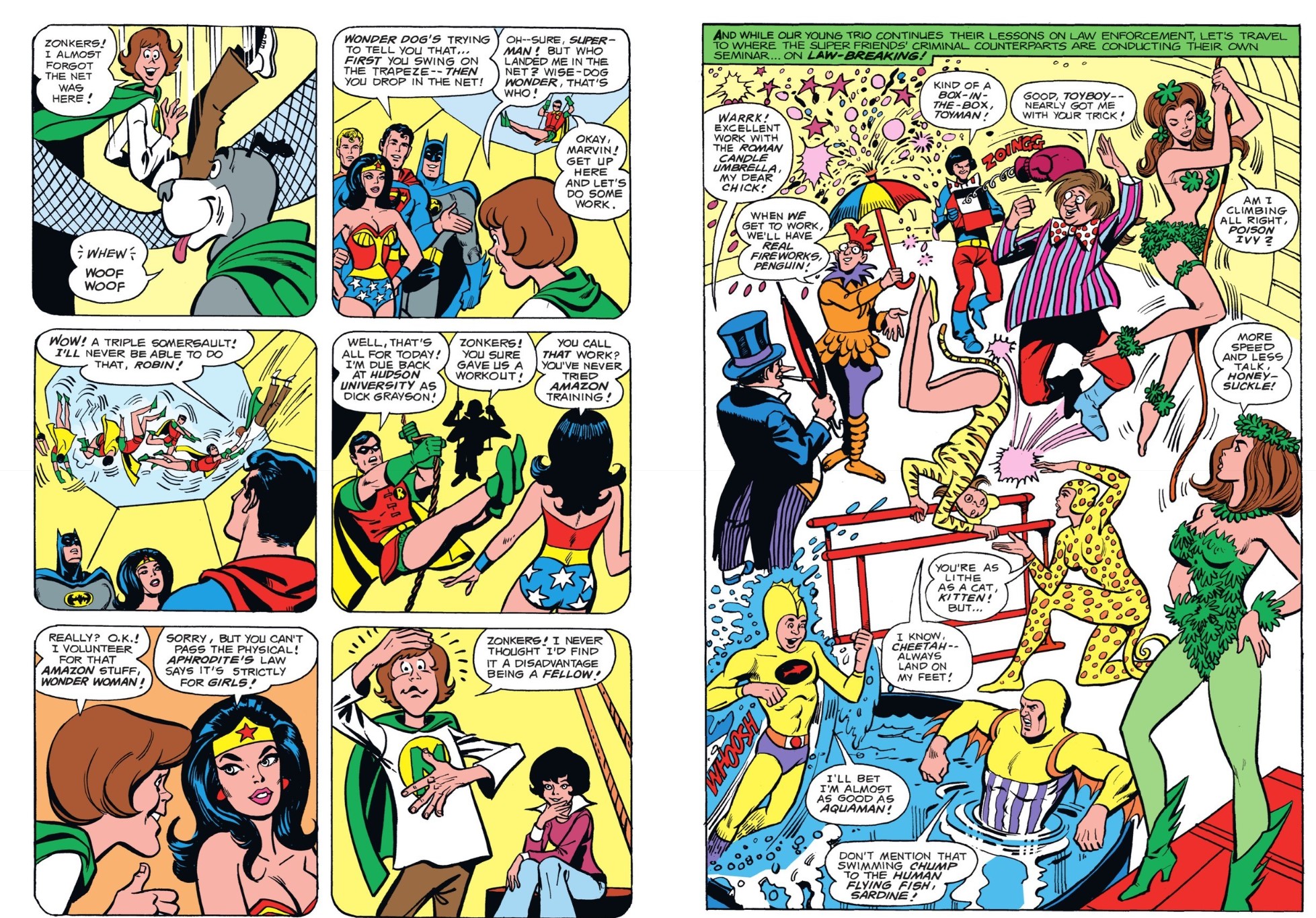
The fun begins a crafty 2-part caper by the wondrous E. Nelson Bridwell and illustrators Ric Estrada, Vince Colletta & Joe Orlando. ‘The Fury of the Super Foes’ finds heroes-in-training Wendy & Marvin – and their incredibly astute mutt Wonderdog – studying at the palatial Hall of Justice, even as elsewhere, a confederation of villains prove imitation is the sincerest form of flattery… if not outright intellectual theft. Having auditioned a host of young criminals, The Penguin, Cheetah, Flying Fish, Poison Ivy and Toyman are creating a squad of sidekicks and protégés to follow in their felonious footsteps. Now Chick, Kitten, Sardine, Honeysuckle and Toyboy are all ready and willing to carry out their first caper…

When the giant “Troubalert” screen informs our heroes of a 3-pronged attack on S.T.A.R. Labs’ latest inventions, the team split up to tackle the crises, but are thoroughly trounced until Wendy & Marvin break curfew to help them. As a result of the clash, Chick and Kitten are brought back to the Hall of Justice, but their talk of repentance is a rascally ruse and they secretly sabotage vital equipment. Thankfully, Wonderdog has seen everything and quickly finds a way to inform the still-oblivious good guys in issue #2, but too late to prevent the Super Friends being briefly ‘Trapped by the Super Foes’

Aided and abetted by inker Bob Smith, the incomparable Ramona Fradon (Aquaman; Metamorpho the Element Man; Brenda Starr, Reporter) became penciller with #3, as ‘The Cosmic Hit Man?’ sees 50 intergalactic super-villains murdered by infernal Dr. Ihdrom, who then blends their harvested essences to create an apparently unbeatable hyper-horror to utterly overwhelm Earth’s heroic defenders. However, he falls victim to his own arrogance and Wendy & Marvin’s logical deductions…

‘Riddles and Rockets!’ sees the Super Friends overmatched by new ne’er-do-well Skyrocket whilst simultaneously seeking to cope with a rash of crimes contrived by King of Conundra The Riddler. Soon a pattern emerges and a criminal connection is confirmed…

Author Bridwell (Secret Six; Inferior Five; Batman; Superman; The Flash; Legion of Super-Heroes; Captain Marvel/Shazam!) was justly famed as DC’s Keeper of Lore and top Continuity Cop thanks to his astoundingly encyclopaedic knowledge of its publishing minutiae and ability to instantly recall every damn thing! ‘Telethon Treachery!’ gave him plenty of scope to display it with a horde of near-forgotten guest-stars joining the heroes as they host a televised charity event. Sadly, money-mad menace Greenback lurks in the wings, awaiting his moment to grab the loot and kidnap the wealthiest donors. Then The Atom (Ray Palmer) plays a crucial role in stopping the depredations of an animal trainer using beasts as bandits in ‘The Menace of the Menagerie Man!’ before a huge cast change is unveiled in #7 (October 1977) with ‘The Warning of the Wondertwins’

You all know TV is very different from comics. When the next season of Super Friends aired, Wendy, Marvin & Wonderdog were abruptly gone, replaced without explanation by alien kids Zan & Jayna and their elastic-tailed space monkey Gleek. With room to extrapolate and in consideration of fans, Bridwell explained the sudden change via a battle to save Earth from annihilation whilst introducing the newest student heroes in memorable style. At the Hall of Justice Wendy & Marvin spot a spaceship hurtling to Earth on the Troubalert monitor and dash off to intercept it. Aboard are two siblings from distant planet Exor: a girl able to transform into animals and a boy who can become any form of water, from steam to ice. They have come carrying an urgent warning…

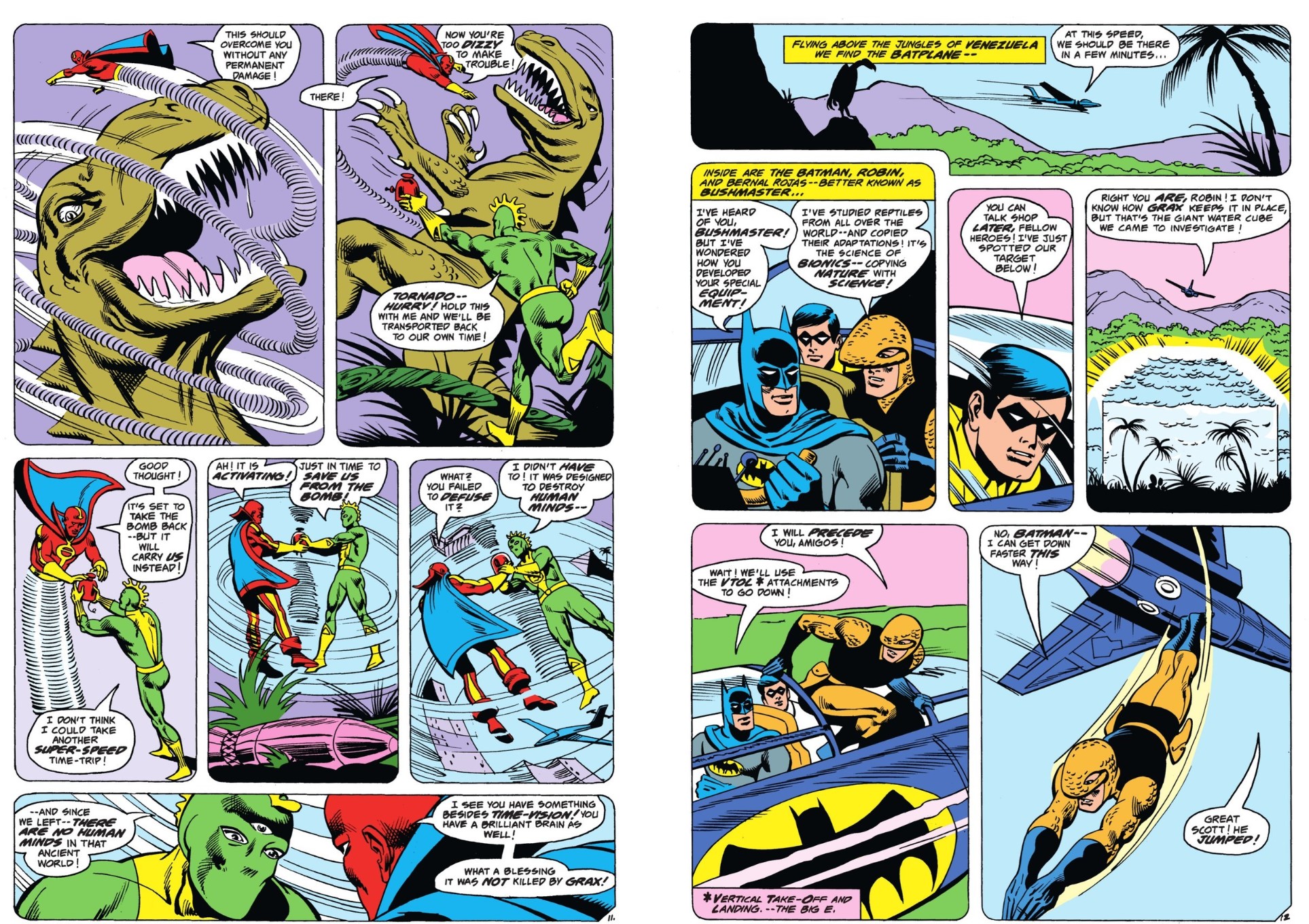
Superman’s alien enemy Grax has resolved to eradicate humanity and devised a dozen different superbombs and attendant weird-science traps to ensure his victory. These are scattered all over Earth and even the entire Justice League cannot stretch its resources to cover every angle and threat. To Wendy & Marvin the answer is obvious: call upon the help and knowledge of hyper-powered local heroes…

Soon Superman and Israel’s champion The Seraph are dismantling a black hole bomb whilst Elongated Man and titan-tressed Godiva perform similar service on a life-eradicator in England. Flash (Barry Allen) and mighty-leaping Impala dismantle uncatchable ordnance in South Africa before Hawkman & Hawkwoman join Native American avenger Owlwoman to crush darkness-breeding monsters in Oklahoma, whilst from the Hall of Justice Wendy, Marvin and the Wonder Twins monitor the crisis with a modicum of mounting hope…

The cataclysmic epic continues in #8 with ‘The Mind Killers!’ as Atom and Rising Son tackle a device designed to decimate Japan, and in Ireland Green Lantern Hal Jordan and Jack O’Lantern battle multi-hued monstrosities before switching off their technological terror.

In New Zealand, time-scanning Tuatara tips off Red Tornado to the position of a bomb cached in the distant past whilst Venezuela’s doom is diverted through a team-up of Batman, Robin and reptile-themed champion Bushmaster. And in Taiwan a melding of sonic superpowers possessed by Black Canary and the astounding Thunderlord harmoniously saves the day…

The saga soars to a classic climax with ‘Three Ways to Kill a World!’ in which the final phases of Grax’s scheme fail thanks to Green Arrow & Tasmanian Devil in Australia, with Aquaman & Little Mermaid sorting out the embattled seas off Denmark and Wonder Woman & The Olympian preserving modern Greece.

Or at least, they would have if the Hellenic heroes had found the right foe. Sadly, their triumph against Wrong-Place, Right-Time terrorist Colonel Conquest almost upsets everything. Thankfully, the quick thinking hero-students send an army of defenders to Antarctica where Norwegian novice Icemaiden dismantles the ultimate booby-trap bomb.  However, whilst the adult champions are engaged, Grax invades the Hall of Justice seeking revenge on the pesky whistleblowing Exorian kids. He’s completely unprepared for and overwhelmed by Wendy, Marvin & Wonderdog, who categorically prove they’re ready to graduate to the big leagues…

Thus with Zan & Jayna enrolled as latest heroes-in-training, Super Friends #10 details their adoption by Batman’s old associate – and eccentric time travel theoretician – Professor Carter Nichols, just before a legion of alien horrors arrive on Earth to teach the kids that appearances can be lethally deceiving in ‘The Monster Menace!’ In #11, ‘Kingslayer’ pits the heroes against criminal mastermind Overlord who has contracted the world’s greatest hitman to murder more than one hundred leaders at one sitting…

Another deep dive into DC’s past resurrected Golden Age titans T.N.T and Dan, the Dyna-Mite in ‘The Atomic Twosome!’ These 1940s mystery men had been under government wraps ever since their radioactive powers began to melt down, but when an underground catastrophe ruptures their individual lead-lined vaults, the Super Friends are called in to prevent potential nuclear nightmare. Then the subterranean reason for the near tragedy is tracked to a monstrous mole creature, and leads to the introduction of eternal mystic Doctor Mist, who reveals the secret history of civilisation and begs help to halt ‘The Mindless Immortal!’ before its random burrowing shatters mankind’s cities. From here, Bridwell would build a fascinating new team concept that would support decades of future continuity…

Super Friends #14 opens with ‘Elementary!’; introducing four ordinary mortals forever changed when possessed by ancient sprits. Tasked by Overlord with plundering the world, Undine, Salamander, Sylph & Gnome are defeated by our heroes yet retain their powers and so become crimefighting team The Elementals. Also on view is a short back-up illustrated by Kurt Schaffenberger & Bob Smith. ‘The Origin of the Wondertwins’ at last reveals they are Exorian genetic throwbacks (despised outcasts on their homeworld) who fled from a circus of freaks and uncovered Grax’s plot before taking that fateful voyage to Earth.

Big surprises come in ‘The Overlord Goes Under!’ (Fradon & Smith) as the Elementals begin battling evil by joining the Super Friends in crushing the crook. All those superheroes are blithely unaware that they are merely clearing the way for a far more cunning and subtle mastermind to take Overlord’s place…

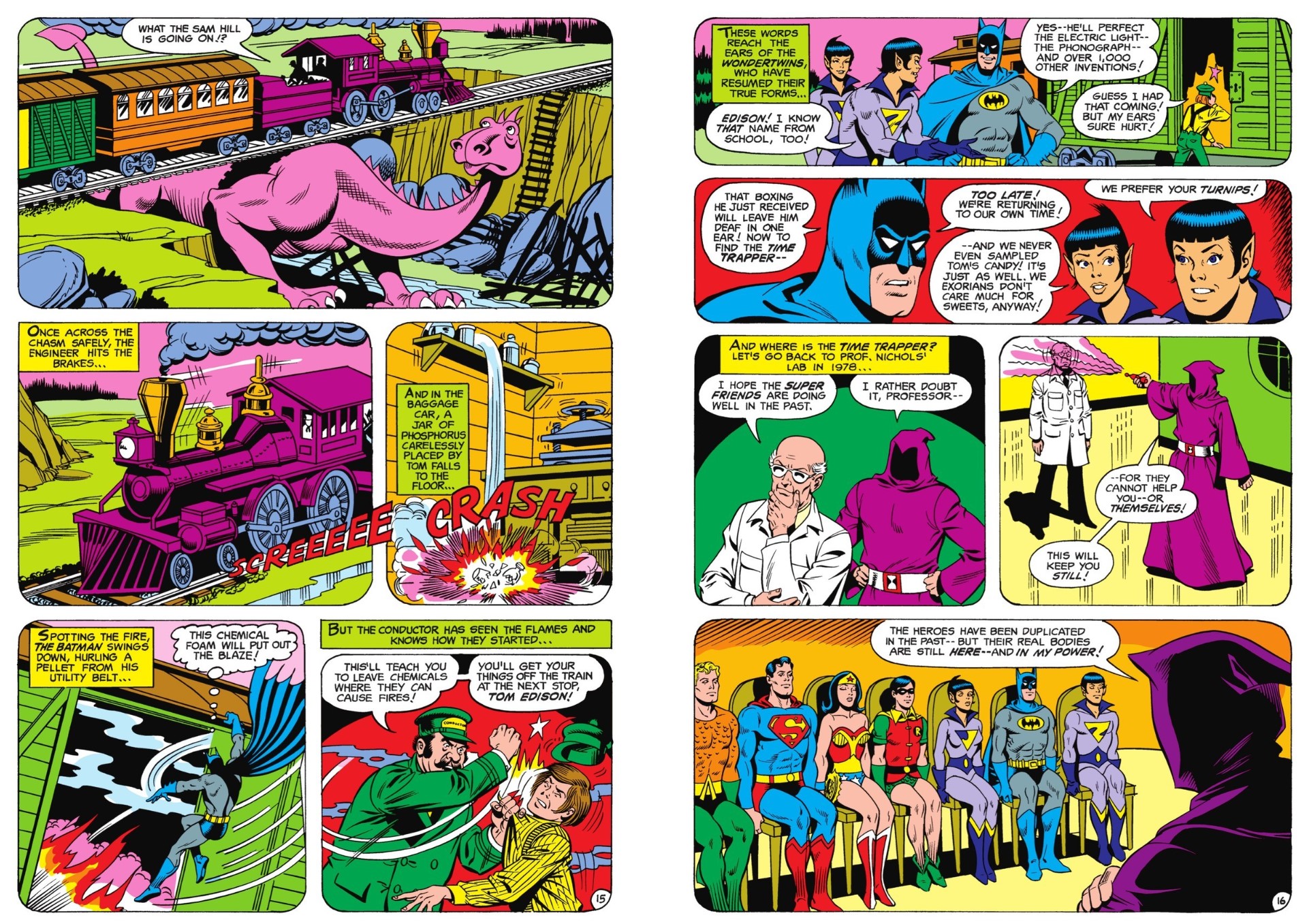
‘The People Who Stole the Sky!’ in SF #16 is a grand, old-fashioned alien invasion yarn, foiled by the team and the increasingly adept Wonder Twins whilst ‘Trapped in Two Times!’ has Zan & Jayna used by the insidious Time Trapper to lure their adult mentors into deadly peril on Krypton in the days before it detonated, and future water world Neryla in the hours before it’s swallowed by its critically expanding red sun. After rescuing the kids – thanks largely to Superman’s legendary lost love Lyla Ler-Rol – the Super Friends employ Tuatara’s temporal insight and Professor Nichol’s obscure chronal methodologies to hunt the Trapper in a riotous yet educational ‘Manhunt in Time!’ (art by Schaffenberger & Smith), by way of Atlantis before it sank, medieval Spain and Michigan in 1860CE: all to thwart a triple-strength scheme to derail history and end Earth civilisation…

SF #19 sees an encore for Menagerie Man in ‘The Mystery of the Missing Monkey!’ (Fradon & Smith) as the animal exploiter appropriates Gleek: intent on turning his elastic-tailed talents into a perfect pickpocketing tool, before Denny O’Neil (as Sergius O’Shaugnessy) teams with Schaffenberger & Smith for a more jocular turn. Here, chaos and comedy ensue when the team tackles vegetable monsters unleashed after self-obsessed shlock-movie director Frownin’ Fritz Frazzle uses Merlin’s actually magical Magic Lantern to make a “masterpiece” on the cheap in ‘Revenge of the Leafy Monsters!’

Bridwell & Fradon bounce back in #21 where ‘Battle Against the Super Fiends!’ has the heroes travelling to Exor to combat super-criminals who can duplicate their power-sets, after which ‘It’s Never Too Late!’ (#22, O’Shaugnessy, Fradon & Smith) reveals how time bandit Chronos subjects the Super Friends to a chronal-delay treatment rendering them perennially too late to stop him… but only until Batman and the Wonder Twins out-think him.

The Mirror Master divides and banishes teachers from students in #23 but is ultimately unable to prevent an ‘SOS from Nowhere!’ (Bridwell, Fradon & Smith) to the Flash. This episode also spends time fleshing out the Wonder Twins’ earthly alter egos as Gotham Central highschoolers John & Joanna Fleming

With O’Shaugnessy scripting, ‘Past, Present and Danger!’ sees Zan & Jayna’s faces found engraved on a recently-unearthed Egyptian pyramid. Upon investigation inside the edifice, the heroes awaken two ancient exiles who resemble the kids, but who are in truth criminals who fled Exorian justice thousands of years previously. How lucky, then, that the kids are perfect doubles that the villains can send back with the robot cops surrounding the pyramid – once they’ve got rid of all those busybody Earthling heroes…

Enjoying promotion through treachery, habitually harassed Underling has seized power at last in Bridwell’s ‘Puppets of the Overlord’, and then employs forbidden technology to mind-control adult and junior heroes. Happily, international champions Green Fury (later Fire), Wonder Woman’s sister Nubia, Tasmanian Devil and Seraph can join Green Lantern and Queen Mera of Atlantis in delivering a liberating solution, after which this splendid selection of super thrills pauses with SF #26 as Bridwell, Fradon & Smith bring back some old friends and enemies for ‘The Wondertwins’ Battle of Wits!’ when a scheming former Bat-foe enacts an infallibly murderous plot…

Rounding out the frenetic fun is a features section that includes the Alex Toth cover from Limited Collectors’ Edition #C-41  and new material from sequel C-46. These include a comic strip collaboration with Bridwell on introductory tale ‘Super Friends’ which was a star-studded framing sequence for a big reprint issue of Justice League classics. The wonders are further augmented by Toth’s comprehensive pictorial essay on creating ‘TV Cartoons’ (with contributions from Bob Foster), plus his ‘The JLA on TV’ model sheets, and designs of ‘The Hall of Justice’ by Terry Austin. As you of course know, comics legend Toth was lead designer on the characters’ transition to TV animation…

The extras include mini-comic Aquateers Meet the Super Friends – a 1979 promotional giveaway included with every purchase of Super Friends Swim Goggles. An uncredited framing sequence (which looks like a Continuity Associates project that Dick Giordano & Frank McLoughlin had a hand in) segues into ‘The Greatest Show on Water’ – an Aquaman short by Fradon originally published in Adventure Comics #219, (December 1955).

The bumper fun wraps with Alex Ross’ painted cover from 2001 book collection Super Friends!

With covers by Fradon, Smith, Schaffenberger, Colletta, Ernie Chan and more, this hopefully initial compendium is superbly entertaining, masterfully crafted and utterly engaging. It offers stories of pure comics gold to delight children and adults in equal proportion. Truly generational in appeal, they are probably the closest thing to an American answer to the magic of Tintin or Asterix and no family home should be without this tome.

Sadly, this masterful mystery megamix is not yet available digitally, but we live in hope. In the meantime, if you prefer your cartoon crimebustng computer collated you could access 2020’s Super-Friends: Saturday Morning Comics volume 1.
© 1976, 1977, 1978, 1979, 2001, 2025 DC Comics, Inc. All Rights Reserved.

Today in 1697, Willam Hogarth was born. Notionally adding to the comics lustre and significance, in 1918, Howard Purcell was also added to the planet’s roster, as was Neil Gaiman in 1960. In the exit column for today, in 1993 we lost astounding illustrator Alberto Breccia, and in 2006 immortal sci fi writer Jack Williamson. All those other guys you can find in old posts here, but I particularly recommend Beyond Mars – The Complete Series 1952-1955.

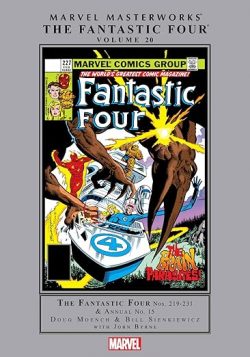
Fantastic Four Marvel Masterworks volume


By Doug Moench & Bill Sienkiewicz, John Byrne, Roger Stern, Joe Sinnott, Al Milgrom, George Pérez, Tom Sutton, Jerome Moore, Chic Stone, Jon D’Agostino, Mike Esposito, Pablo Marcos, Frank Giacoia, George Roussos, Jim Novak, Irving Watanabe & various (MARVEL)
ISBN: 978-1-3029-1027-3 (TPB/Digital edition)

This book includes Discriminatory Content produced in less enlightened times.

For Marvel everything started with The Fantastic Four.

Monolithic modern Marvel truly began with eccentric monster ‘n’ alien filled adventures of a compact superteam as much squabbling family as coolly capable costumed champions. All that Modern Marvel is, company and brand, stems from that quirky quartet and the inspired, inspirational, groundbreaking efforts of Stan Lee & Jack Kirby…

Cautiously bi-monthly and cover-dated November 1961, Fantastic Four #1 – by Stan, Jack, George Klein and/or Christopher Rule – was raw and crude even by the ailing publisher’s standards; but it seethed with rough, passionate, uncontrolled excitement. Thrill-hungry kids pounced on its dynamic storytelling and caught a wave of change beginning to build in America. It and every succeeding issue changed comics a little bit more… and forever. As revealed in that premier issue, maverick scientist Reed Richards, fiancée Sue Storm, close friend Ben Grimm and Sue’s bratty teen brother survived an ill-starred private spaceshot after cosmic rays penetrated their ship’s inadequate shielding.

All were permanently mutated: Richards’ body became elastic, diffident Sue became (even more) invisible, Johnny Storm burst into living flame and tragic Ben shockingly devolved into a shambling, rocky freak. After the initial revulsion and trauma passed, they solemnly agreed to use their abilities to benefit mankind. Throughout the 1960s The Fantastic Four was indisputably the key title and most consistently groundbreaking series of Marvel’s ever-unfolding web of cosmic creation: a forge for new concepts and characters.

Kirby was approaching his creative peak: unleashing his vast imagination on plot after spectacular plot, and intense, incredible new characters whilst Lee scripted some of the most passionate superhero sagas ever seen. Both were on an unstoppable roll, at the height of their powers and full of the confidence only success brings, with The King particularly eager to see how far the genre and the medium could be pushed… which is rather ironic since it was the company’s reticence to give the artist more creative freedom that led to Kirby’s moving to National/DC in the 1970s.

Without Kirby’s soaring imagination the rollercoaster of mindbending High Concepts lost out to traditional tales of characters in conflict, with soap opera leanings and supervillain-heavy Fights ‘n’ Tights forays abounding. With Lee & Kirby long gone but their mark very much still stamped onto every page of the still-prestigious title, this full-colour luxury compendium collects Fantastic Four #219-231 and Annual #15, spanning June 1980-June 1981, wherein editor Jim Salicrup sanctioned a bold new look and direction for the Hallowed team. The call for and upshot of all that is discussed by incoming writer Doug Moench who recalls fan-fright paralysis and jumping in full throttle in his Introduction ‘The Big-Kid Stuff Cold Turkey Fail’ prior to a distinctly spookily toned and frequently supernaturally themed change of pace commencing.

What You Should Know: After being rejuvenated and repowered in an extended space-spanning saga, the Family FF are getting used to being back on earth even with supervillains all over the place. Now Read On…

Penciller John Byrne, having served out his first term of duty on the series he was to soon make his alone was officially and ostensibly only temporarily replaced for FF #219. Ably augmented by Joe Sinnott, stalwart “Guest-Team” Doug Moench & Bill Sienkiewicz were parachuted in for monster mash-up ‘Leviathans’, on the back of huge success and acclaim for their vigilante thriller Moon Knight, bringing with them a whole new look and sensibility, as well as far faster pace to the stories.

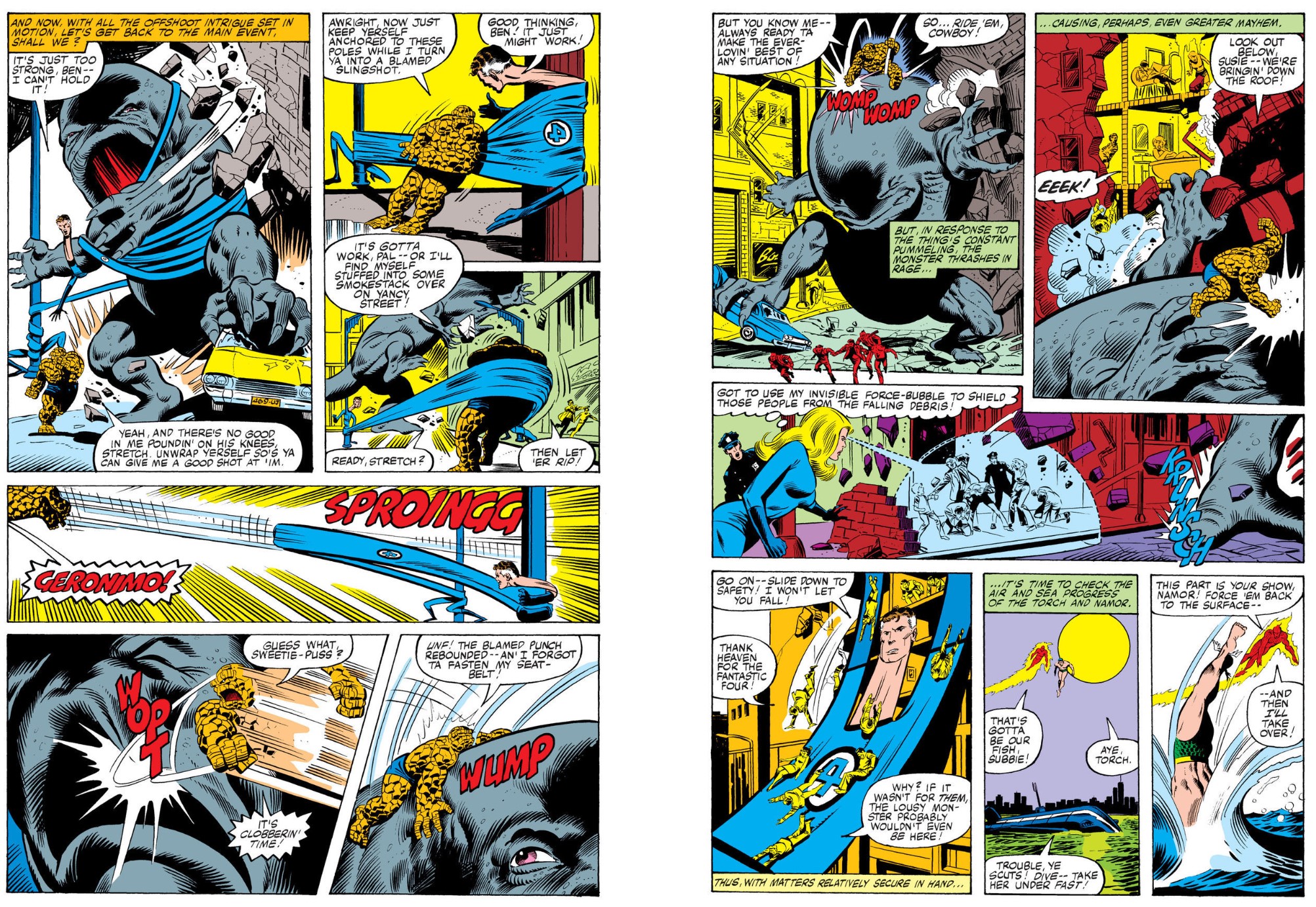
Here, modern day pirate Cap’n Barracuda steal the fabled Horn of Proteus from Atlantis and unleashes a wave of giant monsters on New York City. Thankfully, this is a subject the mighty Sub-Mariner and Mr. Fantastic can agree on and their combined forces are soon stomping beasties and taking names (like Giganto!) to restore order and stop a piratical plunder ploy without peer…

Byrne was back writing & pencilling in #220 as ‘…And the Lights Went Out All Over the World!’ sees the Avengers call in Reed and his team when all of Earth suffers a catastrophic power-outage. Science! soon sends the explorers to the arctic where they encounter an astounding and unbelievable obelisk being constructed by beings of utterly alien appearance…

The story includes an updated origin for the quartet and guest shot for Canada’s finest (that’s Vindicator of Alpha Flight in case you were wondering) and the issue halts with a pinup/possible rejected cover by inker Sinnott (the Torch battling a flaming Skrull) before #221’s concluding chapter ‘Tower of Glass… Dreams of Glass!’ – after the usual misconceptions and rash clashes reveal three aliens shipwrecked for half a million years who just need their myriad mobile mechanisms to reverse the planet’s magnetic poles so that they can return home at last. Thankfully, Reed has a less end of human civilisation-y solution that leaves everyone involved happy and safe…

Now officially the latest regular creative team, Moench & Sienkiewicz return to prep for Halloween in FF #222’s ‘The Possession of Franklin Richards!’ as the kid is targeted from beyond the unknown by the exiled soul of Nicholas Scratch, son of Agatha Harkness and the kind of warlock who gives witchcraft a bad name. Having made the boy his conduit back to reality, Scratch terrorises and tortures his hated enemies, who with Doctor Strange unavailable, must call on the dubious gifts of self-doubting failed horror hero Gabriel the Devil Hunter and his sexy morally ambiguous familiar Desadia (as mostly seen in the Marvel monochrome magazine line such as Haunt of Horror and Monsters Unleashed).

Apparently acquiescing, the team agree to liberate the dead diabolist’s minions of magical cult Salem’s Seven in ‘That a Child May Live…’ but their instant assaults on humanity are an acceptable risk and consequence in a long plan that sets the worlds to rights for all but the defeated devil…

Fantastic Four Annual #15 swiftly follows, wherein Moench & George Pérez, abetted by Chic Stone, Jon D’Agostino & Mike Esposito, renew hostilities between the FF and the Skrull empire when the shapeshifters target Reed’s latest energy-casting breakthrough in ‘Time for the Prime Ten!’ Infiltrating the Baxter Building, negating his teammates and almost banishing Mr. Fantastic to the tender mercies of Annihilus in the Negative Zone, the sneaky killers are actually seeking to end their millennial war against stellar rivals The Kree, but have underestimated Reed’s brilliance, his team’s tenacity and the sheer power and cosmic awareness of Earth-loving Kree Exile Captain Mar-Vell…

A back-up tale by Moench & Tom Sutton takes us to recently liberated Latveria for the opening of proposed series ‘The Return of Doctor Doom!’ with only episode ‘The Power of the People!’ showing how restored monarch King Zorba failing to live up to his democratic promise and discovering how excessive taxation really upsets subjects, at around the same moment crazed and catatonic Victor von Doom goes missing from the most secure dungeon in Doomstadt…

Sadly, the impending crisis never materialised and was only addressed by John Byrne in Fantastic Four #247…

Over in FF #224 & 225, fresh calamity unfolds in Moench, Sienkiewicz & Pablo Marcos’ ‘The Darkfield Illumination’ as an eerie radioactive red mist blankets Manhattan and plays hob with the team’s powers. Tracing the cloud’s origin point to an icy dome in the Arctic, the FF discover a lost colony of technologically advanced Vikings utterly dependent upon a mutated immortal giant. ‘The Blind God’s Tears’ supply heat, light, food materials from the outside world and immortality, but now Korgon is dying and demands the explorers save him and the people who worship him…

Always eager to help, the team strive hard and succeed in saving the God, only to see him betrayed by his most trusted ally. As Korgon rages madly in response, the situation escalates as Thor arrives to investigate Viking worshippers who have abandoned their true god for a false one…

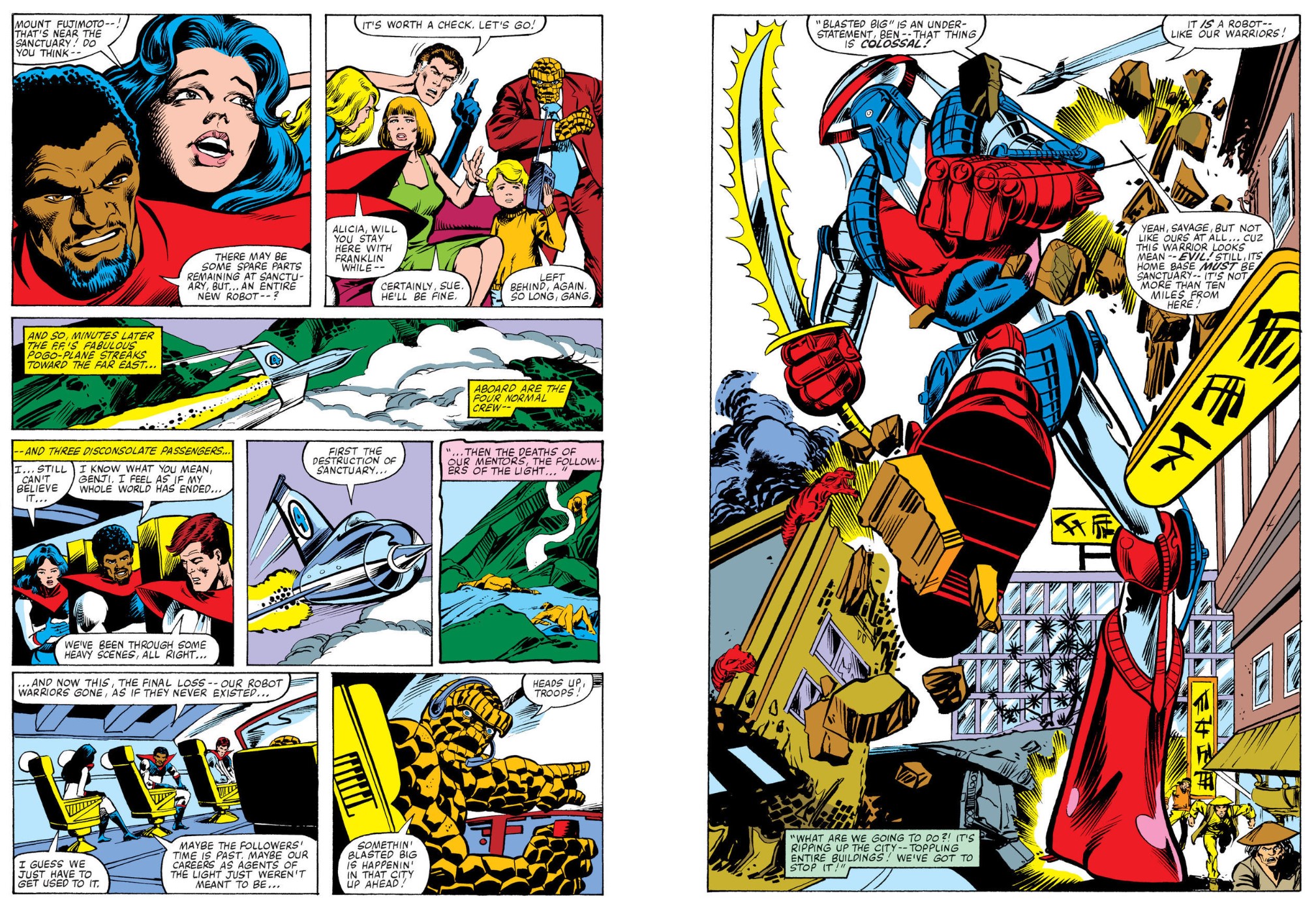
Bruce Patterson joins Marcos inking Sienkiewicz as Moench takes the opportunity to bring closure to fans of his old Shogun Warriors series next. In their own title the former pilots of monster-fighting mega-mecha Dangard Ace, Raydeen and Combatra had been recruited by an ancient order to defend humanity, but had ultimately retired when their machines were destroyed. That epic sacrifice had come when evil enemy Maur-Kon had targeted the Fantastic Four and attempted to kill Reed.

Now a new giant mecha rampages and robs and the teams reunite with Ilongo Savage, Richard Carson and Genji Odashu aiding the battle against ‘The Samurai Destroyer’ and the unworthy soul exploiting its power for profit….

Movie-toned terror in the heartland follows as a meteor crashes in rural Pennsylvania resort Lost Lake just as the FF head out to the Boonies for a break. Their encounter with ‘The Brain Parasites’ infesting hosts and reverting them to earlier evolutionary forms is by-the-books horror fun from Moench, Sienkiewicz & Patterson, and readily fixed by little Franklin’s unreliable mental powers. This sets the scene for the next issue where further tests by professional head shrinkers and brain benders only unleash uncontrollable chaos, possessing bystanders and an adult super-powered version of the lad. Thankfully loving parents and uncles allow Franklin to exorcise his deadly ‘Ego-Spawn’ (Sinnott inks)…

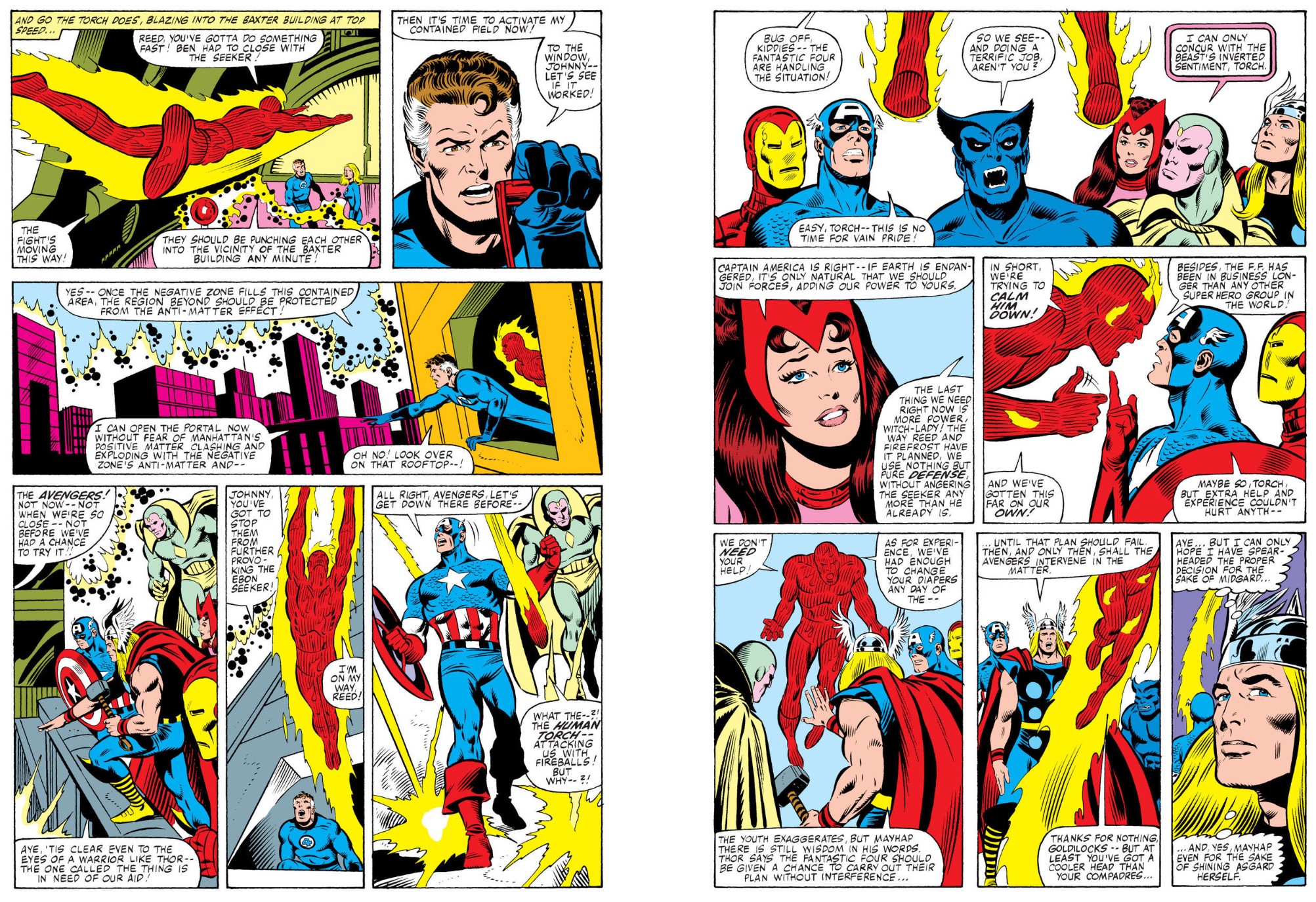
The experiment in alternative tale-telling ends on a 3-part saga that opens with #229’s ‘The Thing From the Black Hole’. After it homes in on Reed’s latest invention, Earth soon totters on the edge of destruction as a living, sentient singularity made of antimatter disrupts physical laws. Desperate Richards makes contact with its cosmic equivalent and uncovers a tale of love lost in service to scientific exploration. The mobile extinction event was once a sentient being whose love for a fellow astronaut turned them both into creatures of uncanny forces. Thankfully ‘Firefrost and the Ebon Seeker’ reach an understanding that saves the world, but as a consequence a section of Manhattan – including the Baxter Building – is marooned inside the Negative Zone.

With panic amongst the hordes of abducted New Yorkers barely suppressed, the FF search for a solution ‘In All the Gathered Gloom!’ (by Moench & Roger Stern with art from Sienkienwisz, Jerome Moore, Sinnott, & Frank Giacoia) even as new antimatter menace Stygorr zeroes in on the intruding enclave. The last thing the FF need is bullying big business plutocrat Lew Shiner telling everyone his money puts him in charge. After his posturing triggers a riot, tragedy is guaranteed, and the heroes barely beat the alien invader in time to return everyone surviving back home…

With covers by Sienkienwicz, Byrne Sinnott & Bob McLeod, the extras here include a Sinnott Thing pinup from FF #219, Sienkievich’s rejected cover-turned-pinup as printed in #224 original art pages/covers inked by Marcos, Bruce Patterson, Sinnott, and original colour-guides painted by George Roussos.

Although never quite returning to the stratospheric heights of the Kirby era, this truly different collection represents a closing of the First Act for the “World’s Greatest Comics Magazine”, and palate cleansing preparation for the second groundbreaking run by an inspired John Byrne. These extremely capable efforts are probably most welcome to dedicated superhero fans and continuity freaks like me, but will still thrill and delight casual browsers looking for an undemanding slice of graphic narrative excitement – especially if this time the movie continues to deliver on its promise…
© 2018 Marvel Characters, Inc. All rights reserved.

To Be Continued…

Today in 1918 artist John Forte was born. He’s most fondly remembered for costumed charm, as best seen in Legion of Super-Heroes: The Silver Age volume 1 . We don’t have nearly enough collected material for UK visionary comics stalwart Ron Embleton who was born today in 1930. If you think you’re old enough, you could look at Oh, Wicked Wanda!.

Indomitable weekly anthology Valiant began its stellar 712 issue run today in 1962. Inside was the magnificent Steel Claw whom we comprehensively covered in The Steel Claw: Invisible Man. Yes. Well done, the modern invisible man could be seen from the start…

DC Finest: Hawkman volume 1 – Wings Across Time


By Gardner F. Fox, Bob Haney, Joe Kubert, Gil Kane, Murphy Anderson, Howard Purcell, Carmine Infantino & various (DC Comics)
ISBN: 978-1-79950-250-0 (TPB)

This book includes Discriminatory Content produced in less enlightened times.

Here’s another stunning compilation from the DC Finest line: full colour chronolgically curated collections delivering “affordably priced, large-size (generally around 600 pages) paperback collections” of past glories. Whilst concentrating on the superhero pantheon, there are and will also be assorted genre selections like horror and war books, and themed compendia.  

Sadly, none of these comics classics are available digitally, as were the last decade’s Bronze, Silver and Golden Age collections, but we live in hope and keep on whining…

Not all passions are romantic: mine is to finally have all old comics forever available in curated editions. These astoundingly engaging Silver Age tales are another joyous moment of past glories revisited highlighting one of the most effective and enduring romantic crime-busting, world-saving partnerships in comics…

With a superhero revival in full swing by 1961, Editorial mastermind Julius Schwartz turned to resurrecting one of DC’s most visually arresting and iconic Golden Age characters. Once again eschewing mysticism for science fiction (the original Hawkman was a reincarnated Egyptian prince murdered by a villainous priest who just kept coming back…), Schwartz picked scripter Gardner F. Fox who had created the Golden Age great and matched him with artist Joe Kubert to construct a new and contemporary hero for the Jet/Space Age.

This titanic tome at last gathers in full colour the works and deeds of the Winged Wonders as first seen in The Brave and the Bold #34-36 & 42-44 & 51; The Atom #7; Mystery in Space #87-90 and Hawkman #1-11: cumulatively spanning February/March 1961 to December 1965/January 1966.

Katar Hol and Shayera Thal are police officers on their own planet of Thanagar. The married couple have travelled to Earth from the star system Polaris in pursuit of a spree-thief named Byth who assaulted a scientist and stole a drug bestowing the ability to change into anything. Thus the scene was set in ‘Creature of a Thousand Shapes!’ which graced The Brave and the Bold #34 (cover-dated February/March 1961) back when the title was a try-out vehicle like Showcase. Disappointments aside, the origin yarn is a spectacular work of graphic magic, with the otherworldly nature of the premise rendered captivatingly human by the passionately emphatic, moody expressiveness of Kubert’s art. It is a minor masterpiece of comic storytelling, and still a darned good read.

The high-flying heroes returned in the next issue, now “temporarily” stationed on Earth to study Terran police methods. In ‘Menace of the Matter Master’ they defeat a plundering scientist who has discovered a means to control elements and indulge in super-larceny, before ‘Valley of Vanishing Men’ takes our fully-integrated visitors from another world to the Himalayas to unlock the astounding and ironic secret of the Abominable Snowmen. Last shot in the try-out session, B&B #36 sees them defeat modern day wizard Konrad Kazlak in ‘Strange Spells of the Sorcerer!’ and, soon after, save Earth from another Ice Age whilst outwitting ‘The Shadow Thief of Midway City!’

With the 3-issue audition over, the publishers sat back and waited for the fan letters and sales figures… and something odd happened: fans were vocal and enthusiastic, but the huge sales figures that previously accompanied such reactions just weren’t there. It was inexplicable. The quality of the work was plain to see on every page, but somehow not enough people had plunked down their dimes to justify an ongoing Hawkman series.

A year later DC tried again. The Brave and the Bold #42 (June/July 1962) featured ‘The Menace of the Dragonfly Raiders’ which found Katar & Shayera returning to Thanagar just in time to encounter a bizarre band of alien thieves and the sinister hand of their oldest foe. Here was superhero action in a fabulous alien locale and the next issue maintained the exoticism – at least initially – before Hawkman and Hawkgirl returned to Midway City to defeat a threat to both worlds – ‘The Masked Marauders of Earth!’.

One last B&B issue followed (#44, October/November 1962) with two splendid and delightful short tales. ‘Earth’s Impossible Day!’ focused on Shayera’s desire to celebrate a holiday tradition of Thanagar before eerie doomsday thriller ‘The Men who Moved the World’ unearthed a lost civilisation and the return of Earth’s original occupiers seeking to move back again…

And then the Hawks vanished again. It certainly looked like this time the Schwartz magic had stumbled if not faltered. It was not, however, the end of the saga. Convinced he was right, Schwartz retrenched. Enjoying some success with his latest revival and mindful of the response when he had teamed Flash with Green Lantern in the summer of 1962, the editor had writer Fox include the Winged Wonder in The Atom #7 (cover-dated June/July 1963). An interplanetary thriller illustrated by Gil Kane & Murphy Anderson, ‘The Case of the Cosmic Camera!’ is a rocket-paced invasion rollercoaster ranging from the depths of space to Earth’s most distant past, where this new, clean-limbed version of the Avian Avenger clearly found fan-favour. In 1963 Hawkman returned! Again!

Mere months later, and dated November, Mystery in Space #87 had the Pinioned Paladin in action on the cover. The anthologogical sci fi standard had been the home of interstellar adventurer Adam Strange since #53, so now Schwartz moved his Winged Wonders into a plausible back-up slot and even bestowed occasional cover-privileges. Still beguilingly written by Fox, Kubert’s dark gritty art was superseded by the clean, graceful illustration of Anderson. Crime caper ‘The Amazing Thefts of the I.Q. Gang!’ dealt with a unexpected repercussion of an Adam Strange thriller and was followed a month later by ‘Topsy-Turvy Day in Midway City!’… a whimsical flourish as the cosmic couple’s devotion and Thangarian wedding customs lead to the capture of Terran bank bandits…

With the management now on board, guest appearances to maximise profile were easier to find. Hawkman returned to The Brave and the Bold with #51 (December 1963/January 1964) to team with Aquaman and face the ‘Fury of the Exiled Creature’ in a quirky tale of monsters, magic and mayhem in sunken Atlantis written by Bob Haney and illustrated by the criminally neglected Howard Purcell. Back in Mystery in Space #89 the ‘Super-Motorized Menace!’ proved the highest tech motor cycle is still no match for ancient weapons and alien  advantages…

These brief, engaging action pieces paled before the majesty and ambition of MiS #90 which delivered a full length epic uniting teaming the Hawks and Adam Strange in a legendary End-of the-World(s) epic. Illustrated by Carmine Infantino & Anderson, ‘Planets in Peril!’ was the last Hawkman back-up. From the next month, and after three years of trying, Hawkman soared into his own title.

Cover-dated April/May 1964, Hawkman #1 is a gem by Fox & Anderson. Two of the most visually arresting chracters in comics, the Hawks also boasted one of the most subtle and sophisticated relationships in the business. Like Sue & Ralph Dibney (Elongated Man and wife) Katar & Shayera are equal partners, and both couples were influenced by the Nick & Nora Charles characters of the Thin Man movies. Like those progenitors, the interplay of the Hols at home or at work is always rich in humour and warmth. In ‘Rivalry of the Winged Wonders’ – and whilst accommodatingly recapping their origins for newcomers, the couple decide to turn their latest case into a contest – Hawkgirl (eventually more appropriately called Hawkwoman) will use Thanagarian super-science to track and catch a band of thieves, whilst Hawkman limits himself to Earth techniques and tools to solving the crime.

This charmingly witty yarn is balanced by action thriller ‘Master of the Sky Weapons’ as recentlt resurrected ancient Mayan warrior Chac threatens Earth with disinterred alien super weapons. The the second issue stuck with star-stuff as the ‘Secret of the Sizzling Sparklers!’ offered an action-packed thriller of transdimensional invasion before closing with ‘Wings across Time!’: a mystery revolving around the discovery of the flying harness of legendary figure Icarus.

With “Carter & Shiera Hall” established as archeologists at Midway City Museum and Earth’s crypto-history & -zoology offering constant story-inspiration, another criminal brain-teaser opened the third issue. However, scientific bandits proved less of a menace than ‘The Fear that Haunted Hawkman’ with inexplicable panic attacks, before ordinary thugs and an extraordinary alien owl converged to make our heroes ‘Birds in a Gilded Cage’. Hawkman #4 then opened with a tale destined to revolutionise DC comics. ‘The Girl who Split in Two!’ introduced legacy hero Zatanna, daughter of a magician who fought crime in the 1940s only to “mysteriously disappear”…

From the very first issue, and for over a decade, Zatarra was a hero in the Mandrake mould who fought evil in the pages of Action Comics. During the Silver Age, Gardner Fox had Zatarra’s young, equally gifted daughter search for the missing mage, systematcally teaming up with superheroes he was currently scripting (if you’re counting, those tales appeared in Hawkman #4, The Atom #19, Green Lantern #42, and the Elongated Man strip from Detective Comics #355). A very slick piece of backwriting latterly included the high-profile Caped Crusader via Detective #336 – ‘Batman’s Bewitched Nightmare!’. The saga concluded in Justice League of America #51’s ‘Z… As in Zatanna… and Zero Hour!’). The collected saga Zatanna’s Search is currently out of print but you can go here for our take on it…

This wide, long-running experiment in continuity proved there was a dedicated fanbase with a voracious appetite for experimentation and relatively deep pockets. Most importantly, it finally signalled an end of the period where DC heroes largely lived and battled in self-imposed worlds of their own.

Hawkman #4 back-up ‘The Machine that Magnetized Men!’ is another enthalling howdunnit  tale as the Pinioned Paladins use reason and deduction to defeat thieves who are impossible to touch. For the next issue ‘Steal, Shadow… Steal!’ was the first full-length thriller, wherein ruthless Shadow Thief Carl Sands returns seeking revenge, believing causing Earth’s next Ice Age to be an acceptable consequence of his schemes, whilst in #6, publishing fashion caught up with the Hawks…

Another epic, and one that turned DC’s peculiar obsession with gorillas into a classic adventure, ‘World Where Evolution Ran Wild!’ lures our heroes to fabled Illoral, where a scientist’s explorations and interventions have stretched Natural Selection to un-natural limits. Bold, brash and daft in equal amounts, this is a fabulous romp and seeing again the cover where Hawkman struggles for his life against a winged gorilla makes the adult me realise those DC chaps might have known what they were doing with all those anthropoid covers!

By issue #7 (April/May 1965) the world was gripped in secret agent fever as the likes of James Bond, The Man from U.N.C.L.E., and a host of others snuck and sashayed across our screens. Comics were not immune,  even though spies had been a staple threat there for decades. Before Hawkman joined the gang, however, he had to deal with the rather mediocre threat posed by solar ray inspired criminal genius Ira Quimby and ‘The Amazing Return of the I.Q. Gang!’ As they were quickly returned to prison the Hawks faced the ‘Attack of the Crocodile-Men!’: a high-octane super-science thriller introducing C.A.W. – the Criminal Alliance of the World…

Another supremely captivating cover adorned #8, as the Hawks fought an ancient Roman Artificial Intelligence, built by not-so-mythical metalsmith Vulcan in ‘Giant in the Golden Mask!’, before defeating an alien Harpy who’d been buried for half a million years and promptly triggered a ‘Battle of the Bird-Man Bandits!’ as soon as she woke up…

Hawkman #9 saw The Atom as guest star when an old villain returned with a seemingly perfect revenge plan. Full-length super-thriller ‘Master Trap of the Matter Master!’ offered sheer superhero hi-jinks, after which #10 saw a playful Fox at his best in both ‘Hawkman Clips the Claws of C.A.W!’ This was another espionage drama with a delicious subplot as the Winged Wonder aids a sexy CIA agent with a big secret of her own – before solving ‘The Magic Mirror Mystery!’: a fair-play brainteaser with lots of high-flying action to balance the smart stuff.

This glorious volume closes with another superb full-length epic. Clearly designed as a so-fashionable “player on the other side”, ‘The Shrike Strikes at Midnight!’ leaving our heroes trailing a super-powered, winged bandit all over the world and on to the star system Mizar, in a gripping tale of crime, super-villainy, aliens, revolutions and even dinosaurs…

Although never the major player of his 1940s ancestor, Hawkman grew to be one of the most iconic characters of the second superhero boom, not just for the superb art but also because of a brilliantly sly, whimsically subtle writer with a huge imagination. These tales are comfortably familiar but also grippingly timeless. Thankfully, comics are a funny business; circumstances, tastes and fashions often mean that wonderful works are missed and unappreciated, but it aso means revivals are never too late. Don’t make the same mistake readers did in the 1960s. Whatever your age, read these astounding adventures and become a fan. It’s never too late.
© 1961, 1962, 1963, 1964, 1965, 1966, 2025 DC Comics. All Rights Reserved.

Ka-Zar Marvel Masterworks volume 2


By Mike Friedrich, Steve Gerber, Carol Seuling, Ross Andru, Don Heck, Dan Adkins, Jim Starlin, Marie Severin, Werner Roth, George Tuska, Paul Reinman, Mike Royer, Bob Brown, Sal Buscema, Gene Colan & various (Marvel)
ISBN: 978-1-3029-0966-6 (HB/Digital edition)

This book includes Discriminatory Content produced in less enlightened times.

There are quite a few comics anniversaries this year. Some of the most significant will be rightly celebrated, but a few are going to be unjustly ignored. As a feverish fanboy wedged firmly in the past, I’m again abusing my privileges and advising an encounter with something old, nigh forgotten but definitely worth a soupçon of your time and energies…

IT’S A JUNGLE OUT THERE! …and apparently everywhere else, too…

Retconned from a pulp hero and latterly comics B-Lister from the early days of Timely comics, primal white jungle god Ka-Zar most accurately stems from 1965 where he stole the show in a dinosaurs & mutants yarn in X-Men #10.

Beginning as a cheeky Tarzan tribute act relocated to a lost world in a realm of swamp-men and dinosaurs, Ka-Zar eventually evolved into one of Marvel’s more complex – if variable – characters. Fabulously wealthy heir to one of Britain’s oldest noble families, his bestest friend is “sabretooth tiger” Zabu and his wife is feisty environmental-crusader Shanna the She-Devil. His dad was apparently a mad scientist, his brother a homicidal super-scientific modern day pirate. Kevin Reginald, Lord Plunder is perpetually torn between the clean life-or-death simplicity of the wilds and bewildering constant compromises of modern civilisation.

The primordial paragon is arguably Marvel’s oldest star, having begun life as a prose star, boasting three issues of his own pulp magazine between October 1936 and June 1937. They were authored by Bob Byrd – a pseudonym for publisher Martin Goodman or one of his retinue of staff writers. Goodman latterly shoehorned him into his speculative venture: new-fangled comic book Marvel Comics #1 (October 1939), where he lurked alongside fellow pulp line graduate The Angel, Masked Raider, Human Torch and Sub-Mariner

In the sixties, when Ka-Zar reappeared he was all rowdy, reimagined and renovated by Jack Kirby for X-Men #10 (cover-dated March but actually on sale from January 5th), and it was clear the uncrowned Sovereign of the Savage Land was destined for bigger and better things. However, for years all we got was guest shots as a misunderstood foe du jour for Daredevil, Sub-Mariner, Spider-Man, and The Hulk.

In 1969 he got his shot as a lone wolf starring in Marvel Super-Heroes. Later that year – after Roy Thomas & Neal Adams used him so effectively in their X-Men run (issues #62-63) – Ka-Zar was awarded his own giant-sized title, reprinting most of his previous appearances. However, the reruns oddly bracketed all-new stories of Hercules and The Angel (the new one from X-Men not the costumed detective of the 1940s). That same month, his first solo series began in a split book entitled Astonishing Tales

Gathering material from Astonishing Tales #17-20, Shanna the She-Devil #1-5, Ka-Zar (volume 2) #1-5 and Daredevil #110-112, spanning cover-dates December 1972 through August 1974, this sequel compilation volume begins with reminiscences from Mike Friedrich and Carole Petersen-Sueling in two separate (but equal) Introductions.

Previously, Ka-Zar & Zabu’s idyllically brutal lives hunting dinosaurs and battling aliens, gods, wizards and lost civilisations in the Savage Land had been turned on its head with the arrival of apparently irresistible S.H.I.E.L.D. agent Barbra “Bobbi” Morse (who becomes costumed spy/Avenger Mockingbird many years from now) and aging biologist Dr. Wilma Calvin. Their quest for a Super-soldier formula dragged the wild man across continents to Florida and into conflict with Advanced Idea Mechanics (A.I.M.), the Man-Thing, super-mercenary Gemini and, on reaching New York City, drug lord dope peddler The Pusher…

Increasingly enamoured of Morse, Ka-Zar opts to give the modern world another go, but increasingly comes to despise the greed, the dirt, the greed, the callous brutality and the sheer greed of civilisation, especially after encountering the drug crisis first hand…

Culture clash conflict resumes with ‘Target: Ka-Zar!’ as crafted by Friedrich, Dan Adkins & Frank Chiaramonte for April 1973’s Astonishing Tales #17. Here, the Jungle Lord’s impatience and discontent are magnified when AIM again tries to snatch Calvin’s prototype serum, employing gunmen on the ground and ultimately super-mercenary Gemini to humiliatingly grab the formula from S.H.I.E.L.D.’s helicarrier and making Ka-Zar and Zabu look like idiots in the process…

Pride stung and mad as hell, the wild man follows Gemini to earth and falls into an ambush laid by his brother Parnival and backed up by his pet alien monster. Hired by AIM to secure the serum the Plunderer has the upper hand when ‘Gog Cometh!’ since the childlike colossus is lethally loyal and can teleport on command. He/it is also growing larger every minute…

The saga spirals out of control as Ka-Zar wins a rematch with Gemini but loses the serum sample to The Plunderer who heads for Manhattan whilst in Land’s End, England, another strand of the search for super-soldiers culminates with AIM scientist Professor Victor Conrad surviving a gun battle with S.H.I.E.L.D. agents by taking his own medicine…

Back in the USA, late-arriving Bobbi Morse and Zabu give the blonde barbarian a lift to Manhattan in time to channel the end of King Kong, as the ever-enlarging Gog runs amok with the local landmarks before confronting its destiny on top of the city’s tallest building, even as, far below, the strictly human clashes result in triumph for the forces of right and wonders of chemistry…

With the serum recovered and his honour upheld, the Noble Savage realises that – other than Bobbi – there is nothing about civilisation that please him, but as he ponders that and pines for the Savage Land, one last loose thread needs tying off as a new threat seizes control of AIM and seeks redress for past sins. Inked by Jack Abel, and with Jim Starlin stepping in to complete the episode begun by Adkins, AT #19 reveals ‘…And Men Shall Name Him… Victorius!’ as Conrad abducts agent Morse to obtain S.H.I.E.L.D.’s version of the formula that made him an unstoppable warrior. When Ka-Zar & Zabu track him down he rejects taking the serum himself and attacks the scientist, Gemini and brother Parnival in all his purely human might and main…

Marie Severin, Werner Roth & Frank Giacoia wrap up the run as Astonishing Tales # 20 (October 1973) depicts ‘The Final Battle!’ before Ka-Zar returns to his (un)natural environment and a new solo title, pausing only to crush his assembled foes turn down a job with Nick Fury and briefly regret losing Bobbi to the Big City….

Before that new beginning though, there’s a slight chronological sidestep to introduce a soon-to-be-crucial character who came and went with little fanfare a few months previously. As the costumed cohort craze subsided with the close of the Sixties, Stan Lee & Roy Thomas looked into creating a girl-friendly boutique of female stars written by women.

Opening shots in this act of liberation were Claws of the Cat by Linda Fite, Marie Severin & Wally Wood (who at least knew how to draw them) and Night Nurse by Jean Thomas & Win Mortimer. Both #1’s were cover-dated November 1972 and despite impressive creative teams none of these fascinating experiments lasted beyond a fifth issue, although a third shot was kept from limbo by some judicious teamwork. The caregiver vanished for decades and the feline fury mutated into Tigra, the Were-Woman in Giant-Size Creatures #1 (July 1974), and even though their experimental comrade stuck around, the general editorial position was upheld… “books starring chicks don’t sell…”

Contemporary jungle queen – possibly the last hurrah of an extremely popular genre subset in Fifties comic books – Shanna the She-Devil #1 was created by Carole Seuling, Steve Gerber & George Tuska, and on sale from 29th August with a December 1972 cover date.

Inked by Vince Colletta, Shanna the She-Devil #1 debuted in a touching and troubled tale, detailing how the gun-hating daughter of Africa-based American game warden Gerald O’Hara became a vet in Manhattan. Wrapped in a contemporary framing sequence, ‘Shanna the She-Devil!’ recalls her origin whilst stalking ruthless poachers ravaging a game preserve in modern-day Africa.

The clash and her capture prompt memories of how, decades previously, she had fled that verdant world of casual slaughter to save lives… and how a moment of casual atrocity by “fun-loving” American gun nuts in the zoo where she worked led to the death of all its big cats bar two panther cubs she saved and fled to Africa with…

Recreating herself as guardian of nature, rearing the kittens Ina & Biri and training her body to the peak of physical readiness and unarmed combat prowess, Shanna O’Hara became a legend to the local peoples, a trusted and valuable ally to game warden Patrick McShane and a nemesis to all interlopers endangering the balance of nature or disrupting its uncompromising harmony…

Two months later Sueling, Ross Andru & Colletta exposed ‘The Sahara Connection!’ as Shanna acquiesces to the desperate requests of S.H.I.E.L.D. agent Jakuna Singh and uses her gifts and cats to crush drug-peddling human traffickers El Montano and Abdullah after which ‘The Moon of the Fear-Bulls!’ finds her fighting the murderous thralls of a lost Minoan colony sacrificing entire African villages to their lost gods and current chief Phobotauros: a maniac with an unsavoury secret…

Gerber scripted Seuling’s plot for #4 as ‘Cry… Mandrill!’ introduced one of Marvel’s wildest mutants. Searching for her vanished father, Shanna inadvertently unravels a conquest plot to subjugate three emerging African nations by the ape-visaged maniac with the power to control women – except apparently Shanna… usurped and captured, Mandrill scores one minor victory by admitting Gerald O’Hara is his hostage…

The series abruptly folded with #5 cover-dated August 1973, but as we’ll see here later, the She-Devil carried on via judicious team-ups and eventually scored a continuance of solo sagas in matured-themed monochrome magazine Savage Tales.

Here and now, Gerber, Andru & Colletta reveal ‘Where Nekra Walks – Death Must Follow!’ as Jakuna Singh, S.H.I.E.L.D. and FBI agent Amos Duncan request Shanna’s participation in dismantling the still-active organisation of Mandrill’s enthralled women: a task necessitating a quick consult with mutant advisor Professor Charles Xavier

The trail then leads to barbarous ceremonies held by the villain’s top subordinate, a brutal superstrong mutant who stokes hatred to feed on the emotion and augment her powers. Directing all her loathing at Shanna makes Nekra physically unbeatable, but being angry all the time is no help if your opponent can stay calm and clear-headed…

Cover dated January 1974, Ka-Zar #1, (volume 2, and on sale from September 25th 1973) boasted the adventurer’s ‘Return to the Savage Land!’, courtesy of Friedrich, Paul Reinman & Mike Royer, and teasingly saw Shanna in a cameo as the victim du jour.

Being parachuted in by S.H.I.E.L.D. was the last modern convenience Kevin Plunder would stomach. Within minutes he was back battling behemoths in his furry underwear and announcing his return to all the primitive tribes, but Ka-Zar was blithely unaware that a new menace lurked. Evil necromancer Malgato, the Red Wizard sought power and control and used the Jungle Lord’s most despised enemy Maa-Gor the Man-Ape to carry out his schemes. These almost come together after a brief history of Ka-Zar’s kingdom, when a pteranosaur ambush leads to our stalwart hero being held for sacrifice beside a strikingly beautiful red-headed woman in a leopard-skin bikini…

Don Heck & Jack Abel limned the catastrophic conclusion and ‘The Fall of the Red Wizard!’ as faithful Zabu comes to the rescue, unleashing utter chaos, routing the wizard and latterly proving the mage and his mission were never what they seemed…

Issue #3 played out on the ‘Night of the Man-God!’ as Maa-Gor, humiliated again by the puny human, undertakes a trek to the mutagenic Region of Mists and gets boosted far up the evolutionary ladder. Transformed into a telepathic wonder, he still clings to his hatred of Ka-Zar and psychically connects to old X-Men villain El Tigre, drawing him to the Savage Land to trap his foe. The ambush succeeds, but only until Bobbi Morse shows up intent on settling unresolved issues. Battling the villains and stopping Man-God’s plans to despoil the wild sanctuary is a welcome break for both unhappy lovers but the battle carries over into #4, albeit broken here by a fabulous maps section entitled ‘Ka-Zar Presents The Savage Land’

Plotted by “Bullpen West”, written by Friedrich and illustrated by Heck & Royer, ‘Into the Shadows of Chaos!’ sees Ka-Zar and all his allies crushed as the Man-God broadcasts global threats of extinction, before distracting himself by resurrecting his dead Man-Ape kin to destroy his most despised foe. The issue concludes with a Royer pin-up of ‘Ka-Zar’s Lair!’ before Mike Esposito inks the epic downfall of the monster in #5’s ‘A Man-God Unleashed!’ wherein a desperate Jungle monarch – and Bobbi – trash the anthropoidal zombies and Maa-Gor falls victim to his own doubts…

Ka-Zar would soon experience a complete change of outlook and genre, but the saga of Shanna and Mandrill carried on in series scripted by Gerber. Here, an excerpt from Daredevil #109 and longer extract from Marvel Two-in-One #3, bring DD, Black Widow, The Thing and, briefly, Captain America into the ongoing war with a sinister terrorist group…

In DD #109 (by Gerber, Bob Brown & Heck), Foggy Nelson’s radical student sister Candace tells Matt Murdock of a plot by criminal gang Black Spectre to steal government printing plates. En route to stop the raid the Scarlet Swashbuckler is intercepted by The Beetle and this brutal interference allows the sinister plotters to abscond with the prize. Even as the exoskeleton-clad thugs break away in Manhattan, in San Francisco Natasha Romanova is attacked by Nekra, Priestess of Darkness, who tries to forcibly recruit her into Black Spectre.

After defeating the Beetle, DD meets Africa-based champion Shanna O’Hara, unaware the fiery American ex-pat is seeking bloody vengeance against enemies who have attacked Foggy, Natasha and the US economy… and murdered her father…

Marvel Two-in-One #3 (Gerber, Sal Buscema & Joe Sinnott) peeped ‘Inside Black Spectre!’ as destabilising attacks on prosperity and culture foment riot in the streets of the beleaguered nation. Following separate clue trails, Ben Grimm joins the Man Without Fear to invade the cabal’s aerial HQ, before they are improbably overcome soon after discovering the Black Widow has defected to the rebels…

Reprinted in full, DD #110 (Gerber, Gene Colan & Frank Chiaramonte) sees perfidious plot ‘Birthright!’ expose Black Spectre as an exclusively female-staffed group, personally led by pheromone-emitting male mutant Jerome Beechman AKA Mandrill. One of the earliest “Children of the Atom”, he endured years of appalling abuse and rejection until he met equally ostracised Nekra. Once they realised their combined power, they swore to make America pay…

Brown & Jim Mooney drew ‘Sword of the Samurai!’ in #111, with DD & Shanna attacked by a formidable Japanese warrior, even as the She-Devil discloses her tragic reasons for hunting Nekra and Mandrill. When she too is taken by Black Spectre – who want to dissect her to discover how she can resist Mandrill’s influence – DD is attacked again by an outrageously powerful sword-wielding Silver Samurai

Triumphing over impossible odds, the Man Without Fear infiltrates the cabal’s flying fortress in #112 to spectacularly conclude the insurrection in ‘Death of a Nation?’ (Colan & Frank Giacoia), which finds the mutant duo seemingly achieving their ultimate goal by desecrating the White House and temporarily taking (symbolic) control of America… But only until Shanna, freshly-liberated Natasha and the fighting mad Man Without Fear marshal their utmost resources…

With covers throughout by Adkins, John Romita, John Buscema, Gil Kane, Frank Brunner, Frank Giacoia, Jim Steranko, Joe Sinnott, Ron Wilson and Colan, this remarkably collegiate collection concludes with tantalising treats including house ads, cover sketches by Romita, original art by Brunner, Heck, Abel and Royer plus a truly copious creator biographies section…

Boldly bombastic if sometimes madly muddled, brilliantly escapist and crafted by some of the biggest and best in comics, these wild rides and riotous romps are timeless fun from the borderlands of Marvel’s endless universe: a fabulous excursion to forgotten worlds you’ll want to treasure forever…
© 2018 Marvel Characters, Inc. All rights reserved.

DC Finest: Superman – The First Superhero


By Jerry Siegel & Joe Shuster, Paul Cassidy, Paul Lauretta, Wayne Boring, Dennis Neville, Creig Flessel, Bernard Baily, Bob Kane, Leo O’Mealia, Jack Burnley, Fred Guardineer & various (DC Comics)
ISBN: 978-1-77952-833-9 (TPB)

This book includes Discriminatory Content produced in less enlightened times

Here’s another stunning and timely compilation comprising the best of vintage comics in another astounding and epic DC Finest edition. These full colour treasure troves are chronologically curated themed tomes highlighting past glories from the company that invented superheroes and so much more. Sadly, they’re not yet available digitally, as were the last decade’s Bronze, Silver and Golden Age collections, but we live in hope…

Just over 87 years ago, Superman rebooted planetary mythology and kickstarted the whole modern era of fantasy heroes. Outlandish, flamboyant, indomitable, infallible and unconquerable, he also saved a foundering industry by birthing an entirely new genre of storytelling: the Super Hero. Since April 18th 1938 (the generally agreed day copies of Action Comics #1 first went on sale) he has grown into a mighty presence in all aspects of art, culture and commerce, even as his natal comic book universe organically grew and expanded. Within three years of that debut, the intoxicating blend of eye-popping action and social wish-fulfilment that had hallmarked the early exploits of the Man of Tomorrow had grown: encompassing crime-busting, reforming dramas, science fiction, fantasy and even whimsical comedy. However, once the war in Europe and the East seized America’s communal consciousness, combat themes and patriotic imagery dominated most comic book covers, if not interiors.

In comic book terms alone Superman was soon a true master of the world, utterly changing the shape of the fledgling industry as easily as he could a mighty river. There was a popular newspaper strip, a thrice-weekly radio serial, games, toys, foreign and overseas syndication and as the decade turned, the Fleischer studio’s astounding animated cartoons.

Moreover, the quality of the source material was increasing with every four-colour release as the energy and enthusiasm of originators Jerry Siegel & Joe Shuster went on to inform and infect the burgeoning studio which grew around them to cope with the relentless demand.

These tales have been reprinted many times, but this latest compilation might arguably be the best yet, offering the original stories in reading – if not strictly chronological publishing – order and spanning cover-dates June 1938 to December 1939. It features the groundbreaking sagas from Action Comics #1-25 and Superman #1-5, plus his pivotal first appearance in New York’s World Fair No. 1. Although most early tales were untitled, here, for everyone’s convenience, they have been given descriptive appellations by the editors.

Thus – after describing the foundling’s escape from exploding planet Krypton and offering a scientific rationale for his incredible abilities and astonishing powers in 9 panels – with absolutely no preamble the wonderment begins with Action #1’s primal thriller ‘Superman: Champion of the Oppressed!’ Here, an enigmatic oddly-clad caped crusader – who secretly masquerades by day as mild-mannered reporter Clark Kent – begins publicly averting numerous tragedies and righting injustices…

As well as saving an innocent woman from the Electric Chair and roughing up an abusive “wife beater”, the tireless paragon works over racketeer Butch Matson and consequently saves feisty colleague Lois Lane from abduction and worse at his hands. Then he exposes a lobbyist for the armaments industry bribing Senators on behalf of the greedy munitions interests fomenting the war in Europe…

One month later Action #2 offered the next breathtaking instalment wherein the mercurial mysteryman travels to that benighted war-zone to spectacularly dampen down hostilities already in progress in ‘Revolution in San Monte Part 2’ before it’s back to the US where ‘The Blakely Mine Disaster’ finds the Man of Steel responding to a coal-mine cave-in and landing the blame squarely on corrupt corporate practises, before cleaning up gamblers ruthlessly fixing games and players in #4’s ‘Superman Plays Football’.

The Action Ace’s untapped physical potential is explored in AC #5 as ‘Superman and the Dam’ pits the human dynamo against the power of a devastating natural disaster, after which #6 sees canny chiseller Nick Williams attempting to monetise the hero – without asking first. ‘Superman’s Phony Manager’ (with Paul Lauretta adding inks to increasingly overworked Shuster’s art) even seeks to replace the real thing with a cheap knock-off, but quickly learns a most painful and memorable lesson in ethics…

Although Superman starred on the first cover, National’s cautious editors were initially dubious about the alien strongman’s lasting appeal and fell back upon more traditional genre scenes for the following issues (all by Leo E. O’Mealia and all included here). The Man of Tomorrow’s – and Joe Shuster’s – second cover graced Action Comics #7 (on sale from October 25th but cover-dated December 1938) and sparked a big jump in sales, even as the riotous romp inside revealed why ‘Superman Joins the Circus’ – with the mystery man crushing racketeers taking over the Big Top and illustrated by new kid Wayne Boring. Fred Guardineer produced genre covers for #8 & 9 whilst their interiors saw Siegel, Shuster & Lauretta’s ‘Superman in the Slums’ working to save young delinquents from a future life of crime and depravity before latterly detailing how city cops’ disastrous decision to stop the costumed vigilante’s unsanctioned interference plays out in the Boring-inked ‘Wanted: Superman’. That manhunt ended in an uncomfortable stalemate and ambiguous relationship with the authorities that endured for years…

Action Comics #7 had been one of the publisher’s highest-selling issues ever, so #10 again sported a stunning Shuster shot, whilst Siegel’s smart story ‘Superman Goes to Prison’ limned by Shuster, Lauretta & Boring struck another telling blow against institutionalised injustice and stacked odds, as the Man of Tomorrow infiltrated a penitentiary to expose the brutal horrors of State Chain Gangs. The next month saw a maritime cover by Guardineer whilst inside heartless conmen driving investors to penury and suicide rued the Metropolis Marvel intercession in ‘Superman and the “Black Gold” Swindle’ as illustrated by Paul Cassidy.

Guardineer’s spectacular cover of magician hero Zatara for issue #12 was a shared affair, incorporating another landmark as the Man of Steel was given a cameo badge declaring his presence inside each and every issue. Between those covers, Siegel, Shuster & Cassidy revealed how ‘Superman Declares War on Reckless Drivers’ – a hardhitting tale of joy-riders, cost-cutting automobile manufacturers, corrupt lawmakers and dodgy car salesmen who all feel the wrath of the human dynamo after a friend of Clark Kent dies in a hit-&-run incident…

By now, the editors had realised Superman had propelled National Comics to the forefront of the new industry, and in 1939 the company won a license to create a commemorative comic book edition celebrating the opening of the New York World’s Fair. The Man of Tomorrow naturally topped the bill on the appropriately titled New York World’s Fair Comics at the forefront of such early DC four-colour stars as Zatara, Butch the Pup, Gingersnap and gas-masked vigilante The Sandman.

Following an inspirational cover by Sheldon Mayer, Siegel & Shuster’s ‘Superman at the World’s Fair’ describes how Lois and Clark are dispatched to cover the event, giving our hero an opportunity to contribute his own exhibit and bag a bunch of brutal bandits to boot…

Back in Action Comics #13 (June 1939 and another Shuster cover) the road-rage theme of the previous issue continued with Cassidy-rendered ‘Superman vs. the Cab Protective League’ as the tireless foe of felons faces murderous racketeers trying to take over the city’s taxi companies. The tale also introduces – in almost invisibly low key – The Man of Steel’s first recurring nemesis The Ultra-Humanite

Next follows a truncated version of Superman #1. This is because the industry’s first solo-starring comic book simply reprinted the earliest tales from Action, albeit supplemented with new and recovered material – which is all that’s featured at this point.

Behind the truly iconic and much recycled Shuster & O’Mealia cover, the first episode was at last printed in full as ‘Origin of Superman’, describing the alien foundling’s escape from doomed planet Krypton, his childhood with unnamed Earthling foster parents and eventual journey to the big city…

Also included in those 6 pages (cut from Action #1, and restored to the solo vehicle entitled ‘Prelude to ‘Superman, Champion of the Oppressed’) is the Man of Steel’s routing of a lynch mob and capture of the actual killer which preceded his spectacular saving of the accused murderess that started the legend. Rounding off the unseen treasures is the solo page ‘A Scientific Explanation of Superman’s Amazing Strength!’, a 2-page ‘Superman text story’, and ‘Meet the Creators’ – a biographical feature on Siegel & Shuster. The landmark closed with a pinup of Superman breaking chains by breathing out: an image the tuned in will recognise as the basis of DC Studios’ animation ident…

Sporting another Guardineer Zatara cover, Superman in Action #14 (as realised by Cassidy) featured the return of a manic, money-mad supergenius deranged scientist in ‘Superman Meets the Ultra-Humanite’ as the mercenary malcontent switches his incredible intellect from incessant graft, corruption and murder to an obsessive campaign to destroy the Man of Steel. Whilst Cassidy concentrated on interior epic ‘Superman on the High Seas’ – wherein the hero tackles subsea pirates and dry land gangsters – Guardineer then made some history as illustrator of an aquatic Superman cover for #15. He also produced the Foreign Legion cover on #16, wherein ‘Superman and the Numbers Racket’ by Siegel, Shuster & Cassidy sees the hero save an embezzler from suicide before wrecking another wicked gambling cabal.

Superman’s rise was meteoric and inexorable. He was the indisputable star of Action, with his own dedicated solo title. Moreover, a daily newspaper strip had begun on 16th January 1939, with a separate Sunday strip following from November 5th of that year. The fictive Man of Tomorrow was the actual Man of the Hour and was swiftly garnering millions of new fans. A thrice-weekly radio serial was in the offing, and would launch on February 12th 1940. With games, toys, and a growing international media presence, Superman was swiftly becoming everybody’s favourite hero…

Inked by Cassidy, overworked Siegel & Shuster’s second issue of Superman opened with ‘The Comeback of Larry Trent’ – a stirring human drama wherein the Action Ace clears the name of the broken heavyweight boxer, and coincidentally cleans all the scum out of the fight game, followed by ‘Superman’s Tips for Super-Health’, as ‘Superman Champions Universal Peace!’ depicts the hero once more tackling unscrupulous munitions manufacturers and crushing a gang who had stolen the world’s deadliest poison gas. The pictorial dramas end with ‘Superman and the Skyscrapers’ which finds newshound Kent investigating suspicious deaths in the construction industry, before committing his alter ego to conflict with mindless thugs and their fat-cat corporate boss, after which a contemporary ad and a ‘Superman Text Story’ bring the issue to a close…

Action #17 declared ‘The Return of the Ultra-Humanite’ in a vicious and bloody caper realised by Shuster & Cassidy, involving extortion and the wanton sinking of US ships, and featured their classic Super-cover as the Man of Steel was awarded all the odd-numbered issues for his attention-grabbing playground. That didn’t last long: after Guardineer’s final adventure cover – a bi-plane dog fight on #18, which fronted the Cassidy-limned ‘Superman’s Super-Campaign’ with both Kent and the Caped Kryptonian determinedly crushing a merciless blackmailer, Superman monopolised every cover from #19 onwards. That issue disclosed the peril of ‘Superman and the Purple Plague’ as the city reeled in the grip of a deadly epidemic created by Ultra-Humanite.

The truncated contents of Superman #3 offer only the first and last strips originally contained therein, as the other two were reprints of Action Comics #5 and 6. “The Superman Studio” was constantly expanding to meet spiralling demand and Dennis Nevillie inked Shuster on ‘Superman and the Runaway’ – a gripping, shockingly uncompromising exposé of corrupt orphanages, after which – following a cartoon briefing on ‘Attaining Super-Health: a Few Hints from Superman!’ – Lois finally goes out on a date with hapless Clark – but only because she needs to get close to a gang of murderous smugglers. Happily, Kent’s hidden alter ego is on hand to rescue her in bombastic gang-busting style in ‘Superman and the Jewel Smugglers’ by Shuster & Cassidy…

Cover dated January 1940 and on sale from November 24th 1939, Action Comics #20 notionally opened a new decade and, although Siegel & Shuster had very much settled into the character by now, the buzz of success still fired them, Innovation still sparked and crackled amidst the exuberance and drudgery of churning out more and more material. Moreover, Shuster’s eyesight was failing, demanding his sure signature touch be parcelled out parsimoniously and judiciouly. Collabotative creativity was the order of the day in the Superman Studio …

This conveyor belt process was absent in ‘Superman and the Screen Siren’ as Cassidy pencilled and inked a moving masterpiece wherein beautiful actress Delores Winters is revealed not as another sinister super-scientific megalomaniac but the latest tragic victim – and organic ambulatory hideout – of aged male menace Ultra-Humanite who perfected his greatest horror… brain transplant surgery!

This is followed with an immediate sequel from Shuster & Cassidy as “Delores” seeks to steal another scientist’s breakthrough and oblierate the Action Ace with ‘The Atomic Disintegrator’ before #22 loudly declares ‘Europe at War (Part One)’: a tense, thinly disguised call to arms to a still neutral USA. It too was a continued story – almost unheard of in those early days of funnybook publishing and spectacularly concluded in #23 with ‘Europe at War (Part Two)’.

Cover-dated Spring 1940, Superman #4 featured four big new adventures, and the debut of more creative stars in the making, beginning with a succession of futuristic assassination attempts in ‘Superman versus Luthor’ by omnipresent author Siegel, Shuster & Bernard (The Spectre) Baily. After an educational cartoon vignette on ‘Attaining Super-Strength’, the original Man of Might battles dinosaurs and bandits in ‘Luthor’s Undersea City’, by Shuster, Cassidy & Creig (The Sandman) Flessel, before saving the whole world from financial and literal carnage by ferreting out ‘The Economic Enemy’: a prophetic espionage yarn about commercial sabotage instigated by an unspecified foreign power and artistically crafted by Shuster, Cassidy and Bob Kane – yes, that Bob Kane…

The issue closed with a tale of gangsters intimidating Teamsters and union workers in Siegel, Shuster & Cassidy’s‘Terror in the Trucker’s Union’.

Simultaneously, in Action Comics #24,‘Carnahan’s Heir’ (Shuster & Cassidy) becomes Superman’s latest social reclamation project when the Metropolis Marvel promises to turn a drunken wastrel into a useful citizen, whilst in #25 Cassidy rendered the tale of ‘Amnesiac Robbers’ compelled to crime by an evil hypnotist, before this initial DC Finest compilation closes with the contents of Superman #5: a superb combination of human drama, crime and wickedly warped science augmented by a flurry of gag cartoons by the burgeoning Superman Studio.

As ever scripted throughout by Siegel, it begins with our crimebusting hero crushing ‘The Slot Machine Racket’ (Cassidy, Boring & Lauretta) before pausing to promote health and exercise, via feaurette ‘Super-Strength: Rules for Summer Living’. Without pausing for breath he then – couertsy of Cassidy – foils a rival newspaper’s ‘Campaign Against the Planet’. Limned by Shuster & Boring, the awesome, insidious threat of ‘Luthor’s Incense Machine’ is similarly scuttled, before finally Big Business chicanery is exposed and severly punished whilst a decent simple chemist is cleared of a felonius frame-up in Cassidy’s ‘The Wonder Drug Racket’.

Re-presenting the epochal run of raw, unpolished but viscerally vibrant stories by Siegel & Shuster and their merry band who collectively and until now largely anonymously set the funnybook world on fire, this chronicle compellingly recaptures the sheer thrill of those pioneering days. As fresh and absorbingly addictive now as they ever were, these endlessly re-readable epics perfectly display the savage intensity and sly wit of Siegel’s stories – which literally defined what being a Superhero means – whilst Shuster formulated the basic iconography for all others to follow.

The crude, rough, uncontrollable wish-fulfilling, cathartically exuberant exploits of The First Superhero reveals a righteous, superior champion of the helpless and outmatched dispensing summary justice equally to social malcontents, exploitative capitalists, thugs and ne’er-do-wells that initially captured the imagination of a generation. Although the gaudy burlesque of monsters and super-villains lay years ahead of Superman, these primitive, raw, captivating tales of corruption, disaster, moral deviancy and social injustice are just as engrossing and speak as powerfully of the tenor of the times then and now. Such Golden Age tales are priceless enjoyment. What comics fan could possibly resist them?
© 1938, 1939, 1940, 2025 DC Comics. All Rights Reserved.

DC Finest: Superman – Kryptonite Nevermore


By Dennis O’Neil, Leo Dorfman, Cary Bates, Len Wein, Curt Swan & Murphy Anderson, Ross Andru & Mike Esposito, Dick Giordano, Carmine Infantino, Neal Adams & various (DC Comics)
ISBN: 978-1-79950-165-7 (TPB/Digital edition)

This book includes Discriminatory Content produced in less enlightened times

This stunning compilation is part of the DC Finest editions line: full colour chronologically curated paperback compilations delivering “affordably priced” comic books generally around 600 pages and highlighting past glories.Whilst primarily and understandably concentrating on the superhero character pantheon, there will also be genre selections like horror and war books, and themed compendia. Sadly, they’re not yet available digitally, as were the last decade’s Bronze, Silver and Golden Age collections, but we live in hope…

Superman is the comic book champion who started the whole genre and, in the decades since his 1938 debut, has probably undertaken every kind of adventure imaginable. With that in mind it’s tempting and very rewarding to gather up whole swathes of his inventory and periodically re-present them in specific themed collections, such as this one commemorating one his greatest extended adventures. The episodes contained herein were originally released just as comics fandom was becoming a powerful – if headless – lobbying force reshaping the industry to its own specialised desires and remains a true landmark of the superhero genre. Moreover the brand overhaul seen here was a major concerted effort to re-energise the Man of Steel at a time when comics superheroes were experincing a major die-back…

When Julie Schwartz took over editorial responsibility for the Superman title in 1970, he was expected to shake things up with nothing less than spectacular results. To that end, he incorporated many key characters and events simultaneously developing as part of fellow iconoclast Jack Kirby’s freshly unfolding “Fourth World”. That bold experiment was a breathtaking tour de force of cosmic wonderment which brought a staggering new universe to fans: instantly and permanently changing the way comics were perceived and how the entire medium could be received. Don’t think for a moment that the 1985 reboot triggered by Crisis on Infinite Earths was new or innovative… just necessary…

As the Sixties closed, Schwartz was again breathing fresh life into a powerful but moribund icon – a job he had been excelling at since more-or-less singlehandedly kickstarting the Silver Age of Comics. Superman had been a mega-media star since his launch, with internationally syndicated comics, books, newspaper strips, movie and cinema serials plus hugely successful radio and TV shows (live action and animated) making the franchise globally recognizable. Whenever that happens, inevitably overkill and overexposure inescapably set in and the core property needs to be carefully overhauled or vanish forever. I’ll bet you can think of plenty of really famous and ubiquitous things from your childhood that one day you simply stopped noticing. Happily, sometimes they can be reborn…

Schwartz knew his market and was open to new ideas, and his creative changes were just appearing in 1971. The new direction was also vanguard and trigger for a wealth of controversial, socially-challenging “realistic” story content unseen since the feature’s earliest days: a wave of tales ultimately described as “Relevant”…

With iconic covers by Curt Swan, Carmine Infantino, Neal Adams, Dick Giordano, Murphy Anderson & Jack Adler, this titanic tome collects in whole or in part the Man of Steel’s first comics renaissance through exploits from Action Comics #393-406 and Superman #233-238 and #240-242, spanning cover dates October 1970 to December 1971.

On sale from 27th August 1970, Action Comics #393 hinted at rather than heralded a new era as ‘Syperman Meets Super-Houdini!’ In a tale by prolific lead super-scribe Leo Dorfman and artists Curt Swan & Murphy Anderson (AKA “Swanderson”) the ultimate hero faces a moral dilemma when reformed crimnal turned escape artist “Hair-breadth” Holahan is blackmailed to resume his criminal ways – or lose his abducted son. Of course, Superman can help…

Following a Superman Scrapbook Pinup, with Swanderson reworking a classic Golden Age Superman contents page, second strip ‘The Day Superboy Became Superman!’ (by Dorfman as Geoff Brown with Ross Andru & Mike Esposito illustrating) depicts a pivotal moment for college boy Clark Kent as radical student Marla Harvey showed the so-conservative law-&-order adherent what those concepts meant to people trapped in poverty and privation…

The updating of an icon continued in AC #394 with Swanderson illustrating both ‘Midas of Metropolis’ and low key “Geoff Brown” character vignette ‘Requiem for a Hot Rod’. The lead yarn pits Superman against world’s richest man Cyrus Brand, who seemingly infects the Action Ace with his own all-encompsing lust for money, only to find the hero is incorruptible and knows actual crime when he sees it, whilst a humourous follow-up sees Clark and Lois Lane at a vintage car event, cleverly exposing a bully rigging games of chicken for cash…

Action #395 revealed ‘The Secrets of Superman’s Fortress’ with a dynamic cutaway spread fuelling an “untold tale” of an early romantic encounter with a sexy alien Superman could have loved. Sadly, super-powered Althera was of an incompatible species… and also a slaver…

Dorfman was the go-to guy for supernatural tales and weird phenomena articles, and at the forefront of a shift in tone as DC characters and titles embraced the global resurgence in spooky horror and mystery fare. Next here a back-up guest starring Supergirl explores the uncanny powers and shocking truth of accident inducing accessory ‘The Credit Card of Catastrophe’, but comes down down heavily on the side of rationality and confidence trickery in the end…

As the sixties closed and with his various screen appearances a thing of the past, Superman was soon in dire need of an editorial overhaul. That officially began with Superman #233 in a groundbreaking epic serial edited by incoming reboot wunderkind Julius Schwartz that was heavily promoted in advance. Crafted by scripter Dennis J. “Denny” O’Neil, and ubiquitous illustrators Swan & Anderson – although stand-in Dick Giordano inked #240 – a deliberate and very public abandonment of tired old super-villains, fanciful Kryptonian scenarios and otherworldly paraphernalia instantly poked the readership and revitalised the Man of Tomorrow, attracting new readers and beginning a period of engagingly human-scaled stories making Superman a “must-buy” character all over again.

The innovations began with ‘Superman Breaks Loose’ as a government experiment to harness Kryptonite as an energy source goes explosively wrong. Closely monitoring the test, the Metropolis Marvel is blasted across the desert surrounding the isolated lab, but somehow survives a supposedly fatal radiation-bath. Then, reports begin filtering in from all over Earth: every piece of the deadly mineral has been transformed to harmless, common iron! As he goes about his protective, preventative patrols, the liberated hero experiences an emotional high at the prospect of all the good he can now accomplish. He isn’t even phased when the Daily Planet’s new owner Morgan Edge – a key character created by Jack Kirby for his soon to unfold Fourth World Saga – shakes up Clark Kent’s cosy civilian life: summarily ejecting him from the print game and remaking him as a roving TV journalist…

Meanwhile, the desert site of his recent crashlanding offers a moment of deep foreboding as Superman’s irradiated imprint in the sand shockingly grows solid and shambles away in ghastly parody of life…

Over in Action Comics #396, editors Murray Boltinoff & E. Nelson Bridwell continued in their editorial positions (right up until #419 December 1972) but heralded the beginning of a radical new age with a 2-chapter Imaginary Story (hey, didn’t Alan Moore do that too?) ‘The Super-Panhandler of Metropolis!’ was set years from “now”, where a highly advanced Earth wonders why and how Superman disappeared. Media mogul Jimmy Olsen discovers the shocking truth of the hero’s degrading decline in #397 as ‘Secret of the Wheel-Chair Superman!’ sentimentally focuses on a pitiable but still valiant do-gooder giving everything for those in need, and thereby saving himself too.

For this colossal collection, each issue’s stand-alone back-up has been moved to allow an uninterrupted lead story and for reader convenience of comprehension. Thus, next comes #396’s Brown/Swanderson teaser ‘The Invaders from Nowhere!’: an intellectual mystery with Superman perplexed and imperiiled by super-technological aliens somehow living inside his own infallible arctic citadel. It is bolstered by the legendary ad that announced the big change in Metropolis…

Rendered by Swan & Vince Colletta, ‘A New Year Brings a New Beginning for Superman 1971’ announced Clark’s job change and enhanced cast, trumpeted that Jimmy Olsen and Lois Lane would be joined by The Newsboy Legion and Rose and the Thorn and that Supergirl would get a new look, as well as suspending the venerable World’s Finest team of Superman, Batman & Robin, with the title becoming a Superman team-up book…

‘The Super-Captive of the Sea!’ was AC #397’s closer, wherein the Man of Tomorrow is indefinitely trapped beneath the oceans thanks to aquatic aliens flooding Earth’s skies with red sun refracting crystal clouds. They wanted Superman for their own world, but foolishly understimated his ingenuity and determination…

O’Niel & Swanderson’s intensely sophisticated suspenseful overhaul properly resumes in Superman #234’s ‘How to Tame a Wild Volcano!’ as an out-of-control, politically untouchable plantation owner/human trafficker refuses to let his indentured workforce flee an imminent eruption on the island of Boki. Handicapped by international laws, the Man of Steel can only fume helplessly as the UN blunders towards a diplomatic solution, and his anxiety intensifies when a sinister sand-thing inadvertently and agonisingly drains him of his powers. Crashed to Earth in a turbulent squall, the de-powered champion is attacked by work boss Boysie Harker’s thugs and instantly responds to the foolish provocation, relying for a change on determination rather than overwhelming might to save the day…

In #235, the ‘Sinister Scream of the Devil’s Harp’ tacitly acknowledged fasionable arcane influences – remember, the comics industry and wider world was enjoying a periodic revival of interest in supernatural themes and stories – as mystery musician and apparent polymath Ferlin Nyxly reveals the secret of his ever-growing aptitudes and gifts is an archaic artefact which steals from living beings knowledge, talents and even Superman’s alien abilities. The Man of Steel is initially unaware of the drain as he’s trying to communicate with his eerily silent dusty doppelganger, but once Nyxly graduates to a full-on raving super-menace self-proclaimed “Pan”, the taciturn homunculus unexpectedly joins its living template to trounce the power plunderer…

“The Youth” and their music take centre stage in Action #398 as Kent’s news round-up of the college campus scene unmasks sinister sonic skulduggery that – accidentally combined with Kryptonian recording tech – makes Superman an out-of-control rioter thanks to ‘The Pied Piper of Steel’, after which Dorfman/Brown reveal a horrifiying transformation for Supergirl into a ‘Spawn of the Unknown’

Superman #236 offered a Batman cameo and science fictional morality play when cherubic E.T.’s seek Superman’s assistance to defeat a band of devils and rescue Kent’s friends from Hell. However, the ‘Planet of the Angels’ proves to be nothing of the kind, and the Man of Steel must pull out all the stops to save his adopted homeworld from a very real Armageddon, whilst in Action #399 ‘Superman, You’re Dead… Dead… Dead!’, finds the hero trapped with other great men of the past abducted by future historians and accidentally discovering a ghastly end that awaits him, before realising that something’s not quite right, whilst B-feature ‘Superbaby’s Lost World’ sees the Tot of Tomorrow lost in a theme park and exploited as cover by charismatic bandits Connie & Hyde. Of course this innocent waif is far more than anyone can handle…

Superman #237 sees him save an astronaut only to see him succumb to a madness-inducing mutative disease. After another savage confrontation with the Sand-thing further debilitates him, the harried hero is present as more mortals fall to the contagion. Convinced he is both carrier and cause, the ‘Enemy of Earth’ considers quarantining in space. Meanwhile, Lois tumbles into another lethal predicament and Kal-el’s instinctive intervention seemingly confirms his earlier diagnosis, before another clash with the sandy simulacrum on the edge of space presents an incredible truth.

Painfully debilitated, Superman nevertheless saves Lois and again meets the ever-more human creature. Now able to speak, it offers a chilling warning and the Man of Steel realises exactly what it is taking from him and what it might become…

In Action #400 ‘My Son… Is He Man or Beast?’ sees Superman made reluctant guardian to troubled teen Gregor Nagy: an angry boy with astounding shapeshifting powers that will inevitably kill him, whilst back-up ‘Duel of Doom!’ offers an untold Tale of Kandor as students, rivals and lovers Yllura and Arvor vie for academic awards, almost die together and ultimately learn the value of teamwork and togetherness…

The Man of Tomorrow is a mere shadow of his former self in Superman #238, unable to prevent terrorists taking over a magma-tapping drilling rig and endangering all Earth in ‘Menace at 1000 Degrees!’ With Lois among their hostages and the madmen threatening to detonate a nuke in the pipeline, the Action Ace desperately begs his doppelganger to assist him, but its cold rejection forces the depleted hero to take the biggest gamble of his life…

Superman #239 was an all-reprint giant featuring the hero in his incalculably all-powerful days – so not included here – before Action Comics #401 & 402 address the growing contemporary political crisis of First Nations’ rights in ‘Invaders Go Home’ and ‘This Hostage Must Die!’ The continued tale sees Superman taken hostage by Indian protesters seeking to stop the US government taking a piece of sacred ground for a rocket base. Despite being apparently helpless before the magic of Angry Young Medicineman Dan Red Hawk the Action Ace is playing a covert game and hunting a criminal profit motive behind all the passionate rhetoric and popular dissent…

Cary Bates scripted #401’s back-up yarn as ‘The Boy Whe Begged to Die!’ sees our hero forced to use his superwits when he’s accidentally activates a mega-timebomb and fails to evacuate every civilian in time whilst Brown delivers #402’s ‘The Feud of the Titans!’ as Superman and Supergirl inexplicably go to war for possesion of the Fortress of Solitude…

The physically diminished Caped Kryptonian returned in Superman #240 (O’Neil, Swan and Dick Giordano inks) to confront his own lessened state and seek a solution. In ‘To Save a Superman’, his inability to extinguish a tenement fire and the wider world’s realisation that their unconquerable champion is now vulnerable and fallible makes his dilemma dangerously common knowledge. Especially interested are the Anti-Superman Gang who immediately allocate all resources to destroying their nemesis. After one particularly close call, Clark is visited by an ancient Asian sage who somehow knows his other identity and offers an unconventional solution…

From 1968 superhero comics began to decline – just as they had at the end of the 1940s – so publishers sought fresh ways to maintain their readerships as tastes changed. Back then, the industry depended on newsstand sales, and if you weren’t popular, you died. Editor Jack Miller, innovating illustrator Mike Sekowsky and relatively new scripter Denny O’Neil came up with a radical proposal and made history by depowering the only female superhero then in the marketplace. They had the mystical Amazons leave our dimension, taking with them all their magic – including Wonder Woman‘s powers and all her weapons…

Reduced to humble humanity she chose to stay on Earth, assuming and legitimising her own secret identity of Diana Prince and resolved to fighting injustice as a mortal. Tutored by blind Buddhist monk I Ching, she trained as a martial artist, and quickly became a formidable enemy of contemporary evil. Now, I Ching claims he can repair Superman’s difficulties and restore his dwindling might, but evil eyes are watching. Arriving clandestinely, Superman allows the adept to remove his remaining Kryptonian powers as a precursor to fully regaining them, allowing the ASG opportunity to strike. In the resultant brutal melee, the all-too-human hero triumphs in the hardest fight of his life…

The saga continues with Swanderson back on art in #241, withSuperman overcoming momentary but nigh-overwhelming temptation to put down his oppressive burden of duty and lead a normal life. Admonished and resolved, he submits to Ching’s resumed remedy ritual and finds his spirit soaring to where the sand-being lurks, before explosively reclaiming the stolen powers. Leaving the gritty golem a shattered husk, the astral Kal-El brings the awesome energies back to their true owner and a triumphant hero returns to saving the world…

Over the next few days, however, it becomes clear that something has gone wrong. The Man of Tomorrow has become arrogant, erratic and unpredictable, acting rashly, overreacting and even making stupid mistakes. In her boutique, Diana Prince discusses the problem with Ching and the sagacious teacher deduces that whilst merely mortal and fighting ASG thugs, Superman received punishing blows to the head which have caused a brain injury that did not heal when his powers returned…

When the out-of-control hero refuses to listen, Diana & Ching track down the dying sand-thing and beg its aid. The elderly savant recognises it as a formless creature from other-dimensional Quarrm and listens to the amazing story of its entrance into our world. He also suggests a way for it to regain some of what it recently lost…

Superman, meanwhile, has blithely gone about his deranged business until savagely attacked by a statue of a Chinese war-demon. Also able to steal his power, it has been possessed by a second fugitive from Quarrm. It has no conscience and wears ‘The Shape of Fear!’…

The shocking saga concludes in ‘The Ultimate Battle’ as the second Quarrmer falls under the sway of two petty thugs who use it to put freshly de-powered Superman into hospital…

Rushed into emergency surgery, the Kryptonian fights for his life as sand-thing confronts war-demon in the streets. Events take an even more bizarre turn once the latter drives off its foe and turns towards the hospital to finish off the flesh-&-blood Superman…
Regaining consciousness – and a portion of his power – the Metropolis Marvel battles the beast to a standstill but needs the aid of his silicon stand-in to drive the thing back beyond the pale. With the immediate threat ended, Man of Steel and Man of Sand face off one last time, each determined to ensure his own existence no matter the cost…

The stunning conclusion was a brilliant stroke on the part of the creators, one which left Superman approximately half the Man of Tomorrow he used to be. Of course, he eventually returned to his unassailable, god-like power levels but never quite regained the tension-free smug assurance of his pre-1970s self…

For now though, with the epic ended day-to-day dilemmas resume with Action #403 and Bates & Swanderson’s ‘Attack of the Micro-Murderer’, wherein the Krptonian is attacked and fatally infected by sentient time-travelling micobe Zohtt before millions of earthlings donate blood to flush his system clean, after which Brown channels Daniel Keyes’ Flowers for Algernon for ‘The Man With the X-Ray Mind’ as an intellectually-challenged janitor develops and tragically loses astounding mental abilities…

Dorfman scripted #404’s ‘Kneel to Your Conqueror, Superman!’ wherein governemntal secret weapon/supergenius Rufus Caesar goes rogue and devises tech to steal The Action Ace’s powers, before inevitably overreaching and reaping every tyrant’s fate. As Geoff Brown, the multi-faceted writer offers another glimpse at our hero’s college years with ‘The Day They Killed Clark Kent’ relating a memorable teaching moment after a hazing incident is covertly commandeered and redirected by the Adolescent of Steel. Then Bates introduces ‘The Starry-Eyed Siren of Space!’ in Superman #243, as cosmic catastrophe catapults the Caped Kryptonian into an encounter with disembodied ultra-mentalities Kond & Rija. Sadly, the latter recalls the long forgotten joys of physicality and constructs an organic form to woo Superman, leaving Rija no choice but to do similar and win back his mate…

‘Superman, Bodyguard or Assassin?!’ leads in Action #405, as Bates posits an Imaginary Story near future where a Psy-ops expert turns the Man of Steel into an assassin pointed at the US President. He follows up with regulation continuity thriller ‘The Most Dangerous Bug in the World?’ as Clark Kent is swept up in a product demo that threatens to expose his secret identity. Over in Superman #244, O’Neil anticipates early AI anxiety and human responses via the rampages of ‘The Electronic Ghost of Metropolis!’, before AC #406 sees Dorfman deal with the rise of counter cultures and semi-religious cults as telejournalist Clark Kent investigates a charismatic ‘Master of Miracles’. What he discovers is a devious plot orchestrated by someone very close to his home and his heart…

For the same issue, the writer dons his “Brown” mantle to expose a restless and beleagured supernatural alchemist inhabiting the Tower of London for centuries as ‘The Ghost That Haunted Clark Kent’ before the wraparound superhero-bedecked cover for all reprint giant Superman #245 and Curt Swan’s pencilled model sheet ‘The Man of Many Faces’ penultimately usher in final wonder ‘Danger… Monster at Work!’ from #246, with Len Wein debuting as super-scribe and introducing an extended cast of Clark Kent’s neighbours in a wry and witty warning tale of pollution gone mad and monsters in Metropolis’ sewers, perfectly limned by Swan & Anderson…

A fresh approach, snappy dialogue and more human-scaled concerns to balance outrageous implausible fantasy elements all wedded to gripping plots and sublime art make Kryptonite Nevermore one of the very best Superman sagas ever created, and its wonderful to see the other stories of the time included for balance and to prove that this was very much the Man of Steel getting his long-needed second wind for the next comics age.

A must-have graphic collection to sit on the same shelf as Watchmen, Batman: Year One, Segar’s Popeye, Gottfredson’s Mickey Mouse, The Fourth World Saga, Kirby & Lee’s Galactus Trilogy and Chaykin’s American Flagg!, this is a shining exemplar of action- adventure comics captured at their most perfect moment. Why don’t you have this yet?
© 1970, 1971, 2025 DC Comics. All Rights Reserved.