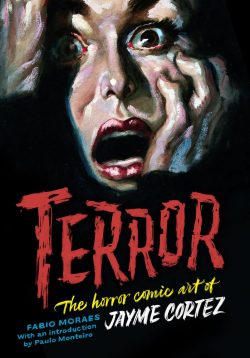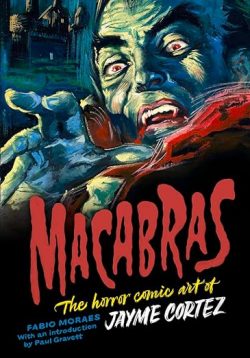
Terror – The Horror Comic Art of Jayme Cortez (volume 1) & Macabras – The Horror Comic Art of Jayme Cortez (volume 2)


By Jayme Cortez, with Fabio Moraes & various, translated by Joe Williams (Korero Press)
ISBN: 978-1-912740-22-2 (PB Terror) & 978-1-912740-21-5 (PB Macabras)

Win’s Christmas Gift Recommendation: Whatever the Season, All Nights Are Dark … 8/10

Please pay careful attention: this art book contains stories and images of an explicit nature, specifically designed for adult consumption. Tomorrow I’ll write about something else – possibly more socially acceptable, with mindless violence and big explosions, so come back then if incredible art, a dedicated career and rectifying oversights is not to your liking.

We comic book guys tend to think we invented and run the medium and art form of graphic narrative, but – gasps in shock! – other countries have been doing the same or similar all along. Moreover, so very much of it is so very good…

Britain and the US have, over decades, employed a select few master craftsmen (and they were mostly men as far as I can see) and I’ve done my bit to point them your way, but until very recently we haven’t seen much of Brazil’s monolithic comics output. That changes here and now with a two-book collection highlighting the breathtakingly prolific career of Jaime Cortez Martins – AKA Jayme Cortez. He was born in Lisbon, Portugal on 8th September 1926 and his life changed at age six when he first saw imported American newspaper strips: particularly Alex Raymond’s Flash Gordon. Jaime’s first drawing was published when he was 11, and in 1944 he was apprenticed to children’s magazine O Mosquito under its art director Eduardo Texiera Coelho. The prodigy generated numerous groundbreaking strips before – having discovered the rich world of Brazilian comics – he emigrated to São Paulo to find great fame fortune and renown. Celebrated globally except in English-speaking countries, Cortez died in 1987.

For more biographic detail resort to the internet or best yet buy these books where editor/writer-compiler/art historian Fabio Moraes and appreciative guests such as Paul Gravett, and Paulo Montiero offer their own insights in Forewords and Intoductions. What’s really important is what follows: a magnificent treasury of a passionate creator’s output (albeit mostly his horror genre material) encompassing Brazil’s “golden age” of scary stories.

Cortez made himself master of countless artistic techniques and although there are ads and a few comic book stories included, these volumes primarily gather a mindboggling number of painted covers (as many as 4 per week!) in chronological order. Whether in colour or monochrome, these stunning retrospective compendia of gloriously designed and delineated imagery in a wealth of styles incorporate a staggering arsenal of artistic techniques – even photographic – to highlight a stunning and prolific career you and I were utterly unaware of.

Terror – The Horror Comic Art of Jayme Cortez properly opens with a comprehensive biographical essay ‘The Life of a Master Illustrator’ relating that dazzling career and offering candid photos, early works, magazine covers, strips and extracts, original artworks and commercial jobs before the serious stuff begins with his entire covers run for landmark publication O Terror Negro (The Black Terror).

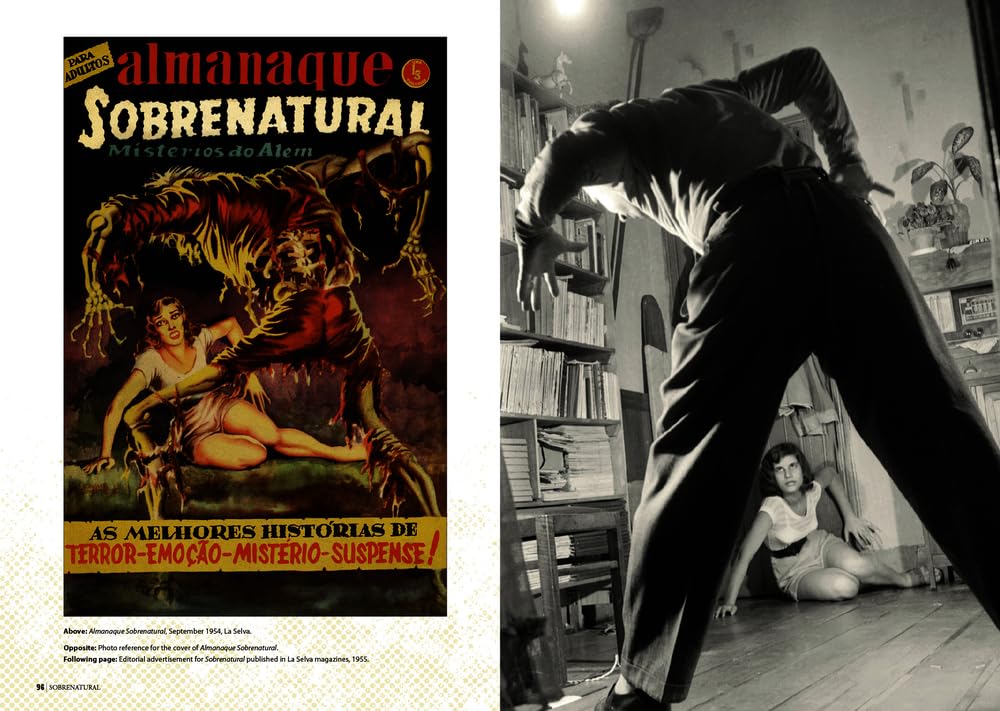
This launched in September 1951 and ran until 1967, with Cortez generating the covers from #2 until the end and also the regular annual editions Almanaque de O Terror Negro. From January 1954 he added Sobrenatural to his commissions list: another 31 covers (plus another Annual) until September 1956 and (from February 1954 to July 1956) 35 more covers for Contos de Terror (Horror Tales), another Almanque and a brace of Frankenstein fronts. Throughout the book are many original art reproductions and dozens of reference photos the artist used as part of his process in bringing ghosts, ghouls, goblins, aliens, psycho-killers, devils, demons and witches to life, and making realistic the demise of countless maidens, wives and sundry other innocents…

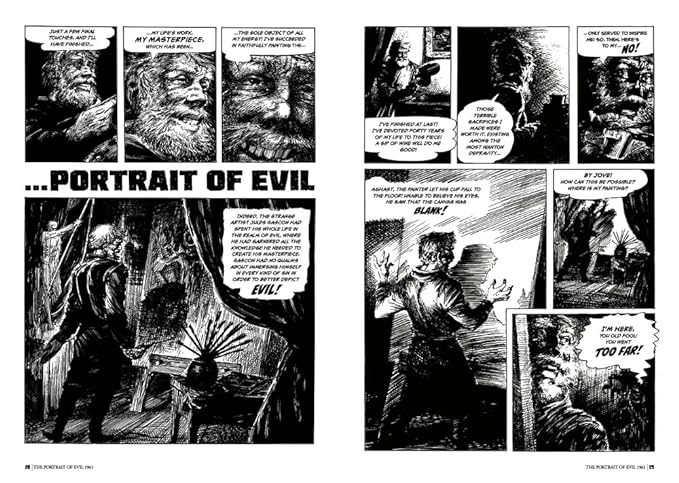
Macabras – The Horror Comic Art of Jayme Cortez continues the gruesome gallery of dark delights by including some more of his beguiling strip work and another cartload of intoxicating covers. Following another context-packed biographical essay – ‘A Virtuoso of Illustration’The Portrait of Evil 1961 reprints and deconstructs what is considered Cortez’s signature sequential narrative masterpiece, before The Portrait of Evil 1973 does the same for the improved version the tireless quester produced when he returned to the subject in a more mature and philosophical frame of mind…

From there it’s a return to eye-catching images and bold typography in a welter of covers for his minor magazine efforts, beginning with 62 issues of Seleçóes de Terror (beginning in 1959 and going on until 1967), 28 for Histórias Macabras, 19 for Clássicos de Terror, an even dozen for Histórias Sinestras, as well as Histórias Do Alem (4), Super B?lso (3), Terror Magazine (3), and 10 for indie company Jotaesse.

Also on view are a chapter on the artist’s fascination with Edgar Allen Poe, a photo-essay on Creating a poster (for his other job working in films) and 14 chilling Black and White Illustrations to round out the fright fest.

This long-past-due celebration of a truly unique artistic pioneer is both compelling and shocking, and something no mature-minded devotee of graphic excellence should miss. Moreover, if the subject matter intrigues you, Korero also publish a stunning line of companion volumes of unknown (to you and me) art masters in their “Sex and Horror” collections: thus far highlighting the mastery of Emanuele Tagglietti, Alessandro Biffignandi, Fernando Carcupino, Roberto Molinio…

It’s never too late to be scared witless or stunned by magnificent comic art so let’s open our eyes and get a little international here.
First published in 2023 © Korero Press Limited. All rights reserved.

The Wilderness Collection


By Claire Scully (Avery Hill)
ISBN: 978-1-910395-74-5- (HB)

Win’s Christmas Gift Recommendation: Know Your Place… 9/10

The most wondrous thing about comics is their sheer versality. In terms of narrative, exposition, mood-setting and information dissemination, nothing comes close, and the range of visualisations span near-abstract construction to hyper-realism. If the end-consumer is particularly receptive, the author can even dial back on narrative or plot or characterisation and let a succession of carefully-applied images make a story unique to each reader. It’s like jazz for your head and before your very eyes…

In all the most telling ways, we’re still monkeys clinging to rocks: we can’t help but respond viscerally to our environment: cowed or elated by stony heights, drawn to and pacified by pools and gardens, inexplicably moved to fear or joy by forests. It’s in our blood and bones: nobody stands on a mountaintop or looks down into the Grand Canyon and says “meh”…

Wherever we are, the landscapes in our heads still unfold before or curl back on us. We may have left the caves and trees and sunlit shores, but we now mimic those ancient sanctuary havens in our dwellings. We climb high and burrow deep and our architecture has visceral, compulsive, instinctive power over us.

Walk by a Victorian school, across a Roman viaduct or study the oppressive, aggressive triumphalism of Nazi-built buildings or battle emplacements – we’re all still part of the wild with Nature in our veins and bones. Just don’t stand too long near towering desert mile-spires or vertical palaces based on knickknacks or vegetables or sex-toys…

When someone really talented and truly invested channels such primal responses, the fires of creativity can push right into the hindbrain to our inner primitive. The Wilderness Collection does that. A timely amalgamation of three earlier rambles through realities – Internal Wilderness, Desolation Wilderness and Outer Wilderness – the sequenced images comprise a hardback handbook of purely and sublimely visual triggers: experiences enhanced by the rough tactile textures of the card they are printed on. This is the culmination of a project examining the relationship between Landscape and Memory.

The first steps come in nocturnal shades of blue as Internal Wilderness presents “a journal of a sequence of events occurring over a period of time and location in space” before the ceaseless peregrination reaches the warm reds, oranges, browns and fading greens of the Desolation Wilderness which depicts “a sequence of events occurring over a period of time in the search for a location in space”.

Careful now, you are nearing a stopping point if not an end, as Outer Wilderness explores the wildest places on the route: “a sequence of events occurring over an unimaginable period of time in the vastness of space” – melding animal, mineral and vegetable in a manner reminiscent of Basil Wolverton in his visionary, inspirational element….

Creator Claire Scully has inscribed and sequenced compelling scenes of rocks and trees and waters and skies and other things less definable, across different seasons and times of day in such a fashion that you must look and pause and ponder.

This is a graphic missile targeting recollection and imagination; one that hits with serenely devastating impact.

If you are still human or at least a primate looking for challenge, this will make you think: you won’t be able to help yourself…
© 2019 Claire Scully. All rights reserved.

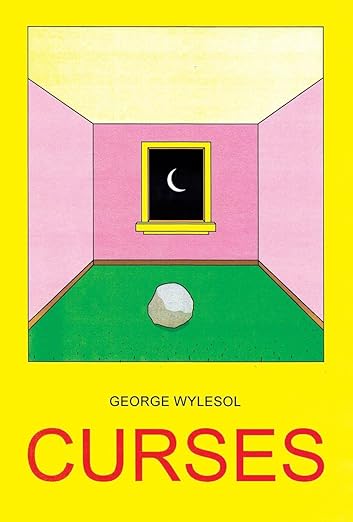
Curses – A collection of short comics


By George Wylesol (Avery Hill Publishing)
ISBN: 978-1-910395-75-2 (TPB)

Baltimore-based George Wylesol (Internet Crusader, 2120) is a cartoonist with lots to say and extraordinarily intriguing ways of doing so. His oeuvre channels avowed fascinations – old computer kit and livery; anxiety; a culture of graphic inundation, pervasive iconography; the nostalgic power of commercial branding and signage plus a general interest in plebian Days Gone By. Drawings of these he melds into chilling affirmations of his faith in the narrative power of milieu and environment as opposed to characters. He’s also pretty big on scaring the pants off folk…

That is especially the case in this latest tome: a retro-modernist glimpse over the shoulder at past shorter tales. This vibrant volume gathers novella Ghosts from 2017 and a section of short comics created between 2015 and 2021 uniformly exploiting his garishly macabre peccadilloes, opening with a devil’s dozen depicted as the ‘Comprehensive List of Curses’: part of a sporadic sequence of stand-alone (or are they?) images peppered throughout the pages.

Breakthrough tale ‘Ghosts’ details a worker sharing experiences wandering in a complex of tunnels under a hospital, after which 2015’s ‘The Rabbit’ macabrely plucks heartstrings (you can see them if you look) in a tale of odd relationships…

Computer game inspired ‘Castle Maker’ seductively and inevitably leads to a powerful exploration of ‘Porn’ that is nothing like you could possibly expect.

Talking heads spouting ‘Cheese’ and worse bring us a ‘List of Cursed Entities’ before ‘Worthless’ pushes the limits of visual reportage and conceptual condemnation. More far-from-random images offer a reset button as prelude to a visit to realtor purgatory via the ‘Open House’ after which ‘The Loser’ displays another way to fail yet win…

Bombarded by fresh pictorial asides, we pause to consider the void in ‘Untitled’ before a sequence of entwined episodes commences, tracing the saga of ‘The Cursed Lover’.

Set in the ghastly, internal-organ-obsessed municipality of Zujojhidi – as governed by drab routine and television prophets – Ghoul is struggling with school and his job at the meat factory. Everything changes once a stranger shows him a spirit hidden under his cloak. From that moment, Ghoul’s existence changes forever and for the worst…

Can the interest of young Mercey – whose attentions he is blithely oblivious to – divert the doomed kid from the inexorable path to apocalypse and oblivion?

Deftly manipulating realities and landscaping the liminal spaces at the boundaries of peripheral vision, Wylesol reshapes forms and formula to carve out chilling, potent suspense sagas unlike anything you’ve ever seen. Genuinely disturbing in the manner of the best psychological dramas, with plenty of scary moments and distressingly eerie characters, the coldly diagrammatical illustration and workplace-bright colour palette adds immensely to the overall aura of unease.

Compelling and compulsive, these eerie evocations are aimed right at you. Whether you duck, dodge or dive in says all you need to know of yourself and proves nothing is what it seems. This is a wild ride not to be missed.
© George Wylesol 2023. All rights reserved.

Chronicles of Fear – Tales of Woe


By Nathalie Tierce (Indigo Raven)
ISBN: 978-1-7341874-5-8 (PB)

Win’s Christmas Gift Recommendation: Cruel Truths for Crazy Days… 9/10

Allying words to pictures is an ancient, potent and – when done right – irresistibly evocative communications tool: one that can simultaneously tickle like a feather, cut like a scalpel and hit like a steam-hammer. As such, repeated visits to a particular piece of work will even generate different responses depending on the recipient’s mood. If you’re a multi-disciplined, muti-media artist like Nathalie Tierce, fresh challenges must be a hard thing to find, but rewards for successfully breaking new ground are worth the effort… and the viewer’s full attention.

Tierce is a valued and veteran creator across a spectrum of media, triumphing in film and stage production for everyone from the BBC to Disney and Tim Burton to Martin Scorsese. She has crafted music performance designs for Andrew Lloyd Webber and The Rolling Stones, all the while generating a wealth of gallery art, painted commissions and latterly, graphic narratives such as Fairy Tale Remnants and Pulling Weeds From a Cactus Garden.

Perpetually busy, she still finds time to stop and stare; thankfully, human-watching is frequently its own reward, sparking tomes like this slim, enthrallingly revelatory package forensically dissecting human nature in terms of cultural landmarks as scourged by the inescapable mountain of terrors large, small, general and intensely personal.

On show in this portable night gallery are stunning paintings in a range of media, rendered in many styles and manners whilst channelling the artist’s own fear-mongering childhood entertainer-influences. These include Edward Gorey, Maurice Sendak, Heinrich Hoffman (Der Struwwelpeter) and other dark fairy tales, as well as compellingly mature comic creators such as Aline Kominsky Crumb & R. Crumb, Will Eisner and Claire Bretecher.

The artworks explore shades of anxiety, alienation, frustration, longing, disappointment, despondency, hopelessness, instant gratification, loss of confidence, purposelessness, racism, toxic masculinity, neurosis, death and loneliness by suborning cultural touchstones like Popeye, Donald Duck and other Disney icons, mass-media mavens like Bowie and King Kong, beloved childhood toys and even modern lifestyle guru Homer Simpson.

Bracketed by revelatory insights and sharing context in Introduction and Biography, the pictorial allegories When Shock and Horror Collide, Forest Nymph, Capitolina and the Dubious Superhero, The Genie and the Swimmer, Bad Fishing Trip, Slapstick Brawl, Undateable, Crazy Rooster Man, Strange Leader, My Favorite Aliens, The Queen of Hearts Goes Shopping, Acrobat, Fear of Death, Running, What Killed the Dodo?, The Bore, 3am, Pussy Cat, Barfly, Alice in Waitingland (my absolute personal favourite!), Beginning and End, Rascal Dog, Spiraling, Lonely Soldier, Homer Gone Bad, Jittery and utterly appalling endpiece Bathtime, connecting forensic social observation with everyday paranoias we all experience. The result is a mad melange of bêtes noire and unsettled icons du jour, with each condemnatory visual judgement deftly wedded to frankly terrifying texts encapsulating contemporary crisis points, delivered as edgy epigrams and barbed odes.

Chronicles of Fear – Tales of Woe is a mordantly mature message of mirth-masked ministrations exposing the dark underbellies we’re all desperately sucking in and praying no one notices.

A perfect dalliance for thinking bipeds at the end of civilisation, aimed at victims of human nature with a sharp eye and unforgiving temperament – and surely, isn’t that all of us?
© 2023 Indigo Raven. © 2023 Nathalie Tierce. All rights reserved.

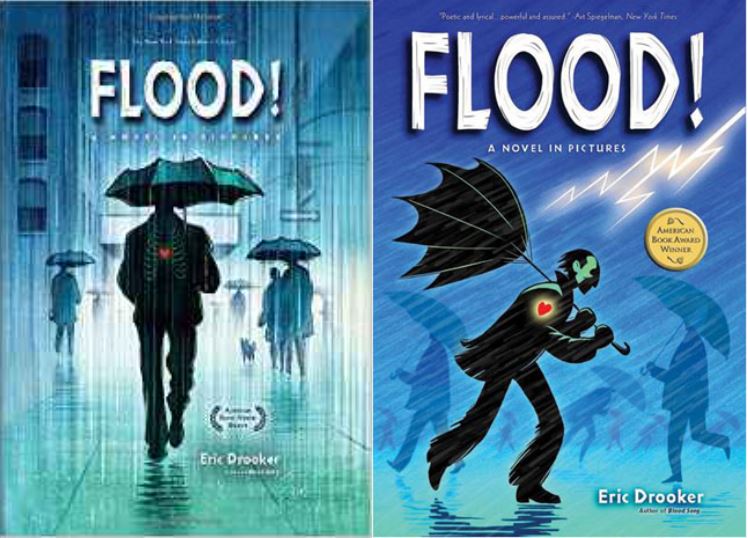
Flood! – A Novel in Pictures


By Eric Drooker (Dark Horse)
ISBN: 978-1-61655-729-4 (HB) 978-1-59307-676-4(PB)

Far too infrequently in comics (and everywhere else) something truly different, graphically outstanding and able to subvert or redirect our medium’s established forms comes along. Generally, when it does, we usually ignore it whilst whining that there’s nothing fresh or new in view.

Happily that’s not what happened with Eric Drooker’s Flood! – A Novel in Pictures when it was first released in 1992. A New York City native, he’s a profound and legendary left-leaning activist, thinker and creator of street art who attended Downtown Community School in the East Village and studied sculpture at Cooper Union before becoming a designer and illustrator.

His covers for The New Yorker are unforgettable, as are his ferociously expressive, eye-catching pieces in The Wall Street Journal, Heavy Metal and World War 3 Illustrated. His drawings and paintings – especially from his far too few graphic novels – were used in videos for Faith No More and Rage Against the Machine. His animated film Howl was the culmination of extensive collaboration with poet Allen Ginsberg (Illuminated Poems, Howl: a Graphic Novel).

Drooker’s political stance and creative influences make his pictorial narratives (like Blood Song: a Silent Ballad) both contentious and greatly favoured by a readership ranging far beyond the usually cloistered and comfortable confines of the traditional comics community.

He won an American Book Award, Inkpot and Firecracker Award, and the artwork for Flood! has been inducted into the Prints & Photographs Division of the American Library of Congress.

Drawing on his earliest influences and following the Depression Era-traditions of artists and printmakers such as Frans Masreel, Lynd Ward, Otto Nuckel and Giacomo Patri, Drooker’s first graphic novel was produced in linocuts and spot-colour: three discrete section chapters created between 1986 and 1992. You only need to look at the news to see that the subject matter has never been more immediate or telling…

These symbolic, spine-tingling observations and tumultuous progressions are generally dispensed without words as lone protagonists – or perhaps alienated, excluded victims – struggle to survive and find meaning in a world that just don’t care. The Man in View restlessly moves past centres of employment that shut down when you’re not looking, trudging cold, mean, directionless streets and alleys at the bottom of canyon-like skyscrapers or riding bleak subways while the pitiless skies look down and just keep spitting more and more rain…

Following a damning indictment of the modern world and warning of the social apocalypse to come from Luc Sante in his trenchant Introduction, the journey into oblivion begins with ‘Homeas a simple worker discovers he’s no longer wanted. Slowly making his way back to the little he still possesses, he witnesses the city and his life in a new way…

That peregrination takes him below the city in ‘L: into the tunnels trains share with lost, abandoned and forgotten people who have been reduced to their most primal elements…

‘Floodthen brings us to a lonely garret where an artist and his cat toil to finish a treasured prospective masterpiece while the waters rise all around them. The deluge is here and everything’s about to change forever…

It’s time for one final excursion out into the submerging city…

This is a disturbing parable of immense depth and potency; made all the more effective by Drooker’s intense visualisations. We all know the consummate power of images over words, but they also impart greater liberty as the reader’s mind is free to attribute as much meaning to the narrative as their own experiences will allow. The result is sheer poetry – and what’s increasingly looking like prophecy…

Flood! – A Novel in Pictures is in its fourth edition now; the latest from Dark Horse being a deluxe (167 x 235 mm) hardback in black-&-blue-&-white which includes a revelatory conversation with the artist as first seen in Comics Journal as a much longer ‘Interview with Eric Drooker.

Conducted by Chris Lanier and supplemented with a superabundant wealth of sketches, full pages, roughs and illustrations it adds great insight to what has gone before and sets us up nicely for Drooker’s even more impressive follow-up second work – Blood Song: a Silent Ballad. At the moment neither is available in digital editions but hope, like great art and timeless stories, springs eternal…

Terrifying, lovely and irresistibly evocative, this is a nightmare vision you must see and will always remember.
Text and illustrations of Flood! – A Novel in Pictures © 1992, 2002, 2007, 2015 Eric Drooker. All rights reserved. Introduction © 2001 Luc Sante. Comics Journal interview used with permission.

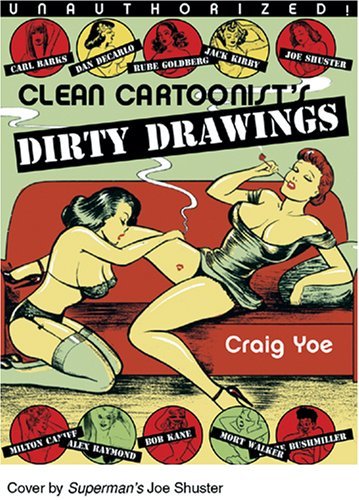
Clean Cartoonists’ Dirty Drawings


By Craig Yoe and many and various (Last Gasp)
ISBN: 978-0-86719-653-5 (TPB)

First things first: yes they are but no they’re not – unless you’re really, really spiritual and old fashioned. Despite the somewhat prurient and sensationalistic – not to say deliberately salacious – title, this compilation of cartoons and illustrations culled from the private files and bins of a number of our industry’s greatest stars (and also many from the drawing boards of those infamous scallywags of the animation industry) – is actually a rather quaint and charming insight into the capabilities, accomplishments and professional ethics of a talented crowd of individualists.

To European eyes there is very little amiss here, but one needs to remember just how prudish and censorious (I personally prefer the terms “daft” and “ridiculous”) the American “family values” lobby is and always has been.

Two brilliantly telling examples would be the covering of Flossie the Cow’s udders; first by a skirt (1932) and eventually (1939) by a full dress. She also had to stop walking on all fours because it was unladylike.

Or perhaps you’d like to consider Mort Walker’s navel collection. Apparently, a syndicate editor had a problem with belly buttons and always returned Beetle Bailey strips that featured one. Walker would scalpel them off the artwork and collect them in a pot on his desk.

Collected and compiled by fan, historian, Renaissance man and truly cool comics bloke Craig Yoe (among his many accomplishments he counts being Creative Director of the Muppets – bet you want to Google him now, don’t you?) and offering an introduction by a properly “Dirty” cartoonist R. Crumb, this is a frothy catalogue of rather chaste naked lady pictures (and often not even that) in colour and monochrome, crafted by some of the best artists and cartoonists in modern history: although you might want to check the oddly incongruous contributions of Gustave Doré and Thomas Rowlandson before giving a copy to your 8-year-old.

So if you’re unflappable, incorruptible or just don’t own a MAGA hat, you’ll want to sneak a peek at this stellar cast of incorrigibles. The roster includes Jack Kirby, James Montgomery Flagg, George Herriman, Joe Shuster, Steve Ditko, Charles Schulz, Milton Caniff, Alex Raymond and Chuck Jones.

Potentially as corrupting are delightful and delicious contributions by Dr, Seuss, Carl Barks, Bob Kane, Rube Goldberg, Bruce Timm, Alex Toth, Fred Moore, Dan DeCarlo, Dave Berg, Ernie Bushmiller, Sergio Aragonés, Jack Davis, Billy De Beck, Hal Foster, Harry G. Peter, Paul Murray, Neal Adams, Al Jaffee, Wally Wood, Nick Cardy, Hank Ketcham, Johnny Hart, Walt Kelly, Adam Hughes, Alex Schomburg, Al Williamson, Henry Boltinoff, Stan Drake, Dik Browne, Matt Baker, Otto Soglow, Al Capp, John Severin, Jim Steranko, Jack Cole, Bill Everett, Grim Natwick, Will Eisner and so many others.

Art is all about establishing a relationship with the beautiful, shocking or thought-provoking. Why not turn your attention to these lesser-known efforts from some of the most familiar names in our world and see what occurs to you?
© 2007 Gussani-Yoe Studio, Inc. All illustrations are © 2007 their respective artist and/or © holders.

(The Tragedie of) Macbeth


By William Shakespeare, adapted by K. Briggs (Avery Hill Publishing)
ISBN: 978-1-910395-73-8 (HB)

Depending on how you liken it, William Shakespeare may be one of the most prolific comic scripters in the business. His mighty works have been staged and adapted as graphic narratives for decades in every language you might consider, and frequently allow contemporary artistic collaborators opportunity to be bold, experimental and vibrantly daring.

This is certainly the case with the lovingly crafted vision of American illustrator, performer and educator K. Briggs (Resistance, The New Chapter Tarot) who opts for colour-blind and gender-balanced casting to recount a visually striking and vivid interpretation which makes Scotland itself a player in the mix. Combining the full text with an abundance of mixed media including collage, paints, markers and pure linework, in a procession of nature-informed, magically-motif-ed page designs referencing ancient charts and maps, Illuminated manuscripts, tapestries, Tarot iconography, medical grimoires, nigh-abstract mood-enhancing tableaux and found historical artworks. These function as a moving backdrop to the actors unfolding the tale before your eyes.

What you already know: valiant general Macbeth meets three witches after saving the kingdom of his liege lord Duncan, and comes away with the notion that he will be King instead. Egged on by greed, ambition and his wife, the Thane of Cawdor personally kills the King whilst the monarch graces them with a visit. The red trail includes framing the guards and heirs and then progressively removing all threats to his reign.

However, both he and his Lady cannot escape their own consciences and the witches’ prophecy leads to delusion, disaster, derangement and death, but never glory…

As far as we can tell, Macbeth was first performed in 1606, written for Shakespeare’s patron King James I of England/VI of Scotland. It is an epic tragedy of ill-starred political ambition, the psychological costs of guilt, the consequences of betrayal and inevitability of tyranny, all wrapped up in veneer of supernatural horror.

The story is one of the greatest in world literature, but also a studied hatchet job, with the Bard shamelessly currying favour by ignoring facts and bigging up James’ distant ancestor and antecedent Macduff. The text first appeared in print in the Folio of 1623, but there have been plenty of editions since then.

The immortal story has frequently made it into comics form. If you’re one of the precious few people unfamiliar with the tale in its intended format (firstly, shame on you and secondly, go watch it right now; there are many excellent filmed versions in every possible language), this imaginatively welcoming rendition is extremely enthralling and powerful…

Moreover, the plot lends itself to many eras and milieux. You may even have already enjoyed it in epics as varied as Joe MacBeth (UK 1951), Throne of Blood (Japan 1957), Teenage Gang Debs (USA 1966), Men of Respect (USA 1991), and Mandaar (India 2021), amongst so many more interpretations – or even thematically as Blackadder Season 1…

Maybe you have seen it all before, but this is better….

Or if you will permit, “By the pricking of my thumbs, Something Wicked your way comes…”
© K. Briggs, 2023. All rights reserved.

Macbeth will be published on 23rd July 2023 and is available for pre-order now.

Thomas Girtin: The Forgotten Painter


By Oscar Zárate (SelfMadeHero)
ISBN: 978-1-914224-07-2 (HB/Digital edition)

Oscar Zárate was born in Argentina in 1942. After studying architecture he worked in advertising until 1971, at which time, like so many other countrymen, he migrated to Europe. Restarting his life and career, his design and painting jobs were augmented from 1977 onwards by illustrating histories of scientific and political luminaries (the …For Beginners and Introducing… series). This led to his adapted literary graphic novels Othello (1983) and Dr. Faustus (1986). A year later he collaborated with Alexei Sayle on Geoffrey the Tube Train and the Fat Comedian and in 1991 the award-winning A Small Killing, written by Alan Moore. He also produced socially active comics strips for Fleetway’s Crisis magazine.

A creator of intellect, passion and sensitivity, Zárate has always delivered far more than expected and in his latest magnum opus advances the potential of graphic biography by combining the avowed popular rediscovery of outsider English Master Thomas Girtin: The Forgotten Painter with a compelling (hopefully, largely fictionalised) drama. The players are three modern day artistic apprentices, devout and dedicated yet adrift and floundering in their own highly personalised searches for integrity and eternal truths. Ultimately, they all finally find ways forward by looking back to a rebel genius inexplicably sidelined by history…

Arturo, Sarah and Fred are all mature-student artists who meet up at a weekly life drawing class in London. Each is passionate about their pastime but cannot escape the crippling pressures their regular lives bring. Arturo is from Argentina and still carries self-inflicted scars of betrayal and failure, as well as the shame of having escaped terror at the cost of his family. It makes him seem gruff, distrusting, weary and cynical …

Architect and imminent grandmother-to-be Sarah is crippled by a different kind of guilt: perpetually wracked by how she is not good enough at anything she does. This recently remanifested when her greatest friend from art school reached out after decades of silence and separation. Back then, Sarah had abandoned and ghosted her on the cusp of success and greatness and has ever since writhed in the torment of debilitating guilt only Catholicism can (self) inflict.

Poor Fred is perhaps the most troubled: an honest, fair-minded worker who accidentally uncovered high levels of tax fraud at work. Even after losing his job because of it, he is still being pilloried: on one side pursued by a journalist who wants him to become a whistle-blower and on the other by a gang of heavies his former bosses hired to ensure his silence…

For nearly a year the trio have gradually become friends, discussing art in after-class pub sessions. Now Fred has become an impassioned zealot with a new love. He’s discovered an 18th century genius who changed the shape of English watercolour painting and then simply vanished from public view and memory.

It’s an injustice Fred is determined to set right…

The story of Thomas Girtin is woven throughout their cumulative tale. He is an intriguing mystery and shining exemplar whose gradually reconstructed history inspires each modern-day acolyte to change the course of their own life. Arturo finds strength from the tragically ill-starred artist’s resolve and courage at a time of widespread and earthshaking political unrest: an outright proudly rebel republican in an avidly monarchist nation, despising, decrying and working against the patronage system that supported his work and kept him in luxury.

Sarah finds inspiration in the driven quest for an almost-mystical connection to Nature and a higher truth. Young Girtin was a contemporary, rival and friend of latterday English icon JMW Turner, and at the turn of the 18th century was rapidly growing in renown. Already recognised as a groundbreaking pioneer outselling his old schoolmate in the cutthroat and exploitative art scene of the day, Girtin never rested, but continually strove to capture the fundamental revelations of reality.

That all ended with his early death in 1802, aged 27. Crucially for Sarah, in his search for the truth of time and the cosmos, Girtin martyred himself: dying due to his own obsessive compulsion to capture the elements in all their ferocious fury and restorative glories…

As for Fred, Girtin’s life increasingly becomes his own. Resurrecting and redeeming the lost painter’s reputation and sharing his mastery with the world becomes his reason for living, driving him to make a pilgrimage in Girtin’s footsteps and thereafter reorder the course of his own remaining years…

The twinned stories are subtly and smoothly presented by Zárate using two different styles of illustrative painting; mixing modern-day pastel tones with stark, sepia-tinted historical episodes that reveal – in his and his characters’ eyes at least – who Girtin was and how he lived, thrived and died.

As this monumental tome unfolds and tellingly argues for Girtin’s popular revival and reassessment, the most convincing asset in that campaign are the beautiful original Girtin works. The reproductions of his greatest triumphs – “View near Beddgelert”, “Estuary of the River Taw, Devon”, “Storiths Heights” and his undisputed masterpiece “The White House at Chelsea” – are judiciously folded into the text and include a selection of large gatefold images.

This is a book about Art and a story of artists, operating on the principle that what we see which moves us, we need to share. Once the story’s done here, that can be easily first facilitated by reading erudite and engaging endpiece ‘Thomas Girtin (1775-1802) An Afterword’ by Dr Greg Smith, (Senior Research Fellow, Paul Mellon Centre for Studies in British Art) and the attendant Acknowledgements, Permissions, and copious Bibliography sections.

You can always check him out yourself. There are many places online to see Girtin’s work, and even a few museums, if you’re pushy. Then go tell a like-minded friend.
© Oscar Zárate 2023. All rights reserved.

Mingus


By Flavio Massarutto & Squaz, translated by Nanette McGuiness (NBM)
ISBN: 978-1-68112-309-7 (HB) eISBN: 978-1-68112-310-3

Charles Mingus Jr. was born on April 22nd 1922 in Nogales, Arizona. He was a musical prodigy perpetually held back and frustrated by the response of other people to the colour of his skin. “The Angry Man of Jazz” died in January 1979, having battled all his life whilst composing and performing some of the most groundbreaking music of all time. When you hear some you will either love it or loathe it.

That’s the facts. Anything else you need can be found on Wikipedia or in countless books written about – or by – him…

That kind of dry data isn’t what this celebration is about. Instead, journalist and author Flavio Massarutto and magazine illustrator/educator/graphic novelist Pasquale Todisco – AKA Squaz (Toutes les obsessions de Victor, Diabolik, Pandemonio) – have successfully captured the feeling and flavour of the man and his music, crafting visual cuts of key moments to make a conceptual album of his embattled existence and lasting legacy.

‘Track 1: Eclipse’ focuses on 1940 and a Hollywood backlot where extras in a cheap jungle picture discuss the appalling conditions in their other job. Once more, Charlie advocates merging their union with a white one…

The man is driven. Nothing in life keeps him from the world of words and music inside his head for long…

‘Track 2: Pithecanthropus Erectus’ finds him in New York City in 1956, meeting music critic Nat Hentoff and sharing his ideology and inspiration. It’s taken from the latest release for the astounding Charlie Mingus Jazz Workshop. Two years later and jobbing composer and film scorer Mingus almost yields to commercial pressures in ‘Track 3: Nostalgia in Times Square’

An activist and resister all his life, the small victories against institutionalised racism start to build as the performer makes waves at the Antibes Juan-les-pins Festival 1960 in ‘Track 4: What Love’. The seduction of the senses crafted throughout comes in waves of limited-colour palette comic snippets, blending reportage with fantasy sequences and is here augmented by Squaz’s reproductions of classic Mingus record sleeve designs.

Here The Clown, Tijuana Moods, Mingus Dynasty and Blues and Roots bring us to the height of the Civil Rights revolution as ‘Track 5: Fables of Faubus’ depicts the response to Arkansas State Governor Orval Faubus closing schools to black students…

With war officially declared, the relentlessly impassioned and driven musician pushed ever deeper into music and social justice before ‘Track 6: Self-portrait in Three Colors’ details how it all proved too much. However, after referring himself to Bellevue Hospital for psychiatric assessment, Mingus was caught in racist red tape and only barely escaped an illegal lobotomy…

One of the jazz man’s greatest sins in the eyes of supremacists was miscegenation. Mingus’ relationships with white women (he married two of them) was apparently fed by a drive to unite eternally divided polarities and is addressed in metaphor via ‘Track 7: The Black Saint And The Sinner Lady’, after which ‘Track 8: Passions Of A Man’ jumps to the end days when inevitable fame and success were marred by declining health.

Unable to perform on his beloved bass, Mingus moved to Cuernavaca, Mexico for treatment and ultimately surrendered to “Lou Gehrig’s Disease” (ALS). The hallucinogenic end is pictured with grace and wonder before a posthumous scattering of his ashes in the Ganges, all seen through the eyes of his widow Susan Mingus (née Graham)…

The lasting importance of the man is seen from a child’s perspective in ‘Track 9: Epitaph’ before the soul of Mingus is displayed in ‘Bonus Track: Sophisticated Lady’. Harking back to 1972, it shows a true and perfect moment as a concert at Yale is disrupted by a hoax bomb threat. With the hall evacuated and cops trying to hustle him out, Mingus ignores everything and keeps on playing…

Accompanying the conceptual wild ride, an author’s Afterword shares Massarutto’s take on the project and this volume also includes suggestions for further enjoyment in what ‘To Read’, ‘To Hear’ and ‘To See’

Just like its subject matter, Mingus follows a radical muse, eschews fact and formula and takes us into the heart and soul of a giant, both scary and almost beyond understanding.

This intensely personal assessment and interpretation is less a biography and more a heartfelt paean of appreciation, channelling and exploring the hard, harsh tone of troubled times where talented, dogged souls fought for recognition and survival in a world determined to exploit and consume them.
© 2021 Coconino Press. © 2021 Flavio Massarutto, Squaz. © 2023 NBM for the English version.

Mingus will be published in August 2023 and is available for pre-order now.

Most NBM books are also available in digital formats so for more information and other great reads see http://www.nbmpub.com/
Rick and Morty: Sometimes Science Is More Art Than Science – The Official Colouring Book


Illustrated by Austin Baechle (Titan Books)
ISBN: 978-1-80336-598-5 (PB)

Multi award-winning Adult Swim (the grown-up after-dark division of Cartoon Network) animated comedy science fiction series Rick and Morty was created by Justin Roiland & Dan Harmon. It was developed from the former’s parody short of Back to The Future in 2006, and with Harmon’s eventual collaboration was unleashed on the universe – arguably all of them – in December 2013. We’re up to Season 7, with 3 more contracted for.

The show combines edgy domestic comedy with outrageous fantasy spread across all of reality, as moral and impressionable Rick Smith is consistently lured into incredible and upsetting situations by his grandfather Morty Sanchez: an alcoholic and extremely brilliant mad scientist who lives with the Smith family. It’s all very funny, wildly imaginative and better read than talked about. (Un)Naturally, there’s a comic book tie-in too, and even a crossover series with the Dungeons & Dragons franchise that you can try too…

This decidedly peculiar and utterly interactive tribute to a strange time all around offers over 60 lusciously large and madly memorable images inspired by the show. Ranging from bizarrely disturbing to profoundly comic, these cartoon confabulations include weird places, odd characters, the Smiths in all their hoary glory, icky, sticky things, dragons, monsters and so much more, all delivered by animator Austin Baechle (Pre Fab), who preloads the magic of the grand parade through time, space, parallel dimensions and the backyard and bedroom in seductive style to delight the already dedicated and entice the uninitiated…

It’s never too soon or too late to unhinge your personal reality and get in touch with your visually expressive side, and the only way this wonderfully whacky experience could be improved is with crayons, paints and pens. Or maybe glue, glitter, fur and precious metals? No digital edition as yet, so if you want to play on a computer, you’ll need to get scanning. However, if you can work a keyboard and acclimatise to Rick and Morty’s many worlds you can surely get by…

Irreverent, subversive and appallingly addictive, the combination of great characters, compelling pictures and mirthful attention-seizing is a welcome way to while away the hours between life and the beyond…

Forget video-games – buy this (renewably resourced) book. If you’re worried about exercise, do the colouring-in standing up and if a mess (or winged dinosaur invasion) ensues, you can boost your cardio rate by cleaning it all up.

Challengingly eccentric and modernistically retro wonderment, this is a fun you can’t imagine …but can purchase.

© 2023 Cartoon Network. RICK AND MORTY and all related characters and elements are © & ™ Cartoon Network.  All Rights Reserved.