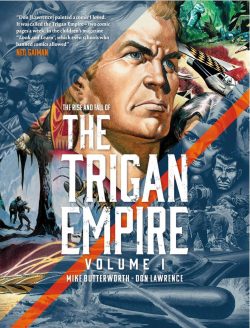
The Rise and Fall of the Trigan Empire volume 1


By Mike Butterworth & Don Lawrence & various (Rebellion Studios)
ISBN: 978-1-78108-755-8 (TPB/Digital edition)

Win’s Christmas Gift Recommendation: Classic Boys Own Nostalgia… 9/10

For British – and Dutch – readers of a certain age and prone to debilitating nostalgia, The Trigan Empire (or The Rise and Fall of the Trigan Empire to give it its ponderous full title) was only ever about two things: boyish wish-fulfilment and staggeringly beautiful art.

The strip was created by Senior Group Editor Leonard Matthews and given to the editor of Sun and Comet to develop and continue. A trained artist, Mike Butterworth became writer of many historical strips such as Buffalo Bill, Max Bravo, the Happy Hussar, Battler Britton and Billy the Kid – and latterly a crime and Gothic Romance novelist with more than 20 books to his pen names.

Based in equal part on cinematic Sword & Sandal/Biblical epics and space age fascination of a planet counting down to a moonshot, for the saga Butterworth combined his love of the past, a contemporary comics trend for science fiction and the long-established movie genre of manly blockbusters to construct a vast sprawling serial of heroic expansionism, two-fisted warriors, wild beasts, deadly monsters and even occasionally the odd female.

The other huge influence on the series was the fantasy fiction of Edgar Rice Burroughs (especially John Carter of Mars and Pellucidar) but without his concentration on strong and/or blatantly sexy women – usually as prizes for his heroes to save. In the formative days of the Trigan Empire, ladies dressed decorously, minded their manners and were dutiful wives or nurses… unless they were evil, vindictive or conniving…

The compellingly addictive, all-action thematic precursor to Warhammer, Civilisation and Warcraft might have been a short run venture had it not been for the art. The primary illustrator was Don Lawrence (Marvelman, Wells Fargo, Billy the Kid, Karl the Viking, Fireball XL5, Maroc the Mighty, Olac the Gladiator, The Adventures of Tarzan, adult comedy strip Carrie and his multi-volume Dutch magnum opus Storm), who painted each weekly instalment.

Initially he used watercolours before switching to quicker-drying gouaches, rendered in a formal, hyper-realistic style that still left room for stylistic caricature and wild fantasy: one that made each lush backdrop and magnificent cityscape a pure treasure. Other, later artists included Ron Embleton, Miguel Quesada, Philip Cork, Gerry Wood and Oliver “Zack” Frey, as the strip notched up 854 weekly instalments, beginning in September 1965 and only ending in 1982. Along the way, it had also appeared in Annuals and Specials and become a sensation in translated syndication across Europe. Even after it ended, the adventure continued: in reprint form, appearing in the UK in Vulcan and across the world; in two Dutch radio plays; collected editions sold in numerous languages; a proposed US TV show and numerous collected editions from 1973 onwards. Surely someone must have a movie option in process: if only Kirk Douglas, Burt Lancaster and Tony Curtis were still around, we could completely close the creative circle…

Lawrence (17th November 1928-29th December 2003) inspired a host of artists such as Brian Bolland and Dave Gibbons, but as he worked into the 1990s, his eyesight was increasingly hindered by cataracts and he took on and trained apprentices such as Chris Weston and Liam Sharp (who offers his own potent reminiscences in the Introduction to this first archival volume from Rebellion Studios’ Treasury of British Comics). Sharp collaborated with the venerable artist on his last Storm stories…

Inescapably mired in powerful nostalgia, but also standing up remarkably well on its own merits, this first collected volume re-presents the series from its enigmatic opening in high-end glossy tabloid magazine Ranger, combining comics with a large selection of factual features. The fantasy soon began to steal the show and was the most noteworthy offering for the entirety of the publication’s 40 week run, spanning 18th September 1965 to 18th June 1966. It then carried over – with a few other choice strips – into Look and Learn, beginning with #232: remaining until the magazine closed with #1049 (April 1982).

Ranger had been a glossy, photogravure blend of traditional comic anthology strips and educational magazine, and when it folded, the only publication able to continue The Trigan Empire in its full grandeur was Look and Learn

One of our most missed publishing traditions is the educational comic. From science, history and engineering features in the legendary Eagle to a small explosion of factual and socially responsible boys and girls papers in the late 1950s to the heady go-getting heydays of the 1960s and 1970s, Britons always enjoyed a healthy sub-culture of comics that informed, instructed and revealed …and that’s not even counting all the pure sports comics!

Amongst many others Speed & Power, Treasure, World of Wonder, Tell Me Why, and Look and Learn spent decades making things clear, illuminating understanding and bringing the marvels of the changing world to our childish but avid attentions with wit, style and – thanks to the quality of the illustrators involved – astonishing beauty.

Look and Learn launched on 20th January 1962: brainchild of Fleetway Publications’ then Director of Juvenile Publications Leonard Matthews. The project was executed by editor David Stone (almost instantly replaced by John Sanders), sub-editor Freddie Lidstone and Art Director Jack Parker.

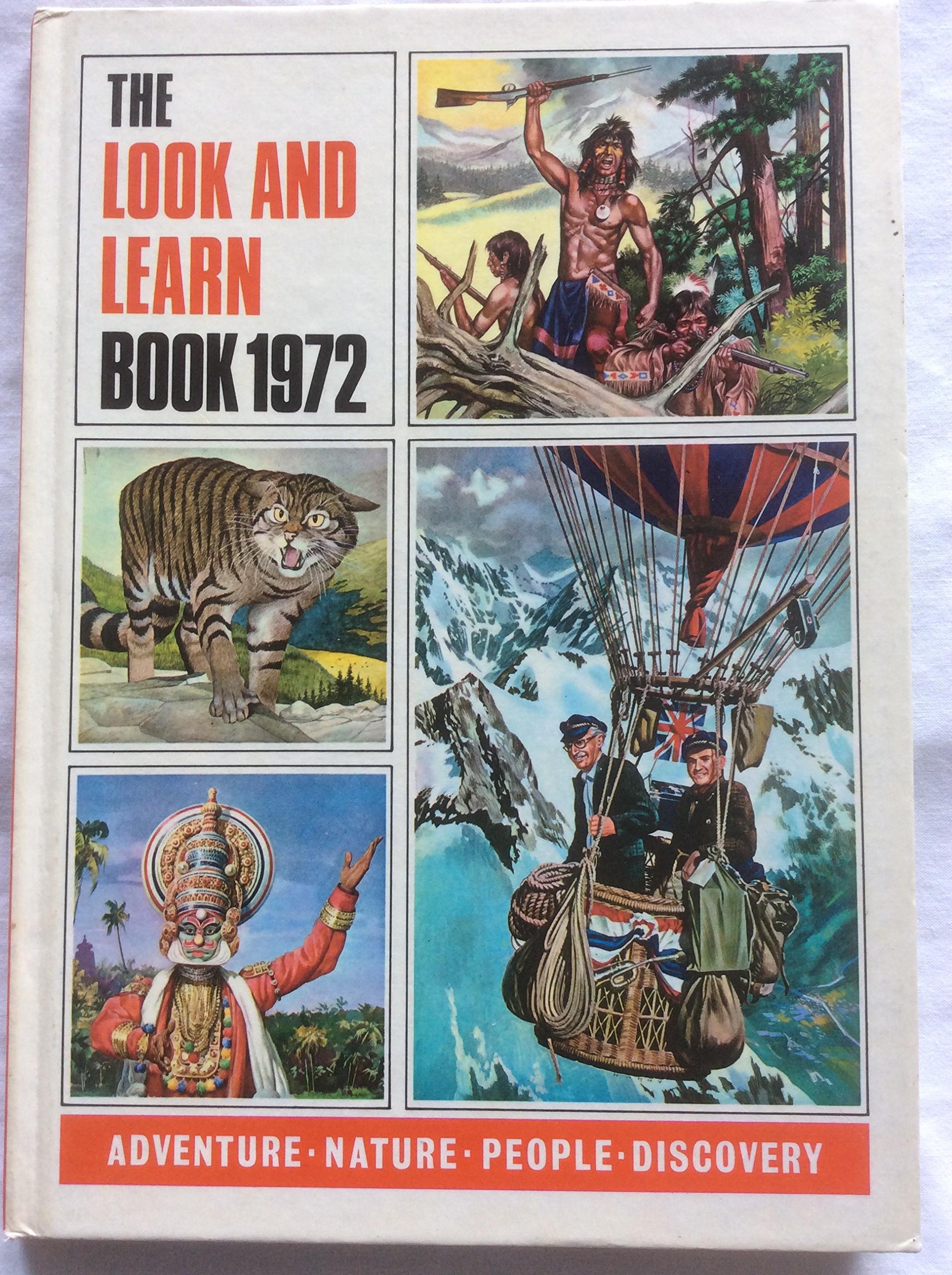
For 20 years it delighted children, and was one of the county’s most popular children’s weeklies. Naturally there were many spin-off tomes such as The Look and Learn Book of 1001 Questions and Answers, Look and Learn Book of Wonders of Nature, Look and Learn Book of Pets and Look and Learn Young Scientist as well as the totally engrossing Christmas treat The Look and Learn Book – and, in 1973 – The Look and Learn Book of the Trigan Empire: The serial’s very first hardback compilation…

Strangely, many, many kids learned stuff they didn’t think they cared about simply because it filled out the rest of that comic that carried the Trigan Empire…

In this tome we span 25th June1966 through 17th May 1968: encompassing Ranger #1-40 and Look and Learn #232-331: subdivided for your convenience into 13 chapter plays of what we oldsters absorbed as one continuous unfolding procession of wonder…

Depicted with sublime conviction and sly wit, it begins with ‘Victory for the Trigans’ (18th September 1965 – 29th January 1966) as fishermen in the Florida swamps witness a spaceship crash. All aboard are dead, and after, the global news cycle wearies of the story, the craft is reduced to a sideshow attraction whilst scholars investigate its technology, dead voyagers and a huge set of journals written in a truly indecipherable language. No one succeeds and eventually, no one cares…

All except student Richard Peter Haddon, who spent the next half century looking for the key and at age 70 cracked the code, subsequently translating the history of a mighty race of aliens so like earthmen…

From then on the scene switches to distant twin-sunned world Elekton, where a number of kingdoms and empires-in-waiting jostle for position. In many ways it’s like Earth a few thousand years before the birth of Christ… except for all the monsters, skycraft and ray guns…

In the wilds and wastes between the nations of Loka, Tharv, Davelli and Cato, brutish free-ranging tribes of nomadic Vorg hunt and clash and live brief free lives, until three brothers decide, existence could be so much more…

Driven, compelling and charismatic, notional leader Trigo has a dream and convinces his siblings Brag and Klud to ask their people to cease following roving herds of beasts and settle by a river where five hills meet. Before long they have built a city and begun the march to empire and dominance. Of course the defiant libertarians were initially resistant to becoming civilised, but that ended after the Lokans began hunting them for sport from their flying ships…

By the time Loka’s King Zorth finally got around to conquering Tharv and formally annexing the lands of Vorg in his plan to become global dictator, Trigo had begun building his city and invited refugees from Tharv to him. Amongst the survivors of Lokan atrocity was Peric – an architect and philosopher acclaimed as the smartest man alive and his daughter Salvia. Both would play major roles in the foundation of the Trigan Empire…

When Zorth at last turned to consolidate by taking Vorg, his air, sea and land forces were met by an unbeatable wall of death and history was rewritten. It had come at great cost, most notably to Trigo as victory was almost snatched from him when his brother Klud attempted to murder him, seize power and betray his people to the Lokans…

With the empire established, one translated book ended, and Professor Haddon’s life’s work moved on to what we’ll call ‘Crash in the Jungle’ (5th February – 19th February 1966) which introduces young warrior/pilot Janno. As the son of Brag, he is childless Trigo’s nephew and heir apparent: undergoing many dynamic adventures as an imperial troubleshooter whilst being groomed for rule…

Here, still wet behind the ears, the lad crashes in the plush green rainforests of Daveli, befriends Keren – son of a formerly antagonistic chieftain – and facilitates an alliance with the ever-expanding Trigan Empire. When Janno returns to pilot training, Keren is beside him and will be his constant companion in all further exploits…

Planetary chaos erupts next as ‘The Falling Moon’ (26th February – 28th May 1966) reshapes Elekton’s political map. When Gallas impacts sister moon Seres, the cosmic collision sends the former satellite smashing into Loka where – forewarned – Zorth seeks to relocate his power base and entire populace by seeking sanctuary in Trigo’s city. Once admitted and welcomed the Lokans bite the hand that shelters them by seizing the city. Valiant Brag manages to save wounded Trigo, but they are captured and enslaved by desert raiders of the Citadel…

As Janno and Keren escape to mount a futile resistance to the Lokans, slave worker Trigo foils an assassination and earns the gratitude of the Citadel king, who lends him a band of warriors to retake his own city. When they unite with Janno and Keren, Zorth’s defeat and doom are assured…

Time seems to move differently on Elekton and many events seem telescoped, but as the strip jumps to a new home, continuity manifests in ‘The Invaders from Gallas’ (4th June – 18th June in Ranger and then Look and Learn #232-237 from 25th June to 30th July 1966. As the fallen moon cools, aliens dwelling inside emerge to attempt the conquest of their new world via their mind control techniques.

With the Trigans crazed and killing each other, only a deaf man holds the key to their survival…

Look and Learn #238-242 (6th August -3rd September 1966) featured ‘The Land of No Return’ – which sees Janno accidentally sent along the River of Death (a rather cheeky “tribute” to Burroughs’ Mars stories), debunking an insidious religious belief that had for millennia curtailed life for Elekton’s elderly and destroying a cult of slavers…

‘The Revolt of the Lokans’ (L&L #243-255, 10th September – 3rd December 1966) returned to the exiled former-conquerors who poisoned and deranged Trigo before retaking his city. Thankfully, Keren and Peric found a way to restore order to the city and its ruler, after which issues #256-264 (10th December 1966 – 4th February 1967) detailed ‘War with Hericon’ as Trigo married Lady Ursa, sister of King Kassar: the ruler of the aloof, distant empire (a visual melange of Earth’s Persian and Byzantine kingdoms). The diplomatic love affair was soured by a single sinister malcontent when Yenni – a vengeful criminal outcast of both Hericon and Trigan – fomented racial unrest in both realms and let human nature do its worst…

Janno and Keren took the lead again in ‘Revolution in Zabriz’ (#265-273, 4th February – 8th April 1967), when he was despatched to survey a distant mountain outpost and uncovered a plot by its governor to use captive labour to finance a coup to oust Uncle Trigo and take over the empire, after which The Lokan Invasion’ (Look & Learn #274-279, 15th April – 20th May) sees the bold brothers-in-arms stumble into a devious scheme by chemist Vannu to destroy the Trigans by contaminating their water with an amnesia-inducing potion…

Revenge is once more the pivotal force as ‘The Revenge of Darak’ (#280-290, 27th May – 5th August) reveals how Trigan’s greatest pilot betrays his emperor and is punished with slavery in the mines. After a year he escapes and uses his intimate knowledge to drive a wedge between Trigo and Brag, poison Peric and embroil Hericon in war. Thankfully, brotherly love trumps hurt feelings and justice conquers all…

A taste of horror comes with The Alien Invasion’ L&L #291-297 (13th August – 23rd September) as energy beings land on Elekton. Able to possess organic brains, the intruders work their way up the planet’s food chain until Keren, Kassar and Trigo are fully dominated, but the cerebral tyrants have not reckoned on Peric’s wit or Janno’s cunning…

The first big role for a woman comes in ‘The Reign of Thara’ (Look & Learn #298-316, 30th September 1967 – 3rd February 1968) as the royal family is ousted by deceit and a secret society of soldiers instals the daughter of Klud in Trigo’s place. Vain, haughty and imperious, she is intended as a puppet of secret manipulators, but proves to possess too much pride and backbone to allow the empire to fall to mismanagement and enemy incursions. Happily, the actual Royal Family have survived their well-planned dooms and returned, leading an army of liberated slaves and a fleet of pirates sworn to Trigo’s service…

During the campaign, Kern and Janno befriend a rural bumpkin, obsessed with flying, and Roffa becomes their third “musketeer”, playing a major in the concluding tale here.

Spanning Look & Learn #317-331 (10th February – 17th May 1968) ‘The Invasion of Bolus’ sees the trio captured by rogue scientist Thulla: pressganged into joining his mission to build a ship and conquer Elekton’s inhabited moon. Unable to defy or escape, they become unwilling members in his army, before defecting to the super-advanced but pacifistic Bolans. At least they left a warning before lift-off: one that – eventually – reaches Trigo and Peric.

As the Trigans rush to construct a rescue vessel, Thulla brutally seizes the moon people’s city and commences the second part of his plan: building a colossal ray cannon to destroy all life on Elekton…

As Trigo’s ship takes off – too late to stop devasting blasts from Bolus – Janno and Keren are forced to desperate measures to save their people from the murderous madman…

Incorporating a tantalising teaser for the next volume and biographies of the creators, this truly spectacular visual triumph is a monument to British Comics creativity: one that simultaneously pushes memory buttons for old folk whilst offering a light but beautiful straightforward space opera epic readily accessible to the curious and genre inquisitive alike.

Is that you or someone you know?
The Rise and Fall of the Trigan Empire is ™ Rebellion Publishing IP Ltd. © 1965, 1966, 1967 & 2019 Rebellion Publishing IP Ltd. All Rights Reserved.

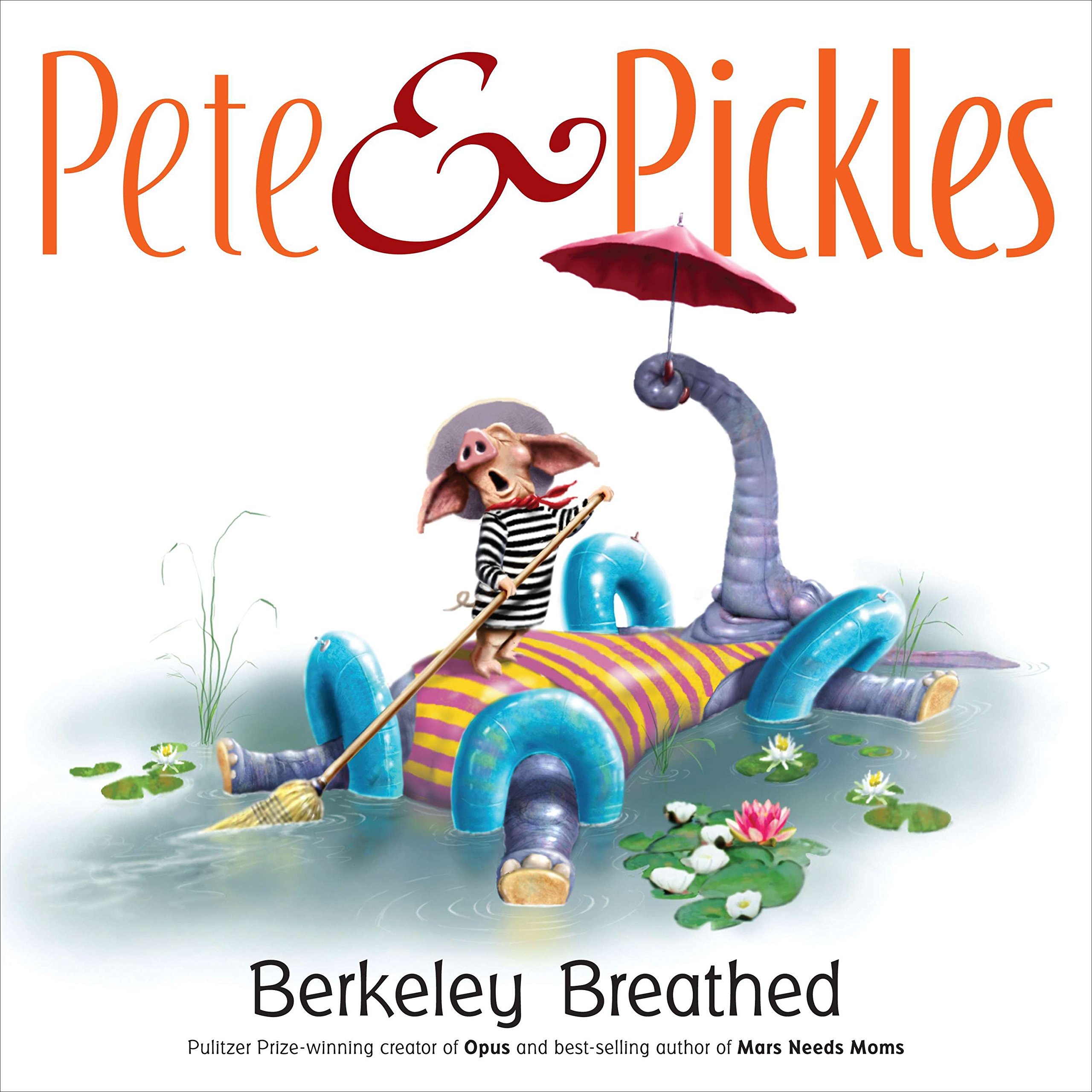
Pete & Pickles


By Berkeley Breathed (Philomel Books/Penguin Young Readers Group)
ISBN: 978-0-399250-82-8 (HB)

Win’s Christmas Gift Recommendation: Because it Ain’t Seasonal Without Cartoon Critters… 10/10

Throughout the 1980s and for half of the 1990s, Berke Breathed dominated the newspaper strip scene with agonisingly funny, edgy-yet-surreal political fantasy Bloom County and, latterly, Sunday-only spin-off Outland. They are all available digitally – so don’t wait for my reviews, just get them now!

At the top of his game and swamped with awards like Pulitzers, Breathed retired to concentrate on books for kids, crafting whimsical wonders like Red Ranger Came Calling, Mars Needs Moms! and Flawed Dogs: The Year End Leftovers at the Piddleton “Last-Chance” Dog Pound (and sequel Flawed Dogs: The Shocking Raid on Westminster), which all rank among the best America has ever produced.

Get them too.

Breathed’s first foray into the field was 1991’s A Wish for Wings That Work: a Christmas parable featuring his signature character, and the most charmingly human one. Between 2003 and 2008, Breathed revived Opus as a Sunday strip, before eventually capitulating to his career-long antipathy for the manic deadline pressures of newspaper production and often-insane, convoluted contradictions of editorial censorship.

It seemed his ludicrous yet appealing cast of misfits – all skilled and deadly exponents of irony and common sense residing in the heartland of American conservatism – were gone for good, until the internet provided a platform for Breathed to resume his role as a gadfly commentator on his own terms.

Since 2015, Bloom County has mocked, exposed and shamed capitalism, celebrities, consumerism, popular culture, politicians, religious leaders and people who act like idiots. Donald Trump figures prominently and often, but that might just be coincidence…

These later efforts, unconstrained by syndicate pressures to not offend advertisers, are also available as book collections. You’ll want those too, and be delighted to learn that all Breathed’s Bloom County work is also available in digital formats – fully annotated to address the history gap, if you didn’t live through events such as Iran-Gate, Live-Aid, Star Wars (both cinematic and military versions), assorted cults, televangelists experiencing less than divine retribution and sundry other tea-cup storms that contributed to all us Baby Boomers beings so obnoxious, rude and defensive…

Not quite as renowned, but every inch as crucial to your enjoyment, is the lost gem on display today: a paean to the power of friendship, all wrapped up in a children’s book about an odd couple thrown together by fate and necessity. And outré noses…

As previously stated, after the all-too-brief, glittering outing as a syndicated strip cartoonist and socio-political commentator (so often the very same hallowed function) Breathed left strips to create children’s picture books.

He lost none of his perception, wit or imagination, and actually got better as an artist. Even so, he never quite abandoned his entrancing cast of characters and always maintained the gently excoriating, crusading passion and inherent bittersweet invective which underscored those earlier narratives.

Moreover, he couldn’t ignore that morally uplifting component of his work that so upset hypocrites, liars, greedy people and others who let us all down while carping on about being unfairly judged and how we don’t really understand complex issues. Trust me, we – and Breathed – understand perfectly…

This crushingly captivating cartoon catechism ruminates on the cost and worth of comradely fraternity.

Pete is a pig: practical, predictable and not in any way a perturbation to normal pedestrian life. He was a pig who didn’t like fuss or surprises and lived alone until the night of the big storm. Aroused from his usual rain-induced nightmare of drowning, Pete gradually became aware that something had broken into his otherwise empty but extremely secure house…

Suddenly accosted, he is all but smothered in the capacious and so strong snoot of escaped circus elephant Pickles, who begs him to shelter her. Of course, pragmatic Pete happily hands her over the moment the clowns hunting her turn up, but can’t forget how she’d smiled at him whilst being dragged away or that she’s left him a posy of dandelions…

The event utterly disrupts his equilibrium and – despite himself – Pete eventually attends the circus. What he sees moves him so greatly that he abandons everything he ever believed and breaks her out.

Hiding her in his house, he soon finds his staid, stolid and secure life shattered by odd adventures and intoxicating fantasies, but no matter how nice it feels, it’s far more than his practical nature can abide. However, the subsequent confrontation jumps quickly from angry words to life-threatening peril when the plumbing breaks and they’re both trapped in a rapidly-filling watery deathtrap…

Combining the potent desolate imagery of Grant Wood’s American Gothic with the paintings of Edward Hopper: channelling the hidden comedic potential of the isolated rural heartland with manic, surreal whimsy in hyper-real fully rendered paintings acting in concert with powerfully simplified line drawings, Pete & Pickles explores loneliness, reticence, compromise and the hunger for companionship in a charming but potent fable. This astounding yarn was inspired by the drawing and razor-sharp perspicacity of Breathed’s (then 5-year-old) daughter Sophie, and can teach us all a thing or two about understanding ourselves and just getting along…

This is a book to trigger personal reflection, audit consciences and promote more honest behaviour, but it will make grown citizens howl and children sit up and pay attention. It’s also wickedly funny and deliciously sad. You’ll laugh, you’ll cry, and you’ll think hard about what you want and who you’d like to share it with…
© 2008 Berkeley Breathed. All rights reserved.

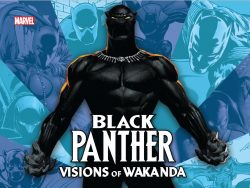
Black Panther: Visions of Wakanda


By Jess Harrold, Rodolfo Muraguchi & Adam Del Re with Stan Lee & Jack Kirby, Roy Thomas & John Buscema, Don McGregor, Rick Buckler, Billy Graham & Gene Colan, Ta-Nehisi Coates & Brian Stelfreeze and many & various (MARVEL)
ISBN: 978-1302919382 (HB/Digital edition)

Win’s Christmas Gift Recommendation: Categorically Picture Perfect… 9/10

Celebrated as the first black superhero in American comics and one of the first to carry his own series, the Black Panther’s popularity and fortunes have waxed and waned since the 1960s when he first attacked the FF (in Fantastic Four #52; cover-dated July 1966) as part of an elaborate plan to gain vengeance on the murderer of his father.

T’Challa, son of T’Chaka was revealed as an African monarch whose hidden kingdom was the only source of a vibration-absorbing alien metal upon which the nation’s immense wealth was founded. Those mineral riches – derived from a fallen meteor which struck the continent in primeval antiquity – had powered his country’s transformation into a technological wonderland. That tribal wealth had long been guarded by a hereditary feline-garbed champion deriving physical advantages from secret ceremonies and a mysterious heart-shaped herb that ensured the generational dominance of the nation’s warrior Panther Cult.

After being a steadfast if minor Marvel stalwart for decades, the character and his world finally achieved global stardom thanks to a series of stunning movie interpretations and is now an assured icon of planetary consciousness…

With accumulated years of superb comics material to fall back on, the company would be crazy not to use that in reprints and overviews like this one: creating a resource for new fans to consult and veterans to relish again.

They’re not crazy and this spiffy landscape edition – written by Jess Harrold and designed by Rodolfo Muraguchi & Adam Del Re – came out a couple of years ago. With a sequel in cinemas and the Holiday Season looming, it’s only sensible to point you in this direction if you’re seeking gift suggestions…

Following Introduction ‘Dear Brian…’ by 1990s scripter Christopher J. Priest, what follows is a series of informative, contextualising – but accessibly fun – essays, dotted with candid behind-the-scenes illustrations (like Kirby’s original concept of “The Coal Tiger”), quotes from contributing creators and artwork from classic issues and storylines: tracing the entire career of the Hero/Heroes who have steered Wakanda through Marvel Comics history…

It starts with Chapter One and ‘Enter… The Black Panther!’, with the aforementioned debut and early days supplemented by printed pages, and original art by Kirby & inker Joe Sinnott, highlighting not just the man but especially the astonishingly futuristic kingdom he ruled. As well as origins, there are introductions to concepts and villains who would shape the destinies of the characters and country…

After treading the guest star route, T’Challa got his first regular gig as Captain America’s replacement on the World’s Mightiest Supergroup. ‘Avengers Assemble!’ reprises those walk-ons and traces the solitary hunter’s career as part of a team, with excerpted art and covers from Kirby, John Buscema, Frank Giacoia, Sal Buscema, Rich Buckler, George Tuska, John Romita Sr., Arthur Adams, Marcos Stein and Phil Noto.

‘Panther’s Rage’ reveals how the King faced an existential threat in his homeland as, after policing the Marvel Universe, the summer of 1973 saw the Black Panther finally advance to solo star in his own series. In Jungle Action #6-18, Don McGregor scripted an ambitious epic of love, death, vengeance and civil war: inventing from whole cloth and Kirby’s throwaway notion of a futuristic jungle, the most unique African nation ever imagined…

With art from Rich Buckler, Klaus Janson and Billy Graham, the chapter highlights the unique structure and page design of what is arguably one of comics’ earliest graphic novels. Also provided are the first maps of Wakanda and hits of McGregor’s follow-up tale.

The Panther versus the Klan shifted focus from war stories to crime fiction, replacing exotic Africa for America’s poverty-wracked, troubled, still segregated-in-all-but-name Deep South for a head-on collision with centuries of entrenched and endemic racism. The multi-layered tale ended but did not conclude as Jungle Action was cancelled before its time…

Two months later, under the auspices of returning creative colossus Jack Kirby, a wholly different kind of Black Panther enjoying utterly unrelated adventures was launched, and ‘The Return of the King’ celebrates a new era of excitement.

Kirby’s return proved to be controversial. He was never slavishly wedded to tight continuity and preferred, in many ways, to treat his stints on titles as a “Day One”. His commitment was to wholesome, eye-popping adventure, breakneck action and breathless, mind-boggling wonderment. Combined with his absolute mastery of the comic page and unceasing quest for the Next Big Thrill, it made for a captivating read, but found little favour with those readers fully committed to the minutiae of the Marvel Universe.

With Black Panther #1, what they got was a rollercoaster ride of classic Kirby concept-overload as the Hereditary King of a miraculous Lost Kingdom gallantly pursued fabulous time machines, fought future men and secret samurai clans, thwarted the plots of super-rich artefact stealers and foiled schemes to nuke his hidden homeland, usurp his rule and even consume his faithful subjects. Kirby even introduced an entire, unsuspected extended Royal Family: a Panther clan who would become an intrinsic part of the new mythology.

All this is dynamically revealed in a wave of wonder from Kirby before ‘Where Prowls the Panther?’ explores the 1980s – and a relative dry spell for the hero. Primarily back as a guest star, T’Challa nevertheless completed the “The Klan” saga, revealed a childhood adventure with Storm of the X-Men and closed the decade with a politically-charged miniseries confronting Apartheid. Art contributors here include Jerry Bingham, Al Milgrom, John Byrne, Bob McLeod, Walter Simonson, Steve Rude and Denys Cowan.

Chapter Six examines ‘Panther’s Quest… Panther’s Prey’ when, – as the 1990s began – South Africa’s morally bankrupt ruling system was buckling and became an acceptable target in many creative fields. McGregor returned after years away from the comics mainstream, and with artists Gee Colan & Tom Palmer, spun a shocking tale of intolerance as an epic serial in 25 chapters (published in fortnightly anthology Marvel Comics Presents #13-37, from February to December1989).

One of the most thought-provoking mainstream comics tales ever released, Panther’s Quest reveals how T’Challa infiltrated totalitarian South Africa in search of Ramonda, the beloved stepmother he had believed dead for decades. His hunt for her uncovered conspiracy and abduction, whilst placing him at the forefront of the battle for survival daily endured by the black majority. The saga added pressure to the ever-growing Anti-Apartheid movement in comics and western media, by examining not only the condition of racial inequality but also turning a damning eye on sexual oppression.

It was followed by prestige Limited Series Panther’s Prey, set in Wakanda and again examining the dichotomy of tradition versus progress that had underpinned Panther’s Rage. McGregor’s chilling script was transformed by the art of Dwayne Turner, as seen here in numerous pages and covers from the series, counterpointed by excepts from 2018’s reprise of the tale illustrated by Daniel Acuña from Black Panther Annual #1.

As seen in ‘The Marvel Knight’, T’Challa’s story took a huge leap when Christopher Priest utterly revamped and modernised the hero – and Wakanda – in an epically transformational run. How and why is supported by sketches, designs, finished art and covers by Mark Texiera, Joe Quesada, Joe Jusko, Mike Manley, Sal Velluto, Norm Breyfogle, Andy Kubert, Jim Calafiore, Kyle Hotz, Tomm Coker. Bruce Timm and more.

Screenwriter Reginald Hudlin’s tenure is covered next with ‘Who is the Black Panther?’ as the king takes a wife and full charge of his country in truly perilous circumstances, just as the secret history of Wakanda is revealed at last…

This epic period of change and revelation was supported by many artists and included here are John Romita Jr., Janson, Esad Ribi?, Fran Cho, David Yardin, Scot Eaton, Olivier Coipel, Leinil Francis Yu, Michael Turner, Joseph Michael Linsner, Trevor Hairsine, Mike Deodato Jr., Gary Frank, Nico Henrichon, Simone Bianchi, Arthur Suydam, Cafu, Alan Davis, Francis Portela, Jason Pearson, Jefté Palo and Denys Cowan.

Tribal wealth had always been guarded by hereditary feline champions deriving physical advantages from secret ceremonies and a mysterious heart-shaped herb. This ensured the generational dominance of Wakanda’s warrior Panther Cult. However, in recent years, Vibranium made the country a target for increasing subversion and incursion. After clashes with Namor the Sub-Mariner and an attack by Doctor Doom, T’Challa was forced to render all earthly Vibranium inert, defeating the invader but leaving his homeland broken and economically shattered.

During that cataclysmic clash, the King’s flighty, spoiled brat half-sister Shuri took on the mantle of Black Panther, becoming clan and country’s new champion whilst her predecessor struggled with the disaster he had caused and also recuperated from near-fatal injuries.

Despite initially being rejected by the divine Panther Spirit, Shuri proved a dedicated and ingenious protector, serving with honour until she perished defending Wakanda from alien invader Thanos. When T’Challa resumed his position as warrior-king, one of his earliest tasks was resurrecting his sister. She had passed into the Djalia (Wakanda’s spiritual Plane of Memories) where she absorbed the entire history of the nation from ascended Elders. On her return to physicality, she gained mighty new powers as the Ascended Future…

That’s addressed in rapid succession via ‘Shuri… the Black Panther!’, ‘The Most Dangerous Man Alive!’ and ‘King of the Dead’ – with art from J. Scott Campbell, Ken Lashley, Paul Neary, Paul Renaud, Will Conrad, Romita Jr., Mike Del Mundo, Francesco Francavilla, Simone Bianchi, Andrea Silvestri, Patch Zircher, Giuseppe Camuncoli, Alex Maleev, Adam Kubert, Tom Raney, Steve Epting, Deodato Jr., Jim Cheung, Christian Ward, Valerio Schiti, Kev Walker, Esad Ribi? and Kenneth Rocafort – before ‘A Nation Under Our Feet’ shows how writer Ta-Nehisi Coates and artists Brian Stelfreeze imagined the concept.

That 2016 reinvention again tackled revolution in Wakanda, but also addressed democracy versus autocracy, science against magic, women’s rights, freedom of education and body autonomy whilst telling astounding powerful heroic tales. Stelfeeze’s art and designs are augmented by art and commentary from Chris Sprouse, Wilfredo Torres, Leonard Kirk, Paolo & Joe Rivers and Janie McKelvie & Matthew Wilson.

The series sparked a renaissance and flurry of spin-off titles and ‘The World of Wakanda’

examines that expanded universe, and utilises art by Alitha E. Martinez, Stelfreeze, Jen Bartel, John Cassaday, Butch Guice, Sprouse, Juan Ferreya, Ed McGuiness, Davis, Deodato Jr., Sam Spratt, Leonardo Romero and Kirbi Fagan.

The Panther’s tale pauses here with Coates final storyline ‘The Intergalactic Empire of Wakanda’ as T’Challa abandoned Earth to investigate a vast cosmic tyranny somehow based on his beloved country: a mystery gradually unfolded through the art of Stelfreeze, Acuña and Jen Bartel before we close with ‘Portraits of a Panther’ and a treasure trove of more incredible images that have resulted from the characters and stories preside here. This includes work and commentary by Bianchi, Mike McKone, Alex Ross, Kirby, Skottie Young, Coipel, Neal Adams, Yasmine Putri, Larry Stroman, Acuña, Mike Perkins, Sanford Greene, Jamal Campbell, Inhyuk Lee, Sophie Campbell, Tradd Moore, Natacha Bustos and Ribi?.

Emotionally engaging, powerfully inspirational, and cathartically thrilling, the fictive realm of the Panther People is one that every fan of thrills and lover of wonder should enjoy. This spectacular visual feast is certainly the only guidebook you should need…
© 2020 MARVEL.

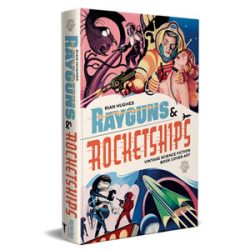
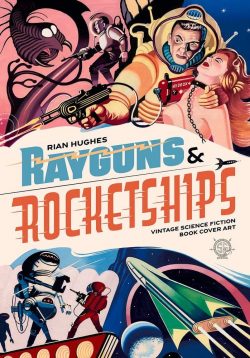
Rayguns & Rocketships: Vintage Science Fiction Book Cover Art


By many and various: edited and compiled by Rian Hughes (Korero Press)
ISBN: 978-1-91274-004-8 (HB)

Win’s Christmas Gift Recommendation: Eyepopping, Mind-blowing Vintage Visions… 9/10

Very often the books we write about our comics and other related passions can be better than the stories and pictures themselves: memorable, intensely evocative and infused with that debilitating nostalgic joy only passing years and selective memory can bestow. It’s not only true of our childhood comics but also the toys and books we encountered and invested so much time in…

For much of Britain’s Baby Boomer population, much of that unharnessed energy went into the wealth of science fiction book and pulp magazines that began popping up around the same time as the Nazis. As hostilities ensued, the genre kept pace, before spectacularly increasing in the post-war years, when prose science fiction became a welcome refuge for millions with an eye on a better tomorrow… and unlike rationed food or sweets or a new wave of weekly comics, books were comparatively cheap and sturdily re-readable…

That in in no way meant to denigrate or decry the superb efforts of countless – usually unrecognised and generally unlauded – creators who briefly brightened the lives of generations (and created quite a few harmless hobbyist/obsessive collectors) with fantastic adventures and brain-bursting images on flimsy, easily damaged pulp tomes but rather because of an added factor inherent in them – sheer mystery. Who made this stuff?…

No kid buying or shoplifting these items had any idea of who did what and only a few even cared: the stories and their covers worked on a primal, visceral connection or not at all, and always promised spectacular escape from the here and now…

As seen in era-expert Steve (read his Bear Alley blog) Holland’s impassioned and informative Foreword ‘Cruisers of the Void (Flying Factories and Hand-Crafted Spaceships)’ the genre and market was a tricky one, with publishers uncertain if they were selling pap to kids or at the sharp end of a new literary movement. What mattered was catching punters’ eyes and separating them from their cash…

Nevertheless from such confused, humble – and often shady – beginnings, a renaissance in speculative fiction emerged to change society and the world…

The conceptual main course of this menu of miracles follows as designer, author and comics creator Rian Hughes (Dare, Typodiscography, I Am a Number, The Science Service) further deconstructs the context and marketplace: sharing his own experiences as a wide-eyed wonder-boy gradually morphing into a Serious Collector and Expert finding favourite stories by falling for captivating cover images in every possible place from specialist emporium to local jumble sale…

Detail-packed Introduction ‘His Raygun Spat Atomic Fire…’ is a splendidly expansive overview, taking us through the evolving epoch. Tracing the genre’s development. he lists writers, publishers imprints and especially those artists who spun their visual webs and caught so many of us before the superb and delicious dessert we came for is served up…

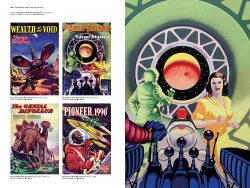
As beguiling and educational as finally knowing the names behind so many icons of an unsuspected communal past, the real joy here comes from the thousands of reprinted covers on books you have seen and those you have not: an exhausting compendium of lost treasures that adolescent minds must have boiled over to first encounter. Although concentrating mainly on the British market, there are also foreign editions and original US mainstream titles and their licensed reprints. At all times the guidance is watch and wonder!

Spanning decades, numerous nations and the infinite gulfs of space and time, this gallery of marvels is as much love story as detective mystery as forensic analysis of a phenomenon, but in the end what you’ll remember most is the astounding, amazing art of Stanley Nicholson, Ed Emshwiller, Ray Theobald, Gordon C. Davies, Norman Light, Ron Embleton, Ron Turner, Denis McLoughlin, Brian Lewis, Henry Fox, Chesley Bonestell, Everett Kinstler, Josh Kirby, Art Sussman, Robert A. Osbourne, Enrich, and so many more, known and unknown.

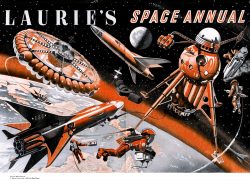
Welcome attention is also paid to games, magazines, comics and British Annuals, with Turner, Ron Forbes, Terry Maloney, David Williams, Ron Jobsen and more well represented through absolutely mouth-watering merchandise and publications.

This copious chronicle concludes with appreciatively fond Afterword ‘Mushroom Cloud Fallout’ by author, archivist, historian and literary agent Philip J Harbottle who revisits that time of changes and era of scientific fantasy via his connection to a stalwart of both worlds: artist and die-hard fan Ron Turner, who rode the mushroom cloud of sci fi illustration until the mid-1950s before moving primarily into comics such as Lion’s Rick Random and TV21’s The Daleks

Perhaps short on depth but gloriously addictive in terms of breadth, variety and wide-eyed nostalgic wonderment, Rayguns & Rocketships is a compendium and catalogue of cover artwork encapsulating Britain’s golden age of science fiction. It will reduce oldsters to tears but should also be offered to younger generations before they get permanently locked into frantically planning their careers (so before they’re five is best) in hopes of reminding them that there’s so much more out there…

The only thing that could make it better is if there was also a tabloid sized poster-book version of all these rousing, evocative, inspirational and occasionally just plain silly images for us to enjoy. Maybe the global interwebs umbrella, some digit-y micro-technologies and these modern electronic calculator contraptions could all be deployed to facilitate that – eh Professor?

First published in 2022 © Rian Hughes/Korero Press Limited/Original Artists & Publishers. All rights reserved.

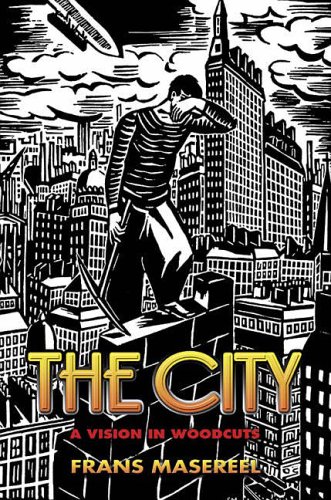
The City: A Vision in Woodcuts


By Frans Masereel (Dover Publications)
ISBN: 978-0-486-44731-5 (TPB/Digital Edition)

We tend to think of graphic novels as being a late 20th century phenomenon, and one that fought long and hard for legitimacy and a sense of worth, but the format was pioneered popularised much earlier in the century… and utilised for the most solemn, serious and worthy purposes.

At the same time as the earliest newspaper strips were being rebound as collected editions, European Fine Artists were addressing the world’s problems in “Wordless Novels”: assembling individual artworks – usually lino or sometimes woodcuts – into narrative sequences which, as the name implies, used images, not dialogue or captions, to tell a story. This also accounts for the other names of the articles – Woodcut Novels/Novels in Woodcut.

The fashion grew out of the German Expressionist movement of the early 20th century which revived and repurposed medieval woodblock printing techniques and even imagery for its own artistic agenda and purposes and was most popular during the 1920s and 1930s. The undisputed master of the form was Flemish artisan Frans Masereel, whose many works were phenomenally popular in German and whose influence spread far and wide – particularly to Depression-era America where Lynd Ward adopted the process for his many sallies against social iniquity, and Giacomo Patri unleashed his anti-capitalist salvo in the wordless novel White Collar as well as comedic parodies such as Milt Gross’ He Done Her Wrong

Masereel (1899-1972) was born in Blankenberge, Belgium and raised by his stepfather, an avowed socialist. He left home to study art in Paris supporting himself through magazine and newspaper illustration, political cartooning and his earliest woodcut prints. He was also a devout pacifist, refusing to fight in WWI, where he instead acted as a translator for the Red Cross. As a result he was unable to return to his homeland and lived most of his life in Germany, Switzerland and France.

In 1918 he created his first narrative: 25 Images of a Man’s Passion and followed up a year later with his masterpiece Passionate Journey. Masereel crafted more than 40 wordless novels, primarily woodcuts, but also a quartet of traditional pen & brush sagas, plus countless illustrations, commissioned paintings, animation works and more. Always stridently and forcefully defending the ordinary man from the horrors of capitalism, disaster and especially warmongering, his potent ability to hone meaning and capture emotion in singular images influenced generations of artists and cartoonists including Ward, Georg Grosz, Will Eisner, Art Spiegelman, Clifford Harper, Eric Drooker, Otto Nückel, Peter Kuper, George Walker and Peter Arno.

The book under review today was first released in 1925 as La Ville: cent bois gravés in France and as Die Stadt in Germany. Originally comprising 100 prints (13cm x 8cm) bound into book form, it quickly became a touchstone for many artists and critics and was hailed as the precursor of a film genre which made environment the focus of narrative (like Berlin: Symphony of a Metropolis or Man With a Movie Camera) and subsequently rereleased in 1961, 1972 and 1988 before this definitive 21st century Dover edition.

The City: A Vision in Woodcuts is translated from the German version as produced by Kurt Wolff Verlag AG (Munich 1925): seeking to forego actual sequential narrative by delivering its stark and startling images encapsulating the modern urban existence. Of course, humans being what we are, readers will find themselves unconsciously imposing form on those unfolding, uncompromising extremely explicit images anyway…

The candid exploration encompasses the highest and lowest echelons of society all rubbing up against each other, zeroing in page by page on the emotions, reactions and consequent horrors such friction creates…

There are bawdy entertainments, diligent toil, crimes of all kinds, quiet times almost unnoticed. We see smoke stacks, railway lines, canals, ports, traffic jams, subways and stations. There are rush hour crowds, fights, civil protests and always personal tragedies: accidents, bad births, thefts, affray, rape murder…

Buildings go up and come down, there is rush and rubbish and courtroom drama: vast office regiments, factory lines and foundry creations. Opulence and desperate poverty co-exist, with the exploited, maimed, forgotten and unwanted ignored by those enjoying themselves at all costs. The masses sing, dance, imbibe carouse and even indulge themselves being part of a grand State funeral. Always people come and people go, some for a different life and others to a “better world”…

It’s a place of constant change and the pace never slows… education, celebration and pauses for thought embrace art edification and human degradation on demand but there is also – for the bold and unbroken – a glimmer of hope…

Stirring, evocative and still movingly inspirational as the world returns to those dark days of Haves, Have-Nots and Why-Should-I-Cares?; this magnificent rediscovery is inventive, ferocious in its dramatic delivery, instantly engaging and enraging: a book long overdue for revival and reassessment and one every callous “I’m All Right” Jackass and “Why Should I Pay For Your…” social misanthrope needs to see or be slapped with…
No © asserted.

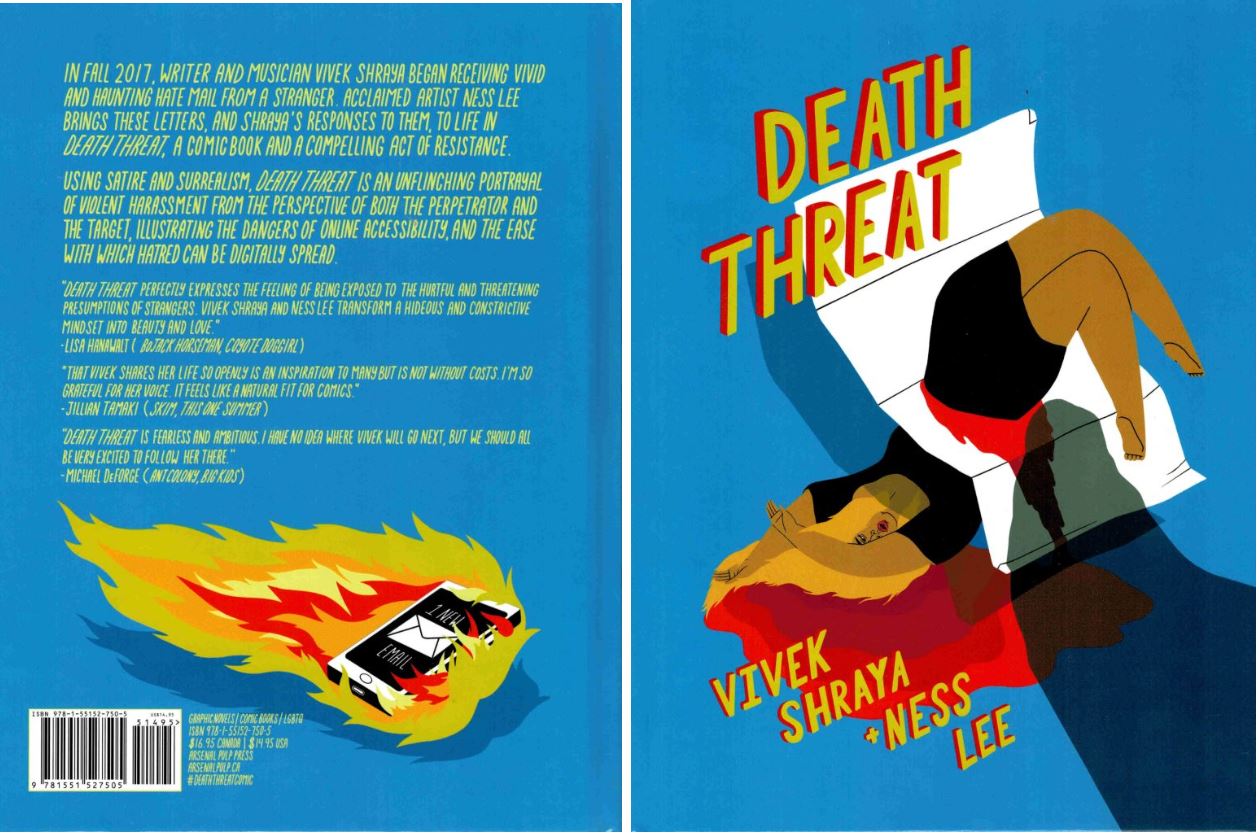
Death Threat


By Vivek Shraya & Ness Lee (Arsenal Pulp Press Vancouver)
ISBN: 978-1-55152-750-5 (HB/Digital edition)

Vivek Shraya is a poet, musician, educator, writer and performer of immense creativity, as can be appreciated in books such as God Loves Hair; even this page is white; The Boy & the Bindi; I’m Afraid of Men and She of the Mountains or her many albums and films.

On her 35th birthday Shraya publicly announced her status as Trans and requested that she be henceforward addressed with female pronouns. That seems inoffensive enough to me and you, and nobody’s business but hers, but sadly and all too typically these days, the announcement inspired the by-now pro forma response from certain quarters: a tirade of vitriol and harassment from nasty busybodies hiding behind and tainting social media…

Unevolved old jerks like me just get angry and hunger to respond in kind – with vituperative counterattacks – but happily, more civilised people find better ways. This book is perhaps the best of them as, in collaboration with Toronto-based artist and designer Ness Lee, Shraya transformed fear and disappointment into art with a heavy helping of surreal, satirical soul searching.

The liberating act of turning those unsolicited, unreasoning email assaults – all couched in offensive terms by people who hide behind religions whose fundamental tenets they will gleefully cherry pick – into a gloriously incisive and witty exploration of the inexplicable mindless aggression that continues to debase so much of modern society is eyepopping and mind-blowing…

Unlike those who cower behind the cowardly anonymity of keyboards and phones, Shraya & Lee proudly appended their names to this vibrant voyage, detailing how the bile of ignorant bullies (you simply won’t believe just how dumb some bigots can be until you see the hate mail here!) inspired beautiful images and empowering inclusivity.

My generation’s parents told us to ignore or strike back, but today’s ostracised, oppressed and unfairly targeted have found a far better way to respond to bullies: turn their hate into beauty and take ownership of it.
Death Threat: Text © 2019 Vivek Shraya. Illustrations © 2019 Ness Lee. All rights reserved.

The Bible


By Sheldon Mayer & Nestor Redondo, with Joe Kubert (DC Comics)
ISBN: 978-1-4012-3425-6 (HB/Digital edition)

I first reviewed this material back in 2008, even though it didn’t really qualify as a graphic novel or book. This was because the artist I wanted to highlight wasn’t a fan-favourite in America or England (a fact I find utterly inexplicable) and English-language collections featuring his incredible artwork were few and far between.

Eventually a new world dawned where comics can be considered both Art forms and high-ticket commercial artefacts, where the big comic has been reborn as a full-on item of merit. All anything ever takes, is time…

In 2012, the entire affair was reprinted as an oversized (262 x 345 mm) commemorative hardback edition, and latterly rereleased in the digital edition I’m referencing here.

Nestor Redondo was born in 1928 at Candon, Ilocas Sur in the American Territory of the Philippines. Like so many others in that impoverished land, he was deeply influenced by US comic strips such as Tarzan, Superman, The Phantom, Buck Rogers and Flash Gordon which were immensely popular and widely disseminated in the entertainment-starved Pacific Archipelago.

Drawing from an early age, Nestor emulated his brother Virgilio who already worked as a comics artist for the cheap magazines of the young country. The Philippines became a commonwealth in 1935, and achieved full-independence from the USA in 1946, but always maintained close cultural links to America.

Nestor’s parents pushed him into architecture, but within a year he returned to comics. A superb artist, he far outshone Virgilio – and everybody else – in the cottage industry. His brother switched to writing and they teamed up to produce some of the best strips the Islands had ever seen, the most notable and best regarded being Mars Ravelo’s Darna.

Capable of astounding quality at an incredible rate, by the early 1950s Nestor was drawing for many comics simultaneously. Titles such as Pilipino Komiks, Tagalog Klasiks, Hiwaga Komiks and Espesial Komiks were fortnightly. and he usually worked on two or three series at a time, pencils and inks. He also produced many of the covers.

In 1953, he adapted MGM film Quo Vadis for Ace Publications’ Tagalong Klasiks #91-92. Written by Clodualdo Del Mundo, it was serialized to promote the movie in the Philippines, but MGM were so impressed by the art-job that they offered 24 year old Nestor a US job and residency. He declined, thinking himself too young to leave home yet. If you’re interested, you can see the surviving artwork by searching online for “Nestor Redondo’s Quo Vadis”, and you should, because it’s frankly incredible.

Ace was the country’s biggest comics publisher, but by the early 1960s they were in dire financial straits. In 1963 Nestor, Tony Caravana, Alfredo Alcala, Jim Fernandez, Amado Castrillo and brother Virgilio set up their own company – CRAF Publications, Inc. – but times were against them …and publishers everywhere.

Around this time, America came calling again, in the form of DC and Marvel Comics. By 1972, US based Filipino artist Tony DeZuñiga had introduced a wave of his associates to US editors. Nestor drew anthological horror tales for House of Mystery, House of Secrets, The Phantom Stranger, Secrets of Sinister House, Witching Hour, The Unexpected, Weird War Tales; fill-ins for Marvel’s Man-Thing; an astonishingly beautiful run on Rima the Jungle Girl #1-7 (a loose adaptation of W H Hudson’s seminal 1904 novel Green Mansions) and ultimately replaced Bernie Wrightson as artist on the first run of Swamp Thing. He also worked on Lois Lane and crafted magnificent tales for Joe Kubert’s Edgar Rice Burroughs/Tarzan titles.

In 1973, Nestor produced classical literature comics adaptations including Dracula and Dr. Jekyll and Mr. Hyde for Vincent Fago’s Pendulum Press Illustrated Classics (later reprinted as Marvel Classics Comics). In later years he moved to Marvel to ink – and eventually fully illustrate – Savage Sword of Conan.

During his DC period, he was tapped to draw an adaptation of King Arthur (which DC killed before it was completed (once again some pages survive and the internet is your friend if you want to see them). He also illustrated issue C-36 of the tabloid-sized Limited Collectors’ Edition. These were comics printed twice the height and width of standard comic book and generally a means of selling themed reprint collections, but also became a magnificent vehicle for all-original special events such as the first Superman/Spider-Man team-up, Neal Adams & Denny O’Neil’s Superman Vs Muhammad Ali and many headline-grabbing moments in DC continuity such as the wedding of Lightning Lad and Saturn Girl or Superman vs Wonder Woman

Another ambitious all-new project that was never completed, The Bible was written by Sheldon Mayer (Scribbly; Red Tornado; Black Orchid; Day After Doomsday; Three Mouseketeers; Sugar and Spike) and designed and edited by Joe Kubert. It was planned as the first instalment in a graphic interpretation of the entire Bible, but apparently readers prefer costumed saviours above all others…

A deeply religious man, Redondo had already produced the serial Mga Kasaysayang Buhat sa Bibliya (Tales from the Bible) for the Philippine’s Superyor Komiks between 1969-1970, as well as creating an on-the-job training scheme for young creators there. Over many years he contributed to various Christian comics, including Marx, Lenin, Mao and Christ, published in 1977 by Open Doors, Aida-Zee and Behold 3-D, produced in the 1990s by Nate Butler Studio. He was also a panellist for the first Christian comics panel discussion of Comic-Con International, in 1992.

Stories from the Bible have been a part of US comics since the earliest days of the industry, but they have never been so beautifully illustrated as in this book. Included herein are loving interpretations of The Creation, The Garden of Eden, Cain and Abel, The Generations of Adam, Noah and the Flood, The Tower of Babel, The Story of Abraham and Sodom and Gomorrah.

Also included are single-page information features ‘Digging into the Past’, ‘School Days in Bible Times’, ‘The Ziggurat’ and ‘Soldiers in the Time of Abraham’ all illustrated by Kubert, but the true star is the passionate beauty of Redondo’s, lush, glorious art.

Redondo worked as an animation designer for Marvel Studios in the 1990s. He wrote On Realistic Illustration – a teaching session for the 1st International Christian Comics Training Conference in Tagaytay, the Philippines, in January 1996, but sadly, died before he was able to deliver it.

Whatever your beliefs – and I don’t really care – you wouldn’t be reading this unless comics meant something to you. On that basis alone, this is work that you simply cannot be unmoved by and truly should be aware of. Even if there isn’t a comprehensive collection of his work – yet – this single work stands as a lasting tribute to Nestor Redondo’s unparalleled talent. If you venerate beautiful pictures telling stories, you must see this book.
© 1975 National Periodical Publications, Inc. All Rights Reserved.

Big Scoop of Ice Cream


By Conxita Herrero Delfa: translated by Jeff Whitman (NBM)
ISBN: 978-1-68112-294-6 (PB) eISBN: 978-1-68112-295-3

Comics are a nigh-universal, extremely powerful medium that lends itself to a host of topics and genres, but the area where it has always shined brightest is in its chimeric capacity for embracing autobiographical self-expression. Whether through fictionalised narratives or scrupulously candid revelation, imaginative forays into self-realisation and self-expression frequently inevitably forge the most impressive and moving connections between reader and author.

Conxita Herrero Delfa’s vibrant collection Gran bola de helado was originally released in 2016, containing lifestyle short stories crafted before COVID changed the world. She is Barcelona born – in 1993 – and studied Fine Arts, but found another outlet for her artistic and raconteurial tendencies by publishing fanzines exploring aspects of free discourse, tireless observation and personal introspection. If you’re open-minded and well-travelled, you may have seen her follow-up work in various magazines and collective books. She’s also a singer, so look out for the album Abducida por forma una pareja by Tronco, if you’re so inclined…

Big Scoop of Ice Cream sees Conxita explore in compelling detail her metamorphic life via comic strips, with what appears to be relentless honesty and inspired veracity. Gathered here is a broad menu of experiences true, slightly true, made up, tedious, meta-real and maybe even a bit untrue, made in response to an ineffectual youth becoming – in fits and starts – a grown up. Everyday tasks, major achievements, personal breakthrough and moments without merit jostle beside strange days and minor miracles in ‘Resolutions’, after which we survive spectral invasion ‘Ghosts’ and learn what “adulting” means in ‘The Bathroom’.

The significance of playing alone shapes ‘Talking’, and perhaps a hint of potential romance looms in ‘The Couch Cushion’, before ‘The Arrival of Spring’ induces travel and causes a mini crisis. Sex happens in dusky pink monotones while ‘Relating’ before solitude returns, sparking thoughts of ‘The South of California’ and triggering ominous internet hook ups in ‘Enter’

Acquiring an item of furniture attains the status of ‘The Metaphor’ for her and her friends whilst a beach break with Ricardo in ‘Alghero’ turns into a partial break with reality before ‘The Castles’ sees perspective restored – and endangered – by an over-sharing drinking buddy and other travelling companions…

A temporary liaison doesn’t pan out, but that’s okay because of what Conxita carries in ‘The Pocket’, and there are always marvels in abundance when ‘Looking Up’ or finding someone who will play ‘The Game’

Visually experimental, the eponymous ‘Big Scoop of Ice Cream’ contrasts flavours and relationships without reaching any useful conclusions but segues neatly into a strange encounter in a bar with ‘The Reject’ before the ruminations conclude with confirmation that ‘People are Only Human’

Boasting quotes from Marcel Proust, José Sainz, and Conxita herself, this whimsical confection is uplifting but never self-deluding, wryly inviting and features a breakout performance by pet cat Julia and a recurring box of toffee apples.

These 17 slices of Latin soul are delivered with verve and gusto in a minimalist cartooning style afforded surprising depth by swathes of flat colour: stylishly masking earnest inquiry and heavy introspection with charm, wit and carefully ingenuous nonsense. Big Scoop of Ice Cream is a book to delight and enthral and get in your head, and should be there with you wherever or however you holiday and forever after when you get back to mundane reality.
© 2016 Conxita Herrero Delfa and apa apa comics. © 2022 NBM for the English translation. All rights reserved.

Big Scoop of Ice Cream is scheduled for UK release July 14th 2022 and is available for pre-order now. For more information and other great reads see http://www.nbmpub.com/. Most NBM books are also available in digital formats.

Edwurd Fudwupper FIBBED BIG – Explained by Fannie Fudwupper with Berkeley Breathed Helping Slightly


By Berkeley Breathed (Little, Brown & Co./Storyopolis)
ISBN: 978-0-316-14291-5 (HB) 978-0-316-14425-4 (Album PB)

I’ve been watching The News and getting upset by politicians’ obnoxiously blatant disregard for probity and dearth of ethical standards, not just in my own bankrupt-in-every-aspect Britain, but everywhere else too – except maybe New Zealand (Nice One, Jacinda).

As is always the case in such circumstances, I turned to comics and cartoons for solace and found this. Please read, enjoy and act according to the dictates of your conscience, if you have one…

Please Note: any similarity to other malign, malformed, bribe-fattened, emotionally stunted, eternally misbehaving overprivileged schoolboys currently serving at the Nation’s expense is just the way things are these days…

Throughout the 1980s and for half of the 1990s, Berke Breathed dominated the newspaper strip scene with agonisingly funny, edgy-yet-surreal political fantasy Bloom County and, latterly, Sunday-only spin-off Outland. They are all fully available digitally – so don’t wait for my reviews, just get them now!

At the top of his game and swamped with awards like Pulitzers, Breathed retired to concentrate on books like Red Ranger Came Calling, Mars Needs Moms! or Flawed Dogs: The Year End Leftovers at the Piddleton “Last-Chance” Dog Pound and sequel Flawed Dogs: The Shocking Raid on Westminster. They rank among the best America has ever produced. Get them too.

His first foray into the field was 1991’s A Wish for Wings That Work: a Christmas parable featuring his signature character, and the most charmingly human one. Between 2003 and 2008, Breathed revived Opus as a Sunday strip, before eventually capitulating to his career-long antipathy for the manic deadline pressures of newspaper production and often-insane, convoluted contradictions of editorial censorship.

It seemed his ludicrous yet appealing cast of misfits – all deadly exponents of irony and common sense residing in the heartland of American conservatism – were gone for good, until the internet provided a platform for Breathed to resume his role as a gadfly commentator on his own terms. Since 2015, Bloom County has mocked, exposed and shamed capitalism, celebrities, consumerism, popular culture, politicians, religious leaders and people who act like idiots. Donald Trump figures prominently and often, but that might just be coincidence…

These later efforts, unconstrained by syndicate pressures to not offend advertisers, are also available as book collections. You’ll want those too, and be delighted to learn that all Breathed’s Bloom County work is available in digital formats – fully annotated to address the history gap if you didn’t live through events such as Iran-Gate, Live-Aid, Star Wars (both cinematic and military versions), assorted cults and televangelists experiencing less than divine retribution and sundry other tea-cup storms that make us Baby Boomers so rude and defensive…

Not quite as renowned, but every inch as crucial to your enjoyment, is the lost gem on display today: a paean to the power of principles and effects of honesty, all wrapped up in a children’s book about a mean kid with no moral compass…

As previously stated, after the all-too-brief, glittering outing as a syndicated strip cartoonist and socio-political commentator (usually the very same hallowed function) Breathed left strips to create children’s picture books.

He lost none of his perception, wit or imagination, and actually got better as an artist. Even so, he never quite abandoned his entrancing cast of characters and always maintained the gently excoriating, crusading passion and inherent bittersweet invective which underscored those earlier narratives.

Moreover, he couldn’t ignore that morally uplifting component of his work that so upset hypocrites, liars, greedy people and others who let us all down while carping on about being unfairly judged and how we don’t really understand complex issues. Trust me, we – and Breathed – understand perfectly…

This crushingly captivating cartoon catechism ruminates on the cost and worth of family and idiocy of arrogant aggrandizement and self-congratulatory self-importance. It is lensed through the fabled truism of the Boy Who Cried Wolf, as little sister Fannie complains again about her idiot brother…

Edwurd Fudwupper tells lies because he wants to, because he can and because of the chaotic consequences his dissembling causes. The only thing he isn’t, is convincing. Always in trouble, he narrowly and perpetually weasels out of instant retribution due to his facility for fibs, but now Fannie recalls the day when that stopped working…

After a couple of whoppers lead to the disappearance of a neighbour and destruction of beloved family property, Edwurd’s automatic response of lying big and compounding nonsense with bigger balderdash sparks community calamity, mass military deployment and imminent alien invasion. As the Earth stands still in the moment before utter disaster, a small voice speaks out…

Delivered in sharp and lyrical rhyme like a weaponised Dr. Seuss story, and with lush lavish illustrations painted in the stunningly grotesque exaggeration beloved of Ralph Steadman and Terry Gilliam cartoons, this is a book to trigger personal reflection, audit consciences and promote better behaviour, but it will make grown citizens howl and children sit up and pay attention. It’s also deliciously funny. You’ll laugh, you’ll cry, you’ll think hard before calling in sick or blaming the dog – or opposition or asylum seekers – for eating your homework…
© 2000 Berkeley Breathed. All rights reserved.

2120


By George Wylesol (Avery Hill Publishing)
ISBN: 978-1-910395-65-3 (TPB)

Baltimore-based George Wylesol (Internet Crusader; Ghosts, Etc.) is a cartoonist with lots to say and intriguing ways of doing so. Past works have channelled his avowed fascinations – old computer kit/livery; anxiety; iconography; the nostalgic power of commercial branding and signage and a general interest in plebian Days Gone By – into chilling affirmations of his faith in the narrative power of milieu and environment as opposed to characters.

That remains the case in his latest retro-modernist extravaganza… a canny revival of a brief fad stillborn on the way to today’s computer game world; explored through a salutary experience befalling a rather bland service engineer…

Once upon a time (way back in the 1980s) books and graphic novels experimented with an interactive approach: constructing stories where readers could opt to proceed in a linear manner, whilst being encouraged to jump ahead or back, by following suggestions at certain decision points of the narrative. Depending on which one a reader followed, the story could travel in numerous directions and outcomes were many and varied…

The fad faded as technology surpassed physical print restrictions and now most games offer even more variety and immersion, but the process was and still is a powerful device for storytelling and point-making, if you know the trick of it.

Wylesol does, and in 2120 skillfully manipulates the form to create a chilling and potent suspense saga. The set-up is simple. Forty-something computer repairman Wade Duffy is booked to service a machine at 2120 Macmillan Drive: an isolated building in a vacant lot.

The place seems deserted and decommissioned, but after gaining entry, Wade dutifully proceeds through countless empty rooms and corridors – far more than seems possible for a facility of its size. The place seems to go down too many levels, and as he seeks endlessly for the broken computer he is determined to repair, his responsible work attitude gradually erodes under tidal waves of suspicion, uncertainty and nervous tension.

The place is just not right…

Too many rooms, odd sights and sounds, bizarre detritus, scraps and remnants indicating rapid abandonment… and his solitary, endless examinations and futile explorations only tip further into paranoia once he finally finds other occupants and his mind starts doubting him…

I first read the book without making any choices. I’m not saying you should, but if you do, let your mind build a story of its own then reread as often as you want, using the page directions to reshape the events and outcomes and see how that changes the momentous “Big Reveal” hidden within.

Genuinely disturbing in the manner of the best psychological dramas, with plenty of scary moments and distressingly eerie characters, the coldly diagrammatical illustration and workplace bright colour palette adds immensely to the overall aura of unease.

A compelling and compulsive experience, seamlessly wedding sensory evocation to carefully neutralised visual input, like the subject matter itself, this book is not what it seems and should not be missed.
© George Wylesol 2019. All rights reserved.