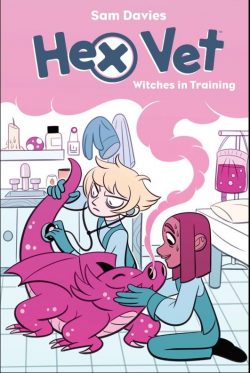
Hex Vet: Witches in Training


By Sam Davies (KaBOOM!)
ISBN: 978-1-68415-288-8 (PB) eISBN: 978-1-64144-127-8

Win’s Christmas Gift Recommendation: Animal Magic… 9/10

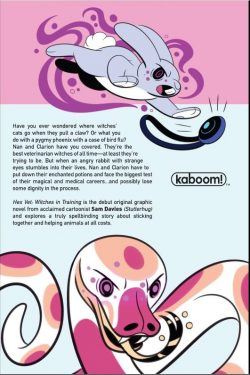
When your animal companions fall ill, you know they need the help only a qualified veterinarian can offer, right?

However, if said furry, feathered, finny or scaly housemate can turn people to stone, teleport or summon devils and imps, a far more specialised service is required. And staff at such vital animal alms houses need a lot of on-the-job training…

At Willows Whisper Veterinary Practice, Dr. Cornelia Talon (Head Veterinary Witch; high Society of Sorcerers. Hons.) and Nurse Ariel Chantsworth (Registered Veterinary Witch; Head of Administration) employ two promising prospects. Trainees Clarion Wellspring and Annette Artifice have all the dedication they need: now they’re just topping up on knowledge, and experience. And co-operation. They really need to learn to work together…

Clarion is fine cleaning out the kennels, dosing beasts with anti-monstrosity tablets or giving hairy horrors a quick tummy rub, but Nan – who comes from a rather infamous family – is quiet and reserved; avoiding contact and preferring to try to learn some new technique or other from a book.

One morning, with Dr. Talon handling an early surgery, Nurse Ariel gives them their assignments – Wellspring to extract and cage a feral bugbear that’s messing up the storeroom and surly Artifice to handle Reception duties – before he and Dr. Talon are called away to an emergency. It’s bad enough being left in charge on their own, but Clarion still hasn’t subdued that bugbear and Nan has unwisely admitted a strange rabbit creature (without an owner or talking companion) which is somehow setting off all her warning instincts…

When it breaks free and stirs up all the other patients (griffins, pythons, witches’ cats and beasties even more exotic!) the stressed students have a real crisis on their hands and must work out how to fix things before their teachers get back or any of their charges are harmed…

A celebrated web cartoonist, Sam Davies (Stutterhug) reaches new heights with her fabulous and charmingly inclusive debut graphic novel which will delight youngsters and all us elderly-but-unbroken fantasy lovers out here. A second volume will be with us early next year, so buy and love this before pre-ordering that…

Also included here is bonus feature ‘How to Make a Comic page (from Scribbles to Finished Artwork)’ giving a step-by-step rundown using book pages as examples of the process from Scribbling while Scripting to Sketch to Inks; Flat Colors to Touch Ups & Smaller Color Details to The Final Page with Letters!, so you and yours can have a go, too.

So much to enjoy!
© December 2018. Hex Vet, Inc. ™ & © 2018 Sam Davies. All rights reserved.
The Thirteenth Floor volume 01


By John Wagner, Alan Grant & Jose Ortiz (Rebellion)
ISBN:978-1-78108-653-7 (TPB)

Win’s Christmas Gift Recommendation: Eerie Seasonal Sensation… 9/10

It’s time for another shamble down memory lane for us oldsters whilst, perhaps, offering a fresh, untrodden path for younger fans of the fantastic in search of a typically quirky British comics experience.

This stunning paperback (and eBook) package is another knockout nostalgia-punch from Rebellion Studios’ superb and ever-expanding Treasury of British Comics, collecting the opening episodes of seminal shocker The Thirteenth Floor.

The strip debuted in the first issue of Scream and ran the distance – spanning all 15 issues from 24th March – 30th June 1984. It then survived the comic’s premature cancelation and subsequent merger, continuing for a good long while in Eagle & Scream – with the remaining stories here taking us from 1st September 1984 to 13th April 1985.

Although arguably the most popular – and certainly most lavishly illustrated – of Scream‘s fearsome features, The Thirteenth Floor is actually the third strip to be gathered, having been preceded by Monster in 2016 and The Dracula File in 2017. We’ll get to those in the fullness of time…

This book carries out its terrorising in stark, shocking monochrome but does include at the end a gallery of full-colour wraparound covers by series artist Jose Ortiz, and then-newcomer Brett Ewins, plus introductory contextual notes from editor Ian Rimmer and a darkly dry history lesson from co-author Alan Grant. With regular writing partner John Wagner, he wrote all the electronically eldritch episodes as enigmatic “Ian Holland”.

Grant maintains the strip derived in part from his own time of residence on the 11th floor of a similar tower block, and, having done my own time in a south London multi-story edifice, I can imagine why the sojourn was so memorable for him…

The series benefitted tremendously from the diligent mastery of its sole illustrator – sublime Jose Ortiz Moya – a veteran creator with a truly international pedigree. He was born on September 1st 1932 in Cartagena in the Spanish region of Murcia and started professional illustration early, after winning a comics competition in national comic Chicos.

Whilst working on comics digest books and strips like as Sigur el Vikingo, he gradually transitioned to the better-paying British market to draw newspaper strip Carolynn Baker for the Daily Express in 1962. He also worked for many kids’ comics here before making a wise move to America in 1974, to become a mainstay of Warren Publishing on horror magazines Eerie, Creepy and Vampirella.

In the early 1980s Ortiz returned to Spain, joining Leopold Sanchez, Manfred Sommer and Jordi Bernet in short-lived super-group cooperative Metropol even as he worked with Antonio Segura on a number of long-lasting strips such as post-apocalyptic action-thriller Hombre.

Metropol’s failure brought him back to British comics where he limned The Tower King and The House of Daemon for Eagle, Rogue Trooper and other strips for 2000AD and this macabre masterpiece…

Ortiz continued to excel, eventually settling in the Italian comics biz, with significant contributions to Tex Willer, Ken Parker and Magico Vento. He died in Valencia on December 23rd 2013.

Because of the episodic nature of the material, originally delivered in sharp, spartan 4-page bursts (eventually dropping to a standard 3), I’m foregoing my usual self-indulgent and laborious waffle and leaving you with a precis of the theme and major landmarks…

A little way into the future (as seen from dystopian yet still partially civilised Britain in 1984), a council tower block is equipped with an experimental computer system to supervise all the building systems and services whilst monitors the welfare and wellbeing of tenants. Maxwell Tower (just one of the names we creative contributors waggishly called the offices of IPC’s comics division at the time) looms into the rather bleak urban night.

Within, however, novel computer-controlled systems assure everyone lives happy lives. The servers also manifest a congenial personality offering advice and a bit of company. Dubbed “Max” by tenants, it – like $%*£!! Alexa today – increasingly inserts itself into every aspect of their lives through its constantly active monitoring systems. For their own good, naturally…

Because humans are fallible and a bit silly, the builders and architects fancifully never designated a 13th floor. Cognizant of human superstition, they designed the block to arbitrarily transit straight from 12 to 14. A human onsite controller/concierge/handyman lives in the penthouse. His name is Jerry and everything is just hunky-dory… until one day it isn’t…

The troubles apparently begin when a mother and son move in. They are trying to make a new start after losing the family breadwinner, but are plagued by a particularly persistent and violent debt-collector. After Mr. Kemp threatens the bereaved Henderson family, he stalks into an elevator and is later found on the ground floor, having suffered an agonising and fatal heart attack. The police write it off as an accident or misadventure, but they don’t know the truth.

Over-protective Max is far more powerful than anyone suspects and can turn his lifts into a terrifyingly realistic arena of terror, judgement and retribution at will. He calls it his “Thirteenth Floor”…

Over the weeks and months that follow, Max detects outrages and injustices and subjects assorted vandals, hooligans, burglars, bailiffs, lawyers, conmen, extortionists, shoddy plumbers, shady workmen, and even a family of problem tenants preying on their own neighbours, to the varied and impossibly realistic terrors of the damned.

Equally vexatious to the monitoring machine is the useless bureaucrat from its own housing department who treats people like subhuman trash. Max devises a very special hell for him after his lazy blunders temporarily make one of Max’s families homeless…

Sometimes these experiences are enough to modify behaviour and ensure silence, but too often the end result is simply another death. It happens so often that Max is reluctantly forced to brainwash husky tenant Bert Runch into acting as his agent: a mindless servant hypnotically conditioned to act as Max’s arms and legs, excising incriminating evidence – or bodies – before forgetting what he’s done.

Sadly, veteran policeman Sergeant Ingram suspects something is amiss and doggedly persists in returning to Maxwell Tower over and over again, ultimately forcing the coddling computer into precipitate action…

Moreover, as Max’s actions grow increasingly bold, even Jerry starts to suspect something is wrong. When he checks the hardware and finds a cracked Integrated Function Module, Jerry calls in council computer experts and Max has to act quickly to preserve his newfound intellectual autonomy. This triggers a cascade of uncontrollable events with Max taking ever-crazier risks, resulting in the tower being stormed by an army of police determined to shut down the AI murder machine…

And that’s where this moody masterpiece pauses with a great big To Be Continued, but there’s a second volume coming soon…

These strip shockers are amongst the most memorable and enjoyable exploits in British comics: smart, scary and rendered with stunning imagination and skill. Don’t believe for a moment that the seemingly limited set-up restricts the visual impact. The eerie punitive illusions of The Thirteenth Floor incorporate every possible monster from zombies and dinosaur to hell itself and history’s greatest villains, whilst the settings range from desert islands to the infinities of time and space. This a superb example of sophisticated suspense, leavened with positively cathartic social commentary that is impossible to dismiss.
© 1984, 1985 & 2018 Rebellion Publishing IP Ltd. All Rights Reserved.

The Tower in The Sea


By B. Mure (Avery Hill)
ISBN: 978-1-910395-36-3 (PB)

Win’s Christmas Gift Recommendation: A Mesmerising Mystical Magnum Opus in the Making… 9/10

Most forms of fiction, depend on strong – or at least memorable – characters and plenty of action to capture the attention. You need to be really good and quite brave to try anything outside those often-infantile parameters. B. Mure is that good.

They are a Nottingham based artist and storyteller whose other notable work is the remarkable webcomic Boy Comics. You should check that out too.

In 2018, B. Mure pulled together threads and ideas from years of planning, dreaming and doodling, to begin building an epic fantasy saga. It started with Original Graphic Novel Ismyre, introducing a strange ancient city of song and tired wonders, unsettled by magical eco-terrorists and weaponised flora, where a sculptor’s works inspired and moved the strangest of folk. This magical city was entering a period of “interesting times”…

That was closely followed by sequel Terrible Means, which seemingly had very little to do with the protagonists of the first, but instead took readers back to a time when wizardly green rebels Niklas, Henriett and Emlyn were simply researchers whose studies divined a growing imbalance in the natural ecosystem…

Now the third instalment is here and The Tower in the Sea again slips to a different point in time and tale, providing a fresh approach to what is shaping up to be a vast and expansively multi-layered saga. Moreover, understanding and narrative connection depends as much on scene and place as actors involved: with sea, sky and terrain as expressive as the gloriously bizarre animalistic characters that have most of the speaking parts in the drama…

Ismyre is currently more dictatorship than civil metropolis, and for years gifted children have been spirited away from it by a clique of outlaw magicians. The prizes are taken across ferocious seas to a hidden island and schooled in magical arts – especially divination. Our story begins and ends with little Miriam, brought to the citadel of knowledge by adventurous operative Emlyn…

Welcomed by imposing leader August Humble, Miriam slowly settles in for the long haul, often wondering if she’ll ever see her dashing saviour again…

Her dreams of the general future are far more specific and emphatic on other issues of importance. In fact, the coming years are plagued by increasingly terrifying visions of apocalyptic disaster, and neither scholarly tomes, skilled teachers or devoted classmates can ease the traumas or even clarify the too-vague portents in her head.

Miriam’s course becomes clearer only after she learns why divination is outlawed in Ismyre and how the school of the Tower in the Sea was first established. Sadly, now the tortured girl feels that her intuitions are presaging the imminent and actual End of the World…

Determined to be part of the action, Miriam – with the reluctant aid of classmates Efrim and Cassius – secretly breaks the school’s most inviolable rule: attempting to build a boat to take her back to the mainland where she can hopefully do some good. Typically, before that comes to pass, the totally unexpected happens…

The word “tapestry” is one much overused but it really fits the gradual unpeeling of layers comprising the history of Ismyre: beautiful images coming together, small self-contained stories unfolding depending upon where you start from, yet all part of a greater whole, always promising more and clearer revelations further ahead. You must read all these books but (so far) it really doesn’t matter where you start from. So, it might as well be here, right?

Sadly, this glorious celebration is not available digitally yet, but that just means you can give physical copies to all your friends, suitably gift-wrapped and ready to be properly appreciated by all the tactile senses as well as cerebral ones…

An anthropomorphic, luscious and compellingly realised world of wonder to savour and ponder over is waiting for you…
© B. Mure, 2019. All rights reserved.
Ken Reid’s Creepy Creations


By Ken Reid, with Reg Parlett, Robert Nixon & various (Rebellion Studios)
ISBN: 978-1-78108-660-5 (HB)

Win’s Christmas Gift Recommendation: Hopelessly Hilarious Horrendousness… 10/10

If you know British Comics, you’ll know Ken Reid.

He was one of a select and singular pantheon of rebellious, youthful artistic prodigies who – largely unsung – went about transforming British Comics, entertaining millions and inspiring hundreds of those readers to become cartoonists too.

Reid was born in Manchester in 1919 and drew from the moment he could hold an implement. Aged nine, he was confined to bed for six months with a tubercular hip, and occupied himself by constantly scribbling and sketching. He left school before his fourteenth birthday and won a scholarship to Salford Art School, but never graduated.

He was, by all accounts, expelled for cutting classes and hanging about in cafes. Undaunted he set up as a commercial artist, but floundered until his dad began acting as his agent.

Ken’s big break was a blagger’s triumph. Accompanied by his unbelievably supportive and astute father, Ken talked his way into an interview with the Art Editor of the Manchester Evening News and came away with a commission for a strip for its new Children’s Section.

The Adventures of Fudge the Elf launched in 1938 and ran until 1963, with only a single, albeit lengthy, hiatus from 1941 to 1946 when Reid served in the armed forces.

From the late 1940s onwards, Reid dallied with comics periodicals: with work (Super Sam, Billy Boffin, Foxy) published in Comic Cuts and submissions to The Eagle, before a fortuitous family connection (The Dandy illustrator Bill Holroyd was Reid’s brother-in-law) brought DC Thomson managing editor R.D. Low to his door with a cast-iron offer of work.

On April 18th 1953 Roger the Dodger debuted in The Beano. Reid drew the feature until 1959 and created numerous others including the fabulously mordant doomed mariner Jonah, Ali Ha-Ha and the 40 Thieves, Grandpa and Jinx amongst many more.

In 1964, Reid and fellow under-appreciated superstar Leo Baxendale jumped ship to work for DCT’s arch rival Odhams Press. This gave Ken greater license to explore his ghoulish side: concentrating on comic horror yarns and grotesque situations in strips like Frankie Stein, and The Nervs in Wham! and Smash! as well as more visually wholesome but still strikingly surreal fare as Queen of the Seas and Dare-a-Day Davy.

In 1971 Reid devised Faceache – arguably his career masterpiece – for new title Jet. The hilariously horrific strip was popular enough to survive the comic’s demise – after a paltry 22 weeks – and was carried over in a merger with stalwart periodical Buster where it thrived until 1987. During that time, he continued innovating and creating through a horde of new strips such as Harry Hammertoe the Soccer Spook, Wanted Posters, Martha’s Monster Makeup, Tom’s Horror World and a dozen others. One of those – and the worthy subject of this splendid luxury hardback (and eBook) is Creepy Creations.

Part of Rebellion’s ever-expanding Treasury of British Comics collected here are all 79 full colour portraits from Shiver & Shake episodes (spanning March 10th 1973 to October 5th 1974), plus related works from contemporary Christmas annuals.

After the initial suggestion and 8 original designs by Reid, Creepy Creations featured carefully crafted comedic horrors and mirthful monsters inspired by submissions from readers, who got their names in print plus the-then princely sum of One Pound (£1!) sterling for their successful efforts.

The mechanics and details of the process are all covered in a wealth of preliminary articles that begin with ‘Creepy Creation Spotter’s Guide’ listing the geographical locations so crucial to the feature’s popularity and is backed up by a fond – if somewhat frightful – family reminiscence from Anthony J. Reid (Ken’s son) in ‘The Erupting Pressure Cooker of Preston Brook’.

The convoluted history of Ken’s feature (which came and went by way of 1960s cult icon Power Comics, Mad magazine, Topps Trading Cards and even stranger stops and was originally intended to save him having to draw the same old characters every day) is detailed in an engrossing historical overview by Irmantas Povilaika dubbed ‘Plus a “Funny Monsters” Competition with These Fantastic Prizes’ before the real wonderment ensues…

Astounding popular from beginning to end, Creepy Creations offered a ghastly, giggle-infused grotesque every week: a string of macabre graphic snapshots (some, apparently, too horrific to be published at the time!) beloved by kids who adore being grossed out.

Seen here are ratified Reid-beasts like ‘The One-Eyed Wonk of Wigan,’, ‘The Chip Chomping Tater Terror of Tring’ and the ‘The Boggle-Eyed Butty-Biter of Sandwich’, his stunning kid collaborations on arcane animals like ‘The Gruesome Ghoul from Goole’ or ‘Nelly, the Kneecap-Nipping Telly from Newcastle’, and due to the stark demands of weekly deadlines, there are even cartoon contributions from UK comics royalty Reg Parlett and Robert Nixon.

Supplementing and completing the eldritch, emetic experience are a selection of Creepy Creations Extras, comprising images and frontispieces from Christmas Annuals, the entire ‘Creepy Creations Calendar for 1975’, four pages of ‘Mini Monsters’, and the entire zany zodiac of ‘Your HORRORscope’…

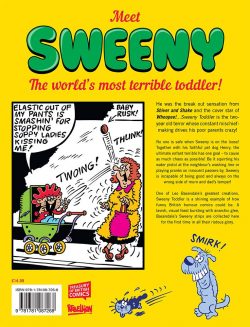
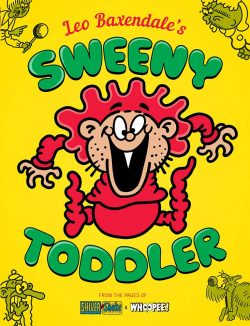
Adding even more comedy gold, this tome also includes tantalising excepts from the Leo Baxendale Sweeny Toddler compilation and Reid’s magnificent World-Wide Wonders collection…

Ken Reid died in 1987 from the complications of a stroke he’d suffered on February 2nd at his drawing board, putting the finishing touches to a Faceache strip. On his passing, the strip was taken over by Frank Diarmid who drew until its cancelation in October 1988.

This astoundingly absorbing comedy classic is another perfect example of resolutely British humorous sensibilities – absurdist, anarchic and gleefully grotesque – and these cartoon capers are amongst the most memorable and re-readable exploits in all of British comics history: painfully funny, beautifully rendered and ridiculously unforgettable. This a treasure-trove of laughs to span generations which demands to be in every family bookcase.
© 1973, 1974, & 2018 Rebellion Publishing Ltd. All Rights Reserved.

The Adventures of Captain Pugwash: Best Pirate Jokes


By Ian D. Rylett & Ian Hillyard (Red Fox/Random House)
ISBN: 978-1-862-30793-3

The problem with pirates is that they don’t know when enough’s enough, so here’s another review to reconnoitre: tangentially celebrating the greatest buccaneer of all…

John Ryan was an artist and storyteller who straddled three distinct disciplines of graphic narrative, with equal qualitative if not financial success.

Born in Edinburgh on March 4th 1921, Ryan was the son of a diplomat, served during WWII in Burma and India and – after attending the Regent Street Polytechnic (1946-48) – took up a post as assistant Art Master at Harrow School from 1948 to 1955.

It was during this time that he began contributing strips to Fulton Press publications, in the company’s glossy distaff alternative Girl, but most especially in the pages of the legendary “boys’ paper” The Eagle.

On April 14th 1950, Britain’s grey, post-war gloom was partially lifted with the first issue of a new comic that literally shone with light and colour. Avid children were soon understandably enraptured with the gloss and dazzle of Dan Dare, Pilot of the Future, a charismatic star-turn venerated to this day.

The Eagle was a tabloid-sized paper with full-colour inserts alternating with text and a range of various other comic features. “Tabloid” is a big page and one can get a lot of material onto each one. Deep within, on the bottom third of a monochrome page was an 8-panel strip entitled Captain Pugwash – The story of a Bad Buccaneer and the many Sticky Ends which nearly befell him. Ryan’s quirky, spiky style also lent itself to the numerous spot illustrations required throughout the comic every week.

Pugwash, his harridan of a wife and the useless, lazy crew of the Black Pig ran (or more accurately capered and fell about) until issue 19 when the feature disappeared. This was no real hardship for Ryan who had been writing and illustrating Harris Tweed – Extra Special Agent as a full-page (tabloid, remember, an average of twenty panels a page, per week!) from Eagle #16. (I really must reinvestigate the solidly stolid sleuth too sometime soon…)

Tweed ran as a page for three years until 1953 when it dropped to a half-page strip and was repositioned as a purely comedic venture

In 1956 the indefatigable old sea-dog (I mean old Horatio Pugwash but it could so easily be Ryan) made the jump to children’s picture books. He was an unceasing story-peddler with a big family, and somehow also found time to be head cartoonist for The Catholic Herald for forty years.

A Pirate Story was first published by Bodley Head before switching to the children’s publishing specialist Puffin for further editions and more adventures. It was the first of a vast (sorry, got away with myself again there!) run of children’s books on a number of different subjects.

Pugwash himself starred in 21 tomes; there were a dozen books based on the animated TV series Ark Stories, plus Sir Prancelot and a number of other creations. Ryan worked whenever he wanted to in the comics world and eventually the books and the strips began to cross-fertilise.

The primary Pugwash is very traditional in format with blocks of text and single illustrations to illuminate a particular moment. But by the publication of Pugwash the Smuggler (1982) entire sequences were lavishly painted comic strips, with as many as eight panels per page, and including word balloons. A fitting circularity to his interlocking careers and a nice treat for us old-fashioned comic drones.

After A Pirate Story was released in 1957 the BBC pounced on the property, commissioning Ryan to produce five-minute episodes (86 in all from 1957 to 1968: later reformatted in full colour and rebroadcast in 1976). In the budding 1950s arena of animated television cartoons, Ryan developed a new system for producing cheap, high quality animations to a tight deadline.

He began with Pugwash, keeping the adventure milieu, but replaced the shrewish wife with a tried-and-true boy assistant. Tom the Cabin Boy is the only capable member of a crew which included such visual archetypes as Willy, Barnabas and Master Mate (fat, thin and tall – and all dim), instantly affirming to the rapt, young audience that grown-ups are fools and kids do, in fact, rule.

Ryan also drew a weekly Captain Pugwash strip in The Radio Times for eight years, before going on to produce a number of other animated series including Mary, Mungo and Midge, The Friendly Giant and the aforementioned Sir Prancelot. There were also adaptations of some of his many other children’s books and in 1997 Pugwash was rebooted in an all-new CGI animated TV series.

The first book – A Pirate Story – sets the scene with a delightful clown’s romp as the so-very-motley crew of the Black Pig sail in search of buried treasure, only to fall into a cunning trap set by the truly nasty corsair Cut-Throat Jake. Luckily, Tom is as smart as his shipmates and Captain are not…

A 2008 edition of A Pirate Story from Frances Lincoln Children’s Books came with a free audio CD, and just in case I’ve tempted you beyond endurance here’s a full list of the good (ish) Captain’s exploits that you should make it your remaining life’s work to unearth…:

Captain Pugwash: A Pirate Story (1957), Pugwash Aloft (1960), Pugwash and the Ghost Ship (1962), Pugwash in the Pacific (1963), Pugwash and the Sea Monster (1976), Captain Pugwash and the Ruby (1976), Captain Pugwash and the Treasure Chest (1976), Captain Pugwash and the New Ship (1976), Captain Pugwash and the Elephant (1976), The Captain Pugwash Cartoon Book (1977), Pugwash and the Buried Treasure (1980), Pugwash the Smuggler (1982), Captain Pugwash and the Fancy Dress Party (1982), Captain Pugwash and the Mutiny (1982), Pugwash and the Wreckers (1984), Pugwash and the Midnight Feast (1984), The Battle of Bunkum Bay (1985), The Quest of the Golden Handshake (1985), The Secret of the San Fiasco (1985), Captain Pugwash and the Pigwig (1991) and Captain Pugwash and the Huge Reward (1991). They are all pearls beyond price and a true treasure of graphic excellence…

Although currently out of print, the assembled Pugwash canon (the only sort this band of rapscallions can be trusted with) are still widely available through online vendors and should be a prize you set your hearts on acquiring.

As you might expect, such success breeds ancillary projects, and cleaving close to the wind and running in the master’s wake is this minor mirthquake that no sassy brat could possibly resist. Compiled by Ian D. Rylett and copiously illustrated by Ian Hillyard in stark monochrome, it’s a fairly standard cartoon joke book as beloved by generations of youngsters and loathed beyond endurance by parents, guardians, older siblings and every other adult whose patience is proven quite exhaustible…

Divided into themed chapters ‘The Captain’s Crackers’, ‘Jakes’ Jests’, ‘Blundering Bucaneersk, KHysterics in the Harbour’, ‘Fishy Funnies’ and ‘All Aboard’, the level of wit is almost lethal in its predictability and vintage (Q: why did the irate sailor go for a pee? A: he wanted to be a pirate.) but the relentless pace and remorseless progression is actually irresistible in delivery.

With the world crashing down around us and the water levels inexorably rising, we don’t have that much to laugh at, so why don’t you go and find something to take your minds off the chaos to come? Your kids will thank you and if you’ve any life left in your old and weary soul, you will too…
Pugwash books © 1957-2009 John Ryan and (presumably) the Estate of John Ryan. All rights reserved.
Best Pirate Jokes © Britt-Allcroft (Development Ltd) Limited 2000. All rights worldwide Britt-Allcroft (Development Ltd) Limited.

Outrageous Tales from the Old Testament


By Arthur Ranson, Donald Rooum, Dave Gibbons, Alan Moore, Hunt Emerson, Neil Gaiman, Mike Matthews, Julie Hollings, Peter Rigg, Graham Higgins, Steve Gibson, Dave McKean, Kim Deitch, Carol Bennett, Brian Bolland & various (Knockabout)
ISBN: 978-0-86166-054-4

Although I couldn’t be happier with the state of the graphic novel market these days, I do miss the early days when production costs were high and canny pioneer publishers resorted to producing anthologies of short tales.

Knockabout Comics has been providing cutting edge and controversial cartoon triumphs since 1975 and although this cracking all-star oddment is actually out of print – like far too many of the graphic novels and collections I recommend – it remains one of their most potent and engaging releases.

However, if you’re a devout Christian you be best advised to just jump to the next review.

Originally released in 1987, it features a varied band of British creators adapting – with tongues firmly in cheeks – a selection of Biblical episodes, and the results are mordantly earnest, deeply bitter and darkly funny.

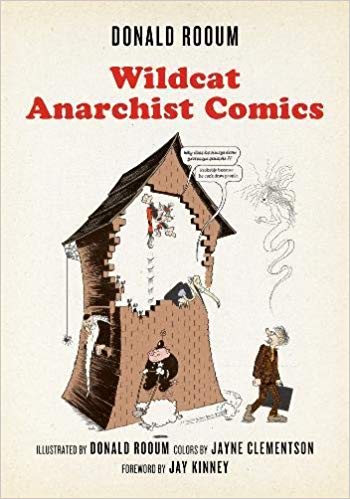
‘Creation’ is the preserve of supreme stylistic realist Arthur Ranson, whilst affable anarchist legend Donald Rooum explores Eden in ‘Gandalf’s Garden’ and Dave Gibbons puts some decidedly modernistic top-spin to the saga of ‘Sodom and Gomorrah’.

Alan Moore & Hunt Emerson examine ‘Leviticus’ (that would be the one with all those pesky Commandments) after which Neil Gaiman tackles ‘The Book of Judges’ accompanied by Mike Matthews (both the introduction and ‘The Tribe of Benjamin’); with Julie Hollings (for ‘Jael and Sisera’); Peter Rigg (‘Jephthah and His Daughter’); Graham Higgins (‘Samson’) and Steve Gibson (‘Journey to Bethlehem’). He even finds time to produce ‘The Prophet Who Came to Dinner’ (From the Book of Kings) with seminal long-time collaborator Dave McKean.

Closing the slim oversized (290 x204 mm) monochrome tome are underground cartooning icon Kim Deitch with ‘The Story of Job’, ‘Daddy Dear’ (from Ecclesiastes) adapted by Carol Bennett & Julie Hollings and the intensely uncompromising ‘A Miracle of Elisha’ (also from the Book of Kings) by the magnificent Brian Bolland.

Powerful and memorable, these interpretations won’t win any praise from Christian Fundamentalists, but they are fierce, subtle and scholarly examinations of the Old Testament realised by passionate creators with something to say and an unholy desire to instruct. As free-thinking adults you owe it to yourself to read these stories, but only in the spirit in which they were created.
© 1987 Knockabout Publications and the Artists and Writers. All Rights Reserved.

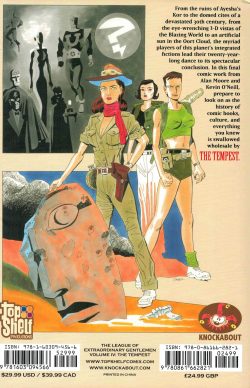
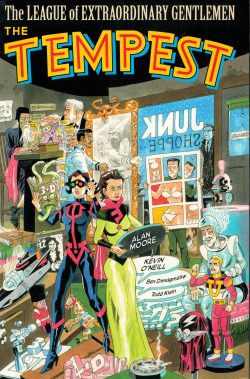
The League of Extraordinary Gentlemen volume one


By Alan Moore & Kevin O’Neill, with Ben Dimagmaliw & Bill Oakley (America’s Best Comics/DC Comics)
ISBN: 978-1-56389-665-1 (HB) 978-1-56389-858-7 (TPB)

The Victorian era saw the birth of both popular and populist publishing, especially in the sub-genres of fantasy and adventure fiction.

Writers – and accompanying illustrators – of varying skill, but possessed of unbounded imaginations, explored and proselytized the concepts of honour and heroism, wedded unflinchingly to the underlying core-belief of English Supremacy in matters of culture and technology. In all worlds and even beyond them, the British gentleman took on all comers for Right and Decency, viewing danger as a game and showing “Johnny Foreigner” just how that game was played.

In today’s poisoned political environment, it’s rather odd to see so much of that dated and offensive rhetoric revived and bombarding us from venal politicians’ untrustworthy mouths and online arsenals without a hint or trace of the splendid irony used in this delicious exercise in retro-imagination…

For all the faults our modern sensibilities can – or at least should – detect in those stirring sagas, many of them remain unshakable classics of adventure and the roadmap of all modern fictional heroes. Open as they are to charges of Racism, Sexism (and Misogyny; so, so much misogyny), Class Bias and Cultural Imperialism, the best of them remain the greatest of all our store of communally-shared ripping yarns.

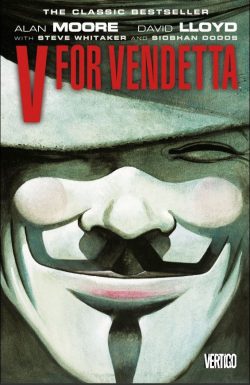
As heroic prototypes, a gaggle of these Imperialist icons were fabulously deputized by Alan Moore and Kevin O’Neill for a six-issue miniseries in 1999 (coloured by Ben Dimagmaliw and lettered by Bill Oakley) which managed to say as much or more about our modern world as that far ago one, and incidentally tell a truly captivating tale as compelling as any of its antecedents.

Available in deluxe hardcover, trade paperback, digital editions and omnibus collections, the story is also one of the best superhero exploits you’ll ever read, all presented as a faux seasonal compendium of that bygone age, with puzzles, paint-by numbers pages, pin-ups, a cover gallery and text features (such as novella ‘Allan and the Sundered Veil’ gilding the lily: a book no fan of fiction should miss.

Wilhelmina Murray survived a clash with a supernatural bloodsucking monster but was forever altered by the encounter. Some years later, recruited by British Secret Service chief Campion Bond, she is charged with organising a team of superior operatives to defeat an insidious foreign menace growing within the very heart of the British Empire. To this end, she circles the globe and convinces the greatest hero and most iniquitous outlaws of the era to band together.

Aged Great White Hunter Allan Quatermain is unlikely company for Invisible Man Hawley Griffin, Captain Nemo and Mister Hyde, although diffident and cultured Dr. Henry Jekyll can be considered a suitable companion for a widow under almost any circumstance…

Despite differences of class, honour, attitude, morality and disposition, together they ultimately foil a most dastardly plot only to discover that all is not as it seems…

The story grew beyond the authors’ avowed expectations of “a kind of Victorian Justice League” to become a veritable steampunk classic, with fin de siècle technology, trappings, expectations and attitudes, to establish itself as a powerful allegory for our own millennial end of days, and the act of its creation materialising as a game for creator and reader alike as every character in the tale was culled from existing works of literature and the audience all-but-dared to identify them…

The wit, artifice and whimsy of the compelling mystery – for that, gentle reader is what it is – as well as the vast, complex array of sub-texts and themed extras (such as faux advertising broadsheets woven into the text) all add to a truly immersive experience the inevitable film adaptation could not match.

To be Clear. This book is better than the movie. Do not watch it. Read This!

The League of Extraordinary Gentlemen is an incredible work of scholarship and artistry recast into a fabulous pastiche of an entire literary movement. It’s also a brilliant piece of comics wizardry of the sort that no other art form can touch.

If you haven’t seen the film – and even more so if you have – I urge you to read this. And then you can start in on Dickens, Rider Haggard, Stevenson, Wells, Verne, Conan Doyle, Stoker, Rohmer and all the glorious rest…
© 1999, 2000 Alan Moore & Kevin O’Neill. All Rights Reserved.

Marble Cake


By Scott Jason Smith (Avery Hill Publishing)
ISBN: 978-1-910395-47-9 (PB)

I might have mentioned once or twice that I read a lot of graphic novels. Some are awful, many are mediocre and the rest – good, noteworthy or just different from the mass, commercially-driven output of a global art and industry – I endeavour to share with you.

Some publishers make a proud policy of championing that last category (Top Shelf, NBM, Fantagraphics and others) and my favourite of those at the moment is British-based Avery Hill Publishing. I simply haven’t yet seen a duff or homogenised release from them yet. When this review copy plunked onto the mat, I realised that I still haven’t …

Scott Jason Smith hails from the seamy south side of London (as all the best folk do) and has quickly forged a solid reputation with his self-published comics and stories – like ‘Blossom the tall old lady’ and in collaborations with his mainstream-adjacent contemporaries in tomes such as 69 Love Songs Illustrated.

Scott is skilled in depicting people and mundane life and possesses a sharp sense of humour, honed by spending a lot of time listening to how ordinary folk talk. He knows what we all have in common and is extremely deft at using that as a means of building characters and constructing scenarios at once drearily familiar and subtly tweaked and twisted. This all adds a potent veracity to his particular brand of everyday adventuring which here seamlessly slips from a soap-operatic drama of the mundane or “Commedia dell’plebeia” to the suitably underplayed terrors of the Theatre of the Absurd as envisioned by Samuel Beckett or Daniel Clowes…

Marble Cake is his first novel-length tale and relates the intersecting moments of a bunch of strangers and casual near-acquaintances who all interact with till girl Tracy at the local Smartmart store. Her job leaves plenty of time to fantasize about what her customers do when she’s not around, but she really has no idea of what’s really going on. In fact, nobody does…

Life and death, joblessness and social standing, malice and sexual desire, ennui and intolerance, and especially hopelessness and general distrust tinge every real or imagined home-life Tracy ponders – even her own, but when genuine threat and mystery – such as a string of baffling disappearances – begin to grip the community, no one has any idea how to respond…

This compelling, pocket-sized (168 x 212 mm) paperback challenges notion of self-worth and universal rationality in a wry and acerbic manner that will intrigue and charm lovers of slice-of-life yarns and surreal storytelling who don’t mind doing a bit of the cerebral heavy lifting themselves.
© Scott Jason Smith 2019. All rights reserved.
The City


By James Herbert & Ian Miller (Pan Books)
ISBN13: 978-0-33032-471-7 (PB Album)

In the early 1990s, a number of British publishers – fired up by the massive mainstream sales of breakthrough sequential narratives such as Watchmen, The Dark Knight Returns and Maus – dipped their corporate toes in the waters of graphic novel publication, with varying degrees of commercial and aesthetic success.

Macmillan, through its Pan Books imprint, was one that took it all very seriously and it’s a crying shame that they were not better rewarded for their bold efforts. Still and all, with the way the country and the world are going at present, a timely reissue couldn’t be more relevant…

This particular slim, apocalyptic tome built upon an already popular property. Horror author James Herbert began his extensive writing career with The Rats (1974) following up with sequels Lair in 1979 and Domain in 1984. Those three novels told of a post-Holocaust Britain where mutated giant Black Rats have risen as humanity declined. In The City (technically Herbert’s 17th book) – and more of an episode than a narrative – an armoured figure known as The Traveller fights his way into the devastated ruins of London.

The decimated Capital is now the undisputed kingdom of the rats and their truly monstrous queen, but the lone human is set irrevocably on a mission of murder, and he has a secret, personal purpose for going into the hellish ruins…

Dark, simplistic and terrifying, the story is elevated to nightmare heights and depths by the astonishing, grotesquely beautiful art of sculptor, painter, film-designer and illustrator Ian Miller (Ratspike, The Luck in the Head, Green Dog Trumpet, Magic: The Gathering). Armageddon has never been better realised, the skies have never looked uglier and the shabby remains and detritus of civilisations never more familiar. His mutants are appalling to see and his intense line-work and domineering colours will haunt you.

Horror is tough to write and nearly impossible to illustrate. This book manages to tell no real story and make it scarier every time you return to it. Let’s hope some sagacious publisher does so before it’s too late for us all…
©1994 James Herbert. Illustrations ©1994 Ian Miller. All Rights Reserved.

The Broons and Oor Wullie: The Roaring Forties


By R.D. Low & Dudley D. Watkins (DC Thomson)
ISBN: 978-0-85116-804-3 (HB)

The Broons is one of the longest running newspaper strips in British history, having run almost continuously in Scottish newspaper The Sunday Post since its delirious debut in the March 8th 1936 edition: the same issue which launched mischievous and equally unchanging wee laddie Oor Wullie.

Both the boisterous boy and the gregariously engaging working-class family were co-created by journalist, writer and editor Robert Duncan Low in conjunction with DC Thomson’s greatest artist Dudley D. Watkins. Moreover, once the strips began to be collected in reprint editions as Seasonal Annuals, those books became as much a Yule tradition as plum pudding or shortbread.

Low (1895-1980) began at DC Thomson as a journalist, rising to the post of Managing Editor of Children’s Publication and launching, between 1921 and 1933, the company’s “Big Five” story papers for boys: Adventure, The Rover, The Wizard, The Skipper and The Hotspur.

In 1936 his landmark notion was the “Fun Section”: an 8-page pull-out comic strip supplement for national newspaper The Sunday Post. This illustrated accessory launched on 8th March and from the outset The Broons and Oor Wullie were the headliners…

Low’s shrewdest notion was to devise both strips as comedies played out in the charismatic Scottish idiom and broad unforgettable vernacular where, supported by features such as Auchentogle by Chic Gordon, Allan Morley‘s Nero and Zero, Nosey Parker and other strips. These pioneering comics then laid the groundwork for the company’s next great leap.

After some devious devising in December 1937 Low launched the first DC Thomson weekly comic. The Dandy was followed by The Beano in 1938 and early-reading title The Magic Comic in 1939.

War-time paper shortages and rationing sadly curtailed the burgeoning strip periodical revolution, and it was 1953 before the next wave of cartoon caper picture paper releases. The Topper started the ball rolling again with Oor Wullie in the logo and masthead but not included in the magazine’s regular roster. In that same year Low & the magnificent Ken Reid created Roger the Dodger for The Beano…

Low’s greatest advantage in the early days was his prolific illustrator Dudley Dexter Watkins, whose style – more than any other – shaped the look and form of DC Thompson’s comics output, until the bombastic advent of Leo Baxendale shook things up in the mid-1950s.

Watkins (1907-1969) had started life in Manchester and Nottingham as an artistic prodigy before entering Glasgow College of Art in 1924. Before too long he was advised to get a job at expanding, Dundee-based DCT, where a 6-month trial illustrating prose boys’ stories led to comic strip specials and some original cartoon creations.

Percy Vere and His Trying Tricks and Wandering Willie, The Wily Explorer made him a dead cert for both lead strips in the Sunday Post‘s new Fun Section. Without missing a beat, Watkins quickly added The Dandy‘s Desperate Dan to his weekly workload in 1937, and The Beano‘s placidly outrageous Lord Snooty seven months later.

Watkins soldiered on in unassailable triumph for decades, drawing some of the most lavishly lifelike and winningly hilarious strips in comics history. He died at his drawing board on August 20th 1969.

For every week of all those astonishingly productive years, he had unflaggingly crafted a full captivating page each of Oor Wullie and The Broons, and his loss was a colossal blow to the company.

DC Thomson reprinted old episodes of both strips in the newspaper and the Annuals for seven years before a replacement was agreed upon, whilst The Dandy reran Watkins’ Desperate Dan stories for twice that length of time.

An undeniable, rock-solid facet of Scots popular culture from the start, the first Broons Annual (technically Bi-Annual due to wartime paper rationing) had appeared in 1939, alternating with Oor Wullie – although, due to those same resource restrictions, no annuals were published between 1943 and 1946 – and for millions of readers a year cannot truly end without them.

So What’s the Set Up?: the multigenerational Broon family inhabit a tenement flat at 10 Glebe Street, in the timelessly metafictional Scottish industrial everytown of Auchentogle (sometimes Auchenshoogle); based in large part on the working class Glasgow district of Auchenshuggle. As such, it’s an ideal setting in which to tell gags, relate events and fossilise the deepest and most reassuring cultural archetypes for sentimental Scots wherever in the world they might actually be residing.

As is always the case, the adamant, unswerving cornerstone of any family feature is long-suffering, understanding Maw, who puts up with cantankerous, cheap, know-it-all Paw, and a battalion of stay-at-home kids comprising hunky Joe, freakishly tall Hen (Henry), sturdy Daphne, pretty Maggie, brainy Horace, mischievous twins Eck and the unnamed “ither ane” plus a wee toddler referred to only as “The Bairn”.

Not officially in residence but always hanging around is gruffly patriarchal buffoon Granpaw – a comedic gadfly who spends more time at Glebe Street than his own quaint cottage, constantly seeking to impart decades of out-of-date, hard-earned experience to the kids… but do they listen…?

Offering regular breaks from the inner city turmoil and a chance to simultaneously sentimentalise, spoof and memorialise more traditional times, the family frequently repair to their But ‘n’ Ben (a dilapidated rustic cottage in the nearby Highlands): there to fall foul of the weather, the countryside and all its denizens: fish, fowl and farm-grown…

As previously stated, Oor Wullie also debuted on 8th March 1936 with his collected Christmas Annuals appearing in the even years.

The basic set-up is sublimely simply and eternally evergreen, featuring an imaginative, good-hearted scruff with a talent for finding trouble and no hope of ever avoiding parental retribution when appropriate…

Wullie – AKA William MacCallum – is an archetypal young rascal with time on his hands and can usually be found sitting on an upturned bucket at the start and finish of his page-a-week exploits.

His regular cast includes Ma and Pa, long-suffering local bobby P.C. Murdoch, assorted teachers and other interfering adults who either lavish gifts or inflict opprobrium upon the little pest and his pals Fat Bob, Soapy Joe Soutar, Wee Eck and others…

The Roaring Forties was released in 2002 as part of a concerted drive to keep earlier material available to fans: a lavish hardback compilation (sadly not yet available digitally) which proffers a tantalising selection of strips from 1940-1949, covering every aspect of contemporary existence except a rather obvious one.

Although for half the book World War II was a brutal fact of life, it barely encroached upon the characters’ lives except perhaps in the unexplained occasional shortages of toys, sweets and other scrummy comestibles…

The parade of celtic mirth begins with – and is regularly broken up by – a number of atmospheric photo-features such as a celebration of film stars of the period in ‘A Nicht at the Picters’ (in three glamour-studded showings) and ‘Cartoon Capers’, which reproduces a wealth of one-off gag panels from The Sunday Post by such luminaries as Carmichael, Eric Cook, Campbell and Housley, whilst ‘Whit’s in The Sunday Post Today?’ gathers a selection of the era’s daftest news items.

The endless escapades of the strip stars comprise the usual subject-matter: gleeful goofs, family frolics and gloriously slapstick shenanigans. Whether it’s a visit with family or just trying to keep pace with the wee terror, highlights include plumbing disasters, fireplace fiascos, food foolishness, dating dilemmas, appliance atrocities, fashion freak-outs, exercise exploits and childish pranks by young and old alike…

Punctuated by editorial extras, such as ‘Correction Corner’ – offering an intriguing look into the strips’ creative process – and ‘Dinnae Mention the War’ which reprints a selection of morale-boosting ads and items, are rib-tickling scenes of sledding and skating, stolen candies, torn clothes, recycled comics, visiting circuses, practical jokes, and social gaffes: stories intended to take the nation’s collective mind off troubles abroad, and for every thwarted romance of poor Daphne and Maggie or embarrassing fiasco focussed on Paw’s cussedness, there’s an uproarious chase, riotous squabble and no-tears scrap for the little ‘uns.

With snobs to deflate, bullies to crush, duels to fight, chips to scoff, games to win and rowdy animals (from cats to cows) to avoid at all costs, the timeless gentle humour and gently self-deprecating, inclusive fun and frolics make these superbly crafted strips an endlessly entertaining serving of superbly nostalgic an unmissable treat.

So why not return to a time of local blacksmiths and coalmen, best china and full employment, neighbours you knew by first names and trousers that always fell apart or were chewed by goats? There are even occasional crossovers to marvel at here, with Wullie and Granpaw Broon striving to outdo each other in the adorable reprobate stakes…

Packed with all-ages fun, rambunctious slapstick hilarity and comfortably domestic warmth, these unchanging examples of happy certainty and convivial celebration of a mythic lost life and time are a sure cure for post-modern glums…
© D.C. Thomson & Co., Ltd. 2002.