Firkin Collection

Firkin Collection

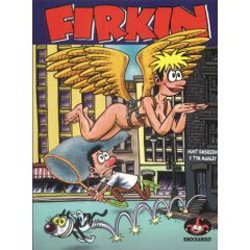
By Hunt Emerson & Tym Manley (Knockabout)
ISBN: 0-861661443

Once again the adult magazine industry has provided a comic strip classic, and this time it’s in the scraggy form of a black and white cat. Running for more than twenty years in the top-selling Fiesta, Firkin (more correctly “that Firkin Cat…”) has observed and commentated, advised and mocked the frankly insane mating habits of Homo (not so very) Sapiens.

In two page instalments the wise and ignoble Moggy has lectured the horny and lovelorn, touching upon every aspect of sexuality in an unbroken string of hilarious, grotesque, bawdy and baroque strips from the fevered minds of writer Tym Manley and cartoon Renaissance Man Hunt Emerson.

For the detail-minded, Firkin is the office mouser of adult photographers and has therefore seen it all – although he’s also been a secret agent, superhero and everything else in between, too. Rude, crude, unbelievably vulgar and pant-wettingly funny, these strips are an international hit too, being translated into eight languages. If you’re an open-minded and amusable grown-up these cat’s tales are an addictive treat and hold the secret of the truest love of all…

© 1981-2000, 2007 Hunt Emerson & Tym Manley. All Rights Reserved.

Pow! Annual

<i>Pow!</i> Annual

By various (Odhams Books)
SBN: 60039607X

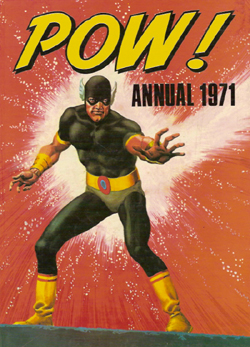
This quirky item is one of my fondest childhood memories and quite inspirational in directing my career path, and as well as being still a surprisingly qualitative read I can now see it as a bizarre and desperate little experiment. By the end of the 1960s DC Thomson had finally overtaken the monolithic comics publishing giant that had been created by Alfred Harmsworth at the beginning of the twentieth century. By absorbing rivals such as Eagle‘s Hulton Press, Fleetway/Odhams/IPC had stayed at the forefront of sales and by latching onto every fad they had kept their material contemporary, if not fresh, but the writing was on the wall.

The comedy strip was on the rise and action anthologies were finding it hard to keep readers attention. By 1970 when this annual was released the trend generated by the success of the Batman TV show was dying, so why release a book of all-new superhero strips in a title very much associated with comedy features and cheap Marvel Comics reprints? A last ditch attempt to revive the genre? Perhaps a cheap means of using up inventory?

I don’t know and I don’t care. What they produced was a wonderful capsule of fanboy delight, stuffed with thrills, colourful characters and a distinctly cool, underplayed stylishness, devoid of the brash histrionics of American comic books.

Within these pages lurked ‘Magno, Man of Magnetism’, ‘Aquavenger’, ‘Mr. Tomorrow: Criminal of the Future’, The Hunter and the Hunted’, ‘Electro’ (no relation to the Marvel villain – other than the high-voltage shtick), The fascinating ‘Esper Commandos’, ‘Marksman’, ‘The Phantom’ (again no relation to the US crime-fighter), the monstrous ‘Norstad of the Deep’ and the crusading ‘Time Rider’, purportedly all created by Alan Hebden and illustrated in alternating full colour (painted) and half-colour (black and magenta) sections by IPC’s European stable of artists. I’m not sure, but I think there’s some Massimo Belardinelli, Carlos Cruz and lots from that prolific bunch at the Giolitti studio.

These are all great little adventures, beautifully illustrated and singularly British in tone, even though most of the characters are American – or aliens (and no, that’s not necessarily the same thing) that easily withstand a critical rereading today, but the most important thing was the inspiring joy of these one-off wannabes. They certainly prompted me to fill sketchbook after sketchbook and determined that I would neither be a “brain surgeon or a bloke wot goes down sewers in gumboots”. This great little tome gave me that critical push towards the fame and fortune I now enjoy!

© 1970 The Hamlyn Publishing Group Limited.

The Beano Book 1971

The Beano Book 1971

By various (DC Thomson & Co., Ltd.)
No ISBN

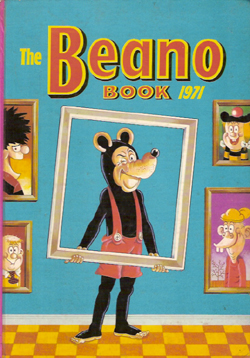
For many British fans Christmas means The Beano Book (although Scots worldwide have a pretty fair claim that the season belongs to them with collections of The Broons and Oor Wullie making every December 25th magical) and I’ve chosen this particular edition as another epitome of my personal holiday memories. As usual my knowledge of the creators involved is woefully inadequate but I’m going to hazard a few guesses in the hope that someone with better knowledge will correct me when I err.

In this little cracker are a number of David Sutherland’s Biffo the Bear strips as well as his Bash Street Kids and even a smashing action-adventure of boy super-hero Billy the Cat (I wonder if the editors distributed strips to artists in alphabetical order?). There are whirlwind tales of “fastest boy on Earth” Billy Whizz drawn by Malcolm Judge. Paddy Brennan worked as a dramatic artist for decades on General Jumbo (the heroic boy who radio-controlled an army of robot toys) and the Q-Bikes, a team of young adventurers with technologically advanced push-bikes. In this volume they trade in two wheels for four, and become the Q-Karts for an Australian adventure, whilst the aforementioned General captures a team of safecrackers in his home town.

These annuals were traditionally produced in the wonderful “half-colour” that many British publishers used to keep costs down. This was done by printing sections of the books with only two plates, such as blue/Cyan and red/Magenta: The versatility and palette range this provided was astounding. Even now this technique screams “Holidays” to me and my contemporaries.

Some of the Dennis the Menace strips are possibly drawn by original creator Davy Law, but are most likely the work of his style-chameleon replacement David Sutherland. They all feature his charismatic new co-star ‘Gnasher’, too. The woefully un-PC but astoundingly funny Little Plum strips are by Ronald Spencer, I think, as are The Nibblers; an anarchic gang – and weren’t they all in The Beano? – of mice.

The 3 Bears segments are by Bob McGrath whilst Lord Snooty (one of the longest running strips in the comic’s history – a record only recently overtaken by Dennis) is the work of Robert Nixon, as is the Roger the Dodger Family Album section. There are short romps with Pups Parade (or the Bash Street Pups – the unlovely pets of those unlovely kids) by Gordon Bell and exemplar of Girl Power Minnie the Minx gets her own 16 page mini-book in this annual – and who could stop her? – courtesy of the wonderful Jim Petrie, but I’ll admit to being totally stumped by Swinging Jungle Jim a frantic boy-Tarzan strip that has sunk without trace since those faraway times.

Topped off with activity and gag-pages, this is a tremendously fun book, and even in the absence of the legendary creators such as Dudley Watkins, Leo Baxendale and Ken Reid and with a small but noticeable decline in the mayhem and anarchy quotas, there’s still so much merriment on offer I can’t believe this book is thirty seven years old. If ever anything needed to be issued as commemorative collections it’s DC Thomson annuals…

Divorcing the sheer quality of this brilliant book from nostalgia is a healthy exercise, but I’m perfectly happy to simply wallow – even today – in the magical emotions this ‘almost-colourful’ annual still stirs. It’s a good solid laugh-and-thrill-packed read, from a magical time (I was in my final year of primary school and a beloved, spoiled and precocious little snot with not a care in the world) and turning those stiffened two-colour pages is always an unmatchable Christmas experience.

© 1970 DC Thomson & Co., Ltd.

Oh, Wicked Wanda!

Oh, Wicked Wanda!

By Frederic Mulally & Ron Embleton (Penthouse)
No ISBN

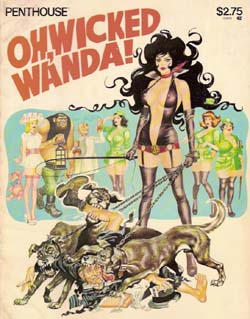
Not all comics are for kids nor ever were they. The men’s magazine trade has often featured graphic narratives, usually sexual in nature, often highly satirical, invariably of a much higher quality than their mainstream contemporaries and always much better regarded and financially rewarded. Where Playboy had Little Annie Fanny (created by Harvey Kurtzman and Will Elder, it ran intermittently from 1962 until 1988, and revived in 1998, illustrated by Ray Lago and Bill Schorr), publishing rival Bob Guccione wanted the same but better for his publication Penthouse.

He hired journalist, editor (of left-wing magazine Tribune), columnist, novelist and political writer Frederic Mulally to script the exotic, erotic adventures of Wanda Von Kreesus, the richest woman in the world, Candyfloss, her insatiable jailbait paramour and an outrageous coterie of faithful employees including an all-girl army, a mad scientist and a brutal looking thug with the soul of a poet. To illustrate he secured the talents of oil painter and comic strip veteran Ron Embleton (who had astounded comic readers with his lush and vibrant strip Wulf the Briton in Express Weekly and his illustrations in Look and Learn).

Oh, Wicked Wanda! was originally a prose serial illustrated by Bryan Forbes, beginning in 1969 before becoming, in 1973, the unbelievably lavish and torrid strip reprinted here, continuing until 1980 when it was replaced by Sweet Chastity, also painted by Embleton, and scripted by Penthouse proprietor Guccione.

The bored and mischievous hellion is a sexually adventurous woman from a time when sexual politics and liberation were huge issues, and therefore prime targets for low comedy and high satire. Mulally peppered his scripts with topical references (many, sadly which would escape today’s casual reader, I’m sure) and the phenomenal Embleton would depict them with hyper-realistic accuracy. Harold Wilson, Edward Heath, Ted Kennedy, Richard Nixon, Henry Kissinger, Fidel Castro, Lyndon Johnson, Spiro Agnew, Mao Tse-tung, showbiz icons such as John Wayne or Bob Hope and even comic strip greats like Pogo, Mutt and Jeff or Krazy Kat, all meandered through the glossy pages, a cross between a Greek Chorus and pictorial ad-libs.

Many celebrities were actively parodied participants. Henry Kissandrun, mafia Don Marlon Blondo/Burpo, Jane Fondle and demented California Governor Ronald Reekin’ all found themselves victims of the wilful minx and her team. Also classical and contemporary erotic allusions abound ranging from a little nymphette lounging about reading William Burroughs’s Naked Lunch to visual and verbal references to Shelley’s Leda and the Swan.

This slim album reprints the earliest adventures as Wanda collects the rich and the famous for a museum of deviancy, takes on the Mafia, the CIA and the Cubans and does her bit to solve the Oil Crisis. Later adventures saw her romp through the ages in a time machine but to my knowledge these tales have never been reprinted – although they really should be.

Perhaps a little dated, definitely for easy-going adults only, Oh, Wicked Wanda! is nonetheless still a funny read and inarguably one of the most beautiful British strips ever made. It is a tragedy that such work is unavailable to aficionados of comic art.

© 1973, 1974, 1975 Penthouse International Ltd. All Rights Reserved.

Garth: The Cloud of Balthus

Garth: The Cloud of Balthus

By Jim Edgar and Frank Bellamy, with John Allard (Titan Books)
ISBN: 0-90761-034-X

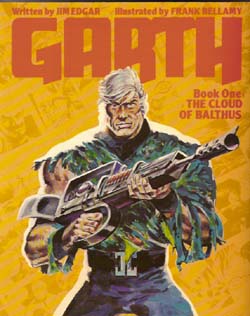
The British Superman Garth first appeared in the Daily Mirror on Saturday, July 24th 1943, the creation of professional cartoonist Steve Dowling and BBC producer Gordon Boshell, at the behest of the editor who wanted an adventure strip to complement their other comic strip features, Buck Ryan, Belinda Blue Eyes, Just Jake and the immortal, morale-boosting Jane.

A blond giant and physical marvel, Garth washed up on an island shore and into the arms of a pretty girl, Gala, with no memory of who he was, but nevertheless saved the entire populace from a brutal tyrant. Boshell never had time to write the series, so Dowling, already producing the successful family strip The Ruggles, scripted Garth until a new writer could be found.

Don Freeman dumped the amnesia plot in ‘The Seven Ages of Garth’ (which ran from September 18th 1944 until January 20th 1946) by introducing the studious jack-of-all-science Professor Lumiere whose psychological experiments Regressed the hero back through some past lives. In the next tale ‘The Saga of Garth’ (January 22nd 1946 – July 20th 1946) his origin was revealed. As a child he’d been found floating in a coracle off the Shetlands and adopted by a kindly old couple. When grown he became a Navy Captain until he was torpedoed off Tibet in 1943.

Freeman continued as writer until 1952 (‘Flight into the Future’ was his last tale), and was briefly replaced by script editor Hugh McClelland (who only wrote ‘Invasion From Space’) until Peter O’Donnell took over in February 1953 (‘Warriors of Krull’). He wrote 28 adventures until he resigned in 1966 to devote more time to his own strip Modesty Blaise, and his place was taken by Jim Edgar; a short-story writer who also wrote such prestigious strips as Matt Marriott, Wes Slade and Gun Law.

Dowling retired in 1968 and his long-time assistant John Allard took over the strip until a suitable permanent artist could be found. He completed ten tales until Frank Bellamy began his legendary run with the 13th instalment of ‘Sundance’ (which ran from 28th June to 11th October 1971). Allard remained as background artist and assistant until Bellamy took full control during ‘The Orb of Trimandias’.

One thing Professor Lumiere had discovered and which gave this strip its distinctive appeal – even before the fantastic artwork of Bellamy elevated it to dizzying heights of graphic brilliance – was Garth’s involuntary ability to travel through time and experience past and future lives. This simple concept lent the strip an unfailing potential for exotic storylines and fantastic exploits, pushing it beyond its humble beginning as a British response to Siegel and Shuster’s American phenomenon Superman.

In ‘Sundance’ Garth is sucked back to 1876 to relive his life as an officer of George Custer’s 7th Cavalry on the Eve of the Battle of the Little Big Horn. He has a brief but passionate love affair with the squaw Falling Leaf before dying valiantly for his beliefs and their love. It is an evocative, powerful tale that totally captures the bigotry, arrogance and futility of the White Man and the tragic demise of the Indian way of life.

‘The Cloud of Balthus’ shows the open, simple elegance of the narrative concept in Garth. Whilst vacationing in the Caribbean the hero becomes embroiled in an espionage plot involving freelance super-spies and a US space station, but even that is mere prelude to fantastic adventure and deadly terrors when he and his delectable, double-dealing companion Lee Wan are abducted by nebulous energy beings in a taut, tension-fraught thriller.

‘The Orb of Trimandias’ sends Garth back in time to the Venice of the Borgias, when he re-lives his life as English Soldier-of-Fortune Lord Carthewan, a decent man battling an insane and all-powerful madman for the secret of a supernaturally potent holy relic. This gripping, exotic yarn is replete with flamboyant action, historical celebrities, sexy women and magnificently stirring locales. It’s a timeless treasure of adventure that has the added fillip of briefly reuniting Garth with his star-crossed true love, the ethereal Goddess Astra.

This lovely volume concludes with a high-octane gothic horror story. In ‘The Wolfman of Ausensee’ Garth becomes the reluctant companion of movie starlet Gloria Delmar on a shoot at the forbidding Austrian Schloss (that’s a big ugly castle to you) of a playboy whose family was cursed by witches. Despite the title giving some of the game away this is still a sharp and savvy spook-fest that would sit easily amongst the best Hammer Horror films, and just gets better with each rereading.

Garth is the quintessential British Action Hero – strong, smart, good-looking with a big heart and a nose for trouble. His back-story gives him all of eternity and every genre to play in and the magnificent art of Frank Bellamy also made his too-brief tenure a stellar one.

Comic-strips seldom get this good, and even though this book and its sequel are still relatively easy to come by, it is still a crime and a mystery that all these wonderful tales have been out of print for so long.

© 198Mirror Group Newspapers. All Rights Reserved.

Citymouth

Citymouth

By Hunt Emerson (Knockabout)
ISBN: 0-86166-142-7

This slim collection of cartoons and strips is possibly the most innovative and surreal work that national treasure Hunt Emerson has ever produced. Surreal to the point of abstraction, these are purely visual statements and bon mots which run the gamut from slapstick to satire, shaggy dog story to barbed social commentary, and like all the great surrealist artists, these works aspire to instantaneous creation but in actuality have been crafted with extreme diligence and terrifying skill.

Somewhere strange creatures roam, little more than mouths on legs. In those cavernous maws are dwellings. Parks, villages, housing developments, even city-states. In mostly wordless displays Emerson examines society, progress and even the absurd nature of reality. He also quite clearly had vast amounts of mind-liberating fun, and so will you when you track down this pictorial delight.

© 2000 Hunt Emerson. All Rights Reserved

The Mirror Classic Cartoon Collection

The Mirror Classic Cartoon Collection

By various, compiled by Mike Higgs (Hawk Books)
ISBN 0-948248-06-8

The Daily Mirror has been home to a number of great strips over its long history – beginning with one of the Empire’s greatest successes Tiger Tim, who debuted there in 1904 and culminating with the likes of the war-winning nymphette Jane, The Perishers, Garth and Andy Capp. The latter two feature in this beautiful compilation from Mike Higgs’ Hawk Books which has done so much over the years to keep British cartoon history alive.

This particular effort collects sample selections from the newspaper’s back catalogue in a spiffy hardback that is stuffed with fun, thrills and quality nostalgia.

Garth is the first star featured in an adventure from 1957 by series originator and longest serving creator Steve Dowling (1943-1969 – succeeded by his assistant John Allard, then Frank Bellamy and finally Martin Asbury). Garth is a hulking physical specimen, a virtual human superman with the involuntary ability to travel through time and experience past and future lives. This simple concept lent the strip an unfailing potential for exotic storylines and fantastic exploits.

‘The Captive’ – written by Peter O’Donnell and illustrated by Dowling and Allard – is a contemporary tale with our hero abducted from Earth as a prize in a galactic scavenger hunt instigated by bored hedonistic aliens who don’t realise quite what they’ve gotten themselves involved with… A second adventure, ‘The Man-hunt’, is the last that Frank Bellamy worked on. The astounding Bellamy died in 1976 whilst drawing this story of beautiful alien predators in search of prime genetic stock with which to reinvigorate their tired bloodlines. Written by Jim Edgar, the strip was completed by Asbury who took over with the 17th instalment. This tongue-in-cheek thriller is full of thrills and fantastic action, yet never loses its light humorous touch.

Andy Capp is a drunken, skiving, misogynistic, work-shy, wife-beating scoundrel who has somehow become one of the most popular and well-loved strip characters of all time. Created by jobbing cartoonist Reg Smythe to appeal to northern readers during a circulation drive, he first saw the light of day – with long-suffering wife Florrie in tow – on August 5th 1957. The volume reprints 37 strips from the feature’s 41 year run, which only ended with Smythe’s death in 1998, but the sheer magic of this lovable rogue is as inexplicably intoxicating as it always was, defeating political correctness and common decency alike: A true Guilty Pleasure.

Romeo Brown began in 1954, drawn by Dutch artist Alfred “Maz” Mazure, and starred a private detective with an eye for the ladies and a nose for trouble. The feature was a light, comedic adventure series that added some glamour to the dour mid-1950s, but really kicked into high gear when Maz left in 1957 to be replaced by Peter O’Donnell and the brilliant Jim Holdaway, who would go on to create the fabulous Modesty Blaise together. The strip ended in 1962 and is represented here by a pair of romps from their penultimate year. ‘The Arabian Knight’ and ‘The Admiral’s Grand-daughter’ combine sly, knowing humour, bungling criminality and dazzlingly visuals in a manner any Carry-On fan would die for.

Useless Eustace was a gag-panel (a single-picture joke) that ran from January 1935 to 1985. Created by Jack Greenall, its star was a bald nondescript everyman who met the travails of life with unflinching enthusiasm but very little sense. Greenall produced the strip until 1974, and other artists continued it until 1985. The selections here are from the war years and the 1960s. Another comedy panel was Calamity Gulch, a particularly British view of the ubiquitous “Western” which invaded our sensibilities with the rise of television ownership in the 1950s. Created by Jack Clayton, it began its spoofing and sharp-shooting on 6th June 1960, and you can see 21 of the best right here, Pardner.

A staple of children’s comics that never really prospered in newspapers was the sports adventure. At least not until 1989 when those grown up tykes opened the Daily Mirror to find a football strip entitled Scorer, written by Barrie Tomlinson and drawn by Barry Mitchell, and eventually John Gillatt. Very much an updated Roy of the Rovers, the strip stars Dave ‘Scorer’ Storry and his team Tolcaster F.C. in fast, hot, sexy tales of the Beautiful Game that owed as much to the sports pages it began on as to the grand cartoon tradition. ‘Cup Cracker’, included here is by Tomlinson and Gillatt from 1994, and shows that WAGS (Wives And GirlfriendS, non-sports fans) were never a new phenomenon.

Not many people know this, but before I review an old book (which I arbitrarily define as something more than three years old) I try to locate copies on the internet. It’s a supreme disappointment then for me to admit that this wonderful and utterly British tome is readily available in France, Germany – most of Europe in fact (and you could order it from Amazon.fr for example), but not in any English-speaking nation that I could find. Perhaps that’s a testament to the book’s quality and desirability, and if that’s the case maybe The Mirror Group should expedite a new edition – or even a few sequels…

© 1998 Mirror Group Newspapers, Ltd. All Rights Reserved.

Ronald Searle: In Perspective

Ronald Searle: In Perspective

By Ronald Searle (New English Library)
ISBN: 0-450-06026-8

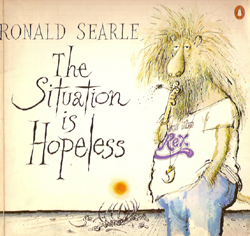
In a previous review of England’s greatest living artistic treasure (even though he has lived, worked and been properly appreciated in France for the last 25 years) I dwelt on his fantastic humorous qualities, and rightly so, because he is one of our greatest ever cartoonists and graphic satirists and the book in question was a collection of his early cartoons (Ronald Searle’s Golden Oldies 1941-1961, ISBN: 0-85145-102-1). I didn’t spend too much time on his other achievements – and I’m still not going to – as his work should be seen and his thoughts and opinions should be understood in his chosen language: Art. At least he still has enough fans to fill the internet with all the information you could need, so go search-engining after you read this if you wish.

This collection traces Searle’s career pictorially from his 1930s art school days to the 1980s, by which time he was established – everywhere but here – as not only a cartoonist and satirist but as a film-maker, sculptor, designer, travel-writer and creator of fascinating reportage. This man is a capital “A” Artist in the manner of Picasso or Hockney, and Scarfe and Steadman notwithstanding, he is the last great British commentator to use cartooning and caricature as weapons of social change in the caustic manner of his heroes Hogarth, Gillray, Rowlandson, Cruikshank and the rest.

This volume includes selections from many previous collections and includes political illustration, war and travel drawings (including some moving pieces from his time as a prisoner of the Japanese in World War II), pure art-studies, nudes, medals he designed for the French Government, poster and paintings and of course, some of the most surreal, sardonic and grotesque funny pictures of the late 20th century.

Why his creations are so under-appreciated I do not know. Why this book is out of print: Ditto. That he will remain a relative unknown as yet another movie of his St Trinian’s girls gets all the headlines: Not if I can help it.

Anyone who considers themselves a devotee of the arts of graphic narrative should know of Searle’s work, not necessarily love – although how could you not? Just be aware of the tremendous debt we all owe to his vision, dedication and gifts.

© 1984 Ronald Searle.

George and Lynne ’89

George and Lynne '89

By Conrad Frost & Joseph Gual (A4 Publications)
ISBN: 0-946197-35-0

Comfortably middle-class, George and Lynne live on the river and have a great marriage. In brief daily instalments they deal with life’s little misfortunes and each others foibles, secure in the knowledge that nothing can ever go really wrong. And it doesn’t.

This is the comfortable comedy of the Terry and June set, with minor embarrassments and occasionally catty observations on the nature of “keeping up with the Joneses” replacing drama and conflict as narrative engines. They are fit, good looking and spend an incredible amount of time naked.

This strip collection definitely falls into the guilty pleasures category, with woefully lame gags and tired sexism counterbalanced by a gentle, natural married relationship idyllically portrayed in welcoming and accessible scripts, and illustrated by an absolute master of narrative drawing, and one especially adept at the unclad female form (I understand that many people like that sort of thing – I’m pretty sure I do…). I don’t know if Joseph Gual is the same artist that drew the James Bond Strip in Spain but I do know that he is very, very good at his job.

I can’t honestly recommend this strip to everybody, but if you love great drawing and don’t mind the odd bit of old-fashioned sexism this is a pretty and mostly inoffensive way to waste a few minutes.

© 1988 Conrad Frost Associates. All Rights Reserved.

A Tale of Two Mothers-in-Law

A Tale of Two Mothers-in-Law

By Patrick Wright (Heinemann)
ISBN: 0-434-87827-8

Patrick Wright is a cartoonist who is inexplicably not a household name. He’s been working for a couple of decades now, producing dark, savage, crushingly funny panels and strips for a variety of magazines such as Private Eye, and unlike most of his peers who fall into either the “good ideas/so-so art” or “great artist in need of a scripter” he can do it all and do it well.

His composition and economy of line, facial expressions, body-language and especially character designs are superb. This guy can really, really draw. And as I’ve said, his incisive observational skills combine with what I can only assume is a deep inner mean-streak to create brilliantly nasty cartoons that are the epitome of shared misery dusted with Schadenfreude. I’m pretty glad he hasn’t met me…

In such collections as Walkies, Worthless Pursuits, 101 Uses For John Major and Not Inconsiderable – The Life and Times of John Major his vented spleen has made me laugh very long and much too loud, and if you can find those, or better yet, this collection of beautifully illustrated thoughts on the “Eternal Struggle”, he’ll no doubt do the same for you. This is a chap sorely in need of a bumper 25 year retrospective book…

© 1983 Patrick Wright.