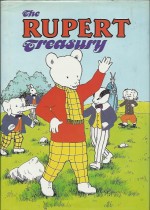
The Rupert Treasury


By Mary Tourtel (Purnell Books)
ISBN: 9 78-0-36106-343-2

Win’s Christmas Gift Recommendation: Truly British Brilliance with Universal Appeal… 9/10

There’s not a lot around these days in our field which caters specifically for little kids, their nostalgic parents and guardians whilst simultaneously introducing them to the ineluctably tactile wonders and sensorium of a high quality comics anthological experience. Once upon a time there was a whole subdivision of the publishing business dedicated to enthralling and enchanting our youngest and, hopefully, brightest but now all I can think of are The Beano and The Phoenix…

At least we still have books – old and new – to fill the gap.

Moreover, comics fans and the British in general equally adore a well-seasoned tradition and in terms of pictorial narrative and sheer beguilement there’s nothing more perfect than the hairy national treasure called Rupert.

Long before television took him, the Little Bear was part of our society’s very fabric and never more so than at Christmas when gloriously painted, comfortingly sturdy rainbow-hued Annuals found their way into innumerable stockings and the sticky hands of astounded, mesmerised children.

The ursine über-star was created by English artist and illustrator Mary Tourtel (January 28th 1874-March 15th 1948) and debuted in the Daily Express on November 8th 1920; the beguiling vanguard and secret weapon of a pitched circulation battle with rival papers the Daily Mirror and Daily Mail. Both papers had cartoon characters for kiddies – Teddy Tail in the Mail and the soon-to-be legendary Pip, Squeak and Wilfred in the Mirror.

Tourtel’s daily serial of the Little Lost Bear ran for 36 instalments and triggered a phenomenon which remains in full force to this day, albeit largely due to the diligent efforts of her successor Alfred Edmeades Bestall, MBE, who wrote and illustrated Rupert Bear from 1935 to 1965 and was responsible for the Annuals which began with the 1936 edition.

The artist originally chosen to spearhead the Express’ cartoon counterattack was already an established major player on the illustration scene – and fortuitously married to the paper’s News Editor Herbert Tourtel, who had been ordered by the owners to come up with a rival feature.

The unnamed little bear was illustrated by Mary and initially captioned by Herbert, appearing as two cartoon panels per day with a passage of text underneath. He was originally cast as a brown bear until the Express decided to cut costs and inking expenses resulting in the iconic white pallor we all know and love today.

Soon though early developmental “bedding-in” was accomplished and the engaging scenario was fully entrenched in the hearts and minds of readers. Young Rupert lives with his extremely understanding parents in idyllically rural Nutwood village: an enticing microcosm and exemplar of everything wonderful about British life. The place is populated by anthropomorphic animals and humans living together and overlaps a lot of very strange and unworldly places full of mythical creatures and legendary folk…

A huge hit, Mary’s Rupert quickly expanded into a range of short illustrated novels (46 by my count from the early 1920s to 1936, with a further run of 18 licensed and perpetually published by Woolworth’s after that. It’s from the former that the five tales in this splendid hardback commemoration are taken…

Tourtel’s bear was very much a product of his times and social class: inquisitive, adventurous, smart, helpful yet intrinsically privileged and therefore always labouring under a veiled threat of having his cosy world and possessions taken away by the wicked and undeserving.

Heretical as it might sound, like the unexpurgated fairy tales of Hans Christian Anderson or the Brothers Grimm, the pre-Bestall Rupert yarns all have a darker edge and worrisome undercurrent with mysterious forces casually, even capriciously targeting our innocent star. Naturally, pluck, good friends and a benevolent adult or two are always on hand to help our hero win through…

This glorious tome – still readily available through many internet vendors and originated in 1984 – gathers a quintet of typical Tourtel tales from the book editions, packing a wealth of full colour painted, duo-hued and monochrome ink-line illustrations into his enchanting pages and opens with the all-colour adventure of ‘Rupert and the Robber Wolf’ from 1932, with the text as always delivered in a succession of rhyming couplets.

The story sees Rupert deprived of his new pocket watch by a burly vulpine bandit and, despite seeking the assistance of best pal Bill Badger, friendly mystic The Wise Old Goat, pixies, fauns and rural troubleshooter The Pedlar, ending up a prisoner of the wolf.

Happily the Old Goat and a posse of police are on hand to collar the crook and his wayward son before something really nasty occurs…

Rendered in bucolic shades of green, ‘Rupert and the Old Miser’ (first released circa 1925) finds our bear playing with a new ball which flies over a forbidding wall into a large garden. When Rupert sneaks in to retrieve his toy he encounters a range of odd and terrified creatures all suborned to the eccentric whims of the rapacious Master Raven…

When the bear is caught the ebon enchanter declares the trespasser to be his property too and sets the poor mite to work as his latest chattel.

Rupert is despondent, but help is at hand. The Little Bear’s friends have concocted a cunning plan to rescue him and when the scheme succeeds the miser meets a grisly fate chasing his fleeing new slave…

Equally verdant in its art aspects is the saga of ‘Rupert and the Enchanted Princess’ (1928) which opens with the bear snatched up by a great bird and delivered to a distant kingdom where a feudal monarch pleads with him to find his missing daughter.

Despite the scorn of the assembled knights, Rupert sets out and, with the aid of woodland creatures and a talking horse, overcomes ogres, dragons and other terrors before reversing the magic curse of three witches and returning the Princess to her doting dad…

Rendered in beautiful, clear, clean black-&-white line art ‘Rupert and the Mysterious Flight’ (1930) begins when The Prince and Princess of the Wood of Mystery send the Little Bear a fully functional aeroplane. Soon Rupert is enjoying his maiden voyage but gets lost and alights in the Land of Kinkajous, where King Toucan – after an initial fright – sets the boy a series of never-ending mystic challenges. After a number of Herculean labours are accomplished Rupert at last regains his flying machine and makes a break for freedom and home…

The fantastic voyages then conclude with the full-colour ‘Rupert and the Magic Toyman’ (1933) wherein a thrilling day enjoying a Fair and Sports Day leads to the unlucky bear being spirited away by a genial craftsman whose enticing wares mask his true nature.

The toy maker is, in fact, a wicked sorcerer and his constructions are transformed animals and even a Princess…

Undaunted, Rupert organises an escape back to Princess Belinda‘s kingdom, but the Toyman has already ensorcelled the whole place into a land of marionettes. Happily, a glimmer of hope remains and the tables can be turned if only Rupert can find and recruit the valiantly heroic Moorland Will whose hunting horn can undo the magic spell…

Beautifully realised, superbly engaging fantasies such as these are never out of style and this fabulous tome should be yours, if only ass means of introducing the next generation to a perfect world of wonder and imagination.
© 1984 Beaverbrook Newspapers Limited. Artwork & text © 1984 Purnell Publishers Limited from original Mary Tourtel material.

21st Century Tank Girl


By Alan Martin, Jamie Hewlett, Philip Bond, Brett Parson, Jim Mahfood, Warwick Johnson-Cadwell, Jonathan Edwards, Craig Knowles & various (Titan Comics)
ISBN: 978-1-78276-661-2

Win’s Christmas Gift Recommendation: Furiously Foul-Mouthed Frolicsome Fun ‘n’ Games… 8/10

Back in the wild and wacky 1980s there was a frantic buzz of feverish creativity in the British comics scene wherein any young upstart could hit the big time.

Possibly the most upstarty of all were art students Jamie Hewlett and Alan Martin (and, associatively, Philip Bond) who prowled the local convention circuit impressing the hell out of everybody with their photocopied fanzine Atomtan. At the back of issue #1 was a pin-up/ad for a dubiously feisty looking young lady with a big, Big, BIG gun and her own armoured transport. And now it’s a whole ‘nother century…

Commissioned by Brett Ewins and Steve Dillon for Deadline, a pop-culture magazine with loads of cool strips, the absurdist tales of a rambunctious, well-armed hottie roaming the wilds of a futuristic Australia with her kangaroo boy-friend Booga caught the imagination of a large portion of the public. There was even a movie…

After many years indolently dallying with a sordid plethora of different publishers, the salty, soldierly slapper found her way to Titan Comics who comprehensively remastered her old adventures and now proudly publish her subsequent outbursts of appealingly appalling new material of a mature and deliberatively offensive nature…

Never particularly enamoured of the concept of internal logic, chronological order, narrative consistency, linguistic restraint or spelling (so if you’re pedantic, be warned!), this latest compote of outrageous and hilarious cartoon phantasmagoria revels in the usual glorious mud-bath of social iconoclasm, in-yer-face absurdity, accumulated decades of British Cultural Sampling and the ever-popular addictive sex ‘n’ violence, but also holds a few shocking surprises, not least of which is the return of originating co-creator Jamie (Gorillaz) Hewlett after twenty years AWOL…

Collecting the 3-issue miniseries from the summer of 2015, this impressively oversized (305 x 216 mm) full-colour hardback album features strips, gag-pages, prose pieces, illustrated poems and loads of pin-ups/covers to astound the multitudes, and opens with a typically inviting Introduction from scripter Alan Martin after which, reunited with fellow instigating wild boy Hewlett, he reveals ‘Space is Ace’ as Tank Girl and Booga, with bosom pals Barney and Jet Girl, perversely invade a strangely erotic asteroid in search of some legendary Udagawa crystals with a most predictable and outrageous outcome…

Following a spoof ‘Drag Tank’ model-kit ad from Brett Parson and poetic aside ‘Your Mission’, the cartoon capers continue in kitsch-drenched nostalgia fest ‘Nanango ’71’ (again pictured by Parson) wherein our cuddly kanga-boy is offered a vast amount of cash to carefully drive a pristine and cherry vintage muscle car across the desert to its frothing new owner.

He really shouldn’t have invited those capricious calamity magnets Tank Girl and Jet Girl along for the ride…

Salutary warning ‘You’re Young Now but Won’t Be for Long’ (art by Jim Mahfood & colourist Justin Stewart) and gag menu ‘Itsnofuckingjoke’ segues neatly into the ever-so-informative ‘Tank Girl War Library: Tank Girl Tactics and Booga Manoeuvres’ and a selection of poster poems/info pages entitled ‘Who Are Tank Girl?’: individually shining a spotlight on Booga, Barney, Jet Girl and Tank Girl, and all illustrated by Warwick Johnson-Cadwell – plus a pin-up of the team on the beach – before Parson’s second issue cover of the girls sharing a shower leads inexorably into poster-poem ‘How Brilliant Are We?’ (Craig Knowles) before Martin, Mahfood & Stewart expose ‘Valleri’.

The undercover cop infiltrating the gang so they can be slaughtered by gun-crazy policemen has an undisclosed past with Tank Girl that nobody knows of and which might just be the advantage needed to help the lovable outlaws swipe the priceless relic God’s Underpants…

‘Colour Me Tank Girl’ offers a little crayon-based relaxation featuring the team’s rampantly rude spaceship after which the Johnson-Cadwell illustrated prose vignette ‘Giraffe’ leads to a wealth of uncanny poetic picto-memories from ‘Tank Girl’s Sundrenched Martian Superholiday’ (Jonathan Edwards), another Johnson-Cadwell pin-up and a hilarious set of stick-on life options courtesy of Tank Girl Inc.‘s ‘Obtuse Ideologies’…

Martin & Parson’s short, sharp comicstrip history of ‘Booga Flakes’ gives way to Johnson-Cadwell’s shocking, silent war epic ‘Tank Girl in Easy’ and a tender loving moment by Parson, highlighting the unique relationship of TG and Booga…

The lovers then explore ‘The Ghost Smell from the Ground’ (Knowles): turning back progress to eradicate a vile super-Shopping Mall and restoring a quaint corner shop before Mahfood limns TG’s mantra to live by and Parson illuminates the tenets of ‘The Church of Booga’. Edwards then returns to delineate our stars’ bitter battles and obscure, surreal search for truth and reliable ammo in ‘Journey to the Centre of the Tank’ – a trip which exposes the harsh potency of 1970s British comedy icons…

A studly kangaroo-cake pin-up of Booga by Philip Bond leads into a prose origin of sorts as we obliquely discover ‘The Name of Tank Girl’; the shock of which is neatly offset by a pack of Parson-produced ’21st Century Bumper Stickers’ and captivating poster for ’21st Century Tank Girl: The Movie’ before diverting back to strip-mode to illustrate Martin’s raucously satirical spoof ‘The Runny Man’ and a brief dose of futurist philosophy, before one last loving pin-up precedes his climactic comics conclusion as ‘Viva Tank Girl’ reveals why Evel Knievel never used tanks when jumping over a row of parked vehicles…

Wildly absurdist, intoxicatingly adorable and packed to the gills with outlandish pictorial pleasures, 21st Century Tank Girl is an ever-so-cool rollercoaster-ride and lifestyle touchstone for life’s incurable rebels and undying Rude Britannians, so if you’ve never seen the anarchic, surreal and culturally soused peculiarity that is Tank Girl, bastard love child of 2000AD and Love and Rockets, you’ve missed a truly unique experience… and remember, she doesn’t care if you like her, just so long as you keep looking.
Tank Girl and all related characters are ™ & © 2014 Jamie Hewlett and Alan Martin. All rights reserved.

21st Century Tank Girl is in comic shops now and can be pre-ordered for a December 1st online release.

Victor: the Best of Alf Tupper – The Tough of the Track


By various anonymous and Peter Sutherland, introduced by Morris Heggie (Prion Books)
ISBN: 978-1-85375-861-4

Win’s Christmas Gift Recommendation: Better than a Boxing Day kick-about… 8/10

If you grew up British anytime after 1960 and read comics you probably cast your eye occasionally – if not fanatically – over DC Thompson’s venerable “Boy’s Paper” The Victor. The Dundee based company has long been a mainstay of British popular reading and its strong editorial stance has informed and influenced a huge number of household names over the decades.

Post-WWII, Victor was very much the company’s flagship title for action and adventure and featured amongst its grittily realistic pantheon of ordinary stars a perpetually grimy, soot-stained, incorrigibly working class sportsman called Alf Tupper; forever immortalised as The Tough of the Track.

Gathered here in another superb hardcover compilation commemorating the truly unique DC Thomson comics experience is a splendid collection of the Running Man’s most impressive exploits, reproduced in the company’s traditional and splendidly evocative two-colour print process.

The main tenet of the Thomson adventure philosophy is a traditional, humanistic sense of decency. Talented and determined distance runner Tupper might be a poor, rough, ill-educated working lad, competing in a world of privileged “Toffee-Nosed Swells”, but he excels for the sheer joy of sportsmanship, not for gain or glory.

He’s the kind of man most decent folk used to want their kids to grow up into…

Hugely friendly, helpful and big-hearted, Alf first appeared in 1949 in a continuing series of prose stories in “Boys Story-Paper” The Rover. He was created by Bill Blaine and the majority of his exploits were written by Gilbert Lawford Dalton with single illustrations by Len Fullerton, Ian McKay, Fred Sturrock, Jack Gordon, George Ramsbottom, Calder Jamieson and James “Peem” Walker.

By the end of the 1950s the publishers were finally accepting that their readers no longer wanted all-prose periodicals, and comic strips were the only way to go. Alf was retooled as just such a pictorial headliner and transferred to The Victor where he persevered until the publication folded. His last appearance was in 1992 in The Sunday Post. He was training for the then-imminent Barcelona Olympics…

Common, rowdy, earthy and perpetually sticking it to the posh-boys who monopolised athletics, Tupper was also one of the greatest distance runners alive and fought prejudice, discrimination, poverty and especially privilege as he won races, medals and accolades.

When he wasn’t running or eating fish and chips, Alf was an accomplished welder in the northern industrial town of Greystone, originally apprenticed to shifty, shiftless Ike Smith before eventually setting up in business for himself.

The lad was all about determination countering ill-fortune, adversity – or even enemy action – and he just hated to be beaten. When he occasionally was, he didn’t dwell on excuses, but resolved to win the rematch…

The True Brit sporting legend apparently had a big influence on the development of many of our actual sporting greats, as seen from the ‘Foreword by Brendan Foster CBE’ and the background-stuffed ‘Introduction by Morris Heggie’ before the profusion of confusingly untitled treats begin – all apparently taken from assorted Victor Book for Boys Christmas Annuals and primarily illustrated by the superb and criminally un-acclaimed Peter Sutherland.

The initial tale finds Alf training in the wee small hours along Greystone’s grimly cobbled streets. As he tells a wary beat copper, he is snatching what time he can because he has a rush job on but still needs to keep in shape for the Fenfield Mile where Olympic hopeful Guy Granger is in competition…

The pace proves just too much and on the day Granger – a typical spoiled rich-boy – just pips Alf at the tape. When they meet again in a record race at White City, the Tough makes certain this race goes his way…

General picture quiz ‘A Question of Sport’ then leads neatly into another epic Tough of the Track tale as Ike ruins Alf’s leisurely trip to London (where he is entered in the 10,000 Metres at the European Championships) by putting his affable apprentice on a rush welding job.

Forced to travel down on a milk train after hours of intense toil, Tupper is suckered by the devious tactics of the Nuroslavian champion Sturmer and has to settle for silver, but when a team-mate competing in the 5,000 Metres is injured, the now-rested Tough gets another shot at a gold medal…

Another time, whilst hitching to a Mile race in Northcastle Alf discusses with the driver how he wants to run against National hope Harold Pilkington, but on arrival finds the devious rich boy refusing to compete. Terrified of being shown up, the sneaky snob is completely unwilling to compete in a fair race but cannot weasel out when Tupper finds employment in his father’s factory just so he can “run him” at the annual Works Sports Day…

When a vagrant wind blows Alf’s fish supper wrappings away from a bin, he falls foul of a litter-crazed policewoman, but later appreciates her stance after he steps on broken glass obscured by trash and is forced to quit running for a fortnight. At least he would have if there wasn’t a race that Saturday…

Now just as obsessed, he spends the rest of his recuperation cleaning up the streets and making litter-louts behave themselves, but almost loses his next race when he stops in the final stretch to pick up paper blown onto the track…

Another last-minute welding job almost ruins his shot at the international “Mile of the Century”. Oddly enough, the much-touted exhibition match is a dull affair because the other three contestants are equally debilitated for various reasons.

With the competitors as disappointed as the fans, Alf’s cheeky suggestion that they all enter for a local amateur Mile near the airport before flying home is met with huge enthusiasm and really pays off the local fans…

One of the most well-regarded Tupper tales follows as the Tough overcomes all manner of pedestrian obstacles in his efforts to race again against mythic Iron Curtain running star Fedor Oranski. When their epic dash at White City resulted in a dead heat the great man invited his young rival to a return match in distant, dangerous totalitarian Rakovia.

After getting his savings out and finagling a visa, the poor oaf is pick-pocketed at the airport and, rather than give in, stows away and enters the dictatorship illegally. Only a fortuitous last-second intervention by Oranski stops our kid ending up in a gulag or worse but at least this time when they run there’s a clear winner…

Tupper’s character and demeanour were again a problem for some people when he was invited to join top British athletes at select training camp Granton Hall. Despite his winning all the time, the snooty trainer – a former naval officer – objected to Alf’s attitude, discipline and apparent lack of team spirit…

It resulted in him being dropped from the official British squad for a major international cross country event, but Alf simply competed as an independent, even though in the days before the race he was hospitalised after saving a man who had crashed his vehicle and become lost in a blizzard…

A few tales have individual story titles. ‘The Winner Came in Eighth’ saw the runner targeted by the unscrupulous trainers of a leading French competitor who initially try to bribe and then simply kidnap Alf in advance of a big international race. This leads to a broadside of humorous sporting facts in ‘Football Fun’ before ‘The Tough of the Team’ finds the working-class hero in contention with an obnoxious American running for Granton Hall who takes an instant dislike to Alf and isn’t above employing dirty tricks to win.

When Tupper is invited to run for the prestigious Old Milocarians against Granton, he has his chance for revenge but almost loses everything when he sacrifices his lead to save an endangered labourer stuck in a smokestack…

The writers were always clever in finding ways to broaden the scope of stories. ‘The Runner from Long Ago’ offers an eerie mystery as Alf’s solitary training regimen finds him seemingly competing against the ghost of a celebrated distance runner from the 19th century after which another ‘A Question of Sport’ picture quiz leads Alf into a different kind of running dilemma as he saves a whippet from being drowned and is then targeted by shady gamblers trying to fix a big race. At one stage they even dope him just as he sets off on a calamitous 1500 metres run at a Miners Sports Meeting…

More ‘A Question of Sport’ segues into to a nasty clash with rich, spoiled running rival Nigel Fenton who tries to hit Alf with his sports-car even as his equally vile father is attempting to fix a traction engine competition. When Alf allies with Colonel Fenton‘s most feared opponent, sparks fly, steam explodes and both generations of bad men learn a much deserved lesson…

When the off-his-form Tough of the Track decides to pit himself against French Steeplechase champion Jussac he gets distracted helping a Formula One driver repair his ailing car engine and his own race against the Continental suffers because of it. Soon after, however, Alf hears of an all-comers event in Amsterdam and hitches to Holland in time to do himself proud despite some unhelpful strategic advice from his new motor racing friends…

Rupert Snyke was both rich and a cheat but Alf “ran him” anyway. And when the cad’s dad tried to nobble a rival in a veteran car rally Tupper was on hand to offer a bit of engineering aid and still had time to pip Rupert to the tape in their rematch, after which one final bout of snob-bashing occurs when Alf travels to France for an all-comers event and stands in for an injured friend at an “It’s a Knockout” style competition of crazy games.

All that whacky merriment and non-standard training stands him in good stead when wild weather threatens to wash out the proper athletics match though…

With the strip dramas concluded everything wraps up with a brace of intellectual exercises as ‘Sports Quiz’ and the photo-packed ‘Alf Tupper’s Athletics Quiz’ test the readers’ memories. This is a wonderfully accessible slice of truly British nostalgia and a certain delight for every fan of sportsmanship and great comics.
VICTOR™ and © D.C. Thomson & Co., Ltd. 2012. Associated text, characters and artwork © D.C. Thomson & Co., Ltd. 2012. All rights reserved.

Ian Fleming’s James Bond: Spectre – the Complete Comic Strip Collection


By Henry Gammidge, Jim Lawrence, John McLusky & Yaroslav Horak (Titan Books)
ISBN: 987-1-78565-155-7

Win’s Christmas Gift Recommendation: A Truly Traditional Licence to Thrill… 9/10

There are sadly few British newspaper strips that can rival the influence and impact of the classic daily and Sunday “funnies” from America, especially in the field of adventure fiction. The 1930’s and 1940’s were particularly rich in popular, not to say iconic, creations and you’d be hard-pressed to come up with household names to rival Popeye, Dick Tracy or Flash Gordon, let alone Blondie, Li’l Abner, Little Orphan Annie or Popeye – and yes, I know I said him twice, but Elzie Segar’s Thimble Theatre was funny as well as thrilling, constantly innovative, and really, really good.

What can you recall for simple popularity let alone longevity or quality in Britain? Rupert Bear? Absolutely. Giles? Technically, yes. Nipper? Jane? Garth? I’d hope so, but I doubt it. The Empire didn’t quite get it until it wasn’t an empire any more. There were certainly many wonderful strips being produced: well-written and beautifully drawn, but that stubborn British reserve just didn’t seem to be in the business of creating household names.

Until the 1950’s…

Something happened in the Britain of the New Elizabethans – and I’m not going to waste any space here discussing it. It just did. Now we’re moving on.

In a new spirit that seemed to crave excitement and accept the previously disregarded, comics got carried along on the wave. Eagle, Lion, the regenerated Beano and girls’ comics in general all shifted into visually receptive high gear and so did newspapers.

Those facts and the canny repackaging of some classy classics which tie in to current Bond Blockbuster SPECTRE – just in time for the Christmas presents rush – means I can happily go on about one of British strip cartooning’s greatest triumphs as Titan Books release a splendidly lavish and sturdy oversized (294 x 277 mm) monochrome compilation of all the canonical adaptations of Fleming’s novels featuring the SPecial Executive for Counter-intelligence, Terrorism, Revenge and Extortion…

The first 007 novel – Casino Royale – was published in 1953 and diligently serialised in the Daily Express beginning in 1958, beginning a run of book adaptations (by Anthony Hern, Henry Gammidge, Peter O’Donnell and Kingsley Amis) before eventually Jim Lawrence, a jobbing writer who had scripted the aforementioned Buck Rogers, came aboard with The Man With the Golden Gun to complete the transfer of the Fleming canon to comics format, thereafter staying to create all new adventures, which he did until the strip’s demise in 1983.

The art was always of the highest standard. John McLusky provided the gripping illustrations until 1966 and the conclusion of You Only Live Twice. Although perhaps lacking in flash or verve, the workmanlike clarity and solidly rugged drive of his drawing easily handled an immense variety of locales, technical set-ups and sheer immensity of cast members, whilst accomplishing the then-novel conceit of advancing a plot and ending each episode on a cliff-hanging “hook” every day.

He was succeeded by Yaroslav Horak, who like Lawrence debuted on Man With the Golden Gun, bringing a looser, edgier style to proceedings, at once more cinematic and with a closer attention to camera angle and frenzied action which seemed to typify the high-octane, all-action 1960’s.

Horak illustrated 26 complete adventures until 1977 when The Daily Express ceased carrying Bond and the then-running case suddenly switched to The Sunday Express (from January 30th until conclusion on May 22nd).

None of which is relevant for this stand-alone edition which commences with fond memories and keen insights in the Introduction ‘The Threat of Spectre’ by playwright, film producer and current 007 screenwriter John Logan…

The strip ‘Thunderball’ (11th December 1961-10th February 1962) adapted the ninth novel and proved to be both calamitous and controversial at the time of publication. The plot involves the theft of nuclear bombs by millionaire treasure hunter Emilio Largo, fronting an unsuspected terrorist group called SPECTRE …

Inexplicably for the paper, the tale was censored and curtailed at the direct demand of the Daily Express‘ owner Lord Beaverbrook. Five days worth of strips were excised (and for the full story you’ll need to read the book or track down Titan’s 2007 paperback album edition which provided an ancillary text feature detailing what was cut).

Nevertheless, what remains by Henry Gammidge & McLusky is still pretty engrossing comics-fare and at least some effort was made to wrap up the storyline before the strip ended.

It was then dropped for almost a year before Bond triumphantly returned with an adaptation of eleventh novel On Her Majesty’s Secret Service…

Here however there’s latitude to print the strip adaptation in proper chronological order so next up is ‘The Spy Who Loved Me’ (which appeared from 18th December 1967 to 3rd October 1968).

The action goes into overdrive as the ongoing strip saga reaches the point where Fleming’s last work is adapted, promptly to be followed by all-new adventures. The story is also generously fleshed out (Fleming’s novel was written from the viewpoint of damsel in distress Vivienne Michel and Bond doesn’t show up until the last third of the text).

What we have here is a complex and intriguingly taut battle of wits as Bond and Vivienne combat a duo of deadly arsonists and hitmen with the super-agent’s foray against the revived SPECTRE mob in Canada providing a tense battle of wits and suitably gratuitous just deserts all around…

Arguably the two best novels were then adapted back-to-back. After the falling out with the Express‘ owner, the Bond strip was absent from the paper’s pages from February 1962 until June 1964. The gap was explained as Bond’s year-long search for arch villain Ernst Blofeld…

On Her Majesty’s Secret Service – by Gammidge & McLusky – ran from 29th June 1964 to 17th May 1965) and depicted how the hunter finally discovered his worst enemy and his own ideal woman in a coolly suspenseful and blistering action-drenched extravaganza set primarily in the Swiss Alps. Closely adhering to Fleming’s script – as did the George Lazenby film version – it all ends with the wedding day murder of Bond’s bride Tracy (Draco) di Vicenzo, an atypically downbeat conclusion that directly led into ‘You Only Live Twice’ (18th May 1965 – 8th June 1966, by Gammidge & McLusky) wherein the shattered hero degenerates to the point of almost being fired by M until despatched to Japan on a milk-run to assassinate Dr Guntram Shatterhand and realises his target is actually despised monster and wife-killer Blofeld…

These stories are a must for not only aficionados of 007 but for all thriller fans; stunning examples of terse, gripping adventure uncluttered by superficial razzamatazz, jam-packed with adventure, sex, intrigue and sudden death and starring the world’s greatest clandestine operative who never rests in his vital mission to keep us all free, safe, shaken, stirred and thoroughly entertained.

Get back to basics and remember that classic style is never out of fashion in this, the Greatest Bond Film You’ll Ever Read…
Thunderball © Ian Fleming Publications Ltd/Express Newspapers Ltd 1961. The Spy Who Loved Me © Ian Fleming Publications Ltd/Express Newspapers Ltd 1962. On Her Majesty’s Secret Service © Ian Fleming Publications Ltd/Express Newspapers Ltd 1963. You Only Live Twice © Ian Fleming Publications Ltd/Express Newspapers Ltd 1964. James Bond and 007 are â„¢ of Danjaq LLC used under licence by Ian Fleming Publications Ltd. All Rights Reserved.

The Dan Dare Dossier


By Norman Wright, Mike Higgs & various (Hawk Books)
ISBN: 978-0-94824-812-2

Win’s Christmas Gift Recommendation: For everybody with Stars in their Eyes… 8/10

Launching on April 14th 1950 and running until 26th April 1969, Eagle was the most influential comic of post-war Britain, and possibly in our nation’s history.

It was the brainchild of a Southport vicar, the Reverend Marcus Morris, who was increasingly concerned about the detrimental effects of American comic-books on British children and wanted a good, solid, middle-class Christian antidote.

Seeking out like-minded creators he hoiked a dummy edition around British publishers for over a year with little success until he found an unlikely home at Hulton Press, a company that produced general interest magazines such as Lilliput and Picture Post.

The result was a huge hit which soon spawned age and gender-specific clones Swift, Robin and Girl which targeted the other key demographic sectors of the children’s market.

A huge number of soon-to-be prominent creative figures worked on the weekly, and although Dan Dare is deservedly revered as the star, many other strips were as popular at the time, and many even rivalled the lead in quality and entertainment value. Eagle‘s sensational pantheon – which included PC 49, Captain Pugwash, Jeff Arnold/Riders of the Range and the inimitable Harris Tweed – quickly became stars as well of radio series, books, toys, games and all other sorts of ancillary merchandising.

At its peak Eagle sold close to a million copies a week, but inevitably changing tastes and a game of “musical owners” killed the title. In 1960 Hulton sold out to Odhams, who became Longacre Press. A year later they were bought by The Daily Mirror Group who evolved into IPC. In cost-cutting exercises many later issues carried cheap Marvel Comics reprints rather than British originated material. It took time but those Yankee cultural Invaders won out in the end. With the April 26th 1969 issue Eagle was subsumed into Lion, eventually disappearing altogether. Successive generations have revived the title, but never the success.

There is precious little that I can say about Dan Dare that hasn’t been said before and better. What I will say is that everything you’ve heard is true. The vintage Dan Dare strips by Frank Hampson and his hand-picked team of dedicated artists are a high point in world, let alone British comics, ranking beside Tintin, Asterix, Tetsuwan Atomu, Lone Wolf & Cub and the best of Kirby, Adams, Toth, Noel Sickles, Milt Caniff, Elzie Segar and Carl Barks.

If you don’t like this stuff, there’s probably nothing any of us can do to change your mind, and all we can do is hope you never breed.

Accepting that there is a part of national culture which is Forever Dare, here’s a long overdue peek at an item which will delight all boys of a certain age which – despite its own vintage – is happily still readily available through internet vendors…

The colourful, magnificently oversized (333 x 242 mm), resolutely hard-backed Dan Dare Dossier was published in 1990 and offers everything any devotee could wish to know and see. It is absolutely packed with mouth-watering artwork and photos, tantalising examples of memorabilia, classic strips and even unseen/new material by a phalanx of the original creators.

Heavily illustrated throughout, it all begins with ‘The Rise of Dan Dare’, detailing the history of science fiction, development of comics – and especially Eagle – and offering a potted biography of Hampson, his team and Dan’s serried exploits.

Simultaneously those great big pages present unseen monochrome strip adventure ‘Dan & Donanza’ by the master himself, wherein our doughty heroes go haring across the solar system in pursuit of a fallen dictator who has turned the moon into a giant bomb…

Following that is an expansive itinerary of the major characters involved over the years in ‘Actors against a Solar Backdrop’ before ‘The Hardware File’ offers an eye-popping selection of plans, designs and extracted strip illustrations displaying the vast wealth of ships, kit and tech invented by the assembled strip-creators over the decades and paying especial attention to Space Transports and Dan and Digby’s venerable runabout Anastasia.

More bravura virtuosity is celebrated in ‘Aliens & Their Worlds’ as pertinent and beautiful clips and snippets highlight the amazing variety of extraterrestrial races and species.

Sharing a few pages with new black-&-white comedic strip ‘Digby – the Guinea Pig’ is a rundown of some of ‘The Artists’ who toiled collaboratively to produce the stunningly painted two pages per week (Hampson, Harold Johns, Eric Eden, Don Harley, Bruce Cornwell, Desmond Walduck, Frank Bellamy and Keith Watson); followed in turn by a fascinating trivia and memorabilia stuffed appreciation of the dauntless chaps’ five years on radio in ‘Dan Dare, Pilot of the Airwaves’…

Wisely taking a break from all that factual stuff, ‘Full Colour Adventure: Dan Dare in The Planulid’ reprints a rousing tale of a monstrous invasion of Earth (first seen in The Dan Dare Space Annual 1963) before the rousing envy-fest resumes with a grand examination of the breathtaking wealth of ‘Merchandise & Ephemera’ the strip generated.

On view is a procession of numerous ray guns and rocket pistols, games, puzzles, buttons, badges, stencil-kits, apparel, models, action-figures, home picture-film strips and projectors, walkie-talkies, all manner of books and print novelties and so much more…

Adjacent and in parallel with a full ‘Dan Dare Chronology’ is the immensely rare and sadly unappreciated Newspaper Strip ‘Mission to the Stars’ by William Patterson & Don Harley, which ran every Sunday in The People from April to October 1964, all capped off by the demise of the dream thanks to changing tastes and commercial mismanagement as detailed in ‘Changes – the Long Decline’…

Downhearted spirits are properly revived by another ‘Full Colour Adventure’ from The Dan Dare Space Annual 1963, specifically ‘The Planet of Shadows’ wherein our gallant lads uncover a lost civilisation on a new world after which ‘Dan Dare – to Date’ describes our hero’s 1977 resurrection in the pages of apocalyptic, dystopian 2000 AD. Reimagined as a bombastic rebel, the article tracks his slow rehabilitation and transition to the newly revived 1982 Eagle, before neatly segueing into a delightful reprint of one of those 80’s retro-exploits as ‘Dan Dare by Keith Watson’ depicts a hazardous mission by the Space Fleet stars to transport Earth’s radioactive waste stockpiles to the depths of space. It’s hard enough as is but things get particularly dicey when arch-nemesis The Mekon raises his giant green head…

Big, bold, beautiful and ruthlessly nostalgia-driven, this epic tome will utterly enchant veterans of the Baby-boomer years and sci fi fanatics in general, but it’s also packed with enough top flight comics material to beguile any kid or newcomer to our medium in search of a little simple, awestruck wonder…
This edition © 1990 Hawk Books Ltd. Dan Dare © 1990 Fleetway Publications.

The Bumper Book of Roy of the Rovers


By Tom Tulley & David Sque (Titan Books)
ISBN: 978-1-84576948-2

Win’s Christmas Gift Recommendation: The Next Best Thing to Actually Being There… 9/10

Every Christmas I recommend what I consider to be some of the best new comics-related books on the market as presents, but that’s actually doing a great disservice to material that whilst not new might well be even more welcome as a treat for fans or better yet people who have left comics long behind them.

In a spirit of near-toxic nostalgia then, here’s a notionally old item – although still readily available through online dealers – which might delight British boys and girls of a certain age…

There was a time when British comics reflected the interests of a much broader proportion of our youthful population, and when adults kept their fascination with picture strips a closely guarded secret. Now that it’s actually cool to read graphic narratives, one of the nation’s greatest heroes – sporting, as well as comic related – should be making a proper comeback any day now.

Roy of the Rovers started life on the front cover of Tiger, a brand-new weekly anthology comic published by Amalgamated Press (later IPC and Fleetway Publications) and launched on September 11th 1954.

The “Sport and Adventure Picture Story Weekly” was a cannily crafted companion to Lion, Amalgamated’s successful response to Hulton Press’ mighty Eagle (home of Dan Dare), but from the kick-off Tiger concentrated heavily on sports stars and themes, with issue #1 also featuring The Speedster from Bleakmoor, Mascot of Bad Luck and Tales of Whitestoke School amongst others. In later years racing driver Skid Solo and wrestler Johnny Cougar joined more traditional, earthy strips such as Billy’s Boots, Nipper, Hotshot Hamish and Martin’s Marvellous Mini, but for most of its 1,555-issue Tiger was simply the comic with Roy of the Rovers. Such was his cachet that he starred in his 37 of own Christmas Annuals between 1958 and 2000.

Roy was created by Frank S. Pepper who used the pseudonym Stewart Colwyn, and drawn by Joe Colquhoun (who inherited it when he took over scripting the feature) after which it was written by Tiger’s Editor Derek Birnage (credited to “Bobby Charlton” for a couple of years), with additional tales from Scott Goodall and Tom Tully.

In 1975 Roy became player-manager and the following year graduated to his own weekly comic, just in time for the 1976-77 season, premiering on September 25th and running for 855 issues (ending March 20th 1993).

Roy Race started as a humble apprentice at mighty Melchester Rovers, and gradually rose to captain the first team. After many years of winning all the glories the beautiful game could offer, he settled down to live the dream: wife, kids, wealth, comfort and triumphant adventure every Saturday…

During the first decade of the 21st century Titan Books released a number of compilations starring the ageless sporting ace and one of the most impressive was a selection of material taken from many of those early aforementioned Roy of the Rovers Annuals, cunningly presented as a sturdy hardback which perfectly mimicked those beloved end-of-year treats…

This splendid specimen of nostalgic imposture perfectly resembles those Bumper British books and is stuffed with a selection of the very best strips, prose stories, games, quizzes and features culled from them. The editors have also wisely included ads from the period to better inculcate a flavour of those bygone times.

My only quibble is that the strips and features are all anonymous, so we’ll be labouring under my far from specialised assumptions when apportioning credit. Amongst the likeliest candidates are Colquhoun, acclaimed sports strip artist Paul Trevillion (Hey Ref! and You Are the Ref), plus any number of freelancers who specialised in the Annuals’ production and a selection of cruelly unknown Spanish and South American illustrators who freelanced for British publishers during the 1960s.

The contents kick off with a splendid hark back to simpler times as ‘Meet the Rovers’ – from the 1960 Annual – introduces the doughty 14-man squad in full process colour, and a beautiful painted frontispiece entitled ‘Heads to It!’, by Van from 1959, precedes the kick-off for an untitled ‘Roy of the Rovers’ yarn from 1957 wherein Roy is forced to drastic action after changing room dissent turns into a disastrous vendetta on the field.

Originally published in the 1962 Annual ‘The Rebel Who Made Good’ is a prose yarn, with monochrome spot illustrations by a continental artist sadly unknown to me, revealing how a spate of thuggish vandalism leads Roy to signing a few apprentice stars, promptly followed by light-hearted factual cartoon strip ‘Could You Pass a Kit Inspection?‘ (1964), a full colour commemoration of the Beautiful Game’s contemporary glittering prizes in ‘Silver Trophies for Super Teams’ (1962) and a paralysingly nostalgia-drenched ad for the Action Manâ„¢ Footballer with kit of your choice…

More thinly-veiled strip-style fact-features follow as ‘Meet Trainer Taff Morgan’ (1960) gives a candid glimpse at the work behind the scenes, ‘Great Goalgetters of Yesterday’ (1962) offers brief bios of halcyon superstars before ‘If You Were the Ref…’ (1962) poses and answers the kind of conundrums which keep fans arguing from Saturday to Saturday…

More evocative ads precede a colour account of the stellar career of ‘“Bombshell Bobby”: the Bobby Charlton Story’ – and this was only up to 1961 – before a Dinky Toys commercial segues into ‘Roy’s Soccer Quiz’ (1962) and a relatively late sci-fi tinged monochrome comic adventure wherein the entire team are kidnapped by a bizarre boffin intent on building footballing robots in ‘The Man Who Stole the Rovers’ (1969)…

The sporting gags of ‘Touch-line Fun’ (1965) lead merrily into a revelatory full-colour sneak peek in ‘Take a Tour Round Melchester Stadium with Roy Race as Your Guide’ (1958) and a classic anti-smoking ad by the legendary Brian Lewis, after which another illustrated text tale details a potential mutiny when management hires an Army PT Instructor in ‘Rovers on Parade’ (1966).

In stark black and white ‘Roy Explains the Offside Law’ (1960, and about time somebody did…) before a splash of colour signals ‘Roy Invites You to Come Special Training’ (1960) and ‘All Sorts of “Football”’ (1959) details exotic ball game from around the world.

Another ad break then leads into more sparkling colour fact-features including ‘Wembley, Captains, Clubs and Continental Colours’ and ‘Footer Giants of Foreign Teams’ (all 1960), whilst monochrome is sufficient for ‘“Penalty!”: Facts About Spot-Kicks’ (1958) and a photo-feature on technological advances in ‘Soccer Machines’ (1966).

After drooling wistfully over Corgi Rockets (no longer available at any good toy shop) you can ‘Learn to Play the Roy Race Way’ (1960) before prose thriller ‘Bandit Hunters’ (1959) sees the team held to ransom whilst on a tour of the Pyrenees, whilst – after mulling over stamps for your collection or opting to join the Army Cadets – an untitled

‘Roy of the Rovers’ strip from 1971 reveals how the ace goal-scorer deals with accusations of collusion with a bent referee…

Wrapping up the armchair time-travel is a crucial ‘Answers Page: Don’t Look Now’ and

‘F.A. Cup Fight Record’ (1969) plus one last fact-feature revealing that even in 1961 ‘Soccer Stars Cost Fortunes’ before the final whistle blows with a gorgeous full-colour ‘Roy Race’s Score-A-Goal Game’ from the 1958 Annual (dice and counters not included) to complete that feeling that the Good Old Days really were…

Beautifully and respectfully restored and packaged, this is a splendid slice of memorable fun which hits home with stunning force. So why not get yours Before Saturday Comes…
Roy of the Rovers © Egmont UK Ltd 2008.

Gabriel


By Jim Alexander, David Hill & Mick Trimble (Planet Jimbot)
No ISBN

Win’s Christmas Gift Recommendation: A Home-Grown Feast of Wonders… 8/10

There’s a wonderful intensity to creator-owned comic tales which is all too often lacking in slicker projects from major outfits with all the financial resources in the world at their fingertips.

When just the right creative elements are in place it can be like seeing The Buzzcocks playing live at a sweaty, heaving college gig in 1976 but then going home to watch to “Ever Fallen In Love (With Someone You Shouldn’t’ve)”, all seamlessly schmaltzed-out and over-produced to buggery by some cosmetically-enhanced, über-styled photogenic twinkie on X-Factor…

Past masters of getting the very best out of finite resources, fresh talent and strong ideas, Jim Alexander and his compadres at Planet Jimbot (whose new periodical release APP-1 will star in our next Small Press Sunday feature) have been crafting superbly enthralling graphic narratives for a wee while now and have recently added to their roster this smart, magnificently chilling – and, arguably, cheekily blasphemous – intellectual challenge to complacent Christianity…

Packaged as a slim, starkly effective monochrome trade paperback, Gabriel is an archly askew urban drama touted as “a true story taking place in an alternative Scotland”. The only noticeable difference I can see is that demons and angels are real and regularly meddle in mortal lives and matters.

…That and the fact that the Church is still supremely powerful: publicly operating its own secret service and special police force which supersedes regular Rozzers in matters both spiritual and temporal…

Writer Alexander’s prodigious back catalogue includes Calhab Justice and other strips for 2000 AD, Star Trek the Manga, GoodCopBadCop and bunches of stuff for The Dandy, DC, Marvel, Metal Hurlant, plus loads of other places and here – bolstered by carefully understated illustrator David Hill (Luther: Echoes of the Hammer) – he turns his mercurial imagination to troubled soul Stewart Gabriel: a poor sinner in another Glasgow with more than his fair share of burdens…

Stewart is an introspective, isolated chap who doesn’t want any bother but has trouble relating to his surviving relations. That’s not uncommon, but he’s also afflicted with terrible dreams of past lives and demonic darkness. Perhaps it’s all because he and his estranged wife Donna are trying to get a shameful, nigh-sacrilegious divorce…

Of course that major doctrinal misdemeanour can’t explain why he is somehow being irresistibly drawn to scenes of carnage and chaos involving the extremely excessive Saint Templar Church militia or why he’s suddenly started walking through walks, doors and other solid objects and even blinking out and rematerialising at scenes of infernal atrocity…

Glasgow is under siege these days: not just from increasingly violent protestors demanding sexual equality and abortions but also reeling from a series of savage serial killings by a particularly gruesome and determined demon.

The beast has decidedly dark “mommy-issues” and is gleefully causing a stink and slaughtering the faithful, especially if they’re partial to a little sin or hypocrisy…

In the higher ecclesiastical echelons, the synod of church leaders known as the Living Saints are fiercely debating how best to quell The Abomination’s sanguine spree and when one of their number prophetically divines Gabriel’s name in connection to the crisis and moves to have him brought in for a little inquisition, the demon is listening…

Despite the growing movement agitating for personal freedoms and responsibilities, this is still a world with no need for faith.

God is. The Devil is. Nobody is asked to believe anything because the spiritual is in fact all physical. So why does Gabriel believe there’s something going on that can’t be explained?

With chaos in the streets, events spiral to bloody climax when The Beast invades the church sanctum and confronts Gabriel, Donna and the Living Saints with a testament and revelation of his own…

First seen in the fabled 1990s thanks to much-missed pioneering publisher Caliber, this modern Mystery Play has been properly remastered for the 21st century and concludes here with an all-new palate cleansing whimsical addendum deftly illustrated by Mick (Bloodfellas) Trimble.

Set six months later, ‘I Am the Resurrection’ follows a good-natured beardy-bloke as he spends one eventful day and night washing the feet of hookers, avoiding death and giving dodgy traders in Temple Market a bit of a kicking. Naturally he ends up in jail – the regular nick, not the Templars’ stronghold – and has a remarkable interview with dying priest Father Salmon, who felt so very much better after giving the stranger the all-clear…

Things only really start to make sense after the unworldly weirdo pops by Gabriel’s place…

Smart, incisive and fictively fascinating, Gabriel builds a brilliantly enticing world before asking all the right questions and offering just enough answers to make readers hungry for a sequel.

This is another dark delight for all those who seek some intellectual meat in their reading matter, so why not break bread here and now?
Gabriel © 2015 Jim Alexander (story) and David Hill (art). I Am the Resurrection © 2015 Jim Alexander (story) and Mick Trimble (art).
Planet Jimbot has a splendid online shop so why not check out: https://www.etsy.com/uk/listing/244444294/gabriel-tpb

The Broons and Oor Wullie: The Fabulous Fifties


By R.D. Low & Dudley D. Watkins (DC Thomson)

ISBN: 978-0-85116-678-4

Win’s Christmas Gift Recommendation: How the Holidays Must Be Celebrated… 10/10

The Broons is one of the longest running newspaper strips in British history, having appeared continuously in Scottish newspaper The Sunday Post since their debut in the March 8th 1936 edition: the same issue which launched mischievous, equally evergreen wee laddie Oor Wullie.

Both the boldly boisterous boy and the gregariously engaging working class family were co-created by journalist, writer and Editor Robert Duncan Low in conjunction with DC Thomson’s greatest artist Dudley D. Watkins and, once strips began to be collected in reprint editions as Seasonal Annuals, those yuletide tomes alternated stars and years right up to the present day.

Low (1895-1980) began at the publishing monolith as a journalist, rising to the post of Managing Editor of Children’s Publication and launching, between 1921 and 1933, the company’s “Big Five” story papers for boys: Adventure, The Rover, The Wizard, The Skipper and The Hotspur.

In 1936 his next brilliant idea was the Fun Section: an 8-page pull-out comic strip supplement for Scottish national newspaper The Sunday Post. The illustrated accessory launched on 8th March and from the very outset The Broons and Oor Wullie were unchallenged stars…

Low’s shrewdest notion was to devise both strips as comedies played out in the charismatic Scottish idiom and broad unforgettable vernacular where, supported by features such as Auchentogle by Chic Gordon, Allan Morley‘s Nero and Zero, Nosey Parker and other strips, they laid the groundwork for the company’s next great leap.

After some devious devising in December 1937 Low launched the first DC Thomson weekly comic. The Dandy was followed by The Beano in 1938 and early-reading title The Magic Comic in 1939.

War-time paper shortages and rationing sadly curtailed the strip periodical revolution, and it was 1953 before the next wave of cartoon caper picture paper releases. The Topper started the ball rolling again (with Wullie in the logo and masthead but not included in the magazine’s regular roster) in the same year that Low & the great Ken Reid created Roger the Dodger for The Beano…

Low’s greatest asset was prolific illustrator Dudley Dexter Watkins, whose wholesomely realistic style, more than any other artist’s, shaped the look of DC Thompson’s comics output until the bombastic advent of Leo Baxendale shook things up in the mid-1950s.

Watkins (1907-1969) had started life in Manchester and Nottingham as a genuine artistic prodigy before entering Glasgow College of Art in 1924. It wasn’t long before he was advised to get a job at burgeoning, Dundee-based DCT, where a 6-month trial illustrating boys’ stories led to comic strip specials and some original cartoon creations.

Percy Vere and His Trying Tricks and Wandering Willie, The Wily Explorer made him a dead cert for both lead strips in the Sunday Post‘s proposed Fun Section and, without missing a beat, Watkins later added The Dandy‘s Desperate Dan to his weekly workload in 1937, eventually including The Beano‘s placidly and seditiously outrageous Lord Snooty seven months later.

Watkins soldiered on in unassailable triumph for decades, drawing some of the most lavishly lifelike and winningly hilarious strips in illustration history. He died at his drawing board on August 20th 1969.

For all those astonishingly productive years he had unflaggingly drawn a full captivating page each of Oor Wullie and The Broons every week, and his loss was a colossal blow to the company.

DC Thomson’s chiefs preferred to reprint old Watkins episodes of both strips in the newspaper and the Annuals for seven years before a replacement was agreed upon, whilst The Dandy reran Watkins’ Desperate Dan stories for twice that length of time.

An undeniable, rock-solid facet of Scots popular culture from the very start, the first Broons Annual (technically Bi-Annual) appeared in 1939, alternating with Oor Wullie (although, due to wartime paper restrictions, no annuals at all were published between 1943 and 1946) and for millions of readers a year cannot truly end without them.

So What’s the Set Up?: the multigenerational Broon family inhabit a tenement flat at 10 Glebe Street, in the timelessly metafictional Scottish industrial everytown of Auchentogle (or sometimes Auchenshoogle), based in large part on the working class Glasgow district of Auchenshuggle. As such it’s an ideal setting in which to tell gags, relate events and fossilise the deepest and most reassuring cultural archetypes for sentimental Scots wherever in the world they might actually be residing.

As is always the case, the adamant, unswerving cornerstone of any family feature is long-suffering, understanding Maw, who puts up with cantankerous, cheap know-it-all Paw, and a battalion of stay-at-home kids comprising hunky Joe, freakishly tall Hen (Henry), sturdy Daphne, gorgeous Maggie, brainy Horace, mischievous twins Eck and the unnamed “ither ane” plus the wee toddling lassie referred to only as “The Bairn”.

Not officially in residence but always hanging around is gruffly patriarchal buffoon Granpaw – a comedic gadfly who spends more time at Glebe Street than his own cottage and constantly tries to impart his decades of out-of-date, hard-earned experience to the kids… but do they listen?

Offering regular breaks from the inner city turmoil and a chance to simultaneously sentimentalise, spoof and memorialise more traditional times, the family frequently repair to their But ‘n’ Ben (a dilapidated rustic cottage in the Highlands) to fall foul of the weather, the countryside and all its denizens: fish, fowl and farm-grown…

As previously stated, Oor Wullie also debuted on March 8th 1936 with his own collected Annual compilations subsequently and unfailingly appearing in the even years.

The basic set-up is sublimely simple and eternally evergreen, featuring an imaginative, good-hearted scruff with a talent for finding trouble and no hope of ever avoiding parental retribution when appropriate…

Wullie – AKA William MacCallum – is an archetypal good-hearted rascal with time on his hands and can usually be found sitting on an upturned bucket at the start and finish of his page-a-week exploits.

His regular cast includes Ma and Pa, local copper P.C. Murdoch, assorted teachers and other interfering adults who either lavish gifts or inflict opprobrium upon the little pest and his pals Fat Bob, Soapy Joe Soutar, Wee Eck and others. As a sign of the changing times however in this book he’s sometimes seen in the company of fetching schoolgirl Elizabeth…

An enchanting compilation in monochrome with some colour, The Fabulous Fifties was released in 1998 as part of a concerted drive to keep that early material available to fans: a lavish sturdy hardback (still readily available through internet vendors and something no baby-boomer should be without as our upcoming Christmasses become less and less likely or lively!) offering a tantalising selection of Sunday pages from 1950-1959, covering every aspect of that halcyon era’s rapidly changing technological and sociological existence, and all still deliciously funny even now…

The jolly procession of Celtic comedy commences with atmospheric photo-and news headline feature ‘New Years Day 1950 – and All Year Through’ and bookends every following year with a similar capsule feature of the unfolding decade often accompanied by a full colour Watkins cover or title page from a fifties Annual.

The endless escapades of the strip stars comprise the usual subject-matter: galling goofs, family frolics, sly pranks and cruel comeuppances: whilst the regular menu of gloriously slapstick shenanigans including plumbing pitfalls, decorating disasters, fireplace fiascos, food foolishness, dating dilemmas, appliance atrocities, fashion freak-outs, bothered Bobbies, excessive exercise exploits, chore-dodging and childish pranks by young and old alike, all seen through the lens of a comfortably traditional world inexorably altering as fashionable technology slowly creeps into the lives of everyone, welcoming or otherwise…

Jings! The fuss when a television is obtained for the Coronation or as the advent of Hire Purchase enables a wave of unwanted home appliances to appear…

Uncontested and always welcome are wry and crafty comparisons of the good old days with mere modernity, rib-tickling scenes of sledding and skating, stolen candies, torn clothes, recycled comics, visiting circuses, sparring school kids, ladies and lassies lost and found, harmless practical jokes and social gaffes: stories intended to take our collective mind off troubles abroad, and for every thwarted romance of poor Daphne and Maggie, embarrassing fiasco focussed on Paw’s cussedness or recalcitrance , there’s an uproarious chase, riotous squabble and no-tears scrap for the little ‘uns.

With snobs to deflate, bullies to crush, duels to fight, chips to scoff, games to win and rowdy animals (from cats to cows) to escape, the timeless affable humour and gently self-deprecating, inclusive frolics make these superbly crafted strips an endlessly entertaining superbly nostalgic, unmissable treat.

So why not slip back to a time of soapbox carts, catapults, scrumping, home perm kits, teachers who used rulers for smacking not measuring, best china, full employment, sub-four minute miles, neighbours you knew by first names and trousers that fell apart or blew away?

You can even get in on the end of rationing and birth of family viewing, package holidays, airbeds, long trousers for schoolboys, hire cars, caravans, Op Art and the decline of gas lampposts, indoor wall posters, Daylight Saving Time, Duffel Coats, Sputniks and Rock ‘n’ Roll…

There are even occasional crossovers to admire with Wullie and Granpaw Broon striving to outdo each other in the “adorable horrors” stakes…

Packed with all-ages fun, rambunctious slapstick hilarity and deliriously domestic warmth, these unchanging examples of happy certainty and convivial celebration of a mythic lost life and time are a sure cure for post-modern glums… and you can’t really have a happy holiday without that, can you?
© D.C. Thomson & Co., Ltd. 1998.

Evil Emperor Penguin


By Laura Ellen Anderson (David Fickling Books)
ISBN: 978-1-910200-51-3

Win’s Christmas Gift Recommendation: Outrageous Antics and Brilliant Buffoonery… 8/10

In January 2012 Oxford-based family publisher David Fickling Books launched an “old school” weekly comics anthology (aimed at girls and boys between 6 and 12) which revelled in reviving the good old days of British picture-story entertainment intent whilst embracing the full force of modernity in its style and content.

In October 2015 The Phoenix will release its landmark 200th issue – the first British comic publication to reach that milestone since 2000AD – and as always each enchanting instalment offers humour, adventure, quizzes, puzzles and educational material in a joyous parade of cartoon fun and fantasy.

In the years since its premiere, the periodical has gone from strength to strength, winning praise from the Great and the Good, child literacy experts and the only people who really count – the totally engaged kids and parents who read it…

The magazine’s pantheon of superbly engaging strips inevitably led to a line of superbly engaging graphic novel compilations, the latest of which is a riotous romp starring a gloriously malign arch-wizard of scientific wickedness who will delight all readers with a profound sense of mischief and unbridled imaginations.

Conceived and created by children’s book illustrator and author Laura Ellen Anderson (Kittens, Snow Babies, My Brother is a Superhero {with David Solomons}), Evil Emperor Penguin lives in a colossal fortress beneath the Antarctic, working tirelessly towards total world domination, assisted by his stylish, erudite administrative lackey Number 8 and a cute, fuzzy, loyal, endlessly inventive little abominable snowman clone named Eugene. EEP had whipped up a batch of 250 but none of the others are quite like Eugene…

EEP appointed the hairy, bizarrely inventive tyke his Top Minion but somehow never managed to instil him with the proper degree of evilness. He is, however, a dab-hand with spaghetti hoops so it’s not a total loss…

Following a pin-up info page ‘EEP’s Evil Underground Headquarters (Top Secret!)’ which discloses all you’ll need to know before an assortment of vile vignettes begins with ‘A Stitch in Time’ wherein the cape-clad malcontent megalomaniac unleashes his Evil Emperor-bot of Icy Doom at the annual World Leaders’ Picnic.

Unfortunately, due to a totally typical cock-up with the plans by oafish underlings, the titanic tin-can terror’s ice-laser eyes have somehow been replaced by instant knitting machines…

The next invention doesn’t even get out of the lab before malfunctioning. ‘Have No Fear’ sees a nasty device that manifests personal terrors run amok in the lab, unleashing EEP’s domineering mother and sweet Eugene’s incredible, ghastly secret phobia before the inventors can reach the Emergency Self-Destruct Button, after which ‘Cat-astrophe’ introduces a terrifying rival in the Word Domination stakes who infiltrates the bad bird’s base as a cute and fluffy feline pet for Number 8…

When EEP’s giant spider robot immobilises the entire Earth in its ‘World Wide Web’ even Evil Cat is caught off guard and only Eugene’s unwholesome preoccupation with shiny, sparkly unicorns prevents total disaster.

The top-hatted, moustachioed, perfidious puss then attempts an amnesty with ‘The Truce: Part 1’. The fuzzy fiend is, of course, shamming friendship and the floral gift he proffers is in fact a deadly animated booby-trap which is only just defeated thanks to Eugene’s usual ineptitude in concluding episode ‘The Truce: Part 2’…

Would-be World Dictators are not a particularly forgiving bunch and when the fuzzy tyke accidentally unleashes the full force of EEP’s Ferocious And Really Terrible machine, ‘The Stinking Truth’ released in a Nuclear Stench Cloud prompts EEP to fire the Top Minion. His loss is Evil Cat’s gain though and Eugene soon settles in with an Evil Master who really appreciates him.

‘Please Alight for the Domination Station: Part 1’ soon finds them quashing the chilly, Caped Fiend’s scheme to transform Britain’s seat of government into the Houses of Penguinment but a pitched battle between super-science cat and brilliant gadget bird swiftly escalates beneath London streets in ‘Please Alight for the Domination Station: Part 2’ and Eugene’s cuteness-filled ultimate weapon sadly takes out his new boss by mistake…

As a result of that debacle the little snowman is briefly evaporated by Evil Cat and ends up floating wistfully over Antarctica as a ‘Head in the Clouds’ even as Evil Emperor Penguin faces his greatest challenge when his little sister Ruth – she prefers “Ruth-less” – pays a visit, sees what big brother is up to and decides that she too is going to rule the world in ‘Sibling Rivalry: Part 1’…

Things get even worse when Evil Cat interferes, holding Ruth-less hostage in ‘Sibling Rivalry: Part 2’ but everybody involved has foolishly forgotten that little turncoat Eugene is afflicted with niceness and a powerful conscience…

This initial outing exploring cartoon evil and daft depravity then concludes with an epic 4-part saga detailing ‘The Return’ when sweet-natured Eugene’s continual bodges at last force Evil Cat to fire him with extreme prejudice.

Hopeless, homeless and homesick, the shaggy savant is on his last legs when he’s taken in by jolly unicorn Keith, who nurses him back to health and flies him to Antarctica just in time for them both to become embroiled in the final fateful clash between Penguin and Cat. Naturally such devoted do-gooders can only get stuck in and engineer a magical reconciliation…

Rollercoaster-paced, hilariously inventive and happy to be silly when it counts, this is a captivating spree of smart, witty adventure, which will delight readers of all ages.
Text and illustrations © Laura Ellen Anderson 2015. All rights reserved.

Evil Emperor Penguin will be released on October 1st 2015 and is available for pre-order now.

The Erotic Adventures of Space Babe 113


By John Maybury (Soaring Penguin Press)
ISBN: 978-1-908030-16-0

I have to declare an interest before I review this splendid and long-awaited collection. John Maybury is, as well as a fellow survivor of the Comic Creators Guild and my editor on the Guild’s Annuals (still available at most Unicorn Fairs and any Galifreyan used-stuff emporium), one of many people I have taught in more than twenty-five years as a tutor of comic skills at various organisations ranging from the London College of Printing, through the London Cartoon Centre to the Cartoon Art Trust.

I think it’s only fair to state, however, looking at how few of those hundreds, if not thousands, of students have gone on to produce outstanding comic work, that we’d be deluding ourselves in assuming I had any effect whatsoever.

I’ve known John for decades both professionally, socially and on occasion alcoholically and feel the Convent-school-inculcated need to admit this long association. Of course you might say it’s no fault of mine if extremely talented and dedicated people congregate around me like shining planets around a dying sun contemplating becoming a big black hole…

Confession over, and so to work…

The Erotic Adventures of Space Babe 113 is a remarkably original and ferociously addictive landmark of comedic science fiction from a creator not content to simply tell stories, but determined also to constantly challenge himself in the process. Redolent with overtones of Barbarella (Jean Claude Forest’s comic more than the Jane Fonda movie), The Ballad of Halo Jones, Red Dwarf, Little Annie Fanny and a dozen other things I could cite to show off, this is the intoxicating tale of a sexy ingénue on a five-year commercial mission to the stars with a motley mob of misfits on the claustrophobic and muddled European Union ship Marco Polo.

Although nominally the ship’s Catering Officer, Space always seems to get the tackiest jobs – such as testing the fetishistic Off World Battle Garb – during a mercilessly mercantile mission to sign up new trading partners.

Perhaps it’s because she’s a bit of a “looker”, not that academically accomplished and reputedly far from chaste? Whatever the actual reason, the Earth-based overseer of this particular mission – Media Director 667 – has already increased company revenue streams by forward-selling the “adults-only” Ship’s Logs to broadcast franchises and so most of Space’s shipboard duties tend to end with her undraped and panting.

Regrettably for all the cunning entrepreneurs, although free, healthy and over 21, SB 113 has faithfully promised her boyfriend to stay exclusive until they’re reunited, even though that tends to make her a little short on patience and quite ready to stroppily protest the stream of strange orders perpetually foisted upon her by immediate superiors Lesbian Sex Officer Mrrf M’n’cha and Marketing & Sales Officer Star 406…

At least she can share her woes with Laundry Officer Rince Cycle 335 – whose sympathetic ear almost makes up for his permanently sneering at her for being a glorified microwave-oven operator…

Not long into the mission the first crisis occurs after cosmic rays mutate the female crew-members’ underwear and only after a valiant struggle are the rampaging killer-skivvies ejected from the ship. Sadly, it does mean that the women might be stuck in Scottish Engineer‘s hastily cobbled-together titanium-steel knickers or reduced to going commando, and further danger lurks since not all the deadly drawers have been banished…

Eventually stability returns in time for the planned rendezvous with the fabled ‘Lirka’ and on Marco Polo assorted crewpersons prepare for their first trade conference with the asexual Aardvarks. Tensions are high but at least all are confident that there will be no further assaults from treacherous or homicidal underwear.

Unbeknownst to most of the Terran delegation, however, lead negotiator Star 406 has been secretly instructed to use any means necessary to compel the Lirka to purchase human porn. She regretfully realises that in such an impossible situation she will need every possible advantage and that means the always-aggravating Space Babe 113.

Can two such widely differing species find some common ground to build upon? In the strangest, stickiest manner imaginable the answer is categorically “yes”, but sometimes getting what you want isn’t really a good thing, as can be seen when the conference devolves into a wild, narcotically-deranged strip-poker party…

Barely surviving the catastrophic aftermath of the all-too successful trade-conference with the androgynous ant-eaters, Space crashes a hastily procured escape pod onto a desolate jungle world dubbed ‘Foliage’ where she must eke out a lonely existence and pray for rescue. She has her snarkily sarcastic and judgemental new AI knickers to talk to, but other than them, is she truly alone?

At last convinced that something on the lush planetoid is trying to communicate with her, she undertakes an epic quest and falls for the oldest line in interstellar seduction. Is she the last hope for a dying race to return from the very edge of extinction, or is it just that Earth Girls really are Easy?

At least she’s still kept her promise, if you only count humans…

Rince had also ditched on the green world and before too long he and Space were rescued by U.S. starship George Dubya: a straight-laced, traditional exploration vessel which only releases “Family Viewing” Mission Logs. ‘Stones’ finds Media Director 667 – terrified of lost sales or shared profits – frantically informing his superiors of the disaster before determining to get his star back or get rid of her before the Yanks get all the cash and glory.

He discloses that Space’s knickers have an illegal patch and are operating without the curbs of the Three Laws of Lingerie: if necessary they can be manipulated and compelled to self-destruct…

Things are pretty desperate already aboard the US starship: Space has met the bosom-heavingly gorgeous archaeologist Dr. Standing Stones and, despite a complete lack of qualifications, has claimed to be one herself, ready and so-very-willing to join his expedition to the ancient world of ‘Sand’ spinning beneath them. She is hot, bothered and blithely unaware of EU Commands’ murderous plan, busily losing another ill-tempered battle with her surly underwear which cruelly claims it is no longer her size…

She is plagued by hot, sweaty dreams as ‘Mud’ then sees the history-hunters encountering one of the most powerful and ancient species in existence. Tragically the puissant Grand T’Kleep of Tyracus III understandably takes great umbrage at being used in a most unseemly manner for a moment of urgently needed libidic relief by the soft, curvy one and decides to put her entire race on trial. As the representative of humanity SB 113 must defeat the mighty Bolboi champion in a sacred duel which looks remarkably like mud-wrestling or her entire species will excised from existence 35,000 years before they began annoying proper civilised beings.

Good thing Space was Academy Champion three years running…

Meanwhile on the George Dubya the Americans have cracked the murderous coded message from MD 667 and begin countermeasures…

Chapter 7 slightly diverts to offer an ‘Origin’ revealing how a simple wannabe fashion designer encountered the wrong Careers Bot and ended up an unwilling astronaut Catering Officer, as well as her hidden history with the frustrated creature who became Media Director 667 before ‘Jet’ finds Star 406 fanatically attempting to complete the explosive sabotage mission even as MD 667 – under orders from his own boss – reluctantly leads a rescue mission to pick up his out-of-control minions as a fantastic, millennia-old plan of cosmic fiddling slowly, teasingly unfolds…

With star ships and space stations in imminent danger of destruction the explosive climax sees Space forced into extremely rash behaviour as she tussles with Star to save Dr. Stones and perhaps all of us thanks to ‘Wings’, common sense, good luck and sheer guts…

Raunchy, hilarious, surreal and astoundingly clever, but still deftly striding the right side of the line between charm and prurience, Space Babe 113 is not only great saucy smut and potent parody but also solid, big sky science fiction treated with all the irreverence it deserves and I for one can’t wait for her snooty talking pants to spin off into their own mini-series. Until that moment however this splendid, long overdue chronicle concludes with a few delicious shorts including ‘Space Babe’s Handy Guide to Lesbian Sex for Single Girls’ and ‘The Space Probe: an investigation of the Seamier Side of Sequential Art’.

There is a long tradition of sexy spacewomen in comics, films, TV and even novels and this gently racy, technically torrid tale ranks among the highest in those arenas. The humour is both broad and gentle, with much more of the Carry On movie rather than Emmanuelle about it, although many subversive side-splitters do sneak in, and there are oodles of deep-genre, comic book and computer techie in-jokes for those in the know.

Remember I said he liked to challenge himself? Although able to draw fabulously well in a variety of representational styles, John has sweetened the pot for us all by setting himself a daunting task. This is a glamour book which has successfully abandoned pseudo or mega-pneumatic realism in favour of reductionist abstraction which has echoes of Vaughn Bodé, Alex Niño and graffiti street art. It is to his credit that his diligence has incontrovertibly succeeded. She may just be large blobs of thick black and white, but she is certainly a tasty little minx.

Well-rounded, captivating and impossible to put down. Buy it and decide if I mean her or it, why don’t you?
© 2015 John Maybury. All rights reserved.