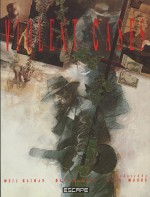

Sleaze Castle – the Directors Cut Part #0


By Dave McKinnon & Terry Wiley with various (Markosia)
ISBN: 978-1-905692-93-4

I’m old, me. I’ve been around for a bit and met a few folks. So, as occurs when I’m reviewing something by people I’ve gone drinking with, I feel compelled to admit to potential conflicts of interest such as here.

The Society of Strip Illustrators/Comics Creators Guild used to meet on the last Thursday of every month in London. There old lags and aspiring talents rubbed scruffy, grimy, dandruffed – occasionally scrofulous – shoulders, talking comics old and new whilst showing off what we were up to.

Always a fun, laid-back evening, those times when the laconic Terry Wiley would turn up from points North with copies of the latest self-published issue of Tales From Sleaze Castle were especially un-memorable – a combination of subsidised booze and the fact that most folks immediately buried their heads in the mesmerising, fundamentally British, trans-dimensional, time-busting kitchen sink comedy/drama/nostalgic fantasy buddy-movie of a comic and lost all power of speech until they’d finished.

It’s just that good – probably the very best home-grown comic saga you’ve never read – and it also holds strong claim to probably the very best and most appalling literary puns in all sequential narrative.

Scripted by the equally demi-mythical Dave McKinnon, the epic adventure is pretty straightforward but also nearly indescribable. The story unfolds in a progression of mini-chapters and vignettes which act as diary and six-month countdown to an inescapable, predestined event…

After a rather bemused Foreword from author McKinnon, this latest edition of the monochrome masterpiece of wacky understatement starts with ‘Another Earth, Another Dimension, Another Reason to Go Shopping’ and a brace of ‘Prologues’ in which we meet incomprehensibly ancient Pandadomino Quartile, puissant albino Empress of another Realm of Reality and undisputed dominant resident of the incredible, infinite domicile dubbed Sleaze Castle.

Also brought to our attention are the thoroughly grounded though no less implausible Dribble family of Earth; mother Poppy, younger daughter Petra and her older sister Jocasta, befuddled student and co-star of our show…

As post-grad Jo returns to college in the Northern wilds of England and her ongoing M.A. in Televisual Studies, in London the Queen (not ours, the other, alien one) goes shopping. It is ‘Sep. ’86: Castaway’ and there’s about to be a small hitch…

The time/space door malfunctions and Pandadomino is stranded here. Establishing shaky communications with home she is assured that things will be fixed but it will take six months to retrieve her. Moreover the portal will appear in another location…

An incoming call then gives further details and instructions.

It’s from herself who has literally just returned to SleazeCastle and she has some advice for her younger, stranded self. It’s quite bizarre, paradoxical and tediously specific instructions on what to do for the next 178 days so she’d better get a pencil…

Jocasta Dribble is on ‘Autopilot   11:23’ as she makes her way from the railway station to her room in the Ethel Merman Hall of Residence at the University of Novocastria.

As usual the trip is fraught with woolgathering and petty weirdnesses but eventually she slumps onto her term-time bed and makes the acquaintance of her new neighbour.

The oddly naive girl with the shock of black hair, exotic face and too much eye makeup is from Thailand.

Sandra “call me Panda” Castle has absolutely no idea about living in England so Jo takes her under her maternal wing, blithely oblivious that her new friend is an extraterrestrial immigrant, used to commanding vast armies and geniuses of various species, cunningly disguised with dyes and contact lenses. Moreover the strange stranger has used all her wiles to cheat her way into the room next door which will, some months’ distant, very briefly become an inter-dimensional gateway before snapping shut forever…

And thus begins the gentle and seductively enchanting story of the relationship between two of the most well-realised women in comics. As geeky outsider Jo at last blossoms into a proper grown-up – she even finds a boyfriend, more than a decade after her precocious schoolgirl sister Petra – her instruction of the oddly sophisticated “Thai” into British civilisation and college life is simultaneously heart-warming, painful, hilarious, poignant and irresistibly addictive to watch.

It’s also deliciously inclusive and expansive: packed with what 21st century consumers now call “Easter Eggs”. These hidden nuggets of in-jokes, wry observations and oblique cultural and comics references are witty and funny enough in their own right, but if you were in any way part of the comics scene in the late 1980s they are also an instant key into golden times past, packed with outrageous guest-appearances by many of the upcoming stars and characters of the British cartooning and small press movement.

(Whilst the absolutely riveting scenes of Jo and Panda trying out both Novocastria’s Women Cartoonist Society and all-male Komik Klub are timeless slices of shtick to you lot, they were a solid reminder of times past and people I still owe a Christmas card…)

Panda spends her first Christmas ever with the Dribbles and their ferociously Italian extended family but, as the days are counting down, the displaced millennia-old queen is beginning to wonder what will happen once she leaves…

Astoundingly there are people and places and things and people and one person in particularly who is apparently unique and irreplaceable even in the unending pan-cosmic Reality she owns. There’s this friend she’s really can’t bear to lose…

Beautifully scripted, alluringly paced and exquisitely rendered, this book would be paralysingly evocative for any Brit who went to college between 1975 and 1990, but what makes it all so astonishingly good is the fact that this delightful melange of all the things that contributed to our unique culture are effortlessly squooshed together as mere background in an captivating tale of two outsiders finding friendship through adversity and by perpetually lying to each other…

There have been comparisons to Los Bros Hernandez’ Love and Rockets but they’re superficial and unfair to both. I will say though that both are uniquely the product of their own time and regional geography…

This collection also includes a cover gallery and pin-ups as well as the additional plus of ‘And Finally… Three Lost Tales’ which features an aspect of the business I really miss.

A few of the self-publishing community cameoed in the Women Cartoonist Society and elsewhere – in a spirit of communal tit-for-tat – collaborated on side-bar stories featuring Panda, Jo and the rest during the comic’s initial run and with commentary from McKinnon are re-presented here, so even after the cliffhanger story-pause you can still have a laugh with ‘The Rules of the Game part I’ by Lee Kennedy, ‘The Rules of the Game part II’ by Lee Brimmicombe-Wood and what I’ll call ‘An Idea in a Book is Worth Two in the Head’ by Jeremy Dennis. You’ll need to buy this book to realise why…

This a book by lovers of comics for lovers of comics and now that I’ve read this brand-new edition with its remastered pages and fresh snippets of original  material I’m going to re-read the next three volumes in the Gratuitous Bunny Editions I bought years ago. Unless you have your own temporal retrieval system you’ll just have to wait for the next volume…
SleazeCastle is ™ & © 1992, 2012 Dave McKinnon & Terry Wiley. This edition ™ & © Dave McKinnon, Terry Wiley and Markosia Enterprises, Ltd. All rights reserved. Three Lost Tales © 1996, 2012 Lee Brimmicombe-Wood, Lee Kennedy and Jeremy Day
This book is available for download on iPhone, iPad or iPod touch with iBooks and on your computer with iTunes. Books must be read on an iOS device.

A Cartoon History of the Monarchy


By Michael Wynn Jones (Macmillan)
ASIN: B001H0OAOO           ISBN: 0-333-19805-0

Just picked this up in a second-hand shop and thought of you – well, some of you anyway – on this anniversary day…

We’re far too reluctant in this country to celebrate the history and quality of our own cartooning tradition; preferring simply to remark on the attention-grabbers or impressive longevity of one or two classic and venerable veterans of the pen-&-ink game, when the actual truth is that for an incredibly long time the political art movement of the Empire and Commonwealth – and its enemies – was vast, varied and fantastically influential.

The British wing of the form has been magnificently serviced over the centuries by masters of form, line, wash and most importantly ideas, repeatedly tickling our funny bones or enraging our sleeping consciences and sensibilities, all whilst poking our communal pomposities and fascinations.

From its earliest inception, satiric draughtsmanship has been used to attack and sell: initially ideas, values, opinions and prejudices or but eventually actual products too. In newspapers, magazines and especially comicbooks, the sheer power of graphic narrative, with its ability to create emotional affinities, has led to the creation of unforgettable images and characters – and the destruction of real people or social systems.

When those creations can affect the daily lives of millions of readers, the force that they can apply in the commercial or political arena is almost irresistible…

In Britain the cartoonist has held a bizarrely precarious position of power for centuries: the deftly designed bombastic broadside or savagely surgical satirical slice instantly capable of ridiculing, exposing, uplifting or deflating the powerfully elevated, unapproachable and apparently untouchable with a simple shaped-charge of scandalous wit and crushingly clear, universally understandable visual metaphor.

For this method of concept transmission, lack of literacy or education is no barrier. As the Catholic Church proved millennia ago with the Stations of the Cross, stained glass windows and a pantheon of idealised saints, a picture is worth far more than a thousand words…

For as long as we’ve had printing in this country there have been scurrilous gadfly artists commentating on rulers, society and all iniquities: pictorially haranguing the powerful, pompous, privileged and just plain perfidious through swingeing satire and cunning caricature. Sometimes artists have been just plain mean…

Britain had no monopoly on talent and indignation, and this canny compendium also frequently features European – and latterly American – takes on our scandalous Royals and oddball citizenry…

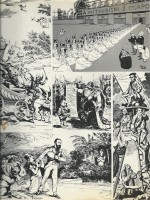
Released in 1978 and desperately in need of updating and re-issue, A Cartoon History of the Monarchy offers a potted, far from hagiographic history and deliciously skewed view of our Ruling Elite in all their unsavoury glory; an unbroken line of jibes, asides and broadsides gathered from divers sources by jobbing journalist and aficionado of japes, lampoons and sketches Michael Wynn Jones, who here casts a discriminating eye from the reign of Elizabeth I up until just before the Silver Jubilee of the second Regina to bear the name…

Following a handy list of the Kings and Queens of England, the pomposity-puncturing procession commences with The Age of Intolerance, reproducing cartoons and adding commentary dealing with the doings of the ten monarchs from Elizabeth I – George II.

The accompanying essays describe the zeitgeist of those times – the religious question as England, Wales, Ireland and eventually Scotland came to numerous crises regarding succession.

That issue always revolved around whether the land should be Catholic or Protestant. ‘Popes, Plots and Puritans’ led to the final solution when ‘The Men from Hanover’ arrived to settle the matter and fully cement the nation under the Church of England.

The savage sampling of the nation and continent’s opinions are represented here by 26 visual bombards such as the allegorical assault ‘Diana and Callisto’ by Dutch artist Miricenys from 1585, the anonymous ‘England’s Miraculous Preservation’ from 1648 and ‘The Royal Oake of Brittayne’ (from 1649) amongst so many others.

Cartoon grotesques such as ‘Cromwell’s Car’ (1649) or ‘Babel and Bethel’ (1679) appear beside such scandalous foreign attacks as Dutch illustrator Dusart’s ‘Fr. James King’ and the anonymous French pictorial polemic ‘Notice of Burial’ (both from 1690). We British riposted with jeering celebrations of martial triumphs such as ‘The Arrival of William and Mary’ (1689), ‘The Great Eclipse of the Sun’ (simultaneously a topical spin on a solar event in 1706 and the defeat of “Sun King” Louis XIV by the British armies of Queen Anne), and ‘A Bridle for the French King’ from the same year.

Domestic contretemps are highlighted through such draughtsman’s delights as the anonymous 1743 shocker ‘The Hanover Bubble’, Ebersley’s ‘The Agreeable Contrast’ (from 1746 and attacking King George’s brother “Butcher” Cumberland’s treatment of Jacobites after the defeat of the Young Pretender), and the exposure of Popish influence in the Highlands described by ‘The Chevalier’s Market’ from 1745…

Whereas much of this material – both British and foreign – was generally national commentary and straight religio-political assault, by the time period covered in The Wickedest Age: George III – George IV (1760-1830) the cartoon had also evolved into a weapon designed to wound with wit and crush through cruel caricature.

After covering the major crises and scandals of the generally sensible – if parsimonious – third George in ‘The Royal Malady’, ‘“The Dregs of Their Dull Race”’ and ‘Twilight Years’, a veritable Golden Age of popular disapproval and artistic mugging of the Prince Regent and much-delayed, frustrated monarch (and his many mistresses) is covered in ‘The Prince of Whales’, ‘The Secret Marriage’, ‘“Pray Get Me a Glass of Brandy”’ and ‘Delicate Investigations’.

The public disdain of the times generated a fusillade of cartoon prints, represented here by 35 graphic bombards and savage cartoon sallies by names which have become as famous as any ruler. However master character assassins Townsend (‘The Scotch hurdy-gurdy’), George Cruikshank (‘Royal Condescension’), Gillray (‘A New Way to Pay the National Debt’, ‘A Voluptuary under the Horrors of Digestion’), Rowlandson (‘The Prospect Before Us’) and Heath (‘A Triumph of innocence over perjury’) are ably bolstered by lesser lights West (‘The Save-all and the Extinguisher!’), Williams (‘Low Life above stairs’), Vowles (‘The shelter for the destitute’) and Marshall (‘The kettle calling the pot ugly names’) and a few anonymous pen-pricks who nevertheless hit hard with ‘Tempora Mutantor’, ‘The captive Prince’ and ‘Reading of the Imperial decree’ and more.

As periodical publication overtook print-shops as the greatest disseminators of carton imagery, the open savagery and targeted vulgarity of caricaturists was gradually replaced with mannered, if barbed, genteel observation.

Thus The Age of Discretion: William IV, Victoria (spanning 1830-1901) offers a different style of Royal Commentary: no less challenging, but certainly much more overtly respectful when critical. Sometimes, though, this new family-oriented cartooning, even in magazines such as Punch and The Times, simply sunk to fawning veneration as the institution of monarchy became more and more removed from the lives of the citizenry.

William’s times are summed up in text via ‘The Sailor King’ and ‘Reform Billy’ whilst Victoria’s epochal reign and the Parliamentarians who increasingly wielded the decisive power is described through ‘The Queen of the Whigs’, ‘Revolutions are bad for the Country’, ‘The Black and the Brown’ and ‘Years of Widowhood’.

The 36 collected images capture those days of Empire, with Heath, Seymour and Doyle predominant in illustrating bluff sea-dog William’s socially contentious days of Reform.

Victoria’s years, from engaging popular ingénue Queen, through happy bride to politically intrusive grand dame of European Court intrigue, highlights the craft of Doyle (‘The Queen in Danger’, 1837), Leech, (‘There’s Always Something’, 1852), Tenniel (‘Queen Hermione’, 1865, ‘New Crowns for Old Ones!’, 1876), Morgan (‘Where is Britannia?’ and ‘A Brown Study’ – both 1867) and Sambourne (‘Kaiser-i-Hind’, 1876) amongst so many others.

Her latter years also saw a rise in social conscience cartooning as displayed by the crusading Merry with ‘The Scapegrace of the Family’ (1880), ‘The fall of the rebels‘ in 1886 and more, or the telling modernist take of Max Beerbohm whose ‘The rare, the rather awful visits of Albert Edward to Windsor Castle’, cuttingly illustrated the rift between the Empress and her playboy heir…

Despite her well-known disapproval, the good-time Prince became an effective king as was his son, both covered in The Edwardian Age: Edward VII – George V, spanning 1901-1936. Their dutiful achievements are recounted in ‘The Coming King’ and ‘The First Gentleman of Europe’ before war with Germany necessitated a family name change for George – ‘The First Windsor’…

With kings increasingly used as good-will ambassadors and being cited in scandals that frequently ended in court, the 30 cartoons included in this section include many German pieces from not only the war years but also the tense decade that preceded them, as Imperial Superpowers jostled for position and tentatively used propaganda to appeal to the world’s “unwashed masses” for justification for their aims and ambitions.

Beside veteran caricaturists such as Leech, Morgan, May, Partridge, Staniforth and David Low are merciless lampoons from German cartoonists Brandt, Blir, Heine, Gulbransson and Johnson as well as French illustrator Veber and lone American Kirby.

Our pictorial history lesson concludes with The Age of Respectability: Edward VIII, George VI, Elizabeth II generally skipping World War II, concentrating instead on the openly secret scandal of Edward and Mrs Simpson in ‘Abdication’ before the advent of ‘New Elizabethans’ brought a modern age of rulers as sideshow attractions…

Although Fleet Street chose to whitewash and suppress the affair between a King-in-waiting and the American divorcee, the rest of the world made great play of the situation: as seen here with 11 telling cartoon shots from Americans McCutcheon and Orro, whilst French scribbler Effel posited typically insouciant Gallic ‘Une Solution’ and German-based Gulbransson played up the true romance angle…

In the meantime British cartoonist Low had to be at his most obliquely hilarious, delineating the crisis by not mentioning it, and Punch stars like Partridge steadfastly pursued a line of deferential, tragic sacrifice…

Although there is very little material featuring wartime monarch George VI – a propaganda casualty of the conflict – the last 20 images herein celebrate the changing image of a very public Royal Family as pictured by names very familiar to contemporary cartoon lovers.

The imagery is also contextually far more familiar – and presumably comfortable – to modern tastes as print media generally learned to save their vitriol for politicians and celebrities and reserved only minor chidings and silly teasing for “the Royals”, as seen in ‘Birthday Greetings’ and ‘Under the Splendid Empire Tree’ by Shepard from 1947 or Illingworth’s 1951 panels ‘Family Ties’ and ‘Happy Returns’.

Papers were, however, happy to utilise the monarchy to score points against governments, as seen in an attack on Enoch Powell (Cummings’ ‘Ministry of Repatriation’) and the battle between Rhodesia’s Ian Smith and Harold Wilson lampooned in ‘Your Move!’ by Jak (both from 1968) or the legendary Giles’ ‘New Rent Assistance Bill’ (1971).

Also offering acerbic jollity of a far more blueblood-specific variety are cartoon giants Trog and Waite who join the abovementioned in exploiting the Royal Family’s gift for headline-stealing gaffes in such daring gags as ‘I Suppose we did send them to the Right Schools?’, ‘I Suppose she’ll think these are of the Queen Mother’, ‘More Pay’ and ‘Andrew’s Exchange Student’: coming full circle with the best of Hanoverian excesses scrutinised by a cost-conscious government and public – but this time for rather more gentle laughs…

Appended with a scholarly section of Acknowledgements, Illustration sources and Index of artists, this is an extremely welcoming and effective introduction to the lasting relationship between Royalty, Church and Fourth Estate that offers a fantastic overview of Regal adaptability and cultural life through a wealth of cunningly contrived images and pictorial iconography that reshaped society and the world.

These are timeless examples of the political pictorialist’s uncanny power and, as signs of the times, form a surprising effecting gestalt of the never-happy nation’s feeling and character…

None of that actually matters now, since these cartoons have performed the task they were intended for: shaping the thoughts and attitudes of generations of voters. That they have also stood the test of time and remain as beloved relics of a lethal art form is true testament to their power and passion.

Stuffed with astounding images, fascinating lost ephemera and mouth-watering tastes of comic art no aficionado could resist, this colossal collection is a beautiful piece of cartoon history that will delight and tantalise all who read it and truly deserves to be back on bookshelves…
© Michael Wynn Jones 1978. All rights reserved.


What’s He Like in Bed? – A Rough Guide to the Bedside Manners of the Human Male


By Marcel Feigel & Brian Heaton (Arrow Books)
ISBN: 978-0-09-944660-X

Warning: this book is rude and a bit nude, so if you’re of a sensitive nature and don’t think sex is funny it could all be a bit of a shock and potentially lead to the sundering of your dreams and life-long disillusionment.

As Winter Part III (This Time it’s Personal!!!) settles in around my oversized, sun-deprived ears, I again turn to an old cartoon book to inculcate a little warmth and cheer to my gloomy days. Here’s another little known collection of cartoons about British bedtime habits to tide us all over: at least if we have to submerge ourselves in duvets and cocoa we might as well have a giggle at the same time…

Of course it’s all really just one more excuse to bemoan the loss of those once-ubiquitous cheap ‘n’ cheerful cartoon-packed paperbacks which are now all-but-forgotten fossils of a once mighty industry; fast fading as the more palatable sounding Graphic Novels and Trade Collections carve a niche in our psyches and on our bookshelves.

What’s He Like in Bed? is a solid example of a lost art form: saucily-themed gag-books which were the last commercial gasp in a tradition of pictorial entertainments that began with Punch and evolved into a racy standby of British life for nearly a century before fading away to loiter around bargain bins, Jumble sales and junk shops…

This particular raucous, ribald and hilariously risqué treatise catalogues the ploys and peregrinations of that forgotten popular hero “The Guy Who Gets All the Girls” and thus contains lots of wickedly naked people making a mess, scandalising the neighbours, and generally letting the side down more than just a bit…

Masquerading as invaluable tips and hints, the assorted chapters fully expose the tactics and foibles of ‘The Truck Driver’, ‘The Customs Man’ and even ‘Country and Western’ fans before breaking for the first of a recurring exploration of inflatable friend aficionados, after which ‘The Translator’ and the ‘Stone Mason’ both fail to live up to the modern girl’s exorbitant and exaggerated expectations.

‘The Estate Agent’ soon gives way to ‘Inflatable Doll #1’ and ‘The Librarian’ to ‘Inflatable Doll #2’ before the urbane legends of ‘The Milkman’ and ‘The Footballer’ are finally tackled…

‘Inflatable Doll #3’ leads to a fully extended chapter on ‘The Macho Man’ (including especially some handy hints on ‘The Condom Moment’, ‘The Importance of Momentum’ and those all-important ‘Orgasm Restrain-Postponement Techniques’), before a brief interlude with ‘Inflatable Doll #4’ gives us all a moment to catch our breaths (big ones too)…

There’s an educational advantage to be had in dealing with ‘The Don’ (Oxbridge not Corleone) and the full SP on ‘The Jockey’, whilst ‘The Detective’ and ‘The Barrister’ reveal facets of human nature best left vague, whilst both ‘The Dentist’ and ‘The Airline Pilot’ act just as you’d suspect – even if ‘The Bishop’ doesn’t.

Also on show are the habits of ‘The Farmer’, ‘Inflatable Doll #5’, stage magician ‘The Great Popoff’, the secrets of ‘Corporate Life’ in the Post Room, for Middle Management and even under the Chairman but as always ‘The Actor’, ‘The Policeman’ and the truly disturbing sight of glamour icon Margaret Thatcher as ‘Inflatable Doll #6’ act as sure signs that those so-different times are gone forever.

Still with secrets to conceal are ‘The Taxi Driver’, ‘The Accountant’, ‘The Athlete’, ‘The Computer Man’, ‘Frenchmen’ in general, ‘The Vicar’, ‘The Disc Jockey’ and ‘The Photographer’, but eventually even modern men need a bit of a rest and the lecture concludes with ‘The Revenge of the Inflatable Doll’…

Dedicated to the certain premise that (other) people’s sexual exploits are simultaneously better than yours and still truly hilarious, this snappy little monochrome tome is a cut above much of the era’s rather tawdry treatment of the subject, superbly rendered and still marvellously entertaining even in these liberally licentious times – and for a change, this one is still readily available from a range of internet retailers…

British cartooning has been magnificently served over the centuries by masters of form, line, wash and most importantly smart ideas, repeatedly poking our funny bones, pricking our pomposities, stroking our happy places and feeding our fascinations, and this sort of thing used to be bread ‘n’ butter in our game. We’re all going to really miss them if they do disappear forever, so why not find a shy, alluring little bookshelf and start filling it with mucky material like this…
Heaton is a competent artist in the modern style and the gags range from contrived to fiendishly clever, all delivered with easy charm and utterly without text – never an easy job in cartooning. If you find this book or anything similar give it a try, as you really will miss them once they disappear forever.
© 1992 Brian Howard Heaton. All Rights Reserved.

Doctor Who Graphic Novels volume 15: Nemesis of the Daleks


By Richard Starkings, John Tomlinson, John Freeman, Paul Cornell, Dan Abnett, Steve Moore, Lee Sullivan, John Ridgway, Steve Dillon, David Lloyd & many and various (Panini Books)
ISBN: 978-1-84653-531-4

The British love comic strips and they love celebrity and they love “Odd Characters.”

The history of our graphic narrative has a peculiarly disproportionate amount of radio comedians, stars of theatre, film and TV such as Charlie Chaplin, Arthur Askey, Winifred Atwell, Max Bygraves, Charlie Drake and their ilk, as well as actual shows and properties such as Whacko!, ITMA, Our Gang, (there was a British version of the Hal Roach film sensation by Dudley Watkins in Dandy as well as the American comicbook series by Walt Kelly), Old Mother Riley, Supercar, Pinky & Perky and literally hundreds more.

Anthology comics such as Radio Fun, Film Fun, TV Fun, Look-In, TV Tornado, TV Comic and Countdown amongst others translated our viewing and listening favourites into pictorial escapism every week, and it was a pretty poor lead or show which couldn’t parley the day job into a licensed comic property.

Television’s Doctor Who premiered with part one of ‘An Unearthly Child’ on November 23rd 1963, and the following year his (their?) decades-long association with TV Comic began in issue #674 and the first instalment of ‘The Klepton Parasites’ – so this year marks the 50th or Golden Anniversary of the evergreen show and the 49th (Apoplexium, I believe) of the strip iteration.

On 11th October 1979 (although, adhering to the US off-sale cover-dating system, it says 17th) Marvel’s UK subsidiary launched Doctor Who Weekly, which became a monthly magazine in September 1980 (#44) and has been with us through various title-changes ever since. All of which only goes to prove that the Time Lord is a comic hero with an impressive pedigree and big shoes to fill.

Marvel/Panini is in the ongoing process of collecting every strip from the prodigious annals and archives in a uniform series of over-sized graphic albums, each concentrating on a particular incarnation of the deathless wanderer. This particular one gathers stories from a range of sources (specifically Doctor Who Magazine #152-156, 159-162, The Incredible Hulk Presents #1-12, Doctor Who Weekly #17-20, #27-30 and Doctor Who Monthly #44-46; spanning 1980-1990) and nominally stars the Seventh Doctor -Sylvester McCoy.

Also on show are some awesome ancillary stars from the monolithic Time Lord Universe (Whoniverse?) including the eponymous trundling terrors of the title, legendary cosmic crusaders the Star Tigers and the long-revered tragic, demented antihero Abslom Daak, Dalek-Killer.

Delivered beauty-contest style in reverse order, the magnificent magic opens with the cataclysmic ‘Nemesis of the Daleks’ (from DWM #152-155) as Richard and Steve Alan – AKA Richard Starkings & John Tomlinson – deliver a definitive and classic clash between the nomadic Time Lord and the ultimate foes of life wherein the deadly Daleks enslave a primitive civilisation and drive the pitiful native Helkans to the brink of extinction by forcing them to construct a Dalek Death Wheel armed with the universe’s most potent and toxic Weapon of Mass Destruction.

Grittily illustrated by Lee Sullivan, the blockbuster saga opens with the valiant last stand of incongruous chmpions the Star Tigers before the peripatetic Doctor accidentally arrives in the right place at the wrong time – no surprise there then – and joins death-obsessed Abslom Daak in a hopeless attempt to stop the Emperor of the Daleks from achieving supreme power…

Filled with evocative do-or-die heroics this is a battle only one being can survive…

As a complete change-of-pace, ‘Stairway to Heaven’ (#156 from January 1990 and by John Freeman, Paul Cornell & Gerry Dolan) offers a wry and merrily murderous poke at modern art and the slavish gullibility of its patrons that still holds true today – and probably always will…

The Incredible Hulk Presents was a short-lived reprint weekly from Marvel UK which launched on September 30th 1989, targeting younger readers and featuring four media-fed features.

As well as the Big Green TV sensation it also reprinted American-produced stories of Indiana Jones and GI Joe/Action Force, but the mix was augmented by all-new adventures of the Gallant Gallifreyan by a rapidly rotating roster of British creators.

The plan was to eventually reprint the Who stories in DWM – thus maximising the costly outlay of new material at a time in British comics publishing where every penny counted. It didn’t quite go to plan and the comic folded after 12 issues, with only a couple of the far simpler – though no less enjoyable offerings – ever making it into the more mature magazine publication.

It all began with ‘Once in a Lifetime’ by Freeman & Geoff Senior wherein an obnoxious alien reporter learned to his dismay that some stories are too big even for the gutter press, after which issues #2-3 featured creators Dan Abnett & John Ridgway whose ‘Hunger From the Ends of Time!’ saw the Doctor and Foreign Hazard Duty – the future iteration of UNIT – save the Universal Library from creatures who literally consumed knowledge.

‘War World!’ by Freeman, Art Wetherell & Dave Harwood found the irascible time-traveller uncharacteristically fooled by an (un)common foot soldier, whilst in ‘Technical Hitch’ by Abnett & Wetherell, the Doctor saved a lonely spacer from unhappy dreams of paradise…

Freeman & Senior concocted a riotous, monster-mash for ‘A Switch in Time!’ whilst ‘The Sentinel!’ by Tomlinson & Andy Wildman found the Time Lord helpless before a being beyond the limits of temporal physics who claimed to have created all life in the universe but still needed a little something from Gallifrey to finish his latest project…

Another 2-parter in #8-9 declared ‘Who’s That Girl!’ as the Doctor’s latest regeneration apparently resulted in a female form just as the Time Lord was required to  stop an inter-dimensional war between malicious macho martial empires. Of course there was more than met the eye going in this silly but engaging thriller by Simon Furman, John Marshall & Stephen Baskerville.

Simon Jowett & Wildman produced a light-hearted salutary fable as ‘The Enlightenment of Ly-Chee the Wise’ proved that some travellers are too much for even the most mellow of meditators to handle, after which Mike Collins, Tim Robins & Senior proved just how dangerous fat-farms could be in ‘Slimmer!’ before The Incredible Hulk Presents ended its foray into time-warping with the portentous ‘Nineveh!’ by Tomlinson & Cam Smith, wherein the Tardis was ensnared in the deadly clutches of the Watcher at the End of Time – an impossible mythical being who harvested Time Lords after their final regeneration…

For most of its run and in all its guises the Doctor Who title suffered from criminally low budgets and restricted access to concepts, images and character-likenesses from the show (many actors, quite rightfully owning their faces, wanted to be paid if they appeared in print…) but diligent work by successive editors gradually bore fruit and every so often fans got a real treat…

‘Train-Flight’ by Andrew Donkin, Graham S. Brand & John Ridgway ran in DWM #159-161 from April to June 1990 and benefited from some slick editorial wheeler-dealing and the generosity of actress Elizabeth Sladen (who allowed her Sarah Jane Smith character to be used for a pittance) in a chilling tale of alien abductions.

A long overdue reunion between the Time Lord and his old Companion was swiftly derailed when their commuter train was hijacked by marauding carnivorous insects…

‘Doctor Conkerer!’ (#162 by Ian Rimmer & Mike Collins) then terminates the Time Lord’s travails in this tome with a humorous tale describing the unsuspected origins of that noble game played with horse chestnuts beloved by British schoolboys, assorted aliens and, of course, Vikings of every stripe…

There’s still plenty of high quality action and adventure to enjoy here, however, as the complete saga of ‘Abslom Daak, Dalek-Killer’ by Steve Moore and artists Steve Dillon& David Lloyd (from Doctor Who Weekly #17-20, February-March 1980, Doctor Who Weekly #27-30, April 1980 and Doctor Who Monthly #44-46, December 1980-February 1981) fills in the blanks on the doomed defenders of organic life everywhere…

In the 26th century the Earth Empire is in a death struggle with voracious Dalek forces yet still riven with home-grown threats.

One such is inveterate, antisocial killer Abslom Daak, who, on sentencing for his many crimes, chooses “Exile D-K” – being beamed into enemy territory to die as a “Dalek Killer”. His life expectancy as such is less than three hours… and that suits him just fine.

Materialising on an alien world the madman eagerly expects to die but finds an unexpected reason to live until she too is taken from him, leaving only an unquenchable thirst for Dalek destruction…

The initial ferociously action-packed back-up series led to a sequel and ‘Star Tigers’ found the manic marauder winning such improbable allies as a rebel Draconian Prince, a devilish Ice Warrior and the smartest sociopath in Human space, all willing to trade their pointless lives to kill Daleks…

As always the book is supplemented with lots of text features, and truly avid fans can also enjoy a treasure-trove of background information in the 17-page text Commentary section at the back, comprising story-by-story background, history and insights from the authors and illustrators, supplemented by scads of sketches, script pages, roughs, designs, production art covers and photos.

This includes full background from former DWM editor/scripter John Freeman on the stories, plus background on the guest stars in ‘Tales from the Daak Side’ by John Tomlinson.

More details and creator-biographies accompany the commentaries on The Incredible Hulk Presents tales and there’s a feature on ‘Hulk meets Who’ explaining that odd publishing alliance, as well as reminisces from editor Andy Seddon and even more info on the legendary Dalek killer and his Star Tiger allies to pore and exult over.

None of which is relevant if all you want is a darn good read. However all the creators involved have managed the ultimate task of any artisan – to produce engaging, thrilling, fun work which can be equally enjoyed by the merest beginner and the most slavishly dedicated and opinionated fans imaginable.

This is another marvellous book for casual readers, a fine shelf-addition for dedicated fans of the show and a perfect opportunity to cross-promote our particular art-form to anyone minded to give comics one more go…

All Doctor Who material © BBCtv. Doctor Who, the Tardis and all logos are trademarks of the British Broadcasting Corporation and are used under licence. Licenced by BBC Worldwide. Tardis image © BBC 1963. Daleks © Terry Nation. All commentaries © 2013 their respective authors. Published 2013 by Panini Publishing, Ltd. All rights reserved.

Clubbing


By Andi Watson & Josh Howard (Minx/Titan Books edition)
ISBN: 978-1-84576-580-4

In 2007 DC comics had a worthy go at building new markets by creating the Minx imprint: dedicated to producing comics material for the teen/young adult audience – especially the ever-elusive girl readership – that had embraced translated manga material, momentous global comics successes such as Maus and Persepolis and those abundant and prolific fantasy serials which produced such pop phenomena as Roswell High, Twilight and even Harry Potter.

Sadly after only a dozen immensely impressive and decidedly different graphic novels Minx shut up shop in October 2008, markedly NOT citing publishing partner Random House’s failure to get the books onto the appropriate shelves of major bookstore chains as the reason.

Nevertheless the books which were published are still out there and most of them are well worth tracking down – either in the US originals or the British editions published by Titan Books.

One of the most engaging was Clubbing, from Andi Watson & Josh Howard, which stylishly and wittily blended teen rebellion and shopping-culture insouciance with murder-mystery and supernatural horror in an audacious and winning black and white, cross-cultural romantic romp in Wordsworth Country…

Charlotte Brook has been a bad girl. London’s most self-absorbed fashionista, social butterfly and shopping diva, “Lottie” got caught using a homemade fake I.D. to get into an out-of-bounds West End nightclub and ended up coming home in a police car…

Her outraged but rather disinterested parents simply bundled her off for the summer to the wilds of the Lake District where her dull grandfather and good old Grandma Aggie are going to put her to work in their new Golf resort.

Faced with the dire prospect of months of rain, no Wi-Fi coverage, Golf, Women’s Institute do’s, old people, hicks and yokels, golf and mud and golf, Lottie is far from happy, but as always Aggie’s ubiquitous cakes and cuppas go some small way towards assuaging the agony.

Granddad Archie Fitz-Talbot‘s time is constantly taken up with the on-going and behind schedule conversion of his posh old country club into a major modern sport and leisure venue and, after only one wind-blown, rain-sodden tour in the most fabulous outfit from her stylishly inappropriate wardrobe, Lottie realises that she’s actually in hell.

Her poor beloved shoes are all doomed too…

The local teens are a dire lot, rough, rude and pretentious; more interested in gore, blood and faux Satanism rather than music and fashion – like any self-respecting Goth should be – and as for the nice young man Aggie is trying to set her up with, Lottie wouldn’t be seen dead with a guy who loves fishing and golf no matter how good looking he is…

Howard is the least of her problems. In their affable, comfortable way, Archie and Aggie are determined to torture her to death: they feed her wholesome stodgy food, drag her all over the place on walks and trips through the beautiful countryside, take her to W.I. galas and, horror of horrors, ask her to work in the gift-shop with ghastly golf pro Tom Hutchinson – at least until she accidentally burns it down…

Things get decidedly strange after Lottie clashes with officious wizened-ancient employee Mrs. Geraldine Gibbons over towels in the gym, and again at a W.I. cake-baking contest. The old biddy has a real bee in her bonnet and babbles on about secrets and hidden truths and is clearly bingo-wing bonkers…

Lottie begins to suspect otherwise when she and the slowly growing in coolness Howard find the old bat’s strangely mutilated body in a water-hazard on the Links…

Some of those sinister secrets start to emerge when the shaken teen then discovers old Archie is a bit of a player – Urgh! wrinklies indulging in illicit lurrve – and might need to get rid of the occasional octogenarian bit of rough, but something just doesn’t add up and before long Lottie and Howard are grudgingly, disbelievingly swept into a bizarre and baffling mystery with demonic cults, a horrific monster menace from beyond Reality and staggering personal implications for Lottie and her entire family…

Clubbing is a sharp, witty, subtly funny and intriguing coming of age horror-thriller-comedy which follows all the rules of the teen romance genre yet manages to inject a huge helping of novelty and individual character into the mix: a perfect vehicle for attracting to our medium new and youthful readers with no abiding interest in outlandish power-fantasies or vicarious vengeance-gratification – and yes, that does mean girls…

This snazzy so-British reading rave also includes ‘Lottie’s Lexicon’: a cool guide to speaking young Londoner, full creator biographies and three tantalising preview segments from other tempting MINX titles.

Track them all down and enjoy a genuinely different kind of comic book…
© 2007 Andi Watson and DC Comics. All rights reserved.

The Perils of Pushing 40


By Colin Whittock (Century Hutchinson)
ISBN: 0-7126-1290-4

It’s been a while since I’ve taken a fond look at a resolutely British cartoon compendium and indulged in a few sound and certain smirks and chuckles. This time it’s a little known collection of cartoons about the inexorable passage of time from one of our best yet criminally under-celebrated gagsters.

Of course it’s really just another excuse to bemoan the loss of those once-ubiquitous cheap ‘n’ cheerful gag-filled paperbacks which are now all-but-forgotten fossils of a once mighty industry; fast fading as the much more important-sounding Graphic Novels and Trade Collections carve a niche in our psyches and on our bookshelves.

Me, I’m still convinced that there’s a place on those shelves for some new collections of our magnificent history of graphic giggles and cartoon chortles…

…And, having again glanced at the wasteland that is daytime TV, I’m firmly of the opinion that Parliament should mandate that all new homes have at least one bookshelf built in…

None of which matters a jot or tittle as I call to your attention to a particularly fine example of a lost Artform: themed gag-books which sadly were the last commercial gasp in a tradition of pictorial entertainments that began with Punch and evolved into a saucy standby of British life for nearly a century before fading away, to only haunt bargain bins, Jumble Sales and junk shops…

Colin Whittock was born in Birmingham in 1940 and, after the traditional period of vocational wandering in the wilderness in which he worked as a shopfitter, eventually took up his brushes, pens and pencils to work as a freelance cartoonist.

In 1969 he became Editorial Cartoonist on the Birmingham Evening Mail – a position I suspect he still holds – and also worked as Sports cartoonist for the Sunday Mercury. In his spare time he produced the full-colour feature strip Kev, freelanced for Punch and Private Eye, as well as The Daily Mirror, The Sun, Daily Sketch, Tit-Bits, Weekend, Reveille and The Oldie whilst pursuing a healthy and respectable sideline in advertising, with commissions from greetings card companies, TNT, British Telecom, Jaguar and Powergen amongst others.

British readers of a certain vintage would recognises the art if not the name, as Whittock also worked for years on Buster, Whizzer & Chips, The Beano and other humour weeklies.

He succeeded Leo Baxendale on Champ, and also drew Catnap, Lazy Bones, Clever Dick & Mizz Marble amongst others. The comics work dried up in 1989 as our industry contracted to near death and he again concentrated on gag panels, although he soon began producing scripts for BBC Radio’s venerable News Huddlines and continued his series of Perils of… books such as this one.

Way back when in 1986, he was at his wry, dry best when sharply observing the pitfalls and pratfalls of the big Four Oh!, remarking with assured style on the absurdity of waning life and drained vitality…

The linked cartoons are clustered into successively trenchant chapters beginning with ‘Fit at 40’, rancorously discussing medical screening, doctors in general and particular, exercise and dieting before moving on to the reason for all that torment in ‘Sex’…

Bitter comparisons abound in ‘The Younger Generation’ and ‘Pet Pals’ describes our often double-sided relationship with things hairy, tooth-filled, unpredictable and expensive before men and women of that uncertain age are shown bearing up under the pressure of ‘The Social Whirl’ and making the unwelcome effort to ‘Dress for Success’…

There’s always the imminent threat of more leisure time, successfully countered by ‘The Sporting Hero’ and the glaring giveaway of outdated taste is tackled in ‘The Music of Time’. At least holidays are a safe subject, as (not) seen in ‘Away From it All’, but never forget that such jaunts can have unexpected repercussions such as ‘Late Arrivals’…

Even if an “Autumn” baby does occur though at least that’s a reason to keep ‘On the Job’ but those work woes won’t assuage the concerns of the world-weary middle-aged in ‘The Future’…

British cartooning has been magnificently served over the centuries by masters of form, line, wash and most importantly smart ideas, repeatedly poking our funny bones, pricking our pomposities, stroking our happy places and feeding our fascinations, and this sort of thing used to be bread ‘n’ butter in our game. We’re all going to really miss them if they disappear forever, so why not get a bookshelf if you don’t have one yet and start filling it with magical material like this…
© 1986 Colin Whittock. All Rights Reserved.

Batman: Knight and Squire

Batman - Knight and Squire
By Paul Cornell & Jimmy Broxton with Staz Johnson (DC Comics)
ISBN: 978-1-4012-3071-5

British Dynamic Duo Knight and Squire first appeared in the cheerfully anodyne, all-ages 1950s – specifically in a throwaway story from Batman #62 (December 1950/January 1951) – as ‘The Batman of England!’

Earl Percy Sheldrake and his son Cyril returned a few years later as part of seminal assemblage ‘The Batmen of All Nations!’ (Detective Comics #215 January 1955) – a tale retrieved from the ranks of funnybook limbo in recent times and included in Batman: Black Casebook – with sequel ‘The Club of Heroes’ appearing in World’s Finest Comics #89, July-August 1957. That one’s reprinted in Showcase Presents World’s Finest volume 1.

The characters had languished in virtual obscurity for decades before fully entering modern continuity as part of Grant Morrison’s build-up to the Death of Batman and Batman Incorporated retro-fittings of the ever-ongoing legend of the Dark Knight dynasty…

They floated around the brave New World for awhile with guest shots in places like Morrison’s JLA reboot and Battle For the Cowl before finally getting their own 6-issue miniseries (December 2010 – May 2011), courtesy of scripter Paul Cornell and artist Jimmy Broxton (with some layout assistance from Staz Johnson), who rather bit the hand that fed them by producing a far from serious, but captivating quirky and quintessentially English frolicsome fantasy masterpiece.

It all begins, as most things boldly British do, down the pub. However The Time in a Bottle is no ordinary boozer but in fact the favourite hostelry for the United Kingdom’s entire superhuman community: the worthy and the wicked…

Hero and villain alike can kick back here, taking a load off and enjoying a mellow moment’s peace thanks to a pre-agreed truce on utterly neutral ground, all mystically enforced by magics and wards dating back to the time of Merlin…

As the half-dozen chapters of ‘For Six’ open it’s the regular first Thursday of the month – and that’s an in-joke for Britain’s comics creator community – with the inn abuzz with costumed crusaders and crazies, all determined to have a good time.

Cyril Sheldrake, current Earl of Wordenshire and second hero to wear the helm and mantle of The Knight, sends his trusty sidekick Beryl Hutchinson – AKA The Squire – to head off a potential problem as established exotics Salt of the Earth, The Milkman, Coalface, The Professional Scotsman and the Black and White Minstrels all tease nervous newcomer The Shrike.

He’d do it himself but he’s chatting with Jarvis Poker, the British Joker…

The place is packed tonight in honour of visiting yank celebrity Wildcat, and a host of strange, outrageous and even deadly patrons all bustle about as Beryl chats to the formerly cocky kid who’s also getting a bit of grief because he hasn’t quite decided if he’s a hero or villain yet…

She’s giving him a potted history of the place when the customary bar fight breaks out but things take an unconventionally dark turn and an actual attempted murder occurs. It would appear that two of these new gritty modern heroes have conspired to circumvent Merlin’s pacifying protections…

Each original issue was supplemented with a hilarious text page which here act as chapter breaks, so after ‘What You Missed If You’re A Non-Brit’ (a glossary of national terms, traits, terminology and concepts adorned with delightful faux small ads), the tale continues as Beryl and Cyril spend a little down-time in rural Wordenshire where the local civilians tackle the insidious threat of The Organ Grinder and his Monkey so as not to bother the off-duty Defenders.

However the pair do rouse themselves to scotch the far more sinister schemes of inter-dimensional invader Major Morris and the deadly Morris Men…

That’s supplemented by the far-from-serious text feature ‘What Morris Men are Like’…

The saga then kicks into high gear with the third instalment as Britain’s Council for Organised Research announces its latest breakthrough.

C.O.R.’s obsessively romantic Yorkist Professor Merryweather had no idea that her DNA reclamation project would lead to a constitutional crisis after she reconstituted Richard III, but it seems history and Shakespeare hadn’t slandered the Plantagenet at all. The wicked monarch was soon fomenting rebellion, using his benefactor’s technology to resurrect equally troublesome tyrants Edward I, Charles I, William II and the ever-appalling King John and even giving them very modern superpowers…

Of course Knight, Squire and her now besotted not-boyfriend Shrike were at the vanguard of the British (heroic) Legion mustered to fight for Queen and Country and repel the concerted criminal uprising…

Following a history lesson on ‘Cabbages and Kings’, Beryl invited the Shrike back to the Castle for tea, teasing and some secret origins, but things went typically wrong when Cyril’s high tech armour rebelled, going rogue and attacking them all.

The text piece deals with ‘Butlers and Batmen’ before it all goes very dark when lovable celebrity rogue Jarvis Poker gets some very bad news from his doctor and a terrifying follow-up visit from the real Joker.

The CampCriminal was desperately concerned about his national legacy but GothamCity’s Harlequin of Hate is just keen on increasing his ghastly and frankly already astronomical body-count. First on the list is that annoying Shrike kid, but the American psycho-killer has big, bold, bizarre plans to make the UK a completely good guy-free zone…

Broken up with a two-part ‘The Knight and Squire Character List’, it all culminates and climaxes with a spectacular and breathtaking showdown after the malevolent Mountebank of Mirth goes on a horrendously imaginative hero-killing spree that decimates the Costumed Champions of Albion: a campaign so shocking that even Britain’s bad-guys end up helping to catch the crazed culprit…

Rewarding us all for putting up with decades of “Gor, blimey guv’nor” nonsense in American comics whilst simultaneously paying the Yanks back for all those badly researched foggy, cobbled-rooftops-of-London five minutes from Stonehenge stories which littered every aspect of our image in the USA, this witty, self-deprecating, action-packed and deucedly dashing outing perfectly encapsulates all the truly daft things we noble Scions of Empire Commonwealth love and cherish about ourselves.

Stuffed with surreal, outrageous humour, double entendres, quirky characters, catchphrases and the comedy accents beloved by us Brits – Oh, I say, Innit Blud? – and rife with astonishingly cheeky pokes at our frankly indefensible cultural quirks and foibles, this is the perfect book for anyone who loves grand adventure in the inimitable manner of Benny Hill, Monty Python and the Beano.

Also included are covers and variants from Yanick Paquette & Michel Lacombe and Billy Tucci & HiFi, plus a wealth of working art, character designs and sketches by Jimmy Broxton and an unpublished spoof cover in tribute to the immortal Jarvis Poker…

Buy this book. It’s really rather good. Oh, go on, do: you know you want to…
© 2011, DC Comics. All Rights Reserved.

Hellraisers – a Graphic Biography


By Robert Sellers & JAKe (SelfMadeHero)
ISBN: 978-1-906838-36-2

I’m a sucker for comics biographies, and when I saw this superbly engaging and imaginative one on the shelves of my local library I just couldn’t resist a peek…

Robert Sellers is a former stand-up comedian and current film journalist with prose biographies of Sting, Tom Cruise, Sean Connery and the Monty Python phenomenon to his name, as well a regular contributor to periodicals and magazines such as The Independent, Empire, Total Film, SFX and Cinema Retro. He has also been seen on TV.

In 2009 he published a magnificent history of brilliance and excess in his “Life and Inebriated Times of Burton, Harris, O’Toole and Reed” in 2011 in collaboration with prestigious illustrator, designer and animator JAKe (How to Speak Wookiee, cartoon series Geekboy, Mighty Book of Boosh, The Prodigy’s Fat of the Land and so much more, both singly and with the studio Detonator which he co-founded). The artist keeps himself to himself and lets his superb artistry do all the talking.

Self-adapted from his prose history of the iconic barnstorming British film and theatre legends Richard Burton, Richard Harris, Oliver Reed and Peter O’Toole, Sellers here transformed Hellraisers into a pictorial feast, featuring the unique lives of a quartet of new wave, working class thespian heroes – more famed for boozing and brawling than acting – into a masterful parable and celebration of the vital, vibrant creative force of rebellion, interpreted with savage, witty style in ferociously addictive and expressive monochrome cartoon and caricature by the enigmatic artist.

Working on the principle that a Hellraiser is “a person who causes trouble by violent, drunken or outrageous behaviour” and cloaked in the guise of Charles Dickens’ A Christmas Carol, the salutary fable opens as another drunken reprobate is thrown out of another pub. It’s Christmas Eve at the Rose & Crown of Broken Dreams and Martin should be home with his wife and son.

After again disgracing himself the pathetic drunk staggers back, shaking with DT’s and unexpunged rage to his loving but scared family, only to pass out. He is awoken by his hellraising father who drank and smoked himself to death seven years ago…

Told that he has one last chance to save himself, Martin is warned that he will be visited by four spirits (no, not that sort) who will regale him with the stories of their lives and fates and failures and triumphs …

What follows is a beguiling journey of bitter self-discovery as Burton, Harris, Reed and O’Toole (still alive but part of the visitation of “spooky buggers” since it’s just a matter of time, my dear boy) recount their own sodden histories, experiences and considerations in an attempt to turn the neophyte around.

They’re certainly not that repentant, however, and even proud of the excesses and sheer exuberant manly mythology they’ve made of their lives…

Managing the masterful magic trick of perfectly capturing the sheer charismatic force and personality of these giants of their craft and willing accomplices in their own downfalls, this superb saga even ends on an upbeat note, but only after cataloguing the incredible achievements, starry careers, broken relationships, impossibly impressive and frequently hilarious exploits of debauchery, intoxication and affray perpetrated singly and in unison by the departed, unquiet soused souls…

Filled with the legendary exploits and barroom legends of four astoundingly gifted men who couldn’t stop breaking rules and hearts (especially their own), blessed or cursed with infinitely unquenchable thirsts for the hard stuff and appetites for self-destruction, this intoxicating and so very tasty tome venerates the myths these unforgettable icons promulgated and built around themselves, but never descends into pious recrimination or laudatory gratification.

It’s just how they were…

Sellers has the gift of forensic language and perfectly reproduces the voices and idiom of each star even as JAKe perfectly blends shocking historical reportage with evocative surreal metafiction in this wonderful example of the power of sequential narrative.

Clever, witty and unmissable.
© 2010 Robert Sellers and JAKe. All rights reserved.

The Joy of Headaches – How to Survive the Sexual Revolution


By Martin Honeysett (Century Publishing)
ISBN 10: 0-7126-0491-X,      ISBN 13: 978-0712604918

I’ve got a dose of the post-Christmas glums today so it’s probably time to roll out another cartoon compendium and indulge in a bit of safe smirks. This time it’s a little known collection of cartoons about British bedtime habits from one of our best modern gagsters.

Of course it’s really just another excuse to bemoan the loss of those once-ubiquitous cheap ‘n’ cheerful gag-filled paperbacks which are now all-but-forgotten fossils of a once mighty industry; fast fading as the much more important sounding Graphic Novels and Trade Collections carve a niche in our psyches and on our bookshelves.

…And, having glanced at daytime TV over the break, I’ve since firmly fixated on another frightening thought – how many modern homes even have bookshelves any more?

None of which matters a jot or tittle as I call to your attention to a particularly fine example of a lost Artform: themed gag-books which sadly became the last commercial gasp in a tradition of pictorial entertainments that began with Punch and evolved into a saucy standby of British life for nearly a century before fading away, to only haunt bargain bins, Jumble sales and junk shops…

Martin Honeysett was born in Hereford in 1943 and, after the traditional wandering about not knowing what to do with himself, at the end of the 1960s became an animator, illustrator, award-winning cartoonist, painter and educator whose prolific works regularly appeared in the aforementioned Punch, as well as Daily Mirror, Private Eye, Radio Times, The Oldie, The Spectator, Evening Standard, Sunday Telegraph and Observer amongst others. He was a visiting professor at theKyotoSeikaUniversity, Faculty of Art,Japan, from 2005 to 2007.

These days he’s probably best known for magnificently illustrating books for children and adults, such as Bert Feggs Nasty Book, scripted by Terry Jones & Michael Palin, The Queen and I by Sue Townsend, Dick King-Smith’s H. Prince and Ivor Cutler’s mesmeric poetry books Gruts, Fremsley and  Life in a Scotch Sitting Room.

Way back when in 1984, he was an edgy, wryly sharp observer and commentator upon the absurdity of contemporary life, and this collection is a grippingly intriguing discourse on our nasty monkey mating habits and social gaffe-ability, stitched together with a running theme of how the more things change the more they stay the tedious same…

Warning: this hilarious treatise contains lots of wickedly naked people making a mess, frightening the horses, scandalising the neighbours, boring the kids and generally being rudely funny…

Beginning with a trenchant examination of with-it parents in a “permissive society”, what kids already know, lots of spoofs on the peccadilloes of the aristocracy, love amongst the Poor, a history of sex – especially the Swinging Sixties -, social nudity, commercial innovations and the latest technical improvements, before the emphasis easily shifts to niche areas of the intercoursing game.

There are examinations into School Sex Education, fidelity, promiscuity, international mores and incongruities, the mania for manuals and furtive practising leading to a thorough exploration of personal relationships, exploding long-held myths and getting to grips with that contentious size issue…

Much mention is made of medical matters, physical functions, foreign imports and tactics, the nature of consent and the roles of School, Church and State concerning private Citizens’ and citizen’s Privates…

With telling observations on birth control, marital norms, porn, assorted forms of human neutering, infections and disease control, the nuanced differences between “kinky” and “perverted” – as well as taboo, illegal and just plain wrong – addressed, readers will soon be assured that they too can do it right, do it often and do it well into old age.

…Even if the range and choice of partner(s) might cause a few sharp intakes of breath.

Rest assured, however, that there’s still room for old-fashioned Romance.

Sort of.

Dedicated to the certain premise that (other) people having sex is simultaneously better than yours but still truly hilarious, this snappy little monochrome tome is a cut above much of the era’s rather tawdry treatment of the subject, superbly rendered and still marvellously entertaining even in these liberally licentious times – and for a change, this one is still readily available from a range of internet retailers…

British cartooning has been magnificently served over the centuries by masters of form, line, wash and most importantly smart ideas, repeatedly poking our funny bones, pricking our pomposities, stroking our happy places and feeding our fascinations, and this sort of thing used to be bread ‘n’ butter in our game. We’re all going to really miss them if they disappear forever, so why not get a bookshelf if you don’t have one yet and start filling it with magical material like this…
© 1984 Martin Honeysett. All Rights Reserved.

Fantastic Annuals 1968, 1969, 1970


By various (Odhams)
No ISBNs

Fantastic was the flagship of the “Power Comics” sub-brand used by Odhams to differentiate those periodicals which contained reprinted American superhero material from the company’s regular blend of sports, war, western and adventure comics. During the mid-1960s these captivating ubiquitous British weeklies did much to popularise the budding Marvel characters and universe in this country. With its sister paper Terrific the comic was notable for not reformatting or resizing the original artwork. In Wham!, Pow! and Smash! an entire 24 page adventure could be squeezed into 10 or 11 pages over two weeks…

However, although the all-action comic featured Thor, Iron Man and the X-Men in chronological tales (with a few gags and a UK generated adventure feature), the annuals were a far more exotic and intriguing mixed bag…

The 1968 book – released in December 1967 – opens with the full-colour Thor thriller ‘When Magneto Strikes!’ (by Stan Lee, Jack Kirby & Chic Stone from Journey into Mystery #109, October 1964) recounting a blistering battle beneath the sea between the Thunder God and mutant master of Magnetism before plunging on after with the home-produced fantasy adventure ‘The Temple of Zentaca’ wherein a two explorer pals, their dog and a handy super-rifle foil a plot by a manic mad scientist in a cunning, anonymous yarn probably illustrated by the great Luis Bermejo Rojo.

After a rather bland and uncredited science fiction prose vignette ‘The Fugitives’ the Annual lapses into traditional two tone mode (red and black) and offers a Marvel monster yarn ‘The Man Who Hated Monstro!’ (from Journey into Mystery #92, May 1963 by Stan Lee, Larry Lieber & Paul Reinman) before launching into the bombastic ‘Beware of the Blob!’ (X-Men #3 1963, Lee, Kirby & Reinman) wherein the mutant teens tackle an immovable human mountain and his evil carnival, followed by a magical Stan Lee/Steve Ditko sci fi yarn ‘I Used to be… Human!’ …also taken from JiM #92.

‘Colossus!’ is another British weird mystery saga illustrated by European master José Ortiz Moya, with a young man obtaining ultimate vengeance for the murder of his father by animating a giant stone statue…

Full colour is restored for the prose short ‘The Invaders’ and the book closes with the captivating Lee/Robert Bernstein/Kirby classic ‘Iron Man vs Doctor Strange!’ (or ‘The Stronghold of Doctor Strange!’ as it originally was: a mad scientist who paved the way for the later Master of the Mystic Arts and whose one-and-only appearance was in Tales of Suspense #41, May 1963).

This fabulous collection blew me away Christmas morning and still makes my weary pulse race today…

© 1967 Odhams Books Limited. Selected material © Marvel Comics Group (1963) 1967.

One year later the magic resumed with Fantastic Annual 1969, which began with a beautiful double-page painted frontispiece featuring the entire heroic pantheon contained therein before the X-Men battled artificially enhanced giant insects in ‘The Plague of the Locust!’ (from X-Men #24, September 1966, by Roy Thomas, Werner Roth & Dick Ayers) after which ‘Miniman the Incredible Crusader’ debuted in a spectacular clash with insane roboticist Dr. Tome; another uncredited fantasy thriller illustrated by a tantalisingly familiar artist tragically unknown to me…

With talk of moonshots in the air the ‘Conquest of Space’ was an inevitable but endearing text feature, followed by the red and black section which kicked off with folksy fantasy masterpiece ‘Humans Keep Out!’ (Journey into Mystery #86, November 1962) by Stan Lee and the marvellous Don Heck, who also illustrated the untitled Iron Man thriller which followed, pitting the Armoured Avenger against the wicked Count Nefaria and invaders from the Moon.

(For your peace of mind the story was originally entitled ‘If a Man be Mad!’, scripted by Al Hartley and inked by Mike Esposito from Tales of Suspense #68, August 1965).

After another ‘Conquest of Space’ page ‘All About Iron Man’ reprinted a selection of fact pages and pin-ups disclosing the technical secrets of old Shellhead, whilst ‘The Mighty Thor Battles the Incredible Hulk!’ (Lee, Kirby & Chic Stone from Journey into Mystery #112, January 1965) gave us one of the very best frantic fight-fests in Marvel’s entire history before Lee & Ditko leavened the mood with a classy time travel thriller ‘Prophet of Doom!’ (from Tales of Suspense #40, April 1963) whilst Lee & Sol Brodsky shone light on the incredible unknown with ‘Mr. Flubb’s Torch’ (originally the more euphonius “Flashlight” in the October 1963 ToS #46)…

After one final ‘Conquest of Space’ full colour was restablished and this year’s model concluded with a magnificent adventure of home-grown superman Johnny Future who travelled to the end of the universe to defeat the invincible Disastro in a stunning tale probably scripted by Alf Wallace and illustrated by the inimitable Luis Bermejo.

© 1968 Odhams Books Limited. Selected material © Marvel Comics Group (1963) 1968.


Fantastic Annual 1970 saw the end of the era. Interest in superheroes and fantasy in general were on the wane and British weeklies were gradually switching back to war and sports stories. This was one of the last Odhams Christmas compendiums to feature imported Marvel material: from then on the Americans would handle their own Seasonal books rather than franchise out their classics to mingle with the Empire’s motley, anarchic rabble.

The frantic fun started in full colour with the contents of X-Men #40, January 1968, by Roy Thomas, Don Heck & Dick Ayers, wherein the merry mutants tracked down an alien robot Frankenstein in ‘The Mark of the Monster!’ after which the switch to red and black synchronised with ‘The Fantastic Origin of Doctor Doom!’ – a genuine Marvel Masterwork by Stan Lee, Jack Kirby & Chic Stone from Fantastic Four Annual #2, September 1964, which revealed the pride and folly which shaped one of the greatest villains in comics.

‘The Haunted House!’ (or ‘I Speak of the Haunted House’ from Tales of Suspense #42, June 1963) is a splendid example of Lee and Ditko at their light-hearted best, whilst Thor displayed his warrior acumen battling ‘The Evil of Loki!’ in a severely edited, almost truncated reprint of ‘The Day Loki Stole Thor’s Magic Hammer!’ (Lee, Robert Bernstein & Joe Sinnott from Journey into Mystery #92, May 1963). At least it was in full colour, as was the group pin-up page featuring the Thunder God, the X-Men and Iron Man traced off by a Power Comics art junior – possible Steve Parkhouse or Barry (Windsor) Smith – after which the two colour printing returns as the Armoured Avenger is ‘Suspected of Murder!’

The supposed victim was, of course, his own alter-ego Tony Stark in this tense, guest-star studded yarn by Lee, Heck & Dick Ayers (from Tales of Suspense #60, December 1964) after which ‘The March of the Steelmen’ offered another excellent but uncredited science fiction thriller, pitting a brace of upstanding British researchers against an uncanny invasion of unstoppable metallic warriors from a sub-atomic world…

The final tale, in full colour, introduces another indomitable domestic hero as ‘Matt Marvel – Lawman of the Future’ pitted all his incredible resources against maddest of scientists Doctor Merlin in a mind-boggling battle of wits and wiles with the world at stake…

These stunningly more-ish collections are mostly tasty treats for we backward-looking baby-boomers, but even though the Marvel material has been reprinted ad infinitum, there’s still a wealth of excellent and intriguing home-made heroic action going begging here, and it’s long past due for some enterprising publisher to gather all that quirky British invention into a modern compendium of weird warriors and wonders.

Anybody here tempted by a new/old UK Action Force…?
© 1969 Hamlyn Publishing Group Limited. Selected material © Marvel Comics Group (1963, 1964) 1969.