Merry Christmas, Boys and Girls

Since the Mayans miscalculated and we’re all (most?) still here, I’ve gotten all extra-nostalgic and doubled my pleasure by indulging in not just one but two days of British Annual excellence…

Today’s Cool Yule Drool comprises a trio of my most often enjoyed festive frolics and tomorrow we’re doing it again with even more passion but just a little less imaginatively.

Have a Very Merry Day and always keep reading new things…

Robin Annual Number 1
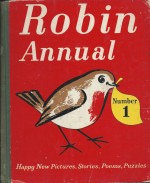
By various, edited by Marcus Morris (Hulton Press)
No ISBN:

There’s not a lot around these days in our field which both caters specifically for little kids and simultaneously introduces them to the ineluctably tactile wonders and sensorium of a high quality comics anthology experience, but once upon a time there was a whole subdivision of the business dedicated to enthralling and enchanting our youngest and, hopefully, brightest…

Robin was created in the hugely successful wake of Marcus Morris and Frank Hampson’s iconic Eagle, catering to the pre-school market the way Swift targeted 6-10 year olds and Girl concentrated on potential young ladies (that looks far creepier in print than I’d intended…). The periodical ran from March 28th 1953 to 25th January 1969, a startling 836 joy-stuffed issues.

Offering a range of beautiful genteel, diffidently Christiano-centric stories, strips and puzzles for parents to read with and to their toddlers, Robin sported the same supremely high production values as all the Hulton Press titles. It was edited by Morris until 1962 when Clifford Makins took over, shepherding the title until its absorption into Odhams/Fleetway comic Playhour, just as the collapse of theUK comics industry was beginning…

There were at least nine Christmas Annuals – such as this first one from 1953 – which combined stunning, lavishly illustrated colour strips and features with solid, memorably stylish and glossy monochrome pages for an 80 page compendium of enticing wonderment between sturdily thick and reassuring red cardboard covers.

Again like its older brothers and sister, Robin included a selection of licensed characters well known to the new but ever-growing television audience…

This particular British Festive icon opens with double-page front and end-pieces by Reg Forster, depicting railway station scenes to colour in and a beautiful painted dedication to the young Princess Anne and Prince Charles, after which the prose tale of ‘Johnny and Mr Spink’ related the tale of a boy given a pony for his birthday.

The first comic strip is in colour. ‘The Amazing Adventure of Percy and the Cricket Ball’ featured anthropomorphic animals and a young man who turned sporting disaster to his advantage, followed by an illustrated poem ‘Things to Do’ and ‘The Story of Woppit’, a monochrome strip featuring an infamous teddy-bear in the snow with bunnies.

More shrew than bear, Mr. Woppit was merchandised as a toy and one was adopted as a lucky mascot by notoriously superstitious sportsman and speed enthusiast Donald Campbell. It was with him when Campbell died piloting the hydroplane Bluebird K7 on Coniston Water in 1967, and found amidst the floating wreckage.Campbell’s remains weren’t recovered until 2001.

A Play Page of puzzles is followed by the first TV star as ‘Andy Pandy’ played garden pranks on Teddy after which ‘The Old Woman and the Mouse’ offered a delightfully salutary prose fable illustrated by the incredibly talented David Walsh and then ‘The Twins Simon and Sally’ got into a mess feeding the chickens in their first strip saga.

‘Princess Tai-Lu’ was a magical Siamese cat and in her initial strip here celebrates Christmas with a few furry feline friends in her own unique manner, whilst the illustrated poem ‘Little Grey Stone’ by Margaret Milnes is a visual feast of tone-&-wash mastery and colour comic ‘Tom the Tractor’ related the heroic rescue of a climbing lamb and piglet by a handy animated farm vehicle,

‘Scruffy the Scarecrow’ was almost junked by the farmer until some friendly Magpies saved his job in a rather moving text tale, but ‘The Proud Mouse’ was the architect of her own downfall in a delightfully executed strip by an uncredited hand.

‘Richard Lion’ (and his animal chums Henry the kangaroo, Pug the bulldog, Peggy the black panther, Nemo the jester and others) seems like a rather excellent knock-off of Bestall’s Rupert Bear by the brilliant Maria Jocz, but it still offers wonder and joy aplenty in a two-chapter, vividly coloured strip which finds the cubs being harassed by and then saving some irascible Snow Gnomes. Next comes the second of the BBC’s Watch With Mother properties as Bill and Ben ‘The Flower-Pot Men’ saved a tortoise from his own exuberant folly in a captivating black and white strip.

A black Scottie dog narrates ‘The Sad Story of McTavish’ (by Norman Satchell) whilst ‘Charlie and the Cake’ takes only three panels to explain the folly of stealing confectionery from the larder…

The snow-bound adventures of Rufus, Rodney Rita and little brother “Fums” resulted in a new family pet thanks to the intervention of ‘The Magic Wellingtons’ in a beguiling colour strip, whilst, following a Bo Peep maze-page, ‘The Twins Simon and Sally’ return no wiser than before as their attempts to bath both a dog and cat at the same time goes spectacularly awry…

‘Midge the Motor Car’ was a living autonomous little auto and his trip to the local Fair resulted in initially chaos but eventually a dramatic and heroic rescue in a lovely monochrome strip from Catherine Hammond and an uncredited scripter, after which ‘The Shepherd Boy’ retold the story of David and Goliath in a stylish full colour comics version, and short story ‘The Runaway Bus’ – illustrated by Forster – detailed how a London Passenger Service Vehicle took itself off to the seaside for the day…

The poem ‘Eider Downy House’ (Gay Wood) is followed by the sublime black and white nature strip ‘The Dormouse at Christmas’ and a full colour rebus double spread of the alphabet before the prose tale of ‘Ku Mu and the Crocodile’ (written and illustrated by Dorothy Craigie) told a gentle tale of West Africa and the strip ‘Bingo, Bango and Bongo’ by Jenetta Vise demonstrated to three monkeys that performing in a circus was far more fun than merely spectating…

A ‘Mrs Bunny Maze Puzzle’ precedes the all-colour adventures of talking calf ‘Johnny Bull’ on land, sea and in the air, after which the superbly limned prose story ‘The Excited Red Balloon’ shows the sheer class of illustrator Eileen Bradpiece, before Technicolor tiny titan ‘Andy Pandy’ performed a prankish encore at a tea-party for Teddy and ‘Tina, Tim and the Magic Helicopter’ undertook an astounding prose voyage to the Wild West…

Patricia Hubbard drew an amazing strip adventure of the dolls in ‘Toyville’ and, following the conclusion of Richard Lion‘s excursion to the cave of the Snow Gnomes and another rebus page entitled ‘Can You Read this Letter?’, ‘The Flower-Pot Men’ accidentally built themselves a splendid flying sailboat.

The rather trenchant warnings in the tale of ‘Canty Kitten’ are balanced by a practical feature on ‘How to Draw a Toy Engine’, after which David Walsh displays his dexterity with both monochrome and full colour scenes for the ode to ‘Skating on a Pond’ and the enigmatic Kearon (perhaps Robot Archie artist Ted Kearon?) exhibits great virtuosity in relating the strip saga of ‘Philip’s Circus’…

The indefatigable Walsh then lent his deft pen and brush to the alarmist but happily ended text tale of ‘The Squirrel Who Forgot’ and sublime ‘Princess Tai-Lu’ returned to save her human companion’s hat in another lovely monochrome strip.

‘Billyphant’s Birthday’ provided a menagerie of pets for the lonely little pachyderm and that motivated Motor Car returned in ‘Midge at the Zoo’, handling runaway rhinos and adoring peacocks alike, before another Play Page segued into a black and white bible strip detailing what happened when ‘Jesus gets lost’ and all the seasonal magic ended with the prose saga of runaway pigs ‘Quibble and Quarrel’.

Unlike most periodicals of the time, this annual actually lists all the creative contributors involved – although not which pieces they worked on – so those I’ve been unable to identify I’ve name-checked here: writers Leila Berg, Maria Bird, John Byrne, Nancy Catford, Dennis Duckworth, Jessica Dunning, Rosemary Garland, James Hemming, Maureen Hillyer, Winifred Holmes, Ursula John, Rosemary Sisson, John Taylor, Billy Thatcher, & Shelagh Fraser whilst artists unattributed include Anthony Beaurepaire, Nancy Catford, Harry Hants, Irene Hawkins, Elizabeth Hobson, Stewart Irwin, Faith Jacques, Janet & Anne Graham Johnstone, Mary McGowan, Constance Marshall, Michael K. Noble, Walter Pannett, Prudence Seward, A.E. Speer, Astrid Walford & Andrew Wilson.

Relatively cheap and still quite available, books like this were and should remain an integral part of our communal history, always astoundingly high in quality and absolutely absorbing. Whimsical, comforting and supremely entertaining, this is a package with a host of child-friendly tales that have tragically missed becoming nursery classics simply because they appeared in a disposable comic rather than permanent kid’s novel, and it’s long past time publishers re-examined this wealth of forgotten material with a view to creating new masterpieces for library shelves and wholesome all-ages TV animation projects…

No copyright notice so I’m guessing most of the originally created intellectually properties material now resides as part of IPC or Egmont. If you know better I’ll be happy to have this entry amended.

Superadventure Annual 1967
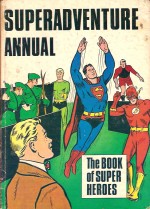
By various (Atlas Publishing & Distribution)
No ISBN

Whereas the 1962 edition – the first Christmas Annual I can remember getting – was a stunning shock to my British-born, Polish/German reared, pre-school senses, by the advent of the 1967 Superadventure Annual (December 25th 1966 at about 11 minutes past 4 in the morning), I was a far more sophisticated but no less excitable consumer.

I had since learned in those short intervening years quite a bit about Superman, Jimmy Olsen, Aquaman, Green Arrow, Flash, Tommy Tomorrow and all the rest through the sleek American import comics that my Dad faithfully brought home every Friday after work, teaching me – and himself – English (admittedly American-seasoned) by poring through them together over weekends filled with sugary snacks and in-between huge, rustic, home-grown and Mum-cooked meals.

That early indoctrination and fascination remains strong – for the comics at least. I’m far too old and debilitated for sugar, starch, caffeine and artificial additives now…

This was one of the last licensed UK DC collections before the Batman TV show turned the entire planet Camp-Crazed and Batmanic, and therefore offered a delightfully eclectic mix of material far more in keeping with traditionally perceived British boy’s interests than the masked suited and booted madness that was soon to follow in the Caped Crusader’s scalloped wake. Of course this collection was still produced in the cheap and quirky mix of black and white, dual-hued and full colour pages which made those Christmas books such a bizarrely beloved treat.

The action opens with a classically lovely yarn starring the Fastest Man Alive, printed in black and red.

The first story is reprinted from The Flash #119 (March 1961), crafted by John Broome, Carmine Infantino & Murphy Anderson, and related how the lethal Looking Glass Bandit used his incredible technology to turn our hero into a living genie before attempting to murder him with ‘The Mirror Master’s Magic Bullet’ after which space cop Tommy Tomorrow tackled – in plain old monochrome – ‘The Planeteer’s Alien Allies’.

The strip was a hugely long-running back-up strip which moved from Real Fact Comics, to Action Comics and Worlds Finest Comics before fading from sight and memory. This particular tale of sneaky conniving ETs only pretending to be Earth’s friends comes from WF #122, December 1961, courtesy of scripter Jack Miller and versatile illustrator Murphy Anderson. Ubiquitous gag cartoonist Henry Boltinoff produced hundreds of funny pages and characters over the years, and a great selection are sprinkled through this book, beginning with a crafty ‘Casey the Cop’ howler…

World’s Finest Comics #125 from May 1962 provided the Green Arrow thriller ‘The Man Who Defied Death’ (by Ed “France” Herron and Lee Elias); a bold and grittily terse mini-epic and taut human drama about a desperate daredevil willing to do absolutely anything to earn the cash for his son’s medical bills, followed by a Boltinoff ‘Moolah the Mystic’ rib-tickler and the start of the full (but exceedingly odd) colour section.

Superman’s Pal Jimmy Olsen #60 (April 1962) provided the astonishing story of ‘Super-Mite’ as author Leo Dorfman & artist Al Plastino had the exuberant cub reporter explore the mystery of a little action figure given by the Man of Steel to an ailing boy which inexplicably became as smart and powerful as any full-sized Kryptonian! This is followed by a Boltinoff gag starring ‘Peter Puptent, Explorer’ and a chiller featuring Aquaman and Aqualad battling ‘The Curse of the Sea Hermit’.

First seen in Detective Comics #295, September 1961 by George Kashdan & Nick Cardy, this spooky sea tale seemingly pitted the heroes against ancient evil but there was ultra-modern piratical plundering behind this scheme…

Back in black and white, ‘The Trickster Strikes Back’ (Flash #121, June 1961) saw the rapacious return of an air-walking bandit with murderous intent, outmanoeuvred by the Vizier of Velocity in a stunning yarn from Broome, Infantino and Joe Giella whilst, after another Peter Puptent page, Tommy Tomorrow undertook a desperate ‘Journey to 1966’ (originally entitled ‘Journey to 1960’, by Miller & Jim Mooney, when it first appeared in WF #113, November 1960) to capture a would-be world-conqueror with the inadvertent aid of the Planeteer’s own grandfather, after which the grand Costumed Dramas end in fine style with ‘The League of Fantastic Supermen’ (by Jerry Siegel, Curt Swan & George Klein from Superman’s Pal Jimmy Olsen #63, September 1962) in which a quartet of Kryptonian outlaws and the double-dealing Legion of Super-Villains are all outwitted by the plucky junior journalist.

Maybe I’m blinded by nostalgia-coloured goggles, but it seems admirably astounding to me that the all-ages stories featured here are so perfectly constructed that whether an innocent(ish) tubby toddler or the sullen, embittered old coot I became, these tales continue to beguile, bemuse and satisfy in a way that no food, drink or drug could. This is another book that will always say “Merry Christmas” to me.

…And hopefully to you, too…

© 1966 National Periodical Publications, Inc.,New York. Published and distributed jointly by Atlas Publishing and Thorpe & Porter, Ltd., by arrangement with The K.G. Murray Publishing Company Pty. Ltd., Sydney.

Beano Book 1972
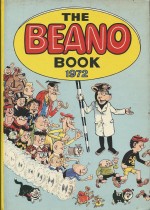
By various (DC Thomson & Co., Ltd.)
Retroactively awarded ISBN: 978-0-85116-038-2

For many British – and indeed Commonwealth – fans, Christmas can only mean The Beano Book (although Scots worldwide and of every nationality have a pretty fair claim that the season belongs exclusively to them via the traditional, annually-alternating collections of The Broons and Oor Wullie which make every December 25th mirthfully magical), so I’ve yet again highlighted another of the venerable and beloved tomes as particularly representative of the Season of Joy.

In those days these annuals were produced in the wonderful “half-colour” British publishers used to keep costs down. This was done by printing sections or “Signatures” of the books with only two plates, such as Cyan (Blue) and Magenta (Red): The sheer versatility and colour range this provided was astounding. Even now this technique inescapably screams “Holidayextras” for me and my contemporaries.

As is always the tragic case, my knowledge of the creators involved is criminally sub-par but I’ll hazard the usual wild guesses in the hope that someone with better knowledge will correct me when I err and embarrassingly get it wrong again…

This boisterously compelling chronicle opens with a double-page splash of The Bash Street Kids (by David Sutherland) breaking the fourth wall and playing mischievous hob with the book’s two-colour formatting, after which The Three Bears by Bob McGrath and the exceedingly domestic Biffo the Bear (Sutherland again) officially welcome us to the festivities.

Leading off this year’s anarchic antics is a splendid school Panto skit starring Minnie the Minx courtesy of Jim Petrie, after which the iconoclastic Dennis the Menace and Gnasher make their first appearance adding their own unique tinge of terror to a school play thanks to prolific diversity of style chameleon David Sutherland.

“Fastest boy on Earth” Billy Whizz (by Malcolm Judge) then experiences painful feedback from a rashly hurled boomerang and his Antipodean counterpart, before the re-assembled Bash Street Kids helpfully assist Teacher get over his over-sleeping problem with the expected catastrophic results in a dedicated and extended niche chapter interwoven with the eccentric and imaginative ‘Bash Street Motor Cartie Show’.

Biffo and human pal Buster go shopping for new furniture next – in an eye-popping blue and yellow segment – after which Roger the Dodger is again outwitted by his dad and Lord Snooty learns the error of his selfish, posh-boy ways in a brace of gloriously funny strips from Robert Nixon, whilst Ronald Spencer’s painfully un-PC but exceedingly hilarious Little Plum follows with the rambunctious redskin falling foul of a bolshie buffalo before Billy Whizz rockets back with a tricky ‘Whizz Quiz’ to test our wits and reactions.

In a previous annual the Bash Street Kids found themselves the reluctant owners of an accident-prone elephant, and she riotously returns here in an extended episode of Pups Parade starring the Bash Street Dogs (and Ethel Hump) by the marvellous Gordon Bell. Stuck with the excitable, ponderous pachyderm by the awesome and omnipotent Beano Editor, the mangy mutts soon handed her off to their arch-foes The Bash Street Cats but it took the canny connivings of ‘The Nibblers’ (drawn by either John Sherwood or Ron Spencer?) to finally quell Ethel’s destructively effusive spirits…

At this time The Beano still had the odd adventure strip and perhaps the greatest of these was local boy superhero Billy the Cat. Here in an expansive section of his own, the plucky acrobat chases burglars over rooftops, crushes bullies, catches car thieves and almost mucks up a fire drill in a rollicking rollercoaster of blistering action by Sandy Calder – and there’s also a splendid ‘Quick on the Draw’ feature inviting readers to become artists themselves…

Biffo the Bear then endures an agony of indecision whilst his hirsute and voracious American cousins The Three Bears got a slap-up Christmas feed even after failing again to breach the impregnable local general store of grocer Hank Huckleberry…

The defences of Bunkerton Castle proved too much when Lord Snooty and His Pals tried to bring in a truly tremendous Xmas tree, but Minnie the Minx had far more success in her spring-heeled hi-jinx – until Dad caught her, at least – whilst the ‘Billy Whizz Diary’ proved its worth in mirth before Little Plum and that buffalo had their hands and hooves full trying to wigwam-train Chiefy‘s latest pet – a Smart Alec chimpanzee…

The Nibblers next resumed their war of attrition with malicious moggy Whiskers whilst Roger’s latest Dodges proved ultimately unsuccessful but did prompt him to dream big and explain what would happen ‘If I Were a Rich Boy…’

Another extended journey to Bash Street found the Kids literally sucking up to Teacher after “borrowing” a Corporation Dust Cart and industrial vacuum cleaner, whilst following some enthralling, appalling ‘Party Puzzles’ the ‘Pup Parade’ ended the segment with a dirty scheme to clean up the dog’s communal dustbin home…

Biffo then worked out with the local Fire Brigade and ‘The Three Bears’ had snow fun at all when Hank trapped them with a frigid, foodless maze, after which Minnie found things to amuse herself – but not so many other folks – building snowmen…

The Festive fun then concludes with a thinly veiled but entertaining ad for that year’s Dennis the Menace Annual and a return to the Bash Street Kids’ colour cavortings…

This is another astoundingly compelling edition, and even in the absence of legendary creators such as Dudley Watkins, Leo Baxendale and Ken Reid there’s no discernable decline in the outrageous and infectious insanity. With so much merriment on offer I can’t believe this forty year old book is still sprightlier and more entertaining than most of my surviving friends and relatives. If ever anything needed to be issued as commemorative collections it’s these fabulous DC Thomson annuals…

Divorcing the sheer quality of this brilliant book from nostalgia may be a healthy exercise – perhaps impossible, but I’m perfectly happy to simply wallow in the magical emotions this annual still stirs. It’s a fabulous laugh-and-thrill-packed read from a magical time, and turning those stiffened two-colour pages is always an unmatchable Christmas experience – and still relatively easy to find these days.

© 1971 DC Thomson & Co., Ltd.

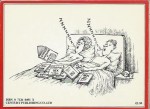
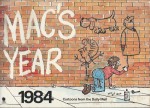
Mac’s Year: 1984 – Cartoons from the Daily Mail


By Mac – Stan McMurtry (Sphere)
ISBN: 978-0-7221-5798-5

“Democracy must be something more than two wolves and a sheep voting on what to have for dinner” – James Bovard

If you live long enough you’ll experience the pop culture keystones of every definitive era of your life at least twice more. The base, tasteless and utterly superficial aspects of the 1980s are currently doing the rounds again as the current generation – which was too young to remember them – get all nostalgic for the good bits and blithely ignore all the bad stuff: same as it ever was…

For us Brits it was Union-Bashing, Loads-a-Money, Yobs and Yuppies, poverty, excess, Royal Weddings, daft hair and Thatcher, whilst America endured trickle-down Reaganomics, insider dealing, illicit warfare and poodle rock – so nobody really got off lightly either side of the Pond – and then all the money ran out…

The truly amazing – and most depressing – realisation is that the issues never go away. The names and faces of the political or industrial scoundrels and mountebanks may change, but the mistakes they make and problems they create just keep going, so it’s always a wearisome, disturbing but oddly topical exercise to examine news cartoons this long after the fact and discover how distressingly familiar the hot topics still are. Same as it ever was…

So here’s another little dip into the vast forgotten annals of cartoon comedy generated by Britain’s greatest natural resource (and still un-privatised so it belongs to us all for the moment) – Clever Folks What Make Us Laugh…

Oftentimes our industry is cruel and unjust and frequently prone to guilt by association. This collection of cartoons is by Stan McMurtry – perhaps unfairly attributed a cartoon champion of the Populist Right – who, as “Mac”, has worked for nearly 40 years as social and political cartoonist for The Daily Mail.

Cartooning is a hard, demanding, mercurial job and a regular gig is every brush-monkey’s dream. Although it’s fair to say that most artists who settle in one place have an affinity for a periodical’s positions, stance and core politics, there will always be friction between creative expression and the Editor’s own inclinations and prudence…

The precociously artistic Mac was born inEdinburghin 1936 but raised inBirminghamfrom 1944. His father, a travelling salesman, never supported his son’s dreams of a career in art, but Stan persevered, attending Birmingham College of Art from 1950-1953, after which his 2-year National Service saw him serve in the Royal Army Ordnance Corps until 1956.

On demobilisation he entered the animation industry (at Henley-On-Thames), producing short films for the newly-launched commercial broadcast company ITV. Two of his efforts were prize winners at Cannes. Like so many other artists he also began contributing to the huge and broad cartoon market, selling his first job to Today in 1961. He became a full-time freelancer in 1965, drawing comics strips for a number of Odhams/IPC kids’ periodicals such as Wham! and Buster whilst selling gag panels to Punch, The London Evening News and others.

When Norman Mansbridge retired in 1968, Mac was offered his spot as topical cartoonist on the Daily Sketch, a centrist paper whose politics the artist generally agreed with.

In 1971 the paper was absorbed by the Daily Mail, a broadsheet which was repositioning itself as a tabloid. The once-posh paper had for years favoured the use of two staff cartoonists but was letting the revered Wally “Trog” Fawkes go (to The Observer). Offered the vacant chair, Mac alternated with the venerable John Musgrave-Wood – who signed his beautiful but so savage visual blasts against the Left “Emmwood” – until the senior partner retired in 1976.

From then, although other cartoonists appeared, the paper was Mac’s playground. Despite Editor David English constantly urging McMurtry to be “more politically minded”, Mac felt happiest employing sarcasm and gentle mockery, regarding his job as making “the dreary news-copy of the daily paper brighter by putting in a laugh”.

Mac has always been adamant that he was more a social than political animal. Even whilst spending decades turning last night’s newsflash into this morning’s mirth, McMurtry has always pursued other lucrative creative pursuits: working in advertising, straight illustration and greetings card design. In 1977 he wrote and drew children’s book The Bungee Venture and negotiated it into a Hanna-Barbera animated feature. With writing partner Bernard Cookson he also wrote TV scripts for comedians Tommy Cooper and Dave Allen. He was awarded an MBE in 2003 and remains at large and comically active to this day…

Artists like Mac who were commenting on contemporary events are poorly served by posterity. This particular volume (re-presenting a selection of single panel-gags from August 9th 1983 to June 8th of the politically and culturally front-loaded year 1984), like all of these books, was packaged and released for that year’s Christmas market, with the topics still fresh in people’s minds.

Decades later the drawing is still superb and, despite perhaps the wry minutiae escaping a few, the trenchant wit, dry jabs and outraged passion which informed these visual ripostes are still powerfully effective. And obviously human nature never changes and there’s nothing new under the sun…

Many of the blasts in this book deal unkindly – but rather hilariously, I’m forced to admit – with the fallout from the Greenham Common protest (and I’m speaking as someone who lost his then-girlfriend to that clarion call to arms, and marvels that today’s Occupy movement is so marvellously Co-Ed), underage sex and contraception, industrial turmoil and business closures, Health scandals and the NHS under attack whilst the Police themselves were increasingly Under The Cosh: same as it ever was…

There’re also episodes of Royal embarrassment and unwise escapades caught on film, doping and gender testing at major sporting events, the outrages of racist football thugs and players, vacillating doctors’ advice on booze and smokes, turmoil as opposition leaders were judged inadequate and heartfelt tributes to entertainment giants who had passed away…

Then as now, the overwhelming rain and horrendous climate often seized our attention, as did Irish Republican killers, the threat of Iran, illegal American wars, Arab Oil, celebrity love cheats, Airline blues, tacky TV Magicians, Judges with no grasp of modern life, holiday horrors, Parliamentary scandals (sex and money) and mouthy maverick cricketers causing trouble, all while the battle for equal pay for women was raging…

We kept annoying the French, there were Olympic surprises, welcome pops at privileged Toffs and posh-boys, wry Anniversary celebrations of WWII, the Scots were revolting, we all thought the Chancellor was inept or crooked, there were Papal gaffes and the Press was obsessed with Princesses…

My absolute favourite gag is a panel from February 23rd 1984 in which an ambitious couple behind a tree aim a little tot at the pram carrying the baby William Windsor and urged her to ‘Think of your career, kid – just saunter up to the Prince William and say “Hello gorgeous’”…

Thankfully some progress has occurred. Less perennial topics included pops at the PM’s idiot children (give it time), the prejudices shown to returned and wounded servicemen, body-issues and diet Nazis, arrogant and paranoid Yankee Presidents, insane African dictators, out of control school kids and… Hey, wait a minute…

Despite being often and usually unfairly targeted by factions of the Left and Right – and even accused of racism on one occasion – Mac is one of most celebrated and lauded cartoonists in British history: his energy, creativity, perspicacity and grasp of the public mood generating thousands of unforgettable gags and acres of brilliant cartoons.

His comical commentaries, produced on a punishing daily deadline, were appreciated if not feared by Peers and plebs alike and were all created with a degree of craft and diligence second to none. Even now, decades later, they are still shining examples of wit and talent… and still bitingly funny too.

It’s a terrible shame that the vast body of graphic excellence which topical cartoonists produce has such a tenuous shelf-life. Perhaps some forward-looking educational institution with a mind to beefing up the modern history or social studies curricula might like to step in and take charge of the tragically untapped and superbly polished catalogue of all our yesterdays.

Clearly they’re all short of a bob or two these days and I’m pretty sure these cartoon gems could find a willing market eager to invest in a few good laughs, or even market them as social history books that students might actually enjoy absorbing. Same as it never was…

© 1984 Stan McMurtry. All rights reserved.

Brought to Light – Thirty Years of Drug Smuggling, Arms Deals, and Covert Action


By Alan Moore, Bill Sienkiewicz, Joyce Brabner, Tom Yeates, Paul Mavrides & others (Eclipse Books/Titan Books)
ISBNs: 978-0913035672 (Eclipse),                978-1-85286-154-4 (Titan)

“It is lamentable, that to be a good patriot one must become the enemy of the rest of mankind” – Voltaire

There’s no more painful truism than Politics is Dirty Business, but as information has become more readily obtainable and widely disseminated from the 1980s onward, scandal after scandal has surfaced everywhere men of power play their games, seemingly impossible to cover up by administrations and regimes all over the planet.

This was never more common than in Ronald Reagan’s America.

No matter what else you may think of the Land of the Free, that’s one supreme advantage that their Inalienable Right to Free Speech gives them over so many other cultures. Still, that’s nothing a few judicious Plutocratic backhanders and dedicated lobbyists won’t one day fix, I’m sure…

As always us proud, dirty Liberals in comics got into the exposé act early and often, hopefully opening many young complacent eyes at just the right developmental moment…

While I’m unsure of the exact and total effect of comic condemnation as opposed to legal sanctions and official reprimands, I am utterly certain that politicians eventually have to listen to the people who vote them in and out, so the power to arouse Joe Public is one I completely appreciate and respect – even if these days there’s an apparent campaign of legalised disenfranchisement being steadily carried in the once-civilised west…

During the Reagan Era, many of the poisonous pigeons of previous administrations finally came home to roost and a high-profile legal case involving a CIA operative accused of blowing up journalists in South America first cast a very unwelcome light on US covert operations in sovereign nations.

However, even after very public hearings and a torrent of media scrutiny, nobody particularly high up was ever punished, and those middle-rankers actually convicted of crimes were soon Presidentially pardoned…

The Christic Institute, a “Public Interest” law firm which had successfully tackled the Nuclear Power industry on behalf of Karen Silkwood, the Ku Klux Klan, institutionally corrupt Police Departments and the American Nazi Party, finally met their match when they tried to use Rico (Racketeer Influenced and Corrupt Organizations Act) Laws to expose clandestine elements of the Administration which wilfully circumvented the Senate, Congress and the Constitution in pursuit of their own illegitimate goals.

Prior to that they had acted upon the behalf of American reporters Tony Avirgan and Martha Honey when they brought suit against the covert, unsanctioned CIA agents who had been working with right-wing terrorist groups – Contras – and even destabilising democratically elected socialist governments in Central America.

Devised as a “Flip Book” with two separate stories joined back to back, I’ve decided to start with ‘Flashpoint – The La Penca Bombing’, constructed from legal affidavits and the journalists’ own accounts by editor/scripter Joyce Brabner and illustrated by Thomas Yeates.

Beautifully rendered with stylish aplomb, this tale of cynical, institutionalised malfeasance documents the growth of a clandestine wing of operatives designed to work beyond the oversight of Congress to make America safe by any means necessary. It opens by covering the fall of Cubato Castro and Vice-President Nixon‘s illegal formation of a Contra-revolutionary army to take the island back for the Mafia bosses who had previously run it. This led to the gradual growth of an illicit anti-communist “Secret Team” which would perpetrate and facilitate countless acts of terrorism across the continent and incidentally create most of the trade routes and contacts used by drug cartels for the next fifty years.

In 1980 President Reagan had authorised the CIA to fund, train and supply “Contras” in Honduras with the intention of unseating Nicaraguan revolutionary Eden Pastora“Comandante Zero” – who had overthrown the regime of corrupt Right Wing reactionary President Anastasio Somoza in 1978.

When he refused overtures to work with the CIA, Pastora became a prime target for the Secret Team which consisted of obsessive American patriots, anti-communist thugs and career criminals. It was decided that assassination was the most expedient solution…

The focus then switches to Avirgan and Honey, whose latest overseas assignment saw them and their family transfer fromAfricatoCosta Rica. In 1984, as part of their news brief, Avirgan attended an international press conference held by Pastora in La Penca where the disillusioned Nicaraguan leader was stating his new aim and denouncing his erstwhile comrades who had abandoned their revolutionary principles and started cashing in…

Comandante Zero narrowly escaped death in a huge bomb blast which, according to figures at the time, killed 8 and brutally maimed another 28 journalists.

In the aftermath the recovering Avirgan and Honey began diligently investigating the hitman who caused the blast and overturned a can of worms which changed America’s conception of itself. Eventually they resorted to litigation, exposing key players to piercing public scrutiny in the groundbreaking case of Avirgan vs. Hull. The CIA agent was only one of more than twenty covert American operatives involved in the network and who would all figure prominently in the later Congressional Investigations and Tower Commission reports we know today as the Iran-Contra Scandals.

…And of course the Secret Team struck back in their own time-honoured and so-very effective ways…

“Patriotism is the willingness to kill and be killed for trivial reasons” – Bertrand Russell

This documentary foray into the underprovided genre of graphic activism alternatively undertakes a sublimely surreal and devastatingly memorable tutorial as Alan Moore and Bill Sienkiewicz transform the dry facts of redacted history into a masterful and impassioned satirical blast against the unsanctioned status quo with ‘Shadowplay – The Secret Team’.

A guy walks into a bar and cosies up to a smug, drunk and pompously bloated American Eagle. Soused and soured, the repellent fallen symbol begins to boast and babble of the things he and his guys at The Company have been proud to do to keep America Strong and Free since WWII…

Acerbic, biting and miraculously packed with astoundingly copious information, this is a visual tour de force which sublimely demonstrates the unmatched ability of comics to convey hard facts, inform by implication, and even shade tone and timbre. Translating the most dry and dusty detail to beguiling, unforgettable truths, the battered old bird reveals the complete history and exposes the many sins of the Central Intelligence Agency from Pinochet to Noriega, Vietnam to Iran and all over South America in a litany of horror too incredible to be made up…

A supremely evocative counter-attack against the unsanctioned dark forces which have committed innumerable atrocities in the name of the American People, this immorality play still has terrifying resonance to today’s world and remains one of the most bleakly lovely exhibitions of sequential narrative ever produced.

This striking chronicle also includes text pieces from attorney Daniel Sheehan and author Jonathan Marshall and extensive creator biographies plus a ferocious cartoon history – ‘Ailing World’ – of America and a world map of ’30 Years of Covert Action: Brought to Light’ from underground cartoonist and political activist Paul Mavrides, relating many of the CIA’s past “successes” in election tampering, drug trafficking, assassination and other less definable exercises in democracy.
© 1989 Eclipse Enterprises, Inc. Flashpoint: the La Penca Bombing © 1989 Joyce Brabner & Thomas Yeates. Shadowplay: the Secret Team © 1989 Alan Moore & Bill Sienkiewicz. Ailing World & Map of Covert Operations © 1989 Paul Mavrides. All other material © 1989 the respective creators/owners.

Stabbed in the Front – Post-War General Elections through Political Cartoons


By Dr. Alan Mumford (Centre for the Study of Cartoons & Caricature, U of K,Canterbury)
ISBN: 978-1-90267-120-8

“True patriotism hates injustice in its own land more than anywhere else” – Clarence Darrow

From its earliest inception cartooning has been used to sell: initially ideas or values but eventually actual products too. In newspapers, magazines and especially comicbooks the sheer power of narrative with its ability to create emotional affinities has been linked to the creation of unforgettable images and characters. When those stories affect the daily lives of generations of readers, the force that they can apply in a commercial or social arena is almost irresistible…

InBritainthe cartoonist has held a bizarrely precarious position of power for centuries: the deftly designed bombastic broadside or savagely surgical satirical slice instantly capable of ridiculing, exposing and always deflating the powerfully elevated and apparently untouchable with a simple shaped-charge of scandalous wit and crushingly clear, universally understandable visual metaphor.

For this method of concept transmission, literacy or lack of education is no barrier. As the Catholic Church proved millennia ago with the Stations of the Cross, stained glass windows and a pantheon of idealised saints, a picture is absolutely worth a thousand words…

More so than work, sport, religion, fighting or even sex, politics has always been the very grist that feeds the pictorial gadfly’s mill. This gloriously informative book (sponsored by the marvellous Centre for the Study of Cartoons and Caricature, University of Kent at Canterbury), offers a fantastic overview of political adaptability and cultural life as Britain moved from Empire to mere Nationhood in the latter half of the 20th century, examined through General Elections and the wealth of cunningly contrived images and pictorial iconography they provoked and inspired.

After an effusive Foreword by professional politician and celebrated cartoon aficionado (the Rt. Hon.) Lord Kenneth Baker of Dorking, author Alan Mumford – a specialist in management training – covers the basic semiology and working vocabulary of the medium in his copious Introduction.

Designating definitions and terms for the treatise, he subdivides the territory into ‘Origins’, ‘Criteria for Selection’, ‘Newspapers and Magazines’, ‘The Longevity of Political Cartoonists’, ‘References, Symbols and Metaphors’, ‘The Impact of Cartoons on General Elections’ and ‘Savagery in Political Cartoons’ as a very effective foundation course in how to best contextualise and appreciate the plethora of carefully crafted mass-market messages which follow.

The format is extremely ergonomic and effective. Thus Philip Zec’s iconic cartoon and caption/slogan “Here You Are. Don’t Lose it Again!” begins the Great Endeavour with historical background in The Run-up to the General Election of 1945, followed by Election Issues and the 1945 Campaign, major Personalities of the 1945 General Election, Results of… and finally a nominated “Cartoonist of the Election” whose work most captured the spirit of or affected the outcome of a particular contest.

This methodology then proceeds to efficiently and comprehensively recreate the tone of each time, augmented whenever possible by a personal interview or remembrance from one of the campaigners involved. These telling vignettes include contributions from Frank Pakenham/Lord Longford, Barbara Castle, Edward Heath, Denis Healey, Roy Jenkins, Kenneth Baker again, Jim Callaghan, Jim Prior, Margaret Thatcher, David Steel, Norman Tebbit, John Major and Tony Blair…

Each fact-packed, picture-filled chapter then dissects every succeeding campaign: 1950’s tame ‘Consolidation not Adventure’ which resulted in Labour and Clement Attlee’s second victory by the narrowest – practically unworkable – of margins, Churchill’s resurgence in 1951 as ‘The Grand Old Man Returns’ and a slow steady decline in fortunes and growth of a New Politics as Anthony Eden’s star rose for the 1955 General Election when ‘The Crown Prince Takes Over’…

In an era of international unrest Harold McMillan eventually rose to become Tory top gun and in 1959 was ‘Supermac Triumphant’, but domestic troubles – race, unionism and the always struggling economy – wore away his energies. In a minor coup he was ousted andSirAlecDouglasHome took over mid-term, consequently losing to glib, charismatic new Labour leader Harold Wilson.

This entire era is one of aged and infirm Big Beasts passing away suddenly with too many lesser lights to succeed them; further complicated by both Labour and Conservative parties rent by infighting and jockeying for position with wannabe upstarts such as the Liberals cruising the room looking to pick up what scraps they could (so it’s not a new thing, OK?).

In 1966 “Labour Government Works” took Labour to a second term but social turmoil in the country, with unions demands spiralling out of control, enabled Edward Heath to lead the Conservatives into the most dangerous and turbulent decade in modern British history. The General Election of 1970 proved ‘Wilson Complacent, Heath Persistent’…

There were two General Elections in 1974.

A massive ongoing crisis in industrial relations and the growing racial tension caused by maverick Tory Enoch Powell’s continual cries to “end Immigration or face rivers of blood in the streets” forced Prime Minister Heath to ask in February ‘Who Governs Britain?’ He was informed by the disaffected electorate “Not you, mate.”

Even though Wilson and Labour were returned to power, the majority was miniscule and by October the people were compelled to do it all again and ‘Vote for Peace and Quiet’.

Although he’d again narrowly led them to victory, Wilson’s time was done and he abruptly resigned in 1976 to be replaced by deputy Jim Callaghan.

Heath too was reduced to the ranks and relegated to the Tory Back benches, replaced by a rising star from Finchley. As Britain staggered under terrifying economic woes in 1979, Callaghan called an election and lost to Margaret Thatcher who had famously said “No Woman in My Time” would ever be Prime Minister. I think that was the last time she ever admitted to being wrong…

Despite horrifying and sustained assaults on the fabric of British society – and great unpopularity – she enjoyed two more election victories: in 1983 “The Longest Suicide Note in History” and again in 1987 as ‘Thatcher Moves Forward’ before finally being turned on by her own bullied and harried cabinet.

The best political cartooning comes from outrage, and the Tory administrations of the 1980’s provided one bloated, bile-filled easy mark after another. Just look at TV’s Spitting Image which grew fat and healthy off that government’s peccadilloes, indignities and iniquities (as well as Reagan’sAmerica and the Royal Family) in just the way that millions of unemployed and disenfranchised workers, students and pensioners didn’t. The election cartoons reproduced here from that period, come from a largely Tory Press, and whilst contextualised and accurate don’t approach the level of venom she engendered in certain sections.

For a more balanced view one should also see Plunder Woman Must Go! by Alan Hardman, Drain Pig and the Glow Boys in Critical Mess,  You are Maggie Thatcher: a Dole-Playing Game or even Father Kissmass and Mother Claws by Bel Mooney & Gerald Scarfe, not to mention any collection of the excoriating Steve Bell’s If…

In 1992 the only thing stopping a Labour landslide was the party itself, which had so dissolved into factional infighting and ideological naval-gazing that not even the fiery oratory of Welsh Wizard Neil Kinnock could pull them together. Once again however the newspapers claimed the credit when Tory consensus/concession leader John Major pulled off a surprising ‘Triumph of the Soapbox?’

That Labour Landslide had to wait until 1997 and the ‘Teeth and Sleaze’ of Tony Blair (although at that time we all thought the latter term only applied to corrupt Tory MPs selling parliamentary time and attention to business interests) which brings this incredibly appealing tome to a close. Since then a whole lot has happened and I think it’s long past time for a new, revised and updated edition…

As well as making addictively accessible over half a century of venal demagoguery, hard work, murky manipulations, honest good intentions and the efforts of many men and women moved in equal parts by dedication and chicanery, this oversized monochrome tome is also literally stuffed with the best work some of the very best cartoonists ever to work in these Sceptred Isles.

The art, imagination, passion and vitriol of Abu, Steve Bell, Peter Brookes, Dave Brown, Michael Cummings, Eccles, Emmwood, Stanley Franklin, George Gale, Nick Garland, the Davids Gaskill and Ghilchik, Les Gibbard, Charles Griffin, Graham High, Leslie Illingworth, Jak, John Jensen, Jon, Kal, David Low, Mac, Mahood, Norman Mansbridge, Sidney Moon, Bill Papas, Chris Riddell, Paul Rigby, Rodger, Stephen Roth, Martin Rowson, Willie Rushton, Peter Schrank, Ernest Shepard, Ralph Steadman, Sidney Strube, Trog, Vicky, Keith Waite, Zec and Zoke are timeless examples of the political pictorialist’s uncanny power and, as signs of the times, form a surprising effecting gestalt of the never happy nation’s feeling and character…

None of that actually matters now, since these cartoons have performed the task they were intended for: shaping the thoughts and intentions of generations of voters. That they have also stood the test of time and remain as beloved relics of a lethal art form is true testament to their power and passion, but – to be honest and whatever your political complexion – isn’t it just a guilty pleasure to see a really great villain get one more good kicking?

Stuffed with astounding images, fascinating lost ephemera and mouth-watering tastes of comic art no fan could resist, this colossal collection is a beautiful piece of cartoon history that will delight and tantalise all who read it… and it’s still readily available through the University of Kent’s website…
© 2001. Text © 2001 Alan Mumford. All illustrations © their respective holders or owners. All rights reserved.

The Adventures of Tintin – Breaking Free


By J. Daniels (Attack International/Freedom Press)
ISBNs: 0-9514261-0-9,      978-0-9514261-0-4,        978-1-90449-117-0 (Freedom Press)

“Freedom of the Press is only guaranteed to those who own one” – Abbott Joseph Liebling

Politics is always composed of and used by firebrands and coldly calculating grandees, but that’s the only guiding maxim you can trust. Most other people don’t give a toss until it affects them in the pocket and, no matter to what end of the political spectrum one belongs, the greatest enemy of the impassioned ideologue is apathy. This forces activists and visionaries to ever-more devious and imaginative stunts and tactics…

Crafted by the enigmatically anonymous J. Daniels and concocted and released by the anarchist faction Attack International in 1988, The Adventures of Tintin – Breaking Free is a perfect exercise in the use of Détournement (“turning expressions of the capitalist system and its media culture against itself”), using mimicry, mockery, parody and satire to counter the seductive subversion of the Monied Interests of the status quo.

It also reads rather well as social documentary and human drama, for all its earnest worthiness and fiercely dogmatic posturing…

The gimmick is this: the comforting cosy style and iconic images of Hergé’s immortal adventurers are removed into our pedestrian oppressive, corrupt world and co-opted to incite a revolution in thinking and action…

In Chapter 1, ‘We’ve Had Enough!’ has unemployed hothead, petty thief and disenfranchised youthful dole-queue outcast Tintin visit his uncle on the run-down-and-dying council estate where the once-vital man and his wife Mary now live on the breadline. The boy needs money and The Captain suggests a labouring job with him on the new building site. Although there’s work to be had, tensions are high there: dangerous working conditions, shoddy management practices and subsistence wages for the desperate men crafting luxury flats for more of the rich and gentrified types steadily pushing real people out of the community…

Another alienated faction joins the swell of discontent when squatters break in to the flat next door and the Captain helps them sort out the utilities. Everybody knows the council is letting the estate die of neglect so that the corrupt councillors can sell it off, so the lesbian activists are welcomed as fellow fighters against the powers that be.

Tensions mount as the National Front recruit in broad daylight, skinheads carry out racist attacks and yuppie winebars push out good old-fashioned working-men’s pubs. Soon Tintin is striking back whenever he can: vandalising posh cars and pickpocketing rich poseurs. All proper men need is jobs, beer, football and a decent life, but the boy soon has his eyes opened – if not his opinions changed – when he is made painfully aware of how even those lower class paragons treat their women…

Events come to a head when a worker dies on the building site and the supervisor is more concerned about lost time; even suggesting poor Joe Hill was drunk and not the hapless victim of negligent, non-existent safety procedures…

‘One Out, All Out!’ sees a wildcat strike seeking compensation for Joe’s widow escalate into a national furore after trade union officials strike a shady deal with the property developers and the incensed workers reject their useless official action for measures that will actually work.

Soon bosses and unions are conspiring together to break the unsanctioned, unofficial action as the ordinary people rally around the strikers, providing food, money and – most important of all – encouragement.

Soon the authorities resort to their tried and true dirty tactics: picket-breaking riot squads, undercover agent provocateurs, intelligence-led targeted arrests of “ringleaders” and general, brutal intimidation.

Scab labour is harshly dealt with in ‘Let’s Get Organised’ as the hard-working, underappreciated women increasingly take up the challenge. The movement is growing in strength and national support. Soon other cities are in revolt too, and The Captain is becoming an unwilling and unlikely figurehead. Tintin, ever impatient, finds like-minded hotheads and secretly begins a campaign of literally explosive sabotage…

It all culminates in ‘Getting Serious’ as everything kicks into overdrive when the Captain endures a punishment beating from unidentified thugs and his family is similarly threatened. Scared but undeterred, the old salt carries on, and planning for a national march continues unabated. With reports coming in of similar movements inPoland,Yugoslavia and other Warsaw Pact countries (the Soviet Empire was still very much in existence and continually crushing workers’ freedoms at this time) the local groundswell becomes a national expression of solidarity and the underclass consolidates under a mass rallying call to arms…

When the riot squads are again deployed it all turns ugly and the events go global, but in the aftermath The Captain has been “disappeared” or, as the authorities would have it, been “arrested for conspiracy”.

With half a million people on the streets of the city, the powers-that-be move to full military response but it’s too late…

The later edition, published by Freedom Press in 2011, also includes the infamous early adventures of this extremely alternative Tintin (as first seen in polemical pamphlet The Scum in 1986) from the scallywag’s days sorting out Rupert Murdoch from the picket line at Wapping during the legendary Printer’s Strike…

Passionate and fiercely idealistic, the initial release of Breaking Free unsurprisingly unleashed a storm of howling protest from the establishment, Tory Press and tabloid papers (especially News International) and by all accounts even Prime Minister Thatcher was “utterly revolted”.

Of course that only meant that the little guys had won: achieving a degree of publicity and notoriety such puny, powerless underdogs could only have dreamed of but never afforded by any traditional means of disseminating their message…

More a deliciously tempting dream than a serious clarion call to end social injustice, this is a wickedly barbed and superbly well-intentioned piece, lovingly capturing the sublime Ligne Claire style and utterly redirecting its immense facility to inform and beguile…

First released in April 1988 by Attack International. This book proudly proclaims that no copyright has been invoked unless capitalists want to poach it…

Apes of Wrath


By Steve Bell (Methuen in association with The Guardian)
ISBN: 978-0-41377-450-7

For as long as we’ve had printing in this country we’ve had gadfly artists commentating on society and its iniquities, and visually haranguing the powerful, pompous, privileged and just plain perfidious through swingeing satire and cunning cartoons.

Even after many centuries of savage satirical Masters, we’re still throwing up brilliant firebrands and cruelly artistic geniuses whose political acumen, societal consciences and staggering graphic gifts irresistibly combine to make the powerful, unscrupulous and hypocritically venal sweat a bit in their own self-important juices whilst making we mere rabble of hoi-polloi and avowed plebs chuckle and smirk at their revealed discomforts…

Probably the most effective and dedicated of the modern crop of cartoonist champions of the underclass (or “the public” as I call them) is Steve Bell, who has been skewering the Great and the not-so Good since 1977.

Born in Walthamstow in 1951, raised in Sloughand North Yorkshireand educated at Teeside College of Art, the Universities of Leeds and later Exeter(where he obtained a teaching qualification from St. Luke’s Campus), he abandoned education for freelance art as both comics artist (the Gremlins in Jackpot) and cartoonist.

His strident, polemical strips ‘Maggie’s Farm’ (Time Out and City Limits) and ‘Lord God Almighty’ in The Leveller led to a commission from The Clash for the album Sandanista! and eventually his own regular feature ‘If…’ which began in national newspaper The Guardian in 1981 and is still going hard and strong…

It’s a controversial maxim of political cartooning that you’re only as good as the times you’re in and the targets on offer, but if so either Bell has been born into the End of Days or he’s particularly blessed in having a perpetually renewing procession of perfectly risible prime lampooning targets – or maybe that should be “suspects”…

After lambasting a succession of utterly ghastly Tory leaders and their appalling acolytes at home, and rabid Rightist rulers abroad for years, blow me if a global swing to the left didn’t seemingly leave Bell with nothing to shoot at. However it all soon proved to be a false alarm which offered a new American C-i-C with his own on-board, self-destructive arsenal of gaffes and a covert continuation of Conservative idiocy ideology at home with the election of Labour’s Saviour Tony Blair.

And then in 2000, the Nicedaysmerca and birthplace of Freem even found itself another Bush to hide in front of…

Collecting and repurposing comical cutlass-slashes, surgically sardonic scalpel-cuts, a riot of rapier-like witticisms and, when nothing else will do, the occasional bludgeon with the blunt-end of a cartoon cudgel, this crushingly hilarious  full-colour  – and often off-colour – compendium collects Guardian cartoons from 1988, 1991 and 1998-2004, tracing the rise of the Bush Dynasty in war and profit peace, without ever underplaying the key role played by dogged Little Britain in assuring a nice steady pace on the road to mutually-assured Armageddon…

The grand conceit of this savage little hardcover treat is that we get to peek beneath the hem of great men in a time of turrble crisis where Freeman Moxy were threatened and only the Curge of our leaders kept us all from  being wiped out by Slamic Fananimalism and Terrrsts. Moreover we get to hear it all in the humble words of George Dubya Bush as he recounts his role in countering the crisis…

Featuring 110 wickedly manic graphic salvoes against just about everybody and a few utterly damning moral condemnations as only arch cartoonists can concoct them, Apes of Wrath captures the true spirit of those troubled times with such standout pictorialised diatribes as ‘Bigtime for Bonzo’, ‘Electile Dysfunction’, ‘Al Who’da??’, ‘The Age of Irony is Dead…’, ‘Corporate Responsibility’, ‘The Humanitarian Thrust Continues’ and so many more…

Thoughtfully containing a comprehensive glossary of frequently-used terms such as “Morl Curge” (What you need to be a wurl class wurl leader), “Cladral damage” (What happens to pain in the ass innocent bystanders that don’t keep their heads down) and “Diplocrap” (talking to forners) which will help us all speak Presidentially and understand the complexity of high level negotiation, this chronicle of catastrophe is a perfectly guided missile of agonised, mordant mirth that no as-yet free-thinking individual should miss, especially as elections just keep on happening…
Text © 2004 Steve Bell. Illustrations © 1988, 1991, 1998, 1999, 2000, 2001, 2002, 2003, 2004 Steve Bell. All rights reserved.

What-a-Mess


By Frank Muir & Joseph Wright (Carousel, Picture Corgi)
ISBNs: 0-552-52105-I (Carousel)      978-0-55252-105-5 (Corgi)

Once a hugely popular franchise, the subtly superb and wryly fantastic adventures of What-a-Mess have all but disappeared from today’s library lists and Athenaeum book-shelves. Written by Frank Muir and illustrated by Joseph Wright, the gloriously engaging, dolorously delightful yarns starred a philosophically trenchant, galumphing great ugly-duckling dog and spawned 22 further books, in assorted styles and formats, as well as two seasons (48 episodes in total between 1990 and 1995) of a successful trans-Atlantic TV cartoon series.

Joseph Wright is still a brilliant but enigmatic jobbing illustrator who generally keeps to himself and lets his wonderfully manic art do his talking for him. He is most well known these days as the provider of hilariously gory perfectly perfidious pictures for the Little Dracula series of books by Martin Waddell – a task he toiled at from 1986 onwards and which again resulted in a fondly remembered American cartoon series.

Frank Herbert Muir was born on February 5th 1920 inRamsgate,Kent and spent the next 77 years of his life becoming a British entertainment legend. His formative years were spent in his grandmother’s pub, before moving toLondon.

Despite possessing an astounding vocabulary, phenomenally disciplined, cultured diction and a plummy, posh voice, Muir was educated atChathamHouseGrammar SchoolandLeytonCountyHigh Schoolfor Boys, not the public-school system he so miraculously mimicked. He proudly and often averred “I was educated in E10, notEton”…

During WWII he served as a photographic technician in the Royal Air Force and when demobbed began writing radio scripts for comedians Jimmy Edwards and Dick Bentley. This led to his teaming with life-long writing partner Denis Norden, and their creation of the venerable comedy show Take it from Here reinvented the Funny Business. Their first major innovation was the invention of iconic sitcom family The Glums, and the team quickly became a keystone and shaper of British humour (…for instance, they originally coined the much-beloved phrase “Infamy, Infamy, they’ve all got it in for me”) so when Edwards moved over to the new-fangled television medium Muir & Norden went with him…

Scriptwriter, satirist, scholar, author, performer, star of Radio and Television, Muir was also the BBC’s Assistant Head of Light Entertainment during the 1960s and followed up by becoming London Weekend Television’s first Head of Entertainment in 1969, and worked constantly and brilliantly in his many careers until his death on January 2nd 1998. Ten months later, he and Norden were joint recipients of their last of so many honours: the Writers’ Guild of Great Britain Writer of the Year Award for 1998.

Muir and his family shared their home with a succession of Burmese cats and Afghan Hounds, and these latter were the inspiration for the simply magical picture book story featured here.

Prince Amir of Kinjan was a very clumsy and confused puppy. Excitable, inquisitive, rash and so very careless, the long-nosed, long-legged, pot-bellied pooch always hurtled from here to there, rolling in things, overturning objects and generally causing a sticky calamity all over the place.

There were always things trapped in, nastily glued to or even growing on him – and usually a small yellow duck stuck to the crusted fringe on his head. Even his serene, gracious and long-suffering mother so often said “What-a-Mess!” that the mucky moppet actually believed that it was his name…

No wonder the dire doggy was so confused and pondered – whenever he wasn’t rushing about, tearing furniture or eating something he shouldn’t – over what kind of beast he actually was…

This resplendent riot of frolicsome folderol then follows the scruffy scamp as he searches in the house, garden and pond for his true identity and a meaning to his life. Using observation, logical deduction and rationalist reasoning, the daft beast notes his definite physical similarities to a big fat bee, an expensive haute couture hat and a goldfish, earning the consequent ire of assorted humans, a compost heap, gravity and merciless, short-tempered ducks …

Even when, at the end of a particularly trying day – for all concerned – the pooped pup slinks home to mother and she tells him what he truly is, Prince Amir still gets a firm hold of the wrong end of the stick…

A lost classic of very clever kids’ comedy, Muir’s tale rattles along, combining delectable irony with empathy and surreal slapstick whilst Wright’s astonishingly busy illustrations convey pathos and naifish enthusiasm and idiocy with glib ease. Moreover every colourful conception is additionally crammed with deliciously bizarre background detail: madcap marginals, surreal sidebars and outrageous off-focus action involving a host of animals and far less natural characters…

Bright, brash, beautiful and brilliant, these books are a sublime treat and long overdue for a fresh release in today’s wonder-starved world.
Text © 1977 Frank Muir. Illustrations © 1977 Joseph Wright.

The Incredible Adventures of Professor Branestawm


By Norman Hunter, illustrated by W. Heath Robinson (Puffin/Red Fox and others)
ISBNs: PSS33 (1969 Puffin edition)             978-1-86230-736-0 (Red Fox 2008)

Although I’m pushing a number of comic-based kids books this week I’d be utterly remiss if I didn’t also include at least one example of the venerably traditional illustrated novel which used to be the happily inescapable staple of bedtime for generations. This particular example is particularly memorable, not simply because it’s a timeless masterpiece of purely English wit and surreal invention, but also because most editions are blessed with a wealth of stunning pictures by an absolute master of absurdist cartooning and wry, dry wit.

Norman George Lorimer Hunter was born on November 23rd, 1899in Sydenham; a decade after that part of Kentbecame part of the ever-expanding Countyof London. He started work as an advertising copywriter and moved into book writing soon after with Simplified Conjuring for All: a collection of new tricks needing no special skill or apparatus for their performance with suitable patter, Advertising Through the Press: a guide to press publicity and New and Easy Magic: a further series of novel magical experiments needing no special skill or apparatus for their performance with suitable patter published between 1923 and 1925.

He was working as a stage magician in Bournemouthduring the early 1930s when he first began concocting the genially explosive exploits of the absolute archetypical absent-minded boffin for radio broadcasts. The tales were read by the inimitable Ajax – to whom the first volume is dedicated – as part of the BBC Home Service’s Children’s Hour.

In 1933 The Incredible Adventures of Professor Branestawm was published in hardback with 76 enthrallingly intricate illustrations by W. Heath Robinson to great success, prompting the sequel Professor Branestawm’s Treasure Hunt (illustrated by James Arnold & George Worsley Adamson) four years later.

During WWII Hunter moved back to Londonand in 1949 emigrated to South Africawhere he worked outside the fiction biz until his retirement. He returned to Britainin 1970, following the release of Thames Television’s Professor Branestawm TV series which adapted many of the short stories from the original books in the summer of 1969.

Following the show Hunter resumed writing: another 11 Branestawn tomes between 1970-1983, plus a selection of supplemental books including Professor Branestawm’s Dictionary (1973), …Compendium of Conundrums, Riddles, Puzzles, Brain Twiddlers and Dotty Descriptions (1975), …Do-it-yourself Handbook (1976) and many magic-related volumes.

Norman Hunter died in 1995.

William Heath Robinson was born on May 31st 1872 into something of an artistic dynasty. His father Thomas was chief staff artist for Penny Illustrated Paper. His older brothers Thomas and Charles were also illustrators of note.

After schooling William tried unsuccessfully to become a watercolour landscape-artist before returning to the family trade and in 1902 produced the fairy story ‘Uncle Lubin’ before contributing regularly to The Tatler, Bystander, Sketch, Strand and London Opinion. During this period he developed the humorous whimsy and penchant for eccentric, archaic-looking mechanical devices that made him a household name.

During the Great War he uniquely avoided the Jingoistic stance and fervour of his fellow artists, preferring instead to satirise the absurdity of conflict itself with volumes of cartoons such as The Saintly Hun. Then, after a 20-year career of phenomenal success and creativity in cartooning, illustration and particularly advertising, he found himself forced to do it again in World War Two.

He died on13th September 1944.

Perhaps inspired by the Branestawm commission, Heath Robinson’s 1934 collection Absurdities hilariously describes the frail resilience of the human condition in the Machine Age and particularly how the English deal with it all. They are also some of his funniest strips and panels. Much too little of his charming and detailed illustrative wit is in print today, a situation that cries out for Arts Council Funding or Lottery money, perhaps more than any other injustice in the sadly neglected field of cartooning and Popular Arts.

The first inspirational Professor Branestawm storybook introduces the dotty, big-domed, scatterbrained savant as a ramshackle cove with five pairs of spectacles – which he generally wears all at once – and his clothes held together with safety pins …probably because the many explosions he creates always blow his buttons off.

The wise buffoon spends most of his days thinking high thoughts and devising odd devices in his “Inventory” whilst his mundane requirements are taken care of by dotty, devoted, frequently frightened or flustered housekeeper Mrs. Flittersnoop. Branestawm’s best chum is the gruff Colonel Dedshott of the Catapult Cavaliers, although said old soldier seldom knows what the scientist is talking about…

The over-educated inspirationalist and his motley crew first appeared in ‘The Professor Invents a Machine’ which saw the debut of an arcane device that moved so quickly that Branestawm and Dedshott were carried a week into the past and accidentally undid a revolution in Squiglatania – and ended up upsetting everybody on both sides of the argument.

In ‘The Wild Waste-Paper’ Mrs. Flittersnoop’s incessant tidying up caused a spill of the Professor’s new Elixir of Vitality and the consequent enlargement and animation of a basket full of furiously angry bills, clingy postcards and discarded envelopes, whilst in

‘The Professor Borrows a Book’ the absent-minded mentor mislaid a reference tome and had to borrow another from the local library.

A house full of books is the worst place to lose one, and when the second one went walkies Branestawm had to borrow a third or pay the fine on the second. By the time he’d finished the Professor had checked out fourteen copies and was killing himself covertly transporting it from library to library…

When his stuff-stuffed house was raided by ‘Burglars!’ the shocked and horrified thinker was driven to concoct the ultimate security system. It was the perfect device to defend an Englishman’s Castle – unless he was the type who regularly forgot his keys and that he had installed an anti-burglar machine…

When he lost a day because he hadn’t noticed his chronometer had stopped, the Professor invented a new sort of timepiece that never needed winding. Even the local horologist wanted one.

Sadly the meandering mentalist had forgotten to add a what-not to stop them striking more than twelve and as the beastly things inexorably added one peal every hour soon there were more dings than could fit in any fifty-nine minutes. ‘The Screaming Clocks’ quickly became most unwelcome and eventually an actually menace to life and limb…

The Professor often thought so hard that he ceased all motion. Whilst visiting ‘The Fair at Pagwell Green’ Mrs. Flittersnoop and Colonel Dedshott mistook a waxwork of the famously brilliant bumbler for the real thing and brought “him” home to finish his pondering in private. Sadly the carnival waxworks owner alternatively believed he had a wax statue that had learned to talk…

‘The Professor Sends an Invitation’ saw the savant ask Dedshott to tea but forget to include the laboriously scripted card. By means most arcane and convoluted, the doughty old warrior received an ink-smudged blotter in an addressed envelope and mobilised to solve a baffling cipher. Of course his first port-of-call had to be his clever scientific friend – who had subsequently forgotten all about upcoming culinary events…

‘The Professor Studies Spring Cleaning’ found Branestawm applying his prodigious intellect and inventive acumen to the seasonal tradition that so vexed Mrs. Flittersnoop before inevitably finding a way to make things worse. He thus constructed a house-engine that emptied and cleaned itself. Of course it couldn’t really tell the difference between sofa, couch cupboard or housekeeper…

‘The Too-Many Professors’ appeared when the affable artificer invented a solution which brought pictures to life. Flittersnoop was guardedly impressed when illustrations of apples and chocolates became edibly real but utterly aghast when a 3-dimensional cat and elephant began crashing about in the parlour.

So it was pretty inevitable that the foul-smelling concoction would be spilled all over the photograph albums…

In a case of creativity feeding on itself, ‘The Professor Does a Broadcast’ relates how the brilliant old duffer was asked to give a lecture on the Wireless (no, not about radio, but for it…). Unaccustomed as he was to public speaking, the tongue-tied boffin had Dedshott rehearse and drill him until he could recite the whole speech in eleven minutes. Of course the scheduled programme was supposed to last half an hour…

A grand Fancy Dress Ball resulted in two eccentric pillars of Pagwell Society wittily masquerading as each other. Naturally ‘Colonel Branestawm and Professor Dedshott’ were a great success but when the Countess of Pagwell‘s pearls were purloined whilst the old duffers changed back to their regular attire nobody noticed the difference or believed them…

‘The Professor Moves House’ found the inventor forced to rent larger premises because he had filled up the old one with his contraptions. However Branestawm’s attempts to rationalise the Moving Men’s work patterns proved that even he didn’t know everything. At least the disastrous ‘Pancake Day at Great Pagwell’ rescued his reputation when his magnificent automatic Pancake-Making Machine furiously fed a multitude of friends and civic dignitaries. The Mayor liked it so much he purchased it to lay all the municipality’s pavements…

This gloriously enchanting initial outing ends with ‘Professor Branestawm’s Holiday’ as the old brain-bonce finally acquiesced to his housekeeper’s urgent urgings and went for a vacation to the seaside. Keen on swotting up on all things jellyfish the savant set off but forgot to check in at his boarding house, prompting a desperate search by Dedshott, Flittersnoop and the authorities.

Things were further complicated by a Pierrot Show which boasted the best Professor Branestawn impersonator inBritain: so good in fact that even the delinquent dodderer’s best friends could not tell the difference.

With the performer locked up in a sanatorium claiming he wasn’t a Professor, it was a lucky thing the one-and-only scatty scholar was unable to discern the difference between a lecture hall and a seaside show-tent…

As I’ve already mentioned, these astonishingly accessible yarns were originally written for radio and thus abound with rhythmic cadences and onomatopoeic sound effects that just scream to be enjoyed out loud. This eternally fresh children’s classic, augmented by 76 of Heath-Robinson’s most memorable character caricatures and insane implements, offer some of the earliest and most enduring example of spiffing techno-babble and fabulous faux-physics – not to mention impressive iterations of the divine Pathetic Fallacy in all its outrageous glory – and no child should have to grow up without visiting and revisiting the immortal, improbable Pagwell Pioneer.

In 2008 a 75th Anniversary edition of The Incredible Adventures of Professor Branestawm was released by Red Fox but you’re just a likely to find this uproarious ubiquitous marvel in libraries, second-hand shops or even jumble sales – so by all means do…
© 1933 Norman Hunter. All rights reserved.

Doctor Who Graphic Novels volume 14: The Child of Time


By Jonathan Morris, Mike Collins, David A. Roach, Roger Langridge, Martin Geraghty, Dan McDaid, Rob Davis, Geraint Ford, Adrian Salmon, & James Offredi (Panini Books)
ISBN: 978-1-84653-460-7

Win’s Christmas Gift Recommendation: scintillating, superior sci fi for the bigger kids cluttering up the house and waiting for the TV Specials to start … 8/10

Doctor Who launched on television in the first episode of ‘An Unearthly Child’ on November 23rd 1963. Less than a year later, his decades-long run in TV Comic began with issue #674 and the premier instalment of ‘The Klepton Parasites’. On 11th October 1979 (although adhering to the US off-sale cover-dating system so it says 17th) Marvel’s UK subsidiary launched Doctor Who Weekly, which became a monthly magazine in September 1980 (#44) and has been with us under various names ever since.

All of which only goes to prove that the Time Lord is a comic hero with an impressive pedigree…

Panini is in the ongoing process of collecting every strip from its archive in a uniform series of over-sized graphic albums, each concentrating on a particular incarnation of the deathless wanderer. This particular one gathers stories short and long which, taken together comprise a two-year extended epic. From Doctor Who Magazine (or DWM) #421-441 (originally published between 2010-2011), this run features the strip debut of the Matt Smith incarnation of the far-flung, far-out Time Lord as well as his foremost companion Amy Pond.

None of which is relevant if all you want is a darn good read. All the creators involved have managed the ultimate task of any comics-creator – to produce engaging, thrilling, fun stories which can be equally enjoyed by the merest beginner and the most slavishly dedicated – and opinionated – fans imaginable.

With all tales written by Jonathan Morris (plus, according to the author, liberal input from editors Scott Gray & Tom Spilsbury), coloured by James Offredi and lettered by Roger Langridge, the drama kicks off in ‘Supernature’ (illustrated by Mike Collins & David A. Roach, from DWM #421-423, May-July 2010).

Arriving on a jungle paradise world The Doctor and Amy quickly discover Earthling colonists in the midst of a terrifying plague…

The humans – all convicts press-ganged and abandoned to turn the planet into a suitable home – are being transformed into uncanny mutant beasts, and even the Time Lord and his new companion are monsterised before the crisis is solved. However when they depart they take part of the problem with them…

A rare but very welcome art job for regular letterer Langridge results in a bizarre and wonderful spoof on ‘Planet Bollywood!’ when warring factions of an ancient empire – and a romantic leading man – all struggle to possess a sexy humanoid device which compels listeners to break out in song and dance routines, after which a trip to Tokyo found fresh horror in the metamorphosis of innocent – if educationally lacking – children into a deadly fifth column…

‘The Golden Ones’ (#425-428, by Martin Geraghty & Roach) is a grand old-fashioned blockbuster invasion saga with a huge body-count, valiant armed resistance by dedicated UNIT soldiers, a classic villain’s return, a brilliant scientific solution and a slew of subtle clues to the greater saga unfolding. Just who is that strange little girl who keeps popping up everywhen?

From #429 comes the literary fantasy-homage ‘The Professor, the Queen and the Bookshop’ (Rob Davis & Geraint Ford) wherein our heroes meet a reclusive writer and evacuee children Amy – and hubby-to-be Rory – encounter a strange man in an infinite shop which can travel anywhere…

It’s back to Paris in 1858 for Dan McDaid’s ‘The Screams of Death’ as aspiring but hopeless singer Cosette is taken under the wing of impresario Monsieur Valdemar and develops a voice that could shake the Opera House to its foundations. Of course, the Svengali-like Fugitive from the Future had far grander plans for his many captive songbirds until Mam’selle Pond and M’sieu le Docteur turned up to foil a mad scheme to rewrite history…

The over-arching epic takes a big step forward in #432’s ‘Do Not Go Gentle into that Good Night’ (featuring a welcome full-art outing for the splendid David Roach) as the Tardis turns up in an old people’s home staffed by robots, haunted by children and plagued by a vanishing roster of residents, whilst Adrian Salmon gets his freak on in the trippy terror-tale ‘Forever Dreaming’ (#433-434) as Amy is apparently trapped in a 1960’s seaside town with a dark secret, a phantom octopus and a host of psychedelic icons who really should be dead…

The saga swings into full acceleration with ‘Apotheosis’ (DWM #435-437 and limned by McDaid) as the Doctor and Amy land aboard a derelict space station and walk into the closing act of a galaxy-spanning war between humanity and their scheduled replacements: the awesome autonomous androids of Galatea.

Aboard the station, a cadre of warrior Space Nuns are seeking an ultimate weapon to tip the scales of the conflict, but with lethal sanitation robots everywhere and rogue time-distortion fields making each step a potential death-march, the hunt is hard-going. With everybody – even the Time Lord – hyper-aging at vastly different rates, when the Tardis then mutates into something impossible, the stage is set for a spectacular threat to all of creation to be born…

Of course, first the Machiavellian, monstrously manipulative and atrociously amoral creature calling herself Chiyoko must carry out a number of crucial appointments in Eternity to ensure the existence and consolidate the celestial dominance of ‘The Child of Time’ (with art from Geraghty & Roach from (DWM #438-441 August -November 2011).

Two years’ worth of cleverly-concocted mystery and imagination are then wrapped up in a staggering, creatively-anachronistic display of temporal hocus-pocus by scripter Morris as The Doctor, Amy and allies Alan Turing and the Bronte Sisters ward off the unmaking of time, the end of humanity and eradication of all life in the universe before the tragic finale and a happy ever after of sorts…

Dedicated fans can also enjoy a treasure-trove of background information in the 25-page  text Commentary section at the back, comprising chapter-by-chapter background, history and insights from the author and each of the illustrators, supplemented by happy horde of sketches, roughs, designs, production art and even excised material from all concerned.

We’ve all have our private joys and hidden passions. Sometimes they overlap and magic is made. This is another superb set of supremely satisfying comic strips, starring an absolute Pillar of the British Fantasy pantheon.

If you’re a fan of only one, The Child of Time should certainly spark your hunger for the other. This is a fabulous book for casual readers, a fine shelf addition for devotees of the show, the ideal opportunity to cross-promote our particular art-form and the perfect present for the Telly Addict haunting your house…

All Doctor Who material © BBCtv. Doctor Who logo © BBC 2012. Tardis image © BBC 1963. Doctor Who, Tardis and all logos are trade marks of the British Broadcasting Corporation and are used under licence by BBC Worldwide. Published 2012 by Panini Publishing, Ltd. All rights reserved.

The Crazy World of Golf


By Mike Scott (Exley)
ISBN: 978-1-85015-356-6

With so much time on my hands these days I’m considering taking up a hobby to while away the tedious hours. So, rather than using the internet or asking a friend, I’ve started consulting old cartoon compilations in search of sage advice and scintillating suggestions and here’s what’s turned up on the top of the pile…

One of a delightful range of themed collections issued by transatlantic publishing outfit Exley in both English and American editions (including The Crazy World of Cats, the Greens, the Handyman, Hospitals, Gardening, Marriage, Sex and many others as well as real, proper sports such as Rugby, Cricket and Sailing) this winning monochrome landscape tome is the work of Mike Scott, who I’m appalled and ashamed to say I can find no biographical information on.

Even my trusty Dictionary of British Cartoonists and Caricaturists omits him and in this instance the internet has not been my friend. I’m not certain that he’s British-based or even a bloke at all, despite a delightfully authentic line in UK fashions, trivia and frustration-fuelled attitude – but his keen observation, surreal invention and loosely manic drawing style lend themselves perfectly to synthesising and encapsulating the passion and insanity of this all-weather subject which fascinates and absorbs so many normally rational folk…

Cartooning has been magnificently served over the centuries by masters of form, line, wash and most importantly sharp ideas, repeatedly poking our funny bones whilst pricking our pomposities and fascinations, and nothing says more about us than the sinister lure and apparently obsessive grip of hitting balls with sticks – especially if you have to dress up funny, learn bewildering rules and terms and buy lots and lots of over-priced drinks for strangers to properly enjoy it…

Within the pages of the Crazy World of Golf the confirmed couch-potato reader will learn the horrors and joys of fashionably appropriate attire, the “Japanese Way”, how to handle the always-bracing weather, the problem with those unfortunates who don’t play and how extraterrestrials view our bizarre practices…

There are plenty of gags considering and exploring the effects upon local flora and fauna, clubhouse politics, the misunderstanding spouse, women drivers (that’s a pun, but not a good one), golf throughout history, some useful free tips, terminology explained and many moments of sheer mind-warping whimsy. There’s even a plethora of pages proving that God loves the game, if not the players…

These kinds of cartoon collections are perennial charity shop or jumble-sale fare and if you ever chance upon an item of potential artistic amusement in such a place, do yourself a favour, help out a good cause and have a cheap laugh. It might be the start of a fresh phase in your life, courtesy of another unsung master of mirth.

As for me and my hobbies… no, probably not golf…

© 1985 Mike Scott. All rights reserved.