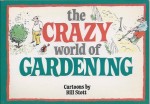
The Crazy World of Gardening


By Bill Stott (Exley)
ISBN: 978-1-85015-355-9

As it’s a Bank Holiday here in Britain and probably raining somewhere, I’ve taken the opportunity to re-examine the so-very-English obsession with domestic horticulture through the medium of cartoon books and in particular a collection of dry, droll and often painfully accurate observations by one of my favourite unsung gagsters, Bill Stott.

Another prolific but criminally nigh-forgotten staple of British cartooning, Stott’s manic loose line, stunningly evocative drawing and mordantly acerbic conceptions (which basically boil down to “no matter how strange, if it can happen it will happen to you, but only if somebody is watching…”) were a mainstay of Punch, Private Eye, The Times and many other papers and publications since 1976.

In his other life he was – and still is – a degree-level college painting and drawing tutor. Moreover he’s still in the game – such as it is in these days of magazine and newspaper cartoon paucity – and you can check out his latest stuff or even commission an original simply by visiting billstott.co.uk.

There might even be copies of this superb little rib-tickler on sale there…

British cartooning has been magnificently served over the centuries by masters of form, line, wash and most importantly clever ideas repeatedly poking our funny bones whilst pricking our pomposities and fascinations, and nothing says more about us than our dark compulsion to mow lawns and torture plants in flood or gale or drought and all points between…

Within the pages of the Crazy World of Gardening (released in both English and American editions as a hardcover and paperback) the wise reader will learn the horror and delight of motor mowers, why men and women mustn’t garden together, how every living thing that sprouts or flies or crawls hates and despises humanity, the wit, wisdom and worth of gnomes, anti-slug tactics, how hosepipes are not our friends, the root cause of garden distress, hedge-warfare, the misery of pond-life, greenhouse etiquette and such various and assorted plant lore as will keep the aforementioned wise ones safely inside whilst letting nature and the seasons – such as they now are – just get on with it…

These kinds of cartoon collection are perennial library/charity shop and jumble sale fare and if you ever see a Stott package (others in this particular series include The Crazy World of Cats, Cricket, Hospitals, Housework, Marriage and Rugby) in such a place, do yourself a favour, help out a good cause and have a brilliant laugh with another true master of mirth.
1987 Bill Stott. All rights reserved.

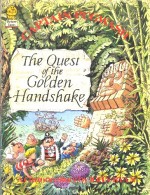
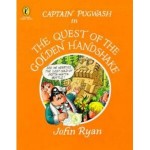
Captain Pugwash and the Quest of the Golden Handshake


By John Ryan (Fontana Picture Lions/Puffin)
ISBN: 0-00-662253-4 (Fontana 1985)   978-0-14055-486-1 (Puffin 1997)

Paperback: 32 pages

I recently reviewed an old John Ryan kid’s book and enjoyed it so much that I simply had to share another all-ages masterpiece with you…

John Ryan was an artist and storyteller who straddled three distinct disciplines of graphic narrative, with equal qualitative if not financial success.

The son of a diplomat, Ryan was born in Edinburgh on March 4th 1921, served in Burma and India and, after attending the Regent Street Polytechnic (1946-48), took up a post as assistant Art Master at Harrow School from 1948 to 1955. It was during this time that he began contributing strips to Fulton Press publications.

On April 14th 1950 Britain’s grey, post-war gloom was partially lifted with the first issue of a new comic that literally gleamed with light and colour with which avid children were soon understandably enraptured; blown away by the gloss and dazzle of Dan Dare, Pilot of the Future, a charismatic star-turn venerated to this day and a host of other spectacularly illustrated stories strips and features.

The Eagle was a tabloid-sized paper with full colour inserts alternating with text and a range of various other comic features. “Tabloid” is a big page and one can get a lot of material onto each one. Deep within, on the bottom third of a monochrome page was an eight panel strip entitled ‘Captain Pugwash – The story of a Bad Buccaneer and the many Sticky Ends which nearly befell him’ delivered with dash and aplomb by John Ryan.

The indefatigable artist’s quirky, spiky style also lent itself to the numerous spot illustrations required throughout the comic every week and he also regularly produced ‘Lettice Leefe, the Greenest Girl in School’ for Eagle’s distaff companion comic Girl.

Pugwash, his harridan of a wife and the useless, lazy crew of the Black Pig ran until issue #19 when the feature disappeared.

This was no real hardship as Ryan had been writing and illustrating the incomparable and brilliantly mordant ‘Harris Tweed – Extra Special Agent’ a full page (tabloid, remember, upwards of twenty crammed and meticulously detail stuffed panels a page, per week) from The Eagle #16 onwards.

Tweed ran for three years as a full page until 1953 when it dropped to a half page strip and was repositioned as a purely comedic venture.

In 1956 the indefatigable old sea-dog (I’m referring to Horatio Pugwash, but it could so easily be Ryan: an unceasing story-peddler with a big family, he still found time to be head cartoonist at the Catholic Herald for four decades) made the jump to children’s picture books and animated features for television.

A Pirate Story was the first Pugwash chronicle (originally published by Bodley Head before switching to the children’s publishing specialist Puffin) and the first of a huge run of children’s books on a number of different subjects. Pugwash himself starred in 21 tomes; there were a dozen books based on the animated series Ark Stories, as well as Sir Prancelot and a number of other creations. Ryan worked whenever he wanted to in the comic world and eventually the books and the strips began to cross-fertilise.

When A Pirate Story was released in 1957 the BBC pounced on the property, commissioning Ryan to produce five-minute episodes (86 in all from 1957 to 1968, which were reformatted in full colour and rebroadcast in 1976). In the budding 1950s arena of animated television cartoons, Ryan developed a new system for producing cheap, high-quality animations to a tight deadline. Naturally he began with Pugwash, keeping the adventure milieu, but replaced the shrewish wife with a tried-and-true boy assistant. Tom the Cabin Boy is the only capable member of a crew which included such visual archetypes as Willy, Pirate Baranabas and Master Mate (fat, thin and tall – all dim) instantly affirming to the rapt, young audience that grown-ups are fools and kids do, in fact, rule.

Ryan also drew a weekly Pugwash strip in the Radio Times for eight years, before going on to produce a number of other animated series including Mary, Mungo and Midge, The Friendly Giant and Sir Prancelot as well as adaptations of some of his many children’s books. In 1997 an all new CGI-based Pugwash animated TV series began.

John Ryan returned to pirate life in the 1980s, drawing three new Pugwash storybooks: The Secret of the San Fiasco, The Battle of Bunkum Bay and today’s riot of scurvy delights The Quest of the Golden Handshake…

There was even a thematic prequel in Admiral Fatso Fitzpugwash, in which it is revealed that the not-so-salty seadog had a medieval ancestor who became First Sea Lord, despite being terrified of water…

In the Golden Handshake the Querulous Captain finds a genuine treasure map at an auction but a bidding war with nefarious nemesis Cut-Throat Jake turns into a full-blown riot in which the coveted chart is torn in half.

Never knowingly daunted, Pugwash and company steal Jake’s half of the map that night but on returning to the safety of the Black Pig are horrified to discover that their rival has had the same idea…

Luckily the brilliant cabin boy had anticipated the move and has already copied their portion of the priceless document. Heartened and enraptured by thoughts of vast wealth, the crew hastily set sail for South America, determined to plunder the Lost Treasure of the Stinkas…

However Jake is a brilliant rogue and smuggles himself and two burly accomplices aboard, planning to let Pugwash do all the heavy lifting and await his moment to claim his revenge and the gold…

Packed with in-jokes, glorious tom-foolery and daring adventure, the voyage to the New World in a “haunted” ship culminates in a splendid battle of half-wits before Tom, as usual, saves the day in his quiet, competent and deucedly clever way…

The first Pugwash was very traditional in format with blocks of text and single illustrations that illuminated a particular moment. But by 1982 the entire affair became a lavishly painted comic strip, with as many as eight panels per page, with standard word balloons. A fitting circularity to his careers and a nice treat for us old-fashioned comic drones.

The most recent edition of A Pirate Story (2008 from Frances Lincoln Children’s Books) came with a free audio CD, and just in case I’ve tempted you beyond endurance here’s a full list (I think) of the good(?) Captain’s exploits: Captain Pugwash: A Pirate Story (1957), Pugwash Aloft (1960), Pugwash and the Ghost Ship (1962), Pugwash in the Pacific (1963), Pugwash and the Sea Monster (1976), Captain Pugwash and the Ruby (1976), Captain Pugwash and the Treasure Chest (1976), Captain Pugwash and the New Ship (1976), Captain Pugwash and the Elephant (1976), The Captain Pugwash Cartoon Book (1977), Pugwash and the Buried Treasure (1980), Pugwash the Smuggler (1982), Captain Pugwash and the Fancy Dress Party (1982), Captain Pugwash and the Mutiny (1982), Pugwash and the Wreckers (1984), Pugwash and the Midnight Feast (1984), The Battle of Bunkum Bay (1985), The Quest of the Golden Handshake (1985), The Secret of the San Fiasco (1985), Captain Pugwash and the Pigwig (1991) and Captain Pugwash and the Huge Reward (1991), but quite frankly read any Pugwash pirate publication and you’ll be we’ll and truly hooked…

This magical, wry and enchantingly smart yarn is one of Ryan’s very best and long overdue for re-issue – as are they all – and a sure winner with fans of all ages if you can find it (talk about real buried treasures…).

We don’t have that many multi-discipline successes in comics, so why don’t you go and find out why we should celebrate one who did it all, did it first and did it well? Your kids will thank you and if you’ve any life left in your old and weary adult fan’s soul, you will too…

© 1984, 1997, 2012 John Ryan and presumably the Estate of John Ryan. All rights reserved.

Doctor Who Graphic Novels volume 13: The Crimson Hand


By Dan McDaid, Martin Geraghty, Mike Collins & various (Panini Books)
ISBN: 978-1-84653-451-5

Doctor Who launched on television in the first episode of ‘An Unearthly Child’ on November 23rd 1963. Less than a year later his decades-long run in TV Comic began with issue #674 and the premier instalment of ‘The Klepton Parasites’. On 11th October 1979 (although adhering to the US off-sale cover-dating system so it says 17th) Marvel’s UK subsidiary  launched Doctor Who Weekly, which became a monthly magazine in September 1980 (#44) and has been with us under various names ever since.

All of which only goes to prove that the Time Lord is a comic hero with an impressive pedigree…

Marvel/Panini is in the ongoing process of collecting every strip from its archive in a uniform series of over-sized graphic albums, each concentrating on a particular incarnation of the deathless wanderer. This particular one gathers stories from issues Doctor Who Magazine or DWM #394, The Doctor Who Storybook 2010 and DWM #400-420, (originally published between 2008 and 2010): all featuring the escapades of the David Tennant incarnation of the far-flung Time Lord.

This is actually the third – and final – collection of strips featuring the Tenth Doctor and whether that statement made any sense to you largely depends on whether you are an old fan, a new convert or even a complete beginner.

None of which is relevant if all you want is a darn good read. All the creators involved have managed the ultimate ‘Ask’ of any strip creator – to produce engaging, thrilling, fun strips that can be equally enjoyed by the merest beginner and the most slavishly dedicated fan.

After an effusive introduction from series re-creator Russell T. Davies, the full-colour graphic grandeur begins with a one-off romp from 2008 entitled ‘Hotel Historia’ by writer/artist Dan McDaid, wherein the Good Doctor fetches up in a spectacular resort for time-travellers and first encounters the pushy and obnoxious corporate raider Majenta Pryce and uses her shoddy and slipshod time-technology to counter a threat from the chronal brigands known as the Graxnix.

This is riotously followed by a delightful clash with ‘Space Vikings’ (by Jonathan Morris, Rob Davis & Ian Culbard, from the 2010 Christmas Doctor Who Storybook) wherein the slave-taking star-rovers prove to be far less than they at first appear…

The main body of stories here formed something of an experiment as DWM #400-420 were designed as an extended story-arc leading up to the big change on television where Matt Smith would replace Tennant as “the Eleventh Doctor”.

Therefore McDaid was tasked with scripting the entire 21 issue run and began by reintroducing scurrilous money-mad chancer Majenta Pryce in ‘Thinktwice’ (#400-402, illustrated by Martin Geraghty & David A. Roach); an intergalactic penal institution with some decidedly off-kilter ideas on reforming prisoners.

Pryce is a prisoner but has amnesia. So does her cellmate Zed and in fact, most of the convicts aboard. The supposedly cushy debtor’s prison is in fact a horror-house of psychological abuse where suicide is endemic, maintained by the creepy Warden Gripton who is messing with the inmates’ memories to satisfy the hungers of something he calls “memeovax”…

Luckily the new prison doctor “John Smith” is a dab hand with the Sonic screwdriver…

With her memory far from restored the wickedly entrepreneurial Majenta becomes the unlikeliest of Companions as she demands that the “legally liable” Doctor makes restitution for all the trouble he’s caused by ferrying her to the planet Panacea where she can be properly cured. As we all know however, the Tardis goes where She wants and at Her own pace…

‘The Stockbridge Child’ (#403-405 with art from Mike Collins & Roach) deposits the unhappy partners to that peaceful English village where three different incarnations of the Time Lord have encountered incredible alien incursions. When the Doctor is reunited with outcast skywatcher Maxwell Edison they uncover at last the ancient horror beneath the hamlet which as made the place such a magnet for madness and monsters before finally despatching the brooding anti-dimensional threat of the Lokhus…

Meanwhile Majenta’s big secret hasn’t forgotten her and is rapidly closing in…

DWM #406-407 featured ‘Mortal Beloved’, illustrated by Sean Longcroft, wherein the Doctor and “Madge” arrive at a decrepit asteroid mansion on the edge of the biggest storm in creation. Amidst the flotsam and jetsam lurk poignant clues to Pryce’s past as tantalisingly revealed by the robots and holograms left to run the place after a far younger Majenta jilted brilliant playboy industrialist Wesley Sparks. Of course, after such an immense length of time even the most devoted of loves and programs could falter, doubt and even hate…

‘The Age of Ice’ (#408-411, by McDaid, Geraghty & Roach) brought the Last Time Lord and Lost Executive to Sydney Harbour and a fond reunion with Earth Defence Force UNIT, just as time-distortions began dumping dinosaurs in the sunny streets and crystalline knowledge stealers The Skith once more attempted to assimilate all the Doctor’s vast experience. Majenta too found an old friend in the shape of her long-lost junior associate Fanson who admitted he had wiped her memory. When he became part of the huge body-count before revealing why, Madge thought she would lose what was left of her mind…

‘The Deep Hereafter’ (#412, by Rob Davis with above-and-beyond calligraphy from faithful letterer Roger Langridge) is a scintillating space detective story, pastiching the classic Will Eisner Spirit Sunday sections, but still succeeds in advancing the overarching plot as Madge and the Doctor complete the last case of piscine P.I. Johnny Seaview and chase down the threat of the reality warping World Bomb whilst ‘Onomatopoeia’ in #413 (Collins & Roach) pits the reluctant pair against space-rats and out-of-control pest prevention systems in a clever and heart-warming fable told almost exclusively without dialogue.

The superb ‘Ghosts of the Northern Line’ (#414-415) follows with guest-artist Paul Grist working his compositional magic in a chilling yarn of murderous phantoms slaughtering tube passengers in present day London. Obviously they can’t be spirits so what is the true cause of the apparitions? This yarns leads directly into the big payoff as they assemble forces of galactic Law and Order suddenly show up to arrest Majenta, plunging the voyagers into a spectacular epic as the stroppy impresario at last regains her memory and acquires the power to reshape all of reality as part of the cosmic consortium known and feared as ‘The Crimson Hand’ (DWM #416-420, by McDaid, Geraghty & Roach.

This blockbuster rollercoaster epic perfectly ends the saga of Majenta Pryce and signs off the Tenth Doctor in suitable style, but dedicated fans still have a plethora of added value bonuses in the wonderful text section at the back, which includes a commentary from editor Tom Spilsbury, the origins of the saga from McDaid, Doctor Who Story Notes, the Majenta Pryce “Pitch” and an annotated story background, section: all copiously illustrated with behind-the-scenes photos, sketches and production art.

We’ve all got our little joys and hidden passions. Sometimes they overlap and magic is made. This is a superb set of comic strips, starring an undeniable bulwark of British Fantasy. If you’re a fan of only one, this book might make you an addict to both. The Crimson Hand is a fabulous book for casual readers, a fine shelf addition for devotees of the show and a perfect opportunity to cross-promote our particular art-form to anyone minded to give comics another go…

All Doctor Who material © BBCtv.  Doctor Who logo © BBC 2009. Tardis image © BBC 1963. Doctor Who, the Tardis and all logos are trade marks of the British broadcasting corporation and are used under licence. © Marvel. Published 2012 by Panini Publishing, Ltd. All rights reserved.

Beano: How to Draw


By anonymous (Beano Books/Parragon Book Service Ltd)
ISBN: 978-1-40548-745-0

I haven’t covered a “How To” book for ages and as this one’s entertaining, wonderfully fit for purpose, still cheap and readily available and even comes with the appropriate toolkit (a set of coloured pencils), it would well serve any budding artists and prospective animators to seek it out and absorb…

This large-scale, slim yet sturdy book gives away the visual secrets behind the anarchic stars of Britain’s best loved comic; offering Getting Started and Basics, assorted Character Profiles and, divided into Faces, Heads and Bodies, the nuts and bolts of how you too can craft the antics of the scurrilous stars of the show in action.

Said scamps include Dennis the Menace, faithful, frightful Gnasher, Minnie the Minx, terrible toddler and arch-rival Ivy the Terrible, weedy Walter the Softy and Baby Bea – the Menace’s sinister baby sister.

Also included are supporting cast members such as the long-suffering Colonel, Police Sgt. Slipper and willing accomplice-in-mischief Curly, precisely broken down into easy to follow graphic steps and supplemented by a gallery of model sheets and handy stock poses to get you started: everything you need to create your own comics once you’ve read, re-read and re-reread the splendid weekly adventures of all concerned.

Brilliantly colourful and with clear concise instructions covering the undeniable basics that every pictorial storyteller – whatever their age – needs to master, this is an indispensable and tremendously inspiring introduction for the aspiring Artist of Tomorrow.
“The Beano” ® © and associated characters ™© D.C. Thomson & Co., Ltd 2007. All Rights Reserved.

Crockle Saves the Ark


By John Ryan (Hamlyn)
ISBN: hardback 600-754022   paperback: 978-0-60030-461-6

John Ryan was an artist and storyteller who straddled three distinct disciplines of graphic narrative, with equal qualitative if not financial success.

The son of a diplomat, Ryan was born in Edinburgh on March 4th 1921, served in Burma and India and after attending the Regent Street Polytechnic (1946-48) took up a post as assistant Art Master at Harrow School from 1948 to 1955. It was during this time that he began contributing strips to Fulton Press publications.

On April 14th 1950 Britain’s grey, post-war gloom was partially lifted with the first issue of a new comic that literally shone with light and colour. Avid children were soon understandably enraptured with the gloss and dazzle of Dan Dare, Pilot of the Future, a charismatic star-turn venerated to this day. The Eagle was a tabloid-sized paper with full colour inserts alternating with text and a range of various other comic features. “Tabloid” is a big page and one can get a lot of material onto each one. Deep within, on the bottom third of a monochrome page was an eight panel strip entitled Captain PugwashThe story of a Bad Buccaneer and the many Sticky Ends which nearly befell him. Ryan’s quirky, spiky style also lent itself to the numerous spot illustrations required throughout the comic every week and he produced ‘Lettice Leefe, the Greenest Girl in School’ for Eagle’s distaff companion comic Girl.

Pugwash, his harridan of a wife and the useless, lazy crew of the Black Pig ran until issue 19 when the feature disappeared. This was no real hardship as Ryan had been writing and illustrating the incomparable and brilliantly mordant ‘Harris Tweed – Extra Special Agent’ a full page (tabloid, remember, an average of twenty crammed and meticulous panels a page, per week) from The Eagle #16 onwards. Tweed ran for three years as a full page until 1953 when it dropped to a half page strip and was repositioned as a purely comedic venture.

In 1956 the indefatigable old sea-dog (I’m referring to old Horatio Pugwash, but it could so easily be Ryan: an unceasing story-peddler with a big family, he still found time to be head cartoonist at the Catholic Herald for four decades) made the jump to children’s picture books. Ryan also drew a weekly Pugwash strip in the Radio Times for eight years, before going on to produce a number of other animated series including Mary, Mungo and Midge, The Friendly Giant and Sir Prancelot as well as adaptations of some of his many children’s books and the item on offer today.

In the late 1970’s Ryan wedded his love of maritime adventure, devout faith and facility for telling engaging tales to the young to re-examine the Biblical story of Noah in another delightful animated series.

The Ark Stories comprised a selection of delightful cartoon books in the style of Pugwash (eleven in total, I think) initially released by Beaver Books in 1979, which were translated into a series of ten-minute animated TV shorts, written, made by and presented by Ryan himself with voices by famed animal-imitator Percy Edwards. The show was produced for Trident/ITV by Yorkshire Television in 1980, after which Hamlyn re-released them in both hardback and softcover editions.

Crockle Saves the Ark is my favourite; whimsical, charming, superbly illustrated and just plain funny. In the days just before the big flood, as Noah and family were filling the Ark with animals, two by two, the youngest son Jaffet brought his best friend Jannet along.

The little lad and lass brought with them a pet baby crocodile and for forty days and nights Noah turned a blind eye whenever he counted all his animals since the giant vessel already had its full compliment of reptiles…

The reason was simple: just when the deluge began and the waters started to cover the land, the fully-laden ark had not risen. Indeed the bottom of the boat began to fill up and all the water-loving beasts thought that they had their own indoor pool.

Luckily little Crockle – for that was the scaly tyke’s name – was small enough to explore the hull of the rapidly-filling vessel until he found the leak and smart enough to fix it, after which the rest of the creatures all pitched in to bale out the water…

This magical, wry and enchantingly smart yarn is one of Ryan’s very best and long overdue for re-issue – as are they all (and the original 1981 video collection too please!) and a sure winner with fans of all ages if you can find it.
© John Ryan and presumably the Estate of John Ryan. All rights reserved.

Goliath


By Tom Gauld (Drawn & Quarterly)
ISBN: 978-1-77046-065-2

Everybody knows the story of David and Goliath. Big, mean evil guy at the head of an oppressive army terrorising the Israelites until a little boy chosen by God kills him with a stone from his slingshot.

But surely there’s more to it than that…?

In this supremely understated and gentle retelling we get to see what the petrifying Philistine was actually like and, to be quite frank, history and religion have been more than a little unkind…

Like most really big guys Goliath of Gath is a shy, diffident, self-effacing chap. The hulking man-mountain is an adequate administrator but fifth worst swordsman in the army, which has been camped in opposition to the Hebrew forces for months. Moreover, the dutiful, contemplative colossus doesn’t even have that much in common with the rough-and ready attitudes of his own friends…

When an ambitious captain gets a grand idea he has the towering clerk outfitted in terrifying brass armour and orders him to issue a personal challenge to the Israelites every day.

“Choose a man, let him come to me that we may fight.

If he be able to kill me then we shall be your servants.

But if I kill him then you shall be our servants.”

The plan is to demoralise the foe with psychological warfare: grind them down until they surrender. There’s no reason to believe that Goliath will ever have to actually fight anybody…

Elegiac and deftly lyrical this clever reinterpretation has literary echoes and overtones as broadly disparate as Raymond Briggs and Oscar Wilde and as it gently moves to its sad and inescapable conclusion the deliciously poignant, simplified line and sepia-toned sturdiness of this lovely hardback add a subtle solidity to the sad story of a monstrous villain who wasn’t at all what he seemed…

Tom Gauld is a Scottish cartoonist whose works have appeared in Time Out and the Guardian. He has illustrated such children’s classics as Ted Hughes’ The Iron Man and his own books include Guardians of the Kingdom, 3 Very Small Comics, Robots, Monsters etc., Hunter and Painter and The Gigantic Robot. You can see more of his work at www.tomgauld.com
© 2012 Tom Gauld. All rights reserved.
This book is scheduled for release in mid-March 2012. For book signing/tour dates please consult our Noticeboard or the author’s own website.

New British Comics volume 3


By various (NBC)
No ISBN:

Here’s a terrific little anthology tome (the third in a very impressive series) for older readers which delivers a tremendous amount of cartoon wonder and literary entertainment. This lovely B5 format compilation gathers a selection of contemporary graphic tales and vignettes by very talented, imaginative and keen creators who aren’t quite household names yet, beginning with the delightful ‘Cindy & Biscuit Save the World (again)’ by Dan White, wherein a plucky lass and her faithful mutt tackle an alien invasion, after which Lawrence Elwick & Paul O’Connell reveal an unsuspected side of ‘Alfred Hitchcock: Master of Suspense’.

‘Ink vs Paper’ by John Miers is an edgy, multi-layered silent foray into high design and “Hai! Karate!” followed by ‘Animal Magnetism’, the first of two equally speechless jazzy adventures by Elwick & O’Connell starring ‘Charlie Parker “Handyman”…

Scathing social satire is the order of the day in the futuristic unreality show ‘Here Comes the Neighbourhood’ by Matthew Craig & Richard Johnson, whilst more traditional sci fi fare informs the excellent ‘Better Living Through Distance’ by Dave Johnson, and genuine spooky nihilism makes Craig Collins & Iain Laurie’s ‘The Quiet Burden’ the very last thing you want to read at bedtime…

‘Luvvable Lex: Dirty ‘N’ Down’ by Rob Miller offers the unique Celtic insights of a very with-it “Glesga Gangster” before ‘Wonderland’ by Wilbur Dawbarn finally confirms what you’d always feared about the fauns and that Wardrobe to Narnia… After ‘Charlie Parker “Handyman”: Skyscraper Lunch’, Van Nim breaks hearts and shatters illusions of fairytale romance in‘(crack)’.

The thrills and chills come thick and fast in the macabre western ‘Von Trapp’ by WJC and this superb sojourn in strange lands ends with ‘A Complex Machine’ wherein David Ziggy Greene exposes the ghastly, fantastic, impossible truth about reflexology, Chinese medicine and those serene but wizened old gentlemen…

Most of the most popular and impressive creators of the last thirty years broke into the paying end of the business via the Independent, Small Press or Self Publishing routes and as each of the contributors here has a website you can see more at, courtesy of the biographies section at the back, you can get in on the crest of the next wave simply by picking up the luscious little black and white book…
All work © 2011 the individual creators. All rights reserved

To obtain New British Comics check this out, or contact Rob Miller.

Axa Adult Fantasy Color Album


By Enrique Badia Romero & Donne Avenell (Ken Pierce Books/Eclipse Comics)
ISBN: 0-912277-27-0

Axa ran in The Sun Monday to Saturday from 1978 to her abrupt cancellation in 1986 – a victim of political and editorial intrigue which saw the strip cancelled in the middle of a story – and other than the First American Edition series from strip historian Ken Pierce and this colour collection, has never been graced with a definitive collection. It should be noted also that at the time of these books she was still being published with great success and to popular acclaim.

In those days in Britain it often appeared that the only place where truly affirmative female role-models appeared to be taken seriously were the cartoon sections, but even there the likes of Modesty Blaise, Danielle, Scarth, Amanda and all the other capable ladies who walked all over the oppressor gender, both humorously and in straight adventure scenarios, lost clothes and shed undies repeatedly, continuously, frivolously and in the manner they always had…

Nobody complained (no one important or who was ever taken seriously): it was just tradition and the idiom of the medium… and besides, artists have always liked to draw bare-naked ladies as much as blokes liked to see them and it was even “educational” for the kiddies – who could buy any newspaper in any shop without interference, even if they couldn’t get into cinemas to view Staying Alive, Octopussy or Return of the Jedi without an accompanying adult…

Enrique Badía Romero’s career began in his native Spain in 1953, where he produced everything from westerns, sports, war stories and trading cards, mostly in conjunction with his brother Jorge, eventually forming his own publishing house. “Enric” began working for the higher-paying UK market in the 1960s on strips such as ‘Cathy and Wendy’, ‘Isometrics’ and ‘Cassius Clay’ before successfully assuming the drawing duties on the high-profile Modesty Blaise adventure-serial in 1970 (see Modesty Blaise: The Hell Makers and Modesty Blaise: The Green Eyed Monster), only leaving when this enticing new prospect appeared.

Tough’n’sexy take-charge chicks were a comic-strip standard by the time the Star Wars phenomenon reinvigorated interest in science fiction and the infallible old standby of scantily-clad, curvy amazons in post-apocalyptic wonderlands never had greater sales-appeal than when The Sun – Britain’s best-selling tabloid – hired Romero and Donne Avenell to produce a new fantasy feature for their already well-stacked cartoon section.

This beautifully illustrated but oddly out of kilter collection doesn’t bear much similarity in terms of tone or format to the (ostensibly) family-oriented daily strip, and features none of the regular supporting cast such as long-suffering lover Matt or robotic companion Mark 10, which leads me to suspect it was created independently for the European market, perhaps as a Sunday page in Romero’s homeland of Spain or elsewhere where attitudes and mores are more liberal.

Certainly in the early 1980s Axa appeared in the French adult bande dessinee magazine Charlie Mensuel which reprinted many classic newspaper strips from around the world and after that closed in the Swedish publication Magnum.

Whatever their origin the tales collected here are far stronger and more explicitly sexual in nature; occasionally coming close to being mere macho rape-fantasies, so please be warned if such content, no matter how winningly illustrated, might offend…

The eponymous heroine was raised in a stultifying, antiseptic and emotionless domed city: a bastion of technological advancement in a world destroyed by war, pollution and far worse. Chafing at the constricting life of the loveless living dead, Axa broke out and, ancient sword in hand, chose to roam the shattered Earth searching for something real and true and free…

This slim oversized tome opens with Axa crossing a trackless wasteland under a scorching sun until she finds a hidden grotto beneath a ruined building. The coolly sensual hidden pool is a welcome delight but harbours a ghastly monster and mutant voyeur…

Captured by the hideously scarred human degenerate Axa discovers his gentle nature but is soon abducted by his far-less sympathetic brethren who attempt to use her as a brood mare for their next generation, until fate, her newfound friend and that ever-present long-sword combine to effect her escape…

Resuming her aimless explorations, Axa then encounters a coastal village but is almost killed by a pack of wild dogs. Her desperate flight takes her to a lighthouse on the promontory above the deserted town where ruggedly handsome Juame and his teenaged daughter Maria have been trapped for months.

Soon the sexual tension between Axa and Jaume culminates in the only way it can and Maria is driven mad by a jealousy she can barely comprehend. When a roving band of vicious post-apocalyptic Hell’s Angels hits town hungry for slaughter and kicks, the conflicted teen opens the tower doors for them…

The brutes casually murder her father and are intent on adding her and Axa to their string of human playthings, but when a terrific storm hits Axa breaks loose and becomes the bloody tool of harsh, uncompromising and final fate…

This incarnation of the warrior wanderer is certainly harder-hitting and more visceral than the British strip version and has little of the feature’s sly, dry humour, but art-lovers cannot fail to be impressed by Romero’s vibrant mixed-media illustration and imaginative, liberating page compositions.

Lush, lavish, luxurious and strictly for adventure-loving adults, there’s still a tantalising promise of a major motion picture and above all else Axa is long overdue for a definitive collection. Where is that bold publisher looking for the next big thing…?
Axa ©1985 Enrique Badía Romero. Previously ©1983, 1984 in Spanish.  Express Newspapers, Ltd.

Hewligan’s Haircut


By Peter Milligan & Jamie Hewlett (Fleetway Publishing/Rebellion)
ISBN: 978-1-85386-246-5, Rebellion HC 978-1-90426-506-1, SC 978-1-90673-598-2

Since its inception in 1977 the weekly science fiction anthology comic 2000AD has been a cornucopia of thrills, chills, laughs and anarchic, mind-boggling wonderment as well as springboard for two generations of highly impressive creators.

Beside such “A-List” serial celebrities as Judge Dredd, Slaine, Rogue Trooper and their ilk, the quirky, quintessentially British phenomenon has played host to a vast selection of intriguing yarns with much less general appeal and far more discerning tastes.

Or, to put it bluntly, strips with as many foes as friends amongst the rabidly passionate audience.

Just one such was this outrageously tongue-in-cheek, fantastically surreal and absurdist love story from the era of Rave Parties and Acid Houses from Peter Milligan and Tank Girl co-creator Jamie Hewlett which originally ran in #700-711 of the Galaxy’s Greatest Comic, from 13th October to December 1st 1990.

The story is told in “Eight Partings”, commencing in black and white with the introduction of style-starved psychiatric patient Hewligan, about to be booted out of Five Seasons Mental Hospital.

In ‘Donald, Where’s Your Troosers?’ the hapless innocent spruces up his copious coiffure and accidentally carves a transcendental cosmic symbol into his bedraggled barnet. Suddenly everything that previously made no sense in his bemused and befuddled life instantly makes even less – but now it’s all in full, effulgent dayglo colour…

‘Under a Bridge with Dick and Harry’ finds the latest victim of “Don’t Care in the Community” undergoing even crazier visions and hallucinations than the ones which got him sectioned in the first place and also the subject of a bizarre police – and animated everyday objects – manhunt, until a wall tells him of a safe haven in ‘Don’t Put your Daughter on the Stage Mrs. Worthington’…

Giving Consensual Reality the old heave-ho, the tonsorial target meets the effervescent trans-dimensional gamin and pulchritudinous know-it-all Scarlett O’Gasometer, who offers companionship and the secret of what’s really going on. Still pursued by every cliché in British popular life the pair soon fall victim to a barrage of Art Attacks (Cubism and Warholian Pop) from unsanctioned Pirate Dimensions in ‘A Man , A Plan, Canal Panama’ but as Scarlet reveals the true nature of Everything and the pair leak into cult TV shows in ‘Oh Danny Boy Oh Danny Boy!’ Hewligan begins to understand why his entire life has been plagued with odd voices and images of giant stone heads…

The dashing due take a bus to Easter Island where ‘I Know a Fat Old Pleeceman’ finds them in a position to save all creation in ‘Roget’s Thesaurus’ before the sweet sorrowful monochrome parting of ‘The Psychedelic Experience’ wraps it all up with one last surprise…

Light, frothy, multi-layered with cultural time-bombs and snarky asides; this is a fun-filled, occasionally over-clever, but always magically rendered and intoxicatingly arch, quest-fable that no jaded Fantasy Fashionista or cultural gadabout could resist. However there’s not a tremendous amount of gore, smut or gratuitous violence but I suppose you can’t have everything…

This a gloriously silly piece of pure contemporary Albion perfectly captures a unique period in time and offers a pungent and memorable dose of New Age Nostalgia and there shouldn’t be any trouble finding this is tall, slim tale since it was re-released in a collectors hardback in 2003 and a paperback edition in 2010 by current 2000AD custodians Rebellion.

Coo! What larks…
© 1991 2000AD Books, A division of Fleetway Publications. © 2003, 2011 Rebellion A/S. All rights reserved.

Official Batman Annual 1985


By Gerry Conway, Don Kraar, Roy Thomas, Alan Moore, Jamie Delano, José Luis García-López, Alan Davis, Garry Leach & various (London Editions)
ISBN: 7235-6733-6

Generally I save the Christmas annuals for the nostalgia-drenched Festive Season but this is a little gem I recently re-examined and found to be an item which I had no illogical or purely emotional attachment to. It’s simply an extremely good-looking, thoroughly entertaining package which might be unknown to and of some interest to fans and collectors.

By the end of the 1970s the Superman and Batman Christmas books were a slim and slight shadow of their former bumper selves, but during the mid 1980s a new crop of editors and designers found a way to invigorate and add value to the tired tomes.

Now full-colour throughout but reduced to 64 pages this example stems from the days when I was just starting out in the business and a few of my more talented and famous colleagues and acquaintances on groundbreaking independent comic Warrior, star-studded 2000AD and at gradually expanding Marvel UK were offered a little side-work from Manchester-based London Editions Comics…

Behind the Bryan Talbot cover, ‘The Falcons Lair!’ written by Don Kraar and illustrated by Adrian Gonzales & Mike DeCarlo (originally seen in US comicbook Brave and the Bold #185, April 1982) opened proceedings with a boisterous action-romp teaming the Caped Crusader and Emerald Archer Green Arrow against the wiliest of criminal birds The Penguin, after which a brief prose piece by Jamie Delano lavishly illustrated by Alan & Damian Davis tantalisingly whetted the Fights ‘n’ Tights taste-buds with the wry and salutary tale of a foredoomed pickpocket ”Birdsong’ Mickey’s Day Out’…

The editors were equally canny in selecting the US reprints. ‘Last Laugh!’ first appeared in Batman #353 (November 1982): a dynamite stand alone tale pitting the Gotham Guardian against the archest of villains The Joker; a spectacular and audacious thriller by Gerry Conway magnificently illustrated by the incredibly talented and inexplicably underrated José Luis García-López.

Possibly one of the neatest and most impressive text tales in UK Annuals history ‘The Gun’ reunited Marvelman co-conspirators Alan Moore & Garry Leach (who painted the beguiling pictures which accompany the twisted trail of the weapon which killed Thomas and Martha Wayne) and the seasonal sensationalism concluded with ‘Where Walks a Snowman!’ (Batman #337, July 1981) wherein Gerry Conway& Roy Thomas recounted the horrific history of a chilling killer stalking Gotham in another lost art-masterpiece by García-López & Steve Mitchell.

Being a British Christmas book there’s even a traditional send-off with a brace of

‘Batman’s Puzzles’ pages comprising word games and “spot the difference” panels.

This impressive tome might well be of more interest to comics completists than chronic nostalgists like me, but such items often turn up in jumble sales and charity shops and are frequently well worth the price of admission

© 1984 DC Comics Inc. and London Editions Limited. All characters © 1984 DC Comics Inc.