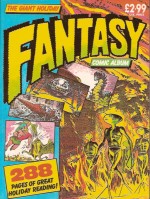
The Giant Holiday Fantasy Comic Album


By various, edited by Mike Higgs (Hawk Books)
ISBN 0-948248-06-8

Being almost universally anthology weeklies, British comics over the decades have generated a simply incomprehensible number of strips and characters in a variety of genres ranging from the astounding to the appalling. Every so often dedicated souls have attempted to celebrate this cartoon cornucopia by reprinting intriguing selections and in 1990 the splendid Hawk Books released this delightfully cheap and cheerful compendium that is still readily available for connoisseurs of the wild and wonderful British oeuvre…

As is so often the case creator credits are nonexistent and although I’ll hazard the odd guess now and then, a lot of these marvellous concoctions will have to remain annoyingly anonymous until someone more knowledgeable than me pipes up…

With little ado the monochrome madness began with a magically whacky superhero tale featuring supernatural warrior Thunderbolt Jaxon who promptly mopped up a gang of saboteurs in ‘The Flying Wreckers’.

Plucky lad Jack Jaxon could transform into the invincible mini-skirted muscleman because he wore the magic belt of Thor, and as comprehensively revealed in Steve Holland’s superb Bear Alley articles, the character was originally designed in 1949 by Britain’s publishing powerhouse Amalgamated Press as an export feature for Australian publisher Kenneth G. Murray after WWII. The strips were commissioned by Editor Edward Holmes and realised by writers TCH Pendower, Leonard Matthews, plus Holmes, with prolific artist Hugh McNeill the original illustrator. The export-only hero soon began appearing in UK comics Comet and Knockout with later stories limned by Geoff Campion, Robert Roger & Ian Kennedy.

Next here is a charming tale of ‘The Space Family Rollinson’ by Graham Coton: a series which ran in Knockout from 1953-1958 and was successfully syndicated in France. Your average Mum, Dad and four kids on a trek across the universe, here stopping to save the natives of Skandok from a hideous space spider and its interplanetary jelly-webs, after which a moodily engrossing adventure of outlandish Victorian escapologist Janus Stark finds the man with rubber bones thwarting a gang of kidnappers in a stirring extravaganza by Tom Tully & Francisco Solano López .

A stunning strip The Jungle Robot debuted in the first issue of Lion in 1952, created by E. George Cowan & Alan Philpott, before vanishing until 1957. On his return he became one of the most popular heroes of the British scene. Reprinted here from the early days after his comeback is ‘Robot Archie and the Mole Men’ illustrated, I suspect, by Ted Kearnon, pitting the amazing automaton and his hapless handlers Ted Ritchie and Ken Dale against a bunch of subterranean bandits plundering Paris in an incredible burrowing machine – a complete 14 week adventure delivered two pages at a time.

Next up is ‘The Men from the Stars’ a complete 60 page sci fi epic originally presented in AP’s digest Super Detective Library #14. In this grand old invasion romp, test pilot and “Special Agent in Space” Rod Collins endured the World’s first contact with a marauding and incomprehensible race of flying saucer people before spearheading Earth’s inevitable resistance and narrow victory, after which paranormal detective ‘Maxwell Hawke’ and plucky girl Friday Jill Adair investigated ‘The Ghost of Gallows Hill Manor’ – a creepy, condensed shocker probably drawn by a young Eric Bradbury.

Knocker White and Jinx Jenkins were ‘The Trouble-Seekers’; two-fisted construction workers who had to add giant monsters to the list of obstacles threatening to delay the completion of South American super city Futuria, after which action-man cover star of Smash! Simon Test narrowly survived ‘The Island of Peril’ in another moody masterpiece of all-ages action-adventure illustrated by Bradbury.

One of the most fondly remembered British strips of all time is the strikingly beautiful Steel Claw. From 1962 to 1973 Jesús Blasco and his small family studio thrilled the nation’s children, illustrating the breakneck adventures of scientist, adventurer, spy and even costumed superhero Louis Crandell. Created by novelist Ken Bulmer, the majority of the character’s exploits were scripted by Tom Tully.

Crandell was a bitter man, missing his right hand, which was replaced with a gadget-packed prosthetic. Moreover, whenever he received an electric shock he became invisible.

After going on a deranged rampage Crandell’s personality shifted and by the time of ‘The Return of the Claw’ (which first saw print in Valiant from 5th June 1971-22nd April 1972) the super-agent was a tired and broken emotional burn-out dragged out of retirement to foil an alien invasion wherein disembodied invaders the Lektrons possessed the bodies of children, turning them into demonic, energy-blasting monsters.

More than any other strip the Steel Claw was a barometer for British comics reading fashions. Starting out as a Quatermass style sci-fi cautionary tale the series mimicked the trends of the outer world, becoming in turn a Bond-like super-spy saga complete with outrageous gadgets, a masked mystery-man romp when Bat-mania gripped the nation, and eventually a Doomwatch era adventure drama combating eerie menaces and vicious criminals.

The thrills of the writing are engrossing enough, but the real star of this feature is the artwork. Blasco’s classicist drawing, his moody staging and the sheer beauty of his subjects make this an absolute pleasure to look at.

Over 90 pages long ‘The Return of the Claw’ alone is worth the price of admission – even with the terribly poor quality printing of this volume. Just imagine the impact when somebody finally completes the deluxe reprinting of this classic series begun in The Steel Claw: the Vanishing Man…

After the main course there’s a few short dessert items to end this feast of nostalgic fun, beginning with an engaging vintage alien invasion chiller ‘The Marching Trees’ after which the light-hearted ‘Toby’s Timepiece’ propels errant schoolboy Toby Todd into a mediaeval nightmare and an epic adventure with an extraterrestrial chrononaut before ‘Thunderbolt Jackson and the Golden Princess’ closes the memorable montage of comics wonderment in a simply splendid tale of Amazonian lost cities and rampaging dinosaurs.

This is a glorious lost treasure-trove for fans of British comics and lovers of all-ages fantasy, filled with danger, drama and delight illustrated by some of the most talented artists in the history of the medium. Track it down, buy it for the kids and then read it too. Most of all pray that somebody somewhere is actively working to preserve and collect these sparkling and resplendent slices of our fabulous graphic tradition in more robust and worthy editions.

Maybe we need a Project Gutenberg for comics…
© 1989 Fleetway Publications. All Rights Reserved.

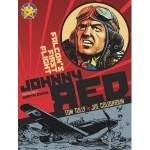
Johnny Red: Falcon’s First Flight


By Tom Tulley & Joe Colquhoun (Titan Books)
ISBN: 978-1-84856-033-8

In acknowledgement of the upcoming Comics in Conflict event at the Imperial War Museum this weekend – see our Noticeboard for details – I’m reviewing another captivating combat classic.

Britons have been enamoured of fighting aviators since the earliest days of popular fiction, but wonderful and thrilling as Biggles, Paddy Payne, I Flew with Braddock or Battler Britton might have been, the true hellish horror of war in the air didn’t really hit home for comics readers until strip veterans Tom Tully and Joe Colquhoun began crafting the epic career of a troublesome working class maverick pilot kicked out of the RAF at our time of greatest need, only to carve a bloody legend for himself in the blistering skies of the Eastern Front.

Johnny Red debuted in January 1977, in #100 of the increasingly radical war comic Battle Picture Weekly and Valiant, swiftly becoming a firm fixture for the next 500-odd issues, before finally calling it a day in 1987. Even then the strip continued as a reprint feature in Best of Battle until Fleetway stopped publishing comics.

Falcon’s First Flight collects chapters 1-37 of the long-running aerial epic in a lavish monochrome hardcover which also features an effusive introduction from starry-eyed fan Garth Ennis and a fascinating historical essay from Jeremy Briggs. Genesis of a Hero provides some intriguing perspective as well as revealing the incredible story of the pilot who was the real life inspiration for Johnny Red.

The racing breakneck action (utterly unavoidable since almost all Battle instalments were between three and four pages long) opens on September 1941 as young Liverpool oik Johnny Redburn helplessly watches Stukas and Junkas strafe and bomb the merchant ship he’s working on. The Empire Cape is part of a relief convoy en route to Murmansk with supplies for Britain’s hard-pressed Russian allies.

Scared and helpless Redburn recalls the incident which got him cashiered from RAF training (originally striking an officer but later retconned into accidentally killing an instructor) and banned from flying. He doesn’t miss the snobs and stupid rules but Johnny was a natural flier and is still hungry for the skies…

Unable to provide fighter escorts or aircraft carriers, the Navy at this time outfitted some freighters with a catapult-launched plane. The Cape has one of these insane contraptions: a single Hurricane which would be launched into enemy-filled skies with a few hours’ fuel and a pilot expected to do whatever he could until German bullets or the seas claimed him. Convoy ships had no landing facility and if the flier survived the dogfights he was expected to ditch in the sea or crash…

When the aviator is killed on the way to launch Johnny takes his place and against all odds shoots down enough attackers to allow the crew of the Cape to successfully abandon ship. Now he faces a unique dilemma. He is an illegal pilot in a stolen plane he can’t land. Having no faith in British military justice or the cold cruel waters below Redburn decides to try for the Russian mainland and a proper landing field…

Typically though, it’s a case of out of the frying pan and into the freezer as lethal weather conditions close in. Miraculously escaping fog, storm and ice he lands in a hidden base only to be mistaken for a German by the starving and desperate air fighters of the 5th Soviet Air Brigade… the “Falcons”.

These are patriotic but damned men, ordered to resist to the last in creaky biplanes against the overwhelming forces of the Luftwaffe. As the embattled communists close on Johnny the Germans attack and a unique bond of comradeship is formed as his skill and modern Hurricane wreaks havoc amongst the complacent Nazis.

With nowhere else to go Johnny joins the squadron of the doomed, galvanising them into a competent unit of rule-breaking, triumphant aerial killers risking everything to save their beleaguered homeland.

Ill-supplied and written off by their own leaders the Soviet airmen are convinced by “Johnny Red” to steal whatever food, replacements and weapons they need from their own retreating forces, quickly becoming a cohesive and credible threat to the once unstoppable Germans.

The warrior’s spectacular revival causes its own problems. Johnny is hiding from all contact with the British, convinced that only jail or the gallows awaits him, whilst beyond the close brotherhood of his fellow Falcons, successive Soviet military bureaucrats such as demented political officer Major Alexie Kraskin – a martinet who loves executing his own troops if they won’t obey suicidal orders – or cowardly, carpet-bagging Comrade Colonel Grigor Yaraslov, politically appointed to lead the resurgent squadron, all seem far too eager to get rid of the humiliatingly competent foreign interloper…

In sortie after sortie Johnny Red tackles privation, exhaustion and the enmity of his superiors whilst clearing Russian skies of fascist predators, but as this first volume closes he faces his greatest challenges.

With the Falcons posted to the frozen hell of Leningrad during the worst part of the German siege Johnny is increasingly plagued by the recurring effects of an old head-wound causing sporadic fits of blindness whilst a kill-crazy psychopathic replacement to the Falcons is determined to murder the Englishman, for stopping the strafing of Germans after they have surrendered…

These gritty, evocative tales are packed with historical detail, breathtaking passion and a staggering aura of authenticity. The classic theme of a misfit making good under incredible adversity has never been better depicted and Tom (Kelly’s Eye, Steel Claw, Roy of the Rovers, Raven on the Wing, Harlem Heroes, Mean Arena) Tully’s visceral scripts are perfectly realised by miracle worker Joe Colquhoun. The artist quit writing and drawing Roy of the Rovers to perfect his mastery of aviation war-stories on the long-running but more traditional Paddy Payne in Lion (from 1959 until the feature folded) before co-creating Johnny Red in late 1976. He illustrated 100 episodes before moving on to his greatest work Charley’s War.

This premiere collection is a grand moment in the transition of comics from boy’s own bravado in a Toff’s World to mature, mercurial yet moving adventures starring ordinary working class heroes. Johnny Red was at the forefront of this invasion of extraordinary commoners during a war that almost abolished the class system forever.

However, whatever your dogma or preferred arena of struggle, there’s no question that these magnificent war-stories are among the Few: the cream of British comics well worth your avid time and attention.

Johnny Red © 2010 Egmont UK Ltd. All Rights Reserved. Introduction © 2010 Garth Ennis. Genesis of a Hero © 2010 Jeremy Briggs.

Darkie’s Mob: The Secret War of Joe Darkie


By John Wagner & Mike Weston (Titan Books)
ISBN: 978-1-84856-442-8

To celebrate this weekend’s Comics and Conflict symposium at the Imperial War Museum and to kick off a Now Read This “Best of British Week here’s a piece about one of the greatest and most impressive war strips ever created…

Britain has always had a solid tradition for top-notch comic strips about the Second World War but the material produced by one radically different publication in the 1970s and 1980s surpassed all previous efforts and has been acknowledged as having transformed the entire art form.

Battle was one of the last great British weekly anthologies: an all-combat comic which began as Battle Picture Weekly on 8th March 1975 and through absorption, merger and re-branding became Battle Picture Weekly & Valiant, Battle Action, Battle, Battle Action Force and finally Battle Storm Force before itself being combined with the too-prestigious-to-cancel Eagle on January 23rd 1988.

Over 673 gore-soaked, epithet-stuffed, adrenaline drenched issues, it gouged its way into the bloodthirsty hearts of a generation, consequently producing some of the best and most influential war stories ever, including Major Eazy, D-Day Dawson, The Bootneck Boy, Johnny Red, HMS Nightshade, Rat Pack, Fighter from the Sky, Hold Hill 109, Fighting Mann, Death Squad!, Panzer G-Man, Joe Two Beans, The Sarge (star-artist Mike Western’s other best work ever), Hellman of Hammer Force and the stunning and iconic Charley’s War among many others.

The list of talented contributors was equally impressive: writers Pat Mills, John Wagner, Steve McManus, Mark Andrew, Gerry Finley-Day, Tom Tully, Eric & Alan Hebden, with art from Colin Page, Pat Wright, Giralt, Carlos Ezquerra, Geoff Campion, Jim Watson, Mike Western, Joe Colquhoun, Carlos Pino, John Cooper, Mike Dorey Cam Kennedy and many others.

One of the most harrowing and memorable series was an innovative saga of group obsession and personal vengeance set in the green hell of Burma in the months following the Japanese invasion and rout of the entrenched British Empire in Spring 1942.

Darkie’s Mob by John Wagner & Mike Western is a phenomenally well-regarded classic of the genre, wherein a mysterious maniac adopts and subverts a lost, broken, demoralised and doomed squad of British soldiers, intent on using them to punish the Japanese in ways no man could imagine…

This glorious oversized monochrome hardback 112 page compilation collects the entire uncompromising saga – which originally ran from 14th August 1976 to 18th June 1977 – in a deluxe edition which also contains ‘Dead Men Walking’ – an effusive introduction by unabashed fan Garth Ennis and a comprehensive cover gallery.

The tale opens as a frantically fast-paced mystery-thriller beginning in 1946 when Allied troops discover the blood-soaked combat journal of Private Richard Shortland, reported missing along with the rest of his platoon during the frantic retreat from the all-conquering Japanese. The first entry and the opening initial episode are dated May 30th 1942, describing a slow decent into the very heart of darkness…

Beaten and ready to die, the rag-tag remnants of the British Army are rescued from certain death by the uncompromising, unconventional and terrifyingly brutal Captain Joe Darkie who strides out of the hostile Burmese foliage and instantly asserts an almost preternatural command over the weary warriors. The men are appalled by Darkie’s physical and emotional abuse of them and his terrifying treatment of an enemy patrol he encounters whilst leading them out of their predicament.

They’re even more shocked when they discover that he’s not heading to safety but guiding them deeper into Japanese-held territory…

Thus begins a guerrilla war like no other as Darkie moulds the soldiers by brutal bullying and all manner of psychological ploys into fanatics with only one purpose: hunting and killing the enemy.

In rapid snatches of events culled from Shortland’s account we discover that Darkie is a near-mythical night-terror to the invaders, a Kukri-wielding, poison-spitting demon happy to betray, exploit and expend his own men to slaughter his hated foes, well-known to the enslaved natives and ruthlessly at home in the alien world of the Burma jungles and swamps. What kind of experiences could transform a British Officer into such a ravening horror?

The answer quickly comes when Shortland intercepts a radio communication and discovers that the Army has no record of any soldier named Joe Darkie, but the dutiful diarist has no explanation of his own reasons for keeping the psycho-killer’s secret to himself…

For over a year the hellish crusade continued with the Mob striking everywhere like bloody ghosts; freeing prisoners, sabotaging Japanese bases and engineering works and always killing in the most spectacular manner possible. Eventually after murdering Generals, blowing up bridges and casually invading the most secure cities in the country the Mob become the Empires’ most wanted men as both Britain and Japan hunt the rogue unit with equal vehemence and ferocity.

Darkie wants to kill and not even Allied orders will stop him…

The mob are whittled away by death, insanity and fatigue as Darkie infects them with his hatred and nihilistic madness until all the once-human soldiers are nothing more than Jap-hating killing machines ready and willing to die just as long as they can take another son of Nippon to hell with them…

The descent culminates but doesn’t end with the shocking revelations of Darkie’s origins and secret in Shortland’s incredible entry for October 30th 1943, after which the inevitable end inexorably approached…

This complete chronicle also includes a heavily illustrated prose tale from the 1990 Battle Holiday Special and I’m spoiling nobody’s fun by advising you all to read this bonus feature long before you arrive at the staggering conclusion…

A mention should be made of the language used here. Although a children’s comic – or perhaps because it was – the speech of the characters contains a strongly disparaging and colourful racial element. Some of these terms are liable to cause offence to modern readers – but not nearly as much as any post-watershed TV show or your average school playground, so please try and remember the vintage and authorial directives in place when the stories were first released.

Battle exploded forever the cosy, safely nostalgic “we’ll all be alright in the end” tradition of British comics; ushering an ultra-realistic, class-savvy, gritty awareness of the true horror of military service and conflict, pounding home the message War is Hell. With Darkie’s Mob Wagner and Western successfully horrifyingly showed us its truly ugly face and inescapable consequences.

Darkie’s Mob © 2011 Egmont UK Ltd. All Rights Reserved. Dead Men Walking © 2011 Garth Ennis.

The World of Pont

New, Revised Review

By Graham Laidler, with an introduction by Richard Ingrams (Nadder Books 1983)
ISBN: 0-90654-038-0

Graham Laidler was born in Jesmond, Newcastle upon Tyne-on July 4th 1908, son of a prominent painter and decorator. Educated at Newcastle Preparatory school and Glenalmond in Perthshire, he was 13 when his father died and the family relocated to Buckinghamshire. Always captivated by cartooning he channelled his artistic bent into more traditionally profitable avenues to support his widowed mother and trained as an architect at the London School of Architecture from 1926-1931.

Always dogged by ill-health Laidler moonlighted as a cartoonist and in 1930 began a long-running domestic comedy strip entitled The Twiffs for the Women’s Pictorial. In 1932 he was diagnosed with a tubercular kidney and advised to live in healthier climates than ours. In August of that year he sold his first cartoon to that prestigious bulwark of British publishing Punch.

He was so popular that editor E.V. Knox took the unprecedented step of putting him under exclusive contract. With financial security established and his unique arrangement with Punch in place Laidler travelled the world and drew funny pictures, mostly of The English both at home and abroad generating 400 magnificent, immortal cartoons until his death in 1940, aged 32.

A charmingly handsome and charismatically attractive young man, Laidler visited Germany, Austria, Italy, Switzerland, Norway, Sweden, America and many other places. He won his nickname and nom-de-plume in Rome during an incident with two “Vestal Virgin” travelling companions after which he was forevermore “Pontifex Maximus”…

His greatest gift was a surgical gift for observation of social and cultural minutiae: gleaning picaresque detail and broad attitude which translated through his gently humorous graphic commentaries into simultaneously incisive and gentle, baroque and subtle picture plays encapsulating the funniest of moments on every subject pertaining to the great Enigma of Being English in Public and Getting Away with It…

His work was collected into a number of books during his lifetime and since, and his influence as humorist and draughtsman can still be felt.

Although he excelled in the strip cartoon format Pont’s true fully mastery was in telling a complete story with a single perfect drawing. His cartoons exemplified the British to the world at large and to ourselves.

During World War II the Nazis, with typical sinister efficiency, used his drawings as the basis of their anti-British propaganda when they invaded Holland, further confirming to the world the belief that Germans Have No Sense of Humour.

As Pont, for eight too-brief years, Graham Laidler became an icon and global herald of English life and you would be doing yourself an immense favour in tracking down his work. If you like Ealing comedies, Alistair Sim and Margaret Rutherford, St Trinian’s and the Molesworth books or the works of Thelwell or Ronald Searle, you won’t regret the search.

Unbelievably, despite his woefully small output there still doesn’t seem to be a definitive collection of his work. One again I implore any potential publisher reading this to take the hint, but until then, for the rest of us there’s just the thrill of the hunt and the promised bounty in seeking out The British Character, The British at Home, The British Carry On, Most of us are Absurd, Pont and this magical compendium The World of Pont, which comprises the perfect primer by sampling the best of his drawn divinations from his themed Punch series’ ‘The British Observed’, ‘The British at War’, ‘Popular Misconceptions’, ‘The British Woman’ and last but certainly not least, ‘The British Man’.

If you love good drawing and sharp observational wit you’ll thank me. If you just want a damn good laugh, you’ll reward yourself with the assorted works of Pont.
© 1983, 2007 the estate of Graham Laidler.

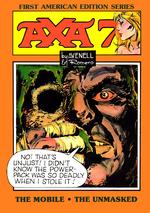
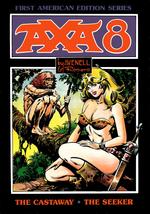
Axa volumes 5 and 6


By Donne Avenell & Enrique Badia Romero (Ken Pierce Books)
Vol. 5 ISBN: 0-912277-21-1   Vol. 6 no ISBN: 0-912277-22-X

Although the “Swinging Sixties” is thought of as the moment when we all lost our prudish innocence, the real era of sexual liberation was the early 1970s. In that period of swiftly shifting social and cultural morés and rapidly evolving attitudes to adult behaviour British newspapers radically altered much of their traditional style and content in response to the seemingly inexorable wave of female social emancipation and reputed sexual equality.

All the same, this still allowed newspaper editors plenty of leeway to squeeze in oodles of undraped women, who finally escaped from the perfectly rendered comics strips and onto the regular pages (usually the third one), the centre-spreads, pop pages and fashion features…

However the only place where truly affirmative female role-models appeared to be taken seriously were the aforementioned cartoon sections, but even there the likes of Modesty Blaise, Danielle, Scarth, Amanda and all the other capable ladies who walked all over the oppressor gender, both humorously and in straight adventure scenarios, lost clothes and shed undies repeatedly, continuously, frivolously and in the manner they always had…

Nobody complained (no one important or who was ever taken seriously): it was just tradition and the idiom of the medium… and besides, most artists have always liked to draw bare-naked ladies as much as blokes liked to see them and it was even educational for the kiddies – who could buy any newspaper in any shop without interference even if they couldn’t get into cinemas to view Flashdance, Trading Places or Spacehunter: Adventures in the Forbidden Zone without an accompanying adult…

Sales kept soaring…

Take-charge chicks were practically commonplace when the Star Wars phenomenon reinvigorated public interest in science fiction and the old standby of scantily-clad, curvy amazons and post-apocalyptic wonderlands regained their sales-appeal. Thus The Sun hired Enrique Badia Romero and Donne Avenell to produce just such an attention-getter for their already well-stacked cartoon section.

Romero had begun his career in Spain in 1953, producing everything from westerns, sports, war stories and trading cards, often in conjunction with his brother Jorge Badía Romero. He even formed his own publishing house. “Enric” began working for the higher-paying UK market in the 1960s on strips such as ‘Cathy and Wendy’, ‘Isometrics’ and ‘Cassius Clay’ before successfully assuming the drawing duties on the high-profile Modesty Blaise strip in 1970 (see Modesty Blaise: The Hell Makers and Modesty Blaise: The Green Eyed Monster), only leaving when this enticing new prospect appeared.

In 1986 political and editorial intrigue saw Axa cancelled in the middle of a story and Romero returned to the bodacious Blaise until creator/writer Peter O’Donnell retired in 2001. Since then he has produced Modesty material for Scandinavia and a number of projects such as Durham Red for 2000AD.

Axa ran in The Sun Monday to Saturday from 1978 to her abrupt disappearance in 1986 and, other than these slim volumes from strip historian Ken Pierce, has never been graced with a definitive collection. It should be noted also that at the time of these books the strip was still being published to great acclaim.

In ‘Axa the Eager’ opens with the winsome wanderer and her current paramour Dirk drifting along barren coastlines until they encounter a bird-like man-creature and are drawn inescapably into a clash of ideologies between two factions of tree-dwelling humanoids.

One, led by the boisterous dreamer Zeph, wishes to remain in the safety of the canopies until they evolve into true fliers whilst his brother Galen wishes to return the Sky People to the Earth and the ways of technological progress. The division also splits Dirk and Axa and to complicate matters further the solid ground they’re all squawking about is surrounded by deadly mutated toad monsters…

Powerful and impressively philosophical, this tale of family discord could only end in tragedy…

‘Axa the Carefree’ finds the chastened explorers travelling inland to a new and desolate landscape concealing a sedate well-hidden village. Impossibly it seems to have escaped unscathed the horrors of the Great Contamination and investigating further Axa and Dirk discover a population of simple peasants blithely thriving, unaware of the horrors of the last hundred years. However, as always, things are not as they seem and the farmers are only a satellite branch of specialist technological guilds collectively dubbed “The Artisans”.

Ever curious the nubile nomad sneaks into the mountain citadel of the Artisans to find a virtual paradise where her wild beauty captivates one too many of the masters of the Craft Guilds that run the place. She is also reunited with her lost companion Mark 10, a robotic servant she won and lost in Axa volume 3.

Tensions are already rising when the bored and enamoured Galen stumbles onto the scene and, as her very presence incites the normally-stable creative types into a kind of madness, there looks to be a revolution in the Artisans’ immediate future unless Axa can broker a return to productive rationality…

Axa 6 dispenses with tedious text and dashes straight into the graphic action of ‘Axa the Dwarfed’ with the glorious gladiatrix and Mark 10 abandoning the Artisans to trek across a bleak wasteland until they stumble into an old government research facility where the flora and insect life has grown to immense proportions. Moreover, truly advanced and properly civilised scientists appear to be running the whole show…

Typically however, even this technological Garden of Eden has a serpent in the form of one boffin with a little too much ambition, so it’s a lucky thing old flame Matt has been tracking Axa for months and finally reunites with her just as the unscrupulous mastermind makes his move…

‘Axa the Untamed’ finds the fiery fury dragging Matt and Mark 10 into a different kind of danger when the trio encounter a tribe of Gipsies who have proliferated into a modern horde of nomadic Mongol plainsmen, trading horses and other valuable commodities in a mad, macho wonderland of testosterone and arrogance.

Even Axa’s freedom-fuelled head is turned by the attentions of Gipsy Prince Django, much to Matt’s dismay, but it isn’t too long before the glamour fades and the worth of women in Django’s world leads her to reassess its value. It’s a lot harder to cure her love affair with his magnificent horses though…

These tales are superb examples of the uniquely British newspaper strip style: lavishly drawn, subversively written, expansive in scope and utterly enchanting in their basic simplicity – with lots of flashed flesh, emphatic action and sly, knowing humour. Eminently readable and re-readable (and there’s still that dwindling promise of a major motion picture) Axa is long overdue for a definitive collection. Here’s hoping there’s a bold publisher out there looking for the next big thing…
© 1984 Express Newspapers, Ltd.

Jak volume 15 (1983)


By Jak (Express Newspapers)
ISBN: 0-85079-133-2

The truly sad if not terrifying thing about rereading topical news cartoons this long after the fact is how distressingly familiar the subjects and hot topics still are.

For example this volume taken from 1983 features crass greed and duplicity amongst our financial elite, Prince Andrew starring in all the wrong sort of headlines, returning British soldiers, children easily subverting electronics systems designed to deny them access to things they shouldn’t see, all the wrong sorts of weather in the most inconvenient places, Sectarianism (Irish and otherwise), railways under-performing, overcharging and under the cosh, football violence and footballers peccadilloes (look it up if you must), Middle East madness, industrial action and business inaction, heat waves and water shortages, crises in Greece, controversies in definitions of rape, strangers making themselves at home in Buckingham Palace and a Tory Government that simply adored shooting off its collective mouth whilst simultaneously shooting itself in the foot…

This compendium even closes with looming public cynicism about an impending global sporting event…

Sometimes our industry is cruel and unjust. This collection of cartoons by Raymond Allen Jackson, who, as Jak, worked for thirty years as political cartoonist for London Evening Standard and its later incarnation The Standard – is one of many that celebrated his creativity, perspicacity and acumen as he drew pictures and scored points with and among the entire range of British Society.

His gags, produced daily to a punishing deadline as they had to be topical, were appreciated, if not feared, by toffs and plebs alike and were created with a degree of craft and diligence second to none. Even now, decades later, they are still shining examples of wit and talent… and they’re still bitingly funny too.

Artists like Jak who were commenting on contemporary events are poorly served by posterity. This particular volume (re-presenting a selection of single panel-gags from September 15th 1982 to August 12th 1983), like all of these books, was packaged and released for that year’s Christmas market, with the topics still fresh in people’s minds.

Decades later the drawing is still superb and despite perhaps the wry minutiae escaping a few the trenchant wit, dry jabs and outraged passion which informed these visual ripostes are still powerfully effective. And obviously human nature never changes and there’s nothing new under the sun…

It’s a terrible shame that the vast body of graphic excellence which topical cartoonists produce has such a tenuous shelf-life. Perhaps some forward looking educational institution with a mind to beefing up the modern history or social studies curricula might like to step in and take charge of the tragically untapped and superbly polished catalogue of all our yesterdays.

Clearly they’re all short of a bob or two these days and I’m pretty sure these cartoon gems could find a willing market eager to invest in a few good laughs…
© 1983 Express Newspapers Limited.

Celeb


By Charles Peattie, Mark Warren & Russell Taylor (Private Eye/Corgi)
ISBN: 0-552-13858-4

In terms of taste, as in so many other arenas, our modern world seems to be heading for Heck in a hand-basket, so  I thought I’d take the opportunity to cover a little lost gem of British cartooning delight that’s increasing re-relevant in these appalling days of fame campaigns and dodgy talent show democracy.

Celeb was a strip which ran in that evergreen gadfly Private Eye, beginning in May 1987, created by Mark Warren and the team of Charles Peattie and Russell Taylor (who were simultaneously crafting the abortive first iteration of greed-glorifying mini-classic Alex for Robert Maxwell’s short-lived London Daily News).

For years credited to the pseudonymous “Ligger”, the pithy and hilarious episodes followed the day to day life of Swinging Sixties survivor and disgracefully declining rock-legend Gary Bloke as he dealt with a changing world, thinning hair, parenthood and inexorable middle age.

These days with 24/7 reality shows, desperate celebrities enduring career-resuscitating humiliations in locked houses and jungle clearings and a host of other self-inflicted, double-edged B-list exposé freak-shows everywhere, the outrageous pronouncements and antics of Gary seem pretty tame but in the days before Ozzy Osbourne became more famous for parenting and not singing whilst footballers’ performance off the field took precedence over goals scored on it, the sozzled, crass, befuddled, and pitifully pompous cocky cockney-boy-made-good was the very epitome of affably acceptable, ego-bloated, publicity-seeking, self-aggrandizing, drug-fuelled idiocy.

Within this collection from 1991 the legendary “Man of the Peeple” distributes kernels of hard-won wisdom to the likes of Michael Parkinson, Terry Wogan, Clive James, Cilla Back, Ruby Wax, Barry Norman, Anne Diamond, Selena Scott, Michael Aspel and other interviewers of lesser longevity, tackles world poverty and the environment head-on (and eyes tight shut), learns how to cope with those new-fangled rock videos, adapts to the needs of his burgeoning family and, of course, consumes a phenomenal quantity of recreational pharmaceuticals…

Including a selection of interviews from the Sunday Times (October 1989), The Sun (Wednesday August 3rd 1988) and candid shots of Gary with Bob Geldof and George Michael at Live Aid, the collection concludes with the infamous days during which Gary was dead of an overdose and met both God and Elvis, plus the sordid truth behind his numerous brushes with the law, leading to his 18-month stretch At Her Majesty’s Pleasure and subsequent key role in a terrible prison riot for better conditions and macrobiotic food…

The heady cocktail of drink, sex, drugs, money, sport, music, adoration and always-forgiven crassness is perhaps the reason so many folks are seduced by celebrity. If you want to see another side to the fame-game and have a hearty laugh into the bargain Gary Bloke is your man…
© 1991 Peattie, Taylor & Warren. All Rights Reserved.

Max


By Giovanetti (Macmillan, New York)
No ISBN

Pericle Luigi Giovanetti was a huge star in the cartoon firmament in the years following World War II and one look at his work will instantly show you why. Born in 1916 in Switzerland, this doyen of brilliant penmen launched his most famous character in Punch in April 1953 – from whence most of these scintillating escapades sprang (the remaining pieces are courtesy of Nebelspalter and Glamour).

Max is a small, round furry creature most likened to a hamster, whose wordless pantomimes were both cute and whimsical – as well as trenchantly self-deprecating. Don’t ask me how a beautifully rendered little puff-ball could stand for pride brought low and pomposity punctured, but he did. The weekly incidents were also blissfully free of mawkish sentimentality; a funny animal for adults and children.

Max was syndicated across the world, (known as Mr. Makkusu-san in Japan) numbering such diverse luminaries as Jason Robards and Charles Schulz as fans and even lending its image and cache to the British Navy and Swiss Air Force as mascot and figurehead.

There were four collections between 1954 and 1961: this one, Max Presents, Nothing But Max and the Penguin Max. Like these, two other collections, Beware of the Dog and Birds without Words, are also criminally out of print.

In this initial 96 page hardback the hairy hero happily demonstrates the challenges inherent in assorted musical instruments, ink-pens, all kind of cooking, drink, hats, hobbies and a host of other occupations and interests…

For all his trenchant ability to convey meaning and offer salutary warnings without uttering a sound, Max’s origins – and indeed species – was a subject of much dispute in the four corners of the globe until Clive King and Giovanetti revealed all in the magical children’s book Hamid of Aleppo, (written in 1958) which delightfully revealed the little wonder’s true origins, antecedents, taxonomy and species: Max is a Syrian Golden Hamster!

The sheer artistic virtuosity of Giovanetti is astounding to see and the fact that his work should be forgotten is a travesty and a crime. If you ever find a collection of his work do yourself the biggest favour of your life and grab it with both hands.

The internet is a wonderful thing. Just as it finally provided me with a book I’d been hunting out for decades it also revealed that I’d been a short-sighted idiot for not looking further afield – or indeed across the Channel.

A French edition was released in 2003 (ISBN-13: 978-2-21107-074-4) because our Gallic cousins have a far more informed opinion of comics and cartooning than us Anglos – and since all these glorious cartoons are wordless masterpieces that shouldn’t hinder anybody wishing to make the acquaintance of this magical superstar of yesteryear – and, hopefully tomorrow…
© 1954 Pericle Luigi Giovannetti. All Rights Reserved.

Jak volume 13 (1981)


By Jak (Express Newspapers)
ISBN: 0-85079-117-0

I reviewed one of Jak’s earliest collections a few years back and churlishly bemoaned the lack of contextual grounding, utterly forgetting that a brief time later the editors of the series began doing just that so here’s another bite of a superb cartoon cherry that’s still not impossible for the determined fan to find.

The truly sad if not terrifying thing about rereading topical news cartoons years if not decades later is how distressingly familiar the subjects and hot topics are.

For example this volume taken from 1981 features an impending Royal Wedding, bombings in Ireland, nuclear contamination, BP cocking up the planet, banking scandals, insane cuts in military spending, increased unemployment – especially for school and college leavers, brutal spending cuts, a chancellor who couldn’t add up (Geoffrey Howe back then), cynical disinformational bitching about overpaid Council and public sector workers plus a Tory government falling apart and attacking itself and its partners.

However, that time the Government saved itself by fighting a war with somebody thousands of miles away over oil, but there’s no chance of that happening aga…

Hey, wait a minute…

Even the quirky “silly season” stories seem afflicted by generational déjà vu then and now: ITV’s breakfast show was suffering a star-strapped meltdown, the space shuttle was big news (the first not last ever flight into orbit), Prince Andrew was embarrassing us in the eyes of the world, a major acting star went spectacularly off the rails and we were “all in it together” with even rich people cutting down on luxuries (slightly) and England had an appalling football team…

This compendium even closes with the threat of impending war in Libya…

Sometimes our industry is cruel and unjust. This collection of cartoons by Raymond Allen Jackson, who, as Jak, worked for thirty years as political cartoonist for London Evening Standard – renamed by this time as The Standard – is one of many that celebrated his creativity, perspicacity and acumen as he drew pictures and scored points with and among the entire range of British Society.

His gags, produced daily to a punishing deadline as they had to be topical, were appreciated, if not feared, by toffs and plebs alike and were created with a degree of craft and diligence second to none. Even now, decades later, they are still shining examples of wit and talent. Most of them are still scathingly funny too.

Artists like Jak who were commenting on contemporary events are poorly served by posterity. This particular volume (re-presenting a selection of single panel-gags from September 5th 1980 to October 19th 1981), like all of these books, was packaged and released for that year’s Christmas market, with the topics still fresh in people’s minds. Thirty years later – although the drawing is still superb – although the minutiae might escape a few – the trenchant wit, dry jabs and outraged passion which informed these pictorial puncture wounds is still powerfully present. And clearly human nature never changes…

It’s just a huge shame that the vast body of graphic excellence that news cartoonists produce has such a tenuous shelf-life. Perhaps some forward looking university with a mind to jazzing up their modern history or social studies curricula might want to step up and take charge of the tragically untapped and superbly polished catalogue of all our yesterdays…
© 1981 Express Newspapers Limited.

Axa volumes 3 and 4


By Donne Avenell & Enrique Badia Romero (Ken Pierce Books)
Vol. 3 No ISBN: 0-912277-00-9  Vol. 4 no ISBN: 0-912277-00-9

During the 1970s British newspapers radically altered much of their style and content to varying degrees in response to the seemingly inexorable move towards female social emancipation and sexual equality. Nevertheless, this somehow allowed newspaper editors to squeeze in even more undraped women, who finally escaped from the perfectly rendered comics strips and onto the regular pages, usually the third one, the centre-spreads and into the fashion features…

The only place where truly strong female role-models were taken seriously was the aforementioned cartoon sections but even there the likes of Modesty Blaise, Danielle, Scarth, Amanda and all the other capable ladies who walked all over the oppressor gender, both humorously and in straight adventure scenarios, lost clothes and shed undies repeatedly, continuously and in the manner they always had…

Nobody complained (no one important or who was ever taken seriously): it was just tradition and the idiom of the medium… and besides, artists liked to draw bare-naked ladies as much as blokes liked to see them and it was even educational for the kiddies – who could buy any newspaper in any shop without interference even if they couldn’t get into cinemas to view Flashdance, Trading Places, Octopussy or Spacehunter: Adventures in the Forbidden Zone without an accompanying adult…

Sales kept going up…

Take-charge chicks were almost commonplace when the Star Wars phenomenon reinvigorated public interest in science fiction and the old standby of scantily-clad, curvy amazons and post-apocalyptic wonderlands regained their sales-appeal. Thus The Sun hired Enrique Badia Romero and Donne Avenell to produce just such an attention-getter for their already well-stacked cartoon section.

Romero had begun his career in Spain in 1953, producing everything from westerns, sports, war stories and trading cards, often in conjunction with his brother Jorge Badía Romero. He even formed his own publishing house. “Enric” began working for the higher-paying UK market in the 1960s on strips such as ‘Cathy and Wendy’, ‘Isometrics’ and ‘Cassius Clay’ before successfully assuming the drawing duties on the high-profile Modesty Blaise strip in 1970 (see Modesty Blaise: The Hell Makers and Modesty Blaise: The Green Eyed Monster), only leaving when this enticing new prospect appeared.

In 1986 political and editorial intrigue saw Axa cancelled in the middle of a story and Romero returned to the bodacious Blaise until creator/writer Peter O’Donnell retired in 2001. Since then he has produced Modesty material for Scandinavia and a number of projects such as Durham Red for 2000AD.

Axa ran in The Sun Monday to Saturday from 1978 to her abrupt disappearance in 1986 and other than these slim volumes from strip historian Ken Pierce has never been graced with a definitive collection. It should be noted also that at the time of these books the strip was still being published to great acclaim.

In the first two volumes Axa, a pampered citizen of a sterile, domed community in 2080AD, rebelled against her antiseptic society’s cloying strictures and escaped to the ravaged, mutant-infested post apocalyptic wilderness to be free. Her journeys took her across the ravaged planet, discovering lost enclaves and encountering bizarre new tribes and cultures.

The third volume opens with an avid appreciation by C.C. Beck, the “Crusty Curmudgeon” most celebrated as co-creator of the Shazam!-shouting Captain Marvel before the nubile nomad resumed her explorations in ‘Axa the Brave’ with her latest companion Jason Arkady in tow. Crossing a frozen wasteland reclaimed by wolves after man’s Great Contamination excised human civilisation, the pair stagger into a lush tropical valley populated by dinosaurs and cavemen.

The historical anomalies are disturbing and dangerous enough, but when they were invited to join the new stone-agers they uncovered an even greater enigma: the cave-walls were covered in paintings of robots and weird machines… The secret of the hidden valley is yet another example of the brilliance and folly of the lost human civilisation and leads the unstoppable freedom-seeker to a swamp-city where an enclave of scientists had survived the disaster…

The hidden sages had a big plan to reshape the world and wanted Axa aboard, so they built her the perfect companion: a faithful, semi-sentient laser-wielding robot dubbed Mark 10 who instantly aroused the jealous ire of Jason. As so often the case however, Axa’s male benefactors had hidden plans for her but the scientists had built too well and the utterly devoted Mark came rattling rapidly to her rescue…

In ‘Axa the Gambler’ the winsome wanderer, with Mark and Jason faithfully following, stumbled onto a community where wagering was the basis for existence and pilgrims came from miles around to bet with the fervour of religious zealots.

In The City of Hope patrons worshipped Las Vegan relics, seeking instant gratification for their greedy, hungry prayers. Soon Jason had caught the bug and gambled away all their meager possessions including the magnificent ancient sword Axa had carried since her first escape from the Domed City.

Of course the game was fixed, but with Mark’s cybernetic intervention Axa recouped all their losses, narrowly escaping the hidden penalty that underpinned the barter-economy of the City: when you don’t have any more goods to wager with, you become the property of the house…

When Jason discovered a historic family link to big boss Mr. Nero he switched allegiance and Axa ended up fighting for her life and liberty in the gladiatorial arena beside motorcycle warrior Dirk. With freedom her greatest love, Axa inevitably engineered Nero’s bloody fall, but lost Jason to the lure of greed and an idle life of pleasure…

Axa 4 begins with an appreciation and “previously on…” by publisher Bernie McCarty before ‘Axa the Earthbound’ saw the blonde bombshell and Dirk hunting the missing mechanical Mark 10 through a haunted, monster-haunted swamp until they stumbled upon a lost oasis of beauty – a veritable paradise amidst the ruins of the world.

In a ramshackle old house lived aged Joy Eden who happily welcomed the wanderers to stay. Axa was subtly drawn to the aged free spirit’s talk of Mother Earth and pagan renewal but Dirk had his suspicions: did the old lady thrive despite the mutants and mud-monsters… or because of them?

Deeply steeped in Earth-magic and transformative mysticism, did the lonely old crone have another reason for keeping Dirk and Axa within the tumbledown walls of her “Seventh Heaven”… and just what did happen to the coldly technological but absolutely loyal Mark?

Ending as always in bitter revelation, chilling conflict and spectacular conflagration the denouements led the explorers back into the desert wastes in ‘Axa the Tempted’. Their trek brought them to the coast where mutated seaweed and giant sea-life threatened to end their trials for ever and whilst fleeing giant land-crustaceans the couple found an ancient beached ocean-liner from where inbred pirates raided other coastal settlements for slaves, provisions and “Old People” technological artifacts.

Escaping from “The Crewmen”, Axa and Dirk allied themselves with the united sea-villagers and the heroic Cap, King of the Coast, who protects the scattered communities from pirate depredations. The wily wild-girl was strangely attracted to the larger-than-life champion and his luxurious life of adventure, excitement and bold deeds, but Dirk had mysteriously vanished and something just didn’t ring true about the magnanimous warrior-king…

Once more bitter disappointment and righteous indignation awaited Axa as she once more learned that no matter where she roamed men were all the same whilst greed and depravity had not vanished with the Old Ones and their Great Contamination.

These tales are superb examples of the uniquely British newspaper strip style: lavishly drawn, subversively written, expansive in scope and utterly enchanting in their basic simplicity – with lots of flashed flesh, emphatic action and sly humour. Eminently readable and re-readable (and there’s still that dwindling promise of a major motion picture) Axa is long overdue for a definitive collection. so here’s hoping there’s a bold publisher out there looking for the next big thing…

© 1983 Express Newspapers, Ltd. First American Collectors Edition Series ™ & © 1983 Ken Pierce, Inc.