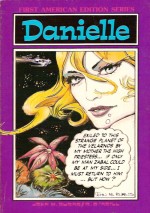
Danielle: First American Edition Series


By John M. Burns & Richard O’Neill (Vertigo)
ISBN: 0-912277-23-8

If you indulge in the wonders of comics for any appreciable length of time you’ll increasingly find yourself becoming something of an apologist.

“I just like the artwork.”

“They’ll be worth money one day”

“It’s a metaphor for…”

You get the idea. I often end up having to explain away situations and depictions that might seem racist, sexist or – worst of all – painfully naff, and at first glance, this book and its contents might easily confirm most if not all of those charges. But I’m not apologising and I urge you not to rush to judgements.

The prime reason for this is the illustrator. John M. Burns is an international star of comics but still remains largely unsung in his own country – which, considering the sheer breadth and quality of his output, is possibly the greatest compliment I can pay him. Britain has always been painfully ignorant of its comics heroes…

Born in Essex in 1938 he apprenticed at Doris White’s Link Studios in 1954 before moving on to Amalgamated Press where he worked on “Young Juvenile” titles such as Junior Express, Girl’s Crystal and School Friend, graduating to the luxurious photogravure mainstream comic Express Weekly a year later.

After National Service (we used to conscript our young men for two years’ military training in those hazy Cold War days – just in case…) which found him in the RAF and sent to Singapore he returned to comics in 1961, adapting Wuthering Heights for DC Thomson’s Diana and drawing Kelpie in Odhams revolutionary weekly Wham!

Spreading himself far and wide he followed Ron Embleton on Wrath of the Gods in Boy’s World and Eagle (scripted by Michael Moorcock – now there’s a strip crying out for collection), as well as The Fists of Danny Pike, Dolebusters and Roving Reporter. He was part of the inimitable and beloved team of artists who worked on Gerry Anderson’s licensed titles TV Century 21 and its sister magazines – he was particularly impressive on Space Family Robinson in Lady Penelope.

From 1965 he worked increasingly for newspapers beginning with The Tuckwells in The Sunday Citizen, The Seekers for The Daily Sketch (1966-1971), Danielle in the Evening News (1973-74), George and Lynne (1977-1984) and The Royals – the official strip biography of Prince Charles and Diana Spencer (1981) in The Sun and Modesty Blaise for The Evening Standard (see Modesty Blaise: Yellowstone Booty).

He revived Jane for the Daily Mirror (1985-1989) and has intermittently worked on many others. He was chosen to conclude Jim Edgar and Tony Weare’s incredible, long-running western strip Matt Marriot in 1977.

Burns’ TV related work is magnificent. He has worked on licensed series for Look-In, TV Action and Countdown illustrating the adventures of UFO, Mission Impossible, Tomorrow People, Bionic Woman, How the West Was Won and others. For Germany he drew the strip Julia (also know as Lilli) and worked with Martin Lodewijk on the fantasy series Zetari before in 1980 beginning his long association with the legendary British science fiction comic 2000AD, where he has – and continues to – work on Judge Dredd, Trueno, Nikolai Dante and his own Bendatti Vendetta.

He is also a regular adaptor of significant literary masterpieces, having already completed pictorial versions of Lorna Doone, Wuthering Heights and Jane Eyre.

1973 was the height of the much-maligned “Sexual Revolution” with women demanding equal rights, equal pay and fair treatment (and isn’t it great that they’ve got all those things now…). Contraception was becoming readily available, everywhere bras were burning, and men thought that sex wasn’t going to be so expensive anymore. It was a reactionary Male Chauvinist Pig’s Dream, and unrepentant old-school stand-up comedians were having a field day.

I’m not sure that the various editors of papers were supporters of the Women’s Lib movement, or simply found a great excuse to turn the industry’s long tradition of naked chicks in strips into something at least nominally hip, political and contemporary: I do know that a awful of new features with liberated, forceful women who nevertheless still had hunky take-charge boyfriends in tow appeared – but not for very long.

One of them was Danielle: at first glance a fantasy saga in the tradition of Garth, but as the saga unfolded, one that developed beyond its superficial beginnings. The strip launched on Monday, September 17th 1973, and introduced a willowy blonde heroine: a rebel against an oppressive regime, and one whose railing against the system had resulted in her banishment. Her crime? She had loved a man.

Now Danielle had returned to the planet Janus to overthrow her own mother, whose matriarchal dictatorship had kept men as subservient sex-slaves, and to rescue her truly beloved Zabal from the State Brothel he had been condemned to (stop sniggering).

Reversing many of the cherished trappings of Flash Gordon, Danielle fought monsters and militarists before she and Zabal escaped, using a magical Pendant of Power to leap into the chaos of time and space. From then on the pair roamed the universe like buff, unclad Doctor Who extras, first landing in futuristic Britain in ‘Master Plan’ where the previous situation is utterly reversed and women have been drugged into subservient submission and a highly commercialised male hegemony rules virtually unopposed.

When Zabal’s head is turned by freedom and testosterone-soaked male dominance he betrays Danielle until she joins the all-female resistance and helps overthrow the Masters. Reunited but not quite so trusting anymore they are then whisked by the Pendant to ‘The Dump’ an intergalactic penal colony, where she is the only woman, before the space eddies tear them apart and Zabal is lost…

In ‘Dark Genesis’ Danielle lands on a desolate world where the rejects of a super-alien’s genetics program try to stop her from becoming their creator’s latest stock-breeder, but after defeating the alien with common sense the hapless voyager materialises at a ‘Black Sabbath’ in Edinburgh in 1660. Mistaken for a demon she finds herself at the mercy of Puritan witch-finders and corrupt, debased officers of Cromwell’s New Model Army…

Appalling as these summations sound, Richard O’Neill’s scripts are a wry and canny counterpoint to the strident zeitgeist of the times. Brought in to overhaul Burns’ initial proposal, the ex-TV 21 editor managed to impose a studied balance to what was always intended to be a slight, escapist, lad-ish girly-strip with lots of ogle-worthy nudity and loads of fantasy action.

With deliberate overtones of H.P. Lovecraft and Philip José Farmer, the military historian added a knowing lightness to the proceedings which, married to Burn’s imagination and incredible line-work, resulted in a delight of self-deprecatory storytelling which is far, far from the exploitative, pandering lip-service it might first seem to be.

However it couldn’t save the feature. ‘Superstar’, the last story in this slim black and white volume, deviates from the established format as Danielle lands on a Hollywood film set in 1930. Quickly co-opted by a zany movie director she becomes a reluctant rising star before being reunited with Zabal who has been marooned on Earth for decades. Roaring along at a rather brisk pace and played strictly for gentle laughs, this final tale abruptly ended Danielle’s cosmic capers on September 14th 1974. Not included in this book is her 54 day revival from 1978, but I suspect that’s for the best…

Heavy-handed at first glance but stunningly beautiful to look upon; this is a series with a lot to say about the times it came from and perhaps one that might finally find a welcoming readership in these oh-so-perfect modern days.
© 1984 Associated Newspapers Group. All Rights Reserved.

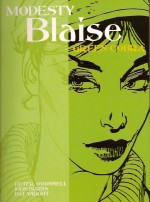
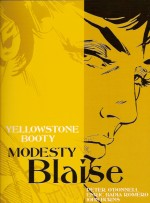
Modesty Blaise: Yellowstone Booty


By Peter O’Donnell, Enric Badia Romero & John Burns (Titan Books)
ISBN: 978-1-84576-419-7

Originally a newspaper strip created by Peter O’Donnell and drawn by the brilliant Jim Holdaway, Modesty and her charismatic partner in crime (and latterly crime-busting) Willie Garvin have also starred in 13 prose novels and short story collections, two films, one TV pilot, a radio play and nearly one hundred comic strip adventures between 1963 and the strip’s conclusion in 2002. She has been syndicated world-wide, and Holdaway’s version has been cited as an artistic influence by many major comic artists.

Titan Books’ marvelous series re-presenting the classic British newspaper strip reaches a period of artistic instability with this thirteenth volume as Spanish collaborator Romero left in 1978 to concentrate on his own creation Axa; although if anything the strip actually improved under the all-too-brief tenure of his replacement.

John M. Burns had worked on Junior Express and School Friend but truly began his auspicious rise as part of the inimitable and beloved team of artists who worked on the Gerry Anderson licensed titles TV Century 21 and its sister magazines (he is particularly admired for Space Family Robinson in Lady Penelope). He drew strips for The Daily Sketch, Daily Mirror and Sun with long, acclaimed runs on The Seekers and the saucy “Good Girl” strip Danielle (expect a review of her really soon), before briefly – and controversially – taking over Modesty Blaise.

Since then he has worked on TV-based series for Look-In and Countdown before latterly abandoning pen and ink for painted art and finding a welcome home in the legendary British science fiction comic 2000AD, where he has – and continues to – work on Judge Dredd, Nikolai Dante and his own Bendatti Vendetta. He is also a regular adaptor of significant literary masterpieces, having already completed pictorial versions of Lorna Doone, Wuthering Heights and Jane Eyre.

Although Burns only drew 272 consecutive daily strips, his influence on Modesty was marked and long-lasting. His deft ability with nib and brush are highlighted here with a complimentary feature reprinting 12 of his illustrations from some of those prose novels O’Donnell wrote starring his inimitable creation, and there are also sketches and cover reproductions from Titan Books’ 1980s Modesty collections.

The adventure portion of this book begins with ‘Idaho George’ an extremely engaging comedy thriller which sees Garvin and “the Princess” rescue an old acquaintance. The eponymous George is a marriage-dodging conman who accidentally fools the wrong mark: superstitious and extremely dangerous Anastasia Bone sets her gang of murderous crime specialists on the hapless trickster when he masquerades as a swami who can materialise gold from thin air…

Fast-paced and tremendously satisfying, that caper is just a taster for Romero’s last job ‘The Golden Frog’, a globe-girdling vendetta that brings Modesty back to her roots when Saragam – the martial arts master who taught her to fight – is captured by a revenge-crazed Khmer Rouge warlord with a grudge against her that stretches back to her days as leader of the criminal organisation The Network. Lured back to the “Killing Fields” of Cambodia and unsure who to trust, Modesty and Willie face possibly their greatest threat in this action-packed, fists of fury fight-fest.

John Burns seemed an ideal replacement for Romero, and is still remembered with affection and appreciation by fans, but he only illustrated two-and-a-half stories, beginning with ‘Yellowstone Booty’ which ran from November 1st 1978 to March 30th 1979 (if you’re curious Idaho George and The Golden Frog appeared in the Evening Standard from 23rd January to October 31st 1978).

His innate design sense, sleek, deceptive line and facility with the female form coincided with a much freer use of casual nudity in the feature, and the action scenes were to become graphic poetry in motion. All these advantages can be observed in this clever yarn of gangsters and lost treasure that sees a young couple save Willie from an ingenious murder-plot, incurring a debt that Modesty moves Heaven and Earth to repay…

These timeless tales of crime and punishments are more enthralling now than ever, and provide much-needed relief in a world increasingly bleak and confusing. At least here you always know who to cheer for and who to boo at. More than three decades later it’s quite odd to realise just mere months after the heroine shockingly – and controversially – bared her breasts, naked ladies adorned not just the comics pages but the “news” portions of so many British papers – all without the kingdom falling into flaming anarchy.

Odder still is the realization that heavy-handed censorship still occurs in America and other countries: boobies and botties – no matter how well-drawn – are still racy, shocking and a big deal opposed with all the vehemence one expects from populations when their Governments suspend Habeas Corpus and/or outlaw football.

I trust this will be all the warning you need, should you be of a sensitive disposition, but hope that such sights won’t discourage you from reading these incredible tales of fiction’s greatest adventuress.

© 2008 Associated Newspapers/Solo Syndication.

Modesty Blaise: Death Trap


By Peter O’Donnell & Enric Badia Romero (Titan Books)
ISBN 13: 1-84576-418-0

Modesty Blaise and her devoted deputy Willie Garvin were retired super-criminals who got too rich too young without ever getting too dirty and are now usually complacent and bored out of their brains. When approached by Sir Gerald Tarrant, head of a British spy organization, they jumped at his offer of excitement and a chance to get some real evil sods. From that tenuous beginning in ‘La Machine’ (see Modesty Blaise: the Gabriel Set-Up) the pair began a helter-skelter thrill ride that has pitted them against the World’s vilest villains…

The legendary femme fatale adventurer first appeared in the Evening Standard on May 13th, 1963 and starred in some of the world’s most memorable crime fiction, all in three panels a day. Her creators Peter O’Donnell and Jim Holdaway (who had previously collaborated on Romeo Brown – a light-hearted adventure strip from the 1950’s and itself well overdue for collection) produced story after story until Holdaway’s tragic early death in 1970, whereupon Spanish artist Enric Badia Romero assumed the art reins taking the daredevil duo to even grater heights.

The tales are stylish and engaging spy/crime/thriller fare in the vein of Ian Fleming’s Bond stories (as opposed to the sometimes over-the-top movie exploits). Modesty and Willie are competent and deadly, but all too fallibly human.

Following an intriguing dissertation by fan and historian Lawrence Blackmore on how the strip was censored in America (entitled ‘Preserving Modesty’s Modesty’ ) this twelfth superb black and white volume, collecting strips which originally appeared in the between October 21st 1976 and January 20th 1978, kicks off in high style with the entrancing but ultimately tragic yarn ‘The Vanishing Dollybirds’ wherein the duo are drawn into a web of Arabic white slavery, administered by the frightfully British and thoroughly unpleasant Major Hamilton and his formidable wife Priscilla, not to mention their uniquely fey hitman and murder-artisan, Bubbles.

Combining high-octane drama with sly comedy and all the charms of the circus (Willie bought one when he was feeling bored…) this is a cracking, straightforward tale which acts as pace-setter for ‘The Junk Men’, a moody murder mystery set in Turkey. Willie is playing stuntman on a science fiction film before getting accidentally embroiled in a war between the police and the world’s three biggest drug lords. And whenever Willie is in trouble can Modesty be far away?

Closing the book is a truly sinister plot from a vengeance-crazed Warsaw Pact commissar determined to punish Modesty for past offences in the gripping, brutal thriller ‘Death Trap’. Comrade Director Breslin wants the retired super-criminal to suffer so he begins his campaign by murdering her current lover in the most appalling manner he could conceive of, but the ambitious politician could never imagine just how dangerous an angry Modesty Blaise could be…

Tightly plotted, with twist after turn, and cross after double-cross, this is no simple revenge story but a sharp, incisive romp that uses the madness of the Cold War “Mutually Assured Destruction” philosophy to great advantage and devastating effect…

In an industry where comic themes seem more and more limited and the readership dwindles to a slavish fan base that only wants more and shinier versions of what it’s already had, the beauty of such strips as Modesty Blaise is not simply the timeless excellence of the stories and the captivating wonder of the illustration, but that material like this can’t fail to attract a broader readership to the medium. Its content can hold its own against the best television and film. NCIS, Chuck Bartowski and Sydney Bristow beware – Modesty’s back to show you how it should be done…

© 2007 Associated Newspapers/Solo Syndication.

The Misadventures of Jane


By Norman Pett & J.H.G. (“Don”) Freeman (Titian Books)
ISBN: 978-1-84856-167-0

Jane is one of the most important and well-regarded comic strips in British, if not World, history. It debuted on December 5th 1932 as Jane’s Journal: or The Diary of a Bright Young Thing, a frothy, frivolous gag-a-day strip in the Daily Mirror, created by (then) freelance cartoonist Norman Pett.

Originally a comedic vehicle, it consisted of a series of panels with cursive script embedded within to simulate a diary page. It switched to the more formal strip frames and balloons in late 1938, when scripter Don Freeman came on board and Mirror Group supremo Harry Guy Bartholomew was looking to renovate the serial for a more adventure- and escape-hungry audience. It was also felt that a continuity feature such as Freeman’s other strip Pip, Squeak and Wilfred would keep readers coming back – as if Jane’s inevitable – if usually unplanned – bouts of near nudity wouldn’t…

Jane’s secret was skin. Even before war broke out there were torn skirts and lost blouses aplenty, but once the shooting started and Jane became an operative for British Intelligence her clothes came off with terrifying regularity and machine gun rapidity. She even went topless when the Blitz was at its worst.

Pett drew the strip with verve and style, imparting a uniquely English family feel: a joyous innocence and lack of tawdriness. He worked from models and life, famously using first his wife, his secretary Betty Burton, editorial assistant Doris Keay but most famously actress and model Chrystabel Leighton-Porter until May 1948 when Pett left for another newspaper and another clothing-challenged comic star.

His art assistant Michael Hubbard assumed full control of the feature (prior to that he had drawn backgrounds and male characters), and carried the series, increasingly a safe, flesh-free soap-opera and less a racy glamour strip, to its conclusion on October 10th 1959.

Now Titan Books have added the saucy secret weapon to their growing arsenal of classic British comics and strips, and paid her the respect she deserves with a snappy black and white hardcover collection, complete with colour inserts.

Following a fascinating and informative article taken from Canadian paper The Maple Leaf (which disseminated her adventures to returning ANZAC servicemen), Jane’s last two war stories (running from May 1944 to June 1945) are reprinted in their entirety, beginning with ‘N.A.A.F.I, Say Die!’ wherein the hapless but ever-so-effective intelligence agent is posted to a British Army base where somebody’s wagging tongue is letting pre “D-Day” secrets out and only Jane and her new sidekick and best friend Dinah Tate can stop the rot.

This is promptly followed by ‘Behind the Front’ wherein Jan and Dinah invade the continent tracking down spies, collaborators and boyfriends in Paris before joining a ENSA concert party, accidentally invading Germany just as the Russians arrive.

The comedy is based on musical hall fundamentals and the drama and action are right out of the patriotic and comedy cinema of the day (as you’d expect: but if you’ve ever seen Will Hay, Alistair Sim or Arthur Askey at their peak you’ll know that’s no bad thing) and this book also contains a lot of rare goodies to drool over.

Jane was so popular that there were three glamour/style books called Jane’s Journal for which Pett produced many full-colour pin-ups, paintings and general cheese-cake illustration. From these this book includes ‘The Perfect Model’ a strip “revealing” how the artist met his muse Chrystabel Leighton-Porter, ‘Caravanseraglio!’, an eight page strip starring Jane and erring, recurring boyfriend Georgie Porgie and 15 pages of the very best partially and un-draped Jane pin-ups.

Jane’s war record is frankly astounding. As a morale booster she was reckoned worth more than divisions of infantry and her exploits were cited in Parliament and discussed by Eisenhower and Churchill. Legend has it that TheMirror‘s Editor was among the few who knew the date of “D-Day” so as to co-ordinate her exploits with the Normandy landings. In 1944, on the day she went full frontal, the American Service newspaper Roundup (provided to US soldiers) went with the headline “JANE GIVES ALL” and the sub-heading “YOU CAN ALL GO HOME NOW”. Chrystabel Leighton-Porter toured as Jane in a services revue – she stripped for the boys – during the war and in 1949 starred in the film The Adventures of Jane.

Although the product of simpler, though certainly more hazardous, times, the charming, thrilling, innocently saucy adventures of Jane, patient but dedicated beau Georgie Porgie and especially her intrepid Dachshund Count Fritz Von Pumpernickel are landmarks of the art-form, not simply for their impact but also for the plain and simple reason that they are superbly drawn and huge fun to read.

After years of neglect, don’t let’s waste the opportunity to keep such a historical icon in our lives. You should buy this book, buy your friends this book, and most importantly, agitate to have her entire splendid run reprinted in more books like this one. Do your duty lads and lassies…

Jane © 2009 MGN Ltd/Mirrorpix. All Rights Reserved.

Smash Annual! 1969


By various (Odhams)
No ISBN

Following my own self-created Christmas tradition here’s another British Annual that contributed to making me what I am today, selected not just for nostalgia’s sake but because it is still eminently palatable and worthy of your attention, even under 21st century scrutiny.

Smash! was one of the “Power Comics” brand used by Odhams to differentiate those periodicals which contained resized, reprinted American superhero material from the regular blend of sports, war, western and adventure comics, and which did so much to popularise the budding Marvel characters in this country. However although the comic featured the Hulk and Batman (repackaging the 1960s newspaper strip rather than comic-books), this annual is an all British affair.

In actuality that’s not strictly true but if meat from Argentina can be “produce of Britain” if it’s processed here, then surely art commissioned in England but produced by some of the best illustrators from Europe and South America (as was increasingly the case in the late 1960s and 1970s) qualifies too…

The Annual itself consists of a plethora of short comedy strips and longer action pieces, with classic gag characters such as Grimly Feendish, Percy’s Pets, the Swots and the Blots, Bad Penny, The Man from B.U.N.G.L.E., The Nervs, Charlie’s Choice, Ronnie Rich and the promotional Mick and the Martians, by the likes of Leo Baxendale, Mike Brown, Gordon Hogg and Stan McMurty, but since my knowledge of British creators at this time is so woefully inadequate, I wouldn’t be surprised if I’ve misattributed and besmirched the good names of Graham Allen, Mike Lacey, Terry Bave and Artie Jackson.

If so I sincerely apologise, but at least my ignorance can’t detract from the manic brilliance of the strips themselves.

The action content is provided by The Rubber Man (probably by Ken Mennell and Alfredo Marculeta), two outings for time-travelling historians The Legend Testers (and I’m pretty sure neither was drawn by regular artist Jordi Bernet) a science fiction invasion tale entitled Inferno (definitely Spanish and possibly Ortiz) and a peculiar futuristic superhero strip Lieutenant Lightning and the Thog Menace which looks a lot like early Ron Smith – but I’m sure someone with greater knowledge than mine will correct me where I err.

To keep the nippers extra-engrossed and quiet there were also some games pages from Mister Knowall to supplement the food and drink fuelled frenzy: the kinds of things Dads lose patience with by the third card trick…

Christmas simply wasn’t right without a heaping helping of these garish, wonder-stuffed compendiums that offered a huge variety of stories and scenarios. Today’s celebrity, TV and media tie-in packages simple can’t compete so why not track down a selection of brand-old delights for next year…?
© 1968 Odhams Books Limited. 2006, 2007, 2008 DC Comics. All Rights Reserved.

TV Fun Annual 1959


By various (the Amalgamated Press)
No ISBN

After decades when only American comics and nostalgia items were considered collectable, recent years have seen a resurgence of movement in home grown product. If you’re lucky enough to stumble across a vintage volume, I hope my words can convince you to acquire it. However, if I can also create a groundswell of publishers interest maybe a lot of magical material out there in print limbo will resurface in affordable new collections…

Great writing and art is rotting in boxes and attics or the archives of publishing houses, when it needs to be back in the hands of readers once again. On one level the tastes of the public have never been more catholic than today and a sampling of our popular heritage will always appeal to some part of the mass consumer base. Let’s make copyright owners aware that there’s money to be made from these slices of our childhood. You start the petition… I’ll certainly sign it.

TV Fun Annual 1959 was released by The Amalgamated Press just as the silver screen became a staple of every household, but as the comic it celebrated was gasping its last (dating was year-forward on these bumper, hard-backed premium editions so this edition would have been released in the Autumn of 1958).

The comic launched on 19th September 1953, presenting strips, stories and manufactured gossip and PR for a range of entertainment figures. The format had been a popular one since the times when British comics had featured silent film and radio stars, but as paper and print technology advanced and illustrators were replaced by photography only the comedic elements really kept pace.

TV Fun ran until September 1959, absorbing Jingles and Tip Top along the way before being swallowed by the rise of new style celebrity comics like Buster.

This volume doesn’t vary from the traditional format, with a preponderance of text stories, “messages” from such stars as Sally Barnes, Dickie Valentine, Pat Boone and others, plus a selection of puzzles, “Would You Believe It” fact-files, strip histories of motoring and aviation and party games on offer. There are also a number of lavish, fully painted plates inserted featuring Robinson Crusoe, The Dancing Highwayman and the latest technological marvel the Deltic – a Diesel-Electric locomotive.

The prose content comprises two to five page stories, some attributed to the likes of Ruby Murray and Winifed Atwell, recollections from Arthur Askey and Whacko! Headmaster Jimmy Edwards and there’s a ripping yarn from the Casebook of Inspector James and but The Isle of Fear, The Duel at Daybreak!, Jungle Magic, The Man from the Circus!, The Last Voyage, Hold-up in Snake Valley, The Ragged Millionaire and The Spy at the Inn are all standard, celeb-free historical, pioneering or seafaring adventures, westerns and other types of trauma-free yarns meant to thrill while encouraging a love of reading.

The strips are gentle comedies and gentler dramas starring Max Bygraves, Arthur Askey, Diana Decker (who you won’t recall as “the Cutie-Queen of the TV Screen”), Strongheart the Wonder Dog of the Woods, The Harty Family, Mick of the Mounties, Ferdy the Sly Old Fox, Our Jean, Mick and Montmorency, Sally Barnes, Derek Roy and his dog Nero, Jimmy Edwards – the Pride of St. Capers, Brownie the Pony, Sheikh Abdul and his servant Pepi, Shirley Eaton – the Modern Miss and Inventors Circle: a cornucopia of colour and monochrome tales from some of Britain’s best postwar cartoonists.

Some of the content might raise a few eyebrows these days. Popular fiction from a populist publisher will always embody some underlying assumptions unpalatable to modern readers, but good taste was always a watchword when producing work for children and a strip like Mississippi Max and his Axe, whilst visually racist, still had a black protagonist who was kind, helpful and above all not an idiot – a claim many white characters couldn’t make…

A more insidious problem was the institutionalised sexism through-out. All we can hope for is that the reader uses judgement and perspective when viewing or revisiting material this old. Just remember Thomas Jefferson kept slaves and it’s only been illegal to beat your wife since the 1980’s.

Before I go off on one let’s return to the subject at hand and say that despite all the restrictions and codicils this is a beautiful piece of children’s entertainment in a traditional mould with illustrations that would make any artist weep with envy.
© 1958 The Amalgamated Press.
Which I’m assuming is now part of IPC Ltd., so © 2009 IPC Ltd.

Charley’s War volume 5: Return to the Front


By Pat Mills & Joe Colquhoun (Titan Books)
ISBN: 978-1-84576-769-9

The fifth instalment of Mills and Colquhoun’s astonishing comic strip condemnation of the Great War (and war-mongering in general) picks right up from the previous volume (Blue’s Story) as recuperating boy-soldier Charley Bourne settles his affairs in London before reluctantly returning to the terrifying trenches and insane warlords on both sides of No-Man’s Land, whose callous and inept tactics and strategies decimated an entire generation of Europe’s manhood.

Charley’s War, originally published in the weekly comic Battle (from #200, 6th January 1979 until October of 1986), tells the story of an underage East-Ender who lies about his age to enlist in the British Army setting out to fight the Hun in 1916. Writer Mills fully exercised his own political and creative agendas on the series and, as his own always informative commentary relates, was always amazed at what he got away with and what seeming trivialities his editors pulled him up on. Here for example, as the lad rejoins his unit in April 1917, just in time for the third Battle of Ypres, the creators was allowed to wallow in historical accuracy, and some intriguing gallows humour, capitalising on the lengthy build-up of troops which forced a long period on tedious inactivity upon the already bored soldiery.

Life in the trenches was notoriously hard and unremittingly dull… except for brief bursts of action which ended so many lives. By closely following the events of the war, powerful episodes featuring such insanity as a Cricket match played out whilst shells rained down, brutal forced marches that incapacitated already shattered “Tommies”, dedicated heroes destroying their own equipment and a dozen other daily insanities of the military mind are exposed with devastating effect.

The saga focuses far more on the characters than the fighting – although there is still plenty of harrowing action – and reveals to the readers (which at the time of original publication were presumed to boys between ages 9-13) that “our side” could be as unjust and monstrous as the “bad guys”.

Charley receives the dubious honour of being seconded a servant to the callous officer Captain Snell who thinks the war a terrific lark: thereby revealing an utterly different side to the conflict, and acts as the only voice of reason when the veterans of earlier conflicts take out their resentment on the new replacement troops – all conscripted, and commonly seen by the hardened survivors of early years as cowards and shirkers for not volunteering.

But although the horrors and madness and incessant waiting for the big show to begin are omnipresent, things do proceed: as the book closes Charley discovers that his unit has been posted to join an engineering detail short of manpower. The losses were caused by cave-ins and flooding, and Charley realises that his next job will be to complete a year-long project to tunnel under a vast ridge of solid rock and undermine the German Guns on the Messine Ridge. If they don’t get killed he and his comrades will be packing the explosives for the biggest explosion the world has ever experienced…

Brutal, dark, beautiful, instantly affecting and staggeringly informative, there has never been a series like Charley’s War: it is something future generations will scorn you for not reading…

© 2008 Egmont Magazines Ltd. All Rights Reserved.

The Best of Battle


By various (Titan Books)
ISBN: 978-1-84856-025-3

For most of the medium’s history British comics have been renowned for the ability to tell a big story in satisfying little instalments and this, coupled with superior creators and the anthology nature of our publications, has ensured hundreds of memorable characters and series have seared themselves into the little boy’s psyches inside most British adult males.

One of the last great weekly anthology comics was the all-combat Battle, which began as Battle Picture Weekly (launched on 8th March 1975), and through absorption, merger and re-branding (becoming Battle Picture Weekly & Valiant, Battle Action, Battle, Battle Action Force and Battle Storm Force) before itself being combined with Eagle on January 23rd 1988, after 673 blood-soaked testosterone drenched issues, fought its way into the bloodthirsty hearts of a generation, consequently producing some of the best and most influential war stories ever.

This action-packed compendium features the opening salvos of some of the very best from those 13 odd years produced by a winning blend of Young Turk writers Pat Mills, John Wagner, Steve McManus, Mark Andrew and Gerry Finley-Day and stalwarts of the old guard Tom Tully, Eric and Alan Hebden, with art from Colin Page, Pat Wright, Giralt, Carlos Ezquerra, Geoff Campion, Jim Watson, Mike Western, Joe Colquhoun, Eric Bradbury, Mike Dorey, John Cooper and Cam Kennedy.

The strips featured are D-Day Dawson (a sergeant with only a year to live and nothing to lose, by Gerry Finley-Day, Ron Carpenter & Colin Page), Day of the Eagle (a spy serial by ex-SOE agent Eric Hebden and artist Pat Wright), The Bootneck Boy (a little lad who lives his dream by becoming a Marine, by Finley-Day, Ian McDonald & Giralt), and the legendary Dirty Dozen-inspired Rat Pack, by Finley-Day and then featuring some of Carlos Ezquerra’s earliest UK artwork.

Ezquerra also shone on Alan Hebden’s anti-establishment masterpiece Major Eazy, whilst Fighter from the Sky is the first of the comic’s groundbreaking serials telling World War II stories from a German viewpoint. Written by Finley-Day and drawn by the superb Geoff Campion it tells of a disgraced paratrooper fighting for his country, even if they hated him for it.

Hold Hill 109 by Steve McManus and Jim Watson was a bold experiment: basically a limited series as a group of Eighth Army soldiers have to hold back the Afrika Korps for seven days, with each day comprising one weekly episode. Unbelievably only the first three days are collected here, though, as apparently there wasn’t room for the complete saga!

Darkie’s Mob (John Wagner & Mike Western) is another phenomenally well-regarded classic as a mysterious maniac takes over a lost and demoralised squad of soldiers in the Burma jungles intent on using them to punish the Japanese in ways no man could imagine, whilst Finley-Day and Campion’s Panzer G-Man tells of a German tank commander demoted and forced to endure all the dirty jobs foisted on the infantry that follow and Johnny Red, by Tom Tully and the great Joe Colquhoun, follows a discharged RAF pilot who joins the Russian air force to fight over the bloody skies of the Soviet Union.

Joe Two Beans by Wagner and Eric Bradbury follows an inscrutable Blackfoot Indian through the Hellish US Pacific campaign, The Sarge (Finley-Day& Mike Western) follows a WWI veteran as he leads Dunkirk stragglers back to England and then on to North Africa, and Hellman of Hammer Force (Finley-Day, Western, Mike Dorey & Jim Watson) follows a charismatic and decent German tank commander as he fights Germany’s enemies and the SS who want him dead.

Alan Hebden and Eric Bradbury’s Crazy Keller was an US Army maverick who stole, cheated and broke all the rules. He was also the most effective Nazi killer in the invasion of Italy, whilst The General Dies at Dawn saw Finley-Day and John Cooper repeat the miniseries experiment of Hold Hill 109 (this time in eleven instalments each representing one hour – pre-dating Jack Bauer by two decades) as Nazi General and war hero Otto von Margen tells his jailor how he came to be sentenced to the firing squad by his own comrades even as Berlin falls to the allied forces.

I don’t really approve of Charley’s War being in this book. Despite it being the very best war story ever written or drawn, uncompromising and powerfully haunting, as well as Pat Mills and Joe Colquhoun’s best ever work, it’s already available in beautiful collector volumes and the fifteen pages here could have been better used to complete Hold Hill 109 or even reprint some of the wonderful Complete-in-one-part war tales the comic often carried.

Enough barracking: Fighting Mann, by Alan Hebden and Cam Kennedy, was the first British strip set in Viet Nam, and followed the hunt of retired US Marine Walter Mann who went “in-country” in 1967 to track down his son, a navy pilot listed as a deserter, and the book concludes with Death Squad!: A kind of German Rat Pack full of Werhmacht criminals sent as a punishment squad to die for the Fatherland in the icy hell of the Eastern Front. Written by Mark Andrew and illustrated by the incomparable Eric Bradbury this is one of the grittiest and most darkly comedic of Battle’s martial pantheon.

This spectacular blend of action, tension and drama, with a heaping helping of sardonic grim wit from both sides of World War II and beyond as well as the unique take on the American soldier, hasn’t paled in the intervening years and these black and white gems are as powerful and engrossing now as they’ve ever been. Fair warning though: Many of the tales here do not conclude. For that you’ll have to campaign for a second volume…

© 2009 Egmont UK Ltd. All Rights Reserved.

Marshal Law: Fear Asylum


By Pat Mills & Kevin O’Neill with Mark A. Nelson (Titan Books)
ISBN: 978-1-84023-699-6

In 1987 Marvel’s creator-owned imprint, Epic Comics, published a six-issue miniseries starring a hero superficially very much in the vein of Judge Dredd, but one who took the hallowed American creation of the superhero genre and gave it a thorough duffing-up, Brit-boy style, in the tale of a costumed cop who did the Right Thing and did it His Way…

San Futuro is a Metropolitan urban dystopia built on the Post- Big Quake remnants of San Francisco. America is recovering from another stupid, exploitative war in somebody else’s country, and as usual the discharged and brain-fried veterans are clogging the streets and menacing decent society. Unfortunately this war was fought with artificially manufactured superheroes: now they’re home and a very dangerous embarrassment.

Marshal Law was one of them, but now he’s a cop; angry and disillusioned. His job is to put away masks and capes. This establishing series was collected as Marshal Law: Fear and Loathing.

Being a creator-owned property, old zipper-face went with Mills and O’Neill to the British independent outfit Apocalypse, publishers of the talent-heavy 2000AD rival Toxic, which ran from March to October 1991. But before that a final Epic one-shot ‘Marshal Law takes Manhattanwas released in 1989, and forms the first part of this final collection.

With some art assistance from Mark A. Nelson and Mark Chiarello, the Hero-Hunter was dispatched to New York to extradite a war criminal (and Law’s old army trainer) The Persecutor. Unfortunately (for them) the perp has hidden himself amongst the inmates of “The Institute” – a colossal Manhattan skyscraper housing all the Big Apple’s native superheroes; each and every one a brilliant, barmy, bile-filled parody of Marvel’s Mightiest.

Naturally carnage and mayhem are the result, but not before author Mills slips a few well-aimed pops at US covert practices and policies in South America under the door.

Less contentious – unless you’re a fan of the movie “Alien” or the Legion of Super Heroes – is ‘Secret Tribunal’ wherein the Marshal is sent to an orbiting Space Station where the government grows its manufactured superbeings just as a nasty incursion of fast-breeding carnivorous space-beasts starts ripping the immature supermen and wonder women to gory gobbets…

The book closes with the decidedly odd pairing of ‘The Mask/Marshal Law’ which finds the militant cape-crusher on the verge of resigning just as the magical mask that made mucho moolah for Dark Horse and a star out of Jim Carrey resurfaces in San Futuro… Cue chaos, carnage and lots of deadly silliness…

Although still fiercely polemical and strident, this is probably the least effective of the Marshal Law books. The feeling that Mills has said all he wanted or needed to say is ominously prevalent and although O’Neill’s art seemingly improves with every page – and the sketch and unseen art sections are engrossing and powerful – the overall feeling is one of tired duty rather than passionate verve.

Although still tremendously entertaining it’s clear than the Marshal hung up his barbed wire and boots just in time. Hero-Harriers Pat Mills and Kevin O’Neill produced a wonderful edgy parody, but until the industry annoys them enough to come back with all Honking Great Guns blazing, fans should just content themselves with this one last hurrah.

© 2003 Pat Mills & Kevin O’Neill. Art © 1993 Kevin O’Neill. The Mask is © 2003 Dark Horse Comics, Inc. All Rights Reserved.

The Casebook of Sexton Blake


By various, edited by David Stuart Davies (Wordsworth Editions)
ISBN: 978-1-84022-170-1

Here’s a welcome blast from the past: a mainstay of magazines and children’s comics since the end of the 19th century and yet one who’s comics appearances are – as yet – comprehensively uncollected. So we’ll just have to make do with these selected prose adventures of the most prodigious and prolific crimebuster in British fiction: Sexton Blake.

Back in the days when even the shabbiest waif and ragamuffin could read, story periodicals for young and old ruled. Just as The Strand Magazine published the “last Sherlock Holmes story” ‘The Adventure of the Final Problem’ in1893, (it nearly was: Conan Doyle held out against incredible pressure from fans, editors and bankers until 1901 when ‘The Hound of the Baskervilles’ began serialisation) another British criminologist was beginning his even more spectacular – if less well celebrated career.

Sexton Blake was created by freelance journalist Harry Blyth, writing as Hal Meredeth, for the powerful Populist – if cut-rate – publisher Alfred Harmsworth, whose monolithic Amalgamated Press would eventually grow and swallow most other British publishers becoming today’s colossus IPC. In the same Christmas week that Holmes bowed out in the Strand a new star (if only “in the making” at this stage) strode in, solving the mystery of ‘The Missing Millionaire’ in The Halfpenny Marvel (#6, 20th December, 1893). It was a frankly inauspicious start, and Meredeth’s lacklustre prose and dull plots won no fans. He was replaced after his seventh script and other hands took over.

The detective moved to Union Jack in 1902 with that story-paper’s second issue, but Blake still had no true character or individuality even though the pace and logic of the adventures improved. He soldiered on as a workhorse property with scripts by William de Montmorency, William Shaw Rae, Percy Bishop and Alec Pearson, but the first real improvement came in 1904 when W.J. Lomax invented the role of Boy Sidekick by introducing cockney sparrow and indefatigable problem-solver Tinker, a young feisty street orphan with the heart of a lion. Tinker first met and assisted “The Guv’nor” in ‘Cunning Against Skill’ (Union Jack #53) and became both lab assistant and archivist for the great man.

Even though securely ensconced in the Union Jack story paper (large but flimsy pamphlets brightly coloured with lots of prose and a few illustrations: comics without strips), he could often be found in other Amalgamated titles such as Boys’ Friend Weekly (from 1905) with much longer tales; often upwards of 60,000 words as well as Penny Pictorial from 1907-1913.

In 1915 The Sexton Blake Library began, running for five volumes until 1968. The first issue, dated 20th September, ‘The Yellow Tiger’ by G.H. Teed introduced Wu Ling and Baron de Beauremon, initiating a classic period of incredible confrontations with literary super-baddies that would shape the aesthetics of criminal masterminds from Bond Villains to Lex Luthor.

Blake also got a new home in 1905 (Baker Street no less!) and an imposing landlady/cook, Mrs. Bardell. To perfect the formula in that same year he also acquired Pedro, the world’s smartest Bloodhound (‘The Dog Detective’ Union Jack #100, 9th September 1905). Another of Blake’s groundbreaking and much copied innovations was his penchant for labeled gadgets. He had both a cool car – a bullet-proof Rolls-Royce named the Grey Panther – and even a similarly themed customised Moth monoplane. Union Jack evolved into the racier Detective Weekly in 1933, with Blake as cover star and only World War II’s paper shortages stopped him – if only temporarily.

Continuously published from December 1893 to the end of 1978, more than 4,000 complete stories have been written by over 200 different authors – and that just the prose material.

A global sensation, translated into numerous languages throughout the Empire and the World, with several stage plays (from 1907), 20 silent movies (1909-1928) plus three “talkies”, vast amounts of toys and merchandise, a radio show on the BBC (from January 1939 to 1940), another in 1967 on Radio 4, and (although played too much for laughs for my taste) more in 2006 and again this year (the collected audio-book is scheduled for release on September 10th so will probably be out by the time you read this). A successful TV series ran from 1967-1971, with its own tie-in comic strip, one of many over the years, beginning with a prominent cartoon feature in the legendary Knockout Comic, beginning with issue #1 (4th March, 1939). Comic strips starring the unstoppable Blake appeared in The Knock-Out through its many amalgamations such as Knock-Out Comic & Magnet and, to finally, just plain Knockout from 1939 to 1960.

Written by Edward Holmes and illustrated by Jos Walker, successive artists included Alfred Taylor, Eric Parker (who painted most of the superb Sexton Blake Library covers and indeed the cover of this very book as seen at the top of this review), Robert MacGillivray, Reginald Heade, Frank Plashley, Graham Coton, George Parlett, and William Bryce Hamilton. Modern writers, although not necessarily of the strip, include John Creasy, Jack Trevor Story and Michael Moorcock.

From there Blake and his team appeared in Valiant, (1968-70, and tying-in to the TV series) and, more-or-less, Tornado. A seven-part adventure was drawn up but inexplicably retitled and re-lettered as Victor Drago.

Sexton Blake is a thinker, but he’s also a man of constant, instant action. His reasoning skills and intuitive manner, his “have-a-go” nature and world girdling exploits have made him the earliest and greatest epitome of crime-busting Renaissance Man.

The Casebook of Sexton Blake is a hefty but remarkably inexpensive tome gathering some of the very best exploits of the archetypical “Brains and Brawn” hero. Often described as “the poor man’s Sherlock Holmes” – most notably by Professor Jeffrey Richards on the BBC in ‘The Radio Detectives’ in 2003 – in fact he almost immediately grew beyond those commercial expedient origins to become so very much his own man.

This initial volume reprints some of the very best tales from the Golden Age of Sexton Blake beginning with The Slave Market! by Cecil Hayter (1907) which finds the detective and Tinker in darkest Africa rescuing an old friend in tumultuous Allen Quartemain Style, This is followed by the delightfully whimsical A Football Mystery (by W.J. Lomax, 1907). Blake and Tinker play for England and invent training shoes almost as an afterthought.

The Man from Scotland Yard by (Ernest Sempill writing as Michael Storm, 1908) tells the tale of a bent copper and introduces the hero’s greatest super-foe George Marden Plummer, whilst The Law of the Sea (1912) mirrors the incredible saga of the Titanic in a dynamic tale released within months of the event. Perhaps it was the result of swift opportunism, but it appears that writer William Murray Graydon may have anticipated the tragedy in his plot!

The Brotherhood of the Yellow Beetle by G.H. Teed (1913) is Blake’s own version of the prevalent “Yellow Peril” fad, introducing Oriental Mastermind Wu Ling whilst Robert Murray Graydon followed in his dad’s authorial footsteps with A Case of Arson (1917), a brilliant mystery pitting the team against the Raffles-like super-thief Dirk Dolland the Bat!

The book concludes with the unforgettable revenge-thriller The Black Eagle (by G.H. Teed, 1923) inspired by the cause celebré Dreyfus-Affaire wherein a man wrongly sent to Devil’s Island escapes to seek revenge on those who wronged him…

These are classic adventures from an age where people held different views on race, class, religion and just about everything. To that extent (and I’m not sure I’m particularly comfortable with the decision) certain words have been amended to conform with contemporary sensibilities.

Nonetheless, as a society we’re not at a stage yet where a sticker saying “Warning! Not Written Recently! Contains views WE don’t actually hold, believe, endorse or condone!” is enough to forestall controversy, so if old prejudices can still tick you off, maybe you should skip this chance to enjoy some rousing, rip-roaring fun and thrills. It’s your call…

© 2009 Wordsworth Editions, Limited. All Rights Reserved.