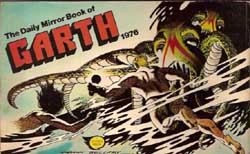
The Daily Mirror Book of Garth 1976

(GARTH ANNUAL 1976)

Book of Garth 1976

By Jim Edgar & Frank Bellamy (Fleetway/IPC)
No ISBN/book number 85037-204-6

When Frank Bellamy was drawing the Daily Mirror strip Garth, it caught the public attention in a way seldom seen. I even recall having passionate conversations with school friends who normally sneered or at best uncomprehendingly accepted my strange addiction to comics over the two unmissable strips of the day (the other being Maurice Dodd and Dennis Collin’s unbelievably wonderful The Perishers – also in the Mirror and which I must get around to covering). Was it less the mind-melting adventure stories with eye-popping graphics and more that the stories contained, without exception, the most beautiful women ever seen in pictures, and that they were usually naked?

Whatever the reason for first looking, the strips soon made dedicated fans out of many who previously weren’t; a fact the publishers seemed to acknowledge with a couple of reprint editions during the traditional Christmas Annuals release period.

Whereas the first of these – The Daily Mirror Book Of Garth 1975 – was an A-4 format, full-sized book in the traditional manner, the second volume switched to a landscape edition with only two tiers of strip per page, possibly to bring it more into line with other cartoon-reprint paperbacks such as The Gambols, Fred Bassett or the aforementioned Perishers. For fans that meant fewer stories in the book.

This volume collects The Mask of Atacama and The People of the Abyss (both of which I’ve covered in Titan Books’ Garth: Book 2 – The Women of Galba, ISBN: 0-907610-49-8) but sandwiched between them is the rare and spectacular space-thriller ‘The Beast of Ultor’, which originally ran from February 19th to June 5th 1974. In it a pot-holing Garth discovers a strange egg deep underground that hatches into a stunning (and yes – naked) alien woman who reunites him with the Goddess Astra in a battle against Cosmic Evil on a faraway world.

Visually this is one of the most exciting stories Bellamy drew in his too short career, and is worth any difficulty you might have in tracking it down. But even if Personal Shoppers or Private Detectives are out of your reach perhaps enough chatter might induce a publisher (such as Titan – who have so successfully brought back other classic British comics masterpieces in recent years) to finally bring the British Superman back for good.

© IPC Magazines 1975.

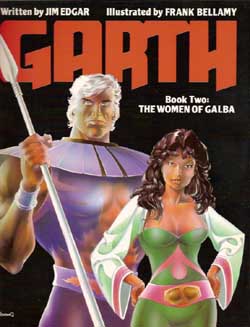
Garth: The Women of Galba

Garth: The Women of Galba

By Jim Edgar and Frank Bellamy (Titan Books)
ISBN: 0-907610-49-8

The second 1980s Titan Books collection of the Frank Bellamy Garth spans the period from 7th September 1972 to 25th October 1973 and shows the artist at the absolute peak of his powers. (These great old volumes are still available through some internet vendors such as Amazon.com – and I know because I just checked – but it never hurts to simply Google the title of a book if you’re interested in it)…

Garth was the British answer to America’s publishing phenomenon Superman and first appeared in the Daily Mirror on Saturday, July 24th 1943, the creation of Steve Dowling and BBC producer Gordon Boshell, joining the regular comic strip features, Buck Ryan, Belinda Blue Eyes, Just Jake and the irrepressible, morale-boosting glamour-puss Jane.

A blond giant and physical marvel, Garth washed up on an island shore and into the arms of a pretty girl, Gala, with no memory of who he was, just in time to save the entire populace from a tyrant. Boshell never actually wrote the series, so Dowling, who was also producing the successful family strip The Ruggles, scripted Garth until a writer could be found.

Don Freeman dumped the amnesia plot in ‘The Seven Ages of Garth’ (which ran from September 18th 1944 until January 20th 1946) by introducing the studious jack-of-all-science Professor Lumiere whose psychological experiments regressed the hero back through his past lives. In the next tale ‘The Saga of Garth’ (January 22nd 1946 – July 20th 1946) his origin was revealed. Found floating in a coracle off the Shetlands, baby Garth was adopted by a kindly old couple. Growing to vigorous manhood he returned to the seas as a Navy Captain until he was torpedoed off Tibet in 1943.

Freeman continued as writer until 1952 and was briefly replaced by script editor Hugh McClelland until Peter O’Donnell took over in 1953. He wrote 28 adventures but resigned in 1966 to devote more time to his own Modesty Blaise feature. His place was taken by Jim Edgar; who also wrote the western strips Matt Marriott, Wes Slade and Gun Law.

In 1968 Dowling retired and his assistant John Allard took over the drawing until a permanent artist could be found. Allard had completed ten tales when Frank Bellamy came on board with the 13th instalment of ‘Sundance’ (see Garth: The Cloud of Balthus ISBN: 0-90761-034-X). Allard remained as background artist/assistant until Bellamy took full control during ‘The Orb of Trimandias’.

Professor Lumiere had discovered something which gave this strip its distinctive appeal – even before the fantastic artwork of Bellamy elevated it to dizzying heights of graphic brilliance: Garth was blessed – or cursed – with an involuntary ability to travel through time and experience past and future lives. This concept gave the strip infinite potential for exotic storylines and fantastic exploits, pushing it beyond its humble origins as a Superman knock-off.

This volume begins with the eerie chiller ‘The People of the Abyss’ wherein Garth and sub-sea explorer Ed Neilson are captured by staggeringly beautiful – and naked! – women who drag their bathyscaphe to a city at the bottom of the Pacific where they are at war with horrendous aquatic monstrosities. But even that is merely the prelude to a tragic love affair with Cold War implications…

Next up is the eponymous space-opera romp ‘The Women of Galba’ wherein another alien tyrant learns to rue the day he abducted a giant Earthman to be a gladiator. Exotic locations, spectacular action and oodles of astonishingly beautiful females make this an unforgettable adventure.

“Ghost Town” is a western tale, and a very special one. When Garth, holidaying in Colorado, rides into ‘Gopherville’ an abandoned mining town, he is drawn back to a past life as Marshal Tom Barratt who lived, loved and died when the town was a hotspot of vice and money. When Bellamy died suddenly in 1976 this tale, long acknowledged as his favourite was rerun until Martin Asbury was ready to take over the strip.

The final adventure ‘The Mask of Atacama’ finds Garth and Professor Lumiere in Mexico City. In his sleep the hero is visited by the spirit of beautiful Princess Atacama who brings him through time to the Aztec City of Tenochtitlan where as the Sun God Axatl he hopes to save their civilisation from the marauding Conquistadores of Hernan Cortés, but neither he nor the Princess have reckoned on the jealousy of the Sun Priests and their High Priestess Tiahuaca…

Of especial interest in this volume are a draft synopsis and actual scripts for ‘The Women of Galba’, liberally illustrated, of course. There has never been a better adventure strip than Garth as drawn by Bellamy, combining action, glamour, mystery and the fantastic into a seamless blend of graphic wonderment. Of late, Titan Books has published a magical run of classic British strips and comics. I’m praying that Garth also is in their sights, and if he is it’s up to us to make sure that this time the books find a grateful, appreciative and huge audience…

© 1985 Mirror Group Newspapers/Syndication International. All Rights Reserved.

Jeff Hawke: Overlord

Jeff Hawke: Overlord

By Sydney Jordan & Willie Patterson (Titan Books)
ISBN: 978-1-84576-597-2

Finally back in print – and in Titan’s spiffy Deluxe hardback format – is this superb collection of strips from the only serious rival to Dan Dare in either popularity or quality, not just in Britain but in the entire world.

Sydney Jordan began his saga of the thinking man’s hero in the Daily Express on February 2nd 1954, writing the first few adventures himself. In 1956 his old school friend and associate Willie Patterson moved from Scotland to London and helped out with the fifth adventure ‘Sanctuary’, and scripted the next one ‘Unquiet Island’, whilst sorting out his own career as a freelance scripter for such titles as Amalgamated Press’s Children’s Encyclopaedia, Caroline Baker – Barrister at Law and eventually Fleetway’s War Picture Library series.

He continued to supplement and assist the artist intermittently (Jordan was never comfortable scripting, preferring to plot and draw the strips – another confederate of the time was Harry Harrison who wrote the ninth tale ‘Out of Touch’, which ran from October 10th 1957 – April 5th 1958) until, with the fourteenth tale, he assumed the writing chores on a full-time basis and began the strip’s Golden Age. He would remain until 1969.

‘Overlord’ began on February 10th 1960. In it, British Space Scientist Jeff Hawke meets for the first time a character who would become one of the greatest villains in pictorial fiction: Chalcedon, galactic criminal and would-be Overlord of Space.

When an alien ship crashes into the Egyptian desert, it reveals that two huge fleets of spaceships are engaged in a running battle within the Solar System, and the Earth is directly in their path. After interminable babble and shilly-shallying at the UN, Hawke convinces the authorities to let him take a party to the warring factions in the hope of diverting them from our poor, endangered world. What he finds is not only terrifying and fantastic but, thanks to Jordan’s magical illustration and Patterson’s thrilling, devastatingly wry writing, incredibly sophisticated and very, very funny.

Running until June 20th, it was followed by a much more traditional and solemn yarn. ‘Survival’ (21-June to December 12th 1960) follows the events of an interplanetary prang that severely injures Hawke’s assistant Mac Maclean. Repaired – and “improved” by the penitent extraterrestrials that caused the accident – Mac rejoins the Earth crew, but is no longer one of them. Moreover they are all still marooned on a desolate asteroid with no hope of rescue, and must use all their meagre resources to save themselves. This gritty tale of endurance and integrity was mostly illustrated by fellow Scot Colin Andrew as Sydney Jordan was busily preparing art for a proposed Jeff Hawke Sunday page, which never materialised, although that art was recycled as the eighteenth adventure ‘Pastmaster’.

It was a return to Earth and satirical commentary with the next tale ‘Wondrous Lamp’. Running from 13th September 1960 to 11th March 1961 it begins in second century Arabia when an alien survey scout crashed at the feet of wandering merchant Ala Eddin, briefly granting him great powers before his timely comeuppance. Nearly two thousand years later the ship – which looks a bit like a lamp – precipitates a crisis when its teleportation circuits lead to an invasion by a couple of million of the universe’s toughest warriors…

This brilliantly quirky tale, like all the best science-fiction, is a commentary on its time of creation, and the satirical view of Whitehall bureaucracy and venality, earthbound and pan-galactic, is a dry and cynical delight, which is as telling now as it was in the days before the Profumo Affair.

Chalcedon returns for the final tale in this volume. ‘Counsel For The Defence’ (13th March -2nd August 1961) sees Hawke and Maclean press-ganged into the depths of Intergalactic Jurisprudence as the Overlord, brought to Justice at last, chooses the Earthman as his advocate in the upcoming trial. Naturally he has a sinister motive and naturally nothing turns out as anybody planned or expected it to, but the art is breathtaking, the adventure captivating and the humour timeless.

Jeff Hawke is a revered and respected milestone of graphic achievement almost everywhere except its country of origin. Hopefully this latest attempt to reprint these gems will find a more receptive audience this time, and perhaps we’ll even get to see those earlier stories as well.

© 2007 Express Newspapers Ltd.

Jane

jane

By (Pelham Books/Rainbird)
ISBN: 0-72071-456-7

Jane is one of the most important and well-regarded comic strips in British, if not World, history. It began on December 5th 1932 as Jane’s Journal: Or The Diary of a Bright Young Thing, a frothy, frivolous gag-a-day strip in the Daily Mirror, created by the cartoonist Norman Pett. Originally a series of panels with cursive script embedded to simulate a diary page it switched to the more formal strip frames and balloons in late 1938, around the time scripter Don Freeman came on board.

Jane’s secret was skin. Even before war broke out there were torn skirts and lost blouses aplenty, but once the shooting started and Jane became an operative for British Intelligence her clothes came off with terrifying ease. She even went topless when the Blitz was at its worst.

Pett drew the strip, famously using first his wife and then actress and model Christabel Leighton-Porter until May 1948 when his assistant Michael Hubbard assumed full control of the feature (prior to that he had drawn backgrounds and male characters). Hubbard carried the series, increasingly a safe soap-opera and less a racy glamour strip to its conclusion on October 10th 1959.

Jane’s war record is frankly astounding. As a morale booster she was reckoned worth more than divisions of infantry and her exploits were cited in Parliament and discussed by Eisenhower and Churchill. Legend has it that The Mirror‘s Editor was among the few who knew the date of “D-Day” so as to co-ordinate her exploits with the Normandy landings. In 1944, on the day she went full frontal, the American Service newspaper Roundup (provided to US soldiers) went with the headline “JANE GIVES ALL” and the sub-heading “YOU CAN ALL GO HOME NOW”. Christabel Leighton-Porter toured as Jane in a services revue – she stripped for the boys – during the war and in 1949 starred in the film The Adventures of Jane.

Since there still isn’t a definitive collection of this fabulous strip (although the occasional brief tome has slipped out over the years) I’ve chosen to review this slim gem that was originally released in 1983 to tie-in with a BBC TV series starring Glynis Barber. It features “Hush-Hush House” from 1940 (incidentally the adventure adapted as the aforementioned TV show) wherein the simple ingénue becomes a British agent and is sent to a code-breaking site where a spy is causing havoc, and also “Nature in the Raw”, a gentle mystery with genteelly salacious artwork from 1951, drawn by the criminally underrated Hubbard.

Although the product of simpler, if more perilous times, the innocently saucy adventures of Jane, patient but dedicated beau Georgie-Porgie and especially her intrepid Dachshund Count Fritz Von Pumpernickel are landmarks of our artform, not simply for their impact but also for the plain and simple reason that they are superbly drawn and great to read. Let’s hope that one day that fact will be acknowledged with a definitive reprinting.

© 1983 Mirror Group Newspapers Ltd. All Rights Reserved.

You Are Maggie Thatcher: A Dole-Playing Game

You Are Maggie Thatcher: A Dole-Playing Game

By Pat Mills & Hunt Emerson (Titan Books)
ISBN: 1-85286-011-1

The most successful comic strips depend more on the right villain than any hero or combination of protagonists, so this quirky little oddment was better placed than most for success. Created by British legends Pat Mills and Hunt Emerson this strident, polemical satire puts the boot in on the appalling tactics and philosophies of the third term Thatcher government with savagely hilarious art and stunningly biting writing.

The concept is simple now but groundbreaking in 1987. The reader is to be Prime Minister Maggie who, by reading sections of the book and selecting a choice of action at the end of each chapter is directed to another page to experience the ramifications of that decision. The objective is to win another election, and the method is to make only vote-winning decisions – thus the multiple-choice page-endings. The intention is not to win the game, obviously.

This powerful piece of graphic propaganda may have dated on some levels but the home-truths are still as pertinent. Even as Maggie and her demented pack of lap-dogs wriggled and squirmed on Mills and Emerson’s pen-points, their legacy of personal gain was supplanting both personal and communal responsibility to become the new norm. Today’s Britain is their fault and this book still reminds us of a struggle too few joined and a fight we should have won, but didn’t.

It’s still really, really funny though…

Text and concept © 1987 Pat Mills. Illustrations © 1987 Hunt Emerson. All Rights Reserved.

Night Raven: House of Cards

Night Raven: House of Cards

By Jamie Delano & David Lloyd (Marvel)
ISBN13: 978-1-85400-288-4

This (regrettably!) one-off sequel to Night Raven: The Collected Stories (ISBN13: 978-1-85400-557-3), although the second comic-strip adventure, actually followed a long and impressive run of prose tales that appeared in a huge variety of Marvel UK titles throughout the 1980s, written by such luminaries as Alan Moore and Jamie Delano, and eerily illustrated by some of Britain’s top artists. This utilisation of such a pulp-fiction style character in a modern equivalent of the originating genre was very fitting and those stories will hopefully be gathered together in a collection one day.

House of Cards is set in those fabled gangster days and tells a complex tale of tragic love and futile vengeance. Night Raven – who gets an origin of sorts here – is fascinated by the nearly-fallen-flower Inez Pearl. In the Depression-era Big City a girl does whatever she has to, but although in love with Soldier Jack, a charismatic Trigger-man for Tall Saul’s mob, she has remained mostly clean. That’s all going to change once she sings in Tall Saul’s Speakeasy, though…

When corrupt Congressman Harry Chase decides he wants Inez, Tall Saul orders Soldier Jack to lend the politician his girlfriend, precipitating a savage clash that devastates the underworld and leaves no winners, and even the enigmatic Night Raven is helpless to affect the outcome of this star-crossed melodrama.

Night Raven: House of Cards

The writing of Jamie Delano is in the modern florid, faux-poetic style and as such seems almost untrue to its pulp origins, which worked on a staccato rhythm of tough, clipped prose. Nevertheless it does work and the subtly washed-out, painted artwork by David Lloyd more than compensates for any perceived failing. The dreamy, muted tones belie the intensity of the events and make the action and the sad, still moments all the more powerful. This is a beautiful book to look at and one you should own.

A Prestige-format, comic-book sized edition was also released in 1992.

© 1991, 2008 Marvel Characters, Inc. All Rights Reserved.

Night Raven: The Collected Stories

Night Raven: The Collected Stories

By Steve Parkhouse, David Lloyd & John Bolton (Marvel)
ISBN13: 978-1-85400-557-3

In the good old days comic stories were pithy and punchy, (like the all-but-dead and much-missed prose short-story) relying on mood and action rather than excessive exposition and breast-beating pseudo-poetry to enthral their readers. A perfect example would be the three page instalments of pulp-noir magic created by Steve Parkhouse and David Lloyd for the weekly Hulk comic produced by Marvel UK in 1979.

Gathered in this volume and coloured (the originals were captivating in stark, moody black and white) they outline the earliest adventures of Night Raven, a helmeted, trench-coating wearing vigilante who stalked the grimy streets and alleys of Prohibition-era America dealing out fearsome personal justice to a succession of low-life hoods and thugs. Lloyd masterfully illustrated Night-Time in the City, Blind Justice, Gang Rule, In the Frame, The Assassin and Scoop before leaving the strip, but his replacement was another British star on the rise.

The Dragon is an eerie drama of the mythic Chinese Tongs that resonates with Parkhouse’s long fascination with all subjects Oriental, powerfully realised by John Bolton, in the days just before he made it big with King Kull, Marada the She-Wolf and Classic X-Men.

Clean, simple and irresistibly compelling these action vignettes serve to show how far we’ve come since the 1970’s, and sadly just how much we’ve lost in telling comic stories. But at least we can still see how it should be done…

©1979, 1990, 2008 Marvel Characters, Inc. All Rights Reserved.

The Daily Mirror Book of Garth

(GARTH ANNUAL 1975)

The Daily Mirror Book of Garth

By Jim Edgar & Frank Bellamy (IPC)
No ISBN

This wonderful Softcover book was released whilst the amazing Frank Bellamy was still alive and astounding fans with his phenomenal illustration and design on the Mirror’s long-running time-travelling adventure strip (for fuller background you could Google ‘Garth’ or even check out our own archives for Garth: The Cloud of Balthus – ISBN: 0-90761-034-X or The Mirror Classic Cartoon Collection – ISBN: 0-948248-06-8).

This large tome is printed on thick newsprint and if you’re at all moved by the physical nature of comics as artefact, as well as the power of the work itself, the texture and even smell of such an item is as effective a time travel method as any used by our burly hero. Also, for some reason the art just seems to look better on off-white, gritty paper rather than the admittedly more durable slick and shiny stock favoured these days.

So if you can track down this book – and there are still a few out there – you can luxuriate in the majesty of Bellamy and Jim Edgar’s masterful, sexy thrillers with the first collection of The Orb of Trimandias, Ghost Town, The Cloud of Balthus, Women of Galba, Sundance (which Bellamy inherited from artist John Allard three weeks in) and Wolfman of Ausensee. I will digress and admit that the all-original cover created for this last story was a major factor in reviewing this annual. It’s a sight every comic art fan ought to be familiar with.

© IPC Magazines 1974.

Thunderbirds… In Space

(THUNDERBIRDS COMIC ALBUM VOLUME 2)

Thunderbirds… In Space

By Frank Bellamy, with Steve Kite & Graham Bleathman, edited and compiled by Alan Fennel (Ravette Books/Egmont)
ISBN: 1-85304-407-5

This second collection of adventures culled from the pages of TV 21 once again features the magical artwork of Frank Bellamy in three more fantastic adventures of the original International Rescue team. Written by Alan Fennell, these thrillers for all ages capture the energy and wonderment of the original Gerry Anderson puppet shows without the budgetary restrictions that always dog fantasy shows, and mercifully the colour reproduction of the photogravure artwork is infinitely better in this volume than in its predecessor (Thunderbirds … To The Rescue, ISBN: 1-85304-406-7).

The Space Mirror is a deep space thriller featuring an orbital platform used to melt the polar ice-caps; Operation Depthprobe sees a sabotaged fuel-rocket seconds from destroying its launch facility; and The Atlantic Tunnel features the devilish Hood whose machinations nearly end not only a new transport system but also the lives of Brains and Alan Tracy.

Augmented by cutaway technical features on Thunderbirds 3, 4 and 5, this fabulous comic album is a superb example of the quality of those old British comics and especially the brilliance of Frank Bellamy. There will never be a greater argument of the necessity for a new and permanent collection of his strips and illustrations.

© 1991 ITC Entertainment Group Ltd. Licensed by Copyright Promotions Ltd. All Rights Reserved.

Charley’s War Book IV: Blue’s Story

Charley's War Book IV: Blue's Story

By Pat Mills & Joe Colquhoun (Titan Books)
ISBN: 1-84576-323-8 ISBN-13: 978-1-84576-323-7

The fourth instalment of the magnificent anti-war comic strip picks right up from the cliffhanging ending of the previous volume and shows the hairbreadth escape of boy-soldier Charley Bourne and his mum from the Silvertown munitions factory targeted by a Zeppelin bombing London, before launching into the experimental narrative of the eponymous ‘Blue’.

Writer Mills fully exercised his own political and creative agendas on this First World War series, and as his own commentary relates, was always amazed at what he got away with and what novelties his editors pulled him up on. Firstly, for a weekly war comic like Battle it was rare to allow the hero time away from the action, but here Charley spent the entire story on leave – although hardly safe or sound. Secondly, although unwittingly embroiled in the black market trade in new identities for deserters by his unscrupulous brother-in-law, the hero’s humanity compels him to side against the dictates of patriotism and duty.

Most importantly, whilst aiding the escape of Blue – an Englishman serving with the French Army in the living Hell of Verdun – the episodes become depictions of Blue’s War: A story within a story with the strip’s lead character reduced to an avid and appalled listener.

The horrors of Verdun (the longest single battle in history), related by a British rebel (based on the real-world ‘Monocled Mutineer’ Percy Toplis) wrapped in a tense flight from Military Police and the fearsome ‘Drag Man’ (a obsessive hunter of Deserters) through the eerie streets of a bombed out London, makes for one of the most sophisticated and adult dramas ever seen in fiction, let alone the pages of a kid’s war comic. It is compelling, emotionally draining and dauntingly earnest. But it works.

Lifted to dizzying heights of excellence by the phenomenal artwork of Joe Colquhoun, ‘Blue’s Story’ is a masterpiece of subversive outrage within the greater marvel that is Charley’s War. I pray it never becomes a film or TV series, but I’d bribe Ministers to get these wonderful books onto the National Curriculum.

© 2007 Egmont Magazines Ltd. All Rights Reserved