Colored: The Unsung Life of Claudette Colvin


By Émilie Plateau, with Tania de Montaigne, translated by Montana Kane (Europe Comics)
No ISBN: digital only edition

Sometimes history doesn’t just happen. On occasion – and for the grandest and noblest of reasons – it has to be manufactured…

On December 1st 1955, Rosa Parks rode the bus home. She had taken said public transport vehicle many times before and until that moment had always followed the rules. This was in Montgomery, Alabama, where “Jim Crow” laws had been continually clawing back from black citizens every vestige of freedom and precious personal liberty won with shot and shell during the War Between the States, almost from the moment the shooting stopped…

Thus, on those commuter routes – as everywhere else – white people had priority, and if a black person was seated, they had to get up and literally move to the back of the bus to let “their betters” sit.

On that evening, weary Rosa refused to give up her seat, even when told to by the white bus driver. She knew there would be consequences, anticipated them and was ready for them. Perhaps she wasn’t quite as sure where that act of passive defiance would take her and the entire country…

That moment is as much part of mythology as history, but we know today that her action wasn’t the spontaneous, world-changing act of rebellion it has become mythologised as. The struggle for equality and to end segregation in America was a calculated, carefully planned campaign, with white and black people working in tandem to overturn a racist, supremacist power structure that had entrenched the principle that some human beings were less than others based on the colour of their skin.

There was always a goal, and often a plan, but the leaders of the cause were savvy and agile enough to understand that they must capitalise on random events as they happened…

Colored is a graphic novel encapsulating and re-examining events you might not know of, delivered in simple terms and enticing pictures any bright child can grasp. Mimicking a kid’s book, it’s delivered in bold two-toned (black and browns on white) images and opens with a reprise of the then current situation in America…

Montgomery in the 1950s. Interracial marriage is illegal. Social and even workplace mixing between black and white is discouraged: reinforced by laws preventing them sitting together, eating in the places and even using the same toilets. In every location and situation black skin defers to white privilege and exclusion is a fact of life. In spaces where mixing is unavoidable draconian rules apply. Separate stores and eating places. To travel, black customers have to buy tickets from drivers at the front of buses, but must then get off the vehicle and reboard at the back using a separate door…

There was understandable tension to everyday life but the 1950s was the era of rebellion and change was coming.

Claudette Austin was born black in 1939. Her wandering father only stayed around long enough to father her little sister Delphine, before vanishing forever. Their mother Mary Jane sent them to live with great aunt Mary Ann and husband Q.P. Colvin in King Hill: one of the most deprived parts of Montgomery. Despite hardship and early tragedy, Claudette was a good student and hoped to become a lawyer, but those dreams ended on March 2nd 1955. After school, the 15-year old boarded the bus home in the approved manner, but today, as it filled up, she refused to surrender her seat to a white woman and drew down upon herself the full force and brutality of the law…

Beaten, abused and sent to adult jail, Claudette’s case came to the attention of crusading groups. Black lawyer Fred Gray, Jo An Gibson Robinson of The Women’s Political Council and NAACP representative Rosa Parks considered pleading her cause at the federal level to challenge Segregation laws. However, crucial local support necessary to carry the program of resistance – which included a bus boycott – faded away as local residents questioned her age, experience, resilience and especially reputation.

Eventually a council of concerned elders including E.D. Nixon of the NAACP and activist reverend Dr. Martin Luther King Jr. met with police and civic authorities, bargaining over her upcoming trial. On her day in court, she was convicted of Disorderly Contact, Violation of the Segregation Laws and Assaulting Police Officers.

Fearing she could never be a lawyer, Claudette agreed to an appeal, and was vindicated of the first two verdicts. The Assault charge stood however, and in the aftermath the crusading advisors moved on to the next cause leaving her life and dreams in tatters. A sexual scandal followed, and although Claudette was a minor and probably a victim of abuse, it was hushed up by the Colvins, who shipped her off to distant relatives.

At that time Rosa Parks got on her bus and the desired scenario finally began unfolding the way it was supposed to. The initial response had been organised by The Women’s Political Council, but they were soon edged away from all decision making by male-dominated activists led by King and Nixon. To keep the impetus and hone focus, it was decided that Colvin – and five other women who challenged Segregation laws and been brief candidates for the role of inspirational figurehead – would be forgotten.

Gaslighting began at once. Claudette was called “mentally unstable” and immoral: giving the movement a very negative image. When she returned to Montgomery after delivering her baby, she moved back in with her mother. Meanwhile Rosa Parks went to trial and was successfully convicted of Disorderly Contact, Violation of the Segregation laws and Assaulting law enforcement officers. The entire black community rallied around her and a devasting boycott began…

Claudette tried to join them but was silently excluded from events and activities, yet still suffered daily threats and actual retaliation from thugs belonging to the racist opposition of The White Citizens Council. And then, the cautious strategists had another idea, and Claudette and those other possible martyrs became a crucial tool in their next campaign tactic and won their day in federal court. Here Claudette won her moment and shone…

On December 20th 1956 the boycott ended with a Supreme Court ruling that segregation on buses was unconstitutional. The decision was the death knell of the practise across the South.

Thus is told a revelatory tale of how an impetuous, wayward girl changed the world: how she became pawn and part of a studied, thoughtful plan, sacrificed to an inarguably greater good. Happily this wonderful story also traces her life beyond The Boycott, hopefully showing that being part of men’s ruthless, political “Cold Equations” isn’t all there is for women…

Released in France in 2019, this graphic novel is based on Tania de Montaigne’s 2015 book Noire, who here contributes a selection of Historical Notes, explaining how Jim Crow Laws came about and operated. Also provided are biographies and crucial details on the NAACP (National Association for the Advancement of Coloured People), WCC (White Citizens’ Council), WPC (Women’s Political Council), and the key minor players in the political drama: Jo Ann Gibson Robinson, Fred Gray, Rosa Parks, E.D. Nixon, William A. Gayle, Martin Luther King, Mary Louise Smith, and Jeanetta Reese.

Devastatingly powerful thanks to its primal and cunningly devised simplicity of execution, Colored takes a hard second look at the defining events and mythology of an oppressed minority, but does so through the eyes of the other downtrodden underclass dominated by both white and black men. Forthright, disturbing and necessary, it shows that even the most noble of causes needs to police itself and beware its own bias and intolerances, if we truly want everybody to be free and equal.
© 2019 – DARGAUD – Émilie Plateau. All rights reserved. This graphic novel is based on the book Noire, by Tania de Montaigne. © Éditions Grasset & Fasquelle, 2015.
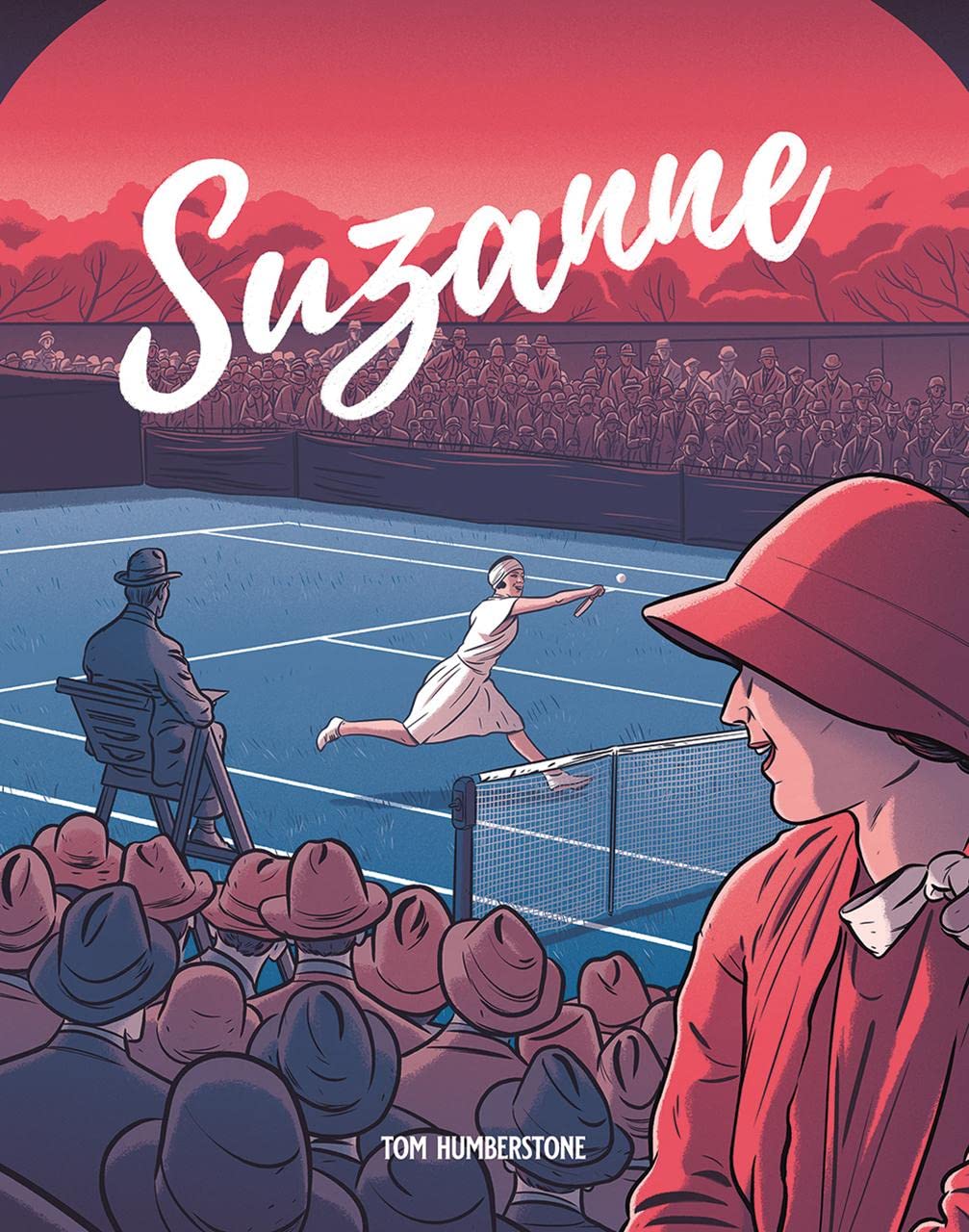
Suzanne: The Jazz Age Goddess of Tennis

By Ted Humberstone (Avery Hill Publishing)
ISBN: 978-1-910395-69-1 (HB)

I’m sure by now you have realised that history is utterly filled with women we apparently can’t stop talking about quickly enough. Happily, the medium of comics is one area where we’re digging deeper and revealing obscured accounts of past giants to make vibrant new stories about. Here’s a particularly poignant one that actually qualifies as living memory for many, yet is about a wonder woman so many have literally never heard of…

…And it’s not like these stories are hidden away where none can find them: it’s simply a case of invisibility by tacit omission, WG Grace died in 1915 and Don Bradman played his final Test Match in 1948, but I grew up with – and still hear – their names cited at every modern meeting.

For years Suzanne’s near-contemporary Fred Perry was downplayed if not actually excluded from the history books and media celebration before being reclaimed as a “Great” (politics: you should look him up too, and see how he was mostly rediscovered by the simple expedient of being the last Brit to win a Wimbledon title until 2013!).

For so many stars like Suzanne, it’s hard not to consider a conspiracy of silence was at play amongst previous generations of pundits and sports writers…

This torrid hardback tome opens with a handy diagrammatic guide to the rules of Lawn Tennis before we trace in a carefully audited and beautifully visualised manner episodes of a truly unique individual’s life.

In Paris in 1938, fading American tennis star Bunny Ryan visits an old friend. Her great friend and colleague is dying of the undiagnosable mystery ailment that has plagued her entire life, but which never prevented her from becoming the greatest woman player in history. Suzanne Rachel Flore Lenglen was born on May 24th 1899 and would die in July 1938. In between, she courted controversy, lived life her way, embraced personal and career scandal, and changed the course of Lawn Tennis.

Her accomplishments were truly astounding. Between 1912 and her death, Suzanne won 241 titles, enjoyed a 181 match-winning streak, was World Number One for 8 years and held a 341-7 match record, but that is only the tip of this social and sporting iceberg…

Our examination truly begins in Nice in 1908, when Suzann’s father Charles observed a (men’s) tennis match and realised the attention and approbation the players basked in. At this time, the pastime was a rich man’s diversion: strictly amateur status with nothing but “expenses” paid to the gentry who indulged in it. There was a thriving women’s game too, but this also was more freak show than serious sport.

Lenglen was an athletic child who loved dance, and the family was comfortable with inherited wealth. Had her older brother not died, her life might have been utterly different, but her father then and there decided that his remaining offspring would be greatest tennis player who ever lived…

How his ruthless ambition shaped the life of sporting superstar who broke all the rules is tantalisingly outlined in snapshots of Suzanne’s life: the men who shaped her career, rare friendships (usually men and women connected to the rarefied world of tennis) and particularly her rebellions.

Suzanne refused to play in corsets, ultimately liberating all female players and pioneering a dashing, vigorous, aggressive style of play. Keenly understanding that she was a centre of attention, she had a clothes designer create a string of daring costumes that forged today’s link between sports and fashion. She drank alcohol between sets, partied hard and won match after match.

Dubbed “the Maid Marvel” by the all-male press that she developed an increasingly hostile relationship with, her personal life consisted of dazzling success, broken by recurring periods of debilitating illness no doctors could understand of properly treat. The only thing that caused temporary remissions was the next tournament…

Possibly her greatest achievement began after an exhibition tour of America in 1921. Here, in the shadow of Prohibition, she met financier Charles Pyle and was asked for the first time to consider becoming a professional player. At this juncture tennis was a sacrosanct, pure and “amateur” game with all rewards and inducements being “under the counter”. Only the clubs like Wimbledon and Nice or the newspapers made any sordid profit from players efforts and labours, whilst the rulers of her country’s Tennis Federation even tried to sabotage her with patriotic nonsense, demanding that she only play doubles matches with French nationals rather than her preferred (and equally triumphant) Bunny Ryan.

In 1926, her eventual acquiescence to Pyle’s offer to join his American league and go on a world tour – brought on by her advancing age and Charles Lenglen’s financial losses – saw her ostracised and exiled from the circuit she had dominated for decades, but also paved the way for fair and equitable remuneration of tennis players, rather than the glad-handing rewards and mutable generosity of being exploited by the rich and privileged…

Rather than a straight catalogue of events and assessment of achievement, this examination is carefully fictionalised and massaged to capture what Suzanne Lenglen may have been. Unwell or unstoppable, confused, angry and always desperately seeking to please her father and still be herself, this bright, breezy account of Suzanne details appalling treatment, but succeeds in painting the Goddess of the Courts as a triumphant survivor and not a victim, thanks as much to the astonishingly engaging and open drawing style of the biographer as an astute appreciation of the times and the players involved.

The revelatory saga also includes an Introduction from founding co-secretary of the Women’s Tennis Association and International Tennis Hall of Famer Françoise Dürr; Thank Yous, Foot Notes and a list of Further Reading, and comes courtesy of staggeringly gifted Scottish cartoonist Tom Humberstone (Doctor Who, Nelson, Solipsistic Pop) and publisher Avery Hill.

You should buy all their books and, if you want more of similar, after buying this you could also check out publishers such as SelfMadeHero, Myriad, NBM and so many more outfits seeking to correct the historical balance through informative entertainments.

Trust me, you can’t lose…

© 2022 Tom Humberstone.

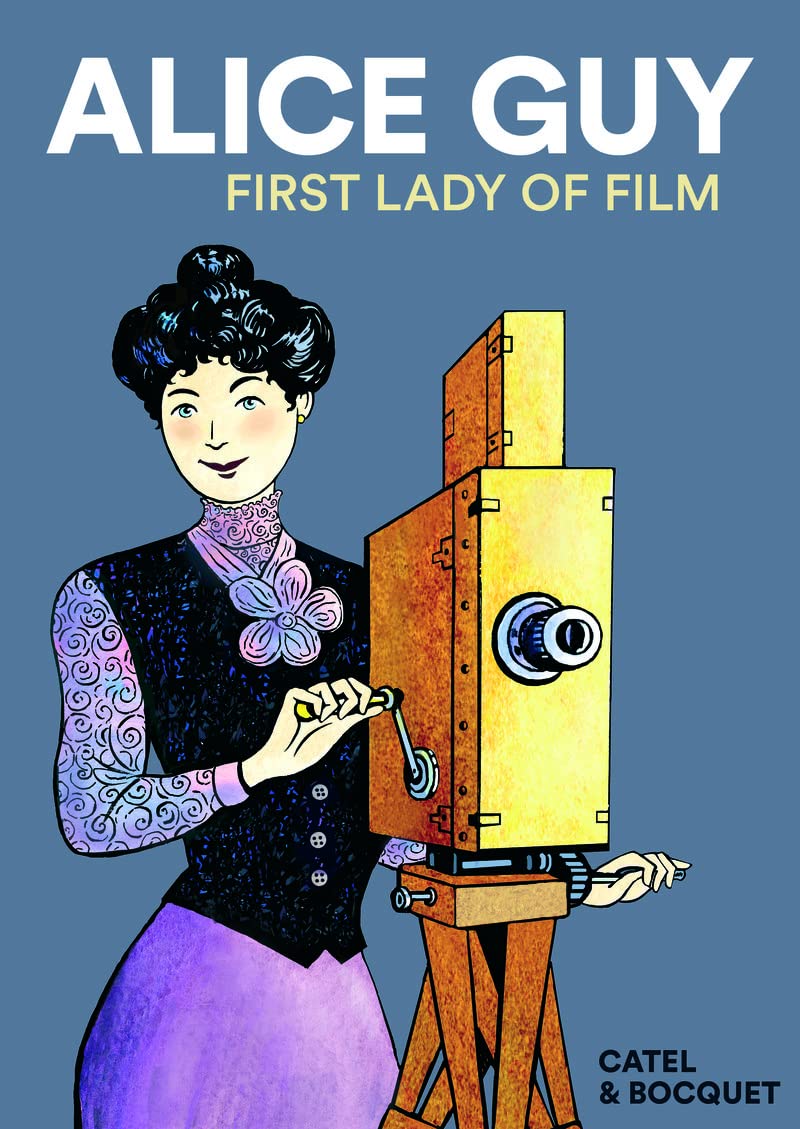
Alice Guy: First Lady of Film


By Catel & Bocquet, translated by Eward Gauvin (SelfMadeHero)
ISBN: 978-1-914224-03-4 (TPB/Digital edition)

I’ve reached a ripe – really, really ripe – old age and only learned one true thing: Men should not be allowed to be in charge of history. We have a very nasty and juvenile tendency to balls it up and – I’m going to say – “forget” stuff that women actually did.

I’m not going to embarrass us all with a list of female accomplishments and discoveries excised from the record, but I might wax quite a bit wroth whilst reviewing this superb graphic biography that joins the movement to redress the wrongs done to an extraordinary talent who shaped the primary entertainment medium of the last century and was then made to be forgotten…

Alice Ida Antoinette Guy-Blaché was born on July 1st 1873 and is officially the world’s first female Film Director as well as. by most metrics, the first person to add narrative to the nascent scientific diversion and tent show phenomenon of Cinema. Where once the spectacle of objects moving, ordinary people walking about and trains entering stations was the sum total of creative endeavour, she added storytelling and birthed a whole new world.

However, her legacy was almost erased in the years after she stopped working. At one stage none of her films were officially registered anywhere and to this day no complete archive of her works exists or even a complete record of how many motion-pictures she made…

A well-travelled, well-read daughter of educated parents (her father owned bookshops and a tri-national publishing house in Chile, before war and natural disasters destroyed their fortune), Alice Guy’s connection to photography began in 1894, when she joined a photographic instruments business that would become the mighty Gaumont Cinema empire. She started as a stenographer (possibly the first ever in France), and quickly – pretty much sans any acknowledgement – became company secretary, business manager and – when the explosion of individual technical discoveries converged to make a scientific oddity into an unexpected entertainment phenomenon – the company’s foremost maker of films for public consumption.

Initially indulged and soon eagerly supported and encouraged by (most of) the men in charge Alice Guy wrote the first scripted films, beginning in 1996 with a charming fantasy about where babies come from.

La Fée aux Choux (The Fairy of the Cabbages or, in at least two later remakes benefitting from her technological and narrative inventions, The Birth of Children) was huge hit with the public and resulted in her scripting and/or directing hundreds of further films of varying lengths. A passionate pioneer, she blended strong, visually arresting narratives and constant examination of social inequity and inequality with cutting edge and innovative technology, art direction and set making.

At the turn of the century, Guy made many dozens of sound-enhanced films in the now all-but forgotten “Chronophone” system (synchronising phonographic recordings with projected film decades before 1927’s “Talkies” revolution); championed and perfected location shooting; devised new special effects; instituted purpose-built studios and specialised sets and experimented with colour-tinted film.

In 1906, Guy invented historical/biblical epics and chapter serials with La vie du Christ (The Life of Christ): a 25 part extravaganza employing 300 actors and in 1912 – after moving to America to found her own studio Solax – made the first film with an all-black cast.

Minstrel comedy A Fool and his Money would have had only one African American character and loads of white guys in traditional and popular “blackface”, but when her established white American actors refused to work beside even one actual negro – vaudeville comedian James Russell – she let them all go and hired Russell’s fellow performers instead…

In 1913, she directed The Thief: the first script sold by Harvard student William Moulton Marston, eventual polygraph pioneer and creator of Wonder Woman

Guy also created groundbreaking feminist satires, and used her films to explore women’s rights and champion birth control politics. She made international dance and travelogue films in incredibly successful “one-reelers” dedicated to sharing the wonders of terpsichorean movement across borders, and always looked for the next new thing, but her rising star burned out after moving to America and ending her marriage to a faithless man who speculated away all their money amidst the chaos of changing economic systems, Spanish Flu, and the Great Depression. Sounds like a classic movie plot, right?

Guy directed her last film – Tarnished Reputations – in 1920, and began an inexorable descent into poverty and obscurity, spending her days seeking to find copies of any of the hundreds of features she had created.

Alice Guy died in 1968, just as other, more appreciative truth-seekers who had taken up her later-life struggle to re-establish her  place in history were finally making headway and returning her to the annals of cinema history.

Written after WWII, her autobiography had languished on a publishers desk for decades before finally being posthumously published in 1976. Since then, a veritable Who’s Who of academics, historians and industry greats have toiled to overturn her erasure. Alice is now getting the acclaim and appreciation she earned incognito. As always, it appears to be one more case of Too Little, Too Late…

All that achievement, accomplishment, disillusionment and ultimate abandonment by her own colleagues and the public she invisibly captivated has been given a sublimely moving human face in this chronological, episodic, dramatized narrative from award-winning graphic novelist Catel Muller (Ainsi soit Benoîte Groult, Adieu Kharkov, Lucie s’en soucie, Le Sang des Valentines, Kiki de Montparnasse, Joséphine Baker, Olympe de Gouges) and crime novelist, screenwriter, biographer and comics writer José-Louis Bocquet (Sur la ligne blanche, Mémoires de l’espion, Panzer Panik, Kiki de Montparnasse, Joséphine Baker, Olympe de Gouges, Anton Six). Here, Alice’s life is traced from cradle to grave in black-&-white “shorts”, concentrating on her family life and relationships, with her astounding energy, creativity and catalogue of innovations and successes acting as a mere spine to form an impression of the woman whose guiding motto was always “be natural”.

Entertaining, engaging and subtly informative, the book is supplemented by a vast supporting structure of extras, beginning with a heavily illustrated and highly informative ‘Timeline for Alice Guy’ incorporating pivotal events in the invention of cinema. That’s further augmented by ‘Biographical Notes’: 32 character portraits in prose and sketch form of the historical figures who also feature in this epic saga, as well as a Filmography of the movies researchers have since confirmed and acknowledged, and a Bibliography of films, documentaries and books about her.

If you love film, or comics, justice triumphant or just great stories, you really need to set some records straight and read this book.
© Casterman 2021. All rights reserved.

David Bowie in Comics


By Thierry Lamy & Nicolas Finet; illustrated by Bast, Martin Trystam, Thomas Gilbert, Marcello Quintanilha, Christelle Pécout, Jérémie Royer, Nicolas Pitz, Monsieur Iou, Christopher, Claire Fauvel, Léonie Bischoff, Joël Alessandra, Samuel Figuière & various: translated by Christopher Pope (NBM)
ISBN: 978-1-68112-298-4 (HB) eISBN: 978-1-68112-299-1

In recent years graphic biographies have become a major component of publishers’ output. This one – originally released on the continent in 2020 – will appeal to a far larger mainstream audience than comics usually reach: unlocking some secrets of someone with many identities; a musician and performer who changed popular culture and modern society and an agent provocateur ushering in a digital age…

Gathered in this fetching account are context-providing photo-enhanced essays bookending individual comics sections. Each chronological article and attendant comics vignette is written by French author/comics scripter Thierry Lamy and author, filmmaker, journalist, publisher, educator and music documentarian Nicolas Finet – who has worked in comics for three decades, generating a bucketload of reference works like Mississippi Ramblin’ and Forever Woodstock).

In this vivid exploration of a one-man cultural revolution, they are supported by an army of illustrators crafting vividly vibrant strips, beginning with ‘The 1950s: Plastic Saxophone’. An introductory text briefing leads to a comic strip nativity scene limned by Martin Trystam, as David Robert Jones is born in post-war Brixton on January 8th 1947. What follows traces his middle class boyhood in Bromley, South London, introduction to music and science fiction by his tragic step-brother Terry, and how his new dad got the little “spaceboy” his first instrument and lessons…

Following a context-packed essay on the birth of Rock ‘n’ Roll, Thomas Gilbert illustrates ‘1962: A Unique Gaze’ as schoolboy David and classmate/best friend George Underwood clash over a girl, inadvertently gifting the future star with his signature look. Another text piece – on the star’s appearance and early relationships – segues into ‘1962-1966: First Bands’, with Marcello Quintanilha delineating how music obsessed Jones and Underwood pursue their dream in a succession of blues bands (The Hooker Brothers, The Konrads, King Bees and others) and cut their first single. Following further text and photo details on those heady days, Christelle Pécout’s strip ‘1966: When David Jones Became David Bowie’ heralds the moment everything changed…

An essay on personal reinvention moves the story along to when Bowie studied with theatrical legend Lindsay Kemp, visualised by Jérémie Royer in ‘1969: Ground Control to Major Tom’ and highlighting the role the first Moon Landing played in Bowie’s breakout hit. A feature on the influence of Stanley Kubrick’s 2001: A Space Odyssey closes one era as Nicolas Pitz illustrates the meeting of Bowie and his new inspirational inamorata Angela Barnett in ‘1969-1971: Angie’. Her freewheeling lifestyle and attitudes would liberate her eventual husband and drive his rise, as seen in a prose feature and Monsieur Iou’s strip ‘1972: Top of the Pops: The Birth of a Legend’…

Bowie early realised the power of image tied to story and his first musical alter ego is examined in ‘1972-1973: An Alien Named Ziggy Stardust’, courtesy of Christopher, after which Claire Fauvel details the growth of the major musical theoretician behind the stage performer. ‘1972-1973: Bowie the Producer: Lou Reed & Iggy Pop’ sees David save the careers of two fading American icons and gain friends who will save him in his troubled years to come…

Having cycled through two performer personalities – Ziggy and Aladdin Sane – Bowie endured creative ennui and branched out into theatre, as seen in Léonie Bischoff’s ‘1974: A Hint of Science Fiction’. When his proposed adaptation of Orwell’s 1984 foundered, Bowie reinvented key elements for his Diamond Dogs show before the Quintanilha strip ‘1975: Turning to Soul: Young Americans’ outlines the next step in the musician’s mercurial career. Christelle Pécout’s comics contribution reveals how drug abuse and legal struggles with his embezzling manager left Bowie burned out and ready for another reinvention in ‘1976: The Thin White Duke’…

With this chapter’s essay concentrating on Bowie’s role in Nick Roeg’s film The Man Who Fell to Earth, Christopher’s encore art act ‘1976-1979: A Date with Berlin’ focusses on relocation to West Germany at the height of Cold War tensions and creation of a landmark series of albums comprising “The Berlin Trilogy”.

Discussions of minimalism and masterpieces are complemented by Monsieur Iou’s cartoon coverage of the performer’s golden years as ‘1980-1984: The Global Icon: Let’s Dance’ detail Broadway acting triumphs and collaboration with Funk genius Nile Rodgers. Always with his mismatched eyes on the future, Bowie was the first mega-star to grasp the potential of a new phenomenon. MTV’s launch shifted his focus to musical videos and his status grew even more…

Illustrated by Joël Alessandra, ‘1983: Bowie in Film: Merry Christmas Mr. Lawrence’ explores his astounding performance and heralds his gradual move away from pop stardom towards musical exploration and personal experimentation. Trystam returns for ‘1989-1992: Forever Innovating: Bowie and Tin Machine’…

By then, Bowie’s car-crash home life had steadied and Samuel Figuière shares the happiest times as the music man finds his true life partner in ‘1992: Iman’, after which Alessandra illustrates ‘1992-1999: Experiments in Genre’ as Bowie increasingly explored digital technology (in 1997, he released the first digital music single for fans to download) before Figuière visually catalogues ‘2004-2014: Quiet’ as the star’s progressively poor health ends his performing career…

The story ends with one final essay appreciation, supplementing Pitz’s fantasy montage ‘2014-2016: The Last Dance’ commemorating the last work and The End of All The Songs…

A human agent of social change, David Bowie made sublime music, offered groundbreaking and pioneering advocacy of the barely post-natal internet and provided an example for generations of confused kids seeking to fit their own personally perceived oddities into a binary world that never really existed except in the minds of a few hidebound religious bigots.

In so many ways, he inspired and reshaped people on the margins and did so by example. Always aware of what could be, he even patterned the way modern social media and eCommerce evolved. He also made life extraordinary and much of that is captured here.

Also equipped with a Discography, Filmography, Sitography and Recommended Reading list, David Bowie in Comics is an astoundingly readable and beautifully rendered treasure for comics and music fans alike: one to resonate with anybody who loves to listen and look. It can’t actually play you the songs, but you can read it while listening to them on your aural medium of choice, so everything’s Hunky Dory,

© 2020 Petit as Petit. © 2022 NBM for the English translation.
David Bowie in Comics is scheduled for UK release June 16th 2022 and is available for pre-order now. For more information and other great reads see http://www.nbmpub.com/

Most NBM books are also available in digital formats.

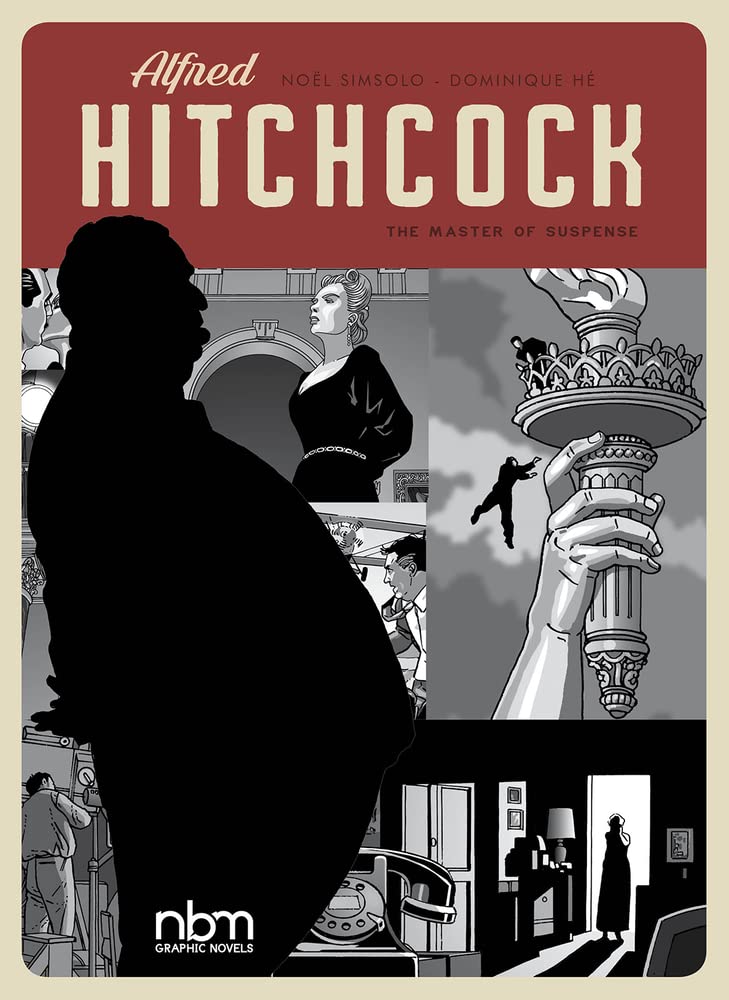
Hitchcock: Master of Suspense


By Noël Simsolo & Dominique Hé, translated by Matt Maden (NBM)
ISBN: 978-1-68112-296-0 (HB) eISBN: 978-168112-289-2

Graphic biography is now a mainstay of graphic novel publishing: so much so that distinct styles and approaches have evolved, ranging from primarily factual reiterations to predominantly fictionalised accounts, with events and actions extrapolated and dramatized in search of some higher truth.

In this superbly gripping exploration of filmmaker and self-created celebrity Alfred Hitchcock, authors Noël Simsolo & Dominique Hé have chosen – most fittingly – to stage manage facts, achievements and accomplishments to craft a beguiling mystery.

In addition to scripting comics series such as Saladin, Napoleon and Lodewijk de Heilige, French writer Simsolo is a film director, novelist, comedian and cinema historian who wrote a biography of Sergio Leone.

Dominique Hé is an illustrator and comics veteran who got his start in 1973 after chucking his intended career as an astronomer. Apprenticing by limning Jean Giraud stories for Pilote, he moved on to Metal Hurlant, compiling material for two albums of short tales dubbed Voyages, before creating ghost-busting, weird science specialist Marc Mathieu. In 1988 he drew Alex Lechat for Le Journal de Mickey and went on to craft many more adventure serials like Tanatha, Moonfleet, Sophaletta and Sécretes Bancaires. Here his delightfully moody gifts stage a spooky, foggy monochrome greytone movie experience as we follow the life and career of a master not just of suspense but also personal brand management…

The epic unfolds through intercut flashbacks, focusing simultaneously on different time periods, pinpointed and highlighted via his 55 official film releases and other works. Throughout, “Hitch” is used as his own narrator, in frighteningly candid and revelatory conversations with glittering associates (because you will come away realising that – other than his wife Alma and mother Emma – he had no close friends) and such actors as he could bear to talk to, such as Grace Kelly, Carole Lombard and Cary Grant.

We open in 1960. Paris in November is rapt with the debut of Psycho – just like every other city on Earth. As Hitch and Alma continue their prickly but utterly honest and committed life of success, thoughts wing back to Cannes in 1964 as ‘Honni soit Qui Mal Y Pense’ finds the director regaling Grant and Kelly with tales of a unique childhood…

That’s pretty much all you’re getting here. This is too good a book and too well constructed to give away anything. However, in keeping with the Master’s whimsical humour and the assurance of a superbly entertaining time, here’s a tantalising list of chapter titles to spark your imagination. The eventual delivery will not disappoint you…

His ‘Apprenticeship’ is pretty self-explanatory, but progress is not assured in ‘The Young Man With the Mind of a Master’. ‘Silence and Cries’ lead to ‘Highs and Lows’ before attaining the ‘Summit’, whereafter ‘The Temptation of Departure’ heralds ‘The French Connection’ and ‘A New World’.

The success and security of later life afforded little protection from Hitch’s driving hunger for validation. He spent much of his life failing to make the one film he always wanted to, always distracted by the immediate and instead just making better and better movies. He did find time to conquer the new medium of television though. ‘The Killers Are Among Us’ sparked ‘Descent into Hell’, but always he pursued ‘Experimentation’; never finding his ‘State of Grace’. Settling in the USA, ‘Citizen Hitchcock’ found ‘Apotheosis’, and encountered further ‘Turbulence’ as advancing age signalled one ‘Final Role’…

Sir Alfred Joseph Hitchcock KBE was a brilliant creator who changed the way cinema worked and how tales are told. A tireless traveller and resident of many nations, he was a manic homebody with a vast appetite for domestic comfort. He was a devout catholic trapped by his upbringing, guilty and anxious his entire life. Simultaneously sexually obsessed and painfully chaste, he was a voyeur who utilised his peccadillo to build a new means of seeing and telling stories, adroitly using his methodical planning skills and graphic design talents to storyboard films – and manipulate people in the exact same manner. Like the creators of this book, he knew how to nest stories within stories and how to satisfy an audience whilst leaving them hungry for more.

This wonderful tome includes scholarly appendices too: an ‘Alfred Hitchcock Filmography’ spanning 1922-1976, detailing his entire oeuvre broken down into Director, Assistant Director and Screenwriter, a Select List of abandoned film projects and his signature Cameos. There’s also an extensive Bibliography of books about the man, his works and his legacy.

Sublimely layering fact, mythology and critical appraisal, Hitchcock: Master of Suspense offers a fulsome exploration of an iconic legend who made his own life as much an artwork as any of his films. Furthermore, it does so in a manner supremely befitting the attributes and inclinations of the man for whom storytelling was a way of life, fear was food and drink, and mystery a blessing.

© 2018 Dargaud-Benelux. © 2020 NBM for the English Translation. All rights reserved.
© DUPUIS 2020 by Rubio, Efa. All rights reserved.

Hitchcock: Master of Suspense is scheduled for UK release June 2nd 2022 and is available for pre-order. For more information and other great reads see http://www.nbmpub.com/

Most NBM books are also available in digital formats.

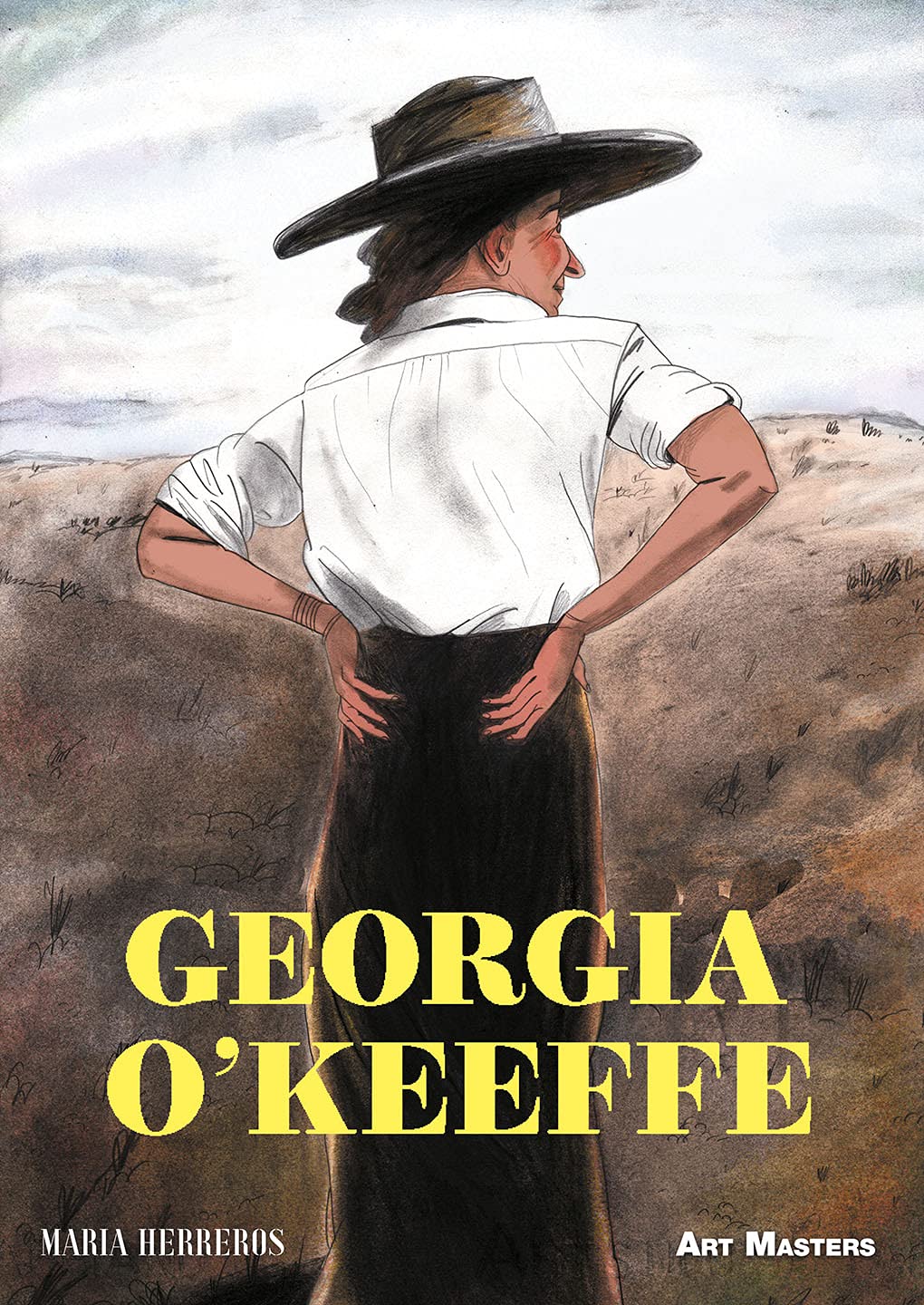
Georgia O’Keeffe


By María Herreros; translated by Lawrence Schimel (SelfMadeHero)
ISBN: 978-1-914224-05-8 (TPB/Digital edition)

Georgia Totto O’Keeffe entered the world in Sun Prairie, Wisconsin on November 15th 1887, second of seven children born to a dairy farmer turned (failed) construction entrepreneur. Seized and overwhelmed by the artistic impulse before the age of ten, she overcame financial hardship to secure an impressive traditional artistic education which she promptly rejected in favour of finding her own path.

From 1917 and her first exhibition, to her death in 1986, she made art her way, most famously with series of paintings of flowers, buildings and ultimately desert scenes which became a catalyst of taste and part of global artistic culture. She is regarded as America’s first abstract artist and has been called The Mother of American Modernism.

Innocently controversial from the start, O’Keeffe increasingly sought to understand colour and shape via stark cityscapes and florid blossoms but had to endure censure and gossip over nude photos exhibited by her patron Alfred Stieglitz, and the indignity of having her flower paintings mansplained by critics – even female ones – who continuously likened them to female sexual organs.

Bored with saying ‘They’re just flowers’ and self-important fools, she began a gradual, years-long process of quitting metropolitan civilisation for peace, contentment and endless inspiration under the big skies and vivid deserts of New Mexico.

Over a decades-long career. O’Keefe garnered international acclaim and many awards. These included an honorary Doctor of Fine Arts degree from the College of William and Mary (1938); election to the American Academy of Arts and Letters and a fellowship of the American Academy of Arts and Sciences(1966); receiving the M. Carey Thomas Award from Bryn Mawr College (1971) and another honorary degree (from Harvard in 1973) as well as the Presidential Medal of Freedom (1977), The National Medal of Arts (1985) and – in 1993 – posthumous induction into the National Women’s Hall of Fame.

As you’d expect of a determined, driven professional woman of that period in that country, making extremely successful headway in a predominantly male preserve, her personal life was something of a trainwreck, but this compelling examination chooses to downplay those aspects.

Sensibly side-lining the more sensationalised moments of O’Keefe’s past in favour of tracing her accomplishments and victories, graphic biographer Mar­a Herreros has employed her painterly, primitivistic narrative style which liberally samples O’Keeffe’s copious canon of letters and idiosyncratic writings to bring us inside the head of a profoundly visual and arguably obsessive being.

Based in Madrid, but born in Valencia in 1983, Herreros is a modern multidisciplinary artist. She studied at the University of Fine Arts, San Carlos and since 2011 has combined high level commercial commissions with gallery shows, book collaborations and comics such as Viva la Dolce Vita, Marilyn tena once dedos en los pies, and Paris sera toujours Paris. Her personal works explore human emotion, societal evolution and the concepts of beauty and normative states.

Although remaining primarily positive and inquisitive here, Herreros touches on O’Keeffe’s mental ill health issues, her Svengali-like attachment (later marriage) to older, already-married Fine Art photographer/gallery owner Stieglitz and her end-of-life companion John Bruce “Juan” Hamilton – both notorious age-inappropriate public scandals that Georgia casually, magnificently, ignored.

Via communications with Georgia’s close female friends and Stieglitz, Herreros takes us inside the painter’s mind, revealing the creative process and progress in navigating society, the public and the poison chalice of simply having to exhibit art to survive, while emphasising making the images she wanted to in places she truly loved which became her greatest joy and solitary citadels.

Less a biography than a carefully crafted appreciation and appraisal of a career and legacy by a fellow fully emancipated, self-determining female creator, Georgia O’Keeffe is a compelling and beguiling glimpse into the forces that shape art and artists.
Text and illustrations © 2021 by Mar­a Herreros. All rights reserved. Published by agreement with Astiberri Ediciones and Fundacian Coleccian Thyssen-Bornemisza English translation © 2021 SelfMadeHero.

The Boxer – the True Story of Holocaust Survivor Harry Haft


By Reinhardt Kleist; translated by Michael Waaler (SelfMadeHero)
ISBN: 978-1-906838-77-5 (TPB/Digital edition)

Multi-award-winning German illustrator, designer, author, cartoonist and comics maker Reinhard Kleist (Berlinoir; Steeplechase; Das Grauen im Gemäuer) has been working in the industry since 1994: setting up a cooperative studio/atelier and beginning his professional career with graphic biography Lovecraft, and supernal dramas Minna, Das Festmahl, and Abenteuer eines Weichenstellers while still a student in Münster.

He has constantly explored and gratified his fascination with notable individuals who have overcome stacked odds and inner darkness in stellar works such as Johnny Cash: I See a Darkness; Elvis – An Illustrated Biography; Castro; An Olympic Dream: The Story of Samia Yusaf Omar and Nick Cave: Mercy on Me.

In 2011 he again turned to boxing for inspiration, adapting a Holocaust biography written by the son of a survivor of the death camps. Hertzko/Herschel “Harry” Haft might be regarded amongst the more noteworthy of those benighted souls: a ruthlessly determined individual who overcame every iteration of horror and privation, using his fists and low cunning.

His life was first recounted in 2006 by his son Alan Scott Haft in prose biography Harry Haft: Auschwitz Survivor, Challenger of Rocky Marciano, and as well as the graphic novel under review here, you can absorb the tale in filmic form in Barry Levinson’s movie adaptation The Survivor.

Delivered in stark monochrome, Kleist’s compelling and uncompromising interpretation opens with the protagonist a humble grocer in America, trying to relate to his young son. Harry is a hard man to relate to, but in a moment of contrition he promises to one day share with his boy what made him that way.

Alan waited another forty years to hear the truth and turned it into a narrative for everyone…

The story proper opens in 1939, in the Polish town of Belchatow. Since the Germans came, the Jewish Haft family have become smugglers, and 14-year old Hertzko thinks himself invincible.

His father had sold fruit and veg but found it increasingly difficult to support a wife and eight children. When he died, the family splintered and only Hertzko and brothers Aria and Peretz stayed with their mother. When the invasion took hold, their illicit activities made them all targets, but amidst daily outrages, he found opportunity for love and was betrothed to Leah Pablanski, daughter of the receiver of all the contraband he shifted across the Nazis’ new borders…

When Hertzko was transported to his first labour camp, seeing Leah again one day was the dream that kept him going. Barely literate but strong and determined he had a gift for being useful and, despite toiling in the most horrific circumstances and being present for every atrocity of the regime, he endured – especially after his smuggling experience made him an essential tool of one particular guard officer who was methodically enriching himself at the prisoners’ expense…

Moved from camp to camp as a slave labourer, Hertzko eventually arrived in Jaworzno camp and was reunited with his brother Peretz. Here his sponsor found him less egregious duties. All he had to do was fight other prisoners in Sunday exhibition matches for the officers. Haft had never boxed before, but would do anything for better conditions and what passed for “guaranteed” survival. What he did there remained with him for the rest of his life…

Despite his resilience and adaptability, Haft always found himself at the mercy of superior and more ruthless forces. As the Allies slowly pushed the Nazis back on all fronts, he was left to the “death marches” the SS instigated to empty the camps and hide evidence of their industrialised slaughter factories. Over and again, Haft dodged certain death and committed more sins until finally captured by American troops. Soon his underworld experience was being exploited by the GIs as Hertzko ran a bordello for the soldiers. When Peretz resurfaced, Haft finally had time and enough money to go looking for Leah. That trail led ultimately to America.

While in US-occupied Straubing, Haft had won a boxing competition organised by the Army, and was – after further machinations – allowed to emigrate in 1946. He was 23 years old…

The second half of Haft’s life began in the New World. He still wanted Leah and decided fame would be the key. The fight game in America was popular but increasingly under the control of organized crime. Nevertheless, Haft – now calling himself “Hershel” and “Harry” – pursued his chosen path with relentless zeal.

Overcoming every administrative obstacle, he found a manager, learned how to actually box rather than fight and kept on winning.

The equation was simple. Leah was here somewhere. If he could get his picture in the papers or newsreels or even on this new television thing, she would see him and get in touch. Sadly, it only brought him to the attention of mobsters. After his moment of glory fighting Rocky Marciano in 1949, Haft learned how his chosen world really worked…

Walking away, he married a neighbour’s daughter in November and opened a grocery store in Brooklyn. In 1963 the family took a trip to Florida and young son Alan helped locate a woman named Leah Lieberman…

Please be warned: The Boxer is not just a testament of atrocity or celebration of the human spirit under the most appalling conditions. It’s also a real world love story where the always-inevitable ultimate reunion does not follow the rules of romantic fiction or bring about a happy ending.

Kleist’s graphic tour de force is supplemented by a stunning gallery of sketches and working drawings, and backed up with a picture-packed essay from sports journalist Martin Krauss.

‘Boxing in concentration camps – a report’ details the long-neglected topic of Nazi sports exhibitions in work and death camps and relates it to Haft’s later professional career in America, including a chilling sidebar on ‘US boxing and the Mafia’. Also on the bill are biographies of other ‘Forgotten champions’ of the camps: Victor “Young” Perez; Noach Klieger; Leendert “Leen” Josua Sanders; Leone “Lelletto” Efrati; Salamo Arouch; Jacko Razon; Johann “Rukelie” Trollman; Tadeusz “Teddy” Pietrzykowski and Francesco “Kid Francis” Buonagurio.

Potent, powerful, moving and memorable, this is a quest tale well told and one not easily forgotten.
© Text and illustrations 2012 CARLSEN Verlag GmbH, Hamburg, Germany. © Appendix 2012 Martin Krauß and CARLSEN Verlag. English translation © 2021 SelfMadeHero. All rights reserved.

White Rapids


By Pascal Blanchet, translated by Helge Dascher (Drawn & Quarterly)
ISBN: 978-1-897299-24-1 (Album PB)

A fascinating moment in relatively recent social history was brought magically to life in this captivating and innovative graphic novel which eschewed the traditional iconography and lexicography of sequential narrative, instead utilising the bold stylisations of art deco design and the gloriously folksy imagery of 1950s Modernism (think the architecture and landscape of David Suchet’s definitive television Poirot and the movie Metropolis wedded to the crinkly curlicue characters populating the title sequences of Bewitched or Those Magnificent Men in Their Flying Machines).

The effect is like looking at a period brochure, which tragically underscores the bold and far too typical story of the town which lived and died at the behest of forces beyond the control of the everyday working stiffs who lived there.

A design tour de force, this was the first translated work of award-winning Québécois creator Pascal Blanchet who transformed the history from dry fact into a magnificent torrent of visual music. And no, you can’t find this bloody book anywhere. It’s why I’m re-reviewing it, in the hope some wise (and probably Canadian) publisher will revive it…

In the 1920s, Canada’s growing power demands were supplied by private companies, and the most efficient generation method was hydroelectric, created by damming the mighty rivers of the country. In 1928 the Shawinigan Water & Power Company decided to build a new dam in a remote northern region of the St. Maurice River at Rapide Blanc, a section where the waters narrowed into the eponymous fast-running white waters of the title.

To operate a power-plant in such an inaccessible – and for nearly half of each year, actively hostile – region, a company town needed to be built for workers and their families. Moreover, for any man to bring his family into such a wilderness, it would have to be an impressive and wonderful town indeed…

Blanchet avoids the tempting option of personalising or dramatizing the tale, preferring to let mood, impression, atmosphere and style describe the birth, brief life and sad, sudden death of White Rapids (here’s a clue: it involved bottom lines and transfers of ownership, not evolving environmentalism) as a gleaming moment of Enlightened Capitalism actually doing the right and decent thing for the Proletarian Worker winked out and was washed away.

This is like no other Graphic Novel you’ve ever seen and is stunningly effective for all that; rendered in reduced hues of orange, brown and grey, marvellously devoid of the heretofore presumed necessary clichés of narrative convention. It also avoids the dynamic seductions of Protagonist/Antagonist and the avid fetishism of Vitruvian representational faces and forms that underpin all comics art no matter how avant-garde.

This is a beautiful work and deserves every award it’s ever won as well as your rapt attention. Why not start a internet campaign to have some solid citizen publisher bring it back for us all to share?
© 2006, 2007 Pascal Blanchet. All Rights Reserved.

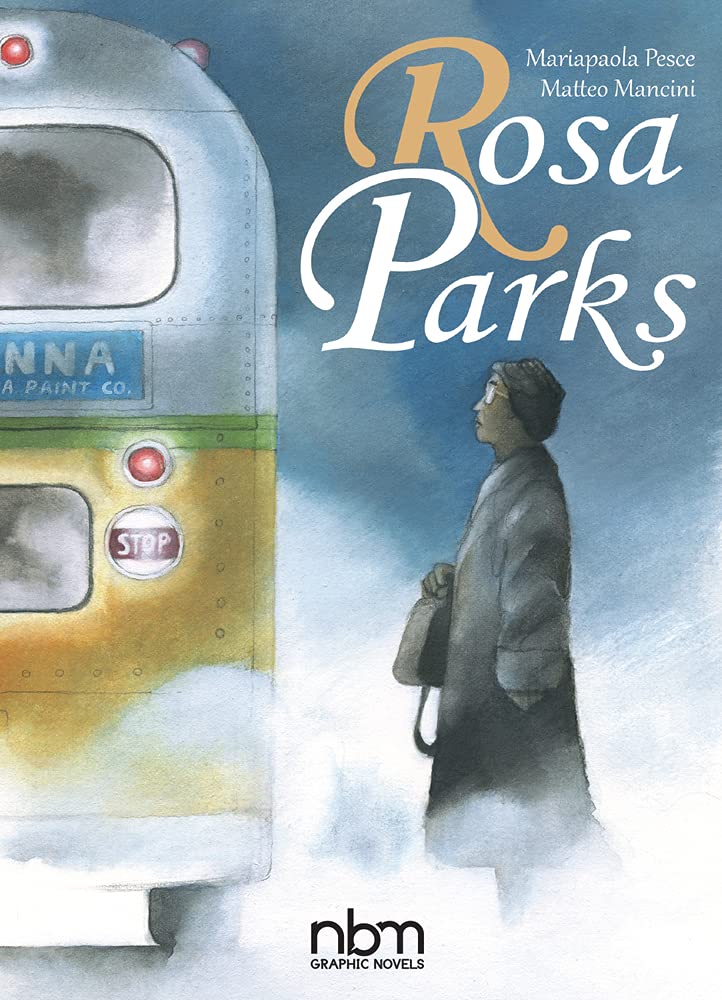
Rosa Parks


By Mariapoala Pesce & Matteo Mancini, translated by Nanette McGuiness (NBM)
ISBN: 978-1-68112-291-5 (HB) eISBN: 978-1-68112-292-2

It must be quite hard to say something new – or even get under the accumulated skin – of a legend, and doubly so when the single act the entire world knows them for is not the beginning or end, but rather a middle moment in a long life of impassioned exceptionalism…

On December 1st 1955, “negro” seamstress Rosa Parks rode the bus home. She had taken said public transport vehicle many times before and until that moment had always followed the rules. This was in Montgomery, Alabama, where “Jim Crow” laws had been steadily snatching back every vestige of freedom and liberty won with shot and shell during the War Between the States, almost from the moment the shooting stopped…

Thus, on those commuter routes – as everywhere else – white people had priority, and if a black person was seated, they had to get up and literally move to the back of the bus to let “their betters” sit down.

On that evening, weary Rosa Parks refused to give up her seat, even when told to by the white bus driver. She knew there would be consequences, anticipated them and was ready for them. Perhaps she wasn’t so sure where that act of passive defiance would take her and the entire country…

That moment is as much part of mythology as history, but here – via some intriguing extrapolation from writer Mariapoala Pesce (Angela Davis; Alice in Austenland; La Fattoria Degli Animali) and illustrator/designer Matteo Mancini (Una divisa per nino) – we take a look at what made the moment: who Rosa Parks was before and what she became after that act of wanton lawbreaking…

Preceded by thoughtful author’s preface ‘Does it still make sense to talk about Rosa Parks?’ the story is then told through a distant lens, beginning in a taxicab on December 1st 2014, where a hot young rapper frets and slowly gets acquainted with the elderly blue collar driver. They’re different generations of black man, but as the ride progresses, conversation shows how much has changed and how much they’re still alike…

The star is wearing an “I Can’t Breathe” shirt and that cause celebre sparks talk of another more distant time…

And thus is told an intimate tale of the thoughtful family woman who weathered instant infamy and dangerous notoriety to become an eternal activist, iconic institution and tireless campaigner for employment equality, civil rights education, literacy and an end to sexual abuse and exploitation of black women and girls.

The captivating tale within a tale is augmented by ‘Martin Luther King’s Letter to Citizens of Montgomery, AL’; an essay by Stephanie Brooks detailing ‘Rosa Parks After’; a bibliography of Further Reading and a beautiful, capacious and extensive sketch and design section.

Intriguing and entertaining, Rosa Parks offers a powerful and enriching approach to a much-lauded but little known example of humanity at its very best.
© Mariapoala Pesce 2020 for the text. © Matteo Mancini 2020 for the illustrations. © for the original Italian EditionBeccoGiallo S.r.l. 2020. All rights reserved.

Rosa Parks will be published on February 17th 2022 and is available for pre-order now. For more information and other great reads see http://www.nbmpub.com/

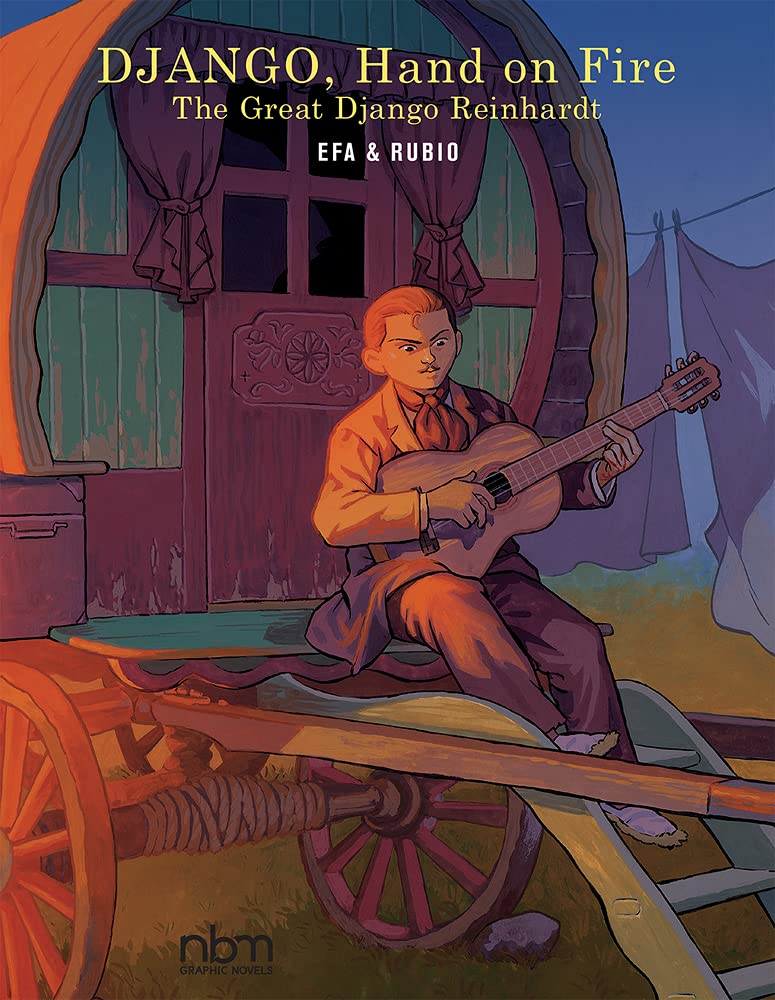
Django, Hand on Fire: The Great Django Reinhardt


By Salva Rubio & Efa, translated by Matt Madden (NBM)
ISBN: 978-1-68112-287-8 (HB) eISBN: 978-1-68112-288-5

Publisher NBM’s line of European-originated biographies never fails to delight, and this new oversized luxury hardcover (also available in digital formats) is one of the most engaging yet: skilfully deconstructing – when not actually aiding and adding to – the myths and legends surrounding a top contender for the title of greatest guitar player of all time…

Django, Hand on Fire happily reunites award-winning screenwriter, historian and novelist Salva Rubio (Max; The Photographer of Mauthausen) with animator and illustrator Ricard Fenandez AKA “Efa” (Les Icariades; Rodriguez; L’Âme du Vin; Le Soldat) – whose other collaborations are also beautiful biographies – Monet: Itinerant of Light and the as yet untranslated Degas: La danse del la solitude.

Originally released in France, the translated Django, main de feu is preceded here by an introductory prose appraisal from Thomas Dutronc. This stunning confection of painterly images traces the life of the troubled and unfortunate Roma musician from his fraught birth in a frozen field in Belgium to his second birth and reunion with the true love he threw away and found again…

That natal moment was in 1910 as his father and the other itinerant performers of their tribe were eking out a wage entertaining outworlders.

By 1922, the troupe were resident in Paris’ “Zone”: an enclave for his sort where social outcasts could reside until posh folks found a use for them. The lad was cocky and troublesome, an arrogant illiterate born for mischief but blessed with astounding musical skill…

His life turned around when his mama acquired a six-string banjo for him and all his energies refocussed on mastering music. Soon he was making money – and losing it gambling – even before he was considered a man…

Still an emotional child, he became the star of a professional (adult) band but his actions and attitude lost him many friends and family and ultimately the girl who adored him: Irma AKA Naguine. She faithfully trailed in his wake as producers and record publishers tracked the young man and watched in resignation as he succumbed to the shining blonde glory of artificial flower maker Florine/Bella. Naguine left the Zone entirely when Django and the flower girl wed, but swore to return…

The musician’s meteoric rise stalled only as he awaited his first child’s birth. As they slept in their wagon, it caught fire and although Bella got out, Django was badly burned on his legs and left hand…

How – driven by his mother – he battled back to overcome his life-changing injuries and, by changing his style, mastered another instrument, found undying fame and finally realized where his true love lay is a fabulous – if not strictly accurate – tale to warm the heart and gladden the eyes…

The pictorial paean to persistence and testament to passion is supported by a Bibliography and Creator Biographies plus ‘Django Reinhardt, from mystery to legend… In the light of History’: a fulsome, copiously-illustrated essay detailing the author’s factual choices and path to this particular truth, categorised and examined in ‘A mythical birth’, ‘The Zone’, ‘An interloper in the world of bal-musette’, ‘J’ai deux amours: Naguine and “le jass”‘, ‘The Cross of Blood…’, ‘…and the fiery flowers’, ‘Hospital for the Poor’ and ‘Hand on fire’…

Sparkling and inspirational, this is destined for the reading list of every music historian and intrigued dilettante: a beguiling magic window into another world and one you should seek out tout de suite…
© DUPUIS 2020 by Rubio, Efa. All rights reserved.

Django, Hand on Fire: The Great Django Reinhardt will be published on January 18th 2022 and is available for pre-order. For more information and other great reads see http://www.nbmpub.com/