
Hip Hop Family Tree Book 1: 1970s-1981


By Ed Piskor (Fantagraphics)
ISBN: 978-1-60699-690-4 (PB)

Comics is an all-encompassing narrative medium and – even after 40-plus years in the game – I’m still amazed and delighted at innovative ways creators find to use the simple combination of words and pictures in sequence to produce new and intoxicating ways of conveying information, tone, style and especially passion to their audience.

A particularly brilliant case in point was this compulsive compilation of strips and extras from self-confessed Hip Hop Nerd and cyber geek Ed Piskor (author of the astonishing Hacker graphic novel Wizzywig) which originally appeared in serial form on the website Boing Boing.

In astounding detail and with a positively astounding attention to the art styles of the period, Piskor detailed the rise of the rhyme-and-rhythm musical art form (whilst paying close attention to the almost symbiotic growth of graffiti and street art) with wit, charm and astonishing clarity.

Charting the slow demise of the disco and punk status quo by intimately following fledgling stars and transcendent personalities of the era, ‘Straight Out of the Gutter’ begins mid-1970s with South Bronx block parties and live music jams of such pioneers as DJ Kool Herc, Grandmaster Flash, Grandwizard Theodore and Afrika Bambaataa.

The new music is mired in the maze of inescapable gang culture but as early word-of-mouth success leads to first rare vinyl pressings and the advent of the next generation, the inevitable interest of visionaries and converts leads to the circling of commercial sharks…

The technical and stylistic innovations, the musical battles, physical feuds, and management races by truly unsavoury characters to secure the first landmark history-making successes are all encyclopaedically yet engaging revealed through the lives – and, so often, early deaths – of almost-stars and later household names such as Furious 4-plus-1, Kurtis Blow, The Sugarhill Gang, the Furious Five, and those three kids who became Run-DMC.

The story follows and connects a bewildering number of key and crucial personalities – with a wealth of star-struck music biz cameos – and ends with Hip Hop on the very edge of global domination following the breakout single Rapture (from new wave icons and dedicated devotees Blondie) as well as the landmark TV documentary by Hugh Downs and Steve Fox on national current affairs TV show 20/20 which brought the new music culture into the homes of unsuspecting middle America…

To Be Continued…

Produced in the tone and style of those halcyon, grimily urban times and manufactured to look just like an old Marvel Treasury Edition (an oversized – 334x234mm – reprint format from the 1970s which offered classic tales on huge and mouth-wateringly enticing pulp-paper pages), this compelling confection (available in very large paperback and variably-proportioned digital formats) – also includes a copious and erudite ‘Bibliography’, ‘Discography’ and ‘Funky Index’, an Afterword: the Hip Hop/Comic Book Connection (with additional art by Tom Scioli) and a fun-filled Author Bio.

Moreover, there’s also a blistering collection of ‘Pin Ups and Burners’ with spectacular images from guest illustrators including The Beastie Boys by Jeffrey Brown, Afrika Bambaataa by Jim Mahfood; Fat Boys by Scioli; Grandmaster Flash and the Furious Five by Ben Marra; Vanilla Ice by Jim Rugg; Run-DMC by Dan Zettwoch; Eric B. and Rakim by John Porcellino; Salt-n-Pepa by Nate Powell; KRS-One by Brandon Graham & Snoop Dogg by Farel Dalrymple, to get your pulses racing, if not your toes tapping…

Cool, informative and irresistible, Hip Hop Family Tree is wild, fun and deliciously addictive: sparking a revolution and sub-genre in comics creation. This is what cultural cross-pollination is all about and you should dive in right now…
This edition © 2013 Fantagraphics Books. All Hip Hop comic strips by Ed Piskor © 2013 Ed Piskor. Pin ups and other material © 2013 their respective artists. All rights reserved.


First Names: Nelson (MANDELA)


By Nansubuga Nagadya Isdahl & Nicole Miles (David Fickling Books)
ISBN: 978-1-78845-097-3 (PB)

Since its premiere in 2012, The Phoenix has offered humour, adventure, quizzes, puzzles and educational material in a traditional-seeming weekly comics anthology for girls and boys. The vibrant parade of cartoon fun, fact and fantasy has won praise from the Great and the Good, child literacy experts and the only people who really count – a dedicated legion of totally engaged kids and parents who read it avidly…

David Fickling Books provides other types of reading matter: novels, graphic novels and a newish imprint of cartoon and strip illustrated biographies highlighting historical and contemporary groundbreakers and earthshakers.

First Names introduces young readers to noteworthy achievers rightly deemed role models and adds now to its roster an absolute legend: the man who defied modern society’s greatest tyranny, defeated an entrenched oppression and changed the lives and minds of millions if not billions of people.

Devised along the lines of the mega-successful, eternally-engaging Horrible Histories books, these prose paperbacks come with a superabundance of monochrome cartoon illustrations to keep the pace of learning fast and fact-packed, and are generally bright, breezy, easily-accessible hagiographies with the emphasis on graphics. That doesn’t mean that they pull any punches when the facts warrant, though…

Written by Nansubuga Nagadya Isdahl, First Names: Nelson (MANDELA) details the astounding life and ultimate triumph of the rational, gentle-minded freedom fighter who endured decades of personal hardship while shepherding his nation through an all-but-bloodless revolution to a tolerant liberation.

The amazing story begins with Introduction ‘Nelson Arrives At The Great Place’, describing how the 12-year old lad arrives at the royal residence of the acting king of the Thembu people. It is 1930 in the Transkei region of South Africa…

The full story begins then with the antecedents and early childhood of small boy Rolihlahla as winningly described in chapter 1: ‘Nelson is Named’ before encompassing school, family joy and heartbreak and relating how a carefree cattle boy with few clan connections grows into a scholar of promise in ‘Nelson Gets Some Boots’ and rejects tribal plans to seek personal independence as ‘Nelson Heads For The City’…

Studies, setbacks, marriage and political transformation are deftly covered as 4’Nelson Joins The Fight’ and 5’Nelson Stirs Things Up’, whereafter the forthright but breezy tone takes a darker turn as the struggle against South Africa’s white minority rulers starts to bite.

Chapter 6 reveals ‘Nelson Goes On Trial’ and covers life on the run in ‘Nelson Undercover’ before the more public stages of this remarkable life are covered in ‘Nelson Makes His Plea’ and the concluding Chapter 9: ‘Nelson Casts His First Vote’, after which an ‘Epilogue’ deals with the later years of rule, reconciliation and retirement.

This is a subject with plenty of controversial and complex issues for kids to unpack, but the author has illustrator Nicole Miles putting faces to the names and places in smart cartoon collations such as ‘Didn’t you ever lose faith?’, ‘The Awful Passbook Laws’ ‘South Africa’s Horrible Racial Divide’ and brilliantly deals with potentially contentious issues by clever visual essays such as ‘Nelson Explains: Apartheid’ and ‘Nelson Explains: Life on Robben Island’.

There’s also plenty of visual sidebars detailing the basics with background detail like ‘My Tribe and Ancestry’, ‘How South Africa was Conquered’, ‘Circumcision’, and ‘Arranged Marriages’.

Ending the fun is a cool and crucial ‘Pronunciation Guide’ as well as a detailed Timeline (1918-2013), full Glossary and Index appendices for those eager to check out the facts and educate themselves even further…

Working in tandem with delicate sensitivity, the creators have constructed a superb introduction into the most remarkable man of modern times: a book any kid would be proud to share with interested adults.
First Names: Nelson (MANDELA) Text © Nansubuga Nagadya Isdahl 2021. Illustrations © Nicole Miles 2021. All rights reserved.

Race to Incarcerate – A Graphic Retelling


By Marc Mauer & Sabrina Jones (The New Press)
ISBN: 978-1-59558-514-7 (TPB)

When I first read it, this book made me really, really angry.

That’s okay though; it was supposed to.

I read it again yesterday. Still angry, so it’s your turn…

Marc Mauer has worked to end criminal inequality since 1987. In 2005 he became Executive Director of The Sentencing Project, a non-profit organisation working for nearly 35 years to establish “a fair and effective U.S. criminal justice system by promoting reforms in sentencing policy, addressing unjust racial disparities and practices, and advocating for alternatives to incarceration”.

The Project provides training for American defense lawyers; explores methods of changing the ferociously slanted legal system in regard to socially disadvantaged and racial minorities; seeks to debunk politically advantageous myths about the efficacy of incarceration, and works towards reducing the USA’s reliance on prison sentences through advocacy and by affecting policy on how best to safeguard the citizenry and punish criminals.

Highlighting disturbing trends and inequities in the criminal justice system since 1986 – especially in the treatment of non-white and juvenile offenders – the organisation has been consulted by Congress, The United States Sentencing Commission, U.S. Commission on Civil Rights and other Federal Agencies, subsequently overseeing changes to national drug policy guidelines and helping shape The Fair Sentencing Act of 2010.

I’m assuming they were not contacted by the Trump Administration when Orange Donnie decided to free up all those Federal Cells on Death Row at the end of his regime…

The Sentencing Project particularly concerns itself with combating racial disparity in detention, cataloguing various forms of felony disenfranchisement and has led campaigns to end the still-widespread practice of condemning juveniles to life without parole, as well as working to beef up the mandate of The Juvenile Justice and Delinquency Prevention Act.

All of which made Mauer the perfect person to write 1999’s landmark exposé Race to Incarcerate, which shockingly detailed the causes and minutia of the meteoric rise in America’s prison population since 1970.

Mauer followed up in 2002 with Invisible Punishment: The Collateral Consequences of Mass Imprisonment (co-edited by Meda Chesney-Lind). A telling indictment of a flawed, cruel, unfair and unscrupulous system, Race to Incarcerate was re-released in 2006, and in 2013 the powerfully polemical tract was brilliantly updated, revised and adapted by cartoonist Sabrina Jones into a ferocious pictorial broadside, re-positioned to engage and inform the general public and especially older kids who were most likely to experience the wrong arm of the Law.

Jones is a painter, illustrator, scenic artist, writer and activist whose evocatively lush and organically primitivist work has graced such politically aware publications as Studs Terkel’s Working, FDR and the New Deal for Beginners, The Real Cost of Prisons, graphics collective World War 3 Illustrated and autobiographical anthology GirlTalk amongst many others. Her most notable solo project to date is the beguiling Isadora Duncan: A Graphic Biography.

Following an evocative Foreword from Civil Rights lawyer and author Michelle Alexander, and heart-rending yet hope-filled Preface by author Mauer, the bare, bald facts are starkly presented in ‘Introduction: U.S. Prisons from Inception to Export’: tracing the invention of penitentiaries by the Puritans to the current situation where America has the disturbing honour of being number 1 country in the field of locking up citizens. The USA still boasts the highest rate of incarceration in the world – despite heavy and ever-increasing competition from old rivals Russia and China.

Perhaps that’s because they don’t just execute their criminals… no, wait…

The stunningly effective visual history lesson is followed by the American sector’s political background and lowdown on ‘The Rise of the “Tough on Crime” Movement’ from 1973: examining the divisive policies and calculated duplicity of Nixon and the Republicans in the wake of the triumphant Civil Rights Movement, and tracking the switch from programs of rehabilitation to specious but vote-winning punitive prison policies.

The situation culminated with ‘The Triumph of “Tough on Crime”’ which casts a spotlight on the disparities in dealing with increasing drug abuse during the rise of the Black Power movement and focuses on the draconian, tragically trend-setting policies of New York Governor Nelson Rockefeller, who instigated the harshest drug laws in the USA when ‘The Rock Gets Rolling’…

With prison populations rising rapidly and disparately, things took a turn for the worst from 1980, as seen in ‘Crime as Politics: The Reagan-Bush Years’, after which a particularly heinous travesty of justice is spotlighted in ‘Kemba Smith: a Case of Extreme Sentencing’.

The problem was not simply the self-serving prejudice of one party as poignantly, frustratingly illustrated in ‘Crime as Politics: The Clinton Years’, but plumbed new depths of hypocrisy in 2000 as ‘Crime as Politics: The George W. Bush Years’ stomach-churningly reveals…

Over the last 60-odd years, the whole situation seems to have been predicated upon a few fallacious, if not deliberately disingenuous dictums clearly exposed in ‘The Prison-Crime Connection’ which inexorably led to a monumental, institutionalised injustice system generating ‘Color-Coded Justice’: a concentration on profiling or criminality as seen in ‘The War on Drugs and African-Americans’.

The biggest shock however comes in ‘A New Direction’ as the authors reveal that – despite all the rhetoric and entrenched biases – the situation was actually improving as more and more States abandoned old, costly, failing punishment policies to try something new and humane – and more cost-effective. I wonder how the years 2016 to 2020 affected those policies?

After decades where States stopped building schools to pay for bigger and bigger prisons – with no appreciable effect other than depriving kids of an education – various localities tried different approaches; finding that where costly incarceration and harsh punishments don’t work, social programs, rehabilitation projects and investment in people do…

Coda:  Also included in this (long overdue for an update) book are details of outreach projects asking readers to contribute books to prisoners or become pen-friends with inmates, illustrated by Carnell Hunnicutt, a long-term inmate whose comics about his penal experiences and prison issues initially inspired Mauer to release Race to Incarcerate as a graphic novel (now available in paperback and digital editions).

Packed throughout with shocking, well-documented, specific cases and backed up by an eye-watering torrent of shameful statistics, this is a work with the potential to change society, so, with British politicians increasingly emulating idiotic mistakes and politically-advantageous, socially destructive criminal justice policies of our oversea friends, Race to Incarcerate remains a book every school library and home should have.

Moreover, if you care about people and justice it’s one you must read…
© 2013 by The New Press, based on Race to Incarcerate by Marc Mauer © 1999, 2006 by The Sentencing Project. ‘Kemba Smith: a Case of Extreme Sentencing’ © 2013 by Sabrina Jones. Foreword © 2013 by Michelle Alexander. Preface © 2013 by The Sentencing Project. All rights reserved.

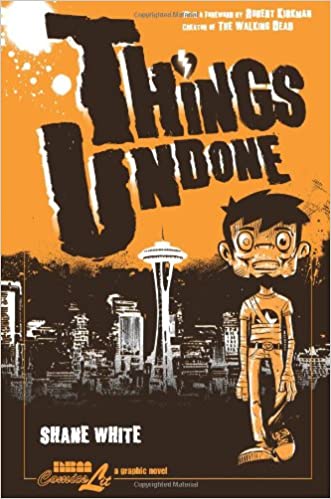
Things Undone


By Shane White (NBM/ComicsLit)
ISBN: 978-1-56163-563-4 (PB)

The sheer variety of themes and species in contemporary cartooning can be quite breathtaking to an old coot who grew up with the restricted comics fare of a baby-boomer in Britain – and I wouldn’t have it any other way. These days I can peruse a graphic novel on any subject in any style and incorporating any number of converging genres – and this compelling gem comes pretty close to defying categorisation.

Things Undone is a little bit romance, a little bit alternative biography, a little bit punk and a whole lot of terrific. Young Rick Watts is an artist and world-weary peon in the art-consuming field of video games graphics. He’s just moved to Seattle for a new job, but nothing’s really changed, and relationship-wise things aren’t going so great either. Long-distance never works so he dragged his girl-friend clear across the country, and his 7-year hitch with her couldn’t have ended more badly…

When you can’t catch a break and the new life proves no better than the old one, what can a guy do? And it’s only a matter of time before somebody notices that Rick is a zombie, what with him leaving decaying extremities and eyeballs and such like all over the place. Maybe he should just get a gun and do the job right…?

This sharp and bittersweet examination of modern life is funny and poignant, using the populist imagery of the walking dead as an effective metaphor for modern life, but it’s the amazingly comforting art and production (the book is printed in black, white and shocking orange, in a kind of raucous skate-punk cartoon style) that underpins this tale, making the tragic comedic, and making confusion the means of exploring the mundane horrors of urban living.

Clever, witty and one of the most sensitive funny/sad, real/imaginary stories you’ll ever read. Track this down and change your life…
© 2009 Studiowhite LLC.

Willie Nelson: A Graphic History


By T.J. Kirsch, CoÅŸkun Kuzgun, Jeremy Massie, HÃ¥vard S. Johansen, Jesse Lonergan, Jason Pittman, J.T. Yost,Adam Walmsley & various (NBM)
ISBN: 978-1-68112-262-5 (HB) eISBN: 978-1-68112-263-2

I live a pretty blessed life these days. I love history and am addicted to comics and many of the best ones are just sent to me. The present trend is to combine both of my passions in graphic biographies – or even autobiographies. Our continental cousins have pretty much collared the market on the former, with a range of personal histories featuring the great, the good and especially the extremely cool, but just for a change here’s an all American(ish) confection that deftly hits that elusive sweet spot.

Whether you’re a fan or not of the music, you can’t deny the tenacity and enormous spirit of musician, writer, actor, filmmaker and activist Willie Nelson: an outsider’s outsider.

Utilising the talents of a group of indie artists writer T.J. Kirsch has compiled an effective and moving monochrome testament to the troubadour’s determination and talent which begins in 1933 in ‘Hill County, Texas’. Rendered throughout in monochrome, the history begins with CoÅŸkun Kuzgun detailing a hard life for a young boy wedded to mischief and addicted to music…

As they grew, Willie and sister Bobbie became local celebrities – but not rich – performing, so he began a career in radio, using the opportunity to plug his own material. Never finding that elusive hit, Willie joined the Air Force in 1951 until a persistent back injury forced him out of the services, just in time to stumble into matrimony…

‘A Humble Picker’ (by Jeremy Massie) traces that tempestuous relationship and Willie’s attempts to feed his family in and out of showbiz, before sliding back into disc jockeying and discovering marijuana…

The slow painful climb begins in HÃ¥vard S. Johansen’s ‘Country Willie’, continues in ‘Grinding Away’ (Jesse Lonergan) and culminates in professional breakthroughs and personal breakdowns in Austin, Texas (by Jason Pittman) as 1970 sees the true commencement of the legend…

J.T. Yost depicts a life hard-lived but well-worth the effort in ‘Honeysuckle Rose’ and the saga sparkles to a close – for now – in the all-T.J. Kirsch chapter ‘Elder Statesman’, revealing that music and legends just keep on going…

With Intro, Outro, Chapter and Endpaper illustrations by Adam Walmsley plus a bibliography and full ‘Song Credits’listing, this is an immensely likable tract that feels like a journey shared with a most interesting stranger. You may not like the music – yet – but you’ll be unable to not love the indomitable, irrepressible man.

© 2020 T.J. Kirsch and each respective artist. All rights reserved and managed by NBM Publishing, Inc.
First printing September 2020

Willie Nelson: A Graphic History is scheduled for release in hardback and digitally on September 15th 2020, and is available for pre-order now.

Most NBM books are also available in digital formats. For more information and other great reads see http://www.nbmpub.com/


Leonardo da Vinci: The Renaissance of the World


By Marwan Kahil & Ariel Vittori, translated by Montana Kane (NBM)
ISBN: 978-1-68112-259-5 (HB) eISBN: 978-1-68112-260-1

Some people are simply so famous that everybody thinks they already know all about them. That’s what makes biographies like this one such a tricky proposition. As always, talent will tell and the narrative gifts of writer Marwan Kahil and illustrator Ariel Vittori are more than sufficient to breathe fresh life into a much-told tale of one of the most accomplished men in world history…

Kahil (A. Einstein – the Poetry of Real) studied at the École Spéciale d’Architecture in Paris and Simon Boudvin’s prestigious Graphic Art Workshops before deciding to split his time and efforts between comics and film and theatre. Rome-based Ariel Vittori (Quelques pincées de désir) is an artist and designer who numbers Disney, Campari and Monadori amongst her satisfied clients, although her true calling is narrative illustration. She is co-founder and President of Attacapanni Press: an independent publisher matching rising stars with seasoned comics veterans…

Available in English in both sturdy hardback and assorted digital formats, Leonardo da Vinci: The Renaissance of the World opens with a querulous preface from Kahil before the Maestro’s eventful life begins to unfold in glorious colour as the elder reminisces in Rome 1515 anno domini…

It begins with ‘Chapter 1: A Young Man Unlike Any Other’ in April 1452 at the hamlet of Anchiano (near Vinci) with the welcoming of a very observant baby to loving extended family. Time passes and a doting grandfather passes, leaving the special child apprenticed to a painter in Florence…

The present interrupts as the elderly Leonardo falls foul of the Roman clergy and is forced to flee to France…

‘Chapter 2: The Most Handsome Man in Florence’ then follows the seemingly blessed teenager as he excels and overtakes his mentor Andrea del Verrocchio, roistering his way through Florence and making many friends and far more enemies as he courts rich, powerful and essentially dangerous patrons. Throughout it all he is driven by his unconventional romantic drive and fanatical compulsion to see more and understand everything…

In ‘Chapter 3: The Sforza’s Man’ the itinerant ideas man reaches Milan and works for the powerful duke, even as his older self in 1515 must deal with the so-different responses of his two apprentices Salaì and Francesco to their impending arrest and excommunication…

The sage concludes as the great man finally achieves a measure of peace and security under the patronage of lifelong admirer Francis I, allowing Leonardo to end his days in ‘Chapter 4: In the Service of the King of France’…

Although many scenes and snippets are taken from non-chronological key moments, the overall effect reveals a life both frustrating and often dangerous, but lived very much on the scholar’s own terms and with few regrets. The tale is also liberally dosed with revelatory secrets on the creation of the Masters greatest artworks and scientific discoveries, adding a degree of enthralling vitality to proceedings.

This beguiling dramatized biography is splendidly augmented by educational extras, such as with ‘Leonardo da Vinci – Works’: a commentary on many of his creations, supplemented by a crucial illustrated menu of ‘Principal Players’, a fulsome list of further reading in ‘More on Leonardo’ and a copious illustrated collection of ‘Quotes of Leonardo da Vinci’.

Seen here is a visual delight celebrating a unique mind and personality, and one you should reacquaint yourself with as soon as you can.

© 2017 Blue Lotus Prod. © 2019 NBM for the English translation.

For more information and other great reads go to NBMpub.com

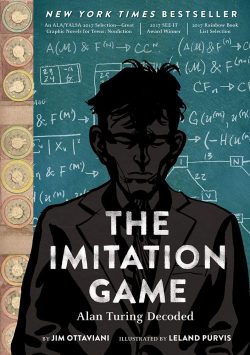
The Imitation Game: Alan Turing Decoded


By Jim Ottaviani & Leland Purvis (Abrams ComicArts)
ISBN: 978-1-4197-1893-9 (HB) 978-1-4197-3645-2 (TPB)

Like every persecuted grouping of humanity, the LGBTQ community have far too many martyrs, but apart from Oscar Wilde and perhaps Harvey Milk, how many can you name? If any, I’ll bet Alan Turing tops that list…

Spellbindingly scripted by Jim Ottaviani (who has similarly eulogised and dissected quantum physicist (Richard) Feynman and – in Primates – primatologists Jane Goodall, Dian Fossey and Biruté Galdikas) with compellingly effective art by Leland Purvis (Vox, Pubo, Vulcan & Vishnu and Suspended in language: Niels Bohr’s life, discoveries, and the century he shaped – a previous collaboration with Ottoviani), this full-colour hardback, trade paperback or eBook biography divides Turing’s life into three broad sections, incisively and winningly reviewed as if in a documentary.

Events from his turbulent life are deftly mixed with faux “interviews” and candid disclosures from those who knew him – his mother, the computing “girls” at Bletchley Park, fiancée Joan Clark, Professor Max Newman, engineer and lab partner Bayley and the weak, shady “rent-boy” who brought about Turing’s eventual downfall and death…

‘Universal Computing’ covers the difficult, solitary boy’s childhood and college years, providing plenty of revelatory scenes showing how smart, obsessed and just plain different Alan Mathison Turing always was.

Top Secret Ultra’ focuses on the war years that built Turing’s reputation as a cryptographer and inventor at the officially “non-existent” base where the Enigma Code was cracked and the battle against fascism won.

The most painful and potent moments are seen in his post-war years at Manchester University, trying to beat the Americans in the ferociously competitive race to build Thinking Machines. Here he came under increasing stress as his open homosexuality – accepted as fact and ignored at Bletchley – gradually overtook and destroyed the life of the mis-socialised plain-speaking genius whose thoughts and writings resulted in the breakthroughs everybody now knows as ‘The Imitation Game’…

Rounding out the cruelly educational experience is a poignant and challenging ‘Authors Note’ touching on the still-unresolved mystery concerning Turing’s death, a vast ‘Bibliography and Recommended Reading’ list and a bewilderingly comprehensive ‘Notes and References’ section, covering everything from the panel structures of this tale to the mathematics involved in and comprising much of the book’s subtly beguiling make-up.

This is an astoundingly inviting way to take in a true story of incredible accomplishment, dedicated passion and terrifying naivety, ending in a horrific loss to us all…

Please be warned: this is categorically not an adaptation of the 2014 film.
Text © 2016 Jim Ottaviani. Illustrations © 2016 Leland Purvis. All rights reserved.
 

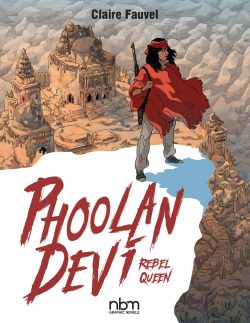
Phoolan Devi: Rebel Queen


By Claire Fauvel, translated by Montana Kane (DC Comics)
ISBN: 978-1-68112-251-9 (HB)

Born in 1988, award-winning graphic novelist Claire Fauvel (À la recherche d’Alvaro Dolor; Sur les pas de Teresa, la religieuse de Calcutta [w/Marie-Noëlle Pichard]; Une Saison en Égypte; Catherine’s War [w/Julia Billet]) studied illustration at Paris’ l’école Estienne and animation at l’école des Gobelins before beginning an illustrious career in bande dessinée. She’s particularly adroit and adept with female historical figures and her latest tome gives her plenty to work with…

Phoolan Devi: Rebel Queen is that rare event, a history that has all the energy and impetus of a great action adventure and pioneering, political tract. Despite being a factual graphic biography, this is the stuff of legend and grand drama, detailing the astounding, appalling, tragic and triumphant life of a woman who bucked India’s ancient, all-pervasive caste system. Victim from birth of poverty and inequality, she sought change through bloody deeds and ultimately political action in a country where prejudice is institutionalised: expressed via cultural violence, and which fostered for millennia a tyrannical social system of inherent, inbuilt corruption where gods and birth status forever dictate one’s position in life…

Phoolan suffered a double blow at birth: born both poor and female. Never educated, she remained illiterate all her life. A life of being shunned and grinding poverty was exacerbated when she was married off at age 11, starting a harrowing pattern of slavery and sexual abuse lasting until she was rescued by a troop of the legendary bandits infesting Uttar Pradesh at the time. They were actually more decent – and heroic – than most respectable citizens (men), civil authorities and police officers of the region. Becoming lover to one of the gang, she suffered even greater abuse when he was murdered by a rival from a different caste.

Surviving these assaults, Phoolan organised an infamous vengeance massacre at the village of Behmai. That slaughter was picked up by the press, who recast her as a rebel queen and her lover a martyr. The public began using the honorific “Devi” for her and, after a mythic career, she surrendered to authorities in 1983. Over eleven years of imprisonment, 48 capital charges including murder, plunder, arson and kidnapping were incrementally dropped before a trial that never came. In 1994, the state government led by Mulayam Singh Yadav of the Samajwadi Party withdrew all charges and she walked free. Joining the party, she was elected to national office twice, becoming a strong advocate for radical change, in the caste system and the patriarchal treatment of women. Regarded as the “voice of the oppressed”, on 26th July 2001 her past caught up with her when she was assassinated by relatives of the bandits killed at Behmai.

Fauvel took her inspiration from acclaimed 1996 autobiography Moi, Phoolan Devi, reine des bandits by Phoolan Devi & Marie-Thérèse Cuny, and although not all of those events are included in this stunning and uncompromising account, the supremely enticing and engaging art manages to mix in a few moments of hopeful aspiration, happy romance and family unity to offset the revolting iniquities Phoolan and other women had to survive on a daily basis.

Nevertheless, this brilliant tale is grim and unflinching in the portrayal of the constant assaults and abuses she endured, so you’d better gird yourself for plenty of righteous indignation and outright anger at the catalogue of venality and casual intolerance civilised folk still seem capable of…

Potent, unmissable, and primed to continue the fight, this is a book you must read.
© 2018 Casterman. © 2020 NBM for the English translation.

Phoolan Devi: Rebel Queen will be published on March 19th 2020 and is available for pre-order. NBM books are also available in digital formats. For more information and other great reads go to NBM Publishing at nbmpub.com

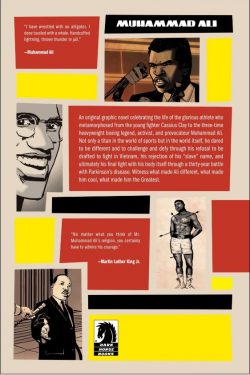
Muhammad Ali


By Sybille Titeux de la Croix & Amazing Améziane, translated by Nicole Seguin-Morris for Studio Cutie (Dark Horse Books)
ISBN: 978-1-50670-318-3 (HB) eISBN: 978-1-63008-899-6

Fuelled largely by European comics, there’s a superb wealth of graphic biographies and auto biographies around for us mere English-speakers and I’ve reviewed a fair few of them. One of the best is this redoubtable treat from 2016, crafted by all-round artist and musician Sybille Titeux de la Croix (L’Apparition, Dostoyevski’s Gratte Moi La Puce) who studied at the École nationale supérieure des arts décoratifs. Her tag-team partner and illustrator here goes by Amazing Améziane: a multi-disciplinary creator, screenwriter and avowed child of the 1970s. He started crafting comics in 2001 and his other efforts include Clan, Bagmen and Cuatro Manos.

Their subject certainly needs no introduction. Born Cassius Marcellus Clay Jr. on January 17th 1942, he rose to fame through professional boxing during the most turbulent period in American history. Smart, incredibly fit and ferociously determined, he used his fame to become an activist, philanthropist and political and social influencer long before the term was coined or even possible. You don’t need me to tell you how important he was: history does that perfectly well and this superb appreciation and distillation of his life – available in hardback and digital editions – adds stylish gloss and polish to it all.

Following the Introduction from author Titeux de la Croix, the potent blend of narrative art and calligraphic declamation begins with ‘Equality’, relating the early days in Louisville, Kentucky, describing the day to day hardships of segregation, racist atrocities such as ‘The Murder of Emmett Till’ and how little Cassius Clay accidentally falls into boxing after his bike is stolen…

Grit, determination and focus carry him to the Olympics where he wins gold, and back to America where he still can’t ride some buses or eat in any diner he chooses…

‘Islam’ relates the days of political and religious awakening, meeting Henry Cooper and Malcolm X, proving he’s “the Greatest” and changing his name…

Diverting for a detailed and comprehensive analysis of ‘Ali’s Technique’, we follow the champion’s major bouts and landmark fights in and out of the ring (with specific reference to FBI boss J. Edgar Hoover’s obsessive investigations) and the time when pro civil rights advocates started being assassinated, leading to a quest for ‘Justice’…

The increasingly famous fighter becomes a figurehead through the late 1960s and spokesman in the 1970s, all the while combatting other boxers, media persecution and the aging process, before the later years of ‘Freedom’ culminate in 1984’s ‘Diagnosis: Parkinson’s’ and the long, slow unwinnable fight that ultimately claimed his life on June 3rd 2016…

Remarkable and uncompromising – the book, as well as the man – Muhammad Ali celebrates a unique life and unmatchable achievements with compelling effect. Even if you don’t like biographies or sports, this is a story and graphic treat every comics lover will want to see…
Muhammad Ali, Ali the Great © ÉDITIONS DU LOMBARD (DARGUAD- LOMBARD S.A.) 2015 by Amazing Améziane, Sybille Titeux de la Croix. All rights reserved.

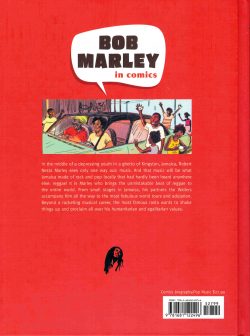
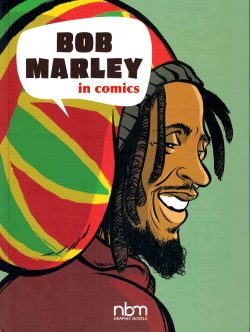
Bob Marley in Comics


By Gaets & Sophie Blitman, illustrated by Olivier Desvaux, Ammo, Didier Millotte, Tanguy Pietri, Matthieu Beaulieu, Jena, Efix, Domas, Simon Léturgie, Sarah Williamson, Cyrille Brégère, Julien Modde, Moh, Armel Ressot, Lu-K, Clément Baloup, Joël Alessandra, Julien Atika, Gil & various: translated by Montana Kane (NBM)
ISBN: 978-1-68112-250-2 (HB)

Graphic biographies are all the rage at the moment and this one – originally released on the continent in 2018 – is another cracker likely to appeal to a far larger mainstream audience than comics usually reach. It certainly deserves to as it captivatingly deconstructs the life of a truly unique force in music and popular culture…

If you’ve never heard of Bob Marley or don’t like reggae, you might still want to check this out. The singer was deeply spiritual and it’s never too late to see the light and convert or, failing that, just buy a record…

Gathered in this fetching hardback (or eBook) edition are context-providing essays backing up individual comics sections; each chronological article and comics vignettes written by the ever-informative comics scribe Gaets and journalist/children’s author Sophie Blitman, supported by a veritable legion of illustrators providing vivid and vibrant strips, beginning with ‘From Nesta to Robert’ – limned by Olivier Desvaux.

The early life of the musician introduces us to his mother Cedella Malcolm and the old white soldier she married. With Norval Marley disinherited and promptly absconding, Nesta Robert Marley spent his early years in the rural farming community of Nine Miles in Jamaica until at age six, when he was whisked away to Kingston by his dad… who simply dumped him with another woman and vanished again…

Happily, a few years later Cedella joined the boy who was already showing promise as both a fortune telling mystic and award-winning singer. Rendered in stark monochrome by Ammo, ‘The Rude Boys of Trenchtown’ exposes the appalling poverty Nesta endured and the lasting friendships that privation engendered as they played, made music and hung out together: relationships expanded upon in the essay ‘Growing Up Between Worlds’.

Working in muted full colour, Didier Millotte explores ‘Reggae in the Ghetto’ as Robert Marley – now working as a full-time (14-year-old) welder – and his mates Peter Tosh and Bunny Wailer are taken under the wing of pro musician Joe Higgs who teaches young Marley to play guitar…

‘Making Friends in Trenchtown’ details the development of the musical genre Reggae from Ska and Marley’s growing influence after which Tanguy Pietri illuminates sordid conditions and lack of opportunities which compel him to make music his life in ‘A Ray of Light in the Dark’…

Matthieu Beaulieu reveals the unique way poor Jamaicans consumed pop music in ‘Sound Systems, Ska & Studio One’, how the blossoming star is ripped off for the first – of many – times and how he meets wife-to-be Rita Anderson: a relationship which grows in Jena’s vignette ‘Is This Love?’

Efix delineates Marley’s spiritual growth in historical lecture ‘The Roots of the Rasta Movement’, whilst Domas’ ‘Tuff Gong in Nine Miles’ follows his musical journey to America – until the threat of being drafted into Vietnam – and ultimately to London, where The Wailers become stranded…

Essay ‘The Path to Success’ concentrates upon Marley’s song-writing and musical self-determination which led to the critical meeting with British Producer Chris Blackwell in ‘The Reggae Wave’ (art by Simon Léturgie) and the release of first album Catch a Fire. Now a growing global sensation among young white music fans – as detailed in essay ‘An “International Reggae”’ – Bob Marley and The Wailers retire to Blackwell’s ‘Villa Rasta’ (illustrated by Sarah Williamson), to make more music and bask in fame in their own country whilst enjoying a few rock star trappings of success…

One such is covered in ‘Bob Marley, Rita… And All the Other Women’, recounting the numerous affairs and children the singer indulged in even as the parade of mega-hits began. Cyrille Brégère encapsulates the tone of the times in ‘The Sheriff Died Tonight’ with the financial sharks already circling, as seen in ‘Around the World’ (Julien Modde), leading to the breakup of the founding members…

Throughout this period, Jamaica was descending into political chaos and gangsterism fuelled by economic disparity. This was something no amount of interviews or comments from the pacifist, life-loving musician could affect, but did result in the assassination attempt depicted by Moh in ‘Panic in the Hen House’.

The spark was believed to be proposed peace and reconciliation concert Smile Jamaica, but despite being wounded, three days later the show went on with Marley proudly in the spotlight…

Following more history in ‘The Price of Fame’, Armel Ressot graphically caters a ‘Punk Reggae Party’ as the leading proponents of two landmark musical movements meet and cross pollinate, despite falling foul of British Law, after which ‘From Exile to Exodus’ covers the creation of the classic album before ‘Red Card’ (art by Lu-K) heralds the beginning of the end after an impromptu kickabout in Paris leads to a shocking discovery…

The star’s obsessive passion for the sport of the ghettos is examined in ‘Bob Marley and His Love of Soccer’, as is his refusal to compromise his Rastafari principles by accepting medical treatments unacceptable to his faith. Clément Baloup then pictorially details the escalating civil war in Kingston and Marley’s controversial pre-election solution of a One Love Peace Concert in ‘Ablaze’.

Knowing his end was near, Marley finally visited Ethiopia in 1978 before finishing the album Survival and discovering yet another friend and manager had been stealing from him and his fans. He played controversial concerts in Africa – including the independence ceremony of recently liberated and newly-created Zimbabwe – twice in fact, as the authorities cut the first one short through force of arms – as seen Joël Alessandra’s ‘Roots’.

Penultimate essay ‘For Peace and Unity Among Peoples’ shares his philosophies, awards and legacy, via the peace concerts he headlined, backed up by a moving strip of his final days in ‘All the Way’ (by Julien Atika), after which closing essay ‘Death of the “Pope of Reggae”’ fills in the detail of his passing and ‘What Next?‘ by Gil closes the show with the events of the Tuff Gong’s state funeral and his musical legacy, courtesy of his many children.

Bob Marley in Comics is an astoundingly readable and beautifully rendered treasure for comics and music fans alike: one that resonates with anybody who loves to listen and look. Without it, you’re simply nowhere, man…

© 2016 Petit as Petit. © 2018 NBM for the English translation.
Bob Marley in Comics will be released in the UK in February 2020 and is available for pre-order now. NBM books are also available in digital formats. For more information and other great reads go to NBM Publishing at nbmpub.com