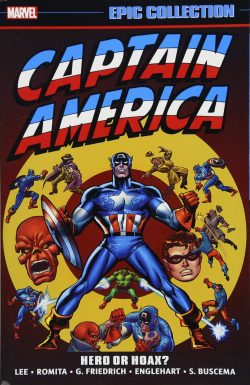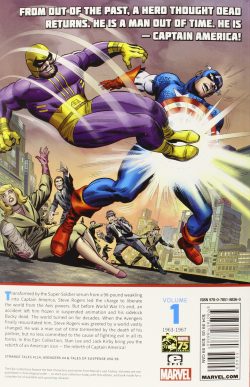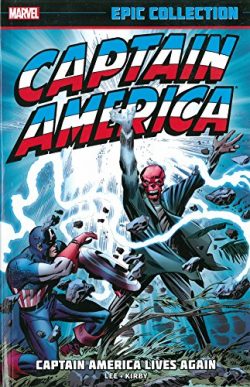
Captain America Epic Collection 1963-1967: Captain America Lives Again


By Stan Lee, Jack Kirby, Roy Thomas, Don Heck, Dick Ayers, George Tuska, John Romita, Gil Kane, Jack Sparling & various (Marvel)
ISBN: 978-0-7851-8836-0 (TPB)

During the natal years of Marvel Comics in the early 1960s Stan Lee & Jack Kirby opted to mimic the game-plan which had paid off so successfully for National/DC Comics, albeit with mixed results. Beginning cautiously in 1956, Julie Schwartz had scored incredible, industry-altering hits by re-inventing the company’s Golden Age greats, so it seemed sensible to try and revive the characters that had dominated Timely/Atlas in those halcyon days two decades previously.

A new Human Torch had premiered as part of the revolutionary Fantastic Four, and in the fourth issue of that title the Sub-Mariner resurfaced after a 20-year amnesiac hiatus (everyone concerned had apparently forgotten the first abortive attempt to revive an “Atlas” superhero line in the mid-1950s).

The Torch was promptly given his own solo lead-feature in Strange Tales (from issue #101 on) where, eventually, the flaming teen fought a larcenous villain impersonating the nation’s greatest lost hero…

Strange Tales #114 changed the face of the Marvel Firmament forever. Written by Lee and illustrated by Kirby & Dick Ayers, it featured the return of the third of Timely Comics’ Golden Age Big Three – or at least a devious simulation of him by the insidious Acrobat – in a blockbusting battle entitled ‘The Human Torch meets…Captain America!

Here’s a quote from the last panel…

“You guessed it! This story was really a test! To see if you too would like Captain America to Return! As usual, your letters will give us the answer!” I guess we all know how that turned out?

With reader-reaction strong, the real McCoy was promptly decanted in Avengers #4 and, after a captivating, centre-stage hogging run in that title, won his own series as half of a “split-book” with fellow Avenger and patriotic barnstormer Iron Man.

This premiere Epic Collection – available as a blockbusting trade paperback and in assorted digital formats – assembles all those early appearances (Strange Tales #114, The Avengers #4 and Tales of Suspense #58-96, spanning November 1963 to December 1967) in chronological order and following the action-packed try-out reenergises the one and only original as the World’s Greatest Heroes return in their subsea vessel from a catastrophic clash with the Hulk and Sub-Mariner in abandoned World War II tunnels beneath the Rock of Gibraltar…

Inked by George Roussos, Avengers #4 was an epic landmark as Marvel’s greatest Golden Age sensation was revived for another increasingly war-torn era. ‘Captain America joins the Avengers!’ has everything that made the company’s early tales so fresh and vital. The majesty of a legendary warrior reborn in our time of greatest need: stark tragedy in the loss of his boon companion Bucky, aliens, gangsters, antiheroes, subtle social commentary and – naturally – vast amounts of staggering Kirby Action.

After his real resurrection in March 1964, Cap grew in popularity and was quickly awarded his own solo feature, sharingTales of Suspense with former teammate Iron Man (beginning with #59, cover-dated November 1964).

Iron Man had monopolised the title since his own debut in #39, but ‘In Mortal Combat with Captain America’ (Lee, Don Heck & Ayers) featured an all-out scrap between the two heroes resulting from a clever impersonation by the evil Chameleon. It was a taster for the next issue when Cap began his own solo adventures, dividing the monthly comic into an anthology featuring Marvel’s top patriotic paragons.

Scripted by Lee and with the astoundingly prolific Kirby either pencilling or laying out each action-packed episode, the series grew in standing and stature until it became must-read entertainment for most comics fans.

It began with eponymously initial outing ‘Captain America’, illustrated by the staggeringly perfect team of Kirby & Chic Stone. The plot is non-existent, but what you do get is a phenomenal fight as an army of thugs invades Avengers Mansion because “only the one without superpowers” is at home. They soon learn the folly of that misapprehension…

The next issue held more of the same, as ‘The Army of Assassins Strikes!’ on behalf of evil arch enemy Zemo before ‘The Strength of the Sumo!’ proves insufficient after Cap invades Viet Nam to rescue a lost US airman. The Star-Spangled Swashbuckler then took on an entire prison to thwart a ‘Break-out in Cell Block 10!’…

After these gloriously simplistic romps the series took an abrupt turn and began telling tales set in World War II. ‘The Origin of Captain America’, by Lee, Kirby & Frank Ray (AKA Frank Giacoia) recounts how patriotic, frail physical wreck Steve Rogers is selected to be the guinea pig for an experimental super-soldier serum, only to have the scientist responsible die in his arms, cut down by a Nazi bullet.

Now regarded as forever unique, he is given the task of becoming the fighting symbol and guardian of America, all while based as a regular soldier in a US boot camp. There he is accidentally unmasked by Camp Mascot Bucky Barnes, who then blackmails the hero into making the kid his sidekick.

The next issue (Tales of Suspense #64) kicked off a string of spectacular episodic thrillers adapted from Kirby and Joe Simon’s Golden Age classics with the heroes defeating Nazi spies Sando and Omar in ‘Among Us, Wreckers Dwell!’before Chic Stone returned – as did Cap’s greatest foe for landmark saga ‘The Red Skull Strikes!’

‘The Fantastic Origin of the Red Skull!’ sends the series swinging into high gear – and original material – as sub-plots and characterisation are added to the all-out action and spectacle with the backstory of the most evil man on Earth revealed to a captive Sentinel of Liberty, after which ‘Lest Tyranny Triumph!’ and ‘The Sentinel and the Spy!’ (both inked by Giacoia) combine espionage and mad science with a plot to murder the head of Allied Command…

The All-American heroes stay in England for moody gothic suspense shocker ‘Midnight in Greymoor Castle!’ (illustrated by Ayers over Kirby’s layouts) before second chapter ‘If This be Treason!’ sees Golden Age and Buck Rogers newspaper strip artist George Tuska perform the same function. The final part – and last wartime operation – then reveals what happens ‘When You Lie Down with Dogs…!’ with Joe Sinnott inking a rousing conclusion to this frantic tale of traitors, madmen and terror-weapons.

We return to the present for ToS #72 where Lee, Kirby & Tuska reveal that Cap has been telling war stories to his fellow Avengers for the last nine months. The reverie triggers a long dormant memory as ‘The Sleeper Shall Awake!’ kicks off a classic catastrophe romp as a Nazi super-robot activates 20 years after Germany’s defeat to exact a world-shattering vengeance.

Continuing in ‘Where Walks the Sleeper!’ and concluding in ‘The Final Sleep!’, this masterpiece of tense suspense perfectly demonstrates the indomitable nature of the perfect American hero.

Dick Ayers returns with John Tartaglione inking ’30 Minutes to Live!’: introducing both Gallic mercenary Batroc the Leaper and a mysterious girl who would eventually become Cap’s long-term girl-friend: S.H.I.E.L.D. agent Sharon Carter.

The taut 2-part countdown to disaster ends with ‘The Gladiator, The Girl and the Glory’, illustrated by John Romita: the first tale with no artistic input from Kirby, although he did lay out the next issue (TOS #77) for Romita & Giacoia. ‘If a Hostage Should Die!’ again focuses on WWII, hinting at both a lost romance and tragedy to come.

‘Them!’ sees Kirby take back the pencilling role and Giacoia assume a regular inking spot as the Star-Spangled Avenger teams with Nick Fury in the first of many missions as a (more-or-less) Agent of S.H.I.E.L.D. It’s followed by ‘The Red Skull Lives!’ wherein the arch nemesis escapes from the grave to menace the Free World again. Initially aided by subversive technology group AIM, he promptly steals their ultimate weapon in ‘He Who Holds the Cosmic Cube!’ (inked by Heck), setting himself up as Emperor of Earth before his grip on omnipotence finally falters in ‘The Red Skull Supreme!’ (Giacoia inks).

The dynamic dramas contained herein signalled increasingly closer links with parallel tales in other titles. Thus, with subversive science scoundrels AIM defeated by S.H.I.E.L.D. in Strange Tales ‘The Maddening Mystery of the Inconceivable Adaptoid!’ pits Cap against one last unsupervised experiment as their artificial warrior life-form – capable of becoming an exact duplicate of its victim – stalks Cap in a tale of vicious psychological warfare.

Sadly, even masterfully manufactured mechanoids are apt to err and ‘Enter… The Tumbler!’ (inked by Ayers) sees a presumptuous wannabe attack the robot after it assumes the identity of our hero before ‘The Super-Adaptoid!’ completes an epic of breathtaking suspense and drama with the real McCoy fighting back to defeat all comers.

Such eccentric cross-continuity capers would carry the company to market dominance in a few short years and become not the exception but the norm…

‘The Blitzkrieg of Batroc!’ and ‘The Secret!’ return to the early, minimum-plot, all-action, overwhelming-odds yarns whilst ‘Wanted: Captain America’ (by Roy Thomas, Jack Sparling & Sinnott) offer a lacklustre interval involving a frame-up before Gil Kane takes his first run on the character with ‘If Bucky Lives…!’, ‘Back from the Dead!’, ‘…And Men Shall Call Him Traitor!’ and ‘The Last Defeat!’ (TOS #88-91, with the last two inked by Sinnott): a superb thriller of blackmail and betrayal starring the Red Skull.

The fascist felon had baited a trap with a robotic facsimile of Cap’s dead partner, triggered it with super-hirelings Power Man and the Swordsman and then blackmailed the Star-Spangled Sentinel into betraying his country and stealing a new atomic submarine…

Kirby & Sinnott then detail ‘Before My Eyes Nick Fury Died!’, ‘Into the Jaws of… AIM!’ and ‘If This Be… Modok!’ as the Champion of Liberty battles a giant brain-being manufactured purely for killing…

A portentous change of pace proceeds with the last two episodes in this volume as – in rapid succession – ‘A Time to Die… A Time to Live’ and ‘To Be Reborn!’ see the eternal hero retire and reveal his secret identity, only to jump straight back into the saddle with S.H.I.E.L.D. for #97’s ‘And So It Begins…’ when a rash of would-be replacements provoke a campaign of opportunistic assassination attempts from the underworld

Rounding out this patriotic bonanza is a brief gallery of original art pages by Kirby Ayers, Giacoia and Kane, taken from these tales of dauntless courage and unmatchable adventure: fast-paced and superbly illustrated, which rightly returned Captain America to the heights his Golden Age compatriots the Human Torch and the Sub-Mariner never regained. They are pure escapist magic. Unmissable reading for the eternally young at heart and constantly thrill-seeking.
© 1963, 1964, 1965, 1966, 1967, 2019 Marvel Characters, Inc. All rights reserved.

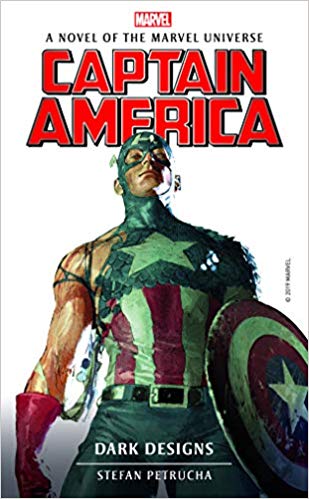
Captain America: Dark Designs – a Novel of the Marvel Universe


By Stefan Petrucha & various (Titan Books)
ISBN: 978-1789093483 (PB) eISBN: 978-1789093490

Win’s Christmas Gift Recommendation: Epic Fights ‘n’ Tights Adventure… 8/10

After a few half-hearted and ultimately abortive attempts in the 1960s and a more strategic – but no less enduring – attempt at the close of the 1970’s, Marvel finally secured a regular presence on prose bookshelves in the 1990s with a select series of hardback novels. Since then, those fans who want to supply their own pictures to gripping MU exploits have enjoyed a successive string of text thrills in all formats…

In recent times, British publisher Titan Books have been repackaging and rereleasing many of those prose powerhouse publications, and this handy paperback from 2016 is the tenth in their Novels of the Marvel Universe line.

Scripted by novelist, educator and comics writer Stefan Petrucha (X-Files, Walt Disney Comics & Stories, Nancy Drew: Girl Detective, Time Tripper) this explosive thriller also manages to pile on mood and psychological pressure in a tale of the Star-Spangled Avenger that addresses one of the biggest fears of modern times…

Although newcomers and casual fans won’t notice, Captain America: Dark Designs is deeply embedded in the minutiae of Marvel’s comic book continuity, as the WWII hero – who was frozen in ice for decades – faces the horror of voluntarily returning to the icy isolation of hibernation when, in the course of his hectic crime-busting, terrorist-thrashing activities, he is diagnosed as carrier of a deadly virus that can wipe out all life on Earth…

However, even as he contemplates his fate from a quarantine cage, his greatest enemy The Red Skull is planning one last hurrah. The Nazi fiend has previously survived his own death by occupying a clone of Steve Rogers but has subsequently developed an advanced form of the virus riddling Cap’s genetic structure.

With oblivion and increasing helplessness tormenting him, the swiftly-fading Skull unleashes Adolf Hitler’s last battalion of robotic Sleepers, resolved that his hated enemy will precede him to the grave, even if all Earth burns in the process…

Despite the assistance of Nick Fury, S.H.I.E.L.D., Iron Man and a host of other guest stars, the onus of saving himself and preserving humanity ultimately rests on the broad shoulders of the indomitable Sentinel of Liberty whose tireless efforts always seemed able to extract miracles from the most hopeless of situations.

However, it’s a devilish twist of fate that truly saves the day this time…

Strong, accurate characterisation, fast-paced, non-stop yet feasible action and ever-ratchetting tension make this a book impossible to put down, and supplementing the high-octane thrills are a wealth of monochrome illustrations by cap artists Steve Epting, Jackson Guice, Michael Lark, Jay Leisten, Steve McNiven, Mike Perkins, Dexter Vines and Patrick Zircher, making this compulsive page-turner a solid example of how comics books can transfer to prose and why they should…
© 2019 Marvel.

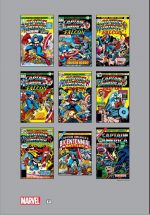
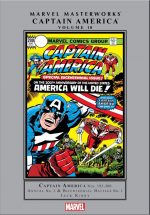
Captain America Marvel Masterworks volume 9


By Steve Englehart, John Warner, Tony Isabella, Bill Mantlo, Marv Wolfman, Sal Buscema, Frank Robbins, Herb Trimpe & various (Marvel)
ISBN: 978-0-3029-0345-9 (HB)

Created by Joe Simon & Jack Kirby in an era of frantic patriotic fervour, Captain America was a bombastic, dynamic and highly visible response to the horrors of Nazism and the threat of Liberty’s loss.

He faded away during the post-war reconstruction but briefly reappeared after the Korean War: a harder, darker sentinel ferreting out monsters, subversives and the “commies” who lurked under every brave American kid’s bed. Then he vanished once more until the burgeoning Marvel Age resurrected him just in time for the turbulent, culturally divisive 1960s.

By the time of the tales gathered in this nifty ninth Masterworks volume (available in luxurious hardback and accessible eBook formats and re-presenting issues #176-192 of Captain America and the Falcon from August 1974 to December 1975), the once convinced and confirmed Sentinel of Liberty had become a lost symbol of a divided nation, uncomfortable in his red, white and blue skin and looking to carve himself a new place in the Land of the Free. Calamitous events were about to put paid to that particular American dream…

Following an informative behind-the-scenes farewell reminiscence from scripter Steve Englehart in his Introduction, the action opens here with a shocking transformation.

At this time America was a nation reeling from a loss of idealism caused by Vietnam, Watergate and the (partial) exposure of President Richard Nixon’s crimes.

The general loss of idealism and painful public revelations that politicians are generally unpleasant – and even possibly ruthless, wicked exploiters – kicked the props out of most Americans who had an incomprehensibly rosy view of their leaders, so a conspiracy that reached into the halls and backrooms of government was extremely controversial yet oddly attractive in those distant, simpler days…

Following an attempt by sections of the elected government to undemocratically seize control of the country by deceit and criminal conspiracy (sounds like sheer fantasy these days, doesn’t it?) Captain America had foiled and exposed the plot but could no longer be associated with a tarnished ideal.

Issue #176 sees shocked, stunned Steve Rogers search his soul and realise he can not be the symbol of such a country. Despite the anxious arguments and advice of his Avenging allies he decides that ‘Captain America Must Die!’ (by Englehart, Sal Buscema & Vince Colletta).
Unable to convince him otherwise, staunch ally Sam Wilson/the Falcon carries on alone, tackling the following month an invasion by body-snatching old X-Men foe in ‘Lucifer be thy Name’ before wrapping up the threat in KIf the Falcon Should Fall…!’

Meanwhile, as Steve Rogers settles into an uncomfortable retirement, a number of painfully unqualified civilians begin trying to fill the crimson boots of Captain America… with dire results…

Captain America and the Falcon #179 finds unsettled civilian Rogers hunted by a mysterious Golden Archer whose ‘Slings and Arrows!’ convince the ex-hero that even if he can’t be a Star-spangled sentinel of liberty, neither can he abandon the role of do-gooder: leading to a life-changing decision and ‘The Coming of the Nomad!’ in #180. Typically, the sinister Serpent Squad turn up again with psychotic Princess Python in tow and maniac nihilist Madame Hydra murderously assuming the suddenly vacant role of the Viper

When “the Man Without a Country” tackles the ophidian villains, he fares badly but stumbles across a sinister scheme by the Squad and Sub-Mariner‘s arch-nemesis Warlord . The subsea tyrant – in the grip of ancient evil forces – seeks to raise a sunken continent and restore an ancient civilisation in ‘The Mark of Madness!’

At the same time Falcon is ignoring his better judgement and training a determined young man to become the next Captain America…

A glittering era ended with #182 as Sal Buscema surrendered Captain America and newspaper-strip creator Frank Robbins came aboard for a controversial run, beginning with ‘Inferno!’ (inked by Joe Giella). Whilst Nomad successfully mops up the Serpent Squad – despite well-meaning police interference – Sam and Cap’s substitute encounter the Sentinel of Liberty’s greatest enemy… with fatal consequences…

The saga shifts into high gear as ‘Nomad: No More!’ (inked by Frank Giacoia) find shamed, grief-stricken Steve Rogers once more taking up his stars and stripes burden as the murderous Red Skull simultaneously attacks the hero’s loved ones and dismantles America’s economy by defiling the banks and slaughtering the financial wizards who run them.

Beginning in the chillingly evocative ‘Cap’s Back!’ (Herb Trimpe, Giacoia & Mike Esposito), rampaging through the utterly shocking ‘Scream of the Scarlet Skull!’ (art by Sal Buscema, Robbins & Giacoia), it all climaxes in ‘Mindcage!’ (with additional scripting from John Warner and art by Robbins & Esposito) wherein our titular hero’s greatest ally is apparently revealed as his enemy’s stooge and slave…

The Red Skull, in all his gory glory, gloatingly revealed that his staggeringly effective campaign of terror was as nothing to his ultimate triumph, and that the high-flying Falcon had been his unwitting secret weapon for years: originally a cheap gangster named “Snap” Wilson, radically recreated and reprogrammed by the Cosmic Cube to be a perfect partner for Captain America and a tantalising, ticking time bomb waiting to explode…

Captain America and the Falcon #187 opens on ‘The Madness Maze!’ (Warner, Robbins & Frank Chiaramonte) with the Skull fled and a now-comatose Falcon in custody of super-spy agency S.H.I.E.L.D. Suddenly, the Star-Spangled Avenger is abducted by a mysterious flying saucer and attacked by alchemical androids employed by a rival espionage outfit, culminating in a ‘Druid-War’ (Warner, Sal B & Colletta), before Tony Isabella, Robbins & Chiaramonte put Cap into an ‘Arena For a Fallen Hero!’ wherein psychological warfare and unarmed combat combine into a risky shock therapy to kill or cure the mind-locked Wilson.

Just as the radical cure kicks in, an old foe takes over S.H.I.E.L.D.’s flying HQ in ‘Nightshade is Deadlier the Second Time Around!’ (Isabella, Robbins & Colletta), after which the crimes of forcibly-reformed Snap Wilson are re-examined and judged in an LA courtroom in climactic wrap-up ‘The Trial of the Falcon!’ (Isabella, Bill Mantlo, Robbins & D. Bruce Berry): proffering a predictable court ruling, a clutch of heroic cameos and a bombastic battle against the sinister Stilt-Man – hired by mob bosses to ensure Snap’s silence on his gangland activities…

With the narrative decks cleared, Captain America and the Falcon #192 featured an ingenious, entertaining filler written by outgoing editor Marv Wolfman, illustrated by Robbins & Berry, wherein Cap hops on a commercial flight back to the East Coast and finds himself battling deranged psychiatrist Dr. Faustus and a contingent of mobsters on a ‘Mad-Flight!’ thousands of feet above New York.
With all plots safely settled, the stage was set for the return of Captain America’s co-creator: Jack Kirby was returning with a bombastic fresh take that would take the Sentinel of Liberty into regions never before explored… but that’s the concern of another book and review…

Back here, however, there’s still more fun to be had via selections from Marvel fan mag FOOM #8: an all cap issue.

As well as a John Romita & Esposito cover, there’s historical overview “Well Come on, All You Big Strong Men…” by Roger Stern – and with early art from John Byrne -, text profiles of Bucky (‘Manchild in a Troubled Land’) and Falcon (“He Was Only Waiting For This Moment to Arise…”) and a photo-feature on the wartime cinema serial in ‘Star of the Silver Screen’.

The extracts conclude with bio page ‘Joe Simon and Jack Kirby: “By their works shall ye know them” and a back cover by Romita and Byrne, after which the cover of all-reprint Giant-Size Captain America #1 precedes a gallery of original art pages by Ron Wilson, Romita & Giacoia, Buscema & Colletta, and Robbins and Chiaramonte & Berry. Wrapping up the extras are the Cap & Falcon pages by Romita from The Mighty Marvel Calendar for 1975.

Despite the odd cringe-worthy story moment (I specifically omitted the part where Cap battles three chicken-themed villains for example, and still wince at some of the dialogue from this forthright and earnest era of “blaxsploitation” and ethnic awareness) these tales of matchless courage and indomitable heroism are fast-paced, action-packed, totally engrossing fights ‘n’ tights that no comics fan will care to miss, and joking aside, the cultural significance of these tales were crucial in informing the political consciences of the youngest members of post-Watergate generation…

Above all else ‘though, these are fabulously fun tales of an irresistible American Dream…
© 1974, 1975, 2017 Marvel Characters, Inc. All rights reserved.

Captain America Marvel Masterworks volume 8

By Steve Englehart, Roy Thomas, Tony Isabella, Mike Friedrich, Sal Buscema, Alan Weiss & various (Marvel)
ISBN: 978-0-7851-9929-8 (HB)

Created by Joe Simon & Jack Kirby in an era of frantic patriotic fervour, Captain America was a bombastic, dynamic and highly visible response to the horrors of Nazism and the threat of Liberty’s loss.

He faded away during the post-war reconstruction but briefly reappeared after the Korean War: a harder, darker sentinel ferreting out monsters, subversives and the “commies” who lurked under every brave American kid’s bed. Then he vanished once more until the burgeoning Marvel Age resurrected him just in time for the turbulent, culturally divisive 1960s.

By the time of the tales gathered in this eighth Masterworks volume (available in luxurious hardback and accessible eBook formats and re-presenting issues #160-175 of Captain America and the Falcon from April 1973 to July 1974), the once convinced and confirmed Sentinel of Liberty had become an uncomfortable symbol of a divided nation, but was looking to make the best of things and carve himself a new place in the Land of the Free. Real world events were about to put paid to that American dream…

Into an already turbulent mix of racial and gender inequality played out against standard Fights ‘n’ Tights villainy came creeping overtones of corruption and betrayal of ideals that were fuelled by shocking real-world events…

Following an informative behind-the-scenes reminiscence from scripter Steve Englehart in his Introduction, the action opens here with ‘Enter: Solarr!’ (illustrated by Sal Buscema &Frank McLaughlin), offering an old-fashioned clash with a super-powered maniac as the main attraction.

However, the real meat is the start of twin sub-plots that would shape the next half-dozen adventures, as the Star-Spangled Avenger’s newfound super-strength increasingly makes partner-in-crimefighting Sam – the Falcon – Wilson feel like a junior and inferior hindrance, even as Steve Roger’s long-time romantic interest Sharon Carter leaves him without a word of explanation…

Inked by John Verpoorten, Captain America and the Falcon #161 ramps up the tension between Steve and Sam as the heroes search for Sharon in ‘…If he Loseth His Soul!’, and find a connection to the girl Cap loved and lost in World War II in a deadly psycho-drama overseen by criminal shrink Dr. Faustus. This culminates one month later in a singular lesson in extreme therapy which only proves ‘This Way Lies Madness!’

‘Beware of Serpents!’ heralded the return of super snakes Viper and Eel, who combine with the Cobra to form a vicious but ultimately unsuccessful Serpent Squad to attack the heroes. Defeated former ad-exec Viper then vengefully begins a media manipulation campaign to destroy the Sentinel of Liberty with the “Big Lie”, fake news weapons and the worst tactics of Madison Avenue. Although the instigator quickly falls, his scheme rumbles on with slow, inexorable and dire consequences…

Issue #164 offers a stunningly scary episode illustrated by Alan Lee Weiss, introducing faux-coquette mad scientist Deadly Nightshade: a ‘Queen of the Werewolves!’ who infects Falcon with her chemical lycanthropy as an audition to enlist in the fearsome forces of one of the planet’s greatest menaces…

The full horror of the situation is only revealed when ‘The Yellow Claw Strikes’ (Englehart, Buscema & McLaughlin); renewing a campaign of terror begun in the 1950s, but this time attacking his former Chinese Communist sponsors and the USA indiscriminately. Giant bugs, deadly slave assassins and reanimated mummies are bad enough, but when the Arcane Immortal’s formidable mind-control dupes Cap into almost beating S.H.I.E.L.D. supremo Nick Fury to death during the ‘Night of the Lurking Dead!’, the blistering final battle results in further tragedy when an old ally perishes in the Frank Giacoia inked ‘Ashes to Ashes’…

One of the Star-Spangled Avengers most durable foes sort-of resurfaces in tense, action-heavy romp ‘…And a Phoenix Shall Arise!’ (scripted by Roy Thomas & Tony Isabella and inked by John Tartaglione & George Roussos) before Viper’s long-laid plans begin to finally bear bitter fruit in #169’s ‘When a Legend Dies!’ (with additional scripting from Mike Friedrich).

As anti-Captain America TV spots make people doubt the honesty and sanity of the nation’s greatest hero, the Falcon and his “Black Power” activist girlfriend Leila Taylor depart for the super-scientific African nation of Wakanda in search of increased powers, leaving Cap to battle third-rate villain the Tumbler.

In the heat of combat the Avenger seemingly goes too far and the thug dies…

‘J’Accuse!’ (Englehart, Friedrich, Buscema & Vince Colletta) sees Cap beaten and arrested by too-good-to-be-true neophyte crusader Moonstone, whilst in Africa Leila is kidnapped by exiled Harlem hood Stone-Face: far from home and hungry for some familiar foxy ghetto friendship…

‘Bust-Out!’ in #171 finds Cap forcibly sprung from jail by a mysterious pack of “supporters” as Black Panther and the newly-flying Falcon crush Stone-Face preparatory to a quick dash back to America and a reunion with the beleaguered and tarnished American icon.

‘Believe it or Not: The Banshee!’ opens with Captain America and the Falcon beaten by – but narrowly escaping – Moonstone and his obscurely occluded masters, after which the hard-luck heroes trace a lead to Nashville, encounter the fugitive mutant Master of Sound and stumble into a clandestine pogrom on American soil.

For long months mutants have been disappearing unnoticed, but now the last remaining X-MenCyclops, Marvel Girl and Professor Charles Xavier – have tracked them down, only to discover that Captain America’s problems also stem from ‘The Sins of the Secret Empire!’, whose ultimate goal is the conquest of the USA…

Eluding capture by S.H.I.E.L.D., Steve and Sam infiltrate the evil Empire, only to be exposed and confined in ‘It’s Always Darkest!’ before abruptly turning the tables and saving the day in #175’s ‘…Before the Dawn!’, wherein the vile grand plan is revealed, the mutants liberated and the culprits captured.

In a shocking final scene, the ultimate instigator is unmasked and horrifically dispatched within the White House itself…

At this time America was a nation reeling from a loss of unity, solidarity and perspective as a result of a torrent of shattering blows such as losing the Vietnam war, political scandals like Watergate and the (partial) exposure of President Nixon’s lies and crimes.

The general loss of idealism and painful public revelations that politicians are generally unpleasant – and even possibly ruthless, wicked exploiters – kicked the props out of most Americans who had an incomprehensibly rosy view of their leaders, so a conspiracy that reached into the halls and backrooms of government was extremely controversial yet oddly attractive in those distant, simpler days…

Unable to process the betrayal of all he has seen, the Star-Spangled Avenger cannot accept that this battle has any winner: a feeling that will change his life forever – in the next volume…

Any retrospective or historical re-reading is going to turn up a few cringe-worthy moments, but these tales of matchless courage and indomitable heroism are fast-paced, action-packed and still carry a knockout conceptual punch. Here Captain America was finally discovering his proper place in a new era and would once more become unmissable, controversial comicbook reading, as we shall see when I get around to reviewing the next volume…
© 1973, 1974, 2016 Marvel Characters, Inc. All rights reserved.

Captain America Marvel Masterworks volume 5


By Stan Lee, Gene Colan & various (Marvel)
ISBN: 978-0-7851-4200-3 (HB)

During the Marvel Renaissance of the early 1960’s Stan Lee & Jack Kirby tried a tactic that had reaped huge dividends for DC Comics. Although initially generating mixed results their efforts eventually changed the nature of comicbooks. Julie Schwartz had scored an incredible success with his revised versions of the company’s Golden Age greats, so it seemed natural to try and revive the characters that had dominated Timely/Atlas in those halcyon days.

A new Human Torch had premiered as part of the revolutionary Fantastic Four, and in the fourth issue of that title the Sub-Mariner resurfaced after a 20-year amnesiac hiatus (everyone concerned had apparently forgotten the first abortive attempt to revive an “Atlas” superhero line in the mid-1950s).

The Torch was promptly given his own solo feature in Strange Tales from issue #101 on and in #114 the flaming teen fought an acrobat pretending to be Captain America. With reader-reaction strong, the real thing promptly resurfaced in Avengers #4 and, after a captivating and centre-stage hogging run in that title, was granted his own series as half of the “split-book” Tales of Suspense with #59 (cover-dated November 1964). An unmissable string of classics ensued and in 1968 the Star-Spangled Avenger won his own solo title… but not for long…

This groundbreaking full-colour compilation (available in hardback and digital editions) spans May 1970 to April 1971 and re-presents Captain America #125-#136, with the action and drama occurring at an unprecedented moment of social, political and generational upheaval in the Land of the Free, as evocatively contextualised by historian and archivist Bruce Canwell in his potent Introduction.

Captain America #125 dips into sensational contemporary headline fare as the Sentinel of Liberty seeks to rescue a kidnapped peacemaker only to become ‘Captured… in Viet Nam!’ The mystery villain du jour is anything but politically motivated and the hero’s brief visit – as recounted by Stan Lee, Gene Colan and Frank Giacoia – owes more to super-villainy than nationalistic interventionism…

The Star-Spangled Avenger’s long-anticipated reunion with his erstwhile associate and partner Sam Wilson features in #126’s ‘The Fate of… the Falcon!’: tapping into the blossoming “blaxsploitation” trend to recount an entertaining (although, sadly, not always intentionally) caper of gangsters and radicals in funky old Harlem that still has a kick to it. Just play the (original) theme from Shaft whilst reading it…

Still working off-the-books for super-scientific government spy-agency S.H.I.E.L.D. (which back then stood for Supreme Headquarters International Espionage Law-enforcement Division), Cap demands ‘Who Calls Me Traitor?’ (#127, July 1970, by Lee, Colan & the astounding Wally Wood).

This pacy romp finds the veteran hero framed and manipulated by friend and foe alike in the search for a double agent in the ranks, after which the embittered warhorse drops out and decides to “discover America” – as so many kids were doing in the era of Easy Rider – on a freewheeling motorcycle.

Inked by Dick Ayers, ‘Mission: Stamp Out Satan’s Angels!’ finds the Red, White and Blue wanderer barely clear the city limits before encountering a nasty gang of bikers terrorising a small-town rock festival, after which his oldest enemy resurfaces to exact ‘The Vengeance of… the Red Skull’ as a simple albeit satisfying by-product of his main plan to start a Middle East war…

Issue #130 finds Cap ‘Up Against the Wall!’ when old foe Batroc the Leaper leads the Porcupine and Whirlwind in a fully paid-for ambush by a hidden villain just as the Sentinel of the Establishment is attempting to defuse an imminent college riot. The mysterious contractor then resorts to a far subtler tactic: launching a psychological assault in ‘Bucky Reborn!’…

With the mystery manipulator finally exposed, the tragic true story behind the resurrected sidekick comes out in ‘The Fearful Secret of Bucky Barnes!’ – a powerful, complex drama involving ruthless science terrorists A.I.M., their murderous master Modok and even Doctor Doom…

Back in New York, Advanced Idea Mechanics again feature prominently in #133 as Modok foments racial unrest by sending another killer cyborg to create ‘Madness in the Slums!’ The inner-city crisis allows Cap to reunite with his protégé the Falcon – whose name began appearing on the cover from the next issue…

Operating as full-fledged, official partners, the dynamic duo battle ghetto gangsters in ‘They Call Him… Stone-Face!’ (Captain America and the Falcon #134, with Ayers inking), before the Avenger introduces his new main man to S.H.I.E.L.D. in the chilling ‘More Monster than Man!’

Inked by Tom Palmer, this moody spin on the Jekyll and Hyde theme sees a love-struck scientist turn himself into an awesome anthropoid to steal riches, only to end up in ‘The World Below!’

With the Falcon coming to the rescue (and the legendary Bill Everett applying his brilliant inks to Colan’s eerily effective pencils) the battle of man against beast continues with the greedy technologist soon reduced to a collateral casualty of the Mole Man‘s latest battle with the champions of the surface world….

With a cover gallery by Marie Severin, Jack Kirby, Herb Trimpe, John Romita and Colan plus the cover to all-reprint Captain America Annual #1 (January 1971) to round out the riotous adventure, this is a titanic tome no Fights & Tights fan could possibly do without…

Any retrospective or historical re-reading is going to turn up a few cringe-worthy moments, but these tales of matchless courage and indomitable heroism are fast-paced, action-packed and illustrated by one of the greatest artists and storytellers American comics has ever produced.

As the nation changed Captain America was finally discovering his proper place in a new era and would once more become unmissable, controversial comicbook reading, as we shall see when I get around to reviewing the next volume…
© 1970, 1971, 2016 Marvel Characters, Inc. All rights reserved.

Captain America Marvel Masterworks volume 4


By Stan Lee, Gene Colan, John Romita Sr., John Buscema & various (Marvel)
ISBN: 978-0-7851-2936-3 (HB)

During the Marvel Renaissance of the early 1960’s Stan Lee & Jack Kirby tried a tactic that had reaped huge dividends for DC Comics. Although initially generating mixed results, their efforts eventually changed the nature of comicbooks. Julie Schwartz had scored an incredible success with his revised versions of the company’s Golden Age greats, so it seemed natural to try and revive the characters that had dominated Timely/Atlas in those halcyon days.

A new Human Torch had premiered as part of the revolutionary Fantastic Four, and in the fourth issue of that title the Sub-Mariner resurfaced after a 20-year amnesiac hiatus (everyone concerned had apparently forgotten the first abortive attempt to revive an “Atlas” superhero line in the mid-1950s).

The Torch was promptly given his own solo feature in Strange Tales from issue #101 on and in #114 the flaming teen fought an acrobat pretending to be Captain America. With reader-reaction strong, the real thing promptly resurfaced in Avengers #4 and, after a captivating and centre-stage-hogging run in that title, was granted his own series as half of the “split-book” Tales of Suspense with #59 (cover-dated November 1964). An unmissable string of classics ensued and in 1968 the Star-Spangled Avenger won his own solo title… but not for long…

This groundbreaking full-colour compilation (available in hardback and digital editions) gathers Captain America #114-124 – spanning June 1969 to September 1970 – and opens with a captivating Introduction from illustrator Gene Colan revealing amongst other things how he created The Falcon…

The comics portion of this treat opens as the Sentinel of Liberty has just acrimoniously retired from superhero service and reclaimed his anonymity after impetuously revealing his secret identity to the world mere months earlier.

The hiatus doesn’t last long as, again a man of mystery, Captain America bursts into action to save his lover Sharon Carter (SHIELD Agent 13) from a suicide mission against Advanced Idea Mechanics.

The tale coincided with an ongoing period of artistic instability as here John Romita the Elder (inked by Sal Buscema) illustrated Stan Lee’s tense spy-caper ‘The Man Behind the Mask!’.

The action and suspense were merely prologue to an extended war against the Red Skull. Issue #115 – ‘Now Begins the Nightmare!’ – was drawn by John Buscema and inked by his brother Sal, wherein the fascist arch-villain uses the reality-warping Cosmic Cube to switch bodies with the shield-slinger and trash the hero’s reputation, after which ‘Far Worse than Death!’ in #116 follows Cap’s frantic attempts to escape his own friends and allies the Avengers, as well as the villain’s callous reality-warping torments.

This issue saw the start of Gene Colan’s impressive run on the character, here augmented by the smooth, slick inks of Joe Sinnott.

This next instalment returns him to the Isle – and clutches – of aging war criminals the Exiles in a tale that introduced Marvel’s second black superhero.

‘The Coming of … the Falcon!’ in issue #117 was a terse, taut build-up to a cataclysmic clash before the neophyte hero-in-training takes centre-stage in ‘The Falcon Fights On!’ after which all the ducks drop neatly into place for a spectacular finale in ‘Now Falls the Skull!‘ in #119.

As 1970 dawned, Marvel imposed a moratorium on continued stories for most of their titles, and Cap – having returned to his hectic twin lives as unofficial SHIELD Agent and mighty Avenger – here hops on the disaffected youth/teen revolt bandwagon for a series of slight but highly readable puff-pieces promising nothing but delivering much.

Kicking off is ‘Crack-up on Campus!’ by Lee, Colan & Sinnott: an odd mélange of student radicalism and espionage that sees itinerant cipher Steve Rogers become a Physical Education teacher to foil a scheme by the sinister cyborg Modok and his AIM cohorts.

Demented bio-chemist Silas X. Cragg then rediscovers the fabled Super Soldier serum that had originally created Captain America in ‘The Coming of the Man-Brute!’ Sadly, the bonkers boffin picks the wrong candidate to become his Blockbuster stooge…

Spider-Man’s old sparring partner mugs the wrong guy in #122’s ‘The Sting of the Scorpion!’ and subsequently falls to Cap’s bludgeoning fists before issue #123 taps into the seemingly eternal “battle of the sexes” zeitgeist with ‘Suprema, The Deadliest of the Species!’ turning her espionage-tinged attentions to the Star-Spangled Avenger…

The blazing battle action then concludes here as AIM returns with a deadly new hi-tech human weapon. Despite all their efforts the Sentinel of Liberty triumphs yet again in ‘Mission: Stop the Cyborg!’…

Supplementing the drama is Romita’s original art cover for #114s and its colour roughs.

These are tales of dauntless courage and unmatchable adventure, fast-paced and superbly illustrated, which rightly returned Captain America to the heights that his Golden Age compatriots the Human Torch and the Sub-Mariner never regained. They are pure escapist magic. Glorious treats for the eternally young at heart, these are episodes of sheer visual dynamite that cannot be slighted and should not be missed.
© 1969, 1970, 2016 Marvel Characters, Inc. All rights reserved.

Captain America: War & Remembrance


By Roger Stern & John Byrne, with Joe Rubinstein & various (Marvel)
ISBN: 978-0785126935 (TPB)

Created by Joe Simon & Jack Kirby in a previous era of frantic patriotic fervour, Captain America was a bombastic, dynamic and highly visible response to the horrors of Nazism and the threat of Liberty’s loss.

He faded away during the post-war reconstruction to briefly reappear during the Korean War: a harder, darker sentinel, ferreting out monsters, subversives and the “commies” who lurked under every brave American kid’s bed. He quickly vanished once more until the burgeoning Marvel Age resurrected him just in time for the turbulent, culturally divisive 1960s. He’s been with us – in one form or another – ever since…

Although not the USA’s original patriotic superhero, the Star-Spangled Avenger was the first to truly dominate public attention, and over the years a vast number of talented artists and writers have crafted his adventures. It is therefore quite odd to realise just how few of those exploits are truly memorable.

I’ll leave you to compile your own top ten, but I’ll wager that this all-too-brief run by Roger Stern, John Byrne & Joe Rubinstein will provide at least one of them.

This slim volume – available in all the usual physical and digital formats – collects Captain America #247-255 (cover-dated July 1980-March 1981) seamlessly blending epic adventure with spectacular superhero art: a fans’ delight that is also readily accessible to the newcomer or casual reader.

Following fond reminiscence ‘Remembering Cap’ from author Stern, the action explosively opens with ‘By the Dawn’s Early Light’, offering insight into the hero’s World War II career and uncovering a mystery apparently involving leftover Nazi mastermind and sworn foe Baron Wolfgang von Strucker.

The episode leads Cap to uncover secrets from his past whilst setting up a new threat from deadly robotic villain Machinesmith, leading directly into extended saga ‘Dragon Man’ and ‘Death, Where is Thy Sting?’.

This complex and convoluted yarn explains many seeming inconsistencies in Marvel continuity: combining all-out action with a genuine moral dilemma that perfectly illuminates the character of this American Dream. Cap is always at his best when overcoming overwhelming opposition and ethical enigmas…

These stories were first released in an election year and the truly uplifting ‘Cap for President!’ is still a wonderful antidote for sleaze and politicking whilst confirming the honesty and idealism of the decent person within us all. This tale of honour, duty and worthiness was developed from an abandoned idea conceived by Roger McKenzie & Don Perlin, and is all the more poignant in today’s febrile world of political expediency, Fake News and raw self-promotion…

It’s back to basics after that as Cap unexpectedly teams up with long-time foe Batroc the Leaper to save New York City from flaming Armageddon in ‘The Mercenary and the Madman’ and concluding chapter ‘Cold Fire’: a classic thriller that returned Mr. Hyde to the first rank of Marvel villains.

A short infomercial bonus feature follows, sharing ‘The Life and Times of Captain America’, and revealing ‘The Apartment of Steve Rogers, Esq.’ as well as ‘Steve Rogers’ Friends and Neighbors’ and highlighting ‘Captain America’s Partners Against Crime’ in a breezy, accessible manner before the drama resumes with ‘Should Old Acquaintance Be Forgot’.

Captain America is called to England and the deathbed of WWII comrade Lord Montgomery Falsworth who battled Nazis as the legendary Union Jack, and finds brooding menace, family turmoil and a returned supernatural horror. The menace escalates in the concluding ‘Blood on the Moors’, which even now is still one of the best-handled Heroic Death/“Passing of the Torch” sagas in comics history…

The story portion of the book concludes with a brilliant new version of Captain America’s origin: a stripped down, rationalised retelling designed to celebrate the Sentinel of Liberty’s 40th Anniversary: drawn and inked by Byrne and which became the definitive history for decades to come.

It’s also where the creative team, for unspecified reasons, called it a day.

Supplementing the narrative wonderment is ‘Remembering “Remembrance”’: an illustrated interview and commentary with Stern & Byrne conducted by Dugan Trodglen, augmented by numerous illustrations. Following is the six pages of Byrne’s art from the never-completed tenth issue, a tantalising glimpse of missed magic. Their collaboration was inexplicably curtailed and the creators abruptly left the series for reasons still largely unknown…

The thrills conclude with a selection of Byrne’s covers from various earlier collected editions.

This tome is a sheer escapist thrill-ride, endlessly gratifying and tremendously satisfying. After Jack Kirby, these are probably the purest evocation of this American Icon that you could ever read, so you really should.
© 1980, 1990 Marvel Entertainment Group. © 2008, 2018 Marvel Characters, Inc. All rights reserved.

Captain America Marvel Masterworks volume 7


By Gerry Conway, Steve Englehart, Steve Gerber, Sal Buscema, John Romita & various (Marvel)
ISBN: 978-0-7851-8799-8 (HB)

Created by Joe Simon & Jack Kirby in an era of frantic patriotic fervour, Captain America was a bombastic, dynamic and highly visible response to the horrors of Nazism and the threat of Liberty’s loss.

He faded away during the post-war reconstruction but briefly reappeared after the Korean War: a harder, darker sentinel ferreting out monsters, subversives and the “commies” who lurked under every brave American kid’s bed. Then he vanished once more until the burgeoning Marvel Age resurrected him just in time for the turbulent, culturally divisive 1960s.

By the time of the tales gathered in this seventh Masterworks volume (available in luxurious hardback and accessible eBook formats) – comprising issues #149-159 of Captain America and the Falcon from May 1972 to March 1973 – the Star-Spangled Avenger had become an uncomfortable symbol of a troubled, divided society, split along age lines and with many of the hero’s fans apparently rooting for the wrong side. Now into that turbulent mix crept issues of racial and gender inequality…

Following a fond, forthright and informative reminiscence from scripter Steve Englehart in his Introduction, the action opens here with the Star-Spangled Avenger – now increasingly at odds with super-scientific government spy-agency S.H.I.E.L.D. (which back then stood for Supreme Headquarters International Espionage Law-enforcement Division) and its Director Nick Fury. The troubled hero is also attempting to revive his secret identity as a New York beat cop…

Gerry Conway assumed the writing chores for issues #149-152, an uncharacteristically uninspired run that began with ‘All the Colors… of Evil!’ (illustrated by Sal Buscema & Jim Mooney) wherein Gallic mercenary Batroc resurfaces, kidnapping ghetto kids for an unidentified client…

This turns out to be the alien Stranger (or at least his parallel universe incarnation Jakar) who intervenes personally in ‘Mirror, Mirror…!’ (inked by John Verpoorten) but is still defeated far too easily.

‘Panic on Park Avenue’ (Buscema & Vince Colletta) pits Cap against enfeebled villains Mr. Hyde and the Scorpion as Conway sought to retroactively include Captain America in his ambitious Mr. Kline Saga. Android copies of the super-creeps had attacked Daredevil and the Black Widow in their own comicbook and here we discover what happened to the originals during that period. Assuming S.H.I.E.L.D. was responsible for their woes, the thugs target Steve Rogers and his secret agent girlfriend Sharon Carter with disastrous results, climaxing with the Frank Giacoia inked ‘Terror in the Night!’ featuring all-out battles and new plot-complications for officer Rogers and his hard-boiled boss Sgt. Muldoon…

Captain America and the Falcon #153 heralded a renaissance and magical return to form for the Sentinel of Liberty as Steve Englehart came aboard, hitting the ground running with a landmark epic rewriting Marvel history and captivating die-hard fans simultaneously.

The wonderment opens with ‘Captain America… Hero or Hoax?’ (inked by Mooney) as Falcon, Sharon and Cap endure an acrimonious confrontation with Nick Fury and decide to take a break from S.H.I.E.L.D.

While Sam Wilson goes back to Harlem – splitting his time between social work, chasing sexy activist Leila and stamps his mark on the local gangs as the Falcon – Steve and Sharon book a holiday in the Bahamas, but it isn’t long before Falcon catches Captain America committing racist attacks in New York. Enraged, Falcon tracks him down but was easily beaten since supposed partner has somehow acquired super-strength and a resurrected Bucky Barnes…

In ‘The Falcon Fights Alone!’ (Verpoorten inks) the maniac impostors claim to be “real” American heroes and reveal what they want: a confrontation with the lily-livered, pinko wannabe who has replaced and disgraced them…

Even after torturing their captive they are frustrated in their plans until the faux Cap tricks the information out of the Avengers.

Battered and bruised, Falcon heads to the holiday refuge but is too late to prevent an ambush wherein Steve Rogers learns ‘The Incredible Origin of the Other Captain America!’ (Frank McLaughlin inks and including repurposed excepts from the 1950s comics by John Romita): a brilliant piece of literary sleight-of-hand that ties up the Golden Age, 1950s revival and Silver Age iterations of the character in a clear, simple, devilishly clever manner, leading to an unbelievably affecting fabulously gratifying conclusion in ‘Two into One Won’t Go!’

After meeting and defeating a shade of the nation’s ugly past, Rogers hopes for less troublesome times, but instead ‘Veni, Vidi, Vici: Viper!’ (plotted by Englehart, scripted by Steve Gerber, with Sal Buscema & John Verpoorten illustrating) begins an epic, engrossing storyline by introducing a despicable advertising executive-turned snaky super-villain ostensibly working for an enigmatic boss named the Cowled Commander.

It transpires that corrupt connections at the police precinct where Rogers serves have been stirred into murderous action by our hero’s presence, leading to good cops being framed, bombs in offices and the Viper taking out survivors with lethally experimental poisonous darts…

When Falcon follows news of Cap’s death he also succumbs to toxins until ‘The Crime Wave Breaks!’ (Englehart, Buscema & Verpoorten) sees last-second salvation, a ramping-up of criminal activity and Rogers’ abduction, leading to a ‘Turning Point!’ wherein super-scum-for-hire Porcupine, Scarecrow, Plantman and the Eel‘s ill-conceived attack give the game away and expose a hidden criminal mastermind in the heroes’ midst…

Wrapping up the patriotic revival is a stirring short selection of original art.

Any retrospective or historical re-reading is going to turn up a few cringe-worthy moments, but these tales of matchless courage and indomitable heroism are fast-paced, action-packed and depicted by top rank artists and storytellers. Here Captain America was finally discovering his proper place in a new era and would once more become unmissable, controversial comicbook reading, as we shall see when I get around to reviewing the next volume…
© 1972, 1973, 2017 Marvel Characters, Inc. All rights reserved.

Captain America Marvel Masterworks volume 3

By Stan Lee, Jack Kirby, Jim Steranko & various (Marvel)
ISBN: 978-0-7851-2063-6 (HB)                    978-0-7851-8803-2 (TPB)

During the Marvel Renaissance of the early 1960’s Stan Lee & Jack Kirby tried the same tactic that had worked so tellingly for DC Comics, but with mixed results. Julie Schwartz had scored an incredible success with his revised versions of the company’s Golden Age greats, so it seemed natural to try and revive the characters that had dominated Timely/Atlas in those halcyon days.

A new Human Torch had premiered as part of the revolutionary Fantastic Four, and in the fourth issue of that title the Sub-Mariner resurfaced after a 20-year amnesiac hiatus (everyone concerned had apparently forgotten the first abortive attempt to revive an “Atlas” superhero line in the mid-1950s).

The Torch was promptly given his own solo feature in Strange Tales from issue #101 on, and in #114 the flaming teen fought an acrobat pretending to be Captain America. With reader reaction strong, the real thing promptly resurfaced in Avengers #4 and, after a captivating and centre-stage hogging run in that title, was granted his own series as half of the “split-book” Tales of Suspense (from #59, cover-dated November 1964).

Marvel’s inexorable rise to dominance in the American comicbook industry really took hold in 1968 when a number of their characters finally got their own titles. Prior to that and due to a highly restrictive distribution deal, the company was tied to a limit of 16 publications per month. To circumvent this, Marvel developed titles with two series per publication, such as Tales of Suspense where original star Iron Man shared honours with Cap. When the division came, Shellhead started afresh with a First Issue, and Cap retained the numbering of the original title; thereby premiering with #100.

This resoundingly resolute full-colour collection – available in hardcover, trade paperback and digital editions – gathers Captain America #101-#113, spanning May 1968 to May 1969, and also includes a fervent Introductory reminiscence from John Morrow plus a fascinating Afterword by Steranko wherein he meticulously deconstructs the landmark epic that fills the end of this titanic tome…

Crafted by Stan Lee, Jack Kirby & 1940s Cap illustrator Syd Shores, Captain America #101-102 sees the return of fascist revenant the Red Skull and another appalling Nazi revenge-weapon in ‘When Wakes the Sleeper!’ and furious finale ‘The Sleeper Strikes!’ as our hero and his support crew Agent 13 and Nick Fury hunt a murderous mechanoid capable of ghosting through solid Earth and blowing up the planet…

Although the immediate threat is quashed, the instigator is still at large and #103 reveals ‘The Weakest Link!’ as a budding romance with S.H.I.E.L.D. Agent 13 (finally revealed after two years as Sharon Carter) is interrupted by the nefarious Nazi.

The über-fascist’s new scheme of nuclear blackmail extends to a second issue, wherein his band of war-criminal assassins, The Exiles, test Cap nigh to destruction on the hidden isle where he becomes the ‘Slave of the Skull!’

That issue and following super-villain team-up – wherein Living Laser and the Swordsman ally with another old Cap foe to attack ‘In the Name of Batroc!’ – feature the loose, flowing inking of Dan Adkins, whilst Frank Giacoia embellished the all-action, spies-&-evil-doppelgangers romp ‘Cap goes Wild!’ in issue #106, before Shores returned in #107.

Sinister mystery ‘If the Past Be Not Dead…’ is an action-packed psycho-thriller introducing malevolent, mind-bending psychiatrist Doctor Faustus…

The Star-Spangled Avenger is rescuing Agent 13 again – at least he thinks he is – in breakneck thriller ‘The Snares of the Trapster!’ before Captain America #109 redefined his origin with ‘The Hero That Was!’: a spectacular wrap-up to Kirby’s run on the Sentinel of Liberty – at least for the moment…

Comics phenomenon and one-man sensation Jim Steranko then took over the art direction with #110 for a too-brief stint that became everybody’s favourite Cap epic for decades to come.

After a swift and brutal skirmish with the Incredible Hulk, teen appendage Rick Jones becomes the patriotic paladin’s new sidekick in ‘No Longer Alone!’, just in time for the pair to tackle the memorably lascivious Madame Hydra and her obedient hordes in #111’s ‘Tomorrow You Live, Tonight I Die!’ – both inked by Joe Sinnott in a landmark saga that inspired and galvanised a generation of would-be comics artists.

With the Avenger seemingly killed at the issue’s close, the next month saw a bombastic account of Captain America’s career by fill-in superstars Kirby & George Tuska, before Lee, Steranko & Tom Palmer concluded the Hydra epic with ‘The Strange Death of Captain America’ in #113. This yarn reset the hero’s character for years to come…

Also on offer are a selection of Kirby’s original art pages and covers, including rejected and unseen pencil versions prior to editing and the draconian interference of the Comics Code Authority…

These are tales of dauntless courage and unmatchable adventure, fast-paced and superbly illustrated, which rightly returned Captain America to the heights that his Golden Age compatriots Human Torch and Sub-Mariner never regained. They are pure escapist magic: glorious treats for the eternally young at heart, and episodes of sheer visual dynamite that cannot be slighted and should not be missed.

© 1968, 1969, 2016 Marvel Characters, Inc. All rights reserved.

Captain America and the Falcon: Nomad


By Steve Englehart, John Warner, Sal Buscema, Frank Robbins, Herb Trimpe & various (Marvel)
ISBN: 978-0-7851-2197-8 (TPB)

Created by Joe Simon & Jack Kirby in an era of frantic patriotic fervour, Captain America was a dynamic and highly visible response to the horrors of Nazism and the threat of Liberty’s loss.

He faded away during the post-war reconstruction but briefly reappeared after the Korean War: a harder, darker sentinel ferreting out monsters, subversives and the “commies” who lurked under every brave American kid’s bed. Then he vanished once more until the burgeoning Marvel Age resurrected him just in time for the turbulent, culturally divisive 1960s. Perhaps it’s just coincidence but at the time the USA were just getting heavily involved in a conflict in Southeast Asia…

This startling paperback and eBook collection reprints issues #177-186 (spanning September 1974 – June 1975) of the monthly comicbook and shows the previously steadfast Sentinel of Liberty as a troubled and disillusioned man: unhappy, uncomfortable and unable to bear the weight of being a national symbol of a divided nation that had been betrayed and subverted by its highest elected officials.

At this time America was a nation reeling from mass culture shock caused by Vietnam, the Watergate scandal and the humiliating exposure of President Nixon’s crimes. The widespread loss of idealism and painful public revelations that politicians are generally unpleasant – and even possibly ruthlessly wicked exploiters – kicked the props out of most Americans who had an incomprehensibly rosy view of their leaders, so a conspiracy that reached into the halls and backrooms of government was extremely controversial yet oddly attractive in those distant, simpler days…

Sickened, shocked and stunned at the poisoned American Dream – and despite the arguments and advice of his Avenging allies – Steve Rogers searched his soul and realised he could not be the symbol of such a country. He threw off the costume and rank to wander the country bereft of ideals or direction…

Unable to convince him otherwise his crimefighting partner Sam Wilson carried on alone, as the high-flying Falcon tackles an invasion by a body-snatching alien X-Men foe – in conjunction with earthly villain Aries – in ‘Lucifer be thy Name’ (scripted by Steve Englehart and illustrated by Sal Buscema & Vince Colletta).

The double-dealing devils are promptly wrapped up in ‘If the Falcon Should Fall…!’ when Steve, unable to keep aloof, resorts to type and heroically piles in to the final showdown…

Whilst the dejected civilian settles into an uncomfortable self-inflicted retirement, in his costumed absence a few painfully unqualified civilians begin trying to fill the crimson boots of Captain America… with dire results…

Captain America and the Falcon #179 sees Rogers hunted by a mysterious Golden Archer whose ‘Slings and Arrows!’ soon convince the ex-hero that even if he can’t be the Star-Spangled Avenger, neither can he abandon the vocation of do-gooder. This moment of revelation leads to a life-changing decision and ‘The Coming of the Nomad!’ in #180, even as the Serpent Squad turn up again with morally ambivalent Princess Python in tow and maniac nihilist Madame Hydra assuming the suddenly-vacant role of the Viper.

When “the Man Without a Country” tackles the ophidian outlaws, he comes off second best but does stumble across a sinister scheme by the Squad and Sub-Mariner‘s arch-nemesis Warlord Krang. The marine malcontent plans to raise a sunken continent and restore an ancient evil-drenched civilisation in ‘The Mark of Madness!’…

At the same time Falcon is ignoring his better judgement: agreeing to train a determined young man to become the next Captain America…

An era ended when Sal Buscema surrendered Captain America and newspaper-strip creator Frank Robbins came aboard for a controversial run beginning with ‘Inferno!’ (inked by Joe Giella). Whilst Nomad successfully mops up the Serpent Squad – despite well-meaning police interference – Sam and Cap’s youthful substitute had encounter the Sentinel of Liberty’s greatest enemy with fatal consequences…

Inked by Frank Giacoia, ‘Nomad: No More!’ finds a grief-stricken, guilt-crushed Rogers once more take up his stars and stripes as the murderous Red Skull simultaneously attacks the hero’s loved ones and destabilising America’s economy by defiling banks and slaughtering the financial wizards who run them…

Beginning in the chillingly evocative ‘Cap’s Back!’ (with art by Herb Trimpe, Giacoia & Mike Esposito), rampaging through the utterly shocking ‘Scream of the Scarlet Skull!’ (Buscema, Robbins & Giacoia) and climaxing in ‘Mindcage!’ (with additional scripting from John Warner and art by Robbins & Esposito) the inimitable Sentinel of Liberty takes the fight to freedom’s greatest foe.

Tragically, despite driving the Skull off, Steve is stymied and frustrated when his greatest friend and ally is apparently revealed as the Skull’s stooge and sleeper-agent slave…

And on that staggering cliffhanger note this epic collection concludes…

To Be Continued…

Despite the odd cringe-worthy moment (for example, I specifically omitted the part where Nomad battles three chicken-themed crooks, and still wince at some from this era of “blacksploitation” and burgeoning ethnic awareness), these tales of matchless courage and indomitable heroism are fast-paced, action-packed, totally engrossing fights ‘n’ tights that no comics fan will care to miss: fabulously fun tales of a true American Dreamer…

Moreover, and all joking aside, the cultural significance of these tales were crucial in informing the consciences of the youngest members of the post-Watergate generation and could even stand as a warning from history in regard to the current polarising party-political shenanigans besetting the hotly-contested, gerrymandered Land of the Free and over-mortgaged Home of the Brave…
© 1972, 1973, 1984, 1975, 2006, 2016 Marvel Characters, Inc. All rights reserved.