
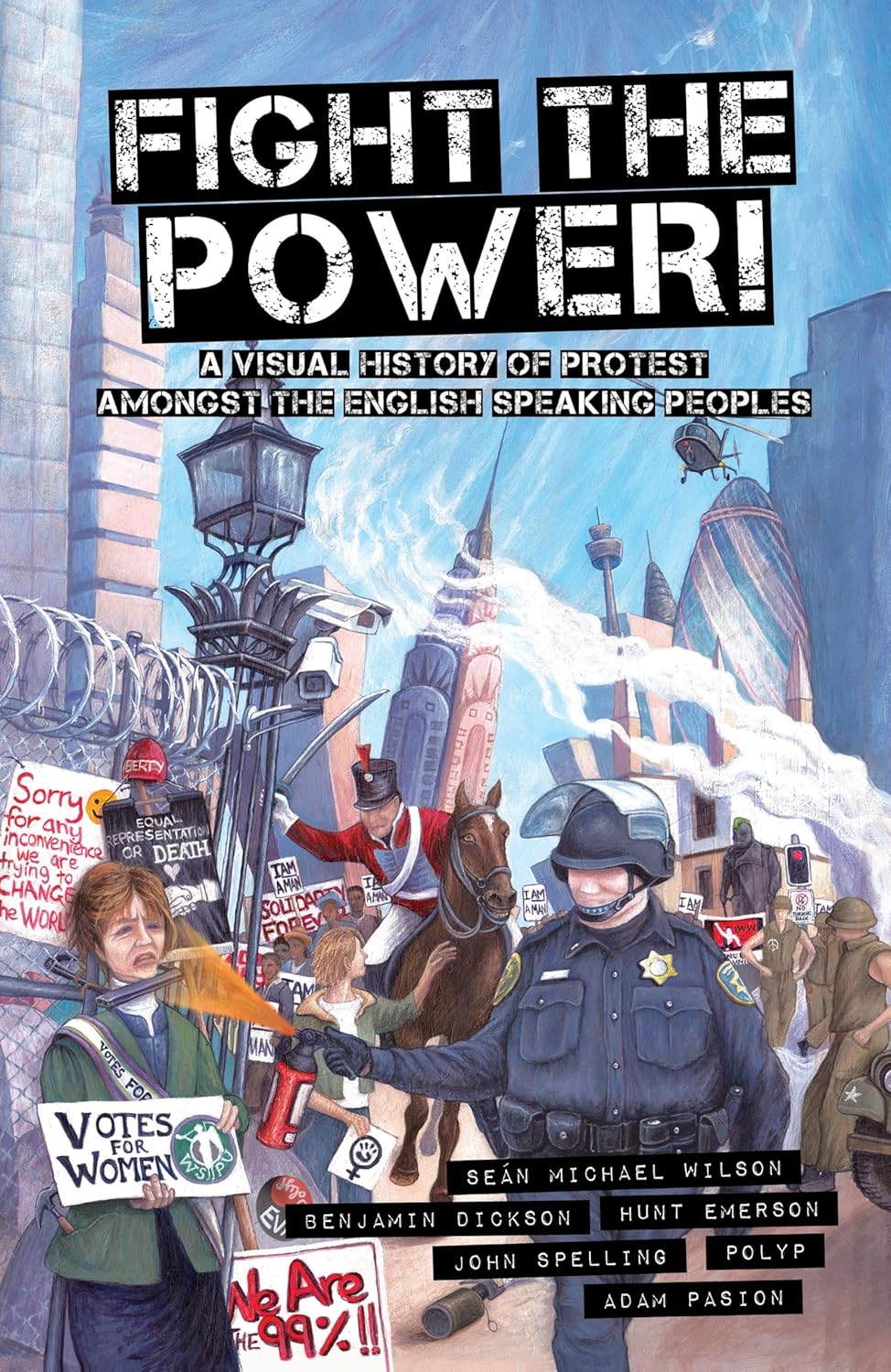
By Sean Michael Wilson, Benjamin Dickson, Hunt Emerson, John Spelling, Adam Pasion with additional cartoons by Polyp (New Internationalist)
ISBN: 978-1-78026-122-5 (PB)
Politics is composed of and utilised equally by firebrands and coldly calculating grandees, and that’s probably the only guiding maxim you can trust. Most normal people don’t give a toss about all that until it affects them in the pocket or impacts their kids and, no matter to what end of the political spectrum one belongs, the greatest enemy of the impassioned ideologue is apathy. This simple fact forces activists and visionaries to ever-more devious and imaginative stunts and tactics…
However, all entrenched Powers-That-Be are ultimately hopeless before one thing: collective unified resistance by the very masses they’re holding down through force of arms, artificial boundaries of class or race, capitalist dogmas, various forms of mind control like bread, circuses and religion, divisive propagandas or just the insurmountable ennui of grudging acceptance to a status quo and orchestrated fear that unknown change might make things worse.
Perhaps you can see how such musings might be of relevance in these current unforgettable days?
From its earliest inception, cartooning has been used to sell: initially ideas or values but eventually actual products too. In newspapers, magazines and especially comic books the sheer power of narrative – with its ability to create emotional affinities – has been linked to the creation of unforgettable images and characters. When those stories affect the lives of generations of readers, the force that they can apply in a commercial, social or especially political arena is almost irresistible…
The compelling power of graphic narrative to efficiently, potently, evocatively disseminate vast amounts of information and seductively advocate complex issues with great conviction through layered levels has always been most effectively used in works with a political or social component. That’s never been more evident than in this stunning and scholarly graphic anthology detailing infamous and effective instances of popular protest.
In Britain the cartoonist has always occupied a perilously precarious position of power: with deftly designed bombastic broadsides or savagely surgical satirical slices ridiculing, exposing and always deflating the powerfully elevated and apparently untouchable with a simple shaped charge of scandalous wit and crushingly clear, universally comprehensible visual metaphor… or sometimes just the plain and simple facts of the matter.
For this universal and welcomingly basic method of concept transmission, levels of literacy or lack of education are no barrier. As the Catholic Church proved millennia ago with the Stations of the Cross, stained glass windows and a pantheon of idealised, sanitised saints, a picture is absolutely worth a thousand words, and as William the Conqueror saw with the triumphalist Bayeux Tapestry, picture narratives are worth a few million more…
Following a fabulously thought-provoking Introduction by author, journalist and filmmaker Tariq Ali, this march through the history of dissent as compiled and scripted by Sean Michael Wilson & Benjamin Dickson begins with an agenda-setting ‘Prologue’ illustrated by Adam Pasion, best described (without giving the game away) as Uncle Sam, John Bull and the Statue of Liberty (AKA ‘Liberty Enlightening the World’) walk into a bar…
Their heated discussion on the value and need of people using their right to dissent is then captivatingly illustrated through a series of erudite, fascinating, shocking and deliciously funny tutorial episodes, beginning with a compelling account of ‘The Luddites and the Swing Riots, 1811-1832’ written by Wilson and rendered both palatable and mesmerising by comics legend Hunt Emerson.
The artist then turns to recreating the horrific events and aftermath of ‘The Battle of Peterloo, 1819’ via Dickson’s script before, with Wilson, cataloguing a wave of ‘Colonial Rebellions, 1836-1865’ which the British Empire dealt with in its traditional even-handed, temperate manner (and in case you were wondering, that’s me doing sarcasm). Wilson & Pasion then detail the global impact of the ‘Irish Rebellions, 1791-1922’ whilst Dickson & Emerson’s account of ‘The Suffragettes, 1903-1918’ follows the story of Votes for Women right up to the present. Practically forgotten and brutally savage, ‘The Australian General Strike, 1917’ (by Wilson & Pasion) and the equally appalling landmark events of ‘The Boston Police Strike, 1919’ – as told by Dickson & John Spelling – reveal a pattern to modern labour conflicts, with working folk ranged against intransigent and greedy commercial interests.
The age-old struggle escalated during the ‘UK General Strike and the Battle of George Square, 1918-1926’ (Wilson & Spelling) and reached an intolerable strike-busting peak in Ohio during ‘The Battle of Toledo, 1934’ (Wilson & Spelling): a struggle which cemented management and labour into the intractable ideologically opposed positions they still inhabit today in the aforementioned English-speaking world…
Championing of Human Rights is commemorated by Dickson & Pasion in ‘Rosa Parks and the Bus Boycott, 1955-1956’ followed by a deeply moving account of ‘The Trial of Nelson Mandela, 1964’, whilst the modern American soldier’s method of combating unwelcome or insane orders is reviewed in brilliantly trenchant Wilson & Emerson’s ‘Fragging’…
Back home and still etched in so many peoples’ memories, Dickson & Spelling’s ‘The Poll Tax Riots, 1989-1991’ offers a surprisingly even-handed rundown of Margaret Thatcher’s greatest political blunder, before hitting more recent headlines with the origins and outcomes of ‘Occupy, 2011’…
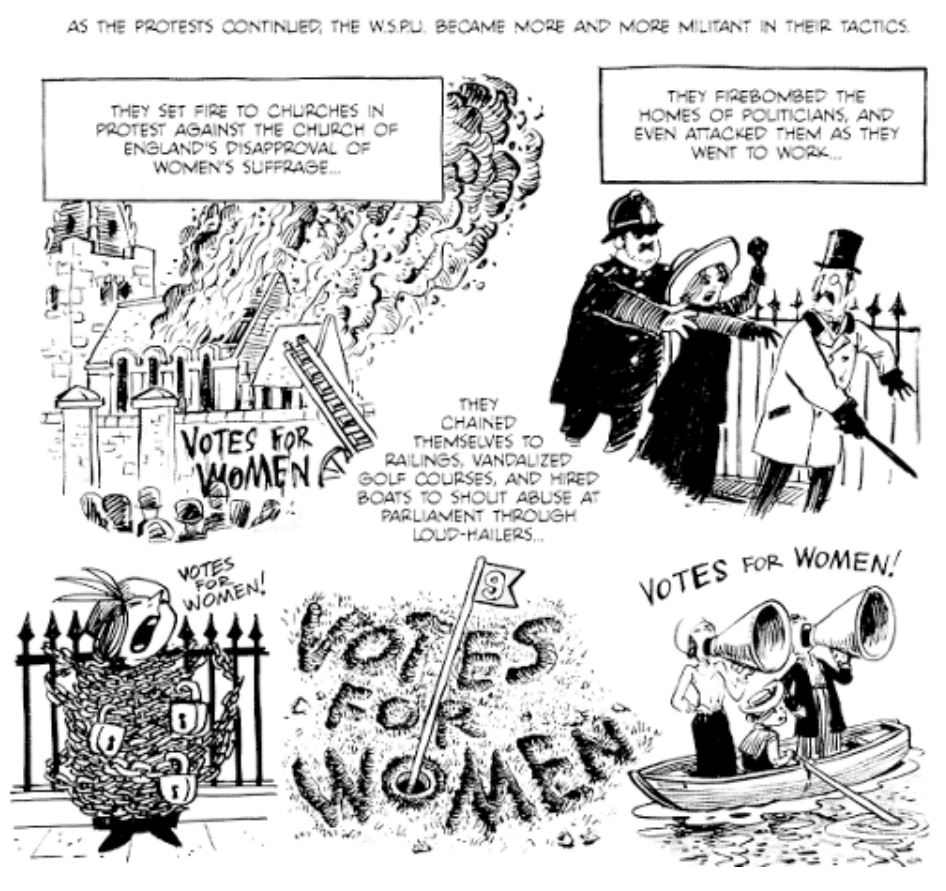
Returning to that bar and Lady Liberty, Dickson, Wilson & Pasion draw some telling Conclusions to close our cartoon course in mass resistance, after which the writers discuss their process in Authors Notes: Why This Book? before then listing the truly phenomenal rewards of all those campaigns and protests with a long list of Rights Won. These range from Women’s Suffrage to the universal formal acknowledgement of the Human Right to Protest that our current global leaders and assorted billionaires are so keen on taking away again…
Understanding the value of a strategically targeted chuckle, this fabulous monochrome chronicle concludes with one last strip as Dickson & Emerson hilariously reveal ‘The Four Stages of Protest’ courtesy of Mohandas “Mahatma” Gandhi…
More so than work, sport, religion, fighting or even sex, politics has always been the very grist that feeds the pictorial gadfly’s mill. Of course, cartooning can only accomplish so much, and whilst Fight the Power! recounts a number of instances where physical and intellectual action were necessary to achieve or maintain justice, at least comics can still galvanise the unconvinced into action and help in the useful dissemination of knowledge about protest: the Who, Where, When, and How.
If you don’t understand What or Why then you’re probably already on the other side of the barricades – and complaining about who gets what vaccine or can be allowed to shout in the streets at all…
© 2013 Sean Michael Wilson and Benjamin Dickson. Illustrations © 2013 Hunt Emerson, John Spelling and Adam Pasion. Cartoons © 2013 Polyp. All rights reserved.
Today in 1909, Golden Age legend Howard Sherman (Dr. Fate, Tommy Tomorrow, Congorilla) was born, as was David Micheline (Iron Man, Spider-Man, Venom, Swamp Thing, Aquaman, Magnus – Robot Fighter) in1948, inkers Dennis Jensen in 1952, John Beatty in 1961 and John Lucas in 1968. France greeted Emmanuel Larcenet (Dungeon, Le combat ordinaire) in 1969, with the US response being Nunzio DeFilippis (Three Strikes, Dragon Age) in 1970, and Bryan Edward Hill (American Carnage, Blade) in 1977.
This date in 2002, Robert Kanigher died.