
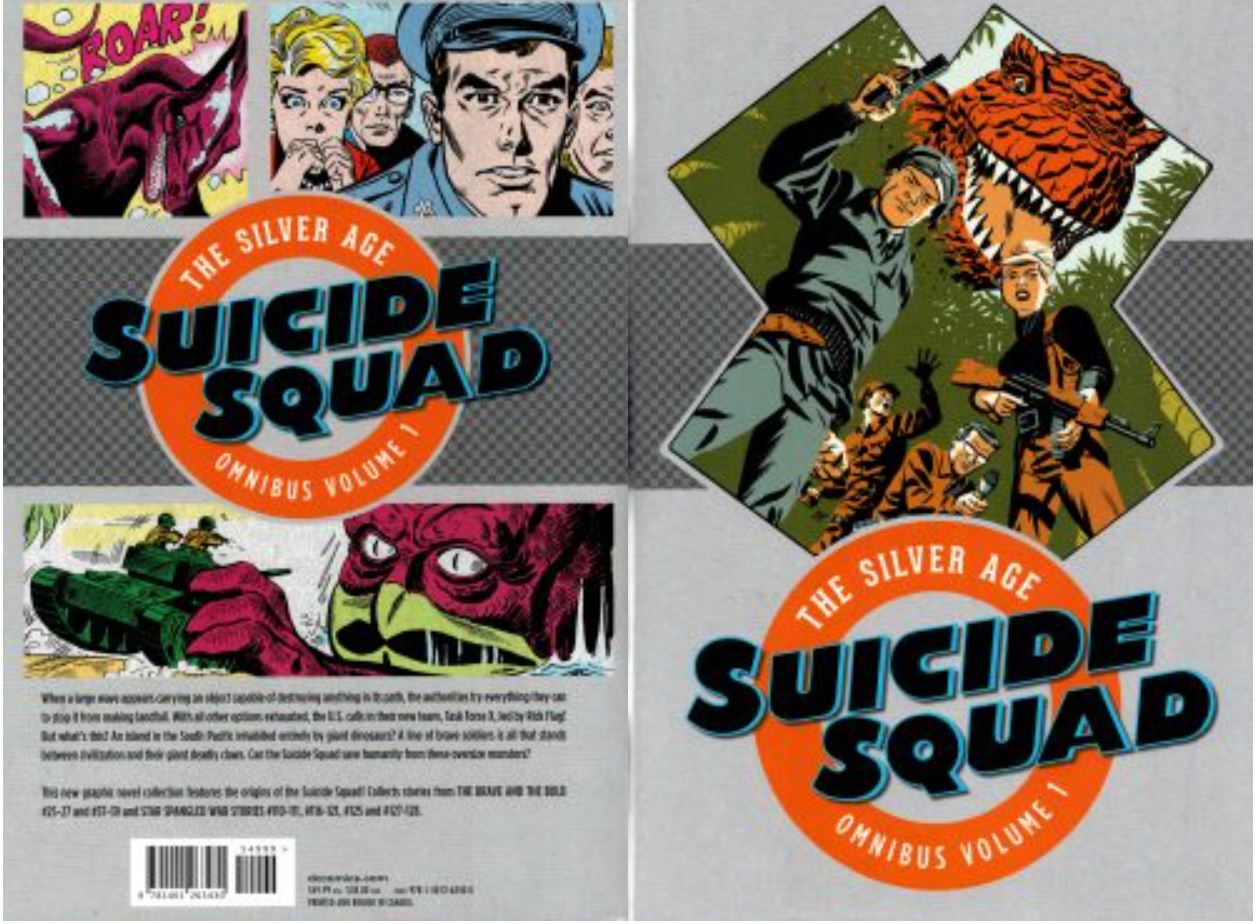
By Robert Kanigher, Howard Liss, Ross Andru & Mike Esposito, Gene Colan, Joe Kubert & various (DC Comics)
ISBN: 978-1-4012-6343-0 (HB/Digital edition) 978-1-4012-7516-7 (TPB)
This book includes Discriminatory Content produced in less enlightened times.
The War that Time Forgot was a strange series which saw paratroopers and tanks of the “Question Mark Patrol” dropped on Mystery Island from whence no American soldiers ever returned. Assorted crack GIs discovered why when the operation was suddenly overrun by pterosaurs, tyrannosaurs and worse. However, the combat-&-carnosaur creation was actually a spin-off of an earlier concept which hadn’t quite caught on with the comics-buying public. That wasn’t a problem for writer/editor Robert Kanigher: a man well-versed in judicious recycling and reinvention…
Back in 1955 he had devised and written anthology adventure comic The Brave and the Bold, which featured short complete tales starring a variety of period heroes in a format mirroring the era’s filmic fascination with historical dramas. Issue #1 led with Roman swords-&-sandals epic Golden Gladiator, medieval mystery-man The Silent Knight and Joe Kubert’ Viking Prince. Soon, the Gladiator was sidelined by the company’s iteration of Robin Hood, but the high adventure theme carried the title until the end of the decade when a burgeoning superhero revival saw B&B transform into a try-out vehicle in the manner of the astounding successful Showcase. Used to launch enterprising concepts and characters like Cave Carson, Strange Sports Stories, Hawkman and the epochal Justice League of America, the title began these test runs with #25 (August/September 1959) with the fate-tempting Suicide Squad – codenamed Task Force X by the US government to investigate uncanny mysteries and tackle unnatural threats.
The light-scary tales were all illustrated by Kanigher’s go-to team for fantastic fantasy (Ross Andru & Mike Esposito) who clearly revelled at the chance to cut loose and show what they could do outside the staid whimsy of Wonder Woman or gritty realism of the war titles they usually handled…
Following the February 1957 launch of Jack Kirby’s Challengers of the Unknown, landmark premiere The Brave and the Bold #25 was cover-dated September 1959 and on sale from 28th August 1959 (nearly two years before Fantastic Four #1 went on sale). The “novel-length” yarn introduced a quartet of highly trained but merely human specialists – air ace war hero Colonel Rick Flag, combat medic Karin Grace and big-brained boffins Hugh Evans and Jess Price – all officially convened as a unit whose purpose was to tackle threats beyond conventional comprehension, such as the interstellar phenomenon dubbed ‘The Three Waves of Doom!’ The quartet were built on a very shaky premise. All three men loved Karin. She only loved Rick (and who wouldn’t?), but agreed to conceal her inclinations and sublimate her passions so Hugh and Jess would stay on the team of scientific death-cheaters…
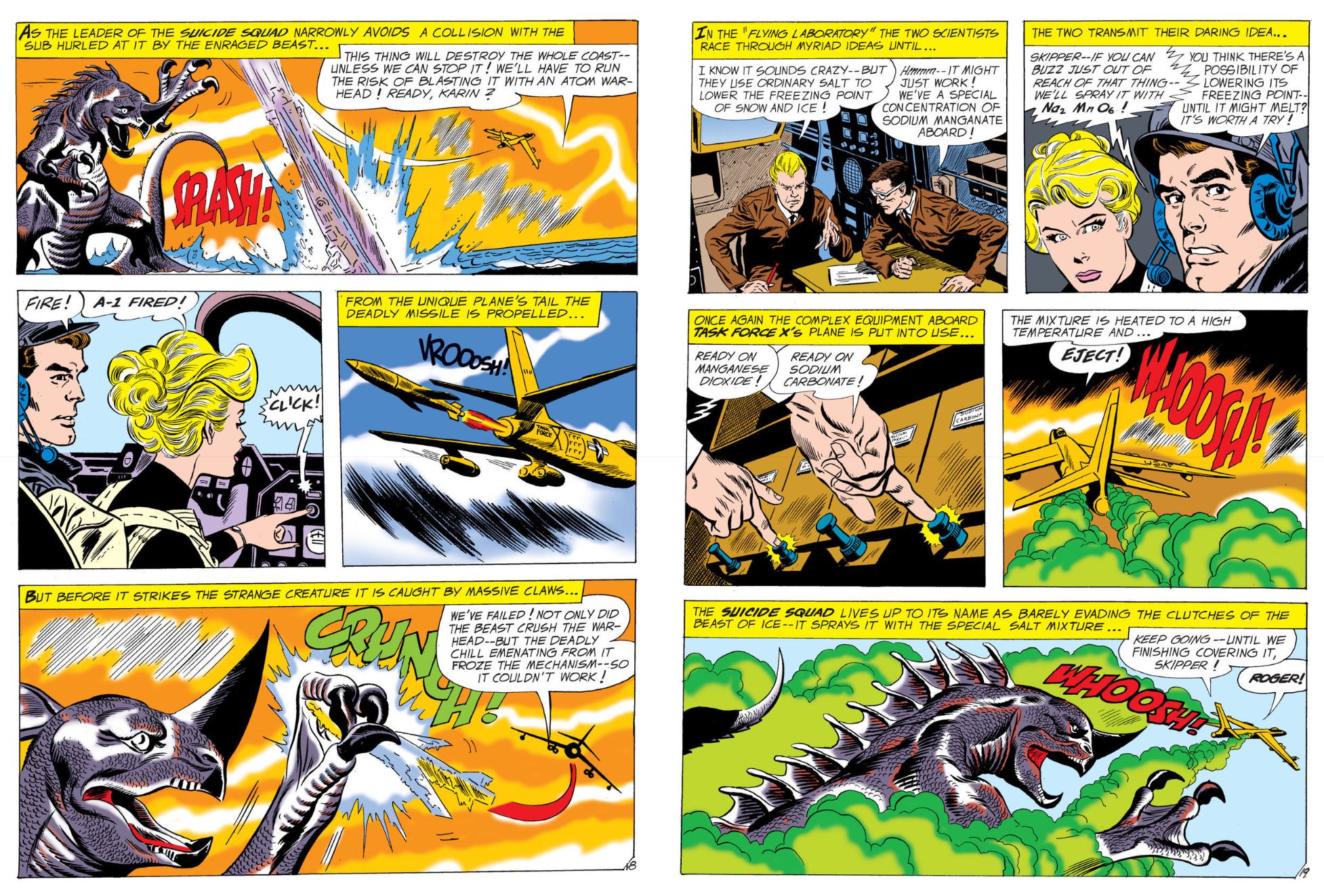
In their first published exploit, a cloud from outer space impacts Earth, creating a super-heated tsunami which threatens to broil America. With dashing derring-do, the patriotic troubleshooters quench the ambulatory heat wave only to have it spawn a colossal alien dragon emanating super-cold rays that could trigger a new ice age. The only solution is to banish the beast back into space on a handy rocket headed for the sun, but tragically, the ship has to be piloted…
Having heroically and categorically ended the invader, the team redeployed two months later as B&B #26 opened with immediate continuation ‘The Sun Curse’ seeing our stranded astronauts struggle – in scenes eerily prescient and reminiscent of the Apollo 13 crisis a decade later – to return the ship to Earth. Uncannily, the trip bathes them in radiation that causes them to shrink to insect size. Back on terra firma, but now imperilled by everything around them, the team nonetheless manage to scuttle a proposed attack by a hostile totalitarian nation before regaining their regular stature. A second, shorter follow-up tale finds the foursome enjoying downtime in Paris before the Metro is wrecked by an awakened dinosaur. Of course, our tough tourists are ready and able to stop the ‘Serpent in the Subway!’
In an entertainment era dominated by monsters and aliens, with superheroes only tentatively resurfacing, Task Force X were at the forefront of bombastic beastie-battles. Their third and final try-out issue found them facing evolutionary nightmare as a scientist vanishes and the region around his lab is suddenly besieged by gigantic insects and a colossal reptilian humanoid the team dubbed ‘The Creature of Ghost Lake!’ (December 1959/January 1960). They readily destroy the monster but never find the professor…
A rare misfire for those excitingly experimental days, the Suicide Squad vanished after the triple try-out, only to resurface months later for a second bite of the cherry. I’m sure it’s just coincidence, but Fantastic Four #1 went on sale on August 8th 1961, pipped again as The Brave and the Bold #37 (August/September 1961 and on sale from June 22nd) saw DC’s decidedly different quirky quartet resume operations with Karin displaying heretofore unsuspected psychic gifts and predicting an alien ‘Raid of the Dinosaurs!’
This pitted Task Force X against hyper-intelligent saurians whilst ‘Threat of the Giant Eye!’ focussed on the retrieval of a downed military plane and lost super-weapon. The mission brought the Squad to an island of mythological mien where a living monocular monolith hunted people…
For #38 (October/November 1961) the team tackled the ‘Master of the Dinosaurs’ – an alien using Pteranodons to hunt as Earthlings employed falcons – after which the fabulous four fell afoul of extradimensional would-be conquerors, yet still had enough presence of mind and determination to defeat the ‘Menace of the Mirage People!’
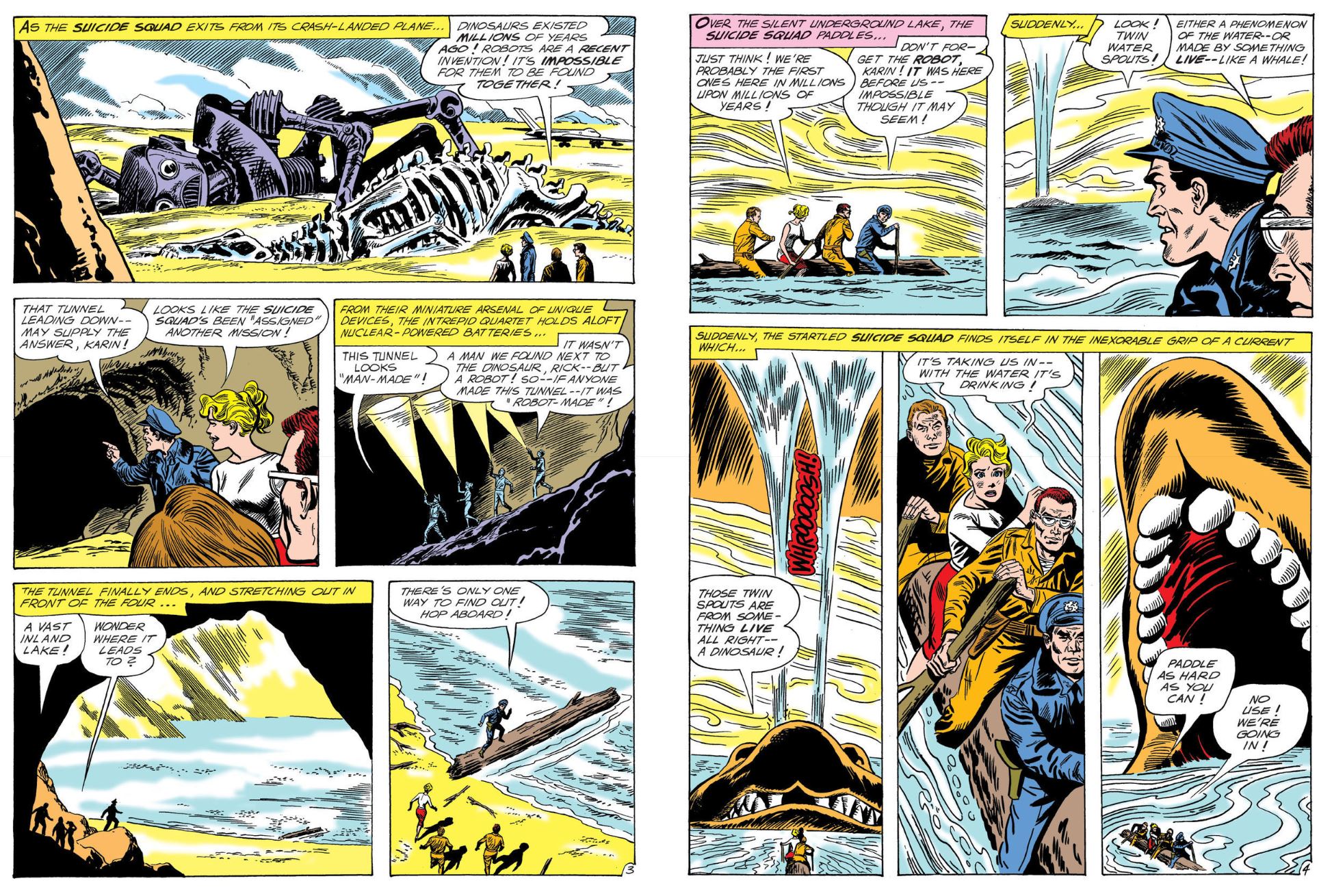
B&B #39 (December 1961/January 1962) called “time!” on Task Force X after ‘Prisoners of the Dinosaur Zoo!’ saw the team uncover an ancient extraterrestrial ark caching antediluvian flora and fauna, after which a ‘Rain of Fire!’ found them crushing a macabre criminal who had entombed many other crime-busters in liquid metal.
That was it for the Squad until 1986 when a new iteration of the concept was launched in the wake of Crisis on Infinite Earths.
Or was it? Superhero fans are notoriously clannish and insular so they might not have noticed how one creative powerhouse refused to take “no thanks” for an answer…
Robert Kanigher (1915-2002) was one of the most distinctive authorial voices in American comics, blending rugged realism with fantastic fantasy in signature war comics, westerns, horror stories, romance and superhero titles including Wonder Woman, Teen Titans, Metal Men, Batman and other genres too numerous to cite here. He scripted ‘Mystery of the Human Thunderbolt’, the very first story of the Silver Age, introducing Barry Allen AKA the second Flash to hero-hungry kids in 1956.
Kanigher sold his first stories and poetry in 1932 and wrote for the theatre, film and radio before joining the Fox Features shop where he created The Bouncer, Steel Sterling and The Web whilst also providing scripts for Blue Beetle and the original Captain Marvel. In 1945, he settled at All-American Comics as both writer and editor, staying on when the company amalgamated with National Comics to become the forerunner of today’s DC. He wrote the original Flash and Hawkman, created Black Canary and Dr. Pat, plus many memorable villainous femme fatales like Harlequin and Rose and Thorn. This last he reconstructed during the relevancy era of the early 1970s into a schizophrenic crimebusting female superhero.
Mystery-men faded away as the 1940s closed, and Kanigher easily switched to espionage, adventure, westerns and war stories, becoming in 1952 writer/editor of the company’s combat titles: All-American War Stories, Star Spangled War Stories and Our Army at War.
He created Our Fighting Forces in 1954 and added G.I. Combat to his burgeoning portfolio when Quality Comics sold their line of titles to DC in 1956, all the while helming/writing Wonder Woman, Johnny Thunder, Rex the Wonder Dog, Silent Knight, Sea Devils, Viking Prince and a host of others. Among his numerous game-changing war series were Sgt. Rock, Enemy Ace, Haunted Tank and The Losers as well as the visually addictive, irresistibly astonishing “Dogfaces & Dinosaurs” dramas sampled and filling out the back of this stunning collection. Kanigher was a restlessly creative writer and even used the uncanny but formulaic adventure arena of The War that Time Forgot as a personal proving ground for potential series concepts. The Flying Boots, G.I. Robot and many more teams and characters first appeared in the manic Pacific hellhole with wall-to-wall danger. Indisputably, the big beasts were the stars, but occasionally (extra)ordinary G.I .Joes made enough of an impression to secure return engagements, too.
The War that Time Forgot debuted in Star Spangled War Stories #90 (April-May 1960), running until #137 (May 1968). It skipped only three issues: #91, 93 & #126 (the last of which starred United States Marine Corps simian Sergeant Gorilla… go on. Look it up. I’m neither kidding nor being metaphorical…
Simply too good a concept to ignore, this seamless, shameless blend of Sir Arthur Conan Doyle’s Lost World and Edgar Rice Burroughs’ Caprona stories (known alternatively as the Caspak Trilogy or The Land That Time Forgot) provided everything baby-boomer boys could dream of: giant lizards, humongous insects, fantastic adventures and two-fisted heroes with lots of guns. The only thing mostly missing was cave-girls in fur bikinis…
In the summer of 1963, a fresh Suicide Squad debuted in Star Spangled War Stories #110 to investigate a ‘Tunnel of Terror’ into the lost land of giant monsters. This time though, a giant albino gorilla decided that us mammals should stick together…
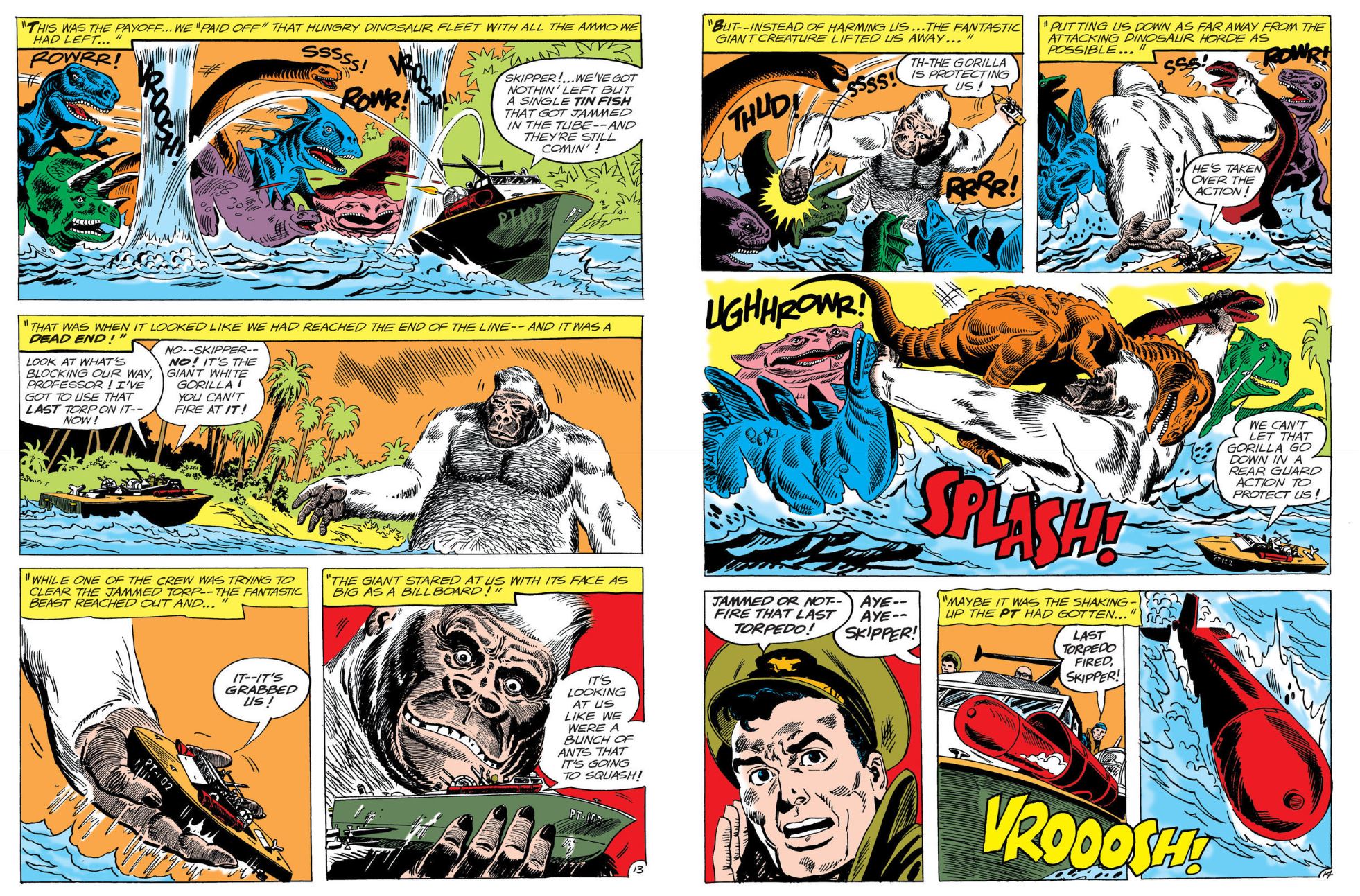
The huge hairy beast was also the star of ‘Return of the Dinosaur Killer!’ in #111, as the unnamed Squad leader and a wily boffin (visually based on Kanigher’s office associate Julie Schwartz) struggled to survive on a reptile-ridden atoll. SSWS #116 (August/September 1964) depicted a duo of dedicated soldiers facing ice-bound beasts in ‘The Suicide Squad!’ – the big difference being that Morgan and Mace were more determined to kill each other than accomplish their mission…
‘Medal for a Dinosaur!’ (#117) bowed to the inevitable: introducing a (relatively) friendly and extremely cute baby pterodactyl to balance out Mace & Morgan’s barely suppressed animosity, after which ‘The Plane-Eater!’ in #118 saw the army odd couple adrift in the Pacific and in deep danger until the leather-winged little guy turned up once more…
The Suicide Squad were getting equal billing by the time of #119’s ‘Gun Duel on Dinosaur Hill!’ (February/March 1965), as yet another band of men-without-hope battled leathery horrors – and each other – to the death, before apparently unkillable Morgan & Mace returned with Dino, the flying ptero-tot, who found a new companion in handy hominid Caveboy before the entire unlikely ensemble struggled to survive against increasingly outlandish creatures in ‘The Tank Eater!’…
SSWS #121 presented a diving drama when a UDT (Underwater Demolitions Team) frogman won his Suicide Squad rep as a formidable fighter and ‘The Killer of Dinosaur Alley!’ Increasingly now, G.I. hardware and ordnance trumped bulk, fang and claw and undisputed master of gritty fantasy art Joe Kubert added his pencil-&-brush magic to a tense, manic thriller featuring a returning G.I. Robot for battle bonanza ‘Titbit for a Tyrannosaurus!’ (#125, February/March 1965), after which Andru & Esposito covered another Suicide Squad sea-saga in #127’s ‘The Monster Who Sank a Navy!’ This eclectic collection tumultuously terminates in scripter Howard Liss and visual veteran Gene Colan’s masterfully crafted, moving human drama from #128, which was astoundingly improved by the inclusion of ravening reptiles in ‘The Million Dollar Medal!’
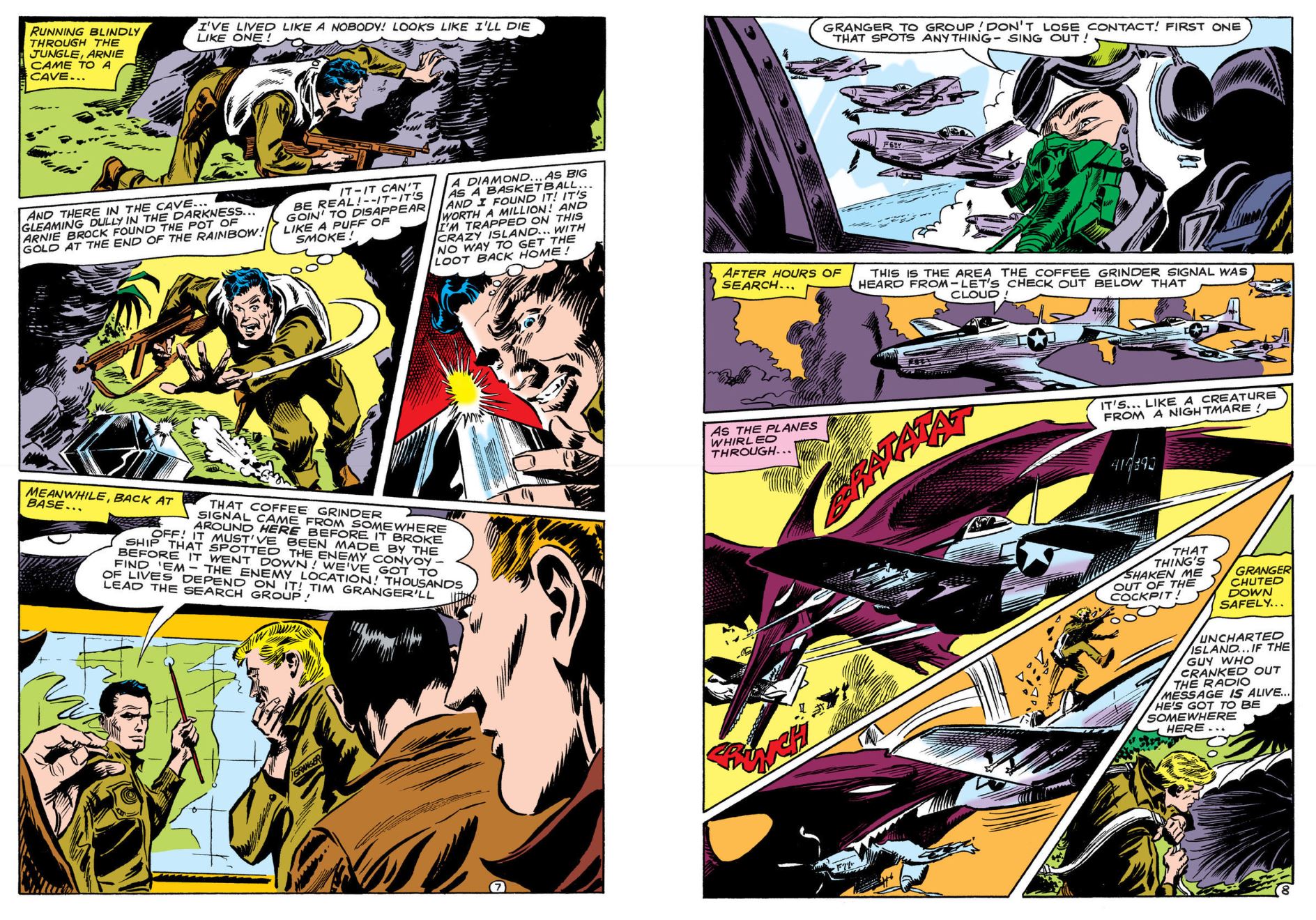
Throughout this calamitous compilation of dark dilemmas, light-hearted romps and battle blockbusters, the emphasis is always on foibles and fallibility, with human heroes unable to put aside grudges, swallow pride or forgive trespasses even amidst the strangest and most terrifying moments of their lives. This edgy humanity informs and elevates even the daftest of these wonderfully imaginative adventure yarns.
Classy, intense, insanely addictive and Just Plain Fun, the original Suicide Squad offers a kind of easy, no-commitment entertainment seldom seen these days and is a deliciously guilty pleasure for one and all. Surely, this is a movie we would all watch…
© 1959, 1960, 1961, 1962, 1963, 1964, 1965, 1966, 2016 DC Comics. All Rights Reserved.
This date in 1942 political cartoonist/children’s book illustrator Tony Auth was born, with Underground Commix creator Joel Beck (Lenny of Laredo) arriving one year later, and Michael T. Gilbert (Doc Stearn – Mr. Monster, Elric) joining the party in 1951. That same year, multitalented Rick Veitch (Swamp Thing, Army@Love, Can’t Get No, Bratpack, Abraxas and the Earthman, Miracleman) with Belgian craftsman Philippe Geluck (Le Chat) popping by in 1954; writer/editor Joey Cavalieri (Wonder Woman, Huntress, Bugs Bunny) in 1957 and artist Jon Bogdanove (Power Pack, Superman, Steel) born in 1958.
Colourist Paul Mounts was born in 1964; Spanish artist Angel (Star Wars, Titans, Flash) Unzueta in 1969 and colourist Beth Sotelo in 1974.
Robert Kaniger (Sgt Rock, Metal Men, Black Canary, G.I. Robot, The Private Diary of Mary Robin R.N., Sea Devils, Haunted Tank, The Losers, Lady Cop, Wonder Woman, Lois Lane, Batman, Atom & Hawkman, Iron Man and all the rest) was so great he is also listed as having died today in 2002 as well as yesterday!