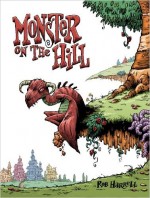
Monster on the Hill


By Rob Harrell (Top Shelf Productions)
ISBN: 978-1-60309-075-9

Once upon a time in England – but not our England – decent, hardworking folk went about their lives in every county-town, their hearts swollen with well-earned civic pride. Content and progressive Victorians one and all, they congratulated themselves upon their achievements and most especially upon the terrifying merits of their local monsters.

By the year of Our Lord 1867 each minor metropolis had for simply ages been twinned with a ferocious giant creature who would occasionally rampage through the municipality, wrecking shops, houses and public works; thereby doing wonders for the local building professions and tourist trade.

Thriving communities would vie with each other for the distinction of being most periodically and ritually terrorised by their assigned Brobdingnagian beast, with the most fearsome of the creatures even being celebrated with local souvenirs and their images engraved on collectible cigarette cards and albums…

Not so the poor, benighted citizens of Stoker-on-Avon. Their monster was something of a disappointment. In fact he was a bit rubbish…

One morning, soon after a properly petrified family returned from a truly frightful encounter with Tentaculor in neighbouring conurbation Billingwood, plucky ragamuffin, town-crier and newsboy Timothy is peddling his papers. The headline is very similar to many previous ones, declaring that it has been 536 days since their monster last appeared…

Thus he’s on hand to overhear firsthand that disgraced mad scientist Dr. Charles Nathaniel Wilkie has been summoned to meet the town fathers. They have bravely offered to reinstate his license and even let him back into his laboratory – despite past embarrassments and misdemeanours – if he can cure, pep up or somehow put some vim back into their monster…

After struggling up the so-very-steep hill from which the formerly ferocious force of nature surveys his neglected domain, the baffled physician discovers his gimcracks and implements have been jettisoned by the stowed-away Timothy, but that’s not really important. Nothing he has bought or built could possibly have helped the colossal winged-but-flightless non-terror known as Rayburn.

The scourge of Stoker-on-Avon is depressed and doesn’t want to perform. He’s lost all confidence and believes he is a failure…

And thus begins a deliciously funny romp – with a generous plenitude of surreal diversions and divertissements – following the classic lines of a coming-of-age road-trip buddy-movie redemption scenario, as the unlikely human team find a perilously peripatetic way to restore Rayburn’s Mojo, which involves getting too close to another town’s terror, humiliating lessons in stomping, smashing and smooshing and the horrifying, shocking and not at all funny revelation of why every town actually has its own monster…

Crafted with verve and supreme slapstick deftness by strip cartoonist Rob Harrell (Big Top, Life of Zarf) this wondrous cartoon fable is joy for fun and fantasy lovers of every stripe and vintage.
Monster on the Hill ™ & © 2013 Rob Harrell. All Rights Reserved.

Small Press Sunday

I started out in this game when marks on paper were considered Cutting Edge, making minicomics, collaborating on fanzines and concocting stripzines with fellow weirdoes, outcasts and comics addicts. Even today, seeing the raw stuff of creativity in hand-crafted paper pamphlets still gets me going in ways that threatens my tired old heart…

With that in mind here’s a selection of tantalising treats that have landed in my review tray recently…

I’ve been collecting comics for more than fifty years now and my biggest regret is that for all the magnificent things I’ve read and enjoyed, only a pitifully fraction of the superb Alternative/Small Press/Self Published stuff I’ve seen has ever been collected in the online or graphic novel boom of this century.

I don’t know how to fix that problem – maybe a communal site where old stuff can be posted for readers to enjoy – but that means finding shy, lost or embarrassed creators and securing permissions and, most distressingly, so many of the creative folk I loved most are dead, vanished or cured now…

I’m not going to let such great material pass un-eulogized though, so whenever I feel like it I’m going to review something ancient, handmade and wonderful, and if the paper gods permit, perhaps you’ll find copies lurking in back-issue bins (do they still exist?) or at conventions or maybe the forgotten ones will re-emerge to take their long-deserved bows.

I’m going to start with a glorious prototype graphic novel compilation far ahead of its time, solely because creator Bob Lynch has already preserved it – and all of his other work – online. Skip my babblings and go right to his site if you wish.

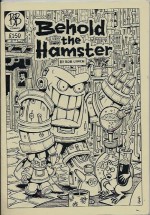
Behold the Hamster

By Bob Lynch (Bob Comics)
No ISBN:

Most British comics devotees first noticed the self-effacing Bob Lynch through his contributions to the wonderfully eclectic self-publishing phenomenon Fast Fiction. From 1981 through 1990 Paul Gravett, Phil Elliott and Ed Pinsent’s Little Creative Co-operative That Could made conventions, comic-marts and monthly meetings of the Society of Strip Illustrators and Comics Creators Guild distractingly fun and bemusingly intoxicating with hand-crafted magazines of tiny print-runs yet immeasurably vast and broad comics entertainment.

Bob’s work first featured in the middle teens of the run (my memory is even more worn out than I am) and Behold the Hamster ran in #19, 20 and 22 – amongst other Bob bits such as Sav Sadness and rhymic slug Samantha – before being collected by your man himself in the book under discussion here and The Whirlpool of Disaster and Sadness in Space.

Lynch’s artwork is deceptively simple and astoundingly stylish, with puckish characterisations rendered in strong, bold black lines (sheer self-defence in an era where paper printing plates and public photocopiers were the acme of affordable reproduction technology for most of us). He was – hopefully still is – also one of the most surreal and simultaneously inviting story-men in the business; incorporating shared cultural icons from all vistas of the TV-watching, pub-going, comics-reading UK public into whacky whimsies and gently barbed observations on the human condition. You know: all the usual stuff…

This little A-5 64-page pamphlet has brightened my day on many occasions since I bought it in 1991, with its mad mash-up of time-travel, Frankensteinian science, detective mystery, true love and daft humour starring a star-crossed hamster named Behold who was brought back from beyond the grave to achieve an incredible destiny and save something or other…

Don’t take my word for it: check out –
https://www.flickr.com/photos/8424687@N08/sets/72157618049179283/

If I’ve piqued your interest you can catch a different flavour of Bob’s fantastic life at http://savsadness.blogspot.co.uk/

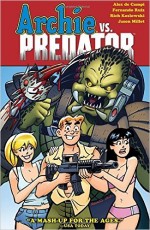
Archie vs. Predator


By Alex de Campi, Fernando Ruiz, Rich Koslowski, Jason Millet & various (Dark Horse Books)
ISBN: 978-1-61655-805-5

For nearly three-quarters of a century Archie Andrews has epitomised good, safe, wholesome fun, but inside the staid and stable company which shepherds his adventures there has always hidden an ingenious and deviously subversive element of mischief.

Family-friendly iterations of superheroes, spooky chills, sci-fi thrills and genre yarns have always been as much a part of the publisher’s varied portfolio as the romantic comedy capers of America’s cleanest-cut teens since they launched as MLJ publications in the Golden Age’s dawning.

As you probably know by now, Archie has been around since 1941, spending most of those seven-plus decades chasing both the gloriously attainable Betty Cooper and wildly out-of-his-league debutante Veronica Lodge whilst best friend Jughead Jones alternately mocked and abetted his romantic endeavours and rival Reggie Mantle sought to scuttle his every move…

As crafted over the decades by a legion of writers and artists who’ve skilfully logged innumerable stories of teenage antics in and around the idyllic, utopian small-town Riverdale, these timeless tales of decent, upstanding, fun-loving kids have captivated successive generations of readers and entertained millions worldwide.

To keep all that accumulated attention riveted, the company has always looked to modern trends with which to expand upon their archetypal brief. In times past they have strengthened and cross-fertilised their stable of stars through a variety of team-ups such as Archie Meets the Punisher, Archie Meets Glee, Archie Meets Vampirella and Archie Meets Kiss, whilst every type of fashion-fad and youth-culture sensation have invariably been accommodated into and explored within the pages of the regular titles.

That willingness to dip traditional toes in unlikely waters led in 2015 to the publishers taking a bold and potentially controversial step which paid huge dividends and created another monster sales sensation…

The genesis of this most unlikely cross-fertilisation of franchises is explained in great detail and with a tremendous sense of “how did we get away with it?” in Roberto Aguirre Sacasa’s ‘Introduction’, but just in case you’re new to the other participant in all this…

Predators are an ancient alien species of trophy-taking sporting types who have visited the hotter parts of Earth for centuries, if not millennia. They are lone hunters who can turn invisible and resort to a terrifying selection of nasty weapons. They particularly like collecting skulls and spinal columns…

Predator was first seen in the eponymous movie from 1987 and started appearing in comic book extensions and continuations published by Dark Horse with the 4-issue miniseries Predator: Concrete Jungle (June 1989 to March 1990). It was followed by 22 further self-contained outings and numerous crossover clashes ranging from Batman and Superman to Judge Dredd and Tarzan, steadily keeping the franchise alive and kicking whilst the movie iteration waxed and waned…

This spectacularly eccentric yarn pulls off the peculiar and miraculous trick of creating a hilarious and scary family-friendly teen-slasher flick which begins ‘When You Wish Upon a Star’ as all the young cast regulars head to Costa Rica for Spring Break and are having the time of their lives, until Betty and Veronica have a particularly vicious spat over Archie which leads to a spooky confrontation and a curse uttered over what might be an actual voodoo dagger.

Science-whiz Dilton is occupied with his telescope watching and everybody is blissfully unaware that they’ve piqued the attention of something patient, invisible and completely alien…

When they all head home they have no conception that some of their number are already trophies on a wall…

With the youngsters back in Riverdale Archie and his companions settle back into their routine but soon realise that something has followed them when a beloved adult is decapitated in plain sight. Soon the community is cut off and they are all waiting ‘To Live and Die in a Small Town’…

Convinced their meddling with the occult has brought on the killing-spree, Betty and Veronica testily consult sorcerous expert Sabrina (the Teenage Witch) but that ends in another welter of scarlet and screaming and the first sighting of the thing from the stars…

Thing get grim and crazy as the rapidly depleting posse of teens meet the Government agents tasked with covertly countering the Predators but continue to fall until Dilton rolls out the weird science and Archie dons a ‘Full Metal Varsity Jacket’…

Soon the beloved cast is down to the barest essentials and the last few resistors face their final curtain in ‘Guess Who’s Coming to Dinner’…

After a surprisingly gripping and gory conclusion that will astonish and delight everyone an ‘Afterword’ by series Editor Brendan Wright gives more insight into the impetus and creative process behind this inspired tale, but there are still plenty of treats in store.

Scripter Alexi de Campi also got to play with others creators’ toys in a series of Bonus Crossovers, which rounded out the comics issues. Here follow quirky, perky little one and two page vignettes such as the eerily satisfying ‘Sabrina Meets Hellboy’ with art and colours by Robert Hack, lettered by Clem Robins, and the fabulously bizarre ‘Li’l Archie and his Pals meet Itty Bitty Mask’ by Art Baltazar.

Philosophical and physical depths are plumbed as ‘Jughead meets Mind MGMT’ (Matt Kindt) and the girls have fun when ‘Josie and the Pussycats meet Finder’ illustrated by Carla Speed McNeil, with colours from Jenn Manley Lee and letters from the ubiquitous de Campi.

By all accounts, when news of this project got out an army of eager professionals clamoured to get involved. The miniseries offered a wealth of covers-&-variants – some scattered about and acting as chapter-breaks by Ruiz, Koslowski, Millet, Dan, Parent, Gisèle, Maria Victoria Robado and Andrew Pepoy. The rest are gathered in a massive Variant Cover Gallery displaying varying degrees of gore, whimsy and humour from Eric Powell, Francesco Francavilla, Colleen Coover, Darick Robertson with Millet, Pepoy with Millet, Dennis Calero, Patrick Spaziante, Robert Hack with Stephen Downer, Dustin Nguyen, Kelley Jones with Michelle Madsen, Paul Pope with Shay Plummer, Faith Erin Hicks with Cris Peter, Joe Quinones, Tim Seeley, Richard P. Clark, Ruiz with Anwar Hanano, Koslowski as full illustrator and even more.

Also on view are samples of ‘Promo Art’ prepared for the comics convention circuit and a large section of Ruiz’s developmental ‘Character Studies’ plus a feature on the ‘Art Process’ from rough pencils through to finished colour pages.

But wait, there’s still more as ‘Unused Covers’ offers eight final tantalising ideas which never made it off the drawing boards of Ruiz, Pepoy, Gisèle and Faith Erin Hicks.

This book is one of those “Pitch hooks” Hollywood producer types thrive by. All you need is the three word title and a graphic acronym to know whether you’ll love this yarn.

Archie Versus Predator….

AVP.

Another Victorious Pairing.

Astounding.
Visual.
Perfection.

Archie vs. Predator © 2015 Archie Comic Publications, Inc. and Twentieth Century Fox Film Corporation. Archie™ and © 2015 Archie Comic Publications, Inc. Predator™ and © 2015 Twentieth Century Fox Film Corporation. All guest material ™ and © 2015 its creators or copyright holders. All rights reserved.

The Rugger Boys volume 2: A Snootful of Style and a Ton of Class!


By Béka & Poupard with colour work by Magali Poli Rivière, translated by Luke Spear (Cinebook)
ISBN: 978-1-905460-44-1

Human beings – and apparently a huge variety of our pets and animal housemates – seem obsessed with and revel in chasing balls about. So much so that we/they even apply a range of complex rules to the sheer exhilaration of the process, just to make things more difficult and artificially extend proceedings.

We call it sport and when it’s not hugely thrilling and deadly serious it can be hilariously funny…

Comics over the decades and throughout the world have often mined our obsession with assorted games for secondary entertainment value and this Cinebook compilation proffers more stunning strips starring a dedicated amateur team of French gladiators all painfully enamoured of the manly (and British-originated, let’s not forget) oddball-based pastime called Rugby…

Les Rugbymen was created in 2005 by writing partnership Bertrand Escaich & Caroline Roque under their collaborative nom de plume Béka (Studio Danse, Les Fonctionnaires) in conjunction with self-taught illustrator Alexandre Mermin, who generally labours under the pseudonym Poupard (Chez Gaspard, Les Brumes du Miroboland).

The resulting flurry of short sharp gags and extra-time yarns have filled an even dozen albums thus far. There’s even a junior league spin-off which began in 2010 entitled Les Petits Rugbymen…

On va gagner avec le lard et la manière was the fifth Continental encounter but the second (and, thus far, last) translated by Cinebook – probably because it features brief sporting excursions to Scotland and New Zealand – and perfectly recapitulates the passion, toil and sheer testosterone-fuelled idiocy which can warp normally rational folk.

The titular stars are some few dedicated souls faithfully enjoying the trials of club rugby (Union rules, right?) as played by the stalwarts of fictional south-western French side Paillar Athletic Club, affectionately known to their frankly obsessive fans as The PAC…

As seen on the introductory page, our bloody but unbowed stars manifest as intellectually compromised Hooker Lightbulb, Herculean Prop Fatneck, precocious ¾ Centre Hugo “The Engineer” Cap, 2nd Row star Freddy “The Anaesthetist” Bones, dashing sex-crazed Back Romeo and Scrumhalf/Captain The Grumpster, all regularly adored and vilified by Bernard FarmerThe Coach – who never lets his barrrrbarous accent get in the way of a good insult or pithy instruction to the dozy slackerrrs…

All you need to know is that these guys are bold, sturdy and love to eat and drink as much as they do trampling each other into the mud every weekend…

The exploits are generally delivered as single page sequences, lavishly, lovingly and outrageously illustrated and jam-packed with snippets of off-kilter slapstick to supplement the main gag and the material. Content is almost everything you’d expect from such a fixture: big beefy blokes in very small towels, lots of booze-fuelled gaffes, eating eccentricities, knob jokes and the mutual sportsmanlike skulduggery which permeates all games Real Men compete in…

This time however equality reigns and there’s a succinct glimpse of the Paillar Athletic Ladies Team too, and you can share the lads’ first turbulent TV appearance too.

Mostly, however, on display is a profusion of smartly-planned running gags and compact comedic gems such as the well-meaning meatheads’ ongoing efforts to help Lightbulb find “love”, Romeo’s constant comeuppances from husbands, boyfriends and employers unhappy with his off-pitch Tries, the woebegone touchline medic’s miserable life and Coach’s eternal battle to whip his band of idiots into a team he can be proud of…

This particular collection kicks off with an extended origin story revealing how the playful imps they once were turned a boring school lesson into a life-changing indoor match and formed sporting bonds that lasted a lifetime…

As previously mentioned, this fixture also includes a brief tour of Scotland, offering a broad belt of new experiences from braw brews to fine foods and bonnie lassies to life-changing injuries, and concludes with a bombastic whistle-stop tour of the Antipodes as The Pac are generously invited to visit the mighty New Zealand All-Blacks at home after the Rugby World Cup concludes…

Mostly though it’s always about mud, mauling, getting stuffed and getting smashed – in every sense of the term…

Fast, furiously funny and splendidly boisterous, these are the kind of cartoon antics that might even inspire dedicated couch-potatoes to get out of the house – unless they order books and dinner online…
© BAMBOO EDITION, 2007 by Béka & Poupard. All rights reserved. English translation © 2007 Cinebook Ltd.

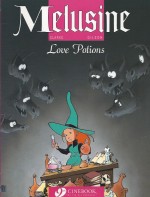
Melusine volume 4: Love Potions


By Clarke (Frédéric Seron) & Gilson, coloured by Cerise and translated by Jerome Saincantin (Cinebook)
ISBN: 978-1-84918-005-4

Like most things in life, this ideal keepsake for Love’s Labours’ Ludicrously Lost comes far too late to be the perfect St. Valentine’s Day recommendation, but let’s face it: if you want to read a comic rather than romance a paramour – imagined, potential or otherwise – there’s little hope for you anyway…

And Dark Gods forbid if you think buying one for him/her/it/they counts as a Romantic Gesture. You deserve everything you get…

Witches – especially cute and sassy teenage ones – have a long and distinguished pedigree in fiction and one of the most seductively engaging first appeared in venerable Belgian magazine Spirou in 1992.

Mélusine is actually a sprightly 119-year-old diligently studying to perfect her craft at Witches’ School. To make ends meet she spends her days – and far too many nights – working as au pair and general dogsbody to a most disgraceful family of haunts and horrors who inhabit/infest a vast, monster-packed, ghost-afflicted chateau some chronologically adrift, anachronistically awry time in the Middle-ish Ages…

The long-lived, much-loved feature is presented in every format from one-page gag strips to full-length comedy tales, all riffing wickedly on supernatural themes and detailing Mélusine’s rather fraught existence is filled with the daily indignities day-job, college studies, the appallingly trivial domestic demands of the master and mistress of the castle and even our magic maid’s large circle of exceedingly peculiar family and friends.

The strip was devised by writer François Gilson (Rebecca, Cactus Club, Garage Isidore) and cartoon humorist Frédéric Seron, AKA Clarke whose numerous features for all-ages Spirou and acerbic adult humour publication Fluide Glacial include Rebecca, Les Cambrioleurs, Durant les Travaux, l’Exposition Continue… and Le Miracle de la Vie.

Under the pseudonym Valda, Seron also created Les Babysitters and as Bluttwurst Les Enquêtes de l’Inspecteur Archibaldo Massicotti, Château Montrachet, Mister President and P.38 et Bas Nylo.

A former fashion illustrator and nephew of comics veteran Pierre Seron, Clarke is one of those insufferable guys who just draws non-stop and is unremittingly funny. He also doubles up as a creator of historical and genre pieces such as Cosa Nostra, Les Histoires de France, Luna Almaden and Nocturnes and apparently is free of the curse of having to sleep…

Collected Mélusine editions began appearing annually or better from 1995 onwards, with the 24th published in 2015 and another due this year. Thus far five of those have shape-shifted into English translations…

Originally released in 1998, Philtres d’amour was Continentally the fifth fantabulous folio of mystic Mélusine mirth and is again most welcoming: primarily comprised of one and two page gags starring the sassy sorceress which delightfully eschew continuity for the sake of new readers’ instant approbation…

As the translated title of this (fourth) Cinebook offering suggests, Love Potions devotes the majority of its content to affairs of the heart – and lower regions – and how to alchemically stack the deck in the game of romance….

When brittle, moody Melusine isn’t being bullied for her inept cleaning skills by the matriarchal ghost-duchess who runs the castle, ducking cat-eating monster Winston, dodging frisky vampire The Count or avoiding the unwelcome and often hostile attentions of horny peasants and over-zealous witch-hunting priests, our saucy sorceress can usually be found practising her spells or consoling and coaching inept, un-improvable and lethally unskilled classmate Cancrelune.

Unlike Mel, this sorry enchantress-in-training is a real basket case: her transformation spells go awfully awry, she can’t remember incantations and her broomstick-riding makes her a menace to herself, any unfortunate observers and even the terrain and buildings around her…

This tantalising tome features the usual melange of slick sight gags and pun-ishing pranks; highlighting how every bug, beast, brute and blundering mortal suffers the pangs of longing and occasionally needs a little Covenly charisma to kick romance into action…

Whether that means changing looks, attitudes or minds already firmly made up, poor harassed student Mel is bombarded with requests to give Eros a hand…

Her admittedly impatiently administered and often rather tetchy aid is pretty hit-or-miss, whether working for peasants, rabbits, tortoises or even other witches, and helping poor Cancrelune is an endless, thankless and frequently risky venture.

Moreover the master and mistress of the castle have obviously never had an ounce of romance in them, even when they were alive…

At least daunting dowager Aunt Adrezelle‘s is always around to supply the novice with advice, a wrinkly shoulder to cry on and, when necessary, a few real remedies…

This turbulent tome also includes a longer jocular jaunt exploring the dull verities of housework, anti-aging elixirs and the selfish ingratitude of property-speculators…

Wrapping up the thaumaturgical hearts-&-flowers is eponymous extended epic ‘Love Potions’ which sees Melusine’s patience pushed to the limits after another attempt by the local priest to “burn the witch” ends up with her helping the locale’s latest scourging saurian marauder find the dragon of his fiery dreams…

Wry, sly, fast-paced and uproariously funny, this compendium of arcane antics is a great taste of the magic of European comics and a beguiling delight for all lovers of the cartoonist’s art. Read before bedtime and share with your loved ones – but only after asking politely first…
Original edition © Dupuis, 1998 by Clarke & Gilson. All rights reserved. English translation 2009 © Cinebook Ltd.

Lucky Luke volume 7: Barbed Wire on the Prairie


By Morris & Goscinny, translated by Luke Spear (Cinebook)
ISBN: 978-1-905460-24-3

Lucky Luke is a good-natured, lightning-fast gunslinger who roams the fabulously mythic Old West, having light-hearted adventures with his sarcastic horse Jolly Jumper, interacting with a host of historical and legendary figures. His continued exploits over seven decades have made him one of the best-selling comic characters in Europe (over 80 collected books and more than 300 million albums in 30 languages thus far), with the usual spin-off toys, computer games, animated cartoons and a plethora of TV shows and live-action movies.

He was created in 1946 by Belgian animator, illustrator and cartoonist Maurice de Bévère (“Morris”) and was first seen the 1947 Annual (L’Almanach Spirou 1947) of Le Journal de Spirou, before launching into his first weekly adventure ‘Arizona 1880’ on December 7th 1946.

Prior to that, while working at the CBA (Compagnie Belge d’Actualitiés) cartoon studio, Morris met future comics superstars Franquin and Peyo, and joined weekly magazine Le Moustique as a caricaturist – which is probably why (to my eyes at least) his lone star hero looks uncannily like the young Robert Mitchum who graced so many memorable mid-1940s B-movie Westerns.

Morris quickly became one of la Bande des quatre or “The Gang of Four” comprising Jijé, Will and his old comrade Franquin: the leading proponents of the loose, free-wheeling artistic style known as the “Marcinelle School” which predominated in Spirou in aesthetic contention with the “Ligne Claire” style used by Hergé, EP Jacobs and other artists on Tintin magazine.

In 1948 said Gang (all but Will) visited the USA, meeting American comics creators and sightseeing. Morris stayed for six years, linking up with fellow traveller René Goscinny, scoring some work from the newly-formed EC sensation Mad and making copious notes and sketches of the swiftly vanishing Old West.

That research would resonate on every page of his life’s work.

Working solo until 1955, Morris produced another nine albums worth of affectionate sagebrush spoofery before reuniting with Goscinny, who became the hero’s regular wordsmith as Luke attained the dizzying heights of superstardom, commencing with ‘Des rails sur la Prairie’ (Rails on the Prairie), which began in Spirou on August 25th 1955.

In 1967 the six-gun straight-shooter switched sides, transferring to Goscinny’s own magazine Pilote with ‘La Diligence’ (The Stagecoach). Goscinny eventually produced 45 albums with Morris before his untimely death, from whence Morris continued both singly and with fresh collaborators.

Morris himself died in 2001 having drawn fully 70 adventures, plus some spin-off sagas crafted with Achdé, Laurent Gerra, Benacquista & Pennac, Xavier Fauche, Jean Léturgie, Jacques Pessis and others all taking a crack at the venerable franchise…

Moreover, apart from that very first adventure, Lucky (to appropriate a quote applied to the thematically simpatico TV classic Alias Smith and Jones) “in all that time… never shot or killed anyone”…

He was first seen in Britain syndicated to weekly comic Film Fun during the late 1950s and again in 1967 in Giggle where he was renamed Buck Bingo. In all these venues – as well as the numerous attempts to follow the English-language successes of Tintin and Asterix albums – Luke had a trademark cigarette hanging insouciantly from his lip. However in 1983 Morris – no doubt amidst both pained howls and muted mutterings of “political correctness gone mad” – deftly substituted a piece of straw for the much-mauled dog-end, which garnered him an official tip of the hat from the World Health Organization.

The most recent and successful attempt to bring Lucky Luke to our shores and shelves comes from Cinebook (who have rightly restored the foul weed to his lips on the interior pages, if not the covers…) and Ma Dalton was the seventh of their 58 (and counting) albums, now available both on paper and as e-books.

Chronologically the album Des barbelés sur la prairie, first appeared in 1967: Luke’s 29th chronicle and Goscinny’s 20th collaboration with Morris, offering an engagingly classic confrontation and deviously diabolically bloodless solution wherein all the laconic lawman’s legendary speed proved as nothing when battling bad men with numbers, tradition and intransigence on their side…

It all begins with a suitably mock-heroic paean to western mythology, eulogizing the role of cattle and birth of cowboys before introducing overfed, self-satisfied cattle baron Cass Casey, casually chowing down on cow meat in boisterous cow-town Cow Gulch.

The big man is blissfully unaware that salad-farmers Vernon and Annabelle Felps are currently building a home and planting their crops on the small parcel of the prairie they recently purchased. That means nothing to Casey’s men as they indifferently guide a mooing massive herd through house and garden alike…

When the vegetable man heads into town to remonstrate with the cattle king, Vernon would have killed for his impertinence but for the quiet yet lethally loaded intervention of a wanderer trying to eat his steak in peace…

Casey thinks he’s powerful enough to do whatever he wants, but within seconds he’s the only man drawing down on the legendary Lucky Luke. A little whilst the burly boss’ hand is healing, the Lone Rider is accompanying Vernon back to a home-cooked meal of tasty greens. He’s still there when vengeful Casey sends his thundering herd back to trample everything.

Not long after, Cass’ men are all trussed up, those steers are stampeding though Cow Gulch and Vernon has done the unthinkable…

As the authors brilliantly detail, back then the battle between settlers and ranchers reached obsessive fever pitch after barbed wire was invented. Despite being used to fence off legally owed property, the stuff was so contentious to free ranging cattlemen that shops stocking it would be destroyed and cowboys reacted with unimaginable fury when it was used…

The very mention of it causes local stores to shut for business but Vernon is implacable and mail-orders a few bales. In response, the coach carrying it to him is robbed and vandalised and the Felps’ house is razed to the ground… again.

Hating bullies, Luke adopts a cunning disguise and sneaks a shipment past the ever-vigilant vigilantes and before long the wide open prairie has its first enclosure…

Casey reacts in the expected manner and before long a full-fledged war is brewing.

When Luke organises and trains all the other crop-growing Settlers, Casey increases his night raids and shattering cattle stampedes.

Once Luke decides to get personally involved and bring in more wire, the Cow King calls in all the other cattle barons who congregate in town for a big dinner before taking decisive final action. The prognosis looks bleak for everybody…

And then the Western Wonder has a most intriguing notion which seems certain to end the mounting crisis in a bloodless manner and give all parties concerned an appetite for conciliation…

Fast-paced, seductive slapstick and wry cynical humour beef up this splendidly trope-heavy tribute to classic westerns: another grand old hoot in the tradition of Destry Rides Again and Cat Ballou, superbly executed by sublime storytellers and providing a wonderful introduction to a unique genre for today’s kids who might well have missed the romantic allure of an all-pervasive Wild West that never was…
© Dargaud Editeur Paris 1971 by Goscinny & Morris. © Lucky Comics. English translation © 2007, Cinebook Ltd.

Iznogoud and the Jigsaw Turk


By Goscinny & Tabary, translated by Jerome Saincantin (Cinebook)
ISBN: 978-1-84918-209-6

For the greater part of his far-too-short lifetime René Goscinny (1926-1977) was one of the most prolific and widely-read writers of comic strips in history.

He still is.

Amongst his most popular and enduring comic collaborations are Lucky Luke, Le Petit Nicolas, Signor Spaghetti and, of course, Asterix the Gaul, but there were so many others, such as the despicably dark deeds of a dastardly usurper whose dreams of diabolical skulduggery perpetually proved to be ultimately no more than castles in the sand…

In the wake of the Suez crisis, the French returned – by way of comics, at least – to the hotly contested Arabian deserts after Goscinny teamed with hugely gifted Swedish émigré Jean Tabary (1930-2011) – who numbered Richard et Charlie, Grabadu et Gabaliouchtou, Totoche, Corinne et Jeannot and Valentin le Vagabond amongst his other hit strips – to detail the innocuous history of imbecilic Arabian (im)potentate Haroun el-Poussah.

However, as is so often the case, it was the strip’s villainous foil, power-hungry vizier Iznogoud, who stole the show… possibly the conniving little blackguard’s only successful insurrection.

Les Aventures du Calife Haroun el Poussah was created for Record; the first episode appearing in the January 15th issue of 1962. A petite hit, the feature subsequently jumped ship to Pilote – a new comics magazine created and edited by Goscinny – where it was artfully refashioned into a starring vehicle for the devious little Tuareg toe-rag who had been hogging all the laughs and limelight.

Insidious Iznogoud is Grand Vizier to Haroun Al Plassid, the affable, easy-going Caliph of Ancient Baghdad, but the sneaky little second-in-command has loftier ambitions, or as he is always declaiming “I want to be Caliph instead of the Caliph!”…

The retooled rapscallion resurfaced in Pilote in 1968, quickly becoming a massive hit, resulting in 29 albums to date, his own solo comic, a computer game, animated film, TV cartoon show and even a live-action movie.

Like all great storytelling, Iznogoud works on two levels: for youngsters it’s a comedic romp with adorably wicked baddies invariably hoisted on their own petards and coming a-cropper, whilst older, wiser heads can revel in pun-filled, witty satires and superbly surreal antics.

Following Goscinny’s death in 1977, Tabary began scripting his own tales, switching to book-length complete adventures rather than the short, snappy vignettes which typified his collaborations. Upon his own passing, Tabary’s children Stéphane, Muriel and Nicolas took over the franchise.

The deliciously malicious whimsy is always heavily dosed with manic absurdity, cleverly contemporary cultural critiques, brilliantly delivered creative anachronisms and fourth-wall busting episodes which serve to keep the assorted escapades bizarrely fresh and hilariously inventive.

La tete de turc d’Iznogoud (The Turkish Head of Iznogoud) was originally released in 1975, the 11th mirthfully malignant album compilation, offering a rather remarkable quartet of trend-setting tales with our ambitious autocrat as ever scheming to seize power from his good but gullible Lord and Master. Following the traditional preface page introducing our tawdry star and other regulars, the devious deceptions resume with the epic length saga of ‘The Jigsaw Turk’.

With Baghdad gripped in a strike by refuse collectors, a fuming Vizier visits the freshly-opened magical accessories shop of Dokodah Bey in search of something to solve his promotion-impeding problem. The proprietor is an annoyingly jolly japester who typically meets his intellectual equal in the Vizier’s foolish flunky Wa’at Alahf, but finds time between pranks to sell the surly insurgent a magic puzzle of a Turk’s head.

All one has to do is complete the 10,000 piece jigsaw, but just before adding the final tile, think of the thing you want to get rid of: he/she/it will crumble into as many fragments as the puzzle with the addition of that last component…

And thus begins a catalogue of chaos, with every moment of the weeks that follow finding the Vizier intolerably interrupted. Eventually however he finally finishes the infernal pasteboard pastime only to discover the last piece is missing. Now he has to endure an epic voyage to the faraway factory to replace the missing trigger to all his dreams coming true, but even after he secures it, Iznogoud has no idea his problems are only just beginning…

A commotion in the harbour at Basra is the opening movement in the next cacophonous composition of calamity as the Vizier and his hulking henchman buy a most unlovely mermaid trawled up by Crawdad the Sailor. The deaf, daft seadog needs to get rid of the Siren in his bathtub because ‘The Freezing Song’ she shrieks paralyzes all who hear it…

Smelling opportunity, the ambitious autocrat buys the garrulous nymph and sneaks her into the palace, but as usual there’s hitch after hitch and in the end it’s the Vizier’s stinking scheme which ends up going flat…

Next up is a tantalising oddment. ‘The Adventures of Caliph Haroun Al Plassid: The Sheik’s Potion’ looks to me like an earlier yarn of Les Aventures du Calife Haroun el Poussah from Record, recycled and remastered for the contemporary series. In it a much altered Iznogoud attempts to administer a shrinking potion to his Lordly Master but, after a furore of frantic attempts meet with ever-diminishing success, only succeeds in making himself look small…

This sublime selection ends on a superbly surreal note as the Vile Vizier consults a chronally adrift Gypsy seer and buys ‘The Magic Calendar’ which will allow its careful owner to move about in time. With such an arcane addition to his arsenal, surely his ambitions must be realised?

Of course the most important word here is “careful” and before/after/between long the impatient impotentate is lost many somewheres in time and ends up annoying a most confused cartoonist who only wants a little time to finish his latest script about that obnoxious oaf who wants to be Caliph instead of the Caliph…

Such convoluted witty, fast-paced hi-jinks and craftily crafted comedy set pieces have made this addictive series a household name in France where “Iznogoud” is common parlance for a certain kind of politician: over-ambitious, unscrupulous – and frequently insufficient in inches (or should that be centimetres?).

Desiring to become “Caliph in the Caliph’s place” is a popular condemnation in French, targeting those perceived as overly-ambitious, and since 1992 the Prix Iznogoud is awarded annually to “a personality who failed to take the Caliph’s place”.

Nominees are chosen from prominent French figures who have endured spectacular failures in any one year and been given to the likes of Édouard Balladur (1995) and Nicolas Sarkozy (1999). The jury panel is headed by politician André Santini, who gave himself one after failing to become president of Île-de-France in regional elections in 2004.

When first released in Britain during the late 1970s and 1980s (and again in 1996 as a periodical comicbook) these tales made little impression, but at last this wonderfully beguiling strip has deservedly found an appreciative audience among today’s more internationally aware, politically jaded comics-and-cartoon savvy connoisseurs…
Original edition © 2012 IMAV éditions by Goscinny – Tabary. All rights reserved. English translation © 2014 Cinebook Ltd.

Plastic Man Archives volume 4


By Jack Cole (DC Comics)
ISBN: 978-1-56389-835-8

As adroitly recounted by European comics historian and film critic Andreas C. Knigge in his Foreword to this fourth beguiling Deluxe Archive collection, Jack Cole was one of the most uniquely gifted talents of America’s Golden Age of Comics.

Before moving into the magazine and gag markets he originated landmark tales in horror, true crime, war, adventure and especially superhero comicbooks, and his incredible humour-hero Plastic Man remains an unsurpassed benchmark of screwball costumed hi-jinks: frequently copied but never equalled. It was a glittering career of distinction which Cole was clearly embarrassed by and unhappy with.

In 1954 he quit comics for magazine cartooning, becoming a household name when his brilliant watercolour gags and stunningly saucy pictures began running in Playboy from the fifth edition. Cole eventually moved into the lofty realms of newspaper strips and, in May 1958, achieved his life-long ambition by launching a syndicated newspaper strip, the domestic comedy Betsy and Me.

On August 13th 1958, at the moment of his greatest success he took his own life. The reasons remain unknown.

Without doubt – and despite his other triumphal comicbook innovations such as Silver Streak, Daredevil, The Claw, Death Patrol, Midnight, Quicksilver, The Barker, The Comet and a uniquely twisted and phenomenally popular take on the crime and horror genres – Cole’s greatest creation and contribution was the zany Malleable Marvel who quickly grew from a minor back-up character into one of the most memorable and popular heroes of the era. “Plas” was the wondrously perfect fantastic embodiment of the sheer energy, verve and creativity of an era when anything went and comics-makers were prepared to try out every outlandish idea…

Eel O’Brian was a brilliant career criminal wounded during a factory robbery, soaked by a vat of spilled acid and callously abandoned by his thieving buddies. Left for dead, he was saved by a monk who nursed him back to health and proved to the hardened thug that the world was not just filled with brutes and vicious chisellers after a fast buck.

His entire outlook altered and now blessed with incredible elasticity, Eel resolved to put his new powers to good use: cleaning up the scum he used to run with.

Creating a costumed alter ego he began a stormy association with the New York City cops before being recruited as a most special agent of the FBI…

He soon picked up the most unforgettable comedy sidekick in comics history. Woozy Winks was a dopey indolent slob and utterly amoral pickpocket who accidentally saved a wizard’s life and was gifted in return with a gift of invulnerability: all the forces of nature would henceforth protect him from injury or death – if said forces felt like it.

After failing to halt the unlikely superman’s impossible crime spree, Plas appealed to his sentimentality and, once Woozy tearfully repented, was compelled to keep him around in case he strayed again. The oaf was slavishly loyal but perpetually sliding back into his old habits…

Equal parts Artful Dodger and Mr Micawber, with the verbal skills and intellect of Lou Costello’s screen persona or the over-filled potato sack he resembled, Winks was the perfect foil for Plastic Man: a lazy, greedy, morally bankrupt reprobate with perennially sticky fingers who got all the best lines, possessed an inexplicable charm and had a habit of finding trouble. It was the ideal marriage of inconvenience…

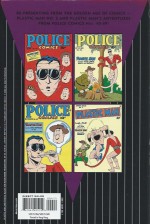
This lavish, full-colour hardback barely contains the exuberantly elongated exploits of the premier polymorph from Police Comics #40-49 and Plastic Man #3 (stretching from March 1945 to Spring 1945), and opens with an outrageous murder mystery in Woozy’s loon-filled boarding house as ‘The Overalls in Mrs. Murphy’s Chowder’ inexorably lead to a fatal stabbing and the ever-imaginative Plas aping the victim until the culprit tries to kill him again…

Police #41 details how an epidemic of shoplifting threatens to close a department store, but when Plas and Woozy hunt down prime suspect ‘Louie the Lift’ they soon discover the thief is only the stooge of a far more dangerous crook, whilst ‘The Diabolical Dr. Dratt’ is clearly his own maniacal man; conning innocent strangers into distilling a deadly new weapon which could level the city…

In ‘Arctic Circle Adventure’ the misshaped manhunters head to the far north to save a little professor’s radium mine from claim-jumpers but none of the polar perils compare to the ardour of marriage-mad Hut Sut who thinks Woozy is the man of her dreams, after which the big goof helps a down-&-out drifter get into a old folks home and precipitates a ‘Murder at the home for the Aged’. Thankfully Plastic Man is on hand to ascertain the identity of the assassin-wolf in the well-wrinkled fold…

Sheer absurdity – and Woozy – trigger a city-wide disaster when a founding father determines to sell the smelly, garbage-strewn land the city is built on back to the Indians and Plas’ poltroon pal makes it happen. Soon ‘Chief Rain-in-the-Trap’ and his braves are running roughshod over everyone and the chameleonic cop is intent on discovering if there’s a pale face behind all that war-paint…

Issue #46 reveals the genesis – and demise – of ‘The Owl’s Witch Union’ as a crook realises magic has as much power as the A-bomb and organises all the city’s sham shamans and con conjurers to take control of the state by eradicating its legislature and government…

‘Slicer and Doser’s Medical School’ finds Woozy trying to save his partner’s life when a pair of deranged surgeons decide to dissect Plastic Man for the sake of science and the betterment of humanity, and it’s just such noble sentiments which prompt inventor Jasper Tipple to design ‘The City of the Future’. Sadly since honest entrepreneurs won’t provide the venture capital to build it the poor fool accepts dirty money and sees his masterpiece become a safe-haven for crooks… until Plastic Man takes an elasticated hand…

The monthly exploits end here with Police Comics #49 (cover-dated December 1945) and the sad tale of a young lady whose physical blandishments were merely average but who nevertheless had the power to make men into helpless puppets.

After years of men acting like slaves around her naturally she fell for the one man immune to her gifts. Such a shame he was a murderous conman and she was so naïve and love-struck…

It was more luck than wit which saved Plas, Woozy and ‘Thelma Twittle, Super-Charmer’…

Rounding out this stylish slapstick selection is grand quintet of tales from Plastic Man #3 (Spring 1946) which opens with ‘The Killing of Snoopy Hawks’ wherein Woozy is threatened by a gossip columnist who ends up dead. Although the cops feel certain it’s the confirmed felon at fault, Plastic Man is equally suspicious of the former banker, upcoming actress and brutal prize-fighter also on the victim’s scandal-list…

The Pliable Paladin almost meets his match when a criminal sociologist hoodwinks a trio of genuine magic makers into destroying the only barrier to his nefarious plots in ‘B. T. Tokus and the Witch Doctors’ after which the stooge becomes the star as ‘Woozy Winks: The Escape of Smelly Pitts’ finds the Dolorous Dope attempting a (semi-legal) get-rich-quick bounty-hunting scheme only to be captured by his target, and fooled into getting married…

Plastic Man’s uncanny abilities are then explored in prose short ‘The Hand Behind’ before this superb slice of superhero silliness concludes with a daring tale of High Seas drama as at-long-last body-conscious Mr. Winks goes in search of deodorant and becomes embroiled in an ambergris-smuggling racket, which is only the tip of an illegal iceberg.

When the oaf turns up missing again, Plastic Man gets on the case and soon discovers and closes ‘A Whale of a Tale’…

Augmented by all the stupendously hilarious covers and a ‘Biographies’ feature detailing the author’s amazing achievements and unhappy life, this is another true gem of funnybook virtuosity: exciting, breathtakingly original and still thrilling, witty, scary, visually outrageous and pictorially intoxicating more than seventy years after Jack Cole first put pen to paper.

Plastic Man is a truly unique creation who has only grown in stature and appeal and this is a magical comics experience fans would be crazy to deny themselves.
© 1945, 1946, 2003 DC Comics. All Rights Reserved.

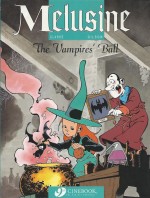
Melusine volume 3: The Vampires’ Ball


By Clarke (Frédéric Seron) & Gilson, coloured by Cerise and translated by Jerome Saincantin (Cinebook)
ISBN: 978-1-905460-69-4

Witches – especially cute and sassy teenage ones – have a long and distinguished pedigree in fiction and one of the most seductively engaging first appeared in venerable Belgian magazine Spirou in 1992.

Mélusine is actually a sprightly 119 years old and spends her days – and many nights – working as an au pair/general dogsbody to a most ungracious family of haunts and horrors inhabiting a vast monster-packed, ghost-afflicted chateau whilst diligently studying to perfect her craft at Witches’ School…

The long-lived much-loved feature is presented in every format from one-page gag strips to full-length comedy tales, all riffing wickedly on supernatural themes and detailing her rather fraught life, filled with the demands of the appallingly demanding master and mistress of the castle and even her large circle of exceedingly peculiar family and friends.

The strip was devised by writer François Gilson (Rebecca, Cactus Club, Garage Isidore) and cartoon humorist Frédéric Seron, AKA Clarke whose numerous features for all-ages Spirou and acerbic adult humour publication Fluide Glacial include Rebecca, Les Cambrioleurs, Durant les Travaux, l’Exposition Continue… and Le Miracle de la Vie.

Under the pseudonym Valda, Seron also created Les Babysitters and as Bluttwurst Les Enquêtes de l’Inspecteur Archibaldo Massicotti, Château Montrachet, Mister President and P.38 et Bas Nylo.

A former fashion illustrator and nephew of comics veteran Pierre Seron, Clarke is one of those insufferable guys who just draws non-stop and is unremittingly funny. He also doubles up as a creator of historical and genre pieces such as Cosa Nostra, Les Histoires de France, Luna Almaden and Nocturnes and apparently is free from the curse of having to sleep…

Collected editions began appearing annually or better from 1995, with the 24th published in 2015 and another due next year. Thus far five of those have transformed into English translations thanks to the fine folk at Cinebook.

Originally released on the Continent in 1996, Le bal des vampires was the second Mélusine album and sets the scene delightfully for newcomers as the majority of the content is comprised of one or two page gags starring the sassy sorceress who makes excessive play with fairy tale and horror film icons, conventions and themes.

When brittle, moody Melusine isn’t being bullied for her inept cleaning skills by the matriarchal ghost-duchess who runs the castle, ducking cat-eating monster Winston, dodging frisky vampire The Count or avoiding the unwelcome and often hostile attentions of horny peasants and over-zealous witch hunting priests, our saucy sorceress can usually be found practising her spells or consoling and coaching inept, un-improvable and lethally unskilled classmate Cancrelune.

This sorry enchantress-in-training is a sad case: her transformation spells go awfully awry, she can’t remember incantations and her broomstick-riding makes her a menace to herself, any unfortunate observers and even the terrain and buildings around her…

At least Mel’s boyfriend is a werewolf, so he only troubles her a couple of nights each month…

This turbulent tome features the regular procession of slick sight gags and pun-ishing pranks but also features a few longer jocular jaunts such as the fate of rather rude knight in armour, a brush with what probably isn’t a poltergeist in the Library and Mel’s unfortunate experience with daunting dowager Aunt Adrezelle‘s patented Elixir of Youth…

Wrapping up the barrage of ghostly gaffes, ghastly goofs and grisly goblin gaucheries is the sordid saga of the eternal elite at their most drunkenly degenerate as poor Melusine is not only expected to organise and cater ‘The Vampires’ Ball’ but has to stick around and handle the explosive clean-up for those especially intoxicated Nosferatus who tend to forget why the revelry has to die down before dawn…

Wry, sly, fast-paced and uproariously funny, this compendium of arcane antics is a great taste of the magic of European comics and a beguiling delight for all lovers of the cartoonist’s art. Read before bedtime and don’t eat any hairy sweets…

Original edition © Dupuis, 2000 by Clarke & Gilson. All rights reserved. English translation 2007 © Cinebook Ltd.

Alley Oop: the First Time Travel Adventure – Library of American Comics Essentials volume 4


By V.T. Hamlin (IDW/Library of American Comics)
ISBN: 978-1-61377-829-6

Win’s Christmas Gift Recommendation: Primal Cartoon Fun… 10/10

Modern comics evolved from newspaper comic strips. These pictorial features were, until relatively recently, extremely popular with the public and highly valued by publishers who used them as a powerful weapon to guarantee and even increase circulation and profits. From the earliest days humour was paramount; hence our umbrella terms “Funnies” and of course “comics”.

Despite the odd ancestor or precedent like Roy Crane’s Wash Tubbs (comedic when it began in 1924; gradually moving from mock-heroics to light-action into full-blown adventure with the introduction of Captain Easy in 1929) or Tarzan and Buck Rogers – which both debuted January 7th 1929 as adaptations of pre-existing prose properties – the vast bulk of strips produced were generally feel-good humour strips with the occasional child-oriented fantasy.

This abruptly changed in the 1930s when an explosion of rollicking drama strips were launched with astounding rapidity. Not only features but actual genres were created in that decade which still impact on not just today’s comicbooks but all our popular fiction.

Another infinitely deep well of fascination for humans is cavemen and dinosaurs. During that distant heyday of America’s strip-surge a rather unique real character created a rather unique and paradoxical cartoon character: at once both adventurous and comedic; simultaneously forward-looking and fantastically “retro” in the same engagingly rendered package…

Vincent Trout Hamlin was born in 1900 and did many things before settling as a cartoonist. After mustering out of the US Expeditionary Force at the end of the Great War V.T. finished High School and then went to the University of Missouri. This was in 1920 and he studied journalism but, since he’d always loved drawing, the eager beaver took advantage of the institution’s art courses too.

Hamlin was always a supreme storyteller and lived long enough to give plenty of interviews and accounts – many impishly contradictory – about the birth of his antediluvian archetype…

As a press photographer Hamlin had roamed the Lone Star State filming the beginnings of the petroleum industry and caught the bug for finding fossils. Whilst drawing ads for a Texas Oil company, he became further fascinated with bones and rocks as he struggled to create a strip which would provide his family with a regular income…

When V.T. resolve to chance his arm at the booming comic strip business, those fossil fragments got his imagination percolating and he came up with a perfect set-up for action, adventure, big laughs and even a healthy dose of social satire…

Alley Oop is a Neanderthal (-ish) caveman inhabiting a lush, fantastic land where dinosaurs still thrive. In fact his greatest friend and boon companion is Dinny; a faithful, valiant saurian chum who terrifies every other dinosaur in creation… as well as all the annoying spear-waving bipeds swarming about.

Because Dinny is as smart and obedient as a dog, all the other cave folk – like arrogant, insecure King Guzzle – generally treat the mighty, free-thinking, disrespectful Oop with immense caution…

Unlike most of his audience, Hamlin knew such things could never have occurred but didn’t much care: the set-up was too sweet to waste and it would prove to be the very least of the supremely imaginative creative anachronisms he and his brilliant wife Dorothy would concoct as the strip grew in scope and popularity.

Oop actually launched twice. In 1930 Hamlin whipped up primeval prototype Oop the Mighty which he then radically retooled and sold to small, local Bonnet-Brown Syndicate as Alley Oop. It debuted on December 5th 1932 and was steadily gaining traction when Bonnet-Brown foundered in the worst days of the Great Depression a year later.

Happily the strip had won enough of a popular following that the Newspaper Enterprise Association syndicate – whose other properties included Major Hoople, Boots and Her Buddies and the aforementioned Wash Tubbs – tracked down the neophyte scribbler and offered him a regular slot in papers all over America.

Alley Oop re-debuted as a daily strip on August 7th 1933, swiftly reprising his old stories for a far larger audience before moving on to new adventures and inevitably winning a Sunday colour page on September 9th 1934, the year V.T., Dorothy and new daughter Theodora relocated to affluent Sarasota, Florida.

Sadly for such a revered series with a huge pedigree – still running today scripted by Carole Bender and drawn by her husband Jack as both Sunday and daily feature – there has never been a concerted effort to properly collect the entire epic. There have however been tantalising outbursts of reprints in magazines and short sets of archive editions from Kitchen Sink, Dark Horse and IDW’s Library of American Comics.

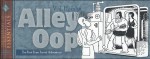
This uniquely intriguing monochrome hardback (Part of The Library of American Comics Essentials range) re-presents – in the form of one day per elongated landscape page – the absolutely most crucial and game-changing sequence in the strip’s 80-year history as the protagonists escaped their antediluvian environs for the first time and were calamitously catapulted into the 20th century…

Supplementing the cartoon bedazzlement is a superbly informative and candid-picture packed introduction by Michael H. Price. ‘V.T. Hamlin and the Road to Moo’ reviews the creator’s amazing life and other strip endeavours before starting his life’s work and what the feature meant to him, after which the grand adventure – spanning Monday March 6th 1939 to Saturday March 23rd 1940 – opens in a strange land a long, long way from here and now…

A little background: the cave-folk of that far-ago time lived in a rocky village ruled over by devious, semi-paranoid King Guzzle and his formidable, achingly status-conscious wife Queen Umpateedle. The kingdom was known as Moo and the elite ruling couple were guided, advised and manipulated in equal amounts by the sneaky shaman Grand Wizer. All three constantly sought to curb the excesses of a rebelliously independent, instinctively democratic kibitzer and free-spirit Oop.

Our hero – the toughest, most honest man in the land – had no time for the silly fripperies and dumb made-up rules of interfering civilisation, but he did usually give in to the stern glances and fierce admonishments of his long-suffering girl “companion” Ooola. The uneasy balance of power in the kingdom comes from the fact that Guz and the Wizer – even with the entire nation behind them – were never a match for Oop and Dinny when they got mad… which was pretty often…

The big change began when Dinny turned up with an egg and became broody and uncooperative. With Oop’s mighty pal out of sorts, the Wizer then played a cruel master-stoke and declared that only the contents of the egg could cure King Guz of a mystery ailment and prompted a mini civil war…

After revolution and counterrevolution Oop and Ooola are on the run when they encounter a bizarre object which vanishes before their eyes. As they stare in stupefaction they are ambushed by Guz’s men and only escape because they too fade from sight…

Somewhere in rural America in 1939, brilliant researcher Dr. Elbert Wonmug (that’s a really convoluted but clever pun) discusses with his assistant the movies their camera took when they sent it into the distant past via their experimental time machine…

The heated debate about the strangely beautiful and modern-looking cave woman and her monstrously odd-looking mate are soon curtailed as the subjects actually materialise in the room and the absentminded professor realises he left his chronal scoop running…

Before he can reverse his mistake and return the unwilling, unwitting guests to their point of origin, the colossal mechanism catastrophically explodes, wrecking the lab and burying the astounded antediluvians in rubble.

Thanks to an unexplained quirk of temporal trans-placement, time travellers always speak the language of wherever they’ve fetched up – albeit through their own slang and idiom – so after Oop digs his way out utterly unharmed, explanations are soon forthcoming from the modern tinkerers. Before long the cave folk are welcomed to all the fabulous advances of the 20th century…

At least Ooola is – thanks to the friendly advice of Wonmug’s daughter Dee – but the hulking male primitive is quickly getting fed up with this fragile place, all snarled up with just as many foolish rules and customs as home…

Storming off to catch and eat something he understands, Oop is suddenly whisked across country in a spectacular and hilarious rampage of destruction – in the best silent movie chase tradition – after he falls asleep in a transcontinental freight train. After weeks of wondering Wonmug and the now thoroughly-acclimated Ooola read newspaper reports of a cunning and destructive “Great White Ape” and make plans to fetch their stray home. The government meanwhile have put top agent G.I.Tum on the case…

The Phantom Ape however has plans of his own and, after “trapping” an aeroplane and its pilot, makes his own tempestuous way back to the isolated lab.

Eventually the whole story comes out and the displaced cave-folk become media sensations just as Wonmug finally completes his repairs to the time machine. Sadly Ooola – and to a lesser extent Alley – are not keen on returning to their dangerous point of origin…

Moreover, not everybody believes Elbert has actually cracked the time barrier and the next segment sees scientific sceptic Dr. Bronson demand first hand proof. However when he eagerly zips off to experience Moo first hand he disappears and – after much pleading – Oop is convinced to follow him and find out what happened…

When the swirling sensation ends our hirsute hero discovers what the problem is: the machine is by no means accurate and its focus has shifted. He has rematerialised outside a gigantic walled city of what we’d call the Bronze Age…

What follows is a stupendous romp of action, adventure and laughs as Oop and Bronson become improbable and forgotten heroes of the Trojan War, meeting and enchanting Helen of Troy and becoming the embattled city’s top warrior generals.

In the 20th century Wonmug is arrested for murder. Dee and his assistant Jon struggle to perfect the machine but in the end resort to busting the genius out to fix the problem and bring the time-lost wanderers back. In a race against time that’s all soon sorted and Ooola heads for ancient Greece to save the lost boys.

Unfortunately she’s picked up by the besieging Greeks and, thanks to her skill with guns, mistaken for the goddess Minerva…

The legendary story further unfolds with Oop and Ooola on opposite sides until wily Bronson makes a breakthrough based on his historical knowledge and they all return home in time to save Wonmug from the cops…

Soon a compact time team is established to exploit the invention – but not before Oop returns to devastated Troy to retrieve his beloved stone axe and – with Bronson and Ooola in tow – finds himself swept up in little sea voyage we knows as the Odyssey…

Back in America the team expands after old college chum and genius of all knowledge G. Oscar Boom invites himself to Wonmug’s scientific party. With all contact lost the unscrupulous rogue offers to go looking for them in the untrammelled past, providing he can take his specially tricked-out station wagon…

As this stunning collection concludes Boom and a mighty hitchhiker named Hercules have just run into the missing chrononauts as they are about to enter the Amazonian wilds of the Land of Warrior Women…

To Be (hopefully) Continued…

Having escaped the ultimately limiting confines of the strip and becoming a seasoned time travellers Hamlin had made the best of all worlds for his characters: Oop and Ooola periodically returned home to Dinny and the cave folk of Moo but they also roamed every intriguing nook and cranny of history ands even escaped planet Earth entirely and hopefully our own future holds the prospect of more such splendid strip sagas…

Fast-paced, furious, fantastically funny and bitterly barbed in the wryly acerbic manner of Billy Wilder and Preston Sturges, Alley Oop is a bone fide classic of strip narrative, long overdue the respect and honour of a complete chronological collection.

However until some enlightened publisher gets around to it, by all means start digging on line and in bargain bins for each – or any – of the wonderful tomes already released. It’s barely the tip of an iceberg but it’s a start…
Alley Oop © and ® 2013 United Features Syndicate, Inc. All rights reserved.