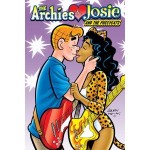
Archie American Series: Best of the Eighties volume 2


By Frank Doyle, George Gladir, Dan DeCarlo, Stan Goldberg & various (Archie Comics Publications)
ISBN: 978-1-879794-58-0

For most of us, when we say comicbooks people’s thoughts turn to buff men and women in garish tights hitting each other and lobbing trees or cars about, or stark, nihilistic crime, horror or science fiction sagas aimed an extremely mature and sophisticated readership of confirmed fans – and indeed that has been the prolific norm of late.

For many years however, other forms and genres have waxed and waned, but one that has held its ground over the years – although almost now completely transferred to television – is the teen-comedy genre begun by and synonymous with a carrot topped, homely (at first just plain ugly) kid named Archie Andrews.

MLJ were a small publisher who jumped wholeheartedly onto the superhero bandwagon following the debut of Superman. In November 1939 they launched Blue Ribbon Comics, promptly following with Top-Notch and Pep Comics. The content was the common blend of costumed heroes, two-fisted adventure strips and one-off gags. Pep made history with its lead feature The Shield, who was the industry’s first super-hero to be clad in the flag (see America’s First Patriotic Hero: The Shield).

Even while profiting from the Fights ‘N’ Tights crowd Maurice Coyne, Louis Silberkleit and John Goldwater (hence MLJ) spotted a gap in their blossoming market and in December 1941 the action strips were supplemented by a wholesome ordinary hero; an “average teen” who had ordinary adventures like the readers, but with the laughs, good times, romance and slapstick heavily emphasised.

Pep Comics #22 introduced a gap-toothed, freckle-faced, red-headed goof showing off to the pretty blonde next door. Taking his lead from the popular Andy Hardy movies starring Mickey Rooney, Goldwater developed the concept of a wholesome youthful everyman protagonist, tasking writer Vic Bloom and artist Bob Montana with the job of making it work. It all started with an innocuous six-page tale entitled ‘Archie’ which introduced boy-goofball Archie Andrews and pretty girl-next-door Betty Cooper. Archie’s unconventional best friend and confidante Jughead Jones also debuted in that first story as did the small-town utopia of Riverdale.

It was an instant hit and by the winter of 1942 had graduated to its own title. Archie Comics #1 was the company’s first non-anthology magazine and began the slow transformation of the entire company. With the introduction of rich, raven-haired Veronica Lodge, all the pieces were in play for the industry’s second Phenomenon (Superman being the first).

By May 1946 the kids had taken over, and the company renamed itself Archie Comics, retiring its heroic characters years before the end of the Golden Age and becoming to all intents and purposes a publisher of family comedies. Its success, like the Man of Steel’s, changed the content of every other publisher’s titles, and led to a multi-media industry including TV, movies, pop-songs and even a chain of restaurants.

Those costumed cut-ups have returned on occasion (see High Camp Superheroes), but the company now seems content to license them to DC whilst they concentrate on what they do uniquely best.

Archie is a good-hearted lad lacking common sense, Betty the pretty, sensible girl next door, with all that entails, who loves the ginger goof. Veronica Lodge is rich, exotic and glamorous and only settles for our boy if there’s nobody better around. She might actually love him too, though. Archie, of course, can’t decide who or what he wants…

This family-friendly eternal triangle has been the basis of seventy years of charming, raucous, gentle, frenetic, chiding and even heart-rending comedy encompassing everything from surreal wit to frantic slapstick, as the kids and an increasing cast of friends grew into an American institution. Adapting seamlessly to every trend and fad of the growing youth culture, the host of writers and artists who’ve crafted the stories over the decades have made the “everyteen” characters of mythical Riverdale a benchmark for youth and a visual barometer of growing up.

Archie’s unconventional best friend Jughead Jones is Mercutio to Archie’s Romeo, providing rationality and a reader’s voice, as well as being a powerful catalyst of events in his own right. That charming triangle (and annexe) has been the rock-solid foundation for decades of comics magic. Moreover the concept is eternally self-renewing…

Archie has thrived by constantly reinventing its core characters, seamlessly adapting to the changing world outside its bright, flimsy pages, shamelessly co-opting youth, pop culture and fashion trends into its infallible mix of slapstick and young romance.

Each and every social revolution has been painlessly assimilated into the mix (the company has managed to confront a number of social issues affecting the young in a manner both even-handed and tasteful over the years) and the constant addition of new characters such as African-American Chuck – who wants to be a cartoonist – his girlfriend Nancy, fashion-diva Ginger, Hispanic couple Frankie and Maria and a host of others such as spoiled home-wrecker-in-waiting Cheryl Blossom all contributed to a broad and refreshingly broad-minded scenario. In 2010 Archie jumped the final hurdle with Kevin Keller, an openly gay young man and a clear-headed advocate capably tackling and dismantling the last major taboo in mainstream kids comics.

This second 1980s compendium collects a few further gems from the Era of Excess: Big Hair, make-up for Men, synth-pop music, Fashion Victims and Fad madness all playing heavily to the crowd and playing very funnily indeed. After an introduction from Glenn Scarpelli, (son of comic artist Henry and himself a recovering child-star of an Eighties sit-com) the merriment commences with ‘Health Nuts’ (from Betty & Veronica #302, February 1981) by Frank Doyle, Dan DeCarlo & Rudy Lapick wherein spoiled Veronica pops into the new ultra-swish Health Club to be stylish, but receives a rather destabilising shock after which ‘A Zest for the West’ (Pep #374, June 1981, George Gladir, Stan Goldberg & Bill Yoshida) finds school principal Mr. Weatherbee railing in vain against the inexorable tide of cowboy fashions following America’s rediscovery of all things Country and Western…

Video games and especially Mall Games Arcades began seducing kids at this time and ‘Test Zest’ (Betty & Veronica #312, December 1981 by Gladir & Dan DeCarlo Jr.) found Archie ignoring both his dream-dates for the bleeping boxes. However, where Ronnie spits and pouts, Betty found a way to turn the situation to her advantage, whilst Jughead proved that old-fashioned cunning beats speed, coordination and practise every time in ‘Game Acclaim’ from Archie’s Pals ‘N’ Gals #162 (January 1983 by Gladir, Goldberg & Rudy Lapick).

Another modern mainstay just beginning to proliferate was computers and Mr. Weatherbee made a grave mistake in ‘Input and Output’ (Archie & Me #140, August 1983, Doyle, Dan DeCarlo & Jimmy DeCarlo) when he let that Andrews boy program the school’s first ever bit of kit…

Stories regularly spoofed popular movies, TV shows and bands and in ‘Scheme Scamp’ (Archie #327, January 1984, by Gladir & DeCarlo Jr.) our hero and scurvy rich-kid rival Reggie battled long and hard to secure an interview for the school paper with hot girl band “the Ga-Ga’s” (don’t make me feel even older by having to explain the pun…)

After ‘Krazy Knits’ a pin-up of the Boys of Riverdale modelling chunky sweaters by Dan Decarlo Jr., ‘Cable Caboodle’ (Archie’s Pals ‘N’ Gals #171, September 1984, Gladir & Goldberg) described the joys and pitfalls of the cable TV revolution, and the subsequent ‘A Flair for Wear’ from Everything’s Archie #116, March 1985 by Gladir & Goldberg, found occasional bubblegum pop-stars The Archies (remember the global hit “Sugar, Sugar” in 1969 – well that was technically them) making their first promotional video…

Still focusing on the music scene the Archies support King of Pop Jackie Maxon (think about it: he has sparkly clothes and weird pets) and end up trying to keep his diary out of the hands of sleazy reporters in ‘The Book’ (Archie’s TV Laugh-Out #100, April 1985, Gladir, Goldberg & Lapick) whilst ‘Fashion Frolic’ (Archie’s Pals ‘N’ Gals #176, July 1985, Gladir, Hy Eisman & Jon D’Agostino) saw Mr. Weatherbee trying to quell the outrageous clothes the kids in the cliques were wearing to class.

‘Dimrider’ (Archie’s TV Laugh-Out #102, August 1985) by Ed Berdej, Dan & James DeCarlo lambasted action blockbusters with chilling accuracy whilst ‘Delightful Dilemma’ (Archie Giant Series #550, August 1985 by Gladir, Dan DeCarlo Jr. & James DeCarlo) returned to the basics of Betty and Veronica duelling over their oblivious “Archie-kins”.

‘Rock ‘n’ Rassle’ from Everything’s Archie #120 (November 1985, Gladir, Goldberg & Sal Trapani) referenced the revitalised, ultra-glamourised “sport” of televised wrestling and Punk hit Riverdale High hard in ‘Out of the Ordinary’ (Archie #354, January 1988 by Nate Butler, Dan DeCarlo Jr. & Jim DeCarlo) when our feckless star fell for leather-studded bad-girl Tina, leading to a startling new look for the freckle-faced fool…

Movie madness once more inspired mockery and mirth in ‘Robo-Teen’ (Laugh #13, April 1989, Gladir, Rex Lindsey & D’Agostino) as Archie suffered a tragic ski-boarding mishap before ‘Shlock Rock’ (Everything’s Archie #143, June 1989 by Gladir, Goldberg & Lapick) wraps up the reminiscent drollery with a barbed satire on the budding MTV generation.

These are some of the most effective and impressive stories from that brutal, bizarre decade, and by always concentrating on fashions, fads, and the eternal divide between rebellious teens and fun-thwarting adults achieves a kind of timeless permanence. Then is still now, due in large part to the overwhelming power of good writing and brilliant art, which will always captivate any audience of any age.

This is gentle fun and charming nostalgic delight for all ages so what are you waiting for? It’s not like it costs “Loadsamoney!”

© 2010 Archie Comics Publications, Inc. All rights reserved.

Betsy’s Buddies


By Harvey Kurtzman & Sarah Downs (Kitchen Sink Press)
ISBN: 0-87816-029-9

Harvey Kurtzman is probably the most important cartoonist of the last half of the 20th century. His triumphs in the fledgling field of comicbooks (Frontline Combat, Two-Fisted Tales, Mad) would be enough for most creators to lean back on but Kurtzman was an innovator, a commentator and a social explorer who kept on creating, kept on observing and with satire magazines such as the black and white magazine Mad (a highly successful format he invented), further inspirations Trump, Humbug and Help!, all the while still creating challenging and powerfully effective funny strips such as Little Annie Fannie (for Playboy), The Jungle Book, Nutz, Goodman Beaver and the strip on review here. He died far too soon in 1993.

This superb hardcover volume was collected by that much-missed champion of all things grand, esoteric and/or naughty in comics, Denis Kitchen through his Kitchen Sink Press outfit, and collects the racy, revelatory exploits of young Betsy, a fresh, if not so innocent student in the jaded halls of Academia and the Big City, a full-on, dedicated Sexual Revolutionary – at least by her own lights. Through one and two page exploits (all the colour strips were previously printed in Playboy whilst the black and white adventures have no single source or provenance I can find), this feisty femme – in a still mostly man’s world – endeavours to live her life by her own ready-made rules.

She’s got an apartment, a nudist roommate, a horny law-student boyfriend and enough savvy, modern sense not to tell anybody she’s shagging her English Lit Professor. Her classy, sophisticated, raucous riotous, hilariously true-to-life exploits and uniquely female viewpoint come in no small part from Sarah Downs, who was Kurtzman’s associate, assistant and co-writer in the 1980s, and a highly skilled colourist and teacher of cartooning at the School of Visual Arts.

As well as these delightful adult strips they also produced material for Europe together seen in such classy mature vehicles as L’Echo des Savannes and she also appeared in the Marvel Epic all-star anthology Harvey Kurtzman’s Strange Adventures (coming soon to a graphic novel review blog near you…)

Sharp, sassy, wickedly barbed and penetratingly insightful about the differences that draw men and women together Betsy’s Buddies is an utter delight and long overdue for a fresh edition and another close look…
© 1988 Harvey Kurtzman and Sarah Downs. Entire contents © 1988 Kitchen Sink Press. All rights reserved.

Castle Waiting Volume 2


By Linda Medley (Fantagraphics Books)
ISBN: 978-1-60699-405-4

What exactly happens after “Happy Ever After”?

Castle Waiting is a far too infrequent comicbook answer to that question, produced in lovely bursts of joyful creativity since 1996 by cartoonist and sometime self-publisher Linda Medley, set in a generically plentiful fairytale milieu encompassing everything from talking animals to medieval knights to fairies and giants all leavened with a dry sharp wit and commonsense modern sensibility.

After voyaging peripatetically from self-published to co-published and back in 2006 Medley settled at Fantagraphics who collected all the previous issues (one shot Castle Waiting: the Curse of Brambly Hedge, seven issues under her own Olio Press imprint, four more with Cartoon Books and a further five under her own steam) and began work on a further fifteen issues which comprise this wonderful, colossal, book shaped hardback. Although the series is again on hiatus I’m hopeful that soon there will be more magic to come.

Originally published in black and white at standard US comicbook proportions, Medley’s sturdy, open, woodcut-like art actually benefits from the slight reduction to book format. Her superb backgrounds and location establishing shots are made perfectly ponderous and wonderfully unyielding whilst her incredible facility with expressions is given full range of play and ideal conditions to work in.

As seen in the previous volume, the castle in question is a fantastic and mysterious edifice sitting on the edge of a tempestuous sea-facing cliff. Once it had Lords-and-Ladies and other grand occupants a-plenty, but when the Princess fell into a deep enchanted sleep and giant thorns and bushes enveloped the place it fell into abandoned disuse. It has since been occupied by a motley – and often anthropomorphic – crew and exists as a kind of affable commune-community centre, populated by good, hearty background characters who didn’t cause any fuss or trouble in those famous tales.

Medley’s stories are deft, clever and work because they focus on everyday life at the fringes of the “Big Stuff”, with characters such as old bearded nun Sister Peace; Patience, Prudence and Plenty, three elderly ladies in waiting who have seen it all, the tragically demented surgeon Doctor Fell, seven-foot tall, foundling dwarf blacksmith Henry/Loki, warrior-centaur Chess, assorted kitchen-staff like Mrs. Cully and her giant son Simon – who is not simple – and a host of others, permanent and passing through, all wrangled by stork-headed, self-appointed major domo Rackham. The venturesome “vermin” who inhabit the still-unexplored nooks and crannies are sprites, pixies, poltergeists and demons.

Convivial and conversational the narrative impetus is provided by Lady Jain who first came seeking refuge from an abusive husband. She moved in heavy with child and when he was eventually delivered the kid was not human. Everybody bides their own business here though…

The pace is deliciously slow, filled with situations rather than events that unfold at their own pace so by the opening of this volume Jain and her newborn Pindar are only just moving to better rooms in the Keep. She settles on the old counting house because of the memories it provokes (and as the book progresses we’ll see many secret snippets of her childhood…). As the days go by blacksmith Henry’s dwarf (they prefer the term “Hammerlings”) relatives Tolly and Uncle Dayne come by for a visit. They’re on a mysterious mission but are distracted: Tolly is pretty sure he knows what or who Pindar’s dad was…

The Hammerlings extend their stay to provide some remodeling work for Rackham and open unsuspected areas of the Castle to long-delayed scrutiny, with results both well and ill welcomed, and Jain reveals she has a magic trunk…

The horrifying secret of Doctor Fell is revealed and a preliminary restoration of his faculties, as is Jain’s romantic past and Henry’s connection to the little folk, before the cast are introduced to the unimaginable delights of nine-pin bowling and the volume meanders to a close with the portents indicating something big and nasty is coming…

Saucy, bold, enigmatic, gently funny, reassuringly romantic; brimming with human warmth and just the right edge of hidden danger Castle Waiting is a masterpiece of subtle ironic, perfectly paced storytelling that any kid over ten can and will adore. Moreover, if you’re long in the tooth or have been around the block a time or two, this fantastic place can’t help but look like home…

™ & © 2010 Linda Medley. Compilation © 2010 Fantagraphics Books. All rights reserved.

Young Gods & Friends


By Barry Windsor Smith (Fantagraphics Books)
ISBN: 978-1-56097-491-8

In keeping with the dolorous nature of this time of year I’m concentrating on a few missed opportunities in this period between the dubious joys of Christmas and the nervous anticipation of the New Year so here’s a graphic novel that in some way didn’t live up to all it could have been not because of the material itself but because of the kind of world we live in…

Barry Windsor Smith is a consummate creator whose work has moved millions and a principled artist who has always been poorly served by the mainstream publishing houses. Whether with his co-creation of Sword-and Sorcery comics via Conan the Barbarian or his later work-for-hire material for The Thing (Marvel Fanfare #15 – utterly hilarious), Machine Man, Iron Man, X-Men, Weapon X or the tremendously fun Archer & Armstrong/Valiant Comics work with Jim Shooter, his stunning visuals always entranced but never led to anything long-lived or substantial. And always the problem seemed to be a clash of business ethics versus creative freedom…

In 1995 Dark Horse, an outfit specialising in licensed and creator-owned properties, offered him the carte-blanche chance to do it his way in his own tabloid-sized anthology Barry Windsor-Smith: Storyteller. The magazine carried three features all written and drawn by the artist; The Paradoxman, The Freebooters and Young Gods. Although the work was simply stunning it appeared independent publishers were cut from the same cloth as the mainstream…

It’s not my business to comment on that: I’ve been both freelancer and publisher so I know there are at least two sides to everything (and you can hear Mr. Windsor Smith’s in this superb collection from Fantagraphics) but the series ended acrimoniously in 1997 after nine issues and the stories remained unfinished. This tome, the first of three, collected all the published material of each strip-strand and also includes the chapters still in progress at the time of the split, some new and reformatted material and other extras that fans and lovers of whimsical fiction would be crazy to miss.

But it is still incomplete and that’s a true shame…

Created as a light-hearted and wittily arch tribute to Jack Kirby’s majestic pantheon of cosmic comic deities Young Gods and Friends nominally stars foul-mouthed earthbound goddess Adastra, getting by as a pizza-delivery chick in New York City, but slowly builds and spreads into a mythico-graphic Waiting for Godot as we trace her past, discover warring pantheons that decided arranged weddings were better than Ragnaroks and meet the bold and heroic nuptualists who would do anything to avoid the arrangement: thus becoming delightfully diverted down a dozen different paths as a picture/story oh-so-slowly builds.

As I’ve mentioned the series came to an abrupt halt with the ninth episode, but there was a tenth ready and that is here, as well as material and fragments that would have been finished out the first dozen instalments as well as deleted scenes, fragments, outtakes and reworked snippets.

On a purely artistic level this collection and extrapolation is a sheer delight; with superb art, splendid writing and all sorts of added extras, but the story-consumer in me can’t help but yearn for what might have been and how much has been lost.

Beautiful wry, witty and completely enchanting – and tragically disappointing because of that

™ & © 2003 Barry Windsor Smith. All Rights Reserved.

Merry Christmas, Boys and Girls!

In keeping with my own self-created Christmas tradition here’s another selection of British Annuals that contributed to making me what I am today, selected not just for nostalgia’s sake but because they are still eminently palatable and worthy of your attention, even under here in the disconcertingly futurist 21st Century.

After decades when only American comics and nostalgia items were considered collectable, recent years have seen a resurgence of interest in home grown product. If you’re lucky enough to stumble across a vintage volume, I hope my words can convince you to acquire it. However, if I can also create a groundswell of publishers’ attention, maybe a lot of magical material out there in print limbo will resurface in affordable new collections…

Great writing and art is rotting in boxes and attics or the archives of publishing houses, when it needs to be back in the hands of readers once again. On one level the tastes of the public have never been more catholic than today and a sampling of our popular heritage will always appeal to some part of the mass consumer base. Let’s make copyright owners aware that there’s money to be made from these slices of our childhood. You start the petition… I’ll certainly sign it.

Hanna-Barbera’s The Impossibles Annual

By various (Atlas Publishing & Distributing Co.)
No ISBN

British Comics have always fed from other media and as television grew during the 1960s – especially the area of children’s shows and cartoons – those programmes increasingly became a staple source for the Seasonal Annual market. There would be a profusion of stories and strips targeting not readers but young viewers and more and more often the stars would be American not British.

Much of this stuff wouldn’t even be as popular in the USA as here, so whatever comic licenses existed usually didn’t provide enough material to fill a hardback volume ranging anywhere from 64 to 160 pages. Thus many Annuals such as Champion the Wonder Horse or Lone Ranger and a host of others would require original material or as a last resort, similarly themed or related strips. The Impossibles Annual was one of these and used both solutions…

Frankenstein, Jr. and the Impossibles debuted in America in Fall 1966, an early entry in Hanna-Barbera’s line of spoof superheroes cartoons (preceded by Atom Ant and followed by the likes of Captain Caveman and Hong Kong Phooey) and led to a string of straight adventures heroes like Birdman, Johnny Quest and the magnificent Alex Toth-designed Space Ghost.

Frankenstein Jr. was an affable giant robot built by the rather recondite Professor Conroy who went crimefighting with his builder’s spunky son Buzz, whilst The Impossibles were a trio of superheroes who travelled the world defeating evil at the behest of their mysterious handler “Big D”. Their cover was a pop group of the same name, and, since television and comics producers love to hedge their bets, Multi Man Fluid Man and Coil Man bore a more than coincidental resemblance to a certain band from Liverpool who were currently taking the world by storm…

The show ran for two seasons, but Hanna-Barbera’s comicbook connection Gold Key only ever released one issue of Frankenstein Jr. (which included an Impossibles back-up) and the contents of that are all included here, so the British publisher found themselves having to reprint other H-B adaptations as well as paying for new material – in the traditional form of text stories and features.

With typical British eccentricity the B-feature got top billing here so the titular stars don’t actually appear too often in this 64 page nostalgia goldmine, which opens with just such an illustrated prose story (sadly uncredited and anonymous). ‘The Impossibles Cure a Doctor’ is an impressively clever duel with a mad scientist, promptly followed by a Gold Key strip ‘The Impossibles vs. The Mirror-Man’ (probably drawn by unsung genius of cartoon comics Pete Alvarado – but I’m only guessing).

Next up is the first associative fill-in; one of two rewritten strips featuring future family The Jetsons. ‘Auto-Pappy’ (and the subsequent ‘How to Mine a Moon!’ might actually be The Rogue Robot and The Wild Moon Chase from #22 of their own Gold Key comic series, but again I’m positing not positive), after which Big Franky and little Buzz tackled ‘The Image Invasion’.

Next up is a stunning show-stealer from artist Dan Spiegle whose Space Ghost thriller ‘Zorak’s Revenge’ blew my mind over forty years ago and still does the business now. It originally appeared in a one-shot from Christmas of 1966 (cover-dated March 1967, because that’s the way the Americans did things). The all-out action against aliens and monsters is followed by another comedy romp when ‘Frankenstein Jr. Meets the Flea Man’ and that aforementioned Jetsons retread, after which a crossword featuring those fabulous future folks gives us all pause for thought.

The Impossibles Annual ends as it began with another prose piece, but one starring Franky and the boy Buzz as they faced ‘A Spook in his Wheel.’

A lost bauble probably only recalled by increasingly doddery dotards, this book is packed with solid family entertainment from simpler times – and possibly created for simpler kids – but I’d love to be proved wrong..

All other material ™ and © 1968 Hanna Barbera Productions Inc. The Jetsons ™ 1968 Screen Gems, Inc. All rights reserved.

Marvel Comic Annual 1969

By various (World Distributors, Ltd.)
No ISBN

When Stan Lee rejuvenated the American comic-book industry in the early 1960s, his biggest advantage wasn’t the small but superb talent pool available, but rather a canny sense of marketing and promotion. DC, Dell/Gold Key and Charlton all had limited overseas licenses (usually in dedicated black-and-white anthologies liked the much beloved Alan Class Comics such as Suspense) but Lee – or his business managers – went further, sanctioning Marvel’s revolutionary early efforts in regular British weeklies like Pow!, Wham!, Smash! and even the venerable Eagle.

There were two wholly Marvel-ised papers, Fantastic! and Terrific! which ran from 1967 to 1968. These slick format comics featured a number of key Marvel properties, and, appearing every seven days, soon exhausted the back catalogue of the company.

After years of being a guest in other publications Marvel finally secured their own UK Annuals through the publishing arm of World Distributors and this sparkling collection is one of the very best. Completely gone are the text pieces, quizzes and game pages that filled out British Christmas books, replaced with cover-to-cover superhero action produced by the emergent House of Ideas at the very peak of their creative powers and even includes a few almost Golden Age classics. Moreover it’s in full colour throughout – almost unheard of at the time.

A closer look by Marvel scholars would ascertain that all of the strips published here were actually taken from the wonderful 25¢ giants (Marvel Tales, Marvel Collectors Item Classics and Marvel Superheroes) released during the previous year, perfectly portioned out to fit into a book intended for a primarily new and young audience.

Behind the delightful painted cover the enchantment commences with a John Romita drawn Captain America tale from 1954, as the Sentinel of Liberty and Bucky lay waste to a scurvy gang of Red Chinese dope smugglers in ‘Cargo of Death’, promptly followed by a spectacular Thor saga from Lee, Jack Kirby & Chic Stone as the Thunder God tackled ‘The Cobra and Mr. Hyde’ complete with cameo from the mighty Avengers.

The first of two Hulk shorts comes next, another commie-busting classic with science fiction overtones Lee, Kirby & Dick Ayers’s ‘The Gladiator from Outer Space’ is a terrific all-action mini-blockbuster, perfectly complimented by the superbly Lee & Steve Ditko sinister crime Shocker wherein Spider-Man finds himself trapped between ‘The Goblin and the Gangsters!’

Unsung genius Bill Everett provided two superb Sub-Mariner tales, both from the fabulous 1950s, and the secret origin saga ‘Wings on his Feet’ is the first and undeniable best of these, his magical line-work wonderfully enhanced by the bold colour palette and crisp heavy white paper of this comfortingly sturdy tome.

He is followed by a masterful clash of titans as ‘Iron Man Faces Hawkeye the Marksman’ by Lee & Don Heck, before ‘The Hulk Triumphant’ (concluding chapter of the very first appearance wherein the Green Goliath ended the menace of Soviet mutation The Gargoyle) and this Annual ends with an enthralling Everett Sub-Mariner epic as the Prince of Atlantis defeated mad scientists and monsters ‘On a Mission of Vengeance!’

These oft-reprinted tales have never looked better than on the 96 reassuringly solid pages here: bold heroes and dastardly villains running riot and forever changing the sensibilities of a staid nation’s unsuspecting children. Magic, utterly Marvellous Magic!
© 1969 Perfect Film & Chemical Corporation, Marvel Comics Group. All rights reserved.

The Dandy Book 1968


By various (D.C. Thomson & Co.)
No ISBN

For many British fans Christmas means The Beano Book (although Scots worldwide have a pretty fair claim that the season belongs to them with collections of The Broons and Oor Wullie making every December 25th magical) but I’ve done one of those so this year I’m concentrating on a another Thomson cracker that made me the man wot I am. As usual my knowledge of the creators involved is woefully inadequate but I’m going to hazard a few guesses in the hope that someone with better knowledge will correct me when I err.

The Dandy comic actually predated the Beano by eight months, completely revolutionising the way children’s publications looked and most importantly how they were read. Over the decades it too produced a bevy of household names that delighted generations and the end of year celebrations were bumper bonanzas of the comic’s weekly stars in brief and extended stories.

The action here begins on the inside front cover as seminal star Korky the Cat (by Charles Grigg?) got the ball rolling – wrapped up the show at the end – before unique cowboy superman Desperate Dan suffers a prank from his equally rambunctious nephew and niece which literally brings the house down and hard-pressed squaddie Corporal Clott (by Dennis the Menace originator Davy Law or possibly his successor David Sutherland) finds guard duty in the snow a little chilly, taking ludicrous steps to warm up. He was equally ill-considered in his other two appearances this year…

D.C. Thomson were extremely adept at combining anarchic, clownish comedy with solid fantasy adventure tales such as ‘The Island of Monsters’ (illustrated by Paddy Brennan or perhaps Ron Smith) a thrilling castaway yarn as two boys find themselves marooned on a tropical paradise where all the animals suddenly grow to incredible size. He/they might also be the artist on the other science fiction thriller in this volume. ‘Captain Whoosh’ was a jet-pack wearing thief constantly foiled by plucky paperboy Terry Ball who here foils the rocket rogue’s attempts to plunder Moortown’s extremely well-stocked Art Gallery and museum. These picture thrillers usually came in the old-fashioned captioned format, with blocks of typeset text rather than lettered word balloons.

These annuals were traditionally produced in the wonderful “half-colour” that many British publishers used to keep costs down whilst bringing a little spark into our drab and gloomy young lives. This was done by printing sections of the books with two plates, such as blue/Cyan and red/Magenta: The versatility and palette range this provided was astounding. Even now this technique screams “Holidays” to me and my contemporaries, and this volume uses the technique to stunning effect.

The Smasher was a lad from the same mould as Dennis the Menace and in the four episodes here (by Hugh Morren) he carves a characteristic swathe of anarchic destruction, whilst a great deal of material was based on school as seen by both teachers and pupils. ‘Greedy Pigg’ (by George Martin), featured a voracious teacher always attempting to confiscate and scoff his pupils snacks. He fails miserably three times in this book… After a giant rebus crossword quiz by Eric Roberts (or perhaps Tom Williams), Dan returns only to fall foul of tomato growers, whilst Korky accidentally talks himself into a duel and ends up soundly thrashed. The immortal cat fares far better in his spats with be-kilted Highland strongmen, a beach inspector and in an angling competition but comes painfully second to boxing organisers when he tries to view without paying…

There’s one more extra-long Desperate Dan tale (wherein he paints the town red, but not in a good or gentle way) at the end of the book, but before then the magnificent Eric Roberts does double-duty this year with five strips starring perennial bath-dodger Dirty Dick and an extended seasonal saga of Boarding School bright-spark Winker Watson, and still found time and energy to illustrate five giant puzzle-spreads, whilst the inevitable outcomes of the four clashes between Bully Beef and Chips (drawn by Jimmy Hughes) invariably found the underdog’s brain always trumps brutal brawn.

This book is not short on drama or comedy adventure either. ‘Spunky and his Spider’ is the delightful rustic tale of an affable, truanting kid and his devoted, amiable apple-loving, giant antediluvian arachnid by the fabulous Bill Holroyd, who also crafted a hilarious school Christmas party romp starring schoolboy Charley Brand and his robotic pal ‘Brassneck’ and a cheeky sci fi giggle-fest starring alien visitor ‘Super Sam’ and his humongous minder Big Boris on a fact-finding mission to a town near you… As with the thrillers these yarns also came typeset, allowing more of the fabulous artwork to shine through.

‘Randall’s Vandals’, by an artist I don’t recognise, is the story of a canny gamekeeper’s son seeing off a bunch of rowdy big city poachers and everybody’s favourite sheepdog Black Bob tugs at the heartstrings in the book’s only prose story as a wilful lad playing with fireworks renders the legendary Border Collie a (temporarily) ‘Blind Bob!‘ The beautiful illustrations are, as ever, by the great Jack Prout.

Stuffed with activity and gag-pages, and bursting with classic kid’s comedy and adventure this is a tremendously fun book, and even in the absence of the legendary creators such as Dudley Watkins, Leo Baxendale and Ken Reid, there’s still so much merriment on offer I can’t believe this book is over four decades old. If ever anything needed to be issued as commemorative collections it’s such D.C. Thomson annuals as this…

© 1968 D.C. Thomson & Co., Ltd. All rights reserved.

Elephant Man


By Greg Houston (NBM)
ISBN: 978-1-56163-588-7

Cartoonist, caricaturist, designer, educator, actor and big fan of old movies Greg Houston delights in the baroque and comically grotesque; positively revelling in taking taste-free pot-shots at societal and popular culture icons (see Vatican Hustle for more of his measured, manic musings) and his latest brilliant black and white book has a go at the very bedrock of our medium by parodying and pastiching the classic superhero scenario.

Baltimore has its own Costumed Crusader and he is the perfect symbol of a city with so little to recommend it. He doesn’t have any proper powers, but the people love him and on the fifth anniversary of his first appearance the minor metropolis is holding a week of commemorative events.

Local paper the Daily Crab is following events, particularly feisty journo Tracie Bombasso, cub reporter Dud Cawley and mild-mannered, colonically-challenged reporter Jon Merrick (yes, that kind of Elephant Man), despite the rantings of unpopular on-air TV presenter Handsome Dick Denton – but he’s just jealous, right?

Also determined to spoil everything is sinister conjoined villain The Priest, the Rabbi and the Duck, twisted victim of an old joke and a tragic accident involving alcohol and science…

Can Merrick keep his identity secret from his fellow reporters, foil the machinations of Denton and stop the three-headed Hydra of Pique? Of course he can, but along the way there’s bizarre characters old and new (keep your eyes peeled for cameos from Boss Karate Black Guy Jones and other Vatican Hustle alumni), cripplingly painful embarrassing moments and enough ugly hilarity to have a very good time indeed.

And lest you think we’re being unkind to the place let me reveal that Houston is Baltimore born-and-bred…

Beneath the outrageous parody and extreme mock-heroics is another witty and genuinely funny adult romp which pokes edgy fun at everything from politicians to donuts, weathermen to beauticians, making some telling observations about heroes and how to treat them, all rendered in a busy, buzzy, black and white line that appeals and appals in equal amounts.

Warning: this book contains Six-foot talking flies and shaved, car-racing monkeys.

© 2010 Greg Houston. All rights reserved.

Will Eisner Color Treasury


By Will Eisner, written by Catherine Yronwoode (Kitchen Sink Press)
ISBN: 0-87816-006-X

It is pretty much accepted today that Will Eisner was one of the key creative forces who shaped the American comic book industry, with most of his graphic works more or less permanently in print – as they should be. But as far as I know at least one of his milestones has generally escaped public attention.

From 1936 to 1938 Eisner worked as a jobbing cartoonist in the comics production firm known as the Eisner-Eiger Shop, creating strips to be published in both domestic US and foreign markets. Using the pen-name Willis B. Rensie he created and drew the opening instalments of a huge variety of characters ranging from funny animal to historical sagas,

Westerns, Detectives, aviation action thrillers… and superheroes – lots of superheroes …

In 1940 Everett “Busy” Arnold, head honcho of the superbly impressive Quality Comics outfit, invited Eisner to take on a new challenge. The Register-Tribune newspaper syndicate wanted a 16-page weekly comicbook insert to be given away with the Sunday editions. Eisner jumped at the opportunity, creating three strips which would initially be handled by him before two of them were handed off to his talented assistants. Bob Powell inherited Mr. Mystic and distaff detective Lady Luck fell into the capable hands of Nick Cardy (then still Nicholas Viscardi) and later the inimitable Klaus Nordling.

Eisner kept the lead strip for himself, and over the next twelve years The Spirit became the most impressive, innovative, imitated and talked-about strip in the business. In 1952 the venture folded and Eisner moved into commercial, instructional and educational strips, working extensively for the US military in manuals and magazines like P*S, the Preventative Maintenance Monthly, generally leaving comics books behind.

In the wake of “Batmania” and the 1960s superhero craze, Harvey Comics released two giant-sized reprints with a little material from the artist, which lead to underground editions and a slow revival of the Spirit’s fame and fortune via black and white newsstand reprint magazines. Initially Warren Publishing collected old stories, even adding colour sections with painted illumination from such contemporary luminaries as Rich Corben, but with #17 the title reverted to Kitchen Sink, who had produced the first two underground collections.

Eisner found himself re-enamored with graphic narrative and saw a willing audience eager for new works. From producing new Spirit covers for the magazine (something the original newspaper insert had never needed) he became increasingly inspired. American comics were evolving into an art-form and the restless creator finally saw a place for the kind of stories he had always wanted to tell.

He began crafting some of the most telling and impressive work the industry had ever seen: first in limited collector portfolios and eventually, in 1978, with the groundbreaking graphic novel A Contract With God.

If Jack Kirby is the American comicbook’s most influential artist, Will Eisner is undoubtedly its most venerated and exceptional storyteller. Contemporaries originating from strikingly similar Jewish backgrounds, each used comic arts to escape from their own tenements, achieving varying degrees of acclaim and success, and eventually settling upon a theme to colour all their later works. For Kirby it was the Cosmos, what Man would find there, and how humanity would transcend its origins in The Ultimate Outward Escape. Will Eisner went Home, went Back and went Inward.

This fictionalised series of tales about the Jewish immigrant experience led to a wonderful succession of challenging, controversial and breathtakingly human stories for adults which changed how comics were perceived in America… and all because the inquisitive perfectionist was asked to produce some new covers for old stories.

This glorious oversized hardback (still available through internet retailers) features two full Spirit adventures, fully re-coloured by the master (who was never particularly pleased with how his strips were originally limned), pencil sketches and a magnificent confection of those aforementioned covers – plus some really rare extras.

The eerie 1948 chiller ‘Lorelei of Odyssey Road’ leads off this tome followed by a barely seen science fiction Spirit story. ‘The Invader’ – produced in the 1970s as the result of a teaching gig Eisner had at Sheridan College in Canada.

Eisner created the first page in class to show students the fundamentals of comics creation, and after months of coaxing was convinced to complete the tale, which was published in an extremely limited edition as the Tabloid Press Spirit in 1973. The action and sly, counter-culture comedy is impressively compact and well coordinated: ‘The Invader’ comfortably fits 57 panels into its five pages whereas the old eight-page yarns used to average a mere 50 frames…

Following two gloriously lush wraparound Kitchen Sink covers (complete with a pencil rough) and the hilarious cover to underground anthology Snarf #3, the single page Warren pieces commence. Originally seen on issues #2 through 10 they have all been re-mastered by Eisner and are simply stunning.

After these come the fully-painted wraparounds (all magnificently presented as double-page spreads) that graced the Kitchen Sink Spirit issues #18,-24, #27-29 and #31 and then the rare 1977 Spirit Portfolio is reproduced in the same generous proportions: eleven stunning paintings encapsulating key moments in the masked detective’s astonishing career.

‘The Hideaway’, ‘The Scene of the Crime’, ‘The Women’, ‘The Duel’, ‘Dead End’, ‘The Convention’, ‘The Rescue’, ‘The Chase’, ‘The Capture’ and ‘The City’ plus the portfolio cover are followed by the contents of 1980’s ‘City: a Narrative Portfolio’ a series of evocative black line and sepia ghetto images with obverse blank verse and cameo images dealing with the eternal themes that shape man as a metropolitan dweller. Once more including the cover image, ‘The Spark’, ‘The City’, ‘Predators’, ‘Mugger’, ‘Family’ and ‘Life’ are powerfully moving and magically rendered one-frame stories that presage his growing use of the urban landscape as an integral character in his later works.

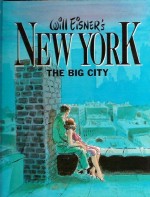
With a fascinating biography and commentary from historian and publisher Cat Yronwoode this book is a lavish treat for Eisner aficionados, but the treats still aren’t exhausted: there are also rare colour works and illustrations from Cosmos magazine and Esquire, plus poster art, unpublished Spirit paintings and a preview of his then forthcoming book Big City…

Will Eisner is rightly regarded as one of the greatest writers in American comics but it is too seldom that his incredible draughtsmanship and design sense get to grab the spotlight. This book is a joy no fan or art-lover can afford to be without.
© 1981 Will Eisner. All rights reserved.

Comics at War


By Denis Gifford (Hawk Books)
ISBN: 978-0-96824-885-6

Often the books we write about our comics are better than the stories and pictures themselves: memorable, intensely evocative and infused with the nostalgic joy that only passing years and selective memory bestows.

That’s not in any way to denigrate or decry the superb works of the countless, generally unlauded creators who brightened the days of generations of children with fantastic adventures and side-splitting gags in those so flimsy, so easily lost and damaged cheap pamphlets, but rather because of an added factor inherent in these commemorative tomes: by their very existence they add the inestimable value and mystery of lost or forgotten treasures into the mix.

A perfect example of this is today’s wonderful item, a copious and huge chronicle released as an anniversary item in 1988 celebrating the wartime delights rationed out to beleaguered British lads and lasses, compiled by possibly the nation’s greatest devotee and celebrant of child-culture.

Denis Gifford was a cartoonist, writer, TV show deviser and historian who loved comics. As both collector and creator he gave his life to strips and movies, acquiring items and memorabilia voraciously, consequently channelling his fascinations into more than fifty books on Film, Television, Radio and Comics; imparting his overwhelming devotion to a veritable legion of fans.

If his works were occasionally short on depth or perhaps guilty of getting the odd fact wrong, he was nevertheless the consummate master of enthusiastic remembrance. He deeply loved the medium in concept and in all its execution, from slipshod and rushed to pure masterpieces with the same degree of passion and was capable of sharing – infecting almost – the casual reader with some of that wistful fire.

With hundreds of illustrative examples culled from his own collection this volume was released to commemorate the outbreak of World War II and revels in the magnificent contribution to morale generated by a battalion of artists and (usually anonymous) writers, covering the output of an industry that endured and persevered under appalling restrictions (paper was a vital war resource and stringently rationed), inciting patriotic fervour and providing crucial relief from the stresses and privation of the times.

Abandoning academic rigour in favour of inculcating a taste of the times this 160 page book reprints complete sample strips of the period beginning with the affable tramps and cover feature of Jester, Basil and Bert (by George Parlett), covering the start of the war in four strips from January to November 1939, before dividing the collection into themed sections such as ‘Be Prepared’ (with examples of Norman Ward’s Home Guard heroes Sandy and Muddy from Knock-Out and John Jukes’ Marmaduke, the Merry Militiaman from Radio Fun.

‘At War With the Army’ displays the ordinary Englishman’s perennial problem with Authority- displaying Koko the Pup and Desperate Dan (by Bob MacGillivray and Dudley Watkins from D.C. Thomsons’ Magic and The Dandy), Weary Willie and Tired Tim (from Chips and superbly rendered by Percy Cocking), as well as stunning two-tone and full colour examples from Tip-Top, The Wonder and others.

‘Tanks a Million!’ finds selections from the height of the fighting, and brings us head-on into the controversial arena of ethnic stereotyping. All I can say is what I always do: the times were different. Mercifully we’ve moved beyond the obvious institutionalised iniquities of casual racism and sexism and are much more tolerant today (unless you’re obese, gay, a smoker or childless and happy about it), but if antiquated attitudes and caricaturing might offend you, don’t read old comics – it’s your choice and your loss.

The strip that started this tirade was an example of Stymie and his Magic Wishbone from Radio Fun (a long-running strip with a black boy-tramp in the tradition of minstrel shows) from a chapter dealing with the comic strip love-affair with armoured vehicles and includes many less controversial examples from Tiger Tim’s Weekly, Knock-Out, Chips and Dandy, featuring stars such as Our Ernie, Our Gang, Stonehenge, Kit the Ancient Brit and Deed-A-Day Danny.

…And if you think we were hard on innocent coloured people just wait till you see the treatment dealt to Germans, Italians and Japanese by our patriotic cartoonists…

‘At Sea with the Navy!’ highlights nautical manoeuvres from Casey Court (Chips, by Albert Pease), Rip Van Wink (Beano, James Crichton), Lt. Daring and Jolly Roger (from Golden, by Roy Wilson, Billy Bunter (Knock-Out, by Frank Minnitt), Hairy Dan (Beano, Basil Blackaller) and Pitch and Toss (Funny Wonder, Roy Wilson again) whilst ‘Sinking the Subs’ takes us below the surface with Our Ernie, Desperate Dan, Koko, Pansy Potter, Alfie the Air Tramp and Billy Bunter.

Britain’s fledgling flying squad takes centre-stage with ‘In the Air with the R.A.F.’ featuring Freddie Crompton’s Tiny Tots, Korky the Cat from Dandy, The Gremlins (Knock-Out, by Fred Robinson) and Koko the Pup.

‘Awful Adolf and his Nasty Nazis!’ demonstrates just what we all thought about the Axis nations and even indulges in some highly personal attacks against prominent personages on the other side beginning with Sam Fair’s riotously ridiculing Addie and Hermy, (Beano‘s utterly unauthorised adventures of Hitler and Goering), whilst Our Ernie, Lord Snooty, Pitch and Toss, Big Eggo (Beano, by Reg Carter), Plum and Duff (Comic Cuts, Albert Pease) and the staggeringly offensive Musso the WopHe’s a Big-a-Da-Flop, (Beano, Artie Jackson and others) all cheered up the home-front with devastating mockery.

‘Doing Their Bit’ gathers wartime exploits of the nation’s stars and celebrities (turning Britain’s long love affair with entertainment industry stars into another bullet at the Boche. Strips featuring Tommy Handley, Arthur Askey, Charlie Chaplin, Jack Warner, Flanagan and Allen, Haver and Lee, The Western Brothers, Sandy Powell, Old Mother Riley featuring Lucan & McShane, Claude Hulbert, Duggie Wakefield, Joe E. Brown, Harold Lloyd, Lupino Lane and Laurel and Hardy re-presented here were collectively illustrated by Reg and George Parlett, Tom Radford, John Jukes, Bertie Brown, Alex Akerbladh, George Heath, Norman Ward and Billy Wakefield.

The kids themselves are the stars of ‘Evacuation Saves the Nation!’ as our collective banishment of the cities’ children produced a wealth of intriguing possibilities for comics creators. Vicky the Vacky (Magic, George Drysdale), Our Happy Vaccies (Knock-Out, by Hugh McNeill) and Annie Vakkie (Knock-Out, by Frank Lazenby) showed readers the best way to keep their displaced chins up whilst ‘Blackout Blues!’ find the famous and commonplace alike suffering from night terrors.

Examples here include Grandma Jolly and her Brolly, Will Hay, the Master of Mirth, Ben and Bert, Barney Boko, Crusoe Kids, Grandfather Clock, Constable Cuddlecock and Big Ben and Little Len whilst ‘Gas Mask Drill’ sees the funny side of potential asphyxiation with choice strips such as Stan Deezy, Hungry Horace, Deed-A-Day Danny, Big Eggo, Good King Coke and Cinderella.

‘Barrage Balloons!’ lampoons the giant sky sausages that made life tricky for the Luftwaffe with selections from Luke and Len the Odd-Job Men (from Larks by Wally Robertson), It’s the Gremlins, Alfie the Air Tramp, and In Town this Week from Radio Fun, whilst ‘Tuning Up the A.R.P.!’ deals out the same treatment to the volunteers who patrolled our bombed-out streets after dark. The Air Raid Precautions patrols get a right sending up in strips starring Deed-A-Day Danny, Big Eggo, P.C. Penny, Ben and Bert, Marmy and His Ma, Lord Snooty and his Pals, The Tickler Twins in Wonderland, Our Ernie, Tootsy McTurk, Boy Biffo the Brave and Pa Perkins and his Son Percy.

The girls get a go in the vanguard with ‘Wow! Women of War!’ starring Dandy‘s Keyhole Kate and Meddlesome Matty (by Allan Morley and Sam Fair respectively), Dolly Dimple (Magic, Morley again), Tell Tale Tilly, Peggy the Pride of the Force, Pansy Potter the Strongman’s Daughter, Big Hearted Martha Our A.R.P. Nut and Kitty Clare’s Schooldays whilst the Home Guard stumble to the fore once more in a section entitled ‘Doing Their Best’ with examples from Tootsy McTurk (Magic, John Mason), Casey Court, Lord Snooty, Deed-A-Day Danny, and Big Eggo.

Imminent invasion was in the air and the cartoonist responded with measured insolence. ‘Hop It, Hitler!’ displays our fighting spirit with examples such as Bamboo Town (Dandy, Chick Gordon), Sandy and Muddy, Pansy Potter, the astonishingly un-PC Sooty Snowball, Hair-Oil Hal Your Barber Pal and Stonehenge Kit, whilst espionage antics are exposed in ‘I Spy Mit Mein Little Eye!’ in Laurie and Trailer the Secret Service Men, more Sandy and Muddy, Herr Paul Pry, Big Eggo and Lord Snooty.

‘Wireless War!’ celebrates both radio stars and enemy broadcasts with a selection from Tommy Handley, Troddles and his Pet Tortoise Tonky-Tonk, Happy Harry and Sister Sue, Crackers the Perky Pup, Our Gang and a couple of examples of John Jukes’ spectacularly wicked Radio Fun strip Lord Haw-Haw – The Broadcasting Humbug from Hamburg.

‘To Blazes With the Firemen!’ is a rather affectionate and jolly examination of one of the toughest of home-front duties with a selection of strips including Podge (who’s dad was a fire-fighter, drawn by Eric Roberts for Dandy), Casey Court, Pansy Potter and In Town This Week.

Rationing was never far from people’s minds and an art-form where the ultimate reward was usually “a slap-up feed” perfectly lambasted the measures in many strips. Examples here include The Bruin Boys from Tiny Tim’s Weekly, Freddy the Fearless Fly (Dandy, Allan Morley), Cyril Price’s vast ensemble cast from Casey Court (Chips), Our Ernie and Dudley Watkins’ Peter Piper from Magic, all in need of ‘Luvly Grub!’

Under the miscellaneous sub-headings of ‘Salvage’, ‘Comical Camouflage!’, ‘Workers Playtime!’ and ‘Allies’, strips featuring Ronnie Roy the Indiarubber Boy, Ding Dong Dally, Desperate Dan, Tin-Can Tommy the Clockwork Boy, Big Hearted Arthur and Dicky Murdoch and other stalwarts all gather hopeful momentum as the Big Push looms and this gloriously inventive and satisfying compilation heads triumphantly towards its conclusion.

‘V for Victory!’, wherein a telling gallery of strips celebrating the war’s end and better tomorrows features final sallies from Casey Court, Weary Willie and Tired Tim, a stunning Mickey Mouse Weekly cover by Victor Ibbotson, Its That Man Again – Tommy Handley, Laurel and Hardy and from Jingles, Albert Pease has the last word with ‘Charlie Chucklechops Speaking… About New Uses for Old War materials’…

Some modern fans find a steady diet of these veteran classics a little samey and formulaic – indeed I too have trouble with some of the scripts – but the astonishing talents of the assembled artists here just cannot be understated. These are great works by brilliant comic stylists which truly stand the test of time. Moreover, in these carefully selected, measured doses the tales here from a desperate but somehow more pleasant and even enviable time are utterly enchanting. This book is long overdue for a new edition and luckily for you is still available through many internet retailers.
Text and compilation © 1988 Denis Gifford. © 1988 Hawk Books. All rights reserved.

Ding Dong Daddy From Dingburg (Zippy Annual #10)


By Bill Griffith (Fantagraphics Books)
ISBN: 978-1-60699-389-7

Starting life as an underground cartoon in 1971, Bill Griffith’s absurdist commentary on American society has grown into such a prodigious and pervasive counter-culture landmark that it’s almost a bastion of the civilisation it constantly scrutinises. Almost: there’s still a lot of Americans who don’t like and certainly don’t get Zippy the Pinhead.

Legendarily based on the microcephalic Schlitzie from Tod Browning’s controversial 1932 film “Freaks” and P.T. Barnum’s carnival attraction Zip the Pinhead, Griffith’s Muu-Muu clad simpleton first appeared in Real Pulp Comix #1 (March 1971) and other scurrilous home-made commix before winning a regular slot in the prominent youth culture newspaper The Berkley Barb in 1976. Soon picking up syndication across America and the world, Zippy “dropped in” when in 1985 King Features began syndicating the strip, launching it in the San Francisco Examiner.

Zippy’s ruminations and dada-ist anti-exploits have expanded over the years to include his own nuclear family and cat, a peculiar cast of iconic semi regulars like Mr. The Toad, embodiment of Capitalism, Griffy (an analogue of the cartoonist creator) and brother Lippy (a conceptual and ideological opposite in the grand tradition of Happy Hooligan’s sibling Gloomy Gus: Lippy is the epitome of the average mainstream US citizen) plus an entire town of like-minded pinheads – Dingburg.

The strip follows few conventions although it is brilliantly drawn. Plot-lines and narratives, even day to day traditional gags are usually eschewed in favour of declamatory statements of absurdist, quasi-philosophical and often surreal concept-strings that resemble word (and occasionally picture) association or automatic writing, all highlighting the ongoing tsunami of globalisation as experienced by every acme of our modern culture from the latest fad in consumer electronics to celebrity fashion and “newsfotainment”.

The strip is the home of the damning non-sequitur and has added to the global lexicon such phrases as “Yow!” and “Are we having fun yet?”

Being free of logical constraint and internal consistency, Zippy’s daily and Sunday forays against The Norm can encompass everything from time travel, talking objects, shopping lists, radical philosophy, caricature, packaging ingredients, political and social ponderings and even purely visual or calligraphic episodes. It is weird and wonderful and not to everybody’s tastes…

This current volume (16 and counting) is broken into themed segments beginning with an extended tour of his home town: meeting the everyday folk and getting to know them in ‘Back to Dingburg’, which is followed by a selection of informed conversations with three dimensional commercial signage and advertising statuary in ‘Roadside Attractions’.

The central section reprints a selection of ‘Sunday Color’ strips, followed by a collection of muses and meanderings between character and creators via ‘Zippy and Griffy’ cunningly counter-pointed by a extended sequence of existential ripostes, spiritual revelations and biblical revisions when ‘God’ comes for an uninvited visit to Dingburg.

‘The Usual Suspects’ introduces new readers to such luminaries as Mr. The Toad, and recurring topics such as the spoof comic-strip-within-a-strip Fletcher and Tanya, before the book concludes with a brief but illuminating conglomeration of strips featuring the pinhead as a boy in the pastiche-frenzied  ‘Little Zippy.’

The collected musings of America’s most engaging Idiot-Savant have all the trappings of the perfect cult-strip and this latest volume finds cretin and creator on absolute top form. If you like this sort of stuff you’ll adore this enticing slice of it. Yow!

© 2008, 2009, 2010 Bill Griffith. All rights reserved.

Dr. Watchstop: Adventures in Time and Space


By Ken Macklin (Eclipse Books)
ISBN: 0-913035-85-8

Before becoming a successful games artist for LucasArts graphic adventure games (I don’t actually grok push-button fun but I gather that Maniac Mansion, Loom, the second and third Monkey Island contraptions and the character Bubsy the bobcat number among his electronic hits) Ken Macklin was an underground/small press creator who delighted in cleverly whimsical and witty funny animal strips during the late 1970s in indy publications such as Quack!

Married to equally talented anthropomorphic raconteur Lela Dowling, he assisted and contributed to her marvelously manic Weasel Patrol tales, which were published in the lost and long-lamented sci-fi anthology Fusion whilst producing his own diabolically wonderful one-shot space opera romp Contractors and the stimulating vignettes gathered here.

As well as a talented designer and illustrator Macklin is a gifted painter and slyly devious writer and in 1982 he began selling brief, luxurious mini-epics starring an astonishingly brilliant but outrageous innocent multi-discipline savant named Dr. Watchstop to Epic Illustrated and Fusion: high quality graphic fantasy magazines aimed at older readers.

In an era where science fiction was synonymous with and indistinguishable from cops and cowboys with blasters, Watchstop’s antics were contemplative, slapstick, wickedly ironic, eyes wide-open wonderments that only saw the ridiculous side of technology and the future cosmos…

Still readily available this oversized compilation gathers all those marvelously intellectual, winningly funny spoofs and japes, opening in glorious painted colour with ‘Dr. Watchstop Faces the Future’ (Epic #10 February 1982), possibly the last word in time paradox tales, followed by an amoebic dalliance ‘One Cell at a Time’ before demonstrating the downside of ancient alien artifacts in ‘Time Bomb’ (Epic #14 and #17 respectively).

If possible Macklin’s art is even better as monochrome tonal washes, as perfectly illustrated in the hilarious ‘Unique Specimen’ (Fusion #1, January 1987), life-through-a-lens fable ‘Modern Culture’ (Fusion #3) and natural history segments ‘Right Stuff’ (Fusion #7) and ‘Bugs’ (Fusion #5).

‘Relic’ (Fusion #2) is pure Future Shock whilst full-colour ‘The Single Electron Proof’ from Epic #21(September 1983, and with the timely assistance of Toren Smith) will stretch the higher mathematics prodigies amongst us with a little metaphysical tomfoolery.

Epic #29 provided a first home for ‘In Search of Ancient Myths’, #33 both ‘Reaching Out’ and ‘Beating the Heat’ whilst the last colour cosmic conundrum ‘Wasting Time’ debuted in #34. The remainder of this collection features more black and white antics from Fusion, beginning with the vaudevillian ‘Gone Fishing’ (#4), moving adroitly into ‘Xlerg’s Fossil Emporium’ (#8) and anarchically culminating in a riotous Weasel Patrol collaboration enigmatically entitled ‘The Weasels Fill In’ from Fusion #9 (May 1988)

Sheer artistic ability and incisive comedy for smart people is never going to be out of style and this stellar compilation will be a constant joy for any fan smart enough to unearth it.
© 1989 Ken Macklin, and where appropriate Raymond E. Feist, Toren Smith, Lela Dowling and LX Ltd. All rights reserved.