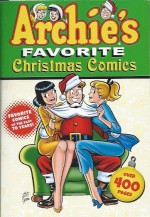
Archie’s Favorite Christmas Comics


By many and various (Archie Comics)
ISBN: 978-1-936975-80-8

Win’s Christmas Gift Recommendation: For All Good Girls & Boys Who’ve Been Nice This Year 9/10

As long-term readers might recall, my good lady wife and I have a family ritual we’re not ashamed to share with you. Every Christmas we barricade the doors, draw the shutters, stockpile munchies and stoke up the radiators before settling down with a huge pile of seasonal comics from yesteryear.

There’s a few older DC’s, loads of Disney’s and some British annuals, but the vast preponderance is Archie Comics. From the earliest days this too-often neglected comics institution has quite literally “owned Christmas” with a gloriously funny, charming, nostalgically sentimental barrage of cannily-crafted stories capturing the spirit of the season through a range of comicbooks running from Archie to Veronica, Betty to Sabrina and Jughead to Santa himself…

For most of us, when we say comicbooks people’s thoughts turn to buff men and women in garish tights hitting each other, bending lampposts and lobbing trees or cars about, or stark, nihilistic crime, horror or science fiction sagas aimed at an extremely mature and sophisticated readership of confirmed fans – and indeed that has been the norm of late.

Throughout the years though, other forms and genres have waxed and waned but one that has held its ground over the years – although almost completely migrated to television these days – is the genre of teen-comedy begun by and synonymous with a carrot topped, homely (at first just plain ugly) kid named Archie Andrews.

MLJ were a small publisher who jumped on the “mystery-man” bandwagon following the debut of Superman. In November 1939 they launched Blue Ribbon Comics, promptly following-up with Top-Notch and Pep Comics. The content was the common blend of funny-book costumed heroes and two-fisted adventure strips, although Pep did make a little history with its first lead feature The Shield, who was the American industry’s first superhero to be clad in the flag (see America’s 1st Patriotic Hero: The Shield)

After initially revelling in the benefits of the Fights ‘N’ Tights game, Maurice Coyne, Louis Silberkleit and John Goldwater (MLJ, duh!) spotted a gap in their blossoming market and in December 1941 the costumed cavorters and two-fisted adventurers were gently nudged aside – just a fraction at first – by a wholesome, improbable and far-from-imposing new hero; an unremarkable (except, perhaps, for his teeth) teenager who would have ordinary adventures just like the readers, but with the laughs, good times, romance and slapstick emphasised.

Almost certainly inspired by the hugely popular Andy Hardy movies, Goldwater developed the concept of a youthful everyman protagonist and tasked writer Vic Bloom & artist Bob Montana with the job of making it work. Their precocious new notion premiered in Pep #22: a gap-toothed, freckle-faced, red-headed kid obsessed with impressing the pretty blonde girl next door.

A 6-page untitled tale introduced hapless boob Archie Andrews and wholesomely pretty Betty Cooper. The boy’s unconventional best friend and confidante Jughead Jones also debuted in the first story as did idyllic small-town utopia Riverdale. It was a huge hit and by the winter of 1942 the kid had won his own title.

Archie Comics #1 was MLJ’s first non-anthology magazine and with it began the slow transformation of the entire company. With the introduction of ultra-rich, raven-haired Veronica Lodge, all the pieces were in play for the industry’s second Genuine Phenomenon…

By 1946 the kids were in charge, so MLJ became Archie Comics, retiring most of its costumed characters years before the end of the Golden Age to become, to all intents and purposes, a publisher of family-friendly comedies. The hometown settings and perpetually fruitful premise of an Eternal Romantic Triangle – with girl-hating best bud Jughead Jones and scurrilous rival Reggie Mantle to test, duel and vex our boy in their own unique ways – the scenario was one that not only resonated with the readership but was infinitely fresh…

Archie’s success, like Superman’s, forced a change in content at every other publisher (except perhaps Gilberton’s Classics Illustrated) and led to a multi-media brand which encompasses TV, movies, newspaper strips, toys and merchandise, a chain of restaurants and, in the swinging sixties, a pop music sensation when Sugar, Sugar – from the animated TV cartoon – became a global pop smash. Clean and decent garage band “The Archies” has been a fixture of the comics ever since…

That Andrews boy is good-hearted, impetuous and lacking common sense, Betty his sensible, pretty girl next door who loves the ginger goof, and Veronica is rich, exotic and glamorous: only settling for our boy if there’s nobody better around. She might actually love him too, though. Archie, of course, is utterly unable to choose who or what he wants…

The unconventional, food-crazy Jughead is Mercutio to Archie’s Romeo, providing rationality and a reader’s voice, as well as being a powerful catalyst of events in his own right. That charming triangle (and annexe) has been the rock-solid foundation for seven decades of funnybook magic. Moreover the concept is eternally self-renewing…

This eternal triangle has generated thousands of charming, raucous, gentle, frenetic, chiding and even heart-rending humorous dramas ranging from surreal wit to frantic slapstick, with the kids and a constantly expanding cast of friends (boy genius Dilton Doily, genial giant jock Big Moose and aspiring comicbook cartoonist Chuck amongst many others) growing into an American institution and part of the nation’s cultural landscape.

The feature has thrived by constantly re-imagining its core archetypes; seamlessly adapting to the changing world outside its bright, flimsy pages, shamelessly co-opting youth, pop culture and fashion trends into its infallible mix of slapstick and young romance. Each and every social revolution has been painlessly assimilated into the mix and, over the decades, the company has confronted most social issues affecting youngsters in a manner always both even-handed and tasteful.

Constant addition of new characters such as African-American Chuck and his girlfriend Nancy, fashion-diva Ginger, Hispanic couple Frankie and Maria and spoiled home-wrecker-in-waiting Cheryl Blossom have contributed to a wide and appealingly broad-minded scenario. In 2010 Archie jumped the final hurdle when openly gay Kevin Keller became an admirable advocate capably tackling and dismantling the last major taboo in mainstream Kids’ comics.

One of the most effective tools in the company’s arsenal has been the never-failing appeal of the seasons and holiday traditions. In Riverdale it was always sunny enough to surf at the beach in summer and it always snowed at Christmas…

The Festive Season has never failed to produce great comics stories. DC especially have since their earliest days perennially embraced the magic of the holiday with a decades-long succession of stunning and sentimental Batman thrillers – as well as many other heroic team-ups incorporating Santa, Rudolph and all the rest.

Archie too started early and kept on producing year-end classics. The stories became so popular and eagerly anticipated that in 1954 the company created a specific title – Archie’s Christmas Stocking – to cater to the demand, even as it kept the winter months of its other periodicals stuffed with assorted tales of elves and snow and fine fellow-feeling…

This splendidly appealing, cheap-&-cheerful full-colour pocket-digest (as long as your pockets are both deep and strong), gathers and re-presents a superb selection of cool Yule extravaganzas of ancient and relatively recent vintages which begins, after jolly, informative Introduction ‘Christmas in Riverdale!’ from Paul Castiglia, with a selection from ‘The Early Years’.

It naturally kicks off with ‘Archie Andrews’ Christmas Story’ by Montana (from Jackpot Comics #7 1942) wherein our hapless boy wonder is even more obvious than usual and ends up with a surfeit of the same present from everybody he cares about. His antics to offload the unwanted extras lead to a painful comeuppance…

Also from 1942 and Montana, ‘The Case of the Missing Mistletoe’ debuted Archie #1, and found Archie and Jughead at loggerheads after unknowingly taking identical twins to a party whilst a few unchanging years later ‘Christmas Cheers’ (Pep Comics #46, 1944, by Harry Sahle, Ed Goggin & Ginger) saw the red-headed fool in deep trouble after losing his diligently deliberated present list – and all his savings…

The next two tales originate from Archie Giant Series #5, 1958, and are both by Dan DeCarlo, Rudy Lapick & Vincent DeCarlo, beginning with ‘Generous to a Fault’ wherein Betty and Veronica convince all the boys in town to elect the most “giving” among them from over the last year and instigate a major riot, whilst ‘Seasonal Smooch’ sees Reggie abusing mistletoe privileges with agonising consequences…

The theme of ‘Christmas Trees and Decorations’ opens with ‘A Christmas Tale’ (Life With Archie #33, 1965 by Frank Doyle, Bob White & Marty Epp) as arch-rivals Andrews and Mantle try to establish the manly pecking order by competing to cut down the best tree before ‘ ‘Tis the Season for Extreme Decorating’ (Betty & Veronica Spectacular #80 2007, by Dan Parent, Rich Koslowski, Barry Grossman & Jack Morelli) finds the distaff competitors succumbing to another bout of insane one-upmanship over who can spruce up and illuminate a home best…

When loaded Mr. Lodge hires ‘Tree Experts’ (Veronica #191, 2009 by Mike Pellowski, Parent, Jim Amash, Grossman & Morelli) to trim the Mansion’s huge pine, Archie’s wistful nostalgia produces a sentimental change of heart before ‘Price Clubbed’ (Archie Digest #248, 2008, Pellowski, Randy Elliott & Bob Smith) finds him and his own dad spending special time obtaining their tree. The chapter concludes with Betty & Veronica one-pager ‘Snow Flakes’ featuring some punishingly accurate satirical snowmen…

‘Gifts and Giving’ opens with a ‘Holiday Rush’ (Holiday Fun Digest #11 2006 from Pellowski, Tim Kennedy, Koslowski, Grossman & Morelli) as Betty and Veronica bemoan the early advent of Xmas overload, ‘Gift Exchange’ (Betty & Veronica #87 1965, Doyle, Dan & Vincent DeCarlo) then deals with the repercussions of the little rich girl giving her friends away – as presents – and ‘Christmas Misgivings’ (Veronica #60 1997, Barbara Slate, Jeff Shultz, Rudy Lapick, Grossman & Bill Yoshida) sees her friends reactions after they all sneak a peek in Ronnie’s shopping bags and reach all the wrong conclusions about who’s getting what…

‘Stamp of Approval’ (Archie Giant Series #6 1959 by Doyle, Dan DeCarlo, Lapick Sheldon Brodsky & Vincent DeCarlo) sees Betty obsessed with collecting Green Stamps to offset her regular lack of funds for presents whilst ‘Gift Exchange’ (Holiday Fun Digest #11 2006 by Pellowski, Tim Kennedy & Al Nickerson) finds Chuck and Big Moose inadvertently selecting perfect prezzies for their girlfriends by mixing up their purchases…

‘Snuggle Up’ (Betty & Veronica #244, 2009 by Parent, Shultz, Koslowski, Grossman & Morelli) then reveals how the loaded Lodge lass really feels about the hideous thing Archie got for her when left all alone…

‘Fit to be Yuletide’ (Jughead #125, by Craig Boldman, Rex Lindsey, Koslowski, Grossman & Morelli from 2000) follows snide sidekick Juggy as he goes to extraordinary lengths to find the perfect present for his arch-enemy Trula Twist after which selfish, conceited Reggie surprises everyone when they follow to see how he actually spends his holidays in ‘The Gift Horse Laugh!’ from Archie Digest #248, (2008 by Pellowski, Pat Kennedy & Ken Selig).

The next selection concentrates on ‘Playing Santa’, opening with ‘Wanted: Santa Claus’ (Archie and Me #26 from 1969, by Joe Edwards & Jon D’Agostino) wherein long-suffering School Principal Mr. Weatherbee pines for the annual dress-up role he claims to despise and ‘Santa Claws’ (Archie Digest #248, 2008 from Bill Golliher, Pat Kennedy & Amash) sees our red-headed loon deeply regretting accepting the opportunity to make extra cash by being the Santa in a pet shop.

Even more upset is the raven-haired rich girl when she inveigles the position of ‘Santa’s Little Helper’ (Veronica #176, 2007 Parent, Amash, Grossman & Teresa Davidson) to be near Archie yet ends up as elf assistant to a creepy stalker-nerd before enjoying a jumbo crop of jolly red fellows after announcing there’s a ‘Santa Shortage’ (Betty & Veronica #231, 2008 by Pellowski, Shultz & Al Milgrom) at a party for needy kids. The chapter concludes with a vivacious pin-up of ‘Veronica’s Christmas Card’…

‘Santa and His Elves’ opens with ‘Playing Santa’ from Jughead & Friends Digest #35 (2010 by Pellowski, Fernando Ruiz, Milgrom, D’Agostino & Grossman) as a posse of pixies pressgang laconic young Mr. Jones into making the all-important delivery run as St. Nick is out of action, after which elfin Lisa seemingly spoils the Season of Giving with her new-fangled online ordering website to replace letters to Santa. Oddly, things work out fine anyway, as everyone gets ‘Surprise Presents’ (Archie Digest #248, 2008 by George Gladir, Shultz, Koslowski, Morelli & Grossman)…

‘Pizza and Good Cheer’ (Jughead’s Double Digest #145, 2009 from Pellowski, Ruiz, Nickerson, Morelli & Grossman) displays Jughead at his most engaging when the greedy goof wins a year’s worth of pies and hands them out to Riverdale’s destitute, unaware that the ever-watching little people have had a hand in his generous gesture…

This section then slapsticks to a sharp stop via a typically rambunctious pin-up of ‘Archie’s Christmas Card’…

Jingles the Elf has been an Archie regular for decades and ‘Santa’s Sprites’ raids the archives for some of his best moments, beginning with first appearance ‘A Job for Jingles’ from Archie Giant Series #10 (1961 by Doyle, Dan DeCarlo, Lapick & Vincent DeCarlo) as the playful imp – who cannot be seen by adults – spends his day off just like any normal kid.

He resurfaced in ‘Return of Jingles’ (Archie Giant Series #20, 1963 by the same creative team) but found himself upstaged by a brace of his workbench associates who wanted to see for themselves how much fun humans have, but in ‘Season of Magic’ (Archie Giant Series #158, 1969, Doyle, White & Yoshida) Jingles met his puckish, pranksterish match when Reggie decided to teach him a lesson…

Perhaps it was in retaliation for ‘Treed’ (Archie Giant Series #150, 1968 Doyle, Al Hartley & Yoshida) wherein Jingles aided and abetted Archie in the yearly ritual of impressing Ronnie by chopping down a Christmas fir for the Lodge Mansion…

Rivalry resulted in sweet music in ‘Jingles Rocks’ (Archie & Friends #21, 2012 by Golliher, Lapick, Grossman & Yoshida) when the showy sprite tried out as lead singer in Archie’s band but had to make some radical wardrobe changes to be seen and heard by the over-21s…

Always adept at seeing issues from the female point of view, the editors soon added a feminine counterpart to Jingles; someone with the same magical powers and festive mission, but a bitter despised rival – and in a miniskirt…

‘Some Things Never Change’ (Betty & Veronica #156, 2001 by Kathleen Webb, Shultz & Henry Scarpelli) saw effusive Sugar Plum Fairy pop in for her annual visit only to find the too-cool kids already out of Christmas cheer. Her solution is carol singing…

Another year and Webb, Dan DeCarlo, Grossman & Yoshida crafted ‘Visions of a Sugar Plum’ (Betty & Veronica #108, 1997). Now it was the twinkly sprite who couldn’t catch the mood – until B & R convinced her to turn human-sized and come shopping. Everything was fine until hunky elf boyfriend Troll – the cause of her Yule blues – came to Riverdale to find her and made a lasting impression on the town’s available young ladies…

In ‘Tis the Season to be Jolly’ (Betty & Veronica #120, 1998, Webb, Dan DeCarlo, Alison Flood, Grossman & Yoshida) Sugar Plum brought flu-ridden Ronnie a stolen dose of Santa’s special pick-me-up – and the cure proved worse than the ailment – whilst in ‘She’s So Gifted’ (Veronica #191, 2009 by Parent & Amash) the fairy comforted our spoiled heiress after everybody decided to make presents and Ronnie found she had no talent for anything. At least that’s what she thought until Sugar Plum pointed out the obvious thing she’s overlooked…

Santa himself sent Sugar to sort out a depletion of seasonal cheer afflicting B & V in ‘The Gifted’ (Betty & Veronica #169, 2002 Webb, Shultz, Scarpelli, Yoshida &Grossman) whilst an all-out magic war broke out in Riverdale when ‘Holiday Watch’ (Betty & Veronica #244, 2009 by Parent, Shultz, Koslowski, Morelli & Grossman) saw the Fairy and Jingles vying for the young mortals’ attentions before ‘Jingles All the Way’ (Betty & Veronica Spectacular #86, 2009 by Parent, Koslowski, Rosario “Tito” Peña & Morelli) proves an old truism when the elfin enemies – thanks to Betty, Ronnie and Archie – are convinced to quit hissing and start kissing…

The merriment then concludes with manga-styled ‘The Naughty Clause’ (Archie #639, 2013 by Alex Segura, Gisele, Koslowski, Digikore Studios & Morelli) as Jingles takes the entire gang to the North Pole so Santa can give Reggie a little personal attitude adjustment…

‘Once upon a Yuletide’ focuses on the odder ends of Archie history with ‘A Children’s Story’ coming from The Adventures of Little Archie #29, (Winter 1963-64 by amazing one-man band Dexter Taylor) which see the little red-headed scamp entertain a lost Santa Claus from a strange other world whilst ‘Let it Snow’ (from Archie’s Weird Mysteries #18, 2002 by Paul Castiglia, Ruiz, Koslowski, Stephanie Vozzo & Vickie Williams) introduces a quartet of seasonal superheroes to while away a quiet night of tale-telling. The fanciful feast finishes with two half-page gag-fests starring Dan DeCarlo’s Sabrina the Teenage Witch enduring a ‘Hanging Hang-Up’ and experiencing ‘Foto Fun’…

A selection of ‘Winter Wonderland’ escapades starts with ‘Ski-Cart Catastrophe’ from Laugh Comics #300 (1976, by George Gladir, Sal Amendola, D’Agostino, Grossman & Yoshida) wherein the lads covert a shopping cart into an idiot-powered ski-mobile, resulting in many pains for them and pained looks from the girls after which golden greats of slapstick Frank Doyle & Harry Lucey treat us to a ‘Slay Ride’ (Archie Giant Series #5, 1958) wherein Archie and a borrowed horse make much manic mischief in the Lodge Mansion…

‘Frosty Fairy Tales’ (Betty & Veronica #120, 1998 by Pellowski, Dan DeCarlo, Grossman & Yoshida) sees Betty get the good-looking guy – but not Archie – when she and Ronnie go skiing and it all concludes with a silent romantic interlude involving ‘Snowmobile Snuggles’…

‘Holiday Party Time’ shows the gang at their best and worst starting with ‘Party Time’ (Betty & Veronica Double Digest #176, 2010 by Gladir, Shultz & D’Agostino) as Ronnie refuses to give up a long planned-for ball by merging it with a charity supper after her guests all decide to help the needy…

Her soiree for the town’s pets is much less of a hit with the ‘Party Dogs’ (Betty & Veronica #222, 2007, Gladir, Shultz & Milgrom) but some ‘Give and Take’ (Archie Digest #258, 2009, Parent, Amash & Grossman) turns a pot-luck shindig into the roaring success of the season. After voracious Jughead accidentally eats all the treats intended for Riverdale Orphanage he pulls out all the stops to ensure ‘The Party’ (Betty & Veronica Digest #189, 2009, Gladir, Shultz & D’Agostino, Morelli & Grossman) is still a howling hit…

Closing out this epic tome is a hearty heaping of ‘Christmas Spirit’ beginning with ‘You’re Cooked’ (Veronica #176, 2007 by Parent, Amash, Grossman& Teresa Davidson) as Betty teaches infamous Anti-chef Ronnie how to cook something festive – and Juggy descends like a locust – whilst ‘She Needs a Little Christmas’ (Betty & Veronica #132, 1999, Webb, Dan DeCarlo, Scarpelli, Grossman & Yoshida) finds him teaching the rich miss a few things about flaunting her wealth…

Ronnie’s social credibility takes a mortal hit when the true origin of the hyper-prestigious and ultra-exclusive Lodge family Christmas confection is revealed in ‘A Couple of Fruitcakes’ from Betty & Veronica #169 (2002 by Webb, Shultz & Scarpelli) and an impromptu sing-along turns into an inclusive town event in ‘Here We Come A-Caroling’ (Holiday Fun Digest #8, 2003, by Greg Crosby, Tim Kennedy, Lapick & Yoshida) before all the graphic good will pops to a stop with a deep dip into ‘Archie’s Holiday Fun Scrapbook’ (Holiday Fun Digest #12, 2007, by Parent) offering revealing glances at the Riverdale gang over many happy years.

These are perfect stories for young and old alike, crafted by a host of Santa’s most talented Helpers, epitomising the magic of the Season and celebrating the perfect wonder of timeless children’s storytelling. What kind of Grinch could not want this book in their kids’ stocking (from where it can most easily be borrowed)?
© 2014 Archie Comics Publications, Inc. All rights reserved.
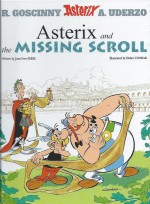
Asterix and the Missing Scroll


By Jean-Yves Ferri & Didier Conrad, translated by Anthea Bell (Orion Books)
ISBN: 978-1-4440-

Win’s Christmas Gift Recommendation: A Classical Way to Celebrate the Season… 9/10

Asterix debuted in 1959 and has since become part of the fabric of French life. His exploits have touched billions of people all around the world for five and a half decades and for almost all of that time his astounding adventures were the sole preserve of originators Rene Goscinny and/or Albert Uderzo.

After nearly 15 years as a weekly comics part-work subsequently collected into book-length compilations, in 1974 the 21st saga – Asterix and Caesar’s Gift – became the first to be released as a complete, original album prior to serialisation. Thereafter each new tome was an eagerly anticipated, impatiently awaited treat for legions of devotees, but perhaps none more so than this one, created by Uderzo’s handpicked replacements – scripter Jean-Yves Ferri (Fables Autonomes, La Retour à la terre) and illustrator Didier Conrad (Les Innomables, Le Piège Malais, Tatum) – who landed the somewhat poisoned chalice after he retired in 2009.

After their initial epic Asterix and the Picts proved they could follow ably in their masters’ footsteps, critics started wondering if the new kids could pull it off again…

Whether as an action-packed comedic romp with sneaky, bullying baddies getting their just deserts or as a sly and wicked satire for older, if-no-wiser heads, these new yarns seem to be is just as engrossing as the established canon especially as English-speakers are still happily graced with the brilliantly light touch of translator Anthea Bell who, with former collaborator Derek Hockridge, played no small part in making the indomitable little Gaul so palatable to Anglophilic sensibilities.

As you already know, half of the intoxicating epics are set in various exotic locales throughout the Ancient World, whilst the rest take place in and around Uderzo’s adored Brittany where, circa 50 B.C., a little hamlet of cantankerous, proudly defiant warriors and their families resisted every effort of the mighty Roman Empire to complete the conquest of Gaul.

Although the country is divided by the notional conquerors into provinces Celtica, Aquitania and Armorica, the very tip of the last named stubbornly refuses to be pacified. The otherwise dominant Romans, utterly unable to overrun this last bastion of Gallic insouciance, are reduced to a pointless policy of absolute containment – and yet the Gauls come and go as they please.

Thus a tiny seaside hamlet is permanently hemmed in by heavily fortified garrisons Totorum, Aquarium, Laudanum and Compendium, filled with veteran fighters who would rather be anywhere else on earth than there…

Their “prisoners” couldn’t care less; daily defying and frustrating the world’s greatest military machine by uncaringly going about their everyday affairs, bolstered by magic potion brewed by resident druid Getafix and the shrewd wits and strategic aplomb of diminutive dynamo Asterix and his simplistic, supercharged best friend Obelix…

Le Papyrus de César was released on October 22nd 2015, simultaneously hurtling off the shelves of many nations as Asterix and the Missing Scroll (or whatever the local language equivalent of the many nations addicted to these epics might be).

Even though, as with many previous tales, it takes its momentum from satirising current affairs the resemblances to certain unscrupulous publishing magnates and founders of information-leaking internet sites is both remarkable and – I’m sure – utterly coincidental…

This home fixture begins away in glorious Rome where Caesar is anticipating the release of his memoirs Commentaries on the War with the Gauls (or Commentarii de Bello Gallico as your granddad probably knew it). Unimaginative, forthright Caesar has ended the ruminations with a final scroll detailing how he has been unable to completely end the conflict because of repeated incidents with a small village of indomitable Gauls who simply won’t accept that they’ve been conquered.

He is shocked – but not averse – to the suggestion of his advisor and publisher Libellus Blockbustus who recommends that they just leave it out of the published edition…

The expurgated publication is a sensation throughout the empire and far away in that still-unconquered enclave life goes on as usual after publication. In fact when the latest newspaper arrives the villagers are only concerned with the latest horoscopes.

As myopic Wifix reads them out, aged Geriatrix takes his prediction to heart and sees “new conquests” in his future whilst Obelix is mortally crushed by a rather specific prognostication to “avoid conflict, take stock and go easy on the roast boar”…

Asterix, who shares the same birthday as his ponderous pal, doesn’t believe in all that astrology rubbish, but cannot shake the big buffoon out of his debilitating dudgeon. Although that means things grow quiet in Gaul, back in Rome a clandestine crisis has erupted. A mute Numidian Scribe named Bigdatha has taken umbrage with the massaging of the truth and, believing the public has a right to know everything, has turned whistleblower. Swiping Caesar’s 24th scroll – “Defeats at the Hands of the Indomitable Gauls of Armorica” – he has passed it on to Confoundtheirpolitix, a Gaulish “newsmonger without borders”…

Fearing the scandal will affect profits and dreading what Caesar will do if he’s made to appear foolish or dishonest, Blockbustus instigates emergency measures and sends Roman secret police to arrest the scribe and the newsmonger. Confoundthepolitix however has already rushed to Armorica and sought sanctuary in a certain village that Romans cannot enter…

When details of the omissions on the scroll are revealed (particularly Asterix’ many exploits such as The Chieftain’s Shield, Mansions of the Gods and so on) the villagers react in different ways – those that aren’t still fighting over the horoscope predictions at least.

The excitable Lutetian newsmonger is adamant that the contents of the scroll could topple Caesar and something must be done to preserve it, prompting Chief Vitalstatistix to affably write his own history of the war to set things right. More sensibly Getafix suggests that since Gauls don’t appreciate writing but memorialise facts and history in their oral tradition, he should transport the potentially devastating data to the Forest of the Carnutes where the Grand Druid Archaeopterix can commit the information to his mighty and phenomenal cogitative cranial chronicles…

Meanwhile word has reached Centurion Verigregarius in Totorum to get that scroll back at all costs and he surrounds the village with a cordon of his best warriors. That means nothing to the villagers of course. In the dead of night Asterix, Getafix and faithful petite wonder-hound Dogmatix sneak out of a secret door and set out on their mission, dragging with them dolorous, downcast and decidedly pacifistic Obelix. They are unaware that they are being stalked by a crack squad of elite Roman army surveillance specialists, equipped with the latest advancement in the empire’s covert communications technology…

Back in Rome, every fresh evidence of Caesar’s delight in his new-found authorial celebrity terrifies Blockbustus more and more. With the humiliating last chapter still out there, a monarch’s reputation and thus the publisher’s life remain balanced on a knife-edge. Succumbing to panic, the wily advisor heads for Armorica to take personal charge of the search, even as our heroes reach the fabled forest. As their stalkers fall victim to the unique and fabulous security measures of the Carnutes druids, Getafix renews old acquaintances and begins the torturous process of committing the scroll to Archaeopterix‘ capacious memory…

In Totorum, deprived of all the ongoing fresh facts and breaking news, Blockbustus and Verigregarius plan a major assault on the village to retrieve the scroll they think is still there. Their cause is greatly advanced when they catch Confoundtheirpolitix outside the stockade and take him hostage…

Thankfully the embattled Gauls have messaging system which can reach all the way to the great forest and Archaeopterix has a power-potion of his own which will allow his guests to get back to the village in time to save the day…

Even Obelix gets to play once he learns that he was read the wrong horoscope and can have as many boars and hit as many Romans as he wants. But then Julius Caesar angrily arrives and all Tartarus breaks loose…

Fast-paced, furiously funny, stuffed with action and hilarious, contemporary swipes and timeless jibes plus a marvellously enchanting double twist ending, this is a splendid continuation of the series by creators who clearly know what they’re doing and enjoy doing it. Asterix and the Missing Scroll is an unmissable joy for lovers of laughs and devotees of comics alike and a welcome addition to the mythic canon.

True Dat…
© 2015 Les Éditions Albert René. English translation: © 2015 Les Éditions Albert René. All rights reserved.

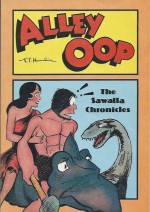
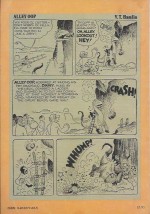
Alley Oop


By V.T. Hamlin (Ken Pierce Books)
ISBN: 0-912277-02-5

Modern comics evolved from newspaper comic strips. These pictorial features were, until relatively recently, extremely popular with the public and highly valued by publishers who used them as a powerful weapon to guarantee and even increase circulation and profits. From the earliest days humour was paramount; hence our umbrella terms “Funnies” and of course “comics”.

Despite the odd ancestor or precedent like Roy Crane’s Wash Tubbs (comedic when it began in 1924, and gradually moving from mock-heroics to light-action into full-blown action-adventure with the introduction of Captain Easy in 1929), or Tarzan and Buck Rogers – which both debuted January 7th 1929 as an adaptation of pre-existing prose properties – the vast bulk of strips produced were generally feel-good humour strips with the occasional child-oriented fantasy.

This changed in the 1930s when an explosion of action and drama strips were launched with astounding rapidity. Not only strips but actual genres were created in that decade and they still impact on not just today’s comic-books but all our popular fiction.

Another infinitely deep well of fascination for humans is cavemen and dinosaurs. During that heyday of America’s strip surge a rather unique real character created a rather unique and paradoxical cartoon character: one both adventurous and comedic and simultaneously forward-looking and fantastically “retro” at the same time…

Vincent Trout Hamlin was born in 1900 and did lots of things before becoming a cartoonist. When he mustered out of the US Expeditionary Force after the Great War he finished High School and then went to the University of Missouri. This was in 1920 and he studied journalism but, since he’d always loved drawing, the eager beaver took advantage of the institution’s art courses too.

He was always a supreme storyteller and lived long enough to give plenty of interviews and accounts – many impishly contradictory – about the birth of his antediluvian archetype…

As a press photographer Hamlin had roamed the Lone Star State and filmed the beginnings of the petroleum industry, catching the bug for finding fossils. Later, whilst drawing ads for a Texas Oil company, he became further fascinated with fossils as he struggled to create a strip which would provide his family with a regular income…

When V.T. decided to chance his arm at the booming comic strip business, those old stones and bones got his imagination percolating and he eventually came up with a perfect set-up for action, adventure, big laughs and even a healthy dose of social satire…

Alley Oop is a Neanderthal-ish caveman inhabiting a lush and fantastic land where dinosaurs still thrive. In fact his greatest friend and boon companion is Dinny; a faithful, valiant saurian chum who terrifies every other dinosaur in creation as well as all the annoying bipeds in residence.

Because Dinny is as smart and obedient as a dog, all the other cave dwellers – such as arrogant, insecure King Guzzle – generally treat the mighty, free-thinking, disrespectful Oop with immense caution…

Unlike most of his audience, Hamlin knew such things could never have occurred but didn’t much care: the set-up was too sweet to waste and it would prove to be the very least of the supremely imaginative creative anachronisms he and his brilliant wife Dorothy would concoct as the strip grew in scope and popularity.

Oop actually launched twice. In 1930 Hamlin whipped up primeval prototype Oop the Mighty which he then radically retooled and sold a year later to the small and local Bonnet-Brown Syndicate as Alley Oop. It debuted on December 5th 1932 and was gaining steam when Bonnet-Brown foundered during the worst part of the Great Depression in 1933.

Happily the strip had won enough of a popular following that representatives of the vast Newspaper Enterprise Association syndicate – whose other properties included Major Hoople, Boots and Her Buddies and the aforementioned Wash Tubbs – tracked down the neophyte scribbler and offered him a regular slot in papers all over America.

Alley Oop debuted again as a daily on August 7th 1933, reprising his old stories for a far larger audience before moving on to new adventures and winning a Sunday colour page on September 9th 1934, the year V.T., Dorothy and new daughter Theodora relocated to affluent Sarasota, Florida.

Sadly for such a revered series with a huge pedigree – still running today as both Sunday and daily feature, scripted by Carole Bender and drawn by her husband Jack – there has never been a concerted effort to properly collect the entire epic. There have however been tantalising outbursts of reprints in magazines and short sets of archive editions from Kitchen Sink, Dark Horse and IDW’s Library of American Comics.

One of – if not actually – the very first serious compilation came courtesy of dedicated preserver of great comics Ken Pierce, who in 1983 released this marvellously compact monochrome paperback edition which reprints one of the most revered sequences of the burly and boisterous dawn man.

Preceded by an Introduction from fellow cartoonist Herb Galewitz and ‘When Hamlin Started Digging Into History Out Came Alley Oop’ – a typically bright and breezy Press Release from 1960 – ‘The Sawalla Chronicles’ ran from April 10th to August 28th 1936 and detailed a classic clash between perennial free-thinker Oop and the increasingly oppressive forces of civilisation and polite society that was growing around him…

A little background: most cave-folk of that long ago time lived in a rocky village ruled over by devious, semi-paranoid King Guzzle and his formidable, achingly status-conscious wife Queen Umpateedle.

Their kingdom was dubbed Moo and the elite couple were guided/manipulated by sneaky shaman the Grand Wizer with all three of them constantly seeking to curb the excesses of the rebelliously independent, instinctively democratic Oop.

Our hero – toughest man in the land – had no time for all the silly fripperies and dumb made-up rules but he did usually give in to the stern glances and fierce admonishments of his long-suffering girlfriend Ooola. The uneasy balance of power in the kingdom comes from the fact that Guz and the Wizer, even with the entire nation behind them, were never a match for Oop and Dinny when they got mad…

As this story starts however that détente has suddenly ended because the Wizer has hypnotised the gigantic beast and turned him against Oop…

Seizing his chance, Guzzle orders his guards to throw his rival into “The Pit”, but when they all regain consciousness they see their intended victim is now astride the throne with the crown on his head…

With a new king in charge things start to move quickly and Oop’s only ally is his old, less-evolved rhyming pal Foozy, so they are hard-pressed to stop the Grand Wizer’s own power-grab since the malevolent old geezer still commands Dinny…

When the chums then fall out, Foozy decides to restore normality by putting Guz back on the throne and to that end devises a cunning plan to immobilise gargantuan Dinny. As events spiral completely out of control, however, it’s ferocious Umpateedle who finally restores the status quo by knocking a few stubborn male heads together…

Oop doesn’t care. After a few precarious and decidedly risky moments he and Dinny are restored and for him that’s what really matters.

As normality returns – exemplified by Umpateedle organising a swanky Ladies Day – Oop takes Ooola on a hunting trip deep into unexplored territory where they discover other men. Moreover these strangers are riding dinosaurs, something everyone thought only Oop could do…

A brutal battle results in some answers from thoroughly beaten Wur, warrior-guardian of the previously unsuspected Sawalla Frontier who surprisingly invites the startled Moovians to visit his own unsuspected country.

Despite Oop’s suspicions, Sawalla seems a paradise. Sited beside a colossal body of water everything is great until Wur – who also happens to be king – informs him they will be staying forever…

Despite lethal swamps and ferocious dinosaurs barring their way back, Oop is determined to return – more because nobody tells him what to do than any degree of patriotism or homesickness – and doesn’t stop looking for escape routes even after Wur sets a gang of brutes to watch him. More distressing is the fact that Wur – desiring Ooola for himself – wants to marry the male Moovian to his own sister Loo…

When that scheme goes south he opts to just get rid of Oop, unaware that his rival has co-opted the Sawallan squad ordered to supervise him. As intrigue turns into all-out war, Oop, Ooola and their converts try to escape through the lethally impassable swamp with all Wur’s forces hard on their soggy heels.

As the fugitives’ arduous slog and occasional battles with Sawallan scouts intensify, at the other end of the green hell, long-missing Dinny finally emerges from the jungle depths and trots into Moo. Realising something’s up, Foozy – accompanied by towering throwback the Cardiff Giant – leads a rescue mission into the swamp and is soon engaged in furious battle with Wur and his army, even as elsewhere Oop’s party fight for their lives against an armada of wild and angry thunder lizards.

And then in a one terrifying moment, the abundant flora catches alight and a monstrous forest fire begins…

Fast, furious, fantastically funny and bitterly barbed in the manner of Billy Wilder and Preston Sturges, Alley Oop is a bone fide classic of comicstrip narrative, long overdue the respect and honour of a complete chronological collection.

However until some enlightened publisher gets around to it, by all means start digging on line and in bargain bins for each – or any – of the wonderful tomes already released. It’s barely the tip of an iceberg but it’s a start…
© 1983 Newspaper Enterprise Association, Inc. All rights reserved. ALLEY OOP COMIC STRIPS © 1936 Newspaper Enterprise Association, Inc. Introduction and editorial material © 1983 Hern Galewitz.

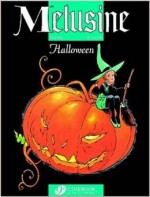
Melusine volume 2: Halloween


By Clarke (Frédéric Seron) & Gilson, coloured by Cerise and translated by Erica Jeffrey (Cinebook)
ISBN: 978-1-905460-34-2

Teen witches have a long and distinguished pedigree in fiction and one of the most engaging first appeared in venerable Belgian magazine Spirou in 1992.

Mélusine is actually a sprightly 119 year old who spends her days working as an au pair in a vast monster-packed, ghost-afflicted chateau whilst diligently studying to perfect her craft at Witches’ School…

The long-lived feature offers everything from one-page gag strips to full-length comedy tales on supernatural themes detailing her rather fraught life, the impossibly demanding master and mistress of the castle and her large circle of exceedingly peculiar family and friends.

Collected editions began appearing annually or better from 1995, with the 24th published in 2015 and another due next year. Thus far five of those have transformed into English translations thanks to the fine folk at Cinebook.

The strip was devised by writer François Gilson (Rebecca, Cactus Club, Garage Isidore) and cartoon humorist Frédéric Seron, AKA Clarke whose numerous features for all-ages Spirou and acerbic adult humour publication Fluide Glacial include Rebecca, Les Cambrioleurs, Durant les Travaux, l’Exposition Continue… and Le Miracle de la Vie.

Under the pseudonym Valda, Seron also created Les Babysitters and, as Bluttwurst, Les Enquêtes de l’Inspecteur Archibaldo Massicotti, Château Montrachet, Mister President and P.38 et Bas Nylo.

A former fashion illustrator and nephew of comics veteran Pierre Seron, Clarke is one of those insufferable guys who just draws non-stop and is unremittingly funny. He also doubles up as a creator of historical and genre pieces such as Cosa Nostra, Les Histoires de France, Luna Almaden and Nocturnes and apparently is free from the curse of having to sleep…

Halloween was the eighth Mélusine album, originally released in 2001, and gathers a wealth of stunning seasonally sensitive strips, making it a great place for newcomers to start as the majority of the content is comprised of one or two page gags starring the sassy sorceress who – like a young but hot Broom Hilda – makes excessive play with fairy tale and horror film conventions and themes.

When brittle, moody Melusine isn’t being bullied for her inept cleaning skills by the matriarchal ghost-duchess who runs the castle, or ducking cat-eating monster Winston and frisky vampire The Count, she’s avoiding the attentions of horny peasants, practising her spells or consoling and coaching inept, un-improvable and lethally unskilled classmate Cancrelune.

Mel’s boyfriend is a werewolf so he only bothers her a couple of nights a month…

Daunting dowager Aunt Adrezelle is always eager and happy to share the wisdom of her so-many centuries but so, unfortunately, is family embarrassment cousin Melisande who spurned the dark, dread and sinisterly sober side of the clan to be a Fairy Godmother; all sparkles, fairy-cakes, pink bunnies and love. She’s simplicity, sweetness and light itself in every aspect, so what’s not to loathe…?

This turbulent tome riffs mercilessly on the established motifs and customs of Halloween where kids fill up to lethal levels on sweets and candies, monsters strive to look their worst, teachers try to keep the witches-in-training glued top their books and grimoires even as their over-excitable students experiment most unwisely on what to do with pumpkins – including how to grow, breed or conjure the biggest ones – whilst the fearfully pious local priest and his flock endeavour to ruin all the magical fun…

Even Melisande gets in on the party atmosphere in her own too nice-to-be-true manner, lightening the happy shadows with too much sunshine and saccharine before the collection ends with the extended eponymous ‘Halloween’ wherein Melusine and Cancrelune learn the true meaning of the portentous anniversary when they inadvertently join the creaking clacking cadavers of the Risen Dead as they evacuate their graves on the special night to fight and drive away for another year the Evil Spirits which haunt humanity…

Wry, sly, fast-paced and uproariously funny, this compendium of arcane antics is a great taste of the magic of European comics and a beguiling delight for all lovers of the cartoonist’s art. Read before bedtime and don’t eat any hairy sweets…
Original edition © Dupuis, 2000 by Clarke & Gilson. All rights reserved. English translation 2007 © Cinebook Ltd.

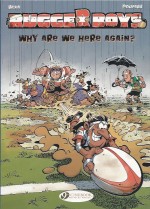
The Rugger Boys volume 1: Why Are We Here Again?


By Béka & Poupard with colour work by Sylvain Frecon & Murielle Rousseau, translated by Luke Spear (Cinebook)
ISBN: 978-1-905460-33-5

Human beings – and apparently a huge variety of our pets and animal housemates – seem obsessed with and are delighted by chasing balls about. So much so that we/they even apply a range of convoluted sets of rules to the sheer exhilaration of the process, just to make things more difficult and artificially extend proceedings.

We call it sport and when it’s not hugely thrilling and deadly serious it can be hilariously funny…

Comics over the decades and throughout the world have often mined our obsession with assorted games for secondary entertainment value and this Cinebook compilation gathers a fine bunch of strips starring a dedicated amateur team of French gladiators all painfully enamoured of the manly (and British-originated) ball-based pastime called Rugby…

Les Rugbymen: was created in 2005 by writing partnership Bertrand Escaich & Caroline Roque under their collaborative nom de plume Béka (Studio Danse, Les Fonctionnaires) in conjunction with self-taught illustrator Alexandre Mermin, who generally labours under the pseudonym Poupard (Chez Gaspard, Les Brumes du Miroboland).

The resulting flurry of short sharp gags and yarns have filled an even dozen albums thus far. There’s even a junior league spin-off which began in 2010 entitled Les Petits Rugbymen…

On n’est pas venus pour être là! was the third Euro-volume but the first to be translated by Cinebook – probably because it features a brief sporting tour of England – and perfectly encapsulates the passion, toil and sheer testosterone-idiocy which can warp normally rational folk.

Our stars are a few dedicated souls faithfully enjoying the trials of club rugby (and that’s Rugby Union, right?) as played by the stalwarts of fictional south-western French town side Paillar Athletic Club, affectionately known to their frankly obsessive fans as The PAC…

As seen on the introductory page, the usual suspects generally manifest as intellectually compromised Hooker Lightbulb, Herculean Prop Fatneck, 2nd Row star The Anaesthetist, dashing sex-crazed Back Romeo and Scrumhalf/Captain The Grumpster, all regularly adored and vilified by The Coach who never lets his speech defect get in the way of a good insult to the dozy slackerrrs…

All you need to know is that these guys are bold, sturdy and love to eat and drink as much as they do smashing each other into the mud…

The exploits are generally delivered as single page sequences, lavishly, lovingly and outrageously illustrated and jam-packed with snippets of off-kilter slapstick to supplement the main gag and the material. Content is almost everything you’d expect from such a fixture: big beefy blokes in very small towels, lots of booze-fuelled gaffes, eating eccentricities, knob jokes and the mutual sportsmanlike skulduggery which permeates all games Real Men compete in…

However also on display are a profusion of smartly-planned running gags and little comedic gems such as the well-meaning meatheads’ ongoing efforts to help Lightbulb find “love”, Romeo’s constant comeuppances from husbands, boyfriends and employers unhappy with his off-pitch conquests and The Coach’s eternal battle to whip his band of idiots into a team he can be proud of…

As previously mentioned, this collection also contains a wry, preconception/prejudice-confirming international excursion when The PAC accept an offer to play a friendly match against British college side Camford. As well as a chance to pummel the despised English, there’s the promise of seeing a Six Nations match to offset the unbearable pain of living on the foreigners’ appalling food and pathetic beer…

Fast, furiously funny and splendidly boisterous, these are the kind of cartoon antics that might even inspire dedicated couch-potatoes to get out of the house – unless they order books and dinner online…
© BAMBOO EDITION, 2006 by Béka & Poupard. All rights reserved. English translation © 2007 Cinebook Ltd.

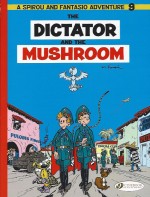
Spirou and Fantasio volume 9: The Dictator and the Mushroom


By André Franquin, translated by Jerome Saincantin (Cinebook)
ISBN: 978-1-84918-267-6

Win’s Christmas Gift Recommendation: Mirth and madcap melodrama in a true comics classic… 9/10

Spirou (which translates as both “squirrel” and “mischievous” in the Walloon language) was created by French cartoonist François Robert Velter using his pen-name Rob-Vel for Belgian publisher Éditions Dupuis in direct response to the phenomenal success of Hergé’s Tintin for rival outfit Casterman.

Thus, a soon-to-be legendary weekly comic entitled Spirou launched on April 21st 1938 with a rival red-headed lad as the lead of an anthology which bears his name to this day.

The eponymous lead character was originally a plucky bellboy/lift operator employed by the Moustique Hotel (a sly reference to the publisher’s premier periodical Le Moustique) whose improbable adventures with pet squirrel Spip gradually grew into high-flying, far-reaching and surreal comedy dramas.

Spirou and his chums have spearheaded the magazine for most of its life, with a phalanx of truly impressive creators carrying on Velter’s work, beginning with his wife Blanche “Davine” Dumoulin who took over the strip when her husband enlisted in 1939. She was assisted by Belgian artist Luc Lafnet until 1943 when Dupuis purchased all rights to the property, after which comic-strip prodigy Joseph Gillain (“Jijé”) took the helm.

In 1946 Jijé‘s assistant André Franquin assumed the creative reins, gradually sidelining the well-established short gag-like vignettes in favour of epic adventure serials, introducing a wide and engaging cast of regulars and eventually creating phenomenally popular magic animal the Marsupilami to the mix (first seen in Spirou et les héritiers in 1952 and eventually a spin-off star of screen, plush toy store, console games and albums in his own right). Franquin continued crafting increasingly fantastic tales and absorbing Spirou sagas until his resignation in 1969.

He was followed by Jean-Claude Fournier who updated the feature over the course of nine stirring adventures which tapped into the rebellious, relevant zeitgeist of the times with tales of environmental concern, nuclear energy, drug cartels and repressive regimes.

By the 1980s the series seemed outdated and without direction: three different creative teams alternated on the feature, until it was at last revitalised by Philippe Vandevelde – writing as Tome – and artist Jean-Richard Geurts AKA Janry, who adapted, referenced and in many ways returned to the beloved Franquin era.

Their sterling efforts revived the floundering feature’s fortunes and resulted in fourteen wonderful albums between 1984 and 1998. As the strip diversified into parallel strands (Spirou’s Childhood/Little Spirou and guest-creator Specials A Spirou Story By…) the team on the core feature were succeeded by Jean-David Morvan & José-Luis Munuera, and in 2010 Yoann & Vehlmann took over the never-ending procession of amazing adventures…

Cinebook have been publishing Spirou & Fantasio’s exploits since 2009, alternating between Tome & Janry’s superb reinterpretations of Franquin and earlier efforts from the great man himself.

André Franquin was born in Etterbeek, Belgium on January 3rd 1924. Drawing from an early age, the lad only began formal art training at École Saint-Luc in 1943 and when the war forced the school’s closure a year later, he found work at Compagnie Belge d’Animation in Brussels where he met Maurice de Bévère (AKA Lucky Luke creator “Morris”), Pierre Culliford (Peyo, creator of The Smurfs) and Eddy Paape (Valhardi, Luc Orient).

In 1945 all but Peyo signed on with Dupuis and Franquin began his career as a jobbing cartoonist/illustrator, producing covers for Le Moustique and scouting magazine Plein Jeu. During those early days Franquin and Morris were being tutored by Jijé, who was the main illustrator at Spirou. He turned the youngsters and fellow neophyte Willy Maltaite AKA Will (Tif et Tondu, Isabelle, Le jardin des désirs) into a smooth creative bullpen known as the La bande des quatre or “Gang of Four”.

They later reshaped and revolutionised Belgian comics with their prolific and engaging “Marcinelle school” style of graphic storytelling…

Jijé handed Franquin all responsibilities for the flagship strip part-way through Spirou et la maison préfabriquée, (Spirou #427, June 20th 1946) and he ran with it for two decades; enlarging the scope and horizons until it became purely his own. Almost every week fans would meet startling new characters such as comrade/rival Fantasio or crackpot inventor and Merlin of mushroom mechanics the Count of Champignac.

Spirou and Fantasio became globe-trotting journalists, travelling to exotic places, uncovering crimes, exploring the fantastic and clashing with a coterie of exotic arch-enemies such as Zorglub and Fantasio’s unsavoury cousin Zantafio.

Incidentally, The Dictator and the Mushroom features the second appearances of Zantafio and strong, capable, female (!) rival journalist Seccotine (renamed Cellophine for these English translations)…

In a splendid example of good practise, Franquin mentored his own band of apprentice cartoonists during the 1950s. These included Jean Roba (La Ribambelle, Boule et Bill), Jidéhem (Sophie, Starter, Gaston Lagaffe) and Greg (Bruno Brazil, Bernard Prince, Achille Talon, Zig et Puce), who all worked with him on Spirou et Fantasio over the years.

In 1955 contractual conflicts with Dupuis droved Franquin to sign up with rival outfit Casterman on Tintin. Here he collaborated with René Goscinny and old pal Peyo whilst creating the raucous gag strip Modeste et Pompon. Although he soon patched things up with Dupuis and returned to Spirou – subsequently co-creating Gaston Lagaffe in 1957 – Franquin was now contractually obliged to carry on his Tintin work too…

From 1959 on, co-writer Greg and background artist Jidéhem increasingly assisted Franquin but by 1969 the artist had reached his Spirou limit and resigned.

His later creations include fantasy series Isabelle, illustration sequence Monsters and bleak adult conceptual series Idées Noires, but his greatest creation – and one he retained all rights to upon his departure – is Marsupilami.

Franquin, plagued in later life by bouts of depression, passed away on January 5th 1997 but his legacy remains; a vast body of work which reshaped the landscape of European comics.

Originally serialised in Spirou #801-838, between 1953 and 1954 and subsequently released on the continent in 1956 as hardcover album Spirou et Fantasio 7 – Le Dictateur et Le Champignon, this epic episode begins as globe-trotting troubleshooter Spirou and his short-tempered pal Fantasio approach the isolated home of eccentric inventor Count Champignac, resolved to return the mischievous Marsupilami to its natural habitat in the jungles of Palombia…

Whilst they discuss their plan with the elderly savant, however, the mischievous monkey he’s been safeguarding has swiped the inventor’s latest mycoprotein marvel and headed for town…

Champignac calls the gaseous form of his newest mushroom extract “metalsoft” and that’s exactly what the stuff does: reduce the solidity of iron, brass, bronze, tin or whatever to the consistency of hot wax. By the time the prankish primate has finished innocently playing with the pump dispenser, the locals are in uproar and their village is practically a puddle…

With nobody in Europe objecting, the lads book passage on a South America-bound cruise ship, where once again the elastic-tailed terror causes a cacophony of comedic chaos. Eventually though, the increasingly irate and exhausted adventurers at last head in-country towards sleepy Palombia where a big surprise is waiting for them…

Thanks to Marsupilami, they are forced to travel the last ten miles to capital city Chiquito on foot and are astonished to observe the sheer number of military vehicles which constantly overtake them. In the city, an altercation with soldiers then leads to their arrest and interview with new supreme dictator General Zantas. The meeting is both a huge shock and unhappy reunion…

Fantasio’s cousin Zantafio had been only a little mean and perhaps misguided when they were all first hunting for the Marsupilami, but since then he has reinvented himself and graduated into a full-blown murderous megalomaniac: a cheap thug in a flashy uniform determined to carve himself a bloody empire and vast wealth through the conquest of his national neighbours.

Moreover, Zantafio/Zantas wants his countrymen to join him in the campaign of conquest, a horrific demand the reporters initially refuse.

Locked in jail, Spirou and Fantasio ponder how to stop the murderous scheme and realise the perfect counter to Zantas’ burgeoning war machine is Champignac’s Metalsoft. All they have to do is get a message to the inventor and have him send enough of the wonder stuff to destroy the ever-growing army…

Thus they apparently switch sides and are promptly installed as high ranking officers, but Zantafio is no fool and sets his most cunning spy to watch them; just waiting for the moment when they betray themselves.

Of course it’s not our heroes’ first rodeo either and, aware of their shadow, the lads engage in a prolonged and hilarious game of cat-&-mouse with the spook, all the while fretting that D-Day is approaching and still they have not been able to smuggle a message out…

A solution presents itself when go-getting journalist Cellophine makes contact. She’s been secretly covering the crisis for ages – without being caught like her mere male rivals – and offers to get the request for Metalsoft to Champignac ASAP…

Things aren’t all going Zantafio’s way. Even though weapons dealers are frantically auditioning their death-dealing wares for the General, Colonels Spirou and Fantasio are especially diligent and somehow able to find dangerous faults in everything on offer…

And then one night Cellophine sneaks back into Palombia with the secret weapon which will end Zantas’ dreams of empire…

Following a fantastical fight with the mushroom gas-wielding trio battling an entire modern military and a tense yet inconclusive showdown with Zantafio, peace and democracy breaks out and the boys finally complete their original mission.

Having at last safely returned the Marsupilami to his natural wilderness, Spirou and Fantasio wearily head back to civilisation, content in the knowledge that the lovable little perisher is back where he belongs.

Of course, the pestilential primate has his own ideas on the matter…

Stuffed with superb slapstick situations, riotous chases and gallons of gags, but barely concealing a strongly satirical anti-war message, this exuberant yarn is a joyous example of angst-free action, thrills and spills. Easily accessible to readers of all ages and drawn with beguiling style and seductively wholesome élan, this is another enduring comics treat from a long line of superb exploits, certain to be as much a household name as that other kid reporter and his dog…
Original edition © Dupuis, 1956 by Franquin. All rights reserved. English translation 2015 © Cinebook Ltd.

Zombillenium volume 3: Control Freaks


By Arthur de Pins (NBM)
ISBN: 978-1-56163-956-4

Arthur de Pins is a British-born French filmmaker, commercial artist and Bande Dessinées creator whose strips – such as adult comedy Peccadilloes (AKA Cute Sins) and On the Crab – have appeared in Fluide Glacial and Max.

In recent years his superbly arch and beautifully illustrated supernatural horror-comedy Zombillénium has become his greatest success (keep your eyes peeled for the upcoming movie!): a truly addictive comics cult classic which began in 2009 (serialised in Spirou from #3698 on) and has now filled three albums released in English thanks to Canadian publisher NBM.

Rendered with beguiling style and sleek, easy confidence, the unfolding saga details the odd goings-on in a horror theme park run by real monsters and operated by capitalistically-inclined infernal powers and, with this latest volume, we finally get to peek behind the curtain a little to see who – and what – is pulling the strings…

Zombillenium is a truly magical entertainment experience celebrating all aspects of the spooky and supernatural, where (human) families can enjoy a happy day out rubbing shoulders with werewolves and witches and all breeds of bogeyman. Of course, those enthralled visitors customers might not laugh so hard if they knew all the monsters were real, usually hungry and didn’t much like humans … except in a culinary fashion…

The inaugural volume introduced hard-working, humane Director/vampire Francis Von Bloodt, newly-reborn Aurelian Zahner (a pathetically inept thief until he expired at the park and returned transformed into a demonic indentured employee of the business) and quirky British Witch Gretchen: a young newcomer interning at the park whilst secretly advancing her own agenda.

As they individually toiled away at the vast entertainment enterprise its true nature was slowly revealed: for unwary, unlucky mortals the site is a conduit to the domain of the damned and its devilish overlord Behemoth: an intolerant horror ever-hungry for fresh souls…

For the uncanny undead workers in Zombillenium, conditions of employment worsen every day: it is one of the least profitable holiday destinations on Earth and The Board are always threatening to make sweeping changes…

Despite the incredible bargaining power of the many monster Trade Unions, the only way out of a Zombillenium contract is the True Death and a final transition to Hell; yet for some reason the shop-stewards prefer to blame Aurelian for all their woes and seem determined to drive him out.

Stuck between a rock and a hot place, Zahner gradually adapts to his new (un)life of constant sorrow and grows closer to Gretchen after she shares with him her own life-story; revealing what he has become whilst disclosing what she’s really doing at the Park. The big boob has no idea how much she left out…

The saga moves into apocalyptic high gear with Control Freaks as Gretchen’s private plot gathers pace after she makes contact with a loved one currently confined in Hell. The bold sorceress promises a seemingly impossible liberation before sneaking out, whilst in the mortal world a long-dreaded day dawns and all the arcane artisans and supernatural staff quail at some really Big News…

A Consultant has been despatched to “observe” how the park is run but everybody from Von Bloodt to the Shop-Stewards know that elite vampire Bohémond Jaggar de Rochambeau is actually here to take the business by the throat and shake things up. They have no idea just how much everything is about to change…

One of the most unfortunate aspects of the fearsome funfair is that any human who dies on Zombillenium property is instantly reborn as a monster, owned by Behemoth and compelled to work eternally in the theme park until the master takes them below. Under Francis’ governance that’s been wisely offset by a set of stringent rules, the first of which states that no employee is ever allowed to attack a human…

Jaggar has other ideas. Before long he has impetuously killed a little girl and delivered in no uncertain terms the new working time directives to Francis and the astounded staff. The Park is a pump designed to generate money for the shareholders and a steady supply of souls to Behemoth. Now the old, timid tolerant ways championed by Von Bloodt have been superseded by more robust policies which demand bigger returns on both sides of the investment…

The news is met with mixed feelings by the workforce: most are scared, appalled and resistant. For some however it’s the opportunity they’ve long argued for: a chance to feed and feast and hunt all those obnoxious yet tasty human morsels…

With isolated attacks reported all over the park Aurelian suddenly goes into a rage-fuelled meltdown and Gretchen uses his colossal rampage to trigger an evacuation of Zombillenium. Casualties are kept to a minimum even though Jaggar is openly egging on the demonically transcendent Zahner to cut loose. With the park emptied by panic, however, the cutthroat Consultant is temporarily stymied…

Unfortunately, his new business model very much piques the greedy interest of the Board and before long Francis is out and Jaggar is Director; actively encouraging the killing of unattached or unaccompanied humans, who now come in droves to the most exciting entertainment experience in the world.

It’s all too much for ambulatory Egyptian Mummy Aton who enlists the aid of change-resistant union boss Sirius Jefferson to orchestrate an inspired industrial action which closes the Park. Management’s retaliation is swift, decisive and infernally effective and, as Gretchen and Aurelian get a message from an ally in Hell, in Jaggar’s Zombillenium irrevocable lines are drawn for a final battle to win the stilled hearts and captive souls of the enslaved employees…

To Be Continued…

One of the most engaging candidates in a burgeoning category of seditiously mature and subversively ironic horror-comedies, this superb and deliciously arch tale combines pop-cultural archetypes with smart and sassy contemporary insouciance and a solid reliance on the verities of Nature, Human and not…

Sly, smart, sexy and scarily hilarious, Zombillenium achieves that spectacular trick of marrying slapstick with satire in a manner reminiscent of Asterix and Cerebus the Aardvark, whilst easily treading its own path. You’ll curse yourself for missing out and if you don’t there are things out there which will. © Dupuis 2013 by De Pins. All rights reserved.

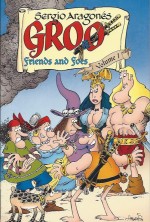
Groo: Friends and Foes volume 1


By Sergio Aragonés, Mark Evanier, Stan Sakai & Tom Luth (Dark Horse)
ISBN: 978-1-61655-814-7

Win’s Christmas Gift Recommendation: A welcome wave of nostalgic nonsense and comic craziness… 8/10

Groo is the smelliest, ugliest, stupidest, unluckiest mercenary in the world – but he’s also the best swordsman in creation and far too stupid to be harmed. He is always hungry and wanders because most places he pauses in burn down, wash away or crash into rubble soon after his arrival.

He loves to fight and entire nations and navies reel at the mention of his name. Of course they do the same when they stand downwind of him too…

Produced in a unique traditional fashion by storyteller Sergio Aragonés, wordsmith Mark Evanier, colourist Tom Luth – with assistance from Michael Atiyeh – and letterer Stan Sakai (yeah, that Usagi Yojimbo guy), the Itinerant Imbecile’s adventures form one of the longest running comicbook humour series in America and there seems to be no chance of stopping his creators as long as we keep buying these incredible, hilarious sagas…

Both in comic narrative and the infinitely tougher field of gag-cartooning, Aragonés has produced vast volumes of incomparable work. His darkly skewed sensibilities and instinctive grasp of the cosmically absurd, wedded to his anarchically meticulous drawing style and frankly terrifying professional discipline, have made his pantomimic doodles vibrant proof of the maxims that laughter is universal and one picture is worth a thousand words.

In 1981, after years working for Mad Magazine whilst also producing gags for DC’s horror titles (plus the occasional full strip), he joined with Mark Evanier (who writes lots of stuff and Writes it Good), Sergio crafted a madcap 4-page parody of Sword-&-Sorcery yarns as a contribution to Eclipse Comics’ Creators Rights benefit comic Destroyer Duck.

Following a second outing in Mike Grell’s Starslayer (#5), Pacific Comics launched Groo the Wanderer in his own title. After 8 issues (December 1982-April 1984) the troubled company folded but the unsinkable barbarian (that’s a joke you’ll understand later) resurfaced in the Groo Special one-shot from Eclipse (October 1984), before finding a home at Epic Comics: Archie Goodwin’s creator-owned corner of the Marvel Universe.

Aragonés had first devised his witless warrior in the 1970s but no publisher would take on the property unless he surrendered all rights – an almost universal situation in the comics industry until the advent of the Direct Sales market transferred power from companies and distributors to creators and consumers.

With ownership issues settled to his maker’s satisfaction, Groo bedded in for an uproarious 120 issue run at Epic – resulting in loads of graphic novel compilations – until the imprint died, after which the witless wonder moved on to Image and Dark Horse Comics. They haven’t sunk yet…

In fact, the latter (gluttons for punishment) have even let the bumbling bladesman loose with new 12-issue miniseries Groo: Friends and Foes; each issue revisiting one of the silly saga’s regular cast who had inconceivably escaped being slaughtered by the star. This tawdry tome is but the first of four trade paperback collections and this first compilation collects issues #1-4, finding the perpetually puzzled peripatetic poltroon meeting again merchant mariner Captain Ahax, who has good reason to dread the consequences…

That sinking thing? Among his other lack of abilities Groo cannot travel by ship. He’s not sea-sick or anything, it’s just that his mere physical presence on a nautical apparatus of any sort causes it to founder and plunge into the fearsome fathoms below. Knowing that fact and unable to get rid of the affable oaf, Ahax surrenders to fate and opts to replace the crew with drunks, sell his ship and even his clients’ cargoes. Then he over-insures the vessel, confident that at least this time when she goes down he’ll actually profit from it.

But this time his ship comes in, despite Groo constantly waving sharp objects about, an attack by pirates and Ahax’s own increasingly desperate efforts to scuttle his livelihood. Perhaps it’s the calming influence of the sweet little girl who befriends the woeful warrior’s adoring dog Rufferto? She’s a fellow passenger all alone, searching for her long-lost father…

As disaster finally strikes – far too late for Ahax – the smelliest, ugliest, stupidest mercenary in the world shambles off and soon encounters a band of gypsies who seem familiar. They ought to: they’re led by his calculating grandmother Granny Groo. How fondly the weary wanderer remembers the way she used to beat him and his sister Grooella before selling him. Of course, being the kind of kid he was, Granny had to sell him many times before it finally stuck…

Now that he’s become the most terrifying person on Earth, however, she decides on a different plan to get rid of him before he brings calamity upon them all: raffling him off to greedy villagers who think they might profit from “controlling” the most dangerous man alive…

Baffled Rufferto gamely sticks with his master and soon discovers that the little girl from the ship has joined the gypsies too…

When that brief debacle ends as all Groo gigs do, the dog and his hero head further inland and soon encounter a magic-blighted region controlled by old enemies and devilish witches Arba and Dakarba.

The female fiends have good reason to fear the innocently intruding idiot and decide to get their retaliation in first by conjuring up the scariest thing they can think of to destroy him. Sadly, a marauding 50-foot Groo – even backed up by a hundred normal-sized facsimiles – are no match for the sheer force of destructive stupidity the real McCoy can muster and the witches inevitably fail, leaving their noodle-nosed nemesis to saunter off accompanied by a little girl he thinks he might have met before…

Groo’s initial outings end after a frantic reunion with Legendary Hero and shameless fraud Arcadio whom our pack of peregrinators stumble across as he tries to train a brace of dragons. The crafty champion plans on using them to gull villagers into hiring him, but when good-natured Groo offers his help, the plan – and the villagers – soon go up in smoke…

Closing this inaugural volume is a quartet of wordless strips starring Rufferto and a captivating cover-gallery by Aragonés adding to the wonderfully wonky misshapen madness and grand display of confusions, contusions, conflagrations, conflicts, pratfalls, pitfalls, punch-lines and punch-ups…

These are true masterpiece of mirth comedy addicts will love and the great strength of the series is that new readers can start practically anywhere – and still be none the wiser…
© 2015 Sergio Aragonés. Groo, all related characters and the distinctive likenesses thereof are trademarks of Sergio Aragonés. All rights reserved.

The Erotic Adventures of Space Babe 113


By John Maybury (Soaring Penguin Press)
ISBN: 978-1-908030-16-0

I have to declare an interest before I review this splendid and long-awaited collection. John Maybury is, as well as a fellow survivor of the Comic Creators Guild and my editor on the Guild’s Annuals (still available at most Unicorn Fairs and any Galifreyan used-stuff emporium), one of many people I have taught in more than twenty-five years as a tutor of comic skills at various organisations ranging from the London College of Printing, through the London Cartoon Centre to the Cartoon Art Trust.

I think it’s only fair to state, however, looking at how few of those hundreds, if not thousands, of students have gone on to produce outstanding comic work, that we’d be deluding ourselves in assuming I had any effect whatsoever.

I’ve known John for decades both professionally, socially and on occasion alcoholically and feel the Convent-school-inculcated need to admit this long association. Of course you might say it’s no fault of mine if extremely talented and dedicated people congregate around me like shining planets around a dying sun contemplating becoming a big black hole…

Confession over, and so to work…

The Erotic Adventures of Space Babe 113 is a remarkably original and ferociously addictive landmark of comedic science fiction from a creator not content to simply tell stories, but determined also to constantly challenge himself in the process. Redolent with overtones of Barbarella (Jean Claude Forest’s comic more than the Jane Fonda movie), The Ballad of Halo Jones, Red Dwarf, Little Annie Fanny and a dozen other things I could cite to show off, this is the intoxicating tale of a sexy ingénue on a five-year commercial mission to the stars with a motley mob of misfits on the claustrophobic and muddled European Union ship Marco Polo.

Although nominally the ship’s Catering Officer, Space always seems to get the tackiest jobs – such as testing the fetishistic Off World Battle Garb – during a mercilessly mercantile mission to sign up new trading partners.

Perhaps it’s because she’s a bit of a “looker”, not that academically accomplished and reputedly far from chaste? Whatever the actual reason, the Earth-based overseer of this particular mission – Media Director 667 – has already increased company revenue streams by forward-selling the “adults-only” Ship’s Logs to broadcast franchises and so most of Space’s shipboard duties tend to end with her undraped and panting.

Regrettably for all the cunning entrepreneurs, although free, healthy and over 21, SB 113 has faithfully promised her boyfriend to stay exclusive until they’re reunited, even though that tends to make her a little short on patience and quite ready to stroppily protest the stream of strange orders perpetually foisted upon her by immediate superiors Lesbian Sex Officer Mrrf M’n’cha and Marketing & Sales Officer Star 406…

At least she can share her woes with Laundry Officer Rince Cycle 335 – whose sympathetic ear almost makes up for his permanently sneering at her for being a glorified microwave-oven operator…

Not long into the mission the first crisis occurs after cosmic rays mutate the female crew-members’ underwear and only after a valiant struggle are the rampaging killer-skivvies ejected from the ship. Sadly, it does mean that the women might be stuck in Scottish Engineer‘s hastily cobbled-together titanium-steel knickers or reduced to going commando, and further danger lurks since not all the deadly drawers have been banished…

Eventually stability returns in time for the planned rendezvous with the fabled ‘Lirka’ and on Marco Polo assorted crewpersons prepare for their first trade conference with the asexual Aardvarks. Tensions are high but at least all are confident that there will be no further assaults from treacherous or homicidal underwear.

Unbeknownst to most of the Terran delegation, however, lead negotiator Star 406 has been secretly instructed to use any means necessary to compel the Lirka to purchase human porn. She regretfully realises that in such an impossible situation she will need every possible advantage and that means the always-aggravating Space Babe 113.

Can two such widely differing species find some common ground to build upon? In the strangest, stickiest manner imaginable the answer is categorically “yes”, but sometimes getting what you want isn’t really a good thing, as can be seen when the conference devolves into a wild, narcotically-deranged strip-poker party…

Barely surviving the catastrophic aftermath of the all-too successful trade-conference with the androgynous ant-eaters, Space crashes a hastily procured escape pod onto a desolate jungle world dubbed ‘Foliage’ where she must eke out a lonely existence and pray for rescue. She has her snarkily sarcastic and judgemental new AI knickers to talk to, but other than them, is she truly alone?

At last convinced that something on the lush planetoid is trying to communicate with her, she undertakes an epic quest and falls for the oldest line in interstellar seduction. Is she the last hope for a dying race to return from the very edge of extinction, or is it just that Earth Girls really are Easy?

At least she’s still kept her promise, if you only count humans…

Rince had also ditched on the green world and before too long he and Space were rescued by U.S. starship George Dubya: a straight-laced, traditional exploration vessel which only releases “Family Viewing” Mission Logs. ‘Stones’ finds Media Director 667 – terrified of lost sales or shared profits – frantically informing his superiors of the disaster before determining to get his star back or get rid of her before the Yanks get all the cash and glory.

He discloses that Space’s knickers have an illegal patch and are operating without the curbs of the Three Laws of Lingerie: if necessary they can be manipulated and compelled to self-destruct…

Things are pretty desperate already aboard the US starship: Space has met the bosom-heavingly gorgeous archaeologist Dr. Standing Stones and, despite a complete lack of qualifications, has claimed to be one herself, ready and so-very-willing to join his expedition to the ancient world of ‘Sand’ spinning beneath them. She is hot, bothered and blithely unaware of EU Commands’ murderous plan, busily losing another ill-tempered battle with her surly underwear which cruelly claims it is no longer her size…

She is plagued by hot, sweaty dreams as ‘Mud’ then sees the history-hunters encountering one of the most powerful and ancient species in existence. Tragically the puissant Grand T’Kleep of Tyracus III understandably takes great umbrage at being used in a most unseemly manner for a moment of urgently needed libidic relief by the soft, curvy one and decides to put her entire race on trial. As the representative of humanity SB 113 must defeat the mighty Bolboi champion in a sacred duel which looks remarkably like mud-wrestling or her entire species will excised from existence 35,000 years before they began annoying proper civilised beings.

Good thing Space was Academy Champion three years running…

Meanwhile on the George Dubya the Americans have cracked the murderous coded message from MD 667 and begin countermeasures…

Chapter 7 slightly diverts to offer an ‘Origin’ revealing how a simple wannabe fashion designer encountered the wrong Careers Bot and ended up an unwilling astronaut Catering Officer, as well as her hidden history with the frustrated creature who became Media Director 667 before ‘Jet’ finds Star 406 fanatically attempting to complete the explosive sabotage mission even as MD 667 – under orders from his own boss – reluctantly leads a rescue mission to pick up his out-of-control minions as a fantastic, millennia-old plan of cosmic fiddling slowly, teasingly unfolds…

With star ships and space stations in imminent danger of destruction the explosive climax sees Space forced into extremely rash behaviour as she tussles with Star to save Dr. Stones and perhaps all of us thanks to ‘Wings’, common sense, good luck and sheer guts…

Raunchy, hilarious, surreal and astoundingly clever, but still deftly striding the right side of the line between charm and prurience, Space Babe 113 is not only great saucy smut and potent parody but also solid, big sky science fiction treated with all the irreverence it deserves and I for one can’t wait for her snooty talking pants to spin off into their own mini-series. Until that moment however this splendid, long overdue chronicle concludes with a few delicious shorts including ‘Space Babe’s Handy Guide to Lesbian Sex for Single Girls’ and ‘The Space Probe: an investigation of the Seamier Side of Sequential Art’.

There is a long tradition of sexy spacewomen in comics, films, TV and even novels and this gently racy, technically torrid tale ranks among the highest in those arenas. The humour is both broad and gentle, with much more of the Carry On movie rather than Emmanuelle about it, although many subversive side-splitters do sneak in, and there are oodles of deep-genre, comic book and computer techie in-jokes for those in the know.

Remember I said he liked to challenge himself? Although able to draw fabulously well in a variety of representational styles, John has sweetened the pot for us all by setting himself a daunting task. This is a glamour book which has successfully abandoned pseudo or mega-pneumatic realism in favour of reductionist abstraction which has echoes of Vaughn Bodé, Alex Niño and graffiti street art. It is to his credit that his diligence has incontrovertibly succeeded. She may just be large blobs of thick black and white, but she is certainly a tasty little minx.

Well-rounded, captivating and impossible to put down. Buy it and decide if I mean her or it, why don’t you?
© 2015 John Maybury. All rights reserved.

Lucky Luke volume 6: Ma Dalton


By Morris & Goscinny, translated by Frederick W. Nolan (Cinebook)
ISBN: 978-1-905460-14-4

It’s hard to think of one of Europe’s most beloved and evergreen comics characters being in any way controversial, but when changing times caught up with the fastest gun in the West (“so fast he can outdraw his own shadow”) and the planet’s most laconic cowboy moved with them, the news made headlines all over the world.

Lucky Luke is a rangy, good-natured, lightning-fast cowboy who roams the fabulously mythic Old West, having light-hearted adventures with his sarcastic horse Jolly Jumper and interacting with a host of historical and legendary figures. His continued exploits over nearly seventy years have made him one of the best-selling comic characters in Europe (over 80 collected books and more than 300 million albums in 30 languages thus far), with the usual spin-off toys, computer games, animated cartoons and a plethora of TV shows and live-action movies.

He was created in 1946 by Belgian animator, illustrator and cartoonist Maurice de Bévère (“Morris”) and was first seen the 1947 Annual (L’Almanach Spirou 1947) of Le Journal de Spirou, before launching into his first weekly adventure ‘Arizona 1880’ on December 7th 1946.

Prior to that, while working at the CBA (Compagnie Belge d’Actualitiés) cartoon studio, Morris met future comics superstars Franquin and Peyo, and joined weekly magazine Le Moustique as a caricaturist – which is probably why (to my eyes at least) his lone star hero looks uncannily like the young Robert Mitchum who graced so many memorable mid-1940s B-movie Westerns.

Morris quickly became one of la Bande des quatre or “The Gang of Four” comprising Jijé, Will and his old comrade Franquin: the leading proponents of the loose, free-wheeling artistic style known as the “Marcinelle School” which predominated in Spirou in aesthetic contention with the “Ligne Claire” style used by Hergé, EP Jacobs and other artists on Tintin Magazine.

In 1948 said Gang (all but Will) visited the USA, meeting American comics creators and sightseeing. Morris stayed for six years, linking up with fellow traveller René Goscinny, scoring some work from the newly-formed EC sensation Mad and making copious notes and sketches of the swiftly vanishing Old West.

That research would resonate on every page of his life’s work.

Working solo until 1955, Morris produced another nine albums worth of affectionate sagebrush spoofery before reuniting with Goscinny, who became the regular wordsmith as Luke attained the dizzying heights of superstardom, commencing with ‘Des rails sur la Prairie’ (Rails on the Prairie), which began in Spirou on August 25th 1955.

In 1967 the six-gun straight-shooter switched sides, transferring to Goscinny’s own magazine Pilote with ‘La Diligence’ (The Stagecoach). Goscinny eventually produced 45 albums with Morris before his untimely death, from whence Morris continued both singly and with fresh collaborators.

Morris himself died in 2001 having drawn fully 70 adventures, plus some spin-off sagas crafted with Achdé, Laurent Gerra, Benacquista & Pennac, Xavier Fauche, Jean Léturgie, Jacques Pessis and others all taking a crack at the venerable franchise…

Moreover, apart from that very first adventure, Lucky (to appropriate a quote applied to the thematically simpatico TV classic Alias Smith and Jones) “in all that time… never shot or killed anyone”…

Lucky Luke first appeared in Britain syndicated to weekly comic Film Fun during the late 1950s and once again in 1967 in Giggle where he was renamed Buck Bingo. In all these venues – as well as the numerous attempts to follow the English-language successes of Tintin and Asterix albums – Luke had a trademark cigarette hanging insouciantly from his lip. However in 1983 Morris, no doubt amidst both pained howls and muted mutterings of “political correctness gone mad”, deftly substituted a piece of straw for the much-travelled dog-end, which garnered him an official tip of the hat from the World Health Organization.

The most recent and successful attempt to bring Lucky Luke to our shores and shelves comes from Cinebook (who have rightly restored the foul weed to his lips on the interior pages, if not the covers…) and Ma Dalton was the sixth of their 54 (and counting) albums, now available both on paper and as e-books.

Chronologically it was the cowboy’s 38th chronicle and Goscinny’s 29th collaboration with Morris, offering an engagingly riotous romp and a stupendously shocking showdown situation wherein all the laconic lawman’s legendary speed proved as nothing when facing a foe he could not draw against…

It all begins after another suitably heroic escapade with our hero is relaxing in boisterous Cactus Junction when he stumbles upon the strangest hold-up he’s ever seen, as a little old lady holds up the local butcher at gunpoint and gets away with a steak and some scraps for her cat. Baffled, he tracks her to the store next door where a similar scenario occurs.

On questioning the shopkeepers Luke is informed that proud old Ma Dalton has fallen on hard times and the sympathetic merchants have all agreed – even though her creaky old six-gun doesn’t work – to let her “rob” them whenever she runs out of the necessities of life such as tea, soap, food and scraps for her horrible cat “Sweetie”…

And yes, the engaging old biddy is indeed the mother of Luke’s intolerable arch-enemies: those vile owlhoot miscreants Averell, Jack, William and their devious, slyly psychotic, overly-bossy shorter brother Joe…

Sadly, Ma isn’t as sweet as everybody thinks. She knows full well what the infamous Dalton Gang are all about. Her lads are still in jail after the last time the tall busybody put them there, but as she writes them a letter they are again making a break for it. It’s easier than usual this time since the prison is a multi-story affair made mostly from wood…

As it burns to the ground the warden thinks he’s pretty smart chaining Joe to faithful prison hound Rin Tin Can but has forgotten that the vain, friendly and exceedingly dim pooch is utterly loyal to absolutely everybody.

The outraged authoritarian only realises his mistake when the boys abscond, taking the deliriously unresisting mutt with them…

After his introduction in 1962’s Sur la piste des Dalton, (On the Daltons’ Trail) Rantanplan – “dumbest dog in the West” and a wicked parody of cinema canine Rin-Tin-Tin – became an irregular feature in Luke’s adventures before eventually landing his own spin-off series title. The moronic mutt earns his spurs here, being a literal drag on the villains’ progress until he tries chasing Sweetie after the boys sneak home. Ma however is a stern and commanding pet owner who paralyses the pooch with one curt command…

As they lay low, old family pressures build again at the Dalton shack. Dim, sneaky Averell was always Ma’s favourite and as he again sops up all her attention Joe, Jack and William settle upon a scheme to make some cash whilst they’re hiding out. It revolves around the fact that Daltons all look remarkably similar and, once the moustaches are off and they’re wearing her old dresses, the boys can pass for their mum in any shop or bank in the region with Lucky Luke none the wiser…

However when Averell starts joining in and queering the guileful gig, the “old dear” is seen in stores miles apart in Alfalfa City and Tumbleweed Town, swiping cash and guns rather than vegetables and soap, and the canny cowboy quickly puts two and two together…

Soon the infamous family are on the run with Lucky and Jolly Jumper hard on their heels. But it’s guile and not gunplay that will win the day since nobody expects the gangling gunfighter to draw down on a little old lady. She just might end up as “the one who got away”…

Fast-paced, seductive slapstick and wry cynical humour colour this splendidly mad ride: another grand old hoot in the tradition of Destry Rides Again and Cat Ballou, superbly executed by master storytellers and providing a wonderful introduction to a unique genre for today’s kids who might well have missed the romantic allure of an all-pervasive Wild West that never was…
© Dargaud Editeur Paris 1971 by Goscinny & Morris. © Lucky Comics.