Drain Pig and the Glow Boys in “Critical Mess”


By Dan Pearce
ISBN: 0-86245-103-5

Once upon a time it was acceptable and desirable rather than just cool for entertainers to be political. Music, film, comedy and especially comics and cartoons rather than today’s obsessions with sex, parenthood and celebrity were at the forefront of social and political criticism…

From the Plutonium Age of Comics comes this scarce, all but unknown, but still readily locatable little lost gem by Dan Pearce which perfectly captured all the daily indignities and nightly horrors of the Thatcher years: the rise of untrammelled greed, the death of personal responsibility and the celebration of conscienceless self-aggrandisement…

I’m ashamed to say that I know very little of this wickedly effective dark satire, although it does look as if the saga was released in strip or magazine instalments a la Steve Bell’s Worlds of If… or Donald Rooum’s stunningly funny Wildcat series.

As ever if anyone knows more, I’d love to hear from you…

Drain Pig is a social leper and despised outcast: a full-grown talking animal who ekes out a pathetic existence living in the sewers. One dreadful night he sees the woman who raised him but when he tries to talk to her she denies him and has him arrested.

The wealthy Mrs. Berkely-Hunt is a pillar of the community and well-in with the powers that be: how could someone of her standing possibly know a scumbag like Drain Pig?

Meanwhile her daughter Mag has started a job as the newest journo for the Daily Dross and her first day is spent covering the trial of the ghastly layabout and social dreg…

She is shocked to see her mother as witness and complainant and horrified when she realises the maternal Society snob is lying in her teeth. The railroaded pig gets five years hard labour when the Judge forces a guilty verdict…

Meanwhile Mag’s scientist boyfriend Mike is travelling to Sizemould Nuclear Power station on a fact-finding mission investigating reports of leaks and mutations.

Mag forces Mummy to tell the truth: Drain Pig was once the beloved companion of a scientist who named him Danny. Her mother, still an impressionable girl herself, was named executor and guardian of the piglet’s inheritance.

Mrs. Berkely-Hunt then reveals how she grew to despise the low beast, leading to the dowager’s flushing the poor piglet down to loo to get rid of him whilst keeping his endowment for herself and making a socially advantageous marriage.

Appalled, the plucky reporter resolves to make amends but discovers to her disgust that the pitiful porker has been deliberately lost within in the prison system…

Meanwhile the secret connections between Britain’s sales of weapons-grade Plutonium and the decrepit, radiation-leaking power station are beginning to circulate and Mag is sent to cover the protesters peace-camp set up around the plant.

Whilst there she interviews Bernard Klein, the physicist who originally built Sizemould; now the spiritual leader of the movement to close it down. Amidst determined, well-intentioned campaigners and a host of four-clawed crabs, Mag learns of the “rabble’s” only success – convincing all the local unemployed not to take jobs as “glow boys” or pipe repairmen.

So faulty is the building that steam generator and water-system repairs are necessary every day, but the ruptures and escapes are so radioactive that workers can only safely be exposed to the pipes for 30 minutes a year!

Unknown to all, however, the ruthless controllers of the plant and the Ministry have worked out a perfect solution: use hardcore convicts nobody will miss as the unwitting repairmen. As long as the public is kept in the dark nobody important will care…

However when Mag glimpses the long missing Drain Pig through the security fences and armed paramilitary guards policing Sizemould, she knows something dirty is up…

With her editor rewriting and slanting her copy, the plant’s technical director in a drug-and-booze filled meltdown, Special Branch infiltrating the protest camp and bugging phones, an ambitious junior circumventing what few safety-protocols still remain in the plant and a snap inspection by Men from the Ministry (of Defence as well as Energy…), the situation looks ripe for an explosive confrontation…

And then Bernie Klein is murdered and everything starts to spectacularly unravel…

Blending Machiavellian intrigue with baroque humour and perfectly riding the popular wave of corrupt back-door deals, old boy network cronyism and vile elitism which has become the hallmark of the period, Drain Pig and the Glow Boys tells a captivating tale in compelling, evocative visual style enticingly reminiscent of the best of Underground Commix’ stars such as R. Crumb and Spain Rodriguez.

Despite being as funny as The New Statesman, mordantly surreal as Whoops, Apocalypse! and as trenchantly biting as Spitting Image, Critical Mess never caught the battered, impoverished public’s attention – although the book still has its passionate supporters to this day.

Perhaps it was because Pearce was too good at his job. Not only is this a bitingly savage satire on the times, but a well-reasoned and minutely researched assault on the idiocies and inadequacies of the Nuclear industry, “legitimate” Arms deals and exports and a blistering attack on the Press and legal system.

It’s also a superbly well-written thriller with stark overtones of David Drury’s 1985 film Defense of the Realm and the gloriously absurdist swingeing satire of Gulliver’s Travels or Animal Farm…

If this kind of honest incisive, important cartoon work appeals there are still copies to be found at incredibly reasonable prices and the author is still active, still passionate, still angry (and rightly so  after all these years) and can be found here
© Dan Pearce 1983.

Lucky Luke volume 2: Ghost Town


By Morris & Goscinny, translated by Luke Spear (CineBook)
ISBN: 978-1-905460-12-0

It’s hard to think of one of Europe’s most beloved and long-running comics characters being in any way controversial, but when the changing times caught up with the fastest gun in the West (“so fast he can outdraw his own shadow”) and the planet’s most laconic cowboy moved with them, the news made headlines all over the world.

Lucky Luke is a rangy, good-natured, lightning fast cowboy who roams the fabulously mythic Old West, having light-hearted adventures with his horse Jolly Jumper and Rantanplan (“dumbest dog in the West” and a charming spoof of cinema canine Rin-Tin-Tin), interacting with a host of historical and legendary figures of the genre.

His continued exploits over more than 66 years have made him one of the best-selling comic characters in Europe, (78 collected books and more than 300 million albums in 30 languages thus far), with spin-off games, computer games, animated cartoon and even a plethora of TV shows and live-action movies.

He was created in 1946 by Belgian animator, illustrator and cartoonist Maurice de Bévère – AKA Morris – for the 1947 Annual (L’Almanach Spirou 1947) of Le Journal de Spirou, launching into his first weekly adventure ‘Arizona 1880′ on December 7th 1946.

Before then, while working at the CBA (Compagnie Belge d’Actualitiés) cartoon studio Morris met future comics super-stars Franquin and Peyo, and worked for weekly magazine Le Moustique as a caricaturist (to my eyes Lucky Luke looks uncannily like the young Robert Mitchum who graced so many mid-1940s B-movie Westerns).

He quickly became one of “la Bande des quatre”, or Gang of Four, which comprised the creators Jijé, Will and his old comrade Franquin, and who were the leading proponents of the loose and free-wheeling artistic style known as the “Marcinelle School” which dominated Spirou in aesthetic contention with the “Ligne Claire” style used by Hergé, EP

Jacobs and other artists in Tintin Magazine.

In 1948 the Gang (all but Will) visited America, meeting US creators and sightseeing, and Morris stayed for six years, meeting René Goscinny, scoring some work from the newly-formed EC sensation Mad and making copious notes and sketches of the swiftly vanishing Old West. That research would resonate on every page of his life’s work.

Working alone until 1955 when he reunited with Goscinny, Morris produced another nine albums worth of affectionate sagebrush parody before, working in perfect unison, Luke attained the dizzying heights of superstardom, commencing with ‘Des rails sur la Prairie’ (Rails on the Prairie), which began in Spirou on August 25th 1955.

In 1967 the straight-shooter switched teams, transferring to Goscinny’s own magazine Pilote with ‘La Diligence’ (The Stagecoach). Goscinny produced 45 albums with Morris before his death, from when Morris continued both alone and with fresh collaborators.

Morris died in 2001 having drawn fully 70 adventures, plus the spin-off adventures of Rantanplan, with Achdé, Laurent Gerra, Benacquista & Pennac taking over the franchise, producing another five tales to date.

Moreover, apart from that very first adventure Lucky, to appropriate a quote applied to the thematically simpatico Alias Smith and Jones “in all that time he never shot or killed anyone”…

Lucky Luke first appeared in Britain syndicated in the weekly comic Film Fun and again in 1967 in Giggle where he was renamed Buck Bingo. In all these venues as well as the numerous attempts to follow the English-language successes of Tintin and Asterix albums from Brockhampton and Knight Books, Luke had a trademark cigarette hanging insouciantly from his lip, but in 1983 Morris – no doubt amidst both pained howls and muted mutterings of “political correctness gone mad” – substituted a piece of straw for the much-travelled dog-end, which garnered him an official tip of the hat from the World Health Organization.

The most recent attempt to bring Lucky Luke to our shores and shelves comes from Cinebook, with Ghost Town the second of the 28 (and counting) available albums, originally collected in 1965 as La Ville fantôme, the 25th adventure and Goscinny’s 16th collaboration with the artist.

As Luke rides the range he encounters two tarred-and-feathered gamblers Denver Miles and Colorado Bill. Despite instantly assessing their scurrilous natures – and of course they do try to rob him – he gives them assistance and a ride to the nearest outpost of civilisation.

That happens to be the deserted mining town of Gold Hill where they encounter an embittered old miner dubbed Old Powell who chases them off at gunpoint.

A little further on they reach Bingo Creek where they discover the mad old coot was once the victim of a gold-salting scheme (hiding gold on worthless land and getting a sucker to buy it) but stubbornly refused to quit, convinced that somewhere in his mountain the motherlode still lay hidden…

Denver and Colorado are incorrigible crooks and after Lucky exposes their fleecing of the townsfolk the bent gamblers try to backshoot him, only to fall foul of Powell’s skill with a rifle…

Eternally grateful Lucky determines to befriend and assist the irascible old coot, despite his surly protests, whilst Denver and Colorado plan the perfect revenge by attempting to steal his mine and then re-salt it before selling it to some other sucker…

To this end they try buy up the claim, have Old Powell hanged for witchcraft, frame him for cattle-rustling and even plant the stolen cash-register from the saloon in his mine.

But they haven’t reckoned on the ingenuity of Lucky Luke; a man so swift and sharp that he can outdraw his own shadow… Against the masterful wits and wicked wits of our indomitable hero the gamblers are ultimately helpless in this splendidly intoxicating blend of all-ages action, slapstick and wry cynical humour.

Although the dialogue is still a bit dry in places, this is a grand old hoot in the tradition of Destry Rides again and Support Your Local Sheriff (or perhaps Paint Your Wagon, Evil Roy Slade or Cat Ballou are more your style?) superbly executed by master storytellers and a wonderful introduction to a unique genre for modern kids who might well have missed the romantic allure of the mythical Wild West.

And in case you’re worried, even though the interior art still has our hero chawin’ on that ol’ nicotine stick, trust me, there’s very little chance of anyone craving a quick snout, but quite a high probability that they’ll want more Lucky Luke Albums…
© Dargaud Editeur Paris 1971 by Goscinny & Morris. © Lucky Comics. English translation © 2006 Cinebook Ltd.

Name Droppings


By Mahood (Columbus Books)
ISBN: 978-0-86287-260-1

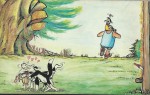
Another prolific but criminally all-but forgotten staple of British cartooning is Kenneth Mahood, whose darkly dry and merrily mordant panel gags were a mainstay of humour mags, cartoon-book racks and newspapers from 1949 to the end of the 1980s.

Your man was born in Belfast in 1930 and after going the usual route of jobs he didn’t want – solicitor’s Junior and Apprentice printer – the painter, collage artist and political cartoonist sold his first work to Punch in 1948 and went full-time.

He never quit “real” art and had exhibitions of paintings throughout the 1950s in Belfast London and Dublin and studied art in Paris on a CEMA scholarship. Constantly selling gags he became Assistant Art Editor at Punch (1960-1965), only surrendering the position when he became the first ever resident political cartoonist in The Times‘ history (1966-1968). He performed the same function for The London Evening Standard from 1969 to 1971 before moving over to the Financial Times and the Daily Mail in 1982, at which time he began to concentrate increasingly on his Fine Art output.

This slightly off-kilter and wittily impressive collection from 1986 could double as a rainy-day parlour-game kit as it offers cartoon images and sight-gags which the reader is asked to identify as the title of either Books, Theatre or Cinema classics and blockbusters; much like graphic charades or a prototype Pictionary, ranging from the punishingly obvious and literal to the devious, askew and outright surreal, all delivered in the artist’s signature style of heavy line, angular definition and dark tones.

It’s fun and it’s funny in equal measure and a glorious example of the wide and expansive appeal and facility of cartoon expression.

Good luck finding it though. As is the norm these days, most of Mahood’s collections – political, general or otherwise – are all out of print, although many old bookshops and charity stores have a few in their bargain bins.
© 1986 Mahood.

Thoroughly Ripped with the Fabulous Furry Freak Brothers …and Fat Freddy’s CAT!


By Gilbert Shelton & Dave Sheridan with Paul Mavrides (Rip Off Press, Inc.)
ISBN: 978-0-89620-088-3
(1978)

Since nobody normal, god-fearing, decent and upstanding would ever dabble with  recreational pharmaceuticals, you’re probably utterly unaware of the extensive sub-culture which has grown up around the casual abuse and dastardly trafficking of narcotics – and so, of course, am I – but it must be said: those counter-culture dudes certainly know how to craft a comic tale.

The Fabulous Furry Freak Brothers shambled out of the Underground Commix counter-culture wave in 1968; initially appearing in Berkeley Print Mint’s Feds ‘n’ Heads, before creator Gilbert Shelton and a few friends founded their own San Francisco based Rip Off Press in 1969. This effective collective continued to maximise the madness as the hilarious antics of the “Freaks” (a contemporary term for lazy, dirty, drug-taking hippy folks) captured the imagination of the more open-minded portions of America and the world (not to mention their kids)…

In 1971 Rip Off published the first compilation: The Collected Adventures of the Fabulous Furry Freak Brothers – which has been in print all around the planet ever since – and soon assorted underground magazines and college papers were joined by the heady likes of Rip Off Comix, High Times, Playboy and numerous foreign periodicals in featuring the addictive adventures of Freewheelin’ Franklin, Phineas T. Freakears and Fat Freddy Freekowtski (and his cat): simpatico metaphorical siblings in sybaritic self-indulgence.

Always written by Shelton and, from 1974 illustrated by Dave Sheridan (until his death in 1982) after which Paul Mavrides picked up the nibs and brushes; the disjointed strips (sorry; irresistible puns are the monkey on my back) combined canny satirical cynicism, surreal situations, scatological sauciness and a terrifying grasp of human nature in staggeringly comedic episodes which cannot fail to amuse anyone with a mature sense of humour.

All the strips have been collected in various formats (in Britain by the marvellous Knockabout Comics) and have been happily absorbed by vast generations of fans – most of whom wouldn’t read any other comic.

Despite the hippy-dippy antecedents and stoner presentiments, Shelton is irrefutably a consummate professional. His ideas are always enchantingly fresh yet timeless, the dialogue is permanently spot-on and his pacing perfect. The stories, whether half-page fillers, short vignettes or full blown sagas, start strong and relentlessly build to spectacular – and often wildly outrageous, hallucinogenic yet story-appropriate – climaxes.

And they’re so very, very funny.

Freewheelin’ Franklin is the tough, street-savvy one who can pull the chicks best, Phineas T. Freakears is a wildly romantic, educated and dangerous (to himself) intellectual whilst Fat Freddy Freekowtski is us; weak-willed, greedy, not so smart, vastly put upon by an uncaring universe but oddly charming (you wish…)

One last point: despite the vast panoply of drugs imbibed, both real and invented, the Freaks don’t ever do heroin – and if that’s not a warning message I don’t know what is…

Thoroughly Ripped is a compilation first released in 1978 and revised with the 1980 edition reviewed here: a luxurious full painted-colour softcover which collects the last of Dave Sheridan’s strips and a couple of the superb early Paul Mavrides efforts in a gloriously anarchic and hilarious chronicle of cloudy-headed, anti-corporate skits and sketches.

The wit and wonderment opens with ‘Fat Freddy’s CAT in the Burning of Hollywood’ from 1978 as the sublimely smug and sanguine survivor of a million hairy moments recounts to his ever-burgeoning brood of impressionable kittens how he and his imbecilic human spectacularly flamed out in the movie biz in a classic tale written and illustrated by Shelton, after which follows a single page strip about the dangers of buying your fun from a guy in an alley…

Next up is the breakthrough “origin” saga of Phineas ‘Winter of ’59’ (produced for internationally distributed Playboy magazine in 1974) and a saucy retrospective of high times in the Fabulous Fifties and Swinging Sixties.

‘Sunday Funnies’ was a single-page spoof of super-cop Dick Tracy starring inept undercover Fed Notorious Norbert (the Nark) who returned in ‘The Fabulous Furry Freak Brothers and the Mysterious Visitor’ which saw the start of Dave Sheridan’s artistic endeavours in a snazzy sting operation by the dragged-up drug cop, followed by the superbly surreal ‘Ridin’ That Train’ as Fatty Freddy discovered the mixed joys of train sets and strong weed…

Much of the material consisted of untitled quickies and short strips. Freewheelin’ Franklin solos in a paranoid cautionary tale of the perils of housework, whilst Freddy and Phineas get into a bizarre battle over TV privileges after which the Fat One finally decides to get rid of the cockroach invasion blighting his life before accidentally and cataclysmically exposing corporate greed in the fire-alarm sales trade…

Preceded by a one-page tale of Phineas’ latest drug-dregs recycling invention, ‘The $29.95 SF to NYC Non-Stop Whiteline Cannonball Express’ by Shelton & Sheridan details the explosive and acerbic epic tale of the Bro’s attempt to start a trans-continental people’s vintage bus service with the usual wildly unbelievable detours and results, after which a flurry of short strips, including Freddy’s adventure in a mud wallow, Phineas’ attempt to make bees produce marijuana honey, Norbert’s latest drug scanning technology fiasco and a search for the legendary “Lost Volkswagen Cocaine Stash” leads to the lads’ latest home-growing experiment decimating their apartment block.

The Reefer Madness concludes with a yarn exposing the secret TV conspiracy to suck out our brains, how undercover cops won a Fabulous Furry Freak Brothers look-alike competition and two Mavrides one-pagers – an untitled collaboration with Sheridan detailing the wonder of “the munchies” and the disgustingly uproarious ‘Zeno’s Law’ as the Freaks attempt to legislate and police refrigerator privileges and responsibilities…

Without Shelton and the Freaks the whole sub-genre of slacker/stoner movies, from Cheech and Chong‘s assorted escapades to more modern entries such as Dude, Where’s My Car?, Supertroopers, Harold and Kumar and all the rest, good, bad or indifferent, wouldn’t exist. Whether or not that’s a good thing is up to you…

Anarchically sardonic and splendidly ludicrous, the madcap slapstick of the Freak Brothers is always an irresistible and joyously innocent tonic for the blues and these tales should be a compulsory experience for any fan of the comics medium. However, if you’re still worried about the content, which is definitely habit-forming, simply read but don’t inhale…
© 1981 Rip Off Press, Inc. Fat Freddy’s Cat © 1981 Gilbert Shelton. “Winter of ’59” © 1974 Playboy.

The Victims Guide to… The Baby


By Roland Fiddy (Exley)
ISBN: 978-1-85015-503-8

British cartooning has been magnificently serviced over the centuries by masters of form, line, wash and most importantly clever ideas repeatedly tickling our funny bones whilst poking our pomposities and fascinations.

As is so often the case, many of these doyens of drollery are being daily forgotten in their own lands whilst still revered and adored everywhere else. One of our most prolific and best was a chap named Roland Fiddy whose fifty-year career encompassed comics, newspaper strips and dedicated gag-books such as the item I’ve zeroed in on here; one of a half-dozen he crafted examining such passions, fascinations and obsessions as Middle Age, Air Travel and the Dentist. I’d actually intended to feature his chronicle of Christmas but I’ve had enough of that for a while and so, I’m sure, have you.

His brisk, seductively loose cartooning winnowed out extraneous detail and always zeroed straight in to the punch-line with a keen and accurate eye for shared experience and a masterfully observational sense of the absurd, whether producing one-off gags for magazine such as Punch, cartoons and strips for comics or even the far tougher discipline of daily features; winning him nearly two dozen international humour awards from places as disparate as Japan, Italy, the Netherlands, Bulgaria and many others. His work was particularly well received in the USA, making him an international icon and ambassador of “Britishness” as valuable as Giles or Thelwell.

“Fiddy” as he signed his work, was born in Plymouth in 1931 and educated at Devonport High School, Plymouth College of Art and Bristol’s West of England College of Art: a dedicated course of study interrupted for three years’ compulsory National Service which saw him join the RAF.

He had been an art teacher for two years when he sold his first professional cartoon to digest men’s magazine Lilliput in July 1949. He quickly graduated to Punch, selling constantly to intellectual powerhouse editor Malcolm Muggeridge. By 1952 he was also a regular contributor of gags to populist papers the News Chronicle, Daily Mail and Daily Mirror.

His first continuity work was for the post-war British comics industry, creating Sir Percy Vere for Clifford Makins, editor of the prestigious Eagle after it was bought by Odhams from original publisher Hulton Press. He followed up the period poltroonery with an army strip entitled Private Proon for Boy’s World before settling back into his comfort zone with a weekly page of one-off gags for Ranger.

The Fun with Fiddy feature was one of the few (others included the legendary Trigan Empire) which survived the high-end comic’s inevitable absorption into Look and Learn.

In 1976 he began a decade-long stint drawing the rather anodyne Tramps (scripted by practising Christian Iain Reid) which featured jovial hoboes Percival and Cedric; an inexplicably well-regarded strip which ran seven days a week. I mention the religious aspect in case you ever see Tramps in the Kingdom: a 1979 collection of the 110-odd, faith-based episodes. To my knowledge the remaining 3000 or more everyday, secularly funny instalments haven’t ever been collected.

In 1985 Fiddy created Paying Guest for the Sunday Express (another 10 year spree) and in 1986 Him Indoors for The People. The home-grown strip market was changing and contracting however and increasingly Fiddy chose to sell gags as an international freelancer and create cartoon books.

Within the pages, of The Victim’s Guide To… the Baby (available as both English or American editions) is a sympathetic seminar and calamitous catalogue of the joys and woes of  early-child-rearing: heavy on the irony and surrealism and mercifully light on bodily functions.

After all, we all know babies do that: let’s see what other horrors and wonders they’re capable of…

The charming and effective observations include interactions with and similarities to pets, men becoming “Daddies”, the reactions of older children, fun with mirrors, cribs, playpens and maximum security cells and of course the sheer destructive potential of the little rugrats…

Fiddy built a solid body of irresistible, seductive and always funny work which had universal appeal to readers of all ages, appearing in innumerable magazines, comics and papers where his instantly accessible style always stood out for its enchanting impact and laconic wit. Other than these and the Fanatic’s Guides his most impressive and characteristic collection is probably The Best of Fiddy.

Fiddy’s cartoon books are perennial library/charity shop and jumble sale fare: if you ever see a Fiddy in such a place, do yourself a favour, help out a good cause and have a brilliant laugh with the master of mirth.
Cartoons © 1994 Roland Fiddy. Compilation © 1994 Exley Publications  Ltd.

The Fanatics Guide to: Computers


By Roland Fiddy (Exley)
ISBN: 978-1-85015-271-2

The field of British cartooning has been tremendously well-served over the centuries with masters of form, line, wash and most importantly ideas repeatedly tickling our funny bones whilst poking our pomposities and fascinations.

As is so often the case many of these masters of merriment and mirth are being daily forgotten in their own lands whilst still revered and adored everywhere else. One of our most prolific and best was a chap named Roland Fiddy whose fifty year career encompassed comics, newspaper strips and dedicated gag-books such as the item I’ve zeroed in on here; one of an eleven volume series assaulting such commonplace bugbears of modern society as Sex, Cats, Dogs, Diets, Money, Golf and more.

His brash, amorphously loose cartooning winnowed out extraneous detail and always zeroed straight in to the punchline with a keen and accurate eye for shared experience and a masterfully observational sense of the absurd, whether producing one-off gags for magazine such as Punch, cartoons and strips for comics or even the far tougher discipline of daily features; winning him nearly two dozen international humour awards from places as disparate as Japan, Italy, the Netherlands, Bulgaria and many others. His work was particularly well received in the USA, making him an international icon and ambassador of “Britishness” as valuable as Giles or Thelwell.

“Fiddy”, as he signed his work, was born in Plymouth in 1931 and educated at Devonport High School, Plymouth College of Art and Bristol’s West of England College of Art: a dedicated course of study interrupted for three years compulsory National Service which saw him join the RAF.

He had been an art teacher for two years when he sold his first professional cartoon to digest men’s magazine Lilliput in July 1949. He quickly graduated to Punch, selling constantly to intellectual powerhouse editor Malcolm Muggeridge. By 1952 he was also a regular contributor of gags to populist papers the News Chronicle, Daily Mail and Daily Mirror.

His first continuity work was for the post-war British comics industry, creating Sir Percy Vere for Clifford Makins, editor of the prestigious Eagle after it was bought by Odhams from original publisher Hulton Press. He followed up the period poltroonery with an army strip entitled Private Proon for Boy’s World before settling back into his comfort zone with a weekly page of one-off gags for Ranger.

The Fun with Fiddy feature was one of the few (others included the legendary Trigan Empire) which survived the high-end comic’s inevitable absorption into Look and Learn.

In 1976 he began a decade-long stint drawing the rather anodyne Tramps (scripted by practising Christian Iain Reid) which featured jovial hoboes Percival and Cedric; an inexplicably well-regarded strip which ran seven days a week. I mention the religious aspect in case you ever see Tramps in the Kingdom: a 1979 collection of the 110-odd, faith-based episodes. To my knowledge the remaining 3000 or more everyday, secularly funny instalments haven’t ever been collected.

In 1985 Fiddy created Paying Guest for the Sunday Express (another 10 year spree) and in 1986 Him Indoors for The People. The home-grown strip market was changing and contracting however and increasingly Fiddy chose to sell gags as an international freelancer and create cartoon books.

Within these pages, available as both English or American editions, is a bombastic barrage of digital disaster-themed cartoon experiences so uncompromisingly comprehensive in range and breadth that any poor fool who has ever lived a hand-to-mouse life cannot help but cringe in sympathy and laugh with the glorious relief that “it’s not just me, then…” with harrowing observations of the shortcomings of users, the imbecility of bosses, the potentially addictive doom of digital obsession, programmers and why they’re like that, kids and computers, military applications, jargon and language, drunk-keyboarding, the perils of interfacing, girls in computing, a historical guide and the nature of nerds and geeks…

Fiddy built a solid body of irresistible, seductive and always funny work which had universal appeal to readers of all ages, appearing in innumerable magazines, comics and papers where his instantly accessible style always stood out for its enchanting impact and laconic wit. Other than the Fanatic’s Guide books his most impressive and characteristic collection is probably The Best of Fiddy. Roland John Fiddy died in 1999.
© 1991 Roland Fiddy.

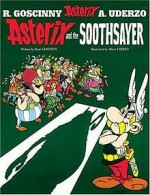
Asterix in Switzerland, The Mansions of the Gods & Asterix and the Laurel Wreath


By Goscinny & Uderzo, translated by Anthea Bell & Derek Hockridge (Orion Books)
ISBNs: 978-075286-628-4, 978-0-75286-630-7 and 978-0-75286-632-1

One of the most-read comics strips in the world, the collected chronicles of Asterix the Gaul have been translated into more than 100 languages since his debut in 1959, with animated and live-action movies, TV series, assorted games, toys and even a theme park outside Paris (Parc Astérix, unsurprisingly…) all stemming from his glorious exploits.

More than 325 million copies of 34 Asterix books have sold worldwide, making his joint creators France’s bestselling international authors.

The diminutive, doughty, potion-powered paragon of Gallic Pride was created by two of the industry’s greatest masters, René Goscinny & Albert Uderzo. Although their inspirational collaborations ended in 1977 with the death of the prolific scripter, the creative wonderment continued until relatively recently from Uderzo and assistants – albeit at a slightly reduced rate.

The wonderment works on multiple levels: ostensibly, younger readers revel in the action-packed, lavishly illustrated comedic romps where sneaky, bullying baddies get their just deserts, whilst we more worldly readers enthuse over the dry, pun-filled, sly satire, especially as enhanced for English speakers by the brilliantly light touch of translators Anthea Bell & Derek Hockridge, who played no small part in making the indomitable Gaul and his gallant companions so palatable to the Anglo-Saxon world. (Moi, I still rejoice in a perfectly produced “Paf!” to the phizzog as much as any painfully potent procession of puns or sardonic satirical sideswipe…)

The stories were set on Uderzo’s beloved Brittany coast, where a small village of warriors and their families resisted every effort of the Roman Empire to complete the conquest of Gaul, or alternately, anywhere in the Ancient World, circa 50BC, as the Gallic Gentlemen wandered the fantastic lands of the Empire and beyond…

When the heroes were playing at home, the Romans, unable to defeat this last bastion of Gallic insouciance, resorted to a policy of containment. Thus the little seaside hamlet is permanently hemmed in by the heavily fortified garrisons of Totorum, Aquarium, Laudanum and Compendium.

The Gauls don’t care: they daily defy the world’s greatest military machine simply by going about their everyday affairs, protected by the magic potion of resident druid Getafix and the shrewd wits of the rather diminutive dynamo and his simplistic, supercharged best friend…

Firmly established as a global brand and premium French export by the mid-1960s, Asterix the Gaul continued to grow in quality as Goscinny & Uderzo toiled ever onward, crafting further fabulous sagas; building a stunning legacy of graphic excellence and storytelling gold. Moreover, following the civil unrest and nigh-revolution in French society following the Paris riots of 1968, the tales began to increasingly show signs of trenchant satire and more directed social commentary…

Asterix in Switzerland was the sixteenth saga, originally running in Pilote #557-578 throughout 1970 and first translated into English in 1973. It opens with the attempted murder of Roman official Quaestor Vexatius Sinusitus; dispatched to Gaul to audit the corrupt, embezzling and utterly decadent Governor Varius Flavus.

The poisoning only fails due to the efforts of the Druid Getafix, but to keep the Roman alive – and further thwart Flavus – the sage needs a rare flower which only grows in the mountains of neighbouring country Helvetia (and that’s Switzerland, mein kinder).

Always keen for a road-trip, Asterix and Obelix quickly volunteer to fetch the fabled “silver star” or Edelweiss …

With Sinusitus sheltered in the village of the indomitable Gauls, Flavus’ only hope is to stop the happy voyagers and to that end he sends his most unscrupulous man to warn the equally repugnant and devious Curius Odus, Governor of Helvetia, to stop the Gauls at all costs…

Although a far darker tale than most previous escapades, all the familiar gentle spoofing of national characteristics, cartoon action and hilarious lampoonery is incorporated into this splendid and beautifully rendered yarn.

Asterix and Obelix cannily avoid Roman sabotage plots, beat up many, many thugs and bullies, whilst marvelling at the quirkiness of their newfound Helvetian friends, with their mania for cleanliness, yodelling, passion for melted cheese, tidy, solicitous brand of medical treatments, cultured beverages, cultivated villages, lakes and banks and their fruit-based archery training programs for the young…

The search for the silver-star is, of course ultimately successful, despite an entire battalion of troops racing up a mountain after them, with a stunning alpine climax and an exceptionally different kind of ending…


Translated that same year was The Mansions of the Gods (from Pilote #591-612, in 1971) wherein Caesar, determined to eradicate the last remnant of Gaulish resistance, tries to win by social planning and cultural imperialism. To that end he plans to cut down the great forest which surrounds the village and build a new town of lavish Roman apartments in the stylish, modern Roman manner.

Whiz kid architect Squaronthehypotenus leads the project, but his immigrant army of slave labourers soon founders when boar-loving Obelix strenuously objects to having his hunting preserve torn down and paved over…

However the massed might of Rome is insurmountable and eventually many mighty oaks are felled. To counter this Getafix simply grows instant new ones whilst Asterix shares his magic potion with the increasingly fed up slaves…

This stalemate is only overcome when the wily Gauls seemingly surrender and allow the “Mansions of the Gods” to be built and stocked with middle-class colonists from Rome. After a rapid bump in trade as the villagers become tourist-trappers, the complacent property developers make their greatest mistake and rent an apartment to the Gaul’s uniquely gifted bard Cacofonix, leading to an exodus of tenants and an inevitable and breathtaking final clash with the garrison of Aquarium, who had moved into the luxurious vacant apartments…

Drenched in trenchant observation of and jibes at the industrial relations conflicts, the then runaway speculation in new developments in France and the inexorable growth of “planning blight” (still painfully relevant today anywhere in the industrialised world), this tremendously effective satire is packed with gags and action and displays artist Uderzo’s sublime gift for caricature and parody – especially in the wonderful spoofs of real estate advertising campaigns…


Asterix and the Laurel Wreath was serialised in issues #621-642, in 1971 and given the fabulous Bell/Hockridge treatment in 1974. It begins in Rome where Asterix and Obelix are arguing…

During a visit to Chief Vitalstatistix‘s wealthy, snobbish, city-dwelling brother-in-law Homeopathix the doughty old warrior gets too drunk and boasts that he can get something which all the merchant’s money cannot buy – a stew seasoned with Caesar’s fabled wreath of office.

Sober now and in dire danger of eternal embarrassment and the unflinching approbation of his sharp-tongued wife Impedimenta, the Chief has no option but to allow his two best men – the larger of whom had drunkenly egged him on at the family gathering and then volunteered to fetch the leafy headpiece – to travel to the heart of Caesar’s power and attempt the impossible…

At least Asterix knows it’s impossible; Obelix is quite happy to storm the Imperial Palace and just grab the wreath…

Luckily reason prevails and the wily little warrior determines their only chance is infiltration, to which end Asterix sells them both as slaves. Unfortunately they are bought by the wrong Roman…

Osseus Humerus is an innocuous Patrician with a troublesome family, but as Asterix tries every trick to get their unsuspecting owner to return them to the Slave Auctioneer, he only endears himself even more to very satisfied customer. So much so in fact, that Humerus entrusts them with a message to be delivered to Julius Caesar himself…

Jealous major-domo Goldendelicius then accuses them of planning assassination and the heroes are locked in the dungeons – leaving them complete access to the entire palace…

Before long the indomitable duo are wreaking havoc in the Imperial Court and playing hob with the usually predictable proceeding in the Arena of the Circus Maximus.

Seemingly untouchable but no nearer the Laurel Wreath, the despondent Gauls finally seize their chance when they encounter again the recently promoted Goldendelicius. Rewarded by Caesar, the major-domo now holds a position of great responsibility: holder of the triumphal floral arrangement at Caesar’s next public engagement…

Sharp and deeply intriguing this comedy of errors is spectacularly illustrated by Uderzo at the very top of his game, whilst Goscinny’s dry, wry script seamlessly rockets from slapstick set-piece to penetrating observational comedy and magnificently engaging adventure, with, as always our unlikely heroes inevitably, happily victorious in every  instance.

Asterix epics are always packed with captivating historical titbits, soupcons of healthy cynicism, singularly surreal situations and amazingly addictive but generally consequence-free action, illustrated in a magically enticing manner. These are perfect comics that everyone should read over and over again.
© 1970-1972-3 Goscinny/Uderzo. Revised English translation © 2004 Hachette. All rights reserved.

Adventures of Aaron: My Mom’s Meatloaf Moves!


By Aaron Warner (Amazing Aaron Productions)
ISBN: 1-889509-00-0

As a result of the 1980s boom in self-publishing the comics industry underwent a radical and permanent change in creative access wherein eager or talented – and sometimes neither – new strip-makers found themselves given unprecedented access to the buying public. A plethora of comics appeared by artists and writers who no longer had to wait to be discovered by DC or Marvel. The majority of these liberated Young Turks used comicbooks as their forum but a few, such as Aaron Warner, first began to find fame with the venerable but dying newspaper comic strip.

After much fruitless portfolio bombardment to (paying) comicbook publishers and a few commercial art gigs Warner began contributing a semi-fictionalised autobiographical weekly strip to the Young Adults weekend entertainment section of the Kalamazoo Gazette and his self-deprecatingly wry yet frantically over-the-top frat-boy humour and spectacularly fresh and impressive cartooning soon found him an appreciative and constantly growing audience.

Still fortune eluded him until Warner began a wave of guerrilla-marketing and began pedalling the strip to other local papers. This self-syndication eventually led to The Detroit News, a stage play, comicbook compilations from Image and, eventually, the Tribune Media Syndicate who picked up the feature in 1994. The Adventures of Aaron debuted nationally on October 20th 1995; ten years of whacky, unconventional, irreverent fun…

Since then Warner has created A College Girl Named Joe and You Are Here whilst running his own commercial arts business.

This large monochrome landscape collection gathers two years worth of the pre-syndication strips: a bold period of innovation as the artist explores the limits of his page and mirthful, pictorial self-abuse as young, dumb and feckless Aaron relates the latest low point – and occasional high – of his crummy mid-western existence.

Aaron lives with – and is hassled by – his mother and arrogant ineffectual, parsimonious, baldness-obsessed dad, his diabolical older sister (married, a mom, living elsewhere but still terrorising him and ruining his lazy life).

The boy can’t keep a job and often hangs out a lot in the print copyshop; quietly adoring the gorgeous Michelle who works there. Like most kids he has a couple of close friends – Brad and Scott – and they’re both worse than him. His dog and sister are both insane and possibly possessed by Satan…

Peppered with lushly drawn daydreams of hot chicks, a regular girlfriend, coolness not perpetual shame, untold wealth and acquiring superpowers, the early Adventures of Aaron are wildly experimental, fabulously exuberant, gloriously, infectiously fun, whacky, absurdist, astonishingly intimate and delightfully off the wall, and include delightful text features on the poor suckers good friends who were the basis of the strip’s wide and varied cast.

Still readily available this splendid self-published tome is well worth tracking down for a great read; and most worthy of your attention if you’re a cartoonist in dire need of an inspirational success story…
© 1996 Aaron Warner. All rights reserved.

The Complete Crumb Comics volumes 1 and 2


By Robert Crumb and Charles Crumb (Fantagraphics Books)
ISBNs: 0-930196-43-1(hb)   & 978-0-930193-62-8

Robert Crumb is a unique creative force in the world of cartooning with as many detractors as devotees. His uncompromising, excoriating, neurotic introspections, pictorial rants and invectives unceasingly picked away at societal scabs and peeked behind forbidden curtains for his own benefit, but he has always happily shared his unwholesome discoveries with anybody who takes the time to look…

In 1987 Fantagraphics Books began the nigh-impossible task of collating, collecting and publishing the chronological totality of the artist’s vast output and many of those engrossing compendia are now being reissued.

These earliest volumes have been constantly described as the least commercial and, as far as I know, remain out of print, but contrary as ever, I’m reviewing them anyway…

The son of a career soldier, Robert Dennis Crumb was born in Philadelphia in 1943 into a functionally broken family. He was one of five kids who all found different ways to escape their parents’ shattering problems and comics were always paramount amongst them.

As had his older brother Charles, Robert immersed himself in the strips and cartoons of the day; not simply reading but feverishly creating his own. Harvey Kurtzman, Carl Barks and John Stanley were particularly influential, but also newspaper artists like E.C. Segar, Gene Ahern, Rube Goldberg, Bud (Mutt and Jeff) Fisher, Billy (Barney Google), De Beck, George (Sad Sack) Baker and Sidney (The Gumps) Smith as well as illustrators like C.E. Brock and the wildly imaginative and surreal 1930’s Looney Tunes and Merrie Melodies animated shorts.

Defensive and introspective, young Robert pursued art and slavish self-control through religion with equal desperation. His early spiritual repression and flagrant, hubristic celibacy constantly warred with his body’s growing needs…

Escaping his stormy early life, he married young and began working in-house at the American Greeting Cards Company. He discovered like minds in the growing counterculture movement and discovered LSD. In 1967 Crumb relocated to California and became an early star of Underground Commix. As such he found plenty of willing hippie chicks to assuage his fevered mind and hormonal body whilst reinventing the very nature of cartooning with such creations as Mr. Natural, Fritz the Cat, Devil Girl and a host of others. The rest is history…

Those tortured formative years provide the meat of the first volume The Early Years of Bitter Struggle which, after ‘Right Up to the Edge’ – a comprehensive background history and introduction from lifelong confidante Marty Pahls – begins revealing the troubled master-in-waiting’s amazingly proficient childhood strips from the self-published Foo #1-3 (a mini-comic project passionately produced by Robert and his older brother Charles from September to November 1958).

Rendered in pencils, pens and whatever else was handy; inextricably wedded to the aforementioned funnybooks, strips and animated shorts cited above, the mirthful merry-go-round opens with ‘Report From the Brussels World’s Fair!’ and ‘My Encounter With Dracula!’: frantic and frenetic pastiches of the artists’ adored Mad material, with Robert already using a graphic avatar of himself for narrative purposes.

Closely following are the satirical ‘Clod of the Month Award’, ‘Khrushchev Visits U.S.!!’ and ‘Noah’s Ark’.

From 1959 comes ‘Treasure Island Days’: a rambling gag-encrusted shaggy dog Russian Roulette experiment created by the lads each concocting a page and challenging the other to respond and continue the unending epic, after which ‘Cat Life’ followed family pet Fred’s fanciful antics from September 1959 to February 1960 before morphing, or perhaps “anthropomorphing” into an early incarnation of Fritz the Cat in ‘Robin Hood’…

That laconic stream of cartoon-consciousness resolved into the raucous and increasingly edgy saga ‘Animal Town’ followed here by a very impressive pin-up ‘Fuzzy and Brombo’, before the central full-colour section provides a selection of spoof covers.

Four ‘R. Crumb Almanac’ images – all actually parts of letters to Pahls – are complemented by three beautiful ‘Arcade’ covers, swiftly followed by a return to narrative monochrome and ‘A Christmas Tale’ which saw Crumb’s confused and frustrated sexuality begin to assert itself in his still deceptively mild-mannered work.

A progression of eleven single-page strips produced between December 1960 and May 1961 precedes three separate returns to an increasingly mature and wanton ‘Animal Town’ – all slowly developing the beast who would become Crumb’s first star until Fritz bows out in favour of ‘Mabel’ – a prototypical big and irresistible woman of the type Crumb would legendarily have trouble with – and this initial volume concludes with another authorial starring role in the Jules Feiffer (see Explainers) inspired ‘A Sad Comic Strip’ from March 1962.


The second volume Some More Early Years of Bitter Struggle continues the odyssey after ‘The Best Location in the Nation…’ – another Pahls reminiscence – describes the swiftly maturing and deeply unsatisfied Crumb’s jump from unhappy home to the unsatisfying world of work.

‘Little Billy Bean’ (April 1962) returns to the hapless, loveless nebbish of A Sad Comic Strip whilst ‘Fun with Jim and Mabel’ revisits Crumb’s bulky, morally-challenged amazon after which the focus shifts to her diminutive and feeble companion ‘Jim’. Next, an almost fully-realised ‘Fritz the Cat’ finally gets it on in a triptych of saucy soft-core escapades from R. Crumb’s self-generated Arcade mini-comic project.

From this point onwards the varied and exponentially impressive breadth of Crumb’s output becomes increasingly riddled with his often hard-to-embrace themes and declamatory, potentially offensive visual vocabulary as his strips grope towards the creator’s long-sought personal artistic apotheosis.

His most intimate and disturbing idiosyncrasies regarding sex, women, ethnicity, personal worth and self-expression all start to surface here…

Therefore, if intemperate language, putative blasphemy, cartoon nudity, fetishism and comedic fornication are liable to upset you or those legally responsible for you, stop reading this review right here and don’t buy the book.

Working in the production department of a vast greetings card company gave the insular Crumb access to new toys and new inspiration as seen in the collection of ‘Roberta Smith, Office Girl’ gag strips from American Greetings Corporation Late News Bulletins (November 1963-April 1964), followed here by another Fritz exploit enigmatically entitled ‘R. Crumb Comics and Stories’ which includes just a soupcon of raunchy cartoon incest, so keep the smelling salts handy…

A selection of beautiful sketchbook pages comes next and then a full-colour soiree of faux covers: letters to Pahls and Mike Britt disguised as ‘Farb’ and ‘Note’ front images as well as a brace of Arcade covers and the portentously evocative front for R. Crumb’s Comics and Stories #1 from April 1964.

The rest of this pivotal collection is given over to thirty more pages culled from the artist’s sketchbooks; a vast and varied compilation that ably displays the artist’s incredible virtuosity and proves that if Crumb had been able to suppress his creative questing he could easily have settled for a lucrative career in any one of a number of graphic disciplines from illustrator to animator to jobbing comic book hack.

Crumb’s subtle mastery of his art-form and obsessive need to reveal his most hidden depths and every perceived defect – in himself and the world around him – has always been an unquenchable fire of challenging comedy and riotous rumination, and these two tomes are the secret to understanding the creative causes, if not the artistic affectations of this unique craftsman and auteur.

This superb series charting the perplexing pen-and-ink pilgrim’s progress is the perfect vehicle to introduce any (over 18) newcomers to the world of grown up comics. And if you need a way in yourself, seek out these books and the other fifteen as soon as conceivably possible…

Report From the Brussels World’s Fair!, My Encounter With Dracula!, Clod of the Month Award, Khrushchev Visits U.S.!! & Noah’s Ark © 1980 Robert and Charles Crumb. Other art and stories © 1969, 1974, 1978, 1987, 1988 Robert Crumb. All rights reserved.

Re-Gifters


By Mike Carey, Sonny Liew & Marc Hempel (Minx/Titan Books edition)
ISBN: 978-1-84576-579-8

In 2007 DC comics attempted a bold experiment in building new markets by creating the Minx imprint: dedicated to producing comics material for the teen/young adult audience – especially the ever-elusive girl readership – that had embraced translated manga material, momentous global comics successes such as Maus and Persepolis and those abundant and prolific fantasy serials which produced such pop phenomena as Roswell High, Twilight and even Harry Potter.

Sadly after only a dozen immensely impressive and decidedly different graphic novels Minx shut up shop in October 2008, markedly NOT citing publishing partner Random House’s failure to get the books onto the appropriate shelves of major bookstore chains as the reason.

Nevertheless the books which were published are still out there and most of them are well worth tracking down – either in the US originals or the British editions published by Titan Books.

My particular favourite is the second release: a magnificently beguiling and engaging black and white, cross-cultural romantic martial arts melange by writer Mike Carey and artists Sonny Liew & Marc Hempel.

The trio’s glorious offbeat and upbeat Vertigo miniseries My Faith in Frankie is generally regarded as a prototype for the Minx model, and that quirky quixotic brilliance is in full flower in this tale of feisty yet desperately dutiful Korean-American teen Jen “Dixie” Dik Seong who channels her suppressed aggression into hapkido and her blossoming crush on hunky Adam into daydreaming, clumsiness and humiliating imbecility…

A klutz in real life, Dixie is a demon in martial arts battle, but as her best friend and dojo-mate Avril is keenly aware, the flummoxed lass’s poor head is stuck in the clouds these days…

It’s hard enough for Dixie to juggle school, a quick-fire temper, her precious heritage and loving-but-generally clueless parents with burgeoning hormones and astoundingly annoying younger brothers; without the added distraction of infatuation with a rich, self-absorbed white boy who is also her only serious rival in the upcoming National Hapkido Tournament.

After a chance encounter with mouthy street punks and bad boy Dillinger, Dixie blows all her savings and the Tournament entrance fee which her father gave her on an ancient warrior statue for Adam; leading to a huge fight with Avril but which actually succeeds in getting the boy to notice her.

So much so, in fact, that he wants her advice in getting snooty babe Megan to go out with him…

When Dixie discovers that a business loan for her father from traditional Korean bankers depends on her performance in the tournament, the furious and lovelorn girl is forced to battle for a wild-card place in the event by joining a knockout “Street Sweep Competition” against half the kids in Los Angeles… including the dire and dangerous Dillinger…

Moreover, Adam has finally got into Megan’s good books – and other places – by re-gifting Dixie’s statue to the most popular girl in school…

Re-Gifters is a bright, witty, sublimely funny and intriguing coming of age comedy which follows all the rules of the romance genre but still manages to inject a vast amount of novelty and individual character into the mix: a perfect vehicle for attracting to the medium new and youthful readers with no abiding interest in outlandish power-fantasies or vicarious vengeance-gratification – and yes, that does mean women…

Track this down and read a genuinely different kind of comic book – but do it before some hack movie producer inevitably turns the tale into just another teen rom-com…
© 2007 Mike Carey, Sonny Liew & Marc Hempel. All rights reserved.