Daydreams and Nightmares – The Fantastic Visions of Winsor McCay (second edition)


By Winsor McCay & various (Fantagraphics Books)
ISBN: 978-1-56097-569-4 (TPB/Digital editions)

Win’s Christmas Gift Recommendation: Picture Perfect… 10/10

Winsor McCay was a cartoonist and animator best known for Little Nemo in Slumberland. There was of course, so much more to him and this retrospective touches on the man whilst displaying a glorious abundance of his many graphic marvels.

Born in Spring Lake, Michigan, on 26th September, 1869 (or maybe 1871 in Canada: records differ) Zenas Winsor McCay was a brilliant and hugely successful cartoonist and animator who worked on newspaper illustrations, strips and political panels from 1898 until his untimely death in 1934.

This collection (a remastered release of a 1998 celebration) offers up some sublime examples of his many oeuvres. Following a Foreword by Gary Groth and context-packed biographical preface ‘The Dream Master’ by Richard Marschall, the man himself relates what we need to know in his own words thanks to 1927 essay ‘From Sketchbook to Animation by Winsor McCay’ and a 1926 letter to fellow artisan Clare Briggs (Danny Dreamer, Mr. and Mrs.) ‘On Being a Cartoonist’ before we begin a magical trawl through a magnificent career…

Spanning 1989 to 1903 – when McCay signed with The New York Herald publisher James Gordon Bennett – ‘Chapter One: Early Magazine Work’ offers political broadsides, early editorial diatribes in pictorial form, social commentary and pure illustration pieces, albeit gradually trending towards his later fascination with fantastic architecture and parlous prognostications of cultural collapse, before ‘Chapter Two: Newspaper Fantasy Illustrations’ focusses on wry speculative futurism – a popular topic of periodical publication back then…

Encompassing 1904-1924, ‘Chapter Three: Midsummer Daydreams and Other Comic Strips’ offers timeless examples of his ceaseless cartoon endeavours including A Pilgrim’s Progress, Poor Jake, Midsummer Daydreams/Daydreams, It Was Only a Dream, The Dreams of a Lobster Fiend, The Faithful Employee, He’s One of Those Telephone Lobster Fiends, And Then – Kerchoo! – He Sneezed!, Everyone Has Met That Well Known Character, Mr. Duck, and Rabid Reveries but sadly omits Jungle Imps, Dull Care, The Man from Montclair, Mr. Bosh, Hungry Henrietta and It’s Nice to be Married…

On October 15th 1905 the most important children’s strip in the world debuted in the Sunday Herald but Little Nemo in Slumberland had precursors and indeed a mature-reader rival. ‘Chapter Four: Dream of the Rarebit Fiend’ explores the many variations and iterations penned (and inked) from 1904 to 1913. Tireless McCay had conjured up visions for adult readers of The Evening Telegram, initially entitled Dream of the Rarebit Fiend. The editor, wishing to distance the feature from other strips, required McCay to use a pen-name, and he complied, signing the strips “Silas”, reputedly after a local garbage cart driver.

Where Nemo was a beautifully clean formal and surreal fantasy of childish imagination, Fiend displayed a creepy, subdued tension resonant with the fears and worries of its adult audience. Black, cruel and often outright sick humour pervades the series combining monstrous destruction and expressionist trauma. Even root causes of otherworldly nightmares were salutary. Each self-contained episode (18 reproduced here) and disturbing sequence of unsettling or terrifying, incredibly realistic images was the result of overindulgence; usually in late night toasted cheese treats!

Every anxiety from surreal terror to social embarrassment was grist for the fantasist’s mill and startling perspectives, bizarre transformations and uncanny scenes – always immaculately rendered – made the strip hugely successful and well-regarded strip in its day.

In 1906, American film pioneer Edwin S. Porter created a landmark 7-minute live action special-effects movie entitled The Dream of a Rarebit Fiend and the Edison company produced a cylinder recording with the same name the following year – played by the Edison Military Band. McCay himself produced four animated shorts in 1916-17: Dream of a Rarebit Fiend; Dreams of The Rarebit Fiend: The Pet, Dreams of The Rarebit Fiend: The Flying House and Dreams of The Rarebit Fiend: Bug Vaudeville, and despite his many other later successes returned to the feature sporadically over the years. Between 1923 – 1925 he revived it as Rarebit Reveries, officially attributing the strip to his son who signed the panels Robert Winsor McCay, Jr.

An artist hugely in-demand then and revered today, from 1903 to 1906 McCay invented many other all-ages cartoon works and ‘Chapter Five: Sunday Excursions’ highlights one of most enduring and inventive with 18 episodes of Little Sammy Sneeze, before the linear lunacy ends with his speculations on the world, its people and impending dystopias in ‘Chapter Six: Sermons on Paper’ with 54 stunning tableaux full-page rendered between 1913-1934, shaped by war and other disasters depicting so very many ways humanity could end and so few where we stop our species’ extinction event…

Although working far more than a century ago McCay still affects all aspects of graphic narrative produced ever since and his visions are more pertinent now than in his own lifetime. A darker side of an absolute master of our art form, this is work you must see and cannot miss.
Daydreams and Nightmares © 2005 Fantagraphics Books.

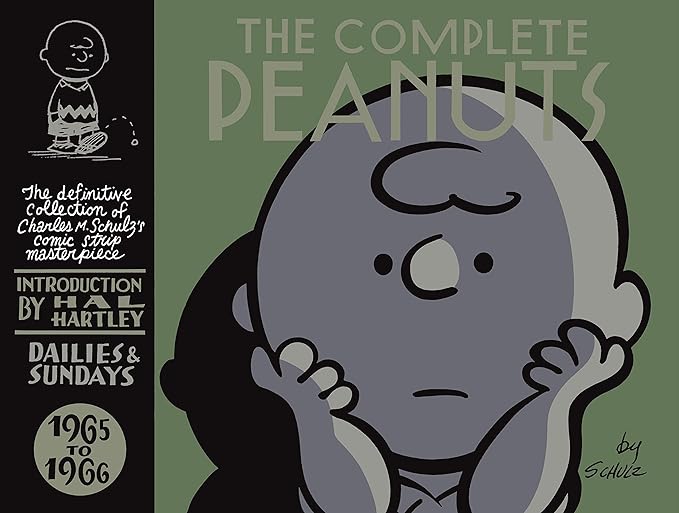
The Complete Peanuts volume 8: 1965-1966


By Charles M. Schulz (Fantagraphics Books/Canongate Books UK)
ISBN: 978-1-56097-724-7 (HB) 978-1-84767-815-7 (UK HB)

Halloween’s just around the corner and so, in the spirit of beleaguered, embattled diversity, here’s a sop to those devout devotees of the sectarian offshoot awaiting with nervous anticipation the spiritual harvest of The Great Pumpkin. The rest of you can just relish the timeless cartoon mastery of a pictorial comedy genius…

Peanuts is unequivocally the most important comic strip in the history of graphic narrative. It is also the most deeply personal. Cartoonist Charles M Schulz crafted his moodily hilarious, hysterically introspective, shockingly surreal philosophical epic for half a century: 17,897 strips spanning October 2nd 1950 to February 13th 2000. He died – from complications of cancer – the day before his last strip was printed.

At its height, Peanuts ran in 2,600 newspapers, in 21 languages and75 countries. Many of those venues still run it in perpetual reprints, as they have ever since his death. During his lifetime, book collections, a merchandising mountain and television spin-offs had made the publicity-shy doodler an actual billionaire at a time when that really meant something…

None of that matters. Peanuts – a title Schulz loathed, but one the syndicate forced upon him – changed the way comics strips were received and perceived: proving cartoon comedy could have edges and nuance and meaning as well as soon-forgotten pratfalls and punchlines.

Following a thoughtful Foreword from screenwriter, director, producer, composer and independent filmmaker Hal Hartley (Trust, Henry Fool, The Unbelievable Truth, Simple Men), the timeless episodes of play, peril, psychoanalysis and personal recrimination resume. Rendered in marvellous monochrome, there are some crucial character introductions, more plot developments and the creation of even more traditions we all revere to this day. Of particular note is the end of the de facto soft revolution leaving the wonder beagle in the driving – or rather pilot’s – seat…

Mostly, though, our focus and point of contact is quintessential, inspirational loser Charlie Brown who, beside fanciful, high-maintenance mutt Snoopy, remains squarely at odds with a mercurial supporting cast, hanging out doing what at first sight seems to be Kids Stuff.

Always, gags centre on play, varying degrees of musicality, pranks, interpersonal alignments, the mounting pressures of ever-harder education, mass media through young eyes and a selection of sports in their season. leavened by agonising teasing, aroused and crushed hopes, the making of baffled observations and occasionally acting a bit too much like grown-ups.

However, with this tome, themes and tropes that define the entire series (especially in the wake of the animated TV specials) become mantra-like yet endlessly variable. One deliciously powerful constant is Brown’s inability to fly a kite, and here war with wind, gravity and landscape reaches absurdist proportions…

Mean girl Violet, prodigy Schroeder, self-taught psychoanalyst and dictator-in-waiting Lucy van Pelt, her brilliantly off-kilter little brother Linus and dirt-magnet “Pig-Pen” are fixtures honed to generate joke-routines and gag-sequences around their signature foibles, but some early characters have faded away in favour of fresh attention-attracting players joining the mob. At least the Brown boy’s existential crisis/responsibility vector/little sister Sally has grown enough to become just another trigger for relentless self-excoriation. As she grows, pesters librarians, forms opinions and propounds steadfastly authoritarian views, Charlie is relegated to being her dumber, but eternally protective big brother…

Resigned – sort of – to life as a loser in the gunsight of cruel and capricious fate, the boy Brown is helpless meat in the clutches of openly sadistic Lucy. When not sabotaging his efforts to kick a football, she monetises her spiteful verve via a 5¢ walk-in psychoanalysis booth: ensuring that whether at play, in sports, kite-flying or just brooding, the round-headed kid truly endures the character-building trials of the damned. She’s so good at it that she even expands the franchise and brings in locums…

At this time, the beagle grew into the true star of the show, with his primary quest for more and better food playing out against an increasingly baroque inner life, wild encounters with birds, skateboarding, dance marathons and skating trysts with a “girl-beagle”, philosophical ruminations, and evermore popular catchphrases. Here, the burgeoning whimsy leads to the dog’s first forays into drama (“It was a dark and stormy night…”), a hunt for the brothers and sisters he was so cruelly torn from as a pup, and the opening shots in his WWI other life, peppered with classic dogfights against the accursed Red Baron…

Snoopy is the only force capable of countering Van Pelt. Over these two years, her campaign to curb that weird beagle, cure her brother of his comfort blanket addiction and generally reorder reality to her preferences reaches astounding heights and appalling depths…

This volume opens and closes with many strips riffing on snow, and television – or the gang’s responses to it – become ever more pervasive. As aways, Lucy constantly and consistently sucks all the joy out of the white wonder stuff and the astounding variety offered by the goggle-box. Perpetually sabotaged, and facing abuse from every female in his life, Brown endures more casual grief from smug, attention-seeking Frieda, demanding constant approval for her “naturally curly hair” and championing shallow good looks over substance. Linus meanwhile is pulled in many directions: primarily between his beloved blanket and the eerie attractions of his teacher Miss Othmar…

Schulz had established way points in his year: formally celebrating certain calendar occasions – real or invented – as perennial shared events: Mothers and Fathers’ Days, Fourth of July, National Dog Week strips accompanied in their turn yearly milestones like Christmas, St. Valentine’s Day, Easter, Halloween/Great Pumpkin Day and Beethoven’s Birthday were joined this year by another American ritual as first Charlie Brown and latterly Linus are sent to summer camp. The experience heralded big changes and led to two permanent additions to the cast: camp mate and distant acquaintance Roy (debuting June 11th 1965) and eventually – on August 22nd 1966 – his pal Patricia Reichardt AKA bluff tomboy Peppermint Patty…

Endless heartbreak ensued – and escalates here – after Charlie Brown foolishly let slip his closet romantic aspirations regarding the “little red-haired girl”: a fascination outrageously exploited by others whenever he doesn’t simply sabotage himself, but the poor oaf has no idea how to respond to closer ties with his dream girl or why Patty cares…

Sports loom large and terrifying as ever, but star player Snoopy seems more interested in surfing and skateboarding than baseball and Lucy finds far more absorbing pastimes after picking up a croquet mallet and a sack for trick-or-treat candies…

Her brother, however, endures more disappointment (twice!) when again The Great Pumpkin spends Halloween night in someone’s patch. Poor Sallie also ends 1965 on a downward spiral after being diagnosed with amblyopia and forced to live with an eyepatch, just as everybody is drawn into a massive, unstoppable snowball war…

Another year and even more of the above sees lovesick sad sack Charlie sent to the Principal’s office (twice!) whilst his best bud is AWOL: continually shot down by phantom Hun The Red Baron or distracted by his growing cohort of bird buddies. Anxiety-wracked Brown even steps down from the baseball team to ease his life, but being replaced by Linus only intensifies his woes. Peppermint Patty eases some of his baseball problems but only until Linus seduces her away with impassioned proselytizing for the Great Pumpkin. As with so many others, Patty’s conversion is brief and doesn’t survive a dark night in field…

And then before you know it, there’s the traditional countdown to Christmas and another year filled with weird, wild and wonderful moments…

The Sunday page debuted on January 6th 1952: a standard half-page slot offering more measured fare than 4-panel dailies. Thwarted ambition, sporting failures, crushing frustration – much of it kite/psychoanalysis related – abound this time, alternating with Snoopy’s inner life which diversifies and intensifies into dogfights and other signature sorties as the sabbath indulgences afforded Schulz room to be his most imaginative, whimsical and provocative…

Particular moments to relish include the sharply-cornered romantic triangle involving Lucy, Schroeder & Beethoven; snow escapades, Snoopy v Lucy deathmatches; Charlie Brown’s food feud with the beagle, Lucy’s solutions to complex questions; toothbrush discipline: “tricks or treats”; doggy dreams; the growing power of television; sporting endeavours; and more…

To wrap it all up, Gary Groth celebrates and deconstructs the man and his work in ‘Charles M. Schulz: 1922 to 2000’, preceded by a copious ‘Index’ offering instant access to favourite scenes you’d like to see again…

Readily available in all formats, this volume guarantees total enjoyment: comedy gold and social glue metamorphosing into an epic of spellbinding graphic mastery that still adds joy to billions of lives, and continues to make new fans and devotees long after its maker’s passing.
The Complete Peanuts © 2007, United Features Syndicate, Ltd. 2014 Peanuts Worldwide, LLC. The Foreword is © 2007, Hal Hartley. “Charles M. Schulz: 1922 to 2000” © 2007 Gary Groth. All rights reserved.

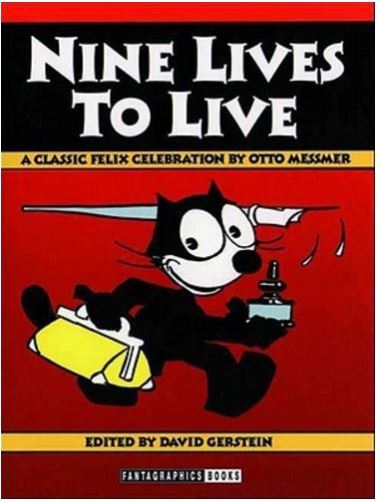
Nine Lives to Live – A Classic Felix Celebration


By Otto Messmer, edited by David Gerstein (Fantagraphics Books)
ISBN: 978-1-56097-308-9 (HB)

It might surprise you to know, but funny kitties actually pre-date the internet. They are still big at trick or treat time though…

Unless you’re as old as me, Felix is a hilarious, antic-enjoying talking cat of incredibly ancient vintage. His origins are confused, contentious and still challenged. I’m going with…

Felix was created by Otto Messmer for Australian Pat Sullivan’s animation studio between 1915 and 1917 and was an overnight global hit. Those moving picture cartoons led to a long supplementary career as a newspaper strip, as well as a plethora of merchandisable products in many other media.

Messmer wrote and drew the Sunday newspaper strip – which first premiered in London papers – before the feature finally launched in the USA on August 19th 1923. As Messmer’s employer and boss, Sullivan re-inked those initial strips, signed them, and then took the credit for both strips and even the animated cartoons, which Messmer carried on directing until 1931.

Otto quietly toiled on, producing Sunday pages and daily strips for decades. In 1955, his assistant Joe Oriolo took over the creative duties: simultaneously starting a campaign to return the credit for Felix’s invention and exploits to the “true” originator. It wasn’t until the 1960s that shy, loyal, brilliant Otto Messmer finally admitted what most of the industry had known for years…

As the cat evolved via successive movie shorts – and eventually numerous TV appearances – an additional and ever-expanding paraphernalia of mad professors, clunky robots and the fancy feline’s fantastical Bag of Tricks gradually became icons of Felix’s magical world, but most of that is the stuff of a later time and – hopefully one day – another collected volume.

The early work collected here comes from the halcyon 1920’s and displays a profoundly different kind of whimsy. Fast-paced slapstick, fantastic invention and, yes, a few images and gags that might arch the collective metaphorical eyebrow of our more enlightened times; these are the strips that caught the world’s imagination more than a century ago.

This was a time when even the modern citizens of America and Great Britain were social primitives compared to us – or at least so I’d like to think… until I read a paper or watch the news…

The imagination and wonderment of George Herriman’s Krazy Kat and Cliff Sterrett’s Polly and her Pals – both so similar to Felix in style, tone and execution – got the same responses from their contemporary readership and with the same sole intent: make the reader laugh.

Our modern response of casually and frequently lazily labelling as racist or sexist any such historical incidence in popular art-forms, whilst ignoring the same “sins” in High Art, is the worst kind of aesthetic bigotry, and usually prompted by opportunistic bias or dog-whistle opportunism and it really truly ticks me off.

Why not use those incensed sensibilities to confront the still-present injustices and inequalities so many people are still – and often increasingly – enduring rather than take a cheap shot at the bygone, far-less-enlightened world when most creators had no conception of the potential ramifications of their efforts?

Sorry about that, but the point remains that the history of our artform is always going to be curtailed and covert if we are not allowed the same “conditional discharge” afforded to film, ballet, opera, painting or novels. When was the last time anybody demanded that Oliver Twist was banned or shunned because of its depiction of a Jew? And if you’re going to legislate against Tootsie, Mrs. Doubtfire, Nuns on the Run or Twelfth Night, don’t do it unless you want bigots and cretins to vote for you.

The modern rush to brand or Other any form of existence lived after Oliver Cromwell died actually shuts down debate before anything can be achieved to fix or even address the issue…

And it’s rants like that that really scare people…

None of which alters the fact that Felix the Cat is a brilliant and vitally important comic strip by an unsung genius. The wonderful work collected here – which include hundreds of rowdily phantasmagorical Daily and Sunday strips plus a comprehensive biography, filmography and TV videography section – perfectly encapsulates the wonder, universal charm and rapid-fire, surreal gags that enchanted generations and will still delight and enthral youngsters of all ages.

It’s long past time that this cat came back…
© 1996 O.G. Publishing Corp.

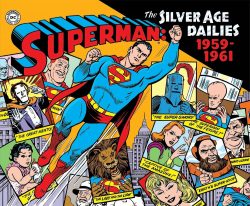
Superman: The Silver Age Dailies volume 1 – 1959-1961


By Jerry Siegel, Curt Swan, Wayne Boring & Stan Kaye, with Otto Binder, Robert Bernstein & Jerry Coleman (IDW Publishing Library of American Comics)
ISBN: 978-1-6137-7666-7 (HB)

It’s indisputable that America’s comic book industry – if it existed at all – would be an utterly unrecognisable thing without Jerry Siegel & Joe Shuster’s Superman. Their unprecedented invention was fervidly adopted by a desperate and joy-starved generation and quite literally gave birth to a genre if not an actual art form.

Spawning an impossible army of imitators and variations within three years of his 1938 debut, the intoxicating blend of eye-popping action and wish-fulfilment which epitomised the early Man of Steel grew to encompass cops-&-robbers crime-busting, socially reforming dramas, science fiction, fantasy, whimsical comedy and, once the war in Europe and the East dragged in America, patriotic relevance for a host of gods, heroes and monsters, all dedicated to profit through exuberant, eye-popping excess and vigorous dashing derring-do.

In comic book terms Superman was master of the world. Moreover, whilst transforming the shape of the fledgling funnybook industry, the Man of Tomorrow relentlessly expanded into all areas of the entertainment media.

Although we all think of the Cleveland boys’ iconic creation as epitome and acme of comic book creation, the truth is that very soon after his debut in Action Comics #1 Superman pretty much left mere funnybooks behind to become a fictional multimedia monolith in the same league as Sherlock Holmes, Tarzan, and Mickey Mouse.

We parochial and possessive comics fans too often regard our purest and most powerful icons in purely graphic narrative terms, but the likes of Batman, Spider-Man, Wonder Woman, X-Men, Avengers and Superman long ago outgrew their four-colour origins and are now fully mythologized modern media creatures instantly familiar in mass markets, platforms and age ranges.

Far more people have seen or heard the Man of Tomorrow than have ever read his comic books. The globally syndicated newspaper strips alone reached untold millions. By the time his 20th anniversary rolled around at the very start of what we know as the Silver Age of Comics, he had been a thrice-weekly radio serial regular, starred in a series of astounding animated cartoons, two chapter play serials, a movie and a novel by George Lowther.

He was a perennial success for toy, game, puzzle and apparel manufacturers and had just ended his first smash live-action television serial. In his immediate future even more shows, a stage musical, a franchise of blockbuster movies and an almost seamless succession of games, bubble gum cards and TV cartoons beginning with The New Adventures of Superman in 1966 and continuing ever since.

Even superdog Krypto got in on the small-screen act…

Although pretty much a spent force these days, for the majority of the last century the newspaper comic strip was the Holy Grail that all American cartoonists and graphic narrative storytellers hungered for. Syndicated across the country – and planet – with millions of avid readers and generally accepted as a more mature and sophisticated form of literature than comic books. It also paid better.

Rightly so: some of the most enduring and entertaining characters and concepts of all time were created to lure readers from one particular paper to another and many of them grew to be part of a global culture. Mutt and Jeff, Flash Gordon, Dick Tracy, Buck Rogers, Charlie Brown and so many more escaped humble newsprint origins to become meta-real: existing in the minds of earthlings from Albuquerque to Zanzibar.

Most still do…

So it was always something of a risky double-edged sword when a comic book character became so popular that they swam against the tide (after all, weren’t the funnybooks invented just to reprint the strips in cheap accessible form?) to become a genuinely mass-entertainment syndicated serial strip.

Superman was the first original comic book character to make that leap – almost as soon as he was created – but only a few have ever successfully followed. Wonder Woman (briefly), Batman (eventually), DC’s aviator Hop Harrigan and groundbreaking teen icon Archie made the jump in the 1940s and only a handful like Spider-Man and Conan the Barbarian have done so since.

The daily Superman newspaper comic strip launched on 16th January 1939 and was supplemented by a full-colour Sunday page from November 5th of that year. Originally crafted by such luminaries as Siegel & Shuster and their studio (Paul Cassidy, Leo Nowak, Dennis Neville, John Sikela, Ed Dobrotka, Paul J. Lauretta & Wayne Boring), the mammoth task soon required the additional talents of Jack Burnley and writers Whitney Ellsworth, Jack Schiff & Alvin Schwartz.

The McClure Syndicate feature ran continuously until May 1966, appearing at its peak in more than 300 daily and 90 Sunday newspapers, boasting a combined readership of more than 20 million. Eventually, artists Win Mortimer and Curt Swan joined unfailing Wayne Boring & Stan Kaye, whilst Bill Finger and Seigel provided stories: serial tales largely separate and divorced from comic book continuity throughout years when superheroes were scarcely seen.

In 1956, Julie Schwartz opened the Silver Age with a new Flash in Showcase #4. Soon costumed crusaders were returning en masse to thrill a new generation. As the trend grew, many companies experimented with the mystery man tradition and the Superman newspaper strip began to slowly adapt: drawing closer to the revolution on the comic book pages.

As the Jet and Atomic Ages gave way to the Space-Age, the Last Son of Krypton was a vibrant yet comfortably familiar icon of domestic modern America: particularly in the constantly evolving, ever-more dramatic and imaginative comic book stories which had received such a terrific creative boost as super heroes began to proliferate once more. Since 1954, and thanks to television, the franchise had been cautiously expanding. In 1959, the Caped Kryptonian could be seen not only in Golden Age survivors Action Comics, Superman, Adventure Comics, World’s Finest Comics and Superboy, but now also in Superman’s Pal Jimmy Olsen, Superman’s Girlfriend Lois Lane and soon Justice League of America. Such increased attention naturally filtered through to the more widely seen newspaper strip and resulted in a rather strange and commercially sound evolution…

After author/educator Tom De Haven’s impassioned Foreword, Sidney Friedfertig’s Introduction explains how and why Jerry Siegel was tasked with turning recently published comic book tales into daily continuities for an apparently more sophisticated and discerning newspaper readership. This meant major rewrites, frequently plot and tone changes and, in some cases, merging two stories into one.

If you’re a comic book fan, don’t be fooled: these stories are not mere rehashes, but variations on an idea for an audience perceived as completely separate from kids’ funnybooks. Even if you are familiar with the source material, the adventures gathered here will read as brand new, especially as they are gloriously illustrated by Curt Swan – and latterly Wayne Boring – at the very peak of their artistic powers.

As an added bonus the covers of the issues those adapted stories came from have been added as a full nostalgia-inducing full-colour gallery…

The astounding everyday entertainment commences with Episode #107 from April 6th to July 11th 1959. ‘Earth’s Super-Idiot!’ by Siegel, Swan & Stan Kaye is a mostly original story that borrows heavily from the author’s own ‘The Trio of Steel’ (Superman #135, February 1960, where it was drawn by Al Plastino). It details the tricks of an unscrupulous super-scientific telepathic alien producer of “Realies” who blackmails the Action Ace into making a fool and villain of himself for extraterrestrial viewers. If the hero doesn’t comply – acting the goat, performing spectacular stunts and torturing his friends – Earth will suffer the consequences…

After eventually getting the better of the UFO sleaze-bag, our hero returns to Earth with a bump and encounters ‘The Ugly Superman’ (July 13th – September 5th). First seen in Lois Lane #8 April 1959, where it was written by Robert Bernstein and illustrated by Kurt Schaffenberger, here eternal spinster Lois agrees to marry a brutish wrestler, and the Man of Tomorrow, for the most spurious of reasons, acts to foil her plans…

Episode #109 ran from September 7th to October 28th 1959, with Superman reluctantly agreeing to make a dying billionaire laugh in return for the miserable misanthrope signing over his entire fortune to charity.

Some of the apparently odd timing discrepancies in publication dates can be explained by the fact that submitted comic book stories often appeared months after they were completed, so their version of Siegel’s ‘The Super-Clown of Metropolis’ didn’t get published until Superman #136 (April 1960) where Plastino took the art in completely different directions…

‘Captive of the Amazons’ – October 29th 1959 to February 6th 1960 – merges two funnybook adventures both originally limned by Boring & Kaye. The eponymous equivalent from Action #266 (Jul 1960) was augmented by Bernstein’s ‘When Superman Lost His Powers’ (Action Comics #262) detailing how super-powered alien queen Jena came to Earth intent on making Superman her husband. On his refused she removed his Kryptonian abilities, subsequently trapping now merely mortal Clark Kent with other Daily Planet staff in a lost valley of monsters where Lois’ suspicions are again aroused…

Episode #111 ran from 8th February to 6th April. ‘The Superman of the Future’ originated in Action #256 (September 1959, by Otto Binder, Swan & Kaye). Both versions seemingly see Superman swap places with a hyper-evolved descendent intent on preventing four catastrophic historical disasters, but the incredible events are actually part of a devious hoax…

Superman’s Girlfriend Lois Lane #10 (July 1959 by Siegel & Schaffenberger) offered up a comedy interlude as ‘The Cry-Baby of Metropolis’ (April 7th – May 28th) sees Lois terrified of losing her looks and exposing herself to a youth ray. Rapidly regenerating into an infant, she provokes much amusement in arch-rival Lana Lang… and that cad Superman…

Episode #113 May 30th – July 2nd features ‘The Super-Servant of Crime’ (Bernstein, from Superman #130, July 1959) as our hero outsmarts a petty crook who has bamboozled the Action Ace into granting him five wishes. Thereafter, ‘The Super-Sword’ (4th July to August 13th and originally by Jerry Coleman & Plastino for Superman #124, September 1958) pits the Kryptonian Crimebuster against an ancient knight with a magic blade that can penetrate his invulnerable skin. Once more, however, all is not as it seems…

Siegel, Boring & Kaye’s comic book classic ‘Superman’s Return to Krypton’ (in Superman #141, November 1960) was first seen in daily instalments from August 15th to November 12th 1960. There it told a subtly different tale of epic love lost as an accident marooned the adoptive Earth hero in the past on his doomed home-world. Reconciled to dying there with his people, Kal-El befriended his own parents and found love with his ideal soul-mate Lyla Lerrol, only to be torn from her side and returned to Earth against his will in a cruel twist of fate.

The strip version here is one of Swan’s most beautiful art jobs ever and, although the comic book saga was a fan favourite for decades thereafter, the restoration of this more mature interpretation might have some rethinking their opinion…

Wayne Boring once more became the premiere Superman strip illustrator with Episode #116 (November 14th – December 31st), reprising his & Siegel’s work on ‘The Lady and the Lion’ from Action #243 (August 1958), wherein the Metropolis Marvel is transformed into an inhuman beast by a Kryptonian exile the ancients called Circe…

Siegel then adapted Bernstein’s ‘The Great Superman Hoax’ and Boring & Kaye redrew their artwork for the episode (January 2nd – February 4th, 1961) from Superman #143 (February 1961). Here, a cunning criminal tries to convince Lois and Clark that he’s actually the Man of Might, blissfully unaware of who he’s failing to fool.

February 6th to March 4th has Superman using brains as well as brawn to thwart an alien invasion in ‘The Duel for Earth’ – originally appearing as a Superboy story in Adventure Comics #277 (October 1960) by Siegel & George Papp.

Superman #114 (July 1957) and scripter Otto Binder provided Siegel with the raw material for a deliciously wry and topical tax-time tale ‘Superman’s Billion-Dollar Debt’ – March 6th to April 8th – wherein an ambitious IRS agent presents the Man of Steel with a bill for unpaid back-taxes, whilst Episode #120 (April 10th – May 13th) introduces ‘The Great Mento’ (from Bernstein & Plastino’s yarn in Superman #147, August 1961): a tawdry showbiz masked mind-reader who blackmails the hero by threatening to expose his precious secret identity…

The final two stories in this premiere collection both come from Superman’s Girlfriend Lois Lane – issues #24, April and #26, July respectively – both originally crafted by Bernstein & Schaffenberger.

In ‘The Perfect Husband’ (15th May to July 1st) – begun and ended by Boring but with Swan pinch-hitting for 2 weeks in the middle – Lois’ sister Lucy tricks the journalist into going on a TV dating show. Here she meets her ideal man: a millionaire sportsman and war hero who looks just like Clark Kent…

Then ‘The Mad Woman of Metropolis’ sees Lois driven to the edge of sanity by a vengeance-hungry killer: a rare chance to see the reporter and butt of so many shameless male gags show her true mettle by solving a case without the Man of Tomorrow’s avuncular, so-often patronising assistance…

Superman: – The Silver Age Dailies 1959-1961 was the first in a series of huge (305 x 236mm) lavish, high-end hardback collections (frustratingly still not available in digital editions!) starring the Man of Steel and a welcome addition to the superb commemorative series of Library of American Comics which has preserved and re-presented in luxurious splendour such landmark strips as Li’l Abner, Tarzan, Little Orphan Annie, Terry and the Pirates, Bringing Up Father, Rip Kirby, Polly and her Pals and many of the abovementioned cartoon icons.

If you love the era, these stories are great comics reading, and this is a book you simply must have.
Superman ™ & © 2013 DC Comics. All Rights Reserved.

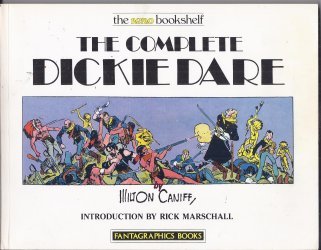
The Complete Dickie Dare


By Milton Caniff (Fantagraphics Books)
ISBN: 0-93019-322-9 (HB)  978-0-93019-321-8 (PB)

Despite being one of the greatest and most influential cartoonists in world history, Milton Caniff wasn’t an overnight sensation. He worked long and hard before he achieved stellar status in the comic strip firmament, before Terry and the Pirates brought him fame, and Steve Canyon secured his fortune.

The strip which brought him to the attention of legendary Press Baron “Captain” Joseph Patterson – in many ways co-creator of Terry – was an unassuming daily fantasy feature about a little boy who was hungry for adventure…

Caniff was working for The Associated Press as a jobbing cartoonist when a gap opened in their strips department. AP was an organisation that devised and syndicated features for the thousands of regional and small-town newspapers which couldn’t afford to produce cartoons, puzzles, recipes and other fillers that ran between the local headlines and regional sports.

Over a weekend, Caniff came up with Dickie, a studious lad who would read a book and then fantasize himself into the story, taking faithful little dog Wags with him. The editors went for it and Dickie Dare premiered on July 31st, 1933.

Caniff wrote and drew the feature for less than 18 months before moving on, although his excellent but unappreciated replacement Coulton Waugh steered the series until its conclusion two decades later.

The first day-dream was with Robin Hood, followed by a frantic, action-packed visit with Robinson Crusoe and Friday, battling hordes of howling savages and scurvy pirates. Rugged combat gave way to fantastic mystery when the tyke perused Aladdin, resulting in a lavish and exotic trip to a very fabled Far East. This segment closed near Christmas, and when his father read Dickie the story of the Nativity, Caniff began his long personal tradition of creating seasonally topical strips.

A visit to Bethlehem ended on Christmas morning, and one of Dickie’s Christmas presents then triggers his next excursion, when he starts reading of General George Armstrong Custer…

King Arthur next, followed by Captain Kidd the Pirate, but by then Caniff was chafing under the self-imposed limitations of his creation. He believed the strip had become formulaic and there was no real tension or drama in mere dreams. In a creative masterstroke, he revised the strip’s parameters, and by so doing produced the prototype for a masterpiece.

On May 11th, 1934, Dickie met a new uncle: globe-trotting author and two-fisted man-of-action Dan Flynn, and one week later the pair embarked on a Round-the-World trip. Caniff had moved swiftly, crafting a template that would become Terry and the Pirates.

The wide-eyed, nervy All-American Kid with adult pal ultra-capable adventurer, whilst a subject of much controversy and even ill-advised and outright scurrilous modern disparagement, was a literary archetype since before Treasure Island. Adapting that relationship to comic strips was commercially sound: a decision that hit a peak of popularity with the horde of sidekicks/partners who followed in the wake of Robin the Boy Wonder six years later.

No sooner have Dickie & Dan taken ship for Africa than the drama begins, when the restless kid uncovers a hidden cargo of smuggled guns. Aided by feisty Debutante Kim Sheridan and sailor Algy Sparrow, our heroes foil the scheme, but not before Dickie is captured by Kuvo, the Arab chieftain awaiting those weapons.

Pursued by French authorities, Kuvo retreats to a desert fortress where Kim, disguised as a slave-girl, rescues the lad, only to be caught herself. The full-tilt action peaks to a splendid conclusion before the boys, with Algy in tow as their butler, head for Tunis only to stumble across a plot to use a World War I U-Boat for ocean-going piracy…

This long adventure (beginning September 13th) is a thoroughly gripping yarn encompassing much of the Mediterranean and Atlantic, as the boys escape pirates and aid the Navy in hunting them down. There’s buckets of action and an astonishing amount of tension, but the tale ends a tad abruptly when Caniff, lured away by Patterson, simply drops the feature and Coulton Waugh takes over the storyline from the next Monday (3rd December).

With no break in the tale Waugh rapidly (in 14 episodes) wraps up the saga. He even has Dickie home by Christmas.

From the New Year the strip would chart new waters with Waugh at the helm, aided (and briefly replaced whilst he wrote his seminal book on Comics and also when he was producing the strip Hank for the New York magazine PM) by assistant and spouse Odin Burvik.

Dickie Dare eventually ended its run in October 1957 with the now adult adventurer beginning a new career as a US Navy Cadet.

Although usually dismissed as a mere stage on the road to his later mastery – and certainly long before Caniff and sometime studio partner Noel Sickles made their chiaroscurist breakthroughs in line-art that revolutionised the form – these early tales delighted and enthralled readers. Full of easy whimsy and charm, the strip evolved into a rip-roaring, all-ages thriller, full of wit and derring-do, in many ways an American answer to Hergé’s Tintin.

They deserve to be appreciated on their own merits and are long overdue for reappraisal in new collections.

At least this edition is still readily available but Dickie Dare is long overdue for rediscovery by the mass-market – and streaming services! – so while we’re at it, let’s see some of the work that the criminally under-valued Waugh originated too.
Artwork originally © 1933-1934 The Associated Press. Other contents this edition © Richard Marschall All rights reserved.

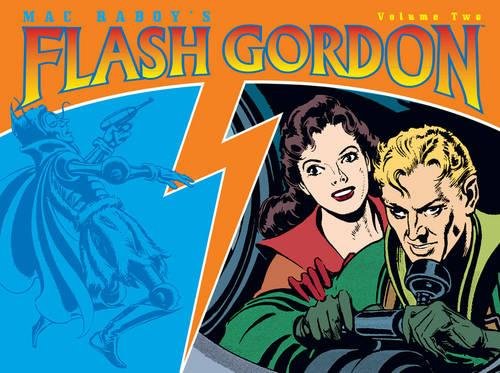
Mac Raboy’s Flash Gordon volume 2


By Don Moore & Mac Raboy (Dark Horse)
ISBN: 978-1-56971-911-4 (TPB)

By almost every metric, Flash Gordon is the most influential comic strip in the world. When the hero debuted on Sunday January 7th 1934 (with the equally superb Jungle Jim running as a supplementary “topper” strip). It was a slick, sophisticated answer to Philip Nolan & Dick Calkins’ revolutionary, ideas-packed, inspirational, but quirkily clunky Buck Rogers (which had also launched on January 7th – albeit in 1929), two fresh elements were added to the wonderment: Classical Lyricism and Poetic Dynamism. The newcomer became a weekly invitation to stunningly exotic glamour and astonishing beauty.

Where Buck merged traditional adventure with groundbreaking science concepts, Flash reinterpreted fairy tales, hero epics and mythology, draping them in the spectacular trappings of contemporary futurism, with the varying “rays”, “engines” and “motors” of modern pulp sci fi substituting for trusty swords and lances. There were also plenty of those too – and exotic craft and contraptions stood in for galleons, chariots and magic carpets. The narrative trick made the far-fetched satisfactorily familiar – and it was initially continued by Mac Raboy and Don Moore in their run of Sunday strips.

Look closely, though, and you’ll see cowboys, gangsters and of course, flying saucer fetishes adding contemporary flourish to the fanciful fables in this second superb volume which is long overdue for a fresh edition.

Most important of all, the sheer artistic talent of Alex Raymond, his compositional skills, fine linework, eye for clean, concise detail and just plain genius for drawing beautiful people and things, swiftly made this the strip that all young artists swiped from. When original material comic books began a few years later, literally dozens of talented kids used Gordon as their model and ticket to future success in the field of adventure strips. Almost all the others went with Milton Caniff’s expressionist masterpiece Terry and the Pirates (and to see one of his better disciples check out Beyond Mars, limned by wonderful Lee Elias).

Flash Gordon began on present-day Earth (which was 1934, remember?) with a wandering world about to smash into our planet. As global panic ensued, polo player Flash and fellow passenger Dale Arden narrowly escaped disaster when a meteor fragment downed their airliner. They landed on the estate of tormented genius Dr. Hans Zarkov, who imprisoned them in the rocket-ship he had built. His plan? To fly the ship directly at the astral invader and deflect it from Earth by crashing into it!

Thus began a decade of sheer escapist magic in a Ruritanian Neverland: a blend of Camelot, Oz and a hundred other fantasy realms promising paradise yet concealing vipers, ogres and demons, all cloaked in a glimmering sheen of sleek scientific speculation. Worthy adversaries such as utterly evil yet magnetic Ming, emperor of the fantastic wandering planet; myriad exotic races and shattering conflicts offered a fantastic alternative to drab and dangerous reality for millions of avid readers around the world.

With Moore doing the bulk of the scripting, Alex Raymond’s ‘On the Planet Mongo’ ran every Sunday until 1944, when the artist joined the Marines. On his return, he forsook wild imaginings for sober reality: creating gentleman-detective Rip Kirby. The public’s unmissable weekly appointment with wonderment perforce continued under the artistic auspices of Austin Briggs – who had drawn the monochrome daily instalments since 1940.

In 1948, eight years after beginning his career drawing for the Harry A. Chesler production “shop” comic book artist Emmanuel “Mac” Raboy took over illustrating the Sunday page. Moore remained as scripter and began co-writing with the new artist.

Raboy’s sleek, fine-line brush style – heavily influenced by his idol Raymond – had made his work on Captain Marvel Jr., Kid Eternity and especially Green Lama a pinnacle of artistic quality in the early days of the proliferating superhero genre. His seemingly inevitable assumption of Flash Gordon’s extraordinary exploits led to a renaissance of the strip and in a rapidly evolving post-war world, it became once more a benchmark of timeless, hyper-realistic quality escapism which only Hal Foster’s Prince Valiant could match.

This second 260-page paperback volume, produced in landscape format and printed in stark black-&-white (although one or two strips appear to have been scanned from printed colour copies) covers May 17th 1953 to February 23rd 1958, and opens with a scholarly Introduction on ‘Comic Strip Godfathers’ from Bruce Jones before the previous volume’s cliffhanger is addressed…

With a new spaceship, far-flung travellers Flash, Dale and Zarkov set off for Earth but are forced to land on the Moon where a secret human base had been established. For unknown reasons Dr. Stella and her thuggish aide Marc detain and delay them, but after an increasing number of close shaves and mysterious accidents, a little digging by our heroes reveals that they are the unwitting guests of ruthless space pirates…

After expediently dealing with the planetary privateers, our heroes head for Earth, and are promptly seconded to spearhead an urgent exploratory expedition to a newly discovered satellite body. Suitably dutiful, they hurtle off into the void again…

‘(Life on) Titan’ ran from 14th June to September 20th 1953: detailing how the little world is populated by giants. However, after capturing one of the hulking inhabitants, Zarkov concludes that the truth is far stranger than the Earthmen could have imagined…

The tireless boffin then builds a single-seater spaceship and requires Flash to take a test run out to Jupiter’s moon ‘Callisto’ (27th September 1953 to 17th January 1954). A sudden illness causes a crash and Flash awakens in care of elderly hermit Phylo, who cunningly embroils the dauntless troubleshooter in his own struggle against invisible psychic dictator The Mind…

After overthrowing the hidden tyrant, the indomitable Earthman heads home and actually enjoys a little rest before an ancient mystery unfolds in ‘Flash Gordon and the Thanatos’ (17th January-2nd May).

After archaeologist Dr. Sark finds incontrovertible evidence of a prehistoric atomic blast in the Libyan desert, our ever-inquisitive action man uncovers an alien in a bottle but is too late to save Dale from being abducted by the mind-bending survivor of an antediluvian starship crash…

Dashing in pursuit as his beguiled beloved heads off-world, Flash is drawn into the parallel dimension of Cortinus where god-like beings dwell. They welcome intruders from fondly-remembered Earth, but are sadly unaware that one of the visitors carries the malevolent spirit of their outcast brother Loki. Once freed, the villain proudly boasts how he influenced and dominated many bellicose humans such as Alexander, Julius Caesar and Genghis Khan, and now intends ruling two realms for his own benefit and amusement. Sadly, nigh-omnipotent Loki vastly underestimates the ingenuity and resolve of his mortal opponents…

In a ship donated by head deity Zustra, Flash and Dale re-cross the dimensional divide, arriving in deep space to encounter a scene of horrific barbarity at an Observatory Station. When the ‘Outlaw of the Asteroids’ (9th May-25th July) took the outpost’s oxygen, the crew almost died in hibernation. After reviving the deep-frozen scientists, our adventurers set off after the ruthless bandit and discover the reason for his heinous theft was both noble and desperate. The bandit perishes for his sins, but not before leaving young space orphan Pebbles with the only humans he can trust…

By the time Flash, Dale and Pebbles reach Earth the next exploit is already well underway as a seed of ‘The Star Tree’ (1st August-17th October) survives a meteor crash in the Amazon and immediately propagates itself in fertile soil. By the time our bold wanderers accidentally land in the region, it has transformed into an arctic wilderness where a gigantic plant voraciously consumes every living thing its grasping branches can seize…

The vegetable invasion is no accident, and as Flash leads the frozen rain forest’s indigenous inhabitants in spirited resistance, cold-blooded aliens appear. They lived on Earth when it was a giant ice ball and after eons on Pluto want their original world back! They would have succeeded too, had not one of the invaders found his heart warming to the plight of the disputed world’s current tenants…

With that threat ended normality returns, but soon after packing Pebbles off to boarding school Flash, Zarkov and many other unsuspecting Earth folk are shanghaied by eerie metal globes and transported to ‘The Lonely Planet!’ (24th October 1954 to 9th January 1955)…

Here, Herculean extraterrestrial barbarians and wily midgets conspire and compete to find fresh fodder for gladiatorial contests, before, with the aid of a usurped king, Flash upsets the unlikely alliance and overthrows the twisted regime. However, just as the liberated Earthlings enter home orbit, their always-embattled birthworld is attacked by insectoid Antomni who require a fresh colony to exploit. The bug beings expect little resistance as they possess the power of Time Migration…

The invaders travel millions of years ‘Into the Past’ (16th January-27th March) to prevent the evolution of humanity but accidentally catch Flash and Zarkov in their temporal backwash, allowing our heroes to inspire a band of Nearly humans to exterminate the insectoids before returning to their proper time and place…

Restless Zarkov then organises an exploratory expedition to ‘Venus’ (3rd April -19th June) where Flash and Dale find a feudal civilisation in turmoil beneath the planet’s impenetrable cloud layers. Before long, they are assisting scientific prodigy Viko and his fellow exiled “Mistiks” in overturning oppressive, superstition-ruled authorities and introducing rational enlightenment to the Second Planet from the Sun…

Next, Africa is beset by a strange sleeping plague. Investigations reveal the source is escaped gasses from an unsuspected ‘City Within the Earth’ (26th June – 28th August). The accident causes toxic oxygen to contaminate the subterranean metropolis of Centra, and when its bravest warriors surface to investigate, a concatenation of misfortunes compel them to take Flash captive. Imprisoned and soon to become the treasured possession of flamboyant Princess Amara, Gordon is rescued by indomitable Dale who braves the depths and deadly air to save her man and seal off the underworld forever…

‘The Dark Planet’ (4th September – 6th November) has lurked undetected at the edge of the solar system for all of humanity’s history, but that occlusion ends when murderers Stragg, Rust and Tula are exiled from their advanced culture on the distant world of Ur and dumped on the frigid world. When Flash, Dale and Zarkov’s planetary mapping mission brings them to the bleak outpost, they are ambushed by the killers who then steal their ship. The aliens have never encountered human cunning though, and are soon back where they started and engaged in a lethal duel for control of the ship and their liberty…

Human trafficking underpins ‘Station Crossroads’ (13th November 1955 – 15th January 1956) as our heroes stumble upon a scheme to kidnap and sell human technicians to scientifically backward aliens. The vile human mastermind behind the plot operates out of Earth’s most popular orbital rest-stop, but before the slavers are crushed Flash discovers a close friend is deeply involved in the abductions…

When Gordon discovers a hidden base at Earth’s North Pole is being used by aquatic aliens, he is embroiled in an ‘Arctic Adventure’ (22nd January-March 25th) where unscrupulous Earthmen use the freezing waters as a cost-free fish-farm to grow giant monsters for mysterious offworlders to consume…

After a far-distant world experiences an atomic accident, the aftermath produces a voracious ‘Radioactive Man’ (1st April – 3rd June) who can only exist by absorbing deadly fallout. The authorities’ solution is to blast the mutant into the void where, after years of lonely travel, atomic exile Djonn Toth lands on planet Rota just as Flash and Dale pay a visit.

Before long the humans’ vast troubleshooting experience is employed to frustrate Toth’s efforts to enslave the population and consume all their radium.

When the fantastic wonder planet’s eccentric orbit again intersects with Earth, Flash, Dale and Zarkov ‘Return to Mongo’ (10th June 1956- 13th January 1957) after six years. However, their proposed sightseeing trip inevitably involves them in an icily arctic cold war between Wolf Men and Walrus Men, a face-off with would-be supreme tyrant Gant, and clashes with leather-winged Dactyl Men. This leads to capture by arrogant cloud dwellers of Paxora where robot duplicates intent on conquest end Mongo’s most secretive sub-culture.

Upsetting the artificial men’s plan eliminates all but one of the inimical automatons, but ‘Rok’ (13th January – 10th March) is like no android the Earthlings have ever encountered before: patronising protector and unstable enemy in one. Despite safeguarding them through Mongo’s wildest regions, the mechanoid’s ultimate aims remain unclear and his manner of demise most unexpected…

Brought to the edge of civilisation Flash, Dale and Zarkov enter a spaceship race, intent on winning a craft able to take them home to Earth, but the ‘Suicide Run’ (17th March-19th May) almost proves their undoing, as most other competitors indulge in sabotage and subterfuge of every sort to secure the glittering prize…

Eventually victorious, our heroes ‘Escape from Mongo’ only to be lured into ‘The Space Tomb’ (26th May – 14th July) of the Gatherer: a nebula-dwelling desperado who wants to imprison them beside a legion of other valiant explorers in his vast Sargasso of Space.

After outwitting the deranged collector, the humans resume their homeward flight but are again diverted, this time by ‘The Space Genie’ (21st July-1st September): a fearsome yet affable, lethally literal-minded being who brings them to planetary paradise Superba. The inhabitants are not pleased: they only just survived the Genie’s last visit and used all their ingenuity and wish-making ability to get rid of the interstellar pest…

The odyssey home is then interrupted by a string of short interconnected adventures (‘Space Voyage/Strange World/The Wheel Men’: spanning 8th September to 24th November) detailing clashes with space moths, elastic primitives and woman-stealing whirling dervishes engaged in all-out war with sky-residing Gyromen. After brokering a lasting peace between these eccentric extraterrestrials, the humans finally reach Earth in a borrowed flying saucer only to fall prey to ‘The Mystery of the Lonely Crowds!’ (1st December 1957 through January 12th 1958). A telepathic plague of depression and rapidly-spreading isolation has an otherworldly cause but is not intended to be a menace. It still culminates in tragedy, however…

This non-stop rollercoaster ride concludes with the merest start of ‘Missiles from Neptune’ (19th January 1958 to the cliffhanging last page of February 23rd) as the Tyrant of Neptune decides to impress the captive populace. This he does by testing his latest Weapons of Interplanetary Destruction against the Earth, prompting Flash to go and discourage him…

Every week that he toiled on the strip, Mac Raboy produced ever-more expansive artwork filled with distressed damsels, deadly monsters and all sorts of outrageous adventure that continued until the illustrator’s untimely death in 1967.

Perhaps that was a kindness. Raboy was the last great Golden Age romanticist illustrator: his lushly lavish, freely flowing adoration of the perfect human form was beginning to stale in popular taste (the Daily feature had already switched to the solid, chunky, He-Manly burly, realism of Dan Barry and Frank Frazetta) but here at least the last outpost of ethereally beautiful heroism and pretty perils prevailed, and you can visit as easily and often as Flash and Dale popped between planets, just by tracking down this book and the ones which followed…
© 2003 King Features Syndicate Inc. ™ & © Hearst Holdings, Inc. All rights reserved.

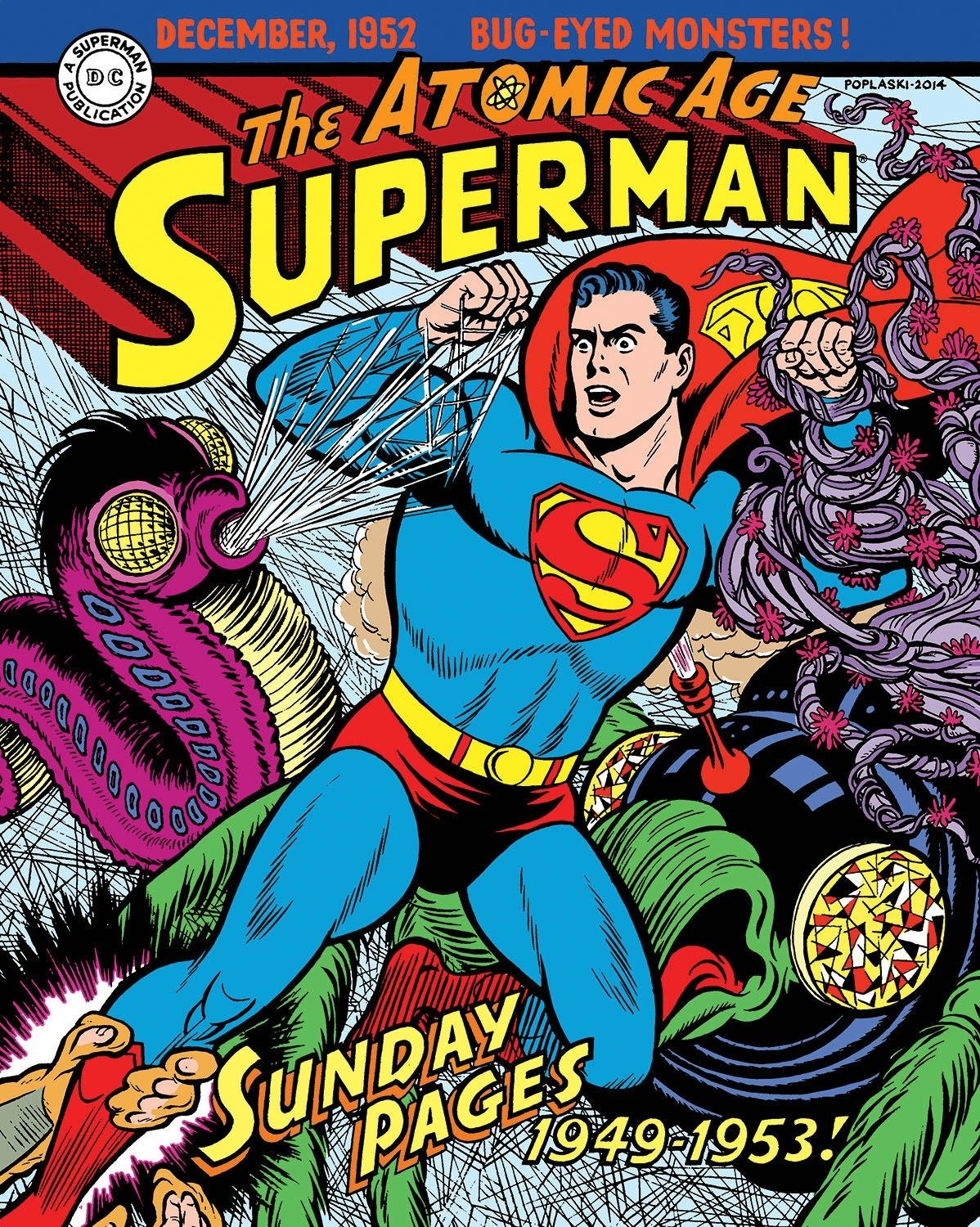
Superman – The Atomic Age Sundays volume 1: 1945-1953


By Alvin Schwartz, Wayne Boring & Stan Kaye (IDW/DC Comics)
ISBN: 978-1-63140-262-3 (HB)

It’s indisputable that the American comic book industry – if it existed at all – would be an utterly unrecognisable thing without Superman. Jerry Siegel & Joe Shuster’s bold and unprecedented invention was fervidly adopted by a desperate and joy-starved generation and quite literally gave birth to a genre if not an actual art form. He was also shamelessly copied and adapted by many inspired writers and artists for numerous publishers, spawning an incomprehensible army of imitators and variations within three years of his summer 1938 debut.

The intoxicating blend of breakneck, breathtaking action and triumphal wish-fulfilment which epitomised the early Man of Steel soon grew to encompass cops-and-robbers crime-busting, socially reforming dramas, science fiction, fantasy, whimsical comedy and, once the war in Europe and the East also engulfed America, patriotic relevance for a host of gods, heroes and monsters, all dedicated to profit through exuberant, eye-popping excess and vigorous dashing derring-do.

In comic book terms Superman was master of the world. Moreover, whilst transforming and dictating the shape of the fledgling funnybook industry, the Man of Tomorrow relentlessly expanded into all areas of the entertainment media. Although we all think of the Cleveland boys’ iconic invention as the epitome and acme of comics creation, the truth is that very soon after his debut in Action Comics #1 the Man of Steel became a fictional multimedia monolith in the same league as Popeye, Tarzan, Sherlock Holmes and Mickey Mouse.

Diehard comics fans regard our purest and most powerful icons in primarily graphic narrative terms, but the likes of Batman, Spider-Man, Black Panther, The Avengers and all their hyperkinetic kind long ago outgrew four-colour origins and are now also fully mythologized modern mass media creatures, instantly familiar across all platforms and age ranges…

Far more people have viewed or heard the Man of Steel than have ever read his comic books. His globally syndicated newspaper strips alone reached untold millions, and by the time his 20th anniversary rolled around at the very start of what we know as the Silver Age of Comics, he had been a thrice-weekly radio serial regular and starred in a series of astounding animated cartoons, as well as two films and a novel by George Lowther.

Superman was a perennial sure-fire success for toy, game, puzzle and apparel manufacturers and had just ended his first smash live-action television serial. In his future were three more shows (Superboy, Lois & Clark and Smallville), a stage musical, a franchise of blockbuster movies and an almost seamless succession of games, bubblegum cards and TV cartoons beginning with The New Adventures of Superman in 1966 and continuing ever since. Even superdog Krypto got in on the small-screen act…

However, during his formative years the small screen was simply an expensive novelty so the Action Ace achieved true mass market fame through a different medium: one not that far removed from his print origins.

Although pretty much a spent force these days, for most of the last century the newspaper comic strip was the Holy Grail all American cartoonists and graphic narrative storytellers aimed for. Syndicated across country – and frequently the planet – they were seen by millions of readers and generally accepted as a more mature and sophisticated form of literature than comic-books. Strips also paid far better and rightly so: some of the most enduring and entertaining characters and concepts of all time were made to lure readers from one particular paper to another and many of them consequently grew to be part of global culture. Flash Gordon, Dick Tracy, Buck Rogers, Charlie Brown and so many more evolved beyond humble, tawdry newsprint to become meta-real: existing in the minds of earthlings from Albuquerque to Zanzibar.

Some still do…

Even so, it was always something of a risky double-edged sword when comic book characters become so popular that they swim against the tide (after all weren’t the funny-books invented just to reprint strips in cheap accessible form?) to became actual mass-entertainment – and often global – syndicated serial strips.

Superman was the first comic book character to make that leap – about six months after he exploded out of Action Comics – but only a few have ever successfully followed. Wonder Woman, Batman (eventually) and groundbreaking teen icon Archie Andrews made the jump in the 1940s with only a handful such as Spider-Man, Howard the Duck and Conan the Barbarian having done so since.

The daily Superman newspaper comic strip launched on 16th January 1939, augmented by a full-colour Sunday page from November 5th of that year. Originally crafted by Siegel & Shuster and their studio (Paul Cassidy, Leo Nowak, Dennis Neville, John Sikela, Ed Dobrotka, Paul J. Lauretta & Wayne Boring), the mammoth task soon required the additional artistic gifts of Jack Burnley and ancillary writers Whitney Ellsworth, Jack Schiff & Alvin Schwartz. The McClure Syndicate feature ran from 1939 until May 1966 and at its peak appeared in over 300 daily and 90 Sunday newspapers: a combined readership surpassing 20 million.

For most of the post-war years, Boring & Stan Kaye illustrated the spectacular Sundays (latterly supplemented by Win Mortimer and Curt Swan). The majority of strips – from 1944 to 1958 – were written by still largely unsung scribe Alvin Schwartz. Born in 1916, Schwartz was an early maestro of comic books, writing Batman, Superman, Captain Marvel and for many other titles and companies. Whilst handling the Superman strip he also freelanced on Wonder Woman and other superheroes as well as DC genre titles such as Tomahawk, Buzzy, A Date with Judy and House of Mystery.

After numerous clashes with new superman Editor Mort Weisinger, Schwartz quit comics for commercial writing: selling novels, essays, documentaries and docudramas for the National Film Board of Canada. He worked miracles in advertising and market research, developing selling techniques like psychographics and typological identification. A member of the advisory committee to the American Association of Advertising Agencies, he died in 2011.

After too many years wallowing in obscurity most of Superman’s newspaper strip exploits are at last available to aficionados and the curious newcomer in tomes such as this compiled under the auspices of the Library of American Comics.

Showcasing Schwartz & artist Wayne Boring in their purest prime, these Sundays (numbered as pages #521 to #698 collectively spanning October 23rd 1949 to March 15th 1953) star a nigh-omnipotent Man of Steel in domestically-framed tales of emotional dilemma and pedestrian criminality rather than a parade of muscle-flexing bombast. Here humour, wit and satire comfortably replace angst and bludgeoning action.

Following an affable appreciation of the creators and the times in Mark Waid’s ‘An Introduction’, ‘A Wayne Boring Gallery’ offers a tantalising selection of contemporaneous Superman and Action Comics covers before weekly wonderment commences in all its vibrant glory. Sadly, the serials are untitled, so you’ll just have to manage with my meagre synopses of individual yarns…

Kicking off is a charming fantasy as the Metropolis Marvel is temporarily stranded in Arthurian Britain after a US government time travel experiment goes awry. Whilst living in the past he befriends and assists court magician Merlin: an old duffer whose conjuring tricks aren’t fooling anyone anymore…

The first new tale of 1950 begins on February 12th, detailing how swindler Joseph Porter cons the Man of Steel into taking his place and clearing up his problems with cops and numerous gulled victims. This includes a hilarious spoofing sequence as the hero plays un-matchmaker to a scandalously-affianced hillbilly ingenue that will delight fans of Li’l Abner…

The extended saga opening on May 28th offers another human-interest drama given a super-powered spin: two aging robber barons recalling their regulation-free heydays before embarking on a ruthless wager to see who will get “anything they wish for” first. The only limitations imposed are their imaginations and financial resources. Before long Superman is hard-pressed to keep collateral casualties to a minimum…

One of the few antagonists to transfer from funnybooks to the Funny pages was fifth dimensional prankster Mr. Mxyztplk who popped back to our third dimension and took instant umbrage to an arrogant Earth educator. Dr. Flipendale had the temerity to declare the imp a mass delusion and refused to believe or even acknowledge the escalating chaos his stark pronouncements triggered…

Strip #573 (October 22nd) offers a different take on the classic secret identity crisis as Clark is exposed as an invulnerable man to all of Metropolis. Although gangsters are convinced, Lois Lane is not, claiming the underworld is perpetrating a frame-up…

That yarn takes us to years’ end and 1951 opens on January 7th with a tale of suspicion and injustice as Clark heads back to childhood hometown Smallville to celebrate Superboy Week and encounters a young man nursing an ancient grudge. When the poison pen/rumour campaign looks set to spoil festivities, the hero’s investigations uncover a betrayed child, a framed, murdered father and nefarious clandestine misdeeds carried out by corporate rogues in the Boy of Steel’s name…

Another identity crisis bedevils Clark beginning on April 1st. A killer’s case of mistaken identity seemingly exposes the reporter as super-strong and bulletproof. Surely, he must be the indomitable Man of Steel in disguise? Not according to Professor Pinberry who believes our hapless scribe has been accidentally exposed to his new superpower ray machine, Clark is happy to grasp at the fortuitous alibi but trouble mounts after the public demands to see the machine in action again and the city’s biggest mobster goes after the gadget to make himself Superman’s equal.

Strip #609 commenced on July 1st as aged duffer Salem Cooley comes to Metropolis and enjoys the most miraculous winning streak in history. Even Superman’s astounding powers can’t keep up with the string of happy circumstances, fortuitously profitable accidents and close shaves. Everybody wants to be the old coot’s pal, so who then is behind the constant assassination attempts on superstitious Salem… and what reward could possibly tempt anyone to challenge the luckiest man alive?

September 9th saw Superman agree to write Daily Planet articles about some of his previous exploits to benefit crime prevention charities. However, when capers he cites are restaged by mysterious malefactors, the city soon turns against the Man of Tomorrow and it takes all his super-wits to uncover the mastermind behind it all and quash one of the boldest crimes in the city’s history…

To lure a crime boss out, the Action Ace agrees to be absent Metropolis for a few weeks in the next adventure (running November 18th 1951 – January 13th 1952). However, when a poverty-struck boy succumbs to disease and depression, the Man of Might opts to return undercover, inspiring the kid’s recovery by granting wishes made on a “magic wand”. The task becomes increasingly difficult after crooks get hold of the stick and the invisible hero has to play along to sustain little Teddy’s recuperation…

From January 20th, Superman plays guardian angel to former wastrel and drunken playboy Reggie de Peyster who swears he’s a reformed character. Nobody but Superman realises the trust fund brat is sincere and all the appalling, shameful scandals he’s currently implicated in are being manufactured to cut him out of a vast inheritance…

Lois Lane takes centre stage from April 6th as, after months of being sidelined, the daring reporter quits her job to find a career offering some real excitement. She’s soon assistant to private detective Mike Crain: catching crooks and bodyguarding glamourous stars, but the work seems dull and pedestrian. Of course, Lois is utterly oblivious to the fact Superman is secretly intervening: patriarchal efforts to get her back where she belongs. Ah, different times, eh?

When maverick Hollywood producer/director Hans Bower arrives in Metropolis, (from June 29th he promptly declares Clark to be his latest mega-sensational super-star. A force of nature unable to take no for an answer, Hans soon has the bewildered reporter helming his next box office blockbuster. As shooting progresses, however, Superman uncovers a covert agenda and shocking secret behind the mogul’s extraordinary actions.

Uncanny crime is the order of the day from September 21st when bizarre illusions plague Metropolis and scientist Dr. Wagonrod accuses Superman of perpetrating hoaxes and staging crises due to an undiagnosed split personality. The truth is far more devious than that…

Concluding this first Atomic Age collection, November 30th 1952 to March 15th 1953 found readers avidly watching the skies when an alien capsule fell to Earth and disgorged a succession of alien bio-weapons to test humanity. Superman was hard-pressed to defeat the army of bizarre beasts but did have one immeasurable advantage: the sage advice and input of life-long science fiction fan Sedgwick Ripple…

The Atomic Age Superman: – Sunday Pages 1949-1953! was the first of three huge (312 x 245 mm), lavish, high-end hardback collections starring the Man of Steel and a welcome addition to the superb commemorative series of Library of American Comics which has preserved and re-presented in luxurious splendour such landmark strips as Lil Abner, Tarzan, Rip Kirby, Polly and her Pals and many of the abovementioned cartoon icons.

It’s an unimaginable joy to see these neglected Superman stories again, offering a far more measured, domesticated and comforting side of one of America’s most unique contributions to world culture. It’s also a pure delight to see some of the most engaging yesterdays of the Man of Tomorrow. Join me and see for yourself and agitate for the entire library to find time to release digital editions…
© 2015 DC Comics. All rights reserved. SUPERMAN and all related characters and elements are trademarks of DC Comics.

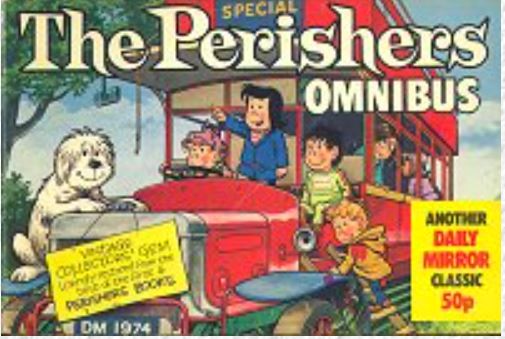
The Perishers Omnibus volume 1


By Maurice Dodd & Dennis Collins (Daily Mirror Books)
ISBN: 0-85939-031-4 (PB)

I plug these little chaps – and the wonderful feature they crafted – every few years because the work is wonderful and quintessentially British. I so wish they were still around to take aim at today’s governments, autocrats, too-common people and general discommodiousness as well as helping us accommodate the impending end of the world with a smile…

Although written almost entirely by Maurice Dodd throughout its 48-year history, the forgotten National Treasure that is The Perishers was actually created in 1957 by artist Dennis Collins, writer Bill Witham (who went on to huge success with uniquely innocent everyman Useless Eustace) and cartoon editor Bill Herbert.

The daily tribulations, ruminations, exploits and misadventures of a bunch of typical kids (for the latter half of the 20th century at least) was first published in the Manchester edition of The Daily Mirror in February 1958. After only a couple of frankly mediocre months the wacky adventures of Maisie & Marlon were withdrawn and retooled.

Jack-of-all-trades, budding artist and advertising whiz-kid Dodd was then approached by ex-paratroop service comrade and drinking buddy Herbert. The freelance designer jumped at the chance to reinvent the characters in what was a meandering but beautifully illustrated, all-ages feature simply stuffed with untapped potential.

Drawing on his own life (he would describe it as “shamelessly pilfering”), Dodd created a plethora of new characters, animal and human – although with this strip distinctions are loose and hard to defend – and rescued an early 1958 casualty in the unkempt and ill-maintained person of laconic orphan and philosophical dilettante Wellington.

This bewildered and ever-anxious symbol of the post-war era was a street urchin living on his wits but still attending school and enduring all the daily trials and indignities of British youth.

Relaunched in October 1959 in London and national editions, the revamped Perishers strip quickly caught on to become a morning mainstay for generations of Brits, blending slapstick and surreal comedy with naive charm, miniaturised modern romantic melodramas (Maisie loves Marlon, Marlon loves fashion and “inventing”, and Wellington loves sausages), liberally laced with sardonic cultural commentary. Particularly rewarding was a continuing and wonderfully twisted faux misperception of contemporary politics and the burgeoning influence of advertising and commercial media.

Even in its earliest days the strip was superbly illustrated, conjuring up in a few judicious lines and cannily applied grey tones a communal urban wonderland we all knew as kids: the familiar post-war melange of shops and streets, building sites and overpasses, alleys and parks and fields where we could get on with our adventures and no adults could interfere or spoil the fun. The unsavoury old git in me still hungers in absentia on behalf of the youth of today who will never experience such freedom without being labelled “neglected”, “at risk” or possibly just “feral”…

Here the primary protagonists are Wellington and Boot, his old English Sheepdog (sort of: the wily, hairy chancer and raconteur considers himself a Manorial Milord “sufferin’ under the curse of a Gypsy Wench”). They are ably unsupported by the formidable Maisie, a thoroughly modern miss torn between self-delusion that the boy of her dreams feels likewise; sweets, an unsurpassed capacity for greed and unrelenting violence, and a tremendous unslaked passion for the aforementioned Marlon, who she thinks is what she wants. And sweets.

Cool, suave and debonair are just three of the many, many words Marlon doesn’t know the meaning of, but lots of girls at school fancy him anyway. If he grows up, he wants to be a brain surgeon or a bloke wot goes down sewers in great big gumboots…

Being on his own and fiercely independent, Wellington takes every opportunity to support himself with sordid scavenging and shoddy schemes – usually involving selling poorly constructed carts and buggies to Marlon who has far more money than sense. To be honest, Marlon has more noses than sense…

Maisie is a shy beautiful maiden waiting for her true beloved to sweep her off her feet – and if he doesn’t, she gives him a thorough bashing up and nicks his sweets…

Other unreasonable regulars introduced here include Baby Grumplin’ – Maisie’s toddler brother and a diabolical force of nature; Plain Jane – a girl who asks too many questions, and the dapper Fiscal Yere: smugly complacent go-getting son of a millionaire and another occasional sucker for Wellington’s automotive inexpertise. Kids like him are what made today’s world what it is…

On the anthropomorphic animal front, extremely erudite Boot regularly encounters stroppy ducks, militant squirrels, socialist revolutionaries Fred the Beetle and his long-suffering wife Ethel, South Asian bloodhound/journalist B.H. Calcutta (Failed) and, latterly, a nicotine-addicted caterpillar who stunted his growth and became Fred’s inseparable comrade in the struggle against canine oppression. The little Trot is also an implacable rival for any food or dog-ends the Bolshevistic bug might find…

Notable moments in this madcap melange include: Wellington gentrifying out of the large concrete pipe he used to live in and taking up residence in an old railway station abandoned after the Beeching Cuts decimated the train infrastructure, and the first couple of kids-only, unaccompanied fortnightly camping holidays to the seaside (oh, such innocent times!).

Here, they encounter sun, surf and the rock-pool crabs who worship the uncannily canine “Eyeballs in the Sky” which annually manifest in their isolated “Pooliverse”…

Utterly English, fabulously fantastical and resoundingly working-class, the strip generated 30 collections between 1963-1990, 4 Big Little Books, 5 novels and 2 annuals as well as an audio record and in 1979 an immensely successful animated TV series.

The tome under review here was released in 1974; the first of a series of extra-sized recapitulations, containing most of the contents of the first four Perishers books (spanning 1959-1965). It superbly sets the scene for newcomers with a glorious extravaganza of enchanting fun and frolics, liberally annotated by Dodd himself. Dennis Collins magnificently and hilariously illustrated the strip until his retirement in 1983, after which Dodd himself took up the pens and brushes. Eventually artist Bill Melvin took over the art chores whilst Dodd scripted until his death in 2006. Once the backlog of material was exhausted The Perishers finished on June 10th of that year.

Soon after, The Mirror began reprinting classic sequences to the general approval of everyone, so perhaps it’s not too much to hope that eventually – or even SOON – all those classic collections will be available…

Quite frankly, it’s what we need and what I deserve…
© 1974 IPC Newspapers Limited.

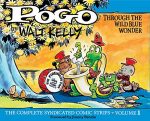
Pogo: The Complete Syndicated Comics Strips volume 1 – Through the Wild Blue Wonder


By Walt Kelly (Fantagraphics Books)
ISBN: 978-1-56097-869-5 (HB/Digital edition)

Walter Crawford Kelly Jr. was born on August 25th 1913 and started his cartooning career whilst still in High School, as both artist and reporter for the Bridgeport Post. Moving to California in 1935, he joined the Disney Studio, working on shorts and features like Dumbo, Fantasia and Pinocchio… until the infamous animators’ strike in 1941.

Refusing to take a side, Kelly moved back East and began drawing comic books – primarily for Dell Comics, who had the Disney funnybook license. Despite his glorious work on such humanistic classics as the movie tie-in Our Gang, Kelly much preferred anthropomorphic animal and children’s fantasy (like Walt Kelly’s Santa Claus Adventures) and created Albert the Alligator and Pogo Possum for Animal Comics #1 (cover-dated December 1942). He sagaciously retained the copyrights in the ongoing tale of two Bayou critters and their young African-American pal Bumbazine. Although the black kid soon vanished, the animal stars stayed on until 1948 when Kelly became art editor and cartoonist for hard hitting, left-leaning liberal newspaper The New York Star.

On October 4th 1948, Pogo, Albert and an ever-expanding cast began their careers on the funny pages, appearing six days a week until the periodical folded in January 1949.

Although a gently humorous kids feature, by the end of its run – included in full at the rear of this magnificent tome – the first glimmers of the increasingly barbed, boldly satirical masterpiece of velvet-pawed social commentary began to be seen…

This first of 12 volumes tracks the ascent of the scintillating, vastly influential strip; don’t believe me, just listen to Gary Trudeau, Berke Breathed, Bill Watterson, Jeff McNally, Bill Holbrook, Mark O’Hare, Alan Moore, Jeff Smith and even Goscinny & Uderzo and our own Maurice Dodd & Dennis Collins, whose wonderful strip The Perishers owes more than a little to the sublime antics of the Okefenokee Swamp citizenry…

After The Star closed, Pogo was picked up for mass distribution by the Post-Hall Syndicate and launched on May 16th 1949. A colour Sunday page debuted January 29th 1950 and both were produced simultaneously by Kelly until his death on October 18th 1973 (and even beyond, courtesy of his talented wife and family…)

At its peak the strip appeared in 500 papers in 14 countries whilst book collections (which began in 1951) number nearly 50 and have collectively sold 30 million copies. This volume includes every Star strip, the Dailies from inception to December 30th 1950, plus the Sundays – in their own full colour section – from January 29th to December 31st 1950, plus supplementary features including a Foreword from columnist Jimmy Breslin, an Introduction by biographer Steve Thompson, a week-by-week highly detailed contents section, useful guide ‘About the Sundays’ by Mark Evanier and an invaluable context and historical notes feature ‘Swamp Talk’ by the amazing R.C. Harvey.

Kelly’s genius and gift was the ability to beautifully, vivaciously draw comedic, tragic, pompous, sympathetic characters of any shape or breed and make them inescapably human and he used that gift to blend hard-hitting observation of our crimes, foibles and peccadilloes with rampaging whimsy, poesy and sheer exuberant joie de vivre. The hairy, scaly, furry, feathered, slimy folk depicted here are inescapably us, elevated by burlesque, slapstick, absurdism and all the glorious joys of wordplay – from puns to malapropisms to raucous accent humour – into a multi-layered hodgepodge of all-ages accessible delight.

In later volumes Kelly set his bestial cast loose on such timid, defenceless victims as Senator Joe McCarthy, J. Edgar Hoover, the John Birch Society, Richard Nixon and the Ku Klux Clan, but he starts off small here, introducing gently bemused Pogo, boisterous, happily ignorant Albert, dolorous Porkypine, obnoxious turtle Churchy La Femme, lugubrious hound Beauregard Bugleboy, carpet-bagging Seminole Sam Fox, pompous (not) know-it-all Howland Owl and a multitude more in gags and extended epics ranging from assorted fishing trips, building an Adam Bomb, losing and finding other people’s children, electioneering, education, kidnapping, the evil influence of comic books, Baseball season, why folks shouldn’t eat each other, Western cow punchers, cows punching back, New Years Resolutions, public holidays and so much more…

The Sundays also opened with one-off gags but soon evolved into convoluted, mesmeric continued sagas such as the search for the Fountain of Youth, building a school and keeping it filled, Albert elected Queen of the Woodland by elf-like forest fauns – and why that was ultimately a very bad thing indeed…

Timeless and magical, Pogo is a true giant not simply comics, but also of world literature, and this magnificent edition should be the pride of every home’s bookshelf and digital library.
POGO Through the Wild Blue Wonder and all POGO images, including Walt Kelly’s signature © 2011 Okefenokee Glee & Perloo Inc. All other material © 2011 the respective creator and owner. All rights reserved.

Sky Masters of the Space Force: The Complete Dailies


By Jack Kirby, Dick & Dave Wood, Wally Wood & Dick Ayers (Hermes Press)
ISBN: 978-1-61345-129-8 (HB) 978-1-61345-211-0 (TPB) 1-56685-009-6 (Pure Imagination)

Sky Masters of the Space Force was – and remains – a beautiful and eminently readable newspaper strip but one with a chequered and troubled back-story. How much so you can discover for yourself when you buy this book.

Even ever-upbeat and inspirational comics god Jack Kirby spent decades trying to forget the grief caused by his foray into the newspaper strip market during the height of the Space Race before finally relenting in his twilight years and giving his blessing to collections and reprints such as this one from Hermes Press.

Be grateful that he did because the collected work is one of his greatest achievements, even with the incredible format restraints of one tier of tiny panels per day, and a solitary page every Sunday. Decades later this hard-science space adventure is still the business!

And that’s despite the acrimonious legal manoeuvrings that poisoned the process of creating the strip from start to finish. That can of worms you can read for yourself in Daniel Herman’s forthright ‘Introduction: Jack Kirby, Wally Wood, and Sky Masters’ which precedes the astronautical adventures contained herein…

Just for context though: against a backdrop of international and ideological rivalry turned white-hot when the Soviets successfully launched Sputnik in 1957, the staid George Matthew Adams newspaper syndicate decided to finally enter the 20th century with a newspaper feature about space.

After approaching a reluctant DC Comics (then National Periodicals Publications) a deal was brokered. The project was steered by editor Jack Schiff who convinced Jack Kirby, inker Wally Wood (later replaced by Dick Ayers) and scripters/brothers Dick and Dave Wood (no relation to Wally) to begin bringing the conquest of the cosmos into our lives via an all-American astronaut, his trusty team of stalwart comrades and the philanthropic largesse of the newly-minted US Space Force (who knew Donald Trump could read back then?).

The daily strip launched on September 8th 1958 and ran until February 25th 1961; scant months before Alan Shepherd became in reality the first American in Space on May 5th.

The Sunday colour page told its five extended tales (The Atom Horse, Project Darkside, Mister Lunivac, Jumbo Jones and The Yogi Spaceman) in a separate continuity running from February 8th 1959 to 14th February 1960. They are sadly not included in this monochrome archival collection, but at least that gives us fans something to look forward to…

This tense, terse and startlingly suspenseful foray into a historical future begins with ‘The First Man in Space’ (September 8th – November 21st 1958) as Major Schuyler “Sky” Masters becomes the second man in space. Romantically involved with Holly Martin, he is hurled into orbit to rescue her astronaut father after the bold pioneer encounters, in the pitiless reaches above Earth, something too horrible to contemplate…

Human tragedy and ever-impinging fear of the unknown of that moody tale informs all the tales that follow, and as Holly Martin’s feisty brother Danny and burly Sgt. Riot join the cast (who do they remind me of?) for ‘Sabotage’ (22nd November – 7th March 1959), the quintessential components of all great comics teams are in place.

In this second encounter the stage expands enormously and a member of the vast Space Force contingent sinks into derangement: convinced colonization of the void and abandonment of Mother Earth is an unholy abomination.

That’s bad enough, but when he’s despatched as one of the six pathfinders constructing America’s first permanent orbiting space station, disaster is assured unless Sky can expose him and stop his deadly machinations…

Even as grim yet heady realism slowly grew into exuberant action and fantastic spectacle, the strip moves into high dramatic gear as woman pilot (or “aviatrix”) ‘Mayday Shannon’ (9th March – 9th May) joins the squad. The Brass have high hopes that she will prove “females” can thrive in space too. They didn’t reckon on her publicity-hungry greed and innate selfishness. Happily, the magnetic allure of the stars ultimately overcomes her bad side and Sky is on hand to deal with her ruthlessly unscrupulous manager…

A medical emergency tests the ingenuity of our dedicated spacers when project instigator and patriarch Doctor Royer is taken ill and Sky must ferry a surgeon to him in ‘To Save a Life’ (11th May – 10th June) after which the tireless Major and an unsuspected rival for Holly’s affections are stranded together on a New Guinea island of cannibals after losing control of ‘The Lost Capsule’ (11th June – 23rd September)…

During that heady meeting of ancient and modern cultures, inker/finisher Wally Wood was replaced by Dick Ayers (although the signatures remained “Kirby & Wood” for years more. Maybe the credit was for the writers?).

The incalculable terrors of space manifested with the next saga as ‘Alfie’ (24th September 1959 to 13th January 1960) carried the heroes of the New Frontier into the next decade. When young astronaut crewman Marek joins the orbiting space wheel, he begins periodically suffering bizarre fits. Every four hours for seven and a half minutes, the young American seems to channel the personality of aging East End cockney thief Alfie Higgins. With the fear that it might be some kind of infectious space madness, Sky and Riot head for London to link up with Scotland Yard in a gripping mystery drama blending jewel robbery and murder with the eerie overtones of Dumas’ Corsican Cousins…

The constant tensions of the Cold War and Space Race come to the fore in ‘Refugee’ (14th January – 19th February) as Sky and the US Space Force aid a most unlikely and improbable Soviet defector’s escape to the West…

Now a fully-trusted and dedicated member of the squad, Mayday Shannon returns to solve an astronaut’s romantic dilemma by arranging a ‘Wedding in Space’ (20th February – 20th April), before the true threat of the outer depths is tackled when Sky meets astronautical guru and maverick Martin Strickland. A tempestuous but invaluable asset of the Space program, the intellectual renegade has proof of alien life but won’t share the ‘Message from Space’ (21st April – 22nd June) unless military and civil authorities give him carte blanche to act on humanity’s behalf…

Counterbalancing such speculative sci fi aspects, the penultimate adventure is very much Earthbound and grounded in contemporary science and economics. ‘Weather Watchers’ (23rd June – 27th December) finds greedy capitalist entrepreneur Octavius Alexia realise he can make huge profits by scamming insurers if he has access to advance weather predictions afforded by the growing web of satellites orbiting the world.

To monopolise on that valuable information, he targets Mayday with the latest in espionage technologies and male honey trap J. Mansfield Sparks III. It might have all gone his way too if the woman hadn’t been so smart, and his mercenary gigolo had remained unencumbered by conscience…

The series ended in a rather rushed and rapid manner with ‘The Young Astronaut’ (28th December 1960 – 25th February 1961) wherein a new recruit proved to be too good to be true. Excelling at every aspect of the harsh training, Frederick T. “Fission” Tate had ulterior motives for getting into space. Luckily, suspicious Major Masters was right beside him on that first flight into the Wide Black Yonder…

As well as these stellar tales of stellar wonder, this volume also contains an abundance of visual extras such as a numerous covers and samples of Kirby’s contemporary comic book work, plus original art panels in a ‘Focus’ section, which almost compensates for the absence of the Sunday colour pages. Almost…

This compilation comprises a meteoric canon of wonderment that no red-blooded armchair adventurer could possibly resist, but quite honestly, I simply cannot be completely objective about Sky Masters.

I grew up during this time period and the “Conquest of Space” is as much a part of my sturdy yet creaky old bones as the lead in the paint, pipes and exhaust fumes my generation readily absorbed. That it is also thrilling, challenging and spectacularly drawn is almost irrelevant to me, but if any inducement is needed for you to seek this work out let it be that this is indisputably one of Kirby’s greatest accomplishments: engaging, beguiling, challenging and truly lovely to look upon. Now go enjoy it.

Back in 2000, Pure Imagination Publishing released The Complete Sky Masters of the Space Force, which also contains an abundance of essays; commentary and extras such as sketches and unpublished art, as well as those omitted Sunday pages, albeit printed in black and white. If you have the resources and that completist bug it’s worth hunting down, until such time as modern publishers finally catch on and print everything.

© 2017 Herman and Geer Communications, Inc. d/b/a Hermes Press. Introduction and Focus © 2017 Daniel Herman.