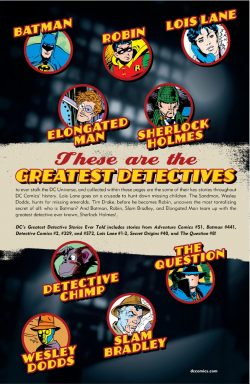
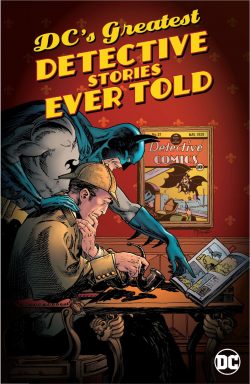
DC’s Greatest Detective Stories Ever Told


By Jerry Siegel & Joe Shuster, Gardner F. Fox, Mindy Newell, Mike W. Barr, Denny O’Neil, Andy Helfer, Rusty Wells, Creig Flessell, Carmine Infantino, Alan Davis, Paul Neary, Terry Beatty & Dick Giordano, Al Vey, E.R. Cruz, Denys Cowan & Rick Magyar, Mark Badger, Jim Aparo & Mike DeCarlo & various (DC Comics)
ISBN: 978-1-7795-0594-1 (TPB/Digital edition)

Fundamental and definitive aspects of “detective stories” have been attributed to the Bible, ancient Greek dramas, One Thousand and One Nights and similarly compelling classical texts from China, India and other places, but the true genre of crime and mystery fiction really began with cheap printing and the rise of mass entertainment culture.

Detective stories are a subgenre wherein an investigation – by amateur or professional (active or retired) – into a legal felony or moral/social injustice. Like exploration/adventuring, fantasy, horror and science fiction, Detective Stories blossomed in white western societies in the mid-19th century: spreading from prose books and magazines to other entertainment media like plays and films, with early stars including C. Auguste Dupin, Sherlock Holmes, Jules Maigret, Father Brown, Lord Peter Wimsey, Sexton Blake and Hercule Poirot. Tales aimed at youngsters generated their own sleuthing stars: Nancy Drew, The Hardy Boys and more

As comic strips developed, they also spawned detective champions like Hawkshaw, Dick Tracy, Charlie Chan, Kerry Drake ad infinitum: all contributing to a tidal wave of pulp fiction crimebusters that inspired true literary legends – Philip Marlow, Sam Spade, Simon Templar, Mike Hammer and so on…

Detective Comics #1 had a March 1937 cover-date and was the third and final anthology title devised by luckless pioneer Major Malcolm Wheeler-Nicholson. In 1935, the entrepreneur had seen the potential in Max Gaines’ new invention – the comic book – and reacted quickly, conceiving and releasing packages of all-new strips in New Fun: The Big Comic Magazine and its follow-up New Fun/New Adventure (which ultimately became Adventure Comics) under the banner of National Allied Publications.

These publications differed from similar prototype comics magazines which simply reprinted edited collations of established newspaper strips. However, these vanguard titles were as varied and undirected in content as any newspaper funnies page.

Detective Comics was different. Specialising solely in tales of crime and crimebusters, the initial roster included (amongst others) adventurer Speed Saunders, Cosmo, the Phantom of Disguise, Gumshoe Gus and two series by a couple of kids from Cleveland named Siegel & Shuster: espionage agent Bart Regan and two-fisted shamus Slam Bradley

Within two years the commercially unseasoned Wheeler-Nicholson had been forced out by his more adept business partners, and eventually his company grew into monolithic DC (for Detective Comics) Comics. Surviving a myriad of changes and temporary shifts of identity and aims, it’s still with us – albeit primarily as a vehicle for the breakthrough character who debuted in #27 (May 1939)…

Celebrating that quintessential connection and affiliation to the form, this slim tome gathers an unconventional array of sleuths and problem solvers, many not native to the parent title, but all offering a heady taste of what made the title great. Re-presenting material from Adventure Comics #51; Batman #441; Detective Comics #2, 329 & 572; Lois Lane #1-2; Secret Origins #40 and The Question #8 it spans August 1937 to November 1989: an epic package chronologically sampling the company’s connection and debt to the genre that truly started their ball rolling…’’

Sans preamble, we dive straight into action with early star Slam Bradley in his second ever case. ‘Skyscrapers of Death’ originated in the April 1937 cover-dated Detective Comics #2, (by Jerry – back when he still called himself “Jerome” – Siegel & Joe Shuster). It reveals how the abrasive, two-fisted gumshoe is framed for murder by a crooked Union boss. Slam and his assistant Shorty were a big draw in those early days: revelling in all the raw action and spectacle that would fire up his younger cousin Superman. The Bradley strip ran until October 1949, finally closing shop in Detective Comics #152.

Next up is quintessential pulp sleuth The Sandman who premiered in either Adventure Comics #40 July 1939 (two months after Batman debuted in Detective Comics #27) or two weeks earlier than that in New York World’s Fair Comics 1939, depending on which distribution records you choose to believe.

He was created and originally illustrated and scripted by multi-talented all-rounder Bert Christman, with assistance from Gardner F. Fox. Head utterly obscured by a gas-mask and slouch hat; caped, business-suited millionaire adventurer Wesley Dodds is a rugged playboy scientist cut from the radio drama/prose periodical mystery-men mould of The Shadow, Phantom Detective, Green Hornet, Lone Ranger, Spider, Avenger and so many more: all household names of early mass-entertainment.

Wielding a sleeping-gas gun and haunting the night hunting killers, thieves and spies, he was soon joined by plucky paramour Dian Belmont, before gradually losing readers’ interest and slipping from cover-spot to last feature in Adventure, just as the shadowy, morally ambiguous avengers he emulated also slipped from popularity in favour of gaudily clad glory-boys…

Alternately titled ‘The Pawn Broker’ in previous reprints, ‘The Van Leew Emeralds’ comes from Adventure Comics #51 (June 1940 by Fox & Creig Flessel): a fascinating mystery romp for the romantically-inclined crimebusters to solve in fine style and double-quick time…

In 1963 Julius Schwartz took editorial control of Batman and Detective Comics and finally found a home for a character who had been lying mostly fallow ever since his debut as a walk-on in The Flash #112 (April/May 1960). The Elongated Man was Ralph Dibny: a circus-performer who discovered an additive in soft drink Gingold which granted certain people increased muscular flexibility. Intrigued, he refined the chemical until he had a serum bestowing ability to stretch, bend and compress his body to an incredible degree. Then Ralph had to decide how to use his new powers…

Designed as a modern take on Jack Cole’s immensely popular Golden Age star Plastic Man, Dibny became a regular guest star/colleague for the Scarlet Speedster. He married vivacious debutante Sue Dibny and joined Flash’s battles against aliens and supervillains, but when the back-up spot opened in Detective Comics (previously held by Martian Manhunter since 1955 and only vacated because J’onn J’onzz was promoted to lead position in House of Mystery) Schwartz had Dibny slightly reconfigured as a flamboyant, fame-hungry, attention-seeking, brilliantly canny globe-trotting private eye solving mysteries for the sheer fun of it.

Aided by his equally smart but thoroughly grounded wife, the short tales were patterned on classic Thin Man filmic adventures of Nick and Norah Charles: blending clever, apparently impossible crimes and events with slick sleuthing, all garnished with the outré permutations and frantic physical antics first perfected by Cole…

Drenched in fanciful charm and sly dry wit, the complex yet uncomplicated sorties began in Detective #327 (May 1964) running until #371 (cover-dated January 1968). Crafted by Fox & Infantino – who inked himself in early episodes – this third outing has them heading for cowboy country to unravel the ‘Puzzle of the Purple Pony!’ (Detective Comics #329) by inadvertently playing cupid for a young couple hunting a gold mine before capturing a gang of murderous bandits with money and murder in mind.

Next up is a rare, completely serious outing for the oldest female lead in superhero comics. Although her role varied from patsy to comedy stooge, from jester to romantic ideal to eye-candy as the situation warranted, Lois Lane was always an investigative whirlwind.

Here in the dying moments of the pre-Crisis on Infinite Earths continuity, scripter Mindy Newell & artist Gray Morrow found their 4-issue miniseries scrunched into two double-length issues (August-September 1986,with that notorious “Superman’s Girl Friend…” strap line thankfully dropped) as Lois Lane #1-2, scrupulously, meticulously, obsessively, and ultimately unsuccessfully tried to bring a national crisis in missing children to the public’s attention in ‘When it Rains, God is Crying’.

Devoid of superhero involvement, the regular Superman cast are drawn into a polemical story exposing the extent of child abduction, the repercussions of recovering victims – dead or otherwise – and official responses in ‘Ignorance Was Bliss’, ‘Dark Realities’, ‘Quicksand’ and ‘Bless the Child’ after Lois becomes increasingly driven to solve the mystery of an unidentified child found dead in Metropolis. Refusing to accept the horrific toll of disappearances she uncovers, the traumatised reporter puts her life and career on the line to find answers nobody seems willing to hear…

From painful reality we fold back into fantastic fantasy as anniversary issue Detective Comics #572 (March 1987) unites Batman, second Robin Jason Todd, Elongated Man, Slam Bradley and Sherlock Holmes in a hunt for ‘The Doomsday Book’, courtesy of scripter by Mike W, Barr, Alan Davis & Paul Neary, Terry Beatty & Dick Giordano, Infantino & Al Vey & ER Cruz.

The story begins with the descendent of infamous Professor Moriarty enacting a century old scheme, countered by each hero in a solo turn before all leads connect them to a certain British castle and a manic climactic confrontation…

In the gritty post-Crisis reality, Denny O’Neil, Denys Cowan & Rick Magyar retooled Steve Ditko’s ultimate lone agent of justice into a philosophical force of nature, relentless in his pursuit of answers.

An ordinary man pushed to the edge by his obsessions, Vic Sage used his fists and a mask that makes him look faceless to secure truth and justice whenever normal journalistic methods failed. Here the remorseless Question prowls Hub City hunting the ‘Mikado’ (The Question #8, September 1987): a good man driven by the daily horrors of the city to take action, against villains and hypocrites, making his punishments fit the crime…

In the years when superheroes were in retreat and considered too foolish for readers. DC launched Rex the Wonder Dog, who solved crimes, fought dinosaurs and saved the world. In issue 4 (July/August 1952), a back-up feature launched. Written by John Broome, Bobo was Detective Chimp: a Florida-based stalwart who was assistant and deputy to the local sheriff. He cracked many cases and was extremely popular among certain types of fan. He remains so and in Secret Origins #40 (May 1989) finally enjoyed ‘The Origin of Detective Chimp’ thanks to Mark Badger Andy Helfer & Rusty Wells. Madcap and hilarious, it’s a wild ride but has been superseded in later years by other, more quasi rational tales. Nevertheless, an ape solving crimes is a sure-fire winner as many other hirsute DC gumshoes could attest…

This eclectic selection closes with the middle chapter of a landmark crossover tale. Crafted by Marv Wolfman, Jim Aparo & Mike DeCarlo, ‘Parallel Line’ comes from Batman #441 (November 1989) the third chapter of the Batman: A Lonely Place of Dying arc introducing third Robin Tim Drake.

After original Robin Dick Grayson’s departure, the Dark Knight worked solo until he caught a streetwise urchin stealing the Batmobile’s tires. This lost boy was Jason Todd, whose short but stellar career as the Boy Wonder was fatally tainted by his impetuosity, tragic links to one of the hero’s most unpredictable foes and shocking death. The trauma of losing his comrade forced Batman to re-examine his own origins and methods, becoming darker still..

After a period of increasingly undisciplined encounters Batman was on the edge of losing not just his focus but also his ethics and life: seemingly suicidal on frequent forays into the night. Interventions from his few friends and associates had proved ineffectual. Something drastic had to happen if the Dark Knight was to be salvaged.

Luckily there was an opening for a sidekick…

The crossover tale originally appeared in Batman #440-442 and New Teen Titans #60-61 (all plotted by Wolfman & George Pérez) and a new character entered the lives of the extended Batman Family; a remarkable child who would reshape the DC Universe.

‘Parallel Lines’ unravels the enigma of Tim Drake, who as a toddler was in the audience the night the Flying Graysons were murdered. Tim was an infant prodigy, and when, some months later he saw new hero Robin perform the same acrobatic stunts as Dick Grayson, he instantly deduced who the Boy Wonder was – and by extrapolation, the identity of Batman.

A passionate fan, Drake followed the Dynamic Duo’s exploits for a decade: noting every case and detail. He knew when Jason became Robin and was moved to act when his death triggered Batman’s increasing instability. Taking it upon himself to fix his broken heroes, Tim tried to convince the “retired” Grayson to became Robin once more – but fate had other plans…

Eccentrically engaging, these tales are the merest hint of the wonders locked in DC’s vaults of fun and wonder. Hopefully, it’s also simply the start of a long and vibrant caseload of recovered mysteries
© 1937, 1940, 1964, 1986, 1987, 1989, 2020 DC Comics. All Rights Reserved.
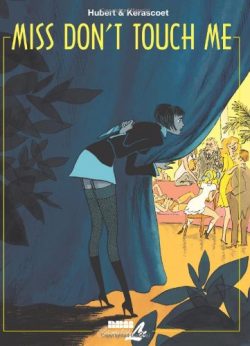
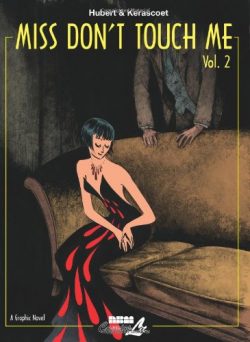
Miss Don’t Touch Me volumes 1 and 2


By Hubert & Kerascoët, translated by Joe Johnson (NBM)
ISBN: 978-1-56163-544-3 (TPB) & 978-1-56163-592-4 (TPB)

Hubert Boulard was a French comics writer and colourist who died suddenly on February 12th 2020. He is criminally unknown in the English-speaking world.

“Hubert” was born on January 21st 1971, and after graduating in 1994 from the École régionale des beaux-arts d’Angers, began his comics career as an artist for seasoned pros such as Éric Ormond, Yoann, Éric Corberyan, Paul Gillon and others. He started writing strips for others in 2002, with Legs de l’alchimiste limned by Herve Tanquerelle, followed up with Yeaux Verts for long-term collaborator Zanzim.

He produced another 14 separate series – many of them internationally award winning like Les Ogres-Dieux and Monsieur désire? – and in 2013 contributed to collective graphic tract Les Gens normaux, paroles lesbiennes gay bi trans: released to coincide with France’s national debate on legalizing same sex marriage.

His final book was with artist Zanzim. Peau d’homme – a comedy exploring gender and sexuality at the height of an era of medieval religious intolerance and social stratification – was posthumously published in June 2020… and is as yet unavailable in English translation.

Debuting in 2006, Miss Pas Touche was Hubert’s third scripting venture and remains arguably his most successful. It was originally released as four volumes in France, which – when translated by NBM – were delivered as two deliciously wicked tomes…

This slim, sleek initial translated tome offers a superb period murder mystery from visual creators probably best known in the English speaking world as contributors to Joann Sfar & Lewis Trondheim’s Dungeon series of interlinked fantasy books.

Here, Paris at the end of the 19th century is plagued by its very own Jack the Ripper – a knife-wielding maniac dubbed “the Butcher of the Dances” because he picks his victims from lower class girls frequenting suburban Tea-dances where the young people gather…

Blanche is a maid in a fine socially prestigious house: pious, repressed and solitary, unlike her sister Agatha – also a maid in the same residence – who is fun-loving and vivacious. They share the attic room at the top of the house where one night, Blanche accidentally sees “the Butcher” at his bloody work through a crack in the wall.

He sees her too, and some nights later she finds Agatha dead, as if by her own hand. Blanche knows what must have really happened…

Anxious to avoid scandal, the mistress of the house dismisses Blanche, who is forced to fend for herself on inhospitable streets. Through a combination of detective enquiry and sheer luck, she finds a lead to the killer and secures a position in The Pompadour, the most exclusive brothel in the city. By catering to a rich and powerful elite, here she will find the Butcher and exact her revenge…

Originally published in France as La Vierge du Bordel and Du Sang sur le Mains, this witty, and hugely engaging crime conundrum cleverly peels back its layered secrets as our star finds a way to turn her steadfast virginal state and overwhelming frustration to her advantage amidst the decadent rich and sexually bored of Paris. Maintaining her virtue against all odds, Blanche discovers the other side to a world she previously despised, while valiantly achieving her goal, even though it threatens to topple two empires!

Feeling very much like a cheeky grown-up version of Frances Hodgson Burnett’s 1905 novel A Little Princess, this saucy confection from writer/colourist Hubert is delightfully realized with great panache by the Kerascoët to the delight of a wide variety of grown-up readers.


Miss Don’t Touch Me volume 2

Let’s return to the eclectic world of the French demi-Monde – in the oddly inappropriate guise of formerly naive and still virginal ex-housemaid Blanche, who one night espied a psychopathic murderer at work. Intent on silencing the pesky witness, “the Butcher of the Dances” mistakenly killed Blanche’s sister Agatha in her stead, before the surviving sibling was unceremoniously sacked by her employers to avoid scandal.

Thrown onto the streets of fin de siècle Paris, our pious innocent found refuge and unique employment within the plush corridors of the city’s most exclusive and lavishly opulent bordello. Fiercely hanging on to her virtue against all odds, Blanche became Miss Don’t Touch Me: a spirited – and energetic – proponent of the “English Method” – specifically, an excessively enthusiastic flagellating dominatrix, beating the dickens out of men who delighted in enduring exquisite pain and exorbitant expense. The first volume ended with justice for both Blanche and the Butcher but her adventures were not over…

This delightfully audacious and risqué sequel opens with Blanche – virtue still notoriously and profitably intact – as the Pompadour’s most popular attraction, even though the magnificent edifice is undergoing an expensive and disruptive refit.

However, she is deeply unhappy with her life and tries to flee, buy and even blackmail herself out of her onerous contract. She is soon made brutally aware of how business is really done in the twilight world of the courtesan-for-hire…

Utterly trapped, Blanche loses all hope, even while becoming gradually enamoured of Apollo-like young dandy Antoine: one of the wealthiest men in the country and a man apparently content to simply talk with her. Complications mount when her unscrupulous, conniving mother returns to Paris and begins to avail herself of the surviving daughter’s guilt-fuelled generosity and social contacts…

Blanche’s velvet-gloved imprisonment seems set to end when her bonny bon vivant boy begins to talk of marriage, but just as suddenly, her life at the brothel begins to radically unravel. Obviously the aristocrat’s dowager mother has no stomach for the match, but social humiliation is not the same as the malicious lies, assaults, attacks and even attempted poisoning Blanche experiences.

Moreover, the genteel dominatrix’s mother seems to hold a hidden secret concerning Antoine’s family and, if they are to be wed, why doesn’t the prospective groom want his bride-to-be to give up her day – or more accurately – evening job?

Originally published in France as Le Prince Charmant and Jusqu’à ce que la Mort Nous sépare, this enticing, knowing and hugely enthralling tale trumps the inspired murder-mystery of the introductory volume with a turbulent period melodrama of guerrilla Class Warfare that promises tragic and shocking consequences, especially after Antoine abruptly vanishes and the apparently benevolent brain surgeon Professor Muniz begins his terrifying work…

A compelling saga stuffed with secrets, this engagingly sophisticated confection from writer/colourist Hubert, illustrated with irrepressible panache by Kerascoët (married artistic collaborators Marie Pommepuy & Sébastien Cosset) will further delight the wide variety of grown-up readers who made the first book such a popular and critical success.
© 2007 Dargaud by Kerascoet & Hubert. All Rights Reserved. English Translation © 2007, 2008, 2010 NBM.

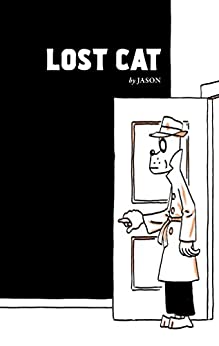
Lost Cat


By Jason, translated by Kim Thompson (Fantagraphics Books)
ISBN: 978-1-68396-009-6 (HB/Digital)

A global star among comics cognoscenti, coining numerous major awards from all over the planet, Jason is secretly John Arne Saeterrøy. Born in Molde, Norway in 1965, he’s been an international cartoon superstar since 1995 when his first graphic novel Lomma full ay regn (Pocket Full of Rain) won that year’s Sproing Award (Norway’s biggest comics prize). He won another Sproing in 2001 for his series Mjau Mjau and in 2002 turned almost exclusively to producing graphic novels.

The stylised artwork is delivered in formalised page layouts rendered in a minimalist take on Hergé’s Claire Ligne style: solid blacks, thick outlines and settings of seductive simplicity – augmented here by mesmerising hints in earth-tones enhancing the hard, moody, suspenseful and utterly engrossing appreciation of the ambience of France’s Cinema Verité movement.

Jason’s work always jumps directly into the reader’s brain and heart, using beastly and unnatural repertory players to gently pose eternal questions about basic human needs in a soft but relentless quest for answers.

That you don’t ever notice the deep stuff because of clever gags and safe, familiar “funny-animal” characters should indicate just how good a cartoonist/storyteller he is. This would be a terrific yarn even without Jason’s understated art, but in combination with his dead-on, deadpan pastiche of The Big Sleep and other movies, the result is outrageous narrative dynamite.

This gem sees the artist’s return to full length tales (160 pages) after some years producing shorter album-style pieces, and in Lost Cat he lends his uniquely laconic anthropomorphic art-stylings to a surprisingly edgy, delicious tale of lost loves, scurrilous misdeeds and uncanny sinister secrets.

This a scarily evocative romantic puzzle with its roots in Raymond Chandler mysteries, tipping a slouched hat to Hollywood Noir, B-Movie sci-fi and psychologically underpinned melodramas, with Jason’s traditionally wordless primal art supplemented by sparse and spartan “Private Eye” dialogue, enhanced to a macabre degree by solid cartooning and skilled use of silence and moment.

This sly and beguiling detective story opens as seedy shamus Dan Delon – a specialist in tawdry divorce cases – sees a poster about a lost cat and, upon accidentally encountering the missing moggy, returns it to solitary, sombre yet oddly alluring bookshop proprietor Charlotte.

The two lonely people enjoy a coffee and stilted conversation before Dan departs, but in his head his calm, pleasant night with the quiet lady continues to unfold…

Life goes on, but even after taking on a big case – tracking the lost nude painting of a rich man’s long-gone inamorata – Delon just cannot get Charlotte out of his mind. Despite knowing better, he inserts himself into the woman’s staid, sedate life and slowly realises that their pleasant evening together was a complete tissue of lies.

Moreover, his grail-like quest for the truth leads the dowdy gumshoe into deadly danger and shocking revelations of Earth-shaking consequences…

Utilising with devastating effect that self-same quality of cold, bleak yet perfectly harnessed stillness which makes Scandinavian crime dramas such compelling, addictive fare, Lost Cat resonates with the artist’s favourite themes and shines with his visual dexterity, disclosing a decidedly different slant on secrets and obsessions, in a tale strictly for adults which nonetheless allows us to look at the world through wide-open young eyes.
All characters, stories and artwork © 2013 Jason. All rights reserved.

Stumptown volume 1: The Case of the Girl Who Took her Shampoo (But Left her Mini)


By Greg Rucka, Matthew Southworth & various (Oni Press)
ISBN: 978-1-93496-437-8 (HB) 978-1-62010-440-8 (TPB) eISBN: 978-1-62010-068-4

Plenty of superhero, supernatural and sci fi comics make the jump to TV and movies these days, but not so many straightforward down to earth crime sagas. One that did came from the ever-entertaining, prodigiously prolific, multi award-winning Greg Rucka: a screenwriter (The Old Guard) and novelist (Atticus Kodiak crime sequence, Jad Bell series and half a dozen general thrillers).

Rucka has also crafted astounding graphic thrillers like Whiteout, Queen & Country and Lazarus and excelled working on prime properties and characters Star Wars, Superman, Batman, Gotham Central (co-scripted by Ed Brubaker), Wonder Woman, Grendel, Elektra, the Punisher and Wolverine and been a major contributor to epic events such as 52, No Man’s Land, Infinite Crisis and New Krypton.

One of HIS most engaging concepts features a private eye barely getting by in the writer’s own backyard: Portland Oregon – AKA “Stumptown”…

The series launched in November 2009 as a 6-issue miniseries from Oni Press, with modern day Portland locales a vibrant and integral part of the story. A huge hit, the series was indefinitely extended and ran until #19. The TV show launched September 25, 2019 and was equally entertaining and initially successful, before dying after one superb season during the worst days of the pandemic.

Preceded by Matt Fraction’s Introduction ‘On Stumptown’, and illustrated by Matthew Southworth (Savage Dragon, Ares, Infinity Inc.) with additional colour from Lee Loughridge & Rico Renzi, ‘The Case of the Girl Who Took her Shampoo (But Left her Mini)’ introduces Dexadrine Callisto Parios, private detective and sole owner of Stumptown Investigations.

She’s struggling with bills, two mortgages, a gambling problem, and dangerous impulses whilst looking after dependent brother Ansel and ignoring other people’s constant grief because of her bisexuality – or more likely her attitude to them shoving their noses into problems she doesn’t want to confront yet…

Here, things kick off with Dex being executed by two low grade thugs before we spin back 27 hours to the Whispering Winds casino, where her latest binge and sky high tab have won her a face-to-face meeting with the owner Native American matriarch Sue-Lynne Suppa.

The bosslady also has problems. Wayward granddaughter Charlotte has gone missing – probably with a girl this time – and Dex’s unique skillset, unusual connections and urgent need makes her the perfect hunter to track down and bring home the truant. In return, the casino will forgive the PI’s entire debt.

Its easy to decide what to do if you’ve got no choice…

However, as soon as Dex finishes checking out Charlotte’s apartment, she’s roughed up by moronic thugs Dill and Whale, who also want to find the missing bad girl. Message delivered, the idiots drive off, and Dex is immediately abducted by far more professional goons working for hugely wealthy (don’t ask how he made his pile) Hector Marenco.

Hector has pressing family problems too, but he’s not talking about his sexually-predatory firebrand daughter Isabel or ambitious idiot son Oscar. He needs Charlotte found too, and is willing to pay twice what Sue-Lynne’s offering… but only if Dex tells him first when she finds the lost girl.

Checking in with Ansel (Rucka’s superbly positive and inclusive take on a neuro-atypical character – he has Downs Syndrome but is a realistically rendered, sensitively realised actor who fully participates in the stories), Dex gets a late call from a terrified Charlotte and cautiously arranges a secret meeting…

The staggered flashbacks catch up to now as Dex’s body is dragged out of the river. Her foresight in wearing body armour pays off in more aches, pains and arrest by the Portland Police Bureau, but at least now she knows how serious Charlotte’s problem is and has a good idea who’s involved, if not why…

Diligent research provided by close friend police detective Tracy Hoffman – and an unpleasant but mercifully brief reunion with precinct captain Volk – gives Dex the identity of one of her would-be killers, but as she doggedly proceeds, ambush interviews with the evermore intrusive Marenco siblings lead to a big break. At least it’s not a missing persons gig anymore…

Now helplessly enmired in a federal crime scenario and escalating civil war within a ruthless family trapped in centuries-old bigotries, face-saving and macho posturing, Dex has to negotiate her way out and keep her meagre supply of friends safe as ancient prejudice and modern crime meet head-on and a father ruthlessly resolved to maintain his position and defend the old ways goes into merciless clean-up mode.

Thankfully, Parios is tough, thinks fast and has a gift for making plans on the fly…

A superbly stylish thriller perfectly exploiting changing society and the nature of Oregon myth and culture, this initial yarn was originally collected as a hardback in 2011 with subsequent volumes in both luxury and trade paperback editions. All are available digitally.

Winningly, there are also wonderful extras included in this first tome, starting with Artifacts of Stumptown – a photo feature of cool promotional objects (“tchotchkes”) released to market the series. There was an 8-page monochrome promo micro-comic (printed at the size of a business card and packaged with a magnifying glass) reprinted at full size here as ‘Dex Parios of Stumptown Investigations in “Mustang Ranch”’; t-shirt designs; art prints and a poster mimicking a yellow pages ad for Stumptown Investigations deigned by Eric Trautman.

If you love crime drama, detective fiction, strong female role models or just bloody great storytelling, you need to pay a visit to Stumptown.
Stumptown ™ & © 2011 Greg Rucka & Matthew Southworth. All rights reserved.

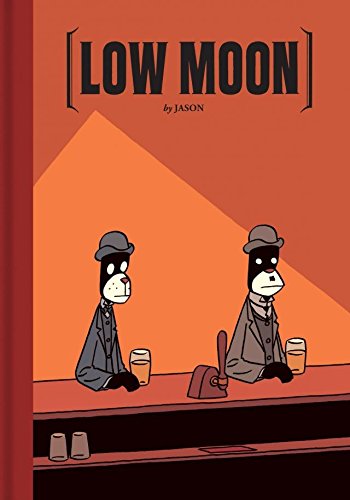
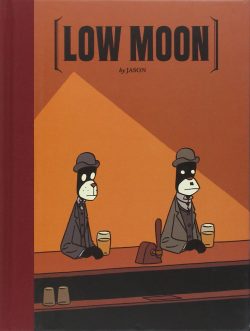
[Low Moon]


By Jason, translated by Kim Thompson (Fantagraphics Books)
ISBN: 978-1-60699-155-8 (HB/Digital edition)

In 1965, John Arne Saeterrøy, who creates under the pen-name Jason, was born in Molde, Norway. At age 30, he burst onto the international cartoonists scene with his first graphic novel Lomma full ay regn (Pocket Full of Rain) which won that year’s Sproing Award (Norway’s biggest comics prize).

Jason followed up with the series Mjau Mjau and won another Sproing in 2001. The following year he turned almost exclusively to produce graphic novels. He is now internationally renowned and (probably quite self-consciously) basks in the glow of critical acclaim for his 24 books to date and for winning so many major awards as far afield as France, Slovakia, the USA and all areas in-between.

His stories utilise a small cast of anthropomorphic animal characters (and occasional movie and pop culture monsters): a repertory company of cartoon colleagues, acting out on a stage of stiffly formal page layouts recounting dark, wry and sardonically bleak tales – often pastiches, if not outright parodies – in a visually welcoming yet coldly austere and Spartan narrative manner. This seemingly oppressive format somehow allows a vast range of emotionally telling tales – on a wide spectrum of themes and genres – to hit home like rockets whether the author’s intention was to make the reader smile or cry like a baby.

Drawing in a minimalist evolution of Hergé’s Claire Ligne style, Jason’s work bores right into the reader’s core, and this movie-themed collection of short tales is arguably his best work.

Redolent of quintessential Film Noir and especially the hard-boiled writing of Jim Thompson, poignant tale of vengeance ‘Emily Says Hello’ precedes what is billed as the World’s “first and only Chess Western”.

The eponymous ‘Low Moon’ was originally serialized in The New York Times Sunday Magazine in 2008: a splendidly surreal spoof of Fred Zinnemann’s 1952 classic High Noon wherein an old menace returns to terrorise the town… until at last the Sheriff capitulates to the incessant demands for one final return match…

‘&’ is a tragic anecdote of love, loss and marital persistence related in terms and stylings of Hal Roach’s silent comedies. ‘Proto Film Noir’ owes an inspirational tip of the thermally insulated hat to Tay Garnett’s The Postman Always Rings Twice (the 1946 version with John Garfield and Lana Turner) – by way of The Flintstones and Groundhog Day, whilst a concluding tale of love, family and abandonment assumes science-fictional trappings to relate the soap-opera, generational tale of a mother kidnapped by aliens and the effects it inflicts on the husband and son she left behind. ‘You Are Here’ is bemusing, evocative and moving, yet manages to never fall off the narrative tightrope into mawkishness or buffoonery.

Jason’s comic tales are strictly for adults but allow us all to look at the world through wide-open childish eyes. He is a taste instantly acquired and a creator any true fan of the medium should move to the top of the “Must-Have” list. This superb compendium could be your entry into a brave, old world, so get it while you can because stuff this good never lasts long…
© 2009 Jason. All right reserved.

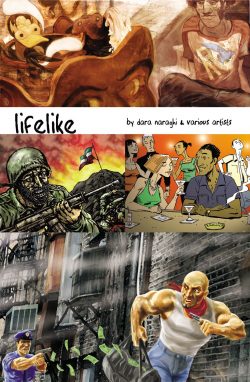
Lifelike


By Dara Naraghi & various (IDW)
ISBN: 978-1-60010-122-9 (HB) 978-1-60010-286 8 (TPB)

We do it for fame, we do it for fortune (or at least to pay bills), we do it for fun and the very best of us make comics because we absolutely have to. Every story we hear, every event we see provokes the reaction “how would I break that down into panels? How many on a page?” All data – from shopping lists to bad TV – is taken in, panned like gold nuggets through an internal grid and then we worry about how we’ll draw that damn thing one day…

All creative people are a little bit chained to their art-form, and Dara Naraghi apparently more so than most. As well as his own celebrated BigCityBlues and Persia Blues comics, he keeps busy adapting licensed properties such as Robert Patterson’s Witch & Wizard novels, Terminator: Salvation, It! The Terror From Beyond Space and Ghostbusters into graphics narrative form, writing for DC, Image and IDW whilst running his own publishing house Ferret Press. He also scripts (and occasionally draws) utterly sublime tales covering every aspect of the human experience from wild fantasy to chilling slice-of-life in a splendid series of webcomic features.

Wonderfully expansive in narrative scope and illustrated by an astounding gathering of talented artisans, an exemplary bunch of these brief delights was compiled into a fabulous compilation. Every yarn in this anthology comes from the webcomic and are written (and lettered) by Naraghi, complete with commentary and context on the illustrators interpreting each piece.

The wonderment begins with ‘The Long Journey’ illustrated by Irapuan Luiz, following the dramatic escape of a disillusioned Iranian soldier determined to leave the Iran-Iraq War behind him forever. Naraghi is Iranian (born in Tehran in 1971) and his own journey to the west would make pretty interesting reading, although probably without the telling sting in the tale embedded here…

‘Imaginarians’ – winningly crafted by award winning Tom Williams – takes a barbed look at how the media deals with artists on the promo circuit, whilst equally lauded Marvin Mann’s atmospheric ‘Double Cross at the Double Down’ proves that even if crime doesn’t pay, stories about it certainly do.

Rendered by Neil Errar, ‘Art/Life’ is a feel-good fable about a comics creator we all concur with, and Jerry Lange’s moody, misty paint-and-Paintbox (showing my digital age there) treatment examines the exquisite pain of unconditional love lost with ‘Remembrance’, after which Stephen Spenser Ledford opts for monochrome ink washes to recount a particularly trenchant tale of crime and ‘Punishment.’

Sex and booze and rock ‘n’ roll form the basis of cheeky dating vignette ‘Intermission’, illustrated by Andy Bennett, whilst Jerry Lange’s watercolour expertise displays a different arena for the relationship dance in ‘Crush’ and Tim McClurg’s ‘Comeback’ describes a meteoric fall from stardom for one has-been actor.

Marvin Mann displays his artistic versatility in ‘Smoke Break’: a heart-warming peek at modern life and ‘The Routine’ by Steve Black touchingly reminds us that even small victories count in our work-a-day world, whereas the stunning drawing of Adrian Barbu’s gritty thriller ‘Rooftop Philosophy’ adds acres of edge to a dark tale of criminal Darwinism. Tom Williams then astounds again with ‘Skin Deep’, a charming semi-autobiographical shaggy-dog story before our pictorial programme ends on a heartwarming high note in‘Repair’ as Shom Bhuiya treats us to a view of the common man at his very best…

The 14 tales assembled in Lifelike demonstrate the sheer breadth and depth that comics can and should cover: a book that opens up all of human experience and imagination to the cartoonist’s particular skills and insights. Now it’s up to the rest of us to respond and react…
Created and © 2007 Dara Naraghi. All artwork © 2007 by its respective artist. © 2007 Idea and Design Workshop. All Rights Reserved.

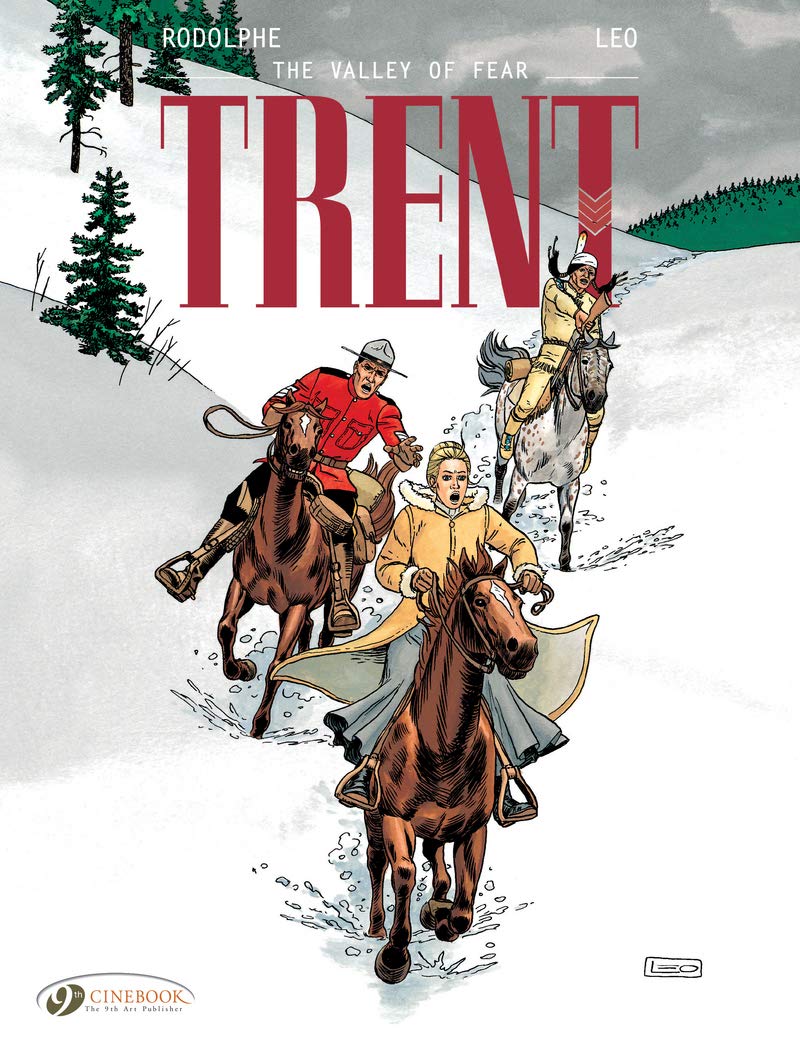
Trent volume 4: The Valley of Fear


By Rodolphe & Léo, coloured by Marie-Paule Alluard, translated by Jerome Saincantin (Cinebook)
ISBN: 978-1-84918-394-9 (Album PB/Digital edition)

Continental audiences have an abiding fascination with the mythologised American experience, whether it be the Big Sky Wild West or later eras of crime-riddled, gangster-fuelled dramas. They also have a vested historical interest in the northernmost parts of the New World which has resulted in some pretty cool graphic extravaganzas if comics are your entertainment drug of choice…

Born in Rio de Janeiro on December 13th 1944, Léo is actually Brazilian artist and storyteller Luiz Eduardo de Oliveira Filho. After attaining a degree in mechanical engineering from Puerto Alegre in 1968, he was a government employee for three years, until forced to flee the country because of his political views. While a military dictatorship ran Brazil, he lived in Chile and Argentina before illegally returning to his homeland in 1974.

To survive, he worked as a designer and graphic artist in Sao Paulo whilst creating his first comics art for O Bicho magazine. In 1981 he migrated to Paris, pursuing a career in Bande Dessinée, and found work with Pilote and L’Echo des Savanes as well as more advertising and graphics fare. His big break came when Jean-Claude Forest invited him to draw stories for Okapi, leading to regular illustration work for Bayard Presse.

In 1988 Léo began his long association with scripter and scenarist Rodolphe D. Jacquette – AKA Rodolphe. The prolific, celebrated writing partner had been a giant of comics since the 1970s: a Literature graduate who transitioned from teaching and running libraries to creating poetry and writing criticism, novels, biographies, children’s stories and music journalism.

After meeting Jacques Lob in 1975, Jacquette expanded his portfolio: writing for a vast number of strip artists in magazines ranging from Pilote and Circus to À Suivre and Métal Hurlant. Amongst his most successful endeavours are Raffini (with Ferrandez) and L’Autre Monde (Florence Magnin), but his triumphs in all genres and age ranges are too numerous to list here.

In 1991 “Rodolphe” began working with Léo on a period adventure of the “far north”. Taciturn, introspective, bleakly philosophical and driven Royal Canadian Mounted Police sergeant Philip Trent premiered in L’Homme Mort, forging a lonely path through the 19th century Dominion generating eight tempestuous, hard-bitten, love-benighted albums between then and 2000. Their creative collaboration prompted later fantasy classic Kenya and its spin-offs Centaurus and Porte de Brazenac.

Cast very much in the classic mould perfected by Jack London and John Buchan, Trent is a man of few words, deep thoughts and unyielding principles who gets the job done whilst stifling emotional turmoil boiling deep within him: the very embodiment of the phrase “still waters run deep”…

As La Vallée de la peur, this fourth saga comes from 1995, with the solitary sentinel of justice and his faithful hound “Dog” initially absent from the scene. Instead, we see rail engineer George Petterson arriving at desolate shanty town White Pass and Rail Camp Seven. Here, navvies are laboriously hacking their way through a mountain, advancing the iron line inch by frozen inch.

It’s a strangely unsettling set-up, as Petterson finds when he moves into the cabin of the man he’s replacing as site manager. There’s an atmosphere of surly secrecy and every window of his new home has been nailed shut…

The first inclination of real trouble brewing comes as George tries to stop native labourers quitting. After two whites were injured and one of their own killed in tunnel accidents, they refuse to stay and be killed by “Hoppo”. The locals know it’s the work of a “demon-bear”, but the engineers will only admit to ordinary, natural problems and mock the silly superstitions. Nevertheless, when night falls they all bolt their doors. Every cabin has its windows nailed shut…

The account closes with reports of more accidents and problems as Mrs. Petterson completes her request to the RCMP to send someone to White Pass, which has been silent and out of touch for many days now…

Trent is assigned the mission and it’s a painful shock to meet again the woman he knows as Agnes. Years ago he had saved her – but not her beloved brother – and was given a clear invitation from her that he never acted upon. Eventually, he made his decision, travelling all the way to Providence with marriage in mind, only to learn that his Miss St. Yves had reached her own conclusion years previously…

Now she stubbornly accompanies him into unknown danger at White Pass. She is resolved to find her missing husband and Trent is wracked with indecision and other darker emotions he refuses to acknowledge…

Travelling to Fraser by train, the rescue party switches to horseback and picks up Trent’s occasional partner Mokashi. The First Nations scout also knows Agnes of old, and has his own reasons for leaving the comforts of family and civilisation, despite having already learned that Hoppo haunts Camp Seven…

After crossing the snowy beautiful wilderness – rendered as always by Leo with staggering craft and force – the riders arrive in a desolate Camp Seven with no sign of life. Seemingly abandoned, the cabins which once held more than fifty men are cold and empty, but it’s not long before Mokashi uncovers some of the former inhabitants…

As they batten down for the night in a reasonably defensible shack, the rescuers are keenly aware of eerie silence punctuated by erratic bursts of animal noise. Eventually sleep comes… until the implacable Mountie and Mokashi are roused by the sounds of an intruder furtively seeking entry…

When Trent investigates, he is ambushed by a beast out of his maddest nightmares. Barely escaping with his life, his frantic flight brings him to an even greater horror – George Petterson, more dead than alive and apparently the only survivor of a supernatural atrocity…

As dawn comes, Agnes is reunited with her husband and the lawmen begin the task of tracking what can only be an exceptionally clever and cunning beast. Trent, however, cannot shake the notion that he heard it speak as it shrugged off his rifle shots…

Tension mounts as both romantic triangle and murderous rampage bloodily converge, but even after the Mountie solves one mystery and the evacuation of George Petterson begins, there is more heartbreak and loss to come before civilisation reclaims them. And as ever, Trent is left to struggle with his solitary thoughts, loss and loneliness…

Another beguilingly introspective voyage of internal discovery, where environment and locales are as much lead characters as hero and villain, The Valley of Fear delivers mystery, epic scope, sinister suspense, action and poignant drama in a compelling concoction to satisfy any fan of widescreen cinematic crime fiction or grandiose western.
Original edition © Dargaud Editeur Paris 1993 by Rodolphe & Léo. All rights reserved. English translation © 2017 Cinebook Ltd.

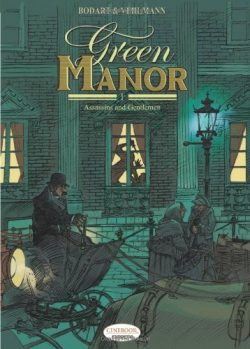
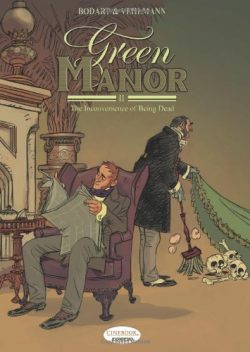
Green Manor volumes 1 & 2: Assassins and Gentleman & The Inconvenience of Being Dead


By Bodart & Vehlmann, translated by Elaine Kemp and Luke Spear (Cinebook Expresso)
ISBN: 978-1-905460-53-3 (vol. 1 Album PB) 978-1-905460-64-9 (vol. 2 Album PB)

Shared preconceptions are a wonderful toy to play with if you are a narrative creator – or reviewer. For instance, the French are generally considered more passionate than us reserved Brits (I wonder if that’s still the case?) and always eager to dole out grandiose appellations and epithets about creators, but at least they’re very seldom wrong in their acclamations.

Here’s a little Continental whimsy exploring the notion…

Fabien Vehlmann was only born in 1972 yet his prodigious canon of work (published from 1998 to the present) has earned him the soubriquet of “the Goscinny of the 21st Century”.

Vehlmann entered the world in Mont-de-Marsan and grew up in Savoie, studying business management before taking a job with a theatre group. In 1996, after entering a writing contest in Le Journal de Spirou, he caught the comics bug and two years later published – with illustrative collaborator Denis Bodart – a quirky, mordantly dark and gleefully sophisticated portmanteau period crime comedy entitled Green Manor.

The episodic, blackly funny tribute to the seamy underside of Victoriana appeared only sporadically until 2005 (and was revived in 2011), whilst the author spread his wings with a swathe of other features such as Wondertown (art by Benoit Feroumont) and the hugely popular children’s thriller Seuls (with artist Bruno Gazzotti and translated after far too long as the Alone series) before undertaking a high-profile stint on veteran all-ages adventure strip Spirou and Fantasio.

Vehlmann has continued to craft enticing and engaging tales for kids (Samedi et Dimanche) but is equally adept on more mature fare like IAN and Sept psychopaths (with Sean Phillips). He even briefly drew his own strip Bob le Cowboy

His partner in crime on Green Manor was Denis Bodart, who studied at the Saint Luc academy in Brussels before taking up teaching. He soon resorted to a life in comics, debuting in 1985 with Saint-Germaine des Morts (scripted by Streng) for publishing house Dupuis.

Three years later he co-created – with writer Yann (Yannick Le Pennetier) – Célestin Speculoos for Circus and Nicotine Goudron for l’Écho des Savanes, whilst acting as a jobbing freelance comics artist with work regularly appearing in Le Journal de Spirou and elsewhere.

Following his highly acclaimed turn here (beginning with Assassins et gentleman), he moved on to succeed Jean-Maire Beuriot as artist of Casterman’s prestigious Amours Fragiles.

The premise of the mystery story is both deliciously simple and wickedly palatable. As this book opens in the infamous Bethlehem Psychiatric Hospital in 1899, eminent Dr. Thorne is attempting to interview the inmate known as Thomas Below.

A domestic in a Gentleman’s Club for his entire life, the poor unfortunate became violently delusional mere days before retirement. Now as Thorne questions the madman deep in the bowels of “Bedlam”, the savant realises the sorry soul before him believes he is Green Manor incarnate. He has certainly been privy to all that strange place’s secrets, surprises and hushed-up scandals. Hesitantly at first, Below begins telling tales of rich, powerful and ostensibly honourable men at their most excessive and unbearable,,,

What follows is a macabre menu of short tales linked by proximity and tone, beginning with ‘Delicious Shivers’, wherein a roomful of The Great and the Good gathered around aged patriarch Dr. Byron on an October night in 1879. The respected physician posed an intriguing challenge to the assemblage: can there be a murder without a victim or a murderer?

Most of the men present had dark hearts and cunning minds and Sir Foswell rose to the challenge with his story of a noted aristocrat who erased an unwise early marriage and “disappeared” his unwanted bride by dint of bloodshed, money and influence.

Inspector Darcroft then related a case whereby there was no discernible murderer although the victim was most certainly gunned down at close range…

As the heated banter built, events took a very dark turn once Byron informed them that he had personally caused such an impossible crime to be committed. To the shocked silence of the throng he described how the administration of an extremely slow-acting poison in the drinks of some, many or all of those gathered might or might not kill an unspecified number of them at some unguessable time in the future…

Of course he might just have been jesting to win a point, but nobody went home complacently that night…

‘Post-Scriptum’ described the lethal intellectual duel between dashing young Detective Johnson and aged Sir Alfred Montgomery in August 1882, after the latter defied the policeman to stop him killing a young woman. The rules of the competition are quite strict and the noble believes he has succeeded in committing a perfect crime, but although the noble correctly considers himself a cunning planner his character judgement leaves much to be desired…

Weary and frustrated police Inspector Gray‘s decades-long hunt for a serial killer ended in shock and castigation when he arrived at an astounding conclusion one gloomy night at the Club in September 1882. That worthy’s too-late grasp of an impossible ‘Modus Operandi’ subsequently led to glorious triumph, but also a most surprising outcome and response from a fellow clubman and confidante…

The most baroque and arcane yarn involves another intellectual game and imaginative wager placed in March 1893, when two connoisseurs of crime determined to commit the most artful murder of all time. Their target would be none other than author and criminologist Sir Arthur Conan Doyle, and to make things interesting the offending weapon could only be ’21 Halberds’

In April 1872 Lord Denton invited young artist Eric Kaye into the Green Manor Club to repair a damaged painting by the great lost genius Jason Sutter. However, the dazzled dauber became obsessed with the story behind the austere family portrait – especially a tragic, beautiful daughter who suddenly vanished from history – depicted in ‘Sutter 1801’, and his fervent enquiries led to the resolution of a decades-old mystery, murder most foul and eventual banishment as his only reward.

Proud and undaunted, Kaye patiently devised a most exquisite vengeance…

The catalogue of upper class skulduggery concludes with ‘The Ballad of Dr. Thompson’ and a most arcane and uncanny murder mystery which begins in 1878, as great friends Professor Ballard and Thompson bid each other a drunken goodnight on the club steps. Only one of them makes it home safely…

When the other’s corpse is found stuffed into a grandfather clock police investigations soon lead to the most insane of conclusions…

Wry, witty, wickedly funny and sublimely entertaining, Assassins and Gentlemen offers a superbly rewarding peek at High Society and low morals as seen from across the Channel and over eventful decades, which will delight and astound lovers of clever crime fiction and classy comics confabulations – and there’s even better to follow…


Sequel release The Inconvenience of Being Dead is a double-length compact Cinebook edition, and like its predecessor is sadly unavailable in English digital formats. However, it does deliver the final pair of original volumes – De l’inconvenient d’Atre mort and Fantaisies meurtriares – which saw Green Manor’s continual catalogue of High Society crime, calumny, depravity and outrage lead to an inevitable sorry conclusion…

The premise is deliciously simple and wickedly palatable. As seen in the first collection, prominent alienist Dr. Thorne has become obsessed with Thomas Below, currently incarcerated in the infamous Bethlehem Psychiatric Hospital.

Thorne resumes the unconventional interviews in 1899 as the savant is dragged from his bed to attend Below once again. This time the need is most urgent. The old retainer has escaped, broken into a house and taken a family hostage. Hesitantly the healer makes his approach and engages the affable maniac in conversation. All too readily Below begins telling more tales of rich, powerful and ostensibly honourable men at their most excessive and unbearable…

The macabre menu of skits and sketches opens with ‘Child’s Play’ from March 1871 wherein cruel Lord Virgil observed and was incensed by a passive, gentle servant with the patience of Job. The noble’s instantly resolved instinct was to turn the saint into a murdering thing of evil.

Admitting to possession of a foolproof, infallible and much-proved method of killing-by-proxy to a roomful of The Great and the Good gathered around, Virgil determined to drive good-natured George into eternally debasing and damning himself by using the system to save himself from torment. Sadly, one man’s torment is another man’s test of faith, and good old George is far from the predictable peasant he appears…

In 1885, dilettante supernaturalist Joseph Sharp returned from Prague following a fruitless shopping trip for magical spells and objects, only to find his best friend Mark Abbott languishing under the force of a family curse. However, detailed investigation of ‘The Mark of the Beast’ and a ghastly family secret in a crypt only proved once again that the unknown has very little force or impact when measured against a mother’s hate, the infinite patience of the tormented and a victim’s fevered imagination…

One night in 1876, Lord Justice Sherman realised he had condemned an innocent man to death, even though not a single shred of evidence existed to confirm his opinion. With one night remaining to save his man, the elderly jurist took to the streets of London to find the true culprit and succeeded, utterly unaware that the malefactor involved had already taken vengeance for the judge’s noble act in advance of its completion and Sherman’s ‘Last Wishes’

In 1897 bombastic, belligerent General Miller gloated at the Club. He had at last come into possession of the fabled Spear of Longinus. The military martinet had no fear of the legends and many deaths laid upon the artefact or ‘The Centurion’s Shadow’, but was beguiled by its repute as a tool to make great men all-conquering.

Nevertheless, he was soon one more corpse attributed to the talisman – and not the last – until a pair of the Club’s armchair investigators applied learning and logic: exposing a deadly trap constructed by one of history’s greatest thinkers… albeit, just a little too late…

With the hostage crisis coming to end, Below shares his most shocking epigram as ‘Voodoo Night’ finds the gathered gentlemen – over cigars and brandy – casually dissecting a juicy murder one evening in December 1870. With irreconcilable facts and impossible assumptions heatedly flying about, soon only absurdity or the supernatural are left as answers to the mystery of the slaying of boorish lout Lord Killian. However, in another room, the genteel conversation of the closeted Ladies married to the assemblage of tobacco-smoking idiots soon reveals a so-simple truth…

The last legends of the Club were gathered up in appendix Murderous Fancies, with the increasingly obsessed Thorne receiving word that Below has passed away. Briefly thinking himself free at last, it is with mixed feeling that the doctor takes custody of the illegible scrawls of the troubled retainer and wearily, warily dares to decipher them…

‘Endgame’ relates an incident from June 1871 when the Club was driven to distraction by the will of recently paralysed Lord Wyatt. It was in the form of a nonsense riddle, and the first to solve it would win all Wyatt’s prodigious wealth…

At the same time, the executor secretly consulted with pioneering dementia expert Dr. Sheffer over the mental state of his master. The aristocrat claimed his parlous condition was the result of a murder attempt, and this riddle might well be a trap to catch the assailant. Sheffer knew better but soon had every reason to regret his rather rash conclusions…

‘A Small Crime Serenade’ found an aged, innocuous gentleman in garrulous mood one night in 1867, sharing with a dutiful Club servant his great gift and passion: a life-long ability to get away with murder. Sadly, his boast of capping his career with one final killing was derailed by a most unanticipated event.

In 1827, talk at Green Manor was of only one matter: the recent demise of a radical libertarian poet. Especially fervent was young devotee Dr. Daniel Ballantyne who promptly fell for a cruel prank when the Club grandees purportedly offered him a chance to autopsy the body and look ‘In the Head of William Blake’. They had arranged that what he saw would be like nothing he had ever experienced…

Ballantyne disappeared that night, and in the cold light of day an inexorable campaign of terror began as the japesters were slowly driven mad by notes threatening vengeance from the “Tygers of Wrath”…

In lighter vein, ‘Fight to the Finish’ related how a brace of bored big game hunters invented an imaginative game in May 1859. Their aim was to determine who exactly was the absolute best. The prey was to be each other but – although the rules of the competition were strict and fair – as the days progressed it seemed that neither Lord Bennett nor Lord Turner were as able or as gentlemanly as they claimed…

The dead man’s tales ended with a chilling homily from 1872 wherein the cream of Society discussed the strange case of Lord Sanders who had blighted his own financial empire and destroyed his greedy heirs by cruelly and carefully tying the purse-strings of their inheritances.

The dominating oligarch had left a vast list of tasks for his four children to fulfil in ‘The Testament’: far too many for any person or persons to complete before getting their undeserving hands on his ill-gotten gains. Of course, even he could not predict how and where greed and frustration could take a desperate man…

And with that final story shared, Below no longer plagued the good doctor’s days, but his influence remained long after he was gone…

Mordant, imaginative, darkly wry and cruelly rewarding, The Inconvenience of Being Dead confirms our most heartfelt suspicions about the pointlessly privileged and inexplicably esteemed, damning them all as useless, venal and worse: A class apart that we could all do without, but a perfect target for all the disdain we can wring from them with rich black comedy and classy comics confabulations like these.
Original editions © Dupuis 2005 by Vehlmann & Bodart. All rights reserved. English translations 2008 by Cinebook Ltd.

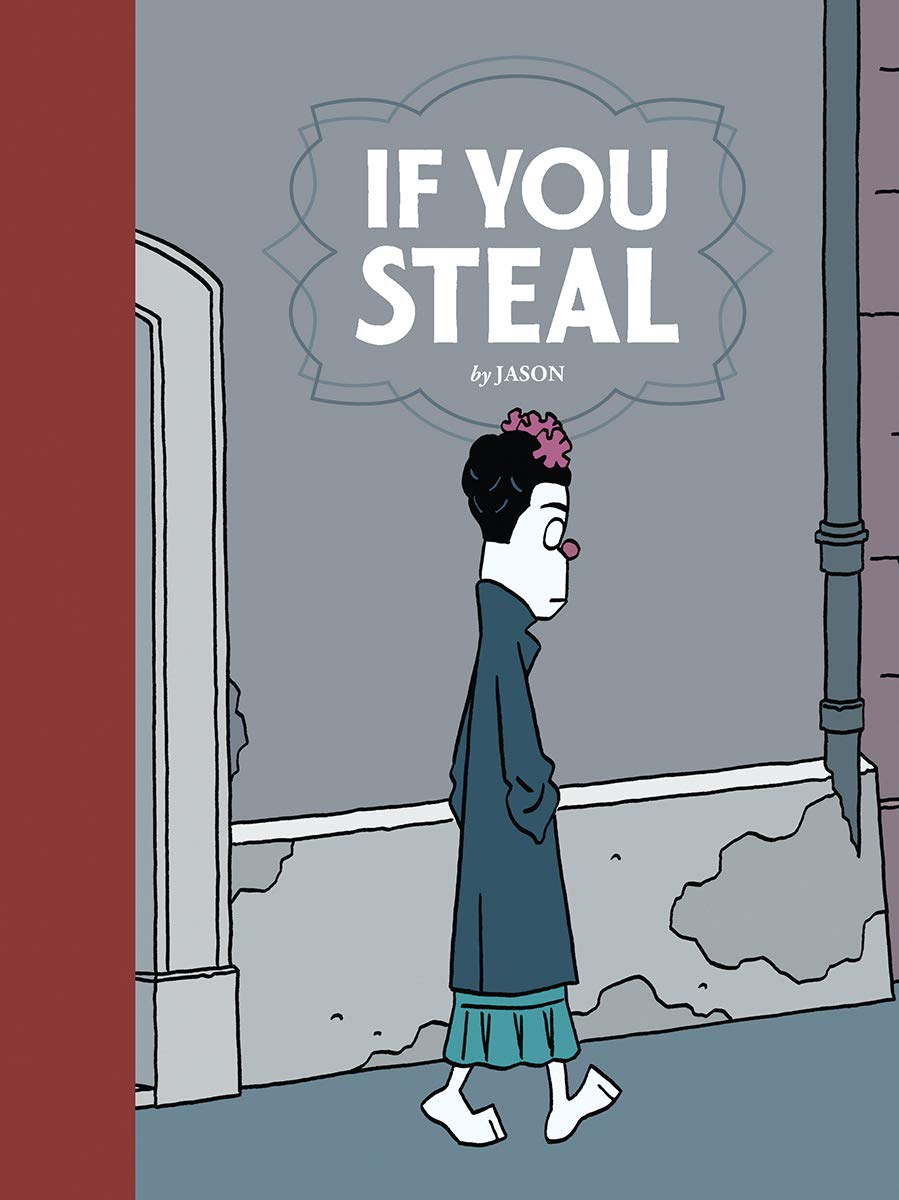
If You Steal


By Jason (Fantagraphics Books)
ISBN: 978-1-60699-854-0 (HB/Digital edition)

Jason is secretly John Arne Saeterrøy: born in Molde, Norway in 1965 and an international cartoon superstar since 1995 when his first graphic novel Lomma full ay regn (Pocket Full of Rain) won that year’s Sproing Award (Norway’s biggest comics prize). He won another Sproing in 2001 for series Mjau Mjau and in 2002 turned almost exclusively to producing graphic novels.

A global star among cartoon cognoscenti, he has received major awards from all over the planet. Jason’s work always jumps directly into a reader’s brain and heart, utilising the beastly and unnatural to gently pose eternal questions about basic human needs in a softly relentless quest for answers. That you don’t ever notice the deep stuff because of the clever gags and safe, familiar “funny-animal” characters should indicate just how good a cartoonist he is…

The stylised artwork is delivered in formalised page layouts rendered in a minimalist evolution of Hergé’s Claire Ligne style: solid blacks, thick outlines and settings of seductive simplicity; augmented by a deft and subtle use of flat colour which enhances his hard, moody, suspenseful and utterly engrossing Cinema-inspired world.

The superbly understated art acts in concert with his dead-on, deadpan pastiche repertoire of scenarios which dredge deep from our shared experience of old film noir classics, horror and sci fi B-movies and other visual motifs which transcend time and culture, and the result is narrative dynamite.

This compilation collects eleven short yarns and opens with the eponymous and eerie ‘If You Steal’, wherein cheap thug Paul perpetually risks everything – including the one person who keeps him feeling alive – in search of quick cash: only to lose it all in the end, after which ‘Karma Chameleon’ sees a small desert community dealing with the discovery of a giant, carnivorous and extremely predatory lizard which nobody seems able to see. Good thing masturbation-obsessed boffin Dr. Howard Jones and his long-suffering daughter Julia are in town…

The deliciously wry and whimsically absurdist Samuel Beckett spoof ‘Waiting for Bardot’ then segues neatly into a dashing mystery of masked derring-do as ‘Lorena Velazquez’ eventually tires of waiting for her ideal man to finish off a necessarily interminable and horrific army of villains prior to doling out a maiden’s traditional rewards, before a fugitive murderer narrates his own paranoia-fuelled downfall after his ‘New Face’ briefly tempts him with love and the never-to-be-achieved promise of peace and safety…

A series of six faux horror comics covers combines to relate the trials of chilling romances in ‘Moondance’. The classic fear theme extends into a rip-roaring battle against the undead in ‘Night of the Vampire Hunter’ and ‘Polly Wants a Cracker’ follows the other unique career path of artistic legend/assassin-for-hire Frida Kahlo.

A junkie musician pushes his luck against some very bad guys because ‘The Thrill is Gone’ after which ‘Ask Not’ takes a trawl through history from Stonehenge in 2583 BC to Salon de Provence in 1554 AD (courtesy of Nostradamus) to 1960s Cuba, revealing the truth behind the assassination of JFK and Abraham Lincoln and what parts Lee Harvey Oswald and Jack Ruby actually played in that millennial plot: a parallel worlds yarn like no other…

The book ends with a stunning, deeply moving graphic examination of dementia which is both chilling and oddly-heart-warming as aging Emma deals with the scary creatures who keep taking away the names of things in ‘Nothing’: proving once more that behind innocuous-seeming cartoons and contemporary fairy tale trappings Jason’s work is loaded with potent questions…

If You Steal resonates with Jason’s favourite themes and shines with his visual dexterity and skewed sensibilities. disclosing a decidedly different slant on secrets and obsessions. Primal art supplemented by sparse and spartan “hardboiled Private Eye” dialogue, enhanced to a macabre degree by solid drawing and skilled use of silence and moment, all utilised with devastating economy, affords the same quality of cold, bleak yet perfectly harnessed stillness which makes Scandinavian TV dramas such compelling, addictive fare.

These comic tales are strictly for adults, yet allow us all to look at the world through wide-open young eyes. They never, however, sugar-coat what’s there to see…
If You Steal is © 2015 Jason. All rights reserved.

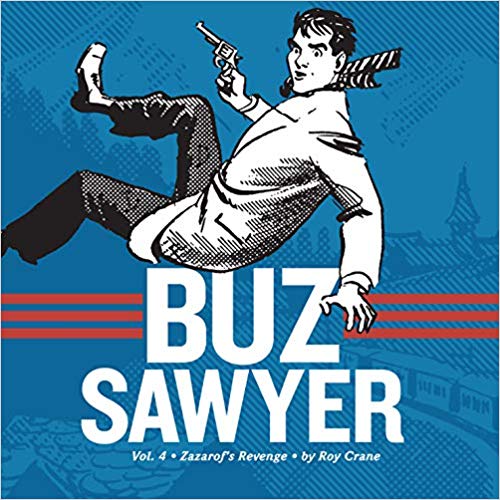
Buz Sawyer volume 4: Zazarof’s Revenge


By Roy Crane, with Henry G. “Hank” Schlensker & Edwin Granberry (Fantagraphics Books)
ISBN: 978-1-60699-975-2 (HB)

Modern comics evolved from newspaper strips: pictorial features that were, until relatively recently, utterly ubiquitous. Hugely popular with the public and highly valued by publishers who used them as a weapon to secure sales and increase circulation, strips seemed to find their only opposition in blinkered local editors who often resented the low brow art form, which cut into potential ad space and regularly drew complaint letters from cranks…

It’s virtually impossible for us today to understand the overwhelming allure and power of the comic strip – especially from the Great Depression to the end of the 1950s. With limited television, broadcast radio far from universal and movie shows at best a weekly treat for most folk, household entertainment was mostly derived from the comics sections of daily and especially Sunday Newspapers. “The Funnies” were universally enjoyed recreation for millions who were well served by a fantastic variety and incredible quality of graphic sagas and humorous episodes.

From the start comedy was king; hence our terms “Funnies” and “Comics”. From these jest and stunt beginnings – blending silent movie slapstick, outrageous fantasy and vaudeville antics – came an entertaining mutant hybrid: Roy Crane’s Wash Tubbs.

Debuting in April 1924, Washington Tubbs II was a comedic, gag-a-day strip which evolved into a globe-girdling adventure serial. For years, Crane spun addictive high-quality pictorial yarns – until his introduction of moody swashbuckler Captain Easy ushered in the age of adventure strips with the landmark episode for 6th May, 1929.

This led to a Sunday colour page which was possibly the most compelling and visually imaginative of the entire Golden Age of Newspaper strips (see Roy Crane’s Captain Easy, Soldier of Fortune: The Complete Sunday Newspaper Strips volumes 1-4). Improving almost minute by minute, it benefited from Crane’s relentless quest for perfection. His fabulously imaginative compositional masterpieces attained a timeless immediacy that made each page a unified piece of sequential art. The influence of his pages can be seen in the works of near-contemporaries like Hergé, giants-in-waiting such as Charles Schulz or comic book masters Alex Toth, John Severin and many more.

The material was obviously as much fun to make as to read. In fact, Crane’s cited reason for surrendering the Sunday strip to his assistant Les Turner in 1937 was NEA/United Features Syndicate’s abrupt and arbitrary diktat that all strips would henceforward be produced in a rigid panel-structure to facilitate their being cut up and re-pasted as local editors dictated.

They just didn’t lift the artist any more so he stopped making them. At the height of his powers, Crane walked away from the astounding Captain Easy Sunday page; concentrating on the daily feature until his contract expired in 1943 whereupon he left United Features: lured away by that grandee of strip poachers William Randolph Hearst.

The result was an aviator strip set in then-ongoing World War II: Buz Sawyer.

Where Wash Tubbs was a brave but largely comedic Lothario and his pal Easy a surly, tight-lipped he-man, John Singer “Buz” Sawyer was a joyous amalgam of both: a handsome, big-hearted, affable country-boy who went to war because his country needed him…

Buz was a fun-loving, skirt-chasing, musically-inclined pilot daily risking his life with his devoted gunner Rosco Sweeney: a bluff, brave ordinary Joe – and one of the most effective comedy foils ever created.

The wartime strip was – and remains – a marvel of authenticity: portraying not just action and drama of the locale and situation but crucially also capturing the quiet, dull hours of training, routine and desperate larks between the serious business of killing and staying alive. When the war ended the action-loving duo – plus fellow pilot/girl-chasing competitor Chili Harrison – all went looking for work that satisfied their thirst for action and adventure…

Crane had mastered popular entertainment tastes, blending adventure with drama and sophisticated soap opera, all leavened with raucous comedy in a seamless procession of unmissable daily episodes. He and his team of assistants – which over decades comprised co-writers Ed “Doc” Granberry, Clark Haas and Al Wenzel, and artists Hank Schlensker, Joel King, Ralph Lane, Dan Heilman, Hi Mankin & Bill Wright – soldiered on under relentless deadline pressure, producing an authentic and exotic funny romantic thriller rendered in his stark signature style as well as a prerequisite full-colour Sunday page.

This fourth stout and sturdy hardcover edition is a mostly monochrome tome re-presenting more magnificent strip shenanigans starring a dynamic All-American good guy, but now Buz is just another fading war hero: albeit admittedly a globetrotting, troubleshooting one and a newlywed husband to boot.

Having – after much kerfuffle, procrastination, intrigue, bloodshed, sexy skulduggery and delay – finally married extremely understanding childhood sweetheart Christy Jameson, our clean-cut boy-next-door then dragged her into his regularly perilous and frequently lethal working world as prime problem-solver for Frontier Oil: a company with fingers in many international pies and one most modern readers will find hard to consider “the Good Guys”…

These strips – made in collaboration with Granberry & Hank Schlensker – cover the societally turbulent period spanning July 1949 to June 1952, as America leaned hard into its dreams of Exceptionalism and enjoyed domestic boom times while embracing it’s self-appointed role as the World’s Policeman. Crane and his creative laboured long, hard, often acrimonious hours to produce each daily strip; all beguilingly rendered in black-&-white through Crane’s masterly techniques employing line art and craftint (a tricky mechanical monochrome patterning effect which added greys and halftones to produce miraculous depths and moods to the superb base drawing) but the toll was heavy on personnel and feelings.

Before the ten self-contained tales here kick off, heavily-illustrated preliminary prose piece ‘The Three of Us are a Team’ (‘remarks at the New York Banshee Society’ from transcripts donated to Syracuse University) revisits Crane’s acceptance speech on winning the 1961 Silver Lady Award as determined by a collation of contemporary communications executives. Effusive and reminiscent, it sees him give his partners all the credit for the hard work in crafting the feature…

Buz Sawyer began on November 1st 1943 and ran until 1989. Crane officially retired with the April 21st 1977 episode (dying on July 7th) while it continued under Granberry, Schlensker, Haas, Wenzel and John Celardo until cancelation on October 7th 1989.

The story resumes with an example of contemporary trends…

Chimpanzees were becoming a popular story addition for most media as the 1940s ended (just look at movies or comic books) and ‘Monkey Business’ finds our happy couple back in the USA after an African honeymoon (of sorts) which left the them owners of a young chimp named Junior…

Anticipating decades of future sitcoms, the tale details how Junior plays up during a critical dinner party/holiday weekend held by Sawyer’s boss Colonel Harrison but the resulting debacle at a swish soiree on Harrison’s palatial estate fails to impress potential business partner Mr Tidley Bragg. A cheeky excuse for manic screwball comedy and social gaffes, the chaos generates explosive hilarity, humiliation and Buz’s sacking before fate intervenes to show everyone that Junior was a boisterous blessing in disguise…

Swiftly rehired, Buz heads south, encountering ‘Revolution’ (September 19th 1949 – January 18th 1950) in a Central American republic. Frontier Oil was seeking an oil concession, but apparently their agent – Barstain – had played a double game. Before long, Buz is using his war experiences to lead a counter revolution to save democracy…

January 20th- June 17th offers a grimly chilling change of pace as ‘Buz Alone’ sees Christy and her husband on a well-earned vacation at a Florida honeymoon cottage. Tragically, danger is never far from them, and the brief idyll is shattered after a nature-watching boat trip leaves them stranded on a sandbar with no food, water, shelter or prospect of rescue.

A true champion, Buz survives a gruelling swim to the mainland and returns in a seaplane only to find three men on the sandbar and no trace of Christy. When he gets agitated, he’s accused of making it all up and – if she ever existed – doing away with the woman…

Beaten up when he tries to search their boat, Buz is left to pick up the pieces and track down Christy. In his hunger for clues, he is manipulated by a woman seeking a new husband – and someone to remove her current one – before eventually clashing with vengeful old enemy Harry Sparrow. At no time does he ever get near his missing better half…

While he flounders, a comely, capable lady with no memory is picked up on the mainland before losing herself amidst the sleazy local underworld. With the police now assisting, Buz sets out on the fresh trail, aided by trusty pal Sweeney. After more trauma and tribulation, Christy is found, but it’s not the girl Buz married yet – not by a long shot…

A return to lighter intrigue and enterprise comes when spoiled debutante ‘Diana’ (June 19th – November 24th) makes Daddy find her a job. Unluckily for Buz, Remington Chase is a bigwig at Frontier and his bored hellion of a daughter likes the idea of being Sawyer’s secretary – or at least the idea of Sawyer…

Even debonair Chili Harrison can’t sway her aim and when Buz “escapes” into work – despatched to Iron Curtain nation Sovmania just when he and Christy began looking at homes to buy – Miss Chase infuriatingly follows. Negotiating with the Soviets is tricky enough, but when it’s a US corporation demanding the communists hand back wells and refineries they illegally annexed and expropriated, Sawyer knows he can’t win and may end up mysteriously deceased. It’s no surprise to find Diana draws attention and danger like a magnet, but her response when the oppressors decide to arrest them is a life-changing revelation.

Spectacular spy games give way to a lighter interlude when Buz reunites with Christy and they babysit a parrot named ‘William Shakespeare’ (November 24th 1950-January 6th 1951). The beloved baby of a poetry professor, with an astounding talent for repeating what he hears, the bird proves to be even more trouble that their chimp was…

Clearly qualified in policing difficult customers, Buz is then assigned to locate a wandering landowner with 6,000 prime acres to lease. ‘Wish Jones’ (January 8th to April 19th) is old, homely, rich, romantic, suggestible and (suddenly) married to exotic dancer Taffy Fawn. However, he hasn’t signed the contracts Frontier needs, leaving Buz playing catch across all the love nests of the South Pacific. The fixer’s greatest asset is Taffy herself, who never thought wedded bliss and matchless wealth included so much sand, birds or bugs. His biggest problem is that even desert island paradises have crooks, radios and newspapers…

Another episode of animal husbandry catastrophes – this time a dachshund and a voracious baby heron – leads implausibly to a sojourn in ‘Alaska’ (26th April – August 22nd) with Sawyer undercover as John Singer.

While seeking a geologist’s killers, he’s also acting as courier for the Government in a serious and solid spy escapade worthy of Alfred Hitchcock with abductions, misreported deaths, murderous sailors, devious twins, fake relatives and hidden uranium reserves all in play, with Buz’s survival skills pushed to the limit before his mission is accomplished.

In dire need of relaxation, the reunited Mr & Mrs Sawyer trust to fate and pluck a name out of an atlas for a vacation. They land in a lakeside resort boasting peace and quiet but dreary ‘Doldrums’ (August 23rd – September 29th) is soon a pandemonium of envy and excitement as bored couples seek to spice up their passionless lives by emulating the infamous, glamorous newcomers…

Eponymous epic ‘Zazarof’s Revenge’ spans October 1st 1951-January 10th 1952, opening with a global sabotage campaign against Frontier, leading Buz to Switzerland where there’s no doubt of mystery man Igor Zazarof‘s guilt, but apparently no way to find or face him.

Ultimately, persistence and charm break down the villain’s obvious pawn Neri, whilst all attempts to bribe, frame, frighten or kill the American fail, leading to an extended and brutal duel to the death on a mountain peak as the only way to deal with Sawyer…

We conclude for now with home-grown bad men ‘The Hawks Boys’ (January 10th – June 19th) terrorising and sabotaging a Frontier installation in Utah. As assault escalates to murder, Buz discovers why the Hawks’ – already well-paid for the oil rights to their land – are doing everything they can to force the company to pull out. What could be worth more than oil and what won’t they do to keep their secret?

Completing this vivid vintage venture is a wry glimpse of Crane’s early days. With text written by Jeet Heer, ‘A Cartoonist’s Travels’ offers a brief gallery of cartoons about bums, hoboes, tramps and voyagers, with the artist drawing upon his own youthful experiences as an itinerant bindlestiff and drifter…

This a sublime slice of compelling comics wonder is an ideal way to discover or reconnect with Crane’s second magnum opus. Bold, daring, funny and astonishingly enthralling, these episodic exploits influenced generations of modern cartoonists, illustrators, comics creators and storytellers. The series ranks amongst the very greatest strip cartoon features ever created: always delivering comics tale-telling unforgettable, unmissable and utterly irresistible. Try it and see for yourself.
Buz Sawyer: Zazarof’s Revenge © 2016 Fantagraphics Books. All Buz Sawyer strips © 2016 King Features Syndicate, Inc. All other material © the respective copyright holders. All rights reserved.