The Art of Sean Phillips


By Sean Phillips, Eddie Robson and various (Dynamite Entertainment)
ISBN: 978-1-60690-420-6

Win’s Christmas Recommendation: A Magical Trawl through Fan-favourite Moments… 9/10

Sean Phillips started selling comic strips in 1980. He was 15 years old, still at school and for all intents and purposes “living the dream”. He’s been doing it ever since, with dedication, professionalism and ever-increasing proficiency.

This magnificent oversized (234 x 310 mm) hardback reproduces hundreds of comics pages and covers, plus an assortment of out-industry artwork, as accompaniment to an astonishingly forthright extended interview and career retrospective of the phenomenally talented and terrifying dedicated illustrator, covering his earliest cartooning efforts right through to his next big thing. There’s even baby pictures and school work. Of course Sean and his friends did make their first professional strip sale – to the local newspaper – when they were twelve…

Compiled by Phillips and writer and journalist Eddie Robson, with contributions from fellow artists, writers and editors the artist worked with over the decades, the book includes an Introduction from co-conspirator Ed Brubaker and offers many complete strips fans will probably never have seen.

As well as many unpublished works the gallery of visual wonder include early strips on “Girls” comics and Annuals such as Bunty, Judy and Diana For Girls as well as college work, try-out pages and portfolio pieces created with the sole purpose of getting into the cool mainstream…

Phillips is equally adept with paints and pen-&-ink and the book tracks his career as a jobbing artist through Bunty to early “mature reader” title Crisis (Crisis, New Statesmen, Straitgate), 2000AD and The Megazine (Armitage, Devlin Waugh), and that crucial jump to America as part of the “British Invasion”; producing features and one-offs at Vertigo and becoming part of the initial intake who launched and cemented the radical imprint’s look. Of particular interest and strongly emphasised are his runs on Kid Eternity, Hellblazer and The Invisibles.

The longed-for move into super-heroics began with Batman, a sidestep into Star Wars and back to Spider-Man. Early hints of later specialisation can be spotted in Scene of the Crime, Gotham Noir and Sleeper, but he was also busy with Wildcats and X-Men. He truly became a major name through the monumental sensation that was Marvel Zombies, but more attention here is paid to poorer-selling critical hit and career crossroads Criminal.

The parade of pictorial perfection continues with finished pages and original art from many more titles including User, Intersections, Incognito and more, strips and covers for licensed titles such as Serenity, Predator, Stephen King’s The Dark Tower spin-offs and for classic film repackager Criterion. Other non-comics work includes true lost gems such as political strip ‘Right Behind You’ from The Sunday Herald depicting how a certain meeting between George W. Bush and Tony Blair probably went as a certain invasion was discussed…

The comics conversation concludes with sneaky peeks at then-upcoming projects Fatale and European album Void 01 and we know just how damn good those both turned out…

Also sporting a healthy Bibliography section, heartfelt Acknowledgements and a Biography page, this massively entertaining, vibrant tome is as much an incisive and philosophical treatise on work-ethic as celebration of a stellar career telling stories in pictures: a beautiful, breathtaking and brilliantly inspirational compendium for the next generation of artists and writers, whatever their age.

If you already have the urge to make pictures but want a little encouragement, this rousing celebration offers all the encouragement you could possibly hope for – and is just plain lovely to look at too.
© 2013 Dynamite Entertainment. All artworks, characters, images and contributions © their respective creators or holders. All rights reserved.

Bob Powell’s Complete Cave Girl


By Gardner Fox & Bob Powell, with James Vance, John Wooley, Mark Schultz & various (Kitchen Sink/Dark Horse Books)
ISBN: 978-1-61655-700-3

Like every art form, comics can be readily divided into masterpieces and populist pap, but that damning assessment necessarily comes with a bunch of exclusions and codicils.

Periodical publications, like all pop songs, movies and the entirety of television’s output (barring schools programming), are designed to sell to masses of consumers. As such the product must reflect the target and society at a specific moment in time and perforce quickly adapt and change with every variation in taste or fashion.

Although very much an artefact of its time I consider “Ever Fallen in Love (With Someone You Shouldn’t’ve)” by The Buzzcocks to be the perfect pop song, but I’m not going to waste time trying to convince anybody of the fact.

For me, and perhaps only for me, it just is.

The situation is most especially true of comics – especially those created before they gained any kind of credibility: primarily deemed by their creators and publishers as a means of parting youngsters from disposable cash. The fact that so many have been found to possess redeeming literary and artistic merit or social worth is post hoc rationalisation.

Those creators striving for better, doing the very best they could because of their inner artistic drives, were being rewarded with just as meagre a financial reward as the shmoes just phoning it in for the paycheck…

That sad state of affairs in periodical publication wasn’t helped by the fact that most editors thought they knew what the readership wanted – safe, prurient gratification – and mostly they were right.

Even so, from such swamps gems occasionally emerged…

The entire genre of “Jungle Girls” is one fraught with perils for modern readers. Barely clad, unattainable, (usually) white paragons of feminine pulchritude lording it over superstitious primitive races is one that is now pretty hard to digest, but frankly so are most of the attitudes of our grandfathers’ time.

However, ways can be found to accommodate such crystallised or outdated attitudes, especially when reading from a suitably detached historical perspective and even more so when the art is crafted by a master storyteller like Bob Powell.

After all, it’s not that big a jump from fictionalised 1950s jungles to the filmic metropolises of today where leather armoured (usually white) Adonises with godlike power paternalistically watch over us, telling we lumpy, dumpy, ethnically mixed losers how to live and be happy…

Sorry, I all comics in all genres from all eras, but sometimes the “guilty pleasure” meter on my conscience just redlines and I can’t stop it. Just remember, it’s not real…

As businessmen, editors and publishers knew what hormonal kids wanted to see and they gave it to them. It’s no different today. Just take a look at any comic-shop shelf or cover listings site and see how many fully-clad, small-breasted females you can spot…

Cave Girl was one of the last entries into the surprisingly long-lived Jungle Queen genre and consequently looks relatively mild in comparison to other titles in regard to suggestive or prurient titillation.

Here the action-adventure side of the equation was always most heavily stressed and readers of the time could see far more salacious material at every movie house if they need to.

End of self-gratifying apologies. Let’s talk about Bob…

Stanley Robert Pawlowski was born in 1916 in Buffalo, New York, and studied at the Pratt Institute in Manhattan before joining one of the earliest comics-packaging outfits: the Eisner-Iger Shop.

He was a solid and dependable staple of American comicbook’s Golden Age, illustrating a variety of key features. He drew original Jungle Queen Sheena in Jumbo Comics plus other Jungle Girl features and Spirit of ’76 for Harvey’s Pocket Comics.

He handled assorted material for Timely titles such as Captain America in All-Winners Comics, Tough Kid Comics plus such genre material as Gale Allen and the Women’s Space Battalion for anthologies like Planet Comics, Mystery Men Comics and Wonder Comics.

Recently he was revealed to have co-scripted/created Blackhawk as well as drawing Loops and Banks in Military Comics as well as so many more now near-forgotten strips: all under a variety of English-sounding pseudonyms, since the tone of the times was rather unforgiving for creative people of minority origins.

Eventually the artist settled on S. Bob Powell and had his name legally changed…

Probably his most well-remembered and highly regarded tour of duty was on Mr. Mystic in Will Eisner’s Spirit Section newspaper insert. After serving in WWII, Bob came home and quit to set up his own studio. Eisner never forgave him.

Powell – with his assistants Howard Nostrand, Martin Epp and George Siefringer – soon established a solid reputation for quality, versatility and reliability: working for Fawcett (Vic Torry & His Flying Saucer, Hot Rod Comics, Lash Larue), Harvey Comics (Man in Black, Adventures in 3-D and True 3-D) and on Street and Smith’s Shadow Comics.

He was particularly prolific in many titles for Magazine Enterprises (ME), including TV tie-in Bobby Benson’s B-Bar-B Riders, Red Hawk in Straight Arrow, Jet Powers and the short but bombastic run of quasi-superhero Strong Man.

Powell easily turned his hand to a vast range of War, Western, Science Fiction, Crime, Comedy and Horror material: consequently generating as a by-product some of the best and most glamorous “Good Girl art” of the era, both in comics and in premiums/strip packages for business.

In the 1960s he pencilled the infamous Mars Attacks cards, illustrated Bessie Little’s Teena-a-Go-Go and the Bat Masterson strip for the newspapers and ended his days drawing Daredevil, the Human Torch and Giant-Man for Marvel.

This captivating hardback compilation gathers all the Cave Girl appearances – written by ubiquitous jobbing scripter Gardner Fox – from numerous ME publications. The company employed a truly Byzantine method of numbering their comicbooks so I’ll cite Thun’da #2-6 (1953), Cave Girl #4 (1953-1954) and Africa, Thrilling Land of Mystery #1 (1955) simply for the sake of brevity and completeness, knowing that it makes no real difference to your enjoyment of what’s to come.

This splendid tome includes a Biography of Bob, an incisive Introduction from Mark Schultz and an erudite essay – ‘King of the Jungle Queens’– by James Vance and John Wooley, diligently examining the origins of the genre (courtesy of the works of Edgar Rice Burroughs, William Henry Hudson’s novel Green Mansions and a slew of B-movies); its development in publishing; the effect of the phenomenon and Powell’s overall contributions to comics in a far more even-handed and informed way than I can manage…

That done it’s time to head to an Africa that never existed for action and adventure beyond compare. Cave Girl started as a back-up strip in Thun’da #2; a primeval barbarian saga set in an antediluvian region of the Dark Continent where dinosaurs still lived.

In ‘The Ape God of Kor’ the mighty primitive encounters a blonde stranger who can speak to birds and beasts, and helps her escape the unwanted attentions of a bestial tyrant. When that’s not enough to deter the monstrous suitor, Thun’da and Cave Girl have no choice but to topple his empire…

In #3 the wild woman met ‘The Man Who Served Death!‘ – a criminal from the outer world whose hunger for gold and savage brutality necessitated his urgent removal from the land of the living. Cave Girl’s beloved animal allies were being wantonly slaughtered to appease ‘The Shadow God of Korchak!’, forcing the gorgeous guardian of the green to topple the lost kingdom’s debauched queen, after which the tireless champion tackled a trio of sadistic killers from the civilised world in ‘Death Comes Three Ways!’

A rather demeaning comedy sidekick debuted in ‘The Little Man Who Was All There!’ from Thun’da #6 as pompous pigmy bumbler Bobo attached himself to Cave Girl as her protector…

From there the forest monarch leaped into her own title, beginning with Cave Girl #11. ‘The Pool of Life!’ delved back in time to when a scientific expedition was wiped out, leaving little blonde toddler Carol Mantomer to fend for herself. Happily, the child was adopted by Kattu the wolf and grew tall and strong and mighty…

The obligatory origin dispensed with, the story proceeds to reveal how two white explorers broach the lost valley in time to reap their deserved fate after finding a little lake with mystic properties…

Tables are turned when explorer Luke Hardin deduces Cave Girl’s true identity and convinces the wild thing to come with him to Nairobi to claim her inheritance. Already appalled by the gadgets and morass of humanity in ‘The City of Terror!’, Carol’s decision to leave is cemented by her only living relative’s attempts to murder her for her inheritance…

En route home, her wild beauty arouses the desires of millionaire hunter Alan Brandon, but his forceful pursuit and attempted abduction soon teaches him he has a ‘Tiger by the Tail!’

Her trek done, Cave Girl traverses high mountains and finds Alan and Luke have been captured by beast-like primitives and must face the ‘Spears of the Snowmen’ to save them both…

Even the usually astoundingly high-quality scripting of veteran Gardner Fox couldn’t do much with the formulaic strictures of the sub-genre but he always tried his best, as in Cave Girl #12 which opened with ‘The Devil Boat!’ – a submarine disgorging devious crooks in death-masks intent on plundering the archaeological treasures found by Luke… Then when an explorer steals a sacred cache of rubies he finds that even Cave Girl can’t prevent him becoming ‘Prey of the Headhunters!’

Fantastic fantasy replaces crass commercial concerns as ‘The Amazon Assassins’ ravage villages under Cave Girl’s protection, seeking to expand their empire. The Women Warriors have no conception of the hornet’s nest they are stirring up…

Cave Girl #13 took its lead tale from newspaper headlines as the jungle defender clashed with ‘The Mau Mau Killers!’ killing innocents and destabilising the region, after which ‘Altar of the Axe’ features the return of the all-conquering Amazons who believe they can counter their arch-enemy’s prowess with a battalion of war elephants.

Their grievous error then seamlessly segues into a battle with escaped convict Buck Maldin. ‘The Jungle Badman’ is beaten by Cave Girl but it’s greedy buffoon Bobo who quickly regrets claiming the reward.

Powell reached a creative zenith with the illustrations for Cave Girl #14 (1954), his solid linework and enticing composition augmented by a burst of purely decorative design which made ‘The Man Who Conquered Death’ a dramatic tour de force.

When a series of murders and resurrections lead Cave Girl to a mad scientist who has found a time machine, she is transformed into an aged crone but still possesses the force of will to beat the deranged meddler…

A tad more prosaic, ‘The Shining Gods’ finds a rejuvenated Cave Girl and Luke stalking thieves stealing tribal relics only to uncover a Soviet plot to secure Africa’s radium, after which the queen of the jungle is “saved” by well-intentioned rich woman Leona Carter and brought back to civilisation.

Happily, after poor Carol endures a catalogue of modern mishaps which equate to ‘Terror in the Town’, Cave Girl is allowed to return to her true home…

The official series ended there, but ME had one last issue ready to print and deftly shifted emphasis by re-badging the package as Africa, Thrilling Land of Mystery #1. It appeared in 1955, sporting a Comics Code Authority symbol. Inside however, it was still formulaic but beautifully illustrated Cave Girl who exposed a conniving witch doctor using ‘The Volcano Fury’ to fleece natives, restoring ‘The Lost Juju’ of the devout Wamboolis whilst stopping a murderous explorer stealing a million dollar gem and crushing a potential uprising by taking a fateful ride on ‘The Doom Boat’…

And then she was gone.

Like the society it protected from subversion and corruption, the strictures of the Comics Code frowned on females disporting themselves freely or appearing able to cope without a man, and the next half-decade was one where women were either submissive, domesticated, silly objects of amusement or just plain marital manhunters. It would be the 1970s before strong, truly independent female characters reappeared in comicbooks…

Whatever your political leanings or social condition, Cave Girl – taken strictly on her own merits – is one of the mostly beautifully rendered characters in pictorial fiction and a tribute to the talents of Bob Powell and his team. If you love perfect comic storytelling, of its time, but transcending fashion or trendiness, this is a treasure just waiting to be rediscovered.
Bob Powell’s Complete Cave Girl compilation © 2014 Kitchen, Lind and Associates LLC. Cave Girl is a trademark of AC Comics, successors in interest to Magazine Enterprises and is used here with permission of AC Comics. Introduction © 2014 Mark Schultz. “King of the Jungle Queens” essay © 2014 James Vance and John Wooley. All rights reserved.

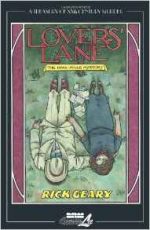
Lovers’ Lane – the Hall-Mills Mystery


By Rick Geary (NBM/ComicsLit)
ISBN: 978-1-56163-628-0

Rick Geary is a unique talent in the comic industry not simply because of his style of drawing but especially because of his method of telling tales.

For decades he toiled as an Underground cartoonist and freelance illustrator of strange stories, published in locales as varied as Heavy Metal, Epic Illustrated, Twisted Tales, Bop, National Lampoon, Vanguard, Bizarre Sex, Fear and Laughter, Gates of Eden, RAW and High Times where he honed a unique ability to create sublimely understated stories by stringing together seemingly unconnected streams of narrative to compose tales moving, often melancholy and always beguiling.

Discovering his natural oeuvre with works including biographies of J. Edgar Hoover and Trotsky and the multi-volumed Treasury of Victorian Murder series, Geary has grown into a grand master and unique presence in both comics and True Crime literature. His graphic reconstructions of some of the most infamous murder mysteries recorded since policing began combine a superlative talent for laconic prose, incisive observation and meticulously detailed pictorial extrapolation. These are filtered through a fascination with and understanding of the lethal propensities of humanity as his forensic eye scoured police blotters, newspaper archives and history books to compile irresistibly enthralling documentaries.

In 2008 he turned to the last century for an ongoing Treasury of XXth Century Murder series, with this volume focusing on a little-remembered scandal which seared the headlines during the “Gilded Age” of suburban middleclass America.

Lovers’ Lane – The Hall-Mills Mystery describes a case of infidelity which rocked staid, upright New Jersey in 1922 and – thanks to the crusading/muckraking power of the press – much of the world beyond its borders. The re-examination of the case begins here after a bibliography and detailed maps of ‘The City of New Brunswick’ and ‘Scene of the Hall-Mills Murders’, setting the scene for a grim tragedy of lust, jealousy, deception and affronted propriety…

The account proper opens in ‘Under the Crabapple Tree’ as a well-to-do conurbation of prosperous church-goers is rocked by the discovery of two bodies on park land between two farms.

Reverend Edward W. Hall of the Church of St. John the Evangelist was found with a single fatal gunshot wound, placed beside and cradling the corpse of Mrs. Eleanor R. Mills, a parishioner and member of the choir. Her fatal injuries easily fall into the category we would now call overkill: three bullet wounds, throat slashed from ear-to-ear and her throat and vocal cords removed and missing…

‘The Victims’ are soon the subject of a clumsy, botched and jurisdictionally contested investigation which nevertheless reveals Reverend Hall was particularly admired by many women of the congregation and, despite being married to a wealthy heiress older than himself, was engaged in a not especially secret affair with Mrs. Mills.

This fact is confirmed by the cascade of passionate love letters scattered around the posed corpses…

The case soon stalls: tainted from the first by gawkers and souvenir hunters trampling the crime scene and a united front of non-cooperation from the clergyman’s powerful and well-connected family who also insist on early burial of the victims.

However, the police doggedly proceed in ‘The Search for Evidence’, interviewing family and friends, forming theories and fending off the increasingly strident interference of journalists.

With pressure mounting on all sides – a persistent popular theory is that the victims were killed by the Ku Klux Klan who were active in the State and particularly opposed to adultery – the bodies are exhumed for the first of many autopsies. Not long after, the youngsters who first found the bodies are re-interviewed, leading to an incredible confession which later proves to be fallacious.

It is not the only one. A local character known as “the Pig Woman” also comes forward claiming to have been present at the killing. Eventually the police of two separate regions find themselves presiding over ‘The Case to Nowhere’: awash with too much evidence and too many witnesses with wildly varying stories which don’t support the scant few facts…

In the midst of this sea of confusion a Grand Jury is finally convened and peremptorily closes after five days without issuing indictments against anybody…

‘Fours Years Later’ the case is suddenly and dramatically reopened when the Widow Hall’s maid – whilst petitioning for divorce – is revealed to have received $5000 dollars to withhold information on her mistress’ whereabouts on the night of the double murder. When the New York papers get wind of this story they unleash a tidal wave of journalistic excess which culminates in a fresh investigation and a new trial, scrupulously and compellingly reconstructed here by master showman Geary…

With all the actors in the drama having delivered their versions of events at last, this gripping confection concludes with a compelling argument assessing ‘Who Did It?’…

This is a shocking tale with no winners and Geary’s meticulous presentation as he dissects the crime, illuminates the major and minor players and dutifully pursues all to their recorded ends is truly beguiling.

The author is a unique talent not simply because of his manner of drawing but because of the subject matter and methodology in the telling of his tales. Geary always presents facts, theories and even contemporary minutiae with absorbing pictorial precision, captivating clarity and devastating dry wit, re-examining each case with a force and power Oliver Stone would envy.

Seductive storytelling, erudite argument and audacious drawing give these tales an irresistible dash and verve which makes for unforgettable reading, and such superb storytelling is an ideal exemplar of how graphic narrative can be so much more than simple fantasy entertainment. These merrily morbid murder masterpieces should be mandatory reading for every mystery addict and crime collector.
© 2012 Rick Geary.

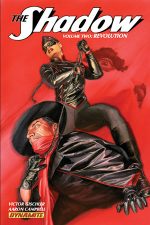
The Shadow volume 2: Revolution


By Victor Gischler, Jack Herbert, Aaron Campbell, Giovanni Timpano & various (Dynamite Entertainment)
ISBN: 978-1-60690-361-2

In the early 1930s, The Shadow gave thrill-starved readers their measured doses of extraordinary excitement via cheaply produced pulp periodical novels, and over the mood-drenched airwaves, through his own radio show.

“Pulps” were published in every style and genre in their hundreds every month, ranging from the truly excellent to the pitifully dire, but for exotic or esoteric adventure-lovers there were two star who outshone all others. The Superman of his day was Doc Savage, whilst the premier dark, relentless creature of the night dispensing terrifying grim justice was the putative hero under discussion here.

Radio series Detective Story Hour – based on stand-alone yarns from the Street & Smith publication Detective Story Magazine – used a spooky voiced narrator (variously Orson Welles, James LaCurto or Frank Readick Jr.) to introduce each tale. He was dubbed “the Shadow” and from the very start on July 31st 1930, he was more popular than the stories he highlighted.

The Shadow evolved into a proactive hero solving instead of narrating mysteries and, on April 1st 1931, began starring in his own printed pulp series, written by the incredibly prolific Walter Gibson under the house pseudonym Maxwell Grant. On September 26th 1937 the radio show officially became The Shadow with the eerie motto “Who knows what evil lurks in the hearts of Men? The Shadow knows!” ringing out unforgettably over the nation’s airwaves.

Over the next eighteen years 325 novels were published, usually at the rate of two a month. The uncanny crusader spawned comicbooks, seven movies, a newspaper strip and all the merchandising paraphernalia you’d expect of a superstar brand.

The pulp series officially ended in 1949 although Gibson and others added to the canon during the 1960s when a pulp/fantasy revival gripped America, generating reprinted classic stories and a run of new adventures as paperback novels.

In graphic terms The Shadow was a major player. His national newspaper strip – by Vernon Greene – launched on June 17th 1940 and when comicbooks really took off the Man of Mystery had his own four-colour title; running from March 1940 to September 1949.

Archie Comics published a controversial contemporary comicbook in 1964-1965 under their Radio/Mighty Comics imprint, by Robert Bernstein, Jerry Siegel, John Rosenberger and latterly Paul Reinman; and in 1973 DC acquired the rights to produce a captivating, brief and definitive series of classic comic adventures unlike any other superhero title then on the stands.

DC periodically revived the venerable vigilante. After the runaway success of Crisis on Infinite Earths, The Dark Knight Returns and Watchman, Howard Chaykin was allowed to utterly overhaul the vintage feature. This led to further, adult-oriented iterations (and even one cracking outing from Marvel) before Dark Horse assumed the license of the quintessential grim avenger for the latter half of the 1990s and beyond.

Dynamite Entertainment picked up the option in 2011 and, whilst republishing many of those other publisher’s earlier efforts, began a series of new monthly Shadow comics.

Set in the turbulent 1930s and war years that followed, these were crafted by some of the top writers in the industry, each taking their shot at the immortal legend, and all winningly depicted by a succession of extremely gifted illustrators.

This second volume – collecting #7-12 of the monthly comicbook from 2013 – comes courtesy of Victor Gischler (Gun Monkeys, Deadpool: Merc with a Mouth, Kiss Me Satan), again throwing a spotlight on the increasing deadly geopolitics of a civilisation sliding inexorably into another World War….

His scripts were variously realised by Jack Herbert, Aaron Campbell, Giovanni Timpano, Ivan Nunes & Carlos Lopez, and the action opens with a self-contained prelude that begins with the Master of the Macabre suffering from uncharacteristic bad dreams…

Very few people know that the black-cloaked fist of final retribution known as The Shadow masquerades by day as abrasive, indolent playboy Lamont Cranston. Most are agents in his employ and they are all aware of his semi-mystical abilities to detect thoughts and cloud the minds of men, but not that in the past few days those abilities have seemingly waned and led to the death of an innocent…

Engaging veteran Great War pilot Miles Crofton, Cranston embarks on a journey to the Himalayan region where he long ago studied under august adepts of the arcane. However, his voyage is interrupted in Nepal when he encounters a brutal bandit leader dubbed Red Raja. This thuggish crimelord seems to have powers and abilities similar and equal to his own…

Eschewing immediate confrontation, Cranston delves deep into the past and eventually learns the Raja also studied with the esoteric “Masters”. Tragically, when his innate evil nature forced them to expel him, the student returned with men and guns; wiping out the entire enclave of puissant accumulated knowledge…

Armed with information and fuelled by righteous fury, The Shadow then assaults Red Raja’s fortress, single-handedly eradicating his army of rogues before enacting final judgement…

Weeks later, vacationing in Paris whilst Miles has their plane repaired, the restless Shadow passes his time hunting down human predators and becomes emotionally embroiled in a missing persons case.

The trail leads to a grand soiree at the Spanish Embassy where Cranston makes a particular splash with the assorted dignitaries and persons of wealth and high station, particularly after loudly declaring that he is an arms dealer with product to sell.

It is 1937 and the civil war in Spain has all but stalled, with both sides afflicted by attrition and exhaustion…

Horrified Ambassador Ramirez is only too happy to fob off the tiresome Cranston on his military attaché. As soon as he sees the devastating Major Esmeralda Aguilar, the Shadow knows she is no ordinary woman…

The swaggering millionaire is only too eager to ditch the stuffy party with the exotic spy, but their intimate drive through the City of Lights is almost ended by a machine gun attack. Then Cranston discovers just how dangerous his companion truly is…

The next day Miles resurfaces with news on a freighter full of munitions headed for Spain and the final clue to the disappearances the Shadow has been investigating. Even with mental faculties and powers diminished and compromised, the Dark Avenger is clear on where his next destination lies…

Intercepting the gunrunners as they seek to offload their illicit cargo at a Spanish port, the Shadow dispenses his brand of justice before vanishing, and twelve hours later Lamont Cranston arrives in Barcelona, unsure of what trick of fate or his own subconscious has brought him there.

His mystically-attuned senses go into overdrive once he meets an inoffensive British volunteer in the Socialist Brigade calling himself “George Orwell”…

After befriending the oddly magnetic militiaman, Cranston excuses himself and resumes his trail of guns whilst Orwell returns to his unit in Aragon. Diligent hunting takes the Shadow to a warehouse where a gang led by a masked woman named Black Sparrow are attempting to sell the munitions to representatives of the underworld.

When the crooks try a double-cross they are savagely wiped out by the Sparrow as her men stand idly by, and from his hidden vantage point the Shadow realises just how extraordinary Major Aguilar truly is…

Soon the Avenger is risking spectacular airborne death; chasing her back to an ancient castle in the Aragon Region where he uncovers a bold scheme by an international cabal to place a third ruler on the throne of Spain. Of course, when he blazes in to end the conspiracy, Cranston finds more than he bargained for.

“El Rey” is far from the dominating despot he appears, and the true mastermind behind the plot is far more of a match for the Shadow than the grim guardian could possibly have anticipated.

And that’s when fate reveals the potential value of a certain nondescript British soldier of ideology and fortune…

This historically-flavoured jaunt then concludes with one last hurrah as Miles and Cranston belatedly return to New York just in time for the Shadow to fixate on a gang of ruthless bank robbers terrorising the city with their bold and lethal raids.

Broaching his contacts on the police force and rampaging through the ranks of the underworld, the Shadow turns the city upside down until at last a grudging tip takes him to a certain Chinatown whorehouse where a most exotic creature provides all the details he need to exact his vengeance on the guilty.

Now all that remains is to trigger the bloody end…

Dynamite publish periodicals with a vast array of cover variants and here a vast gallery features dozens of iconic alternate visions from Alex Ross, John Cassaday, Darwyn Cooke, Francesco Francavilla, Tim Bradstreet, Mike Mayhew, Michael Golden, Jack Herbert and Sean Chen to delight any art lover’s eyes and heart.

Sardonic, uncompromising and packed with subtle nuance, Revolution is a superb addition to the annals of the quintessential Dark Knight, and one no one addicted to action and mystery should be without.
The Shadow ® & © 2013 Advance Magazine Publishers Inc. d/b/a Conde Nast. All Rights Reserved.

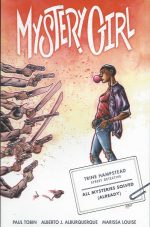
Mystery Girl volume 1


By Paul Tobin, Alberto J. Albuquerque, Marissa Louise & Marshall Dillon (Dark Horse Books)
ISBN: 978-1-61655-959-5

There’s a fabulous wave of smart, entertaining stand-alone comics on the market these days, offering readers a single uncomplicated hit of graphic entertainment without the grief of buying into massive back-history or infinite cross-continuity.

One of the best I’ve seen recently is the compilation of a fierce, frenetic and funny debut 4-issue miniseries from 2015, starring the most infallible detective of all time.

As crafted by Paul Tobin (Marvel Adventures Spider-Man, Plants vs. Zombies, Bandette, Colder) and Alberto J. Albuquerque (Letter 44) – with colours by Marissa Louise and letters from Marshall Dillon – this slim, sleek, slick yarn seems certain to lead to more enigmas excitingly unravelled in our immediate future…

Like any ancient city, London has its fair share of unique characters and unsolved mysteries, but that’s never the case whenever Trine Dorothy Hampstead sets up her “office” on the pavements and begins chatting…

The effusive, ebullient young woman has an incredible gift. She knows the answer to any question she’s asked. Instantly and infallibly. “Where are my keys?” “Did Dad leave a will?” “Where is my son’s body?”

All inquiries get an instant response and every answer is correct…

Trine is a local celebrity in her community, not only for the fact that she’s never judgemental or exploits her gift, but also because everyone knows there’s only one mystery the poor lass can’t solve: how she got her uncanny power…

Trine has an immense taste for life at full throttle and abiding desire to help those in need: regularly consulting with local private eye Alfie and aiding her perpetually sceptical boyfriend – and Metropolitan police constable – Ken Bloke in his work, even though he refuses to believe in her gift…

Her already extraordinary life takes a big step into the unknown when ancient DNA specialist Jovie Ghislain comes to Trine with a fascinating query. The biologist has been researching a 1930’s expedition to the wild Sakha region of Siberia. In the notes of the fabled Weimar-Steinberg trek, the explorers detail how they uncovered a frozen mammoth carcass so perfectly preserved that the meat was still fresh and edible.

The records are tragically incomplete and Ghislain – desperate to secure viable DNA from the deceased giant – wants to know where the rest of the body is now…

The answer is not immediately forthcoming. In fact Trine refuses to say anything unless she can join Jovie’s excursion and personally show the scientists where it is.

Trine thrives on new experiences and this time her gift has paid a huge dividend. As preparations are made, she shrugs off all questions from friends and acquaintances but does confide in her pet budgie Candide. The reason that mammoth meat was so fresh is obvious. It hadn’t been dead long. Now she’s off to see its kin in the only place on earth where the mighty beasts still live…

Sadly, the original expedition and its journals are also the subject of a search by wealthy and far less friendly folk. However, when a mystery billionaire commissions a psychopathic hitman to find all the original journals and stop the new expedition, even the deadly Linford is taken with Trine. Foregoing his usual callous efficiency, the murdering mercenary takes his time, insinuating himself into the life of all her friends. It’s all working out fine until the Mystery Girl is asked about her pal’s latest boyfriend and suddenly she knows all about the new beau, including his real profession…

Hampstead’s plan to deal with him is shockingly effective, but doesn’t go nearly far enough…

Believing the coast clear, Trine and Jovie head for the Arctic Circle, blissfully unaware that their trail is being dogged by Linford’s sinister paymaster and that the killer himself is down but not out. Instead he has devised a cunning method to turn his opponent’s gift against her…

Yet again, however, the obsessive hitman has underestimated Trine’s power, ingenuity and ruthless resolve but when finesse fails at least he can always fall back on overwhelming firepower and direct action…

With the explorers nearing their frozen El Dorado, the bad guys make their move, revealing what’s actually behind all the death and destruction. Now it no longer matters if Trine is asked the right question or not…

As the ghastly true story of the Weimar-Steinberg expedition is exposed, their heirs and inheritors will prove willing to commit mass murder to keep the bloody secret covered up, but Trine asks herself a different question and a life-saving solution pops into her head…

Fast-paced, spectacularly action-packed, witty and superbly balanced as hero and villain play cat-&-mouse around the world, Mystery Girl is a funny, imaginative, brutally uncompromising introduction to a potent and engaging new female character who seems destined for greatness.

Also included are fascinating bonus features including a copious and heavily annotated Sketchbook section with commentary from Tobin and Albuquerque, concept to finished art examples, cover roughs and designs and unused cover art, revealing the masses of effort that went into making this one of the best character debuts of the year.

Don’t ask why you weren’t in at the beginning of her climb to stardom: get Mystery Girl and become someone with (some of) the answers…
Mystery Girl™ & © 2015, 2016 Paul Tobin and Alberto J. Albuquerque. Mystery Girl™ and all prominently featured characters are trademarks of Paul Tobin and Alberto J. Albuquerque.

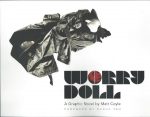
Worry Doll


By Matt Coyle (Dover Comics & Graphic Novels)
ISBN: 978-0-486-80616-7

In the comics biz it’s not too often that something truly different, graphically outstanding and able to subvert or redirect the medium’s established forms comes along.

Sadly, when it does we usually ignore it whilst whining that there’s nothing fresh or new in view.

That’s pretty much what happened with Matt Coyle’s astounding Worry Doll when, after six years of work on the dark epic, it was published by Mam Tor in 2007 and sank from the collective audience’s sight after causing but the barest of ripples.

To be fair, British-born, Australia-based Coyle (see also, if you can, his mordant, socio-political satire Registry of Death) did win the 2007 Rue Morgue award for Best Comic Book Artist for his incredible photo-realistic line-art on Worry Doll, but the innovative delivery of one of the creepiest tales in comics history never garnered the acclaim it deserved in our superhero-saturated toy, TV and film license-loaded entertainment arena.

Now, thanks once again to Dover Books’ Comics & Graphic Novels division, another lost classic of the art form has a second chance to shine, so let’s show some proper respect and make this edition the popular success it should be…

A soft-cover monochrome landscape affair; enigmatic observations and conversations are delivered in the oldest format of pictorial narrative, with blocks of text on one page balanced by an illustrated panel or sequence of images on the facing folio, as a most distressing story unfolds…

A happy home becomes a charnel scene of slaughter and in the aftermath, amidst the bloody remains of a recently-despatched family, a trio of beloved mannequins intended to assuage anxiety take on ghastly animation and leave in search of answers – or is it actually just different questions?

Making their way across familiarly picturesque and simultaneously terrifying country, the dolls increasingly depend on the kindness of strangers, until their nightmare road-trip is eventually subsumed in someone’s story. As our perspective shifts, we get clues that other hands are working these puppets and the story is not as it seems nor quite done yet…  

Spooky and subversive, blending classic noir mood and tone with storybook quests and psychologically daunting introspection, Worry Doll operates on multiple layers of revelation, both in the staggeringly detailed illustration and the prose accompaniment; constantly offering hints and forebodings if not answers…

With a new Foreword from comics author and filmmaker Shaun Tan (The Lost Thing, The Red Tree, The Arrival) who sagely deconstructs the journey and Coyle’s virtuosity with line and form, this is a complex, engaging and ominously beautiful masterwork no true lover of comics or addict of sinister suspense can afford to miss.
© 2007 by Matthew Coyle. Foreword © 2016 by Shaun Tan. All rights reserved.

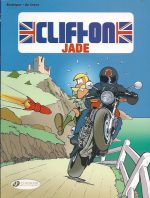
Clifton Volume 5: Jade


By Rodrigue & de Groot, translated by Luke Spear (Cinebook)
ISBN: 978-1-905460-52-6

An infallible agent of Her Majesty’s assorted security forces, Clifton was created by Raymond Macherot (Chaminou, Les croquillards, Chlorophylle, Sibylline) for the weekly Tintin. Our doughty exemplar of Albion debuted in December 1959, just as a filmic 007 was preparing to set the world ablaze and get everyone hooked on spycraft…

After three albums worth of strip material – all compiled and released in 1959-1960 – Macherot left Tintin for arch-rival Spirou and his bombastic buffoon was benched.

Tintin revived him at the height of the Swinging London scene and aforementioned spy-boom, courtesy of Jo-El Azaza & Greg (Michel Régnier). Those strips were subsequently collected as Les lutins diaboliques in French and De duivelse dwergen for Dutch-speakers in 1969.

Then it was back into retirement until 1971 when – Greg – with artist Joseph Loeckx – took another shot. He toiled on the True Brit until 1973 when Bob De Groot & illustrator Philippe “Turk” Liegeois fully regenerated the be-whiskered wonder. They produced ten more tales after which, from 1984 on, artist Bernard Dumont (AKA Bédu) limned de Groot’s scripts before eventually assuming the writing chores as well. The series concluded in 1995.

…But Never Say Never Again…

In keeping with its rather haphazard Modus Operandi and indomitably undying nature, the Clifton experience resumed yet again in 2003, crafted now by De Groot & Michel Rodrigue for four further adventures. Although the humorous visual vein was still heavily mined in these tales, the emphasis was subtly shifted and the action/adventure components strongly emphasised…

Originally released in 2003, Jade was Rodrigue & De Groot’s first collaboration and signalled a fresh start with all the fans’ favourite bits augmented by a stunning new partner for the old war-horse…

Bob de Groot was born in Brussels in 1941, to French and Dutch parents. As a young man he became art assistant to Maurice Tillieux on Félix, before creating his own short works for Pilote. A rising star in the 1960s, he drew 4 × 8 = 32 L’Agent Caméléon where he met Philippe “Turk” Liegeois, and consequently began making a slow transition from artist to writer. Together they created Archimède, Robin Dubois and Léonard before eventually inheriting Raymond Macherot’s moribund Clifton.

In 1989 de Groot – with Jacques Landrain – devised Digitaline, a strong contender for the first comic created entirely on a computer, and co-created Doggyguard with Michel Rodrigue, even whilst prolifically working with the legendary Morris on both Lucky Luke and its canine comedy spin-off Rantanplan.

He’s still going strong with strips such as Leonard in Eppo, Père Noël & Fils and Le Bar des acariens (both published by Glénat) and much more.

Michel Rodrigue really, really likes Rugby. He was born in Lyon in 1961 and eventually pursued higher education at the National School of Fine Arts, where he also studied medieval archaeology.

From 1983-85 he was part of the French Rugby team and in 1987 designed France’s mascot for the World Cup. He made his comics debut in 1984 with sports (guess which one) strip Mézydugnac in Midi Olympique. After illustrating an adaptation of Edmond Rostand’s Cyrano de Bergerac in 1986 he and collaborator Jean-Claude Vruble produced a volume of La Révolution Française, scripted by Patrick Cothias.

Rodrigue then joined Roger Brunel on Rugby en B.D., Du Monde dans la Coupe!, Concept, Le Rugby en Coupe and La Foot par la Bande.

For Tintin he drew Bom’s Les Conspirateurs and produced Rugbyman, the official monthly of the French Rugby Federation, amongst a welter of other strips. Along the way he began scripting too, and after working with de Groot on Doggyguard joined him on the revived Clifton.

He also remains astonishingly creatively occupied, working on Ly-Noock with André Chéret, Brèves de Rugby, La Grande Trambouille des Fées for René Hausmann, Futurama comics, Cubitus with Pierre Aucaigne, and many more…

Pompous, irascible Colonel Sir Harold Wilberforce Clifton is ex-RAF, a former officer with the Metropolitan Police Constabulary and recently retired from MI5. He has a great deal of difficulty dealing with being put out to pasture in rural Puddington and takes every opportunity to get back in the saddle, assisting the Government or needy individuals as an amateur sleuth whenever the opportunity arises. He occupies his idle hours with as many good deeds as befit a man of his standing and service…

In his revived incarnation the balance between satirical comedy, blistering adventure and sinister intrigue is carefully judged and this re-introductory tale begins with the old soldier and his contentiously fiery, multi-talented housekeeper Mrs. Partridge preparing for a camping trip.

Clifton is taking the local scout troop to Wales, but a few last-minute minor catastrophes are testing his patience and turning the air blue with extremely imaginative invective. The unflappable Mrs. P is able to offset them all – thanks to a family connection in the army surplus business – and soon the Colonel is ready to set off.

Plans change at the very last minute when a shadowy figure leaves a letter. That enigmatic messenger is painfully unaware that it is being carefully observed by another…

The message is in code, but once again la Partridge is up to the task, and Clifton adapts his plans. When the scouts board the lorry the colonel has secured, they learn that they are now heading for Devon…

Arriving at scenic Snooze-on-Pillow, Clifton gets the lads to set up camp but is soon accosted by an unctuous stranger who takes him to meet an old enemy fallen upon ignominious times…

Otto von Kartoffeln was one of Hitler’s greatest assets in the war, but now he is a feeble wreck in an old folks’ home bullied by a monster of a nurse. He doesn’t just want to talk over old times, however. The shrunken old remnant wants to share the secret location of a submarine full of Nazi treasure.

Over tea, served by a rather attractive young lady, the old soldiers’ minds go back to their earliest encounters. The tale unfolds of a U-Boat once commanded by Kartoffeln which sank off Scotland at the end of the war. He would happily have left it there forever, if not for the fact that a gang of neo-Nazis are trying to recover it and start up the Fuhrer’s madness all over again…

The old men have no conception that their teapot is bugged and avid young ears are listening with shock and awe and something else…

All too soon the restless old warrior is hurtling north: dodging bombs and ducking bullets beside an unlikely new partner. Determined on scotching a sinister plot, scuppering a vast submarine base and stopping the rise of the Fourth Reich, Clifton is aware that – as always – there are plots within plots, and amidst the frenetic death-defying action he has to keep one eye on his deadly foes and another on the people claiming to be his allies…

Still, with nothing to lose and civilisation to save, Clifton naturally does his utmost…

Funny, fast and furiously action-packed, Jade gives our Old Soldier a subtle overhaul and fresh start in a cunningly-conceived adventure romp in the grandly daft Get Smart! and Austin Powers manner; sufficient to astound and delight blockbuster addicts whilst supplying a solid line in goofy gags for laughter-addicts of every age to enjoy.
Original edition © Les Editions du Lombard (Dargaud-Lombard SA) 2003 by Rodrigue & De Groot. English translation © 2008 Cinebook Ltd.

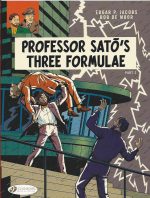
Blake and Mortimer: Professor Satō’s Three Formulae Part 2 – Mortimer versus Mortimer


By Edgar P. Jacobs & Bob De Moor with colours by Paul-Serge Marssignac, translated by Jerome Saincantin (Cinebook)
ISBN: 978-1-84918-303-1

Belgian Edgard Félix Pierre Jacobs (March 30th 1904-February 20th 1987) is rightly considered one of the founding fathers of the Continental comics industry. Although his output was relatively modest compared to many of his iconic contemporaries, Jacobs’ landmark serialised epic starring scientific adventurers Professor Philip Mortimer and Captain Francis Blake practically formed the backbone of the modern action-adventure comic in Europe.

His splendidly adroit, roguish yet thoroughly British adventurers were conceived and realised for the very first issue of Le Journal de Tintin in 1946, and quickly became a crucial staple of life for post-war European kids – in exactly the same way Dan Dare was for 1950s Britain.

Jacobs was born in Brussels, a precocious child perpetually drawing, but even more obsessed with music and the performing arts – especially opera. He attended a commercial school but loathed the idea of office work, so instead avidly pursued arts and drama on his graduation in 1919.

A succession of odd jobs at opera-houses (scene-painting, set decoration and even performing as both an acting and singing extra) supplemented his private performance studies, and in 1929 Jacobs won an award from the Government for classical singing.

His dreamed-of operatic career was thwarted by the Great Depression. When arts funding suffered massive cutbacks following the global stock market crash, he was compelled to pick up whatever dramatic work was going, although this did include more singing and performing.

Jacobs switched to commercial illustration in 1940, winning regular work in the magazine Bravo, as well as illustrating short stories and novels. He famously took over the syndicated Flash Gordon strip after the occupying German authorities banned Alex Raymond’s quintessentially All-American Hero and the publishers desperately sought someone to satisfactorily complete the saga.

Jacobs’ ‘Stormer Gordon’ lasted less than a month before being similarly embargoed by the Occupation fun-police, after which the man of many talents simply created his own epic science-fantasy feature in the legendary Le Rayon U: a milestone in both Belgian comics and science fiction adventure.

During this period Jacobs and Tintin creator Hergé got together, and whilst creating the weekly U Ray strip, the younger man began assisting on Tintin, colouring the original black and white strips of The Shooting Star (originally run in newspaper Le Soir) for an upcoming album collection.

By 1944 Jacobs was performing similar duties on Tintin in the Congo, Tintin in America, King Ottokar’s Sceptre and The Blue Lotus. He was also contributing to the drawing too, working on the extended epic The Seven Crystal Balls/Prisoners of the Sun.

After the war and liberation, publisher Raymond Leblanc convinced Hergé, Jacobs and a few other comicstrip stars to work for his proposed new venture. Founding publishing house Le Lombard, Leblanc also commissioned Le Journal de Tintin, an anthology comic with simultaneous editions in Belgium, France and Holland to be edited by Hergé and starring the intrepid boy reporter supplemented by a host of newer heroes.

Beside Hergé, Jacobs and writer Jacques van Melkebeke, Le Journal de Tintin featured Paul Cuvelier’s ‘Corentin’ and Jacques Laudy’s ‘The Legend of the Four Aymon Brothers’.

As revealed in an enticing, photo-packed essay closing this Cinebook volume, Blake and Mortimer were a lucky compromise. Jacobs had wanted to create a period historical drama entitled Roland the Bold but changed genres due to an overabundance of such strips…

Laudy had been a friend of Jacobs’ since their time together on Bravo, and the first instalment of the epic thriller serial ‘Le secret de l’Espadon’ starred a bluff, gruff British scientist and an English Military Intelligence officer closely modelled on Laudy himself…

The initial storyline ran from issue #1 (26th September 1946) to September 8th 1949) and cemented Jacobs’ status as a star in his own right.

In 1950, with the first 18 pages slightly redrawn, The Secret of the Swordfish became Le Lombard’s first album release, with the concluding part published three years later. The volumes were reprinted nine more times between 1955 and 1982, in addition to a single omnibus edition released in 1964.

Hergé and Jacobs purportedly suffered a split in 1947 when the former refused to grant the latter a by-line on new Tintin material they had collaborated on, but since the two remained friends for life and Jacobs continued to produce Blake and Mortimer for the weekly comic, I think it’s fair to assume that if such was the case it was a pretty minor spat. I rather suspect that the Eccentric Englishmen were simply taking up more and more of the diligent artist’s time and attention…

In 1984 The Secret of the Swordfish was reformatted and repackaged for English translation as three volumes with additional material (mostly covers from the weekly Tintin added to the story as splash pages): part of a push to win some of the lucrative Tintin and Asterix market here. Sadly the tall tomes failed to find an audience and ended after seven magnificent if under-appreciated volumes.

Now happily Cinebook have finally made the Gentleman Heroes a bankable proposition, releasing all 23 extant albums with the most recent – due to the quirks of publishing – being the original twelfth and the last one that Jacobs was involved with.

For further details please check out yesterday’s review, but suffice to say that the concluding instalment of Professor Satō’s Three Formulae was a long time coming …

Les 3 formules du professeur SatōMortimer contre Mortimer was a tragically extended affair and only credited Jacobs as writer and layout artist. The eleventh album had been serialised between September 1971 and May 1972 in Tintin after which the author simply abandoned his story due to failing health and other issues.

He died on February 20th 1987 and soon after veteran cartoonist Bob de Moor (Bart de Scheepsjongen, Monsieur Tric, Cori le Moussaillon, Balthazar, Barelli and so many others) was commissioned by his family and estate to complete his final tale from Jacob’s pencils and notes.

The concluding album was finally released in March 1990, leading to a republishing of all the earlier exploits and eventually new adventures from a variety of creative teams…

Rather than make you wait eighteen years for the conclusion, here’s E.P Jacobs’ final foray starring the beloved tour de force scientific investigators.

As described yesterday, boisterous boffin Mortimer was in Japan when urgently contacted by robotics pioneer and cyberneticist supreme Professor Akira Satō. That savant had accomplished miracles in the mass-production of highly specialised mechanoids and androids, but his discoveries – parsed down into three crucial processes and deposited in three separate banks – were being targeted by a ruthless gang led by Blake and Mortimer’s greatest enemy.

The villains had infiltrated Satō‘s home and laboratory and tried to murder Mortimer numerous times before creating a robot duplicate of the British scientist, but had been unable to stop a summons for help going out to his Secret Service ally. Now, with Blake imminently expected, the gang had to radically move up their timetable…

Captain Blake is watched from the moment he disembarks at Haneda Airport and the hidden enemies are already in place at the hotel where he is staying. The MI5 chief has the suite next to Mortimer’s, and although his old comrade is missing, finds plenty of clues as to what has happened to him. The diligent search also uncovers the video surveillance gear infesting both rooms and sets his watchers running for the exits in panic…

A hasty pursuit only leads to his own capture but, with fortune ever favouring the brave, Blake turns the tables on his foes in a deadly clash in the hotel garages and sends them all fleeing for their lives.

By the time he has connected with Police Superintendent Hasumi and briefed Colonel Mitsu of the Japanese Public Security Intelligence Agency, the assailants have vanished, but Blake is building a picture of what is going on. To end the Englishman’s threat forever, a diabolical and desperate scheme is devised: creating a second Mortimer robot to assassinate Blake…

Turncoat assistant Kim is nervous. Although he’s happy to use Professor Satō‘s incredible inventions to detain Mortimer and his former employer, the traitor is not conversant enough with the production procedures to guarantee success. Nevertheless, soon a deadly doppelganger of the British Professor is despatched to kill Blake…

Meanwhile, the real Mortimer has not been idle. With Satō‘s aid he has escaped the lab prison and rushes to intercept the android assassin, but is unaware that behind him, unqualified hands have meddled with the duplication processes and a legion of horrific misfit mechanoids are tumbling off the conveyor belts…

What follows is a succession of spectacular chases, frantic battles and a final shattering showdown between Blake, Mortimer and the man who has bedevilled their lives since the days of the Swordfish case – a fitting end to the epic adventures and, thanks to the graphic efforts of De Moor, a perfect, revitalising stepping stone for other creators to renew and continue the feature…

Rocket-paced, suspenseful and cathartically action-packed, this is an enthralling changing-of-the-guard building to an explosive conclusion and satisfying final flourish, resulting in another superbly stylish blockbuster to delight every adventure addict.

As well as the aforementioned historical overview – ‘Jacobs: 1946, the Swordfish, starting point of a masterful work’ – this Cinebook edition also includes excerpts from two other Blake & Mortimer albums plus a short biographical feature and publication chart of Jacobs’ and his successors’ efforts.
Original edition © Editions Blake & Mortimer/Studio Jacobs (Dargaud-Lombard s. a.) 1990 by E.P. Jacobs & Bob De Moor. All rights reserved. English translation © 2016 Cinebook Ltd.

Blake and Mortimer: Professor Satō’s Three Formulae Part 1 – Mortimer in Tokyo


By Edgar P. Jacobs, with colours by Paul-Serge Marssignac, translated by Jerome Saincantin (Cinebook)
ISBN: 978-1-84918-292-8

Pre-eminent fantasy raconteur Edgar P. Jacobs devised one of the greatest heroic double acts in pulp fiction: pitting his distinguished scientific adventurers Professor Philip Mortimer and Captain Francis Blake against a broad variety of perils and menaces in a sequence of stellar action-thrillers which merged science fiction scope, detective mystery suspense and supernatural thrills. The magic was made perfect through his stunning illustrations, rendered in the timeless Ligne Claire style which had made intrepid boy-reporter Tintin a global sensation.

The Doughty Duo debuted in September 1946; gracing the pages of the very first issue of Le Journal de Tintin. This was an ambitious international anthology comic with editions in Belgium, France and Holland, edited by Hergé, with his eponymous, world famous star ably supplemented by a host of new heroes and features for the rapidly-changing post-war world…

Les 3 formules du professeur Satō was a tragically extended affair and Jacob’s last hurrah. What became the eleventh album was serialised between September 1971 and May 1972 in Tintin, after which the author abandoned his story due to failing health and other personal issues.

Edgard Félix Pierre Jacobs died on February 20th 1987 and soon after Bob de Moor was commissioned by his family and estate to complete his final tale from Jacob’s pencil roughs and script notes. The concluding album was finally released in March 1990. This led to a republishing of all the earlier exploits and eventually fresh adventures from a variety of creative teams…

Here however the action opens at Haneda Airport, Tokyo where Air Traffic Controllers experience a unique problem as a UFO disrupts their carefully plotted flight courses. With disaster imminent two Starfighter jets are scrambled to pursue the meteoric anomaly and, just before they are destroyed, the pilots radio back they are being attacked by a dragon…

As the news filters around the world, renowned cyberneticist Professor Akira Satō argues with his assistant Dr. Kim, deeply remorseful that his latest breakthrough has been the cause of such tragedy. Kim only barely dissuades his Sensei from turning himself in to the authorities but is utterly unable to convince or prevent Satō from involving visiting colleague Philip Mortimer in his crisis of conscience…

The British Professor is in Kyoto attending a succession of scientific conferences, but when an ominous outsider hears of Satō’s intentions through hidden surveillance methods, the reaction is both explosive and potentially murderous…

The first Mortimer knows of the problem is when a gang of gunmen attempt to kidnap him off the streets, but after fighting them off and escaping the old warrior returns to his hotel and finds a telegram waiting for him…

An urgent request to join old friend Satō immediately seems impossible to accomplish due to stringencies of train timetabling, but an accommodating journalist overhears and offers a speedy compromise…

Mortimer is suspicious of the happy accident… but not suspicious enough…

Surviving another assassination attempt by sheer force of will, the professor is then lost in the wilds of Japan but eventually manages to battle his way to Satō’s lab outside Tokyo where he witnesses a series of astonishing sights.

His host has worked miracles in the fields of robotics – including the dragon which so recently and horrifically malfunctioned – but is at a loss to explain how his incredible creations have gone wrong at such a late stage.

Worldly-wise Mortimer soon deduces the causes: espionage and sabotage…

As the British boffin sends for his old comrade-in-arms Captain Blake, Satō is comforted by the fact that the key formulae for producing his mechanical marvels have been divided and deposited at three different banks in Tokyo. The Sensei breathes even easier after arranging that only Mortimer can retrieve them but this only prompts their hidden enemy to accelerate his plans and reveal himself as one of Mortimer’s greatest foes…

Unable to induce or force Mortimer to retrieve the scientific goldmine, the mastermind has an android double constructed to visit the banks but the rush-job breaks down before the task is completed. Now the vile villain has only more card to play before the formidable Blake arrives…

This Cinebook edition then concludes with excerpts from two other Blake & Mortimer albums (The Time Trap and a tantalising glimpse of Professor Satō’s Three Formulae Part 2) plus a short biographical feature and publication chart of Jacobs’ and his successors’ efforts to whet the appetite for further treats in store… Cunning and convoluted, this devilishly devious tale unfolds with potent authenticity and ever-escalating tension, building to an explosive conclusion which eventually took eighteen years to conclude. At least we don’t have to wait that near life-time for the epic denouement…
Original edition © Editions Blake & Mortimer/Studio Jacobs (Dargaud-Lombard S. A.) 1977 by E.P. Jacobs. All rights reserved. English translation © 2016 Cinebook Ltd.

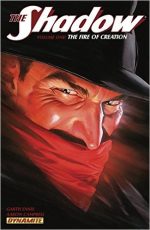
The Shadow volume 1: The Fire of Creation


By Garth Ennis, Aaron Campbell, Carlos Lopez & various (Dynamite Entertainment)
ISBN: 978-1-60690-361-2

In the early 1930s, The Shadow gave thrill-starved readers their measured doses of extraordinary excitement via cheaply produced periodical novels dubbed – because of the low-grade paper they were printed on – “pulps” and, over the mood-drenched airwaves, through his own radio show.

Pulp titles were published in their hundreds every month, ranging from the truly excellent to the pitifully dire, in every style and genre, but for exotic adventure lovers there were two star characters who outshone all others. The Superman of his day was Doc Savage, Man of Bronze, whilst the premier dark, relentless creature of the night dispensing terrifying grim justice was the mysterious slouch-hatted hero under discussion here.

Originally, the radio series Detective Story Hour – based on stand-alone yarns from the Street & Smith publication Detective Story Magazine – used a spooky voiced narrator (variously Orson Welles, James LaCurto and Frank Readick Jr.) to introduce each tale. He was dubbed “the Shadow” and from the very start on July 31st 1930, he was more popular than the stories he introduced.

The Shadow evolved into a proactive hero solving instead of narrating mysteries and, on April 1st 1931, starred in his own pulp series written by the incredibly prolific Walter Gibson under the house pseudonym Maxwell Grant. On September 26th 1937 the radio show officially became The Shadow with the eerie motto “Who knows what evil lurks in the hearts of Men? The Shadow knows!” ringing out unforgettably over the nation’s airwaves.

Over the next eighteen years 325 novels were published, usually at the rate of two a month. The uncanny crusader spawned comic books, seven movies, a newspaper strip and all the merchandising paraphernalia you’d expect of a superstar brand.

The pulp series officially ended in 1949 although Gibson and others added to the canon during the 1960s when a pulp/fantasy revival gripped America, generating reprinted classic stories and a run of new adventures as paperback novels.

As hinted above, in graphic terms The Shadow was a major player. His national newspaper strip – by Vernon Greene – launched on June 17th 1940 and when comicbooks really took off the Man of Mystery had his own four-colour title; running from March 1940 to September 1949.

Archie Comics published a controversial contemporary comicbook in 1964-1965 under their Radio/Mighty Comics imprint, by Robert Bernstein, Jerry Siegel, John Rosenberger and latterly Paul Reinman; and in 1973 DC acquired the rights to produce a captivating, brief and definitive series of classic comic adventures unlike any other superhero title then on the stands.

DC periodically revived the venerable vigilante. After the runaway success of Crisis on Infinite Earths, The Dark Knight Returns and Watchman, Chaykin was allowed to utterly overhaul the vintage feature. This led to further, adult-oriented iterations (and even one cracking outing from Marvel) before Dark Horse assumed the license of the quintessential grim avenger for the latter half of the 1990s and beyond.

Dynamite Entertainment picked up the option in 2011 and, as well as republishing many of those other publisher’s earlier versions, began a series of new monthly Shadow comics. Set in the turbulent 1930s and 1940s these yarns were designed as self-contained story arcs, crafted by some of the top writers in the industry, each taking their shot at the immortal legend, and all winningly depicted by a succession of extremely gifted illustrators. First to fire was the incomparable Garth Ennis who muted his signature black humour for this tale screaming of unrequited injustice…

It begins with a précis of Japan’s official invasion of China in 1937 and the appalling atrocities inflicted by their forces as they began building their “Greater East Asian Co-Prosperity Sphere”, jumping a few years and to the docks of New York City, where a dark angel dispenses bloody judgement to a murderous band of crooked dockworkers.

A little later abrasive, indolent playboy Lamont Cranston joins Washington insider Mr. Landers and his gung-ho young protégé Pat Finnegan at the Algonquin Hotel. They are meeting to discuss an imminent crisis amidst the worsening situation in the East, and how the massacre at the pier was connected to it. Specifically, two of the bodies dropped at the scene were high-ranking Japanese agents…

Despite Finnegan’s outspoken distaste at involving a civilian dilettante, a tale is shared of a rare mineral that both America and Japan will do anything to obtain. Cranston agrees to lead a small party into China to secure the samples (originally dug up by prospecting American geologists before they vanished) for the Land of the Free.

Of great concern is the unspecified part played by Taro Kondo: a formidable and ruthless Major in the Japanese intelligence service that Cranston had some unsavoury dealings with during his younger, less salubrious years in the East…

As Cranston prepares his paramour and assistant Margo Lane for the rigours that lie ahead, she has no conception of how much true horror and mass slaughter the Shadow has foreseen for the years to come…

Whilst Finnegan travels by spartan military plane transport, Cranston and Margo escape his juvenile jingoistic fervour by taking a Pacific Clipper. However their luxurious voyage is abruptly ended when they are attacked by Nazi agents masquerading as rich, indolent vacationers. The bloodbath that results brings down the plane and our heroes barely survive, but they have far greater things to worry about…

Ahead of them Kondo leads ambitious Emperor-lover and sexual deviant General Akamatsu on a tawdry trek to meet Chinese bandit Lord Wong Pang-Yan, descriptively and accurately known to all as “the Buffalo”.

The grotesque and greedy barbarian is their only means of acquiring the mineral they crave, and Kondo is eager to placate his haughty, nauseated superior. After all, they know the Shadow is coming and have other plans in place to deal with him. To soothe the General’s nerves Kondo promises he can behead the double-dealing Buffalo; as soon as they have the enigmatic matter poetically described as the Spirit-Weapon or Fire of Creation…

Since Buffalo Wong originally offered his treasure to many nations, there are a number of expeditions converging on the region. As a Japanese fighter plane removes the Soviet military force from the game, Kondo gloats at another problem solved and returns to placating his aggravating, arrogant superior.

It’s only a minor inconvenience to him that Cranston has survived his German allies’ attack and rendezvoused with the American agent Finnegan in Shanghai…

As the Yankees’ arrangements to use a British Navy vessel to reach Wong’s stronghold are finalised, Kondo’s assassins strike but once again are no match for the mesmerism and gunplay of the Shadow.

To make a point, the Dark Avenger not only eliminates his attackers but weeds out and ends every Japanese and German agent in the city…

At least the delay gives Kondo’s party a good head start. As their sailing boat (an unpowered Junk) navigates the great river, the former smuggler and crimelord passes the time by sharing all he knows about the human monster Kent Allard who was his criminal rival fifteen years previously. He doesn’t know how that despicable rogue became the man now known as Cranston, but is certain he is still the most implacable and remorseless killer on Earth…

Behind them Finnegan, determined to prove his manhood and authority, pushes the British Commander and crew. Resolved to catch Kondo’s military detachment before they reach their ultimate destination, he sees first hand the atrocities the Japanese soldiers casually inflict on “lesser” races, and in his disgust and inexperience leads the gunboat into a lethal trap.

Only he, Margo and the insufferable Cranston survive…

Far ahead of them Kondo and Akamatsu make their final trade with Wong – miracle mineral for gold – and the inevitable double-crossing and bloodletting begins.

What none of the treacherous villains realize is that the vengeful Shadow is already amongst them, cutting down soldiers and bandits like chaff as he patiently, determinedly makes his way to the true cause of all the terror…

At last Kondo realises he has only one card left to play…

Dynamite publish periodicals with a vast array of cover variants and here a vast collected gallery highlights dozens of iconic visions from Alex Ross, Chaykin, John Cassaday, Stephen Segovia, Ryan Sook, Sean Chen, Francesco Francavilla & Jae Lee. Adding to the Bonus Material is Ennis’s script for the first issue, and gloriously gilding the lily is a mountain of powerful pencil studies by Ross and Lee.

Sardonic, brutal and deviously convoluted, The Fire of Creation is a splendid addition to the annals of the ultimate and original Dark Knight, and one no lover of action and mystery can afford to miss.
The Shadow ® & © 2012 Advance Magazine Publishers Inc. d/b/a Conde Nast. All Rights Reserved.