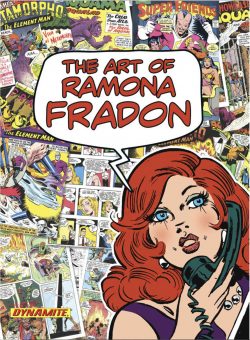
The Art of Ramona Fradon


By Ramona Fradon; interviewed by Howard Chaykin (Dynamite Entertainment)
ISBN: 978-1-60690-140-3 (HB/Digital edition)

Although present in comic books from the start, women – like so many other non-white male “minorities” – have been largely written out of history. One of the very few to have weathered that exclusion is Ramona Fradon. This excellent commemorative art collection celebrates not only her life and contribution, but thanks to its format – a free and unexpurgated extended interview with iconoclastic creator Howard Chaykin – offers the artist’s frank and forthright views on everything from work practise to the power of fans…

It all begins with an Introduction from Walt Simonson who proclaims ‘Meet your Idol… and discover They’re even Cooler than you Thought!’, before the early days are revealed in ‘Part One: Setting the Scene’ and ‘Part Two: In the Beginning’

Ramona Dom was born on October 2nd 1926 to an affluent Chicago family with many ties to commercial creative arts. Her father was a respected artisan, letterer and calligrapher who had designed the logos for Camel cigarettes, Elizabeth Arden and other major brands, and also formulated the fonts Dom Casual and Dom Bold. He had plans for his daughter, urging her to become a fashion designer…

The family moved to (outer) New York when Ramona was five., Ramona initially attended The Parsons School of Design, where she discovered she had absolutely no interest in creating clothes. Although she had never read comic books, she had been a voracious reader of illustrated books like the Raggedy Anne and Andy series by John Barton Gruelle, and a devoted fan of newspaper strips. Her favourites included Dick Tracy, Bringing Up Father, The Phantom, Alley Oop, Flash Gordon, Terry and the Pirates and Li’l Abner (all represented here by examples from the 1930s) and she transferred to the New York Art Students League, a hotbed of cartooning…

There she met and married Arthur Dana Fradon, who would become a prolific illustrator, author and cartoonist and a regular contributor to The New Yorker between 1948-1992. They wed in 1948 and he actively encouraged her to seek work in the still young funnybook biz.

‘Part Three: Gingerly Breaking into Comics’ reveals how her first forays at Timely Comics led to DC/National Comics and a Shining Knight story published in Adventure Comics #165 (cover-dated June 1951), ten months later taking over the long-running Aquaman feature in #167. Fradon was one of the first women to conspicuously and regularly illustrate comic books, drawing the strip throughout the 1950s and shepherding the sea king from B-lister to solo star and Saturday morning TV pioneer.

In the first of a series of incisive and informative mini biographies, ‘Sidebar: Murray Boltinoff’ reveals the influence of the much-neglected and under-appreciated editor. ‘Part Four: Queen of the Seven Seas’ and ‘Part Five: Man of 1000 Elements’ show how occasional stints on The Brave and the Bold team-ups led to her co-creation of Sixties sensation Metamorpho, the Element Man. However in 1965 – at the pinnacle of success – she abruptly retired to raise a daughter, only returning to the fold in 1972 for another stellar run of landmark work.

‘Sidebar: George Kashdan’ tells all about the multi-talented scripter before ‘Part Six: Ramona Returns to Comics… At Marvel???’ details how the House of Ideas lured the artist back to her board and highlights her difficulties working “Marvel-style” on assorted horror shorts, The Claws of the Cat and Fantastic Four, all presaging a return to DC…

‘Sidebar: Joseph Patterson’ looks into the astounding strip Svengali who green lit Dick Tracy, Little Orphan Annie, Gasoline Alley and more before ‘Part Seven: Back Home at DC Comics’ where she was busier than ever. As well as horror and humour shorts, Fradon drew a new Metamorpho try-out, superhero spinoff Freedom Fighters and her twin magnum opuses: revived comedy superhero Plastic Man and TV tie-in Super Friends. The revelations are bolstered by ‘Sidebar: E. Nelson Bridwell’, exploring the life of the man who knew everything about everything…

In 1980, Fradon took over Dale Messick’s long-running Brenda Starr newspaper strip, drawing it for 15 years. ‘Part Eight: Leaping From Books to Strips’ explores the painful and unpleasant chore in sharp detail, supplemented by ‘Sidebar: Brenda Starr’ outlining the feature’s history and reprinting those episodes when the ageless reporter met a certain cop, allowing Fradon to finally draw childhood idol Dick Tracy

The most fascinating stuff is left until last as ‘Part Nine: Ramona the Author’ discusses her career post-Brenda: drawing for Bart Simpson and Spongebob Squarepants comics, returning to higher education and writing a philosophical historical mystery novel – The Gnostic Faustus: The Secret Teachings Behind the Classic Text – as well as illustrated kids book The Dinosaur That Got Tired of Being Extinct.

Packed throughout with candid photos, and stunning pencil sketches, painted pictures and privately commissioned works of her stable of past assignments – like Aquaman, assorted Super Friends, Superman, Batman, Wonder Woman, Robin; the Metal Men, Aqualad, Brenda Starr, Black Canary, Shazam/Captain Marvel, Shining Knight, The Atom, The Spirit, Metamorpho and cast, Marvel Girl, Miss America, Power Girl, Catwoman, Hawkman, numerous illustrations from The Story of Superman book, and convention sketches, this celebration concludes with even more fabulous sleek super art images in ‘Part Nine: Ramona Today’ and ‘Part Eleven: Bibliography’

This is an amazing confirmation of an incredible career and any nostalgiac’s dream package. Amongst the gems unearthed here are complete Aquaman stories ‘The Kid from Atlantis!’ (Adventure Comics #269, 1960), ‘A World Without Water’ (Adventure Comics #251, 1958) and ‘How Aquaman Got his Powers!’ (Adventure Comics #260, 1959), plus tales from Star Spangled War Stories (#184, 1975) and ‘The Invisible Bank Robbers!’ from Gangbusters (#30, 1952).

Also on show are unpublished sample strips by Dana & Ramona Fradon and a monumental cover gallery depicting unforgettable images from Super Friends #3, 5-8, 10, 11, 13, 17, 19, 21, 22, 24-27, 31, 33, 36-39 & 41; Plastic Man #16-20; The Brave and the Bold #55, 57, 58, Showcase #30 & 33, Metamorpho, the Element Man #1-5, Namora #1 (2010), Fantastic Four #133 and Freedom Fighters #3.

These are supported by selected interior pages in full colour or monochrome from Star Spangled War Stories #8; Adventure Comics #190; Metamorpho, the Element Man #1; 1st Issue Special #3; Fantastic Four #133; The Brave and the Bold #57; House of Secrets #116 & 136; Secrets of Haunted House #3 & 14; House of Mystery #232 & 273; Plop! #5; Freedom Fighters #3 & 5; Plastic Man #14; Super Friends #6-8, 10, 13, 16, 19, 21, 23 & 25 and the Super DC Calendar 1977.

A truly definitive appreciation of the Comic Book Hall of Fame inductee 2006, this oversized (229 x 305 mm) hardback reproduces hundreds of pages and covers, plus a wealth of out-industry artwork and commissioned wonders, as accompaniment to an astonishingly forthright testament and career retrospective of a phenomenal and groundbreaking talent.

The Art of Ramona Fradon will delight everyone who wants to see a master in their element showing everybody how it should be done….

Marvel Characters © and ™ 1941-2013 Marvel Characters, Inc. DC Comics Characters © and ™ DC Comics. Brenda Starr™ © 2013 Tribune Media Services. All Rights Reserved

A Very DC Valentine’s Day


By Cecil Castellucci, Amanda Conner, Andy Diggle, Paul Dini, Ray Fawkes, Phil Hester, Kyle Higgins, Collin Kelly, Alisa Quitney, Jackson Lanzing, Peter Milligan, Ann Nocenti, Steve Orlando, Jimmy Palmiotti, James Robinson, Mark Russell, Mairghread Scott, Tim Seeley, Simon Bisley, Ben Caldwell, Aaron Campbell, Giuseppe Camuncoli, Mirko Colak, Andrew Currie, Javier Fernandez, Julio Ferreira, Julius Gopez, Sanford Greene, Stephanie Hans, Bryan Hitch, Frazer Irving, Kelley Jones, Nic Klein, Emanuela Lupacchino, Guillem March, John McCrea, Jaime Mendoza, Inaki Miranda, Robson Rocha, Thony Silas, Cam Smith, John Timms & various (DC Comics)
ISBN: 978-1401287665 (TPB/Digital edition)

After generations of incorporating seasonal occasions, milestones and themes into their regular chronology, in recent years comics publishers have started releasing special issues and compilations to single out those sale-enhancing moments. For DC, that process really began during their New 52 reboot…

Regrettably eschewing their own vast back catalogue of magnificently-limned genre romance material (still… maybe one day, hey?) the home of Batman, Superman and Wonder Woman released all-new anthologies exploring the many roads to and ways of loving.

In 2018, three one-shots – Young Monsters in Love #1, Young Romance: The New 52 Valentine’s Day Special #1 and Harley Quinn Valentine’s Day Special #1 – were tangled together as a celebratory tome which might entice less traditional fans…

We begin with Young Monsters in Love #1, which hit stores on February 7th 2018 carrying an April cover-date. It opens with a tale of Man-Bat wherein Kyle Higgins, Kelley Jones & colourist Michelle Madsen expose the bestial inner monologue of Kirk Langstrom’s “Nocturnal Animal”’ as the self-mutated science renegade seeks to rekindle his romantic relationship with ex-wife Francine

Tim Seeley, Giuseppe Camuncoli & Cam Smith also explore that theme of stability lost as Frankenstein, Agent of S.H.A.D.E. reviews his centuries-long relationship with “The Bride” in ‘Pieces of Me’ whilst Clark Kent and his son Jon learn a few hard truths about love and loss in ‘Buried on Sunday’. It’s a potentially shattering lesson for the Man of Steel and Superboy who seek to ensure that Solomon Grundy does not wallow in the eternal despair of bereavement as sensitively detailed by Mairghread Scott, Bryan Hitch & Andrew Currie…

Disgruntled Teen Titan/peripatetic ghost buster Raven discovers ‘The Dead Can Dance’ on a long-deferred Prom Night(mare) by Collin Kelly, Jackson Lanzing & Javier Fernandez, after which Paul Dini & Guillem March expose the cruel traumas of elementary school bullying when Deadman saves a lonely boy crushed and nearly killed by the annual purgatory of card-giving in ‘Be My Valentine’

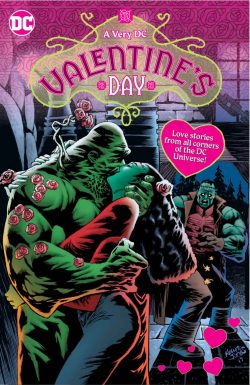
Swamp Thing loves and loses another frail and fragile human contact in the beautifully eerie ‘Heart-Shaped Box’ by Mark Russell & Frazer Irving, before Steve Orlando & Nic Klein push the parameters of amour and self-sacrifice when queer cop Maggie Sawyer seeks to stop a potential bloodbath as Monsieur Mallah & The Brain (of the Brotherhood of Evil) seek a way to further their impossibly complex relationship by looking backwards in ‘Visibility’

Andrew Bennet (I, Vampire, by Alisa Quitney & Stephanie Hans) then experiences painful revelation when forced to accept a new role for his ever-maturing disciple in ‘The Turning of Deborah Dancer’, whereas EtriganThe Demon – brutally challenges the entire infernal host to reach Jason Blood’s lost love in ‘To Hell and Gone’ by Phil Hester &Mirko Colak.

Amidst the madness of WWII, the warped wooing closes with a distressing brush-off letter to the Creature Commandos’ man-made vampire in ‘Dear Velcoro’, by James Robinson & John McCrea.

Heralding a shift from dark dilemmas to costumed courting – courtesy of the contents of Young Romance: The New 52 Valentine’s Day Special #1 (originally cover-dated April 2013) – our soap-opera sagas start with Catwoman reminiscing over her first meeting and troubled history with Batman in Ann Nocenti, Emanuela Lupacchino & Jaime Mendoza’s ‘Think it Through’

Aquaman & Mera uncover unrequited love and reunite unquiet separated spirits in ‘The Lighthouse’ (by Cecil Castellucci & Inaki Miranda) before Batgirl Babs Gordon lets her guard down with a certified bad boy in Ray Fawkes & Julius Gopez’s ‘Dreamer’.

Superhero teammates Apollo & Midnighter revisit their first “ mad moment” mid-mission in ‘Seoul Brothers’ by Peter Milligan & Simon Bisley, whilst paragon legacy hero Nightwing makes all his old mistakes again with new foe/ally/love interest Ursa in ‘Another Saturday Night’ by Kyle Higgins & Sanford Greene…

One of the biggest and most touted draws of the New 52 was the sidelining of Lois Lane and shocking romantic entanglement of Superman and Wonder Woman. Here, Andy Diggle, Robson Rocha & Julio Ferreira depict the ultimate power couple in the early, exploratory stages of that relationship and learning via a shocking game of ‘Truth or Dare’ …until spiteful sirens and a possessed god of love violently object…

The final third of this torrid tome sees lunatic love bandit Harleen Quinzel hog the limelight and steal the show with an extended epic from the Harley Quinn Valentine’s Day Special #1: released on February 11th 2015 and once again cover-dated for the month of All Fools…

Written by Amanda Conner & Jimmy Palmiotti, and collaboratively illustrated by John Timms, Ben Caldwell, Aaron Campbell, Thony Silas and colourists Paul Mounts & Hi-Fi, ‘Just Batty Over You’ offers an hallucinogenic rollercoaster ride of passions and perplexing playfulness as The Joker’s former main squeeze espies and is enthralled by super-sexy Bruce Wayne who is a prize in a charity dating auction…

She determines to make him hers and the abduction part goes off pretty much as required. However, complicating the scheme is Harley’s own meandering grip on reality, Bruce’s many jobs and secrets, so very much over-applied and shared narcotic inducement, hench-folk who can only see the billionaire’s vast dollar-value and the perpetual interference of briny costumes activists The Carp and Sea Robin, who really want everybody to heed their message of marine environmental crisis…

Daft, delightful and delivered with perfect timing and elan, this lustful lark caps a supremely frothy and inconsequential diversion to charm casual and fully committed thrill seekers in equal amounts.
© 2013, 2015, 2018 DC Comics. All Rights Reserved.

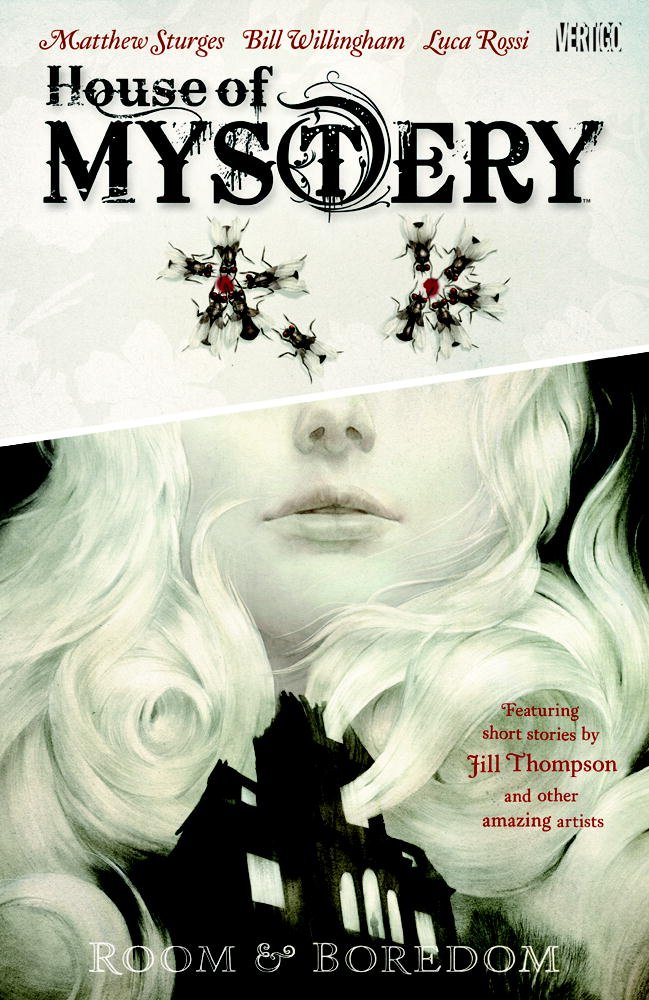
House of Mystery: Room & Boredom


By Matthew Sturges, Bill Willingham, Luca Rossi & various (Vertigo)
ISBN: 978-1-401220792 (TPB)

I suspect we’re on the cusp of another periodic global wave of interest in supernatural suspense fiction. Even if we’re not, there’s a lot of superb comics of that genre that should be reviewed and revisited. Here’s one that hasn’t been seen for a dozen years; long overdue for a digital edition…

Re-imagined under the impressive Vertigo umbrella, one of DC’s most venerable titles returned after years in limbo as a tribute to Something Old cunningly disguised as Something New. Apart from a brief period in the Bat-crazed super-heroic mid-1960s when the Martian Manhunter and the ineffably quirky Dial H for Hero seized control, House of Mystery was an anthology title telling tales of mystery and imagination in the tasteful, sedate manner of its parent company.

The series launched with a December 1951/January 1952 cover-date and ran for 321 issues, before finally folding in October 1983. When superheroes fell out of favour at the end of the 1960s, a little deft retooling made it one of DC’s top selling titles.

Here, however, at a place where realities meet – or at least overlap – a ramshackle house of indeterminate size, shape and age sometimes stands. In its own capacious grounds the unique structure offers a welcome to the star-crossed and time-lost souls of infinity. The lower floor has been converted into a welcoming hostelry.

Like the bar in Cheers, creatures from literally anywhere (many looking like characters out of the previous comic book incarnation) drop in for a brew and a chinwag, often paying their way with a novel yarn. For a select few – such as the Bartender, the Poet, the Pirate and the Drama Queen – the House is more like the Hotel California – in that they can check out any time they like, but they can never leave…

Fig Keele is an architecture student with a problem and a history. Her home fell apart and two spectral, floating horrors started chasing her. Fleeing in panic, she fortuitously found an entrance to the House, and now it won’t let her go. Surprisingly, she adapts pretty quickly to the inhabitants, but what really freaks her out is that the House speaks to her…

Writer Matthew Sturges, with sometime collaborator Bill Willingham, managed the nigh-impossible task of combining the best elements of the old within this compellingly fresh horror yarn, and even concocted a cocktail of actual mysteries to keep the pot boiling away. Strikingly illustrated by Luca Rossi, who incorporated a stylistic ghost of Bernie Wrightson into the artwork, the story of Fig and her fellow residents is punctuated by a series of very classy “pub-stories”, illustrated by some of the industry’s best and brightest talents.

The vignettes include two by Willingham; ‘The Hollows’ – a disturbing love-story by Ross Campbell – and the delightfully far-fetched ‘In Too Deep’ (from Jill Thompson), whilst Sturges scripted the remaining three ‘Spats and the Neck’ (with Zachary Baldus), ‘Familiar’ by Steve Rolston and ‘Jordan’s Tale’ by Sean Murphy.

Collecting issue #1-5 of the much-missed Vertigo comic book series, this is an enchanting blend of ancient & modern, horror & comedy and mystery & adventure, delivering a colossal portion of fearful fun for anyone old enough to handle a little sex and a smidgen of salty language: all whilst unravelling the intricacies of a great big, all-absorbing puzzle.

Just remember once you’re in, you might never want to come out…
© 2008 DC Comics. All Rights Reserved.
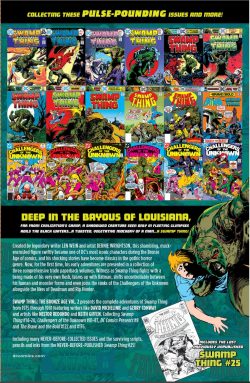
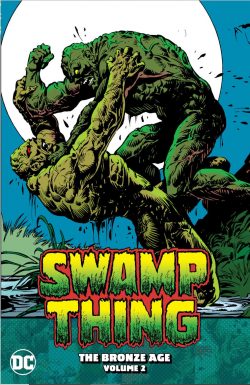
Swamp Thing: The Bronze Age volume 2


By David Michelinie, Gerry Conway, Carla Conway, David Anthony Kraft, Steve Englehart, Bob Haney, Martin Pasko, Nestor Redondo, Fred Carrillo, Keith Giffen, Michael Netzer, Murphy Anderson, Ernie Chan & various (DC Comics)
ISBN: 978-1-4012-9422-9 (TPB/Digital edition)

Win’s Christmas Gift Recommendation: Utter Moodily, Moss-Bedecked Entertainment Perfection… 9/10

The first fan-sensation of the modern era – now officially enshrined as the Bronze Age – of American comic books – Swamp Thing has powerful popular fiction antecedents and in 1972 was seemingly a concept whose time had come again. Prime evidence was the fact that Marvel were also working on a man-into-mucky, muddy mess character at the very same time.

Both Swampy and the Macabre Man-Thing were thematic revisions of Theodore Sturgeon’s classic novella It, and bore strong resemblances to a hugely popular Hillman Comics star dubbed The Heap. He/it sloshed through the back of Airboy Comics (née Air Fighters Comics) from1943 onwards and my fan-boy radar suspects Roy Thomas’ marsh-monster the Glob (from Incredible Hulk #121, November 1969 and #129, June 1970) either inspired both DC and Marvel’s creative teams, or was part of that same zeitgeist.

It should also be remembered that in the autumn of 1971 Skywald – a very minor player with big aspirations – released a monochrome magazine in their Warren Comics knock-off line entitled The Heap.

For whatever reason, by the end of the 1960s superhero comics were in another steep sales decline, again succumbing to a genre boom led by a horror/mystery resurgence. A swift rewriting of the Comics Code Authority augmented the changeover and at National/DC, veteran EC comics star Joe Orlando became editor of House of Mystery and sister title House of Secrets.

These returned to short story anthology formats and gothic mystery scenarios, taking a lead from TV triumphs such as Twilight Zone and Rod Serling’s Night Gallery.

Referencing the sardonic narrator/storyteller format of those EC horror titles, Orlando created Cain and Abel to shepherd readers through brief, sting-in-the-tail yarns produced by the best new and established creators the company could hire. Artists Neal Adams, Mike Kaluta, and especially Bernie Wrightson produced some of their best work for these titles, and the vast range of spin-offs the horror boom generated at DC.

The 12th anthology issue of the resurrected House of Secrets (#92, June/July 1971) cemented the genre into place as the industry leader. There writer Len Wein & Wrightson produced a throwaway gothic thriller set at the turn of the 19th century, wherein gentleman scientist Alex Olsen was murdered by his best friend with his corpse dumped in a swamp.

Years later, Olsen’s beloved bride – now the unsuspecting wife of the murderer – was stalked by a shambling, disgusting beast that seemed to be composed of mud and muck…

The tale struck an immediate chord with the public. That issue was the best-selling DC comic of that month, and reader response was fervent and persistent. By all accounts, the only reason there wasn’t an immediate sequel or spin-off was that the creative team didn’t want to produce one. Eventually however, bowing to interminable pressure, and with the sensible idea of transplanting the concept to contemporary America, Swamp Thing #1 appeared on newsstands in the Spring of 1972. It was an unqualified hit and instant classic…

Wein & Wrightson produced 10 issues together: an extended, multi-chaptered saga of justice and vengeance encompassing a quest for answers that was at once philosophically typical of the time and a prototype for the story-arc and mini-series formats that dominate today’s comics. They also used each issue/chapter to pay tribute to a specific sub-genre of timeless horror story whilst advancing the major plot…

When Alec and Linda Holland retreated deep into the Louisiana Bayou to work on a bio-restorative formula to revolutionise global farming, they had no idea criminal organisation “The Conclave” was after their research. Despite the best efforts of Secret Service agent Matt Cable, the lab was bombed and Linda died instantly. Alec – showered with his own formula and blazing like a torch – hurtled to a watery grave in the swamp. He did not die…

Transformed by the formula (and remember, please, this was prior to Alan Moore’s landmark re-imagining of the character) Holland transformed into a huge man-shaped thing: immensely strong, barely able to speak, and seemingly composed of living plant matter. Holland’s brain still functioned, however, and he vacillated between finding his wife’s killers and curing his own monstrous condition. Cable, misinterpreting the evidence, became obsessed with killing the beat, believing it caused the deaths of his two friends and charges…

Swamp Thing travelled the world, encountering the darkest outbreaks of classic supernature and the insatiable greed of human beasts before eventually convincing Cable of his innocence and true identity. Joined by Abigail Arcane – niece of archenemy and necromantic sorcerer Anton Arcane – they roamed a nation and world increasingly beset by uncanny terrors and macabre plots, with new allies like mystery man Bolt at their side.

Wein’s last issue was #13, having ushered in a new direction for Nestor Redondo – who replaced Wrightson with #11 – to display his own gifts and quickly become the artistic driving force.

Born in 1928 at Candon, Ilocas Sur in the American Territory of the Philippines, Redondo was influenced by US strips like Tarzan, Superman, Buck Rogers and Flash Gordon which were immensely popular in the entertainment-starved Pacific Archipelago.

Drawing from an early age, Nestor emulated his brother Virgilio – who worked as a comics artist in the young country. The Philippines became a commonwealth in 1935, and achieved full-independence from the USA in 1946, but maintained close cultural links to America.

Nestor’s parents pushed him into architecture but within a year he returned to comics. A superb artist, he far outshone Virgilio – and everybody else – in the cottage industry. His brother switched to writing and they teamed up: producing some of the best strips the Islands had ever seen, the most notable and best regarded being Mars Ravelo’s Darna.

Capable of astounding quality and incredible speed, by the early 1950s Nestor was drawing for many titles. Publications like Pilipino Komiks, Hiwaga Komiks and Espesial Komiks were fortnightly and he usually worked on multiple series simultaneously, pencils and inks. He also produced a wealth of covers.

In 1953, he adapted MGM film Quo Vadis for Ace Publications’ Tagalong Klasiks #91-92. Written by Clodualdo Del Mundo, it was serialized to promote the movie in country, and impressed MGM so much that they offered 24-year old Nestor a US job and full residency. He declined, thinking himself too young to leave home yet.

Ace was the country’s biggest comics publisher, but by the early 1960s they were in dire financial straits. In 1963 Nestor, Tony Caravana, Alfredo Alcala, Jim Fernandez, Amado Castrillo and brother Virgilio set up their own company CRAF Publications, Inc., but times were against them and publishers everywhere. Around this time, America called again, in the form of DC and Marvel Comics.

By 1972, US based Tony DeZuñiga had introduced Filipino artists to US editors. Nestor drew horror tales for House of Mystery, House of Secrets, The Unexpected, Phantom Stranger, Secrets of Sinister House, Witching Hour, Weird War Tales; Marvel’s Man-Thing; and an astonishingly lovely run on Rima the Jungle Girl (loosely adapting W. H. Hudson’s seminal 1904 novel Green Mansions), before joining Swamp Thing.

He also worked on Lois Lane and the Tarzan franchise, and in 1973 produced literary adaptations including Dracula and Dr. Jekyll and Mr. Hyde for Vincent Fago’s Pendulum Press Illustrated Classics (later reformatted as Marvel Classics Comics). In later years, he moved to Marvel to ink and eventually fully illustrate The Savage Sword of Conan.

During his DC period he was tapped to draw an adaptation of King Arthur which DC killed before it was completed (once again some pages survive and the internet is your friend if you want to see them) but did limn tabloid-sized Limited Collectors’ Edition: The Bible.

This epic bayou bonanza gathers the last of the original Swamp Thing run (#14-25), plus guest appearances from Challengers of the Unknown #81-87; The Brave and the Bold #122 & 176 and DC Comics Presents #8 (spanning cover-dates January/February 1975 to July 1981) .

Roving America during a period of political instability tainted by cultural hedonism and paranoia, Cable, Abby, Bolt and miserable misshapen Alec Holland (whom they had recently broken out of federal custody) continually stumbled into weird and deadly situations. With writer David Michelinie joining Redondo, proceedings open here with ‘The Tomorrow Children’ (ST #14, January/February 1975).

Separated again, Holland’s human helpers search for him as the depressed nomad discovers an isolated Bayou community of simple folk persecuting a family of freakish kids. Swamp Thing drives off one murderous mob, but stories of the outcast kids’ uncanny powers and the plain facts of strange accidents and mysterious disappearances won’t go away. By the time the townsfolk return to destroy the “demon children”, Holland has discovered radioactive waste is causing all the problems, but far too late to prevent tragedy or promote understanding…

Swamp Thing then falls under ‘The Soul-Spell of Father Bliss’: a seemingly serene and benign cleric with demonically disturbing notions on how to restore faith to his disinterested flock. When Cable and Abby finally find Swamp Thing, it’s not Alec Holland inside the vegetable colossus and only an ultimate sacrifice can save them and humanity from the priest’s folly…

In the awful aftermath, Bolt is captured by agents unknown and the restored Holland-Thing leads a rescue party against an old adversary. Typically, the venture is derailed by cruel fate and the monster ends up alone on tiny Kalo Pago island in the middle of a revolution. On one side is a viciously repressive military government while the rebels are led by High Priestess Laganna – who has a direct line to zombie gods.

Caught in the middle, Holland cannot stem the tide of terror on the climactic ‘Night of the Warring Dead’

ST #17 finds Bolt a prisoner of resurrected former Conclave chief Nathan Ellery, but when Abby, Cable and Swamp Thing finally stumble into his HQ, the maniac’s mercenaries, mechanical myrmidons and global mind-control contraption ‘The Destiny Machine’ at first appear to be an unbeatable opposition. But only at first…

Fleeing the destruction they have partially wrought, the victorious heroes crash land in an idyllic hamlet filled with violently murderous old folk. Its apologetic administrator claims Serenity is an experimental “ultimate retirement facility”, but before long is revealed as a demonic  ‘Village of the Doomed’ requiring all Holland’s power to escape and exorcise…

Cover-dated October 1975, The Brave and the Bold #122 then counts down ‘The Hour of the Beast!’ Bob Haney & Jim Aparo detail the awesome spectacle of Swamp Thing’s return to Gotham City and efforts to save it from a monstrous vegetable infestation. When Holland then becomes a target for a profit crazed showman, it needs all Batman’s ingenuity to save his ally and his city…

That same month in Swamp Thing #19, Gerry Conway joined Redondo to reveal ‘A Second Time to Die’ as a very familiar muck monster prowls Florida’s Everglades and – barely sentient – is befriended elderly Seminole hermit Ho’tah Makanaw. Nearby, Abby Cable and Bolt drive into Gatorberg, seeking their lost companion and following rumours of a big green monster…

The town is far from friendly but one boy is happy to take them to the old Indian who might know something of what they’re seeking…

Events take a drastic turn when the plant giant attacks a government drilling installation even as Ho’tah reveals a magical secret and sets the stage for an incredible clash in the next issue when Swamp Thing Holland battles incredible duplicate ‘The Mirror Monster’ for all the wrong reasons and for people who don’t deserve his aid…

Although the quality of the storytelling was getting better, the times were turning against the horror medium and as Michelinie returned in #21, it was for a science fictional romp as Holland was abducted by alien collector/slaver Solus. The bitterly contested escape left the monster stranded in an American desert and captured by rogue scientists battling madness-inducing contagion in their top secret atomic weapons base. Of course, definitions of “victim” or “cure” for ‘The Solomon Plague’ depended on who was doing the diagnosing, and when the “patients” started resisting treatment Holland could only watch helplessly as nature took its course…

Another attempt at a new direction began in Swamp Thing #23 as Conway & Redondo unleashed ‘Rebirth and Nightmare’, with a mystery mastermind targeting the moss monster and despatching costumed nemeses Sabre and Thrudvang, the Earth Master, even as the lonely wander made contact with his long-lost – and never-mentioned – smarter brother Edward Holland

Their combined efforts to concoct a cure are initially successful despite Sabre’s surprise attack, but as we all know “no good deed goes unpunished”…

Cover-dated August/September 1976, an era ended with #24 as Conway, David Anthony Kraft, Ernie Chan & Fred Carrillo all collaborated on ‘The Earth Below’ as human but still traumatised Alec Holland faces Sabre, even more costumed crazies and ultimately tectonic terror Thrudvang, all craving the bio-regenerative formula still afflicting the former plant monster…

That catastrophic cliffhanger clash was never completed as the title was cancelled without warning or fanfare, just as it was about to formally join the superhero section of the DCU. It was probably for the best. As the Vertigo imprint would prove in a later age, some champions need sophisticated darkness to properly thrive…

As for the Bronze Age, Swamp Thing became a part of the army that hung around waiting to be picked for guest shots or even a revival. With the superhero genre recovering, one old concept granted a new shot ultimately led to fresh shoots for Holland.

The Challengers of the Unknown was a bridging concept. As superheroes were being revived in 1956 here was a super-team – the first of the Silver Age – but with no powers, basic utilitarian uniforms instead of costumes and the most dubious of motives – Suicide by Mystery. They debuted in Showcase #6 (cover-dated February 1957 and on sale in early November of 1956) and followed up in #7, 11 & 12 before gaining their own title (#1-77, May 1958-January 1971, plus a reprint revival in #78-80 in 1973).

They were a huge hit and major players in their time, striking a chord that lasted for more than a decade before they finally died… only to rise again and yet again. The idea of them was stirring enough, but their situation made their success all but inevitable. Conceived by inspirational human hit-factory Jack Kirby – before his move across town to co-create the Marvel Universe – the solid adventure concept and imperfect action heroes he left behind were idealised everyman characters for the tumultuous 1960s – an era before superheroes overtook anthological genre heroes to secure a virtual chokehold on comic book pages.

Kirby had developed a brilliantly feasible concept and heroically archetypical characters in cool pilot Ace Morgan, indomitable strongman Rocky Davis, intellectual aquanaut Prof.” Haley and daredevil acrobat Red Ryan. The Challengers of the Unknown were four (extra)ordinary mortals; heroic troubleshooter and explorers who walked away unscathed from a terrible plane crash. Already obviously what we now call “adrenaline junkies”, they communally decided that since they were all living on borrowed time, they should dedicate what remained of their lives to testing themselves and fate. The quartet would risk their lives for KNOWLEDGE and, naturally, JUSTICE.

They were joined by an occasional fifth member, beautiful (of course) scientist June Robbins in their second appearance (Ultivac is Loose!’ in Showcase #7, March/April 1957), and she became a hardy perennial, frequently popping up to solve puzzles, catch criminals and generally deal with aliens, monsters, mad boffins and assorted supernatural threats. Over the decade other Challengers audited this core group, but none as bizarre as those that popped in during their late 1970s resurgence…

The return began in 1976 as a try-out serial in Super-Team Family #8-10 (January-May 1977) and led to the launch of Challengers of the Unknown #81 (June/July 1977). Crafted by Conway, Michael Netzer (nee Nasser) & Bob Wiacek, it’s included here and sees the boys and June Robbins defeat an old super-foe in ‘Multi-Man’s Master Plan’. In the course of the battle, Prof is diagnosed with an appalling, life-threatening fungal infection that dictates the team heading to Perdition, Pennsylvania, with persistent wannabe hanger-on Gaylord Clayburne desperately seeking to insert himself into the rescue mission…

Older fans will know that’s where Holland first defeated a Lovecraftian horror (Swamp Thing #8): a tale fully reprised in CotU #82, as Conway, Netzer & Joe Rubinstein reveal ‘The Lurker Below’, examine the ‘Legacy of the Damned’, expose ‘The Soul Predator’ and ruthlessly respond as ‘The Lurker Rises’

As a deranged priest seeks to manifest cancer-god M’Nagala, Keith Giffen & John Celardo take over art duties with #83 as the embattled Challs seek to close ‘Seven Doorways to Destiny’. As Prof succumbs to fungal assimilation, aid comes as Clayburne recruits human Dr. Alec Holland as a potential ‘Savior from the Swamp?’ even as ‘The Gods Crawl Closer’. Unknown to the vainly striving Challengers, the subsequent battle reverts Holland to his vegetable form, but ‘Monsters, Good and Evil’ cannot stop the ghastly devil until Holland’s ultimate sacrifice. His triumph over M’Nagala goes completely unnoticed…

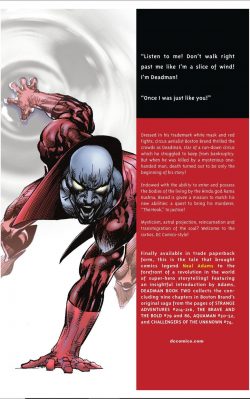
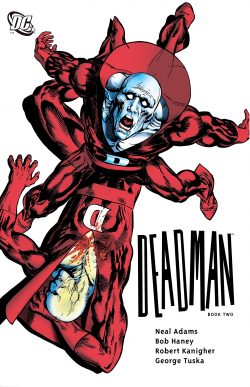
Issue #84 finds the human heroes attempting ‘To Save a Monster’ called Prof Haley, but falter until the spirit of Boston Brand occupies and cures him ‘When Deadmen Walk’. In the meantime the Challs learn Holland is the Swamp Thing and seek to make amends. With unperceived aid from Brand, they track the bog beast down only to find he/it has been taken over by Multi-Man…

The threat is covertly countered by Deadman, who sticks around when the Challs offer the plant monster a place on the team, just as Challengers of the Unknown #85 introduces ‘The Creature from the End of Time!’ as ‘The Box from Beyond’ materialises in Toronto, spawning murderous ‘Monsters and Men’ and necessitating a ‘Flight into the Future’

The team had hoped to consult legendary specialist Rip Hunter, Time Master, but learn he and his team have been missing for a decade…

Disappointed but undeterred, the Challs (minus angry quitter Red Ryan but with unsuspected stowaway Deadman) take off for 12 million AD, leaving recuperating Prof behind to face an unsuspected menace…

Penultimate issue #86 solves the mystery of Rip Hunter as the heroes encounter ‘The War at Time’s End’, whilst recap ‘The Way it Began’ restates the convoluted path and events that brought the situation about.

The dismantling of humanity’s final dystopia begins as ‘If This is Tomorrow, You Must Be Rip Hunter!’, leads to the Challenger team investigating ‘Time Times Terror’ and discovering ‘A Pit by Any Other Name’ before the saga concludes in complete chaos with #87 (June/July 1978) as the  ‘Twelve Million Years to Twilight’ pits the human heroes against mutated terrors of the dominant Sunset Lords.

In the end, the future of humanity depends on monsters ghost and primitives enacting an ‘Assault on Sunset’ to secure ‘Twilight’s Last Glimmer’, courtesy of Carla & Gerry Conway, Giffen & Celardo.

Once again, an abrupt cancellation was the reward for valorous service and all players returned home to be shelved again. This compendium closes with a brace of superhero team-ups and a lost treat for true devotees, beginning with DC Comics Presents #8 (April 1979), as ‘The Sixty Deaths of Solomon Grundy!’ by Steve Englehart & Murphy Anderson pairs bog beast with the Man of Steel. Still believing he was a transformed human and not an enhanced plant, Swamp Thing here searches the sewers of Metropolis for a cure to his condition, only to stumble onto a battle between Superman and the mystic zombie who was “born on a Monday…

Crafted by Martin Pasko & Aparo, an encore in The Brave and the Bold #176 (July 1981) reunites Batman and Swamp Thing in a convoluted tale of Bayou-based murder and frame-ups in ‘The Delta Connection’ before the previously unpublished contents of Swamp Thing #25.

With the series cancelled, in-production story ‘The Sky Above’ by Kraft, Chan & Carillo is presented here as plot, script, uncoloured cover 16 pages of layouts, the pencils and inks in a clash with Hawkman that really should have officially taken place…

Also offering covers by Redondo, Aparo, Chan, Netzer, Neal Adams, Rubinstein, Rich Buckler, Jack Abel, Frank Giacoia, Alex Saviuk, Dick Giordano, José Luis García-López and Mike Kaluta; editorial material from Challengers of the Unknown #86 and an unused cover by Rick Veitch & Michelle Madsen, this collection comprises a genuine landmark of the art form, with stories that are superb examples of old-fashioned comics wonderment, from a less cynical and sophisticated age, but with a passion and intensity that cannot be matched. And, ooh, that artwork…

If you love comics you must have his buried treasure.
© 1975, 1976, 1977, 1978, 1979, 1981, 2019 DC Comics. All Rights Reserved.
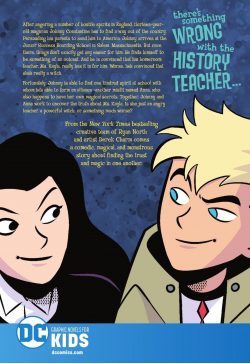
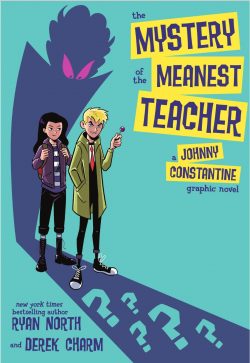
The Mystery of the Meanest Teacher – a Johnny Constantine Graphic Novel


By Ryan North, Derek Charm & various (DC Comics)
ISBN: 978-1-7795-0123-3 (TPB/Digital edition)

Win’s Christmas Gift Recommendation: Moody, Mirthful and Magical… 8/10

In recent years DC has opened up its shared superhero universe: generating Original Graphic Novels featuring its stars in stand-alone adventures for the demographic inappropriately dubbed Young Adult. To date, results have been rather hit or miss, but when they’re good, they are very good indeed. An ideal example is this cheery chiller reinterpreting the formative years of DC’s magical bad boy: particularly concentrating on his early relationship with things that go bump in the night…

You’ve either heard of John Constantine by now or you haven’t, so I’ll be brief. Created in 1985 by Alan Moore, Steve Bissette, Rick Veitch & John Totleben during a groundbreaking run on Swamp Thing, the unlikeliest of heroes is a mercurial modern mage, a dissolute chancer and self-appointed mystic fixer who plays like an addict with magic – on his own terms for his own ends.

He is not a good guy. He is not a nice person, but all too often, he’s all there is between us and the void…

Winning his own series by clamorous popular demand, Constantine’s own series Hellblazer premiered in 1988, during the dying days of Reaganite Atrocity in the US but at the height of Thatcherite Barbarism in England. We’re pretty much singing the same songs now as back then but – with 5th rate Britain’s Got Talent cover-artist wannabes as our revolving-door leaders – that’s something little Johnny will surely get around to sorting if he gets another outing…

In 1988, creative arts and Liberal attitudes were dirty words in many quarters and the readership of Vertigo was pretty easy to profile. The long-running series started with relatively safe horror plots, introducing us to Constantine’s unpleasant nature, chequered history and odd acquaintances. Even then, discriminating fans were aware of a joyously anti-establishment political line, rebellious nature and wildly metaphorical underpinnings. Racism, Darwinian politics, gender fluidity, plague, famine, gruesome supernature and more were everywhere in the dark dystopian purview of John Constantine – a world of bleeding-edge mysticism, Cyber-shamanism and political soul-stealing.

Relax. That is not the Constantine you’re looking at here…

Courtesy of writer Ryan North (Dinosaur Comics, Adventure Time, Slaughterhouse-Five, Power Pack, Machine of Death, Unbeatable Squirrel Girl, How to Invent Everything, Star Trek – Lower Decks) and illustrator Derek Charm (Jughead, Unbeatable Squirrel Girl, Uncle Scrooge, Jughead’s Time Police, Star Wars Adventures) – assisted by letterer Wes Abbott – we’re meeting a wily wizard in waiting: someone apparently without conscience or impulse control who bears more than a passing resemblance to juvenile parental burden Dennis the Menace – but more the malign mischief maker from The Beano than Hank Ketchum’s wayward waif…

It begins in London where a cocky kid pops into a sweetshop. Unfortunately, Archibald Junior’s Discount Confections is no ordinary purveyor of tasty treats, but then again, Johnny Constantine is no ordinary kid…

Behind a cheesy façade of fragrant gleaming bottles, jars and bags, this exotic emporium has a back room where ghosts, demons and world-devouring cosmic entities can also snatch a little snacky something. It just another eldritch secret that Johnny – who calls himself “Kid Constantine” – somehow knows. The boy has an astounding affinity for magic and has even befriended a few lesser devils, but he also has a weakness for Archibald’s magic chocolates.

Sadly, this latest shoplifting lark endangers all of Earth and, haunted by angry ghosts, the Kid has to take refuge with a pack of low-grade demons.

He’s been casually manipulating his parents for a while now, and fooling himself that he’s a wicked cool Jack the Lad, but he learns a few hard truths as he even wears out his welcome with the unholy monsters, and immediately opts to try boarding school to evade further repercussions. Best of all, the place is in America…

It’s pretty far away, but Johnny doesn’t mind. He’s always been better off alone. Just look what happened to the last friend he foolishly shared his magical gifts with…

With terrifying ease, the unaccompanied boy rocks up at The Junior Success Boarding School in Massachusetts, but his charm and roguish manner can’t help him adjust, settle in or make any friends on campus. In fact, he’s actually starting to feel a bit lonely… until a bit of lazy, labour-saving magic is spotted by fellow sixth grade outsider Anna.

The Kid is just starting to think he might have made a mistake coming to America when she comes clean and confesses that she too can make little miracles…

Our gobsmacked loner thinks long and hard before letting his guard down, but soon they are friends and co-conspirators, playing pranks and testing their limits. It seems the best of all worlds until their homeroom teacher Ms. Kayla starts behaving strangely…

Formerly the nicest adult in school, she abruptly changes, spitefully singling out Johnny and Anna for special attention and cruel psychological bullying. Before long, the supernatural students are using their gifts to learn what caused the transformation, but discover it’s far worse than they could ever have imagined…

Facing a deadly existential supernatural threat, Kid Constantine does what he always does and runs away, deserting Anna and the school, but everything changes when he hits the forests surrounding the institution and meets a potentially life-changing ally in the huge form of a witch-hunting demon called Etrigan

Chastened and emboldened, the Kid makes a decision that will change his life: returning to school, joining Anna and the Demon in ending a monstrous menace more terrible than anyone could have imagined…

Rowdy, rousing and riotous – and sublimely stuffed with twists, shocks and enticing snippets of DC lore – the battle against unforgiving evil culminates in a clever piece of misdirection and some stellar sleight of hand as valiant Anna and duty-driven Etrigan see their bad boy come good and save everything…

This tale is done in one but the book also offers a lengthy excerpt from Jeffrey Brown’s Batman and Robin and Howard that is also worth some of your time and attention…

Bold, beguiling, brilliantly entertaining and deliciously uplifting, The Mystery of the Meanest Teacher is a magical rite of passage and smartly funny adventure with a twist to charm and thrill full-on fans and nervous neophytes alike: one introducing a new wondrous world with a rousing reminder that there is magic everywhere.
© 2020 DC Comics. All Rights Reserved.