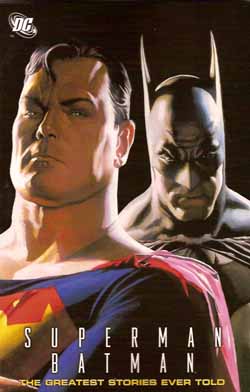
Superman/Batman: Greatest Stories Ever Told

Superman/Batman: Greatest Stories Ever Told 

By various

(DC Comics)  ISBN 1-84576-433-1

This most inevitable of hero pairings first occurred on the Superman radio show in the 1940s, but for picture purposes that event happened in the pages of Superman’s own bi-monthly comic (issue #76, May/June 1952). Pulp science fiction writer Edmond Hamilton had the task of revealing how the Man of Steel and the Caped Crusader first met and accidentally discovered each other’s identities whilst sharing a cabin on an over-booked cruise liner. Although an average crime-stopper yarn in itself, it was the start of a phenomenon. The art for The Mightiest Team in the World was by the superb Curt Swan, with inking by John Fischetti.

As comic book page counts dwindled, World’s Finest Comics, which had featured solo adventures of the heroes, simply combined the two in one story per issue. Many were illustrated by the legendary and unique Dick Sprang. One particularly fine example is Superman and Batman’s Greatest Foes from World’s Finest Comics #88 (1957), with Hamilton again scripting and Stan Kaye inking a team-up of Lex Luthor and the Joker. The Composite Superman (WFC #142, 1964) and the The Cape and Cowl Crooks (WFC #159, 1966) both came courtesy of Hamilton, Swan and George Klein, and dealt with foes with far mightier powers than our heroes – a major concern for young readers of the times. To this day whenever fans gather the cry eventually echoes out, “Who’s stronger/faster/better dressed…?”

1968 brought radical changes to DC, and edgier stories of the Boy Scout heroes began to appear. From World’s Finest Comics #176, comes The Superman-Batman Split by Cary Bates and the iconoclastic Neal Adams. Ostensibly just another alien mystery story, this twisty little gem has a surprise ending for all and a guest stars Supergirl and Batgirl.

A Matter of Light and Death (WFC #207, 1971) is a fine action-mystery romp by Len Wein, Dick Dillin and Joe Giella, and the last of this volume’s tales to feature the long-standing partnership in its traditional form. After the Crisis on Infinite Earths series rewrote the DC universe in 1985, everything was shaken up and the retooling of Superman by John Byrne the following year in the Man of Steel miniseries re-examined all the Caped Kryptonian’s close relationships in a darker, more cynical light. From the third issue comes a new first meeting with Batman in One Night in Gotham City, written and drawn by Byrne, inked by Dick Giordano.

The venerated title “World’s Finest” has resurfaced a number of times since its cancellation during the 1980s. In 2000 a twelve issue maxi-series re-interpreted the growing friendship of the two characters. A Better World (Superman & Batman: World’s Finest #7) by Karl Kesel, Peter Doherty and Robert Campanella is an introspective and very human discourse of motivation and achievement from the pair. This is followed by a magnificent two-pager from Jeph Loeb and Tim Sale first seen in Superman/Batman Secret Files 2003. When Clark Met Bruce posits a road not taken with telling force and subtle wonder.

We come full circle with a retelling of The Mightiest Team in the World from Joe Kelly and a veritable army of artists (Ed McGuinness, Ryan Ottley, Sean Murphy, Carlo Barberi, Dexter Vines, Cliff Rathburn, Don Hillsman II, Bob Petracca, Andy Owens and Rodney Ramos – if you’re keeping score). Originally published in Superman/Batman Annual #1 (2006), Stop Me If You’ve Heard This One… is a retelling of that landmark tale in a thoroughly modern context, with super-villains replacing gangsters, and heavily slanted towards an audience accustomed to action/comedy movie blockbusters, which ends this volume on a very frenetic high note.

These ‘Greatest Stories’ volumes are a smart outreach idea for an industry desperately in need of new and returning consumers. If you accept the premise that everybody has read comics at some time in their life, and that new kids are being born quite a lot, then re-packaging good stories featuring characters that have ‘broken’ on the world stage can only bring new business. For us fanboy vets however, what defines ‘good’ is still a cause for debate. Good thing we’re not the target market then isn’t it?

© 1952, 1957, 1964, 1966, 1968, 1971, 1986, 2000, 2003, 2006, 2007 DC Comics.
All Rights Reserved.
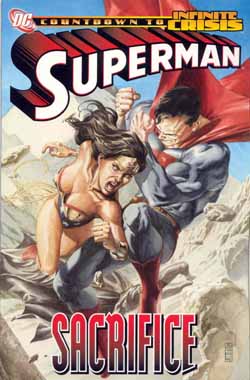
Superman: Sacrifice

Superman: Sacrifice 

By various

(DC Comics)  ISBN 1-84576-243-6

Rather humdrum conclusion to one of the major plot-lines of the Infinite Crisis event as Superman, mind-controlled by Maxwell Lord, architect of the plan to remove all super-beings from humanity, is compelled to attack his fellow heroes.

Reprinting Superman issues # 218-220, Adventures of Superman #442-443, Action Comics #829 and Wonder Woman #219-220, and featuring the efforts of nearly three dozen creators, this is still little more than a glossy but extended punch-up, culminating in what has been touted as an irreconcilable break-up between the DC Universe’s Big Three. As the volume ends – and I’m not being a spoiler by revealing this – those best of friends Superman, Batman and Wonder Woman are alienated and apart – seemingly forever. Or at least until the next times sales dictate a team-up…

© 2005 DC Comics. All Rights Reserved.

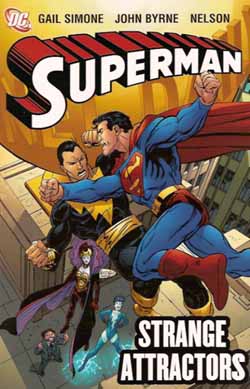
Superman: Strange Attractors

Superman: Strange Attractors 

By Gail Simone, John Byrne & Nelson

(DC Comics)  ISBN 1-84576-249-5

Here’s a Superman collection that’s tailored to the fight fan, as the mighty Man of Steel takes on a bevy of baddies in short, terse tales designed as an antidote to all those multi-chapter epics. First up is a battle against the incredibly mad Master of Magnetism, Dr Polaris, aided, if not abetted, by the Egyptian super-being Black Adam. The original run of these stories was interrupted for the “Sacrifice” storyline (collected as a Graphic Novel of the same name), so this volume reconvenes with the episode after.

Dr. Psycho is an old Wonder Woman villain, an evil, sadistic dwarf with the power to control minds. When he arrives in Metropolis intent on mischief, Superman finds that every citizen is a foe and hostage at the same time. Once again, Black Adam is on hand to render ambivalent assistance, before it all devolves into the obligatory fist fight. Devil-surrogate Lord Satanus and the Spectre use the city as a phantasmal Ground Zero next, and, after refereeing that little cataclysm, Superman finds himself the target of a psychic and spiritual assault from old JLA foe The Queen of Fables. The fun concludes in a duel with Livewire, that perky punkette with absolute control of all things electrical.

Originally published as Action Comics #827-828 and #830-835, these yarns from Gail Simone and returning veteran John Byrne more than live up to that promise. Not overly complicated, concentrating on exhilaration and excitement, but still managing to sustain some tense sub-plots involving Lois and the venerable supporting cast, these stories are just plain fun. Let’s hope the fashion experiment catches on.

© 2005, 2006 DC Comics. All Rights Reserved

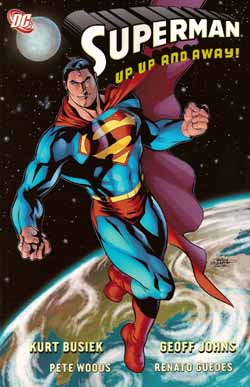
Superman: Up, Up and Away!

Superman: Up, Up and Away! 

By Kurt Busiek, Geoff Johns, Pete Woods & Renato Guedes

(DC Comics)  ISBN 1-84576-348-3

After the never-ending calamity of the DC Infinite Crisis event, the company re-set the time line of all their publications to begin one year later. This enabled them to refit their characters as they saw fit, provide a jumping on point for new converts and also gave themselves some narrative wiggle-room.

During that missing year, Superman vanished and Supergirl became the guardian of Metropolis. Clark Kent and his wife lived a normal, happy and successful life. Clark had adapted to a human scale of operation, but now that’s all about to change.

Lex Luthor is freed from prison – corporate lawyers never lose their powers – and moves to retake ‘his city’, the ex-Man of Steel still consorts with the likes of Green Lantern and Hawkgirl, but chooses to fight evil with a typewriter and a press pass. So when a plague of villains attacks, he’s helpless to resist the assault. Luckily that’s when his powers start to return, just as Luthor takes control of an ancient Kryptonian warship and moves to conquer the world. Can a gradually recovering but markedly under par Superman defeat the limitless power of the Kryptonite warship and regain his pre-eminent status as Earth’s greatest hero?

Of course he can. There’s no suspense here, and I suspect no attempt was made to create any. Everybody knows how this will end and the creators have wisely concentrated on spectacle rather than narrative. After the establishing set-ups there is a dogged trudge to the inevitable triumph and then the board is cleared for new adventures. This is not a great start for the rebooted Man of Tomorrow but it is a necessary one, although I do wonder how this story would have evolved if the movie Superman Returns had been released in a different year…

© 2006 DC Comics. All Rights Reserved

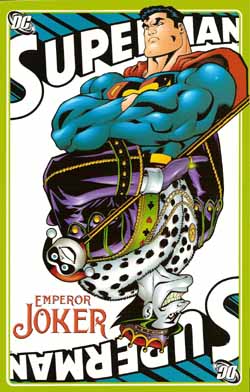
Superman: Emperor Joker

Superman: Emperor Joker 

By various

(DC Comics)  ISBN 1-84576-433-1

The night is broken with hideous screams. Every night. A black-clad superhuman smashes out of Arkham only to be subdued by the warped Superman clone called Bizarro before daybreak. Every night. A diminutive pixie of a man dashes to an appointment only to be hit by a train, or a giant weight or… In a sky that rains custard pies hangs a moon that has the Joker’s face. What is going on and when will it all end?

Although not a new plot, and despite being the product of more than two dozen creators, this tale of a time when the Joker steals the power of the Fifth dimensional Mr. Mxyzptlk and literally remakes creation in his own image just so he can torture the heroes who have so often thwarted him, actually works. Keeping up a breakneck pace and peppering the action with in-jokes and sly asides, the narrative of Superman under terminal pressure to save the universe is gripping and the eventual denouement actually works in context. This is a marvellous piece of comic eye-candy.

Although taken from a particularly grim and humourless period in recent Superman history, this thinly disguised tribute to the zany genius of Chuck Jones, Tex Avery and those wacky Warner Brothers cartoons reads like a breath of fresh air when gathered together in one collection.

Originally published in Superman #160-161, Adventures of Superman #582-583, Superman: The Man of Steel #104-105, Action Comics #769-770 and Emperor Joker #1. Written by Jeph Loeb, J.M. DeMatteis, Mark Schultz and Joe Kelly, with art by Ed McGuinness, Can Smith, Mike Miller, José Marzan Jr., Doug Mahnke, Tom Nguyen, John McCrea, Kano, Marlo Alquiza, Duncan Rouleau, Todd Nauck, Carlo Barberi, Scott McDaniel, Jaime Mendoza, Richard Bonk, and Armando Durruthy

© 2000, 2007 DC Comics. All Rights Reserved.
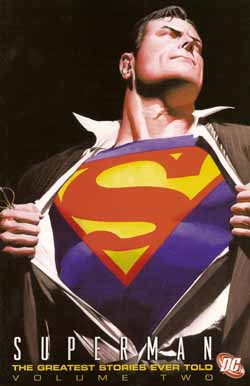
Superman: The Greatest Stories Ever Told, Vol Two

Superman: The Greatest Stories Ever Told, Vol Two 

By various

(DC Comics)  ISBN 1-84576-391-2

Here’s another collection of tales tracing the Man of Steel’s history and development, this time seemingly concentrating on character rather than physical achievement. First off is the much-reprinted, but always glorious, The Mysterious Mr. Mxyztplk (which was later Anglicised to Mxyzptlk, presumably to make it easier to spell) from Superman #30 (1944). Jerry Siegel and artist Ira Yarbrough created a cornerstone of the Superman myth with this screwball other-dimensional pixie, against whom all Superman’s strength and power are useless. From then on brains were going to be as important as brawn as they introduced frustration as the Big Guy’s first real weakness.

By the mid-1950s Superman had settled into an ordered existence. Nothing could really hurt him, nothing would ever change, and thrills seemed in short supply. With the TV show cementing the action, writers increasingly concentrated on supplying wonder instead. Superman’s Other Life by Otto Binder, Wayne Boring and Stan Kaye (Superman #132, 1959) shows what might have happened if Superman had grown up on an unexploded Krypton, courtesy of Batman and the projections of a super-computer.

Superman’s Return to Krypton (Superman #141, 1960) by Siegel, Boring and Kaye shoots successfully for Grand Tragedy as Kal-El is trapped in the past on his doomed home-world. Reconciled to dying there, he finds love with his ideal soul-mate, only to be torn from her side and returned to Earth against his will. This tale was a fan favourite for decades thereafter, and it’s truly deserving of a place in this volume, as is The Team of Luthor and Brainiac (Superman #167, 1964), a kid’s dream of an adventure by Edmond Hamilton (from a Cary Bates plot), Curt Swan and George Klein – possibly the most effective art team ever to work on the Man of Steel.

When Julie Schwartz took over the editorial duties, he decided to shake things up — with spectacular results. Superman Breaks Loose (Superman #233, 1971) by Denny O’Neil, Swan and Murphy Anderson, revitalised the Man of Tomorrow and began a period of superb stories that made him a ‘must-buy’ character all over again.

The Legend from Earth-Prime (Superman #400, 1984) is a clever little pastiche by Elliot S. Maggin and Frank Miller, and The Secret Revealed by John Byrne and Terry Austin comes from the second issue of the remodelled, Post-Crisis, Superman (1987), and reveals just how differently the new Luthor thinks and works. Following that is Life after Death (Adventures of Superman #500, 1993), by Jerry Ordway, Tom Grummett and Doug Hazlewood, the concluding episode of the infamous Death of Superman story-arc.

After a pin-up by Scott McDaniel and Andy Owens the volume concludes, symmetrically, with a recent, and absolutely hilarious, Mxyzptlk tale from Greg Rucka, Matthew Clark and Andy Lanning (Adventures of Superman #638, 2005).

Every generation has its own favourite Superman. This selection has the potential to make a fan reconsider just which one that might be. It’s probably wiser to just love them all.

© 1944, 1959, 1960, 1964, 1971, 1984, 1987, 1993, 2005 DC Comics. All Rights Reserved.
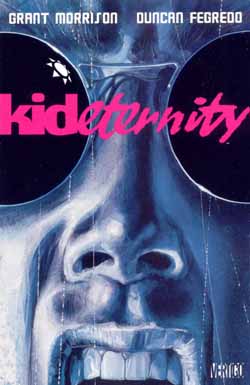
Kid Eternity

Kid Eternity

By Grant Morrison & Duncan Fegredo

(DC Comics)  ISBN 1-84576-239-8

British writer Grant Morrison’s jump to the US big time was facilitated by way of this retro-fitting of the venerable Golden-Age character first published by Quality Comics in 1942 (Hit Comics #25). In his original outing the Kid was a young boy machine-gunned by Nazis and taken to the heavenly realm of Eternity by a hapless soul collector years before his actual due date. Unable to simply return, he was given the ability to temporarily walk the Earth, along with permission to summon any person, myth or legend that has ever existed. Thus armed, and aided by the bumbling and beneficent spirit Mr. Keeper, the Kid fought crime and injustice until all the really good Golden-Age comic-books were cancelled.

Working on the tried and trusty “everything you know is wrong” principle of modern comic scripting, this revival reveals that was all a lie and sinister forces have been secretly at work all this time. Escaping from Hell, where he has been imprisoned for decades, Kid Eternity teams up with third-rate stand-up comedian Jerry Sullivan. As magical chaos and bloodletting begin to devastate the world they return to the Inferno to rescue Mr Keeper, only to discover the truth behind the Kid’s death and subsequent career, and their part in a cosmic plot to alter the nature of reality.

Full of flash and dazzle, Morrison’s own signature pantheon of multi-dimensional higher beings and visceral-magic entities and metaphysical un-realpolitik, bombast their way through this rather weak tale of revenge and deception, although the complex, full colour art of Duncan Fegredo is compelling throughout and occasionally spell-binding. This miniseries spawned a short lived revival of the character: one of the Vertigo imprint’s first forays into periodical publishing after hiving off from the regular DC Universe.

© 1991, 2006 DC Comics. All Rights Reserved.
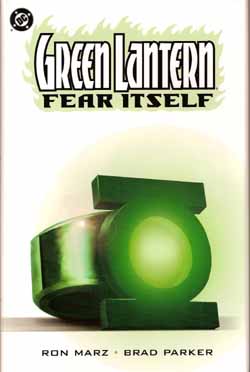
GREEN LANTERN: FEAR ITSELF

Green Lantern: Fear Itself 

By Ron Marz & Brad Parker

(DC Comics)  ISBN 1-56389-310-X

Comics has a rich history of successful character redesigns, and probably none more so than Green Lantern, whose backstory has now become the very fabric of the DC Universe. Therefore an epic tale featuring three generations of Emerald Crusader would seem like a fan’s dream come true.

At the beginning of World War II a team of Nazi occultists break in to a Washington DC museum and release a C’thulu-like monster. After a rampage where it defeats the mighty Justice Society by afflicting them with their deepest fears, only Alan Scott, the original Green Lantern, can throw off its attack and ‘destroy’ it.

During the height of the Cold War, test pilot and Green Lantern Hal Jordan thwarts a KGB attempt to retrieve the monster’s remains and inadvertently reactivates it himself. Although aided by the Justice League of America, it ultimately falls to Jordan himself to defeat the beast.

Kyle Rayner is (at this time at least) the last Green Lantern. A freelance artist and a more introspective type of hero, it’s up to him to find a final solution when the fear-monster returns for a last assault upon humanity.

This is not a particularly unique story, but the decision to use a computer-illustrator for the artwork did make it note-worthy at the time. To what degree that was a good decision is largely a matter of personal taste, but I suspect that this is a book that will only appeal to die-hard fans.

© 1999 DC Comics. All Rights Reserved.

Batman: Secrets

Batman: Secrets

By Sam Kieth

(DC Comics) ISBN 1-84576-425-0

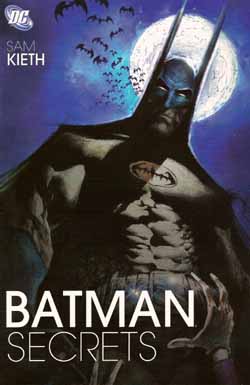
Fan favourite Sam Kieth returns to the caped crusader for an exploration of media tactics and exploitation in this dark, daft and slightly overblown psycho-drama. Somehow the Joker has convinced a parole–board to release him (and no, there’s no explanation as to how such a body can rule on someone under psychiatric detention, so just let it go) and is doing the chat show rounds, plugging his new book.

He hasn’t actually reformed though: Having seduced and enthralled the truly disturbed assistant D.A. handling his case, Joker plans more mischief — beginning with the murder of her boss. When Batman intervenes, two bystanders photograph the fight and a picture that seems to show our hero torturing the villain gets picked up by all the news services.

This is the spark for a media-storm as the jackals of the fourth estate smell a scoop. One of the news-barons, a childhood friend of Bruce Wayne (they share a bloody youthful secret), is blackmailed by the Joker to lead a witch-hunt to harass Batman whilst the mad clown fuels the media frenzy with fraud and slaughter in semi-successful attempts to frame the Dark Knight.

Batman must conquer his own secret past, save lives, and turn the tables on his manic foe’s most insidious scheme under the corrupt glare of a biased media that no longer has the will to assess or the time to judge the facts and actions it purports to report…

This is an oddly dissatisfying concoction. Kieth is a talented creator, and has some good points to make regarding the “if it bleeds, it leads, one picture is worth a thousand thoughts” mentality behind modern news-gathering. He should also be admired for attempting a slightly different style of story, but hasn’t quite pulled it off here. There are plot holes you could drive the Batmobile through, far too many manic head shots and too few backgrounds, establishing shots or even mid-, medium- and full-body long-shots. Visually, it’s as if he’s fallen for the very philosophical and aesthetic trap he decries in newsmen. Is a dramatic picture more worthy than context or narrative? You decide, obviously, but I’ll stick to style AND substance, if you don’t mind.

© 2006 DC Comics. All Rights Reserved

JLA: Crisis of Conscience

JLA: Crisis of Conscience

By Geoff Johns, Allan Heinberg, Chris Batista & Mark Farmer

(DC Comics)  ISBN 1-84576-279-7

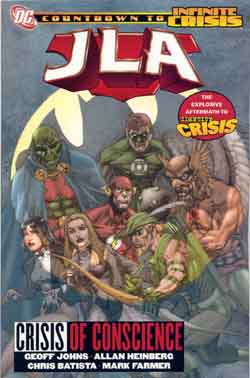
Following on from the events of Identity Crisis, which revealed that some members of the JLA used inhumane, if not illegal, mind altering methods on their defeated foes, the once heroic team was divided and in turmoil. Not only had the erring heroes monkeyed with the villains’ minds, they had also tinkered with the brains of fellow heroes who objected to the measure.

Now those guilt-racked heroes are reaping the consequences as the villains return, with restored faculties and murderous intent, seeking their own kind of justice. So do Batman and Catwoman, who now also know what was done to them. Doing the wrong thing for the right reason has all but destroyed the League, and now they face destruction for their mistake. And who hates them enough, and is powerful enough, to have restored those doctored memories in the first place?

Although convoluted and a little histrionic in places, there’s still plenty of action and intrigue for super-hero lovers to enjoy here, but casual readers might be well advised to re-read Identity Crisis first.

This story first appeared in the monthly JLA comic, issues #115-119.

© 2005, 2006 DC Comics. All Rights Reserved.