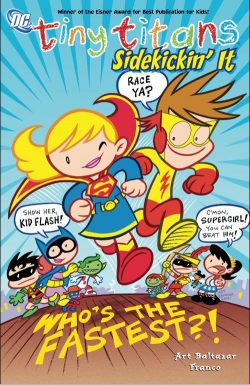
Tiny Titans volume 3: Sidekickin’ it…


By Art Baltazar & Franco with (DC Comics)
ISBN: 978-1-4012-2653-4 (TPB)

The links between animated features and comicbooks are long established and I suspect, for young consumers, indistinguishable. After all, it’s just entertainment in the end…

DC’s Cartoon Network imprint was arguably the last bastion of children’s comics in America and consolidated that link between TV and 2D fun and thrills with stunning interpretations of such television landmarks as Ben 10, Scooby Doo, Powerpuff Girls, Dexter’s Laboratory and others.

The kids’ comics line also produced some truly exceptional material based on TV iterations of their proprietary characters such as Legion of Super Heroes, Batman: Brave and the Bold, Supergirl and Krypto the Super Dog as well as material like Billy Batson and the Magic of Shazam! which was merely similar in tone and content.

Perhaps the imprint’s finest release – and one which has a created a sub-genre recreated at many different publishers – was a series ostensibly aimed at beginning readers but which quickly became a firm favourite of older fans …and a multi-award winner too.

Superbly mirroring the magical wonderland inside a child’s head where everything is happily mixed up together, Tiny Titans is a sublime antidote to continuity cops and slavish fan-boy quibbling (erm, uh… I think you’ll find that in…) by reducing the vast cast of the Teen Titans Go! animated series, the greater boutique of the mainstream comicbooks and (ultimately) the entire DC Universe to little kids and their parents/guardians in the wholesome kindergarten environment of Sidekick City Elementary School.

It’s a scenario spring-loaded with in-jokes, sight-gags and beloved yet gently mocked paraphernalia of generations of strip readers and screen-watchers….

Collecting issues #13-18 (spanning April to September 2009) of the magically madcap and infinitely addictive all-ages mini-masterpiece, this third volume begins on a petulant note with Pet Club at Wayne Manor.

Art Baltazar and co-creator Franco (Aureliani) have mastered a witty, bemusingly gentle manner of storytelling that just happily rolls along, with the assorted characters getting by and trying to make sense of the great big world, having “Adventures in Awesomeness”. The method generally involves stringing together smaller incidents and moments into an overall themed portmanteau tale and it works astoundingly well.

After a handy and as-standard identifying roll-call page, ‘Tough Cookie’ features Raven feeding the park critters but desperately striving to keep her hard-as-nails rep intact, after which bubble-headed Psimon goes to science club and gets caught in some uncool name-calling. The main event kicks off with the kids and their pets convening at Stately Wayne Manor and incurring the wrath of dapper, long-suffering manservant Alfred. The Penguins don’t help… no, wait, they actually do…

‘A Hot Spot’ then finds Raven and Kid Devil trading power sets with firestarter Hotspot and evoking the joys of being a Bird Scout, after which The Kroc Files shows ultimate butler Alfred and the roguish reptilian each demonstrating ‘How to Pick up the Dry Cleaning’, before the issue ends with a Tiny Titans Bubble Squares puzzle and a pinup of bird-themed champions Hawk, Dove and Raven.

Sea-themed issue #14 opens with a proudly shouted ‘Aw Yeah Titans!’ and class trip to Paradise Island. The boys just can’t understand why they have to stand on tables while the girls can run about freely wherever they like and play with the all the weird animals…

Back in Sidekick City, Cyborg’s vacuum cleaning invention runs amok while Beast Boy and infant Miss Martian stage a shapeshifting duel, even as on Paradise Island ‘Stay for Dinner’ sees Wonder Girl and the other Wonder Girl guests for lunch – as lunch – of Mrs. Cyclops.

Wrapping up affairs is another Kroc Files (‘How to Bake a Chocolate Cake’), a string of gags in Time for Jokes by the Riddler’s daughter Enigma plus a ‘Paradise Island Pet Club Pin-up!’

The next issue finds ‘Bunnies, Bunnies, Everywhere Bunnies’ and again opens at Wayne Manor, where Alfred has opted to stay home and watch the kids and their pets. Sadly, magician Zatara joins the fun and once more loses his magic wand to playful Beppo the Super Monkey. Cue rapid rabbit reproduction…

Elsewhere, Deathstroke‘s daughter Rose lands her share of babysitting duties, and soon learns how to handle the Tiny Terror Titans before a ‘Tiny Titans Epilogue’ reveals a marvellous secret regarding one of those proliferating bunnies, before the issue concludes with more activity freebies: ‘Pet Club Mammal Travel’ and a bonus pin-up of Rose and those Tiny Terrors…

Issue #16 revisits a perennial puzzle of comics, specifically ‘Who’s the Fastest?!’ as Coach Lobo sets his heart on making the Sidekick Elementary kids ultra-fit. Part of the regimen includes a footrace around the entire world, and Supergirl, Inertia and Kid Flash all think they have it nailed…

Lesser-powered tykes find unique ways to cope with natural obstacles – such as the ocean – in ‘As the Race Continues…’ while the Coach takes a load off with coffee and comics and the Wonder Girls and Shelly trade costume tips. Down south, late starters Mas y Menos join the final dash to the finish where a non-starter surprisingly triumphs…

In the aftermath, shrinking-hero contingent The tiny Tiny Titans indulge in ‘One more Contest’ before an ‘Aw Yeah Pin-up’ of Supergirl and Kid Flash is preceded by a Tiny Titans Coin Race activity page.

‘Raven’s Book of Magic Spells’ starts as a play date but is bewilderingly disrupted when Trigon‘s devilish daughter shows off her latest present in ‘Mixin’ it Up’: accidentally manifesting unlikely mystical heavyweight Mr. Mxyzptlk. And so, hilarity and impish insanity ensue…

Back in what passes for the land of reason, Robin, Beast Boy and Cyborg are tasked with recovering Batman’s cape and mask in ‘Battle for the Cow’ (if you read DC regularly, you know how painful a pun that is…).

Naturally, Starfire and Bumblebee have a sensible, pain-free solution to their woes, after which the Boy Wonder’s birthday party displays a fashion parade of alternative costumes in the presents giving portion of festivities…

Those tiny Titans go clothes hunting in ‘Shop Shrinking’ while Kid Flash, Robin and Cyborg ask ‘Hey, What’s Continuity?’ Wrapping up is another Kroc Files contrasting how butler Alfred and the lizardly lout cope with ‘Walking in the Rain’, topped off with Special Bonus Pin-up ‘The Return of the Bat-Cow!’

Concluding the juvenile japery is a fall from grace which can only be called ‘Infinite Detention’ as lunch lady Darkseid is demoted to Janitor for the Day and typically overreacts to boisterous behaviour in the hallways. With both good kids and bad suffering after-class incarceration, arguments ensue and the stern Monitor increase the tally for the slightest infraction. Soon the kids are facing days of detention…

Sadly for the Monitor, his nemesis Anti-Monitor has popped by with coffee and more stupid pranks…

One final Kroc Files reveals ‘How to go Bowling’ and Enigma offers another session of ‘Aw Yeah Joke Time!’ before the tome terminates with a selection of character sketches and studies repackaged as ‘Class Photos’.

Despite being ostensibly aimed at super-juniors and TV kids, these wonderful, wacky yarns – which marvellously marry the heart and spirit of such classic strips as Peanuts and The Perishers with something uniquely mired and marinated in pure comicbookery – are an unforgettable riot of laughs no self-respecting fun-fan should miss: accessible, entertaining, and wickedly intoxicating. What more do you need to know?
© 2009, 2010 DC Comics. All Rights Reserved.
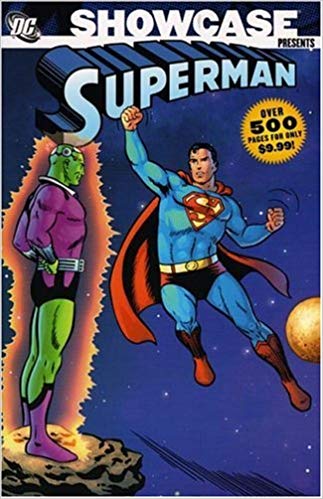
Showcase Presents Superman volume 1


By Otto Binder, Jerry Coleman, Bill Finger, Jerry Siegel, Robert Bernstein, Alvin Schwartz, Wayne Boring, Al Plastino, Curt Swan, Dick Sprang, Kurt Schaffenberger & various (DC Comics)
ISBN: 978-1-4012-0758-8

Although we all think of Jerry Siegel & Joe Shuster’s iconic creation as the epitome of comicbook creation, the truth is that very soon after his launch in Action Comics #1 he became a multimedia star and far more people have seen or heard the Man of Steel than have ever read him – and yes, that does include the globally syndicated newspaper strip.

By the time his 20th anniversary rolled around he had become a mainstay of radio, starred in a series of astounding animated cartoons – plus two movies – and just ended his first smash live-action television serial.

In his future were many more (Superboy, Lois & Clark and Smallville, Krypton et al), a stage musical, a franchise of stellar movies and an almost seamless succession of TV cartoons beginning with The New Adventures of Superman in 1966 and continuing ever since. Even Krypto got in on the small-screen act…

It’s no wonder then that the tales from this Silver Age period should be so draped in the wholesome trappings of Tinseltown – even more so than most of celebrity-obsessed America. It didn’t hurt that editor Whitney Ellsworth was a part-time screenwriter, script editor and producer as well as National DC’s Hollywood point man.

However, that’s not all there is to these gloriously engaging super-sagas culled from Action Comics #241-257 and Superman #122-133, reliving the period June 1958 to November 1959 in crisp, clean black and white in this first economical Showcase Presents collection.

I’d love to plug more modern, full-colour archival editions here, but for some reason DC’s powers-that-be have been woefully slow in gathering this material – and the equally superb all-ages Superboy stuff. I’m not getting any younger but I still eagerly wait in hope – and so should you…

In the meantime, then…

By the mid-1950s The Man of Tomorrow had settled into an ordered existence. Nothing could really hurt him, nothing would ever change, and thrills seemed in short supply. With the TV show cementing the action, writers increasingly concentrated on supplying wonder, intrigue, imagination and, whenever possible, some laughs as well.

The adventure begins here with the lead tale from Action Comics #241 and ‘The Key to Fort Superman’: a fascinating, clever puzzle-play guest-featuring Batman, written by Jerry Coleman and illustrated by Wayne Boring & Stan Kaye, wherein an impossible intruder vexes the Man of Steel in his most sacrosanct sanctuary, after which Superman #122 (July, 1958) proffers 3 yarns by veteran scripter Otto Binder, beginning with ‘The Secret of the Space Souvenirs’ (illustrated by Al Plastino) as temporary madness seems to grip the Man of Steel while he gathers artefacts for a proposed time-capsule. ‘Superman in the White House’ is a fanciful dream by Jimmy Olsen also drawn by Plastino whilst the closing Boring/Kaye bamboozler finds the hero investigating an outbreak of super-powers at a US military base in ‘The Super-Sergeant’…

That same month Binder & Plastino introduce both the greatest new villain and most expansive new character concept the series had seen in years with The Super-Duel in Space’ Action Comics #242) wherein an evil alien scientist named Brainiac tries to add Metropolis to his collection of miniaturised cities in bottles.

As well as a titanic tussle in its own right, this tale completely changed the mythology of the Man of Steel, by introducing Kandor, a city full of Kryptonians who had escaped the planet’s destruction when Brainiac abducted them. Although Superman rescues his fellow survivors, the villain escapes to strike again, and it would be years before the hero could restore the Kandorians to their true size.

Superman #123 (August 1958) featured ‘The Girl of Steel’ by Binder, Dick Sprang & Kaye which tested the potential of a distaff Supergirl as part of a 3-chapter yarn involving a magic wishing totem, which tragically segued into ‘The Lost Super-Powers’ before granting the hero’s greatest dream and facilitating ‘Superman’s Return to Krypton’.

Action #243 (Binder & Boring) sees Superman mysteriously transformed into a beast in ‘The Lady and the Lion’, after which Superman #124 provides the intriguing menace of ‘The Super-Sword’ by Coleman & Plastino, Binder & Kurt Schaffenberger’s delightful desert island drama wherein Lois Lane becomes ‘Mrs. Superman’ and Clark Kent‘s investigation of construction industry corruption which compels him to become ‘The Steeplejack of Steel’ (Binder, Boring & Kaye).

Curt Swan pencilled Binder’s ‘Super-Merman of the Sea’ (inked by Kaye) in Action #244: a canny mystery wherein the Man of Steel abandons the surface world for an alien aquatic princess, before Boring & Kaye delineate Binder’s compelling thriller ‘The Shrinking Superman!’: featuring an insidious menace from the Bottle City of Kandor…

‘Lois Lane’s Super-Dream’ (Coleman & Schaffenberger) led in Superman #125 (October/November 1958) with another potentially offensive and certainly sexist parable wherein the plucky news-hen learns a salutary lesson about powers and responsibility, whilst ‘Clark Kent’s College Days’ (illustrated by Plastino) opened an occasional series of Untold Tales of Superman: revealing just how, when and why Superboy became the Man of Tomorrow, before Boring & Kaye conclude Coleman’s hat-trick with ‘Superman’s New Power’ as the hero gained new and incomprehensible abilities with catastrophic consequences…

Action #246 featured ‘Krypton on Earth!’ (Binder, Boring & Kaye) as a trip to tourist attraction “Krypton Island” reveals a crafty criminal scam, and #247 presented ‘Superman’s Lost Parents!’ (Binder & Plastino), wherein a criminal scheme to reveal the hero’s secret identity prompts an extreme face-saving solution. Superman #126 had Binder, Boring & Kaye reveal ‘Superman’s Hunt for Clark Kent’: a thrilling tale of amnesia and deduction whilst ‘The Spell of the Shandu Clock’ (Coleman, Boring & Kaye), provides spooky chills and clever ploys to outwit a malevolent mastermind and ‘The Two Faces of Superman’ (Coleman & Schaffenberger) again saw “conniving” Lois learn an – apparently – much-needed lesson in humility.

Action #248 (January 1959) was a rare contribution from Bill Finger, illustrated by Boring & Kaye wherein the Caped Kryptonian becomes ‘The Man No Prison Could Hold!’ to topple a war criminal tyrant, before Superman #127 opened with another Untold Tale of Superman, ‘When There Was No Clark Kent!’ (Coleman, Swan & Kaye) as an accident temporarily deprives the hero of his treasured alter ego, after which Coleman, Boring & Kaye expose ‘The Make-Believe Superman’ as a depressed dad tries to impress his son with a most preposterous fib. The issue closed with the debut of another hugely popular character in ‘Titano the Super-Ape!’. The chimpanzee who is transformed into a giant ape with Kryptonite vision was one of the most memorable “foes” of the period, courtesy of Binder, Boring & Kaye’s sublime treatment combining action, pathos and drama to superb effect.

‘The Kryptonite Man!’, by Binder & Plastino in Action #249, sees Lex Luthor deliberately irradiate himself with Green K to avoid capture, but his evil genius proves no match for our hero’s sharp wits, used with equal aplomb in ‘The Eye of Metropolis!’ (Finger & Boring) as a prominent TV journalist seeks to expose Superman’s secret identity in #250.

Finger scripted the entirety of #128 as ‘Superman versus the Futuremen’ (limned by Boring & Kaye) and ‘The Secret of the Futuremen’ finds the Metropolis Marvel framed for heinous crimes and hijacked to the impossible year of 2000AD, before outwitting his abductors and returning in time to encounter ‘The Sleeping Beauty from Krypton!’ – actually Lois in another hare-brained scheme to trap her beloved into marriage, and deliciously illustrated by the unmistakable and fiendishly whimsical Kurt Schaffenberger.

‘The Oldest Man in Metropolis!’ – Robert Bernstein & Plastino – reveals how an unfortunate lab accident ages Superman many decades overnight in Action#251, whilst Superman #129 (May 1959) reveals ‘The Ghost of Lois Lane’ (Coleman, Boring & Kaye) to be anything but before Binder & Plastino’s ‘Clark Kent, Fireman of Steel!’ depicts the reporter’s aggravating and hilarious “luck” as a temporary fire-fighter. Another major debut follows before introducing the bewitching mermaid Lori Lemaris in ‘The Girl in Superman’s Past’ – a moving Untold Tale of Superman (from Finger & Boring) which again refined the Man of Steel’s intriguing early life.

From the same month, Action Comics #252 would have been significant enough merely for introducing the threat of John Corben, a criminal whose crushed skeleton is replaced by a robot body and Kryptonite heart to become ‘The Menace of Metallo!’ (Bernstein & Plastino), but a new back-up strip also began in that issue which utterly revolutionised the Man of Tomorrow’s ongoing mythology.

‘The Supergirl from Krypton!’ introduced Kal-El‘s cousin Kara Zor-El in another captivating, groundbreaking yarn by Binder & Plastino. The Maid of Might would occupy the rear of Action and alternate covers for a decade and more to come, carving her own unique legend…

Issue #253 featured ‘The War Between Superman and Jimmy Olsen!’ by Alvin Schwartz, Swan & Kaye as an alien presence gives the boy reporter super-powers and a mania to conquer the world whilst Superman #130 presented ‘The Curse of Kryptonite!’ (Binder & Plastino), wherein the Action Ace relives his past experiences with the lethal mineral; ‘The Super-Servant of Crime!’ (Bernstein, Swan & John Sikela) which finds the hero turning the tables on a petty crook who thinks he’s fooled the Man of Tomorrow, and ‘The Town That Hated Superman!’ (Binder, Boring & Kaye) which happy hamlet has outlawed the hero. He simply has to know why…

‘The Battle with Bizarro!’(Action #254, by Binder & Plastino) re-introduces an imperfect duplicate super-being who had initially appeared in a well-received Superboy story (#68, from the previous year), courtesy of Luthor’s malfunctioning duplicator ray.

Even way back then high sales trumped death and so popular was the fatally-flawed character that the tale was continued over two issues, concluding with ‘The Bride of Bizarro!’ in #255 – an almost unheard-of luxury back then. Here that bombastic, traumatic conclusion is separated by the contents of Superman #131, which firstly reintroduces a long-vanished pestiferous annoyance with ‘The Menace of Mr. Mxyzptlk!’ by Coleman & Plastino, before Lois Lane is granted a tantalising glimpse of ‘Superman’s Future Wife’ (Bernstein & Schaffenberger) and ‘The Unknown Super-Deeds’ reveals hitherto hidden connections with the Daily Planet staff long before Superboy left Smallville in another Untold Tale… from Binder & Plastino.

Action #256 seemingly unleashes ‘The Superman of the Future’ (Binder, Swan & Kaye) whilst in Superman #132 (October 1959) Batman and the projections of a super-computer show what might have happened had Superman grown up on an unexploded Krypton in the 3-chapter epic ‘Superman’s Other Life’, ‘Futuro, Super-Hero of Krypton!’ and ‘The Superman of Two Worlds!’ by Binder, Boring & Kaye.

Action #257 reveals Clark Kent as ‘The Reporter of Steel!’ after he is hit by a ray from mad scientist Luthor in a cunning yarn by Binder, Boring & Kaye, before the contents of Superman #133 brings to a close this potent premier compendium with ‘The Super-Luck of Badge 77’ (Binder & Plastino) with the reporter trying his hand as a beat cop, before we can enjoy the first new tales by co-creator Jerry Siegel in nearly a decade: ‘How Perry White Hired Clark Kent’ (art by Plastino) and the wryly light-hearted ‘Superman Joins the Army!’ illustrated by Boring & Kaye.

Superman has proven to be all things to all fans over his decades of existence and with the character seemingly undergoing almost constant radical overhaul nowadays, these timeless tales of charm and joy and wholesome wit are more necessary than ever: not just as a reminder of great memories past but also as an all-ages primer of wonders still to come…
© 1959-1963, 2005 DC Comics. All Rights Reserved.

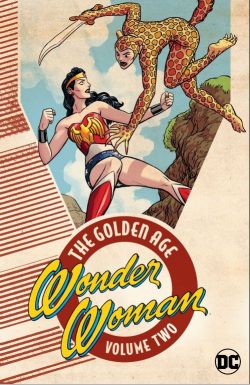
Wonder Woman: The Golden Age Volume Two


By William Moulton Marston & Harry G. Peter with Frank Godwin, Frank Harry & various (DC Comics)
ISBN: 978-1-4012-8536-4 (TPB)

Wonder Woman was conceived by polygraph pioneer William Moulton Marston and illustrated by Harry G. Peter in an attempt to offer girls a positive and forceful role model. She debuted as a special feature in All Star Comics #8 (December 1941), before springing into her own series and the cover-spot of new anthology title Sensation Comics a month later. An instant hit, the Amazing Amazon quickly won her own eponymous supplemental title in late Spring of that year (cover-dated Summer 1942).

Once upon a time on a hidden island of immortal super-women, American aviator Steve Trevor of US Army Intelligence crashed to Earth. Near death, he was nursed back to health by young and impressionable Princess Diana.

Fearing her growing obsession with the creature from a long-forgotten and madly violent world, her mother Queen Hippolyte revealed the hidden history of the Amazons: how they were seduced and betrayed by men but rescued by the goddess Aphrodite on condition that they isolated themselves from the rest of the world and devoted their eternal lives to becoming ideal, perfect creatures.

However, when goddesses Athena and Aphrodite subsequently instructed Hippolyte to send an Amazon back with the American to fight for global freedom and liberty, Diana overcame all other candidates and became their emissary – Wonder Woman.

On arriving in America, she purchased the identity and credentials of lovelorn Army nurse Diana Prince, elegantly allowing the Amazon to be close to Steve whilst enabling the heartsick medic to join her own fiancé in South America. Soon Diana also gained a position with Army Intelligence as secretary to General Darnell, ensuring she would always be able to watch over her beloved. She little suspected that, although the painfully shallow Steve only had eyes for the dazzling Amazon superwoman, the General had fallen for the mousy but superbly competent Lieutenant Prince…

Using the nom de plume Charles Moulton, Marston (with some help in later years from assistant Joye Murchison) scripted almost all of the Amazing Amazon’s many and fabulous adventures until his death in 1947, whereupon Robert Kanigher took over the writer’s role. Venerable veteran illustrator and co-creator H.G. Peter performed the same feat, limning practically every titanic tale until his own death in 1958. A couple of the very rare exceptions appear in this volume…

Spanning March to December 1943 this superb full-colour deluxe softcover compilation (also available as an eBook edition) collects her exploits from Sensation Comics #15-24, Wonder Woman #4-7 plus her adventures from anthological book of (All) Stars Comics Cavalcade #2-5…

In Sensation #15 ‘Victory at Sea’ pits Diana and Steve against murderous saboteurs set on halting military production and working with shady lawyers, whilst in #16 ‘The Masked Menace’ is one of very few stories not illustrated by H.G. Peter but the work of illustrator and strip cartoonist Frank Godwin, stepping in as the crushing workload of an extra 64-page comicbook every couple of months piled the pressure on WW’s artistic director.

The tale sees steadfast Texan Etta Candy ready to elope with slick and sleazy Euro-trash Prince Goulash, until Diana and Steve crash the wedding party to expose spies infiltrating across the Mexican border and a plot to blow up the invaluable Candy family oil-wells…

The inescapable war-fervour was tinged with incredible fantasy in Wonder Woman #4 which opened with ‘Man-Hating Madness!’, wherein a Chinese refugee from a Japanese torture camp reaches America and draws the Amazon into a terrifying scheme to use biological weapons on the American Home Front.

Cruel and misogynistic ‘Mole Men of the Underworld’ then kidnap collegiate sidekicks the Holliday Girls and Diana and reformed and recuperated former-Nazi genius Baroness Paula von Gunther rescue them, free a race of female slaves and secure America’s deepest border from further attack.

‘The Rubber Barons’ provide a rousing romp wherein greedy corporate profiteers attempt to hold the Government and war effort to ransom with a new manufacturing process in a high-tech tale involving mind-control, gender role-reversal and behaviour modification, as only a trained and passionate psychologist could promote them…

The issue concludes with an untitled saga as Paula, now fully accepted into Amazon society, is attacked by Mavis, one of her erstwhile spy-slaves. The traumatised victim then abducts her ex-mistress’ daughter little Gerta and Wonder Woman, burdened with responsibility, is compelled to hunt her down…

A famed classic from Sensation #17 follows ‘Riddle of the Talking Lion’ (also probably drawn by Godwin) wherein Diana Prince visits an ailing friend and discovers that Sally’s kids have overheard a Zoo lion speaking – and revealing strange secrets…

Although Steve and Diana dismiss the tall tale, things take a peculiar turn when the beast is stolen. The trail leads to Egypt and a plot by ambitious Nazi collaborator Princess Yasmini…

At this time National/DC was in an editorially-independent business relationship with Max Gaines that involved shared and cross promotion and distribution for the comicbooks released by his own outfit All-American Publications.

Although technically competitors if not rivals, the deal included shared logos and advertising and even combining both companies’ top characters in the groundbreaking All Star Comics as the Justice Society of America.

However, by 1942 relations between the companies were breaking down – and would culminate in 1946 with DC buying out Gaines, who used the money to start EC Comics.

All-American thus decided to create its own analogue to mammoth sized anthology World’s Finest, featuring top AA characters. The outsized result was Comics Cavalcade…

Next up following a Frank Harry cover of AA Big Three Flash, Green Lantern and our Princess, is Wonder Woman’s first offering from the second issue of that epic title: ‘Wanted by Hitler, Dead or Alive’ (Godwin art), pitting her against devious gestapo agent Fausta Grables…

Also illustrated by superbly gifted classical artist Frank Godwin, ‘The Secret City of the Incas’ from Sensation #18 sees Diana rescue a lost Inca tribe from a despotic theocracy and ancient greed.

  1. G. Peter drew the vast entirety of Wonder Woman #5 (June/July 1943), presenting an interlinked epic in the ‘Battle for Womanhood’. Here war-god Mars (who instigated the World War from his HQ on the distant red planet through his earthly pawns Hitler, Mussolini and Hirohito) returns to plague humanity directly. This time he enlists the aid of a brilliant but deformed and demented woman-hating psychologist with psychic powers. Tormented Dr. Psycho uses his talents to marry and dominate a medium named Marva, and employs her abilities to form ectoplasmic bodies as he seeks to enslave every woman on Earth.

Happily, Wonder Woman counters his divinely-sponsored schemes, after which prominent sidekicks ‘Etta Candy and her Holliday Girls’ comedically crush a burglary before ‘Mars Invades the Moon’ resumes the overarching tale as the frustrated war-god is ousted by devious deputy the Duke of Deception.

In attempting to take over the Moon – home of peace-loving goddess Diana – Mars makes the biggest error of his eternal life as the Amazing Amazon spearheads a spectacular rescue mission which results in the invaders’ utter rout.

The issue then concludes with ‘The Return of Dr. Psycho’, who escapes prison and again perpetrates a series of ghastly attacks on America’s security and the freedom of women everywhere… until the Holliday Girls and their demi-divine mentor stepped in…

Sensation #19 (Godwin again) features ‘The Unbound Amazon’ who responds to a little boy’s letter and stumbles onto big trouble in the far north woods. Of course, Diana knows little Bobby (as seen in the Adventure of the Talking Lion), and with Nazi spy Mavis on the loose, isn’t about to take any chances.

This terrific thriller is notable for the revelation that if an Amazon removes her Bracelets of Submission she turns into a raving, uncontrolled engine of sheer destruction…

Issue #20 was by H.G. Peter – who was coming to grips with the increased extra workload of the explosively popular 64-page Wonder Woman series every 3 months – and ‘The Girl with the Gun’ sees Diana Prince investigating sabotage at a munitions factory and the murder of a General at WAACs training base Camp Doe. To the Amazon’s complete surprise, the culprit seems to be Marva Psycho, but there is far more going on than at first appears…

In Comics Cavalcade #3, Diana exposes and destroys ‘The Invisible Invader’ devastating American men and munitions…

Godwin again handled the art for Sensation Comics #21 as Steve and Diana track down insidious traitor “the American Adolf” as he conducts a murderous ‘War Against Society’, whilst Wonder Woman #6 – another all-Peter extravaganza – introduces another macabrely memorable foe in ‘Wonder Woman and the Cheetah’.

Marston’s psychiatric background provided yet another deeply disturbed antagonist in the form of sugar sweet debutante Priscilla Rich who shared her own body with a jealously narcissistic, savage feline counterpart dedicated to murder and robbery. The Cheetah frames the Amazing Amazon and almost destroys Steve, Etta and the Holliday girls before Wonder Woman finally quashes her wild rampages.

It wasn’t for long: the Cheetah immediately returns to mastermind an espionage-for-profit ring in ‘The Adventure of the Beauty Club’, resulting in the Perfect Princess being captured by Japan’s High Command before spectacularly busting loose for a final confrontation in ‘The Conquest of Paradise’. Here the Feline Fury infiltrates the home of the Amazons and almost irretrievably poisons the minds of the super women sequestered there…

By this time Peter was fully adapted to his new schedule and in Sensation Comics #22 takes the psychological dramas to new heights as a cured Priscilla Rich is seemingly attacked by her manifested evil self after the Cheetah steals America’s latest weapon ‘The Secret Submarine’…

In issue #23 the creators tackle school bullying and women in the workplace as production line staff are increasingly stricken by ‘War Laugh Mania’. Only one of the problems is being promulgated by Nazi spies though…

Comics Cavalcade #4 (Fall 1943) sees Wonder Woman and the Holliday Girls capture Nazi superspy Bertha Nagle and return ‘The Purloined Pressure Coordinator’ before a resumption of straight action in Sensation #24 where ‘The Adventure of the Pilotless Plane’ sees Steve abducted by Japanese agents whilst investigating a new gas weapon which prevents US aircraft from flying. The vile villains have nothing that can stop Wonder Woman from smashing them and freeing him, however, and the status quo is fully restored by the time Wonder Woman #7 offers an optimistic view of the future in a fantastic fantasy tale…

‘The Adventure of the Life Vitamin’ depicts America in the year 3000AD: a utopian paradise ruled by a very familiar female President, where a miracle supplement has expanded longevity to such an extent that Steve, Etta and all Diana’s friends were still thriving.

Sadly, some old throwbacks still yearn for the days when women were second-class citizens subservient to males, meaning there is still work for the Amazing Amazon to do…

‘America’s Wonderland of Tomorrow’ continues the wry but wholesome sex war with Steve going undercover with the rebel forces: uncovering a startling threat in ‘The Secret Weapon’ before the focus returns to the present and a far more intimate crisis for wilful child Gerta whose mother Paula is forced to deal with a ‘Demon of the Depths’. But is that the evil octopus at the bottom of the paddling pool or her daughter’s dangerously anti-authoritarian attitudes…?

Closing out this epic compilation is one last tale from Comics Cavalcade (#5 Winter 1943) as the Amazon Avenger investigates the ‘Mystery of the Crimson Flame’ exposing a cruel cult of subjugation and terrorism led by conniving man-hating High Priestess Zara…

Too few people seem able to move beyond the supposed subtexts and incontrovertible imagery of bondage and subjugation in Marston’s tales – and frankly there really are a lot of scenes with girls tied up, chained or about to be whipped (men too) – but I just don’t care what his intentions might have been.

I’m more impressed with the skilful drama and incredible imaginative story-elements that are always wonderfully, intriguingly present: I mean, just where do such concepts as giant battle kangaroo steeds or sentient Christmas trees stem from…?

Exotic, baroque, beguiling and uniquely exciting, these Golden Age adventures of the World’s Most Famous female superhero are timeless and pivotal classics in the development of comics books and still provide lashings of fun and thrills for anyone looking for a great nostalgic read.
© 1943, 2018 DC Comics. All Rights Reserved.

Batman, Batman vs. The Penguin, Batman vs. The Joker


By Bob Kane, Bill Finger, Gardner Fox, Alvin Schwartz, Edmond Hamilton, David Vern Reed, Bill Woolfolk, Dick Sprang, Sheldon Moldoff, Lew Sayre Schwartz & various (Four Square/New English Library)
ISBNs: 1688, 1692 and 1694

The Silver Age of comicbooks utterly revolutionised the medium, bringing a modicum of sophistication to the returning genre of masked mystery men. However, for quite some time the changes instigated by Julius Schwartz in Showcase #4 (October 1956) which rippled out in the last three years of the decade to affect all of National/DC Comics’ superhero characters generally passed by Batman and Robin.

Fans buying Batman, Detective Comics, World’s Finest Comics and even Justice League of America would read adventures that in look and tone were largely unchanged from the safely anodyne fantasies that had turned the Dark Knight into a mystery-solving, alien-fighting costumed Boy Scout just as the 1940s turned into the1950s.

By the end of 1963, Schwartz having – either personally or by example – revived and revitalised much of DC’s line and the entire industry with his modernization of the Superhero, was asked to work his magic with the creatively stalled and nigh-moribund Caped Crusaders.

Bringing his usual team of top-notch creators with him, the Editor stripped down the core-concept, downplaying all the ETs, outlandish villains and daft transformation tales, bringing a cool modern take to the capture of criminals whilst overseeing a streamlining rationalisation of the art style itself. The most apparent change to us kids was a yellow circle around the Bat-symbol but, far more importantly, the stories also changed. A subtle aura of genuine menace had crept back in.

At the same time, Hollywood was preparing to produce a television series based on Batman and, through the sheer karmic insanity that permeates the universe, the producers were basing their interpretation upon the addictively daft material that the publishers were turning their Editorial backs on and not the “New Look Batman” that was enthralling the readers.

The TV show premiered on January 12th 1966 and ran for 3 seasons (120 episodes in total), airing twice weekly for its first two seasons. It was a monumental, world-wide hit and sparked a wave of trendy imitation. The resulting media hysteria and fan frenzy generated an insane amount of Bat-awareness, no end of spin-offs and merchandise – including a movie – and introduced us all to the phenomenon of overkill.

“Batmania” exploded across the world and then, as almost as quickly, became toxic and vanished.

To this day, no matter how much we might squeal and foam about it, or what has occurred since in terms of comics, games or movies, to a huge portion of this planet’s population Batman is always going to be that “Zap! Biff! Pow!” costumed buffoon…

To tap into the frenzy, American book publisher Signet/New American Library – a company well-used to producing media tie-in titles such as Girl from U.N.C.L.E. or novelisations like Breakfast at Tiffany’s – released 5 paperbacks starring Batman and Robin, beginning in March 1966.

Technically, it was 4 plus a prose adaptation of the movie that was released later in the year (and the second was in fact an all-new prose novel by Winston Lyon – AKA William Woolfolk – which I’ll be covering in a later review), so in the proper fashion of the times, British counterparts quickly followed.

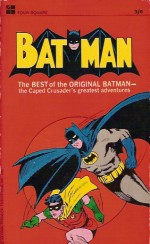
This terrific little trio of monochrome paperback pocket books – spearhead of National Periodical Publications’ on-going efforts to reach wider reading audiences – were published in 1966 to accompany the launch of the Batman TV show, and fully fuelled the “Camp” superhero craze which saw Masked Manhunters and costumed crazies sneak into every aspect of popular entertainment.

Each breathtaking tome contains 5 reformatted stories of the Dynamic Duo, culled from the archives and crafted by some of the greatest scripters and illustrators the industry has ever seen. Collected here in incontrovertible black-&-white are the tales from this trio of cartoon books which blew my unformed little mind in that most auspicious year for fun and fantasy escapism…

The first UK release was Batman which featured primarily crime stories rather than the baroque super-villain fare that informed and monopolised the television iteration. In the aforementioned mid-1950s, fancy-dress felons had all but vanished from view, and the new Schwartz Batman also eschewed costumed crazies … at least until the TV show made them stars in their own right.

The reformatted mini-masterpieces start with the positively eerie 1940 origin tale ‘The Legend of the Batman – Who He Is and How He Came to Be!’ by Gardner Fox, Bob Kane & Sheldon Moldoff from Batman #1 (Spring 1940). This piece was actually recycled from portions of Detective Comics #33 and 34 (1939) but still offers in 13 perfect panels what is effectively the best ever origin of the character.

The drama continued with ‘The Web of Doom’ (from Batman #90, March 1955, by Bill Finger, Moldoff & Charles Paris), in which a biologist loses a package of deadly germ phials somewhere in Gotham City. Batman and Robin have only days to track down 3 criminals who hold the key to restoring the savant’s shattered memories and retrieving the deadly parcel…

Batman #92, from June 1955, provided ‘Fan-Mail of Danger!’ (Finger, Moldoff & Paris) as letters to the gracious heroes pile up and the lads hired a secretary to handle the load. Sadly, Susie Smith‘s over-eager diligence almost exposes Batman’s secret identity to a cunning counterfeiter…

There was one exception in this collection to the “no loons” rule. The Joker tale ‘The Crazy Crime Clown!’ is something extra-special from Batman #74 (December 1952/January 1953, by Alvin Schwartz, Dick Sprang & Charles Paris) and sees the exotic but strictly larcenous Harlequin of Hate apparently go bonkers.

He is committed to the Gotham Institute for the Insane but, naturally, there’s method in the seeming madness which Batman only discovers after he too infiltrates the worthy asylum in disguise…

Cunning criminal mastermind Mr. Blank almost takes over the underworld by destroying a new super-computer in ‘The Crime Predictor!’ (Batman #77, June/July 1953, courtesy of Edmond Hamilton, Bob, Lew Sayre Schwartz & Paris), and it took all of the ingenuity of the World’s Greatest Detective to unravel the deadly mire of duplicity and prevent his own infallibly predicted demise…

‘The Man Who Could Change Fingerprints!’ (Batman #82, March 1954 by David Vern Reed, Sprang & Paris) is another clever scheme by brilliant killers who think to outwit the Caped Crusaders, before this initial volume closes with a thrilling suspense shocker in ‘The Testing of Batman!’ (Batman #83, April 1954) by Hamilton, Sprang & Paris.

Here a scientist’s exercise research is usurped by thugs who wanted to have fun killing the enemies of crime. At least that’s what they told the captive Gotham Gangbusters…


Six months later a second volume was released.

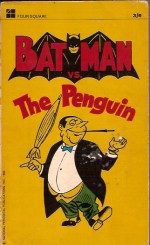
Batman vs. The Penguin followed the same beguiling format but, with flamboyant arch-foes predominating on the silver screen, the emphasis had shifted. As the title clearly shows, this compilation concentrated on cases featuring the Felonious Fowl and Bird of Ill Omen, but it also harboured a secret surprise…

The all-ages action and excitement kicked off with ‘The Parasols of Plunder’ (Batman #70 April/May 1952 by Bill Woolfolk, Kane, Sayre Schwartz & Paris) and details how, after being released from prison, The Penguin gives up his obsession with birds and starts selling umbrellas. But, oh… what deadly umbrellas…

He returned to ornithology for ‘The Golden Eggs!’ in Batman #99 (April 1956, Finger, Moldoff & Paris), as whilst on the run his hobby inspired a deadly retaliatory crime wave before Batman scrambled all his plans, whilst in ‘The Penguin’s Fabulous Fowls’ the Umbrella King turns crypto-biologist, capturing mythical avian monsters and turning them loose to devastate Gotham in a sharp suspense shocker from Batman #76 (April/May 1953 by Hamilton, Kane, Sayre Schwartz & Paris)…

His last appearance was in ‘The Return of the Penguin’ (Finger, Moldoff & Paris from Batman #155 May 1963) which sees the Bird Bandit coming out of retirement to match wits with Batman again. If only the Pompous Peacock had ignored the teasing of the other crooks when they called him a “has-been”…

This tome wraps up with a classic Catwoman yarn, as the Feline Temptress puts all the contestants of Gotham City’s “Queen for a Day” gala into catatonic trances. Moreover, suspiciously still-awake competitor Selina Kyle claims complete innocence and insists some other Catwoman was responsible for creating the ‘The Sleeping Beauties of Gotham City!’ in a taut mystery by Reed, Moldoff & Stan Kaye from Batman #84 (June 1954)…


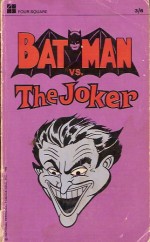
Batman vs. The Joker followed a month later with a full quintet of comicbook curios starring Batman’s ultimate nemesis. The madcap mayhem began with ‘The Challenge of The Joker’ (Batman #136, December 1960 by Finger, Moldoff & Paris) in which the Clown Prince of Crime determines to prove to the world that modern police science is no match for cunning and the 4 ancient elements…

Then ‘The Joker’s Winning Team!’ (Batman #86, September 1954 Woolfolk, Moldoff & Kaye) reveals how the baseball-inspired brigand assembles a squad of crime specialist pinch-hitters to ensure he never loses a match against the Gotham Gangbuster, after which the gloriously engaging saga of ‘The Joker’s Millions!’ (Detective Comics #180, February, 1952 by Reed, Sprang & Paris) discloses how the villain’s crime rival takes deathbed revenge by leaving the Harlequin of Hate too rich to commit capers.

It is a double-barrelled scheme though and makes the Joker twice a fool, as the Caped Crusaders find to their great amusement…

‘The Joker’s Journal’ (Detective #193, March 1953 from Reed, Kane, Sayre Schwartz & Paris) follows the theme after the penniless Punchinello leaves prison and starts a newspaper. Everyone in Gotham knows it was only a matter of time until the Mountebank of Mirth returns to his old tricks, and this final volume concludes in the only way possible as the eternal archenemies’ minds are swapped in a scientific accident. Soon a law-abiding Joker and baffled Robin have to hunt down ‘Batman – Clown of Crime!’: a rousing romp by Reed, Moldoff & Paris from Batman #85, August 1954.

As I’ve constantly averred, the comics tales themselves are always special but somehow when they appeared in proper books it always made those fantastic adventure dreams a little more substantial; and perhaps even real…

Batman has proven to be all things to all fans over his decades of existence and, with the character undergoing almost perpetual overhaul these days, the peerless parables of wit and bravery encapsulated here are more welcome than ever: not just as memorial to what has been but also as a reminder that once upon a time everybody could read the fabulous Tales of Gotham City…

These books are probably impossible to find today – even though entirely worth the effort – but completists can achieve miracles if they put their minds to it and frankly, whatever format or collection you happen upon, in this anniversary year, such forgotten stories of the immortal Dark(ish) Knight are part of our cultural comics heritage and must always be treasured.
© 1940, 1951, 1952, 1953, 1954, 1955, 1956, 1963, 1966 National Periodical Publications. All rights reserved.

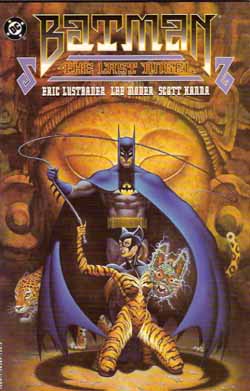
Batman: The Last Angel


By Eric Lustbader, Lee Moder, Scott Hanna & various (DC Comics)
ISBN: 978-1-56389-156-4

I generally plug things I like, or think have some genuine and measurable element of (graphic narrative) quality to them. Sometimes I’m unsure of the result but the tale is notable enough to deserve a mention. Occasionally I just think people might be interested in seeing something a wee bit different…

In this Batman anniversary year, this intriguing experiment certainly ticks those boxes.

Happy hunting, Batfans…

Great looking art from Lee Moder, but a rather disappointing tale from the acclaimed novelist. A Batman who’s much more welcome to the Gotham authorities hunts a killer, while crash victim Selina Kyle has bloody nightmares about being hunted by a jaguar…

As Catwoman she is obsessed and bored in equal measure, but with Gotham’s gangs seemingly at each other’s throats, a Mayan exhibition of the Bat God Balam is focusing everyone’s attention from where it needs to be.

…And her planned heist is just a catalyst for a repeat of the events that destroyed the Mayan Empire!

When the star attraction votive mask possesses Batman himself, Selina is forced into the uncharacteristic role of saviour…

With everybody playing a double game and such villains as Rupert Thorne and the Joker further muddying the waters – plus a frankly lame subplot about Selina’s lost father – this overly-convoluted tale tries just a little too hard to be all things to all people, but it does have great pace and, as I’ve already said, a superlative art job from the under-appreciated Lee Moder.

Silly, but fans will find a lot to enjoy here.
© 1994 DC Comics. All Rights Reserved.

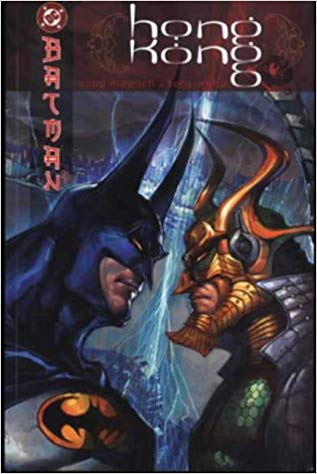
Batman: Hong Kong


By Doug Moench, & Tony Wong (DC Comics)
ISBN 978-1-4012-0057-2 (HB)                     978-1-4012-0101-2 (TPB)

This Batman outreach project is a surprisingly engaging piece of Hong Kong cinema in comic form by veteran scribe Doug Moench and the anonymous horde of illustrators used by Comics Supremo Tony Wong to churn out literally thousands of lavishly executed Kung Fu comics that have earned him the title “the Stan Lee of Hong Kong”.

The story itself is fairly unsurprising tosh. A serial killer who webcasts his murders as real-time snuff movies leads Batman to the former British colony and a civil war between a Triad leader and his brother: a cop determined to bring him to book.

Add to the mix a dashing young nephew who loves his family but thirsts for justice and you have all the elements for the next Johnny To, Kazuya Shiraishi or Park Hoon-jung blockbuster nerve-jangler.

Although a touch stiff in places and a little disorienting if you’re unused to the rapid art-style transitions of Hong Kong comics (artists and even forms of representation – paint, black line wash, crayon etc. can vary from panel to panel) this has a lot of pace and fairly rattles along. In this anniversary year, Batman: Hong Kong is still loads better and more accessible than many outings for the caped crusader of recent years and well worth the time and effort of any diehard Dark Knight aficionado in sech of a rarer flavour.
© 2004 DC Comics. All Rights Reserved.

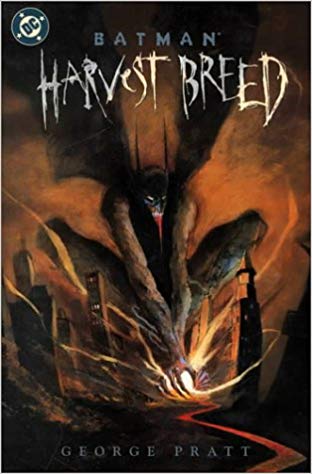
Batman: Harvest Breed


By George Pratt & various (DC Comics)
ISBN: 978-1-56389-692-7 (HC)        978-1-84023-701-6 (Titan Books UK edition HC)

Sometimes even the best of intentions and greatest of artisans don’t quite produce the best result. Master illustrator George Pratt returned tangentially to the Vietnam War for the backstory of this memorable supernatural thriller starring the Dark Knight, but the overall results fall short of his superb par, as established with the landmark Enemy Ace: War Idyll. Even so…

Bruce Wayne is tortured by bloody nightmares of devils and sacrifices as a mysterious killer seeks to re-enact a murder-ritual based on the points of a cross.

Such ritual has been attempted many times throughout history, but on this particular occasion the stakes seem much higher – and far more personal.

Only a girl named Luci Boudreaux, escapee and survivor of the Hell on Earth that was Viet Nam seems to have any answers to the dilemma…

Although painted with astounding passion and skill, and frequently offering unforgettable imagery, the story seems to have been sadly neglected and is – quite frankly – a bit of a mess, with war veterans, voodoo priests, faith-healers, demons and an uncomfortable misunderstanding of the relationship between Batman and Police Commissioner Jim Gordon muddying a rather tired old plot.

Even so, there are plenty of movie blockbusters that have got away with far less to great acclaim and for richer rewards.

If you love bleak and moody style over content, or can always find room for the blackest crannies infested by the darkest of knights, you might want to hunt this down and give it a shot.

So, even if you’re not a Bat-completist, in this anniversary year, there’s still a reason to step out of the light into forgotten realms with the world’s most popular superhero.
© 2000 DC Comics. All Rights Reserved.
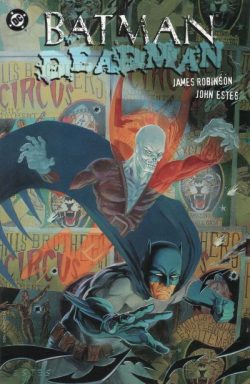
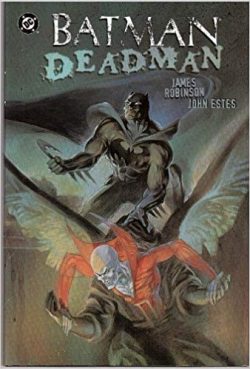
Batman/Deadman: Death and Glory


By James Robinson & John Estes (DC Comics)
ISBN: 978-1-84856-213-4 (HB)                    978-1-56389-228-8 (TPB)

Everybody thinks they know Batman but to only a select few are the secrets of assassinated trapeze artist Boston Brand also revealed. An ordinary man in a brutal, cynical world, Brand was a soul in balance until killed as part of a pointless initiation for a trainee assassin.

When the unlucky aerialist died, instead of going to whatever reward awaited him, Rama Kushna, spirit of the universe, offered him the chance to solve his own murder. That opportunity evolved into an unending mission to balance the scales between good and evil in the world. The ghost is intangible and invisible to all mortals, but has the ability to “walk into” living beings, possessing and controlling them.

Gotham City: Batman gradually regains consciousness, realising he is facing a squad of armed, trigger-happy police and holding a knife to the throat of a hostage. The scene is a nightclub-turned-charnel house and all evidence before the hero’s widened eyes indicates that he is the murderous culprit…

Suddenly clear-headed and rational, he drops his victim and escapes the SWAT teams, determined to find out what has happened since he lost consciousness. Stepping broadly out of character, Batman uses magical items taken from villainous sorcerer Felix Faust to perform an eldritch rite and snags his prime suspect, Boston Brand. Unfortunately, old comrade Deadman is not the guilty party, but does reveal that a rich man who has sold his soul to the devil is responsible for all the Dark Knight’s woes.

Meanwhile, Albert Yeats, terminally ill and imminently dying, is running for what’s left of his life, hunted by things he doesn’t know and can’t understand…

Determined to renege, Frederick Chaplin has offered another’s soul in exchange for his hellbound one, and the devil has accepted. Yeats had been chosen by the universe to reincarnate as the Messiah in his extremely imminent next life, but that can’t happen if he’s paying Chaplin’s tab in the Inferno.

Deadman has been watching over Yeats until he safely passes, but when Batman is first possessed and subsequently distracts the Ghostly Guardian with his spell, Yeats is left alone and unprotected…

Now the kid is in the wind and the heroes must find and shield him long enough to die safely: a task complicated by an entire city hunting what they still think is a murderous Bat-Maniac, whilst the real possession-killer – a phantom, satanic counterpart to Deadman called the Clown who has spread terror and death for 70 years – is loose to spread his own unholy kind of havoc…

Intriguing and pretty, but lacking much of the emotional punch of earlier Batman/Deadman pairings, Death and Glory looks great even if it feels rather dispirited and glib in its attempts to blend urban horror, all-out chase action, cod-religion and hidden histories with a millennial feel-good factor. The result is a top-rate outing for Boston Brand but a rather forced and unlikely performance from the Dark Knight.

Nevertheless, fans of both heroes will find lots to love here and Estes’ painted illustration will win the approval of most comic art lovers. This book is still available through physical and online outlets, in both paperback and hardcover editions but not yet as digital delight…
© 1996 DC Comics. All Rights Reserved.
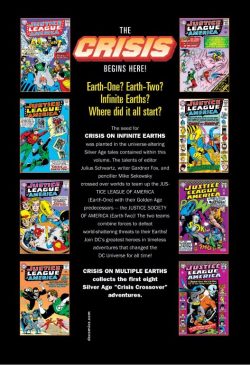
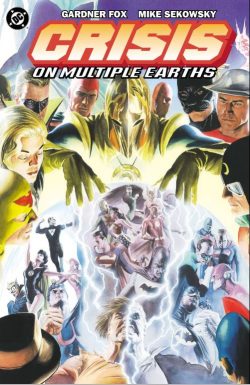
Crisis on Multiple Earths volume 1


By Gardner Fox, Mike Sekowsky, Bernard Sachs & Sid Greene (DC Comics)
ISBN: 978-1-56389-895-2

As I’ve frequently mentioned before, I was one of the “Baby Boomer” crowd which grew up with Julie Schwartz, Gardner Fox and John Broome’s tantalisingly slow reintroduction of Golden Age superheroes during the halcyon, eternally summery days of the early 1960s. To me those fascinating counterpart crusaders from Earth-Two weren’t vague and distant memories rubber-stamped by parents or older brothers – they were cool, fascinating and enigmatically new.

…And for some reason the “proper” heroes of Earth-One held them in high regard and treated them with obvious deference…

The transcendent wonderment began, naturally enough, in The Flash; pioneering trendsetter of the Silver Age Revolution. After successfully ushering in the triumphant return of the superhero concept, the Scarlet Speedster – with Fox & Broome at the writing reins – set an unbelievably high standard for costumed adventure in sharp, witty tales of science and imagination, always illustrated with captivating style and clean simplicity by Carmine Infantino.

The epochal epic that literally changed the scope of American comics forever was Fox’s ‘Flash of Two Worlds’ (Flash #123 September 1961, and reprinted in loads of places, but not here): introducing the concept of alternate Earths to the continuity and by extension the multiversal structure of the future DCU as well as all the succeeding cosmos-shaking yearly “Crisis” sagas that grew from it.

Moreover, where DC led, others followed…

Received with tumultuous acclaim, the concept was revisited months later in Flash #129 which also teasingly reintroduced evergreen stalwarts – Wonder Woman, the Atom, Hawkman, Green Lantern, Doctor Mid-Nite and Black Canary: venerable members of the fabled Justice Society of America. Clearly Editor Schwartz had something in mind…

That tale directly led into the veteran team’s first meeting with the Justice League of America and the start of an annual tradition. When ‘Flash of Two Worlds’ brought us the notion of Infinite Earths and multiple iterations of costumed crusaders, public pressure had begun almost instantly to agitate for the return of the Greats of the “Golden Age”. The Editorial powers-that-be were hesitant, fearing too many heroes would be silly and unmanageable, or worse yet, put readers off. If they could see us now…

These innovative adventures generated an avalanche of popular and critical approval (big sales figures, too) so inevitably the trans-dimensional tests led to the ultimate team-up in the summer of 1963.

This gloriously enthralling volume – available in trade paperback and digital incarnations – is the first of a glorious sequence of collections celebrating Infinite Diversity in Infinite Costumes (extra fanboy kudos if you get where I filched that from!) and re-presents the first four JLA/JSA convocations: stunning superhero wonderments which never fail to astound and delight. It also comes with context-conveying Introduction ‘1 & 2 = Crisis’ from wonder-scribe Mark Waid detailing even more cool facts behind the phenomenon…

The comic book catharsis commences with the landmark ‘Crisis on Earth-One’ and ‘Crisis on Earth-Two’ (from Justice League of America #21-22, August & September 1963) combining to form one of the most important stories in DC history and arguably one of the most crucial tales in American literature: at least the stuff with pictures in it.

Written by Fox and compellingly illustrated by Mike Sekowsky & Bernard Sachs, the yarn finds a coalition of assorted villains from each Earth plundering at will, meeting and defeating the mighty Justice League before insufferably imprisoning them in their own secret mountain HQ…

Temporarily helpless, “our” heroes contrive a desperate plan to combine forces with the champions of another Earth to save the world – both of it – and the result is pure Fights ‘n’ Tights majesty.

It’s impossible for me to be totally objective about this saga. I was a drooling kid in short trousers when I first read it and the thrills haven’t diminished with this umpty-first re-reading.

This is what superhero comics are all about!

The buying public clearly agreed and one year later ‘Crisis on Earth-Three’ and ‘The Most Dangerous Earth of All!’ (Justice League of America #29-30) reprised the team-up of the Justice League and Justice Society, when the super-beings of a third alternate Earth discover the secret of trans-universal travel.

Unfortunately, Ultraman, Owlman, Superwoman, Johnny Quick and Power Ring are villains on a world without heroes who see the costumed crime-busters of the JLA/JSA as living practise dummies to sharpen their evil skills upon.

With this cracking thriller the annual summer get-together became solidly entrenched in heroic lore, giving fans endless entertainment for years to come and making the approaching end of school holidays less gloomy than they could have been.

(A little note: although the comic cover-date in America was the month by which unsold copies had to be returned – the “off-sale” deadline – export copies to Britain travelled as ballast in freighters. Thus, they usually went on to those cool, spinning comic-racks in the actual month printed on the front. You can unglaze your eyes and return to the review proper now, and thank you for your patient indulgence of an old and misty-eyed man…)

The third annual event was a touch different; a largely forgotten and rather experimental tale wherein the educationally-challenged and extremely larcenous Johnny Thunder of Earth-1 wrests control of the genie-like Thunderbolt from his otherworld counterpart: employing its magical powers to change the events which created of all Earth-1’s superheroes.

With Earth-1 catastrophically altered in #37’s ‘Earth – Without a Justice League’, it’s suddenly up to the JSA to save the day in a gripping battle of wits and power before Reality is re-established in #38’s concluding chapter ‘Crisis on Earth-A!’.

Veteran inker Bernard Sachs retired before the fourth team-up, leaving the amazing Sid Greene to embellish the gloriously whacky saga that closes this tome: one springing out of the global “Batmania” craze engendered by the Batman television series…

A wise-cracking campy tone was fully in play, acknowledging the changing audience profile and this time the stakes are raised to encompass the destruction of both planets in ‘Crisis Between Earth-One and Earth-Two’ and ‘The Bridge Between Earths’ (Justice League of America #46-47, August & September 1966).

Here a bold – if rash – continuum warping experiment drags the twin sidereal worlds towards an inexorable hyper-space collision. Meanwhile, making matters worse, an awesome anti-matter being uses the opportunity to break into and explore our positive-matter universe whilst the heroes of both worlds are distracted by the destructive rampages of monster-men Blockbuster and Solomon Grundy.

Peppered with wisecracks and “hip” dialogue, it’s sometimes difficult to discern what a cracking yarn this actually is, but if you’re able to forgive or swallow the dated patter, this is one of the very best plotted and illustrated stories in the entire JLA/JSA canon. Furthermore, the vastly talented Greene’s expressive subtlety, beguiling textures and whimsical humour add unheard-of depth to Sekowsky’s pencils and the light and frothy comedic scripts of Fox.

These titanic tales won’t suit everybody and I’m as aware as any that in terms of the “super-powered” genre the work here can be boiled down to two bunches of heroes formulaically getting together to deal with extra-extraordinary problems. In mature hindsight, it’s obviously also about sales and the attempted revival of more sellable super characters during a period of intense commercial competition between DC Comics and Marvel.

But I don’t have to be mature in my off-hours and for those who love costumed dramas, who crave these cunningly constructed modern mythologies and actually care, this is simply a grand parade of straightforward action, great causes and momentous victories.

…And since I wouldn’t have it any other way, why should you?
© 1963, 1964, 1965, 1966, 2002 DC Comics. All Rights Reserved.
Batman: Detective #27


By Michael Uslan & Peter Snejbjerg with Lee Loughridge (DC Comics)
ISBN: 978-1401201852 (HB)                        978-1401201074 (TPB)

Oooh! Ooh! More Batman!! …Ish.

Not so long ago and for a brief while, DC’s experimental Elseworlds imprint, where familiar characters and continuity were radically or subtly re-imagined, was a regular hive of productivity and generated some wonderful – and quite a few ridiculous – stories.

Moreover, by using what the readers thought they knew as a springboard, the result, usually constricted into a disciplined single story, had a solid and resolute immediacy that was too often diluted in regular, periodical publications where the illusion of change always trumps actual innovation in long-running characters.

A fine example is this intriguing pulp mystery and generational drama blending the lineage of the Wayne family of Gotham City with covert societies and the secret history of the United States of America.

April 1865, Washington DC: President Lincoln overrides the objections of Allan Pinkerton (who had created the Secret Service to protect him) and goes to see Our American Cousin at Ford’s Theatre. His assassination prompts the infuriated security genius to create a dedicated clandestine force beyond the reach of everything but their mission and their own consciences…

April 1929, Gotham City: a doctor, his wife and their young son exit a movie theatre where they have thrilled to the exploits of Douglas Fairbanks as Zorro. Suddenly, sneak thieves confront them and in the struggle Thomas and Martha Wayne are gunned down, leaving a grieving boy kneeling over their bloody corpses. Family butler Alfred packs the coldly resolute boy off on a decade-long world tour to study with masters of criminology around the globe…

Lincoln’s murder was planned by a cabal of Confederate plotters named the Knights of the Golden Circle. Their leader, an early eugenics-inspired geneticist named Josiah Carr, outlines a Doomsday vengeance plot that will take decades to complete…

January 1st 1939: Bruce Wayne returns to Gotham ready to begin his life’s mission, but is diverted when crusading newspaperman Lee Travis reveals the existence of the Secret Society of Detectives and invites the young man to become their 27th operative since Pinkerton…

Charming and relentlessly compelling, this superbly pacy thriller follows two time-lines as the founding Detective hunts the Golden Circle through the years, enlisting the covert aid of many historical figures such as Kate Warne (America’s first female detective), journalist and President-to-be Teddy Roosevelt and biologist/monk Gregor Mendel whilst Wayne closes in on the climax of the Doomsday plot with the aid of Babe Ruth and Sigmund Freud. He even confronts customised versions of such classic Bat-foes as Catwoman, Scarecrow, Hugo Strange and the Joker.

Best of all there’s a deliciously wry cameo from the Golden Age Superman as well as a magnificent surprise ending to this two-fisted tribute to the “Thud-and-Blunder” era of the 1930s pulps…

This is a conspiracy thriller stuffed to overflowing with in-jokes, referential asides, pop culture clues and universal icons that make The Da Vinci Code and its legion of even more tedious knock-offs look like a bunch of dry words on dusty paper. The only flaw is that writer Uslan and artists Snejbjerg & Loughridge were never able to create a sequel…

And just in case you’re wondering…Detective Comics #27 (May 1939) featured the very first appearance of a certain Dark Knight…
© 2003 DC Comics. All Rights Reserved.