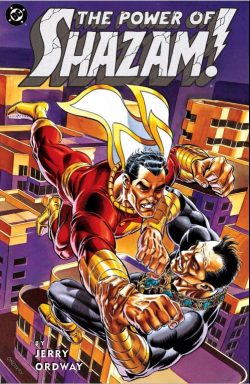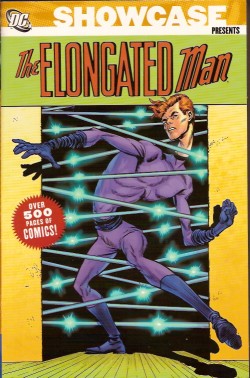
Batman and the Outsiders volume 2


By Mike W. Barr, Jim Aparo, Alan Davis, Jerome K. Moore, Alex Saviuk, Jan Duursema, Rick Hoberg, Bill Willingham, Trevor Von Eeden, Ron Randall & various (DC Comics)
ISBN: 978-1-4012-7753-6 (HC)

During the early 1980s the general trend of comics sales was yet another downturn – although team-books were holding their own – and the major publishers were less concerned with experimentation than with consolidation. Many popular titles were augmented by spin-offs, a recurring tactic in publishing troughs.

At the time the Dark Knight was the star of two and two half titles, sharing World’s Finest Comics with Superman (until its cancellation in 1986) and appearing with rotating guest-stars in The Brave and the Bold, as well as his regular lead spots in both Batman and Detective Comics. He was also a member of the Justice League of America.

In July 1983 B&B was cancelled with issue #200, but inside was a preview of a new Bat-title. One month later Batman and the Outsiders debuted…

The core premise of the new series revealed that Batman was convinced that the JLA was no longer fit for purpose; that too many problems were beyond their reach because they were hamstrung by international red tape and, by inference, too many laws.

To fix the problem he recruited a new team intended to be living weapons in his arsenal: a combination of old allies and new talent.

Markovian scientist Dr. Jace specialised in creating superpowers. When King Victor died, she used her process on Prince Brion and his sister Tara to create Earth-powered Geo-Force (and Terra). Rex (Metamorpho) Mason is a chemical freak able to turn into any element, and Jefferson (Black Lightning) Pierce is an electrically powered urban vigilante.

They were supplemented by female samurai/ninja Katana who wields a magic soul-drinking blade and an amnesiac American girl with inexplicable light-based powers answering to Halo.

The introductory stories cleverly peeled back layers of mystery shrouding all the newcomers, with plenty of plot threads laid for future development in the tried-&-tested super-team formula that had worked so well with the New X-Men and New Teen Titans.

This enticing hardback collection (also available as an eBook) resumes the daring departure of the Gotham Gangbuster, re-presenting BATO #14-23 and Batman and the Outsiders Annual #1, collectively spanning October 1984-July 1985, and also includes relevant pages from the Who’s Who Guide to the DC Universe. The entirety of the book is graced by the adroit writing of Mike W. Barr which – for the majority of the run – meshed perfectly with the understated talents of Jim Aparo; an artist who gave his all to a script. Eventually though he would move on to be replaced by a growing star of the “British Invasion”…

The action opens with the first Annual as ‘…Land Where Our Fathers Died…’ introduces a gang of ultra-patriots seeking to head the country in their own hard right direction called the Force of July in a barbed epic written by Barr and episodically illustrated by Jerome Moore, Alex Saviuk, Jan Duursema and Rick Hoberg with Aparo on inks.

Illustrated by Bill Willingham & Bill Anderson, BATO #14’s ‘Two by Two…’ and #15’s ‘Going for the Gold’ (spectacularly and moodily rendered by Trevor Von Eeden) comprise a two-part thriller set at the 1984 Olympics with raving loon and self-proclaimed god Maxie Zeus unleashing a super-powered minion on the team in an ploy to reclaim the Great Games for his own glory…

Aparo returns in #16 for the start of extended epic ‘The Truth About Halo’: as inconclusive opening ‘…Goodbye…’ sees a couple claiming to be her parents reclaim the memory-wiped child before the next two issues spotlight Metamorpho. This diverting digression takes the depleted team to the desert and back three millennia for ‘We Are Dying, Egypt… Dying’ and ‘Who Wears the Crown of Ra?’, to explore the fateful origins of the ancient antecedents of Element Man.

Seasonal Christmas tale. ‘Who’s Afraid of the Big Red “S”?’ then offers a powerful tale of date-rape and sexual bullying, which results in Geo-Force battling Superman to a standstill, after which a new year resolution details ‘The Truth About Halo: Part Two’ as grotesque gang boss Tobias Whale, debased criminal surgeon Dr. Moon and kinky assassin Syonide reveal the sordid, shocking truth about teenager Violet Harper, if not how she lost her memory and gained her powers. Powerful and haunting, the Barr/Aparo thriller drops as many bodies as secrets…

BATO #23 offers a triptych of solo tales by Barr, with Katana getting ‘The Silent Treatment’ (Jerome K. Moore) while saving priceless and extremely fragile Japanese pottery from thieves in, after which Geo-Force battles a tricked-up and amok robot shark in ‘Jaws 4… Gotham, 0!’ (limned by Von Eeden) and Black Lightning clashes with a sham radical social activist in Ron Randall’s ‘The Roar of the Ghetto-Blaster!’.

Slick stylist Alan Davis became regular artist with issue #22, as ‘The Truth About Halo: Part Three’ promised to disclose ‘What She is and How She Came to Be!’. Invading the recently wrecked and abandoned Justice League Satellite, Batman’s squad and Dr. Jace utilise its advanced technology to scan Violet and finally find what they’ve been looking for…

Sadly, that only leads to Halo being abducted and imprisoned by immortal, antediluvian light beings called Aurakles, prompting the heroes to breach the walls of reality to get her back…

With a full cover gallery, Who’s Who data pages on Black Lightning, Geo-Force, Halo and Katana and a team pin-up by Davis, this is a splendid package to appeal to dedicated Fights ‘n’ Tights fanatics. Batman and the Outsiders was always a highly readable series and is re-presented here in most accessible manner so open-minded new readers in search of quality storytelling could do lots worse than try out this near-forgotten corner of the DCU.
© 1984, 1985, 2018 DC Comics. All Rights Reserved.

Showcase Presents The Elongated Man


By Gardner Fox, John Broome, Carmine Infantino, Murphy Anderson, Irv Novick, Gil Kane, Neal Adams, Mike Sekowsky, Sid Greene & various (DC Comics)
ISBN: 978-1-4012-1042-2 (TPB)

Once upon a time, American comics editors believed readers would become jaded if characters were over-used or over-exposed and so to combat that potential danger – and for sundry other commercial and economic reasons – they developed back-up features in most of their titles. By the mid-1960s the policy was largely abandoned as resurgent superheroes sprang up everywhere and readers just couldn’t get enough…but there were still one or two memorable holdouts.

In late 1963 Julius Schwartz took editorial control of Batman and Detective Comics and finally found a place for a character who had been lying mostly fallow ever since his debut as a walk-on in the April/May 1960 Flash.

The Elongated Man was Ralph Dibny, a circus-performer who discovered an additive in soft drink Gingold which seemed to give certain people increased muscular flexibility. Intrigued, he refined the chemical until he had developed a serum which gave him the ability to stretch, bend and compress his body to an incredible degree. Then Ralph had to decide how to use his new powers…

A quirky chap with his own small but passionate band of devotes, in recent years the perennial B-lister has become a fixture of the latest Flash TV series, but his many exploits are still largely uncollected in either print or digital formats. The only archival asset is this charming, witty and very pretty compilation which gathers his debut and guest appearances from Flash issues #112, 115, 119, 124, 130, 134, and 138 (spanning April/May 1960 to August 1963) and the Stretchable Sleuth’s entire scintillating run from Detective Comics #327-371 (May 1964-January 1968).

Designed as a modern take on the classic and immensely popular Golden Age champion Plastic Man, Dibny debuted in Flash #112’s ‘The Mystery of the Elongated Man!’ as a mysterious, masked yet attention-seeking elastic do-gooder, of whom the Scarlet Speedster was nonetheless highly suspicious, in a cunningly crafted crime caper by John Broome, Carmine Infantino & Joe Giella.

Dibny returned in #115 (September 1960, inked by Murphy Anderson) when aliens attempted to conquer the Earth and the Vizier of Velocity needed ‘The Elongated Man’s Secret Weapon!’ as well as the guest-star himself to save the day.

In Flash #119 (March 1961), Flash rescued the vanished hero from ‘The Elongated Man’s Undersea Trap!’ which introduced the vivacious Sue Dibny (as a newlywed “Mrs Elongated Man”) in a stirring tale of sub-sea alien slavers by regular creative team Broome, Infantino & Giella.

The threat was again extraterrestrial with #124′s alien invasion thriller ‘Space-Boomerang Trap!’ (November 1961) which featured an uneasy alliance between the Scarlet Speedster, Elongated Man and sinister rogue Captain Boomerang who naturally couldn’t be trusted as far as you could throw him…

Ralph collaborated with Flash’s junior partner in #130 (August 1962) only just defeating the wily Weather Wizard when ‘Kid Flash Meets the Elongated Man!’ but then sprang back into action with – and against – the senior partner in Flash #134 (February 1963). Seemingly allied with Captain Cold in ‘The Man Who Mastered Absolute Zero!’ Dibny excelled in a flamboyant thriller that almost ended his budding heroic career…

Gardner Fox scripted ‘The Pied Piper’s Double Doom!’ in Flash #138 (August 1963), a mesmerising team-up which saw both Elongated Man and the Monarch of Motion enslaved by the sinister Sultan of Sound, before ingenuity and justice ultimately prevailed.

When the back-up spot opened in Detective Comics (a position held by the Martian Manhunter since 1955 and only vacated because J’onn J’onzz had been promoted to lead position in House of Mystery) Schwartz had Ralph Dibny slightly reconfigured as a flamboyant, fame-hungry, brilliantly canny globe-trotting private eye solving mysteries for the sheer fun of it.

Aided by his equally smart but thoroughly grounded wife, the short tales were patterned on classic Thin Man filmic adventures of Nick and Norah Charles, blending clever, impossible crimes with slick sleuthing, garnished with the outré heroic permutations and frantic physical antics first perfected in Jack Cole’s Plastic Man.

These complex yet uncomplicated sorties, drenched in fanciful charm and sly dry wit, began in Detective #327 (May 1964) with ‘Ten Miles to Nowhere!’ (by Fox & Infantino, who inked himself for all the early episodes). Here Ralph, who publicly unmasked to become a (regrettably minor) celebrity, discovered that someone had been stealing his car every night and bringing it back as if nothing had happened. Of course, it had to be a clever criminal plot of some sort…

A month later he solves the ‘Curious Case of the Barn-door Bandit!’ and debuts his direly distressing trademark of manically twitching his expanded nose whenever he detects “the scent of mystery in the air” after which he heads for cowboy country to unravel the ‘Puzzle of the Purple Pony!’ and play cupid for a young couple hunting a gold mine in #329.

Ralph and Sue were on an extended honeymoon tour, making him the only costumed hero without a city to protect. When they reach California, Ralph is embroiled in a ‘Desert Double-Cross!’ when hostage-taking thieves raid the home of a wealthy recluse, after which Detective #331 offered a rare full-length story in ‘Museum of Mixed-Up Men!’ (by Fox, Infantino & Joe Giella) as Batman, Robin and the Elongated Man unite against a super-scientific felon able to steal memories and reshape victims’ faces.

Returned to a solo support role in #332, the Ductile Detective discovers Sue has been replaced by an alien in ‘The Elongated Man’s Other-World Wife!’ (with Sid Greene joining as new permanent inker). Of course, nothing is as it seems…

‘The Robbery That Never Happened!’ occurred when a jewellery store customer suspiciously claims he had been given too much change, whilst ‘Battle of the Elongated Weapons!’ in #334 concentrates on a crook who adapts Ralph’s Gingold serum to affect objects, after which bombastic battle it was back to mystery-solving when EM is invited by Fairview City to round up a brazen bunch of uncatchable bandits in ‘Break Up of the Bottleneck Gang!’

While visiting Central City again, Ralph is lured to the Mirror Master‘s old lair and only barely survives ‘The House of “Flashy” Traps!’ before risking certain death in the ‘Case of the 20 Grand Pay-off!’ by replacing Sue with a look-alike – for the best possible reasons – but without her knowledge or permission…

Narrowly surviving his wife’s wrath by turning the American tour into a World cruise, Ralph then tackles the ‘Case of the Curious Compass!’ in Amsterdam, foiling a gang of diamond smugglers, before returning to America and ferreting out funny-money pushers in ‘The Counterfeit Crime-Buster!’

Globe-trotting creator John Broome returned to script ‘Mystery of the Millionaire Cowboy!’ in Detective #340 (June 1965) as Ralph and Sue stumble onto a seemingly haunted theatre and find crooks at the heart of the matter, whilst ‘The Elongated Man’s Change-of-Face!’ (Fox, Infantino & Greene) sees a desperate newsman publish fake exploits to draw the fame-fuelled hero into investigating a town under siege, and ‘The Bandits and the Baroness!’ (Broome) has the perpetually vacationing couple check in at a resort where every other guest is a Ralph Dibny, in a classy insurance scam story heavy with intrigue and tension.

A second full-length team-up with Batman filled Detective Comics #343 (September 1965, by Broome, Infantino & Giella), in ‘The Secret War of the Phantom General!’; a tense action-thriller pitting the hard-pressed heroes against a hidden army of gangsters and Nazi war criminals, determined to take over Gotham City.

Having broken Ralph’s biggest case, the happy couple head for the Continent and encounter ‘Peril in Paris!’ (Broome, Infantino & Greene) when Sue goes shopping as an ignorant monolingual American and returns a few hours later a fluent French-speaker…

‘Robberies in Reverse!’ (Fox) boasts a baffling situation as shopkeepers begin paying customers, leading Ralph to a severely skewed scientist’s accidental discovery, whilst #346’s ‘Peephole to the Future!’ (Broome) finds Elongated Man inexplicably developing the power of clairvoyance. It sadly clears up long before he can use it to tackle ‘The Man Who Hated Money!’ (Fox); a bandit who destroys every penny he steals.

‘My Wife, the Witch!’ was Greene’s last ink job for a nearly a year: a Fox thriller wherein Sue apparently gains magical powers whilst ‘The 13 O’clock Robbery!’, with Infantino again inking his own work, sees Ralph walk into a bizarre mystery and deadly booby-trapped mansion, before Hal Jordan‘s best friend seeks out the Stretchable Sleuth to solve the riddle of ‘Green Lantern’s Blackout!’ – an entrancing, action-packed team-up with a future Justice League colleague, after which ‘The Case of the Costume-made Crook!’ find Ralph ambushed by a felon using his old uniform as an implausible burglary tool.

Broome devised ‘The Counter of Monte Carlo!’ as the peripatetic Dibnys fall into a colossal espionage conspiracy at the casino and afterward become pawns of a fortune teller in ‘The Puzzling Prophecies of the Tea Leaves!’ (Fox), before Broome dazzles and delights one more time with ‘The Double-Dealing Jewel Thieves!’ wherein a museum owner finds that his imitation jewel exhibit is indeed filled with fakes…

As Fox assumed full scripting duties, Mystic Minx Zatanna guest-starred in #355’s ‘The Tantalising Troubles of the Tripod Thieves!’, as stolen magical artefacts lead Ralph into conflict with a band of violent thugs, whilst ‘Truth Behind the False Faces!’ sees Infantino bow out on a high note as Elongated Man helps a beat cop to his first big bust and solves the conundrum of a criminal wax museum.

Detective #357 (November 1966) featured ‘Tragedy of the Too-Lucky Thief!’ (by Fox, Murphy Anderson & Greene) as the Dibnys discover a gambler who hates to win but cannot lose, whilst Greene handled all the art on ‘The Faker-Takers of the Baker’s Dozen!’ wherein Sue’s latest artistic project leads to the theft of an ancient masterpiece.

Anderson soloed with Fox’s ‘Riddle of the Sleepytime Taxi!’, a compelling and glamorous tale of theft and espionage, and when Ralph and Sue hit Swinging England in Detective #360 (February 1967, Fox & Anderson) with ‘London Caper of the Rockers and Mods!’, they meet the reigning monarch and prevent warring kid-gangs from desecrating our most famous tourist traps, before heading home to ‘The Curious Clue of the Circus Crook!’ (Greene). Here Ralph visits his old Big-Top boss and stops a rash of robberies which had followed the show around the country.

Infantino found time in his increasingly busy schedule for a few more episodes, (both inked by Greene) beginning with ‘The Horse that Hunted Hoods’, a police steed with uncanny crime solving abilities, and continuing in a ‘Way-out Day in Wishbone City!’ wherein normally solid citizens – and even Sue – go temporarily insane and start a riot, after which unsung master Irv Novick stepped in to delineate the mystery of ‘The Ship That Sank Twice!’

‘The Crooks who Captured Themselves!’ (#365, by Greene) recounts how Ralph loses control of his powers before Broome & Infantino reunited one last time for ‘Robber Round-up in Kiddy City!’ as, for a change, Sue sniffs out a theme-park mystery for Ralph to solve.

Infantino finally bowed out with the superb ‘Enigma of the Elongated Evildoer!’ (written by Fox and inked by Greene) as the Debonair Detectives tackle a thief in a ski lodge who seems to possess all Ralph’s elastic abilities…

The Atom guest-starred in #368, helping battle clock-criminal Chronos in ‘The Treacherous Time-Trap!’ by Fox, Gil Kane, Greene, and iconoclastic newcomer Neal Adams illustrated the poignant puzzler ‘Legend of the Lover’s Lantern!’, after which Kane & Greene limned the intriguing all-action ‘Case of the Colorless Cash!’.

The end of the year signalled the end of an era as Fox, Mike Sekowsky & Greene finished off the Elongated Man’s expansive run with the delightfully dizzy lost-loot yarn ‘The Bellringer and the Baffling Bongs’ (#371, January 1968).

With the next issue Detective Comics became an all Bat-family title and Ralph and Sue Dibny temporarily faded from view until revived as bit players in Flash and finally recruited into the Justice League of America as semi-regulars. Their charismatic relationship and unique, genteel style have, sadly, not survived: casualties of changing comics tastes and the replacement of sophistication with angsty shouting and testosterone-fuelled sturm und drang…

Witty, bright, clever and genuinely exciting, these smart stories from a lost age are all beautiful to look at and a joy to read for any sharp kid and all joy-starved adults. This book is a shining tribute to the very best of DC’s Silver Age and a volume no fan of fun and adventure should be without. It should not, however, be the only place you can stretch out and enjoy such classic fare…
© 1960, 1961, 1962, 1964, 1965, 1966, 1967, 1968, 2006 DC Comics. All Rights Reserved.

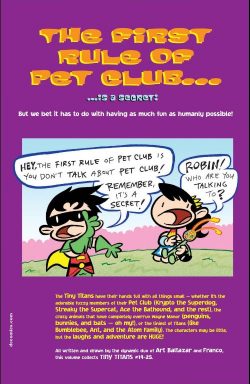
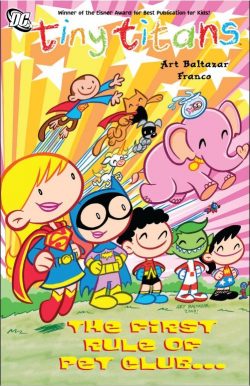
Tiny Titans: The First Rule of Pet Club…


By Art Baltazar & Franco with Geoff Johns & various (DC Comics)
ISBN: 978-1-4012-2892-7 (TPB)

DC’s Cartoon Network imprint was a potent and fun bastion of children’s comics in America and consolidated the link between TV and 2D fun and thrills with stunning interpretations of such television landmarks as Ben 10, Scooby Doo, Powerpuff Girls, Dexter’s Laboratory and others. The comics line also produced some truly exceptional material based on TV iterations of their proprietary characters such as Legion of Super Heroes, Batman: Brave and the Bold and Krypto the Super Dog as well as original material like Billy Batson and the Magic of Shazam! which was merely indistinguishable in tone and content.

Perhaps the imprint’s finest release was a series ostensibly aimed at early readers but which quickly became a firm favourite of older fans – and a multi-award winner too.

Superbly mirroring the magical wonderland inside a child’s head where everything is happily mixed up together, Tiny Titans became a sublime nostalgia-weaponised antidote to continuity cops and slavish fan-boy quibbling by reducing the vast cast of the Teen Titans animated series, the greater boutique of mainstream comicbooks and, eventually, the entire DC Universe to little kids and their parents/guardians in the wholesome kindergarten environment of Sidekick City Elementary School.

It’s a scenario spring-loaded with in-jokes, sight-gags and beloved yet gently mocked paraphernalia of generations of strip readers and screen-watchers….

Collecting issues #19-25 (spanning October 2009 – April 2010) of the magically madcap and infinitely addictive all-ages mini-masterpiece, this fourth volume begins on a romantic note with Deep in Like.

Art Baltazar and co-creator Franco (Aureliani) mastered a witty, bemusingly charming style of storytelling that just happily rolls along, with assorted characters getting by, trying to make sense of the great big world and just coincidentally having “Adventures in Awesomeness”. The method generally involves stringing together smaller incidents and moments into an overall themed portmanteau tale and it works astoundingly well.

After a handy and as-standard identifying roll-call page, ‘Imagine Me and You…’ finds scary blob Plasmus and tiny winged Bumblebee brighten up each other’s drab day, before a similar cupid moment affects the Brain and M’sieu Mallah even as diligent Robin (accompanied by faithful Bat-hound Ace) finds his earnest attempts to finish his homework disturbed by a succession of pesky young ladies including Starfire, Batgirl and Duella all caught up in a ‘Like Triangle’.

‘Dates’ sees Bumblebee and Plasmus inadvertently causing chaos during an afternoon movie monster mash – and even the ‘Intermission’ – after which a sly sight gag for us oldies highlights the company’s many Wonder Girls in ‘Jump Rope’.

The hallowed anthropoid obsession of DC is highlighted in ‘New Recruits’ when Beast Boy chairs a meeting of the Titans Ape Club before regular feature The Kroc Files depicts ultimate butler Alfred, roguish reptilian star Kroc and Plasmus each demonstrating ‘How to Enjoy a Lollipop’ in their own signature manner…

The issue closes with a word puzzle whilst the next promises to disclose The Hole Truth about Raven: beginning with a daybreak disaster at ‘Home with the Trigons’. Raven’s dad is an antlered, crimson trans-dimensional devil-lord – and a teacher at Sidekick Elementary – so when he oversleeps, his sorceress scion gets him to work on time by simply opening a few wormholes.

Of course, leaving those dimensional doors around is just asking for trouble…

Meanwhile it’s washday at Wayne Manor, but Alfred won’t let Robin, Beast Boy or Aqualad go down ‘To the Batcave’. Sadly, even the dapper domestic can’t withstand united pester-power and eventually gives in… and learns to regret it…

Following a perplexing maze game-page, the All Pet Club Issue! launches as Starfire and mean sister Blackfire write home for their beloved critters Silky and Poopu, so that they can go to the oh-so-secret social event, whilst can-do kid Cyborg actually builds himself a brace of chrome companions in ‘Pet-Tronics’…

With ‘Club Hoppin”, the entire school gathers with their uniquely compatible pets and interview some potential new members – specifically tongue-tied and thunderstruck Captain Marvel Junior and his fuzzy pal Hoppy, the Marvel Bunny. With so many members, the club then has to find roomier quarters, leading to a painful tryst for Beast Boy and Terra in ‘Meanwhile, on the Moon…’

There’s a brilliant vacuum-packed bonus pin-up of the Tiny Titans in space from Franco before Hot Dogs, Titans, & Stretchy Guys! finds the kids back on solid ground and wrapped up with the DCU’s many flexible fellows as ‘Offspring into Action’ introduces Plastic Man‘s excitably boisterous bonny boy.

In ‘Just Playing and Bouncing’ Bumblebee spends some time with the diminutive Atoms Family but loses control of their Teeny-Weeny, Super Duper Bouncy Ball and accidentally gets Plastic Man, Offspring, Elongated Man and Elastic Lad all wound up before helplessly watching it bowl over Principal Slade and Coach Lobo in ‘Coffee Dog Latte’.

Thankfully, Robin has exactly the right gimmick in his utility belt to set things straight, but can’t stay since he’s en route to his Bird Scouts meeting. Here potential new members Hot Spot and Flamebird are trying out for Hawk, Dove, Raven and Talon. Distressingly, when shiny Golden Eagle turns up, the girls want to make him the new leader…

The semi-regular ‘Epilogue’ page often supplies one more punch-line to cap each themed issue and this one leads directly into a convoluted and confounding Elastic Four pin-up/cover which in turn precedes a spookily uproarious tale of Bats, Bunnies, and Penguins in the Batcave! Oh My!...

It all begins in ‘Ice to Meet Ya!’ when Wayne Manor’s extraordinarily large penguin population get into a turf war with the house rabbits, displacing the Batcave’s regular inhabitants in ‘Driving Me Batty’. The conflict escalates in ‘All in the Batman Family’ before Robin gets a rather stern admonition from his senior partner to put things right or else…

Happily, ever-so-cute and capable Batgirl is willing to lend a hand – but (unfortunately) so too are the kids she’s baby-sitting (Tim and Jason: you’ll either get that or you won’t, bat-fans) and impishly infuriating Batmite…

With even Batcow helping out, things soon start calming down, but ‘Meanwhile, at the Titans’ Treehouse…’ not all of the fugitive Bat-bats have heard the good news…

Once your ribs have stopped hurting you can then enjoy a Tiny Titans Aw Yeah Pin-up by Franco before The All Small Issue! starts with assorted big kids accidentally drinking ‘Milk! Milk!’ from the Atoms’ fridge and shrinking away to nearly nothing.

Good thing the Atomic nippers think to call their dad, who’s with fellow dwindlers Ant, Molecule and substitute Atoms Adam and Ryan (another in-continuity howler targeting dedicated fans) for a Team Nucleus meeting…

That compressive cow-juice causes more trouble in the ‘Epilogue’ before a Blue Beetle puzzle clears the mind prior in advance of an outrageous ending in Superboy Returns! in a fairly cosmic crossover – with additional scripting by Geoff Johns.

When Conner Kent shows up, all the girls are really impressed and distracted, whilst across town Speedy is trading a lot of junk he shouldn’t be touching to Mr. Johns’ Sidekick City Pawn Shop and Bubblegum Emporium in ‘Brightest Day in the Afternoon!’

When Starfire and Stargirl then buy the seven different coloured “mood rings” from the shop, they and BFFs Duella, Batgirl, Wonder Girl, Terra and Shelly, are turned into Green, Red, Yellow, Orange, Blue, Violet and Indigo Lanterns!

Soon, the Tiny Titans are up in the air again and annoying the Guardians of the Universe and their Green Lantern Corps.

It all ends well though, first in an Emerald ‘Epilogue’ and a lavish pin-up of a passel of pistachio-painted interplanetary peace-keepers…

Available in trade paperback and digital formats and despite being ostensibly aimed at super-juniors and TV kids, these wonderful, wacky yarns – which marvellously marry the heart and spirit of such classic strips as Peanuts and The Perishers with something uniquely mired and marinated in pure comic-bookery – are deliciously hilarious tales no self-respecting fun-fan should miss: accessible, entertaining, and wickedly intoxicating. Go mellow out with some kids’ stuff, now, okay?
© 2009, 2010 DC Comics. All Rights Reserved.

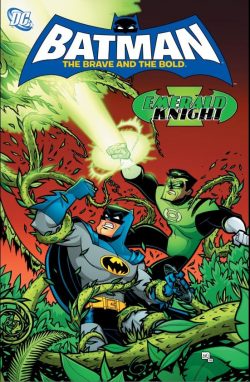
Batman: The Brave and the Bold: Emerald Knight


By Landry Q. Walker, Sholly Fisch, Adam Schlagman, Robert Pope, Eric Jones, Carlo Barberi & various (DC Comics)
ISBN: 978-1-4012-3143-9 (TPB)

The Brave and the Bold premiered in 1955 as an anthology adventure comic featuring short complete tales about a variety of period heroes: a format which mirrored that era’s filmic fascination with flamboyant if fanciful historical dramas. Devised and written by Bob Kanigher, issue #1 led with Roman epic Golden Gladiator, medieval mystery-man The Silent Knight and Joe Kubert’s now legendary Viking Prince. Soon the Gladiator was alternated with Robin Hood, but the adventure theme carried the title until the end of the decade when the burgeoning costumed character revival saw B&B transform into a try-out vehicle like Showcase.

Used to premiere concepts and characters such as Task Force X: The Suicide Squad, Cave Carson, Hawkman and Strange Sports Stories as well as the epochal Justice League of America, the comic soldiered on until issue #50 when it provided another innovative new direction which once again truly caught the public’s imagination.

That issue paired two superheroes – Green Arrow and Martian Manhunter – in a one-off team-up, and was followed by other ones: Aquaman and Hawkman in #51, WWII “Battle Stars” Sgt. Rock, Captain Cloud, Mme. Marie & the Haunted Tank in #52 and Atom & Flash in #53.

The next team-up – Robin, Aqualad and Kid Flash – quickly evolved into Teen Titans and after Metal Men/the Atom and Flash/Martian Manhunter appeared, a new hero debuted in #57-58: Metamorpho, the Element Man.

From then it was back to the increasingly popular superhero pairings with #59, and although no one realised it at the time, that particular conjunction – Batman with Green Lantern – would be particularly significant….

After a return engagement for the Teen Titans, two issues spotlighting Earth-2 champions Starman and Black Canary and Earth-1’s Wonder Woman with Supergirl, an indication of things to come came when Batman duelled hero/villain Eclipso in #64: an early acknowledgement of the brewing TV-induced mania mere months away.

Within two issues (following Flash/Doom Patrol and Metamorpho/Metal Men), B&B #67 saw the Caped Crusader take de facto control of the title and the lion’s share of the team-ups. With the late exception of #72 and 73 (Spectre/Flash and Aquaman/Atom) the comic was henceforth a place where Batman invited the rest of company’s heroic pantheon to come and play…

Decades later, the Batman Animated TV series masterminded by Bruce Timm and Paul Dini in the 1990s revolutionised the Dark Knight and subsequently led to some of the absolute best comicbook adventures in his seventy-year publishing history with the creation of the spin-off print title…

With constant funnybook iterations and tie-ins to a succession of TV cartoon series, Batman has remained popular and a sublime introducer of kids to the magical world of the printed page. One fun-filled incarnation was Batman: The Brave and the Bold, which gloriously celebrated the team up in both its all-ages small-screen and comicbook spin-off.

Shamelessly and magically plundering decades of continuity arcana in a profusion of alliances between the Dark Knight and DC’s other heroic creations, the show was supplemented by a cool kid’s periodical full of fun, verve and swashbuckling dash, cunningly crafted to appeal as much to the parents and grandparents as those fresh-faced neophyte kids…

This stellar trade paperback and digital collection re-presents issues #13, 14, 16, 18, 19 and 21 in an immensely entertaining package suitable for newcomers, fans and aficionados of all ages originally released between March and November 2010. Best of all, although not necessary to the reader’s enjoyment, a passing familiarity with the TV episodes will enhance the overall experience…

Following the format of the TV show, each tale opens with a brief vignette adventure before telling a longer tale. Issue #13 sees the Caped Crimebuster break a leg while working with Angel O’Day and Sam Simeon (the astonishingly daft but wonderful Angel & The Ape) and laid up for main feature ‘Night of the Batmen’ (by Sholly Fisch, Robert Pope & Scott McRae) as an army of (uninvited and unwelcome) heroic comrades – including Green Arrow, Plastic Man, Aquaman and Shazam!-powered Captain Marvel among others – impersonate the Dark Knight to keep Gotham safe from fiends such as Bane, Killer Croc, Penguin, Deadshot and Catwoman. However, when the Joker joins the party, it results in the real deal ending his recuperation early…

Crafted by Landry Q. Walker & Eric Jones, the next yarn opens with Bats and Plastic Man tackling the Scarecrow before the Gotham Gangbuster meets the Huntress. She is having trouble with a costumed crazy with a nasty obsession and ends up briefly ‘Captured by Mr. Camera!’…

The same creative crew return for #16 as a battle with the Teen Titans against Nocturna hatches a sinister sub-plot in ‘Egg Hunt! or: The Evil of Egg Head!’ as the ovoid mastermind revives antediluvian elder god Y’ggphu Soggoth (offering a guilty treat for old fans of truly naff supervillains) and Batman needs the aid of Wonder Woman to scramble the scheme…

Batman: The Brave and the Bold #18 alters the format slightly with a brace of linked tales from Walker & Jones. ‘Life on Mars’ features Batman and Martian Manhunter J’onn J’onzz defeating the human extermination plans of super-psionic shapeshifting White Martian Ma’alefa’ak before a strangely off-kilter Dark Knight calls in mystic master Doctor Fate to diagnose and treat a case of possession in follow-up thriller ‘All in the Mind’…

The last two yarns collected here both co-star Hal Jordan and other stalwarts of the Green Lantern Corps. From #19 and by Adam Schlagman, Carlo Barberi & Terry Beatty, ‘Emerald Knight’ details how the ring-slinger is captured by ultimate tech pirate Cyborg Superman and robotic Manhunters. Unable to prevail alone, Jordan temporarily bequeaths his power to Batman who lead his comrades in the Corps to victory, after which a brief interlude battling dinosaur gangsters beside the Lady Blackhawks leads to the Gotham Guardian and the fully-restored Jordan uniting to defeat ‘The Menace Known as Robert’. Another Walker & Jones production, this depicts the calamitous threat of a primordial alien horror invading Earth and the terrifying lengths Batman will go to save the world…

Despite being ostensibly aimed at TV-addicted kids, these mini-sagas are also wonderful, traditional comics thrillers no self-respecting fun-fan should miss: accessible, well-rendered yarns for the broadest range of excitement-seeking readers. This is a fabulously fun rollercoaster ride and confirms the now-seamless link between animated features and comicbooks. After all, it’s just adventure entertainment in the end; really unmissable entertainment…

What more do you need to know?
© 2010, 2011 DC Comics. All Rights Reserved.

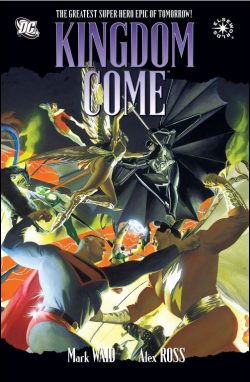
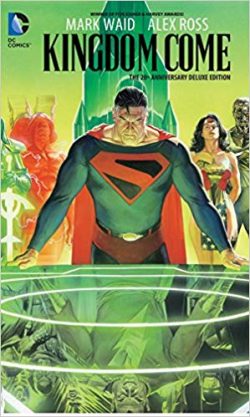
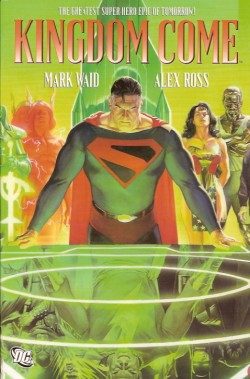
Kingdom Come


By Mark Waid & Alex Ross, with Todd Klein & various (DC Comics)
ISBN: 978-1-4012-6082-8 (20th Anniversary HB) 978-1-4012-2034-1 (TPB

In the mid-1960s a teenaged Jim Shooter wrote a couple of stories about the Legion of Super-Heroes set some years into the team’s own future. Those stories of the adult Legionnaires revealed hints of things to come that shackled the series’ plotting and continuity for decades as eager, obsessed fans (by which I mean all of us) waited for the predicted characters to be introduced, presaged relationships to be consummated and heroes to die.

By being so utterly impressive and similarly affecting, Kingdom Come accidentally repeated the trick decades later, subsequently painting the entire post Crisis on Infinite Earths DC Universe into the same creative corner until one of the company’s periodic continuity reboots…

Envisaged and designed by artist Alex Ross as DC’s answer to epic groundbreaking Marvels, Kingdom Come was originally released as a 4-issue Prestige Format miniseries in 1996 to rapturous acclaim and numerous awards and accolades. Although set in the future and an “imaginary story” released under DC’s Elseworlds imprint, it almost immediately began to affect the company’s mainstream continuity.

Set approximately twenty years into the future, the grandiose saga details a tragic failure and subsequent loss of Faith for Superman and how his attempt to redeem himself almost leads to an even greater and ultimate apocalypse.

The events are seen through the eyes and actions of Dantean witness Norman McCay, an aging cleric co-opted by Divine Agent of Wrath the Spectre after the pastor officiates at the last rites of dying superhero Wesley Dodds. As the Sandman, Dodds was cursed for decades with precognitive dreams which compelled him to act as an agent of justice.

Opening chapter ‘Strange Visitor’ reveals a world where metahumans have proliferated to ubiquitous proportions: a sub-culture of constant, violent clashes between the latest generation of costumed villains and vigilantes, all unheeding and uncaring of the collateral damage they daily inflict on the mere mortals around and in all ways beneath them.

The shaken preacher sees a final crisis coming, but feels helpless until the darkly angelic Spectre comes to him. Taken on a bewildering voyage of unfolding events, McCay is to act as the ghost’s human perspective whilst the Spirit of Vengeance prepares to pass final judgement on Humanity.

First stop is the secluded hideaway where farmer Kal-El has hidden himself since the ghastly events which compelled him to retire from the Good Fight and the eyes of the World. The Man of Steel was already feeling like a dinosaur when newer, harsher, morally ambiguous mystery-men began to appear. After the Joker murdered the entire Daily Planet staff and hard-line new hero Magog executed him in the street, the public applauded the deed. Heartbroken and appalled, Superman simply disappeared for a decade. His legendary colleagues also felt the march of unwelcome progress and similarly dropped from sight.

With Earth left to the mercies of dangerously irresponsible new vigilantes, civil unrest soon escalated. The younger heroes displayed poor judgement and no restraint, with the result that within a decade the entire planet had become a chaotic arena for metahuman duels.

Civilisation was fragmenting. Flash and Batman retreated to their home cities and made them secure, crime-free solitary fortresses. Green Lantern built an emerald castle in the sky, turning his eyes away from Earth and towards the deep black fastnesses of space. Hawkman retreated to the wilderness, Aquaman to his sub-sea kingdom whilst Wonder Woman retired to her hidden paradise. She did not leave until Armageddon came one step closer…

When Magog and his Justice Battalion battled the Parasite in St. Louis, the result was a nuclear accident which destroyed all of Kansas and much of Iowa, Missouri and Nebraska. Overnight the world faced starvation as America’s breadbasket turned into a toxic wasteland. Now with McCay and the Spectre invisibly observing, Princess Diana convinces the bereft Kal-El to return and save the world on his own terms…

In ‘Truth and Justice’ a resurgent Justice League led by Superman begins a campaign of unilateral action to clean up the mess civilisation has become: renditioning “heroes” and “villains” alike, imprisoning every dangerous element of super-humanity and telling governments how to behave, blithely unaware that they are hastening a global catastrophe of Biblical proportions as the Spectre invisibly gathers the facts for his apocalyptic judgement.

In the ensuing chaos, crippled warrior Bruce Wayne rejects Superman’s paternalistic, doctrinaire crusade and allies himself with mortal humanity’s libertarian elite – Ted (Blue Beetle) Kord, Dinah (Black Canary) Lance and Oliver (Green Arrow) Queen – to resist what can only be considered a grab for world domination by the meta-human minority. As the helpless McCay watches in horror, Wayne’s group makes its own plans; another dangerous thread in a tapestry of calamity…

At first Superman’s plans seem blessed to succeed, with many erstwhile threats flocking to his banner and his doctrinaire rules of discipline, but as ever there are self-serving villains with their own agendas. Lex Luthor organises a cabal of like-minded compatriots – Vandal Savage, Catwoman, Riddler, Kobra and Ibn Al Xu’ffasch (Son of the Demon Ra’s Al Ghul) – into a “Mankind Liberation Front”.

With Shazam-empowered Captain Marvel as their slave, this group are determined the super-freaks shall not win. Their cause is greatly advanced once Wayne’s clique joins them…

‘Up in the Sky’ sees events spiral into a deadly storm as McCay, still wracked by his visions of Armageddon, is shown the Gulag where all recalcitrant metahumans have been dumped. He also witnesses how it will fail, learns from restless spirit Deadman that the Spectre is the literal Angel of Death and watches with growing helplessness as Luthor’s plan to usurp control from the army of Superman leads to a shocking confrontation, betrayal and a deadly countdown to the End of Days…

The deadly drama culminates in a staggering battle of superpowers, last moment salvation and a second chance for humanity in a calamitous world-shaking ‘Never-Ending Battle’…

Thanks to McCay’s simple humanity, the world gets another chance and this edition follows up with an epilogue ‘One Year Later’ which end this ponderous epic on a note of renewed hope…

This edition – available as a 20th Anniversary deluxe hardback, a standard trade paperback and in digital formats – comes with an introduction by author and former DC scribe Elliot S. Maggin, assorted cover reproductions and art-pieces, an illustrated checklist of the vast cast list plus a plethora of creative notes and sketches in the ‘Apocrypha’ section, and even hints at lost glories in ‘Evolution’: notes, photos and drawings for a restored scene that never made it into the miniseries.

Epic, engaging and operatically spectacular, Kingdom Come is a milestone of the DC Universe and remains to this day a solid slice of superior superhero entertainment, worthy of your undivided attention.
© 1996, 2008, 2016 DC Comics. All Rights Reserved.

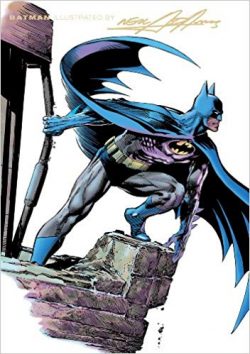
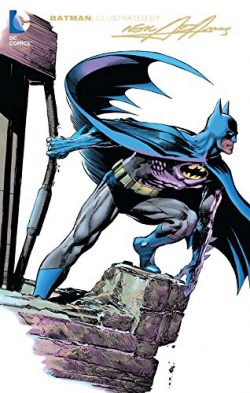
Batman: Illustrated by Neal Adams volume 3


By Neal Adams with Dennis O’Neil, Frank Robbins, Len Wein, Dick Giordano & various (DC Comics)
ISBN: 978-1-4012-4075-2 (TPB)

It’s Batman’s anniversary year. What are you reading?

As the 1960s began Neal Adams was a young illustrator who had worked in advertising and ghosted some newspaper strips whilst trying to break into comics. Whilst pursuing a career in advertising and “real art” he did a few comics pages for Archie Comics and subsequently became one of the youngest artists to co-create and illustrate major licensed newspaper strip Ben Casey (based on a popular TV medical drama series).

That comics fascination never faded, however, and Adams drifted back to National/DC, doing a few covers as inker or penciller before eventually finding himself at the vanguard of a revolution in pictorial storytelling…

He made such a mark that DC recently chose to reprint every piece of work Adams ever did for them into a series of commemorative collections. This is the last of three superb tomes (available in a variety of formats including last minute delivery eBook) starring the “Darknight Detective” as he was dubbed back then, and featuring every cover, story and issue in original publication order.

This particular package celebrates the covers and pertinent contents of Batman #232, 234-241, 243-246, 251, 255, Batman Annual #14, Batman Black & White # 4, The Brave and the Bold #99, Detective Comics #412-422, 439, 600, Heroes Against Hunger, Limited Collectors’ Edition C-25, C-51, C-59, Robin #1, Saga of Ra’s Al Ghul #4, World’s Finest Comics # 211, 244-246, 258; cumulatively embracing June 1971 to September 1996.

Following Adams’ liberally illustrated Foreword and key collaborator Denny O’Neil’s recollections describing their work process in his Introduction, the comics gold begins.

Throughout this period Adams remained one of the industry’s top cover artists, generating a stunning succession of mesmerising images on most Bat-related titles (and plenty of other comics). Those are listed here in chronological release order…

Behind a macabre eye catcher, Batman #232 (June 1971) took the hero to new heights as former kidnap victim Talia returns and we learn more of her as O’Neil & Adams – with inking as usual from Dick Giordano – introduce her father: immortal eco-terrorist Râ’s Al GhÅ«l.

A whirlwind adventure which became one of the signature highpoints of the entire Batman canon, ‘Daughter of the Demon’ is a timeless globe-girdling mystery yarn drawing the increasingly grim hero from Gotham’s concrete canyons to the Himalayas in search of hostages Robin and Talia, purportedly captured by forces inimical to both Batman and the mysterious figure who claims to be working in secret to save the world…

Ra’s was a contemporary, more acceptable visual embodiment of the classic inscrutable ultimate foreign devil (as typified in a less forgiving age as the “Yellow Peril” or Dr. Fu Manchu). This kind of alien archetype permeates popular fiction and is still an astonishingly powerful villain-symbol, although the character’s Arabian origins – neutral at the time – seem to uncomfortably embody a different kind of ethnic bogeyman in today’s post 9/11, ISIS-infested world.

The concept of a villain who has the best interests of the planet at heart is not a new one, but Ra’s Al Ghul, whose avowed intent is to reduce teeming humanity to viable levels and save the world from our poison, hit a chord in the 1970s – a period where ecological issues first came to the attention of the young. It was a rare kid who didn’t find a note of sense in what “the Demon’s Head” planned. The spectacular tale ended with a shocking pronouncement of what Ra’s intended for Gotham’s Guardian…

The chilling covers for Detective Comics #412 and 413 (this was the peak of the revival in supernatural comics, after all), leads to Batman #234 which featured the stellar return of one of the hero’s most tragic foes.

As comics became increasingly more anodyne in the 1950s, psychologically warped, physically actualised schizophrenic Two-Face was quietly retired from Batman’s roster of rogues, but with ‘Half an Evil’ (O’Neil, Adams & Giordano), he resurfaced at the forefront of grimmer, grittier stories.

When a string of bizarre and brutal robberies afflicts the city, the baffled Batman has to use all his ingenuity to discern the reasoning and discover the identity of a ruthless hidden mastermind in time to thwart a diabolical scheme…

Covers for Detective #414-417 Batman #235-236 lead into another much-reprinted classic. ‘Night of the Reaper!’ – by the usual suspect from Batman #237 – is one of the most revered tales of the era: a harrowing Halloween epic which finds Robin working with his old mentor to solve a string of barbarous killings, only to uncover a pitifully deranged perpetrator as much sinned-against as sinner…

The fronts for Detective# 418-422, The Brave and the Bold #99, Batman #238-241 and World’s Finest Comics # 211 bring us to Batman #243 (August) as the long-brewing war between Batman and Ra’s Al Ghul reaches Def Con 3: a single extended saga taken out of normal DC continuity and depicting the final confrontation between two opposing ideals.

Not included here are the non-Adams episodes from Batman #240 and 242 (although they are available in many other collections). In them, the Darknight Detective abandoned his civilian identity by faking Bruce Wayne’s death and gathered a small team of specialist allies – comprising criminal alternate-identity Matches Malone, scientific advisor Dr. Harris Blaine and Ra’s’ top assassin Ling – suborned to the side of the angels by his own superstitious code of honour and sworn to destroy the Demon forever.

O’Neil, Adams & Giordano reunited for Batman #243 which sees the team – plus latecomer Molly Post – invade the Demon’s Swiss citadel moments after their intended target dies. Nobody suspects the ageless villain’s resources include ‘The Lazarus Pit’ which can revive the dead…

The fateful finale came in #244, wherein ‘The Demon Lives Again!’ Sadly, despite all his supernal gifts and forces, Ra’s cannot escape the climactic vengeance of his implacable foe in dream-team O’Neil, Adams & Giordano’s compulsive climax. With the job done, a short addendum in #245 resolves ‘The Bruce Wayne Murder Case!’, restoring the billionaire to his rightful place in Gotham’s social whirl…

The all-Adams cover to Batman #246 (October 1972) leads to another graphic landmark. ‘The Joker’s Five-Way Revenge’ comes from Batman #251 (September 1973 by Dennis O’Neil & Neal Adams) and finally ended forever the zany, “camp” taint of the TV show by re-branding the characters and returning to the original 1930s concept of a grim and driven Dark Avenger chasing an insane avatar of pure evil.

Such a hero needs truly deadly villains and – by reinstating the psychotically unpredictable Killer Clown who scared the short pants off readers in the Golden Age – this single-issue yarn set the bar very, very high. A true milestone that utterly redefined the Joker for the modern age: the story sees the Mirthful Maniac stalking his old gang, determined to eradicate them all with the hard-pressed Gotham Guardian desperately playing catch-up. As the crooks die in all manner of Byzantine and bizarre ways, Batman realises his arch-foe has gone irrevocably off the deep end….

Terrifying and beautiful, for many fans this is the definitive Batman/Joker story, but signalled Adam’s graduation to other jobs and away from regular bat-missions. Before that departure, however, the cover to Detective #439 (February/March 1974) and one last thriller awaited.

Scripted by Len Wein and inked by Giordano, ‘Moon of the Wolf’ from Batman #255 (March/April 1974) pits the ultimate human hero against a tragic former sportsman mutated into a truly supernatural lupine killer and enslaved by old enemy Professor Milo…

From Limited Collectors’ Edition C-25 comes a pin-up before a rare example of the artist’s commercial comics work appears. Adams produced art for a series of comics adventures starring various Marvel and DC heroes – as well as screen icons such as Star Trek and Planet of the Apes – for Power Records’ line of Book and Records sets. These offered a vinyl recording of a story accompanied by a fully illustrated comic tale. The Batman offerings began with ‘Trumping the Joker’ in Stacked Cards (PR-27, 1975 and written & illustrated by Adams) was followed a year later, by PR-30 (Adams, Frank Robbins and Giordano) wherein ‘Robin Meets Man-Bat’. The all-ages tales are accompanied by a house ad for the DC stars available in Power Records’ unique packages.

Still a huge draw as a cover artist, between 1977-1996 Adams generated Bat-related frontages for World’s Finest Comics # 244-246 & 258, Limited Collectors’ Edition C-51 (a wraparound reprinting the “Bride of the Demon” saga) and C-59 (‘Batman’s Strangest Cases’), the Heroes Against Hunger benefit comic, a pin-up in Detective Comics #600, covers for Saga of Ra’s Al Ghul #4 (another wraparound), Batman Annual #14, and pin-ups for Robin #1 and Batman Black & White # 4.

The history of Batman is inescapably linked to and shaped by Neal Adams’ efforts, and captivating secrets of creation are revealed in the stunning Neal Adams Sketchbook section (featuring comic art, ads, storyboards and conceptualisations for a Batman amusement park) which closes this compelling and irresistible tome (still readily available in trade paperback and digital editions).

With the game-changing classics in this volume, Batman finally returned to the commercial and critical top flight he had enjoyed in the 1940s reviving and expanding upon his original conception as a remorseless, relentless avenger of injustice. The next few years would see the hero rise to unparalleled heights of quality so stay tuned: the very best is just around the corner… that dark, dark corner…
© 1971, 1972, 1973, 1974, 1975, 1976, 1977, 1978, 1979, 1986, 1988, 1989, 1990, 1991, 2005, 2015 DC Comics. All Rights Reserved.

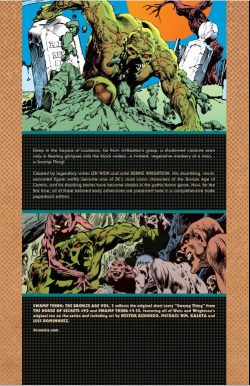
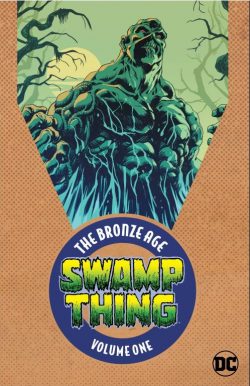
Swamp Thing: The Bronze Age Volume One


By Len Wein & Bernie Wrightson, Nestor Redondo; with Michael Wm. Kaluta & various (DC Comics)
ISBN: 978-1-4012-8440-4 (TPB)

The first fan-sensation of the modern age – now officially enshrined as the Bronze Age – of American comicbooks – Swamp Thing has powerful popular fiction antecedents and in 1972 was seemingly a concept whose time had come again. Prime evidence was the fact that Marvel were also working on a man-into-mucky, muddy mess character at the very same time.

Both Swampy and the Man-Thing were thematic revisions of Theodore Sturgeon’s classic novella It and bore strong resemblances to an immensely popular Hillman Comics character dubbed The Heap. He/it slurped through the back of Airboy Comics (née Air Fighters Comics) from1943. My fan-boy radar suspects Roy Thomas’ marsh-monster the Glob (debuting in Incredible Hulk #121 from November 1969 and promptly returning in #129, June 1970) either inspired both DC and Marvel’s creative teams, or was part of that same zeitgeist. It should also be remembered that Skywald (a very minor player with big aspirations) released a black-&-white magazine in their Warren Comics knock-off line entitled The Heap in the Autumn of 1971.

For whatever reason, by the end of the 1960s superhero comics had started another steep sales decline, once again succumbing to a genre boom and horror/mystery resurgence: a sea-change augmented by a swift rewriting of the specific terms of the Comics Code Authority. At DC, With EC veteran Joe Orlando as editor, House of Mystery and sister title House of Secrets returned to short story anthology formats and gothic mystery scenarios, taking a lead from such TV successes as Twilight Zone and Rod Serling’s Night Gallery.

Referencing the sardonic narrator/storyteller format of EC horror titles, Orlando created Cain and Abel to shepherd readers through brief, sting-in-the-tail yarns produced by the best creators, new and old, that the company could hire. Artists Neal Adams, Mike Kaluta, and especially Bernie Wrightson produced their best work for these titles, and the vast range of successors the horror boom generated at DC.

The twelfth anthology issue of the resurrected House of Secrets cemented the genre into place as the industry leader. There writer Len Wein & Wrightson produced a throwaway gothic thriller set at the turn of the 19th century, wherein gentleman scientist Alex Olsen is murdered by his best friend and his body dumped in a swamp. Years later, his beloved bride – now the unsuspecting wife of the murderer – is stalked by a shambling, disgusting beast that seems to be composed of mud and muck…

This epic trade paperback and digital compilation gathers material from House of Secrets #92, and the contents of Swamp Thing #1-13 (cumulatively covering June/July 1971 to November/December 1974) and perfectly encapsulates the changing face and taste of the times, opening here with that so-pivotal gothic vignette…

‘Swamp Thing’ cover-featured in HoS #92 (June-July 1971), and struck an immediate chord with the buying public. The issue was the best-selling DC comic of that month, and reader response was fervent and persistent.

By all accounts, the only reason there wasn’t an immediate sequel or spin-off was that the creative team didn’t want to produce one. Eventually however, bowing to interminable pressure, and with the sensible idea of transplanting the concept to contemporary America, the first issue of Swamp Thing appeared on newsstands in the Spring of 1972. It was an unqualified hit and an instant classic.

Wein and Wrightson produced ten issues together, crafting an extended, multi-chaptered tale of justice/vengeance and a quest for answers that was at once philosophically typical of the time and a prototype for the story-arc and mini-series formats that dominate today’s comics production. They also used each issue/chapter to pay tribute to a specific sub-genre of timeless horror story whilst advancing the major plot…

Here, the saga resumes with a fresh origin as ‘Dark Genesis’ finds Alec and Linda Holland deep in the Louisiana Bayou, working on a bio-restorative formula that will revolutionise global farming. Working in isolation, they are protected by Secret Service agent Matt Cable, when representatives of an organisation called the Conclave demand that they sell their research to them – or else.

Obviously, the patriotic pair refuse, and the die is cast. The lab is bombed and Linda dies instantly but Alec, showered with his own formula and blazing like a torch, hurtles to a watery grave in the swamp. He does not die…

Transformed by the formula (and remember, please, that this is prior to Alan Moore’s landmark re-imagining of the character) Holland is transformed into a gigantic man-shaped monster, immensely strong, unable to speak, and seemingly composed of living plant matter. Holland’s brain still functions however, and he vacillates between finding his wife’s killers and curing his own monstrous condition. Cable, misinterpreting the evidence, also wants revenge, but he thinks that the monster is the cause of death of his two charges…

Over the next nine issues, Swamp Thing travelled the world, encountering the darkest outbreaks of classic supernature and the insatiable greed of human monsters.

The first was black sorcerer Anton Arcane and his artificial homunculi The Un-Men (eventually the grotesque stars of their own Vertigo series), in ‘The Man Who Wanted Forever.’ The wizard transported Holland to his Balkan castle and sought to mystically trade places with the stupendous swamp beast. The temptation proved too great, but when the restored scientist realised the cost, he violently recanted…

The next issue introduced Abigail Arcane and her tragic Frankenstein-influenced father ‘The Patchwork Man’ in a classic case of monster misunderstanding, which results in her joining free agent Cable in stalking the mossy misanthrope. As Holland makes his torturous way back to the USA, hunters and hunted are waylaid and encounter a Scottish werewolf in ‘Monster on the Moors!’ before at last returning to America and finding ‘The Last of the Ravenwind Witches!’ as well as even more mob-handed human intolerance…

In the wilds of Vermont, he encounters Paradise on Earth, courtesy of an old clockmaker but when the idyll is turned into ‘A Clockwork Horror’ by the voracious Conclave, his torment is transformed into sheer rage, leading to one of the most evocative and revered team-ups of the 1970s.

Swamp Thing #7’s ‘Night of the Bat’ featured the final showdown with the remorseless robber-barons of The Conclave in their Gotham City HQ: a landmark collaboration with the resurgent Batman, himself finally recovering from the hyper-exploitation of the “Campy” TV show era.

Wrightson’s rendering of the superhero through the lens of a horror artist inspired a whole generation of aspiring comics professionals and firmly set the Caped Crusader to rest, replaced with a grim and moody Dark Knight.

Somewhat at a loss after the end of his quest (Swamp Thing came out bi-monthly, so the tale had taken well over a year to tell – unprecedented at a time when most comics still had two or more complete stories per issue), the Moss Monster shambled aimlessly through America’s hinterlands encountering a Lovecraftian horror in the New England town of Perdition. ‘The Lurker in Tunnel 13!’ After dealing with eldritch cancer god M’Naagalah, Holland (as well as Abigail and Cable) were drawn into a US military cover-up involving a marooned and benevolent alien in ‘The Stalker from Beyond!’ which benefitted from supplemental inking by Michael Kaluta before the classic run concluded with #10’s ‘The Man Who Would Not Die!’: a tale of ghostly retribution amidst the graves of unquiet plantation slaves with unliving atrocity Anton Arcane making his first of many demonic returns…

The issue was plotted by Wrightson and marked his swansong on the title: the next chapter in the Swamp Thing saga was still dictated by Wein but the miraculously gifted hands of Nestor Redondo: possible the only artist who could have matched the visual intensity of the feature’s visual originator.

Nestor Redondo was born in 1928 at Candon, Ilocas Sur in the American Territory of the Philippines. Like so many others he was influenced by US comic-strips such as Tarzan, Superman, Buck Rogers and Flash Gordon which were immensely popular in the entertainment-starved Pacific Archipelago.

Drawing from an early age Nestor emulated his brother Virgilio – who already worked as a comics artist for the cheap magazines of the young country. The Philippines became a commonwealth in 1935, and achieved full-independence from the USA in 1946, but maintained close cultural links to America.

His parents pushed him into architecture but within a year Nestor had returned to comics. A superb artist, he far outshone Virgilio – and everybody else – in the cottage industry. His brother switched to writing and the brothers teamed up to produce some of the best strips the Islands had ever seen, the most notable and best regarded being Mars Ravelo’s ‘Darna’.

Capable of astounding quality at an incredible rate of speed, by the early 1950s Nestor was drawing for many comics simultaneously. Titles such as Pilipino Komiks, Tagalog Klasiks, Hiwaga Komiks and Espesial Komiks were fortnightly and he usually worked on two or three series simultaneously, pencils and inks. He also produced many of the covers.

In 1953 he crafted an adaptation of MGM film Quo Vadis for Ace Publications’ Tagalong Klasiks #91-92. Written by Clodualdo Del Mundo, it was serialized to promote the movie in country, but MGM were so impressed by the art-job they offered 24-year old Nestor a US job and residency. He declined, thinking himself too young to leave home yet.

If you’re interested, you can see the surviving artwork by Googling “Nestor Redondo’s Quo Vadis”, and you should because it’s frankly incredible.

Ace was the country’s biggest comics publisher, but by the early 1960s they were in dire financial straits. In 1963 Nestor, Tony Caravana, Alfredo Alcala, Jim Fernandez, Amado Castrillo and brother Virgilio set up their own company CRAF Publications, Inc., but the times were against them (and publishers everywhere). About this time, America came calling again, but in the form of DC and Marvel Comics. By 1972, US based Tony DeZuñiga had introduced a wave of Filipino artists to US editors, and Nestor produced short horror tales for House of Mystery, House of Secrets, Phantom Stranger, Secrets of Sinister House, Witching Hour, The Unexpected, Weird War Tales, fill-ins for Marvel’s Man-Thing, an astonishingly beautiful run on Rima the Jungle Girl (a loose adaptation of W H Hudson’s seminal 1904 novel Green Mansions) before being tapped to take over as illustrator on Swamp Thing. He also worked on Lois Lane and Tarzan and in 1973 produced adaptations including Dracula and Dr. Jekyll and Mr. Hyde for Vincent Fago’s Pendulum Press Illustrated Classics: later reprinted as Marvel Classics Comics.

In later years he moved to Marvel where he inked and eventually fully illustrated Savage Sword of Conan.

During that DC period he was tapped to draw an adaptation of King Arthur which DC killed before it was completed (once again some pages survive and the internet is your friend if you want to see them) and illustrated issue C-36 of the tabloid sized Limited Collectors’ Edition: The Bible. (please link)

Sporting a Luis Dominguez cover, Swamp Thing #11 was cover-dated July/August 1974 and sees the monster back at last in his Bayou home, with Cable and Abigail close on his root-riddled heels. When mutant beasts and ‘The Conqueror Worms!’ attack his human pursuers, Holland rushes to the rescue and the relationship between hunters and prey alters forever…

The carnivorous Worms have suborned crazed survivalist Professor Zachary Nail and taken captives and when their secret plans are exposed war breaks out for possession of Earth…

In the aftermath, Swamp Thing is sucked into an arcane time-loop locked on constantly-killed and perpetually-resurrecting Milo Mobius …until Holland finds a way to break the circle of ‘The Eternity Man’

This initial collection then concludes with Cable, Abigail and new recruit Bolt instigating ‘The Leviathan Conspiracy’ to liberate the Federally imprisoned Swamp Thing and put him beyond the reach of government scientists forever…

A genuine landmark of the art form, these stories are also superb examples of old-fashioned comics wonderment, from a less cynical and sophisticated age, but with a passion and intensity that cannot be matched. And, ooh, that artwork…

If you love comics you must have his buried treasure.
© 1971, 1972, 1973, 1974, 2018 DC Comics. All Rights Reserved.

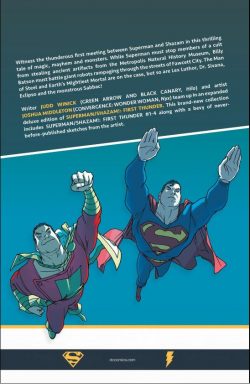
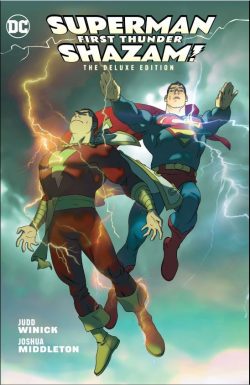
Superman/Shazam!: First Thunder


By Judd Winick, Joshua Middleton & various (DC Comics)
ISBN: 978-1-4012-0923-0 (TPB)

At their most impressive, superhero comics combine all the gravitas of mythology with all the sheer child-like fun and exuberance of a first rollercoaster ride. A perfect example of this is a 4-issue miniseries from November – February of 2006 collected as Superman/Shazam!: First Thunder.

One of the most venerated and loved characters in American comics, (the original) Captain Marvel was created by Bill Parker and Charles Clarence Beck as part of the wave of opportunistic creativity that followed the successful launch of Superman in 1938. Although there were many similarities in the early years, the Fawcett character moved solidly and steadily into the area of light entertainment and even comedy, whilst as the 1940s progressed the Man of Steel increasingly left whimsy behind in favour of action and drama.

At the height of his popularity the World’s Mightiest Mortal outsold the Man of Steel by a wide margin (even published twice monthly), but as the Furious Forties closed tastes changed, sales slowed and Fawcett saw the way the wind was blowing. They settled a long-running copyright infringement case instigated by DC/National in 1940 and the Big Red Cheese vanished – as did so many superheroes – becoming little more than a fond memory for older fans.

As America lived through another superhero boom-and-bust from 1956-1968, the 1970s dawned with a shrinking industry and a wide variety of comics genres servicing a base that was increasingly founded on collector/fans and not casual or impulse buys. DC Comics needed sales and were prepared to look for them in unusual places.

After the settlement with Fawcett in 1953 they had secured the rights to Captain Marvel and Family, and even though the name itself had been taken up by Marvel Comics (via a circuitous and quirky robotic character published by Carl Burgos and M.F. Publications in 1967) decided to tap into that discriminating older, nostalgia-fuelled fan-base, even as the entire entertainment world began looking back in time for fresh entertainments such as The Waltons, Little House on the Prairie (or even Bonnie and Clyde)…

In 1973, riding that burgeoning wave of nostalgia, DC brought back the entire beloved cast of the Captain Marvel strips: restored to their own kinder, weirder universe. To circumvent an intellectual property clash, they entitled the new comic book Shazam!; the trigger phrase used by a huge family of Marvels to transform to and from mortal form and a word that had already entered the American language due to the success of the franchise the first time around.

You know what comics fans are like: they had been arguing for decades – and still do – over who was best (for which read “who would win if they fought?”) out of Superman or Captain Marvel. Thus, though excised from the regular DCU and stuck on a parallel universe, the old commercial rivals met and clashed a number of times, but until the landmark Crisis on Infinite Earths subsumed all those myriad worlds into one overarching continuity, the most powerful heroes in existence maintained the status of “equal but separate”.

In that new reality everything happened in one cosmos and Captain Marvel was fully rebooted and integrated. The basics remained untouched: homeless orphan and good kid Billy Batson is selected by an ancient wizard to be given the powers of six gods and heroes to battle injustice. Bestowed with the ability to transform from scrawny precocious kid to brawny (adult) hero by speaking aloud the wizard’s acronymic name – invoking the powers of legendary patrons Solomon, Hercules, Atlas, Zeus, Achilles and Mercury, the idealistic lad can now right all wrongs as “the World’s Mightiest Mortal!”

After twenty years in this iteration, Captain Marvel’s early days were re-explored in this canny, big-hearted thriller which reveals the details of the first shared case of paragons of power.

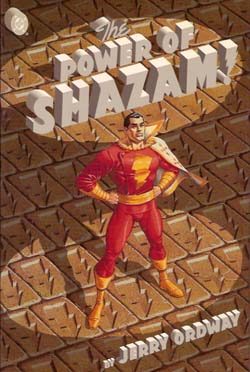
Written by Judd Winick and illustrated by Joshua Middleton in a painterly style gloriously reminiscent of the old Fleischer Studio Superman cartoons, this magical treat is chronologically set just after Superman: Man of Steel volume 1 and The Power of Shazam! original graphic novel, and opens with ‘A Face in the Crowd’ as a new hero begins saving lives in West Coast metropolitan colossus Fawcett City, whilst a continent eastwards in Metropolis, Superman stumbles onto a museum robbery and is surprisingly beaten by thieves employing magic. The robbers belong to a cult – the Temple of Bagdan – and are on a nationwide spree to collect ancient Russian relics for some sinister master-plan…

In Fawcett, Marvel destroys giant robots attacking a new solar powered construction site designed by Doctor Bruce Gordon, unexpectedly inspiring the enmity of billionaire industrialist Thaddeus Sivana. Although the owner of the Solar Center project, Sivana has huge petrochemical interests and only intended his eco-friendly enterprise as a tax shelter. He certainly has no intention of supplying cheap, clean energy to the proles of “his” city…

In a makeshift shelter, homeless Billy Batson talks his day over with Scoot Cooper, another hard-luck kid and the only person who knows his secret, even as Sivana “negotiates” with his hated East Coast rival Lex Luthor. The arrogant Metropolis financier has experience with super-powered meddlers and resources to combat their interference. It’s time to make a deal with a devil…

Later when the Bagdan cultists raid Fawcett’s McKeon History Museum, Marvel is waiting for them but is also overmatched by the magical Mallus Trolls employed by the thieves. At least until Superman shows up…

The team-up explodes into action in ‘Odd Couples’ with the heroes battling together, discovering their similarities and major differences even as, in Metropolis, Luthor sells Sivana the answer to all his superhero problems: an exemplary operative dubbed Spec…

The cultists have again escaped however, and are in the final stage of their plan. Having secured the mystic paraphernalia to summon consummate evil they then force disturbed kidnap victim Timothy Barnes to become host to six infernal fiends. Sabbac is the antithesis of Shazam’s agent: a supernatural super-being sponsored by devil-lords Satan, Aym, Belial, Beeelzebub, Asmodeus and Createis in the way the ancient gods and heroes empower Captain Marvel, and now he is free to wreak havoc and destruction upon the world…

To make matters worse, at that very moment Bruce Gordon succumbs to his own twilight curse at the Solar Centre as a lunar eclipse allows the diabolical Spirit of Vengeance to escape from his fleshy prison…

‘Titans’ finds Captain Marvel furious battling his dark counterpart as Superman struggles against not only evil spirit Eclipso but also his possessed army of innocents enslaved by the dark destroyer’s black diamond. When Sivana secretly funded the cultists, he intended their tool to simply destroy Gordon and his power plant, but now events have spiralled beyond anyone’s control. Even as the hated heroes inadvertently fix both of Sivana’s awry schemes, Spec is hunting through Fawcett. Soon his astounding abilities have ferreted out Billy Batson’s secret and arranged a permanent solution…

The drama roars to a terrific conclusion in ‘Men and Boys! Gods and Thunder!’ as a paramilitary hit squad attempts to gun down the merely human Billy but only hits his best friend instead, leaving Sivana to face the wrath of a lonely, bitter 10-year old boy, amok and enraged with righteous fury in the body of one of the most powerful creatures in the universe…

In the awesome aftermath, Superman decides to deal with the shell-shocked Marvel in a way that will change both of their lives forever…

Still readily available in trade paperback and digital form – and sporting such extras as a roughs and sketches, cover process guide and cover gallery – this is a big, bold, old fashioned comicbook romp full of big fights, dastardly villains, giant monsters, big robots and lasting camaraderie that will delight all lovers of Fights ‘n’ Tights fiction, and whilst not a breakthrough classic like Watchmen or The Dark Knight Returns, is an equally mythic retelling of superhero mythology which ranks amongst the very best of the genre.

They should make a movie out of it…
© 2006 DC Comics. All Rights Reserved.
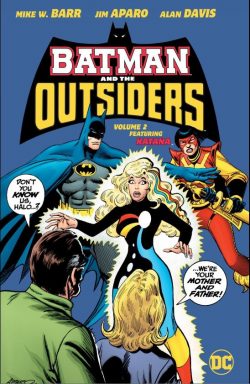
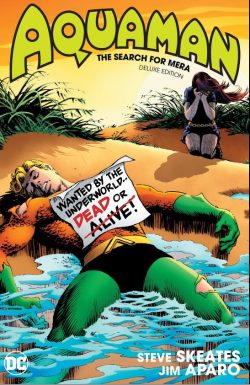
Aquaman: The Search for Mera Deluxe Edition


By Steve Skeates, Jim Aparo & various (DC Comics)
ISBN: 978-1-4012-8522-7 (HB)

Aquaman was one of a handful of costumed adventurers to survive the superhero collapse at the end of the Golden Age: a rather nondescript and genial guy who solved maritime crimes and mysteries when not rescuing fish and people from sub-sea disasters. He was created by Mort Weisinger & Paul Norris in the wake of and in response to Timely Comics’ Sub-Mariner, debuting in More Fun Comics #73 (November 1941).

Strictly a second stringer for most of his career, he nevertheless continued on beyond many stronger features; illustrated by Norris, Louis Cazaneuve, Charles Paris, and latterly Ramona Fradon who drew every adventure until 1960.

When Showcase #4 rekindled the public’s taste for costumed crimefighters with the advent of a new Flash in 1956, National/DC updated its small band of superhero survivors, especially Green Arrow and the Sea King. As the sixties unfolded, Aquaman was appearing as a back-up feature in Detective and World’s Finest Comics. Following a team up with Hawkman in Brave and the Bold # 51 and a try-out run in Showcase #30-33, Aquaman made his big jump. After two decades of continuous adventuring, the marine marvel finally got his own comicbook (cover-dated January/February 1962).

Now with his own title and soon a to be featured in the popular, groundbreaking cartoon show Superman/Aquaman Hour of Adventure, the Finned Fury seemed destined for super-stardom, but despite increasingly bold and innovative tales his title was cancelled as the decade closed. Towards the end, outrageously outlandish yarns gave way to grittily hard-edged epics steered by revolutionary editor Dick Giordano and hot new talents Steve Skeates and Jim Aparo …

This compelling compilation – collecting material from Aquaman volume 1 #40-48 (July/August 1968 to November/December 1969) – is available in hardback and digital formats, offering a potent and timeless drama that changed perceptions of the amiable aquatic avenger forever…

In Aquaman #18, (December 1964 and not included here) the King of Atlantis met extradimensional princess Mera, who became ‘The Wife of Aquaman’ in one of the first superhero weddings of the Silver Age. Talk about instant responsibilities…

A few years later scripter Steve Skeates and new illustrator Jim Aparo began an epic extended tale as the Sea Lord abandoned all kingly duties to hunt for his beloved after she is abducted from his very arms.

The quest began in ‘Sorcerers of the Sea’ with her being brutally whisked away, leaving Aquaman and Aqualad to voyage to strange, distant undersea realms in search of her. In the interim, royal heir Aquababy is left in the care of loyal comrade Aquagirl (her actual name was Tula) while the kingdom devolves to the ministrations of top advisor Narkran. Their first encounter is with a village of mystics whose queen is a doppelganger of missing Mera. Barely escaping, Aquaman’s resources are further taxed when his faithful sidekick is gravely wounded, but, raging and impatient, the Sea King cannot wait for him to heal…

His only clue is the distinctive jewellery one of his assailants wore and ‘The Trail of the Ring’ eventually leads to a deep-sea realm of barbarians known as Maarzons. To reach them, though, Aquaman has to traverse unexplored depths, facing monsters with telepathic powers similar to his own and escape a super civilised micro-culture with some repellent ideas on the price of survival…

On finally reaching Maarzon country, Aquaman savagely confronts warlike primitives who somehow worship his greatest enemy and is forced to ask ‘Is This My Foe?’, before realising he is being played for a fool. Meanwhile, in Atlantis Aqualad has taken a turn for the worst and Tula gets the first inkling that Narkran might not be completely stable. It’s a situation that will soon be reflected throughout the domed city-state…

Despite physical injuries and mental confusion, Aqualad absconds from hospital in Atlantis to aid his friend’s search, only to be captured and forcibly turned into a monster-slayer by a dying subsea race in ‘To Win is to Lose!’ Aquaman has since encountered another bizarre race and a helpful surface-man Phil Darson. The explorer provides a powerful clue that changes everything and sends the Sea King swimming for the sunlight lands above…

And in Atlantis, shattering quakes presage a different kind of instability as the drowned realm begins shifting upwards too…

The mystery begins to resolve in ‘Underworld Reward!’ as Aquaman exposes American gangsters planning a big coup that somehow involves him and Mera. Sadly, that only leads to a bounty landing squarely on his head and every rat in the city gunning for him, before ‘Underworld Reward! Part 2’ sees a partial resolution and fraught reunion when the king and queen explosively meet up and crush the thugs.

Embellished by Frank Giacoia (as “An Inker”) ‘The Explanation!’ fills in the blanks on a bizarre and complex scheme that highlights high level treachery in Atlantis and collusion between the subsea corridors of power and the back alleys of American crimelords…

Dash back home, Aquaman and Mera fortuitously save embattled Aqualad en route as ‘Come the Revolution’ finds Aquagirl and the city’s youth taking on the usurpers until the Royal Family return in climactic earth-shaking conclusion ‘A Kingdom to Re-Build!’

Also boasting a telling Foreword from latterday scripter Dan Abnett and a full cover gallery from Nick Cardy – some of his best ever work – this bombastic thriller forever ended the genteel, anodyne days of the B-lister Aquaman: reforging the hero into a passionate, questioning, forceful champion far more in keeping with the turbulent times.

What this collection proves is that his past adventures are all worthy of far more attention than they’ve received of late, and even though it’s probably just the commercial fallout of his movie incarnation, comics readers get to benefit from the renewed exposure and unearthed gems of aquatic adventure.

It is a total joy to find just how readable they still are. With tumultuous sea-changes always in store for Aquaman, the comics industry and America itself, this tasty testament to the inestimable value of a good bad-guy is a true delight for fans of all ages and vintage.
© 1968, 1969, 2018 DC Comics. All Rights Reserved.
The Power of SHAZAM!


By Jerry Ordway (DC Comics)
ISBN: 978-1-56389-085-7 (HB) 978-1-56389-153-3 (TPB)

Since DC acquired the rights to the Golden Age Captain Marvel (as published by Fawcett from 1940-1953) there have been many enjoyable and effective treatments of the characters. One of the very best which succeeded in to capturing the exuberance and charm of the originals – albeit layered with a potent veneer of modern menace – was Jerry Ordway’s 1994 re-imagining of the concept, based as much on the strengths of the 1940s movie serial as the forceful fun comics of Bill Parker, Otto Binder, C.C. Beck and their close cohort of creative stalwarts…

In Egypt, archaeologists Charles Batson and his wife Marilyn lead the prestigious Sivana Expedition in a search for knowledge and antiquities. That doesn’t fit with the instructions given to the sponsor’s ruthless fixer and overseer Theo Adam, who has his own instructions regarding certain treasures. When they uncover an unknown tomb belonging to an utterly unknown dignitary named “Shazam”, tensions boil over and murder occurs.

The historians had left their son in America with Charles’ brother, but taken their toddler Mary with them. After the bloodshed ends, both she and Adam have vanished without trace…

Some Years Later…

Billy Batson is a little boy living on the streets of ultra-modern art deco Fawcett City, USA. His parents had left him with his uncle Ebenezer when they went away. They never returned and he was thrown out as his uncle stole his inheritance. No one knows where his baby sister is…

Sleeping in a storm drain, selling newspapers for cash, the indomitable kid is pretty street-savvy, but when a mysterious shadowy stranger who seems comfortingly familiar bids him follow into an eerie subway, Billy just somehow knows it’s okay to comply.

When he meets the wizard Shazam and gains the powers of the ancient Gods and Heroes he knows he has the opportunity to make things right at last. But he isn’t aware of just what depths of evil corporate vulture Thaddeus Sivana is capable, nor the role that Black Adam played in the fate of his parents…

This superb and mesmerising retelling was an original graphic novel (available now in Hardback, Trade Paperback and in digital editions) that led to the most successful comic-book revival the original Captain Marvel has yet experienced. The characters refitted in that series are potently realistic but the stories offer a young voice and sensibility.

Moreover, the pulp adventure atmosphere conjured up by Ordway in conjunction with his sumptuous art and spectacular design make for a captivating experience, and the artist’s writing has never been more approachable and beguiling. This is a wonderful book for fans of adventure as well as “costumed drama” addicts and well worth pursuing in light of the movie release.
© 1994 DC Comics. All Rights Reserved.