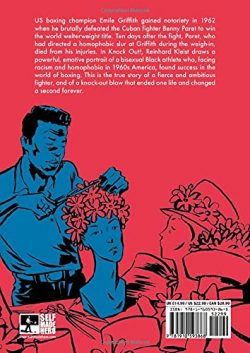
Knock Out! – The True Story of Emile Griffith


By Reinhard Kleist, translated by Michael Waaler (SelfMadeHero)
ISBN: 978-1-91059-386-8 (TPB)

Fairness and Justice are human constructs that afford many opportunities to prove that the universe works on other principles. Ritualized combat – like boxing – seeks to even out the most egregious imbalances between contestants to provide a balanced and equitable battle, but no amount of rule-making and legislation can shield participants from society, the environment they live in or the genetic heritage that shaped them.

Multi-award-winning German illustrator, designer, author, cartoonist and comics maker Reinhard Kleist (Berlinoir; Steeplechase; Das Grauen im Gemäuer) has been working in the industry since 1994: setting up a cooperative studio/atelier and beginning his professional career with graphic biography Lovecraft, and supernal dramas Minna, Das Festmahl, and Abenteuer eines Weichenstellers while still a student in Münster.

He has constantly explored and gratified his fascination with notable individuals who have overcome stacked odds and inner darkness in stellar works such as Johnny Cash: I See a Darkness; Elvis – An Illustrated Biography; Castro; An Olympic Dream: The Story of Samia Yusaf Omar and Nick Cave: Mercy on Me.

Here his powerfully moody yet joyous exuberant monochrome stylings recount the amazing life of a born fighter who triumphs in the best storybook traditions, whilst never deviating from the inescapable chains of history or escaping the sordid realms of real life…

Even if they’ve heard of him, most boxing fans don’t talk about Emile Alphonse Griffith. Born in the US Virgin Islands in 1938, Emile was black, poorly educated and endured abuse at home before moving to America. In 1956, while working in a New York hat factory, his foreman – a former boxing coach – noticed his astounding physique and encouraged the affable easy-going kid to try boxing as a way to improve his financial woes.

Although Emile preferred ping-pong, singing and making hats (later, at the height of his fame, Emile designed hats for women and made upbeat pop records), he went along with his white mentor. Turning Pro in 1958, Emile was soon a Golden Gloves winner and World Champion in the Welterweight, Junior Middleweight and Middleweight categories.

At that time in America, the sporting barriers to black boxers were mostly gone, but Emile laboured under another “handicap” – he slept with men and didn’t particularly care who knew about it.

Just like showbiz and popular entertainer Liberace, Emile’s status was an “open secret” in the 1960s Boxing community, which maintained a “don’t ask, don’t tell” mentality, but that only went so far in the days before the game-changing Stonewall Riots (look it up if you have to – its important). The happy-go-lucky pugilist’s privileged status evaporated after the third of three fights with Cuban Benny Paret, whom Emile defeated to become World Champion, before losing the rematch.

In 1962, they met one final time. After Paret taunted Griffith with homosexual and racial slurs, the match was a savage and unrelenting bout that resulted in the death of Paret…

However, that’s simply the first act of this tale, which follows Griffith – who was allowed to continue boxing until 1977 – as he confounded critics and bigots, breaking down barriers and living a full and extremely varied life… as much as his troubled conscience would allow.

This is a supremely uplifting story of triumph and tragedy which shows just how meaningless such concepts are outside of fiction. It’s a happy-sad example of how life goes on in a personal and macroscopic manner until it just ends: and it successfully argues that all you can do is the best you can…

Available in paperback and digital editions and supported by a Preface from Kleist acknowledging his influences and debt to Griffith biographer Ron Ross; Jonathan W. Gray’s context-enlightening Foreword ‘The Sweet Science and Open Secrets’ and a socio-cultural appraisal of Emile and other gay black boxers by Tatjana Eggeling (European Ethnologist and expert on Homophobia in Sports) plus a superb gallery of sketches and working drawings by Kleist, this is an unqualified hit that resonates far beyond the square ring and the closeted environs of LGBTQIA+ literature. It’s a surefire winner for everyone.
© Text and illustrations 2019 CARLSEN Verlag GmbH, Hamburg, Germany. English translation © 2021 SelfMadeHero. All rights reserved.

The Killer Condom and Down to the Bone


By Ralf König: translated by Jim Steakley and Jeff Krell (Northwest Press/Ignite! Entertainment)
ISBN: 978-0-96563-238-6 (Killer Condom PB) 978-0-96563-239-3 (Down to the Bone PB)
Digital editions by Northwest Press – no ISBN

Standard Disclaimer: These comedy stories contain rude words, explicit nudity, depictions of graphic and hilarious sexual situations and normal non-Biblical lifestyles. If any of these are likely to offend, what the hell are you doing here anyway?

I’d like to think that most social problems humanity suffers from can be fixed by a little honesty and a lot of communication – especially when it comes to relationships. Being able to laugh together probably helps too. In regard to sexual politics and freedom it’s an attitude Germany adopted decades ago. As a result, the country has an admirable record of acceptance of the LGBTQIA+ community and a broad penetration (yes, I’m awful! And Not Funny!) of gay comics into the general population.

Undisputed king of home-grown graphic novels is Ralf König, a multi-award-winning cartoonist, filmmaker and advocate with almost fifty titles – such as Suck My Duck; Santa Claus Junior; Prototyp; Archetyp; Antityp and Stehaufmännchen– under his belt.

He was born in August 1960 and came out in 1979, crafting an unceasing parade of incisive and hilarious strips and sagas set in and around the nation’s ever-evolving gay scene. Much to his own surprise, he discovered that his work had vaulted the divide from niche market to become a staple of popular mass market book sales. Many of his works have been rereleased as eBooks from Northwest Press.

The two volumes covered here were major sellers all over the world: blending the sordid shock-chic of 1970s American crime films and TV shows like Dirty Harry, The Warriors or Kojak and schlocky Sci Fi-horror (as in Scanners or Critters) with absurdist humour and the delicious notion of New York’s toughest Top Cop being Out, Loud and obnoxiously Proud…

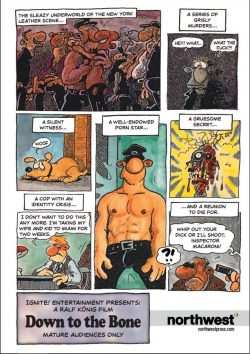
First released in Britain in 1991 and wholly embracing the conceit of being an art house movie, The Killer Condom originally debuted in 1987 as Kondom des Grauens: a whole-hearted genre spoof introducing disgraced and disgraceful New York detective Luigi Macaroni, called on by his reluctant and harassed boss to solve a rash of gory emasculations plaguing the area around the notorious pay-by-the-hour Hotel Quickie.

Brash, gruff and deliberately sleazy, Macaroni is too good a cop to get rid of, despite his brazen attitude, and begins to work just like in every other case his straight colleagues won’t touch. However, as he investigates the brutal street scene he quickly realizes that no human agency is biting the dicks off an escalating stream of unfortunate sinners…

When he picks up a rent boy for a little relief, they too go to the Quickie and soon face terror beyond imagination and every man’s darkest nightmare…

Crafted at a time when HIV/AIDS was ravaging the gay community and scaring the pants off the wider world, this darkly trenchant satire adds a bizarre codicil to the still-ongoing debate about safe sex and condom use, but remains at its core an outrageously funny romp for grown-ups. In 1996, it and sequel Down to the Bone were adapted as a German comedy horror movie, latterly released in America as Killer Condom.
The Killer Condom © 1988 by Editions Kunst der Comics/Ralf König. Revised Edition © 2009, Published by Ignite! Entertainment. All rights reserved.

Down to the Bone emerged in 1990. As Bis Auf die Knochen, it heralded the triumphant return of Detective Inspector Macaroni – an even-more embittered man following his failure to maintain a loving relationship. It’s New Year’s in New York and the city is darker and nastier than ever. In the dead of winter, a fresh horror stalks the streets…

When a man hungry for negotiable affection encounters an oddly familiar “leatherman” hooker, it turns into the last trick of his life. Meanwhile, celebrity restauranteur Joe Baluga meets a similar fate, as does another hapless John triggering another campaign of atrocity in the mouldy, worm-infested Big Apple.

This time, it’s not dicks that are disappearing: now entire bodies are being instantly reduced to bleached skeletons and the Captain needs the department’s top Queer to stop the rot. As the third victim is the wealthy son of an infamous billionaire, and just to be safe, the embattled chief assigns painfully straight whitebread Detective Brian Plumley to assist him – affording Macaroni an irresistible opportunity to play pranks and reaffirm his reputation as a total bastard…

As they trawl the leather bars and other outposts of “the scene” they quickly establish an apparent link to the gay porn industry. But other than providing the inspector with a celebrity hook-up, the investigation stalls until a bizarre find proves that what they’re all hunting is far from human…

From there the pieces swiftly fall into place and the escalating horror leads back to an old case involving carnivorous latex prophylactics. With bodies still dropping, Macaroni and a far-more woke Plumley track down an old mad scientist and his ghastly creation and encounter a deranged fundamentalist determined to enforce Biblical mandates at all costs…

Wry, witty, coarsely hysterical, these books marry the surly, unsavoury thrills of urban cop fiction with a bawdily outrageous whimsy that sadly won’t appeal to everybody, but if you love big raucous ludicrous belly laughs with your thrills and chills, these might well become some of your favourite reads.
Down to the Bone © 1990 by Editions Kunst der Comics/Ralf König. Revised Edition © 2011, and published by Ignite! Entertainment. All rights reserved.

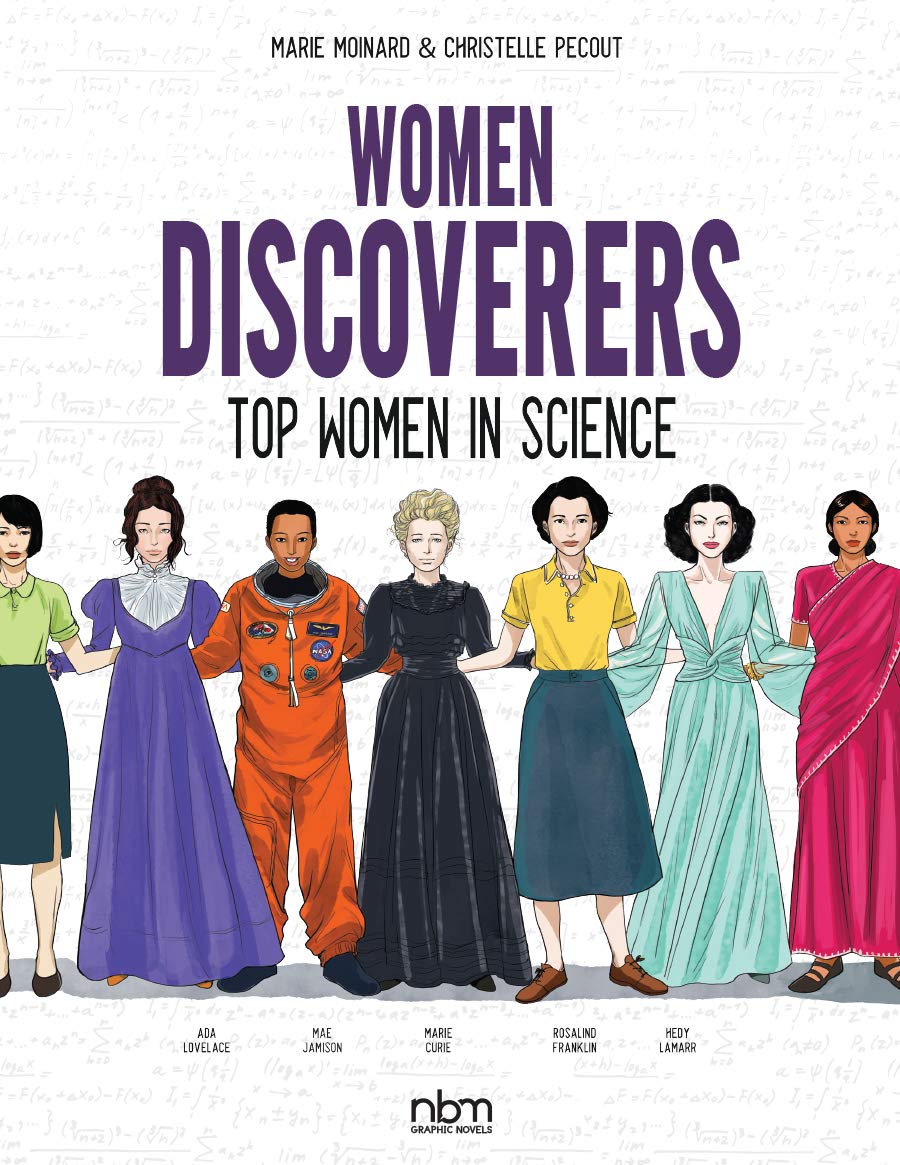
Women Discoverers: 20 Top Women in Science


By Marie Moinard & Christelle Pecout, translated by Montana Kane (NBM)
ISBN: 978-1-68112-270-0 (Album HB) eISBN: 978-1-68112-271-7

Comics and graphic novels have an inconceivable power to deliver information in readily accessible form, and – like all the best teachers – can do so in ways that are fascinating, fun and therefore unforgettable. Here’s a fresh entrant in a wave of historical and biographical visual celebrations seeking to redress centuries of gender injustice while providing true life role models for the coming generations.

Crafted by writer, editor and journalist Marie Moinard (En chemin elle recontre, La petite vieille du Vendredi) & Christelle Pécout (Lune d’Ombre, Hypathie, Histoires et légendes normandes), Les découvreuses is a cheery hardback – or digital – compendium made comprehensible to us, via translation into English by those fine folk at NBM.

As the name suggests, Women Discoverers focuses on twenty female scientists who generally – without fanfare or even fair credit – changed the world. Some are still doing so. A combination of comics vignettes and short illustrated data epigrams preceded by an impassioned Introduction from Marie-Sophie Pawlak (President of Elles Bougent scientific society), the revelations begin an extended strip history of the achievements of the peerless Marie Curie whose discoveries in chemistry and physics practically reinvented the planet. She is followed by brief vignettes of French biologist Françoise Barre-Sinoussi (discoverer of the HIV retrovirus), Canadian physicist Donna Théo Strickland (laser amplification) and African-American Dorothy Vaughan whose mathematical and computing skills served the world at NASA.

It’s back to comics for Ada Lovelace who revolutionized mathematics by inventing computer programming, after which single page biographies describe the achievements of lengths undertaken by French mathematician Émilie du Châtelet to attend men-only institutions in the days of the Enlightenment.

Although separated by centuries, mathematicians Emmy Noether (Germany 1882-1935) and Grace Alele-Williams (born in Niger in 1932) both excelled and triumphed despite male opposition but their stories pale beside the strip-delivered hardships of actress, engineer and mobile phone pioneer Hedy Lamarr…

Another Nasa stalwart, mathematician/astrophysicist Katherine Coleman Goble Johnson, famously calculated Apollo 11’s life-saving orbit, while paediatrician Marthe Gautier discovered the origins of Downs’ Syndrome and Iranian mathematician Maryam Mirzakhani’s geometry discoveries were tragically cut short by illness…

The shameful treatment and fate of British researcher Rosalind Franklin also ended in a cruelly early death and belated fame, unlike French mathematician, philosopher and physicist Sophie Germain whose many (posthumous) triumphs never brought her inclusion in the numerous scientific organisations barring female membership during her lifetime.

Whereas Marie Curie’s daughter Irène Joliot-Curie won similar accolades to her mother, astrophysicist Jocelyn Bell Burnell discovered pulsars only to have her (male) supervisor steal the credit. At least she’s still alive to see the record set straight…

In pictorial form, astronaut Mae Jemison reveals her life and medical successes on Earth, before this potent paean closes with a trio of one-page wonders: Kevlar inventor Stephanie Kwolek, Navy mathematician Rear Admiral Grace Murray Hopper (writer of the COBOL programming language) and Chinese chemist Xie Yi whose advances in nanotechnology have made the world a very different place.

Sure, you could Google them, but this book is a far more satisfying and charming alternative and the very fact that you probably haven’t heard of most of these astounding innovators – or even a few of the more ancient ones – only proves, without doubt, that you need this book.
© 2019 Blue Lotus Prod. © 2021 NBM for the English translation.

For more information and other great reads see http://www.nbmpub.com/

Wage Slaves


By Daria Bogdańska, translated by Aleksander Linskog (Centrala)
ISBN: 978-1-912278-06-0 (TPB)

It’s rare to see an international indie comic that combines personal revelation and intimate expression with hard-hitting reportage, so massive kudos to relative newcomer Daria BogdaÅ„ska who documented her eventful life thus far with uncompromising veracity while becoming a successful social activist battling corruption, authoritarian ennui and exploitation of immigrants in real life as well as this powerful and joyous paperback tome.

Having left her abusive home in Poland at 15, Daria travels across Europe, supporting herself with a succession of “under-the-table” and “off-the-books” jobs of varying legality and daily uncertainty, until she applies for and wins a place on a college course in Sweden.

After arriving in Malmö and hooking up with old friends, she finds accommodation of a tenuous nature, but, like so many others, has to work to pay for her studies. Being a temporary resident, she has no social security number and finds herself in the crushing trap of being unable to secure steady or even legal employment…

While constantly navigating the minefield of Sweden (Hell, any nation’s) Catch 22-based social security system, she finds casual work as a waitress and dogsbody for a chain of bars and curry houses run by an immigrant turned local bigwig…

As the year progresses, she notices things are pretty hinky even by the standards of the illicit economies she’s been exposed to in the past. At one point, the hard-working, occasionally partying student realises she’s supported herself for six years all over the world and never once had legitimate employment…

A little research reveals the nature and level of exploitation her non-white co-workers are enduring in pursuit of the Swedish equivalent of a Green Card, and something snaps. Daria decides something has to be done and boldly risks everything by joining a union…

Brutally frank, charmingly earnest and carrying a potent punch of virtue triumphant, Wage Slaves is a subtly engaging peek at the life too many youngsters have to endure, and one you should refresh your own comfortably numb social conscience with.
© Daria Bogdańska & Centrala. All rights reserved.

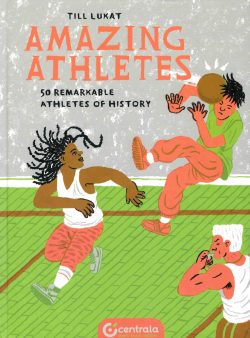
Amazing Athletes – 50 Remarkable Athletes of History


By Till Lukat, translated by Cecil Bronswear (Centrala)
ISBN: 978-1-912278-13-8 (HB)

We’re all in need of role models and actual heroes – these days more than ever. Here’s a charming little (245x x 330 mm) hardback compendium aimed squarely at kids but delivering a mighty sardonic kick for all lovers of competition and achievement.

Comics and graphic novels have an inconceivable power to deliver information in readily accessible form, and – like all the best teachers – can do so in ways that are fascinating, fun and therefore unforgettable. Berlin-born world traveller Til Lukat splits his time between there and Bristol these days, crafting award-winning comics such as Tuff Ladies and this compilation of sporting memorabilia.

Listed here, with no patronising division into sex-based niches, is a wittily engaging primer of the greatest exponents of victory, defeat and all aspects of sporting accomplishment, delivered as a portrait, minicomic and fact-packed text block. The fun begins with an introductory spread recalling the ‘Good Old Times’ of ‘Milo of Croton’ before jumping to 19thcentury cyclist ‘Henri Desgrange’ and mountain climber ‘Alexandra David-Néel’.

Other entrants include the proud, famous, notorious and simply tragic such as ‘Francisco Lázaro’, ‘Johnny Weissmüller’or ‘Yuliya Stepanova’ as well as the generally unsung like ‘Alfonsina Strada’, ‘Helene Mayer’, ‘Jesse Owens’, ‘Fanny Blankers-Koen’, ‘Toni Stone’, ‘Barbara Buttrick’, ‘Tamara Tyshkevich’, ‘Wilma Rudolph’, ‘Katherine Switzer’, ‘Florence Griffith-Joyner’, ‘Tonya Harding’, ‘Ellen MacArthur’ and many others.

Crucial moments in sporting history are précised in spreads such as ‘Christmas on the Front’, ‘Equality: 1 Disability: 0’, ‘A Clean Game’, ‘Kicking Apartheid’ and ‘The Dark Side’ while adding intrigue if not lustre is the ‘Sibling Rivalry’ of Rudolf and Adolf Dassler (you should look them up, or better yet buy this book) to seal a superbly entertaining deal combining comics dash with athletic glory.
© Till Lukat & Cambourakis 2017. All rights reserved.

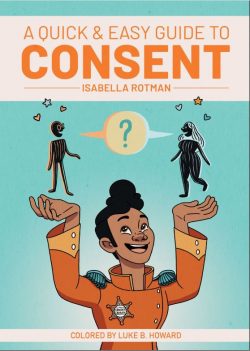
A Quick & Easy Guide to Consent


By Isabella Rotman with Luke B. Howard (Limerance Press/Oni Press-Lion Forge Publishing Group)
ISBN: 978-1-62010-794-2 (PB) eISBN: 978-1-62010-815-4

Win’s Christmas Gift Recommendation: Crucial Companion for Every Social Gathering of More Than 1 Person… 9/10

It’s going to be a seasonal holiday unlike any in living memory for most of us. In Britain, we’ve stringently locked down, been let loose to run rampant in dangerously close proximities and then locked down even harder and with more targeted complexity. For Christmas, as we’ve been not-so-good, the populace can now mix and mingle as we see fit, with no real curbing of contact. What could possibly go wrong?

All that preamble is my convoluted way of introducing what should the ideal accompaniment to the party season or any relationship…

I’ve frequently argued that comic strips are a matchless tool for education: rendering the most complex topics easily accessible and displaying a potent facility to inform, affect and alter behaviour. Here’s another superb example of the art form using its great powers for good…

The Quick & Easy Guide series has an admirable record of confronting uncomfortable issues with taste, sensitivity and breezy forthrightness: offering solutions as well as awareness or solidarity.

Here, Maine-based cartoonist Isabella Rotman (Wait What?: A Comic Book Guide to Relationships, Bodies and Growing Up; You’re So Sexy When You Aren’t Transmitting STIs) and New Orleans colourist Luke Howard collaborate on a cogent and compelling primer covering the irrefutable basics When, Where, Why and most especially What can be taken as Consent.

This is such a charged issue that the light and informative lecture is preceded by a very clear and well thought out Content Warning defining terms and the specifics of situations, with firm regard to gender, scope and even an Informational Disclaimer… that’s how hot a topic this is …

Terms are examined and situations explored during a tenuous first encounter between two healthy young adults, but as things heat up, a phantasmal guide pops in to steer the participants and give voice to their suppressed concerns, through chapters such as ‘What is Consent?’, ‘Consent is Simple’, ‘What is Sex?’ and ‘Consent Must be Freely Given!’ all emphasised through sidebars like ‘Tell Them What Turns You On!’ and an enumeration of what definitively ‘Have Nothing to do With Consent!’

The dialogue and show-&-tells are punctuated by quotes from professional Sexual Consent Educators, augmented by role plays, quizzes and a section outlining and defining the current (US only) ‘Age of Consent’ laws, before asking ‘Is Everyone Fully Informed?’ This last is primarily about all the many factors – physical and emotional – potential partners should always be apprised of, but also broadmindedly enquires ‘What About Kink?’ and even tackles the ever-present ‘Fear of Rejection’…

In closing, the convivial confrontation offers a list of potential faux pas in ‘So Don’t…’, a summation ‘In Review…’ before providing a ‘Yes. No. Maybe So Checklist’ as well as a selection of ‘Safer Sex: Contraception’, ‘…STI Risk Reduction’and ‘…Activities’ suggestions.

Being wise beyond her years and probably acutely aware of how inventive humans are, the author closes with sagacious questionnaire ‘Anything Else?’ plus a fulsome Bibliography and list of Resources to contact including Sex & Relationship Education, appropriate Hotlines and inline Checklists…

I hail from a fabulous far-distant era where we happily ravaged the planet without a qualm and believed emotional understanding led to universal acceptance. At the same time, it seems most of us never really stopped being the greedy cave monkey obsessively snatching whatever it wanted with no consideration of others or even consequences. We’re apparently a little more in tune with the planet now, and finally learning to share and play well with others…

This witty, no-nonsense treatise offers sage advice on becoming our best selves by dealing with our selfish natures – something that really should have been bred out of humanity eons, if not centuries, ago. It should be made compulsory reading in every school and college (and pub, and nightclub, and scenic natural beauty spot, and cinema and waiting room and…)
A Quick & Easy Guide to Consent ™ & © 2020 Isabella Rotman. All rights reserved.

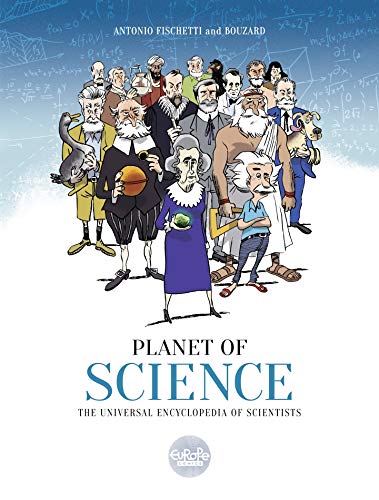
Planet of Science – the Universal Encyclopedia of Scientists


By Antonio Fischetti & Bouzard, translated by James Hogan (Europe Comics)
No ISBN: digital only

Win’s Christmas Gift Recommendation: Celebrating Humanity’s Greatest Miracle – Science! … 8/10

I saw this and thought of you…

Comics and graphic novels have an inconceivable power to deliver information in readily accessible form, and – like all the best teachers – can do so in ways that are fascinating, fun and therefore unforgettable.

A paradigm example is 2019’s La Planète des sciences – Encyclopédie universelle des scientifiques – which is now available digitally in English if not yet as a solidly reassuring tome. A bright and breezy introduction to a number of researchers and discoverers famed and not, it combines a page of personal history, biography and unflinching commentary on 37 notable personages who have added to global scientific knowledge, each accompanied by a smart, punchy and pertinent gag strip by underground cartoonist Guillaume Bouzard (Caca bemol, JeveuxtravaillerpourleCanardEnchaîné, Lucky Luke).

Presenting the facts is Dr Antonio Fischetti, author (Cats and Dogs under the scientist’s magnifying glass, Idiotic and Relevant Questions about Mankind); science journalist; educator (at the National Conservatory of Arts and Crafts, National Conservatory of Music and Dance in Paris, Louis-Lumière School and La Fémis); and author of a weekly science column for Charlie Hebdo.

The Continent is happily awash with factual albums and graphic novels – and not just biographies – and this is one of the most entertaining I’ve seen in years, opening with Dr. Fischetti’s explanatory postulate on why these particular 37 candidates and his cognitive methodology, before the visual revelations begin.

Divide into rough, ofter overlapping time frames it all starts in Ancient Greece with the lowdown and high points of Thales, Pythagoras, Hippocrates and Archimedes, before jumping to 780-850 for the story of Al-Khwarizmi.

Spanning the 15th – 16th Century, we meet Leonardo da Vinci, Nicolaus Copernicus, Ambroise Paré, Giordano Brunoand Galileo, before 17th – 18th Century pioneers Réne Decartes, Antonie van Leeuwenhoek, Isaac Newton, Carl Linnaeus and Antoine Lavoisier get their moment in history’s hindsight and spotlight.

Representing the 19th Century are Charles Darwin, Claud Bernard, Gregor Mendel, Louis Pasteur, Alfred Nobel and Dmitri Mendeleev after which the revolutionary 19th – 20th Century hones in on Ivan Pavlov, Max Planck, Marie Curie, Albert Einstein, Alfred Wegener, Alexander Fleming, Erwin Schrödinger and Trofim Lysenko. By now its probably clear to most of you that this is no simple hagiography: same of the folk here are here because of their effect on scientific progress and it’s not all smiles, acclaim and awards…

The procession ends with the 20th – 21st Century (because, as of this writing, time travel has not been satisfactorily confirmed or reproduced under laboratory conditions) with controversial and occasionally still-living paragons Konrad Lorenz, Alan Turing, Alexander Grothendieck, James Watson, Peter Higgs, Yves Coppens, Jane Goodall and Emmanuelle Charpentier. Sure, you could Google them, but this book is a far more satisfying alternative…

The very fact that you probably haven’t heard of some of these latter savants – or even a few of the more ancient ones – only proves without doubt, that you need this book. QED: What more can I say?
© 2020 DARGAUD – Fischetti & Bouzard. All rights reserved.

A Secret History of Coffee, Coca & Cola


By Ricardo Cortés (Akashic Books)
ISBN: 978-1-61775-134-9 (HB)

Win’s Christmas Gift Recommendation: Potent, Punchy and Thought-Provoking Fodder to Ponder and Enjoy after Overindulging… 9/10

The astounding power of graphic narrative to efficiently, potently and evocatively disseminate vast amounts of information in layered levels has always been best utilised in works with a political or social component. That’s seldom been better demonstrated than in this stunning and scholarly work from Ricardo Cortés.

Born in 1973, illustrator/artistic intellectual activist Cortés has had a sublimely seditious career thus far. He made waves in Vanity Fair, Entertainment Weekly, The New York Post, The Village Voice, San Francisco Chronicle, and been challenged on CNN and FOX News after his controversial children’s book Marijuana: It’s Just a Plant – written by Marsha Rosenbaum – was mentioned in Congress. He followed up by illustrating Adam Mansbach’s Times Best-Selling Go the F**k to Sleep and sequel Seriously, Just Go to Sleep, and created the colouring book I Don’t Want to Blow You Up! about famous Muslims who aren’t terrorists.

In 2011 he received a grant from the Department of Cultural Affairs’ Greater New York Arts Development to create Jury Independence Illustrated – a public booklet dealing with Jury Nullification produced with the intention of educating potential jurors about their powers to acquit if they disagree with specific laws or judicial rulings. Clearly a born troublemaker…

This particular project is a brilliantly engrossing exploration of acceptable addictions blending scrupulously scholarly reportage with a seductively beautiful selection of captivating images and historical reproductions.

The story starts with the origins and history of ‘Coffee‘ from its mythic discovery as a berry fruit for goats in Ethiopia, through being taken up by Yemeni traders who disseminated “qahwah” throughout the Islamic world. A proven intoxicant, concerns over its salubrity, morality and legality grew and it was soon being trafficked by desperate men. In the 16th century the beverage was banned in Mecca, Cairo and elsewhere, but its taste and effects were impossible to resist.

By the time “kahveh” reached Turkey, trading in the beans carried the death penalty. As “Coffee” it reached Europe in the 17th century, touted as a miracle cure-all for everything from headache to miscarriage and grew explosively into an intellectual’s seditious vice. In 1675, Charles II ordered it suppressed and closed England’s Coffee Houses by Royal Edict.

Things got even stranger in 1820 after the alkaloid “Caffe-ine” was finally distilled from the coffee cherry…

The rest of caffeine’s turbulent and torturous legal and commercial progress to today’s status as the world’s most popular stimulant is followed by the story of ‘Cola and Coca’ in which caffeine’s other singularly popular method of natural dissemination is examined. The Kola Nut of West Africa is amazingly high in the stimulant alkaloid and has been used for centuries – if not millennia – as an energy-intensifying fortifier by the various tribes and nations either by chewing the raw nut or brewing a drink called “cola”.

Cola is one of the most popular ancient beverages on Earth and when in 1886 Dr. John Pemberton devised his own formulation – dubbed Coca-Cola – by adding a dash of coca leaves, his medicinal tonic, after an initial shaky start, grew to become the most monolithic drinks brand on Earth.

…But not, apparently, without a little government help…

Coca originated in the Andes, where for centuries indigenous peoples used the herbal bounty as a pick-me-up. Indios chewed coca leaves the way we do gum in the west and in 1499 explorer Amerigo Vespucci brought back tales of the wonder herb’s propensity to promote feats of concentration and endurance. In 1859, Dr. Karl Scherzer returned to Austria after a 2-year scientific voyage aboard the Frigate Novara with 60 pounds of coca, as previously requested by German pharmacologists. Soon after doctoral student Albert Niemann isolated from the samples a new alkaloid which he dubbed “Coca-ine”. This fresh medical marvel – its transparent crystals easily derived from coca leaves – was from 1884 enthusiastically prescribed by the likes of Sigmund Freud for melancholia. Oculist Carl Koller discovered it to be an incredible regional (or as we now say “local”) anaesthetic, allowing unprecedented new surgical procedures to be performed. It became a popular treatment for toothache, labour pains, nervousness, fatigue, impotence, asthma and as a cure for morphine addiction – hence Pemberton’s inclusion of the stuff in his health tonic.

By 1889 cases of compulsive use and abuse began to be reported, leading to heated medical debate, and when the era’s obsessive racial concerns were added to the mix (“cocaine made negroes insane” and it was peddled by “greedy Jewish doctors”) the writing was on the puritanical wall for the foreign import.

On a rising tide of public disapproval, the 1914 Harrison Narcotics Act prohibited Cocaine use and coca importation in the USA. However, due to some truly unbelievable backroom dickering, the already powerful Coca-Cola Company secured a constant supply of the banned substance – re-designated “Merchandise No. 5” – for their Schaefer Alkaloid Works in New Jersey – still thriving today as the Stepan Chemical Company. This mercantile miracle was all due to diligent work of Commissioner Harry J. Anslinger of the Federal Bureau of Narcotics and Ralph Hayes, a former aide to the US Secretary of War and – from 1932 – a vice President of the Coca-Cola Company.

Anslinger was a rabid anti-drug zealot, so just why did he spend 40 years – under seven different US Presidents – enforcing draconian and often expensive, nigh-impossible bans on a vast number of natural pharmaceutical products whilst actively securing and defending Coca-Cola’s uninterrupted supply of cocaine? He even facilitated clandestine schemes to grow coca on American soil and his campaign was so successful that American policy became UN and global norms, forcibly negating all the proven scientific benefits of resources which grew naturally in countries which could never afford Western drugs and chemical advances.

Trust me; you only think you know the answer…

Astonishingly addictive and intoxicatingly revelatory, Coffee, Coca & Cola offers an impressively open-minded history lesson and an incredible look at the dark underbelly of American Capitalism. Exposed here through telling research and beguiling illustrations is a catalogue of hypocrisy wherein successive political administrations and big business always found ways to place commercial interests ahead of any specious moral imperative ingenuously forwarded by the “World’s Cop”.

Learn here how corporations and statesmen conspired to ruthlessly crush the traditions, customs and rituals of other nations and cultures (as recently as 2010, America acted to suppress many sovereign South American countries’ social, spiritual, medicinal and nutritional use of coca) and continue to prevent poor countries utilisation of such ancient natural resources as caffeine and cocaine whilst peddling products inescapably wedded to both American Expansionism and Ideology…

A stunning, hardcover coffee-table book (also available in digital formats) for concerned adults, this captivating chronicle is a true treasure – or perhaps in the parlance of the idiom, I might just say – lip-smacking, trust-quenching, cool looking, stimulating, motivating, hard talking, fool busting, fast thinking, hard quizzing… and unmissable.
© 2012 Ricardo Cortés. All rights reserved.

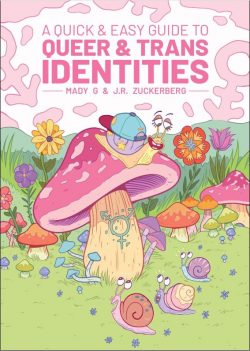
A Quick & Easy Guide to Queer and Trans Identities


By Mady G & J.R. Zuckerberg (Limerance Press/Oni Press)
ISBN: 978-1-62010-586-3 (PB) eISBN: 978-1-62010-587-0

Here’s a handy rule of thumb for getting along. People get to decide what to call themselves. You get to accept and agree with them, as long as no one is being actually harmed. That assessment is to be made by Law, not personal belief or some higher calling. If you can’t accept their definitions of themselves, you have the right to leave people alone and never interact with them.

Okay?

We are the naming primate. If we encounter something unknown and/or scary, we give it a description, definition and title and accept it into our ever-expanding understanding of Reality. It’s what enabled us to take over this world. Naming things is generally a good thing and allows us to navigate our universe.

Some people, however, use the power of naming to isolate, ostracise and wound. They are not doing it right. People like us have plenty of really fitting names for people like them when they abuse our gift…

Seriously though, it seems like every time we make a move towards greater inclusivity, some faction of retrograde, regressive backwards-looking churl and biological luddite manufactures a reason why we can’t all get along.

I personally favour retaliation, but the only way to truly counter them is with understanding, so here’s a book that offers plenty of names and definitions we should all be adding to our lexicons…

I’ve frequently argued that comic strips are a matchless tool for education: rendering the most complex topics easily accessible and displaying a potent facility to inform, affect and alter behaviour. Here’s a splendid example of the art form using its great powers for good…

The Quick & Easy Guide series has an admirable record of confronting uncomfortable issues with taste, sensitivity and breezy forthrightness: offering solutions as well as awareness or solidarity.

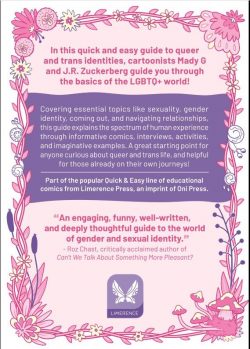
Here, coast-to-coast cartoonists Mady G. and J. R. Zuckerberg collaborate on a bright and breezy primer covering the irrefutable basics on establishing one’s own sexual and gender identity (including the difference between those terms), safely navigating all manner of relationship and exploring the spectrum of experiences available to consenting adults.

A major aspect of us People Primates is that we spend a lot of our lives trying to work out who we are. It takes varying amounts of time for every individual and lots of honesty.

It’s like most work. It can be unwelcome, laborious, painful and even dangerous and nobody should attempt it too soon or alone.

Moreover, all too often, assistance and advice offered can be unwelcome and stemming from somebody else’s agenda. In my own limited experience for example, any sexual guidance offered by anybody with a religious background is immediately suspect and a waste of breath. Perhaps your experience is different. That’s pretty much the point here. In the end, you have make up your own mind and be your own judge…

Unlike me, A Quick & Easy Guide to Queer and Trans Identities takes no sides and offers no bias as it runs through the fundamentals, but only after a Foreword from cartoonist and author Roz Chast and an Intro by Mady lay out the rules of engagement on the attaching and utilisation of the labels and roles gradually becoming common modern parlance…

The micro lectures are set during a wilderness trek where an agglomeration of troubled humans have a group teaching encounter under the supervision of a “Queer Educator” endeavouring to define for them the nature of ‘Queerness’…

The useful commentary, educational asides and plentiful laughs are generated by a colony of snails avidly observing proceedings like a raucous and bewildered Greek Chorus. Such gastropods, as I’m sure you recall from school, are either male, female, hermaphroditic or something else entirely, depending on what time it is. Now that’s perspective…

Subjects covered with forthright verve, clarity and – crucially – wry wit begin with ‘What is Queer?’, proffering terms for defining Sexuality and Gender as subdivided into Bisexuality, Asexuality, Pansexuality amongst other permutations. These and later lessons are illustrated with examples starring primarily neutral vegetable critters dubbed The Sproutlingswho are conveniently pliable and malleable…

‘What is Gender Identity?’ digs deeper, discussing Gender vs Sex via a little biology tutorial before ‘Now… What’s Gender Expression?’ expands the debate, determining modern manners and ways of signalling the world what one has decided is a person’s (current, but not necessarily permanent) status. The lecture comes with carefully curated real-world examples…

This is all fine in an ideal world, but contentious, often life changing problems that can occur are tackled head-on in ‘What Does Dysphoria Mean?’, detailing examples of the traumas accompanying the realisation of not being how you believe you ought to be. Divided into Physical, Social and non-binary Dysphoria, the examination includes ways of combatting the problems and more case histories courtesy of the human wilderness students…

In swift succession ‘So, what is Asexuality?’ and ‘What does it mean to Come Out?’ offer further practical thoughts and prospective coping tactics before vital life lessons are covered in ‘Here are some Relationship Basics’.

Also included here are an “Outro” by Zuckerberg and a section of activities including ‘Design a Pair of Friendship Jackets’, ‘Create Your Own Sprout-sona!’ and ‘How to make a Mini Zine!!’ as well as information on ‘More Resources!’and Creator Biographies.

I hail from a fabulous far-distant era where we happily ravaged the planet without a qualm but believed emotional understanding led to universal acceptance. We’re apparently smarter about the planet now, and it’s wonderful to see that the quest to destroy intolerance and ignorance still continues. This witty, welcoming treatise offers superb strategies for fixing a pernicious issue that really should have been done and dusted decades ago.

Hopefully, when we all share appropriate, non-evocative and un-charged terms for discussing human sexuality and gender – such as seen here – we can all make decisions and assessments that will build a fairer, gentler world for everybody…
A Quick & Easy Guide to Queer and Trans Identities ™ & © 2019 Mady G & J.R. Zuckerberg. All rights reserved.

A Quick & Easy Guide to Sex & Disability


By A. Andrews (Limerance/Oni Press)
ISBN: 978-1-62010-694-5 (PB) eISBN: 978-1-62010-706-5

Comic strips are an incredibly powerful tool for education, rendering the trickiest or most complex topics easily accessible. They also have an overwhelming ability to affect and change behaviour and have been used for centuries by politicians, religions, the military and commercial concerns to modify how we live our lives. Here’s a splendid example of the art form using its great powers for good…

The Quick & Easy Guide series has an admirable record of confronting uncomfortable issues with taste, sensitivity and breezy forthrightness: offering solutions as much as awareness or solidarity. Here, disabled cartoonist A. Andrews (Oh, Hey! It’s Alyssa!) shares experiences and highlights situations too many people would prefer never having to think about…

Before we go any further though, let’s just state something that ought to be obvious. Most human beings want and have sex.

Even amongst the majority, that encompasses a variety of preferences, techniques and practices generally undertaken in a spirit of cooperation and carried out on a sliding scale of satisfaction and success for (at least one of) those taking part. The goal however, surely must be mutual gratification for all involved, right?

Sadly, for a large section of humanity, this fundamental function presents many difficulties. Most have been previously addressed in many learned clinical tracts and therapeutically-themed sources but this welcomingly frank cartoon lecture isn’t one of those. It’s a chat session led by a person who’s lived some of those difficulties and who uses passion, humour, common sense and earnest language to cope. Think here not about achieving sex, but rather making your version of sex better, if not best…

After starting out with some daunting statistics from the Center for Disease Control and World Health Organization to establish the state of play for disabled people (Earth’s largest minority group, accounting for 15% of global adult population), Andrews quickly moves to the meat of the matter in ‘Disability Sexuality’.

Defining different forms of disability – congenital, acquired, intellectual and invisible – and outlining intersecting impacts on individuals as well as tackling the differences between sexuality and gender, naturally leads to an examination of ‘Myths About Disabled Bodies’ before revealing the big secret… ‘Communication’…

Following short and pertinent questionnaire ‘Activity Time’, the talk about talking resumes with ‘Instead of … Try This…’ and more sage advice, plus a fascinating ‘Self-Care Plan’ and the value of preparedness and tools, enhancements and toys in ‘Getting Down’, ‘Positioning’ and ‘Aftercare’…

Also included is a listing of additional information and resources in print, podcast and web formats.

I hail from a distant era when we believed understanding led to acceptance, so it’s wonderful to see that the quest to destroy intolerance and ignorance still continues. This witty, welcoming comics guide tackles an issue that really should have been done and dusted decades ago, but until disability (and race and gender and sexuality and body size and even bloody hair colour) lose every shade of meaning and connotation except purely descriptive, books like this one will remain a necessity and utterly welcome…
A Quick & Easy Guide to Sex & Disability ™ & © 2020 A. Andrews. All rights reserved.