Captain Action: Classic Collection


By Gil Kane, Wally Wood, Jim Shooter & various (IDW)
ISBN: 978-1- (TPB) eISBN: 978-1-64936-046-5

These days comics are about kids of varying ages looking back. So too are toys, and baby boomers like me are particularly prone to the fabled golden age and certain “must-have” items – whether we ever actually owned them or not. An added bonus comes if those toys made it to comics and vice versa…

Back then, the ultimate acme for so many of us in the UK was – no, not the Johnny Seven multi-gun, or Man from U.N.C.L.E. briefcase – but the Captain Action nine-heroes-in-1 doll (sorry, Action Figure)… 

Once upon a time comics were considered the nigh-exlusive domain of children, with many scrupulously-policed genres and subdivisions catering to particular and stratified arenas such as fact, fantasy, adventure and humour. They were even further codified by age and gender.

A particular and popular recurring theme was tapping into the guaranteed and hopefully mutual sales boost offered by licensing and cross-marketing. West Coast outfit Dell/Gold Key had early on specialised in out-industry licensing deals and adaptations…

Many titles depended on a media celebrity like Howdy Doody, Charlie Chaplin or Mickey Mouse and in America that eventually spread to the marketing of products also aimed at kids… such as sweets, cartoons and toys…

By the end of that era, comics for kids were almost exclusively released as a minor strand of a major maketing strategy. That comics like Thundercats, Micronauts, Transformers, Rom and G.I. Joe were actually good and entertaining on strictly strip terms was a happy coincidence and thanks solely to the diligent pride and efforts of the creators involved. Sadly, it also led to publishers intensifying efforts to add a toy component to their own properties. Hands up anyone out there who owns a Spider-mobile, Batboat or Supermobile…

For DC, that trend really began in 1968. Although the company – known as National Periodical Publications back then – had long benefitted from creating comics adventures of movie stars like Bob Hope, Jerry Lewis or Dale Evans and shows such as Gang Busters, A Date with Judy and Mr. District Attorney, they had stayed away from the toy biz – unless you count two issues of Showcase (#53 & 54 Novenber/December 1964 and January/February 1965) that unofficially tied-in to Hasbro’s release of the first G.I. Joe line.

Then, just as costumed superheroes boomed, peaked and began an inexorable die-back, an old connection resurfaced…

In 1964 inventor and promotions wizard Stan Weston devised a way to sell dolls to boys: a dilemma that had stumped toymakers for centuries. He devised an articulated mannequin that would represent all branches of the military and could be aurmented by add-on uniforms and equipment. He called it an “action-figure” and sold the notion to Hasbro, who marketed it with great and lasting success as G.I. Joe (in Britain it was rebranded Action Man).

With his remuneration, Weston – whose promotions company Leisure Concepts had secured representation rights to DC, Marvel and King Features characters – devised a similar boys toy figure designed to ride the then-current global superhero wave triggered by the Batman TV show. “Captain Magic” was not only a superhero in his own right but could also transform into other superheroes via costumes and masks purchased seperately…

Released in waves, these alter egos included Superman, Batman, Aquaman, Spider-Man, Captain America, Sgt. Fury, The Phantom, 2 different Lone Rangers, Tonto, Steve Canyon, Flash Gordon, Buck Rogers and the Green Hornet.

Weston sold this concept to Hasbro’s rival Ideal Toy Company who went all-out in producing and marketing the range. It launched in 1966, redesignated Captain Action

A huge success, an expansion line in 1967 introduced a kid sidekick, pet panther, villains, an Action-Cave, secret lairs, a super car and lots of other paraphenalia. Latterly, distaff partner Lady Action was joined by doll versions (“Super Queens”) of Wonder Woman, Mera, Supergirl and Batgirl

The line was an early casualty of the downturn in superheroes and discontinued in 1968. It has, however, cemented itself in popular memory, with the core character returning on many occasions. He now enjoys a new marketing company seeking to rebuild the brand, Since 2005, Catain Action Enterprises have been testing the waters and some of their efforts can bee seen as ads and addenda throughout the book…

However, back at the height if the craze that DC link led to Editor in Chief Mort Weisinger commissioning a comic book tie-in. It turned out to be one of the most lovely, powerful, experimental and maturely sophisticated titles of the era and – finally – all the legal loopholes have been circumvented so you can see it at last …or if you’re truly blessed, once again…

Weisinger tapped his youngest writer – teenager Jim Shooter – and teamed him with veterans on the potentially colossal project. Miracle-working editor Julie Schwartz was in charge, and Wally Wood started the ball rolling artistically, but the real revelation came after replacement penciller Gil Kane took over the writing…

Born Eli Katz and a pre-WWII infant immigrant from Latvia, Kane was one of the pivotal players in the development of the American comics industry, and indeed of the art form itself. Working as an artist, and an increasingly more effective and influential one, he drew for many companies from the 1940s onwards, tackling superheroes, crime, action, war, mystery, romance, animal heroes (Streak and Rex the Wonder Dog!), movie adaptations and, most importantly perhaps, Westerns and Science Fiction tales.

In the late 1950s he became one of Schwartz’s key artists in regenerating and rebooting the superhero concept. Yet by 1968, at the top of his profession, this relentlessly revolutionary and creative man felt so confined by the juvenile strictures of the industry that he struck out on bold new ventures that jettisoned the editorial and format bondage of comic books for new visions and media.

His Name Is Savage was an adult-oriented black & white magazine about a cold and ruthless super-spy in the James Bond/Matt Helm/Man Called Flint mould; co-written by friend and collaborator Archie Goodwin. It was very much a precursor in tone, treatment and subject matter of many of today’s adventure titles.

His other venture, Blackmark (1971, and also with Goodwin), not only ushered in the comic book age of Sword and Sorcery, but also became one of medium’s first Graphic Novels. Technically, as the series was commissioned by fantasy publisher Ballantine as eight volumes, it was also envisioned as America’s first comic Limited Series.

Before them, though, there was Captain Action

Edited by Schwartz with covers by Irv Novick, Wood, Kane & Dick Giordano, the entire DC run is collected here, preceded by a fulsome and informative Introduction from Mark Waid.

Unable to play with the toy’s major attraction – multiple super-personalities – Shooter & Wood instead went with classical drama for issue #1’s ‘Origin of Captain Action!’: revealing how archaeologist Clive Arno and his assistant Krellik uncover a chest of coins left in antiquity by incredible superbeings remembered by humanity as gods.

These coins allow the holder to access the incredible powers of countless deities, but the temptation proves too much for the scheming assistant.

However, when he tries to steal them, an ancient failsafe painfully prevents him…

Driven away, the scoundrel is then found by the coin vindictively created by primal God of Evil Chernobog: one which imparts astounding magical abilities and feeds his hatred. As Arno designs a costumed identity to help the world via the coins, Krellik spies on and steals his thunder, resolved to taint the project before it even begins…

Returning to America, Arno learns ‘Where the Action is’ from his son Carl, as Krellik plunders museums dressed in Arno’s proposed uniform. A swift chase then results in a cataclysmic clash and brief cameo by Superman

Trailing his enemy, the true Captain cannot stop Krellik obtaining more deadly artefacts of the lost gods. As the first issue ends he is savagely beaten and apparently defeated before he’s even started …

With Kane pencilling Shooter’s script and Wood inking, the saga concludes in #2 as ‘The Battle Begins!’ with the victorious villain repeatedly failing to appropriate the power coins: stymied by the remarkably astute and valiant Action Boy. When Krellik’s frustration boils over and he starts wrecking the city, our recently returned hero goes all out and at last overcomes in ‘Captain Action’s Reactions!’ Kane was eager to stretch his creative muscles in a period of great change and challenge and Schwartz was happy to oblige…

Although already distressingly high in drama and calamity, the series went into overdrive with #3 as the toy company’s preferred archfoe debuted. A blue skinned humanoid with an exposed brain. Dr Evil was fleshed out as Kane wrote and pencilled ‘…And Evil This Way Comes!’, revealing how a catastrophic earthquake in San Francisco caused hundreds of deaths and triggered an evolutionary aberration in the laboratory of Dr. Stefan Tracy…

The Nobel Laureate was also Arno’s father-in-law and both were united in grief over the death of his daughter (and Arno’s wife) Kathryn. They also shared an abiding love for Carl Arno.

All that seemed over when Tracy was elevated to the status of a futureman resolved to similarly improve mankind, no matter how many perished in the process…

The most telling consequence of the quake is the loss of all but a handful of power coins. Action Boy is given the superspeed inducing Mercury artefact, whilst his dad keeps the tokens of Zeus, Hercules and Heimdall (rationalising why the Captain needs cool tools like his supercar the Silver Streak), and they deploy to save lives in the aftershocks.

They are hindered and countered by Tracy/Dr. Evil: using his devices to amplify the natural disaster. His deed almost kills his grandson, until a fast-fading final shred of humanity hampers his deeds and hold back his damning hand…

The act is his last as a human being and allows the Captain a desperate chance to drive him away…

From this issue on a letters page – Action Line – was included, and they are reprinted from here on.

Kane went even more deeply into mature themes with #4 as ‘Evil at Dead World’s End!’, sees the hyper-evolved savant drawn across the universe to a dying planet peopled with beings just like him. Well, not quite: these beings are at the end of existence on a dying planet, worn out by eons and resolutely awaiting death. Dr. Evil refuses to let them go, inspiring their brief rejection of well-earned rest with the promise of a fresh young world: Earth. To offset his son-in-law’s interference, the mind master distracts the hero with a trio of rampaging monsters and cruel resurrection of dead Kathryn. The alluring spectre then implores her husband to forsake life and join her in the beyond…

The high impact dramas were far from what any kid might expect, and the series closed on an even more shocking premise as ‘A Mind Divided’ revealed a nation torn apart by a racist demagogue inciting insurrection and racial purity: a campaign polarising America’s youth and encapsulated in a single father’s descent into madness. Captain Action might be able to rescue victims, stop bombers, break up riots and beat uniformed thugs but saving a twisted soul from self-inflicted tragedy was beyond even the reach of gods…

Now, rush out and buy the Captain Action Parachute Mortar, kids…

The comics material closes with text and letters page Action Line and a reader competition – ‘The Two Faces of Dr. Evil’ – before even more avarice-inspiring found-features fill out the Captain Action Gallery.

The comics stories preceding this section were packed with ads for old and new Cap merch in the gaps originally filled by DC comics releases (some contemporarily crafted by Michael Polis) for dolls/action figures, toys, accessories, costumes, “Captain Action Action Facts!”, card & board games, choco bars, breakfast cereal, freezer pops and vintage comic book house ads and TV promos for the franchise.

Here however are full-page delights such as paintings of Captain Action; toy ads from the comics for Action Boy, Dr. Evil. Lady Action and pages from the Captain Action Yellow Book by Murphy Anderson, Kurt Schaffenberger, & Chic Stone, plus astondingly lovely original art pages and pencil art by Kane & Wood.

Although Captain Action couldn’t sustain a readership or toy-buying clientele, DC would dabble again and again with related topics (like Alex Toth & Neal Adams’s sublime Hot Wheels comic in 1970, MASK, Masters of the Universe, and DC in-house properties Mego Superheroes and Kenner’s Super Powers action figures) and publishing properities now make a large paart of every successful comics company…

The 1960s was the era when all the assorted facets of “cool-for-kids” finally started to coalesce into a comprehensive assault on our minds and our parents’ pockets. TV, movies, comics, bubble-gum cards and toys all began concertedly feeding off each other, building a unified and combined fantasy-land no kid could resist. That nostalgic force has never been more wonderfully expressed than in the stories in this book and you would be mad to miss it.
Captain Action: Classic Collection © & ™ 2022 Captain Action Enterprises, LLC. All rights reserved.

Marsupilami volume 6: Fordlandia


By Yann & Batem; created by Franquin, coloured by Leonardo and translated by Jerome Saincantin (Cinebook)
ISBN: 978-1-80044-026-5 (Album PB/Digital edition)

One of Europe’s most popular and evergreen comic stars is an eccentrically irascible, loyally unpredictable, super-strong, rubber-limbed yellow-&-black ball of explosive energy with a seemingly infinite elastic tail. The mighty manic Marsupilami is a wonder of nature and icon of European entertainment invention who originally spun-off from another immortal comedy adventure strip…

In 1946 Joseph “Jije” Gillain was crafting the eponymous keystone strip for flagship publication Le Journal de Spirou when he abruptly handed off the entire kit and caboodle to his assistant André Franquin. The apprentice gradually shifted format from short complete gags to pioneer longer adventure serials, and began introducing a wide and engaging cast of new characters.

For 1952’s Spirou et les heritiers, he devised a beguiling and boisterous South American critter and tossed him like an elastic-arsed grenade into the mix. Thereafter – until his resignation from the feature – Franquin frequently included the bombastic little beast in Spirou’s increasingly exotic escapades…

The Marsupilami returned over and over again: a phenomenally popular magical animal who inevitably grew into a solo star of screen, toy store, console games and albums all his own.

In 1955 a contractual spat with Dupuis resulted in Franquin signing up with publishing rivals Casterman on Le Journal de Tintin: collaborating with René Goscinny and old pal Peyo and concocting raucous gag strip Modeste et Pompon. However, Franquin quickly patched things up with Dupuis and returned to Le Journal de Spirou. In 1957, he unleashed Gaston Lagaffe, whilst still legally obligated to carry on his Tintin strip work too and, in 1959, writer Greg and background artist Jidéhem formally began assisting him, but after ten more years the artist had reached his Spirou limit. In 1969 Franquin quit for good, taking his mystic yellow monkey with him…

Plagued by bouts of depression, Franquin passed away on January 5th 1997, but his legacy remains: a vast body of work that reshaped the landscape of European comics. Moreover, having learned his lessons about publishers, Franquin retained all rights to Marsupilami and in the late 1980’s began publishing his own adventures of the rambunctious miracle-worker…

Tapping old comrade Greg as scripter and inviting commercial artist/illustrator Luc Collin (pen-name “Batem”), he launched his new raucous comedy feature. The first of these was La Queue du Marsupilami, released in 1987 (translated by Cinebook as The Marsupilami’s Tale) by Franquin’s own Marsu Productions. Ultimately, his collaborators monopolised the art duties, and in recent years, crass commercialism triumphed again. Since 2016 the universes of Marsupilami and Spirou have reconnected, allowing the old gang to act out in shared stories again…

Fordlandia was released in November 1989: the sixth of 33 solo albums (not including all-Franquin short-story collection/volume #0 Capturez un Marsupilami), a gripping comedy action romp, bigging up the fantasy element and capitalising on both weird-but-true history and a growing cast of regular players…

Blessed with a talent for mischief, the Marsupilami is a deviously adaptive anthropoid regarded as one of the rarest animals on Earth. It inhabits the rain forests of Palombia, speaking a language uniquely its own, and has a reputation for causing trouble and instigating chaos. The species is rare and is fanatically dedicated to its young. Sometimes that extends to associates of different species…

The tale is set in the timeless but increasingly fragile teeming life-web of the Palombian rainforest, as it endures its latest environmental disaster. The current grandiose folly of the humans from Palombian capital city Chiquito is a huge dam that has dried up the Amazonian tributary of the once inaccessible Rio Huaytoonarro.

El Presidente’s pride & joy – dubbed “Huetnomor” – has triggered a domino effect for all who depend upon the river waters, from the ubiquitous piranha and crocodiles infesting it to the savage Havoca folk exploiting it, and the lost and broken degenerates of many nations hiding along its length…

Normally such projects would have failed from human malfeasance or due to the interference of the mighty Marsupilami and his extended clan, but our golden wonder is currently preoccupied by a mystery: the disappearance of his adored mate Marsupilamie …and even rival primate Mars the Black

A creature of great empathy and primordial sensitivity, the bereft beast quickly deduces they have been taken by an old enemy: vile hunter Bring M. Backalive

Left alone to care for their three cubs, Marsupilami’s vengeful screams alert jungle-dwelling white kids Sarah and Bip, who have been raising themselves in the green hell – with a little oversight from the Marsupilami patriarch they call “Marsu”. The human youngsters soon save the babies from drugged darts and – as enraged papa goes after the abductors – set off on a parallel investigation which takes then to disreputable shanty town and den of thieves Leyofdasaus…

It’s a canny move, as the rogues and scoundrels squatting and rotting there are currently being beguiled by a deadly glamour queen also looking for Backalive. A serial millionaire marrier, “Gringa” Rosanna Roquette is tracking down a couple of old spouses whilst ostensibly seeking the location of 20th century lost city Fordlandia.

If you’ve never heard of the place I strongly urge you to crank up your search engine of choice right now…

Also converging on the tatty township and the craven hunter is animal trainer Noah, currently helping Mars’ beastly bride Venus find her missing mate. Soon he and she are working with Sarah and Bip to save all the stolen Marsupilamis.

Marsu’s search has been plagued by misfortune. He too is closing in on Backalive and his former flunky (dissolute riverboat captain Bombonera) but cannot stop Roquette and the shabby captain teaming up and heading for the fabled missing metropolis…

Fortune finally shifts the good guys’ way when Marsu links up with Sarah, Bip, Noah and Venus. By dubious means, they then secure their own steamboat from an outcast who used to work in Fordlandia. After many more trials and tribulations, they finally confront the tawdry trapper and consequently uncover a bizarre and deranged plot by one of Rosanna’s former husbands…

Croesus Gummyfeather is convinced the world will soon suffer a second biblical flood and has been paying Backalive to gather two of every animal to stock his fabulous flying ark, and the inevitable confrontation between all aggrieved parties occurs just as the cloud-wracked heavens open…

And, as the deluge kicks off a climactic clash, back at Huetnomor, the engineers and architects wish they hadn’t skimped and grafted and cut so many corners when building the massive – but apparently soluble – hydro-megalith…

Combining astute political commentary with high octane blockbuster action and outrageous comedy antics, this tale is a superbly smart fantasy and masterfully madcap rollercoaster of hairsbreadth escapes, close shaves and sardonic character assassinations, packed to the whiskers with wit and hilarity.

These eccentric exploits of the garrulous golden monkeys are moodily macabre, furiously funny and pithily pertinent, offering engagingly riotous romps and devastating debacles for wide-eyed kids of every age all over the world.
© Dupuis, Dargaud-Lombard s.a. 1991 by Franquin, Yann & Batem. All rights reserved. English translation © 2021 Cinebook Ltd.

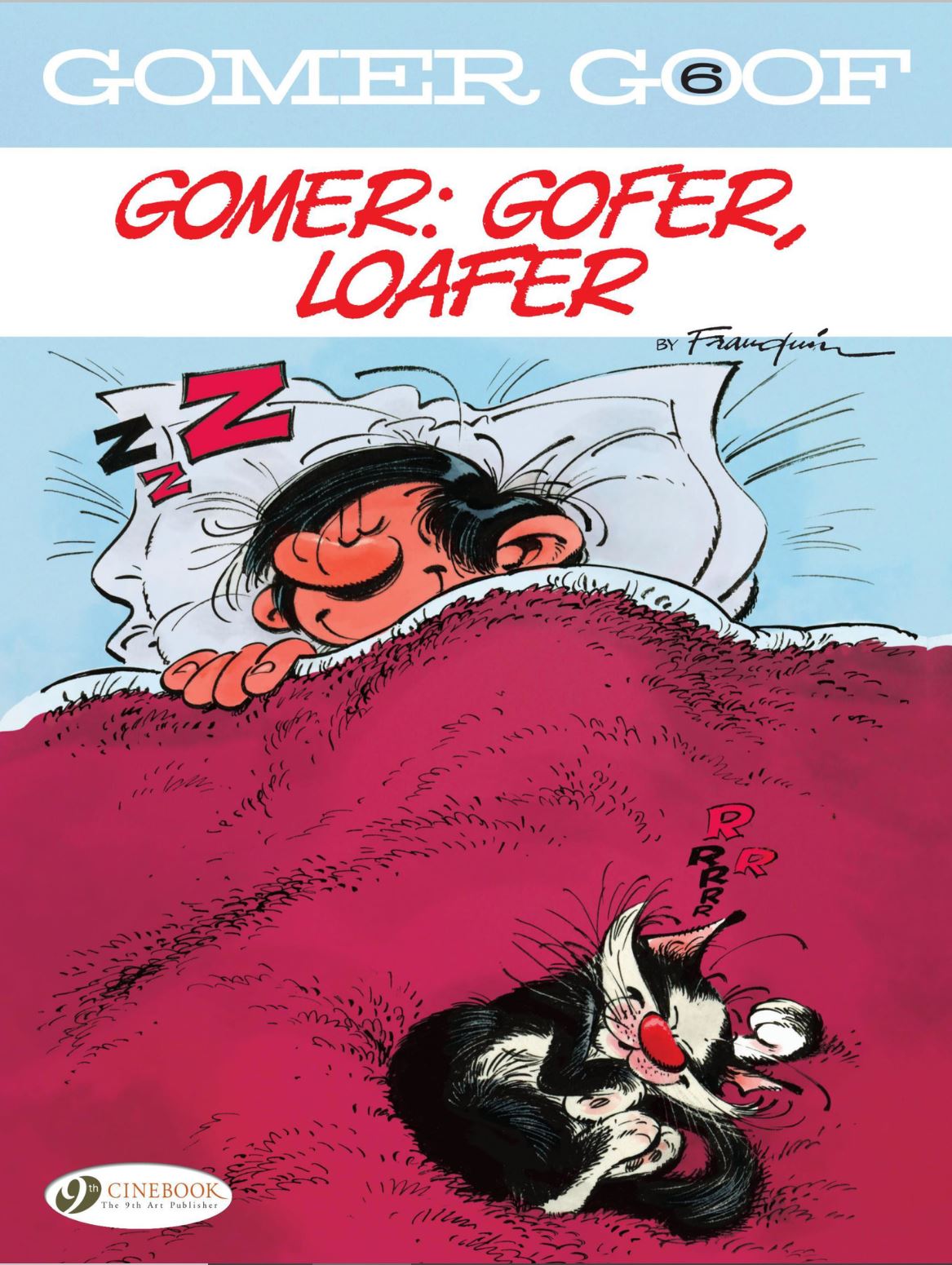
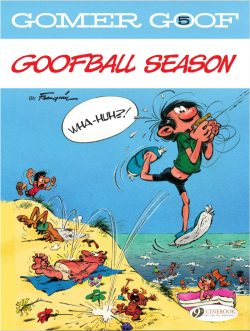
Gomer Goof volume 4: The Goof is Out There


By Franquin, translated by Jerome Saincantin (Cinebook)
ISBN: 978-1-84918-439-7 (PB Album/Digital edition)

Like so much in Franco-Belgian comics, it started with Le Journal de Spirou. The magazine had debuted on April 2nd 1938, with its engaging lead strip created by Rob-Vel (François Robert Velter). In 1943, publishing house Dupuis purchased all rights to the comic and its titular star, after which comic-strip prodigy Joseph Gillain (Jijé) took the helm for the redheaded kid’s exploits. Ultimately the publisher would become a character in its own periodicals publications…

In 1946 Jijé’s assistant André Franquin was handed creative control of the Spirou strip. He gradually switched from short gag vignettes to extended adventure serials, introducing a broad, engaging cast of regulars and in 1952 created phenomenally popular wonder-beast The Marsupilami. Debuting in Spirou et les héritiers, this critter grew into a spin-off star of screen, plush toy stores, console games and albums in his own right. Franquin continued crafting increasingly fantastic tales and absorbing Spirou sagas until his resignation in 1969.

Franquin was born in Etterbeek, Belgium on January 3rd 1924. Drawing from an early age, the lad only began formal art training at École Saint-Luc in 1943. When the war forced the school’s closure a year later, he worked at Compagnie Belge d’Animation in Brussels, where he met Maurice de Bévére (AKA Lucky Luke creator “Morris”), Pierre Culliford (“Peyo”, of The Smurfs and Benny Breakiron) and Eddy Paape (Valhardi, Luc Orient). All but Peyo signed on with Dupuis in 1945.

Franquin began his career as a jobbing cartoonist and illustrator, producing covers for Le Moustique and scouting magazine Plein Jeu. During those early days, Franquin and Morris were tutored by Jijé, at that time chief illustrator at LJdS. He made them – and fellow newbie Willy Maltaite (AKA “Will” – Tif et Tondu, Isabelle, Le jardin des désirs) – into a smoothly functioning creative bullpen known as La bande des quatre or “Gang of Four”. They would ultimately revolutionise Belgian comics with their prolific and engaging “Marcinelle school” style of graphic storytelling…

Jijé handed Franquin all responsibilities for the flagship strip part-way through Spirou et la maison préfabriqué (#427, June 20th 1946) and eager office junior ran with it for two decades; enlarging the feature’s scope and horizons until it became purely his own. Almost every week fans met startling new characters like comrade and rival Fantasio or crackpot inventor and Merlin of mushroom mechanics the Count of Champignac

Spirou & Fantasio became a globetrotting journalist team, visiting exotic places, exposing crimes, exploring the fantastic and clashing with a coterie of bizarre and exotic arch-enemies. Throughout all that, Fantasio was still a full-fledged reporter for Le Journal de Spirou and had to pop into the Dupuis office all the time. Sadly, lurking there – or was it just in the artist’s head? – was an accident-prone, smugly big-headed office junior in charge of minor jobs and dogs-bodying. Franquin called him Gaston Lagaffe

There’s a long history of fictitiously personalising those mysterious back room creatives and all the arcane processes they indulge in to make our favourite comics, whether it’s Stan Lee’s Marvel Bullpen or DC Thomson’s lugubrious “Mr. Editor” and underlings at The Beano and Dandy. Let me assure you that it’s a truly international practise and the occasional asides on text pages featuring well-meaning foul-up/office gofer Gaston (who debuted in #985, cover-dated February 28th 1957) grew to be one of the most popular components of the comic, whether as short illustrated strips or in faux editorial reports in text-feature form.

On a strictly personal note, I still think current English designation Gomer Goof (this name comes from an earlier, abortive attempt to introduce the character to American audiences) is unwarranted. The quintessentially Franco-Belgian tone and humour doesn’t translate particularly well (la gaffe translates as “blunder” not “idiot”) and the connotation contributes nothing here. When he surprisingly appeared in a 1970s UK Thunderbirds annual as part of an earlier syndication attempt, Gaston was rechristened Cranky Franky. Perhaps they should have kept that one or, best of all, his original designation…

In terms of actual schtick and delivery, older readers will recognise beloved beats of Benny Hill and Jacques Tati in timeless elements of all-consuming, grandiose self-delusion, and recognise recurring situations from Some Mothers Do Have ’Em or Mr Bean. It’s all surreal slapstick, paralysing puns, infernal ingenuity and invention, pomposity lampooned and no good deed going noticed, rewarded or unpunished…

As previously stated, Gomer makes his living (let’s not dignify or mis-categorise what he does as “work”) at the Spirou editorial offices: occasionally reporting to go-getting journalist Fantasio, complicating the lives of office manager Léon Prunelle and other staffers, generally ignoring the minor design jobs like paste-up, “gofer-ing” and office maintenance he’s paid to handle. There’s also editing readers’ letters… the official reason why fan requests and suggestions are never answered…

Gomer is lazy, peckish, opinionated, ever-ravenous, impetuous, underfed, forgetful and eternally hungry, with his most manic moments all stemming from “inventing”, cutting work corners and stashing or illicitly consuming contraband food in the office…

This leads to constant clashes with police officer Longsnoot and fireman Captain Morwater, yet the office oaf remains eternally easy-going and incorrigible. Only two questions are really important here: why does Fantasio keep giving him one last chance, and what can gentle, beguiling, flighty, impressionable, utterly lovelorn secretary Miss Jeanne possibly see in the self-opinionated idiot?

Originally released in 1969 as the sixth collection of Le Journal de Spirou strips Gaston – Un gaffeur sachant gaffer, this fourth Cinebook compilation eschews longer cartoon tales and comedic text “reports” from the comic’s editorial page to deliver non-stop all-Franquin comics gags in single-page bursts.

It begins at the New Year and here the office hindrance – as ever – invents stuff that makes life harder for everyone; amiably passes on bugs and ailments; sets driving records no one can believe or probably survive and scotches attempts by financier De Mesmaeker (in-joke analogue of fellow creator Jidéhem – real name is Jean De Mesmaeker ) the explosively irate businessman whose ever-failing efforts to get his contracts signed render him a constant foil for and unfortunate victim of the Goof…

There is also an unwelcome return for his devastating musical invention as the recurrent saga of his truly terrifying Brontosaurophone/Goofophone continues to disrupt commerce, glass, the environment and most organic life in earshot…

Set in snowy, foggy wonderlands, Gomer disastrously pioneers powered ice skating before revolutionising record keeping and book storage with his mechanical successor to ladders, prior to embarking upon an extended sequence of episodes wherein Gomer’s attempts to do away with unsightly, annoying, constantly shedding Christmas tree needles results in the birth of a monster. He should never have dabbled with glue and pressure hoses, but at least he had his Goofophone music to console him…

All too soon, though, he’s back to breaking laws physicists consider sacrosanct – such as when he began dabbling with perpetual motion technology – or upsetting traffic cops, firemen and clients. Somehow, always and in all ways, the Goof keeps letting down his colleagues and employers, like when he decided to fix the big clock on the building exterior, or tweaked the overstretched office fuse board to accommodate his new secret electric stove…

Many strips involve manic efforts to modify the motorised atrocity he calls his car: an appallingly decrepit and dilapidated Fiat 509 auto(barely)mobile desperately in need of his many well-meant attempts to counter its lethal road pollution. It’s the reason he always has the sniffles or wears some kind of bandage, plaster or splint…

At heart, though, Gomer is a Good Samaritan and champion of animals. Many strips here prove how his love of all creatures great and small trumps minor considerations like personal safety, traffic laws or city ordinances, even though his distinctly novel approach to cookery borders on criminal perversity…

This time out there’s also a deep concentration on home – and office – improvements and novel – if somewhat risky – variations on established and beloved sports all given a fresh makeover by the unique innovator, such as when he showed Prunelle and Fantasio how he had beefed up bouncy amusement “the spacehopper”…

And he should never ever have been allowed to bring his chemistry set to work…

In this volume, we meet his opposite number from across the road. Jules-from-Smith’s-across-the-street is a like-minded soul and born accomplice always eager to slope off for a chat, and a devotee of Gomer’s methods of passing the time whilst at work. He even collaborates on such retaliations as Gomer inflicts on officer Longsnoot…

Far better enjoyed than précised or described, these strips allowed Franquin to flex whimsical muscles and even subversively sneak in some satirical support for his beliefs in pacifism and environmentalism. However, at their core the gags remain supreme examples of all-ages comedy: wholesome, barbed, daft and incrementally funnier with every re-reading.

Have you started Goofing off yet?
© Dupuis, Dargaud-Lombard s.a. 2009 by Franquin. All rights reserved. English translation © 2019 Cinebook Ltd.

The Dandy Book 1972


By many & various (D.C. Thomson & Co.)
ISBN: 978-0-85116-043-6 (HB)

For generations of British fans Christmas means The Beano Book, The Broons, Oor Wullie and making every December 25th magical. There used to be many more DC Thomson titles, but the years have gradually winnowed them away. Thankfully, time means nothing here, so this year I’m concentrating on another Thomson Christmas cracker that made me the man wot I am. As usual my knowledge of the creators involved is woefully inadequate but I’m going to hazard a few guesses anyway, in the hope that someone with better knowledge will correct me whenever I err.

The Dandy comic predated The Beano by eight months, utterly revolutionising the way children’s publications looked and – most importantly – how they were read. Over decades it produced a bevy of household names that delighted millions, with end of year celebrations being bumper bonanzas of the weekly stars in magnificent bumper hardback annuals.

Premiering on December 4th December 1937, The Dandy broke the mould of its hidebound British predecessors by utilising word balloons and captions rather than narrative blocks of text under sequential picture frames. A colossal success, it was followed on July 30th 1938 by The Beano. Together they revolutionised children’s publications. Dandy was the third longest running comic in the world (behind Italy’s Il Giornalino – launched in 1924 – and America’s Detective Comics in March 1937).

Over decades the “terrible twins” spawned countless cartoon stars of unforgettable and beloved household names who delighted generations of avid and devoted readers…

The Christmas Annuals were traditionally produced in the wonderful “half-colour” British publishers used to keep costs down whilst bringing a little spark into our drab and gloomy young lives. The process involved printing sections with only two (of potentially 4) plates, such as blue/Cyan and red/Magenta as seen in this majority of this tome. The versatility and palette range provided was astounding. Even now the technique screams “Holidays” to me and my contemporaries, and this volume uses the technique to stunning effect.

As you can see, the fun-filled action begins on the covers and continues on the reverse, with front-&-back covers and Introduction pages occupied by superstar Korky the Cat (by Charlie Grigg) setting the tone with a sequence of splendid seasonal sight gags.

D.C. Thomson were also extremely adept at combining anarchic, clownish comedy with solid fantasy/adventure tales. The eclectic menu truly opens with some topical environmentalism working as drama in Paddy Brennan’s ‘Guardian of the Red Raider’. Such picture thrillers still came in the traditional captioned format, with blocks of typeset text rather than word balloons. Here, bedridden schoolboy Freddy Gibbon “adopts” a vixen and her cubs, secretly safeguarding them from harm until they can fend for themselves.

From there we revert to the cheeky comfort of simpler times as Dirty Dick – by the incredibly engaging Eric Roberts (no, not the actor) – finds our perennially besmudged and befouled boy on his best and cleanest behaviour in anticipation of a visit from his American penfriend. However, in comics good intentions count for nothing…

Appropriately switching to black and blue plates, we next meet eternal enemies Bully Beef and Chips. Drawn by Jimmy Hughes, the thuggish big kid’s antics invariably proved that a weedy underdog’s brain always trumped brutal brawn, as here where little Chips orchestrates well-deserved payback after Bully forces little lads to play with his dangerously-rigged Christmas crackers…

Hugh Morren’s The Smasher was a lad cut from the same mould as Dennis the Menace and in the first of his contributions carves a characteristic swathe of anarchic destruction, when seeking to join a cowboy movie location shoot,

A quick switch to red & black – and all the tones between – signals the advance of hard-pressed squaddie Corporal Clott (by David Sutherland) who again bears the brunt of cruel misfortune and surly Colonel Grumbly when ordered to provide a slap-up feed for a visiting General…

The prolific Roberts always played a huge part in making these annuals work and next up his signature star Winker Watson hosts double-page picture puzzle ‘Catch the Imps!’: testing mind, eye and vocabulary before Shamus O’Doherty’s Bodger the Bookworm is seduced away from his comfortable reading to play football… with catastrophic repercussions…

Back in black & blue, traditional chaotic school hijinks get a cruel and crazy feudal spin in Ron Spencer’s Whacko! before we stay on topic but jump 500 years to the then-present and a different take on the education crisis. Whilst much comics material was based on school as seen by pupils, George Martin’s Greedy Pigg featured a voracious teacher always attempting to confiscate and scoff his pupils’ snacks. This time, he forsakes tuck boxes and extends his reach to the fodder fed to zoo animals – and gets what he deserves after masquerading as a gorilla…

Unforgivably racist but somehow painfully topical, Hughes’ Wun Tun and Too Tun the Chinese Spies traces the misadventures of badly-briefed oriental agents in old Blighty. Here they get lost in and misunderstand the point of sewers, after which Sutherland’s Desperate Dan offers a range of incidents deriving from the sagebrush superman letting his beard grow out of control.

The daftness drifts into more brilliantly entertaining eco-messaging as Peter Potter’s Otters – by Grigg employing his dramatic style – sees a gamekeeper’s son contrive to rescue a family of river-dwelling “pests” from the community seeking to eradicate them…

Jack Edward Oliver’s My Woozy Dog Snoozy proves utterly useless as a security guard, but does usher in green & black tones to welcome back Korky the Cat, whose clash with a fish farm’s “security guards” segues into a doggerel dotted Zany Zoo feature. An examination of The Smasher’s evolutionary forebears heralds a resumption of blue hues as Roberts delivers another classic Winker Watson yarn that is now sadly drenched in controversy and potential offense.

It begins when the Third Form lads of Greytowers School act on their love of the BBC’s Black and White Minstrel Show (look it up, but be prepared to be appalled before realising just how far we’ve come…): adding a blackface minstrel skit to the Christmas Concert. When chastised and rebuffed by form master Mr. Creep, schoolboy grifter Winker institutes a cunning scheme – worthy of Mission Impossible or Leverage – to make the teacher the butt of a joke and star of the show…

The green scene enjoys one last outing for a lengthy police spoof. Created by John Geering and played strictly for laughs, P.C. Big Ears was an overzealous beat copper with outrageous lugholes whose super-hearing and faithful dog Sniffer helped him crush “crime”. Here the dynamic duo are hot on the trail of a truant schoolboy, but pay a irritating price for their dutiful diligence, after which another light-hearted drama ensues, courtesy of Bill Holroyd.

With premium blue & red plates back in play home-made mechanoid Brassneck kicks off an avalanche of trouble after a service by his inventor. Uncle Sam pal warns the robot-boy’s pal Charley Brand that the automaton might be a little fragile for a while but is blithely unaware how rowdy and boisterous school can be. When a couple of unavoidable buffets trigger wild outbursts, Brassneck’s antics close the school, empty the parks and even cause animal escapes from the zoo before order is finally restored…

Desperate Dan then catches cold and almost decimates the environment in his efforts to get warm and stop sneezing before Korky the Cat suffers the downside of camping, and pint-sized hellion Dinah Mite (drawn by Ron Spencer) tests some possible careers should she ever leave school.

Another blue section opens with animal gags in Jokey Jumbo and Winker Watson puzzle feature ‘It’s as Easy as ABC’ before My Woozy Dog Snoozy compounds his worthlessness when a burglar breaks in.

A switch to red and black sees Corporal Clott suckered by a spiv and become the proud new owner of a lethally destructive vacuum cleaner after he replaces the naff motor with a leftover jet engine. Blue tones are back as George Matin’s big-footed klutz Claude Hopper learns why he’s not cut out for a job waiting tables and Korky the Cat wins a fancy dress competition by being extremely cool…

More red & blue pages picture Dirty Dick at his dustily destructive worst before a switch to yellow & black plates finds Greedy Pigg imitating a tramp to get scrumptious handouts before Wun Tun and Too Tun the Chinese Spies return in another distressingly outdated and inappropriate espionage episode.

Rendered in red and black. Sandy Calder powerfully illustrates Scruffy the Bad-Luck Doggie as ordinary kid Danny Dunlop saves a scrappy mutt from bullies trying to drown it, but takes some time and effort – and a few hard knocks – adjusting to being the owner of a semi-feral delinquent dog…

Sentiment surrenders to surreal silliness and yellow hues as Desperate Dan teaches a dog how to be fierce, before Bodger the Bookworm enflames his family by practising matchstick tricks and Korky successfully poaches a fish in more ways than one, after which black & blue tones detail a pretty Darwinian battle for survival and supremacy amongst alley cats as Boss of the Backyards (by Murray Ball – whose wonderful Footrot Flats strips are just crying out for a modern archival edition) sees a tough newcomer challenge a wild moggy in the kingdom of bins and backstreets…

Dirty Dick is tarred by own insolence – and tar – in a very early example of photobombing and My Woozy Dog Snoozy turns the tables on his longsuffering owner, before P.C. Big Ears finds his own hound complicit in apple scrumping. Corporal Clott then dumps the colonel in a frozen river and Korky again profits from his thieving ways…

Another flush of red & blue captures Bully Beef and Chips causing chaos with a doctor’s play set and Greedy Pigg outsmarted by the dog he borrowed to steal food for him, and true blue drama Bold Ben’s Boulder (by Victor Peon?) has a young boy save his uncle’s fortune and life when Burmese bandits go on a kidnapping spree before one final flush of red & black sees Desperate Dan solve a lighting crisis with a little illuminating larceny…

With Puzzle Answers and the aforementioned Korky endpapers wrapping up proceedings, let’s celebrate another tremendously fun book; with so much merriment on offer I can’t believe this book is 51 years old, and still available through second hand outlets.

The only thing better would by curated archive reissues and digital editions…
© D.C. Thomson & Co., Ltd, 1971.

Merry Christmas Every One!

In keeping with my self-imposed Holidays tradition, here’s another pick of British Annuals selected not just for nostalgia’s sake but because it’s my wife’s house and my rules…

After decades when only American comics and memorabilia were considered collectable or worthy, a resurgence of interest in home-grown material means there’s lots more of this stuff available. So, if you’re lucky enough to stumble across a vintage volume, modern facsimile or even one of the growing number of digital reproductions increasingly cropping up, I hope my words can convince you to expand your comfort zone and try something old…

Still topping my Xmas wish-list are more collections from fans and publishers who have begun to rescue this magical material from print limbo in (affordable and annotated) new collections…

Great writing and art is rotting in boxes and attics or the archives of publishing houses, when it needs to be back in the hands of readers once again. As the tastes of the reading public have never been broader and since a selective sampling of our popular heritage will always appeal to some part of the mass consumer base, let’s all continue rewarding publishers for their efforts and prove that there’s money to be made from these glorious examples of our communal childhood.

These materials were created long ago in a different society for a very different audience. As such much material is inadvertently funny, blatantly racist and/or sexist and pretty much guaranteed to offend somebody sooner or later. Think of it as having to talk to your grandparents about “back when everything was better”…

If you don’t think you can tolerate – let alone enjoy – what’s being discussed here, maybe it’s not the book you need today. Why not look at something else or play a game instead?

Archie: 80 Years of Christmas (Archie Christmas Digests book 3)


By Dan Parent, Angelo DeCesare, Francis Bonnet, Pat & Tim Kennedy, Bill & Ben Galvan, Jeff Shultz, J. Torres, Hal Lifson, Bob Bolling, Mike Pellowski, Dexter Taylor, Kathleen Webb, Dan DeCarlo & family, Stan Goldberg, Henry Scarpelli, Holly G!, John Lowe, Rudy Lapick, Frank Doyle, Dan DeCarlo, Alison Flood, George Gladir, Jon D’Agostino, Joe Edwards, Chic Stone, John Rosenberger, Dick Malmgren, Al Hartley, Joe Sinnott, Victor Gorelick, Bill Vigoda, Terry Szenics, Mario Acquaviva, Harry Lucey, Tom Moore, Harry Sahle, Bob Montana & various (Archie Comics)
ISBN: 978-1-64576-927-9 (TPB/Digital edition)

Win’s Christmas Gift Recommendation: An Unmissable Tradition… 9/10

As long-term readers might recall, my good lady wife and I have a family ritual we’re not ashamed to boast of or share with you. Every Christmas, we barricade the doors, draw the shutters, stockpile munchies (healthy ones, because we’re old now), bank up the fires and lazily subside into a huge pile of seasonal comics from yesteryear.

(Well, I do: she also insists on a few monumental feats of cleaning and shopping before manufacturing the world’s most glorious and stupefying meal to accompany my reading, gorging and – eventually, inevitably – snoring… Oh, so much snoring and from all ends!)

The irresistible trove of funnybook treasures generally comprises older DC’s, loads of Disney’s and British annuals, but the vast preponderance is Archie Comics.

From the earliest days this American institution has quite literally “owned Christmas” via a fabulously funny, nostalgically charming, sentimental barrage of cannily-crafted stories capturing the spirit of the season through a range of cartoon stars from Archie to Veronica, Betty to Sabrina and Jughead to Santa himself…

For most of us, when we say “comic books” thoughts turn to anthropomorphic animals or steroidal types, and women in too-skimpy tights and G-strings: hitting each other, bending lampposts and lobbing trees or cars about. That or stark, nihilistic crime, horror or science fiction sagas aimed at an extremely mature and sophisticated readership of confirmed fans…

Throughout the eight decades of the medium, other forms and genres have waxed and waned. One that has held its ground over the years – although almost completely migrated to TV these days – is the genre of teen-comedy, begun by and synonymous with a carrot topped, homely (at first, just plain ugly) kid named Archie Andrews.

MLJ were a small publisher who jumped on the “mystery-man” bandwagon following the debut of Superman. In November 1939 they launched Blue Ribbon Comics, promptly following-up with Top-Notch and Pep Comics. Content was a standard blend of costumed heroes and two-fisted adventure strips, although Pep did make a little history with its first lead feature The Shield, who was the American industry’s first superhero to be clad in the flag (see America’s 1st Patriotic Hero: The Shield).

After initially revelling in the limitless benefits of the Fights ‘N’ Tights game, Maurice Coyne, Louis Silberkleit and John Goldwater (MLJ, duh!) spotted a gap in their blossoming market. In December 1941 their stable of costumed cavorters and two-fisted adventurers were gently nudged aside – just a fraction at first – by a wholesome, improbable and far-from-imposing new hero: an unremarkable (except, perhaps, for those teeth) teenager who had ordinary adventures just like the readers might, but with the laughs, good times, romance and slapstick emphasised.

Inspired by the hugely popular Andy Hardy movies, Goldwater developed the concept of a youthful everyman protagonist: tasking writer Vic Bloom & artist Bob Montana with the job of making it all work. Their precocious new notion premiered in Pep #22: gap-toothed, freckle-faced, red-headed and obsessed with impressing the pretty blonde girl next door.

An untitled 6-page tale introduced hapless boob Archie and wholesome Betty Cooper. The boy’s unconventional best friend and confidante Jughead Jones also debuted in the story, as did idyllic small-town utopia Riverdale. It was a huge hit and by the winter of 1942 the kid and his pals won a title of their own.

Archie Comics #1 was MLJ’s first non-anthology title and with it began a slow, inexorable transformation of the entire company. With the introduction of ultra-rich, raven-haired Veronica Lodge, all the pieces were in play for the industry’s second Genuine Phenomenon…

By 1946, the kids were in charge and the publisher rebranded as Archie Comics: retiring most of its costumed cohort years before the end of the Golden Age, becoming to all intents and purposes a publisher of family-friendly comedies. The hometown settings and perpetually fruitful premise of an Eternal Romantic Triangle – with girl-hating best bud Jughead and scurrilous rival Reggie Mantle to test, duel and vex our boy in their own unique ways – the scenario was one that not only resonated with the readership but was infinitely fresh…

Like Superman, Archie’s success forced change in content at almost every other publisher, building a multi-media brand which encompasses TV, movies, newspaper strips, toys, games and merchandise, a chain of restaurants and, in the swinging sixties, a pop music milestone when Sugar, Sugar – from the animated TV cartoon – became a global pop smash. Clean and decent garage band “The Archies” has been a fixture of the comics ever since…

The Andrews boy is good-hearted, impetuous and lacking common sense, Betty his sensible, pretty girl next door loves the ginger goof, and Veronica is rich, exotic and glamorous: only settling for our boy if there’s nobody better around. She might actually love him too, though. Archie, of course, is utterly unable to choose who or what he wants. Over the years, other girls like Cheryl Blossom and pop Pussycat Valerie have also added to his confusion…

Unconventional, food-crazy Jughead is Mercutio to Archie’s Romeo, providing rationality and a reader’s voice, as well as being a powerful catalyst of events in his own right. That charming House of Luurve (and Annexe of Envy) has been the rock-solid foundation for seven decades of funnybook magic. Moreover, the concept is eternally self-renewing…

This eternal triangle has generated thousands of charming, rowdy, gentle, frenetic, chiding and even heart-rending humorous dramas ranging from surreal wit to frantic slapstick, with the kids and a constantly expanding cast of friends – junior genius Dilton Doily, genial giant jock Big Moose and aspiring cartoonist Chuck amongst many others – growing into American institutions and part of the nation’s cultural landscape.

Archie’s world thrives by constantly re-imagining its core archetypes: seamlessly adapting to the changing world outside its bright, flimsy pages, shamelessly co-opting youth, pop culture and fashion trends into its infallible mix of slapstick and young romance. Every social revolution has been assimilated into the mix and, over decades, the company has confronted most social issues affecting youngsters in a manner always both even-handed and tasteful.

Constant addition of new characters such as African-Americans Chuck and his girlfriend Nancy, fashion-diva Ginger, Latinx couple Frankie and Maria, spoiled Cheryl Blossom and gay teen Kevin Keller have contributed to a wide and appealingly broad-minded scenario.

One of the most effective tools in the company’s arsenal has been the never-failing appeal of seasonal and holiday traditions. In Riverdale it was always sunny enough to surf at the beach in summer and it always snowed at Christmas…

The Festive Season has never failed to produce great comics stories, and Archie also started early (1942) and kept on producing memorable year-end classics. The stories became so popular and eagerly anticipated that in 1954 the company created a specific oversized title – Archie’s Christmas Stocking – to cater to demand, even as it kept the winter months of its other periodicals stuffed with assorted tales of elves and snow and fine fellow-feeling…

For this extra-festive celebratory commemoration, the editors have done something rather smart and savvy. Most collections – and there have been many – have advanced forward chronologically to whenever “now” is, but this one postulates a countdown back to the earliest natal nonsense, and thus we begin with a selection from The 2020s, but only after brief overview ‘80 Years of Holiday Hijinks’

Santa’s globetrotting troubleshooter Jingles the Elf – who cannot be seen by adults – has been a seasonal Archie regular for decades. Here Dan Parent & Jim Amash – with colourist Glenn Whitmore & letterer Jack Morelli – reveal ‘That Elf is Shelved!’ (from Archie Comics Jumbo Digest #315, January 2021) as the playful but exhausted pixie pops in to Riverdale and becomes a helpless tool of Archie’s inability to pick just one girl…

Betty & Veronica Jumbo Comics Digest #289 (January 2021) declares ‘You’re Baking Me Crazy!!’ as Parent, Bob Smith, Whitmore & Morelli depict the eternal rivals competing to create the best Gingerbread House, but making a cookie rookie mistake by letting Jughead judge…

The same creative team unleashed a ‘Blast From the Past’ (World of Archie Jumbo Comics Digest #315, December 2020) as the gang help Pop Tate decorate his diner and recall when they all made him ornaments. It was soooo long ago, but soon they’re squabbling over which one was best …and best-beloved…

Archie Comics Jumbo Digest #304 (January 2020), finds Angelo DeCesare, the Kennedy Bros!, Smith, Whitmore & Morelli introducing old-fashioned Dad Andrews to social media in ‘Yule Tube’ after which ‘It’s the Thoughtlessness That Counts’ (World of Archie Jumbo Comics Digest #94, January 2020 by Francis Bonnet, Bill & Ben Galvan) again sees Archie reel from misdirecting his gifts…

Distant decade The 2010s opens with ‘Santa Sleighed’ (Archie & Me Comics Digest #12, November 2018 by Parent, Jeff Shultz, Jim Amash, Whitmore & Morelli) as the fabled deliveryman makes an unscheduled pit stop at the Lodge mansion, before Little Archie makes trouble – and a big mess – trying to impress grade schoolers Betty & Veronica in ‘Snow Problem!’, courtesy of J. Torres, Bob Bolling & Amash as first seen in Archie Comics Double Digest #257 (February 2015). The era ends with Hal Lifson, Bill Galvan Amash, Phil Felix & Barry Grossman conjuring ‘An Old School Yule’ (Archie Double Digest #233, December 2011) with the world-weary teens recalling their childhoods when Christmas was fun, and going attic and basement diving to reconstruct a Christmas their parents can actually enjoy…

Stopping our retrograde voyage in The 2000s, ‘Christmas Cookies’ stars Little Jughead in a foody fable by Mike Pellowski, Dexter Taylor, Al Milgrom, Bill Yoshida & Grossman. It comes from Archie’s Double Digest Magazine #148 (February 2004) and sees the entire class required to create an original Holidays dish. Juggie’s is exceptional and its effects are global – even reaching Santa at the Pole…

That darned attention-seeking elf returns in ‘Jingles All the Way’ (Archie #543, February 2004, by Kathleen Webb, Stan Goldberg, Amash, Vickie Williams & Grossman), trying to pry Archie away from Betty & Veronica for some guy time and good deeds. However, its greedy Jughead who finds somewhere the pixie can really make a difference…

Archie’s Holiday Fun Digest Magazine #9 (December 2004) provides Betty & Veronica’s Holiday Style’ pinups by Parent, as a prelude to Webb, Shultz, Henry Scarpelli & Yoshida celebrating ‘A Dreamy Teen Christmas’ (Betty & Veronica #156, February 2001), with the rivals asked to decorate a very special tree for a charity bash, but unable to cease sparring over Archie…

Cheryl Blossom #28 (January 2000, by Holly G!, John Lowe, Yoshida & Grossman) finds Riverdale’s most spoiled brat in a war of excess with Veronica. Their flashy cash contest seeks to prove who’s swankiest, but the ‘Holi-Daze’ leave Betty and the plebian kids better off. Then The 1990s test failing memories with feelgood drama ‘Mall Be Home for Christmas’ (Archie & Friends #13, February 1995, by Parent, Rudy Lapick, Yoshida & Grossman), as Ronnie’s up-to-the-wire shopping spree coincides with a freak storm, trapping the entire class in a plush arcade on Christmas: Happily, money solves all problems…

Archie’s Christmas Stocking #1 (January 1995, by Frank Doyle, Dan DeCarlo, Alison Flood, Yoshida & Grossman) delivered ‘A Jingle for Justice’ as the elf’s seasonal sojourn uncovers an embezzler attempting to impoverish Veronica’s dad, after which Little Archie learns how poor people survive the season. Thanks to impoverished Sue Stringly, the kind-hearted but naïve little lad learns some hard truths and grows into a better boy in ‘Shine a Little Light’ (Archie Giant Series Magazine #607, January 1990 by Bolling, Mike Esposito, Yoshida & Grossman).

The 1980s offers pictures of Christmas pasts in ‘Archie’s Christmas Photo Album’ by George Gladir, Parent & Jim DeCarlo as first seen in Archie… Archie Andrews, Where Are You? Comics Digest Magazine #54, February 1988), before Joe Edwards & Dan DeCarlo, explore ‘Christmas Past, Present and Future’ when Ronnie mistakenly thinks Daddy is selling up and moving them out. Archie and Me #161 (February 1987, by Gladir, Chic Stone, Lapick, Yoshida & Grossman) sees Archie accidentally prevent school being closed with his lucky ‘Goof Spoof’, after which teen witch Sabrina learns how her aunts are crucial to Santa’s big night in ‘With a Little Help From His Friends’ (Archie Giant Series Magazine #515, January 1982 by Gladir, Goldberg & Jon D’Agostino). Issue #512 (December 1981) then details Archie’s rejection of faux yule logs and subsequent calamity in search of the real deal in ‘Christmas List’ by Gladir, Goldberg, Lapick, Yoshida & Grossman…

Little Archie #163 (February 1981 by Bolling & Grossman) then saw Little Veronica learn some hard truths of her own when Sue Stringly recruited her to help save ‘The Christmas Ducks’ before the decade closed with silly but satisfying sight gag ‘Carry Tarry’ courtesy of Archie’s Jokebook Magazine #265, February 1980…

The 1970s opens with ‘Christmas Togetherness’ by Doyle, Dan DeCarlo Jr. with Jimmy DeCarlo & Yoshida from Archie Giant Series Magazine #488 (December 1979), as the red-headed fool ponders the perfect gift for mom and dad, after which Sabrina and her family cleverly divert Head Witch Della’s plan to sabotage the Season in ‘And a Zappy New Year’ (AGSM #479, January 1979, by Gladir, Dan DeCarlo, Lapick, Yoshida & Grossman). The previous issue, released the same month, offered a traditional comedy of errors as the easily-distracted Andrews boy got his parcels mixed up in ‘Wisecracker’ by Dick Malmgren, D’Agostino & Grossman, before January 1975 unwraps Doyle, DeCarlo & Lapick’s ‘Plastic Santa’ (AGSM #230) as Mr Lodge is bombarded by the kids’ polemic about the meaning of the Season and still finds a way to make a profit…

AGSM #192 (January 1972) explored ‘Past and Present’ in a yarn by Al Hartley, Joe Sinnott & Yoshida wherein shopping-traumatised Archie hallucinates about the good old, pre-industrial days, coincidentally heralding the jump to The 1960s

Hartley went solo on gag strip ‘Make Their Christmas Wish’ from AGSM #150 (January 1968), followed by Doyle, Goldberg, Vince DeCarlo, Yoshida & Grossman’s ‘Party Pooper’ from the same issue as Archie suffers greatly to organise a surprise soiree for his parents, and Gladir, John Rosenberger & Victor Gorelick’s ‘Gift Tift’ (AGSM #144, January 1967) wherein conniving Reggie outsmarts himself in the cold war to win Ronnie away from Archie…

AGSM #31 (January 1965) offers a ‘Betty Pin Up’ by assorted DeCarlo’s & Lapick before #20 (January 1963) sees everyone trying to get at Archie’s ‘Black Book Bonanza’ in a wild romp by Doyle, DeCarlo’s & Lapick, after which the same team in the same title see Reggie ‘Go For Broke’ after ruining Archie’s flashy perfume gift and reaping a whirlwind of pungent regret.

Staying with AGSM #20, Doyle, Bill Vigoda, Terry Szenics & Grossman continue Reggie’s agonising learning curve as ‘Not Even a Moose’ finds him playing foolish pranks on the naïve, short-tempered giant. The prankster discovers the dangers of telling innocent people there is such a man as Santa…

Veronica’s ‘Pin Up Page’ by Dan DeCarlo from AGSM #15 (January 1962) then segues into gag page ‘Gift Rapped’ (Archie’s Jokebook Magazine #52, February 1961), detouring to AGSM #10 (January 1961, by Vigoda & Mario Acquaviva) where the red menace fumbles a ‘Gift Collection’ and trashes Christmas for the entire school. The period closes with Tom Moore’s gag page from the same issue proving rival Reg and Arch have ‘More Pull Than Talent!’

Heading rapidly for the opening stretch, we explore the feature’s golden age of The 1950s beginning with a wily witticism by slapstick genius Harry Lucey who reveals ‘Santa’s Surplus’ in a certified classic from Archie’s Jokebook Magazine #39 (March 1959), whilst Archie #98 (February 1959) shares Vigoda’s take on Shopping with Veronica in ‘Package Deal’ and Doyle, Lucey & Grossman’s skating themed fiasco ‘Deep Freeze’

Vigoda, Acquaviva & Grossman crafted party panic in ‘Tree to Get Ready’ (Archie’s Girls Betty and Veronica #40, January 1959) before the age of optimism ends with ‘Dis-Missile’ by Doyle, Dan and Vince DeCarlo & Lapick from AGSM #4 (1957) as our helpful B&V coordinate school letters to Santa and trigger a clerical crisis…

We end as it all began in The 1940s where Harry Sahle crafted ‘Mush, Oscar!, Mush!’ for Archie #12 (Winter 1944). Starring Archie’s Dog Oscar it again proved that – although well-intentioned – even the pets in the Andrews home were disaster magnets – especially if there was snow on the ground and ice on the pond…

We close with ‘The Case of the Missing Mistletoe!’ from Winter 1942 by Bob Montana. It featured in Archie #1, and found Archie and Jughead more baffled than ever and at loggerheads after unknowingly taking identical twins to a Christmas party…

These are joyously effective and entertaining tales for young and old alike, crafted by some of Santa’s most talented Helpers, epitomising the magic of the Season and celebrating the perfect wonder of timeless all-ages storytelling. What kind of Grinch could not want this book in their kids’ stocking (from where it can most easily be borrowed)?
© 2021 Archie Comics Publications, Inc. All rights reserved.
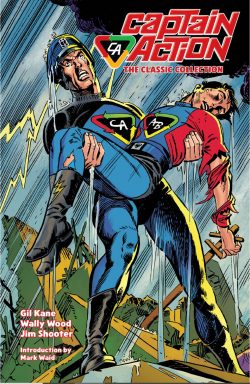
Jack Kirby’s Kamandi – The Last Boy on Earth! Omnibus/Kamandi – The Last Boy on Earth! by Jack Kirby volume 1


By Jack Kirby, Gerry Conway, Mike Royer, D. Bruce Berry & various (DC Comics)
ISBN: 978-1-4012-7469-6 (Omnibus HB) (volume 1 TPB/Digital edition)

Win’s Christmas Gift Recommendation: Epic – if not Prophetic – Entertainment… 10/10

This book is huge and heavy: 191 x 56 x 280 mm, 880 slick pages and topping the scales at 2.75 kilos – that’s more than six pounds! Believe it or not, it’s actually worth every second of time you spend on it, but be warned that you’ll need strong arms and sturdy wrists to get the best out of it…

Jack Kirby (28th August 1917 – 6th February 1994) was – and nearly 30 years after his death, remains – the most important single influence in the history of American comics. There are innumerable accounts of and testaments to what the man has done and meant, and you should read those if you are at all interested in our medium.

Kirby was a man of vast imagination who translated big concepts into astoundingly potent and accessible symbols for generations of fantasy fans. If you were exposed to Kirby as an impressionable child you were his for life. To be honest, that probably applies whatever age you jump aboard the “Kirby Express”…

For those of us who grew up with Jack, his are the images which furnish and clutter our interior mindsets. Close your eyes and think “robot” and the first thing that pops up is a Kirby creation. Every fantastic, futuristic city in our heads is crammed with his chunky, towering spires. Because of Jack we all know what the bodies beneath those stony-head statues on Easter Island look like, we are all viscerally aware that you can never trust great big aliens parading around in their underpants and, most importantly, we know how cavemen dressed and carnosaurs clashed…

Synonymous with larger than life characters and vast cosmic imaginings, Jack “King” Kirby was an astute, spiritual man who had lived through poverty, prejudice, gangsterism, the Depression and World War II. He experienced Pre-War privation, Post-War optimism, Cold War paranoia, political cynicism and the birth and death of peace-seeking counter-cultures, but always looked to the future while understanding human nature intimately.

In the late 1930s, it took a remarkably short time for Kirby and his creative collaborator Joe Simon to become the wonder-kid dream-team of the new-born comic book industry. Together they produced a year’s worth of influential monthly Blue Bolt, dashed off Captain Marvel Adventures (#1) for overstretched Fawcett, and – after Martin Goodman appointed Simon editor at Timely Comics – launched a host of iconic characters including Red Raven, Marvel Boy, Mercury/Hurricane, The Vision, Young Allies and million-selling mega-hit Captain America.

When Goodman failed to make good on his financial obligations, Simon & Kirby were snapped up by National/DC, who welcomed them with open arms and a fat chequebook. Bursting with ideas the staid industry leaders were never really comfortable with, the pair were initially an uneasy fit, and awarded two moribund strips to play with until they found their creative feet: Sandman and Manhunter.

They turned both around virtually overnight and, once safely established and left to their own devices, switched to the “Kid Gang” genre they had pioneered at Timely. Joe & Jack created wartime sales sensation Boy Commandos and Homefront iteration The Newsboy Legion before being called up to serve in the war they had been fighting on comic pages since 1940.

Once demobbed, they returned to a very different funnybook business, and soon after left National to create their own little empire…

Simon & Kirby ushered in the first American age of mature comics – not just by inventing the Romance genre, but with all manner of challenging modern material about real people in extraordinary situations before seeing it all disappear again in less than eight years.

After years of working for others, Simon & Kirby established their own publishing house: making comics for a far more sophisticated audience, only to find themselves in a sales downturn and awash in public hysteria generated by an anti-comicbook pogrom. Their small stable of magazines – generated for an association of companies known as Prize, Crestwood, Pines, Essenkay and Mainline Comics – blossomed and as quickly wilted when the industry contracted throughout the 1950s, but had left future generations fascinating ventures such as Boys’ Ranch, Bullseye, Crime Does Not Pay, Black Magic, Boy Explorers, Fighting American and the entire genre of Romance Comics…

Hysterical censorship-fever spearheaded by US Senator Estes Kefauver and opportunistic pop psychologist Dr. Frederic Wertham led to witch-hunting Senate hearings. Caving in, most publishers adopted a castrating straitjacket of draconian self-regulatory rules. Crime and Horror titles produced under the aegis and emblem of the Comics Code Authority were sanitised and anodyne affairs in terms of mature themes, political commentary, shock and gore even though the market’s appetite for suspense and the uncanny was still high. Crime comics vanished as adult sensibilities challenging an increasingly stratified and oppressive society were suppressed. Suspense and horror were dialled back to the level of technological fairy tales and whimsical parables…

Simon left the business for advertising, but Jack soldiered on, taking his skills and ideas to safer, more conventional, less experimental companies. As the panic abated, Kirby returned briefly to DC Comics, working on bread-&-butter anthological mystery tales and revamping Green Arrow (at that time a back-up feature in Adventure Comics and World’s Finest Comics) whilst concentrating on his passion project: newspaper strip Sky Masters of the Space Force.

During that period Kirby also re-packaged a super-team concept that had been kicking around in his head since he and Joe had closed their innovative, ill-timed ventures. At the end of 1956, Showcase #6 premiered the Challengers of the Unknown

After three more test issues they won their own title with Kirby in command for the first eight. Then a legal dispute with Editor Jack Schiff exploded and the King was gone…

He found fresh fields and an equally hungry new partner in Stan Lee at the ailing Atlas Comics outfit (which had once been mighty Timely) and launched a revolution in comics storytelling…

After more than a decade of a continual innovation and crowd-pleasing wonderment, Kirby felt increasingly stifled. His efforts had transformed the dying publisher into industry-pioneer Marvel, but that success had left him feeling trapped in a rut. Thus, he moved back to DC and generated another tidal wave of sheer imagination and pure invention. The result was experimental adult magazines Spirit World and In the Days of the Mob and a stunning reworking of Superman’s Pal Jimmy Olsen – and by extension, all DC continuity. The latter was a prelude to his landmark Fourth World Saga (Forever People, New Gods and Mister Miracle): the very definition of something game-changing and far too far ahead of its time…

Kirby instinctively grasped the fundamentals of pleasing his audience and always strived diligently to combat the appalling prejudice regarding the comics medium – especially from industry insiders and professionals who despised the “kiddies world” they felt trapped in. After his controversial, grandiose Fourth World titles were cancelled, Kirby explored other projects that would stimulate his own vast creativity yet still appeal to a market growing ever more fickle. These included science fictional survival saga Kamandi, supernatural stalwart The Demon, traditional war stories starring established DC team The Losers, OMAC: One Man Army Corps and even a new Sandman – co-created with old pal Joe Simon.

However, although ideas kept coming (Atlas, Kobra, a new Manhunter and Dingbats of Danger Street), once again editorial disputes took up too much of his time. Reluctantly, he left again, choosing to believe in promises of more creative freedom elsewhere…

As early as 1974, worn down by a lack of editorial support and with his newest creations inexplicably tanking, Kirby considered a return to Marvel, but – ever the consummate professional – scrupulously carried out every detail of an increasingly onerous and emotionally unrewarding DC contract. Although The Demon was cancelled after 16 issues and he needed another title to maintain his Herculean commitments (Jack was legally obliged to deliver 15 completed pages of art and story per week!) Kamandi – The Last Boy on Earth had found a solid and faithful audience. It also provided further scope to explore big concepts as seen in thematic companion OMAC: One Man Army Corps. Both series gave Kirby’s darkest assumptions and prognostications free rein, and his “World That’s Coming” has proved far too close to the World we’re frantically trying to fix or escape from today…

Kirby’s return to Marvel in 1976 was much hyped and eagerly anticipated at the time, but again proved controversial. New works like The Eternals and Devil Dinosaur found friends rapidly, but his return to earlier – continuity-locked – creations Captain America and Black Panther divided the fanbase.

Kirby was never slavishly wedded to what had come before, and preferred, in many ways, to treat his stints on titles as a “Day One”: a policy increasing at odds with the close-continuity demanded by a strident faction of the readership…

There’s no need for any of that here as DC’s interconnected universe takes a distant back seat to amazement, adventure and satirical commentary for most of Kirby’s tenure…

This frankly monstrous hardback collection gathers arguably his boldest, most bombastic and certainly most successful 1970s DC creation: collecting Kamandi – The Last Boy on Earth #1-40 (cover-dated October/November 1972- April 1976): every issue Kirby was involved with, but not the 19 issues that staggered on after under lesser creative lights once he had returned to Marvel…

Preceded by inker/letterer Mike Royer’s Introduction ‘When Kirby Called!’ and supported by more ancillary features at the end, the magic opens with the introduction of ‘The Last Boy on Earth!’ as he explores a shattered world that has grown from the rubble of Mankind’s achievements and mistakes…

A signature of the series was large panels and vistas, particularly spectacular and breathtaking double-page spreads on pages 2-3 of almost every episode: adding an aspect of wide-screen cinematic bravura. It’s especially effective here as a capable, well-armed teenager paddles through the sunken ruins of New York City. The explorer has recently emerged from total isolation in a hermetically sealed bunker designated “Command D”, where he was schooled by his grandfather and constantly viewed a vast library of 1970s microfilm and news recordings. The boy calls himself “Kamandi”…

Having obliviously sat out the seemingly overnight decline and fall of humanity – in which atomic armageddon clearly played a major but not exclusive role, the boy mentally catalogues unbelievable and incomprehensible change on every level resulting from the mysterious catastrophe now called “The Great Disaster”…

This world is nothing like his education promised. Wreckage and mutant monsters abound, the very geography has altered and humans have somehow devolved into savage, non-verbal beasts hunted and exploited by a number of animal species who have gained intellect comparable to his own… and the power of speech. Most of them are engaged in wars for dominance, fuelled by territorial aggression and fostered by the scavenged remnants of humanity’s technologies…

When the boy returns to the bunker, he finds it has finally been breached and his grandfather is dead at the hands of opportunistic wolves far too much like men. Shocked, furious and now utterly alone, Kamandi ruthlessly fights his way out and sets off to find what else is out there in this scary new world…

When he reaches the remains of the New Jersey Turnpike, the boy stumbles into the new political reality when he is captured by mounted cavalry tigers (horses appear to be one species that never made the evolutionary leap to intellectual comprehension and personal autonomy).

A formal army of conquest, the tigers devotedly serve charismatic leader Great Caesar, who plans to unite Earth AD (“After Disaster”) under his militant banner. Here that means crushing a force of gun-toting leopards, but – well aware that their liege-lord is obsessed with weird devices and strange phenomena from the past – they make time to send the weird “talking animal” back to ‘The Royal City Kennels!’

It’s a mixed blessing all around. The human is preened and pampered but also kicked around by smug tiger soldiers, before he discovers Caesar’s greatest secret. The warrior king has recovered an atomic missile and made “the warhead” the central focus of a martial cult, and is outraged when Kamandi recognises and tries to destroy it…

In the aftermath, the troublesome boy is surrendered to the care of the conqueror’s chief scientist. A dog named Doctor Canus, he plays a deep game: advising the tiger army over recovered artefacts, whilst keeping huge secrets from his paymasters. The biggest one immeasurably lifts Kamandi’s crushed spirits when the dog introduces another talking human he’s sheltering…

However, although he’s rational, erudite and friendly, Ben Boxer isn’t exactly human!

The utterly jam-packed first issue also provides a map of what the Americas have become in ‘Kamandi’s Continent’ after which the series advanced to a monthly schedule with the second issue, as the young wanderer encounters more terrifying wonders in ‘Year of the Rat!’

Supplemented at the end by Kirby’s editorial codicil ‘The Great Earth Cataclysm Syndrome!’, this tale sees Ben and the boy escape Great Caesar’s compound when the stranger displays a secret power. Ben and his missing companions are nuclear mutants who can transition from flesh & blood to organic steel by internal fission, and after overpowering their tiger guards they flee together in a submersible vehicle. As they search the sunken remains of New York City for missing mutants Steve and Renzi, they are attacked by the avaricious evolved rats who took them and the flying craft they came in…

The rats are the ultimate scavenger society, stockpiling humanity’s detritus and exploiting whatever they understand of it. Once they add their two new captives to the pile, Ben and Kamandi react, explosively breaking free and escaping with Boxer’s rescued comrades in their reclaimed “Traveller”…

Great Caesar’s main opposition is a nation of militant gorillas, and #3 introduces them when the Traveller’s southward flight to the mutants’ home of “Tracking Site” pauses to survey what was once Nevada. When Kamandi is separated from the mutants and caught up in an animal round-up, he’s taken to a vast city to be broken for service…

As Ben, Steve and Renzi discover a monster-infested space museum and encounter ‘The Thing that Grew on the Moon!’, recalcitrant Kamandi is rebelling against brutal animal trainer Chaku the Mighty before fleeing into the rubble of Las Vegas where all concerned parties converge for a spectacular showdown…

Issue #4 finds the humans seeking to replenish supplies in the aftermath, only to be separated again when tiger scouts clash with the gorillas. In an extended skirmish Kamandi is captured by the simians, only to stage a mass animal breakout and liberate a tiger in ‘The Devil’s Arena!’ However, Prince Tuftan, son of Great Caesar, seems quite happy to stay a prisoner as the two armies clash. He has his eyes on a lost weapon of the ancients, but it’s one Kamandi cannot allow to fall into any militarist’s paws…

Despite Kamandi’s act of humanitarian sabotage, Tuftan allies with the weird talking animal seeking safety as the battle reaches appalling heights of bloodshed. Recaptured by gorillas, the last boy frees more caged humans and meets one who has the rudiments of speech and enough intellect to follow him and Tuftan as they make a break for friendly lines.

There are none for humans and when they reach the Tigers ‘Killing Grounds!’, the grudge-bearing emperor makes the boy battle an enraged gorilla warrior in a deathmatch…

When Tuftan sabotages that moment of entertainment, Kamandi becomes a state problem until the regrouped gorillas counterattack. With slaughter for all the only prospect, the boy buys his own life by suggesting an honourable compromise to be determined by fate and ‘The One-Armed Bandit!’

Given his freedom and a fast car, Kamandi rides away and into tragedy with the evermore loquacious girl who calls herself ‘Flower!’ but they are soon captured again. This time it’s lions; however their fate seems to be a blessing as Sultin and his Rangers relocate the strange animals to The Sanctuary: a wildlife preserve in what used to be Texas, where humans can live their days in peace and security. Sadly, the place is a target for poachers and Kamandi’s chance for love and companionship with his own kinds ends in shocking tragedy and grief when a pair of pumas break through the cordon looking for a little fun with guns…

A new direction and increased social commentary comes in #7’s ‘This is the World of Kamandi The Last Boy on Earth!’ Kirby was a skilled cultural bandit and sampler: swiping and recycling contemporary and classic tropes and memes. Here he recasts the story of Kong with Kamandi as Fay Wray and giant mutant ape named Tiny as a beast with passions too big to save him…

It begins as the grieving boy buries Flower and wins the approval and confidence of Sultin. The lion is not only a ranger but a prominent member of a civilised society dubbed the United States of Lions. They trace their rise back to the fabled days of “Washington Zuu” and consider themselves custodians of Earth AD: protecting fabulous anomalies like talking animals…

Sultin’s biggest problem at the moment is Tiny: a simpleminded, skyscraper sized ape that the neighbouring gorilla armies worship as “the Fetish”. Now, as another surprise raid finally frees the beast, Tiny rampages through the region and is besotted and captivated by a small, golden-haired animal…

Although initially rescued, Kamandi is later recaptured by Tiny who terrorises the city of New Capitol until the lions move in with their latest innovation, petrol driven bi-planes…

The satire reaches new heights in #8 as ‘Beyond Reason’ finds the Last Boy and Sultin debating why the ancients made so many statues and images of dressed up animals. As Kamandi examines a museum filled with dead presidents, he grows increasingly angry, but only truly loses control after encountering local leash laws and discovering that Lions use human as pets, service and security beasts…

A creature of rare sensitivity, Sultin realises there’s no place for his friend in society and sets the boy free deep in the wilds where the wanderer can be himself. Roaming mankind’s ruins and follies the boy is soon in trouble again but survives his first encounter with talking bears thanks to ‘The Return of Ben Boxer’ and his nuclear kin…

After months of mystery the lad finally arrives at ‘Tracking Site!’: eagerly anticipating seeing the last refuge of rational educated human-kind. As their ship is attacked by ravenous, super-evolved bats (graced with a stunning Kirby photomontage) Kamandi learns that his hopes were too high as the NASA built experimental base is populated primarily by robots, except for a telepathic freak dubbed ‘Murdering Misfit!!’ – who mind-controls Ben, Renzi and Steve – and a deadly sentient ‘Killer Germ!’

The morticoccus strain wants to eradicate all life, and almost gets its wish when the bats at last broach the walls. With the atomic brothers freed in the ensuing chaos and the Misfit temporarily stymied by Kamandi, the origin of all the post-human beings is revealed before a brilliant flash of inspiration saves the planet in a masterstroke of technological sleight of hand…

An extended storyline begins in #11 as Kamandi is separated from his friends and plucked out of the Atlantic Ocean by an organisation of scavengers led by a ruthless capitalist. This plutocrat is a sentient snake, and the Sacker’s Co roams the world plundering old tech and exploiting new species like ‘The Devil!’ When his flagship “acquires” Kamandi, the leopards who man it are quick to add the talking beast to the inventory alongside their huge mystery cargo, but by the time they dock, the boy has broken free and formed a powerful bond with the huge mutant grasshopper…

The drama intensifies in ‘The Devil and Mister Sacker!’ as Kamandi plunders the merchant mogul’s department store for weapons, prior to trying to ride away on the fast-reacting, long-leaping beast he’s named Kliklak. However, he changes his mind when caught again and meeting Sacker and his favourite pet. Spirit is the spitting image of Flower and also speaks: not too surprising as they came from the same litter and were raised together before Flower escaped…

As the humans grieve her death together, Sacker has an idea and starts to groom the newcomer for a certain purpose he has in mind…

The snake has been domesticating humans for years and many of them talk. He uses them in sporting events and his prize is a brutal pedigreed oaf trained to kill and ride. Dubbed Bull Bantam, he resents the spark between Spirit and the new boy and plans to kill the kid in Sacker’s forthcoming race meet/arm show…

After once more failing to escape, Kamandi is forced to ride in a deadly death-race: the grand finale in a mass spectacle drawing thousands of prospective clients and the only event able to enforce a truce between tigers, leopards lions, gorillas and sundry other warring species…

The ‘Hell at Hialeah!’ climaxes in a duel with Bantam and another heartbreaking loss for the Last Boy as his Devil is grievously injured and Kamandi must deliver the ultimate release to his beloved pet…

As tensions escalate, a sudden reunion with Canus and Tuftan in ‘Winner Take All!’ is the only thing saving the argumentative human from being euthanized as a dangerous maverick…

Like all science/speculative fiction, Kamandi was never about the future but firmly honed in on contemporary culture. When our hero rides off with Tuftan and the tigers, he stumbles into another pointless hunt for misunderstood myths as the cats continue their mission to uncover ‘The Watergate Secrets!’ These legendary tapes have sustained a level of divine mystery over years, but when the searchers actually find them, Kirby delivers awry twist that will have readers howling…

Cover-dated April 1974, Kamandi #16 sees D. Bruce Berry assist (and eventually replace) Royer on inks and letters as the staggering secret of the animals’ evolutionary leap is revealed, when the wanderers find ‘The Hospital!’ where an obsessed medic explores animal intelligence.

Located in what was Washington DC, and using the lost note of Dr. Michael Grant, ape surgeon Dr. Hanuman experiments on lab humans, resolved to unlock the secrets of brain stimulant Cortexin.

As the night of the Great Disaster seems to play out again, Hanuman himself is somehow trapped as events terrifyingly replay according to Grant’s writing, with him as the doomed researcher and a super-bright beast called Kamandi as the liberator of his test animals and accidental vector and disseminator of a chemical that boosted intellect in everything it contaminated…

Escaping Hanuman’s lab, the Last Boy is scooped up by gorillas in need of a really smart beast for a pest control problem. Shipped across country, Kamandi is dumped underground to destroy ‘The Human Gophers of Ohio!’ stealing all their supplies, but instead leads the devolved humans against the apes until their war calls forth an unstoppable creature which can only be described as ‘The Eater!!’

Kamandi #19 and 20 highlight a much-referenced and often-revisited theme in Kirby’s oeuvre as – one of the few survivors of the monster mash above – the Last Boy stumbles into an entire city of normal humans just like those of his microfilm viewing youth. However, the thugs, molls, mobsters and mooks comprising ‘The Last Gang in Chicago!’ harbour a cruel secret and fatal flaw that cannot survive the determination of obsessed gorilla Sergeant Ugash who won’t rest until Kamandi is dead.  When his commandos invade the bizarre animal-run city, it leads to combat, calamity and ‘Slaughter on Michigan Avenue!’

The horrible ‘Truth!’ of Chicago is exposed in the concluding episode as Kamandi and Ugash are forced to cooperate to escape ‘The Electric Chair!!!’: leaving the lonely boy more broken and alone than ever…

Exploring a rocky shore, Kamandi meets a new ally in ‘The Fish!’, as dolphin and his service human enlist the boys aid in a vital mission. The cetacean’s subsurface civilisation is at war with ancestral enemies the Killer Whales and the foe has perfected the ultimate warrior who patrols the seas and slays at will. When not fighting off marauding sea monsters, the dolphins are steadily failing to stop ‘The Red Baron’, even with the aid of Ben Boxer and his atomic brothers.

They had been recruited after their crash into the sea, and have been aiding in exploring the vast territories behind a radiation barrier isolating what used to be Canada. Now as Kamandi rapidly befriends and loses dolphin pals, the steely trio enact a dangerous plan. It works and ends the hunter, but in the aftermath ‘Kamandi and Goliath!’ sees both sides in the eternal sea war forced to face its cost…

Adrift and possibly the sole survivor, Kamandi washes ashore and meets a troupe of performers taking shelter in a ramshackle old mansion. Schooled in human history, the boy recognises it as a classical haunted house, especially after strange lights and cruel poltergeist phenomena targets elderly monkey Flim-Flam and his three trained and gifted humans…

Terrified but always rational, Kamandi deduces who and what is really going on in ‘The Exorcism!’ before joining Flim-Flam’s ‘Freak Show!’ The ensemble is soon enriched by Ben, Steve and Renzi, but an invasion of monsters forces a rapid evacuation of their shore sanctuary: a retreat that takes them to ‘The Heights of Abraham!’ and the mystery land where Kliklak came from…

The region has been utterly transformed by the Great Disaster, and is a paradise of nature run riot. Sadly this ‘Dominion of the Devils’ is under assault by the Sacker Company, who are harvesting its fauna and destroying its flora in a rabid quest for profit…

The wanderers disgusted first response to stop the atrocity is only halted by the arrival of a ‘Mad Marine!’ in #27: a “Brittanek” bulldog, who is advance guard to an armed force from what was once Europe. These guardians are sworn to ‘Enforce the Atlantic Testament!’, marshalling animal armies to rout sacker and restore this new world’s order. Of course that means immense blood, sacrifice and gallant stupidity on the part of the professional soldier, but Ben and Kamandi have no scruples in stopping Sacker’s forces by any means necessary…

Cover-dated May 1975, Kamandi #29 quickly achieved cult status by apparently confirming the strip’s status as part of a greater DC Universe. An alternate argument can be found in Bruce Timm’s Afterword at the end of this book…

It sees Ben and Kamandi stumble upon a cult of gorillas awaiting the return of a mighty warrior who could leap over tall building, bend metal in his hands and was faster than a speeding bullet. The high priest held in trust the fabled champion’s suit of blue and red cape, waiting the day when a being would emulate his deeds and claim his birth right.

Outraged at gorillas appropriating humanity’s greatest cultural myth, Kamandi convinces Ben to become a Man of Steel and reclaim the garments of the ‘Mighty One!’

Dystopian catastrophe is amped up by cosmic intrigue in #30 as the pair are then scooped up by an extraterrestrial stranded for ages on Earth. ‘U.F.O. The Wildest Trip Ever!’ offers more clues as to how man fell as the pair are dumped on a beach overflowing with human artefacts retrieved from across the globe. However, as ‘The Door!’ to another world opens and the collections starts to vanish, Ben and Kamandi discover a suitcase atom bomb that has been primed to detonate since the night of the Great Disaster.

They barely get clear in time but the bomb shatters the portal, trapping the extremely angry alien far from home even as Boxer absorbs too much radiation and is warped by ‘The Gulliver Effect!’: which reduces him to a mindless metal colossus, just as Tuftan and Canus appear, exploiting a savage sea battle with the gorillas to look for their lost friends…

As that war bloodily expands, the dog doctor establishes contact with energy force ‘Me!’ even as Kamandi manipulates the giant into driving off the gorilla flotilla. When the ape navy resumes its assault, going after the mixed bag of tigers, dogs, humans and unknowns on the beach, the energy alien drives off the simians.

Issue #32 was a giant-sized special that also reprinted the first issue and offered other extras, which here manifests as photo-feature/interview ‘Jack Kirby – A Man with a Pencil’ by Steve Sherman and a new, extended and double-page map of ‘Earth A.D.’, before we resume our abnormal service in #33.

In the enforced calm, Canus helps the stranger build a physical body in ‘Blood and Fire!’: items seen in great abundance offshore as Tuftan’s tigers and the gorillas mercilessly resume hostilities…

By this time Kirby was riding out his contract and #34 (October 1975) saw him relinquish cover duties and the editor’s blue pencil. From this issue on Joe Kubert drew the front images and Gerry Conway edited whilst the King concentrated on the interiors, introducing flamboyant, inquisitive and emotionally volatile ‘Pretty Pyra!’ – who promptly soared off to investigate the sea battle.

Whilst “she” was distracted, Kamandi and Canus unwisely tried to pilot her ship and stop the fight, but instead ended up in space where they encountered a Cold War holdover who had become a living horror. Moreover, ‘The Soyuz Survivor!’ was determined to carry out his doomsday scenario instructions, so it was a good thing that Pyra came looking for them…

Returning to Earth, the voyagers landed in ex-Mexico and found respite of sorts in ‘The Hotel!’ The resort was still a valued destination but now ran on Darwinian principles administered by jaguars. Visitors could stay where they wanted and do what they wished, until some other person of groups took it from them. When Kamandi witnessed a tribe of humans driven off, he used simple cunning to set crocodiles and wolves at each other’s throats…

Cover-dated January 1976, ‘The Crater People’ was Jack’s final script, disclosing how the Last Boy stayed to shepherd the hotel humans when Canus and Pyra took off for more exploring. However, he was soon captured again, this time by what appeared to be normal technologically astute humans. They were anything but…

Initially beguiled into joining them, Kamandi soon learned they were also mutants: living at a hyper-rapid pace and dying of old age by age five. They were harvesting wild human DNA in search of the secret of their longevity and saw this intelligent, normal-aging homo sapiens from the old world as a genetic goldmine. If only they’d been completely honest with him, instead of trying to exploit the boy via honeytrap Arna

Kamandi #38 February 1976) was scripted by Conway and Royer returned as inker with the story splitting focus between the plight of the crater people who overstepped their bounds and drove the appalled last boy away whilst in space, ‘Pyra Revealed’ revealed the truth about her world and her mission…

Frantic fugitives, Kamandi and Arna were captured by intelligent lobsters and imprisoned in ‘The Airquarium’ run by a coalition of crustaceans, molluscs and sea snails, just as Canus and Pyra returned to terra firma and met a nation of saurian. All this time, tigers and gorillas had been engaging at sea and obliviously continued doing so, even as Kamandi engineered a mass breakout to liberate all the undersea playthings of the lobster league…

Issue #40 concluded Kirby’s involvement entirely, with the pencils for ‘The Lizard Lords of Los Lorraine!’, wherein Kamandi & Arna and Canus & Pyra were gulled into stealing a heat-generating ‘Sun Machine’ for rival factions (lizards and donkeys!) seeking absolute control of the rain forest region. Fast-paced but innocuous, it ended with the unlikely rivals reunited again and ready for fresh, non-Kirby adventures.

Rounding out this paper monolith are those aforementioned extra: an ‘Afterword by Bruce Timm’ discussing the title’s role and reach, and ‘Mother Box Files’ reprinting pertinent pages from Who’s Who in the DC Universe (illustrated by Kirby & Greg Theakston), before an absolute hoard of un-inked story pages and covers reveal why ‘The Art of Jack Kirby’ is just so darn great. It all ends with a bunch of ‘Biographies’

For sheer fun and thrills, nothing in comics can match the inspirational joys of prime Jack Kirby. This is what words and picture were meant for and if you love them you must read this.

© 1972, 1973, 1974, 1975, 1976, 2018, 2022 DC Comics. All Rights Reserved.


Should you opt for a less strenuous mode of entertainment, the first 20 tales in this Omnibus have been recently released in a trade paperback and digital edition.

Entitled Kamandi by Jack Kirby volume 1 and © 1972, 1973, 1974, 2022 DC Comics. All Rights Reserved., it’s as wonderful an experience without the need for a chiropractor or steroids. As always the internet is your friend here, so go wild guys, gals, gorillas and whatnots…

The Phantom Sundays Archive volume 1 – Full-Size Newspaper Strips: 1939-1942


By Lee Falk & Ray Moore: introduction by Daniel Herman (Hermes Press)
ISBN: ?978-1-61345-081-9 (HB/Digital edition), ?978-1-61345-091-8 (Limited Edition)

Win’s Christmas Gift Recommendation: Landmark and Lovely Comics Adventure… 9/10

Born Leon Harrison Gross, Lee Falk created the Jungle Avenger at the request of his King Features Syndicate employers who were already making history, public headway and loads of money with his first strip sensation Mandrake the Magician. Although technically not the first ever costumed champion in comics, The Phantom became the prototype paladin to wear a skin-tight body-stocking and the first to have a mask with opaque eye-slits…

The Ghost Who Walks debuted on February 17th 1936 in an extended sequence pitting him against an ancient global confederation of pirates. Falk wrote and drew the daily strip for the first two weeks before handing over illustration to artist Ray Moore. The spectacular and hugely influential Sunday feature gathered here began in May 1939.

For such a long-lived, influential series, in terms of compendia or graphic collections, The Phantom has been quite poorly served in the English language market (except in the Antipodes, where he has always been accorded the status of a pop culture god).

Numerous companies have sought to collect strips from one of the longest continually running adventure serials in publishing history, but in no systematic or chronological order and never with any sustained success. That began to be rectified when archival specialists Hermes Press began offering curated collections…

This particular edition is a lovely and large landscape hardback (but also available in digital formats), displaying a complete full colour Sunday per page. Released in May 2015, it was printed on matt paper to mimic the original newsprint experience: 160 pages measuring 310 x 430 mm, and also in a Special Limited Edition of 1000 copies, should you require your reading matter to double as an antiquarian artefact…

It’s still readily available in digital form and – stuffed with sumptuous visual goodies like movie posters, comics covers and original art – Daniel Herman’s ‘Introduction: The Phantom’s First Foray into Color’ – tells all you need to know about the character, his creators, and predecessor/co-star before the vintage magic begins…

It opens with a recapped origin: showing how 400 years previously, a British sailor survived an attack by pirates, and – washing ashore on the African coast – swore on the skull of his father’s murderer to dedicate his life and that of his descendants to destroying all pirates and criminals. The Phantom fights crime and injustice from a base deep in the jungles of Bengali, and throughout Africa and Asia is known as the “Ghost Who Walks”…

His unchanging appearance and unswerving war against injustice led to his being considered an immortal avenger by the uneducated, credulous and wicked. Down the decades, one champion after another has fought and died in an unbroken family line, with the latest wearer of the mask indistinguishable from the first and proudly continuing the never-ending battle.

‘The League of Lost Men’ spanned May 28th to October 15th 1939, detailing how a gang of white thugs led by untutored brute Twitchy began teaching rural tribes the concept of the “protection racket”. With villagers killed and entire communities aflame, the Ghost took action just as white entomologist Professor Thrush and his beautiful, dutiful daughter Helen stumbled into the army of criminals whilst searching for skull-emblazoned Death’s Head moths…

With the scientists as hostages, the Phantom was reduced to playing a waiting game, but detective work revealed his enemies comprised hundreds of convicts escaped from a foundered prison ship. Gravely outnumbered, our hero and lupine assistant Devil (that’s a wolf. Yes, in Africa. Just go with it…) employ psychological warfare, using those skull moths and combat skills in a war of attrition bringing the legion to doom or reincarceration…

International espionage and environmental terrorism informed ‘The Precious Cargo of Colonel Winn’ (October 15th 1939 March 10th 1940) as the Phantom fails to save an aging British agent and takes over his identity and mission: delivering a crucial coded message to India. As a consequence he soundly scuppers a scheme to blow up a major dam, drown hundreds of people and kill millions more through thirst…

Every saga featured powerful, capable and remarkably attractive women as both heroes and villains, but Falk & Moore went a step further with ‘The Fire Goddess’ (March 17th – July 21st 1940). Restored to Africa, the hero faced mass uprisings and the end of “The Phantom’s Peace” when the Mesabi people took up their belligerent old religion. Some diligent investigation uncovered another get-rich-quick scheme by white crooks and an elderly Mesabi seer who jointly conned and compelled a beautiful red-haired nightclub dancer into being their personal war deity.

Once the Ghost finally liberated Manna Day from her captors and inflicted his brand of justice, he assumed he’d seen the last of her but she was back immediately as ‘The Beachcomber’ (July 28th – December 29th 1940) found her rescuing deranged hobo Whitey, slowly expiring on an African shoreline.

Befriending the degenerate, she uncovered a horrific tale of injustice as her fellow American revealed how he was a fugitive: perfectly framed for murder by his own lawyer. Manna decided it was a case for her masked friend…

After dragging Whitey across the continent to the fabled Skull Cave, she convinced the hero to head for the USA where “Kit Walker” made them extremely conspicuous in New York, drawing the attention of a slick murder-for-hire mob, assassinating powerful people and duping innocents into carrying the can – just as they had with Whitey…

Infiltrating the group, Walker uses his new position to save an honest Judge before deftly dismantling the killer corporation.

Heading home, he was barely out of the judge’s house before the next escapade began as he overheard plans of ‘The Saboteurs’ (January 5th February 23rd 1941) at a railway station. With Devil beside him, The Ghost Who Walks tumbled into an escalating sequence of stunning action set-pieces involving trains, planes, automobiles – even oil pipelines and roller coasters! – as he wiped out the seditious enemy agents.

The remainder of this initial outing features movie-length extravaganza ‘The Return of the Sky Band’ (running March 2nd 1941 to February 22nd 1942). The first clash had been The Phantom’s second published case (originally published in black-&-white Daily form from 9th November 1936 to April 10th 1937): pitting the Grim Ghost against merciless aviators plundering passenger planes and cargo flights.

His crusade against cloud bandits ruthlessly raiding passenger planes and airships throughout the orient only shattered the gang – comprised solely of women – after his manly charms inadvertently drove a fatal wedge between deranged and deadly commander The Baroness and her ambitious second in command Sala

Now as the hero reaches home, news comes of more air piracy and The Phantom volunteers his services to an embattled air clipper company. All too soon, he’s matching wits with Sala again, hunting the new Sky Band’s secret island base. And once again he ends up in jail accused of masterminding their crimes…

However, before he can escape police custody, the air pirates make a fatal error, allying with an enemy power. Very soon the women learn that they are far from the apex predators they consider themselves. When the Phantom escapes, he’s not sure if he’s shutting them down or saving them.

Sala’s deputy Margo has no doubts or qualms though, delivering their potential saviour to the enemy military, only to have the Ghost Who Walks wreak awful vengeance on their sailors as they flee in a submarine…

However, even with a secret invasion foiled and Sala and Margo arrested, the danger is not over, and their attempts to get away leads to a horrific act of sabotage as the enemy submariners also break free…

Only another unlikely alliance saves the day, and sees a return to relative stability in a world teetering on the edge of another global war…

To Be Continued…

Taken from America’s immediate pre-war period, these brief encounters are uncomplicated fare, full of lost kingdoms and savage tribes, very bad guys and fallen but still redeemable dames; but thrilling yet reassuring entertainment for all that. Finally rediscovered, these lost treasures are especially rewarding as the material is still fresh, entertaining and addictively compelling.

But, even if it were only of historical value (or just printed for Australians – who have long been manic devotees of the implacable champion) surely the Ghost Who Walks is worthy of a little of your time?
The Phantom® © 1939-1942 and 2015 King Features Syndicate, Inc. ® Hearst Holdings, Inc.; reprinted with permission. All rights reserved. Introduction © 2015 Daniel Herman.

Moomin volume 6: The Complete Lars Jansson Comic Strip


By Lars Jansson (Drawn & Quarterly)
ISBN: 978-1-77046-042-3 (HB) eISBN: 978-1-77046-553-4

Win’s Christmas Gift Recommendation: Enchanting Entertainment… 9/10

Tove Jansson was one of the greatest literary innovators and narrative pioneers of the 20th century: equally adept at shaping words and images to create worlds of wonder. She was especially expressive with basic components like pen and ink, manipulating slim economical lines and patterns to realise sublime realms of fascination, whilst her dexterity made simple forms into incredibly expressive and potent symbols and as this collection shows, so was her brother…

Tove Marika Jansson was born into an artistic, intellectual and rather bohemian Swedish family in Helsinki, Finland on August 9th 1914. Father Viktor was a sculptor and mother Signe Hammarsten-Jansson a successful illustrator, graphic designer and commercial artist. Tove’s brothers Lars – AKA “Lasse” – and Per Olov became – respectively – an author/cartoonist and art photographer. The family and its close intellectual, eccentric circle of friends seems to have been cast rather than born, with a witty play or challenging sitcom as the piece they were all destined to inhabit.

After extensive and intensive study (from 1930-1938 at the University College of Arts, Crafts and Design, Stockholm, the Graphic School of the Finnish Academy of Fine Arts and L’Ecole d’Adrien Holy and L’Ecole des Beaux-Arts, Paris), Tove became a successful exhibiting artist through the troubled period of the Second World War.

Brilliantly creative across many fields, she published the first fantastic Moomins adventure in 1945. Småtrollen och den stora översvämningen (The Little Trolls and the Great Flood or latterly and more euphoniously The Moomins and the Great Flood) was a whimsical epic of gentle, inclusive, accepting, understanding, bohemian misfit trolls and their strange friends…

A youthful over-achiever, from 1930-1953 Tove had worked as an illustrator and cartoonist for the Swedish satirical magazine Garm: achieving some measure of notoriety with an infamous political sketch of Hitler in nappies that lampooned the Appeasement policies of European leaders in the build-up to WWII. She was also an in-demand illustrator for many magazines and children’s books, and had started selling comic strips as early as 1929.

Moomintroll was her signature character. Literally.

The lumpy, gently adventurous big-eyed romantic goof began life as a spindly sigil next to her name in her political works. She called him “Snork” and claimed she had designed him in a fit of pique as a child – the ugliest thing a precocious little girl could imagine – as a response to losing an argument with her brother about Immanuel Kant.

The term “Moomin” came from her maternal uncle Einar Hammarsten who attempted to stop her pilfering food when she visited, warning her that a Moomintroll guarded the kitchen, creeping up on trespassers and breathing cold air down their necks. Snork/Moomin filled out, became timidly nicer – if a little clingy and insecure – acting as a placid therapy-tool to counteract the grimness of the post-war world.

The Moomins and the Great Flood didn’t make much of an initial impact but Jansson persisted, probably as much for her own edification as any other reason, and in 1946 second book Kometjakten (Comet in Moominland) was published. Many commentators have reckoned the terrifying tale a skilfully compelling allegory of Nuclear Armageddon. You should read it now… while you still can…

When it and third illustrated novel Trollkarlens hatt (1948, Finn Family Moomintroll or occasionally The Happy Moomins) were translated into English in 1952 to great acclaim, it prompted British publishing giant Associated Press to commission a newspaper strip about her seductively sweet and sensibly surreal creations.

Jansson had no misgivings or prejudices about strip cartoons and had already adapted Comet in Moominland for Swedish/Finnish paper Ny Tid. Mumintrollet och jordens undergängMoomintrolls and the End of the World – was a popular feature so Jansson readily accepted the chance to extend her eclectic family across the world. In 1953, The London Evening News began the first of 21 Moomin strip sagas which promptly captivated readers of all ages. Jansson’s involvement in the cartoon feature ended in 1959, a casualty of its own success and a punishing publication schedule. So great was the strain that towards the end she recruited brother Lars to help. He took over, continuing the feature until its end in 1975. His tenure as sole creator officially starts here…

Liberated from the strip’s pressures, Tove returned to painting, writing and other creative pursuits: generating plays, murals, public art, stage designs, costumes for dramas and ballets, a Moomin opera and 9 more Moomin-related picture-books and novels, as well as 13 books and short-story collections strictly for grown-ups.

Tove Jansson died on June 27th 2001. Her awards are too numerous to mention, but just think: how many modern artists get their faces on the national currency?

Lars Fredrik Jansson (October 8th 1926 – July 31st 2000) was just as amazing as his sister. Born into that astounding clan twelve years after Tove, at 16 he started writing – and selling – his novels (nine in total). He also taught himself English because there weren’t enough Swedish-language translations of books available for his voracious reading appetite.

In 1956, he began co-scripting the Moomin newspaper strip at his sister’s request: injecting his own brand of witty whimsicality to ‘Moomin Goes Wild West’. He had been Tove’s translator from the start, seamlessly converting her Swedish text into English. When her contract with The London Evening News expired in 1959, Lars Jansson officially took over the feature, having spent the interim period learning to draw and perfectly mimic his sister’s cartooning style. He had done so in secret, with the assistance and tutelage of their mother Signe Hammarsten-Jansson, and from 1961 to the strip’s end in 1974 was sole steersman of the newspaper iteration of trollish tails.

Lasse was also a man of many parts: his other careers including writer, translator, aerial photographer and professional gold miner. He was the basis and model for cool kid Snufkin

Lars’ Moomins was subtly sharper than his sister’s version and he was far more in tune with the quirky British sense of humour, but his whimsy and wry sense of wonder was every bit as compelling. In 1990, long after the original series, he began a new career, working with Dennis Livson (designer of Finland’s acclaimed theme park Moomin World) as producers of Japanese anime series The Moomins and – in 1993 with daughter Sophia Jansson – on new Moomin strips…

Moomintrolls are easy-going free spirits: modern bohemians untroubled by hidebound domestic mores and most societal pressures. Moominmama is warm, kindly tolerant and capable but perhaps overly concerned with propriety and appearances whilst devoted husband Moominpappa spends most of his time trying to rekindle his adventurous youth or dreaming of fantastic journeys.

Their son Moomin is a meek, dreamy boy with confusing ambitions. He adores their permanent houseguest the Snorkmaiden – although that impressionable, flighty gamin prefers to play things slowly whilst waiting for somebody potentially better…

The 6th oversized (310 x 221 mm) monochrome hardback compilation gathers serial strip sagas #22-25 and is a particular favourite, and opens with Lars firmly in charge and puckishly re-exploring human frailties and foibles via a beloved old plot after a seaside excursion with the Snorkmaiden unearths ‘Moomin’s Lamp’

Of course, the ancient artefact comes with its own rather lazy and inept genie, and when the glamour-crazed Snorkmaiden foolishly wishes for a diamond diadem despite her beau’s best advice, it triggers a bold theft and a great deal of difficulties with the local constabulary…

Soon, fugitives from the law and justice – definitely two different things here – the young malefactors have compromised the honour of overprotective Moominpapa and gone off to hide in the leafy wooded “Badlands” of Moomin Valley, enduring privation on the run until scurrilous reprobate Stinky “nobly” takes the offending lamp off their hands…

The perils of unrelenting progress and growth then manifest in ‘Moomin and the Railway’ when a bunch of burly but affable and unflappable workmen begin laying railroad tracks through the unspoiled beauty of Moomin Valley. Enraged and outraged, our young hero begins a campaign of resistance that includes persuasion, intimidation and even sabotage. Sadly, many of his initial allies turn at the prospect of increased ease, newfound affluence and plain old indifference, before incorrigible rebel Snufkin takes a hand and salvation suddenly comes in a strange form with the valley saved yet changed forever…

Contemporary Cold War concerns are then lampooned when the patriarch meets up with old school chum in ‘Moominpapa and the Spies’. Lost in a nostalgic haze with old crony Wimsy and hankering to recapture the wild and free, glory days of youth, the happy fantasist embarks on a misguided spree bound to disappoint and stumbles into an actual spy plot involving the worst operatives in the world. Ultimately Moominpapa is shanghaied and lost at sea before regaining his equilibrium and heading home again…

The weird wonderments conclude for now with another wry retort to fads and fashions as ‘Moomin and the Circus’ sees the Finn Family of trolls forced into vegetarianism when animal conservation captivates the entire valley. When Moominpapa is – most reluctantly – elected leader of the local Society for the Prevention of Cruelty to Animals, he resolves to lead by example, and his edicts quickly show up the hypocrisy of the fashion-conscious elite who pressganged him. Everybody gets an even more urgent chance to rethink their priorities and intentions after the SPCA forces the closure of a travelling show and then has to deal with the consequences: homing the Lions, horses, elephant, ostrich, monkeys, parrots, and sea-lions who were only really happy in show biz…

This compilation closes with ‘Lars Jansson: Roll Up Your Sleeves and Get to Work’ by family biographer Juhani Tolvanen, extolling his many worthy attributes…

These are truly magical tales for the young, laced with the devastating observation and razor-sharp mature wit which enhances and elevates only the greatest kids’ stories into classics of literature. These volumes – both Tove and Lars’ – are an international treasure trove no fan of the medium – or carbon-based lifeform with even a hint of heart and soul – can afford to be without.
© 2011 Solo/Bulls. “Lars Jansson: Roll Up Your Sleeves and Get to Work” © 2011 Juhani Tolvanen. All rights reserved.

Essential Rampaging Hulk volume 1


By Doug Moench, John Warner, Walter Simonson, Alfred Alcala, Alex Niño, Jim Starlin, Keith Pollard, Tony DeZuñiga, Herb Trimpe, Sal Buscema, Ron Wilson, Bill Sienkiewicz, Rudy Nebres, Bob McLeod & various (Marvel)
ISBN: 978-0-7851-2699-7 (TPB)

The Incredible Hulk was Marvel’s second “superhero” title, although technically Henry Pym debuted earlier in a one-off yarn in Tales to Astonish #27 (January 1962). However, he didn’t become a costumed hero until the autumn, by which time Ol’ Greenskin was not-so-firmly established.

The Hulk crashed right into his own comic book and – after some classic romps by Young Marvel’s finest creators – crashed right out again. After six bi-monthly issues the series was cancelled and Lee retrenched, making the man-monster a perennial guest-star in Marvel’s other titles (Fantastic Four #12, Amazing Spider-Man #14, The Avengers from #1 and so forth) until such time as they restarted his own exploits in the new “Split-Book” format. The Jade Giant landed in Tales To Astonish where Ant/Giant-Man was rapidly proving to be a character who had outlived his time.

It all began in The Incredible Hulk #1 (cover-dated May 1962) which saw puny atomic scientist Bruce Banner sequestered on a secret military base in the desert, and perpetually bullied by bombastic commander General “Thunderbolt” Ross as the clock counted down to the world’s first Gamma Bomb test. Besotted by Ross’s daughter Betty, Banner endured the General’s constant jibes as the clock ticked on and tension increased. During the final countdown, Banner spotted a teenager lollygagging at Ground Zero and frantically rushed to the site to drag the boy away…

Rick Jones was a wayward but good-hearted kid. After initial resistance he let himself be pushed into a safety trench, but just as Banner was about to join him The Bomb detonated…

Miraculously surviving the blast, Banner and the boy were secured by soldiers, but that evening as the sun set the scientist underwent a monstrous transformation. He grew larger and his skin turned a stony grey…

In six simple pages that’s how it all started, and no matter what any number of TV, movie or comic book retcons and psycho-babble re-evaluations would have you believe, it’s still the best and most primal take on the origin. A good man, an unobtainable girl, a foolish kid, an unknown enemy and the horrible power of destructive science unchecked. It was clearly also the idea for a later iteration where continuity was rolled right back to the era of the first run: set in the Sixties and revealing previously “untold tales”…

In December 1976 that’s how the retrospective spin-off series began. Now a literal and figurative Marvel powerhouse, the Jade Juggernaut was awarded a monochrome magazine free of Comics Code supervision to augment his many in-continuity appearances. The Rampaging Hulk took the controversial tack of telling stories of what Banner, Jones and the Big Guy did next during the further formation of the nascent Marvel Universe…

Keeping up the theme, early issues featured tales of monster-hunter Ulysses Bloodstone, but you’ll need to look elsewhere for them…

The Hulk stories were set in 1963, after his own first series foundered, and – following a terse retelling of the classic origin cited above – scripter Doug Moench and illustrators Walt Simonson & Alfredo Alcala channelled primal Jack Kirby via a rather heavy grey-tone wash in a wild yarn of flying saucer sightings over Rome. The portentous sightings heralded invasion and, by also referencing the company’s early Sixties monster mag triumphs, the second-generation creators tacitly acknowledged their target audience: a supposedly older magazine readership who were presumably many of the same kids who had bought the original fantasy masterpieces…

Moench’s scripts and tone were wryly tongue-in-cheek, offering constant visual and verbal comedic touches whilst channelling early Marvel continuity and the tropes of the Sixties, if only as seen from the distant perspective of ten years after…

The magazine phenomenon had only a minor impact and effect on the Hulk’s four-colour adventures at that time, but, as always, the fury-fuelled fugitive was alternately aided or hunted by General Ross and met a variety of guest-star heroes and villains…

Opening gambit ‘The Krylorian Conspiracy’ saw Banner and Jones teaming up with alien rebel Bereet: a pacifist techno-artist hiding on Earth and seeking to prevent her bellicose shape-shifting people conquering humanity. The militaristic, monster-obsessed Krylorians – having failed to recruit the Gamma Goliath – attack Rome whilst enlisting the aid of The Hulk’s first super-foe: renegade Russian mutant The Gargoyle. Of course, they intend to betray him at the first opportunity…

It all ends up in a colossal clash with lots of spectacular smashing, with Bereet, Jones, Banner and The Hulk all resolved to stop the invasion at any cost…

Embellisher Alcala switched to a drybrush technique for the second issue as ‘And Then… The X-Men’ finds the wanderers in Paris, contesting more Krylorian shapeshifters, robots and crazy creatures, and subsequently attracting the attention of a certain band of mutant hunting teenagers. After the customary violent misunderstandings, the clandestine outsiders join forces with the Hulk to stop the razing of the City of Lights…

Another early foe returned as #3 shifted the action to the South of France where ‘The Monster and the Metal Master’ sees the treacherous Krylorians dupe and exploit another alien – a manic metal-moulding malcontent who appeared in the last issue of the original Hulk comic – into piloting their new weapon (“The Ferronaut”), whilst Rick, Bruce and Bereet seek to save little boy Spirou from being abused by his guardian and hotel-running employer. When they also find the invaders, all hell breaks loose and another Krylor base gets rocked to rubble…

The Rampaging Hulk #4 diverts from the overarching plot arc as Jim Starlin & Alex Niño take the tormented Green Giant to another time and place situated on ‘The Other Side of Night!’ Scripted by John Warner from Starlin’s plot, the tale reveals how extraterrestrial wizard Chen K’an abducts Banner and places his intellect into the Hulk’s body to make him the ideal comrade in a quest to defeat evil and save his dying, demon-infested world. The plan succeeds, but as is always the case with mages, Chen K’an has been less than honest about his ultimate intentions…

Back on Earth and his own era, the Hulk next meets his undersea antithesis in an epic 2-part continued tale from Moench, Keith Pollard, Alcala & Tony DeZuñiga. Beginning with ‘Lo, the Sub-Mariner Strikes!’ wherein Krylorians use manufactured sea monsters to assault Atlantis and provoke Prince Namor’s retaliation on Rome. The scheme explosively escalates as Sub-Mariner rescues and is captivated by Bereet, provoking a far from chivalrous response from the Hulk…

During the monumental battle that follows, Bereet is wounded and taken by Namor to Atlantis. The ever-enraged Hulk and Rick follow for cataclysmic climax ‘…And All the Sea With Monsters!’ arriving just in time to duel Namor in his own element until another Krylorian undersea attack puts them on the same side… for a moment…

Throughout the series, Bereet’s semi-sentient techno-creations had played a major role in aiding their efforts but in #7 a typical Hulk tantrum unleashes an inimical spirit inhabiting her bag of tricks and spawning a terrifying ‘Night of the Wraith!’ (Moench, Pollard & Jim Mooney) before the end of the reprised era begins with #8’s ‘A Gathering of Doom!’ – illustrated by Hulk veteran Herb Trimpe & Alcala.

The Hulk’s biggest boost after his debut title was cancelled came as he fought, joined, co-founded and left The Avengers: a saga that took up the first five issues of the new team title. Here that debt is acknowledged in another 2-parter as the Krylorians at last attack America and the valiant trio go after them.

With the shapeshifters impersonating recently emergent hero Iron Man, and the Hulk battling the doppelganger, other new champions are drawn to the conflict. However, when Thor, Ant-Man, The Wasp and the real Iron Man converge, another wrong conclusion is leapt to and the “Pre-Vengers” turn on the big green angry monster…

The shattering finale is by Moench, Sal Buscema & Rudy Mesina as all-out chaos explodes when the assembled titans clash. It’s exactly to wrong moment for the Krylorian fleet to distract everybody with a screaming attack, but that’s what they do, accidentally uniting the suspicious heroic strangers who join forces to ‘To Avenge the Earth’ and repel the invasion…

Originally released as newsprint magazine, The Rampaging Hulk abruptly transformed (and became the testing ground of the company’s “Marvelcolor” process) when a hugely successful TV show starring the Green Goliath took off. It saw the periodical upgraded to slicker paper stock. Sadly, that’s not apparent in this monochrome collection, but I’m sure that one day we’ll see the tales as they were meant to be…

The obliquely continuity-adjacent storylines were instantly shelved and the narrative tone adjusted to address the needs of casual curious readers and television converts. Although guest stars were dropped the scenario shifted back to present day as a solitary emerald outcast wandered the world looking for a cure or at least a little peace…

Supposedly a more sophisticated product, the book also offered a home to Moon Knight, who moved in for a series of darkly modern tales also outside standard superhero parameters.

Only a taste of those is included here, but before those begin, #10 of retitled The Hulk! magazine offers ‘Thunder of Dawn’ with Moench, Ron Wilson & Ricardo Villamonte depositing Hulk/Banner in the Pacific west and working in a local mine.

A born trouble-magnet, Banner takes up with Dawn – a whistle-blower investigating kickbacks and environmental abuses but his assistance only triggers tragedy, murder and a blockbusting battle against colossal digging machines…

The tale is divided by a brief prose vignette by David Anthony Kraft & Dwight Jon Zimmerman with spot illustrations by Ernie Chan. ‘The Runaway and the Rescuer!’ channels a key moment of a classic Universal Pictures Frankenstein film as the lonely misunderstood monster befriends a little girl with tragic and unexpected consequences…

Issue #11 (October 1978) continues the scary star’s picaresque perambulations with restless vagrant Banner joining a travelling circus, only to find his cherished anonymity threatened by ‘The Boy Who Cried Hulk!’ (inked by Fran Matera). When the abused kid’s plight coincides with a string of suspicious fires, Banner’s new friends (such as strongman Bruno) turn against him, and the Hulk is again unleashed…

Moench, Wilson & Chan return to Bruno in #12 as ‘The Color of Hate!’ sees the humiliated performer – now obsessed by the mysterious green brute – sign up for a science experiment and steal an exoskeleton to destroy his personal bête noire (or is that vert?)

The Hulk! #13 finds Banner flying to Zurich after a newspaper headline hints at a possible cure for The Hulk. Inked by Bob McLeod, ‘Season of Terror’ starts with the Green Goliath bringing down the airliner an increasingly stressed Banner was a passenger on – and that was before hijackers took control of the cockpit…

The enraged colossus redeems himself by (mostly) saving it from crashing into an alp with a minimum of fatalities, but that only means the terrorists are able to make hostages of the survivors. As a wary, weary Banner tries to keep everyone safe until rescue parties arrive, he is reminded again what true monsters look and act like…

With Rudy Nebres inking Wilson, the Swiss tragedy resolves into a spark of hope as the fugitive scientist finds ‘A Cure for Chaos!’ in the chateau/schloss of Dr. Hans Feldstadt. Sadly, not all researchers are as altruistic as Banner and the hope is extinguished amidst a wash of unleashed gamma rays and a flurry of huge flying fists…

This initial compilation concludes with Alcala back for #15 (June 1980) to ink Wilson on ‘The Top Secret’. Banner is again in his southwestern desert stomping grounds, and headed for his old subterranean secret lab, resolved to cure himself but the region is now home to bunch of crazed militarists seeking to gain a technological head start on the Soviet Union, telemetrically planting good American patriots in fearsome Cybortron warbots…

When they stumble across and even capture The Hulk, the researchers think they’ve found a way to upgrade the tech even further, but it’s never a good idea to let Banner or The Hulk near your machines or plans…

Just for once, the full contents of this issue are included in the form of a notional crossover between headliner and back-up star. As stated above, Moon Knight was building his reputation in the rear of this title and here is part of a single encounter told from two perspectives. Moench, Sienkiewicz & McLeod explored ‘An Eclipse, Waning’ with millionaire playboy Steven Grant indulging a neglected passion for astronomy by visiting an old pal in the countryside on the night of a total lunar occultation. The event brings brutal burglars out of the woodwork and Moon Knight is required to stop them, but, bizarrely, at the height of the eclipse, during the moment of utter darkness, the Lunar Avenger encounters something huge, monstrous and unbeatable, barely escaping with his life.

Answers come in ‘An Eclipse Waxing’ as on that same night, fugitive Bruce Banner stumbles into burglars breaking into an isolated house. Helplessly transforms into the Hulk just as total night falls, the monster briefly encounters an unseen foe of uncanny capabilities…

With painted covers by Ken Barr, Earl Norem, Starlin, Val Mayerik and Bob Larkin, plus pin-ups and frontispiece from occasional series ‘Great moments in Hulk History’ revisited and reprised by Moench and artists Ed Hannigan, John Romita, Jr. & Nebres, Al Milgrom, Chan, Terry Austin, Rich Buckler, Simonson, Mike Zeck and Gene Colan, this tome concludes with a house ad and a bargain bonus.

In regular monthly comic book The Incredible Hulk #269 (cover-dated March 1982 and by Bill Mantlo &Sal Buscema) it was revealed that the entire tranche of lost 1960s stories and Krylorian Saga was actual an art installation by alien artis Bereet. That 5-page sequence is included here to denote the character finally joining the official Marvel continuity…

The Hulk is one of the most well-known comics characters in the business, thanks in great part to his numerous assaults on the wider world of both large and small screens. The satisfyingly effective formula of radioactively-afflicted Bruce Banner wandering the Earth seeking a cure for his gamma-transformative curse whilst constantly pursued by authoritarian forces struck a particular chord in the late 1970s as the first live action TV show captured the hearts and minds of the viewing public. You can relive or at last sample that simplistic but satisfying situation just by stopping here for little while before inevitably moving on…
© 1976, 1977, 1978, 2010 Marvel Characters, Inc. All rights reserved.