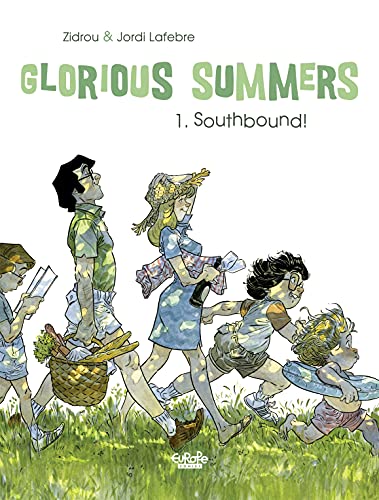
Glorious Summers volume 1: Southbound! (1973)


By Zidrou & Jordi Lafebre, with additional colour by Mado Peña translated by Lara Vergnaud (Europe Comics)
No ISBN: Digital edition only

Until comparatively recently, comics in the English-speaking world mostly comprised comedic or various adventure sub-genres (crime, superhero, horror, sci fi), with only a small but vital niche of “mundane world” ventures, usually depicted via graphic biographies and autobiographies such as They Called Us Enemy, Coma, Death Threat, Love on the Isle of Dogs, Wage Slaves or Sour Pickles offering a different feel and flavour. Even historical sagas were treated as extraordinary moments with larger-than-life characters whenever possible.

What we have never had – and still largely don’t enjoy – is a comics equivalent to general fiction, drama and melodrama. That’s not so in Japan and Europe, where a literal “anything goes” attitude has always accommodated human-scaled, slice of life stories depicting ordinary people in quiet as well as extraordinary moments.

Surely it can’t be that hard to tell engaging stories in pedestrian, recognisably ordinary settings? Medical traumas, love stories, school tales and family tragedies about common folk seem to play well on various-sized screens around the world, so why not in English-“speaking” comics? The closest we seem to get are comedy series like John Allison’s brilliantly superb Giant Days (which I really must review soon)…

People being people is more than enough for our European neighbours. They apparently have an insatiable appetite for everyday events aimed at properly “mature readers”, all joyfully sans vampires, aliens or men in tights. These even have sub-genres of their own. For example, there’s a wealth of superb material just about going on holiday…

So, since our own Government-in-Absentia have ensured that it’s now all-but-impossible for any UK-based citizens to pop across and have une petite vacances in Europe, let’s at least stare covetously at them having a good time. After all, over there holidays are an inalienable right, and they have some simply fabulous tales about a simple break. This is probably the best you’ll ever read…

One of the absolute best examples of fantasy vacations made real, Glorious Summers: Southbound! (1973) is a nostalgia-drenched confection by Zidrou and frequent collaborator Jordi Lafebre: a sublime example of idyllic group memory transformed into graphic sorcery and an everyday account utterly unafraid to temper humorous sweetness and light with some real-world tragedy and suspense…

Perhaps a little context is in order. Summer holidays – “Midi” – are a big deal in France and Belgium. The French even divide into two tribes over the annual rest period, which generally lasts an entire month.

Juilletistes only vacation in July and wield dogma and facts like rapiers to prove why it’s the only way to take a break. They are eternally opposed, heart, soul, and suntan lotion, by majority faction the Aoûtiens, who recharge their batteries in August whilst fully reciprocating the suspicion, disdain and baffled scorn of the early-leavers.

Many European sociologists claim the greatest social division today is not race, religion, gender, political affiliation or whether to open boiled eggs from the top or the bottom, but when summer holidays begin and end…

Les Beaux Étés 1: Cap au Sud! is the first of a string of family visits that began in 2015 courtesy of scripter Zidrou (Benoît Drousie) and illustrator Jordi Lafebre. Drousie is Belgian, born in Brussels in 1962 and a school teacher prior to quitting marking books in 1990 to begin making them. His main successes are school dunce series L’Elève Ducobu, Petit Dagobert, Scott Zombi, La Ribambelle, Le Montreur d’histoires, African Trilogy, Léonardo, the revival of Ric Hochet, Shi and many more. His most celebrated and beloved stories are this sequence and 2010’s Lydie, both illustrated by Spanish artist Jordi Lafebre.

The sublimely gifted, empathically sensitive illustrator and art teacher was born in Barcelona in 1979 and has created comics professionally since 2001, first for magazines like Mister K, where he limned Toni Font’s El Mundo de Judy. He soon found regular work at Le Journal de Spirou, creating the romance Always Never and collaborating with Zidrou on La vieille dame qui n’avait jamais joué au tennis et autres nouvelles qui font du bien, Lydie, and La Mondaine.

A combination of feel-good fable and powerful comedy drama, Southbound! begins “now”, as an aging couple sit on deftly-assembled camping seats in their beloved regular holiday spot. Gazing outwards and back, they remember how all their shared yesterdays almost died unborn during that difficult time in 1973…

It’s August then and Maddie Faldérault tries to amuse her four impatiently waiting kids as their father Pierre frantically puts the finishing touches to his latest comic strip. He has to: the publisher has stationed a gofer at his side to deliver the pages directly to the printer the moment the drawing stops.

The pages were due last Wednesday – as was the start of the annual Faldérault escape from gloomy Brussels for a month in sun-drenched France. That sun has long set, but such is the life of a minor star of the Belgian comics industry. Once the job is despatched, dad and long-suffering Maddie bundle the fractious kids into the car that’s been packed for days, heading for the border and some long anticipated R & R.

The kids are immune to bedtimes and wrapped up in time-honoured holiday rituals like shouting, fighting and singing odd songs. Shy lad Louis reads Lucky Luke to his invisible friend “Beekoo”, self-conscious oldest girl Jolly-Julie spars constantly with Nicole – cruelly picking on her weight – and hyperactive toddler Paulette (Peaches to you and her) bounces everywhere seeking attention and “fench fries an’ maynaze”…

They have no idea that it will be the last family holiday. The parents are planning to separate after the break and  have fooled themselves into thinking the odd atmosphere and strained behaviour will be put down to Aunt Liliane being sick with the cancer…

However, as they make their way south, clocking up priceless, inconsequential memories and acting like fools and bandits in overnight camps and rest stops, the strain starts to hit the beleaguered family in ways none will forget…

This tale is a beautifully rendered and realised series of memories stitched seamlessly together. It’s funny and charming and delivers painful blows you never see coming. There aren’t any spectacular events and shocking crises and that’s the point: awful events can happen to any of us… sudden death, job insecurity, funerals, demands for divorce, an abrupt change of mind…

If you’re British – and old enough – this series (six translated albums thus far, plus a French omnibus edition) will stir deep-seated memories of family sitcoms like Bless This House or Butterflies and generational ads starring the “Oxo Family”. If that description doesn’t fit you, I pity your browsing history if you look up any of that…

The rest of you in need of an opening (but unfair comparator) could break out the Calvin and Hobbes collections and re-examine the bits with his embattled parents when the kid’s out of the picture…

Lyrical, laconic, engagingly demure, and debilitatingly nostalgic, this holiday romance is sheer visual perfection wrapped in sharp dialogue and a superbly anarchic sense of mischief.

Vacations are built of moments and might-have-beens, channelled here in compelling clips that make the mundane. This is an irresistible tale of woe, wonder and second starts; all the more perfect because of it.
© 2018 -DARGAUD BENELUX (Dargaud-Lombard s.a.) – ZIDROU & LEFEBRE, LLC.

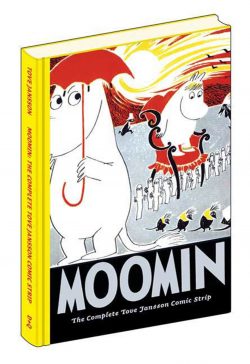
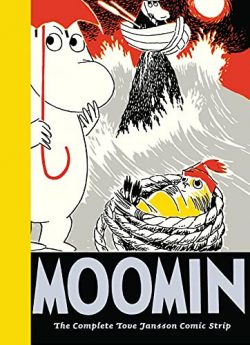
Moomin: The complete Tove Jansson Comic Strip volume 4


By Tove and Lars Jansson (Drawn & Quarterly)
ISBN: 978-1-897299-78-4 (HB) eISBN: 978-1-77046-551-0

If Tove Jansson was alive today she’d still be amazing and fascinating and also 108 years old. Sadly, she isn’t, but her immortal menagerie of bizarre and introspective characters are still going strong and all her best material is readily available for anyone wanting to politely, respectfully and belatedly join in all the dreamy fun…

Tove Jansson was one of the greatest literary innovators and narrative pioneers of the 20th century: equally adept at shaping words and images to create worlds of wonder. She was especially expressive with basic components like pen and ink, manipulating slim economical lines and patterns to realise sublime realms of fascination, whilst her dexterity made simple forms into incredibly expressive and potent symbols.

Tove Marika Jansson was born into an artistic, intellectual and practically bohemian Swedish family in Helsinki, Finland on August 9th 1914. Father Viktor was a sculptor, her mother Signe Hammarsten-Jansson a successful illustrator, graphic designer and commercial artist. Tove’s brothers Lars and Per Olov became a cartoonist/writer and photographer respectively. The family and its close intellectual, eccentric circle of friends seems to have been cast rather than born, with a witty play or challenging sitcom as the piece they were all destined to act in.

After intensive study from 1930-1938 (at the University College of Arts, Crafts and Design, Stockholm, the Graphic School of the Finnish Academy of Fine Arts and L’Ecole d’Adrien Holy and L’Ecole des Beaux-Arts, Paris), shebecame a successful exhibiting artist through the troubled period of the Second World War.

Intensely creative across many fields, she published the first fantastic Moomins adventure in 1945: Småtrollen och den stora översvämningen (The Little Trolls and the Great Flood or latterly and more euphoniously The Moomins and the Great Flood): a whimsical epic of gentle, inclusive, accepting, understanding, bohemian, misfit trolls and their strange friends…

A youthful over-achiever, from 1930-1953 Tove worked as an illustrator and cartoonist for the Swedish satirical magazine Garm, achieving some measure of notoriety with an infamous political sketch of Hitler in nappies that lampooned the Appeasement policies of Chamberlain and other European leaders in the build-up to World War II. She was also an in-demand illustrator for many magazines and children’s books, and had started selling comic strips as early as 1929.

Moomintroll was her signature character. Literally.

The lumpy, gently adventurous big-eyed romantic goof began life as a spindly sigil next to her name in her political works. She called him “Snork” and claimed she had designed him in a fit of pique as a child – the ugliest thing a precocious little girl could imagine – as a response to losing an argument about Immanuel Kant with her brother.

The term “Moomin” came from her maternal uncle Einar Hammarsten who attempted to stop her pilfering food when she visited, warning her that a Moomintroll guarded the kitchen, creeping up on trespassers and breathing cold air down their necks. Snork/Moomin filled out, became timidly nicer – if a little clingy and insecure – acting as a placid therapy-tool to counteract the grimness of the post-war world.

The Moomins and the Great Flood didn’t make much of an initial impact but Jansson persisted, probably as much for her own edification as any other reason, and in 1946 the second book Kometjakten (Comet in Moominland) was published. Many commentators have reckoned the terrifying tale a skilfully compelling allegory of Nuclear Armageddon.

When it and her third illustrated novel Trollkarlens hatt (1948, Finn Family Moomintroll or occasionally The Happy Moomins) were translated into English in 1952 to great acclaim, it prompted British publishing giant Associated Press to commission a newspaper strip about her seductively sweet and sensibly surreal creations.

Jansson had no misgivings or prejudices about strip cartoons and had already adapted Comet in Moominland for Swedish/Finnish paper Ny Tid. Mumintrollet och jordens undergängMoomintrolls and the End of the World – was a popular feature so Jansson readily accepted the chance to extend her eclectic family across the world.

In 1953, The London Evening News began the first of 21 Moomin strip sagas which promptly captivated readers of all ages. Jansson’s involvement in the cartoon feature ended in 1959, a casualty of its own success and a punishing publication schedule. So great was the strain that towards the end she recruited brother Lars to help. He took over, continuing the feature until its end in 1975. His official tenure as writer will begin in the next volume: stay tuned…

Liberated from the strip, she returned to painting, writing and other creative pursuits, generating plays, murals, public art, stage designs, costumes for dramas and ballets, a Moomin opera and 9 more Moomin-related picture-books and novels, as well as 13 books and short-story collections strictly for grown-ups.

Tove Jansson died on June 27th 2001. Her awards are too numerous to mention, but consider this: how many modern artists – let alone comics creators – get their faces on the national currency?

Her Moomin comic strips have long been available in Scandinavian volumes and the discerning folk at Drawn & Quarterly have translated her and Lars’ efforts into English for our sheer delight and delectation.

Moomintrolls are easy-going free spirits, bohemians untroubled by hidebound domestic mores and most societal pressures. Moominmama is warm and capable but overly concerned with propriety and appearances whilst Moominpappa spends most of his time trying to rekindle his adventurous youth or dreaming of fantastic journeys. Their son Moomin is a meek, dreamy boy who adores their permanent houseguest the Snorkmaiden – although that impressionable, flighty gamin prefers to play things slowly whilst waiting for somebody potentially better…

The forth oversized (312 x 222mm) monochrome hardback compilation gathers the 14-18th strip sagas and is a particular favourite, comprising a range of fanciful exploits and a rather bleak and a scary reworking of Comet in Moominland that must have had kids and their parents stocking the bomb-shelters back when it was released as a daily chapter play…

Fantasy fills the page in ‘Moomin Goes Wild West’ after Moominpapa’s annoying tinkering ruin a perfectly good clock and Moominmama’s sewing machine, whilst his attempt at repair accidentally results in a time machine. Following a distressing episode wherein Moomintroll meddles and the family meet their rather upset future selves, it is suggested that everyone go on a small holiday. The women’s rather staid suggestions are naturally overruled by the adventurous males and the machine summarily deposits them all in the land of cowboys.

It is nothing like they imagined and a very good thing that were armed with water pistols and not regulation firearms…

Sadder but no wiser after their extended tribulations in the Big Country, the assembled and not at all rested Moomins submit to suggestions of a little historical romance and travel back to 18th century France in ‘Snorkmaiden Goes Rococo’. Once again, lack of diligent research and an overdependence on popular fiction leads to misunderstanding and mischance as “the Age of Reason” proves to be anything but, and Snorkmaiden’s dreams of passionate folly are continually thwarted.

She does however score an invitation to the King’s Dinner, only to learn how badly the odds are stacked against the poor, and is promptly impelled to experiment with revolution…

Back where they all belong at last, the return of self-sufficient drop-out Snufkin heralds a visit from a representative of the League of Conscience and Duty exhorting the easy-going, but dutiful nonconformists (some unpleasant modern people say “workshy”) to dedicate their lives to personal industry and privation in service of a greater good.

‘The Conscientious Moomins’ certainly try their hardest – pursuing jobs they’re no good at, indulging in entrepreneurialism and seeking to improve character through self-help books and courses – but are just not suited to such new-fangled ideas. Ultimately, nature and good sense lead them back to their bohemian true selves just in time for one of the scariest adventures of their lives…

Comet in Moominland was first translated into English in 1951, and was a familiar text for many children and parents. Here in ‘Moomin and the Comet’ the allegory of nuclear armageddon is subtly reshaped over 86 daily instalments: modernised with the emphasis shifted from narrow escape to inescapable destruction leading to unexpected rebirth.

When a light gradually grows in the sky, the Moomins and their friends can only observe the world’s peoples’ increasing turmoil and riot. As the planet slowly alters in advance of imminent catastrophe and growing heat evaporates the oceans, spiteful Little My acts as Greek Chorus and commentator as everything makes it peace with oblivion. She’s also on hand to witness and announce the miracle that saves them all…

A parable of pride and caution closes this volume as ‘Moomin and the Golden Tail’ reveals how Moomintroll’s fear of premature baldness in this nether appendage prompts unwise exploration of remedial quackery, quasi-science and old family sorcery.

The result is a lush, luxuriant tail of gold, that makes him the world’s most fashionable person and pointless celebrity. All too soon that chic lustre fades and the sad lad is hunting ways to stop being famous and go back to his old look, negligent of how his beloved Snork maiden has reshaped herself to match his gleaming fame…

Especially excoriating are the lawyers and managers who hound him seeking to lock down the marketing rights to his golden fleece, but in the end a way is found to return him to his normal, anxious, insecure, anonymous self…

These are truly magical tales for the young laced with the devastating observation and razor-sharp mature wit which enhances and elevates only the greatest kids’ stories into classics of literature. These volumes are an international treasure and no fan of the medium – or carbon-based lifeform with even a hint of heart and soul – can afford to be without them.
© 2009, 2021 Solo/Bulls. All other material © its creators. All rights reserved.

Lulu Anew


By Étienne Davodeau, translated by Joe Johnson (NBM/Comics Lit)
ISBN: 978-1-56163-972-4 (HB/Digital)

In 2010 Bande Dessinée artist, writer and designer Étienne Davodeau completed a 2-volume tale he’d started in 2008. He was already popular, award-winning and extremely well-regarded for his reality-based and reportage style comics work, but Lulu femme nue was something that was special even for him. Within a year the story had been made into a much lauded and celebrated film by Solveig Anspach.

Davodeau was born in 1965 and, whilst studying art at the University of Rennes, founded Psurde Studios with fellow comics creators Jean-Luc Simon and Marc “Joub” Le Grand. His first album – L’Homme qui aimait pas les arbres (The Man Who Did Not Like Trees) – was released in 1992.

He followed up with a string of thoughtful, passionate and beautifully rendered books like The Initiates, Les Amis de Saltiel, Un monde si tranquille, Anticyclone, Les Mauvaises Gens: une histoire de militants, Le Chien Qui Louches and Le Droit du sol : Journal d’un vertige. Consequently he is now regarded as an integral part of the modern graphic auteur movement in French and Belgian comics.

NBM translated and collected both volumes of the dreamily moody mystery into a stunning hardback edition and Lulu Anew is now regarded as one of the very best graphic novels of its genre…

It begins with a kind of Wake where a number of friends gather to learn the answers to a small, personal but immensely upsetting event which has blighted their lives of late. Xavier is the first to speak and relates what they all already know. Lulu, a frumpy 40-something with three kids and a very difficult husband, has been missing for weeks. She went off for yet another distressing job interview and never came back…

It wasn’t some ghastly crime or horrible abduction. Something simply happened when she was in the city and she called to say she wasn’t coming home for a while…

The sun sets and the attendees calmly imbibe wine and eat snacks. A number of friends and family share their independently gleaned snippets of the story of Lulu’s aberration: a moment of madness where she put everything aside – just for a little while – and what happened next…

Bizarre unsettling phone calls to the raucous family home precede a quiet revolution as Lulu, without any means of support, inexplicably goes walkabout along the magnificent French Coast: living hand-to-mouth and meeting the sorts of people she never had time to notice before. Through interactions with strangers she learns about herself and at last becomes a creature of decisions and choices, rather than shapeless flotsam moved by the tides of events around her…

Related with seductive grace in captivating line-&-watercolours, here is a gently bewitching examination of Lulu’s life, her possible futures and the tragic consequences of the mad moment when she rejects them all. Unfolding with uncanny, compulsive, visually magnetic force, and told through and seen by the people who think they know her. This isn’t some cosmic epic of grand events, it’s a small story writ large with every bump in the road an unavoidable yet fascinating hazard. None of the so-very-human characters are one-sided or non-sympathetic – even alcoholic, often abusive husband Tanguy has his story and is given room to show it.

Ultimately, Lulu’s gradual, hard-earned resolution is as natural and emotionally rewarding as the seemingly incomprehensible mid-life deviation which prompted it…

Slow, rapturous and addictively compelling, Lulu Anew is a paragon of subtlety and a glowing example of the forcefully deceptive potent power of comics storytelling. Every so often a book jumps comics’ self-imposed traditional ghetto walls of adolescent fantasies and rampaging melodrama to make a mark on the wider world. This elegiac petit-epic makes that sort of splash. Don’t hesitate: dive right in.
© Futuropolis 2008, 2010. © NBM 2015 for the English translation.

Stay


By Lewis Trondheim & Hubert Chevillard, translated & edited by Mike Kennedy (Magnetic Press)

ISBN: 978-1-54930-771-3 (HB/Digital edition)

Until so very recently, comics in the English-speaking world were largely comedy or genre adventure, with a small but vital niche of breakthrough biography and autobiography such as Maus, Persepolis and The End of the F**king World.

What we have never had, and still largely don’t have, is an equivalent to general fiction and drama/melodrama. That’s not so in Europe, where a literal “anything goes” attitude has always accommodated human-scaled slice of life stories that depict ordinary people in the quiet as well as extraordinary moments.

Think of such comics as the sequential narrative equivalent of watching mainstream broadcast TV (in the UK that would be BBC 1, 2, 4, ITV1 and Channel 4) and it isn’t hard to find almost impossible genres. For example, there’s a wealth of superb material just about going on holiday…

That’s not really a fair comparison for Americans, but quite frankly, your TV networks are a hellhole of your own devising. It’s a miracle that you have generated so many great shows and programmes over the decades and it’s also why I keep banging on about comics. In them, there are always infinite worlds and possibilities…

So, now our own Powers-That-Be (Hopeless) might have arranged it so that it’s now all-but impossible for any UK-based folk to pop across and have une petite vacances in Europe, but over there it’s an inescapable right, and they have some fabulous tales about a simple break. This is probably one of the best you’ll ever read.

A sublime example of what I’m talking about is Lewis Trondheim & Hubert Chevillard’s Je vais rester. Translated by Magnetic Comics as Stay, it challenges the commercial pressures I’ve alluded to above: an intriguing, engaging drama in both print and byte-sized versions for me to recommend and you to fall in love with. It also means that if you’re stuck in road, rail or airport queues you can download it after getting bored with me…

With north of 100 books bearing his pen-name (his secret identity is actually Laurent Chabosy), writer/artist/editor/animator and educator Lewis Trondheim is one of Europe’s most prolific comics creators: illustrating his own work, overseeing cartoons adaptations of previous successes such as La Mouche (The Fly) and Kaput and Zösky or editing young-readers book series Shampooing for Dargaud.

His most famous tales are such global hits as Les Formidables Aventures de Lapinot (seen in English as The Spiffy Adventures of McConey); the Donjon series of nested fantasy epics (co-created with Joann Sfar and translated as conjoined sagas Dungeon: Parade, Dungeon: Monstres and Dungeon: the Early Years); comedy fable Ralph Azham and an utterly beguiling cartoon diaries sequence entitled Little Nothings.

In his spare time – and when not girdling the globe from convention to symposium to festival – the dourly shy and neurotically introspective savant wrote for satirical magazine Psikopat and provided scripts for many of the continent’s most popular artists such as Fabrice Parme (Le Roi Catastrophe, Vénézia), Manu Larcenet (Les Cosmonautes du futur), José Parrondo (Allez Raconte and Papa Raconte) and Thierry Robin (Petit Père Noël).

Ostensibly retired but still going strong, Trondheim is a cartoonist of uncanny wit, outrageous imagination, piercing perspicacity, comforting affability and self-deprecating empathy who prefers to scrupulously control what is known and said about him…

I must admit that, at this moment, from all his vast canon, STAY is probably my absolute favourite…

Born in Angers in 1962, Hubert Chevillard (Le Pont dans la Vase, Corcal, Terra Incognita, Le Facteur, Pavillon Rouge, Donald’s Happiest Adventures) is a French cartoonist now working from Grenoble who studied animation at the Gobelins School and the School of Fine Arts in Angoulême. He worked at Walt Disney Animation France’s Montreuil Studious for almost a decade before switching to comics as illustrator of Didier Crisse’s Luuna. He thereafter branched out and carried on, scripting his own stuff whilst remaining an in-demand artist for others…

Here his softly endearing images paint us a picture of idyllic summer holidays at the seaside for affianced couple Roland Matturet and Fabienne Guillardin. For their trip to the South of France, he has meticulously (it’s his way) planned everything and paid for it all in advance as a build-up to asking her a certain question.

Sadly, the entire sunny escapade is cut short – as is Roland himself – when a bizarre accident leaves Fabienne instantly alone in a strange but welcoming resort of happy strangers…

Shocked and stunned, but still posthumously guided by Roland’s notebook itinerary, she seems to pause inside. Not even informing the families of the change in circumstance, she roams like a ghost, sampling all the prepaid amenities, diligently attending to Roland’s checklist of events and gradually reinventing herself.

Avoiding all past connections and her current situation, Fabienne savours being unknown, alone, and not yet bereaved: pondering the ramifications in her pensive way, as she grudgingly befriends eccentric, exotic and quixotic local Paco… a man unlike any she has ever met before.

With no idea how she feels about anything, Fabienne allows herself to be intrigued as Roland’s hold on her diminishes and fades away…

What’s next…?

Lyrical, laconic, blackly comic and engagingly demure, this gleefully morbid, platonic holiday non-romance unfolds with a minimum of verbiage and powerfully understated silent visuals: exploring life and death, addressing denial, avoidance and coping mechanisms through a soft-focussed lens of friendships in adversity and those ever-present, never-acted upon holiday impulses…

Vacations are built of never-seized moments of seductive might-have-beens and affable strangers, channelled here in astonishingly compelling episodes that make the mundane magical and encapsulating those brief spells of transient opportunity that comprise such “holidays of a lifetime”. This is tale of woe and wonder writ small, and all the more perfect because of it.
Stay published 2019 by The Lion Forge, LLC. © 2019 The Lion Forge, LLC. Originally published in France as Je vais rester, scenario by Lewis Trondheim, illustrations by Hubert Chevillard © Rue de Sevres, Paris 2018. All rights reserved.

The Archangels of Vinea: Yoko Tsuno volume 14


By Roger Leloup, coloured by Studio Leonardo, translated by Jerome Saincantin (Cinebook)
ISBN: 978-1-84918-438-0 (Album PB)

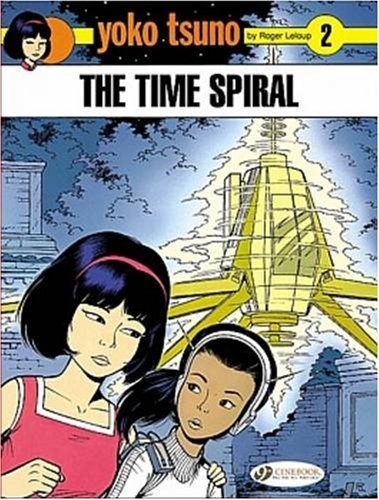
In 1970, indomitable intellectual adventurer and “electronics engineer” Yoko Tsuno began her career in Le Journal de Spirou. She is still delighting readers and making new fans to this day in astounding, all-action, excessively accessible adventures which are amongst the most intoxicating, absorbing and broad-ranging comics thrillers ever created.

The globe-girdling, space-&-time-spanning episodic epics starring the Japanese investigator were devised by monumentally multi-talented Belgian maestro Roger Leloup, who began his own solo career after working as a studio assistant and technical artist on Herge’s timeless Adventures of Tintin.

Compellingly told, superbly imaginative and – no matter how implausible the premise of any individual yarn may appear – always firmly grounded in hyper-realistic settings underpinned by authentic, unshakably believable technology and scientific principles, Leloup’s illustrated escapades were at the vanguard of a wave of strips revolutionising European comics.

That long-overdue sea-change heralded the rise of competent, clever, brave and formidably capable female protagonists taking their rightful places as heroic ideals; elevating Continental comics in the process. Unsurprisingly, these endeavours are as engaging and empowering now as they ever were, and none more so than the trials and tribulations of Miss Tsuno.

Her very first outings (the still unavailable Hold-up en hi-fi, La belle et la bête and Cap 351) were mere introductory vignettes before the superbly competent wanderer and her valiant but less able male comrades Pol Paris and Vic Van Steen properly hit their stride with premier full-length saga Le trio de l’étrange in 1971 with Le Journal de Spirou’s May 13th edition…

Yoko’s journeys include explosive exploits in exotic corners of our world, time-travelling jaunts and sinister deep-space sagas – like this one – where our terrestrial trouble-shooters toil beside the disaster-prone alien colonists of planet Vinea. Their chief contact and most trusted ally is Khany: a competent, commanding single mother who combines parenting her toddler Poky with saving worlds, leading her people and averting continual cosmic catastrophe…

There are 29 European albums to date (with #30 due for release in September) but only 16 translated into English thus far. Today’s tale debuted in 1983 as Les archanges de Vinéa, chronologically Tsuno’s thirteenth exploit and sixth co-starring the Vineans: a thrilling tale of discovery and ancient undying tyranny and evil…

In their first outing, Yoko, Vic and frivolous Pol discovered a pocket of long-dormant aliens hibernating for eons in the depths of the Earth. After freeing them from robotic subjugation, the valiant humans occasionally helped the alien refugees (who had fled their own planet two million years previously) rebuild their lost sciences. Ultimately, the humans accompanied the Vineans as they returned to their own star system and presumed-dead homeworld. As the migrants gradually rebuilt their decadent and much-debased former civilisation and culture, the trio became regular guests…

On this excursion, the humans are again exploring another reclaimed region of the recovering planet. In the millions of years the Vineans slept in the depths of Earth, their primary civilisation collapsed, and the planet they have reclaimed is much-changed with isolated pockets of the former changed beyond recognition… and usually lethally hostile to their returned descendents…

We open as Yoko and little Poky accompany Khany to a desolate island and interview a strange old hermit who has been sheltering a child from the past. Khany’s cautious efforts reveal a young boy in a hibernation pod for countless ages, and that the entre rig has been until very recently, underwater…

As they further question the crazed old woman who lives in constant dread of The God’s wrath, an atmospheric disturbance occurs, leading them to a fantastic machine thunderously drawing air down into the depths of the sea. When they fly over to investigate further, Kany is lost…

By the time Yoko and Poky land, primitive raiders have boarded the edifice as it starts to sink. From nowhere, a serene and calmly confidant Vinean Adonis appears, saving Yoko from being blasted by the barbaric raiders. As he and Poky are arrested he joins the group but does not interfere.

The newcomers are equipped with makeshift breathing gear and share it with the captives, dropping into the depths just as the edifice was. The sea-dwellers also use huge turtle-like sea-beasts and her enigmatic saviour – easily keeping pace with the raiders – appears to be equally amphibious…

Unwelcome but unmolested, the stranger keeps pace as the war party passes a shattered sunken city, and encounters fierce marine monsters that have been tamed by electronic devices clamped to their heads. It is a technology clearly far beyond the understanding of Yoko’s captors, and gradually she learns of a bizarre truth: these sea-Vineans are low caste workers in a lost subterranean city of evil that has survived submerged for millennia, ruled by a capricious, cruel immortal Queen. Hegora has the powers of a god and is just as implacable…

However, her diffident saviour and guardian is one of twenty undying supermen: “Archangels” set apart from and uncaring of the plight of ordinary beings. As Yoko soon discovers, her acquaintance has a ruthless, timeless agenda of his own…

Her life constantly imperilled as she seeks hostage Khany, Yoko learns the horrific secret of the subsea City of the Abyss, and why the Archangels have battled Hegora for so long: possession and control of thousands of hibernating children. The endless struggle ends as Yoko tips a delicate balance, uncovering the incredible secrets of the City’s past and before long, a cold war resolves into a battle of wills and vastly opposing moralities. In the end it’s Yoko who triumphs to impose a new regime on the sunken citadel…

Gripping and visually spectacular, The Archangels of Vinea combines hard science with tense drama and a soupcon of social criticism: delivering another terse, action-packed, sci fi thriller, once again magnified into magnificence by the astonishingly compelling and staggeringly detailed draughtsmanship and storytelling of Leloup and the indomitable integrity of Yoko Tsuno.
Original edition © Dupuis, 1983 by Roger Leloup. All rights reserved. English translation 2019 © Cinebook Ltd.

Miss Don’t Touch Me volumes 1 and 2


By Hubert & Kerascoët, translated by Joe Johnson (NBM)
ISBN: 978-1-56163-544-3 (TPB) & 978-1-56163-592-4 (TPB)

Hubert Boulard was a French comics writer and colourist who died suddenly on February 12th 2020. He is criminally unknown in the English-speaking world.

“Hubert” was born on January 21st 1971, and after graduating in 1994 from the École régionale des beaux-arts d’Angers, began his comics career as an artist for seasoned pros such as Éric Ormond, Yoann, Éric Corberyan, Paul Gillon and others. He started writing strips for others in 2002, with Legs de l’alchimiste limned by Herve Tanquerelle, followed up with Yeaux Verts for long-term collaborator Zanzim.

He produced another 14 separate series – many of them internationally award winning like Les Ogres-Dieux and Monsieur désire? – and in 2013 contributed to collective graphic tract Les Gens normaux, paroles lesbiennes gay bi trans: released to coincide with France’s national debate on legalizing same sex marriage.

His final book was with artist Zanzim. Peau d’homme – a comedy exploring gender and sexuality at the height of an era of medieval religious intolerance and social stratification – was posthumously published in June 2020… and is as yet unavailable in English translation.

Debuting in 2006, Miss Pas Touche was Hubert’s third scripting venture and remains arguably his most successful. It was originally released as four volumes in France, which – when translated by NBM – were delivered as two deliciously wicked tomes…

This slim, sleek initial translated tome offers a superb period murder mystery from visual creators probably best known in the English speaking world as contributors to Joann Sfar & Lewis Trondheim’s Dungeon series of interlinked fantasy books.

Here, Paris at the end of the 19th century is plagued by its very own Jack the Ripper – a knife-wielding maniac dubbed “the Butcher of the Dances” because he picks his victims from lower class girls frequenting suburban Tea-dances where the young people gather…

Blanche is a maid in a fine socially prestigious house: pious, repressed and solitary, unlike her sister Agatha – also a maid in the same residence – who is fun-loving and vivacious. They share the attic room at the top of the house where one night, Blanche accidentally sees “the Butcher” at his bloody work through a crack in the wall.

He sees her too, and some nights later she finds Agatha dead, as if by her own hand. Blanche knows what must have really happened…

Anxious to avoid scandal, the mistress of the house dismisses Blanche, who is forced to fend for herself on inhospitable streets. Through a combination of detective enquiry and sheer luck, she finds a lead to the killer and secures a position in The Pompadour, the most exclusive brothel in the city. By catering to a rich and powerful elite, here she will find the Butcher and exact her revenge…

Originally published in France as La Vierge du Bordel and Du Sang sur le Mains, this witty, and hugely engaging crime conundrum cleverly peels back its layered secrets as our star finds a way to turn her steadfast virginal state and overwhelming frustration to her advantage amidst the decadent rich and sexually bored of Paris. Maintaining her virtue against all odds, Blanche discovers the other side to a world she previously despised, while valiantly achieving her goal, even though it threatens to topple two empires!

Feeling very much like a cheeky grown-up version of Frances Hodgson Burnett’s 1905 novel A Little Princess, this saucy confection from writer/colourist Hubert is delightfully realized with great panache by the Kerascoët to the delight of a wide variety of grown-up readers.


Miss Don’t Touch Me volume 2

Let’s return to the eclectic world of the French demi-Monde – in the oddly inappropriate guise of formerly naive and still virginal ex-housemaid Blanche, who one night espied a psychopathic murderer at work. Intent on silencing the pesky witness, “the Butcher of the Dances” mistakenly killed Blanche’s sister Agatha in her stead, before the surviving sibling was unceremoniously sacked by her employers to avoid scandal.

Thrown onto the streets of fin de siècle Paris, our pious innocent found refuge and unique employment within the plush corridors of the city’s most exclusive and lavishly opulent bordello. Fiercely hanging on to her virtue against all odds, Blanche became Miss Don’t Touch Me: a spirited – and energetic – proponent of the “English Method” – specifically, an excessively enthusiastic flagellating dominatrix, beating the dickens out of men who delighted in enduring exquisite pain and exorbitant expense. The first volume ended with justice for both Blanche and the Butcher but her adventures were not over…

This delightfully audacious and risqué sequel opens with Blanche – virtue still notoriously and profitably intact – as the Pompadour’s most popular attraction, even though the magnificent edifice is undergoing an expensive and disruptive refit.

However, she is deeply unhappy with her life and tries to flee, buy and even blackmail herself out of her onerous contract. She is soon made brutally aware of how business is really done in the twilight world of the courtesan-for-hire…

Utterly trapped, Blanche loses all hope, even while becoming gradually enamoured of Apollo-like young dandy Antoine: one of the wealthiest men in the country and a man apparently content to simply talk with her. Complications mount when her unscrupulous, conniving mother returns to Paris and begins to avail herself of the surviving daughter’s guilt-fuelled generosity and social contacts…

Blanche’s velvet-gloved imprisonment seems set to end when her bonny bon vivant boy begins to talk of marriage, but just as suddenly, her life at the brothel begins to radically unravel. Obviously the aristocrat’s dowager mother has no stomach for the match, but social humiliation is not the same as the malicious lies, assaults, attacks and even attempted poisoning Blanche experiences.

Moreover, the genteel dominatrix’s mother seems to hold a hidden secret concerning Antoine’s family and, if they are to be wed, why doesn’t the prospective groom want his bride-to-be to give up her day – or more accurately – evening job?

Originally published in France as Le Prince Charmant and Jusqu’à ce que la Mort Nous sépare, this enticing, knowing and hugely enthralling tale trumps the inspired murder-mystery of the introductory volume with a turbulent period melodrama of guerrilla Class Warfare that promises tragic and shocking consequences, especially after Antoine abruptly vanishes and the apparently benevolent brain surgeon Professor Muniz begins his terrifying work…

A compelling saga stuffed with secrets, this engagingly sophisticated confection from writer/colourist Hubert, illustrated with irrepressible panache by Kerascoët (married artistic collaborators Marie Pommepuy & Sébastien Cosset) will further delight the wide variety of grown-up readers who made the first book such a popular and critical success.
© 2007 Dargaud by Kerascoet & Hubert. All Rights Reserved. English Translation © 2007, 2008, 2010 NBM.

Lost Cat


By Jason, translated by Kim Thompson (Fantagraphics Books)
ISBN: 978-1-68396-009-6 (HB/Digital)

A global star among comics cognoscenti, coining numerous major awards from all over the planet, Jason is secretly John Arne Saeterrøy. Born in Molde, Norway in 1965, he’s been an international cartoon superstar since 1995 when his first graphic novel Lomma full ay regn (Pocket Full of Rain) won that year’s Sproing Award (Norway’s biggest comics prize). He won another Sproing in 2001 for his series Mjau Mjau and in 2002 turned almost exclusively to producing graphic novels.

The stylised artwork is delivered in formalised page layouts rendered in a minimalist take on Hergé’s Claire Ligne style: solid blacks, thick outlines and settings of seductive simplicity – augmented here by mesmerising hints in earth-tones enhancing the hard, moody, suspenseful and utterly engrossing appreciation of the ambience of France’s Cinema Verité movement.

Jason’s work always jumps directly into the reader’s brain and heart, using beastly and unnatural repertory players to gently pose eternal questions about basic human needs in a soft but relentless quest for answers.

That you don’t ever notice the deep stuff because of clever gags and safe, familiar “funny-animal” characters should indicate just how good a cartoonist/storyteller he is. This would be a terrific yarn even without Jason’s understated art, but in combination with his dead-on, deadpan pastiche of The Big Sleep and other movies, the result is outrageous narrative dynamite.

This gem sees the artist’s return to full length tales (160 pages) after some years producing shorter album-style pieces, and in Lost Cat he lends his uniquely laconic anthropomorphic art-stylings to a surprisingly edgy, delicious tale of lost loves, scurrilous misdeeds and uncanny sinister secrets.

This a scarily evocative romantic puzzle with its roots in Raymond Chandler mysteries, tipping a slouched hat to Hollywood Noir, B-Movie sci-fi and psychologically underpinned melodramas, with Jason’s traditionally wordless primal art supplemented by sparse and spartan “Private Eye” dialogue, enhanced to a macabre degree by solid cartooning and skilled use of silence and moment.

This sly and beguiling detective story opens as seedy shamus Dan Delon – a specialist in tawdry divorce cases – sees a poster about a lost cat and, upon accidentally encountering the missing moggy, returns it to solitary, sombre yet oddly alluring bookshop proprietor Charlotte.

The two lonely people enjoy a coffee and stilted conversation before Dan departs, but in his head his calm, pleasant night with the quiet lady continues to unfold…

Life goes on, but even after taking on a big case – tracking the lost nude painting of a rich man’s long-gone inamorata – Delon just cannot get Charlotte out of his mind. Despite knowing better, he inserts himself into the woman’s staid, sedate life and slowly realises that their pleasant evening together was a complete tissue of lies.

Moreover, his grail-like quest for the truth leads the dowdy gumshoe into deadly danger and shocking revelations of Earth-shaking consequences…

Utilising with devastating effect that self-same quality of cold, bleak yet perfectly harnessed stillness which makes Scandinavian crime dramas such compelling, addictive fare, Lost Cat resonates with the artist’s favourite themes and shines with his visual dexterity, disclosing a decidedly different slant on secrets and obsessions, in a tale strictly for adults which nonetheless allows us to look at the world through wide-open young eyes.
All characters, stories and artwork © 2013 Jason. All rights reserved.

Orbital volume 3 & 4: Nomads & Ravages


By Serge Pellé & Sylvain Runberg, translated by Jerome Saincantin (Cinebook)
ISBN: 978-1-84918-080-1 & 978-1-84918-088-7 (Album PBs/Digital Editions)

French science fiction always delivers amazing style and panache even when the underlying premise might be less than original. In Serge Pellé & Sylvain Runberg’s beautiful Orbital sequence, an initially-mismatched pair of Diplomatic Peacekeeper agents are deployed to quell incipient brushfire wars and mediate internal pressures within a vast pan-species intergalactic alliance, but the hoary “buddy-movie” format is a mere skeleton for eye-popping missions, star-spanning intrigue and intense personal interactions. These are always handled with deft wit and great imagination, never failing to carry the reader along in a blaze of fantastic fun…

What you need to know: after decades of pariah-status and intergalactic exclusion, Earth in the 23rd century has finally been allowed to join a vast Confederation of interstellar civilisations, despite grave and abiding concerns about humanity’s aggressive nature and xenophobic tendencies.

A militant “Isolationist” faction on Earth had moved from politics to horrific terrorism in the immediate run-up to humanity’s formal induction: committing atrocities both on Earth and far distant worlds where mankind had developed colonies and mining bases thanks to misused Confederation technology. Ultimately, the “Isos” failed to prevent our species’ inclusion in the pan-galactic union.

One particular and abiding Confederation concern was the way humans had treated the ancient alien civilisation of the Sandjarrs, whose world was previously invaded in Earth’s all-consuming drive for territory and exploitable resources. Subsequent human atrocities almost exterminated the stoic, pacifistic desert creatures…

Interworld Diplomatic Office operatives are assigned in pairs to troubleshoot throughout the stars, defusing crises before they become flashpoints of violence. IDO’s first human recruit Caleb Swany had been controversially teamed with Sandjarr Mezoke Izzua: a situation clearly designed as a high-profile political stunt, as was their initial mission: convincing an Earth mining colony to surrender a profitable planetary mining industry back to the aliens who actually own the moon Senestem it was situated on…

Moreover, even though Earth is a now a Confederation member, with humans well-placed in all branches of interstellar service, the Isolationist cause is still deeply cherished by many, needing only the slightest spark to reignite…

Nomades was originally released continentally in 2009, and as third translated Cinebook album Orbital: Nomads (2011) picks up soon after Caleb and Mezoke’s hard-won, brutally pragmatic solution was implemented. The Galactic Great-and-Good have since voyaged to Earth to very publicly celebrate and affirm the end of Human/Sandjarr hostilities in a series of spectacular Reconciliation Ceremonies, but the political glad-handing looks to be upstaged by another interspecies crisis…

One of the greatest benefits of induction into The Confederation has been the infusion of alien technologies which have cleansed and reinvigorated the ecosystem of long-abused and much-polluted Earth. Now however, an incident occurs in the newly restocked, again-abundant seas and mangrove swamps around Malaysia. The inexplicable death of millions of cloned and released sea species leads to a bloody clash between local human fishermen and an previously-unsuspected enclave of nomadic space-gypsies: The Rapakhun

In Kuala Lumpur, Caleb is reminiscing with his old mentor Hector Ulrich – instrumental in brokering Earth into the Confederation and Swany into the Interworld Diplomatic Office – when news arrives of the trouble.

This will be tricky: much of mankind is still passively anti-alien, and local economies are fragile, whilst the Rapakhun are apparently no innocent angels. Many stellar civilisations despise them as shiftless, flighty wanderers who go where they please, refusing to be represented in or on Confederation Councils. Worst of all, they practice cannibalism…

By the time Caleb and Mezoke arrive on scene, events have escalated and tensions heightened to fever pitch, with a committee of human fishermen facing off against Rapakhun spokeswoman Alkuun.

The unwanted ancient tries to explain that the problem was simply an escaped Elokarn. The wanderers’ gigantic domesticated aquatic beasts have all been excessively agitated since arriving on Earth…

With the Diplomatic Agents assuring all parties that tests are underway to ascertain not only why the Elokarn went crazy but also why fish are dying off again, the situation seems contained, but when Alkuun invites the human guests to join in their holy consumption of a still-living and eager Rapakhun male, all the attendant peacemakers are physically revolted. Once seen, no amount of explanation that the willing, deeply spiritual and hugely prestigious sacrifice is meant to strengthen and invigorate the life force of Earth can offset that grisly sight…

Returning to Kuala Lumpur, Mezoke and Caleb are anxious. Although the Malaysian Navy are policing the area, the IDO agents know full well the tenuous trust humans place in any alien species, but their attention is unfortunately diverted by the sudden arrival of Caleb’s old friend Lukas Vesely.

The scrawny teen of his youth has become a hulking, good-natured member of Ulrich’s security force who seems very keen to relive the good old days. Caleb’s memories, however, can’t get past what he, little sister Kristina and Lukas used to do as teen vigilantes in Prague, mercilessly wreaking misguided vengeance upon isolationists like the ones who assassinated the Swany’s parents. In Caleb’s head, it’s just like yesterday…

In the mangrove swamps, fish are still dying, and now so are plants. When another group of fisherman get too close to the agreed-upon neutral zone, Ulrich’s forces overreact and the intruders perish, an event twisted by certain members of the outraged Malaysian Navy observers…

Despite and because of the distracting presence of Confederate supremo Evona Toot, Caleb and Mezoke are fully occupied as the delegation of Sandjarr dignitaries arrive. With a hungry pack of journalists eager to build and detonate a media-storm, the DA’s must navigate and manage the aloof, stand-offish guests of honour even though they somehow provoke fellow Sandjarr Mezoke to surly silence…

Soon, grim reports from Senestem take the shine off the supposed triumphant solution, while test results from the swamps all prove inconclusive. No contamination of any sort killed the wildlife: the culprit is some unknown form of energy…

Over gender-opaque Mezoke’s objections, Caleb seeks to downplay and even suppress the concatenation of bad news to keep the Reconciliation Ceremonies alive, until she/he/it/they reveals a shocking truth about the Sandjarr’s status prior to joining IDO…

Reports of human deaths are leaked to the populace and a “patriotic” clique in the Navy colludes to look the other way if any fishermen feel like dealing with the nomads once and for all…

By the time the IDO agents react to another human incursion, appalling bloodshed has ceased and – wading through a site of unspeakable carnage – Caleb and Mezuke decide to split up. The rapidly destabilising situation on Earth must be carefully managed, but most important is urgently sending an investigation team to the Rapakhun’s stopover world to learn exactly what the wanderers are capable of…

To Be Continued…

Fast-paced, action-packed, gritty space-opera with delightfully complex sub-plots fuelled by political intrigue and infighting elevates this tale to lofty and exotic heights, confirming Orbital as a series well worth your time and attention…


Ravages (Orbital volume 4) sees mismatched Diplomatic Peacekeeper agents conclude the sinister saga begun in Orbital: Nomads: subtly tweaking and deftly twisting a cunning skein of far-flung, futuristic political intrigue as the situation devolves into a full-on horror story of relentless alien terror…

Released in France in 2010, Orbital: Ravages is the fourth translated Cinebook album, picking up as Caleb and Mezoke flounder whilst a simple but tedious state function rapidly becomes an interspecies crisis…

The Galactic glitterati are on Earth to confirm the end of Human/Sandjarr hostilities in spectacular Reconciliation Ceremonies, but the cosmic bigwigs are only really concerned with how their precious Reconciliation plays out on their own worlds. The  political glad-handing looked likely to implode after Kuala Lumpur’s human fisherman clashed with a hitherto unsuspected enclave of Rapakhun: cannibalistic space gypsies…

Confederation’s technologies had cleansed and reinvigorated Earth’s gravely wounded, ecosystem, but the restocked, seas and swamps around Malaysia are suddenly blighted by the mass extinction of millions of valuable fish. Humans blame the uninvited aliens, demanding the ODI Agents forcefully intervene. Swany and Mezoke swiftly comply, promising the truth will be found and shared.

This might be tricky: much of mankind remains staunchly anti-alien, local economies are fragile and the Rapakhun’s bad reputation across Confederation space might not be simple prejudice…

With the Agents occupied babysitting the Sandjarr delegation, fish and fisherman continue to die and the Malaysian Navy can no longer be trusted. As Caleb downplays – and even tries to suppress – bad news in hope of keeping the Ceremonies alive, the situation provokes a “patriotic” Navy clique to look the other way when locals try to deal with the nomads once and for all…

Riots and bloodshed erupt and the IDO operatives realise they must know more about the Rapakhun: someone has to visit their last port of call and see what they are really capable of…

The saga resumes in Kuala Lumpur’s grimily cosmopolitan Shah Alam district where human and alien scrap-merchants work side by side, salvaging materials and tech from junked starships. As tensions rise everywhere, one greedy toiler makes a grisly discovery and dies horribly in exactly the same manner as the fishermen in the distant swamps…

Caleb – over Mezoke’s protests – is in full-spin-control mode; weaving a pack of placatory lies to the journalists of uncounted watching worlds. Unable to leave Earth mid-crisis, the IDO agents recruited enigmatic human star-pilot Nina and her secretly-sentient Neuronome ship Angus to canvas distant world Dehadato, last refuge of the Rapakhun. Before they can report back a vast riot breaks out in Shah Alam…

The Fishermen’s Quarter is ablaze, a war-zone exploding with scared and angry humans and aliens, but when Caleb, Mezoke and Hector Ulrich overfly the scene of chaos and looting, they are brought down by rioters and must fight their way out…

Thanks to IDO intervention, canny bargaining, judicious bribery by city officials and an unlikely detente between the extraterrestrial scrap merchants and the ambitious new spokesman of the Fisherman’s Federation, the situation is soon damped down and all sides again tensely wait for answers…

On Dehadato, Nina and Angus explore the Rapakhun’s last campsite, uncovering scenes of horrific devastation, even as in Kuala Lumpur, Confederation leaders – terrified the situation is becoming politically untenable – consider cutting their losses and cancelling the Ceremonies…

It takes all Caleb’s strident persuasiveness to convince them – and Mezoke – to continue the itinerary of events. However, he gets a first inkling that they might be right when he’s informed a body has been found in the city, killed in the same extreme and inexplicable manner as the various swamp casualties…

On Dehadato, Nina and Angus rescue a poacher from the folly of his actions in pursuing monstrous, colossal and officially-protected Nargovals. As the Sülfir recovers, he imparts snippets of information about the Rapakhun and an incredible beast which infested the planet before the stellar nomads left. The doughty hunter only tried for the unstoppable leviathans which killed his entire poaching team after first ensuring there were no more Varosash on Dehadato, so the primordial predator must have departed with the gypsy cannibals…

Caleb has already concluded the Rapakhun are behind his problems, but as he stalks them through the swamps, word comes from Nina that he’s wrong, and it’s probably already be too late for the planet…

At Kuala Lumpur’s biggest sports arena, thousands of avid Speedball fans – human and otherwise – are packed together; reaching a fever pitch of excitement and unaware a hideous invisible killer – the very essence of all mankind’s fear of alien monsters – is ready to consume them all. Can disunited Caleb and Mezoke and their pitifully few allies destroy the invisible rapacious threat before it ends humanity? Or maybe there’s is hope as Nina and the Sülfir think they have a plan. Risky and probably fatal, but a plan nonetheless…

Fast-paced, action-packed, gritty and spectacular, Ravages offers pure high-octane space-opera, with deliciously complex sub-plots fuelled by political intrigue and a vast unexplored canvas tantalising readers at very moment.

One of the most beguiling sci fi strips of all time, Orbital is a delight every fan of the future should indulge in…
Original editions © Dupuis 2009, 2010 by Runberg & Pellé. All rights reserved. These editions published 2011 by Cinebook Ltd.

The Lighthouse


By Paco Roca, translated by Jeff Whitman (NBM)
ISBN: 978-1-68112-056-0 (HB/Digital edition)

Francisco Martínez Roca was born in Valencia in 1969: a time when Franco’s fascist regime still controlled every aspect of Spanish life. Roca was part of an artistic explosion that benefited from the dictator’s death and a return to liberalising democracy, with his earliest efforts appearing in La Cupula in 1994.

As Paco Roca, he contributed (with Rafa Fonteriz) erotic strips featuring Peter Pan and Aladdin to Kiss Comics and – with Juan Miguel Aguilera – devised experimental 3D series ‘Road Cartoons’ for El Vibora.

Roca’s earliest serious works dealt with aspects of Spanish culture and history: El Juego Lúgubre in 2001 (his fictional yarn about Salvador Dali) and 2004’s Spanish Civil War tale El Faro. These were followed by internationally acclaimed works Hijos de la Alhambra and 2007’s multi-award winning Wrinkles – adapted into equally celebrated and critically-rewarded animated movie Arrugas.

More wonderful stuff you’ll want to see includes Las Callas de Arena (Streets of Sand) and semi-autobiographical Sunday newspaper strip Memorias de un hombre en pyjama from Las Provincias and El invierno del dibujante, about comic creators working for the Bruguera magazine Tio Vivo in the 1950s.

When not astonishing folk with his mastery of graphic narrative and grasp of human nature, Roca makes animated films and hosts his own radio show in Valencia.

After the success of Wrinkles it was only a matter of time before his other works started being translated into English, so bravo to NBM for picking up this sublime, elegiacally esoteric little gem…

The Lighthouse is a digest-sized (234 x 157 mm) duotone hardback – or eBook if you’re digitally inclined – celebrating the solace of imagination, which recaptures the hope of liberation in a beguiling black, blue and white wave of perfectly sculpted images.

Spain: as the Civil War staggers to its end, wounded Francisco flees for his life. The victorious fascistas are gathering up the defeated foe and this wounded youngster has no intention of being interned… or worse. After a bloody and eventful flight, he makes it to the coast and, after passing out, finds himself bandaged and rested in someone’s bed. He is in a lighthouse, crammed with fascinating remnants and artefacts…

After some cautious poking about, Francisco finally finds a garrulous old lighthouse keeper on the beach, joyously hauling ashore flotsam, jetsam and assorted treasures torn from unfortunate vessels during the last storm.

Telmo is a jolly giant, constantly quoting from his favourite books about the sea, although Francisco – a soldier since he was sixteen – barely understands what the old man is talking about…

The elder’s good humour is infectious and gradually infects even battle-scarred Francisco. Soon the boy-soldier is helping the incessantly cheerful senior maintain the great lamp and sharing his only anxiety, about when – if ever – the light will shine again. The government have been promising a new bulb for years and Telmo is convinced now peace reigns again, that moment will be any day now…

To pass the days, the old man combs the beaches for useful finds and tends to his special project: building a fabulous boat to carry him across the waters to the impossibly wonderful island of Laputa

Gradually, sullen Francisco – perpetually bombarded by the lighthouse keeper’s wondrous stories – loosens up and starts sharing Telmo’s self-appointed tasks and dreams, but that all ends when the boy finds a letter and accidentally uncovers a web of lies…

However, just when the idyllic relationship seems destined to founder on the rocks of tawdry truth, the tirelessly-searching soldiers arrive and a tragic sacrifice in service of those endangered once-shared dreams is required…

A potently powerful tale delivered with deceptive gentleness and beguiling grace, The Lighthouse is both poignantly moving and rapturously uplifting and is supplemented here by a lengthy prose postscript.

Roca’s ‘The Eternal Rewrite’ – packed with illustrations, model sheets, production art and sketches – reveals how the author is afflicted with Post-Release Meddling Syndrome, constantly editing, amending and reworking bits of his many publications, each time a new or fresh foreign edition is announced.

This short, sweet story about stories and imagination is a true delight and a perfect introduction for anyone still resistant to the idea of comics narrative as meaningful art form… or just read it yourself for the sheer wonder of it.
© 2004, 2009 Paco Roca. © 2014 Astiberri for the present edition. © 2017 NBM for the English translation.

Dungeon: Twilight Vols. 1-2 – Cemetery of the Dragon


By Joann Sfar, Lewis Trondheim & Kerascoet, translated by Joe Johnson (NBM)
ISBN: 978-1-68112-293-9, (TPB/Digital)

Somewhere way out there, is a planet called Terra Amata. On this populated world of rich history and diverse ways of life, there’s a magic castle in a fantastic land of miracles, quests and adventures. There was once also a rather dangerous meeting place called the Dungeon…

As primarily crafted by prolific artisans Joann Sfar (Le Ministère secret, Professeur Bell, Les olives noires, The Rabbi’s Cat) and Lewis Trondheim (Kaput and Zösky, Little Nothings, Stay, Ralph Azham) in collaboration with assorted associates of their New Wave-ish collective of bande dessinée creators (most often seen under the aegis of L’Association) – the Donjon saga has generated more than fifty volumes since debuting in 1998 and become a cult hit all over the world. It began as a fanciful spoof/parody of roleplaying fantasy games, but as so often with stories of innate charm and high quality, it grew beyond its intentions…

After a cruelly long hiatus, English translations of the epic are at last returned. Repackaged in the first of a series of full-colour paperback collections, the initial quartet of the Donjon Crepuscule series have been rereleased for your delight and delectation.

These tales form a mere sub-division of a vast, eccentrically raucous and addictively wacky generational franchise which welds starkly adult whimsy to the weird worlds of Sword & Sorcery sagas. This resurrected, revised and enlarged (8.5 x 11 inch/ 216 x 279 mm) omnibus Twilight tomes take the loony legion of horribly human anthropomorphic characters into territories even wilder than those seen in Dungeon: Early Years, Parade, Zenith and Monstres. Latterly, new adjuncts such as Antipodes and Bonus have been added to the sprawling braided mega-saga set on an alien world very much like ours in all the ways that really matter…

Dungeon tells the story of Terra Armata in time-separated epochs via periodic glimpses of a fantastic magic castle on a magically unstable world. Anthropomorphic inhabitants of the strangely surreal realm include every kind of talking beast and bug, as well as monsters, demons, smart-a$$es, wizards, politicians and always – in all ways – stroppy women-folk. Whenever and wherever you look there’s always something happening and it’s usually quite odd…

The nominal star is a duck with a magic sword which enabled – and eventually compelled – him to channel and be possessed by dead heroes and monsters. By this declining period on the dying world, legendary hero Herbert of Craftiwich has risen to the unassailable rank of Grand Khan – though he’s still not quite sure how – and the doddering but still puissant old guy is now steeped in Total Evil…

Crafted by Sfar & Trondheim with the latter half illustrated by Kerascoët (Miss Don’t Touch Me; Jolies Ténèbres; Reine Beauté): joint pen name of married French illustrators, comics and animation artists Marie Pommepuy and Sébastien Cosset, Cemetery of the Dragon comprises four French albums (Donjon Crepuscule: Le Cimetiere des Dragons, Le Volcan des Vaucanson, Armageddon and Les Dojo du Lagon), spanning 1998-2005. At this time in-world, the planet has ceased spinning, with one half eternally seared whilst the obverse is frozen into chilled darkness. As it just sits rotting in space, life only clings on in the narrow band between the extremes, and is as harsh and unforgiving as it ever was…

We open with the eponymous ‘Cemetery of the Dragon’ as a little talking bat is enticed to become the eyes of immortal blinded dragon and political exile The Dust King. The action prompts a cascade of events which will shake and shatter the dying world. The unchanging saurian is a mage of incredible power under perpetual house arrest on the orders of the Khan and – ravaged by ennui – has decided to die at last. Although Dust King has decided to end it all, he is still too mighty for simple suicide. He needs to journey to a special place and requires a little assistance…

He and the Khan were once great friends, but over intervening eons the potentate had become increasingly wicked and isolated by a coterie of unctuous, ambitious hangers-on and would-be usurpers. The dragon’s decision is detected at the Black Fortress of Gehenna by one of those parasites. Vile functionary Shiwomeez fiendishly facilitates the prisoner’s escape with the tedious journey scrupulously monitored by the malign major domo who also despatches waves of military goons with orders to await an opportune moment to strike.

The last unit have instructions to eradicate the sundry soldiery beside them as the plotter believes the old wizard is travelling to the legendary and mystically significant “Dragon’s Graveyard” and doesn’t want too many menials knowing its location…

The trek is more complex than the sneaky pursuers realise. Dust King needs the assistance of elusive shaman Orlandoh to pass over, and is keenly aware of being followed. When he catches a crazy red rabbit warrior named Marvin the Destroyer, the ancient acts with precipitate haste and almost ends a willing would-be ally…

The obnoxious newcomer – named for a mighty killer of ancient times – attaches himself to the expedition and is stunned to find he is travelling with an old warrior who once also went by the legendary name Marvin…

After finally finding Orlandoh, the Dust King’s necropolitan journey takes a bizarre diversion and, before long, the pilgrims are battling Shiwomeez’s murderous minions and a host of diminutive horrors known as Olfs in their colossal citadel of Poopooloo. At long last the trek ends and the original Marvin prepares to let everything go…

However, in ‘Volcano of the Vaucanson’ events take a bizarre turn after the schemer’s mystic meddling accidentally drags long-eared young Marvin and the bitty bat to the Black Fortress where the crimson crusader’s manic skill with a sword causes utter carnage…

Not only is the pitiful plotter unable to stop the intruder, but Shiwomeez also disturbs the long-distant Grand Khan, calling him back to the mundane world… and the overlord seems to know everything…

Casually blasted back to the Dragon Cemetery, Marvin and the bat can only await further developments…

The Dust King’s demise isn’t going well and after a while the blind antediluvian gives up attempting to expire. Deciding to find what became of his odd acolytes, the testy titan stumbles across red rabbit Marvin dallying with some rather lascivious cat women.

The ancient mage has an announcement: emboldened by his brush with death, he has decided to force a meeting with old friend the Khan. All they have to do is retrace their wearisome path and fight their way through the legions of warriors determined to stop them…

The expedition results in a vast pile of exotic corpses, but one fine day old Marvin and his former friend Herbert have their long-deferred conference. The Dust King pleads with the Grand Khan to renounce Evil and ultimate power. Of course if he does, Terra Amata will begin revolving again and quickly explode…

Naturally, Herbert refuses and – with no other option – the Dust King tries to kill him. The cataclysmic clash ends inconclusively and Herbert, mentally displaced by one of the many monsters which periodically possess him, gives orders for the blind beast and his puny companions’ capture and execution…

Fleeing on giant war-bats into the nocturnal zone the trio soon arrive at the troubled military outpost of Craftiwich, built on a huge volcano. The site is an armoury operated by fanatical duck soldiers, ruled by the Grand Khan’s son Arch-Duke Papsukal. It also houses Herbert’s ogre son Elyacin and libidinous, troublesome daughter Duchess Zakutu. There’s no love lost between this father and these children…

Papsukal is developing firearms and explosive ordnance, so to make conservative warriors give up swordsmanship, he’s ordered all smiths to be hunted down and destroyed. Pretending to be an envoy from the Grand Khan, bunny Marvin tricks the military technicians into fitting him with the first fully-functional suit of nitro-powered super armour…

His impersonation – and assignation with the sexually voracious but insecure Zakutu – come a cropper, however, when the Khan arrives, at the head of an army to resume his death duel with the Dust King…

Now illustrated by Kerascoët, ‘Armageddon’ opens with the fugitives hiding out in a village of cat women. The Dust King had been terribly maimed in his struggle with the Khan but is still unable to die after regaining a terrible power which he anticipated would come in most useful when their pursuers finally catch up with them…

Packing the women off with Red Marvin as guardian, Dust King stays to meet the deadly duck forces. The result is the end of the Khan’s army and ambitions, but in the aftermath, as birdlike shaman Gilberto helps the dragon and his faithful bat hunt down his missing limbs, the surface of Terra Amata detonates, fragmenting into thousands of tiny floating islands above a core of lava…

Jaunting from islet to islet the mystic duo eventually track down old Marvin’s missing parts before landing in the remnants of once-formidable Poopooloo. Here they encounter no Olfs, but a far more deadly, invisible threat. Pausing only to pillage a vast stash of magic botanicals and thaumaturgic vegetable pharmaceuticals, the voyagers flee the hidden horrors before blundering into the free-floating Olf bastion of Boobooloo where they are condemned to death…

Whilst awaiting execution the emotionally repressed Dust King shares some of Gilberto’s plundered stash and in a traumatic daze relives the dogmatic days of dragon philosophy which lost him his family and the subsequent event which cost him his eyes…

When he comes to his senses again the Olf courtroom is a shredded, burning wreck and what few survivors remain are fleeing in terror. Gilberto too has swallowed too many drugs and is stricken with a debilitating possession of incredible new powers. One of them makes him a perfect predictor of every floating island’s path whilst another inflicts random, uncontrollable teleportation upon him…

Forced to escape by more prosaic means (at least by Terra Amata standards), old Marvin and his bat buddy find their own way to Orlandoh and the drifting Hut of Spirits to await fate’s next move…

This first encounter concludes with ‘The Dojo of the Lagoon Hereupon’ as, one day, Red Marvin turns up and is promptly recruited as the Dust King and shamans of the Spirit Hut make plans to combat the remnants of the Grand Khan’s forces. Despatched on an infiltration to the rapidly approaching remnants of Craftiwich, the dry old lizard unexpectedly goes off reservation and drags his bunny disciple to a passing islet inhabited by dragons. As the bunny makes eyes at a reptilian firebrand who subsequently swipes his super-armour, the elder Marvin is meeting a seductive sorceress who was once, so long ago, his wife…

The Dust King is desperate to amend the sacrilege which drove them apart and is astounded when he meets his grandchildren. The rabbit meanwhile has joined a school of dragons learning how to be true warriors. Sadly, he has trouble being taken seriously by the colossal students, let alone their grizzled old tutors. It takes a few pointers from the crestfallen Dust King to make the mockers pay proper attention to his eager friend. Once he’s got them listening, the saurian sage goes about dismantling the doctrinaire dragon religion which cost him his love, his children and his eyes before the heroes return to their shamanic mission in time to rescue Duchess Zakutu from a parched death.

However, taking the faithless trollop back to the dragon isle proves a big – almost fatal – mistake for the besotted rabbit…

To be Continued…

Please be warned that these are welcoming cartoon tales that are a wee bit more sophisticated than general English/American fare. I know you’re okay with them vicariously indulging in extreme and excessive depictions of violence, but if you fear your children, loved ones or servants might be adversely affected by the odd mild swearword or nipples on lady lizards, take what you consider appropriate action. The rest of us will just carry on without you…

Surreal, earthy, sharply poignant, wittily hilarious and brilliantly outlandish, the sophisticated fantasy comedy is subtly addictive to read whilst the vibrant, wildly eccentric cartooning is an absolute marvel of exuberant, graphic style. Definitely not for the younger reader, Dungeon Twilight is the kind of near-the-knuckle, illicit and just plain smart epic older kids and adults will adore, but for a fuller comprehension – and even more insane fun – I strongly recommend acquiring all attendant incarnations too.
© Editions Delcourt 1999-2005. (Donjon Crepescule #101-104, by J. Sfar, L.Trondheim & Kerascoet). © 2006 NBM for the English translation.

Dungeon: Twilight Vols. 1-2 – Cemetery of the Dragon will be released on June 30th 2022 and is available for pre-order now. For more information and other great reads please go to http://www.nbmpub.com/