
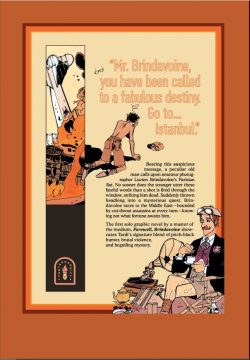
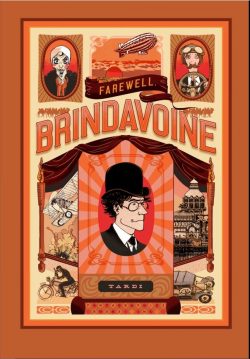
Farewell, Brindavoine


By Tardi, translated by Jenna Allen (Fantagraphics)
ISBN: 978-1-68396-433-9 (Album HB)

Credited with creating a new style of expressionistic illustration dubbed “the New Realism”, Jacques Tardi is one of the greatest comics creators in the world, blessed with a singular vision and adamantine ideals. A strident anti-war activist, he apparently refused France’s greatest honour because he wanted to be completely free to say and create what he wants.

Tardi was born in the Commune of Valence, Drôme in August 1946 studying at École Nationale des Beaux-Arts de Lyon and subsequently the prestigious Parisian École Nationale Supérieure des arts Décoratifs. He launched his comics career in 1969 at the home of modern French comics Pilote, with the series we’re looking at today first seen in 1972-1973.

From illustrating stories by Jean Giraud, Serge de Beketch and Pierre Christian, he moved on to westerns, crime tales and satirical works in magazines such as Record, Libération, Charlie Mensuel and L’Écho des Savanes all whilst graduating into adapting prose novels by Louis-Ferdinand Céline and Léo Malet.

The latter’s detective Nestor Burma was the subject of all-new albums written and drawn by Tardi once the established literary canon was exhausted, leading to the creation of Polonius in Métal Hurlant (1976) and the now-legendary Les Aventures Extraordinaires d’Adèle Blanc-Sec – an epic period fantasy adventure which ran in the daily Sud-Ouest. The series numbers ten volumes thus far and inhabits the same pocket reality as the star of this tome.

The passionate creator has crafted many crushingly powerful anti-war books and stories (C’était la guerre des tranchées, Le trou d’obus, Moi René Tardi, prisonnier de guerre au Stalag IIB and other) dealing with the common soldier’s plight; written novels, created radio series, worked in movies, and co-created – with writer Jean Vautrin – Le Cri du Peuple: a quartet of albums about the Parisienne revolt of the Communards.

Far too few of this French master’s creations are available in English (barely a dozen out of more than fifty) but, thanks to NBM, iBooks and Fantagraphics, we’re catching up.

This lavish full-colour hardback (also available digitally) began life as Adieu Brindavoine, with its obscure yet complex Victoriana, shady political intrigues, dastardly plutocratic plotters and cast-iron-&-clockwork chic, leading to Tardi being proclaimed in later years the Godfather of Steampunk. His surreally-structured absurdist episodes and incidents – strung together in an almost stream-of-consciousness mode – work best on the visual perceptions with dialogue used only to ensure clarity or bemuse perception…

Following a context-supplying appreciation in Benoít Mouchart’s Preface, we begin in Neuilly-Sur-Seine in May 1914, as an aged messenger braves the cluttered and controversial home of gentleman photographer Lucien Brindavoine. Surly Basil Zarkhov has a startling – and potentially life-changing – proposition, but is gunned down by a skylight-shattering intruder before he can share it. However, thanks to his deathbed exposition, Lucien is soon heading by steamship for Istanbul, and another risky meeting…

Constantly encountering strikingly odd individuals, he is soon unwillingly partnered with effetely obnoxious intoxicated Englishman Mr. Oswald Carpleasure and hurtling across the desert towards Afghanistan in a battered motor vehicle. In their immediate future is a fantastic lost city, but the sinister gunman is in hot pursuit and wicked Olga Vogelgesang is determined to destroy them with her deadly state-of-the-military-art biplane…

After much privation and bewilderment, Lucien finally reaches the lost Iron City and is greeted by the orchestrators of many of his woes. Learning of an incredible plutocratic plot affords him little comfort, but before long the baroque devils in nominal charge fall upon each other like deranged wolves, enabling, if not compelling Brindavoine to flee in the most advanced passenger craft in the world…

Thanks to a breaking world war, he doesn’t get far…

Following the tale’s conclusion, a compelling comic epilogue from a previously unseen narrator (think Rocky Horror Show) deviously adds to the confusion by “explaining” what’s happened and Lucien’s ultimate fate before introducing a thematic follow-up.

‘Lambs to the Slaughter’ is set in November 1914 with deserters from all the armies involved holing up in a shattered church. Plagued by visions of perfect pasts and potential tomorrows, they are completely unprepared for when the mad military of today finds them…

Bizarre, visually resplendent, darkly funny, evocative and deliciously challenging, Farewell, Brindavoine is a comic tour de force on every level and a sublime example of how fashion, fantasy and futurism can work miracles when woven together by a master craftsman.
This edition of Farewell, Brindavoine © 2021 Fantagraphics Books, Inc. Adieu Brindavoine © 2011 Casterman. Translation © 2021 Jenna Allen. Preface © 2021 Benoít Mouchart. All rights reserved.

Farewell, Brindavoine is physically released on August 26th 2021 and available for pre-order. Digital editions can be purchased now.

Lucky Luke: The Complete Collection volume 2


By Morris, translated by Jerome Saincantin (Cinebook)
ISBN: 978-1-84918-455-7 (Album HB)

On the Continent, the populace has a mature relationship with comics: according them academic and scholarly standing as well as meritorious nostalgic value and the validation of acceptance as an art form. This hardback/digital compilation celebrates the formulative early triumphs of a fictional hero who is certainly a national treasure for both Belgium and France, whilst tracing the lost origins of a global phenomenon. It’s also timely in that the worldwide western wonder celebrates his 75th Anniversary this year…

As we know him now, Lucky Luke is a rangy, good-natured, lightning-fast cowboy roaming the fabulously mythic Old West, having light-hearted adventures with his horse Jolly Jumper whilst interacting with a host of historical and legendary figures and icons.

His ongoing exploits have made him one of the best-selling comic characters in Europe (81 collected books and more than 300 million albums in at least 33 languages thus far), with all the usual spin-off toys, computer games, puzzles, animated cartoons, TV shows and live-action movies.

This wild and woolly delight – originally released in 2017 as L’Intégrale 2 – features a far more boisterous and raw hero in transition, who hits his stride and struts his stuff after a preliminary text feature fills us in on the tone of the times, Morris’ filmic and comics influences and an eventful US sojourn…

Lucky Luke was created in 1946 by Belgian animator, illustrator and cartoonist Maurice de Bévère (“Morris”). For years we believed it was for Le Journal de Spirou Christmas Annual (L’Almanach Spirou 1947), before being launched into his first weekly adventure ‘Arizona 1880′ on December 7th 1946. However, the previous volume in this superb archival series (in hardback album and digital editions) revealed the strip actually debuted in the multinational weekly comic, but without a title banner and only in the edition released in France…

This second outing re-presents – in strict chronological order – strips created between October 1949 and December 1952 before being collected in albums Under a Western Sky (1952), Lucky Luke versus Poker Pat (1953) and Outlaws (1954). Here all the art and pages have been restored, rejiggled and remastered to achieve maximum contemporary authenticity with the original weekly serialisation.

The previous collection covered how the neophyte auteur became a dependable staple of the Euro-comics scene whilst toiling as a caricaturist for magazine Le Moustique and working at the CBA (Compagnie Belge d’Actualitiés) cartoon studio, where he met future comics superstars Franquin and Peyo. Morris was one of “la Bande des quatre” – The Gang of Four – comprising Jijé, Will and old comrade Franquin: leading proponents of a new, loosely free-wheeling artistic style known as the “Marcinelle School” which dominated Le Journal de Spirou in aesthetic contention with the “Ligne Claire” style used by Hergé, EP Jacobs and other artists in Le Journal de Tintin.

In 1948 said Gang (excluding Will) visited America, meeting US creators and sightseeing. Morris stayed for six years, meeting fellow traveller René Goscinny, scoring work at newly-formed EC sensation Mad and always making copious notes and sketches of the swiftly vanishing Old West. Morris stayed for six years, an “American Period” seeing him chase an outsider’s American Dream while winning fame and acclaim in his own country. That glittering sojourn is carefully unpicked and shared by expert researchers Christelle & Bertrand Pissavy-Yvernault.

Their heavily-illustrated essay covers his East-to-West trek, family life and quest to experience the wonderland of his fantasies. The in-depth treatise is packed with intimate photos and his published illustrations of the period, culled from Le Moustique, plus comics pages, film memorabilia (from the movies that so influenced his stories at that time) and also includes both art work from European and US publications by fellow expat and eventual collaborator Rene Goscinny. There’s even an in-depth analysis of how what Morris Saw became what Lucky Did closely referencing the comics stories that follow…

Working solo (with early script assistance from his brother Louis De Bevere) until 1955, Morris produced nine albums of affectionate sagebrush parody and action before formally uniting with Goscinny, who became the regular wordsmith as Luke attained the dizzying heights of superstardom, commencing with ‘Des rails sur la Prairie’ (Rails on the Prairie), which began in Le Journal de Spirou on August 25th 1955.

Before we get there though, there’s plenty of solo action to enjoy beginning with ‘The Return of Trigger Joe’ from LJdS #602-618 (October 27th 1949-February 16th 1950) and collected in 1952’s Sous le Ciel de l’ouest/Under a Western Sky) album. Here the lonesome wanderer meets another prairie nomad who’s his match in all cowboy disciplines, who becomes a rather ruthless competitor when they sign up for the Nugget Gulch horse race. Of course, “John Smith” believes he’s a shoo-in since he’s riding the stolen Jolly Jumper, but hasn’t counted on Luke’s close relationship with the wonder horse. Once that scheme fails – but not before extended slapstick shenanigans in the race scenes – Smith falls back on his old ways as bank robber Trigger Joe, but his pilfering the prize money only leads to disaster when Lucky trails him deep into the searing desert…

Next up chronologically and also from Under a Western Sky, ‘Round Up Days’ (LJdS #619-629; February 23rd – May 4th 1950) sees Lucky actually working as a cowboy, hiring on for a cattle round-up (lots of rodeo style comedy here!) before encountering rustlers and cleaning up cow town Bottleneck City…

Closing the first album, ‘The Big Fight’ (LJdS #630-646; May 11th – August 31st 1950) sees Luke briefly adopt a two-fisted simpleton with the strength of Hercules and school him in the arts of pugilism for a prize-fight against infamous Killer Kelly. Things are going well until bookmaker Slats “Slippery” Nelson tries to fix the outcome. Thankfully, Lucky is his match in cunning and a faster gun than the gambler’s hirelings…

The next album release was December 1953’s Contre Pat Poker/ Lucky Luke versus Pat Poker, but its contents – ‘Clean-up in Red City’ and ‘Rough and Tumble in Tumbleweed’ were reprinted out of chronological order so here the former (from LJdS #685-697; May 31st – August 23rd 1951) and detailing how Lucky becomes a sheriff after being embarrassingly robbed, and kicks out all the gamblers, shysters and crooked saloon owners led by sinister charlatan Pat Poker – is followed by the eponymous lead adventure from 1954 album Hors-la-loi/Outlaws: a highly significant action romp signalling the debut of Lucky’s greatest foes.

The strip ‘Outlaws’ originally ran in LJdS #701-731 from September 20th 1951 to April 17th 1952 with our hero hired by the railroad companies to end the depredations of Emmett Bill, Grat and Bob Dalton – real life badmen who plagued the region during the 1890s, imported into the strip and given a comedic, but still vicious spin. The cat & mouse chase across the west sees Luke constantly frustrated by close calls and narrow escapes in superbly gripping movie set-pieces until, inevitably, justice claims the killers.

Morris ended the gang forever, but they were insanely popular with fans and the ideal foils for Lucky, so eventually they returned in the form of their own cousins, but we’ll tell that tale another time and place…

Here it’s back to ‘Rough and Tumble in Tumbleweed’ (LJdS #735-754; May 15th – September 25th 1952) as sheep farmers are harassed and imperilled by cattlemen. Luke’s attempts to broker peace are swiftly derailed after escaped convict Pat Poker slips into town and uses his gift for cheating to take over the local saloon and hire shepherd-hating gunslinger Angelface to remove their mutual enemy. Sadly for them, even this alliance of evil is insufficient to tame the wily western wonder…

By now a certified Christmas must-have item, December 1954’s Lucky Luke album Outlaws also carried the ‘Return of the Dalton Brothers’ as first seen in LJdS #755-764 (October 2nd – December 4th 1952). Here, a fraud named Bill Bonney campaigns to become sheriff of a prosperous frontier town by claiming to be the killer of the infamous owlhoots, and seems unstoppable until Lucky orchestrates a brief and equally fraudulent resurrection of the bandit brothers…

Morris died in 2001 having drawn fully 70 adventures, plus spin-off yarns of Rantanplan (“dumbest dog in the West” and a charming spoof of cinema canine Rin-Tin-Tin), with Achdé, Laurent Gerra, Benacquista & Pennac taking over the franchise, producing more tales of the immortal cowboy.

A treasure trove of vintage cartoon material, designs and sketches, contemporaneous extras, commentary, original art, creator biographies and more, this is a delight for older kids who have a gained a bit of perspective and historical understanding, although the action and slapstick situations are no more contentious than most Laurel and Hardy films (perfectly understandable as Morris was a devout fan of the bumbling duo).

These youthful forays of an indomitable hero offer grand joys in the tradition of Destry Rides Again and Support Your Local Sheriff, superbly executed by a master storyteller: a wonderful introduction to a unique genre for modern kids who might well have missed the romantic allure of the Wild West that never was…

Bon anniversaire, Lucky!
© Morris/Dupuis, 1949 to 1954 for the first publications in Le Journal de Spirou.
© Morris/Dupuis 2017 for this volume of the collection. All other material © 2017 its respective creators/owners.

Canciones – Federico García Lorca Drawn by Tobias Tak


Adapted and translated by Tobias Tak (NBM)
ISBN: 978-1-68112-274-8 (HB) eISBN 978-1-68112-275-5

These days a seemingly infinite variety of subjects fit under the umbrella of modern graphic novels – everything from superheroes, sci fi and the supernatural to philosophy, journalism and education. Thanks to its global reach and outlook, NBM are at the forefront of this welcome revolution, bringing a range of visions to the English-speaking table that apparently daunt most mainstream publishers here and in America.

Today’s book is a perfect case in point: a sequence of visual adaptations of one of the world’s most celebrated modern poets, brought to scintillating life by a renowned scholar and a multidisciplinary artist. The result is an utterly enticing hardback treasure, and there’s not a single tragic supervillain in sight…

Federico García Lorca was born in 1898 and died in 1936: winning acclaim in Spain and across the world for his plays, music and poems during a life both dramatic and perilously brief. A strident socialist reformer, he was executed on the orders of fascist dictator General Franco, but his works and observations remain relevant and challenging to this day.

Here, Boston University-based official translator and Lorca expert Christopher Maurer (The Collected Poems of Garcia Lorca) offers crucial background in his Introduction ‘Cloudscapes’, whilst Holland’s cartooning national treasure Joost Swarte (Horst Serie; Modern Papier; Jopo de Pojo; Modern Art) ponders the cultural and creative similarities between the poet and his visual interpreter before the bilingual wonderment begins.

We lost Tobias Eduard Tak (Tante Leny; Gaboon’s Daymare; Upside Down; The Spirit of Saturn) far too early. The Dutch choreographer, dancer, singer, author and illustrator was born in January 1954 in Voorburg and studied at the Royal Academy of Fine Arts in the Hague. Graduating in the late 1970s, he moved to London and began contributing to comics publications across the world, as well as successfully pursuing stage creative disciplines. Delivered in Dutch and Spanish, Canciones was his last completed work. “Tobi” died in Amsterdam on January 7th 2020.

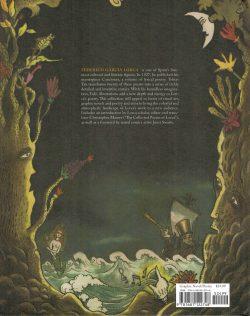
Lorca’s most popular work, Canciones is a collection of Andalusian folk songs and ballads, which lend themselves easily to Tak’s lifelong fascination with dream states and fairy tales.

With English replacing Dutch text on these vividly intoxicating pages, and the Spanish lines cunningly woven into the gently meandering designs, twenty fanciful moments of wistful rumination and longing are yours to share. Preceded by an enchanting ‘Preludio/Prelude’, ‘Song of November and April’, ‘The Deceiving Mirror’, ‘Conch!’, ‘It’s True’, ‘Fable’, ‘First Anniversary’ and ‘Second Anniversary’ carry us through a bizarre and beguiling voyage of discovery with fantastical creatures and characters tirelessly looking… but for what?

The search shifts to ploys of conquest as we learn what is said ‘In a Girl’s Ear’ and experience despondency from the ‘Song of the Barren Orange Tree’, after which the hunt for truth and contentment resumes in ‘Debussy’, ‘The Mute Boy’, ‘Schematic Nocturne’, ‘A Song Sung’, ‘Riverside Songs’ and ‘The Moon Comes Up’.

Temptation comes calling on ‘The Street of the Mute’, leading to painful introspection and fresh insights in ‘Foolish Song’, ‘Farewell’ and ‘Song of the Departing Day’ before we arrive at a deeply personal Mise en Abyme (just look it up: it’s never too late to learn things) in concluding ode ‘In Another Manner’…

Wild, near-hallucinogenic vistas and characters blend history with mythology to depict ephemeral situations and timeless moments in this evocative picture hymnal dedicated to the human condition. It’s a beautiful achievement and the ideal gift for the sensitive ones in your life.
© 2017 Tobias Tak/Scratch Books. Foreword © 2017 Christopher Maurer. Introduction © 2017 Joost Swarte.

Canciones – Federico García Lorca Drawn by Tobias Tak will be released on August 19th 2021 and is available for pre-order now

Blake and Mortimer: Professor Satō’s Three Formulae Parts One (Mortimer in Tokyo) & Two (Mortimer versus Mortimer)


By Edgar P. Jacobs and Bob De Moor: with colours by Paul-Serge Marssignac, translated by Jerome Saincantin(Cinebook)
ISBN: 978-1-84918-292-8 (Album PB Pt 1) 978-1-84918-303-1(Album PB Pt 2)

Pre-eminent fantasy raconteur Edgar P. Jacobs devised one of the greatest heroic double acts in pulp fiction: pitting his distinguished scientific adventurers Professor Philip Mortimer and Captain Francis Blake against a daunting variety of perils and menaces in a sequence of stellar action-thrillers which blended science fiction scope, detective mystery suspense and supernatural thrills. The magic was made perfect through his stunning illustrations, rendered in the timeless Ligne Claire style which had made intrepid boy-reporter Tintin a global sensation.

The Doughty Duo debuted in September 1946; gracing the pages of the very first issue of Le Journal de Tintin: an ambitious international anthology comic with editions in Belgium, France and Holland. It was edited by Hergé, with his eponymous, world-famous star ably supplemented by a host of new heroes and features for the rapidly-changing post-war world. Bon anniversaire, Chaps!…

Les 3 formules du professeur Satō was a tragically extended affair and Jacob’s last hurrah. What became the 11th album was originally serialised between September 1971 and May 1972 in LJdT, after which the author abandoned his story due to failing health and personal issues.

Edgard Félix Pierre Jacobs died on February 20th 1987 and soon after, Bob de Moor was commissioned by the family and estate to complete the final tale from Jacob’s pencil roughs and script notes. The concluding album was finally released in March 1990. This led to a republishing of all the earlier exploits and eventually fresh adventures from a variety of creative teams…

Mortimer in Tokyo opens at Haneda Airport, where Air Traffic Controllers experience a unique problem when a UFO disrupts their carefully plotted flight courses. With disaster imminent, jets are scrambled to pursue the meteoric anomaly. Just before they perish, the pilots radio back that they are being attacked by a dragon…

As the news filters around the world, renowned cyberneticist Professor Akira Satō argues with assistant Dr. Kim, deeply remorseful that his latest breakthrough has been the cause of such tragedy. Kim only barely dissuades his Sensei from turning himself in to the authorities but is utterly unable to convince or prevent Satō from involving visiting colleague Philip Mortimer in his crisis of conscience…

The British scholar is in Kyoto attending a succession of scientific conferences, and when an ominous outsider overhears Satō’s intentions through hidden surveillance methods, the reaction is both explosive and potentially murderous…

The first Mortimer knows of the problem is when a gang of gunmen attempt to kidnap him off the streets, but after fighting them off and escaping, the old warrior returns to his hotel and finds a telegram waiting for him…

An urgent request to join old friend Satō immediately seems impossible due to stringencies of train timetabling, but an accommodating journalist overhears and offers a speedy compromise. Mortimer is suspicious of the happy accident… but not suspicious enough…

Surviving another assassination attempt by sheer force of will, the professor is then lost in the wilds of Japan before eventually battling his way to Satō’s lab outside Tokyo where he witnesses a series of astonishing sights.

His host has worked miracles in the fields of robotics – including the dragon which so recently and horrifically malfunctioned – but is at a loss to explain how his incredible creations have gone wrong at such a late stage. Worldly-wise Mortimer soon deduces the causes: espionage and sabotage…

As the British boffin sends for doughty comrade-in-arms Captain Blake, Satō is comforted by the fact that the key formulae for producing his mechanical marvels have been divided and deposited at three different banks in Tokyo. The Sensei breathes even easier after arranging that only Mortimer can retrieve them, but this only prompts their hidden enemy to accelerate his plans and reveal himself as one of Mortimer’s greatest foes…

Unable to induce or force Mortimer to retrieve the scientific goldmine, the mastermind has an android double constructed to fool the banks, but the rush-job breaks down before the task is completed. Now the vile villain has only more card to play before the formidable Blake arrives…

This edition – available as always in paperback album and digital formats – concludes with excerpts from other B & M albums, plus a short biographical feature and publication chart of Jacobs’ and his successors’ efforts to whet the appetite for further treats in store…

Cunning and convoluted, this devilishly devious tale unfolds with potent authenticity and ever-escalating tension, building to an explosive conclusion which eventually took eighteen years to conclude. At least we don’t have to wait that near-lifetime for the epic denouement…

Part 2: Mortimer versus Mortimer
Edgard Félix Pierre Jacobs (March 30th 1904-February 20th 1987) is deservedly considered a founding father of the Continental comics industry. Although his output was relatively modest compared to many of his contemporaries, Jacobs’ landmark serialised epic formed the backbone of the modern action-adventure comic in Europe.

His splendidly adroit, roguish, thoroughly British stars were conceived for the premier issue of Le Journal de Tintin, and quickly became a crucial staple of life for post-war European kids – in exactly the same way Dan Dare was for 1950s Britain.

Jacobs was Brussels-born: a precocious child perpetually drawing, but even more obsessed with music and performing arts – especially opera. He attended a commercial school but loathed the idea of office work, avidly pursuing arts and drama jobs after graduation in 1919.

A succession of such at opera-houses (scene-painting, set decoration and even performing as both an acting and singing extra) supplemented his private performance studies, and in 1929 Jacobs won an award from the Government for classical singing. His dreamed-of operatic career was thwarted by the Great Depression. When arts funding suffered massive cutbacks following the global stock market crash, he was compelled to pick up whatever dramatic work was going, although this did include more singing and performing.

In 1940, Jacobs switched to commercial illustration, winning regular work in the magazine Bravo, as well as illustrating short stories and novels. He famously took over the syndicated Flash Gordon strip after the occupying German authorities banned Alex Raymond’s quintessentially All-American Hero and the publishers desperately sought someone to satisfactorily complete the saga.

Jacobs’ ‘Stormer Gordon’ lasted less than a month before being similarly embargoed by the Occupation fun-police, after which the man of many talents simply created his own epic science-fantasy feature in the legendary Le Rayon U: a milestone in both Belgian comics and science fiction adventure.

During this period Jacobs and Tintin creator Hergé got together, and whilst creating the weekly U Ray strip, the younger man began assisting on Tintin, colouring the original black and white strips of The Shooting Star (originally published in newspaper Le Soir) for an upcoming album collection.

By 1944 Jacobs was performing similar duties on Tintin in the Congo, Tintin in America, King Ottokar’s Sceptre and The Blue Lotus. He was also contributing to the drawing too, working on extended epic we know as The Seven Crystal Balls and Prisoners of the Sun.

After the war and Europe was liberated, publisher Raymond Leblanc convinced Hergé, Jacobs and a few other comic strip stars to work for his proposed new venture. Founding publishing house Le Lombard, Leblanc also commissioned Le Journal de Tintin, an anthology comic with simultaneous editions in Belgium, France and Holland to be edited by Hergé and starring the intrepid boy reporter and a host of new heroes.

Beside Hergé, Jacobs and writer Jacques van Melkebeke, Le Journal de Tintin featured Paul Cuvelier’s Corentin and Jacques Laudy’s Legend of the Four Aymon Brothers.

As revealed in an enticing, photo-packed essay closing this Cinebook volume, Blake and Mortimer were a lucky compromise. Jacobs had wanted to create a period historical drama entitled Roland the Bold but changed genres due to an overabundance of such strips…

Laudy had been a friend of Jacobs since their time together on Bravo, and the first instalment of the epic thriller serial Le secret de l’Espadon starred a bluff, gruff British scientist and an English Military Intelligence officer closely modelled on Laudy himself…

The initial storyline ran from issue #1 (26th September 1946 to September 8th 1949): cementing Jacobs’ status as a star in his own right.

In 1950, with the first 18 pages slightly redrawn, The Secret of the Swordfish became Le Lombard’s first album release, with the concluding volume published three years later. The albums were reprinted nine more times between 1955 and 1982, in addition to a single omnibus edition released in 1964.

Hergé and Jacobs purportedly suffered a split in 1947 when the former refused to grant the latter a by-line on new Tintin material they had collaborated on, but since the two remained friends for life and Jacobs continued to produce Blake et Mortimer for the weekly, I think it’s fair to assume that if such was the case it was a pretty minor spat. I rather suspect that the Eccentric Englishmen were simply taking up more and more of the diligent artist’s time and attention…

Cinebook have made the Gentleman Heroes a bankable proposition, releasing the 29-and-counting albums, but suffice to say that the concluding instalment of Professor Satō’s Three Formulae was a long time coming …

Les 3 formules du professeur SatōMortimer contre Mortimer was a tragically extended affair and only credited Jacobs as writer and layout artist. The 11th album had been serialised between September 1971 and May 1972, after which the author simply dropped the story.

He died on February 20th 1987 and as cited veteran cartoonist Bob de Moor (Bart de Scheepsjongen, Monsieur Tric, Cori le Moussaillon, Balthazar, Barelli and so many others) was commissioned to complete his final tale from pencils and notes.

The concluding album was released in March 1990, sparking a republishing renaissance and new adventures from a variety of creative teams…

As previously described, boisterous boffin Mortimer is in Japan when contacted by robotics pioneer and cyberneticist supreme Professor Akira Satō. The savant has performed miracles in mass-production of highly specialised mechanoids and androids, but his discoveries – parsed down into three crucial processes and deposited in three separate banks – are targeted by a ruthless gang led by Blake and Mortimer’s greatest enemy.

The villains infiltrated Satō‘s home and laboratory, tried to murder Mortimer numerous times and unleashed a robot duplicate of the scientist, but have been unable to stop a summons for help going out to his Secret Service ally. Now, with Blake imminently expected, the gang radically accelerate their timetable…

Blake is watched from the moment he disembarks at Haneda Airport and hidden enemies are already in place at his hotel. The MI5 chief has a suite next to Mortimer’s, and although his comrade is missing, finds plenty of clues as to what has happened to him. The diligent search also uncovers the video surveillance gear infesting both rooms and sets his watchers running for the exits in panic…

A hasty pursuit only leads to his own capture but, with fortune ever favouring the brave, Blake turns the tables on his foes in a deadly clash at the hotel garages, before sending them all fleeing for their lives.

By the time he has connected with Police Superintendent Hasumi and briefed Colonel Mitsu of the Japanese Public Security Intelligence Agency, the assailants have vanished, but Blake is building a picture of what is going on. To end the Englishman’s threat forever, a diabolical and desperate scheme is devised and a second Mortimer robot is built to assassinate Blake…

Turncoat assistant Kim is nervous. Although happy to use Satō‘s incredible inventions to detain Mortimer and his former employer, the traitor is not conversant enough with production procedures to guarantee success. Nevertheless, a deadly doppelganger of the Professor is soon despatched to kill Blake…

The real Mortimer has not been idle. With Satōs aid he has escaped the lab prison, rushing to intercept the android assassin, but unaware that behind him, unqualified hands have meddled with the duplication processes and a legion of horrific misfit mechanoids are tumbling off the conveyor belts…

What follows is a succession of spectacular chases, frantic battles and a final shattering showdown between Blake, Mortimer and the man who has bedevilled them since the Swordfish case – a fitting end to their exploits and, thanks to the graphic efforts of De Moor, a perfect, revitalising stepping stone for other creators to continue the feature…

Rocket-paced, suspenseful and cathartically action-packed, this is an enthralling changing-of-the-guard, building to an explosive conclusion and satisfying final flourish: another superbly stylish blockbuster to delight every adventure addict and Jacobs purist.

As well as the aforementioned historical overview – ‘Jacobs: 1946, the Swordfish, starting point of a masterful work’ – this Cinebook edition also includes excerpts from two other albums, a short biographical feature and publication chart of Jacobs’ and his successors’ efforts.
Vol 1: Original edition © Editions Blake & Mortimer/Studio Jacobs (Dargaud-Lombard S. A.) 1977 by E.P. Jacobs. All rights reserved. English translation © 2016 Cinebook Ltd.
Vol. 2: Original edition © Editions Blake & Mortimer/Studio Jacobs (Dargaud-Lombard s. a.) 1990 by E.P. Jacobs & Bob De Moor. All rights reserved. English translation © 2016 Cinebook Ltd.

Yoko Tsuno volume 10: Message for Eternity


By Roger Leloup translated by Jerome Saincantin (Cinebook)
ISBN: 978-1-84918-251-5 (Album PB)

The uncannily edgy yet excessively accessible exploits of Japanese scientific adventurer Yoko Tsuno first graced the pages of Le Journal de Spirou in September 1970 and are still going strong, with 29th album Anges et Faucons (Angels and Falcons) released in 2019.

The eye-popping, expansively globe-girdling multi-award-winning series is the brainchild of Roger Leloup, another hugely talented Belgian who worked as a studio assistant on Herge’s Adventures of Tintin before striking out on his own. Compellingly told, astoundingly imaginative yet always grounded in hyper-realistic settings whilst sporting utterly authentic and unshakably believable technology, these illustrated epics were at the vanguard of a wave of comics featuring competent, clever and brave female protagonists that revolutionised Continental comics from the last third of the 20th century onwards and are as potently empowering now as they ever were.

The initial Spirou stories ‘Hold-up en hi-fi’, ‘La belle et la bête’ and ‘Cap 351’ were short introductory vignettes prior to the superbly capable Miss Tsuno and her always awestruck and overwhelmed male comrades Pol and Vic truly hitting their stride with premier extended saga Le trio de l’étrange (which began serialisation with the May 13th 1971 issue).

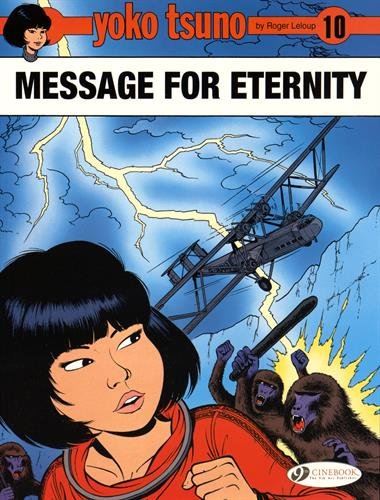
That epic of extraterrestrial intrigue was the first of many European albums, with the one here first serialised in LJdS #1882-1905 (from 9th May-17 October 17th 1974) and released a year later as Message pour l’éternité. A skilfully crafted suspenseful mystery thriller, the chronologically fifth album over there reaches us as Cinebook’s 10th translated chronicle.

It all begins as Yoko perfects her skills in a new hobby. Gliding high above Brittany. she fortuitously sets down in a field near a vast telecommunications complex. Offered a tour of the space-probing facility, she learns from one of the scientists of a fantastic “ghost message” recently picked up by their satellites: a Morse code signal from a British plane lost in 1933. Moreover, the signal is still being regularly broadcast…

As Yoko tries to arrange for her glider to be collected, a mysterious Englishman offers her a lift in his private helicopter but he has an ulterior motive. He works for the company which insured the lost flight and is looking for someone with certain exacting qualifications to trace the downed flight and recover a fortune in jewels from it. Her fee will be £20,000…

His firm has known where the plane went down for quite some time, but geographical and logistical difficulties have prevented them from undertaking a recovery mission until now. Moreover, although they have now started the process, the petite engineer is physically superior to the candidates the company are currently working with…

Cautiously accepting the commission, Yoko starts planning but even before Pol and Vic can join her the following day, strange accidents and incidents impact and imperil her life…

The boys are understandably reluctant but that attitude turns to sheer frustration and terror after someone tries to shoot Yoko down as she practises in her glider. This only makes her more determined to complete the job at all costs…

Two weeks later the trio are heading to the daunting Swiss fortress the company uses as a base, when another spectacular murder attempt almost ends their lives. Yoko remains undaunted but not so Vic and Pol, especially after overhearing that two of her fellow trainees recently died in similar “accidents” in the mountains…

Carrying on regardless, she assesses the technologically sophisticated glider-&-launch system which will take her to the previously unattainable crash site and perfects her landing technique in a fantastic training simulator. Eventually more details are provided and the real story unfolds.

In November 1933, the Handley-Page transport they are hunting was conveying diplomatic mail from Karachi to London before vanishing in a storm over Afghanistan. Decades later, a satellite somehow picked up a broken radio message stating it had landed…

Somewhere…

The businessman the trio call “Milord” identifies himself as Major Dundee – a spymaster from Britain’s Ministry of Defence – who explains how a shady American former U2 pilot approached the British government, claiming to have spotted the downed ship during a clandestine overflight of Soviet territories.

He provided purloined photos showing the plane in the centre of a vast circular crater on the Russo-Chinese border, but subsequent reconnaissance flights revealed nothing in the hole so the decision was taken to make a physical assessment, even though the already inaccessible site was deep in hostile enemy territory. Since then, it has become clear that some unidentified agent or group is acting against the recovery project, presumably intent on retrieving the ship’s mysterious but valuable cargo for a foreign power.

Events spiral out of control when a traitor in the training team attempts to kill Yoko and “Operation Albatross” is rushed to commencement before the unknown enemy can try again…

Within a day she is transported in a speedy manner around the world before her space-age glider prototype is secretly deployed over the enigmatic crater…

Narrowly avoiding patrolling Soviet jets, Yoko deftly manoeuvres into the mist-covered chasm and plunges into one of the most uncanny experiences of her life.

The old plane is certainly gone. The floor of the crater is strangely  cracked and at the centre stands a burned and blackened monolith; there are uncharacteristic animal bones everywhere and at one end of the vast cavity is a primitive but large graveyard…

When the astounded girl goes exploring, she is ambushed by her treacherous fellow trainee who has raced after her by conventional means before parachuting into the bizarre basin. However, his original plans have changed drastically since arrival, and despite the machine gun he wields, he needs Yoko’s help. He’s already located the Handley-Page – somehow manually dragged under an unsuspected overhang in the crater – but is mortally afraid of what he describes as the “tiny people” infesting the terrifying impact bowl…

As the unlikely allies head towards the eerily preserved plane, the truth about the terrifying homunculi is shockingly revealed and they encounter the last human survivor of the downed Diplomatic Flight, discovering to their cost the uncanny and ultimately deadly atmospheric anomaly which has kept the plane a secret for decades and turned the crater into a vast geological radio set…

When the dust settles, Yoko realises she is trapped in the subterranean anomaly. With all her escape plans rendered useless she must align herself with the bizarre sole survivor and his bestial, rebellious servants, but she also refuses to give up on the recovery mission. Of course, that doesn’t mean that she has to trust anything the old relic in the hole or Major Dundee has said. With that in mind she lays her own plans to settle matters…

As ever, the most potent asset of these breathtaking dramas is the astonishingly authentic and staggeringly detailed draughtsmanship and storytelling, which benefits from Leloup’s diligent research and meticulous attention to detail, honed through years of working on Tintin.

With this sleekly beguiling tale Yoko proved that she was a truly multi-faceted adventurer, equally at home in all manner of dramatic milieux and able to hold her own against the likes of James Bond, Modesty Blaise, Tintin or any other genre-busting super-star: as triumphantly capable thwarting spies and crooks as alien invaders, weird science effects or unchecked forces of nature…

This is a splendidly frenetic, tense thriller which will appeal to any fan of blockbuster action fantasy or devious espionage exploit.
Original edition © Dupuis, 1973, 1979 by Roger Leloup. All rights reserved. English translation 2015 © Cinebook Ltd.

Blake and Mortimer: S.O.S. Meteors


By Edgar P. Jacobs, translated by Jerome Saincantin (Cinebook)
ISBN: 978-1-905460-97-7 (Album PB)

Not all of 2021’s comics milestones are Anglo-American affairs. These guys are celebrating 75 glorious years of uncanny exploits and still going strong. Bon Anniversaire, mes amis …

Master storyteller Edgar P. Jacobs pitted his distinguished duo of Scientific Adventurers Professor Philip Mortimer and Captain Francis Blake against a wide variety of perils and menaces in stunning yarns combining science fiction scope, detective mystery suspense and supernatural thriller action, rendered in the same ageless and inviting Ligne Claire style which first made intrepid boy reporter Tintin into a global sensation.

The strip debuted in the premier issue of Le Journal de Tintin (dated 26th September 1946): an international anthology comic with multi-language editions in Belgium, France and Holland. The magazine was edited by Hergé himself, with his eponymous star ably supplemented by a host of new heroes and features designed to inspire young readers of the post-war world…

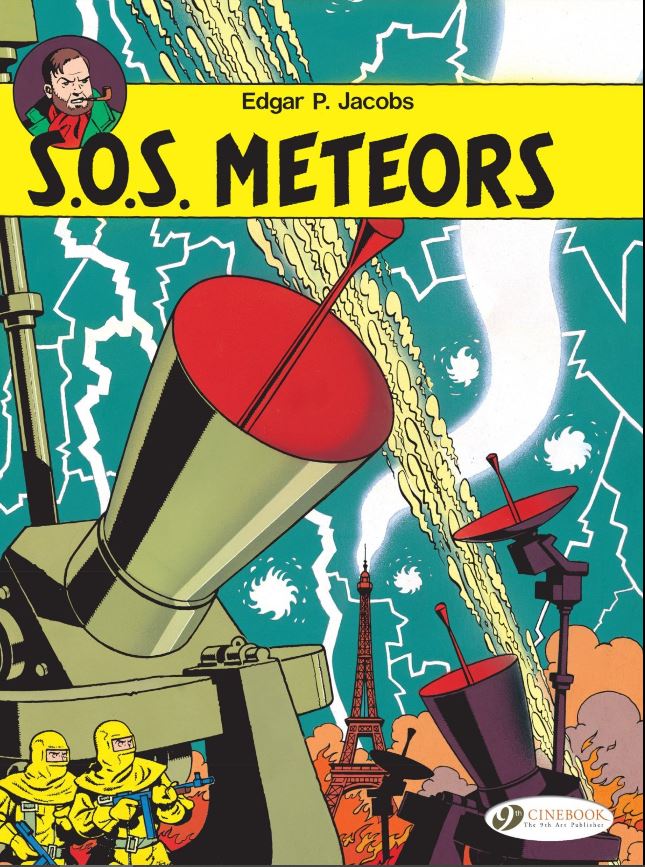
S.O.S. Météores began serialisation in the January 8th 1958 issue: running until April 22nd 1959 before being subsequently collected six months after the conclusion as the 8th album of the drama-drenched epic escapade. It was just in time for the Christmas rush.

In 2009 the tale was translated into English as Cinebook’s 6th Blake and Mortimer release, and – subtitled ‘Mortimer in Paris’ – opens here with the incomparable boffin in the City of Lights, answering a Gallic colleague’s pleas for assistance.

Like all his unhappy ilk, meteorologist Professor Labrousse is shouldering the brunt of public ire over freak weather events which are systematically bringing France to its knees. When Mortimer arrives, he experiences for himself the chaos tumultuous storms are inflicting upon the traffic-heavy metropolis. Thankfully, the embattled weatherman has despatched a taxi to collect the weary Englishman and bring him to the relative calm of suburban enclave Jouy.

Both driver and passenger are unaware of a flashy American car covertly dogging them. As conditions steadily worsen, the ride becomes truly hazardous, leading to an inevitable crash. Separated from the driver and blindly wandering in the storm, Mortimer plunges into a lake and barely manages to scrabble to safety.

Finding his way back to the road, the exhausted scientist thumbs a lift to Labrousse’s house and is warmly welcomed. Of the taxi driver, however, there is no trace…

The old chums discuss the catastrophic conditions and uncanny events long into the night, but the next morning further deliberations are curtailed when the police arrive, eager to interview the Englishman about a certain cab driver’s disappearance…

Deeply troubled, the learned men attempt to retrace Mortimer’s steps and discover the terrain is completely different from Englishman’s memories. They also encounter a thug and his immense dog going over the same sodden ground. The strangers are clearly following the orders of a boss who keeps well hidden, and a violent altercation is barely avoided with a simple whistle from the unseen voyeur…

Eventually the lifetime experience of the local postman enables the baffled British boffin to solve his geographical conundrum, and a recovered trail leads to a nearby estate with huge walls patrolled by the same terrifying hound he met earlier. Well-versed in surveillance procedure, Mortimer prepares to probe further but is distracted when a sudden snowstorm begins. Determinedly he returns later, well-prepared and using the blizzard as cover to investigate the estate. It proves to be a tremendous mistake…

Next morning in Paris, Divisional Commissioner Pradier of French Intelligence welcomes a counterpart from Great Britain, looking into an espionage ring at work in France. Captain Francis Blake’s keen insight quickly scores a hit: opening up new leads that seemly connect to the weather conditions tormenting the nation. However, on meeting hastily-summoned Labrousse, Blake learns old comrade Mortimer has vanished after announcing that the aberrant meteorology is man-made…

Travelling to Jouy with the horrified weatherman, Blake makes a shocking impression on Labrousse’s usually-affable neighbour as the strange atmospheric conditions are abruptly compounded with odd little accidents and frustrations that can only be seen in total as concerted enemy action…

The saga kicks into high gear when Blake recognises old – and presumed dead – enemies and is chased through unrelenting arctic conditions back to Paris in a deadly, hair-raising game of cat-&-mouse which culminates in another confrontation with his most implacable foe…

Assisted by Pradier’s forces, Blake soon has the villains on the run, spectacularly fleeing over Parisian rooftops, but the big fish again escapes, and our heroes face the fact that they may never know what has become of Mortimer…

In Jouy, however, the irascible researcher has made good use of his time. Incarcerated with diabolical Professor Milosh Georgevich – who has used the vast resources of an aggressor nation to weaponise weather in advance of an audacious scheme to invade France for the third time in a century – Mortimer acts alone and escapes his jailers. Picking up an unexpected ally as he tries to sabotage the colossal climate engines, the Prof is utterly unaware that his greatest friend has picked up new clues and is closing in on the plotters…

Moody and comparatively low-key until the final act – when tensions build to explosive heights and a Bond-Movie finish – S.O.S. Meteors is a splendid romp packed with astounding action, scads of sinister deviltry and a blockbuster climax to delight spy-buffs and all devotees of the Distinguished Duo.

Addictive and absorbing in the truest tradition of pulp sci-fi and Boy’s Own Adventures, Blake and Mortimer are the epitome of dogged heroic determination and the natural successors to such heroic icons as Professor Challenger, Bulldog Drummond and Richard Hannay, delivering grand Blood-&-Thunder thrills, chills and spills in timeless fashion and with a mesmerising visual punch.

Any kid able to suspend modern mores and cultural disbelief (call it alternate earth history or bakelite-punk if you want) will enjoy the experience of their lives…

This Cinebook edition – available in paperback and digital editions – also includes excerpts from two other B&M albums plus a short biographical feature and publication chart of Jacobs’ and his successors’ efforts.
Original edition © Editions Blake & Mortimer/Studio Jacobs (Dargaud-Lombard S. A.) 1989 by E.P. Jacobs. All rights reserved. English translation © 2009 Cinebook Ltd.

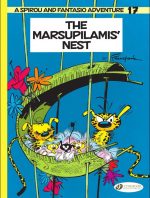
Spirou & Fantasio volume 17 – The Marsupilamis’ Nest


By André Franquin, translated by Jerome Saincantin (Cinebook)
ISBN: 978-1-84918-533-2 (Album PB)

Spirou (whose name translates as “squirrel”, “mischievous” and “lively kid” in the language of Walloons) was created by French cartoonist François Robert Velter – AKA Rob-Vel – for Belgian publisher Éditions Dupuis. The evergreen star was a response to the success of Hergé’s Tintin at rival outfit Casterman. At first, the character Spirou was a plucky bellboy/lift operator employed by the Moustique Hotel (an in-joke reference to Dupuis’ premier periodical Le Moustique) whose improbable adventures with his pet squirrel Spip evolved into astounding and often surreal comedy dramas.

The other red-headed lad debuted on April 21st 1938 in an 8-page, French-language tabloid magazine that bears his name to this day. Fronting a roster of new and licensed foreign strips – Fernand Dineur’s Les Aventures de Tif (latterly Tif et Tondu) and US newspaper imports Red Ryder, Brick Bradford and Superman – the now-legendary anthology Le Journal de Spirou grew exponentially: adding Flemish edition Robbedoes on October 27th 1938, increasing page count and adding compelling action, fantasy and comedy features until it was an unassailable, unmissable necessity for Franco-Belgian kids.

Spirou and chums spearheaded the magazine for most of its life, with many impressive creators building on Velter’s work, beginning with his wife Blanche “Davine” Dumoulin, who took over the strip when her husband enlisted in 1939. She was aided by Belgian artist Luc Lafnet until 1943, when Dupuis purchased all rights to the feature, after which comic-strip prodigy Joseph Gillain (“Jijé”) took over.

In 1946, Jijé‘s assistant André Franquin inherited the feature. Gradually, he retired traditional short gag-like vignettes in favour of longer adventure serials, introducing a wide and engaging cast of regulars. He ultimately devised a phenomenally popular nigh-magical animal dubbed Marsupilami, who debuted in 1952’s Spirou et les héritiers.

Jean-Claude Fournier succeeded Franquin: overhauling the feature over nine stirring serial adventures between 1969-1979 which tapped into the rebellious, relevant zeitgeist with tales of environmental concern, nuclear energy, drug cartels and repressive regimes.

By the 1980s, the series seemed stalled, with three different creative teams alternating on the serial: Raoul Cauvin & Nic Broca, Yves Chaland, and Philippe Vandevelde – writing as “Tome” & artist Jean-Richard Geurts AKA Janry.

These last reverently referenced the still-beloved Franquin era: reviving the feature’s fortunes in 14 wonderful albums between 1984-1998. After their departure the strip diversified into parallel strands: Spirou’s Childhood/Little Spirou and guest-creator specials A Spirou Story By…

Efforts by Lewis Trondheim and the teams of Jean-Davide Morvan & Jose-Luis Munuera and Fabien Vehlmann & Yoann brought the official album count to nearly 80 (if you include specials, spin-offs series and one-shots, official and otherwise), but there are still plenty of the older vintages uncollected, just waiting for another nostalgia wave to revive them (perhaps in Complete Collections as has been done with Lucky Luke and Valerian and Laureline…?)

Cinebook have been publishing Spirou & Fantasio’s exploits since October 2009, mostly concentrating on translating Tome & Janry’s superb pastiche/homages of Franquin, but for this manic marvel (available in paperback and digitally) we hark all the way back to 1960 for pure Franquin-formulated furore and fiasco.

The contents are actual two separate yarns, originally serialised in LJdS #699-991 (1956-1957) and #1034-1045 (1958) before being collected in 1960 as 12th European album Le nid des Marsupilamis. It’s brought to you as The Marsupilamis’ Nest…

In 1952’s Spirou et les héritiers, intrepid heroes Spirou and Fantasio encountered an incredible elastic-tailed anthropoid in the jungles of Central American nation Palombia: ultimately bringing the fabulous, affable creature back to civilisation and a string of bizarre and absurd adventures.

Franquin had assumed all creative responsibilities for Dupuis’ flagship strip part-way through Spirou et la maison préfabriquée (LJdS #427, June 20th 1946). He ran wild and prospered for two decades, enlarging the scope and horizons of the stories until the feature became purely his own.

As the Bellboy became a globe-trotting journalist, fans continuously met startling new characters such as comrade/rival reporter Fantasio; crackpot inventor Count of Champignac and inept colleague Gaston Lagaffe (known in Britain as Gomer Goof). Travelling to exotic places, they uncovered crimes, challenged the fantastic unknown and clashed with nefarious arch-enemies such as Zorglub and Zantafio. They also competed with one of the first strong female characters in European comics – rival journalist Seccotine (renamed Cellophine in the current English translation).

In this compilation, the eponymous lead story sees the enquiring lads lose out on a prestigious film-&-lecture gig to Cellophine, who has truly scooped them by penetrating the Palombian rain forest to create a compelling documentary of the language, mating habits and daily life of Marsupilamis…

Dramatic, action-packed, romantic, passionate and utterly hilarious, the tale depicts the earliest moments of the manic monkey’s adorable triplets and was apparently crafted by Franquin as his wife Liliane was carrying their first child…

The joys of the wilderness are counterbalanced by an enthralling graphic essay on civilisation and human nature as La foire aux gangsters AKA ‘The Gangster Fair’ sees Spirou and Fantasio – after some spectacular initial resistance – trained in the martial arts by innocuous-seeming Yudai Nao.

The aging oriental gentleman is the dutiful bodyguard of Yankee oil tycoon John P. Nutt, whose upcoming visit to Europe has afforded gangster Lucky Caspiano a chance to extract money and exact vengeance on a despised old enemy. Our heroes’ training is intended to create unsuspected back-up for the sentinel, but when the villains brutally remove Mr Nao and kidnap Nutt’s infant son, the likely lads find themselves on their own and painfully probing a sordid street fair for clues. Eventually their investigations centre on an all-comer’s boxing booth…

Happily, the reporters have unexpected allies – such as hapless office intern Gomer Goof and a thug with a conscience – but as the caper devolves into a manic, violent chase, Spirou deduces that they have been lied to, and that not every player in this game is on the side of the angels…

The Marsupilamis’ Nest offers the kind of lightly-barbed, comedy-thriller that delights readers fed up with a marketplace far too full of adults-only carnage, testosterone-fuelled breast-beating, teen-romance monsters or sickly-sweet fantasy.

Easily accessible to readers of all ages and rendered with the beguiling style and seductively wholesome élan which makes Asterix, Lucky Luke, and Iznogoud so compelling, this is a delicious tale from a long line of superb exploits that cries out to be a household name as much as those series – and even that other kid with the white dog…
Original edition © Dupuis, 1960 by Franquin. All rights reserved. English translation 2020 © Cinebook Ltd.

Trent volume 2: The Kid


By Rodolphe & Léo with colour by Marie-Paul Alluard, translated by Jerome Saincantin (Cinebook)
ISBN: 978-1-84918-374-1 (Album PB)

European comics audiences have long been fascinated with the mythologised American experience, whether it be the big-skied Wild West or later eras of crime-riddled, gangster-fuelled dramas. They also have a vested historical interest in the northernmost parts of the New World which has resulted in some pretty cool graphic extravaganzas.

Léo is actually Brazilian artist and storymaker Luiz Eduardo de Oliveira Filho: born in Rio de Janeiro on December 13th, 1944. Attaining a degree in mechanical engineering from Puerto Alegre in 1968, he was a government employee for three years, until forced to flee the country because of his political views. While a military dictatorship ran Brazil, he lived in Chile and Argentina before illegally returning to his homeland in 1974. To survive, he worked as a designer/graphic artist in Sao Paulo and created his first comics art for O Bicho magazine.

In 1981 he migrated to Paris, seeking to pursue a career in Bande Dessinée, and found some work with Pilote and L’Echo des Savanes as well as more advertising and graphics fare. The big break came when Jean-Claude Forest invited him to draw stories for Okapi which led to regular illustration work for Bayard Presse. In 1988 Léo began his long association with scripter and scenarist Rodolphe D. Jacquette – AKA Rodolphe.

His prolific, celebrated writing partner has been a giant of comics since the 1970s: a Literature graduate who transitioned from teaching and running libraries to creating poetry and writing criticism, novels, biographies, children’s stories and music journalism. In 1975, after meeting Jacques Lob, he expanded his portfolio to write for a vast number of artists and strip illustrators in magazines ranging from Pilote and Circus to À Suivre and Métal Hurlant. Amongst his most successful endeavours are Raffini (with Ferrandez) and L’Autre Monde (Florence Magnin) but his collaborations in all genres and age ranges are too numerous to list here.

In 1991 he began working with Léo on a period adventure series of the far north. Taciturn, introspective and fiercely driven Royal Canadian Mounted Police sergeant Philip Trent premiered in L’Homme Mort, forging a lonely path through the 19th century Dominion over eight tempestuous, hard-bitten albums between then and 2000. He also prompted the collaborators’ later fantasy classics Kenya (and its spin-offs), Centaurus and Porte de Brazenac.

Cast very much in the classic adventure mould as crafted by the likes of Jack London and John Buchan, Trent is a man of few words, deep thoughts and unyielding principles who gets the job done whilst stifling emotional turmoil boiling deep within him…

As ‘Le Kid’, this conflicted, moving second exploit originated in 1992, opening with a robbery in Blacktown, North Dakota that goes appallingly awry. The bandits are idealistic teenagers and when Laura is killed in a shootout, her poetry-obsessed partner Emile Tourneur goes completely off the rails…

With nine confirmed kills and nothing to live for, Emile heads north and becomes an RCMP problem. One of many officers assigned to catch him, Trent is despatched to Lake Manitoba with explicit orders to find but not confront the ruthless killer, aided only by faithful canine companion “Dog”.

Following sporadic poetic graffiti, the officer quickly picks up the trail and the impression that something isn’t right. For one thing, the kid is not hiding his tracks, and making plenty of friends and admirers along the way as his adds to the notches on his gun. Some think he’s only killing people who have it coming…

Eventually, Trent locates his quarry in the Frozen wastes and far-too-easily overcomes him. Their long trek back only adds to the mystery of the Rimbaud-quoting golden boy, who has a distressing knack of asking uncomfortable questions…

Brooding tensions and paradoxical revelations explosively come to a head when the now amiable fellow-travellers are ambushed by escaped convicts. Sudden, ruthless gunplay leaves the Mountie inexplicably alive, alone and still fully armed. He can only assume his recent captive is provoking him for some reason, as he traces a trail back to the scene of the kid’s last atrocity and a town full of vengeful survivors…

A beguiling voyage of internal discovery where environment and locales are as much a major character as hero and foe, The Kid offers suspense, action, humour and poignant evocation in a compelling confection that will appeal to any fan of widescreen cinematic crime fiction or epic western drama.
Original edition © Dargaud Editeur Paris 1992 by Rodolphe & Léo. All rights reserved. English translation © 2016 Cinebook Ltd.
Orwell


By Pierre Christin & Sébastien Verdier, with André Juillard, Olivier Balez, Manu Larcenet, Blutch, Isabelle Merlet, Juanjo Guarnido, Enki Bilal & more: translated by Edward Gauvin (SelfMadeHero)
ISBN: 978-1-910593-87-5 (TPB)

We all have our heroes. One whom I apparently share with another of my most admired and revered favourites is Eric Arthur Blair, who you’ll know as George Orwell.

One of the most significant literary, societal, cultural and political figures of the 20th century, Orwell is also a particular fascination of comics icon Pierre Christin, co-creator of epically barbed, venerable sci fi masterpiece Valerian and Laureline. A seditiously canny political commentator in his own right – as seen in such thought-provoking graphic subversions as The Town That Didn’t Exist, The Black Order and The Hunting Party – Christin began this particular piece of literary reportage after completing a personal project investigating the world’s various functioning – if not necessarily functional – Communist regimes…

A writer to his core, Eric Blair was a true and ardent democratic socialist: an author, critic, essayist and unflinching observer of humanity saddled with a loathing of privilege and an inescapably, embarrassingly obvious upper-class education.

Blair was a solitary individual who loved people, and an angry humanist vehemently opposed to greed, stupidity, totalitarianism, extremism and oppression (equally from the Left, Right and religious alike). He fought for his ideals during the Spanish Civil War and loathed Stalin, Hitler and probably his own and all other national leaders with equanimous passion.

The complex man’s fascinating private life is brilliantly and addictively detailed in Orwell: Old Etonian, copper, prole, dandy, militiaman, journalist, rebel, novelist, eccentric, socialist, patriot, gardener, hermit, visionary: Christin’s compelling graphic biography and appreciation primarily illustrated by Sébastien Verdier (Ultimate Agency; Le marathon de Safia; Zodiaque) with additional visual contributions from André Juillard, Olivier Balez, Manu Larcenet, Blutch, Juanjo Guarnido, Enki Bilal, colourist Isabelle Merlet and more.

Divided into ‘Orwell Before Orwell’, ‘Blair Invents Orwell’ and ‘Orwellian Orwell’, with an assessment of the world ‘After Orwell’, the narrative message and potent documentary depictions are bolstered with adapted snatches from Orwell’s groundbreaking stories and non-fiction, plus plenty of quotes taken from the cultural witness/prophet’s diaries.

Moving, revelatory, potent and supplemented by a methodological Afterword from Christin, this is a captivating graphic triumph no fan of graphic biography or devotee of the only man to provably predict the future should be without.
Orwell © DARGAUD 2019, by Christin, Verdier. All rights reserved. English translation © 2021 SelfMadeHero.

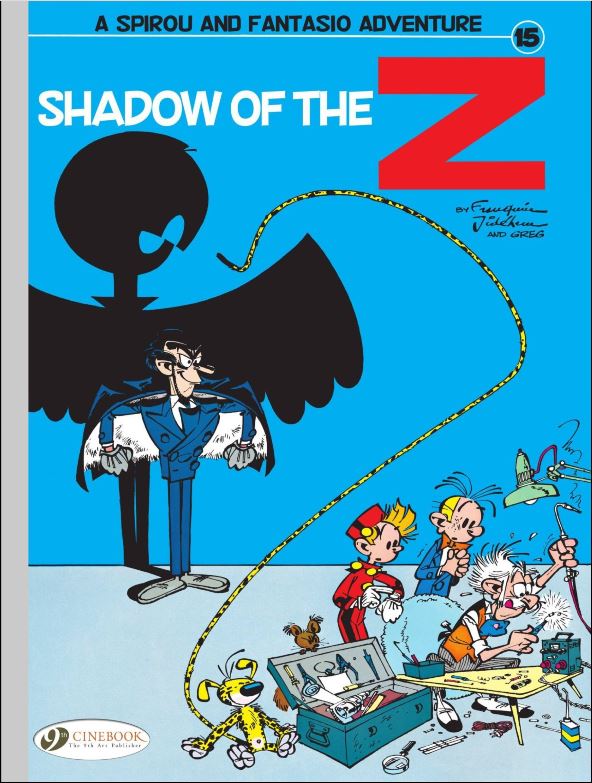
Spirou & Fantasio volume 15 – Shadow of the Z


By André Franquin, with Jidéhem & Greg; translated by Jerome Saincantin (Cinebook)
ISBN: 978-1-84918-419-9 (Album PB)

Spirou (whose name translates as both “squirrel” and “mischievous” in the tongue of the Walloons) was created by French cartoonist François Robert Velter – AKA Rob-Vel – for Belgian publisher Éditions Dupuis in response to the phenomenal success of Hergé’s Tintin at rival outfit Casterman.

The legendary anthology Le Journal de Spirou was launched on April 21st 1938 with this other red-headed lad as lead of the anthology weekly comic which bears his name to this day.

He began life as a plucky bellboy/lift operator employed by the Moustique Hotel (a reference to the publisher’s premier periodical Le Moustique) whose improbable adventures with his pet squirrel Spip eventually evolved into high-flying surreal comedy dramas.

The Spirou cast have been the magazine’s vanguard for most of its life, with a phalanx of truly impressive creators carrying on Velter’s work, beginning with his wife Blanche “Davine” Dumoulin who took over the strip when her husband enlisted in 1939. She was aided by Belgian artist Luc Lafnet until 1943 when Dupuis purchased all rights to the feature, after which comic-strip prodigy Joseph Gillain (“Jijé”) took over.

In 1946, Jijé‘s assistant André Franquin assumed the reins, slowly retiring short, gag-like vignettes in favour of longer epic adventure serials, introducing a wide and engaging cast of regulars. He ultimately devised a phenomenally popular nigh-magical animal dubbed Marsupilami, with the wondrous critter debuting in Spirou et les héritiers in 1952.

On January 3rd 1924, Belgian Franquin was born in Etterbeek. Drawing from an early age, he began formal art training at École Saint-Luc in 1943 and when the war forced the school’s closure a year later, Franquin found animation work at Compagnie Belge d’Animation in Brussels. Here he met Maurice de Bevere (Lucky Luke creator “Morris”), Pierre Culliford (AKA Peyo, creator of The Smurfs) and Eddy Paape (Valhardi, Luc Orient).

In 1945 all but Culliford signed on with Dupuis, and Franquin began his career as a jobbing cartoonist and illustrator, producing covers for Le Moustique and scouting magazine Plein Jeu. Throughout those early days, Franquin and Morris were being trained by Jijé, at that time the main illustrator at Le Journal de Spirou. He turned the youngsters and fellow neophyte Willy Maltaite – AKA Will (Tif et Tondu, Isabelle, Le jardin des désirs) – into a perfect creative bullpen known as the La bande des quatre or “Gang of Four”. They promptly revolutionised Belgian comics with their prolific and engaging “Marcinelle school” style of graphic storytelling.

Jijé handed Franquin all responsibilities for the flagship strip part-way through Spirou et la maison préfabriquée, (LJdS#427, June 20th 1946. The eager beaver ran with it for two decades, enlarging the scope and horizons until it became purely his own. Almost every week fans would meet startling new characters such as comrade and rival Fantasio and crackpot inventor the Count of Champignac.

Along the way Spirou & Fantasio became globe-trotting journalists, endlessly expanding their weekly exploits in unbroken four-colour glory. They travelled to exotic climes, exposing crimes, revealing the fantastic and clashing with a coterie of arch-enemies such as Zorglub and Zantafio and one of the first strong female characters in European comics – rival journalist Seccotine (renamed Cellophine in the current English translation).

In a splendid example of good practise, Franquin mentored his own band of apprentice cartoonists during the 1950s. These included Jean Roba (La Ribambelle, Boule et Bill), Jidéhem (Sophie, Starter, Gaston Lagaffe) and Greg (Bruno Brazil, Bernard Prince, Zig et Puce, Achille Talon), who all worked with him on Spirou et Fantasio. In 1955, a contractual spat with Dupuis saw Franquin sign up with rivals Casterman on Le Journal de Tintin, where he collaborated with René Goscinny and old pal Peyo whilst creating the raucous gag strip Modeste et Pompon. Franquin soon patched things up with Dupuis and returned to Spirou, subsequently co-creating Gaston Lagaffe (now known in Britain as Gomer Goof) in 1957, but was obliged to carry on his Casterman commitments too…

From 1959, writer Greg and background artist Jidéhem assisted Franquin, but by 1969 the artist had reached his Spirou limit. He quit, taking his mystic yellow monkey with him…

His later creations include fantasy series Isabelle, illustration sequence Monsters and bleak adult conceptual series Idées Noires, but his greatest creation – and one he retained all rights to on his departure – is Marsupilami, which, in addition to comics tales, has become a star of screen, plush toy store, console and albums.

Plagued in later life by bouts of depression, Franquin passed away on January 5th 1997, but his legacy remains: a vast body of work that reshaped the landscape of European comics.

Cinebook have published Spirou and Fantasio’s exploits since 2009, initially concentrating on Tome & Janry’s superb pastiche/homages of Franquin, with infrequent doses of the original article also available in paperback and digitally.

Here, in the sequel to Z is for Zorglub (also by Franquin, Greg & Jidéhem) we head back to 1960 for a return engagement with a super-scientific arrogant buffoon whose believes he is the rightful ruler of Earth and the solar system thanks to his discovery of the mind-bending “Zorglwave”.

Previously, the smug weirdo had used his hypnotic rays to make Fantasio one of his mind-controlled Zorglmen whilst attempting to destroy their inspirational boffin acquaintance: mushroom-mad Count Champignac. Apparently, they were at school together…

After an epic encounter, Zorglub was outwitted by Spirou, Spip and the Marsupilami, and all his grand plans scuttled, but as this volume opens our heroes are cleaning up in the generally placid hamlet of Champignac-in-the-Sticks where one last Zorglman is still prowls, armed with a paralysis ray and causing a catastrophic kerfuffle…

Sadly, no sooner do our heroes solve that problem than Zorglub himself turns up to reclaim the last of his evil machines and advanced aircraft: keen to resume his duel with the kindly Count. An inconclusive clash results in Zorglub heading off for his last hidden base – creating a shocking swathe of chaos and destruction in his wake – unaware that he has left a crucial clue.

Soon the heroic gang are off to Palombia – home of wild Marsupilami – landing just in time to become embroiled in the madman’s latest outrage: dominating the local toiletries market through his hypnotic devices. With all that operating capital, his conquest of Earth is assured…

As economic unrest drags the Palombian populace towards destitution and revolution, the Count perfects his anti-Z wave technology and our heroes’ counterattack, but unknown to all, a malicious old enemy has formed a third faction to exploit Zorglub’s grand scheme for shoddy personal gain. When he’s finally exposed, the monster resorts to the death-ray even Zorglub was too ashamed to use but has underestimated Spirou, the Count and the marvellous Marsupilami. The end is a sudden, shocking, comeuppance but we have not seen the last of Zorglub…

Stuffed with an astounding array of astonishing hi-tech spoofery, riotous chases, sight gags and verbal ripostes, this exultant escapade is a fast and fabulous fiesta of angst-free action and thrills. Readily accessible to readers of all ages and drawn with beguiling style and seductive élan, this is pure cartoon gold, truly deserving of reaching the widest audience possible.

Buy it for you, get another for the kids and give copies to all your friends…
Original edition © Dupuis, 1962 by Franquin, Jidéhem & Greg. All rights reserved. English translation 2018 © Cinebook Ltd.