Lucky Luke volume 20: The Oklahoma Land Rush


By Morris & Goscinny, translated by Luke Spear (Cinebook)
ISBN: 978-1-84918-008-5 (PB Album/Digital edition)

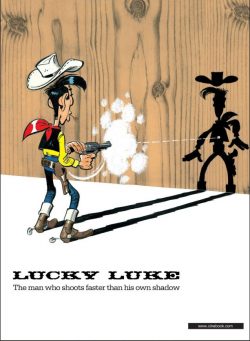
Doughty, dashing and dependable cowboy champion Lucky Luke is a rangy, implacably even-tempered do-gooder able to “draw faster than his own shadow”. He amiably ambles across the fabulously mythic Old West, enjoying light-hearted adventures on his rather sarcastic wonder-horse Jolly Jumper. The taciturn trailblazer regularly interacts with a host of historical and legendary figures as well as even odder folk in tales drawn from key themes of classic cowboy films – as well as some uniquely European notions, and interpretations…

Over 8 decades, his exploits have made him one of the top-ranking comic characters in the world, generating upwards of 85 individual albums with sales totalling in excess of 300 million in 30 languages thus far. That renown has led to a mountain of spin-off albums, plus toys, computer games, animated cartoons, a plethora of TV shows and live-action movies and even commemorative exhibitions. No theme park yet, but you never know…  when…?

The brainchild of Belgian animator, illustrator and cartoonist Maurice de Bévère (“Morris”) and first officially seen in Le Journal de Spirou‘s seasonal Annual L’Almanach Spirou 1947, Luke sprang to laconic life in 1946, before inevitably ambling into his first weekly adventure ‘Arizona 1880’ on December 7th 1946.

Working solo until 1955, Morris produced nine albums of affectionate sagebrush spoofery before teaming with old pal and fellow trans-American tourist Rene Goscinny. When Rene became his regular wordsmith, Luke attained dizzying, legendary, heights starting with Des rails sur la Prairie (Rails on the Prairie) which began serialisation on August 25th 1955. In 1967, the six-gun straight-shooter switched sides, joining Goscinny’s own magazine Pilote for La Diligence (The Stagecoach).

Goscinny co-created 45 albums with Morris before his untimely death, whence Morris soldiered on both singly and with other collaborators. The artist died in 2001, having drawn fully 70 adventures, plus numerous sidebar sagebrush sagas crafted with Achdé, Laurent Gerra, Benacquista & Pennac, Xavier Fauche, Jean Léturgie, Jacques Pessis and others, all taking their own shot at the venerable vigilante…

Lucky Luke has history in Britain too, having first pseudonymously amused and enthralled young readers during the late 1950s, syndicated to weekly anthology Film Fun. He later rode back into comics-town in 1967 for comedy paper Giggle, using nom de plume Buck Bingo.

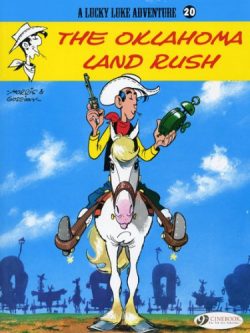
Ruée sur l’Oklahoma was Morris & Goscinny’s 5th collaboration, originally serialised in 1960 before becoming the 14th album release: a wryly satirical romp based on the actual property reallocation event of 1889, and is delivered with only the slightest application of a little extra whimsical imagination to the actual brutal skulduggery and chicanery of history…

In the real world, President Benjamin Harrison signed a proclamation on March 23rd 1889 opening the “Unassigned Lands” of Oklahoma to non-Indian settlers. Citing the 1862 Homestead Act, it promised any white who could stay on and improve a parcel of land for five years would own it free, clear and without cost. It led to a free-for-all scramble on April 22nd year with an estimated 50,000 people looking for a prime location to put down roots…

The comic version begins on the inhospitable plains of the Oklahoma territory where a representative of the American government trades a pile of trinkets and baubles to the resident Cherokee, Creek, Chickasaw, Choctaw and Seminole tribes who were originally dumped there against their collective will by white soldiers.

They are more than happy to leave those dry, dusty, dull, decidedly depressing regions…

In Washington DC, Senators are gloating over opening the region to colonisation, but troubled that all the settlers eager to own their own land and property might one day be accusing them of negligence or worse unless the allocation process is scrupulously fair. Agreeing on a strictly-monitored race as the most transparent method, the statesmen then need to ensure it’s an honest one, and call in American legend Lucky Luke to oversee the process and adjudicate disputes.

Heading westward on Jolly Jumper, the lone rider’s first task is removing the white folk already occupying their own parcels of land before the official start date. Some are there innocently and others have decided to get a head start and secure prime locations, but eventually all are moved back (some into makeshift jails) beyond the notional starting line of the great Oklahoma rush for land…

Backed up by the cavalry and a horde of lawyers Lucky leaves the “Promised Land” clean and clear for the big day, but is kept busy stopping cheating “sooners” from sneaking in early and staking claims illegally: wicked men and enterprising criminals like Beastly Blubber or Coyote Will and his simple stooge Dopey. Their escapades grow increasingly wild as the start day approaches, but Lucky can handle them. What’s more troubling is the ordinary everyday one-upmanship scurrilously employed by the “honest” citizen-contestants: sabotaging each other’s transport, doping their draft animals and worse.

Eventually, the moment comes, cannons boom and the race for space begins…

Humans being what they are, however, every competitor heads for the same few miles of the two million acres (8100 square kilometres) and overnight the mangy metropolis of Boomville springs up. Despite being held until the race was well underway Beastly Blubber, Coyote Will and Dopey are quick to capitalise on the progress and jealous hostility of the settlers, forcing Lucky to step in repeatedly and – ultimately – ban booze and all guns in the city…

Gradually civilisation blossoms and Luke thinks his job is done when the citizens call an election for Mayor. He couldn’t be more wrong, but the plebiscite does signal the end in another painfully ironic and tragically foreboding way…

Employing classic set-piece slapstick and crafty cinematic caricature but layering on an unusually jaundiced – but frighteningly accurate – view of politicians, government and human nature, The Oklahoma Land Rush deftly weaponizes history (Indian displacement, the future Dust Bowl and the billions of barrels of unexploited oil beneath that unhappy soil) to deliver a funny story with plenty of sharp edges and ends, and a sharp twist to keep readers smugly satisfied. Here is another wildly entertaining all-ages confection by unparalleled comics masters, affording an enticing glimpse into a unique genre for today’s readers who might well have missed the romantic allure of an all-pervasive Wild West that never was…
© Dargaud Editeur Paris 1971 by Goscinny & Morris. © Lucky Comics. English translation © 2009 Cinebook Ltd.

Yoko Tsuno volume 13: The Light of Ixo


By Roger Leloup, coloured by Beatrice/Studio Leonardo, translated by Jerome Saincantin (Cinebook)
ISBN: 978-1-84918-392-5 (Album PB)

Indomitable intellectual adventurer Yoko Tsuno began her career in Le Journal de Spirou in 1970 and is still delighting regular readers and making new fans to this day. Her astounding, all-action, excessively accessible adventures are amongst the most intoxicating, absorbing and broad-ranging comics thrillers ever created.

The globe-girdling, space-&-time-spanning episodic epics starring the Japanese technologist-investigator were devised by monumentally multi-talented Belgian maestro Roger Leloup, who began his own solo career after working as a studio assistant on Herge’s Adventures of Tintin.

Compellingly told, superbly imaginative and – no matter how implausible the premise of any individual yarn may appear – always firmly grounded in hyper-realistic settings underpinned by authentic, unshakably believable technology and scientific principles, Leloup’s illustrated escapades were at the vanguard of a wave of strips revolutionising European comics in the mid-1970s.

That long-overdue sea-change heralded the rise of competent, clever and brave female protagonists taking their rightful places as heroic ideals; elevating Continental comics in the process. Happily, most of their endeavours are as timelessly engaging and empowering now as they ever were, and none more so than the trials and tribulations of Miss Tsuno.

Her very first outings (the still unavailable Hold-up en hi-fi, La belle et la bête and Cap 351) were simple introductory vignettes before the superbly capable electrical engineer and her valiant if less able male comrades Pol Paris and Vic Van Steen properly hit their stride with premier full-length saga Le trio de l’étrange in 1971 with Spirou’s May 13th issue…

Yoko’s exploits include explosive exploits in exotic corners of our world, time-travelling jaunts and sinister deep-space sagas – such as this one – with our human troubleshooters working beside the disaster-prone alien colonists of planet Vinea beside devoted best friend Khany: a competent, commanding single mother who combines parenting her toddler Poky with saving worlds, leading her people and chasing cosmic adventure…

There have been 30 European albums to date and today’s tale originally debuted in 1980 as La Lumière d’Ixo, technically the 10th Yoko Tsuno exploit and the fifth to feature the extraterrestrial Vineans. It appears here via UK translation powerhouse Cinebook, offering an interstellar mystery of beguiling power and confirming the dreadful menace of faith in the hands of ruthless manipulators…

In their first outing together, Yoko, Vic and frivolous Pol discovered a pocket of dormant extraterrestrials hibernating for eons in the depths of the Earth. After freeing them from robotic tyranny, the valiant humans occasionally helped the alien refugees (who had fled their own planet two million years previously) rebuild their lost sciences, before ultimately accompanying them on their return to their own star system and presumed-dead homeworld. As the Vineans rebuilt their civilisation and culture, the humans became regular guests…

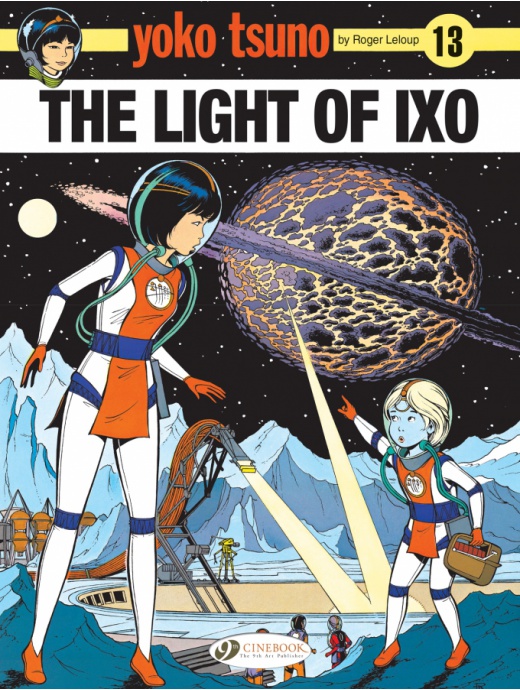
On this excursion, the trio join an exploratory mission to distant moon Ixo. In ages past, it was a dumping ground for lethal toxic wastes, uncontrollable superweapons and other deadly discoveries, but since reclaiming their homeworld, the Vinean refugee/re-colonisers have observed periodic flashes of luminescence from what should be nothing but a dead ball of ice and rock. Now, the humans, Khany and her ever-present Poky join a science team seeking answers…

As the expedition travels across the eerily beautiful frozen vacuum of the moon, they discover a hidden sub-surface enclave of enigmatic survivors dedicated to a staggering goal. In the millions of years the Vineans slept in the depths of Earth, their primary civilisation collapsed. One of the greatest casualties was a neighbour planet used to house rebels and exiles, which at some distant time was reduced to a field of space debris.

For eons now, the banished dwellers of surviving self-contained orbital city Shyra have been harvesting energy on Ixo and transmitting it at the rubble, where it has been utilized to slowly reconstruct the broken world.

Tragically, the vast generational task has devolved into a holy crusade, governed by dogma and superstition. As an age-old power struggle between engineers and priests reaches boiling point, Khany and her human companions are captured and impressed into service. Plunged right into the heart of the clash, with hostile forces all around, the deeply empathic Yoko overcomes all odds and opposition: dethroning two minor dictators while perfecting the colossal concave ice mirror used to beam power across space to the shattered world, and even brokers a tenuous peace between Vinea and the Shyrans who have for millions of years considered their sister world a demonic, implacable enemy…

Gripping and visually spectacular, The Light of Ixo combines hard science with tense drama and a soupcon of social criticism: delivering another terse, action-packed, “Big Sky” sci fi thriller, once again magnified into magnificence by the astonishingly compelling and staggeringly detailed draughtsmanship and storytelling of Leloup.
Original edition © Dupuis, 1980 by Roger Leloup. All rights reserved. English translation 2018 © Cinebook Ltd.

Days of Sand


By Aimée De Jongh, translated by Christopher Bradley (SelfMadeHero) 
ISBN: 978-1-914224-04-1 (HB)  

Certain eras and locales constantly resonate with both narrative consumers and creators. The mythical Wild West, the trenches of the Somme, Ancient Rome, 1940s Hollywood and so many more emotionally evocative enclaves of mythologised moments spark responses of drama, tension and tales crying out to be told.  

One of the most evocative derives from Depression-era America, but rather than a noir-drenched misty Big City, Aimée De Jongh drew her inspiration from a scrupulously documented decade long human catastrophe that inescapably presages ecological collapse in our imminent future. 

The Netherlands-born comics creator, story-boarder, Director and animator studied at Rotterdam, Ghent and Paris before beginning her career as a newspaper cartoonist. While releasing graphic novels The Return of the Honey Buzzard, Blossoms in Autumn and Taxi!, the multi-disciplined, multi award-winning artist worked in television, on music videos and animated movies (Aurora), for gallery shows (Janus), and latterly turned to graphic journalism, detailing refugee life in Greece’s migrant camps. 

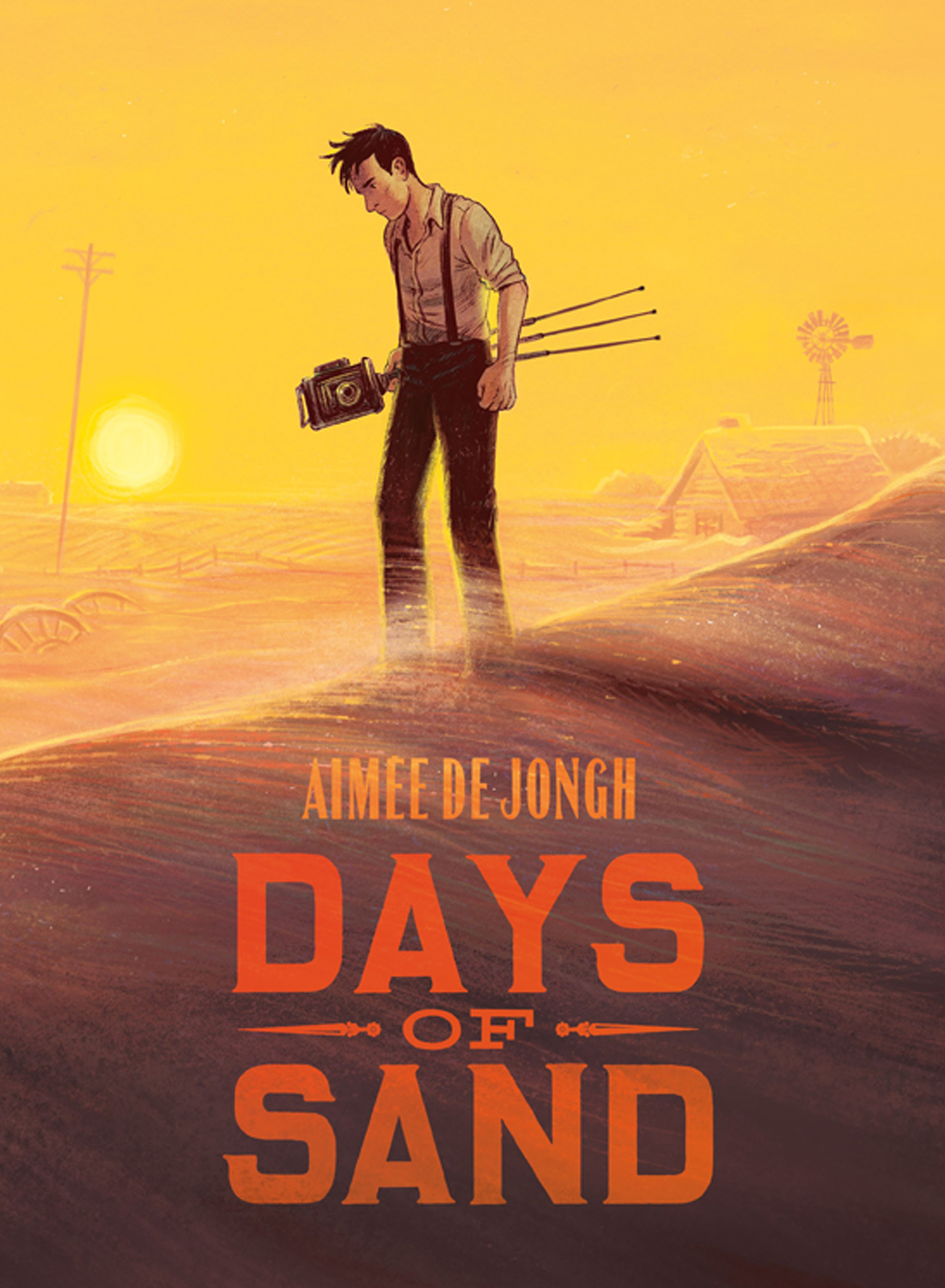
Combining overlapping interests in travel, documentary and ecology, her latest opus tells a carefully curated and fictionalized account of one young man’s reaction to the 1930’s Dust Bowl disaster and the resultant diaspora it triggered over ten years of drought.  

To research the tale – released in Europe in 2021 as two-volume Jours de sable – De Jongh travelled extensively through the region (Oklahoma to California), visiting remaining historical sites and museums while accessing the precious wealth of photographic material sponsored by the contemporary Farm Security Administration. This federal entity recorded the tragedy which forms the narrative spine of this story.  

De Jongh’s blog offers interested readers further insights and this book includes commentary and many of the original photographs that ultimately moved the event from environmental aberration to cultural myth and human tragedy. 

This is not a tale about plot and action but premise and reaction. Captivatingly rendered with colour acting as a special effects suite and utilizing original 1930s photographs throughout, it sees unemployed photographer John Clark take a job in 1937: hired like many others to document the human and economic effects of a decade-long drought and bad farming practises on the people of Oklahoma. Trapped at the heart of an un-Natural Disaster, they daily endure the frightening and no-longer gradual transition of their once lush lands of milk and honey and grass and fruitfulness into a new Sahara desert… 

Unfortunately, Clark has more baggage than just a shooting script and camera cases, and as he carries out his task, he slowly loses perspective and secure distance in the face of awestriking nature and humanity in its rawest, most reduced state. How can his camera intrude and explore when he’s as much lost and unbalanced as any of his subjects? 

It’s easy to read in subtextual messages and apply modern tropes and memes ranging from the movie Dune to the current global migrant crisis or each and every western government’s insipid pettifogging disinclination to take charge or an iota of responsibility. The world has never been in a worse state and if this book motivates anyone to make a change – however small – that’s a big win. However, it’s not the point.  

Terror, loss, hopeless misery and hunger for a better life have always been with us. The fact that our imminent doom is self-inflicted is irrelevant. The fact that everyone is/will be affected is a non sequitur. What’s germane is that when Kent or Hampshire are dust bowls and all Pacific islands are underwater, it’s still going to come down at some point to every one of us making a decision…  

An international hit garnering many honours and accolades, Days of Sand is staggering beautiful, distressingly unforgettable and never more timely, but please don’t dismiss it as a trendy and pretty polemic. This is a timeless examination of individual human choice in reaction to overwhelming, immeasurable forces and how individuals may respond. What’s presented here is one concerned artist’s narrative riposte. What’s yours? 

Jours de sable © DARGAUD-BENELUX (DARGAUD-LOMBARD S.A.) 2021, by Aimée De Jongh. All rights reserved  

Cedric volume 7: Isn’t It Past Your Bedtime?


By Laudec & Cauvin; colours by Leonardo, translated by Jerome Saincantin (Cinebook)
ISBN: 978-1-80044-025-8 (PB Album/Digital edition)

Raoul Cauvin is one of Europe’s most successful comics scripters. Born in Antoing, Belgium in 1938, by 1960 he was working in the animation department of publishing giant Dupuis after studying Lithography. Happily, he quickly discovered his true calling was writing funny stories and began a glittering, prolific career at Le Journal de Spirou.

With Salverius, he conceived the astounding successful Bluecoats, and dozens more award-winning series like Sammy, Cupidon, Les Femmes en Blanc, Pauvre, Lampil Boulouloum et Guiliguili, and Agent 212: cumulatively comprising well over 240 separate albums.

His collaborator on superbly witty kid-friendly family strip Cédric is Italian born, Belgium-raised Tony de Luca, who studied electro-mechanics and toiled as an industrial draughtsman before making his own break into bandes dessinée. Following some fanzine efforts in the late 1970s as “Laudec”, he landed soap-style strip Les Contes de Cure-la-Flute at Le Journal de Spirou in 1979. He traded that for a brace of war-time serials (L’an 40 in 1983 and March Noir et Bottes à Clous in 1985) whilst working his way around the comic’s other strips. In 1987, he joined Cauvin on the first Cédric shorts. From then on all was child’s play…

We have Dennis the Menace (the Americans have their own too, but he’s not the same) whilst the French-speaking world has Cédric: an adorable, lovesick rapscallion with a heart of gold and an irresistible penchant for mischief. He’s also afflicted with raging amour…

Collected albums – 34 so far – of variable-length strips ranging from a ½ page to half a dozen began appearing in 1989, and remain amongst the most popular and best-selling in Europe, as is the animated TV show spun off from the strip.

…A little Word to the Wise: this is not a strip afraid to suspend silly yoks in deference to a little suspense or even near-heartbreak. The bonny boy is crushingly smitten with Chen: a Chinese girl newly arrived in class and so very far out of his league, leading to frequent and painful confrontations and miscommunications. That gradually starts changing here…

Whilst the advice given by his lonely, widowed grandpa is seldom of any practical use, it often picks open scabs from the elder’s long, happy but now concluded marriage. These moments can reduce normal humans to tears…

This seventh Cinebook translation debuted in Europe in 1995 as Cédric – Parasite sur canapé and opens with a typically chaotic school event as ‘Look at the Birdie’ details why photographers hate kids and school photo day, after which Grandpa is shamed into a new coat by a brief park encounter in ‘Worn Out’…

When the old duffer comes down with a virus the well-meaning kid borrows a neighbour’s baby thermometer and makes the mistake of telling his ailing ancestor how it was most recently used in ‘Sick from Top to Bottom’, after which Cédric confronts the true emotional cost of donating old toys to charity in ‘The Christmas Present’.

‘Shocking’ takes a dive into drama as Cédric witnesses a car accident up close, but his parents can’t conceive of why the school psychologist can’t see him…

Body issues surprisingly arise when the kid the accidentally glimpses Grandpa in the bath and inadvertently shakes the elder’s formerly robust self-image in ‘A Critical Eye’ and ‘Blurp!’ reveals a close – and illicit – encounter with Asian cuisine resulting in an unforeseen gastric event before a romantic turning point arrives when Cédric and Chen eavesdrop on the adults recapturing their own youthful days in ‘Shall We Dance?’

Following a classmate’s funeral, the boy’s ‘Low Spirits…’ prompt an uplifting pep talk from dad that has the reverse effect upon the old guy (theoretically) nearest the grave, and a common nightmare comes true, sparking a near riot at school when Cédric becomes ‘Prisoner of the Toilet’…

A bone of domestic contention devolves into four-way chaos over what to watch on TV, with Grandpa eventually triumphing through guile and long-experience in ‘Whatever it Takes…’ after which birthday girl Chen proves a little less than perfect when her ‘Pastry Failure…’ incapacitates her devout admirer…

‘Grandpa Gets Some Air’, in which the old fossil responds to the gift of a free flight in a two-man plane with his typical cunning, and cowardice is followed by ‘Payment in Kind’ wherein the hapless lad dutifully tries fundraising by selling school raffle tickets but is instead introduced the concept of “barter”…

Cédric’s mediocre sporting achievements are again exposed in cross-country lark ‘Where Are the Others?’ and ‘Reluctant Volunteer’ shows why so many kids hate clowns – as well as a uniquely Cédric response to circus acts – before this show closes with the last bow of a veteran cast member. ‘Recline? Decline!’ sees Grandpa finally part with his beloved Him-shaped armchair. Typically, the high design replacement is not what anybody wants or is comfortable with…

Sharp, rapid-paced, warmly witty yet unafraid to explore life’s harshest moments, the exploits of this painfully keen, beguilingly besotted rapscallion are a charming example of how all little boys are just the same and infinitely unique. Cédric is a picture-perfect family portrait ideal for youngsters of every vintage…
© Dupuis 1995 by Cauvin & Laudec. All rights reserved. English translation © 2021 Cinebook Ltd.

Yakari and Nanabozho


By Derib & Job, coloured by Dominque and translated by Jerome Saincantin (Cinebook)
ISBN: 978-1849181778 (Album PB/Digital edition)

Children’s magazine Le Crapaud à lunettes was founded in 1964 by Swiss journalist André Jobin who began writing stories for it under the pseudonym Job. Three years later he hired fellow French-Swiss artist Claude de Ribaupierre who had begun his own career as an assistant at Studio Peyo (home of Les Schtroumpfs), working on Smurfs strips for venerable weekly Spirou. Together they created the well-received Adventures of the Owl Pythagore and two years later struck pure gold with their next collaboration.

Debuting in 1969, Yakari delightfully detailed the life of a young Sioux boy on the Great Plains; sometime after the introduction of horses by the Conquistadores and before the coming of the modern White Man.

Overflowing with gentle whimsy, the beguiling saga celebrates a bucolic existence in tune with nature and free from strife, punctuated with the odd crisis generally resolved without fame or fanfare by a little lad who is smart, compassionate, brave… and can converse with all animals…

As “Derib”, de Ribaupierre – equally excellent in both enticing, comically dynamic “Marcinelle” cartoon style and a devastatingly compelling realistic action illustration form – became one of the Continent’s most prolific, celebrated and beloved creators through such groundbreaking strips as Celui-qui-est-né-deux-fois, Jo (the first comic on AIDS ever published), Pour toi, Sandra and La Grande Saga Indienne).

Over decades, many of his masterworks feature beloved Western themes, magnificent geographical backdrops and epic landscapes, with Yakari regarded by most fans and critics to be the feature which catapulted him to deserved mega-stardom.

First serialised in 1978, Yakari et Nanabozho was the fourth European album – released just as the strip transferred to prestigious Le Journal de Tintin – but was only translated by Cinebook in 2013, making it officially the 11th English-language album. That’s not going to be a problem for chronology or continuity addicts, since – as ever – the tale is both stunningly simple and effectively timeless…

It all begins one bright sunny day as the little wonder wanders out to the Rock of the Bear to meet his friend Rainbow. On arrival there’s no sign of her but he does meet a gigantic and extremely voluble desert hare claiming to be Trickster Spirit Nanabozho – a statement proven by making some astounding adjustments to the dubious little lad’s height.

The Great Rabbit claims to be Rainbow’s totem animal, much like Great Eagle watches over and protects Yakari, and the loopy lepine wants the boy to accompany him on a quest. Ever since a travelling tale-teller arrived in camp, sharing shocking stories of the far north, where it’s so cold the bears are snowy white, headstrong Rainbow has wanted to see the amazing creatures for herself. Eager to please his protégé, the Brobdingnagian bunny agrees to help her, even supplying magic walking moccasins to reduce the hardships of the journey. Unfortunately the impatient, excited child wouldn’t wait for the Trickster and Yakari to join her and has put them on unsupervised. Unable to resist the enchanted slippers, Rainbow has started her trek, not knowing where she’s going or how to stop…

Now with boy and bunny transforming into giants and tiny mites as circumstances demand, they hare off after their impetuous friend, following the path of a magic talisman dubbed ‘the Straight Arrow’ and assisted by such beneficial creatures as a night moose.

…And when they at last find Rainbow, the travellers decide that as they’ve come so far, they might as well complete the journey to the Land of the White Bears, aided by a fabulous flying canoe…

Always visually spectacular, seductively smart and happily heart-warming, Job’s sparse plot here affords Derib unmissable opportunities to go wild with the illustrations; creating a lush, lavish and eye-popping fantasy wonderland breathtaking to behold.

This is Really Big Sky storytelling with a delicious twist in its colossal fluffy tail…

The exploits of the valiant little voyager who speaks to animals and enjoys a unique place in an exotic world is a decades-long celebration of joyously gentle, marvellously moving and enticingly entertaining adventure, honouring and eulogising an iconic culture with grace, wit, wonder and especially humour. These gentle sagas are true landmarks of comics literature and Yakari is a strip no fan of graphic entertainment should ignore.
Original edition © 1978 Le Lombard/Dargaud by Derib & Job. English translation 2013 © Cinebook Ltd.

Lucky Luke volume 19: On the Daltons’ Trail


By Morris & Goscinny, translated by Luke Spear (Cinebook)
ISBN: 978-1-84918-007-8 (PB Album/Digital edition)

Doughty, Dashing and Dependable cowboy champion Lucky Luke is a rangy, implacably even-tempered do-gooder able to “draw faster than his own shadow”. He amiably ambles across the fabulously mythic Old West, enjoying light-hearted adventures on his rather sarcastic wonder-horse Jolly Jumper. The taciturn nomad regularly interacts with a host of historical and legendary figures as well as even odder folk in tales drawn from key themes of classic cowboy films – as well as some uniquely European ideas…

Over seven decades his unceasing exploits have made him one of the top-ranking comic characters in the world, generating upwards of 85 individual albums with sales totalling in excess of 300 million in 30 languages… thus far. That renown has led to a mountain of spin-off albums and toys, computer games, animated cartoons, a plethora of TV shows and live-action movies and even commemorative exhibitions. No theme park yet, but who knows when…?

The brainchild of Belgian animator, illustrator and cartoonist Maurice de Bévère (“Morris”) and first seen in Le Journal de Spirou‘s seasonal Annual L’Almanach Spirou 1947, Luke sprang to laconic life in 1946, before inevitably ambling into his first weekly adventure ‘Arizona 1880’ on December 7th 1946.

Working solo until 1955, Morris produced nine albums of affectionate sagebrush spoofery before teaming with old pal and fellow trans-American tourist Rene Goscinny. When Rene became regular wordsmith, Luke attained dizzying, legendary, heights starting with Des rails sur la Prairie (Rails on the Prairie) which began serialisation August 25th 1955. In 1967, the six-gun straight-shooter switched sides, joining Goscinny’s own magazine Pilote with La Diligence (The Stagecoach).

Goscinny co-created 45 albums with Morris before his untimely death, from whence Morris soldiered on both singly and with other collaborators. The artist died in 2001, having drawn fully 70 adventures, plus numerous sidebar sagebrush sagas crafted with Achdé, Laurent Gerra, Benacquista & Pennac, Xavier Fauche, Jean Léturgie, Jacques Pessis and others, all taking their own shot at the venerable vigilante…

Lucky Luke has history in Britain too, having first pseudonymously amused and enthralled young readers during the late 1950s, syndicated to weekly anthology Film Fun. He later rode back into comics-town in 1967 for comedy paper Giggle, using the nom de plume Buck Bingo.

In each of these venues – as well as many attempts to follow the English-language album successes of Tintin and Asterix – Luke laconically puffed on a trademark roll-up cigarette which hung insouciantly and almost permanently from his lip. However, in 1983 Morris – amidst pained howls and muted mutterings of “political correctness gone mad” – substituted a piece of straw for the much-travelled dog-end, thereby garnering for himself an official tip of the hat from the World Health Organisation.

Strictly for the sake of historical veracity, that tatty dog-end has been assiduously restored for this particular tale and indeed all of Cinebook’s fare – at least on interior pages. They are the most successful in bringing Lucky Luke to our shores and shelves, and it’s clearly no big deal for today’s readership as we’re at 81 translated tomes and still going strong. That’s not even considering the hefty compilations of early pre-Goscinny adventures and the inclusion of spin-offs such as Kid Lucky…

Sur la piste des Dalton was Morris & Goscinny’s 8th collaboration, originally serialised in 1962 before becoming the 17th album release in the same year: a wittily hilarious outing incorporating a little in-story continuity as the dutiful volunteer lawman is called upon to deal with some troublesome old acquaintances. It’s also the story that gave the world a key supporting character: one who ultimately shambled into his own spin-off series…

There’s a penitentiary in Texas that is the regular second home to the appalling Dalton Brothers: the worst and most-feared outlaws in numerous states and territories. Sadly, it is staffed by shiftless idiots, and when once again owlhoot miscreants Averell, Jack, William and devious, slyly psychotic, tyrannical diminutive brother Joe shuck their shackles, the hapless guards trust the facility’s dog to track them down.

Prison guard dog Rin Tin Can is a pathetic pooch with delusions of grandeur: a mutt who is vain, lazy, overly-friendly, exceedingly dim and utterly loyal to absolutely everybody, but the one thing he ain’t is: good at his job…

As Rantanplan – “dumbest dog in the West” and a wicked parody of pioneering cinema canine Rin-Tin-Tin – the pestilential pooch became an irregular co-star before eventually landing his own spin-off series.

Here, after encountering the escapees mid-tunnel and running away, the canine sentinel is dragged into a search party that constantly stops searching seconds before catching their quarry quartet. Moreover, more than a little bit fed up with continually having to recapture the bandit brothers, Lucky has told the guards he’s not helping this time…

That determination only lasts until the brothers rob his rancher pal Old Tex and before long the rangy range-rider is back on their trail, hampered by that well-intentioned but inept hound, while aided by Joe’s frustrated determination to maraud across the region and eternally-hungry Averell’s ceaseless pursuit of another meal…

The tide turns at Horse Gulch where the fugitives get guns, ammo, and transportation (of a sort) and finally resume their favourite pastime, indulging in a rampage of robbery and riot. At the height of the campaign of chaos, Lucky captures and jails Joe. While Luke is deterring a lynch-mob, the dog accidentally finds the remaining brothers and successfully distracts our hero, allowing the Daltons to capture him.

He is humiliatingly traded for Joe’s release and the robbery rollercoaster ramps up until the hero starts thinking smart. Engineering a showdown at Sinful Gulch, Lucky lays his trap and once again triumphs…

Trigger-fast pacing and sublimely stuffed with classic set-piece slapstick, crafty cinematic caricature and potent puns, On the Daltons’ Trail is a brilliant blend of daft wit and rapid action heavy on absurdity, with plenty of canny twists to keep readers guessing and giggling. Here is another wildly entertaining all-ages confection by unparalleled comics masters, affording an enticing glimpse into a unique genre for today’s readers who might well have missed the romantic allure of an all-pervasive Wild West that never was…
© Dargaud Editeur Paris 1971 by Goscinny & Morris. © Lucky Comics. English translation © 2009 Cinebook Ltd.

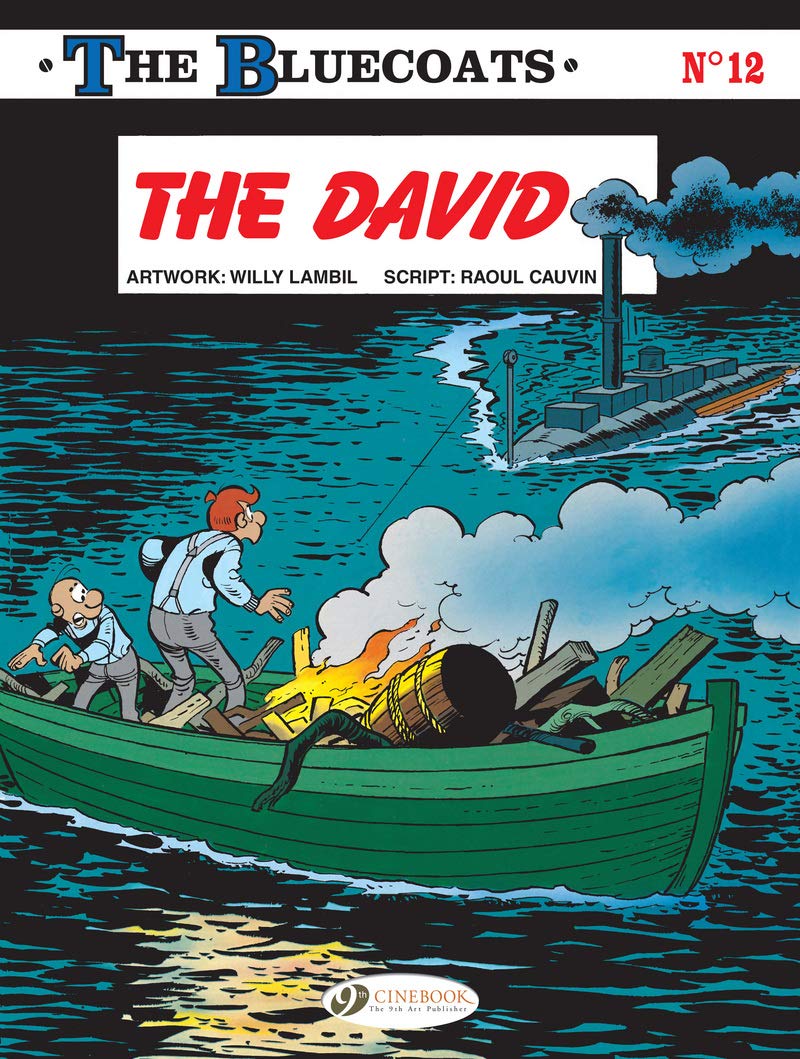
The Bluecoats volume 11: Cossack Circus


By Willy Lambil & Raoul Cauvin, translated by Jerome Saincantin (Cinebook)
ISBN: 978-1-84918-383-3 (Album PB/Digital edition)

Devised by Louis “Salvé” Salvérius & Raoul Cauvin – who scripted the first 64 best-selling volumes until his retirement in 2020 – Les Tuniques Bleues (The Bluecoats) debuted at the end of the 1960s, specifically created to replace Lucky Luke when the laconic maverick defected from weekly anthology Le Journal de Spirou to rival publication Pilote.

Ever since its first sallies, the substitute strip swiftly became one of the most popular bande dessinée series in Europe… and in case you were wondering, the stellar series is now scribed by Jose-Luis Munuera and the BeKa writing partnership…

Salvé was a cartoonist of the Gallic big-foot/big-nose humour school, and when he died suddenly in 1972, his replacement, Willy “Lambil” Lambillotte gradually adopted more realistic – but still overtly comedic – tone and manner. Lambil is Belgian, born in 1936 and, after studying Fine Art in college, joined publishing giant Dupuis in 1952 as a letterer.

Born in 1938, scripter Cauvin is also Belgian and – before entering Dupuis’ animation department in 1960 – studied Lithography. He soon discovered his true calling – comedy writing – and began a glittering and prolific career at Le Journal de Spirou. In addition to Bluecoats he scripted dozens of long-running, award winning series including Cédric, Les Femmes en Blanc and Agent 212: more than 240 separate albums. The Bluecoats alone has sold more than 15 million copies of its 65 (and counting) album sequence.

Our long-suffering protagonists are Sergeant Cornelius Chesterfield and Corporal Blutch; worthy fools in the manner of Laurel & Hardy: hapless, ill-starred US cavalrymen defending America during the War Between the States.

The original format featured single-page gags set around an Indian-plagued Wild West fort, but from the second volume – Du Nord au Sud – the sad-sack soldiers were situated back East, fighting in the American Civil War. All subsequent adventures – despite ranging far beyond the traditional environs of America and taking in a lot of genuine and thoroughly researched history – are set within the timeframe of the Secession conflict.

Blutch is your run-of-the-mill, whinging little-man-in-the street: work-shy, mouthy, devious and especially critical of the army and its inept commanders. Ducking, diving, even deserting whenever he can, he’s you or me – except sometimes he’s smart. principled or heroic if no easier option is available.

Chesterfield is a big, burly professional fighting man; a career soldier who passionately believes in the patriotism and esprit-de-corps of the Military. He is brave, never shirks his duty and hungers to be a medal-wearing hero. He also loves his cynical little troll of a pal. They quarrel like a married couple, fight like brothers and simply cannot agree on the point and purpose of the horrendous war they are trapped in… a situation that stretches their friendship to breaking point in this deceptively edgy instalment.

Cossack Circus is the 11th translated Cinebook album (and 12th sequential European release). As Les Tuniques Bleues: Les bleus tournent cosaques it debuted on the continent in 1976, serialised in Le Journal de Spirou #2000-2014 before collection as an album in 1977.

As so often it opens with another spectacular bloodbath instigated by apparently invulnerable maniac Captain Stark. The glory-addicted cavalry charger has now decimated the Union Army (and remember, that’s the side he’s fighting for) to such an extent that there’s no one left to ride into the Confederate guns…

Having depleted everyone who can be “volunteered” into the army and faced with the prospect of sending in officers or withdrawing, “The Brass” devise a brilliant solution: diverting immigrants who have been induced to America to work in the now-empty mines into nice blue uniforms…

Assigning Chesterfield and Blutch as “recruiters” and instructors, the Generals sit back in anticipation of literally fresh blood. They will soon come to regret this stratagem.

When the squabbling squaddies arrive at the holding camp, their misgivings are confirmed on discovering the future cavalrymen speak no English, and have no idea that they are now expected to officially enlist and give their lives for their new country. To the Russian- and Chinese-speaking internees, this is just a stop en route to their new life underground. If the army has its way, that’s almost the truth…

Without interpreters, our Bluecoats are helpless to convey their demands, which Blutch is increasingly convinced are illegal, immoral and stupid. His arguments with duty-blinded Chesterfield bring them to blows, and mutual murder, testing their affection for each other to the limits.

Ultimately, depriving the foreigners of food leads to their signing papers they don’t understand and donning uniforms they instinctively do, but mounting animosity vanishes when the boot camp prisoners are given horses. After Blutch demonstrates a few mounted manoeuvres he almost dies of embarrassment when the Russian clods seamlessly perform astounding synchronised riding tricks while screaming with joy… or perhaps singing?

At that moment, the camp commandant hands over their despatch orders. Next stop: the Front where Stark is itching to lead another charge into death (for everyone else ) and glory (for him)…

However, as the former best buddies carry out their orders with feelings poles apart, fate has a bizarre denouement in store, which manifests once the hereditary equestrian performers are unleashed on a battlefield they choose to see as the biggest circus ring on Earth…

Combining searing satire with stunning slapstick, this yarn is as much iron fist as velvet glove, delivering a hugely gratifying poke at the blood-&-glory boys of history. Deftly delivering an anti-war saga targeting younger, less world-weary audiences, this tale is agonisingly authentic, and always in good taste while delivering an uncompromising portrayal of state-sanctioned mass-violence. These are comedic tales whose humour makes the occasional moments of shocking verity doubly powerful and hard-hitting.

Thankfully, the divergent attitudes expressed by our put-upon pair, and their inevitable rapprochement in the midst of a magnificent plot twist, makes this battle anything but arrant folly. Funny, thrilling, beautifully realised and eminently readable, Bluecoats is the kind of war-story and Western to appeal to the best, not worst, of the human spirit.
© Dupuis 1977 by Lambil & Cauvin. All rights reserved. English translation © 2018 Cinebook Ltd.

Orbital volume 1: Scars & volume 2: Ruptures


By Serge Pellé & Sylvain Runberg, translated by Jerome Saincantin (Cinebook)
ISBN: 978-1-905460-89-2 (V.1 Album PB/Digital edition) & 978-1-905460-95-3 (V.2 Album PB)

The truest thing that can be said about French science fiction is that it always delivers amazing style and panache, even when the plots may be less than original. Illustrated by Serge Pellé (Malo Korrigan; Kaputt & Zosky; Le Grand Chambardement – as “Torgnoll”) and scripted by Sylvain Runberg (Darwin’s Diaries; Watchdogs Legion; Conquests; On Mars), Orbital was first seen as Cicatrices in 2006.

It follows a seemingly mismatched pair of Peacekeeper agents who are dispatched to quell an incipient brushfire war – just like marshals in a western – but the tale is delivered with such skill and artistry that it’s as fresh as the first time I encountered the notion.

After years of galactic exclusion, Earth in the 23rd century has finally been permitted to join a vast confederation of interstellar civilisations – despite grave concerns about humanity’s aggressive nature and xenophobic tendencies. A militant isolationist faction on Earth had migrated from politics to horrific terrorism in the immediate run-up to the union: committing atrocities both on Earth and distant worlds where they had developed colonies, commercial interests and mining bases, but (narrowly) failed to prevent humanity’s inclusion in the pan-galactic union.

One particular Confederation worry was the way humans treated aliens like the Sandjarrs, whose world was invaded in Earth’s all-consuming drive for territory and exploitable resources. The subsequent atrocities almost exterminated the stoic, pacifistic desert creatures…

Interworld Diplomatic Office agents are assigned in pairs to troubleshoot throughout the galaxy, defusing crises before they can become flashpoints. Now Caleb, IDO’s first human operative, is teamed with Sandjarr Mezoke: a situation clearly designed as a high-profile political stunt, as is their initial mission. The mismatched pair have been ordered to convince an Earth mining colony to surrender their profitable operation back to the aliens who actually own the moon it’s situated on…

Moreover, even though Earth is a now a Confederation member, with humans well placed in all branches of interstellar service, the Isolationist cause is still deeply cherished by many, at home and at large, needing only the slightest spark to reignite into violence and terrorism…

In debut episode Scars, Caleb and Mezoke – still learning to cope with each other – are too-quickly dispatched to ghastly mud-ball moon Senestam to convince understandably belligerent human colonists to pack up and leave quietly. The naked hostility they meet is transformed to sheer terror when the situation escalates and monstrous beasts begin attacking everywhere.

An armada of rapacious creatures able to bore through rock and steel are likely to eat every sentient in town before the IDO agents can broker any kind of deal…

The crisis takes a decidedly tricky turn in concluding chapter Ruptures (second album in a far too short series) when the marauding beasts are discovered to have been manoeuvred into attacking the human colonists. The crisis has been manufactured as part of a greater scheme: but who really profits from this developing tragedy?

Sabotage and murder are swiftly added to the miners’ woes, and whilst Caleb and Mezoke desperately seek a solution satisfactory to all sides, the growing anti-human faction of the Confederation makes its first move to oust Earth from the interstellar alliance. Perhaps they’re not misguided though, since an Isolationist coup is also kicking off in the torrential skies above Senestam…

Smart plots, sharp dialogue and fast-paced, expansive action have produced a gritty space-opera with delightfully complex sub-plots, fuelled by political intrigue, and compelling infighting elevates this tale to lofty heights, and although Caleb and Mezoke come off a little less than fully rounded characters in this initial tale, Orbital was a series to watch closely. It still is.
© Dupuis, 2006, 2007 by Runberg & Pellé. All rights reserved. English translation © 2009 Cinebook Ltd.

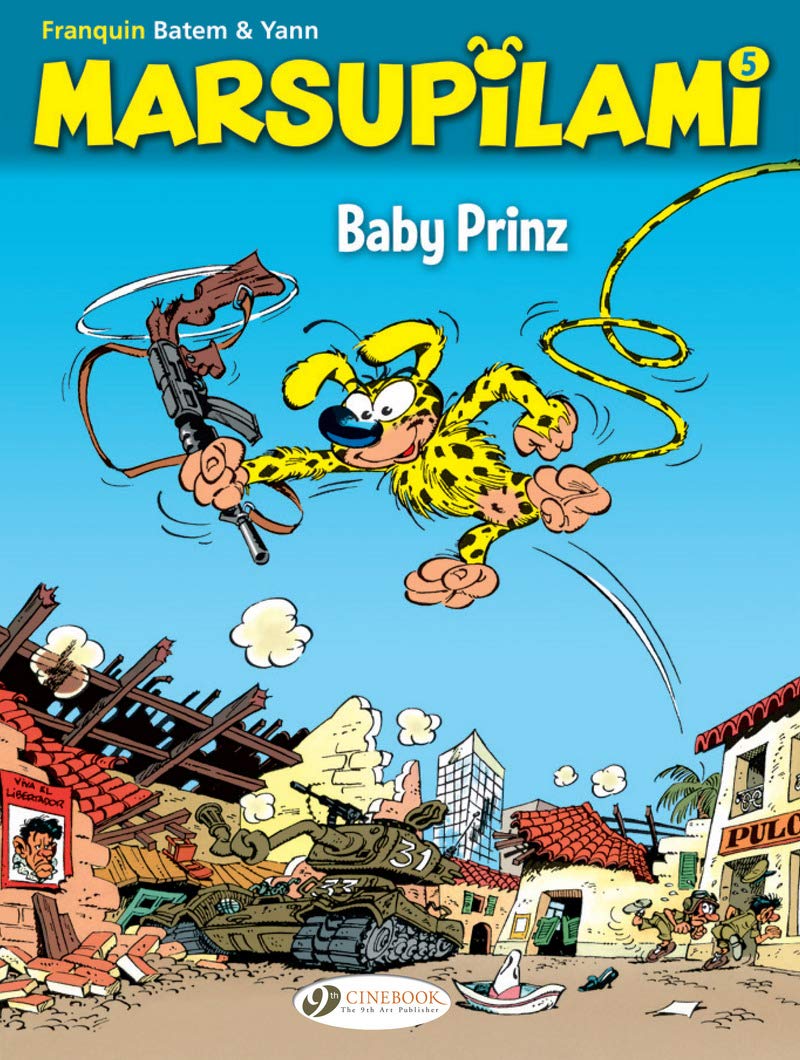
Marsupilami volume 4: The Pollen of Monte Urticando


By Franquin, Batem & Yann; coloured by Leonardo and translated by Jerome Saincantin (Cinebook)
ISBN: 978-1-84918-458-8 (Album PB/Digital edition)

One of Europe’s most popular comic stars is an eccentric, unpredictable, rubber-limbed ball of explosive energy with a seemingly infinite elastic tail. The frantic, frenetic Marsupilami is a wonder of nature and stalwart of European entertainment who originally spun-off from another immortal comedy adventure strip…

In 1946 Joseph “Jijé” Gillain was crafting eponymous keystone strip Spirou for flagship publication Le Journal de Spirou when he abruptly handed off the entire kit and caboodle to his assistant Franquin. The apprentice took the reins, slowly abandoned a previous format of short complete gags to pioneer longer adventure serials, and began introducing a wide and engaging cast of new characters.

For 1952’s Spirou et les héritiers, he devised a beguiling and boisterous South American critter to the mix. The hairy hero returned over and over again: a phenomenally popular magic animal who inevitably grew into a solo star of screen, toy store, console games and albums all his own. Franquin also frequently included the bombastic little beast in Spirou’s increasingly fantastic escapades until his resignation in 1969…

André Franquin was born in Etterbeek, Belgium on January 3rd 1924. A bit of a prodigy, he began formal art training at École Saint-Luc in 1943, but when the war forced the school’s closure a year later, the lad found animation work at Compagnie Belge d’Animation in Brussels. Here he met Maurice de Bevere (Lucky Luke‘s creator Morris), Pierre Culliford (Peyo, creator of The Smurfs) and Eddy Paape (Valhardi, Luc Orient).

In 1945, all but Culliford signed on with publishing house Dupuis, and Franquin began his career as a jobbing cartoonist and illustrator, producing covers for Le Moustique and scouting magazine Plein Jeu.

During those formative early days, Franquin and Morris were being trained by Jijé – at that time the main illustrator at Le Journal de Spirou. He quickly turned the youngsters and fellow neophyte Willy Maltaite – AKA Will – (Tif et Tondu, Isabelle, The Garden of Desire) into a potent creative bullpen dubbed La bande des quatre – or “Gang of Four” – who subsequently revolutionised Belgian comics with their prolific and engaging “Marcinelle school” style of graphic storytelling.

Jijé handed Franquin all responsibilities for the flagship strip part-way through Spirou et la maison préfabriquée, (Le Journal de Spirou #427, June 20th 1946). The eager novice ran with it for two decades, enlarging the scope and horizons until it became purely his own.

Almost every week, fans would meet startling and zany new characters such as comrade and eventual co-star Fantasio or crackpot inventor the Count of Champignac. In the ever-evolving process Spirou et Fantasio became globe-trotting journalists, continuing their weekly exploits in unbroken four-colour glory and “reporting back” their exploits in Le Journal de Spirou…

In a splendid example of good practise, Franquin mentored his own band of apprentice cartoonists during the 1950s. These included Jean Roba (La Ribambelle, Boule et Bill/Billy and Buddy), Jidéhem (Sophie, Starter, Gaston Lagaffe/Gomer Goof) and Greg (Bruno Brazil, Bernard Prince, Achille Talon, Zig et Puce), who all worked with him during his tenure on Spirou et Fantasio.

In 1955 a contractual spat with Dupuis resulted in Franquin signing up with publishing rivals Casterman on Le Journal de Tintin, collaborating with René Goscinny and old pal Peyo whilst creating the raucous gag strip Modeste et Pompon.

Franquin and Dupuis patched things up extremely quickly, and he returned to Le Journal de Spirou; subsequently – in 1957 – co-creating Gaston Lagaffe, and now legally obliged to carry on his Tintin work too. From 1959, writer Greg and background artist Jidéhem assisted Franquin, but by 1969 the artist had reached his Spirou limit and resigned for good, happily taking his mystic yellow monkey with him…

Plagued in later life by bouts of depression, Franquin passed away on January 5th 1997, but his legacy remains: a vast body of work that reshaped the landscape of European comics. Moreover, having learned his lessons about publishers, Franquin retained all rights to Marsupilami and in the late 1980’s began publishing his own new adventures of the fuzzy and rambunctious miracle-worker.

He tapped old comrade Greg as scripter and invited commercial artist/illustrator Luc Collin (pen name Batem) to collaborate on – and later monopolise – the art duties for a new series of raucous comedy adventures. In recent years the commercial world has triumphed again and since 2016 the universes of Marsupilami and Spirou have again collided allowing the old firm to act out in shared stories again…

Now numbering 32 albums (not including all-Franquin short-story collection volume #0, AKA Capturez un Marsupilami), the fourth of these was Le pollen du Monte Urticando, released in November 1989 and translated with staggering accuracy here as Marsupilami: The Pollen of Monte Urticando.

Blessed with a talent for mischief, the Marsupilami is a deviously adaptive anthropoid inhabiting the rain forests of Palombia and regarded as one of the rarest animals on Earth. It speaks a language uniquely its own and also has a reputation for causing trouble and instigating chaos. The species is rare and is fanatically dedicated to its young. Sometimes that takes the form of “tough love”…

Although touching down in the dense Palombian rainforest, this saga introduces fresh exotic vistas and some more interesting facts about the astounding simians in another compelling, wildly wild wildlife presentation from a veteran team of unnatural historians…

It transpires that some distance from the natural habitat of the beasts, a desolate old caldera is a micro-environment housing the last specimens of the Comitl cactus. Every 15 years the spiky plants eject huge clouds of pollen that flood the arid enclosure before spreading far and wide. For inexplicable reasons, this potent powder has a marked effect on young Marsupilamis, and when the latest batch starts changing the proud parents’ new brood, it’s a sign of a rite of passage coming…

Reluctantly bringing his little trio to the primordial enclave to trigger the next stage in their development, daddy dearest tearfully ditches his toddling brood, trusting the wonder stuff to wreak its magic and that the lava, sinister vegetation and primordial monsters won’t bring tragedy…

A wry compendium of bizarre fantasy, inspired non-stop Tom & Jerry style gag riffs and devilish whimsical bemusement, this tale premiers the most sympathetic “villain” in comics history in the form of tatty, toothless, starving and undeterrable aged jaguar Gatogordo, to cap a delicious manual in Marsupilami rearing. This is a hilarious rollercoaster of thrills and chills that naturally restores order at the last, reuniting panicking  parents with pups one step closer to being full grown pains in the… Palombia.

Another masterfully madcap rollercoaster of hairsbreadth escapes, close shaves and sardonic character assassinations, this eccentric exploit of the unflappable golden monkeys is moodily macabre, furiously funny and instantly engaging: providing riotous romps and devastating debacles for wide-eyed kids of every age all over the world. How about channeling your inner child and joining in the fun?

Hoobee, Hoobah Hoobah!
© Dupuis, Dargaud-Lombard s.a. 1989 by Franquin, Yann & Batem. English translation © 2019 Cinebook Ltd.

A Love for the Ages


By Florence Cestac & Daniel Pennac translated by Edward Gauvin (Europe Comics )
No ISBN: 978-1-910395-63-9 (digital edition)

A writer and an artist go into a restaurant. They make comics for a living, but tonight the talk is of love. Before long, the entire place is involved in the conversation. No, not conversation, Story. Any relationship that has, is or may develop is irrelevant here. The writer is talking about years ago when an impressionable waif encountered and observed the most incredible romance and was forever after beguiled…

Now it’s time to immortalise the affair through words and pictures, and like that keenly observed life of domestic paradise, it must be perfect…

Memories flow, snippets are recalled and a story within a story unfolds and gels. Years back, before the Riviera reinvented itself as a haunt of international snobs and wastrels, inland from Nice in rural La-colle-sur-loup, old folks congregated in picturesque village enclaves and  grandparents got stuck with the youngsters in summer.

Bored and watchful, our kid and his local pals’ best chance of amusement was watching Jean and Germaine Bozignac: she, a delightfully feisty and affably bubbly sharing soul, and he, a hideously ugly yet startlingly charismatic and charming rogue. By all lights, Jean should have been a blight on the community: a cheating cardsharp who never worked after being cut off and disowned from his aristocratic wine-growing family. Yet somehow, the disgraced Marquis was adored by most and accepted by all.

Jean and Germaine were inseparable and lived by, with and through books, and on the day the little the writer-to-be learned that the cashiered lord’s reduced circumstances stemmed solely from his refusing to give up house servant Germaine, the passionate child’s future was set. This was what Love Should and Must be…

Expansive yet grounded, witty, compelling and outrageously funny in all the right ways, A Love for the Ages is the kind of tale our continental cousins excel at: light, fluffy, hilarious yet packed with heartbreaking moments and lined with hidden steel to hit hard when you least expect it.

Only available in English digitally at present, this is what it means to be in love all your life – and trust me I know whereof I speak: my good lady wife has put up with me for nearly 33 years and all I’ve ever had are flesh wounds, contusions and minor bouts of food poisoning. If that’s not proof of a love divine, then what is?
© 2015 DARGAUD – Cestac & Pennac. All rights reserved