
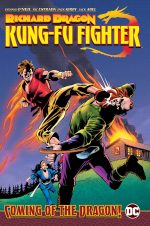

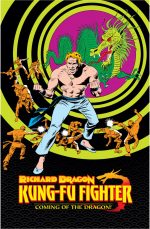
By Dennis J. O’Neil, David Anthony Kraft, Bob Haney, Mike W. Barr, Leopoldo Durañona, Jim Starlin, Alan Weiss, Jack Kirby, Ric Estrada, Jim Aparo, Alex Saviuk Wally Wood, Jack Abel, Al Milgrom, D. Bruce Berry, Vince Colletta & various (DC Comics)
ISBN: 978-1-7795-0810-2 (HC) 978-1-7795-1240-6 (Digital edition)
This book includes Discriminatory Content produced in less enlightened times.
The mysterious martial arts of “The East” have always fascinated western readers and writers. Adventurers, detectives and mystery men like Sexton Blake, Batman, Doc Savage, The Spider and The Shadow drew much of their history and arsenal from the arcane Orient, and even intellectual acme Sherlock Holmes occasionally employed the scientific combat system of “Baritsu” – actually a mixed martial art called Bartitsu which developed between 1898-1902. Moreover, every secret agent worth their salt was au fait with assorted “chop sockey” techniques: generally disparaging them while delivering a visually enticing signature blow…
Putting aside references in assorted newspaper strips, the first specialist martial arts comic book star was Judo Joe: a young American raised in Japan who used his training for the benefit of all. Three issues were released between August and December 1953. The work of Dr Barney Cosneck and illustrator Paul W. Stoddard, it set the tone of the genre as well, devising an enduring feature of most early strips in illustrated lessons on specific moves and techniques to let them all break bones in the security of their own bedrooms. Kids! DO try this at home… but not on the cat. That what little brothers are for…
Comics in the 1960s were highly spiced with judo and karate users, with by far the most accurate forms employed by Charlton Comics champions Sarge Steel (#1 December 1964, by Pat Masulli & Dick Giordano) and WWII costumed combatant Judomaster (first seen in Special War Series #4, November 1965): both benefitting from the specialist Kung Fu knowledge and artistic skills of Frank McLaughlin – an actual judoka who had studied martial arts for years.
Gold Key simply exploited licensing power. Television’s The Green Hornet ran 26 episodes from September 1966 to March 1967 and their comics adaptation (3 issues from February to August 1967) played up the combat skills of the antihero/vigilante’s chauffeur and partner Kato. You’ll recall, I’m sure, that he was played by young Bruce Lee, who was in very large part responsible for the popularisation of martial arts in the west… especially after graduating to film roles.
When the big boom began in the early 1970s, Charlton were again quick off the mark: launching their own knock-off of hugely popular TV series Kung Fu. Running 18 issues, Joe Gill & Warren Sattler’s Yang debuted with a November 1973 cover-date, recounting the life of a Chinese wanderer in the 1870s wild west. It spawned sequel/spin-off House of #1-6, July 1975 – June 1976) by Korean comics creator Sanho Kim and remains a visual highpoint to this day… if you can find it. Marvel really reaped the benefits of the zeitgeist with Shang Chi, Master of Kung Fu in Special Marvel Edition #15 (cover-dated December 1973) and a flood of follow-ups including Iron Fist, Sons of the Tiger, Daughters of the Dragon and White Tiger. As ever – and despite teenager Jim Shooter introducing Karate Kid to the Legion of Super-Heroes back in 1966 (Adventure Comics #346, July) – ever-cautious DC were late to the party, even though one of their key writers was also the co-author of a Kung Fu novel…
…And Karate Kid? As the martial arts boom was subsiding, DC awarded him his own solo series, set primarily in the 20th century: 15 bi-monthly issues running from March/April 1976 to July/August 1978. He travelled through time and across realities, but never met the stars of this particular title…
The Seventies had begun with a downturn in superhero sales and a resurgence of traditional genre comic tales. A few years in, a new genre emerged: one blending eastern philosophy and personal combat systems with a real-world growth in organised crime – especially drug (and human) trafficking. Popular fiction responded with a wave of lone wolf vigilantes like Mack (The Executioner) Bolan and martial arts icon Remo Williams: The Destroyer, as gritty hardboiled crime thrillers evolved and genres began to mash up…
Riding his own wave of comic success and celebrity from Batman, Justice League of America, Wonder Woman, Green Lantern/Green Arrow and Superman, former Marvel trainee/intern turned journalist Dennis J. O’Neil teamed up with editorial cartoonist James R. Berry to write a prose thriller for this burgeoning market. Under the pen-name Jim Dennis, they detailed the life path of teen thug Richard Drakunovski after finding friends and life direction with a martial arts sensei. Kung Fu Master, Richard Dragon: Dragon’s Fists was released in 1974 and ultimately pitted the hero against evil industrialist Guano Cravat…
With a phenomenon unfolding around them, DC finally joined the parade of warriors by having O’Neil adapt the book, expanding the premise and adding significantly to their pantheon of stars in the process: not so much with the leading man but through his potential-packed supporting cast.
Spanning April/May 1975 to November 1981, this fast and furious compendium collects Richard Dragon: Kung Fu Fighter #1-18; a team-up from The Brave and the Bold #132, plus a closing note from DC Comics Presents #39. In keeping with the tone of the genre and time, these stories are tersely underwritten and potently action driven, but racial and gender issues are ubiquitous and fully expressed in the terms of the times.
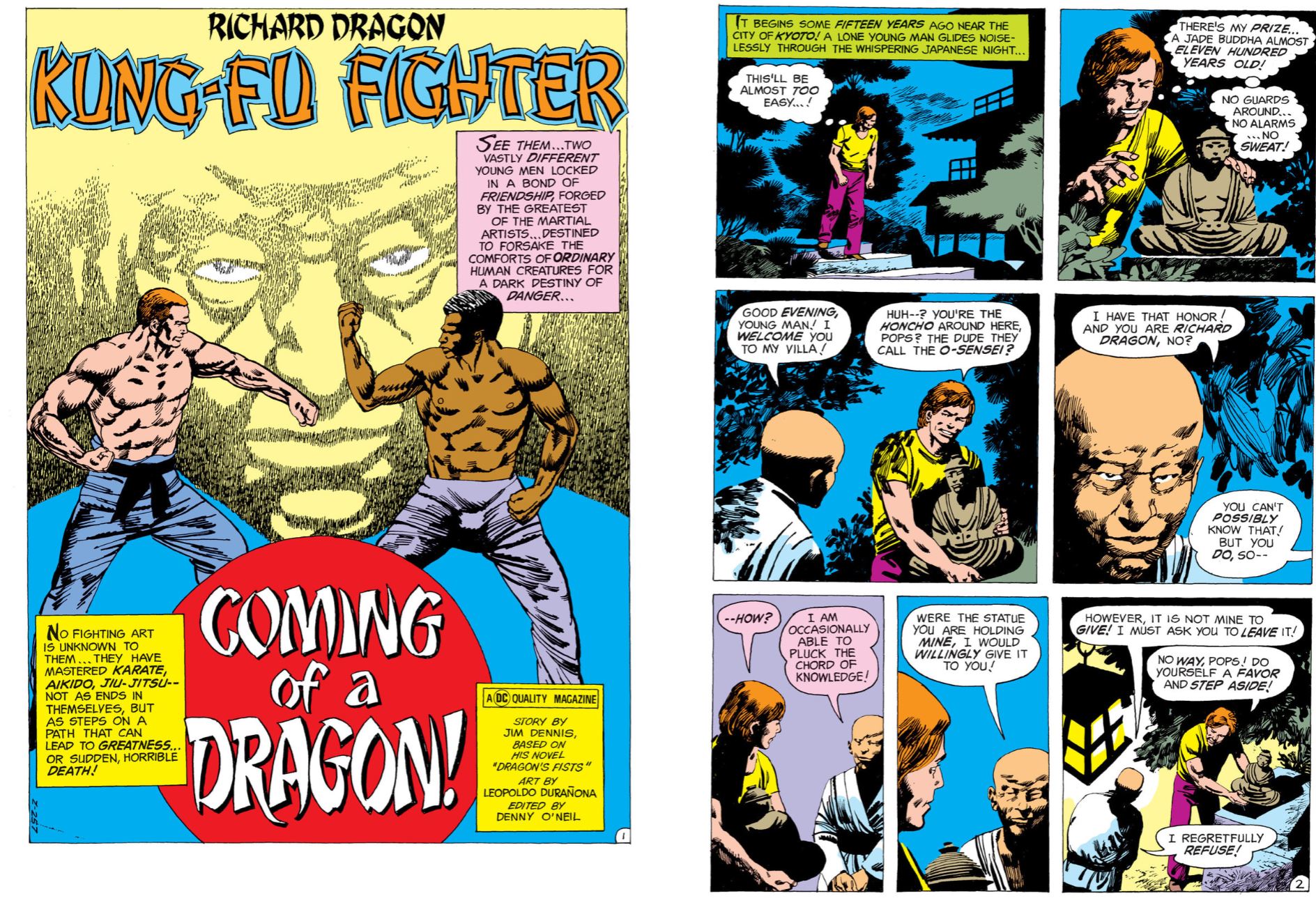
The first issue was cover-dated April/ May 1975 and on sale from January 30th, with opening episode ‘Coming of a Dragon!’ credited to “Jim Dennis” and illustrated by comics legend Leopoldo Durañona. Here it was revealed how a teenager’s attempt to burgle a dojo in Kyoto, Japan was foiled by its head teacher O-Sensei. The venerable ancient easily mastered the violent thief and then invited to him to change his life path. Richard Dragon spends the next seven years mastering countless forms of Kung Fu, higher education and his own raging nature, forming a lifelong bond with his fellow pupil – African American Ben Turner – and seeking to become a physically and ethically “Superior Man”…
The idyllic period ends the day unctuous freelance spymaster Barney Ling shows up. He runs acronymic organisation G.O.O.D. and begs the legendary O-Sensei to aid him in stopping a world-class human trafficker. Instead, the master sends his students against an army of brutes and monsters…
Artistic stability was not an option as O’Neil was partnered in swift succession with Jim Starlin, Alan Weiss & Al Milgrom for second exploit ‘A Dragon Fights Alone’. Wounded but triumphant, Dragon and Turner return to Japan only to be targeted by the hired thugs of a hidden enemy. The attack comes in the wake of a tearful graduation, as they seek to aid O-Sensei’s goddaughter Carolyn Woosan. This results in them all heading for San Francisco, where mercenary The Swiss had orchestrated her uncle’s death whilst searching for a deadly secret. When the freshly-debarked adventurers investigate, Ben is shot and Carolyn taken…
It clearly took some time to assign an art-team as Jack Kirby & D. Bruce Berry limned third instalment ‘Claws of the Dragon!’ as an enraged hero hunts The Swiss and trounces an army of assassins, thanks in no small part to his secret weapon – a jade claw allowing him to focus all his knowledge and fury and become a beast of battle…
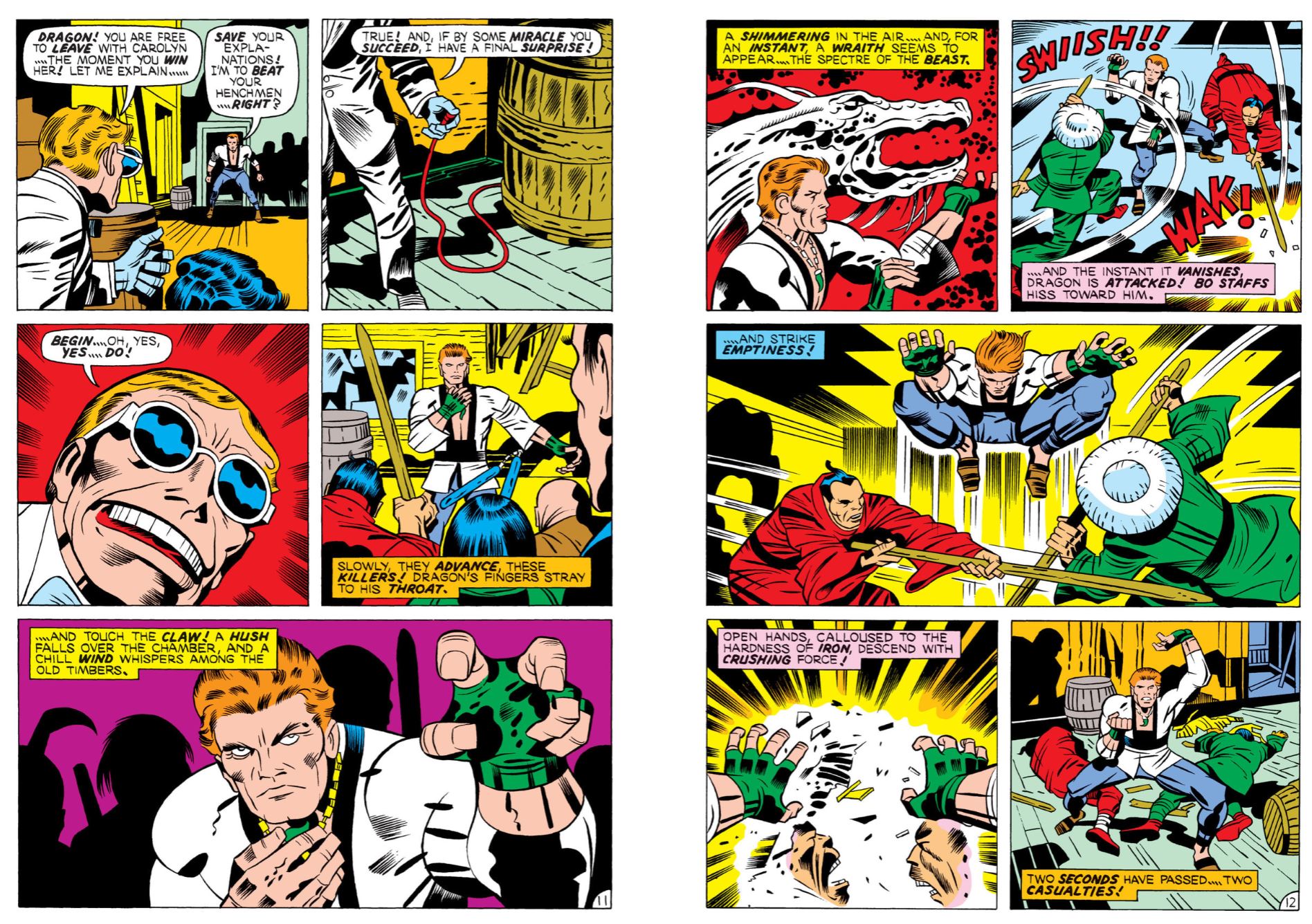
Crushed by their continuing failure to rescue Carolyn, Dragon & Ben reluctantly accept help from Ling and G.O.O.D. Marshalling resources and infiltrating a suspect dojo, Dragon accepts that there is ‘A Time to be a Whirlwind!’, and again overcomes all physical opposition, but once more fails Carolyn, this time forever. This shattering clash signalled the start of artistic stability as Ric Estrada took over pencilling, augmented by master inker Wallace Wood.
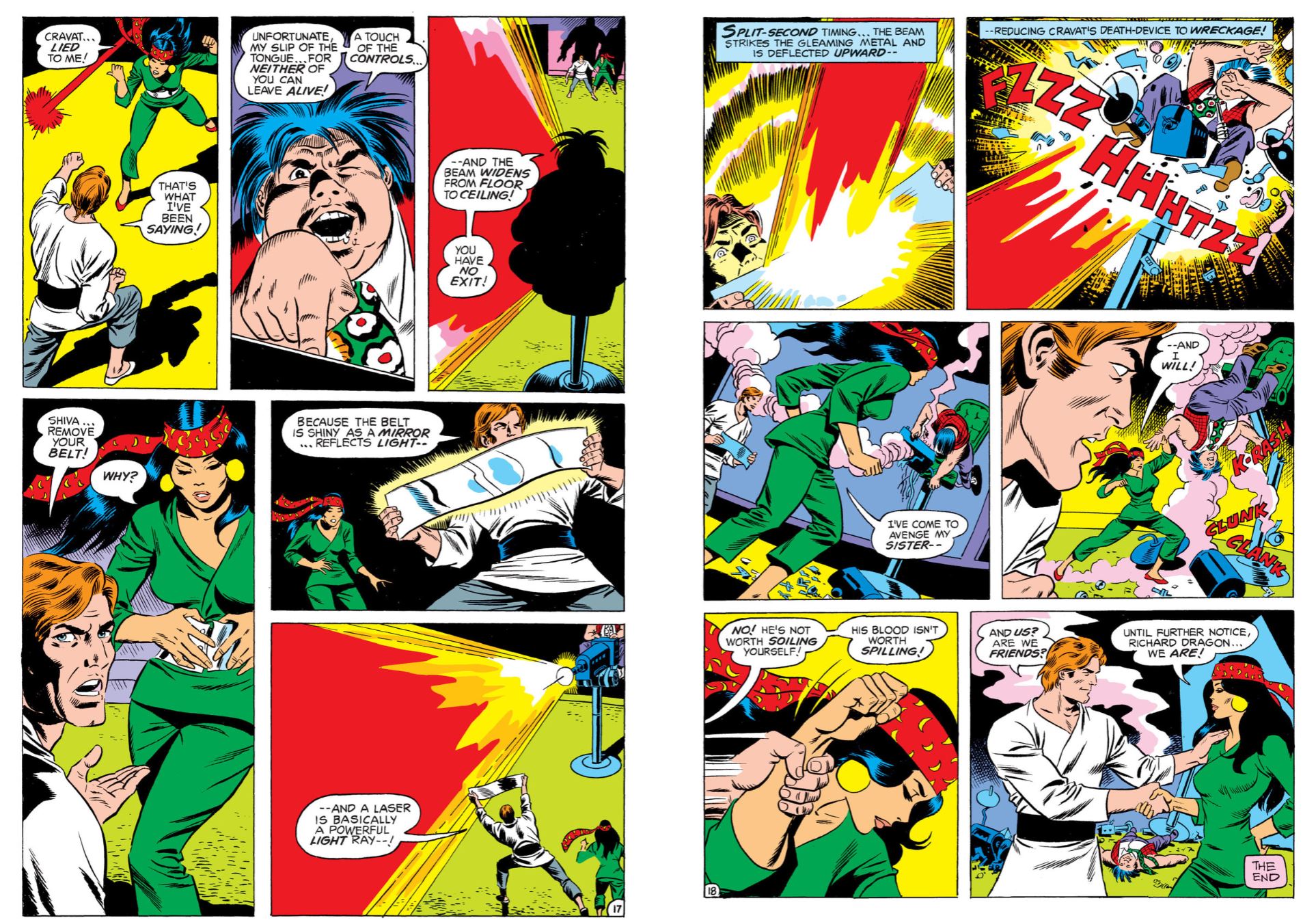
Sandra Woosan debuted in #5, a woman who would become a major player in DC continuity. Cover-dated December 1975-January 1976, ‘The Arena of No Exit!’ introduced lethal Lady Shiva: a conflict-addicted swordswoman seeking bloody redress for her murdered sister. She was working for grotesque super arms-dealer Guano Cravat (the secret mastermind behind The Swiss), but rejected her current assignment to kill Dragon after fighting him and realising that staying in his orbit would generate all the murderous duels her killer’s heart hungered for without betraying her tarnished and diminished ethical code…
In later years she would evolve into the most dangerous assassin on Earth: a major opponent of Batman, Robin, assorted Batgirls, Black Canary, the Birds of Prey and many others.
After foiling Cravat’s scheme, Dragon and Shiva are rewarded by Ling with magnificent matched swords: katana crafted by an 18th century master smith. However, it’s just a ploy to sweeten them up. G.O.O.D. needs them to recover a “misplaced” nuke on a volcanic island: one ruled by a modern pirate with an obsessive fixation on fighting with swords. He calls himself Slash…
The spectacular conclusion of ‘Island of the Inferno’ leads to a confrontation with occasional Batman and Wonder Woman evil scientist Doctor Moon, who uses Cravat’s money to transform mere humans into surgically-augmented, programmable super-warriors in #7’s ‘Command: Slay the Dragon!’ All this time, Ben has been healing and teaching at the dojo he runs with Dragon, but his life is about to change after becoming romantically entangled with promising student Janey Lewis. When she and other students are attacked by Moon’s thugs, Dragon & Shiva retaliate but are almost killed by Moon’s colossal cyborg Topper. Almost…
Another old foe resurfaces in #8, striking at his despised enemies by murdering more dojo students and rendering our hero temporarily sightless, facilitating his scheme to ‘Slay the Blind Dragon’ after which Estrada inks his own pencils in #9 as Barney Ling returns to reveal that the recent dojo attacks are masking a hidden plot to assassinate Ben. The manipulative G.O.O.D. guy offers to reveal all, but only if all three kung fu fighters carry out a few errands for him…
Thus Turner, Shiva & Dragon depart for tropical San Lorenzo to stop a monster ravaging the tourist destination – a thieving mutated killer known as ‘The Preying Mantis’ – prior to Ben discovering he’s inherited millions in prime timberland! He heads north, with his allies in tow and finds that the lumberjacks are definitely killers… and are embezzling all the profits. They have already murdered Turner’s sister, leaving him as guardian of an unsuspected nephew (also called Ben) and their leader Hatchett tries everything possible to destroy the nosy snoopers in ‘The Human Inferno!’ (inked by Jack Abel). However, the assassination attempts only slow, but do not cease…
Cover-dated September 1976, #11 offers a change of pace and scripter, as David Anthony Kraft joins Estrada & Abel in a byzantine futuristic spy conspiracy that begins ‘When Strikes the Samurai!’ After being targeted by a disappearing Japanese warrior, the trio are despatched to Communist China to secure an object dubbed the Tiger Tally which in turn could unlock the secrets of bewildering Project Moon Age Daydream. The mission results in a trail of dropped bodies before ‘A Dragon Defiant’ is subjected to a duplication device resulting in him literally beating himself up before thwarting rival maniacs Telegram Sam and Madame Sun…
Back in the USA for #13, the drama intensifies with O’Neil & Estrada’s reunion, as Ben is poisoned and Dragon & Shiva carve their way through a murderous legion ‘To Catch an Assassin!’ and secure the antidote. When that proves fruitless, detective work leads them to The League of Assassins and a desperate quest for their chief deviser of toxins. Viper makes his potions in the wilds of Mongolia – perilously close to the Soviet Russian border – and the countdown quest allows no time for restraint, which only grants Shiva opportunity to do the work she loves without being held back…
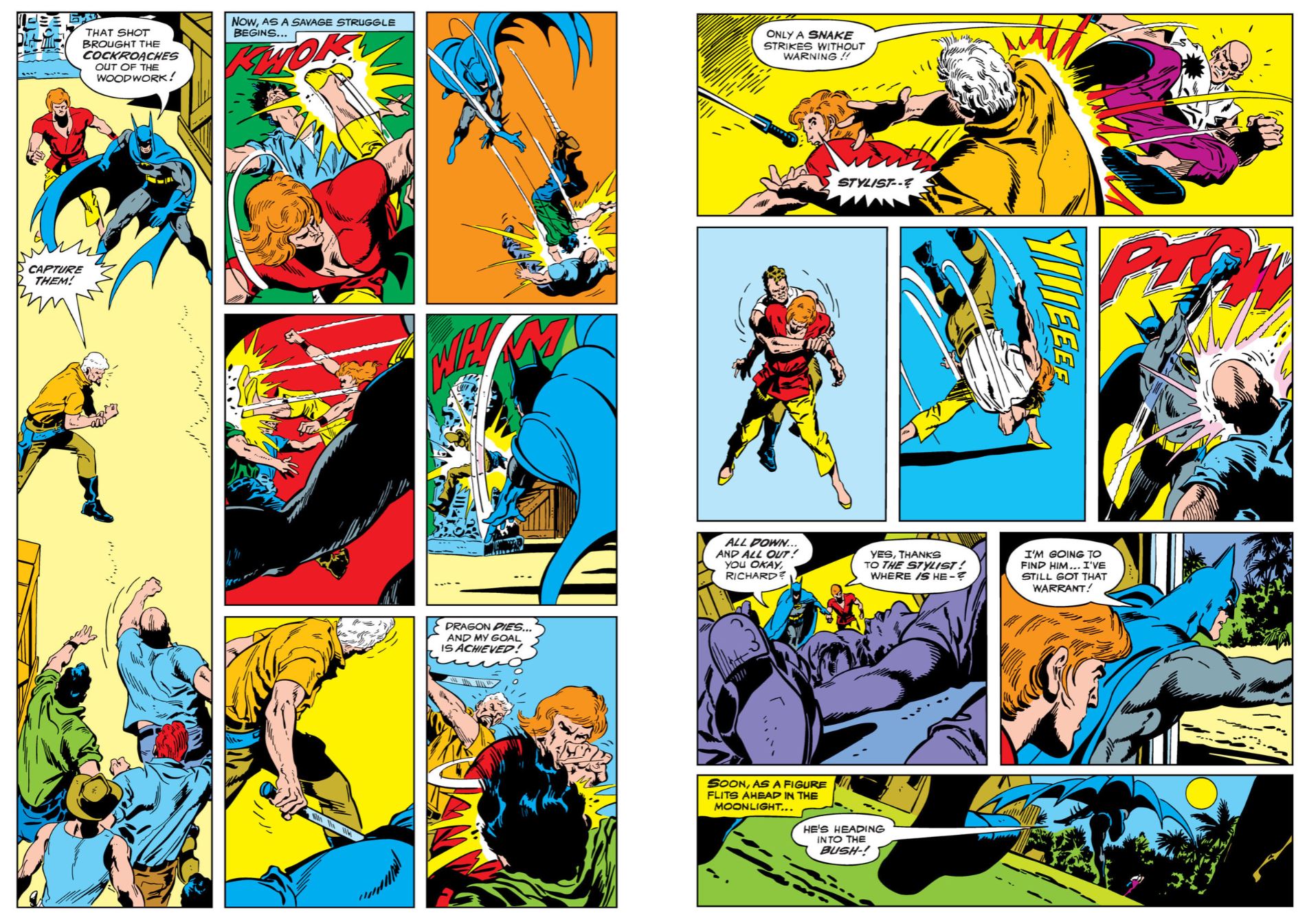
With Turner’s death imminent, we pause for a diversionary team-up as The Brave and the Bold #132 (February 1977 by veteran writer Bob Haney & ultimate guest star artist Jim Aparo) enquires ‘Batman – Dragon Slayer??’ When Denny O’Neil succeeded Murray Boltinoff as B&B editor, it resulted in this rather forced tale of duelling fight stylists after a publicity-shy billionaire sought to repay an imagined debt to good Samaritan Dragon by leaving him a mysterious bequest…
Back in his own title, Dragon’s quest for a cure takes him back to China to find the O-Sensei. At that time, unknown to all, his former master was Dr. Moon’s prisoner, so Richard & Shiva’s mission generates massive mayhem and an inconclusive duel with ‘The Man Who Studied with Bruce Lee’: a gullible yet proficient martial arts purist who had learned all the celebrity’s “lost secrets”…
The clash might have been pointless, but the rescued O-Sensei cures Turner, who pursues his relationship with Janey to the point of asking her father for permission to wed. Tragically, at that moment in #15, ‘The Axeman’ attacks shipyard Security Chief Luke Lewis and his adored daughter is fatally caught in the crossfire. Crushed and broken inside, Ben hunts the killer with Dragon at his side, uncovering shocking betrayal that intensifies his fury into mania. Exploiting all their resources, they follow to the top of the world in #16, where ‘The Doom Seer’ – outrageous, tyrannical madman Professor Ojo (later to become a Green Lantern nemesis!) – pits them and Lady Shiva against outlandish martial arts skaters and an arsenal of scientific terrors before #17’s ‘The Final Victim’ provides a spectacular conclusion, but no resolution…
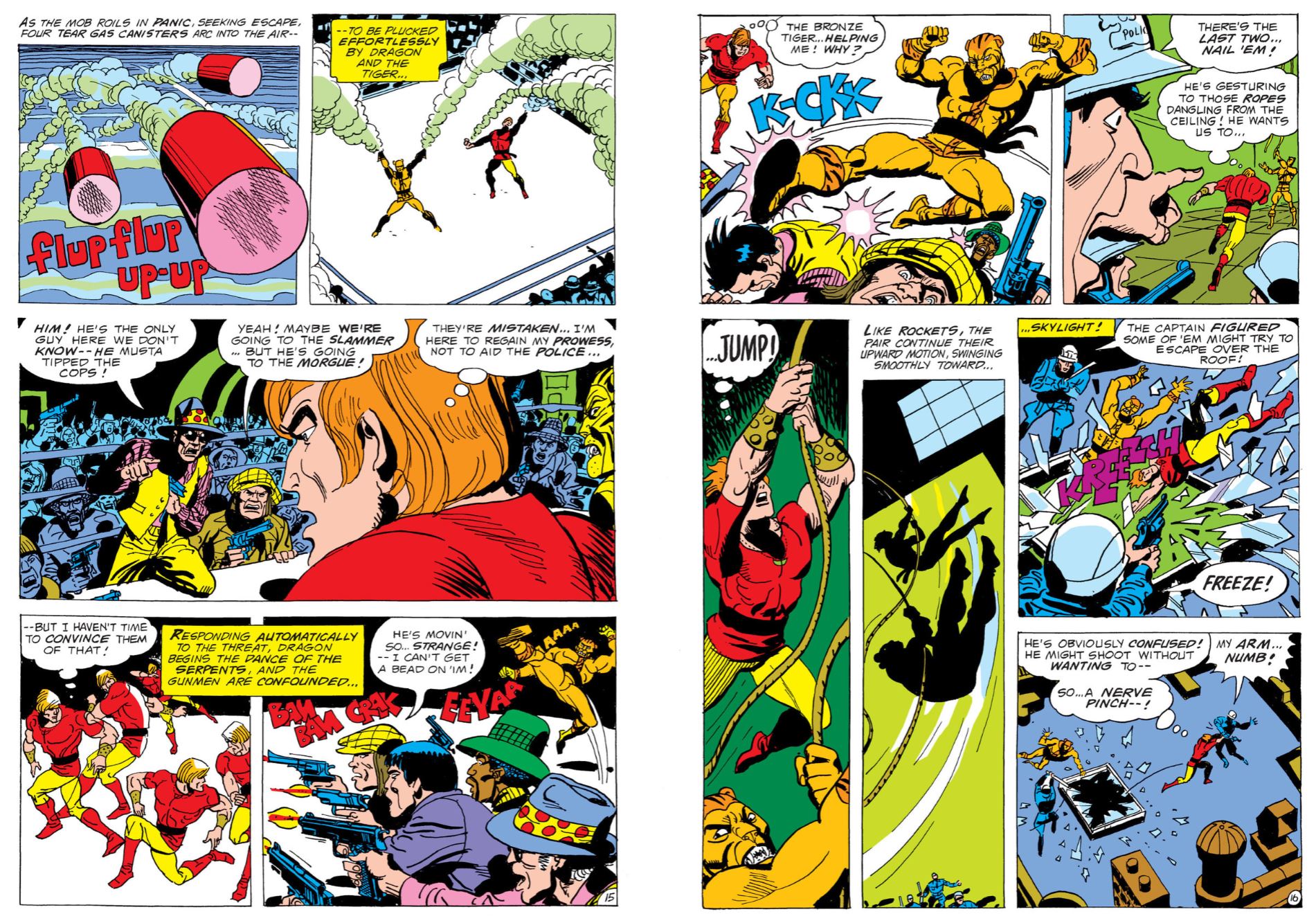
Richard Dragon: Kung-Fu Fighter finished with #18, but ‘The Secret of the Bronze Tiger’ set up decades’ more stories. Bereft, Turner had vanished and was presumed killed battling Ojo, whilst Dragon sank into despair and dissolution. Finally, Shiva dragged him out to investigate a mysterious masked martial artist and illegal fight club. Dragon was stunned to discover Ben was the Tiger – who retained all his skills but was apparently a ruthless criminal with no memory or scruples…
This storyline was later picked up and expanded upon in future Batman tales involving Ra’s Al Ghul’s League of Assassins and sinister splinter group Demonfang (whose leader was ancient killer The Sensei) and resulted in Bronze Tiger becoming an integral part of the Suicide Squad in post-Crisis on Infinite Earths DC Universe. In that rebuilt continuity, Shiva & Dragon were crucial to the development of The Question (Vic Sage) and other martial arts-based characters, emphasising the ripple-effect of “the Superior Man” on an entire heroic universe.
Here, however, there’s an epilogue of sorts as DC Comics Presents #39 (November 1981, by Mike W. Barr, Alex Saviuk & Vince Colletta) discloses ‘Whatever Happened to Richard Dragon: Kung Fu Fighter?’ Having retreated to the peace of a Shaolin monastery, Dragon is called back to the outside world to save mind-controlled Bronze Tiger from the person who had truly been responsible for most of their perils and hardships all along…
With covers by Dick Giordano, Wiess, Milgrom, Estrada & Colletta, Jose Delbo, Ernie Chan, Aparo & Rich Buckler, and including Who’s Who character profiles of Dragon, Bronze Tiger & Lady Shiva, this compendium is very much of its time, but still offers universal thrills and spills whilst providing crucial context to all devotees of DC’s overarching multiversal continuity. Very much the Superior Read of the Superior Fan…
© 1975, 1976, 1977, 1981, 2021 DC Comics. All Rights Reserved.
Today in 1910, cartoonist/animator and legend maker William Hanna was born, sharing the date with inking legend Mike Esposito in 1927; French mythmaker Marcel “Gotlib” Gotlieb (Gai-Luron, Superdupont, Les Dingodossiers, Rubrique-à-Brac, Hamster Jovial, co-founder of L’Écho des savanes & Fluide Glacial) in 1934; writer/artist John K. Snyder III (Fashion in Action, Grendel, Suicide Squad, Doctor Mid-Nite, Mr E, The Duckberg Times, 8 Million Ways to Die) in 1961, artist Richard Case (Doom Patrol, Sensational Spider-Man The Sandman) in 1964 and illustrator/storyteller Colleen Coover (Small Favors, Banana Sunday, Bandette, X-Men: First Class) in1969.
It’s a big day for colourists with Peter Steigerwald born in 1974, Brian Reber in 1975 and Matt Wilson in 1980; and also saw the deaths of arguably Chile’s greatest cartoon humourist Rene Rios Boettiger (Condorito) in 2000 and, in 2006, the utterly irreplaceable British man of letters (and thought balloons and caption boxes) Tom Frame.