By Stan Lee, Jack Kirby, Steve Ditko, Larry Lieber, Roy Thomas, Gary Friedrich, Arnold Drake, Steve Parkhouse, Don Heck, Bill Everett, Dick Ayers, Gene Colan, John Buscema, George Tuska, Christpher Rule, George Klein, Paul Reinman, Joe Sinnott, George Roussos, Sol Brodsky, Vince Colletta, Chic Stone, John Verpoorten, Syd Shores, Frank Giacoia, Sid Greene, Stan Goldberg, Sam Rosen, Art Simek, Terry Szanics, John Duffy & various (MARVEL)
ISBN: 978-0-7851-5864-6 (TPB), 978-1-3025-0063-4 (Digital edition)
This book includes some Discriminatory Content produced during less enlightened times.
Win’s Christmas Gift Recommendation: Timeless Fantasy Masterpiece for All Old Alike… 9/10
For most fans, the Marvel Age of Comics began with Fantastic Four #1 at the tail end of 1961, but the company itself cites Marvel Comics #1 from 1939, when the outfit was called Timely, as the big natal event. That means this year is their 87th anniversary. The first modern (for which read Post-War) comic books badged with a Marvel Comics brand were mystery anthology Journey into Mystery #69 and teen-humour hit Patsy Walker #95 (both cover-dated June 1961), each displaying an “MC” box on the cover. These soon proliferated until iconic storyteller Steve Ditko redesigned the masthead corner box for Amazing Spider-Man #2 (cover dated May 1963 and on sale from February 12th). By the July releases the name was on all issues and Marvel was forever linked to a comics revolution…
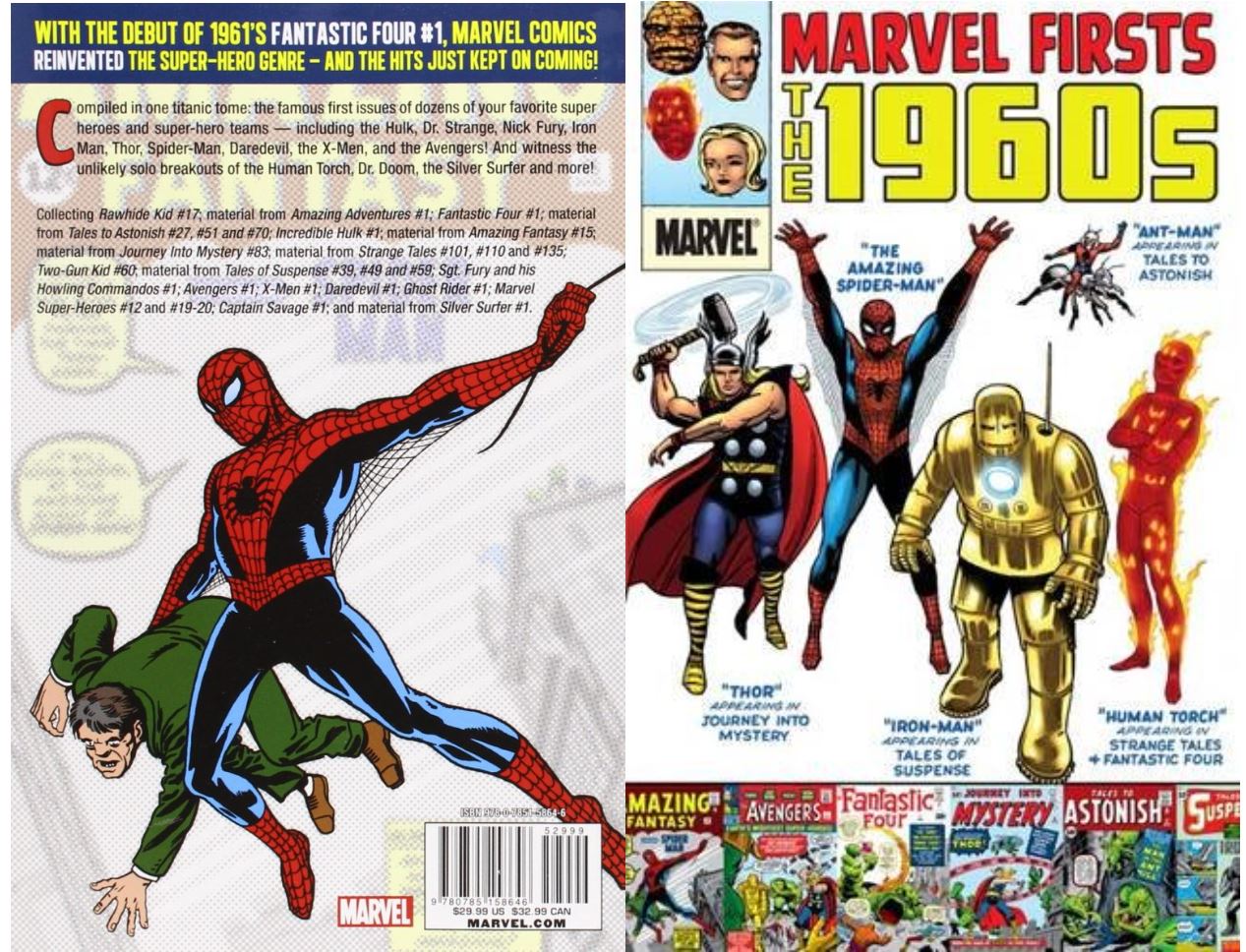
Whenever the event was, has been celebrated in a number of big-ticket compilations. This hefty carefully curated edition from 2011 wasn’t one of them, but is a superb overview of the decade of innovation that made the House of Ideas a global force and household name. It collects the first story of each character’s own series (not necessarily the same as a debut appearance), highlighting key moments through material taken from Rawhide Kid #17, Amazing Adventures #1, Fantastic Four #1, Tales to Astonish #27, 51 & 70, Incredible Hulk #1, Amazing Fantasy #15, Journey into Mystery #83, Strange Tales #101, 110 & 135, Two-Gun Kid #60, Tales of Suspense #39, 49 & 59, Sgt. Fury and his Howling Commandoes #1, The Avengers #1, X-Men #1, Daredevil #1, Ghost Rider #1, Marvel Super-Heroes #12, 19-20, Captain Savage #1 & Silver Surfer #1. These collectively cover August 1960 to May 1969 and also incorporate a vast gallery of covers from the other titles that came and went with such breathtaking rapidity in those days.
As stated, the company that would be Marvel was still going (albeit in dire straits) when Stan Lee, Jack Kirby, Ditko and a select band of other multi-genre creators started that revolution, and these tales offer unmatched insights into how it all happened by re-presenting official first appearances…
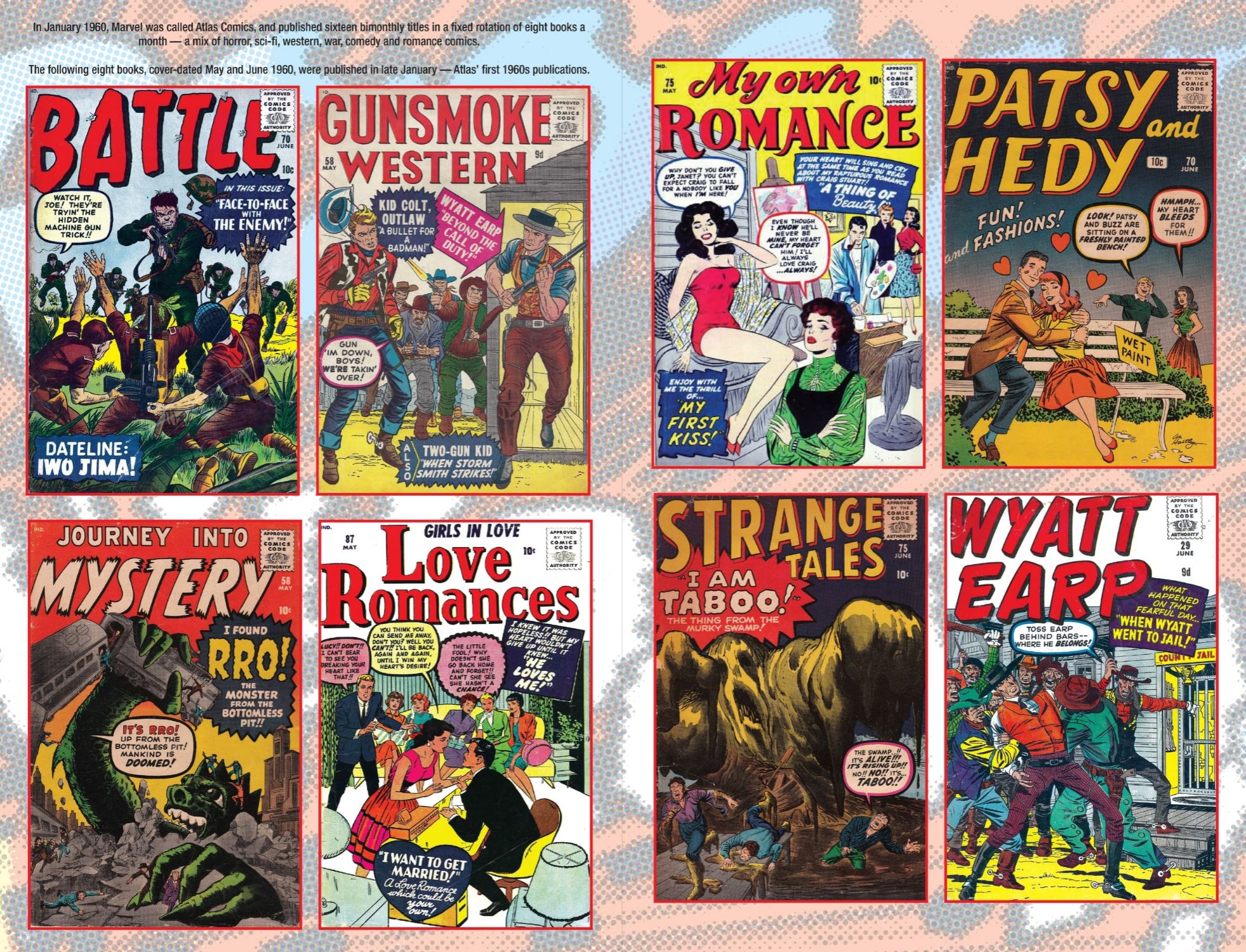
Opening in January 1960 with 16 genre covers ranging from Battle #70 to Love Romances #87 to Patsy Walker #89, the first inklings of what’s to come are seen in narrative components taken from Rawhide Kid #17, by Lee, Kirby and inker Dick Ayers.
The Kid was one of Atlas’ older icons, having starred in his own title since 1955. A stock sagebrush centurion clad in buckskins, he was an early casualty when Atlas’ distribution crisis forced the company to cut back to 16 titles in the autumn of 1957. With westerns huge on TV and youthful rebellion a hot topic in 1960, Lee & Kirby conceived a brand-new sixgun stalwart – and a teenager to boot! – and launched him in the summer of the year, economically continuing the numbering of his cancelled predecessor.
It’s important to remember that these yarns aren’t trying to be gritty or authentic: they’re accessing the vast miasmic morass of wholesome, homogenised Hollywood mythmaking that generations of consumer preferred to learning the grim everyday toil, travail and terror of the real Old West, so sit back, reset your moral compass to “fair enough” and revel in simplistic Black Hats vs White Hats with all the dynamic bombast and bravura Kirby & Ayers could muster.
It all begins with adopted teen Johnny Bart teaching all and sundry in a cow-town named Rawhide to ‘Beware! The Rawhide Kid’ after his retired Texas Ranger Uncle Ben (!) is gunned down by fame-hungry cheat Hawk Brown. After very publicly exercising his right to vengeance, the naive kid flees Rawhide before offering justifications or explanation, resigned to living as an outlaw forevermore. His reputation is further enhanced when he routs a masked gang robbing the ‘Stagecoach to Shotgun Gap!’, after which Don Heck delivers one of his slickly authentic western yarns as a veteran gunslinger devises a way to end his own fearsome career ‘With Gun in Hand!’ The issue closed with by Lee, Kirby & Ayers revealing how another tragic misunderstanding confirms Johnny Bart’s destiny ‘When the Rawhide Kid Turned… Outlaw!’
Following a trio of romantic comedy covers (My Girl Pearl #7; Teen-Age Romance #77 & Life with Millie #8) we turn to the splendidly addictive men-vs-monsters anthology titles wherein Amazing Adventures #1 (cover-dated June 1961) begins a cautious experiment by launching a low-key – un-costumed even – paranormal mystically empowered investigator for a short run of pre-superhero escapades. ‘I Am the Fantastic Dr. Droom!’ (Lee & Kirby with Ditko inking) sees a seemingly sedate American drawn to Tibet to be trained in ancient mysteries before returning home as an occult consultant. The cover for Linda Carter, Student Nurse #1 then takes us to the big moment when everything changed…
Cover-dated November 1961 and on sale from August 8th, Fantastic Four #1 introduced a brave new world in eponymous epic ‘The Fantastic Four’ as maverick genius Reed Richards summons his fiancée Sue Storm, their pilot pal Ben Grimm and Sue’s teenaged brother Johnny before heading off on their first mission. Via flashback we learn they are driven survivors of a private spaceshot that went horribly wrong after Cosmic Rays penetrated their ship’s inadequate shielding. On crashing back to Earth, they found they’d all been hideously mutated into outlandish freaks.
Richards’ body became elastic, Sue could become invisible, Johnny Storm could turn into living flame and tragic Ben was reduced to a shambling, rocky living horror. Shaken but unbowed, they vowed to dedicate their new abilities to benefiting mankind. Crafted by Lee & Kirby. inked by George Klein & Christopher Rule, the drama intensified with ‘The Fantastic Four meet the Mole Man’ as they foil another outcast who tyrannically controls monsters and slave humanoids from far beneath the Earth. This summation of the admittedly mediocre plot cannot do justice to the engrossing wonder of that breakthrough issue… we really have no grasp today of just how different in tone, and how shocking it all was.
Next comes Ditko’s cover to Amazing Adult Fantasy #7, preceding a throwaway vignette from another of the company’s anthological monster mags. Taken from Tales to Astonish #27 (January 1962) a 7-page short introduces Dr Henry Pym, the maverick scientist who discovered a shrinking potion and invoked peril, wonder and a kind of companionship amongst the lowliest creatures on Earth and under it. This engaging piece of fluff – which owed more than a little to movie The Incredible Shrinking Man – was plotted by Lee, scripted by his brother Larry Lieber and stunningly illustrated by Kirby & Ayers.
The Incredible Hulk smashed right into his own bi-monthly comic and, after some classic romps by Young Marvel’s finest creators, crashed right out again. After 6 issues the series was cancelled and Lee retrenched, making the Gruff Green Giant a perennial guest-star in other Marvel titles until such time as they could restart the drama in their new Split-Book format in Tales to Astonish where Ant/Giant-Man was rapidly proving to be a character who had outlived his time.
Cover-dated May 1962, that first issue observes puny atomic scientist Bruce Banner, sequestered on a secret military base in the Midwest desert, perpetually bullied by bombastic commander General “Thunderbolt” Ross as a clock counts down to the world’s first Gamma Bomb detonation. Besotted by the General’s daughter Betty, Banner endures the General’s constant jibes as the timer ticks on and tension increases. At the final moment Banner sees a teenager lollygagging at Ground Zero and frantically rushes to the site to drag the boy away. Unknown to everyone, the assistant he’s entrusted to delay the countdown has an agenda of his own…
Rick Jones is a wayward but good-hearted kid. After initial resistance he lets himself be pushed into a safety trench, but just as Banner prepares to join him The Bomb explodes…
Somehow surviving the blast, Banner and the boy are secured by soldiers, but that evening as the sun sets the scientist undergoes a monstrous transformation. He grows larger and his skin turns stony grey…
In 6 simple pages that’s how it all starts, and no matter what any number of TV or movie reworkings or comicbook retcons and psycho-babble re-evaluations would have you believe that’s still the best and most primal take on the origin. A good man, an unobtainable girl, a foolish kid, an unknown enemy and the horrible power of destructive science unchecked…
Written by Lee, drawn by Kirby & inked by Paul Reinman, ‘The Coming of the Hulk’ barrels along as the man-monster & Jones are kidnapped by Banner’s Soviet counterpart The Gargoyle for a rousing round of espionage and Commie-bashing…
Crafting extremely well-received monster and mystery tales for and with Stan Lee, Ditko had been rewarded with his own title. Amazing Adventures/Amazing Adult Fantasy featured a subtler alternative kind of yarns other than Rampaging Aliens or Furry Underpants Monsters, which – though individually entertaining – had been slowly losing traction in the world of comics ever since National/DC had successfully reintroduced costumed heroes.
Lee & Kirby had responded with Fantastic Four and the ahead-of-his-time Hulk, but there was no indication of the renaissance to come when the cover of officially just-cancelled Amazing Fantasy #15 (August 1962) highlighted a brand new and rather eerie adventure character. The wonderment came and went in 11 captivating pages as ‘Spider-Man!’ told the parable of Peter Parker, a smart yet alienated kid bitten by a radioactive spider on a high school science trip. Discovering he has developed arachnid abilities (which he augments with his own natural engineering genius) Parker does what any lonely, geeky nerd would do when given such a gift… he tries to cash in for girls, fame and money.
Creating a costume to hide his identity in case he makes a fool of himself, Parker becomes a minor celebrity and a vain, self-important one. To his eternal regret, when a thief flees past, he doesn’t lift a finger to stop him, only to find when he returns home that his Uncle Ben has been murdered. Crazy for vengeance, Parker stalks the assailant who made his beloved Aunt May a widow and killed the only father he had ever known, to find that it is the felon he couldn’t be bothered with. Since his irresponsibility led to the death of the man who raised him, the boy swears to always use his powers to help others…
It wasn’t a new story, but the setting was familiar to every kid reading it and the artwork was downright spooky. This wasn’t the gleaming high-tech world of moon-rockets, giant aliens and flying cars, this stuff could happen to anybody. The tragic last ditch tale struck a chord with the readers and by Christmas a new comic book superstar was ready to launch in his own title, with Ditko eager to show what he could do with his first returning character since the demise of Charlton action hero Captain Atom.
The Mighty Thor was the comic series in which Kirby’s restless fascination with all things Cosmic was honed and refined through his dazzling graphics and captivating concepts. The King’s examination of space-age mythology began in modest fantasy title Journey into Mystery where, in the summer of 1962, a tried-&-true comic book concept (feeble mortal transformed into god-like hero) was revived by the fledgling outfit to add a Superman analogue to their growing roster of costumed adventurers. Journey into Mystery #83 (August 1962) saw a bold costumed warrior jostle aside the regular fare of monsters, robots and sinister scientists in a brash, vivid explosion of verve and vigour. The initial exploit follows crippled US doctor Donald Blake vacationing in Norway and encountering the vanguard of an alien invasion. Fleeing, he is trapped in a cave and finds an old, gnarled walking stick. In his frustration, he smashes the stick into a huge boulder obstructing his escape and his spindly frame transforms into Norse God of Thunder Mighty Thor!
Plotted by Lee, scripted by Lieber and illustrated by Kirby & inker Joe Sinnott (at this juncture a full illustrator, Sinnott would become Kirby’s primary inker for most of his Marvel career), ‘The Stone Men of Saturn’ is pure early Marvel: bombastic, fast-paced, gloriously illogical and captivatingly action-packed. The hugely under-appreciated Art Simek was the letterer and logo designer.
It was clear that they were making it up as they went along (not in itself a bad thing) and all that infectious enthusiasm showed. Amazing Fantasy #15 came out the same month as JiM #83 and a month later Tales to Astonish #35 – the first featuring Henry Pym as Astonishing Ant-Man in costumed capers appeared. In this volume you’ll find the cover to TtA #35 to mark that occasion…
Hot on the heels of the runaway success of the FF, Stan & Jack spun the most colourful – and youngest – member of the team into a solo series, seeking to recapture the glory of the 1940s when the original Human Torch was one of the company’s “Big Three” superstars. Within a year, magic-&-monsters anthology Strange Tales became home for the hot-headed hero. ST #101 saw Johnny Storm start his off-duty career with eponymous exploit ‘The Human Torch’. Scripted by Lieber (over a plot by brother Stan) and sublimely illustrated by Kirby & Ayers, the plucky lad investigates sabotage at a seaside amusement park and uncovers Commie-conniving by Red spy The Destroyer. Kirby pencilled the first few adventures before moving on, with Ayers assuming artistic control for most of its run, although The King generated some of the best covers of his Marvel career throughout the Torch’s Strange Tales tenure.
An odd inconsistency – or, more likely, tension- and drama-inducing gimmick – did crop up here. Although public figures in the FF, Johnny and sister Sue lived part-time in Long Island hamlet Glenville, where, despite the townsfolk being fully aware of her as the glamorous and heroic Invisible Girl, they seemed oblivious to the fact that her brother is the equally famous Torch. Many daft-but-ingenious pages of Johnny protecting his “secret identity” ensued before the situation was brilliantly resolved…
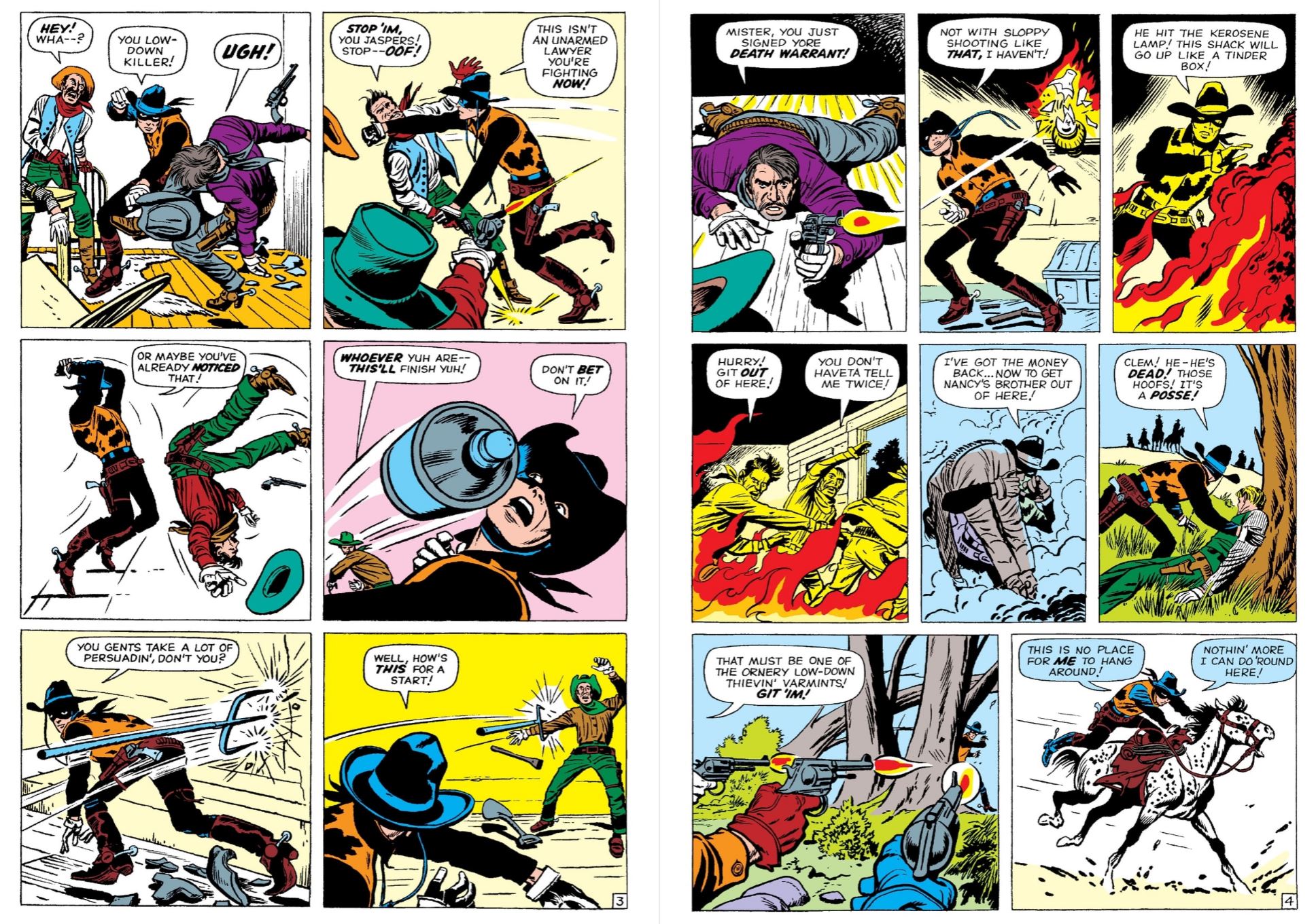
Despite the runway success of its new-fangled superheroes, Marvel still offered a range of genres like westerns. August 1962 saw the retooling of another retired Atlas property when Two-Gun Kid #60 (cover-dated November) introduced Eastern lawyer Matt Hawk. He moved to barbarous, unruly Tombstone, Texas in ‘The Beginning of the Two-Gun Kid’ (Lee, Kirby & Ayers). After merciless and relentless bullying, the tenderfoot is mentored by aged gunslinger Ben Dancer and becomes a powerful, ultrafast deadly accurate shootist.
When Ben is driven out of town by thugs working for land baron Clem Carter, Hawk adopts a masked identity to see that justice is done. Heck then limns stand-alone tale ‘The Outcast’, exposing the naked ambition of a Navajo warrior, before Hawk returns to complete his origin story in ‘I Hate the Two-Gun Kid!’ as romantic interest Nancy Carter succumbs to a scheme by her stepbrother to defraud her and frame the new hero in town…
More striking covers – Modelling with Millie #21 & Amazing Spider-Man #1 – precede the debut of Marvel’s next milestone in Tales of Suspense #39 (March 1963 and on sale for Christmas 1962). Created in the aftermath of the Cuban Missile Crisis at a time when “Red-baiting” & “Commie-bashing” were national obsessions in the U.S. the emergence of a brilliant new Thomas Edison employing Yankee ingenuity and invention to safeguard the World was an inevitable proposition.
Combining the cherished belief that (US) technology could solve every problem with universal imagery of noble knights battling evil, the proposition became certainty. Of course, kids thought it great fun and very, very cool. Scripted by Lieber (over Lee’s plot) and illustrated by the criminally unappreciated Don Heck, ‘Iron Man is Born’ saw electronics wizard turned arms maker Tony Stark field testing inventions in Vietnam when he is wounded by a landmine. Captured by Viet Cong leader Wong-Chu, Stark is given a grim ultimatum. Create weapons for the Reds and a doctor will remove from his chest the shrapnel that will kill him within seven days. If not…
Knowing Commies can’t be trusted, Stark and aged Professor Yinsen – another captive scientist – build a mobile iron lung (remember this is years before transplants or pacemakers) to keep his heart beating, equipping it with all the weapons their ingenuity and resources can secretly build. Naturally they succeed, defeating Wong-Chu, but not without tragic sacrifice.
Next was a new genre title, again given a fresh treatment by Lee, Kirby & Ayers. Sgt. Fury and his Howling Commandos (May 1963) was an improbable, over-the-top WWII combat comics series similar in tone to later ensemble action movies like The Magnificent Seven, The Wild Bunch or The Dirty Dozen. The surly squad of sorry reprobates were the first of three teams concocted by men-on-fire Kirby & Lee to secure Marvel’s growing position as the publisher to watch. Sgt. Fury started out as a pure Kirby creation. As with his various war comics, The King made everything look harsh and real and appalling: the people and places are all grimy and tired, battered yet indomitable. Jack had served in some of the worst battles of the war and never forgot horrific and heroic things he saw. These he more graphically expressed in his efforts during the 1950s genre boom at many different companies. However, even at kid-friendly, Comics Code-sanitised Marvel, those experiences perpetually leaked through onto his powerfully gripping pages.
The saga began with blistering premier ‘Sgt. Fury, and his Howling Commandoes’ (that’s how they spellleded it in the storrie-title – altho knot enneewaire else): a rip-snorting yarn bursting with full-page panels interspersed with ‘Meet the Howling Commandos’ – a double-page spread spotlighting the 7-member First Attack Squad; Able Company, comprising Fury himself; former circus strongman/Corporal “Dum-Dum” Dugan and privates Robert “Rebel” Ralston (a Kentucky jockey); college student Jonathan “Junior” Juniper; jazz trumpeter Gabe Jones; Brooklyn mechanic Izzy Cohen and glamorous movie heartthrob Dino Manelli.
Controversially even for the 1960s, this battle Rat Pack was an integrated unit with Jewish and black members as well as Catholics, Southern Baptists and New York white guys all merrily serving together. The Howling Commandos pushed envelopes and busted taboos from the very start and the first mission was a non-stop riot pitting ‘Seven Against the Nazis!’ whilst putting the squad through their unique paces. The ragged band of indomitable warriors took on hordes of square-necked Nazis to save D-Day and rescue a French resistance fighter carrying vital plans of the invasion and is counterpointed by a far more low-key introduction for the next debut.
Something definitely different debuted at the back of Strange Tales #110.
When the budding House of Ideas introduced a warrior wizard to their proliferating pantheon in the summer of 1963 it was a bold but curious move. Bizarre adventures with menacing monsters were still incredibly popular both in and outside comics but mention of magic or the supernatural – especially vampires, werewolves and their eldritch ilk – were savagely proscribed by the censorship panel which dictated almost all aspects of story content. At this time (nearly a decade after an anti-comics public campaign led to Senate hearings) all comics were ferociously monitored and adjudicated by a draconian Comics Code Authority. Even though some of smaller company’s strongest sellers were mystery mags, their underlying themes and premises were almost universally mad science & alien wonders, not necromantic or thaumaturgic horrors. That might explain Lee’s unobtrusive introduction of Ditko’s mystic defender: an exotic, twilit troubleshooter inhabiting the shadowy outer fringes of rational, civilised society in one of those aforementioned monster titles.
Tales of Suspense #41 (May 1963) saw neophyte Iron Man battle crazed tech-wizard Doctor Strange, and with the codename successfully and legally in copyrightable print, preparations began for a truly different kind of ongoing hero. Marvel had recently published a quasi-mystic champion in balding, trench-coated Doctor Droom (later rechristened – or is that re-paganed? – Dr. Druid) and when Stephen Strange scored big, the prototype was retro-written into Marvel continuity as an alternative candidate and precursor for the ultimate role of Sorcerer Supreme.
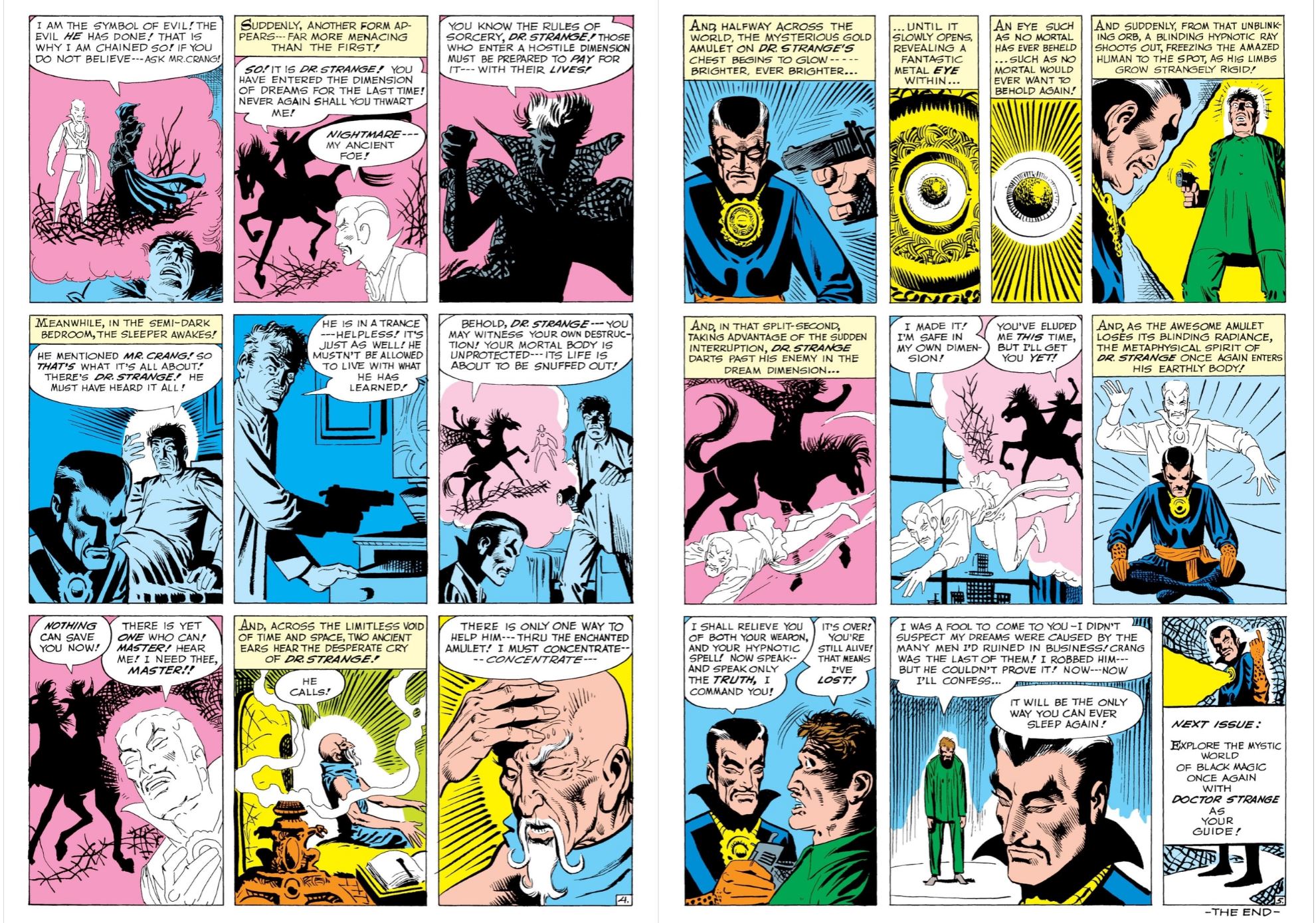
Thus, without any preamble, our first meeting with the man of mystery comes courtesy of a quiet little chiller which has never been surpassed for sheer mood and imagination. Lee & Ditko’s ‘Doctor Strange Master of Black Magic!’ (Strange Tales #110, July 1963) saw a terrified man troubled by dreams approach an exceptional consultant in his search of a cure. That perfect 5-page fright-fest introduced entire fresh realms and featured deceit, desperation, double-dealing and the introduction of both a mysterious, aged oriental mentor and devilish dream demon Nightmare in an unforgettable yarn that might well be Ditko’s finest moment.
After a period of meteoric expansion, by mid-1963 the ever-expanding Marvel Universe was finally ready to emulate the successful DC concept that cemented the legitimacy of the Silver Age of American comics. The notion of putting a bunch of all-star eggs in one basket had made Justice League of America such a winner it inspired fading Atlas to try superheroes again. Nearly 18 months after FF #1, Marvel had a viable stable of leading men (but only sidekick women) so Lee & Kirby assembled a handful of them and moulded them into a force for justice and soaring sales. Seldom has it ever been done with such style and sheer exuberance. Cover dated September 1963, The Avengers #1 kicks off with ‘The Coming of the Avengers’: one of the industry’s cannier origin tales. Instead of starting at a zero point and acting as if the reader knew nothing, Stan & Jack (plus inker Ayers) assumed consumers had at least a passing familiarity with their other titles and wasted very little time or energy on introductions.
In Asgard, God of Mischief Loki is imprisoned on a dank isle, hungry for vengeance on his half-brother Thor. Observing Earth, the wicked godling espies monstrous, misunderstood Hulk and engineers a situation wherein the man-brute seemingly goes on a rampage, simply to trick the Thunder God into battling the brute. When the Hulk’s sidekick Rick Jones radios the FF for assistance, devious Loki diverts the transmission and smugly awaits the outcome of his trickery Sadly, Iron Man, Ant-Man & The Wasp also pick up the redirected SOS and respond. As heroes converge in the US Southwest to search for the Jade Giant, they realize that something is oddly amiss…
This terse, epic, compelling and wide-ranging yarn (New York, New Mexico, Detroit and Asgard in 22 pages) is Lee & Kirby at their bombastic best, but that same month they also premiered another super squad that was the hero team’s polar opposite. X-Men #1 introduced gloomy, serious Scott Summers (Cyclops), ebullient Bobby Drake/Iceman, wealthy golden boy Warren Worthington III codenamed Angel, and erudite, brutish genius Henry McCoy as The Beast. The teens were students of wheelchair-bound telepath Professor Charles Xavier, dedicated to broker peace and achieve integration between sprawling masses of humanity and Homo Superior: an emergent off-shoot species of mutants with incredible extra abilities.
Scripted by Lee ‘X-Men’ opens with the boisterous boy students welcoming newest classmate Jean Grey (promptly dubbed Marvel Girl): a young woman possessing the ability to move objects with her mind. Whilst Xavier is explaining the team goals and mission in life, actual Evil Mutant Magneto is single-handedly taking over US missile-base Cape Citadel. A seemingly unbeatable threat, the master of magnetism is nonetheless valiantly driven off by the young heroes on their first outing in under 15 minutes. It doesn’t sound like much, but the gritty, dynamic power of Kirby’s art, solidly inked by veteran Paul Reinman, imparted raw aggressive energy to the tale which carried the bi-monthly book irresistibly forward.
As Henry Pym matured from Ant-Man to Giant-Man, he took on a crimefighting partner in Janet Van Dyne: The Wasp. Although she almost never got a chance to solo star, with Tales to Astonish #52 (January 1964) Jan was granted a back-up series where she narrated horror stories like the one included here. Crafted by Lee, Lieber & George Roussos, ‘Somewhere Waits a Wobbow!’is a standard cautionary tale of fate and justice catching up to a crooked ne’er-do-well, and is followed here by a similar new position for an alien first introduced in Fantastic Four #13. From the same team and the same month, Tales of the Watcher began in Tales of Suspense #49 with the omnipotent intergalactic voyeur sharing ‘The Saga of the Sneepers!’ with predatory extraterrestrials observing Earth and making plans of conquest…
As the evolved Atlas Comics grew in popularity, it gradually supplanted its broad variety of genre titles with more and more superheroes. The recovering powerhouse was still hampered by a crippling distribution deal that limited the company to 16 titles per month (which would restrict their output until 1968), so each new untried book would have to fill the revenue-generating slot (however small) of an existing title.
Moreover, as costumed characters were selling, each new similarly-themed title would limit the monster, western, war, humour or girls’ comics that had been the outfit’s recent bread and butter. It was putting a lot of those eggs in one basket, and superheroes had failed twice before for Marvel. So Daredevil, the Man Without Fear (April 1964) might have seemed a risky venture. Yes, the artist was one of the industry’s most talented veterans, but not to the young kids who were its audience. Most importantly, he wasn’t Kirby or Ditko…
‘The Origin of Daredevil’ sees how young Matthew Murdock grew up in the slums, raised by his dad Battling Jack Murdock, a second-rate prize-fighter. Determined that his boy will be someone, Jack extracts a solemn promise from his son that he will never fight. Mocked by other kids who sarcastically dub him “Daredevil”, Matt abides by his vow, but secretly trains his body to physical perfection. One day he saves a blind man from being hit by a speeding truck, only to be struck in the face by its radioactive cargo. His sight is burned away forever but his other senses are super-humanly enhanced and he gains a sixth: “radar-sense”. He tells no-one, not even his dad.
Jack is in dire straits. As his career declined, he signed with The Fixer, knowing full well what the corrupt promoter expected from his fighters. Yet Jack’s star started to shine again and his downward spiral reversed itself. Unaware that he was being set up, Murdock got a shot at the Big Time, but when ordered to take a dive, refused. Winning was the proudest moment of his life. When his bullet-riddled corpse was found, the cops had suspicions but no proof…
Heartbroken Matt graduates college with a law degree and sets up in business with old room-mate Franklin “Foggy” Nelson. They hire young secretary Karen Page and, with his life on track, Matt now has time to solve his father’s murder. His promise had stopped him from fighting but what if he became somebody else? Scripted by Lee and moodily illustrated by Bill Everett (with assistance from Ditko) this is a rather nonsensical yet visually compelling yarn that just goes through the motions, barely hinting at the magic yet to come.
A cover gallery highlighting Marvel Tales Annual #1, Tales to Astonish #60 and photo-satire mag Monsters to Laugh With #1 then leads to the return of Captain America in his own series. After his resurrection in Avengers #4, the golden Age Cap exponentially grew in popularity and was quickly awarded his own solo feature, sharing Tales of Suspense with Iron Man. Sparsely scripted by Lee with the staggeringly perfect team of Kirby & Chic Stone illustrating, ‘Captain America’ is one phenomenal extended fight as an army of thugs invade Avengers Mansion because “only the one without superpowers” is at home. They soon learn the folly of that misapprehension…
Veteran war-hero Nick Fury was reimagined in Fantastic Four #21 (December 1963) as a grizzled, world-weary CIA Colonel at the periphery of really big events in a fast-changing world. Fury’s latter-day self then emerged as a big-name star once espionage yarns went global in the wake of popular TV sensations like The Man from U.N.C.L.E. The elder iteration was given a second series in Strange Tales #135 (August 1965). Nick Fury, Agent of S.H.I.E.L.D. (which back then stood for Supreme Headquarters International Espionage Law-enforcement Division) combined Cold War tensions with sinister schemes of World Conquest by a subversive, all-encompassing, hidden enemy organisation. The unfolding saga came with captivating Kirby-designed super-science gadgetry…
Kirby’s genius for graphic wizardry and gift for dramatic staging mixed with Lee’s manic melodrama to create a tough, tense series which the writers & artists who followed turned into a non-stop riot of action and suspense. The main event opens in ST #135 as the Human Torch lead feature was summarily replaced. In the rocket-paced first episode, Fury is asked to volunteer for the most dangerous job in the world: leading a new counter-intelligence agency sworn to stop secret subversive super-science organisation Hydra. With assassins dogging his every move, the Take-Charge Guy with the Can-Do Attitude proves he is ‘The Man for the Job!’ in a potent 12-page thriller by Lee, Kirby & Ayers.
Originally devised by Bill Everett in 1939, Prince Namor, the Sub-Mariner is the offspring of a water-breathing Atlantean princess and a US polar explorer: a hybrid being of immense strength, highly resistant to physical harm, able to fly and exist above and below the waves. Namor technically predates Marvel/Atlas/Timely Comics. He first caught public attention as part of the fire vs. water headlining team in Marvel Comics #1 (October 1939 and Marvel Mystery Comics from the second issue onward), sharing honours and top billing with the original Human Torch, but he had originally been seen (albeit in a truncated monochrome version) in Motion Picture Funnies: a weekly promotional giveaway handed out to moviegoers earlier in the year.
Rapidly emerging as one of the company’s biggest draws, Namor gained his own title at the end of 1940 (cover-dated Spring 1941) and was one of the last super-characters to go at the end of the first heroic age. In 1954, when Atlas briefly revived its Big Three super characters, Everett returned for an extended run of superb fantasy tales, but even so the time wasn’t right and the title sunk again. When Lee & Kirby began reinventing comic books in 1961 they retooled the forgotten awesome amphibian as a troubled, semi-amnesiac, decidedly regal and grandiose antihero in FF #4. Namor despised humanity; embittered at the loss of his sub-sea kingdom (which was seemingly destroyed by atomic testing) whilst being simultaneously besotted with Sue Storm.
Namor knocked around the budding continuity, squabbling with assorted heroes like Hulk, Avengers & X-Men, before winning his own series as half of Tales to Astonish. Marvel’s split-books had been devised as a way to promote their growing stable of stars whilst toiling under a highly restrictive distribution deal limiting the number of titles they could release each month. In 1968 the company ended this commitment and expanded exponentially.
After spectacularly battling Daredevil in the Scarlet Swashbuckler’s 7th issue, TtA #70 heralded ‘The Start of the Quest!’ as Lee, Gene Colan (in pseudonymous disguise as Adam Austin) & Vince Colletta set Sub-Mariner to storming an Atlantis under martial law ordered by his usurping Warlord Krang. The effort is for naught and our returning hero is rejected by his own people. Callously imprisoned, the troubled Prince is freed by his oft-neglected and ignored paramour Lady Dorma, charging him to undertake a mystical quest to find the lost Trident of King Neptune… which only the rightful ruler of Atlantis can hold.
More covers follow: Monsters Unlimited #1, Patsy Walker’s Fashion Parade #1, reprint anthologies Marvel Collectors’ Items Classics #1, Fantasy Masterpieces #1, Marvel Tales #3, King Size Special Marvel Super-Heroes #1 & Thor #126 (a first issue as Journey into Mystery was sensibly retitled here) before a new masked-&-costumed western hero debuted in Ghost Rider #1 (December 1966).
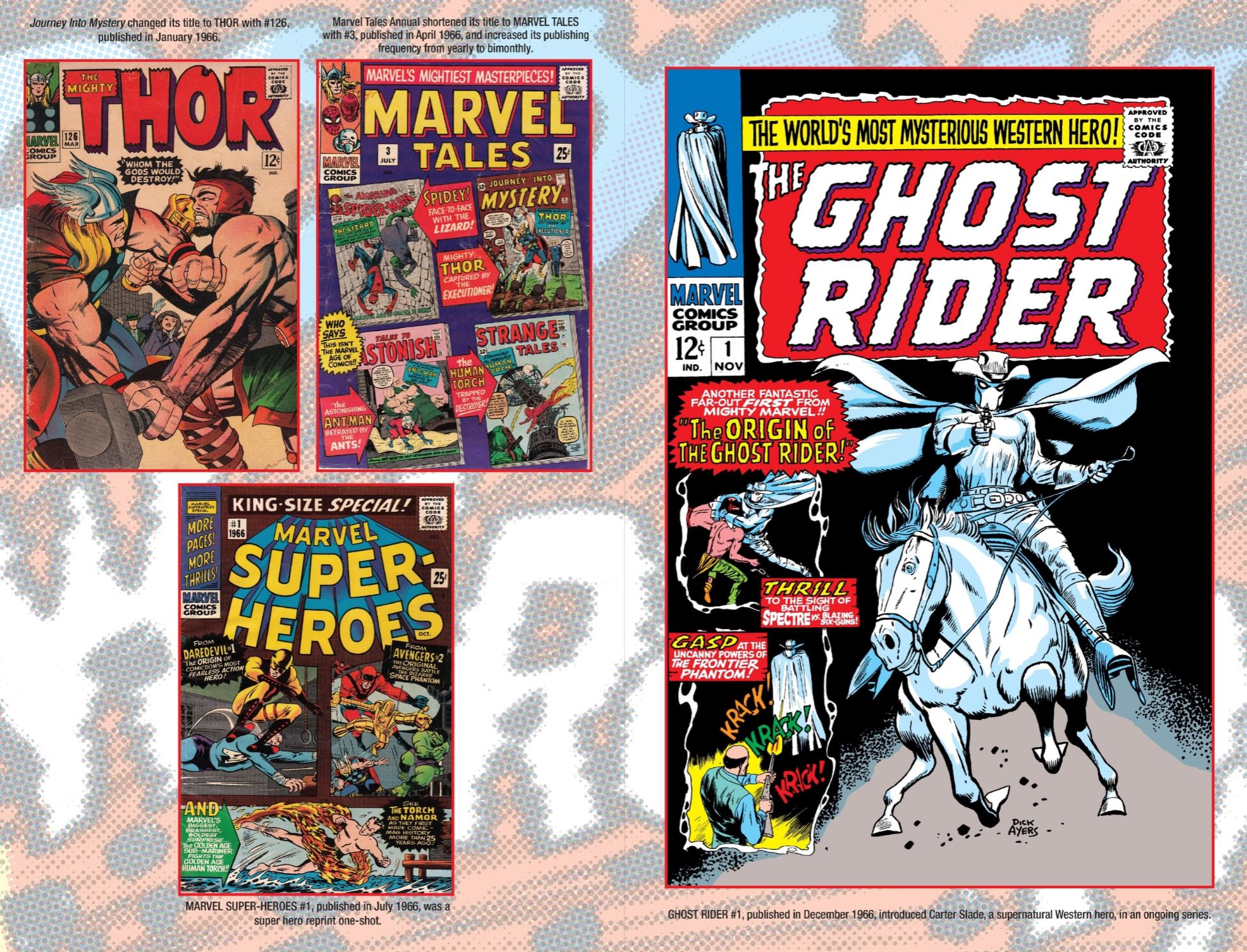
‘The Origin of the Ghost Rider’ by Gary Friedrich, Roy Thomas, Ayers & Colletta revealed how Eastern teacher Carter Slade is shot by fake Indians and brought back from the brink of death by real ones. Saved by recently-orphaned Jamie Jacobs, Slade is healed by shaman Flaming Star who trains Slade in combat and grants him gifts enabling him to perform tricks of stage magic (such as night time invisibility, image projection and bodily discorporation). Creating a glowing costume, Slade goes after plundering white men impersonating native tribes – and who killed Jamie’s parents – as a spectral avenging spirit “He who rides the Night Winds”…
Older fans – or their grandparents – might possibly recognise this hero as a western legend created by Ray Krank & Dick Ayers for Tim Holt #11 (Magazine Enterprises, 1949) and later immortalised by Frank Frazetta. They are stunningly, litigiously similar and Marvel made good use of the original’s reputation and recently voided copyright ownership. The same holds true for their next superhero addition, who crops up following another cover gallery featuring Not Brand Echh #1 and animated cartoon tie-in one-shot America’s Best (TV) Comics #1.
After years as an also-ran/up-and-comer, by 1968 Marvel Comics was in the ascendant. Their sales were catching up with industry leaders National/DC Comics and Gold Key, and they at last secured a new distribution deal that allowed them to expand their titles exponentially. Once the doubled-up stars of split-books Tales of Suspense, Tales to Astonish & Strange Tales all got their own titles, the House of Ideas just kept on going. One dead-cert idea was a star named after the company… one with a vast amount of name-recognition and nostalgic pedigree as well.
After the DC/Fawcett court case of the 1940s-1950s, the name Captain Marvel disappeared from newsstands, but in 1967, during the superhero boom and camp craze generated by the Batman TV show, publisher MLF secured rights to the name and produced giant-sized comics featuring an intelligent robot who could divide his body into segments and shoot lasers from his eyes. Quirky, charming and devised by the legendary Carl (Human Torch) Burgos who had recently worked for Marvel, the comic nevertheless did not attract a large following. Upon its demise, the name was quickly snapped up by the resurgent Marvel Comics Group. Marvel Super-Heroes was a brand-new title. It had been giant-sized reprint title Fantasy Masterpieces, combining monster & mystery tales with Golden Age Timely classics. With #12, it added an all-new experimental lead section for characters without homes. These would include Inhuman Queen Medusa and a new Black Knight when not debuting new concepts like Guardians of the Galaxy, Phantom Eagle (oddly omitted from this volume) and, to start the ball rolling, an troubled alien spy sent to Earth from the Kree Galaxy. He held a Captain’s rank and his name was Mar-Vell.
Crafted by Lee, Colan & Giacoia, initial 15-page MS-H instalment ‘The Coming of Captain Marvel!: Phase One!!’ devolved directly from FF #64-65 wherein the quartet defeated a super-advanced Sentry robot from a mythical space empire, only to be attacked by a high official of those long-lost extraterrestrials in their very next issue! After defeating Ronan the Accuser, the FF heard no more from the far-from-extinct Kree, but the millennia-old civilisation was once again interested in Earth. Dispatching a surveillance mission, the Kree wanted to know everything about us. Unfortunately, the agent they chose was a troubled man of conscience; whilst commanding officer Colonel Yon-Rogg was a ruthless rival for the love of the ship’s medical officer Una. No sooner has the good captain made tentative planetfall and clashed with the US military from the local missile base than this first instalment ends…
Although cover-dated January 1968, Capt. Savage and his Leatherneck Raiders #1 was released in November of the previous year, literally promoting a long-running supporting character from Sgt. Fury and His Howling Commandos to lead status and the Pacific Theatre of War in WWII. Crafted by Friedrich, Ayers & Syd Shores ‘The Last Banzai!’ sees US submarine commander Simon Savage reluctantly appointed the head of a squad of elite (multicultural/multi-ethnic) marines to clear the way for imminent Allied landings on the fortified atoll of Tarawa. It’s a dirty job but…
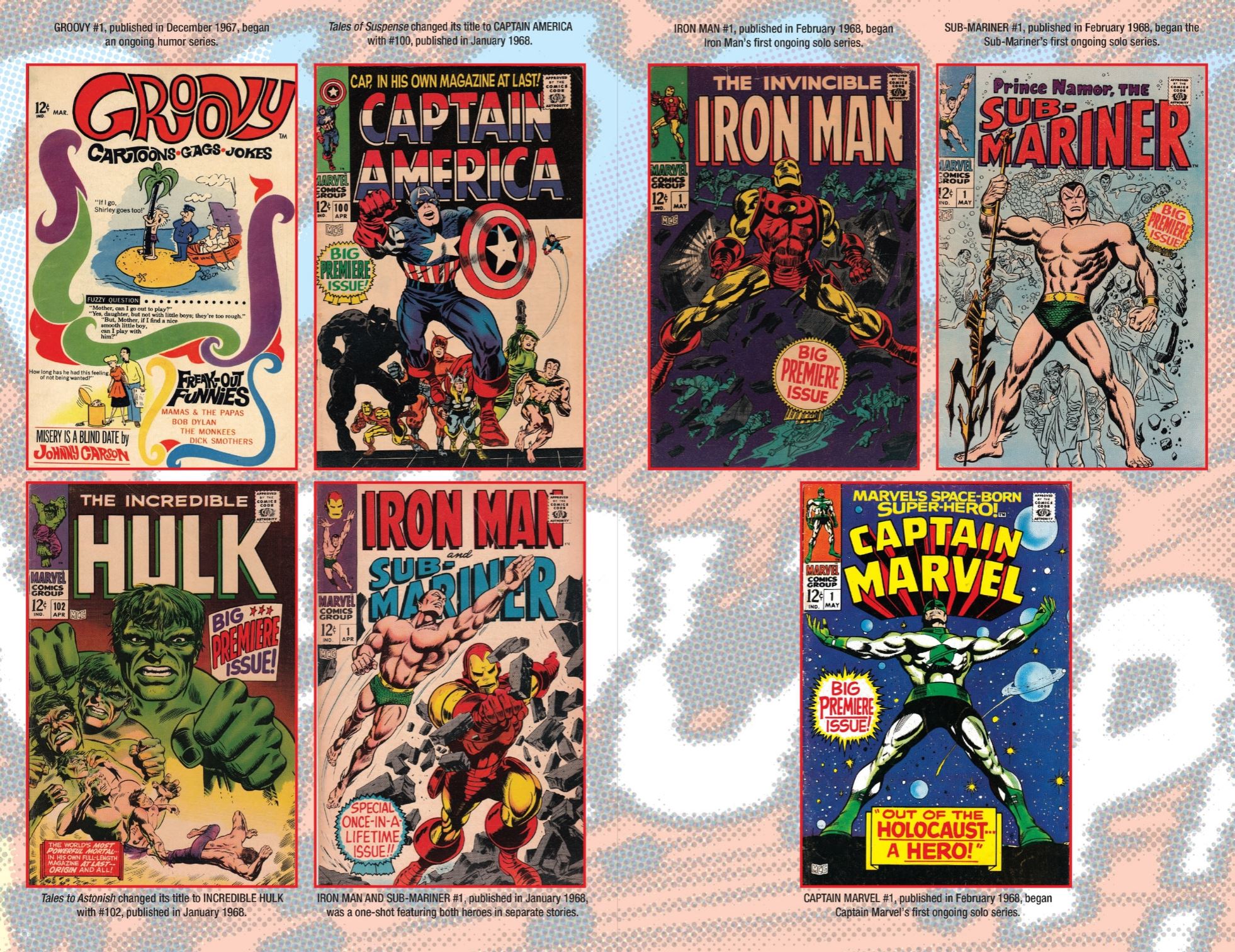
The aforementioned expansion is celebrated by a gallery of debuting series covers for Groovy #1, Captain America #100, Incredible Hulk #102, Iron Man and The Sub-Mariner #1, Iron Man #1, Sub-Mariner #1, Captain Marvel #1, Doctor Strange #169, Nick Fury, Agent of S.H.I.E.L.D. #1 and Spectacular Spider-Man #1 and cemented by the first full solo tale of one the company’s breakthrough stars.
Although pretty much a last-minute addition to Fantastic Four #48-50’s ‘Galactus Trilogy’, Jack Kirby’s scintillating creation the Silver Surfer swiftly became a watchword for depth and subtext in the Marvel Universe and one Lee kept as his own personal toy for many years. Tasked with finding planets for space god Galactus to consume and, despite the best efforts of intergalactic voyeur Uatu the Watcher, one day the Surfer discovers Earth, where the latent nobility of humanity reawakens his own suppressed morality; causing the shining scout to rebel against his master and help the FF save the world. In retaliation, Galactus imprisons his one-time herald on Earth, making him the ultimate outsider on a planet remarkably ungrateful for his sacrifice. The Galactus Saga was a creative high from a period when the Lee/Kirby partnership was absolutely on fire. The tale has all the power and grandeur of a true epic and has never been surpassed for drama, thrills and sheer entertainment. It’s not included here: for that treat you’ll need to see a Fantastic Four Epic Collection or many another Marvel collection…
In May 1968, after frequent guest-shots and even a solo adventure in the back of Fantastic Four Annual #5, the Surfer finally got his own (initially double-length) title at long last. Illustrated by John Buscema & Joe Sinnott, ‘The Origin of the Silver Surfer!’ finds the drama opening on a prolonged flashback sequence of the outcast’s forays on Earth and repeated examples of crass humanity’s brutal callousness and unthinking hostility. Then we see how Norrin Radd, discontented soul from an alien paradise Zenn-La, became the gleaming herald of a planetary scourge. Radd had constantly chafed against a civilisation in comfortable, sybaritic stagnation, but when Galactus shattered their cosy million years of progress in a fleeting moment, without hesitation the discontented dissident offered himself as a sacrifice to save the world from the Devourer’s hunger. Converted into an indestructible, gleaming human meteor, Radd agreed to scour the galaxies looking for uninhabited worlds rich in the energies Galactus needs to survive, thus saving planets with life on them from destruction. He didn’t always find them in time…
The stories in this series were highly acclaimed – if not commercially successful – both for Buscema’s agonised, emphatic and lush artwork as well as Lee’s deeply spiritual and cod-philosophical scripts. The tone was accusatory; with the isolated alien’s travails and social observations creating a metaphoric status akin to a Christ-figure for an audience that was maturing and rebelling against America’s creaking and unsavoury status quo.
Marvel the business had early learned the value of reprinting past glories; both to update new readers and to cheaply monopolise sales points. Here a gallery blends ongoing titles like newly retitled Captain Savage and his Battlefield Raiders #5 and adult-oriented comics magazine Pussycat #1 with double-sized classics reprint compilations Tales of Asgard #1 and The Mighty Marvel Western #1 before Marvel Super-Heroes #19 (March 1969 and on the stands in December 1968) sees Tarzan analogue Ka-Zar in his first solo story ‘My Father, My Enemy!’ courtesy of Arnold Drake, Steve Parkhouse, George Tuska & Sid Greene. Beginning as a barbarian wild man in a lost sub-polar realm of swamp-men and dinosaurs, Ka-Zar eventually evolved into one of Marvel’s more complex – and exceedingly mutable – characters. Wealthy heir to one of Britain’s oldest noble families, his best friend is a sabre-tooth tiger, his wife is feisty jungle warrior/zoologist Shanna the She-Devil and his brother is a homicidal super-scientific bandit. He is one of Marvel/Timely’s oldest heroes; pulp hero predated Martin Goodman’s first foray into comics and strip incarnation Kazar the Great was in Marvel Comics #1, right beside Human Torch, Sub-Mariner and The Angel…
Lord Kevin Plunder was perpetually torn between the clean life-or-death simplicity of the jungle and the bewildering constant compromises of modern civilisation as he guest-starred in titles as varied as X-Men, Daredevil & Amazing Spider-Man. As this enjoyable, under-appreciated tale unfolds many of the modern hero’s inconsistencies and conflicts are squared as the aristocratic outsider quits his English castle for the Antediluvian Savage Land to investigate claims that his dead father was a scientific devil intent on using his discovery of anti-metal for evil. Tragically, his warped brother Parnival is ruthless and determined to hide the truth for his own vile ends. A consequent wild excursion to Antarctica sees the discovery and obfuscation of the truth, strange aliens, dinosaurs, lost cities, spectacular locations, pervasive mystery and all-out action. Comics don’t get better than this…
Ending these astounding formative adventures is a tale from February 1969, just as comics began experiencing another downturn in superhero sales and the resurrection of other, more traditional genres with fresh modern tones. Co-written and pencilled by Lieber with Thomas, Giacoia & Vince Colletta, ‘This Man… This Demon!’ was the final solo try-out in Marvel Super-Heroes (#20, cover-dated May) before it became an all-reprint vehicle. It restated Dr. Victor von Doom’s origins and revealed his tragic, doomed relationship with “insignificant” Roma girl Valeria. That relationship is then exploited by demon alchemist Diablo who claims to need an ally but actually wants a new slave. The terrifying monarch of Latveria deals with the charlatan in typically effective style…
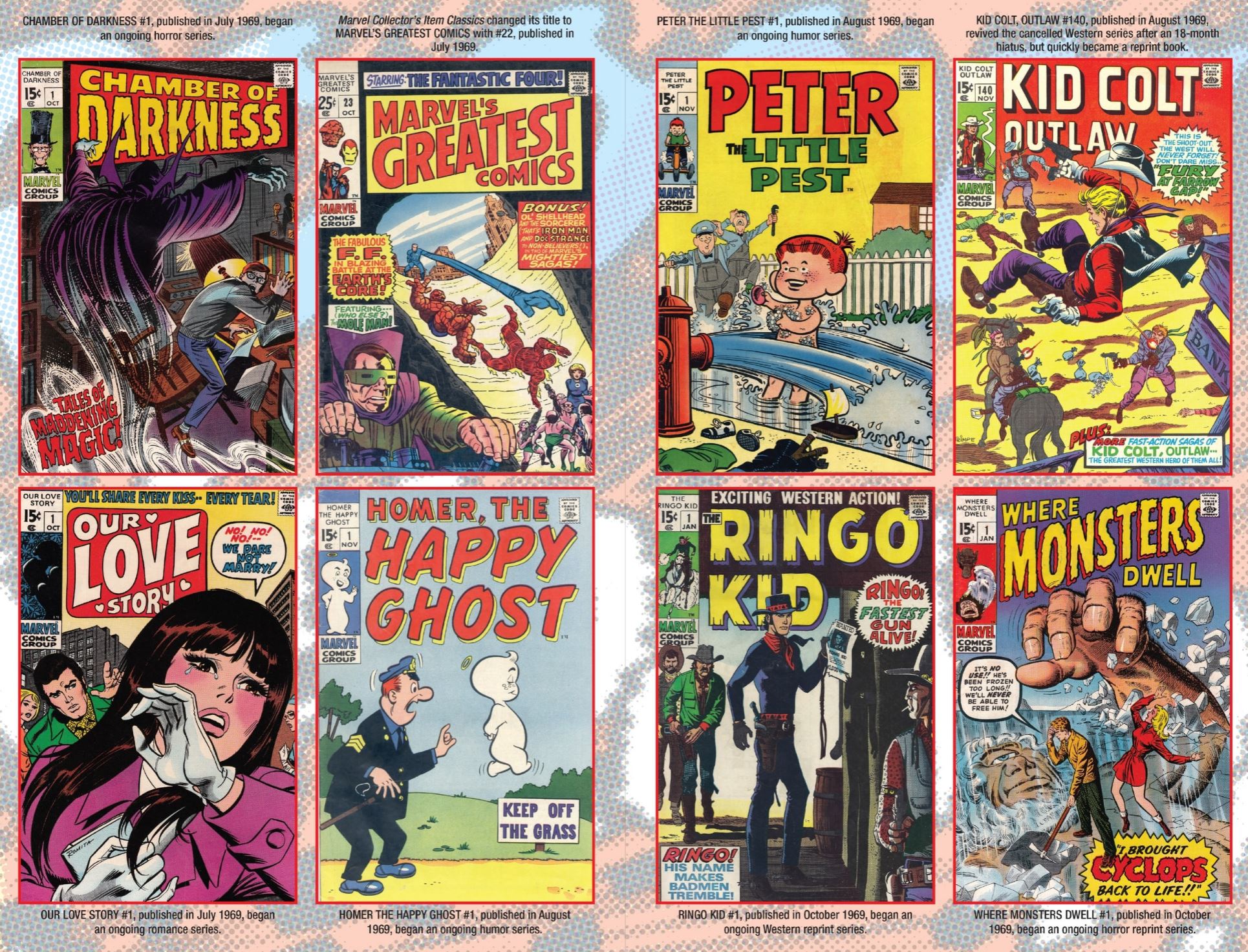
Marvel continued expanding for the remainder of the decade, but not with superheroes, as a final clutch of covers – Mad About Millie #1, Chili #1, My Love #1, Tower of Shadows #1, Chamber of Darkness #1, Our Love Story #1, Marvel’s Greatest Comics #22, Homer, the Happy Ghost #1, Peter the Little Pest #1, the revived Kid Colt Outlaw(#140), Ringo Kid #1 and Where Monsters Dwell #1 – highlights the publisher’s return to broader choices and themes, following as always the trends of TV and movies. Also included is a brief bonus section sharing Stan Lee’s original synopsis for FF #1 and iconic contemporary house ads.
The 1960s was the turning point in the history of US comic books: the moment a populist industry became an art form. These tales helped sparked that renaissance and remain some of the best stories and art you will ever experience. Nuff Said?
© 2017 Marvel Characters, Inc. All rights reserved.