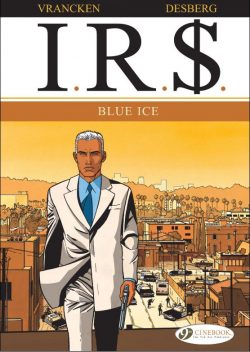
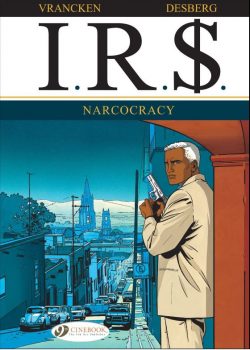
I.R.$. volume 2: Blue Ice


By Vranken & Desberg; coloured by Coquelicot and translated by Luke Spear (Cinebook)
ISBN: 978-1-905460-74-8 (Album PB)

As I’ve perpetually stated, the most appealing aspect of European comics is the sheer breadth of genres, styles and age-ranges their efforts address and their huge readerships support. Thus, this quirky exceedingly readable, all-action Franco-Belgian thriller-series with a tantalising twist offering a deliciously different spin on the tried-and-true trope of driven mystery-man superspy.

The unlikely champion of these sagas is a civil servant with the US government, which once upon a time started employing super-cool, infallibly effective special agents to go after the type of tax-dodger totally beyond the reach of the law. Maybe one day, fact will pilfer from fiction and perhaps every nation will have one…

Belgian writer Stephen Desberg is one of France’s most popular comics authors. He was born in Brussels in 1954, son of an American lawyer (the European distribution agent for Metro-Goldwyn Mayer) and a French mother. Stephen began studying law at Université Libre de Bruxelles but dropped out to follow a winding path into the comics biz.

He began with plots and eventually scripts for Will (Willy Maltaite) on Tif et Tondu in Le Journal de Spirou, growing into a reliable jobbing scribe on established strips for younger readers before launching his own (the Stéphane Colman illustrated) Billy the Cat (a funny animal strip, not the DC Thomson superhero series).

Thereafter came 421 with Eric Maltaite, Arkel (Marc Hardy), Jimmy Tousseul (with Daniel Desorgher) and many others. During the 1980s he gradually redirected his efforts to material for older readerships (such as The Garden of Desire) and in 1999 created contemporary thriller IR$. Historical conspiracy thriller Le Scorpion joined his catalogue of hits a year later.

Bernard Vranken was an award-winning artist by the time he was fifteen. A year later he was working for Le Journal deTintin. Whilst studying architecture at Saint-Luc, he took some comics courses by legendary illustrator Eddy Paape at St. Gilles and his true career-path was set.

Vranken was crafting short stories for A Suivre when he met Desberg. In 1996 they collaborated for the first time on epic romance Le Sang Noir. Three years later they traded love for money with I.R.$.…

The premise is simple and delicious, and Cinebook’s second translated English edition from 2009 once again doubles the bang for your buck by combining third and fourth European albums – Blue Ice and Narcocratie – into one compelling compilation.

Blue Ice (originally released in 2001) opens with stylish American bean-counter Larry B. Max relaxing in his sumptuous home. The quiet start offers the observant reader a few hints into Larry’s past – and motivations – before he renews his odd, long-distance, anonymous relationship with favourite chat-line girl Gloria Paradise.

Larry hates complications in his life but there’s just something about her voice and attitude…

A little later he attends a piano rehearsal and promises his little sister he’ll be there for the recital on Friday. It’s just asking for trouble…

Meanwhile downtown, three very bad men are meeting excessively violent ends while Los Angeles airport sees an American passenger from Mexico trigger a wave of security alerts. Typically, though, just too late for the inattentive security staff to do more than watch him spectacularly disappear into the city, leaving two dead agents behind…

Later at DEA HQ, a high-level meeting of numerous Federal agencies convenes to discuss Ryan Ricks. During his tour in Vietnam, Ricks began managing the money of his platoon-mates, subsequently using it to make a killing on the Stock Exchange.

Slightly wounded, he then shipped out for home to be eagerly pursued by finance houses who saw his unique gift for using money and making it. Ricks settled in at a major tobacco company and started creating wealth…

Nobody noticed – or perhaps cared – that Ricks was making side-deals, nor that being utterly amoral, he went where the money was to be easily found: terrorist nations…

When the IRS found out he was using dirty cash to make the company more money – and making himself fabulously rich at the same time – Ryan was fired. He claimed to have no understanding of why terrorist money was bad, while profits from giving people cancer was good…

Ricks was a man ahead of his time. Even before the Cold War ended, he was saying New Capitalism would be beyond any laws, and consequently pursued that philosophy to its logical extreme. Specialising in creating off-shore accounts, he became the world’s greatest money-launderer, devising an international network for tax evasion.

That’s when Larry Max first encountered him, but the wily finance wizard simply vanished, with a swathe of alphabetised American agencies waiting for him to turn up ever since…

Now twelve years later he’s back in the USA, so scores can be settled and pride regained. However, some bigwigs are unconvinced. With so many major players in the Monterrey Cartel gunned down in the street, the feds would rather concentrate on a clearly-brewing turf war than some nebulous cash-converter.

Late-arriving Larry is “only” a tax collector, not a true cop, but he can’t help wondering why they all think the events are unconnected…

Consulting his own researches, Mr Max coolly exposes a traitor in the cross-agency conclave and foresees things becoming extremely dramatic for the Monterrey Cartel, but is fobbed off with only two agents to assist him. Hanson‘s shadowy spook-show has access to covert satellite surveillance and phone monitoring whereas Ella Hidalgo of DEA is a stone killer everyone calls “Blue Ice”. She’s going to be useful once lead starts flying…

Across the border, the prediction has already come true. Aged, untouchable head of the clan Dion Monterrey has begun cleaning house, eradicating all dissent before heading to LA for the most important meeting of his life…

Aided by cutting-edge covert spy technology, the hunt for Ricks moves into high gear and it’s not long before Larry and Hildalgo are quietly closing in. Then, a second traitor inadvertently tips his hand too soon and the astounded IRS agent has the key piece of information he needs to complete the puzzle…

Ultimate harbinger of unfettered Free Enterprise, Ricks has returned to America because he’s acting as facilitator for the deal of the ages: selling off one of world’s largest drugs cartels…

Larry is not satisfied. The facts simply don’t add up, and as he ponders the mystery and sweats the details, Ricks is closing the deal and Dion is ensuring there’s no one left to contest the sale…

With every party understandably edgy, the final handover is set to occur on the roof of a luxury shopping mall. While fanatical Ricks describes the way business will be conducted in the until-now inefficiently managed, under-exploited market of modern coke consumption, the good guys quietly close in but they have grossly underestimated the guile and paranoia of their targets. Soon the entire scene is a hellish firefight of lethal proportions…

As ever, the end result is a pile of bodies, massive collateral damage and Ricks a ghost in the wind, but this time Larry is hot on his tail…

Without pause for breath the story concludes in Narcocracy as Max arrives in Tijuana, just as the next move in Ricks’ grand strategy goes live: acquisition and expansion…

Before dawn breaks in the seedy hellhole, many of the proud cartel hold-outs opposing the new order are gone and the game plan is clear. It’s not consolidation or merger Ricks and his mystery backers have in mind for the already lucrative drug trade, it’s a hostile takeover…

The only fly in the ointment is a certain white-haired American implacably following the money magician everywhere: someone proving utterly impossible to kill…

Help comes from a most unexpected quarter as the Mexican Federal Bureau of Narcotics picks up the taxman, claiming he’s about to blow a massive sting operation. Larry keeps his thoughts to himself when meeting the country’s top brass to warn them of Rick’s current ambitious activities. After all, money talks; he’s in a country notorious for corruption and the wizard of wealth-creation has more cash than any other crook in the world…

Soon Max is partnered with the Bureau’s top investigators and chasing his elusive quarry, but even though Larry knows a trap is waiting to spring somewhere, he’s not sure when or who’s going to trigger it. Moreover, behind all the double-dealing and staggering slaughter, he can perceive the kind of chicanery only real, Harvard-style business types are capable of.

All he has to do is find out who and prove it…

Inevitably the hammer falls and bodies drop again. For a moment, it looks like someone’s going to miss a piano concert…

Complex, fast-paced, suspenseful and incredibly violent, this yarn is pure movie blockbuster: a sleek, lithe action-fest to seduce any thriller addict. IR$ is a splendidly effective, stylishly gritty series to delight fans of modern mayhem in all it’s artistic forms.

Only death and taxes are inescapable, and Larry B. Max offers either or both in one suavely economical package…
Original edition © 1977 Editions du Lombard (Le Lombard/Dargaud SA) 2001-2002 by Desberg &Vrancken. English translation 2008 © Cinebook Ltd.
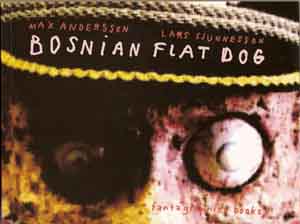
Bosnian Flat Dog


By Max Andersson & Lars Sjunnesson (Fantagraphics Books)
ISBN: 978-1-56097-740-7 (PB)

Very much in the far-too-large category of “why is this out of print and not available digitally?”, here’s a bizarre treat from long ago that you can still find with luck and persistence. And you should…

This manic lost gem is a startling and powerful excursion into the “collective unconsciousness of the Balkans” which resulted in a surprisingly compelling and funny tale from two of Sweden’s finest comic makers. It first emerged appeared in Death & Candy #2-4 before being remastered for this deliciously dark and daft tome which broke loose in 2006. Ostensibly, this is the account of a journey by the creators to Slovenia and an alternative cartoonists convention that spirals inescapably into a manic road-movie quest.

Just after they decide to reimburse an old friend for a story they had “borrowed” for their latest comic creation, an out-of-control ice cream truck begins shooting at them. After miraculously surviving, they discover amongst the debris an engraved grenade shell with the word “Sarajevo” on it. Taking this as sign that they must do the right thing, they resolutely embark on a Kafka-esque trip to the troubled Balkans. Along the way they encounter zombies, mummies, war atrocities and a man who has a refrigerator in his car containing the corpse of Marshal Tito (look him up if you have to and, in your next life, stay awake in history class).

Not to mention that rare breed of hound: The Bosnian Flat Dog…

More treatise than adventure, and savagely underpinned by the appalling realities of the Sarajevo crisis at its worst, this thought-provoking psycho-comedy has compelling pictures, dark whimsy and enough fourth-wall contravention to supply the reader with much metaphysical and social meat to digest long after they’ve finished reading. As surreal as it seems, though, there is still a distressing amount of truth still to be found amid the icons of the fantasy world. This is a damned compelling book if you want a read that will wake you up and not lull you to sleep.
© 2006 Max Andersson & Lars Sjunnesson. All rights reserved.

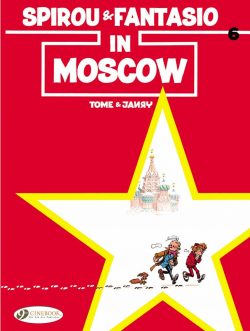
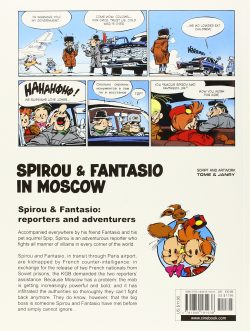
Spirou & Fantasio in Moscow (volume 6)


By Tome & Janry, coloured by Stephane De Becker & translated by Jerome Saincantin (Cinebook)
ISBN: 978-1-84918-193-8 (Album PB)

For most English-speaking comics readers, Spirou & Fantasio might be Europe’s biggest secret. The phenomenally long-lived character was a rough contemporary – and shrewdly calculated commercial response – to Hergé’s iconic Tintin, whilst the fun-filled periodical he has headlined for decades is only beaten in sheer longevity and manic creativity by Detective Comics and our own Beano.

Since launching on January 10th 1929 in Le Petit Vingtième – junior supplement to Belgian newspaper Le Vingtième Siècle – the phenomenal success of the carrot-topped boy reporter had become a money-spinning phenomenon for publisher Casterman and rival printing house Éditions Dupuis saw opportunity knocking…

Conceived in 1936 by boss-man Jean Dupuis, a proposed new magazine targeting juvenile audiences launched on April 21st 1938; debuting neatly between DC Thomson’s The Dandy (4th December 1937) and The Beano (July 30th 1938) in the UK. In America at that time a small comicbook publisher was preparing to release a new anthology entitled Action Comics. Ah, good times…

Le Journal de Spirou – the publication – was to be edited by 19-year-old Charles Dupuis, deriving its name from the lead feature, which related the improbable adventures of a plucky bellboy/lift operator employed at the glamorous Moustique Hotel (a sly in-joke reference to the publisher’s premier periodical Le Moustique).

Spirou – the hero, whose name translates as both “squirrel” and “mischievous” in the Walloon language – was first realised for his Belgian bosses by French cartoonist François Robert Velter under his pen-name Rob-Vel.

The magazine premiered with the plucky bellboy – and pet squirrel Spip – as leads in an anthology weekly which bears his name to this day; featuring fast-paced, improbable cases which gradually evolved into high-flying surreal comedy dramas.

Spirou and his pals have spearheaded the magazine for most of its life, with a phalanx of truly impressive creators carrying on Velter’s work, beginning with his wife Blanche “Davine” Dumoulin who took over the strip when her husband enlisted in 1939. She was aided by Belgian artist Luc Lafnet until 1943 when Dupuis purchased all rights to the feature, after which comic-strip prodigy Joseph Gillain (“Jijé”) took over.

In 1946 Jijé‘s assistant André Franquin assumed the reins, slowly sidelining shorter, gag-style vignettes in favour of longer adventure serials whilst introducing a wide and engaging cast of regulars. Eventually he added a animal act Marsupilami to the mix (first seen in Spirou et les héritiers in 1952 and now a spin-off star of screen, plush toy store, console games and albums all his own), crafting increasingly fantastic tales until he resigned in 1969.

He was then succeeded by Jean-Claude Fournier who updated the feature over the course of nine stirring adventures that tapped into the rebellious, relevant zeitgeist of the times with tales of environmental concern, nuclear energy, drug cartels and repressive regimes.

By the 1980s the series seemed outdated and without direction and three different creative teams were commissioned to alternate on the serial, until it was at last revitalised by Philippe Vandevelde writing as Tome and artist Jean-Richard Geurts AKA Janry.

Their winning approach was to carefully adapt, reference and, in many ways, return to the cherished and revered Franquin era. Their sterling efforts consequently revived the floundering feature’s fortunes, resulting in 14 wonderful albums between 1984 and 1998.

This one, originally entitled Spirou & Fantasio à Moscou from 1990, was their 10th collaboration and the 42nd collected exploit of the tireless wanderers.

Set just after the fall of the Berlin Wall – and effective end of Soviet socialism – there’s a lot of editorial footnoting going on to maintain understanding and sustain context but it’s all done in a witty and amusing manner, so there’s no loss of narrative traction or forced suspension of willing disbelief…

The drama begins with Spirou, Fantasio and Spip heading for a well-deserved vacation in the sweltering heat of Tahiti when they are suddenly abducted by a gang of spooks. As the lads groggily recover from cruelly applied chemical coshes, their assailants offer a (hilariously shaded) review of Russian character and recent history since the end of the Communist State. They pay special attention to the fact that even in the newly capitalist country, the KGB are still in charge…

Russia is in big trouble. The fall of the Iron Curtain has resulted in an influx of gangsterism, with the Mafia paramount in seeking out new territory for their nasty old rackets. Lacking experience in this kind of struggle, the security forces have requested the assistance of experts, and the French government – for it is they who have shanghaied our heroes – are happy to serve up Spirou and Co in return for the return of a couple of well-connected teenagers who got themselves arrested for protesting at the Kremlin…

By the time the pressganged press-men are conscious enough to refuse, they are already on the chilly tarmac of Moscow Airport and being handed badges as fully-accredited – if temporary – members of the KGB…

As they drive via a torturous and convoluted secret route into the city under the care of rowdily boisterous Colonel Dubyoutyev, they are briefed on the untenable situation.

It is not only the newcomers’ past record of success against the Mob which has brought them, albeit unwillingly, to this sorry state of affairs, but also the fact that they aren’t Russian.

When the Mafia first started operating, they were quickly infiltrated by KGB operatives, whilst the gangsters did exactly the same thing to the state police. Now nobody can trust anybody else and the authorities are forced to outsource credible and dependable assistance…

Just as they pull up at the Kremlin, the Colonel shows them a fuzzy photo of an oddly familiar face: suspected top mobster and fellow outsider Ivan Ivanovich Tanaziof. Then a shot rings out and the chauffeur slumps down. With the out-of-control car crashing onto the frozen river, in an office of the ministry, Count Nikita Bloyuredov places a call to his boss to claim “mission accomplished”…

Crawling from the wreckage, our battered but still intrepid lads opt to use their freshly-minted credentials to get to the French Embassy. En route in a commandeered taxi, Spirou shares his suspicions. Perhaps the ruthless westerner Tanaziof has some previous connection to them? Perhaps he’s Fantasio’s insane and merciless cousin Zantafio, back with another murderous scheme to grab power and wealth, no matter who has to suffer?

Arriving just as a grand Fancy Dress Ball commences, they are refused entry by security guards. They do, however, let them see the Embassy Chief of Protocol. Bloyuredov is absolutely delighted to meet them… until he sees his master Prince Tanaziof crash the party with a gang of armed heavies…

Happily, Spirou and Fantasio also spot the intrusion and take cover whilst the mobsters boldly rob the gathering. The jumped-up aristocrat arrogantly boasts his next move to reclaim Russia for his family will be to steal the sacred relic of Lenin’s embalmed body from its utterly secure tomb in Red Square…

As the gangsters gleefully exit, agents “Spirov” and “Fantasiev” are contacted by the miraculously alive and rather wisely deep, deep, deep undercover Dubyoutyev, who has also survived the crash…

Trading information, they all agree Tanaziof/Zantafio is fraudulently proclaiming himself “White Prince of the Russian Mafia” whilst attempting to pass himself off as the next Tsar. The KGB Colonel is horrified to hear of the sacrilegious plot to desecrate Lenin’s mausoleum and dashes off to implement the appropriate security measures, but his reluctant agents know it won’t be enough…

Returning to a now quiet Embassy the rightly suspicious visitors finally meet the Ambassador, who merely tells them it’s a Russian matter. On their way out the disgruntled pair receive an anonymous note promising the whereabouts of Tanaziof. Despite certain knowledge that it’s a trap, the neophyte spies later rendezvous at the spectacular outdoor spa known as the Moskva Pool…

When a horrific “accident” once again kills the wrong people, delighted and oblivious Bloyuredov heads straight for Tanaziof’s palatial hideout to share the good news, utterly unaware of two men and a squirrel on his tail…

The plan to steal Lenin is about to commence and without a moment’s pause Spirou and Fantasio disguise themselves and join the raiding party…

Cannily blending wry humour, broad slapstick, light-hearted action and rollicking adventure with a swift-paced espionage caper, all topped-off with the so-satisfying return of a world-class arch villain to sweeten the deal, this rollercoaster romp builds to a brilliantly madcap conclusion as funny as it is breathtaking… and all lavishly smothered in oodles of wicked irony.

This kind of lightly-barbed, keenly-conceived, fun thriller is a sheer joy in an arena far too full of adults-only carnage, testosterone-fuelled breast-beating, teen-romance monsters or sickly-sweet fantasy. Readily accessible in print and digitally to readers of all ages, drawn with all the beguiling style and seductively wholesome élan which make Asterix,Lucky Luke, Blake & Mortimer and Iznogoud so compelling, this is another cracking read certain one day to be as much a household name as that other pesky kid with the white dog…
Original edition © Dupuis, 1990 by Tome & Janry. All rights reserved. English translation 2014 © Cinebook Ltd.

Yakari and the White Buffalo (volume 2)


By Derib & Job, translated by Erica Jeffrey (Cinebook)
ISBN: 978-1-90546-004-5 (Album PB)

Children’s magazine Le Crapaud à lunettes was founded in 1964 by Swiss journalist André Jobin who then wrote for it under the pseudonym Job. Three years later he hired fellow French-Swiss artist Claude de Ribaupierre AKA “Derib”. The illustrator had launched his own career as an assistant at Studio Peyo (home of Les Schtroumpfs), working on The Smurfs strips for venerable weekly Le Journal de Spirou. Together they created the splendid Adventures of the Owl Pythagore before striking pure comics gold a few years later with their next collaboration.

Derib – equally au fait with enticing, comically dynamic “Marcinelle” cartoon style yarns and devastatingly compelling meta-realistic action illustrated action epics – went on to become one of the Continent’s most prolific and revered creators. It’s a crime that groundbreaking strips such as Celui-qui-est-né-deux-fois, Jo (the first comic ever published dealing with AIDS), Pour toi, Sandra and La Grande Saga Indienne) haven’t been translated into English yet, but we still patiently wait in hope and anticipation…

Many of Derib’s stunning works over the decades feature his cherished Western themes; magnificent geographical backdrops and epic landscapes. Yakari is considered by fans and critics to be the strip which first led him to deserved mega-stardom.

Debuting in 1969, Yakari follows the life of a young Oglala Lakota boy on the Great Plains; set sometime after the introduction of horses by the Conquistadores but before the coming of modern Europeans.

The series – which has generated two separate TV cartoon series and a movie release – has achieved 40 albums: a testament to the strip’s evergreen vitality and brilliance of its creators, even though originator Job has moved on and Frenchman Joris Chamblain assumed the writer’s role in 2016.

Overflowing with gentle whimsy and heady compassion, young Yakari enjoys a largely bucolic existence: at one with nature and generally free from privation or strife. For the sake of our delectation, however, the ever-changing seasons are punctuated with the odd crisis, generally resolved without fuss, fame or fanfare by a little lad who is smart, brave… and can – thanks to the boon of his totem guide the Great Eagle – converse with all animals …

Yakari et le bison blanc was the second collected European album, published in 1976 as the strip continued rapidly rising to huge prominence and critical acclaim.

Transformed to English, Yakari and the White Buffalo begins one cold day on the plains with winter snows still heavy on the ground. With spring delayed, animals and humans are going hungry and when the boy and his pinto mount Little Thunder return to camp, they find his father Bold Gaze has decreed they will move south in search of better prospects.

As they progress across the prairie the buffalo that should form the major part of their diet are nowhere to be found…

Then one day scout Grey Wolf furiously rides in. He has seen the herd. Soon they will all be enjoying the nourishment of Great Spirit Wakonda‘s gift. That night the braves dance in honour of the moving mountains they will soon hunt. Not permitted to join the men, Yakari wanders off with his pony and meets totem spirit Great Eagle in a lush clearing. The noble bird warns him the hunt will not go the way it should and the glum boy heads home with Little Thunder buckling under the weight of firewood the worried yet diligent lad has gathered…

Far away, the braves are baffled and still without meat. The night sky is riven with terrifying lightning and a furious storm. Back at camp, Yakari is scared and worried but soon soothed by elderly Quiet Rock. Eventually, the boy sleeps and is again visited by prophetic dreams. After tracking the buffalo over boiling sandy wastes and through a strange horn-like rock formation, the vision ends with him leading the herd and a great white bull back to the people…

As his mother wakes him in the morning, elsewhere the braves have reached a great desert and, with no sign of the great herd, are forced to split into small scouting parties. With little to do, Yakari and Little Thunder race with boisterous older boy Buffalo Seed and gentle Rainbow. The chase takes them to the top of a hill where he sees the rocky prominence of his dream…

His friends cannot deter Yakari from riding right out into the vast, empty plain and before long both boy and pony suffer the harsh trials of scorching heat and burning thirst. Determined to go on, both are near death when Great Eagle arrives and teaches them the secret of getting water out of the tall cacti around them.

Fortified and reinvigorated, they push on into sandy wastes and the next day are confronted by a towering wall of rock. Unable to climb the forbidding massif, Yakari discusses the problem with his pony and the wise steed suggests that every fence has an opening somewhere…

At last, their patient search reveals a deliciously refreshing waterfall and a tunnel into a lush hidden oasis where the missing buffalo herd is grazing in total secrecy…

As they innocently approach the massive ruminants a young bull furiously attacks, but his charge is intercepted by an immense white buffalo who takes the intruders aside for a quiet chat.

The wise beast explains the nature of the hidden pasture and listens with great care to the tale of woe that has left the Sioux starving. The beast understands the role of all creatures in the grand scheme of life and was already preparing to lead the migration back to the plains when Yakari arrived…

By the time horse and rider have led the herd to the spring plains, the hunters have returned home, but the snowy bovine mountain sagely advises Yakari and Little Thunder to ride away before the braves can arrive to fulfil their role in the eternal cycle of life and death of the plains…

The saga of the valiant little brave who can speak with animals and enjoys a unique place in an exotic world is a decades-long celebration of joyously gentle, moving and inexpressibly entertaining adventures honouring and eulogising an iconic culture with grace, wit, wonder and especially humour. These tales are a masterpiece of kids’ comics literature and Yakari is a series no fan of graphic literature should be without.
Original edition © 1977 Le Lombard/Dargaud by Derib + Job. English translation 2005 © Cinebook Ltd.

The Adventures of Buck Danny volume 3: Ghost Squadron


By Francis Bergése, colours by Frédéric Bergése: translated by Jerome Saincantin (Cinebooks)
ISBN: 987-1-905460-85-4 (Album PB)

Buck Danny premiered in Le Journal de Spirou in January 1947 and continues soaring across the Wild Blue Yonder to this day. The strip describes the improbably long, historically significant career of the eponymous Navy pilot and his wing-men Sonny Tuckson and Jerry Tumbler. It is one of the world’s last aviation strips and a series which has always closely wedded itself to current affairs, from the Korean War to Afghanistan.

The US Naval Aviator was created by Georges Troisfontaines whilst he was director of Belgian publisher World Press Agency and initially depicted by Victor Hubinon before being handed to the multi-talented Jean-Michel Charlier, who was then working as a junior artist.

Charlier’s fascination with human-scale drama and rugged realism had been seen in such “true-war” strips as L’Agonie du Bismark (The Agony of the Bismark – published in Spirou in 1946).

Charlier and René Goscinny were co-editors of Pistolin magazine from 1955 to 1958 and created Pilote in 1959. When they, with fellow creative legend Albert Uderzo, formed the Édifrance Agency to promote the specialised communication benefits of comic strips, he continued to script Buck Danny and did so until his death.

Thereafter his artistic collaborator Francis Bergése (who had replaced Hubinon in 1978) took complete charge of the adventures of the All-American Air Ace, on occasion working with other creators such as Jacques de Douhet.

Like so many artists involved in stories about flight, Bergése (born in 1941) started young with both drawing and flying. He qualified as a pilot whilst still a teenager, enlisted in the French Army and was a reconnaissance flyer by his twenties. Aged 23 he began selling strips to L’Étoile and JT Jeunes (1963-1966), after which he produced his first aviation strip Jacques Renne for Zorro. This was soon followed by Amigo, Ajax, Cap 7, Les 3 Cascadeurs, Les 3 A, Michel dans la Course and many more.

Bergése worked as a jobbing artist on comedies, pastiches and WWII strips until 1983 when he took the coveted job of illustrating globally syndicated Buck Danny, beginning with 41st yarn ‘Apocalypse Mission’. He even found time in the 1990s to produce a few tales for the European interpretation of British icon Biggles before finally retiring in 2008, passing on the reins to illustrators Fabrice Lamy and Francis Winis and scripter Frédéric Zumbiehl. Gil Formosa replaced Winis in 2015, and the full tally thus far is 58 albums…

This third Cinebook volume is another astonishingly authentic yarn: a tense, rip-roaring and politically-charged contemporary war story originally published in 1996 as Buck Danny #46 (L’escadrille fantôme and coloured by Frédéric Bergése). It deftly blends mind-boggling detail and technical veracity with good old-fashioned blistering blockbuster derring-do.

It’s 1995 and, above Sarajevo, Tuckson and pioneer female fighter pilot Cindy McPherson are patrolling as part of the UN Protection Force. “UnProFor” is the West’s broad and criminally ineffectual coalition to stop various factions in the region slaughtering each other.

The flight takes a dark turn when Cindy’s plane is hit by Serb rockets in contravention of the truce rules. Incensed, Tuckson peels off to open up with machine gun fire without obtaining the proper permissions.

Nursing Cindy’s burning plane back to their carrier in the Baltic, Sonny doesn’t care how much trouble he’s in, but rather than a Court Martial, the impetuous lad’s punishment is rather unique…

Called to interview with the Admiral, the pilot expects at the very least to be thrown as food to the skipper’s vile dog O’Connor, but instead meets the enigmatic Mr. Tenderman and is seconded to a top secret “Air Force/Navy Coordination” mission. Buck, meanwhile, is part of an op to locate a strange radar echo in an area supposed to be neutral and empty…

After wishing Cindy a fond farewell and hinting at his big CIA secret posting, Sonny ships out by helicopter to land at Prevesa Airbase in Greece. Bewilderment is replaced with terror and rage once he unpacks and discovers O’Connor has stowed away in his kit…

Now stuck with the infernal, nastily nipping mutt, Sonny’s screams draw an old friend into his room: maverick test pilot and old partner in peril Slim Holden. The inveterate rule-breaker also has no idea what they’ve been roped into…

The next day the conundrum continues as they and a small group of other pilots with no idea of why they’re here or where they’re going are shipped to a secret base in the mountains. After the military’s usual “hurry up and wait” the wary fliers are greeted by a familiar face…

Buck is introduced as Colonel Y by the grimly competent General X, who assigns each of the pilots a number from 1 to 16. All they know is that they have all committed serious breaches of military discipline which will be wiped from their records once the mission is over. Moreover, as long as they’re here they will only refer to each other by their code numbers…

Awaiting them are anonymous, unmarked F-16s without radios. They are to train on the jets in preparation for an unspecified single task under the strictest security conditions, until finally apprised of their specified purpose.

Days of exhausting preparation and pointless speculation are almost disrupted when an unidentified MiG-29 buzzes the base at extremely low altitude. Although Buck rapidly pursues, the quarry eludes him, but the chase does reveal their so-secret base is being covertly observed by a radar station on the Albanian border…

With no viable options, Buck returns and the training continues at full pace. Inevitably the regimen results in a fatality. With the warning of more to come before the strafing and low-level bombing runs end, the practicing goes on and rumours mount over what the actual targets of their illicit ground-attack squadron might be…

Back at the official war zone, tensions mount when two US Navy F-18s are shot down over Bosnia – apparently by a flight of unidentified jets – whilst at the hidden base, Buck’s security overflights still register radar tracks from an unknown source.

Buck and General X have no idea which of the many warring factions might be operating the MiGs or mobile radar unit, but have no choice except to proceed with their original plan. They might be far more concerned if they realised that one of the downed – official – combatants was Cindy McPherson…

With the situation worsening, word is given to go and the unofficial spectre squadron finally learn what they’re expected to do: take out the armoured concentrations and artillery emplacements relentlessly bombarding Sarajevo.

In the face of increasingly obvious NATO and UN impotence, it has been decided the Pan-Serbian aggressors need to be taught a hard lesson about keeping their word regarding cease-fires…

The mission is unofficial, with no radio contact and disabled ejector seats. Moreover, they all have permission to respond in kind to any attack – even by American forces…

As the doomed Ghost Squadron roars across the Adriatic to their targets, the Navy mission to rescue or recover their downed reconnaissance pilots proceeds and an ever-vigilant AWACS plane picks up the inexplicable bogeys heading for Sarajevo.

Of course, they reach the only conclusion possible…

When Major Tumbler and his Flight are despatched after the mystery jets an inconclusive dogfight leads him to suspect the nature and identities of some of his targets, but after breaking off hostilities the officially sanctioned Navy planes are ambushed by MiGs from a third faction…

Things look grim until NATO support arrives in the form of French Mirages and British Tornados. As the ghosts fly on to complete their punishment run, in the mad scramble behind them Tumbler tracks a MiG that has had enough and exposes a hidden Bosnian hangar housing a phantom flight of their own. Unfortunately, they see him too and he is shot down…

The CIA covert mission has been a success and a massive catalyst. In the aftermath, planes from many surrounding nations are tearing up the skies, and in the confusion, Tumbler makes his way from his landing point into the MiG base to discover old enemy and maniac mercenary Lady X running the show. He also learns that a beloved comrade may well be a traitor in her pay but resolves to save his friend and let the chips fall where they may…

This is a stunning slice of old-fashioned razzle-dazzle that enthrals from the first page to the last panel and shows just why this brilliant series has lasted for so long. Complex politics, personal honour and dastardly schemes all seamlessly blend into a breakneck thriller suitable for older kids of all ages.
© Dupuis, 1996 by Bergése. English translation © 2012 Cinebook Ltd. All rights reserved.

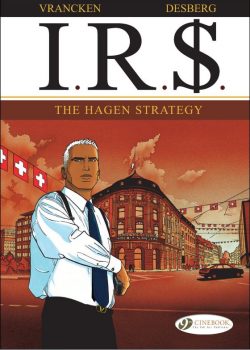
IR$ volume 1: Taxing Trails


By Vranken & Desberg, coloured by Coquelicot: translated by Luke Spear (Cinebook)
ISBN: 978-1-905460-51-9 (Album PB)

The most appetising thing about European comics (and manga too, although we only ever see the tip of that vast iceberg in English) is the sheer breadth of genres, styles and age ranges of material available.

The same used to be true of British and US comics, but creeping cultural colonisation by calcified fan-bases has slowly but surely eradicated many types of tale that might pique interest beyond the generalised ghettoes of superheroes, space opera, sexy horror and merchandised adaptations. Even crime and war comics are a rare exception these days.

Thus, finding that this quirky but exceedingly readable thriller series with a tantalising twist has finally arrived as eBooks is a welcome treat even if the Franco-Belgian original first saw print in 1999.

The unlikely champion of these sagas is a civil servant with the US government. Once upon a time these dedicate civil servants started employing super-cool and infallibly effective agents to go after the type of tax dodger far beyond the reach of the law. These days, every country should have one…

Belgian writer Stephen Desberg remains one of the bestselling comics authors in France. Son of an American lawyer (who was the distribution agent for Metro-Goldwyn Mayer) and a French mother, he was born in Brussels in 1954 and studied law at Université Libre de Bruxelles. However, he dropped out to follow a winding path into the comics biz…

Starting with plots and eventually scripts for Will (AKA Willy Maltaite) on Tif et Tondu in Le Journal de Spirou, he developed into a reliable jobbing creator on established strips for younger readers before launching his own in the Stéphane Colman illustrated Billy the Cat (a funny animal strip, not the DC Thomson superhero series).

Thereafter came 421 with Eric Maltaite, Arkel (Marc Hardy), Jimmy Tousseul (with Daniel Desorgher) and many others. During the 1980s, he gradually redirected his efforts to material for older readerships (such as The Garden of Desire), and in 1999 created this modern thriller before capping it all a year later with exuberant historical drama Le Scorpion joining his catalogue of major hits.

Bernard Vranken was an award-winning artist by the time he was fifteen and working on Le Journal de Tintin a year later. Whilst studying architecture at Saint-Luc, he took some comics courses by legendary illustrator Eddy Paape at St. Gilles and his true career path was set. Vranken was crafting short stories for A Suivre when he met Desberg, and in 1996 they collaborated for the first time on epic romance Le Sang Noir. Three years later they traded love for money and launched IR$…

The premise is simple and delicious, and this English edition doubles your money by combining the first two albums – La voie fiscal and La stratégie Hagen – into one compelling compilation.

As Taxing Trails it opens with stylish American mystery man Larry B. Max calling his new favourite chat-line girl Gloria Paradise (Larry hates complications in his life) to kill some time before heading out.

A few days previously a Swiss banker had been rather ostentatiously splurging cash on a visit to California when he ended up as a freeway statistic. However, his spending spree and sudden demise raised a few red flags…

A right place, wrong time kind of guy, Larry was decisively ending a convenience store hold-up he’d stumbled into when he got a call and soon was working his way up a deadly chain of wealthy reprobates trying to track down who had issued the contract on the banker…

Before long Max identifies the former Luc Cretier as a minor banker and major blackmailer who pushed someone too hard and paid the price. That said, the person he was putting the squeeze to is of far more interest to the tax detective.

Jewish-American Abraham Loewenstein is a rags-to-riches holocaust survivor who turned tragedy into a life of success and good works. Larry, however, has seen something the rest of the world has not, and his interview with the aged activist (as an author investigating the scandal of Jewish gold illegally held in Swiss Banks) puts him on another profitable track…

Those esteemed institutions always found some legal chicanery to deny the claims of survivors and family members who tried to attempted to retrieve their property, but recent years – due to the efforts of people like Loewenstein – have seen frustrated victims begin to win justice through court cases exposing bank practises.

Now Larry’s forensic investigation leads straight to those so-secretive Swiss Banks and a generations-long scandal regarding the illegal retention and redistribution of Jewish funds deposited whilst Hitler was rising to power.

Although the Nazis are apparently long gone, their heritage of plunder remains in those Helvetic vaults and somehow, enigmatic, untouchable multi-billionaire survivor of the Death Camps Moshe Geldhof is involved…

Larry knows he’s on to something when his car is sabotaged and less feasible accidents – such as a girl on a motorbike blasting him with a machinegun – complicate his investigation. Undaunted, he confronts Geldhof in a fancy New York restaurant and finds hot lead is the first course on the menu…

After Abraham is murdered for knowing too much, a spectacular, breakneck car chase results in Max arresting Geldhof, but for once, the infallible tax man has grossly underestimated the sheer power of money…

The story concludes in The Hagen Strategy as the scene shifts to 1943 for the incredible truth about Moshe Geldhof, as the indefatigable Max delves deeper into the history of the man who has the ear of governments, especially Israel’s…

In America, the man himself seems to be “too big to fail” but his sudden liberation only pushes Larry to greater efforts. That means heading to Bern and cultivating the attentions of Geldof’s ferociously Amazonian daughter Lenni whilst dear daddy is tangled in red tape…

No sooner has Larry broached the palatial fortress-like mansion, however, than the sinister patron turns up and the hunt is on, with a cadre of heavily armed killers at his well-shod heels…

Larry has finally gleaned the true appalling secret of the contemporary Croesus and the truth is something his government can’t cover up for him. Now he has only one possible ally in his all-or-nothing war against the money-man… and places a call to Mossad.

Sleek, lean, almost Spartan in its lithe, muscular tribute to James Bond movies, IR$ is a splendidly effective, stylishly gritty thriller series to delight fans of modern mayhem in all its literary and artistic forms.

Only death and taxes are inescapable, and Larry B. Max offers either or both in one suavely economical package…
Original edition © 1977 EDITIONS DU LOMBARD (Dargaud-Lombard) 1999-2000 by Desberg &Vrancken. English translation © 2008 Cinebook Ltd.

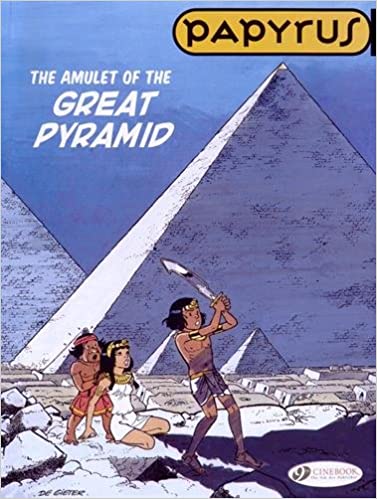
Papyrus volume 6: The Amulet of the Great Pyramid


By Lucien De Geiter, coloured by B. Swysen: translated by Jerome Saincantin (Cinebook)
ISBN: 978-1-84918-240-9 (Album PB)

Papyrus is the astoundingly addictive magnum opus of Belgian cartoonist Lucien de Gieter. Launched in 1974 on the pages of legendary weekly Le Journal de Spirou, it has run to 35 albums and spawned a wealth of merchandise, a TV cartoon series and video games.

Born in 1932, the author studied at Saint-Luc Art Institute in Brussels before going into industrial design and interior decorating. In 1961 he made the jump to sequential narrative, first via ‘mini-récits’ (half-sized, fold-in booklet inserts) for Spirou, starring his jovial cowboy ‘Pony’, and later by writing for art-star regulars such as Kiko, Jem, Eddy Ryssack and Francis.

He later joined Peyo’s studio as inker on ‘Les Schtroumpfs’ (The Smurfs), took over long-running newspaper strip ‘Poussy’ and launched mermaid fantasy ‘Tôôôt et Puit’ when Pony was promoted to Spirou‘s full-sized pages. Deep-sixing the Smurfs, de Gieter expanded his horizons by joining a select band contributing material to both Le Journal de Tintin and Le Journal de Mickey.

From 1972-1974 he worked with cartooning legend Berck on ‘Mischa’ for Germany’s Primo whilst perfecting his dream project: a historical fantasy which would soon occupy his full attention and delight millions of fervent fans for decades to come.

The annals of Papyrus encompass a huge range of themes and milieux, mixing Boy’s Own adventure with historical fiction, fantastic action and interventionist mythology. The Egyptian epics gradually evolved from standard “Bigfoot” cartoon style and content to a more realistic, dramatic and authentic iteration. Each tale also deftly incorporated breaking historical theories and discoveries into the beguiling yarns.

Papyrus is a fearlessly forthright young fisherman favoured by the gods who rises against all odds to become an infallible hero and friend to Pharaohs. As a youngster, the plucky Fellah was singled out and given a magic sword, courtesy of the daughter of crocodile-headed Sobek, before winning similar boons and blessings from many of the Twin Land’s potent pantheon.

The youthful champion’s first accomplishment was freeing supreme deity Horus from imprisonment in the Black Pyramid of Ombos and restoring peace to the Double Kingdom, but it was as nothing compared to current duty: safeguarding Pharaoh’s wilful, high-handed and insanely thrill-seeking daughter Theti-Cheri – a dynamic princess with an astounding knack for finding trouble …

The Amulet of the Great Pyramid was 6th-&-last-to-date Cinebook translation (the 21st album of the series, originally released in 1998 as Le Talisman de la grande pyramide). It’s an enthralling rollercoaster romp through living mythology and a spooky trial for the plucky chosen one which begins when Papyrus is dragged from the palace – and a rare reward from Theti-Cheri for saving her life and soul again – by spookily intelligent donkey Khamelot.

The savvy beast of burden belongs to court jester Puin and whenever it comes running in such a manner, it means the funny little man has found more trouble…

An eventful trip to the Giza plateau with its royal necropolis and great pyramids of Kheops, Khefren and Mykerinusresults in the daring lad finding not only his diminutive friend but also a desiccated yet extremely active mummy unearthed by tomb-robbers.

Puin has been hearing ghastly screams emanating from the tombs and convinces the boy-hero to stay and listen for them too. He never anticipated his bold friend to look for what made them…

The sinister sounds lead deep into the nobles’ grave fields, but as they proceed, the searchers stumble upon another acquaintance. The unconscious man is one of the three Pepi brothers charged with keeping the recently-restored Sphinx free of desert sands. Leaving the comatose victim in Puin’s care, Papyrus presses on. Before very long though, the eerie events prove too much and the panicked Professional Fool bolts. His pell-mell rush carries him down a passage far under the Kheops pyramid where he is confronted with the spirit of Seneb the Dwarf, magician and priest of that august and long-deceased pharaoh…

The garrulous ghost is in need of a favour and urges his terrified “guest” to carry his jewelled heart scarab to Papyrus who will know what to do with it…

Scrabbling out of the ancient passageway, Puin is eventually rescued by his donkey and impetuous Theti-Cheri – who again refused to be left out of any action and secretly followed her bodyguard into peril.

Papyrus, meanwhile, plunges deeper into the necropolis and is attacked by a pack of spectral jackals. Even his magic sword is no help and the malign mobbing only ends when Anubis himself calls a halt to it. The God of the Dead is angered by the sudden increase in grave-robbing and has abducted two of the caretaking Pepi brothers, thinking them desecrators.

Unfortunately, rather than admit a mistake, the jackal-headed judge demands Papyrus retrieve Kheops’ heart amulet in return for their liberty. Anubis needs it to weigh the king’s soul before he can remove all the wandering spirits of the region to a place where the living can no longer disturb them…

And thus ensues an astonishing race against time as the young champion has to scour the Great Pyramid from top to bottom (magnificently detailed and scrupulously explained in some of the best action illustration the author has ever produced); defeating deadly traps, defying spectral sabotage and godly interventions and solving the riddles of the dead to accomplish his mission.

However, even after more than satisfying the demands of Anubis, there’s still the murderously mundane menace of the real grave-robbers holding Theti-Cheri hostage to deal with before the canny champion can rest easy…

Epic, chilling, funny, fast-paced and utterly engaging, this is another amazing adventure to thrill and enthral lovers of wonder from nine to ninety-nine, confirming Papyrus to be a sublime addition to the family-friendly pantheon of Euro Stars who wed heroism and humour with wit and charm.

Any avid reader who has worn out those Tintin, Lucky Luke and Asterix albums would be wise beyond their years to add such classic chronicles to their bookshelves, and actively agitate the publishers to get on with releasing the rest of these too-long buried treasures.
© Dupuis, 1998 by De Gieter. All rights reserved. English translation © 2015 Cinebook Ltd.

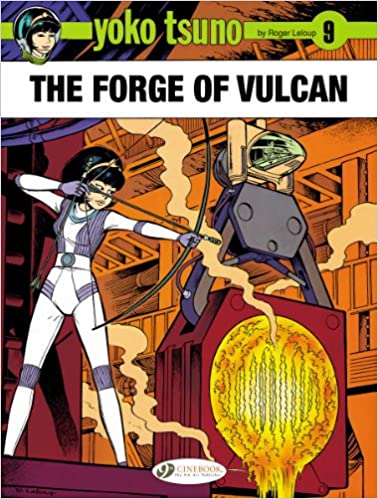
Yoko Tsuno volume 9: The Forge of Vulcan


By Roger Leloup (Cinebook)
ISBN: 978-1-84918-197-6 (Album PB)

The uncannily edgy yet excessively accessible European exploits of Japanese scientific adventurer Yoko Tsuno began first began gracing the pages of Le Journal de Spirou in September 1970 and are still going strong.

The explosive, eye-popping, expansively globe-girdling, multi award-winning series was devised by Roger Leloup, another hugely talented Belgian who worked as one of Hergé’s assistants on the Adventures of Tintin strip before striking out on his own.

Compellingly told, superbly imaginative but always solidly placed in hyper-realistic settings sporting utterly authentic and unshakeably believable technology, these illustrated epics were at the vanguard of a wave of strips starring smart, competent and brave female protagonists which revolutionised Continental comics from the last third of the 20th century onwards and are as potently empowering now as they ever were.

The initial Spirou stories ‘Hold-up en hi-fi’, ‘La belle et la bête’ and ‘Cap 351’ were introductory vignettes before the formidable Miss Tsuno and her always awestruck and overwhelmed male comrades truly hit their stride with premier extended saga Le trio de l’étrange which began serialisation with the May 13th 1971 issue.

That epic of extraterrestrial intrigue was the first of 30 European albums, with this one was first serialised in 1973 (Spirou #1819-1840) before being released the same year as La forge de Vulcain. A spectacular earth-shaking rollercoaster romp, it was chronologically the third album and reached us as Cinebook’s ninth translated chronicle.

It all begins when Yoko spots a TV report of a disaster on an oil rig near Martinique and realises the drill has impacted and penetrated the same strange material – “vitreous, luminous and ultra-magnetic” – that was a basic building material of the subterranean aliens known as the Vineans…

Those ancient wanderers had been secretly hibernating deep within the earth for hundreds of thousands of years until she, TV producer Vic Van Steen and his frivolous cameraman pal Pol Paris encountered them to set the lost race on a new path…

Now the Vineans seem to be at the heart of a burgeoning ecological catastrophe of cataclysmic proportions, and none too soon Yoko and the lads are winging their way to the Caribbean. Upon landing, they waste no time in bluffing their way into the offices of oil company Forex, aided by a few mementoes of their under-earth adventure.

They are, however, about to be unceremoniously ejected when news comes that the soon-to-explode rig has encountered a new problem: a strange craft, unlike any ever seen, trapped in the rig’s legs even as inexplicable seismic distortions propagate, creating an area of meteorological instability.

Yoko convinces the manager she has prior experience in matters like these and is promptly jetting over in a helicopter. Of course, she had to stow away first…

Before long she is valiantly prying a live Vinean and his scout vessel out of a boiling gusher of mud and has discerned the true scale of the threat. The rig’s drill has intercepted a Vinean magma tunnel – used in their construction projects – which has strayed too close to the oil field, triggering a potential geological time-bomb…

Thankfully the crisis has brought forth an unexpected benefit too as old friend and benevolent alien scientist Khanyarrives to take charge. The forthright technologist already has a plan but needs her old surface allies’ assistance to carry it out. Soon Yoko, Pol and Vic are abandoning the incredulous rig engineers and heading back under earth where an unpleasant surprise is awaiting them.

The Vineans had slept in huge, manufactured caverns for almost half a million years, but since recently reviving, internecine strife has entered the lives of the blue-skinned colonist/refugees.

In The Curious Trio, ambitious militaristic throwback Karpan made a play to seize power from the vast electronic complex known as The Centre which regulated the lives of the colonists. The blustering bully was ultimately frustrated by Khany and her newfound surface pals but now – thanks to humanity’s underground atomic testing – has returned to prominence amongst his terrified people and set in motion a dangerous scheme to destroy Earth’s civilisation and conquer the survivors.

Subverting a plan to divert magma and grow a new continent for the Vineans to occupy, Karpan wants to use the colossal magma-shifting technology to drown the surface world. Khany and her followers were already attempting to scuttle the scheme, but now grim fortune and the humans’ drill have damaged the super-engineered magma-tubes, a drastic solution is necessary to save the planet both species occupy from exploding like a cosmic firecracker…

Naturally Yoko has a plan, but this one depends as much on luck as her scientific ingenuity and martial arts prowess as she tries to mould lava like plasticine and thwart Karpan’s globally suicidal schemes…

As always, the most potent asset of these breathtaking dramas is the staggeringly detailed draughtsmanship, which benefits from Leloup’s diligent research and meticulous attention to detail, honed through years of working on Tintin.

Possibly the most frenetic and visually spectacular of all her adventures, The Forge of Vulcan is a relentless, rocket-paced race to doom or salvation that will appeal to any fan of blockbuster action fantasy.
Original edition © Dupuis, 1973, 1979 by Roger Leloup. All rights reserved. English translation 2014 © Cinebook Ltd.

Marie Antoinette: Phantom Queen


By Rodolphe & Annie Goetzinger, translated by Peter Russella (NBM)
ISBN: 978-1-68112-029-4 (HB)

As I’m perpetually reiterating, just like so much European art and culture, French language comics (I’m controversially including Belgium and Swiss strips in this half-baked, nigh-racist, appallingly sweeping statement) often appear as a triumph of style over content.

That doesn’t mean they’re bad – far, far from it – but rather that sometimes writing and plot aren’t as important to the creators – or readers – as the way it looks on a page/in a book, and complex characterisation isn’t always afforded the same amount of room that scenery, players, fighting or sex gets.

Such is not the case in this sublimely evocative and eerily placid episode by eminent Bande Dessinée scenarist Rodolphe D. Jacquette (Le Conservateur, Raffini, Cliff Burton) and former fashion artist turned comics creator supreme Annie Goetzinger (Girl in Dior, Casque d’Or, Aurore, L’Agence Hardy) which seamlessly blends the tone and timbre of two iconic eras in French history into a tale of mystery, imagination and rather indolent intrigue…

First seen in 2011 as Marie Antoinette, La Reine Fantome, the translated wonderment follows an enlightening Introduction from Rodolphe, describing the origins and provenance of the story before co-writer and sole illustrator Goetzinger introduces us to artist Maud as she sits in the gardens of the Petit Trianon at Versailles.

It’s October 5th 1934 and her sketching of the scene is a brief yet welcome escape from her own problems. Her beloved but far older husband is recently dead, leaving her a vast fortune which her stepson son covets. Remy constantly pesters her to marry him, but she knows he’s as likely to kill as wed her to get his hands on the inheritance…

Things take a strange turn when her dog breaks loose and scampers away. He is quite the hit with the ladies of the Court when he bounds into a grand building, just as a frantic footman warns Queen Maria Antoinette that they must all retreat to the castle before the peasants besieging Versailles find them. It is still October 5th, but also somehow, so very long ago…

As her stepson’s attentions become more obnoxious and intolerable, Maud’s dreams are hunted by potent, tangible glimpses of the dead queen’s final days, and close friends Suzy and Maggie convince her to try an oh-so-fashionable séance.

Also attending the affair is attractive psychiatrist Dr. Maurice D’Octrobre, a man of great charm and learning, possessed of a remarkably open mind…

Good thing too, since the ceremony allows Marie Antoinette to manifest, imploring Maud to find her remains and re-bury her so that the tragic queen can rest at last…

And so begins an utterly beguiling, entrancingly sophisticated, classically constructed ghost story with clever plot twists, genteel suspense and even a vile villain who sees his stepmother’s unsuspected psychic gifts as a handy stepping stone to having her committed and possessing her fortune…

Maud’s path is unswerving and her triumph never in doubt, but she never expected that in addition to the satisfaction of a job well done and a soul saved there would be such tangible rewards for her good deed…

Eerily comfortable and superbly satisfying; balancing melancholy shades of The Ghost and Mrs Muir with the foreboding poesy of Daphne Du Maurier’s Rebecca, Marie Antoinette: Phantom Queen is a superb step back into a lost world of elegant mystery and imagination: one no fantasy lover or mature comics reader should miss.
© Dargaud 2011. All rights reserved.

For more information and other great reads see http://www.nbmpub.com/

The Magical History Tour volume 1: The Great Pyramid


By Fabrice Erre &Sylvain Savoia translated by Joseph Laredo (Papercutz)
ISBN: 978-1-54580-633-3 (HB)

Here’s the first instalment of a superb European export designed to make history even more compelling for kids. Originally edited by the fabulous Lewis Trondheim and Frédéric Niffle, Le Fil de l’Histoire is a series of handy introductions to pertinent periods starring an all-wise older sister and her little brother who visit key moments and learn lots.

This kiddies’ hand-sized hardback tome was originally Tome 2: La Pyramide de Khéops, and sees Annie turn young Nico‘s Lego-building triumph into an immersive teaching moment, whisking them back to see the great Pyramid in all its glory, detailing how and why it was built and conducting a tour of the interior most Egyptologists would give their last scarab cartouche for…

Responsible adults are author/educator/newspaper columnist and Doctor of History Fabrice Erre while illustration honours go to diligent comics pro Sylvain Savoia, who will be further entertaining later this month when I review his magnificent Marzi series. Trust me, you can’t wait…

Today’s treat also offers building techniques, comparisons of other mastabas, mausoleums and tombs and traces the history of the magnificent edifice through the centuries. Herodotus‘ misreading of facts, the Caliph of Baghdad’s brutal desecration of the site, tomb robbers, Napoleon‘s obsession and others interactions are all covered as well as a peek into possible future of the site.

Adding extra value are biographies of Imhotep, Cheops, Hemiunu, Herodotus, plans of the Giza Plateau, the Six Other Wonders of the World (now lost) and a comprehensive Timeline.

History is fun and comics are great. This book is both. Add it to your shelves and brace yourself for the chronicles to follow.
© 2018- DUPUIS – Erre – Savoia. All other material © 2021 Papercutz.