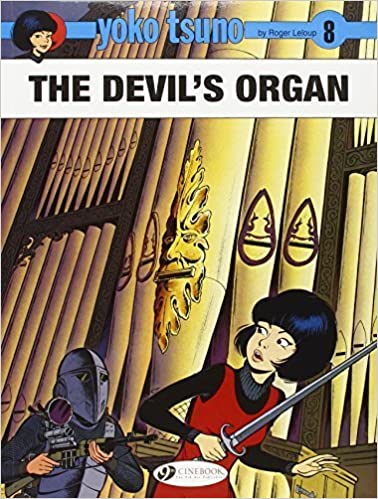
Yoko Tsuno volume 8 the Devil’s Organ


By Roger Leloup (Cinebook)
ISBN: 978-1-84918-1 (PB Album)

The edgy yet uncannily accessible European exploits of Japanese scientific adventurer Yoko Tsuno began gracing the pages of Le Journal de Spirou in September 1970 and are still going strong, with latest album Anges et faucons released last year.

The engaging, eye-popping, expansively globe-girdling multi award-winning series was created by Belgian Roger Leloup, a man of many talents born in 1933. He toiled as one of Herge’s meticulous researchers and background assistants on the Adventures of Tintin strip before striking out on his own.

Compellingly told, superbly imaginative but always solidly placed in hyper-realistic settings sporting utterly authentic and unshakably believable technology, these illustrated epics were at the forefront of a wave of strips featuring competent, brave and immensely successful female protagonists which revolutionised European comics from the 1970s onwards and are as potently empowering now as they ever were. I just wish they were more popular in English (that’s my job I suppose) and that publisher Cinebook would release few more than the dozen or so currently available. It would also be nice if such a forward-looking feature was available in digital editions…

The first Spirou stories ‘Hold-up en hi-fi’, ‘La belle et la bête’ and ‘Cap 351’ were all short introductory vignettes before the formidable Miss Tsuno and her ever-awestruck and overwhelmed male comrades truly hit their stride with premier extended saga Le trio de l’étrange, which began serialisation with the May 13th 1971 issue.

That epic of extraterrestrial intrigue was the first of 29 European albums, promptly followed here with a more down-to-earth but equally breathtaking contemporary thriller set in the heart of Germany against a merely mortal menace who was every inch her match…

Serialised in 1972 as L’orgue du diable in Spirou #1767-1793, the suspenseful thriller first reached us as 8th translated chronicle The Devil’s Organ and begins when young TV mogul Vic Van Steen and frivolous cameraman pal Pol Paristake their new chum – sleekly capable freelance Japanese electrical engineer Yoko Tsuno – with them up the so-scenic Rhine to shoot a travel documentary.

What the working tourists don’t realise is that the epic views and beautiful castles were recently the scene of a bizarre duel which left one man dead whilst his improbably garbed, demonic murderer escaped without anyone knowing a crime had been committed…

Now a week later, Pol is not so subtly ogling (and filming) a comely fräulein on the top deck of the stately, palatial riverboat when the subject of his attentions falls into the chilly waters.

Yoko is only seconds behind him as the cameraman hits the water trying to save the girl. When they are all hauled back aboard, the Japanese adventurer discovers the nearly drowned victim has been drugged…

Ingrid Hallberg is one of Germany’s most promising young classical organists and she has made the trip to the idyllic, fairy tale region to see where her father took his own life a week previously. However, when Pol’s voyeuristic photos are developed, they reveal a strange man injecting her with something before pushing her into the river and Yoko begins to suspect that the senior Hallberg’s death might not be all it appears either. Adding to the mystery is a strange tape he sent Ingrid which she was intending to play once she arrived at his now deserted home in Sankt Goar…

As always, the most potent asset of these edgy dramas is the astonishingly authentic and hyper-realistic settings, which benefit from Leloup’s diligent research and meticulous attention to detail. Tourists could use these pages as an A-Z and never get lost, except in rapturous wonder…

As they accompany the damp damsel Yoko discovers the girl has been electronically bugged and urges all haste, with the party arriving just as a masked man flees the house with the tape. Giving chase, Yoko finds herself facing no ordinary foe and despite all her martial arts skills is near death by the time her friends catch up. The mystery man gets away but not with all of the tape…

The fragment that remains lead the baffled, battered heroes to buried copper artefacts which were part of an incredible restoration project. Werner Hallberg, being an expert in church music and instruments, was apparently contracted to restore a 16th century contraption for an anonymous millionaire. The colossal ancient device was known as The Devil’s Organ and, from what the modern tech team can discern, it was actually a sonic weapon of devastating power…

Tracking down the original location of the device at the world-famous Katz fortress, the self-appointed detectives settle on its current occupier Otto Meyer as the likely wealthy patron who hired Werner. Determined to get to the bottom of the criminal conundrum, they barge in on him, only to be attacked by his misanthropic and overprotective nephew Karl. Over the young man’s strenuous objections, the elder Meyer surprisingly invites the wary intruders to stay and look around all they want.

Cautiously accepting, they continue their enquiries in plain sight but are all too soon the latest targets in the mysterious murderer’s sights…

It takes all Yoko’s considerable ingenuity and boldness to stay one step ahead of the hidden killer, but when she finally unmasks the villain and learns his sordid reasons for the deaths it is almost too late: the Organ from Hell is ready to sound and nothing can prevent it from unleashing a horrific wave of destruction.

…But that doesn’t stop Yoko Tsuno from giving it one final mighty try…

Absorbing, compelling and blending tense suspense with blistering adventure, this is another superbly rationalist mystery and fantastic exploit of the most unsung of all female action heroes: one you’ve waited far too long to meet…
Original edition © Dupuis, 1973 by Roger Leloup. All rights reserved. English translation 2013 © Cinebook Ltd.

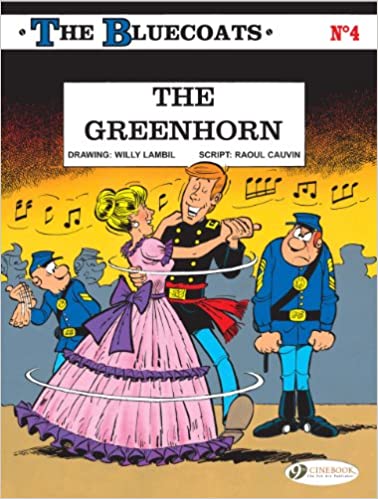
The Bluecoats volume 3: The Skyriders


By Willy Lambil & Raoul Cauvin, translated by Erica Jeffrey (Cinebook)
ISBN: 978-1-84918-014-6 (Album PB)

The glamour of the American Experience has fascinated Europeans virtually since the actual days of owlhoots and gunfighters. Hergé was a devotee, and the spectrum of memorable comics ranges from Italy’s Tex Willer to such French and Belgian classics as Blueberry and Comanche, and even rarefied, seldom seen colonial dramas such as Pioneers of the New World or Milo Manara and Hugo Pratt’s Indian Summer.

Les Tuniques Bleues or The Bluecoats began at the end of the 1960s, created by Louis “Salvé” Salvérius & Raoul Colvin – who has written every best-selling volume since. The strip was created to replace Lucky Luke when the laconic gunslinger defected from weekly anthology Le Journal de Spirou to rival comic Pilote, and his replacement swiftly became one of the most popular bande dessinée series on the Continent.

Salvé was a cartoonist of the Gallic big-foot/big-nose humour style, and when he died suddenly in 1972, his replacement Willy “Lambil” Lambillotte slowly introduced a more realistic – although still visually comedic – illustrative manner. Lambil is Belgian, born in 1936 who, after studying Fine Art in college, joined publishing giant Dupuis as a letterer in 1952.

Born in 1938, scripter Raoul Cauvin is also Belgian, and before joining Dupuis’ animation department in 1960 studied Lithography. He soon discovered his true calling – comedy writing – beginning his glittering and prolific career at Spirou.

In addition to Bluecoats he has written dozens of other long-running, award winning series including Cédric (which translates, funnily enough, into English as Cedric), Les Femmes en Blanc and Agent 212: more than 240 separate albums. The 62 current volumes of Les Tuniques Bleues alone has sold in excess of 15 million copies.

The sorry protagonists of the series are Sergeant Cornelius Chesterfield and Corporal Blutch: a brace of worthy fools in the manner of Laurel and Hardy, two hapless, ill-starred US cavalrymen posted to the wild frontier and various key points of mythic America.

The original format was single-page gags about an Indian-plagued Wild West fort, but with the second volume Du Nord au Sud (North and South) the sad-sack soldiers went back East to fight in the American Civil War (a tale rewritten in the 18th album Blue retro to describe how the chumps were drafted into the military during the war).

All subsequent adventures, although ranging far beyond America and taking in a lot of genuine and thoroughly researched history, are set within the timeframe of the Secession conflict.

Blutch is your average whinging little-man-in-the street: work-shy, mouthy, devious and exceptionally critical of the army and its inept commanders. Ducking, diving, even deserting whenever he can, he’s you or me – except sometimes he’s quite smart and heroic if no other easier option is available.

Chesterfield is a big burly man; a career soldier who has passionately bought into all the patriotism and esprit-de-corps of the Military. He is brave, never shirks his duty and wants to be a hero. He also loves his cynical little pal. They quarrel like a married couple, fight like brothers but simply cannot agree on the point and purpose of the horrendous war they are trapped in…

The Skyriders was the third album of the translated Cinebook series (chronologically the eighth French volume Les cavaliers du ciel when released in 1976) and opens with Chesterfield dashing to see his severely wounded pal. However, when he finds out Blutch has bribed a surgeon to declare him unfit for duty, the doughty sergeant goes through the roof…

Dragging the scurvy dodger back to the Front lines, the sergeant is just in time to be ordered by frankly quite mad Captain Stark to join him in another heroic cavalry charge against the massed Rebel infantry. However, as the division has suffered a few losses recently, this unstoppable wave of valiant Union horsemen will number exactly three…

The assault naturally fails and the deranged officer is captured, with Blutch and the deeply-shaken Chesterfield making it back to their own lines more by luck than skill.

The Union generals are in a bit of a tizzy. They have plenty of artillery and ground troops but are being worn down by the swift-moving Confederate cavalry’s harrying tactics. What they need is some method of observing the enemy’s position. Also, with news of Stark’s capture comes the apprehension of his revealing key positions, so the strategists are forced into trying something new. All they need are a big gasbag and a couple of expendable idiots…

The first observation flight is a huge success, so much so that the generals go up themselves after the principle is proved. Sadly, the Brass are far better fed than Blutch and Chesterfield and the wicker basket they crowd into proves painfully insufficient to their needs…

Broken and battered, the big bosses choose to keep their bandaged feet on the ground from then on and our Bluecoats remain the army’s only airborne soldiery, enduring shot and shell as they spy on the enemy from above…

Stark, meanwhile, has not talked and the Confederates are beginning to lose traction in the battle. Correctly blaming the balloon for their reversals of fortune, the Gray commanders determine to destroy their aerostatic nemesis at all costs and a daring sortie on the observation post enables them to cut the balloon free from its moorings…

Adrift in the sky, the hapless duo try everything to get down safely – consequently causing great consternation to the Rebel forces – before finally crashing to earth on top of their own already balloon-damaged commanding officers.

Ordered to rescue Captain Stark or face a firing squad, Chesterfield then devises an audaciously suicidal plan: using the balloon at night, he and Blutch will infiltrate the Confederate camp and bust their mad boss out.

What could possibly go wrong?

As always, their manic midnight misadventures result in pain, humiliation and not a few explosions but – incredibly – also victory and success… of a sort…

This is another hugely amusing anti-war saga targeting younger, less cynical audiences: historically authentic, and always in good taste despite its uncompromising portrayal of violence. The attitudes expressed by the down-to-earth pair never make battle anything but arrant folly and, like the hilarious yet insanely tragic war-memoirs of Spike Milligan, these are comedic tales whose very humour makes the occasional moments of shocking verity doubly powerful and hard-hitting.

Fun, informative, beautifully realised and eminently readable, Bluecoats is the kind of war-story that appeals to the best, not worst, of the human spirit…
© Dupuis 1976 by Lambil & Cauvin. English translation © 2009 Cinebook Ltd. All rights reserved.

The Emotional Load and Other Invisible Stuff


By Emma, translated by Una Dimitrijevic (Seven Stories Press)
ISBN: 978-1-60980-956-0 (TPB) eISBN: 978-160980-957-7

It’s never been a fair world, although that’s a concept we all apparently aspire to create. In recent years, many people have sought to address imbalances between the roles and burdens of men and women in a civil cohesive society, but the first problem they all hit was simply how to state the problems in terms all sides could understand. We have a lot more names and concepts to utilise now in discourse, but the difficulties don’t seem to have diminished…

In 2018, software engineer, cartoonist and columnist Emma crafted a book of strips reflecting upon social issues affecting women: dissecting The Mental Load – all the unacknowledged, unpaid invisible crap that makes up and comes with most modern relationships and revealing how almost all of that overwhelming, burdensome life-tonnage inescapably settled on one side of the bed in most households…

The book – and the strips as seen in The Guardian – caused something of a commotion and as much trollish kickback as you’d expect from all the wrong places, so she’s back with further explanations and revelations in brilliant follow-up The Emotional Load and Other Invisible Stuff.

Because a large proportion of humans who won the genital lottery don’t really give a damn about other people’s woes – especially if the food keeps coming and the appropriate drawers magically refill with clean clothes and groceries – I fear there’s a segment of truly needy folk who won’t benefit from this selection of treatises, anecdotes, statistics and life-changing stories, but since many guys are genuinely clueless and baffled but willing to adapt, maybe enough of us will give change and thought a chance.

Best of all, most women reading this will realise that it’s not just them feeling the way they do and may even risk starting a conversation with their significant others, or at the very least, start talking to other women and organising together…

Working in the manner of the very best observational stand-up comedy, Emma forensically identifies an issue and dissects it, whilst offering advice, suggestions and a humorous perspective. Here that’s subdivided into a series of comical chapters beginning with the autobiographical ‘It’s Not Right, But…’

This explores the concept of consent for women and reveals how, at age 8, she first learned that it was regarded as perfectly normal for men to bother girls…

The debate over sexual independence and autonomy in established relationships is then expanded in ‘A Role to Play’…

Seemingly diverging off topic (but don’t be fooled) ‘The Story of a Guardian of the Peace’ then traces the life of honest cop Eric and how he fared over years trying to treat suspects and villains as fellow human beings in a system expressly created to suppress all forms of dissent and disagreement, after which the oppressive demarcation of family duties and necessary efforts are dissected into Productive and Reproductive Labor roles via the salutary example of Wife and Mother ‘Michelle’…

‘The Power of Love’ explores how women are expected to police the emotional wellbeing of all those around them and the crushing affect it has on mental wellbeing before the irrelevant “not all men” defence shabbily resurfaces – and is powerfully sent packing – in ‘Consequences’, with a frankly chilling reckoning of the so-different mental preparations needed for men and women to go about their daily, ordinary lives…

As stated above The Mental Load caused a few ructions when it first gained mass popular attention. ‘It’s All in Your Head’ deftly summarises the reactions, repercussions, defanging, belittlement, dismissal and ultimate sidelining of those revelations – particularly in relation to sexual choice and autonomy – with a barrage of damning quotes from France’s political, industrial elites, after which ‘Sunday Evenings’ traces the history of work by oppressed underclasses – like women – and the gaslighting headgames employed to keep all toilers off-balance, miserable and guilt-crushed…

The hopefully life-altering cartoon lectures conclude with an expose of the most insidious form of social oppression as ‘Just Being Nice’ outlines the tactics and effects of sneakily debilitating Benevolent Sexism (and yes, old gits from my generation thought it was okay to do it if we called it “chivalry” or “gallantry”)…

Backed up by a copious ‘Bibliography’ for further research (and probably fuelling some carping niggles from unrepentant buttheads) and packed with telling examples from sociological and anthropological studies as well as buckets of irrefutable statistics, this is a smart, subversively clever look at the roles women have been grudgingly awarded or allowed by a still largely male-centric society, but amidst the many moments that will have any decent human weeping in empathy or raging in impotent fury, there are decisive points where a little knowledge and a smattering of honest willingness to listen and change could work bloody miracles…

Buy this book, learn some stuff. Be better, and please accept my earnest apologies on behalf of myself and my entire gender.
© 2018, 2020 by Emma. English translation © 2020 by Una Dimitrijevic. All rights reserved.

Lucky Luke volume 3: Dalton City


By Morris & Goscinny, translated by Frederick W. Nolan (CineBook)
ISBN: 978-1-905460-13-7 (Album PB)

Lucky Luke is a rangy, good-natured, lightning-fast cowboy who roams the fabulously mythic Old West, having light-hearted adventures with his horse Jolly Jumper and interacting with a host of historical and legendary figures of the genre.

His continued exploits over nearly seventy years have made him one of the best-selling comic characters in Europe (81 collected books and more than 300 million albums in 30 languages thus far), with spin-off toys, computer games, animated cartoons and even a plethora of TV shows and live-action movies.

He was created in 1946 by Belgian animator, illustrator and cartoonist Maurice de Bévère (“Morris”) for the 1947 Annual (L’Almanach Spirou 1947) of Le Journal de Spirou, before launching into his first weekly adventure ‘Arizona 1880′ on December 7th 1946.

Prior to that, while working at the CBA (Compagnie Belge d’Actualitiés) cartoon studio, Morris met future comics super-stars Franquin and Peyo, and worked for weekly magazine Le Moustique as a caricaturist – which is probably why (to my eyes at least) his lone star hero looks uncannily like the young Robert Mitchum who graced so many memorable mid-1940s B-movie Westerns.

Morris quickly became one of “la Bande des quatre” – The Gang of Four – which comprised creators Jijé, Will and his old comrade Franquin: the leading proponents of the loose and free-wheeling artistic style known as the “Marcinelle School” which dominated Spirou in aesthetic contention with the “Ligne Claire” style used by Hergé, EP Jacobs and other artists in Le Journal de Tintin.

In 1948 said Gang (all but Will) visited America, meeting US creators and sightseeing. Morris stayed for six years, meeting fellow traveller René Goscinny, scoring some work from newly-formed EC sensation Mad and making copious notes and sketches of the swiftly vanishing Old West.

That research would resonate on every page of his life’s work.

Working solo until 1955, Morris produced another nine albums worth of affectionate sagebrush parody before reuniting with Goscinny, who became the regular wordsmith as Luke attained the dizzying heights of superstardom, commencing with ‘Des rails sur la Prairie’ (Rails on the Prairie), which began in Spirou on August 25th 1955.

In 1967 the six-gun straight-shooter switched teams, transferring to Goscinny’s own magazine Pilote with ‘La Diligence’ (The Stagecoach). Goscinny produced 45 albums with Morris before his death, from whence Morris continued both singly and with fresh collaborators.

Morris died in 2001 having drawn fully 70 adventures, plus the spin-off adventures of Rantanplan (“dumbest dog in the West” and a charming spoof of cinema canine Rin-Tin-Tin), with Achdé, Laurent Gerra, Benacquista & Pennac taking over the franchise, producing another five tales to date.

Moreover, apart from that very first adventure, Lucky (to appropriate a quote applied to the thematically simpatico Alias Smith and Jones) “in all that time… never shot or killed anyone”…

Lucky Luke first appeared in Britain syndicated to weekly comic Film Fun and again in 1967 in Giggle where he was renamed Buck Bingo. In all these venues – as well as the numerous attempts to follow the English-language successes of Tintin and Asterix albums from Brockhampton and Knight Books – Luke had a trademark cigarette hanging insouciantly from his lip, but in 1983 Morris, no doubt amidst both pained howls and muted mutterings of “political correctness gone mad”, substituted a piece of straw for the much-travelled dog-end, which garnered him an official tip of the hat from the World Health Organization.

The most recent attempt to bring Lucky Luke to our shores and shelves comes from Cinebook (who have rightly restored the foul weed to his lips on the interior pages if not the covers…) and Dalton City was the third of 76 albums (and counting), available both on paper and as e-book editions.

It was the 34th comic cowboy chronicle and Goscinny’s 25th collaboration with Morris, originally appearing in 1969 and featuring the first appearance of that most stupid of do-gooding doggy sidekicks Rantanplan. You have been warned…

The saga commences in Fenton Town, a city of utter depravity and villainy run by and for crooks, badmen and owlhoots by the cunning mastermind Dean Fenton; a mean man with the unsavoury hobby of collecting Sheriff’s stars… from their bullet-riddled bodies…

The night a lean, laconic lone rider ambled into town the murderous gambler’s fortunes changed forever, and when Luke spectacularly delivered the gang boss to justice, Fenton got 1223 years hard labour at Texas penitentiary, an imposing edifice already crammed with dozens of other varmints who failed to take Lucky Luke seriously.

And that’s where the trouble really starts…

Amongst the inmates are stupid sandbagging scallywags Averell, Jack and William Dalton and their smart, psychotic, bossy and short brother Joe, who had made things hot for our hero in the past. As they all crack rocks together the Dalton Gang are particularly influenced by Fenton’s tales of his little kingdom.

Contentedly ambling away from the prison, Luke and Jolly Jumper have no idea that an idiotic, incompetent telegraph operator is about to make their lives impossibly difficult. Handed a mis-transcribed message from the Governor to free inmate Joe Milton for Good Behaviour, the baffled Warden forcibly ejects the furiously insulted Dalton head honcho. Eventually calming down – at least as much as Joe Dalton ever can – the wily skunk promptly blows up an outer wall to liberate his scurrilous simpleton siblings and they all make tracks for the now-deserted Fenton Town.

Search parties of course trail them, but when vain, friendly and exceedingly dim prison hound Rin Tin Can absently-mindedly forgets himself and joins his quarry, the shame-faced guards have to return empty-handed…

Regretfully, the Warden sends a telegram to Lucky Luke – again appallingly garbled – and the normally unflappable gunhawk is less than amused. It takes the pleadings of the Governor of Texas himself to convince him to go after his old enemies…

In the renamed Dalton City, Joe and the boys have big plans. They’re going to operate a Mecca for all the criminals in the state: a safe place for badmen to hide and spend their stolen loot. Joe will be in charge, Jack will operate the hotel, William the stables and Averell will run the restaurant. He even has faithful, omnivorous Rin Tin Can to test all his recipes on…

After much unlikely and unfamiliar hard work the place is starting to come together when they get an even bigger boost by capturing their nemesis Lucky Luke spying on them. The hero had forgotten how stupid Rin Tin Can could be…

The hapless prisoner is then put to work testing their wares: surely if the service is good enough for Luke it will be perfect for the scum of the West? However the boys make the foolish mistake of listening to his suggestions for improvement…

The beginning of the end comes when Joe writes off to hire a singer and troupe of dancing girls. When the bombastic virago Lulu Breechloader and her associates Belle, Sugar Linda and Pearl arrive Lucky has all he needs to drive an amorous wedge into the solidarity of the felonious fellowship and, as an army of bandits and killers steadily roll into town looking for sanctuary and entertainment, they are invited to the wedding of the century…

The only persons unaware of the impending – and hard-fought for – nuptials of Joe Dalton and Lulu are the bride herself and her blithely unaware piano-playing husband…

In the ensuing chaos and explosive gunplay it isn’t hard for a smart cowboy crusader to make the biggest capture of wanted criminals in Texas’ history and ride off into the sunset with a new four-footed canine companion…

Once again the masterful wit and wicked deviousness of the indomitable hero triumphs in a splendidly intoxicating blend of all-ages action, seductive slapstick and wry cynical humour.

This grand old hoot sits in the tradition of Destry Rides again and Support Your Local Sheriff (or perhaps Paint Your Wagon, Evil Roy Slade or Cat Ballou are more your style?), superbly executed by master storytellers, and a wonderful introduction to a unique genre for modern kids who might well have missed the romantic allure of the Wild West that never was…

And in case you’re worried, even though the interior art still has our hero chawin’ on that ol’ nicotine stick, trust me, there’s very little chance of anyone craving a quick snout, but quite a high probability that they’ll be addicted to Lucky Luke Albums…
© Dargaud Editeur Paris 1969 by Goscinny & Morris. © Lucky Comics. English translation © 2006 Cinebook Ltd.

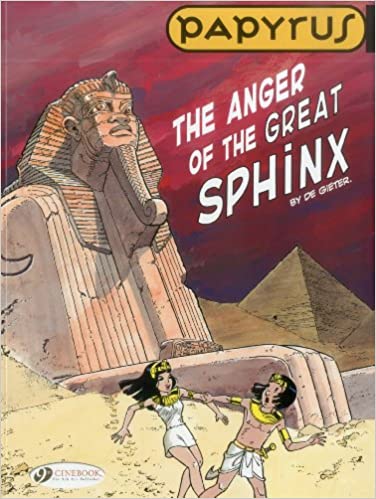
Papyrus volume 4: The Evil Mummies


By Lucien De Geiter, coloured by Georges Vloeberghs & translated by Luke Spear (Cinebook)
ISBN: 978-1-84918-027-6 (Album PB)

Papyrus is the masterfully evocative magnum opus of Belgian cartoonist Lucien de Gieter. It premiered in 1974 in legendary weekly Le Journal de Spirou, running to 35 collected albums, and consequently spawning a wealth of merchandise, including an animated television show and a video game.

De Gieter was born in 1932 and studied at Saint-Luc Art Institute in Brussels before going into industrial design and interior decorating. He made the jump into sequential narrative in 1961, first through “mini-récits” (fold-in, half-sized booklets) inserted into LJdS, starring his jovial little cowboy Pony, and later by writing for art-star regulars such as Kiko, Jem, Eddy Ryssack and Francis. After that he joined Peyo’s studio as inker on Les Schtroumpfs (The Smurfs) and took over the long-running newspaper strip Poussy.

In the 1960s, De Gieter launched South Seas mermaid fantasy Tôôôt et Puit whilst Pony was promoted to the full-sized pages of Spirou, deep-sixing the Smurfs gig to expand his horizons working for Le Journal de Tintin and Le Journal de Mickey.

From 1972-1974, De Gieter assisted cartooning legend Berck on Mischa for Germany’s Primo, whilst applying the finishing touches to his latest project: a historical confection which would occupy his full attention and delight millions of fervent fans for the next forty years…

The annals of Papyrus encompass a huge range of themes and milieux, blending Boy’s Own adventure with historical fiction and interventionist mythology: the epic yarns gradually evolving from traditionally appealing “Bigfoot” cartoon style and content towards a more realistic, dramatic and authentic iteration, through means of light fantasy romps always leavened and flavoured with the latest historical theories and discoveries.

The named star is a fearlessly forthright peasant lad (specifically, a fisherman by trade) favoured by the gods who rises to become a hero of Egypt and friend to Pharaohs.

As a youngster the plucky Fellah was blessed by the divine powers and given a magic sword, courtesy of a daughter of crocodile-headed Sobek. The lad’s first task was to free supreme god Horus from imprisonment in the Black Pyramid of Ombos, thereby restoring peace to the Double Kingdom. However, his most difficult and seemingly never-ending duty is protecting Pharaoh’s wilful, high-handed and insanely danger-seeking daughter Theti-Cheri – a princess with an unparalleled gift for seeking out trouble…

The Evil Mummies is the fourth Cinebook tome (of, inexplicably, only six thus far). Available in paperback and in eBook formats, it translates the 19th European album in the run, which was originally released in 1996 as Les Momies maléfiques: a riotous rollercoaster of all-out action and fearsome fantasy which begins in the rocky fastnesses of the deep sands. Here Pharaoh’s headstrong daughter impatiently leads an expedition to retrieve the revered mummies of the fabled Ten Archers of Sekenenre Taa from the lost Hammamat mines, who legendarily fell defending the nation from the invading Hyksos.

The bodies are to be returned in honour and interred in Thebes, but first they have to find them…

Cheekily joining Theti-Cheri, her protector Papyrus and all the assorted, hurrying specialists is sometime court jester Puin, charged with caring for the precious pack animals – although it would be more accurate to say that his phenomenally intelligent donkey Khamelot is actually guiding all those reins…

In their haste to finish the mission, the party are shamefully negligent and forget to make proper obeisance to divine Seth, Master of the Desert Wastes, and soon a furious cloud image warns of the dark overlord’s wrath. Nervously shrugging it off, the expedition prepares for sleep but is suddenly devastated by a terrifying flash-flood manifesting from nowhere and brutally scattering the impious intruders.

Papyrus awakes battered and bruised above a lofty precipice. He has been saved from crushing doom by a great silver falcon, favoured beast of mighty Horus…

In trying to retrieve his magic sword the boy-hero triggers a flaming omen which points him a certain direction. Setting off into the scorching desert, he slowly follows a treacherous trail and with the falcon’s timely aid uncovers a deep crevice and shaft into a deep, long-forgotten mine. In a chamber far within the abandoned workings is a golden statue of Seth and ten roughly hewn coffins in a makeshift temple…

Curiosity overcoming caution, Papyrus uncovers a ghastly, poorly-preserved mummy in one but the second – already opened – casque holds Theti-Cheri herself: alive, but bound and gagged. When he cuts the princess loose, she descends into utter panic, frantically warning that she had been captured by walking corpses: the angry archers of Sekenenre Taa…

The boy warrior is saved from a lethal arrow by the ever-present falcon, but in his panicked flight is separated from his rattled companion, before plunging into open air and landing in the mine’s ancient water-filled well.

Recovering his wits, he trails Theti and finds her and the bird on a rooftop. She claims to have been saved by Horus himself.

Sadly, the aroused mummies are determined and unstoppable. With his magic sword useless against the already dead, Papyrus is about to be crushed by the restless revenants and is only rescued when the princess plunges one of the monsters’ own arrows into a dusty body…

Before long though, the buried temple is crawling with revived and raging mummy murderers and the terrified youths are again racing in panic. Spotting a trickle of water on a stony rock face, Papyrus smites the wall with his sword and a watery tumult catapults them to relative safety in the well.

With the water flooding away, however, the pair can see two huge golden statues of Horus at the bottom and realise that they must restore them to the temple to quiet the still-marauding mummies…

Seth unleashes more magical mischief to deter the already overwhelmed children, but Papyrus’ defiance and the fortuitous appearance of Khamelot quickly turn the tables after the unthinking dead things mistake the donkey for their own ghastly long-eared, long-nosed dark lord and rapidly retreat…

With aid from the faithfully following pack animals, the Horus statues are quickly restored to their rightful stations but Theti insists that the now-dormant archer mummies must be respectfully gathered up and transported to their proper resting place in Thebes as per her father’s plans…

As the bizarre entourage makes its laborious way back across the burning sands, more strange encounters plunge both princess and protector into another hidden tomb. This one holds the real, righteous, sacredly-interred Ten Archers of Sekenenre Taa. But if that’s the case, who or what have they been shipping back at such tremendous, exhausting effort?

Solving that enigma, the pair still have to defeat an army of bandits and pillagers even as the battle leads them to the impossible plain where the lost members of the original expedition have been enduring the slow punishment of Seth…

Epic, funny, enthralling and frenetically paced, this amazing adventure will thrill and beguile lovers of wonder from nine to ninety-nine, again proving Papyrus to be a sublime addition to the family-friendly pantheon of continental champions wedding heroism and humour with wit and charm. Anybody who has worn out those Tintin and Asterix albums would be wise beyond their years to unearth and acquire all these classic chronicles.
© Dupuis, 1996 by De Gieter. All rights reserved. English translation © 2010 Cinebook Ltd.

A Carrot for Iznogoud (Iznogoud volume 5)


By Goscinny & Tabary, translated by Anthea Bell & Derek Hockridge (Cinebook)
ISBN: 978-1-84918-021-4 (Album PB)

For the greater part of his too-short life, René Goscinny (1926-1977) was one of the most prolific and most-read writers of comic strips the world has ever seen. Incredibly, he still is.

Among his most popular comic collaborations are Lucky Luke, Le Petit Nicolas and of course Asterix the Gaul, but there were so many others, such as the dazzling, dark deeds of a dastardly usurper whose dreams of diabolical skulduggery all proved to be ultimately no more than castles in the sand…

Scant years after the Suez crisis, the French returned to the hotly contested deserts when Goscinny teamed with sublimely gifted Swedish émigré Jean Tabary (1930-2011) – who numbered Richard et Charlie, Grabadu et Gabaliouchtou, Totoche, Corinne et Jeannot and Valentin le Vagabond amongst his other hit strips – to concoct the innocuous history of imbecilic Arabian (im)potentate Haroun el-Poussah.

However it was the strip’s villainous foil, power-hungry vizier Iznogoud, who stole the show – possibly the conniving little imp’s only successful coup.

Les Aventures du Calife Haroun el Poussah was created for Record; the first episode appearing in the January 15th issue in 1962. A minor hit, it subsequently jumped ship to Pilote – a comics magazine created and edited by Goscinny – where it was refashioned into a starring vehicle for the devious little rat-bag who had increasingly been hogging all the laughs and limelight.

Like all the best storytelling, Iznogoud works on two levels: as a comedic romp with sneaky baddies invariably hoisted on their own petards and coming a cropper for younger readers, whilst older, wiser heads revelled in the pun-filled, witty satire: the same magic formula which made its more famous cousin Asterix such a global success.

…And just like the saga of the indomitable little Gaul, this irresistibly addictive Arabian nonsense is adapted here by master translators Anthea Bell & Derek Hockridge who made those Roman Follies so very palatable to the English tongue.

Moreover the deliciously malicious whimsy is always heavily laden with manic absurdity and brilliantly applied creative anachronism to keep the plots bizarrely fresh and inventive.

Insidious anti-hero Iznogoud is Grand Vizier to affable, easy-going Haroun Al Plassid, Caliph of Ancient Baghdad, but the sneaky little toad has loftier ambitions, or as he is always shouting “I want to be Caliph instead of the Caliph!”

The revamped series launched in Pilote in 1968, quickly becoming a massive European hit, with 30 albums to date (carried on by Tabary’s children Stéphane, Muriel and Nicolas), his own solo comic, a computer game, animated film, TV cartoon show and even a live action movie.

When Goscinny died in 1977 Tabary added the scripting to his sublimely stylish illustration (from the 13th album onwards), moving to book-length complete tales, rather than the compilations of short punchy stories that typified the collaborations.

This fifth Cinebook English language edition was actually the seventh French album (released in 1971 as Une carotte pour Iznogoud) with the lead tale an exceptional, extended epic comprising half the book, bolstered by a triumvirate of shorter yarns and prefaced as ever with a handy catch-up profile page of the usual suspects…

The eponymous A Carrot for Iznogoud’, is a rare bird indeed as the verminous Vizier is all but absent from proceedings which commence when gentle, isolated and very dim Haroun Al Plassid finally gets an inkling of what his trusted deputy is truly like…

Stealing out into Baghdad disguised as an insurance salesman, the Caliph finally gets the message that his beloved people fear, despise and revile his precious Iznogoud. Shocked and dismayed, he ponders what to do before – politely – accidentally aiding an ancient wizard (or perhaps crazy old coot…).

In gratitude the dotard tells him of a fabled vegetable that makes people nice. Desperately keen to redeem and “cure” his advisor, the Caliph instantly dashes off on a monumental solo voyage of discovery to secure some of the legendary “Carrot”.

The logic is simple: if eating carrots makes you nice all he has to do is find a place where people are pleasant, kind, honest and generous. The deed is nowhere near as simple as the thought – or indeed, the Caliph…

After exhausting and enraging the grocers and market sellers of his own lands, the search takes the determined Haroun Al Plassid to neighbouring kingdoms, across deserts and even oceans (where he encounters a certain band of pirates moonlighting from their damp and dangerous day jobs in Asterix), but everywhere all he finds are conmen, chancers, rude brutes and impatient surly types just like the ones at home in Baghdad.

He is almost ready to give up when he is sold as a slave to lordly Rhu’Barbfoul in distant Lastyearatmarienbad and sent to the kitchens to grate carrots for soup.

Excited beyond belief he begs his master to give him a carrot and release him, which after hearing the tale of woe and (perhaps) thanks to the steady diet of nice-making veg, the nervous lord does…

The journey home is no less dramatic or magical, though fraught with painful ironies, but even after the Caliph reclaims his vacated throne, the ameliorating herb he fought so hard to secure does not at the last find its way to its intended target…

Wry and deliciously surreal, the epic is an especial change of pace as the evil architect of all woes only appears in two panels over the 19 hilarious pages…

He is completely present for the three venal vignettes which follow, beginning with an outrageously bizarre close encounter in the desert entitled ‘Magic-Fiction’.

When Iznogoud and bumbling, long-suffering crony Wa’at Alahf are taking a break from the sorcery-besotted city of Baghdad they stumble across a couple of Martian explorers. The curious, affable alien explorers want facts and data for their records but, after seeing the power of their Spatial-Temporaliser ray-guns, all the Vizier can envisage is the effect the weapons would have on the royal simpleton he wants to replace: an indolent oaf who couldn’t answer a straight question if his dinner depended on it…

Sadly, after sneaking the E.T.’s back to the palace, Iznogoud’s intemperate temperament gets the better of him before his plan can succeed…

Baghdad is a city that suffers with an excess of heat but in ‘Iznogoud on Thin Ice’the vile vizier hears tell of a drinks seller whose wares are always freezing cold. Ever inquisitive and always looking for an angle he investigates and discovers that the unfortunate lady in charge is so unseemly that anyone who glimpses her face is frozen solid with shock. She just stacks the chilled out victims in her cellar and stores her drinks beside them…

The infernal imp’s heart soars! All he has to do is get the Caliph to peek under the appalling and enigmatic Gehtorehd‘s ever-present veil and the throne is his…

Sadly, her gift doesn’t work on anyone with an elevated temperature, so even after getting the gorgon into the palace Iznogoud has to wait for the doctors to cure the Caliph who has a touch of fever. All he has to do is wait a while, but Iznogoud is a very impatient potentate-in-waiting…

There’s more direct skulduggery afoot in ‘Tried and Tsetsed’ which closes this compilation of crazy criminality. When bribe-taking Iznogoud officially greets an embassage from Africa he is given the most dangerous beast they know as a placating present by the chief ambassador who came ill-prepared to grease palms.

He is less than impressed until he is advised that the dread Tsetse Fly can put victims into a permanent slumber with one little bite. Now seeing his dreams falling into place at last, the Vizier lays his plans to introduce the bug to his boss, but is distracted by his idiot servant Wa’at Alahf and releases the flying terror in the wrong room…

Snappy, fast-paced hi-jinks and abundantly stocked with gloriously agonising pun-ishments (see what I did there?), this mirthfully infectious series is a household name in Europe, and especially in France where “Iznogoud” is common parlance for a certain type of politician: over-ambitious, unscrupulous – and frequently not that tall.

Still a cartoon barometer for chicanery and inanity, Iznogoud is a masterpiece of savvy commentary in a world where realpolitik has finally caught up and – inconceivably – surpassed the fertile imaginations of comics’ premiere wits.
© 1971 Dargaud Editeur Paris by Goscinny & Tabary. All rights reserved.

The Scorpion volume 1: The Devil’s Mark


By Stephen Desberg & Enrico Marini, translated by Jerome Saincantin (Cinebook)
ISBN: 978-1-905460-62-5 (Album PB)

We in the English-speaking world will have to work long and hard to come anywhere near the astonishing breadth of genres present in European comics. Both in scenario and narrative content, our continental cousins have seemingly explored every aspect of time and place to tell tales ranging from comedy to tragedy, drama to farce and most especially encompassing the broad, treasure-laden churches of adventure and romance. Le Scorpion is a graphic series which embraces and accommodates all of these and more…

Belgian writer Stephen Desberg is one of the most popular and bestselling comics authors in the business. Born in Brussels, he is the son of an American lawyer (European distribution agent for Metro-Goldwyn Mayer) who married a French woman. He began studying law at Université Libre de Bruxelles, but dropped out to follow a winding path into the bande dessinée biz.

It began with plots – and eventually scripts – for Willy Maltaite – AKA “Will” – on Tif et Tondu in Le Journal de Spirou, growing into a reliable jobbing creator on established strips for younger readers and ultimately launching his own with Billy the Cat (a funny-animal strip) drawn by Stéphane Colman, not the be-whiskered boy superhero of DC Thomson fame). In quick succession came 421 with Eric Maltaite, Arkel (with Marc Hardy), Jimmy Tousseul (Daniel Desorgher) and many, many more. Throughout the 1980s, Desberg gradually redirected his efforts into material for older readerships (such as The Garden of Desire) and in 1999 he originated contemporary thriller IR$, with this historical romp joining his catalogue of major hits a year later.

Enrico Marini attended the School of Fine Arts in Bêle before starting his creative career. Drawn since childhood to comics and manga, he began selling his artistic skills as the 1980s ended. A stint on junior adventure strip Oliver Varèseled to Gypsy (1993-1996), after which he began collaborating with Desberg on western L’Étoile du Desert. Contiguously crafting detective serial Rapaces with Jean Dufaux, Marini teamed again with Desberg in 2000 on Le Scorpion. In 2007, the illustrator added writing to his repertoire with historical drama Les Aigles de Rome…

A complex historical romp in the movie style of Robin Hood, the Three Musketeers, and even, if you squint right, Dangerous Liaisons, The Scorpion is a devious rollercoaster of sumptuous epic intrigue with cunning factual underpinnings fuelling frantic fantasy and chilling conspiracy. This first expansive English-language translation from Cinebook is available in album-sized paperback and eBook formats, bundling together the first two European tomes – La marque du diable and Le secret du pape from October 2000 and October 2001 – into one grand bulging behemoth of literary and pictorial gold.

The fun starts in The Devil’s Mark, opening with a fulsome flashback to the most critical moment in the mighty Roman Empire’s long history. At a place and time where nine families secretly own and rule everything, a pact is made which places all their resources – if not actual Faith – in the coming thing: a new religion to be called Christianity. The families will remain in charge and in control, but now the official face and might of Rome will not be short-lived Caesars, but rather Popes…

Tumbling forward to the early 18th century, we see roguish conman, historian, tomb-robber and relic retailer Armando Catalano – and his capable but constantly carping assistant Hussard – deftly swiping the bones of long-lost Saint Alastor. The affable scoundrels are blithely unaware that, elsewhere malign forces within the Church are mobilising to change the way the world runs with especial significance to freewheeling entrepreneurs like themselves…

The current Pope is a well-meaning, unconventional commoner set on a path of reform, but that doesn’t matter to Monsignor Trebaldi. Even though doctrine should make the Pope infallible, literally God’s hand and word on Earth, the militant cleric gives his allegiance to an older belief than Christianity…

“Cardinal Eagle” has decided to reinstate the direct influence of the nine families using the papacy as his tool of statecraft. That means somehow first reuniting the varied clans who have drifted into isolation and bitter rivalry over centuries. The first step has already been accomplished. Cosmopolitan Rome is now heavily policed by the Order of the Knights of Christianity: warrior monks who are The Eagle’s own paramilitary zealots and a militant faction gaining in strength despite every effort of the incumbent Pontiff to reign them in…

Devil-may-care Armando is the son of Magdalena Catalan, an infamous witch burned for seducing a high-ranking priest away from the one true faith. As sign of his ill-begotten origins, their son bears a birthmark of the devil on his shoulder: a scorpion signalling his diabolical origins. It has not stopped him becoming well-known to every rich patron desperate to possess holy relics, but now, inexplicably, makes him Trebaldi’s personal obsession…

However, after the Cardinal despatches seductive gypsy Mejai to assassinate him, her repeated attempts all fail. It is as if her target has the luck of the devil on his side…

Alerted and affronted, Armando retaliates, even breaking into a palace to have a discussion with the Pope, only to discover a previously-hidden connection between Trebaldi and his own long-dead mother and that an even greater scandal and mystery have been draped around the circumstances of his birth…

The war of wills escalates rapidly, and the Scorpion finally confronts the Cardinal… seemingly paying the ultimate price…

The drama continues in The Pope’s Secret with an hallucinogenic flashback offering even more clues into the astoundingly long-planned conspiracy, via a glimpse at Armando’s early life following Magdalena’s execution. This ends abruptly as faithful Hussard rouses him from the death-like coma caused by Mejai’s latest attempt to kill them. With the gypsy their prisoner, they seek further information regarding which high-ranking churchman was Armando’s debauched father and boldly infiltrate the Eagle’s citadel. They discover instead that the Cardinal has appropriated the Secret Files of the Vatican, planning to kill the Pope and replace him…

The outlaws are horrified at this travesty and assault on reality. They frantically race back to Rome to halt the abomination. They almost make it…

To Be Continued…

Effortlessly combining devious plots and beguiling historical conspiracies with riotous swashbuckling adventure and non-stop, breathtaking action, this blistering, bombastic and exotically engaging period thriller gives Game of Thrones, The Name of the Rose and even frothier romps like Da Vinci’s Demons a real run for their money. The twelfth and latest volume Le Mauvais Augurearrived last year after far too long a hiatus, so there’s plenty for fans of the genre to catch-up to and adore…
Le Marque du diable & Le Secret du pape © Dargaud Benelux (Dargaud-Lombard SA) 2000, 2001 by Desberg & Marini. All rights reserved. English translation © 2008 Cinebook Ltd.

Maybe… Maybe Not and Maybe… Maybe Not Again!


By Ralf König, translated by Jeff Krell (Northwest Press)
No ISBNs:

I’d like to think that most of the social problems humanity suffers from can be fixed by a little honesty and a lot of communication – especially when it comes to relationships. Being able to laugh together probably helps too. In regard to sexual politics and freedom it’s an attitude Germany adopted decades ago. As a result, the country has an admirable record of acceptance of the LGBTQ community and a broad penetration (yes, I’m awful! And Not Funny!) of gay comics into the general population.

Undisputed king of home-grown graphic novels is Ralf König, a multi-award-winning cartoonist, filmmaker and advocate with almost fifty titles (such as Suck My Duck, Santa Claus Junior, Stehaufmännchen, and Kondom des Grauens – released in Britain as The Killer Condom) under his belt.

He was born in August 1960 and came out in 1979, crafting an unceasing parade of incisive and hilarious strips and sagas set in and around the nation’s ever-evolving gay scene. Much to his own surprise, he discovered that his work had vaulted the divide from niche market to become a staple of popular mass market book sales. The two collections covered here – curated, “Foreworded” and translated by American cartoonist Jeff Krell (creator of gay domestic sitcom strip Jayson) and available as eBooks from Northwest Press even inspired the largest grossing film in German history…

Originally published as Der Bewegte Mann in 1987 (and appearing in a UK paperback from Ignite! Entertainment in 2005 if you can find it), Maybe… Maybe Not introduces a cool and comfortable group of gay men enjoying their glamourous, gossipy days and nights in Dusseldorf. However, after ambiguous – and curious – hetero hunk Axel enters their lives, Walter Ruhmann AKA Waltrina and Norbert find composure increasingly rocked and jarred out of kilter…

After failing to trick his girlfriend Doro into taking him back via a fake suicide attempt, Axel rudely returns to the Men’s Support Group where Waltrina acts as the expert voice on homosexuality and related issues as a representative of the Dusseldorf Gay Alliance.

Waltrina cannot take his eyes off Axel, and astonishingly, über-macho Axel seemingly responds. Maybe he’s not totally ‘On the Straight and Narrow’…

The confusion mounts in ‘Clothes Make the Man’ as Axel agrees to go to a party with Walter and Norbert also falls under his brawny spell…

An ever-escalating comedy of errors and sexual impolitics launches as Axel adjusts surprisingly well to the alternative lifestyle and scene of those turbulent times, before grudgingly revealing a few secrets from his own past. Before long, he’s couch-surfing with his new pals, but everything comes to a hedonistic head after ‘Attack of the Killer Penis’ exposes the clearly-confused and conflicted brute to the pros and cons of Gay culture, proving he is still ‘Deep in the Closet’ one way or another…

Doro, meanwhile, is having second thoughts about the useless lump she thought she was well rid of. She’s been to the doctor and has some news…

The hilarious and still-outrageous volume ends with a happy event in ‘Epilogue: Two Months Later’ when Axel’s two worlds collide and have to play nice at the church…


Sequel volume Maybe… Maybe Not Again! opens scant months later with ‘Trouble in Paradise’ and Axel still undecided on whether he’s Gay or Straight (modern shades of gender and sexuality being largely unestablished way back in 1988), but definitely less than enamoured of his impending membership in a traditional nuclear family. He’s also blithely unaware of the fallout he’s left in the now-acrimonious friendship circle inhabited by Watrina and new rival Norbert.

A new disruptive element arrives when ‘Muscle Queens’ introduces spitefully provocative bitch Frank Hilsmann – who thrives on infidelity and innuendo. He targets poor Norbert even as Axel’s manic old flame ‘Elke Schmitt’ resurfaces and tempts the undecided oaf with yet another bad choice… hot, commitment-free hetero infidelity while Doro is at her most shouty and unattractive…

Of course he succumbs, and of course he drags in his still-smitten Norbert to provide cover and a comfortable liaison space. And of course, such ‘Commitment’ to friendship and fidelity only makes things worse for poor Norbert as he finds himself overwhelmed by the cost of everyone else’s ‘Primal Urges’. Thankfully the chaos is derailed when Doro turns up on her way to the delivery room…

Simultaneously wry and witty and coarsely hysterical, these books manage to bawdily entertain whilst asking questions that still vex many of us to this day. Maybe… Maybe Not and Maybe… Maybe Not Again! certainly won’t appeal to everybody, but if you love a big raucous belly laugh about how daft we can all be about one of the most basic drives we’re afflicted with, these might well become some of your favourite reads.
© 1987, 1988 by Rowohlt Taschenbuch Verlag GmbH, Reinbek bei Hamburg, Germany. All rights reserved.

Spirou and Fantasio: The Marsupilami Thieves

y André Franquin, translated by Jerome Saincantin (Cinebook)
ISBN: 978-1-84918-167-9 (Album PB)

Spirou (whose name translates as both “squirrel” and “mischievous” in the Walloon language) was created by French cartoonist François Robert Velter – AKA Rob-Vel – for Belgian publisher Éditions Dupuisin response to the phenomenal success of Hergé’s Tintin for rival outfit Casterman.

The legendary anthology Le Journal de Spirou was launched on April 21st 1938 with this other red-headed lad as lead of the anthology weekly comic which bears his name to this day.

He began life as a plucky bellboy/lift operator employed by the Moustique Hotel (a reference to publisher’s premier periodical Le Moustique) whose improbable adventures with his pet squirrel Spip, eventually evolved into high-flying surreal comedy dramas.

Spirou and his pals have spearheaded the magazine for most of its life, with a phalanx of truly impressive creators carrying on Velter’s work, beginning with his wife Blanche “Davine” Dumoulin who took over the strip when her husband enlisted in 1939. She was aided by Belgian artist Luc Lafnet until 1943 when Dupuis purchased all rights to the feature, after which comic-strip prodigy Joseph Gillain (“Jijé”) took over.

In 1946 Jijé‘s assistant André Franquin assumed the reins, slowly sidelining the short, gag-like vignettes in favour of longer epic adventure serials, introducing a wide and engaging cast of regulars and ultimately creating a phenomenally popular apparently-magic animal dubbed Marsupilami to the mix, with the magic critter debuting in Spirou et les héritiers in 1952.

He was succeeded by Jean-Claude Fournier who updated the feature over the course of nine stirring adventures that tapped into the rebellious, relevant zeitgeist of the times with tales of environmental concern, nuclear energy, drug cartels and repressive regimes.

By the 1980s, the series seemed to stall: three different creative teams alternated on the serial: Raoul Cauvin & Nic Broca, Yves Chaland and the author of the adventure under review here: Philippe Vandevelde writing as Tome and artist Jean-Richard Geurts AKA Janry. These last adapted and referenced the still-beloved Franquin era and revived the feature’s fortunes, producing 14 wonderful albums between 1984-1998. Since their departure and as the strip diversified into parallel strands (Spirou’s Childhood/Little Spirou and guest-creator specials A Spirou Story By…), Lewis Trondheim and the teams of Jean-Davide Morvan & Jose-Luis Munuera and Fabien Vehlmann & Yoann have brought the official album count to 55 (there are also dozens of specials, spin-offs series and one-shots, official and otherwise)…

Cinebook have been publishing Spirou and Fantasio’s exploits since October 2009, mostly concentrating on translating Tome & Janry’s superb pastiche/homages of Franquin, but for this fifth edition (available in paperback and digitally and originally entitled Les voleurs du Marsupilami or The Marsupilami Robbers), they reached back all the way to 1952 to re-present the second appearance of the adorable wonder-beast by the great man himself.

On January 3rd 1924, Belgian comics superstar André Franquin was born in Etterbeek. Drawing from an early age, the lad began formal art training at École Saint-Luc in 1943 and when the war forced the school’s closure a year later, Franquin found animation work at Compagnie Belge d’Animation in Brussels. Here he met Maurice de Bevere (Lucky Luke creator “Morris”), Pierre Culliford (AKA Peyo, creator of The Smurfs) and Eddy Paape (Valhardi, Luc Orient).

In 1945 all but Culliford signed on with Dupuis, and Franquin began his career as a jobbing cartoonist and illustrator, producing covers for Le Moustique and scouting magazine Plein Jeu. Throughout those early days, Franquin and Morris were being trained by Jijé, at that time the main illustrator at Le Journal de Spirou. He turned the youngsters and fellow neophyte Willy Maltaite – AKA Will (Tif et Tondu, Isabelle, Le jardin des désirs) – into a perfect creative bullpen known as the La bande des quatre or “Gang of Four”. They promptly revolutionised Belgian comics with their prolific and engaging “Marcinelle school” style of graphic storytelling.

Jijé handed Franquin all responsibilities for the flagship strip part-way through Spirou et la maison préfabriquée, (LJdS #427, June 20th 1946) and the eager lad ran with it for two decades, enlarging the scope and horizons until it became purely his own. Almost every week fans would meet startling new characters such as comrade and rival Fantasio and crackpot inventor the Count of Champignac. Along the way Spirou and Fantasio became globe-trotting journalists, continuing their weekly exploits in unbroken four-colour glory.

The heroes travelled to exotic places, uncovering crimes, revealing the fantastic and clashing with a coterie of exotic arch-enemies such as Zorglub and Zantafio, as well as one of the first strong female characters in European comics, rival journalist Seccotine (renamed Cellophine in the current English translation).

In a splendid example of good practise, Franquin mentored his own band of apprentice cartoonists during the 1950s. These included Jean Roba (La Ribambelle, Boule et Bill), Jidéhem (Sophie, Starter, Gaston Lagaffe) and Greg (Bruno Brazil, Bernard Prince, Zig et Puce, Achille Talon), who all worked with him on Spirou et Fantasio.

In 1955, a contractual spat with Dupuis saw Franquin sign up with rivals Casterman on Le Journal de Tintin, where he collaborated with René Goscinny and old pal Peyo whilst creating the raucous gag strip Modeste et Pompon.

Franquin soon patched things up with Dupuis and returned to Spirou, subsequently co-creating Gaston Lagaffe (known here as Gomer Goof) in 1957, but was obliged to carry on his Casterman commitments too…

From 1959, writer Greg and background artist Jidéhem assisted Franquin, but by 1969 the artist had reached his Spirou limit. He quit, taking his mystic yellow monkey with him…

His later creations include fantasy series Isabelle, illustration sequence Monsters and bleak adult conceptual series Idées Noires, but his greatest creation – and one he retained all rights to on his departure – is Marsupilami, which, in addition to comics tales, has become a star of screen, plush toy store, console and albums.

Plagued in later life by bouts of depression, Franquin passed away on January 5th 1997, but his legacy remains: a vast body of work that reshaped the landscape of European comics.

The Marsupilami Thieves was originally serialised in LJdS #729-761 (collected into an album in 1954); a sequel to previous adventure Spirou et les héritiers, in which the valiant lad and his inseparable companion colleague encountered an incredible elastic-tailed anthropoid in the jungles of Palombia and brought the fabulous, affable creature back to civilisation.

Franquin’s follow-up tale – crafted from an idea by fellow cartoonist Jo Almo (Geo Salmon) – sees the triumphant journalists visit the big City Zoo where their latest headline has ended up, only to be stricken with guilt and remorse at the poor creature’s sorry state of incarceration.

Resolved to free the poor thing and return him to his rainforest home, their plan is foiled when the critter suddenly dies in its cage. Distraught and suspicious, they muscle their way in to see the vet and discover the corpse has gone missing…

Acting quickly, Spirou and Fantasio rouse the authorities and the commotion prevents the body thief from escaping. All through the night the keepers and our heroes scour the institution and, in the deadly dark finally spook the mysterious malefactor from his cosy hiding place…

There follows a spectacular and hilarious midnight chase through the zoo, with the lads harrying a dark figure – who must be some kind of athlete – past a panoply of angry animals, hindered more than helped by inept keepers…

They almost catch the intruder, but a last burst of furious energy propels the bandit over a back wall, although not before Spirou snatches a paper clue from him…

The precious scrap takes the determined investigators to the flat of Victor Shanks, where his wife Clementine provides further information. Her man is flying off to the city of Magnana for his new job… and to deliver a package…

The boys’ frantic chase to the airport is plagued by manic misfortune and they miss Victor by mere moments, but, undeterred, borrow a neighbour’s car and attempt to follow overland. This leads to a fractious episode of fisticuffs with striking Customs Officers (they’re withholding their labour, not exceptionally attractive…).

After a night in jail, the undeterred duo and the kvetching Spip eventually fetch up in Magnana and the search begins.

A month later, they are frustrated and ready to throw in the towel when Spirou literally runs into Clementine Shanks and trails her to a football stadium where formerly unemployed, desperate Victor is now a star of the local soccer team…

Confronting the essentially good-hearted rogue, Fantasio and Spirou force the truth from him. In return for his new job Victor drugged and swiped the Marsupilami for ruthless showman The Great Zabaglione as a star attraction for his circus and travelling menagerie…

Determined to see the little creature free, the boys attempt to infiltrate the show but are quickly discovered and forcefully expelled. After a chance meeting with weird science master Count of Champignac they try once more, perfectly disguised as miraculous magic act Cam and Leon…

This time the ruse succeeds, but after a phenomenally outrageous opening performance the brutal Zabaglione rumbles the reporters. Things look bleak for the lads and the Marsupilami until guilt-wracked Victor steps in to save the day. Once the dust settles the wondrous beast is free, but happily opts to stay with the boys and share their fun-filled, exciting exploits…

Soaked in superb slapstick comedy and with gallons of gags throughout, this exuberant yarn is packed with angst-free action, thrills and spills and also offers an early ecological message and an always-timely moral regarding the humane treatment of animals. There’s even a fascinating history and creative overview of the timeless wandering heroes in back-up feature ‘Spirou & Fantasio’s Stories Last Through Generations’.

The Marsupilami Thieves is the kind of lightly-barbed, comedy-thriller to delight readers who are fed up with a marketplace far too full of adults-only carnage, testosterone-fuelled breast-beating, teen-romance monsters or sickly-sweet fantasy.

Easily accessible to readers of all ages and drawn with all the beguiling style and seductive yet wholesome élan which makes Asterix, Lucky Luke, and Iznogoud so compelling, this is a truly enduring landmark tale from a long line of superb exploits, and deserves to be a household name as much as those series – and even that other kid with the white dog…
Original edition © Dupuis, 1954 by Franquin. All rights reserved. English translation 2013 © Cinebook Ltd.

Bigby Bear: For All Seasons


By Philippe Coudray, translated by Miceal Beausang-O’Griafa (BiG/Humanoids)
ISBN: 978-1-64337-990-6(HB)

Born in Bordeaux in March 1960, writer, photographer and illustrator Philippe Coudray specialises in cartoons and books for children. Working with brother Jean-Luc, they co-crafted the Drôles sequence of books and comics series Théocrite. However, Philippe conceived and executed his signature creation L’Ours Barnabé – the philosophically absurdist ruminations of an artistically-inclined bear and his woodland companions – all on his own…

When not crafting kids’ comics or surreal otherworldly gags (such as Loin de Tout) Philippe writes articles and such like for magazines such as Capsule Cosmique, Psikopat, Perlin and Fripounet as well as books such as Guide to Hidden Animals: Treatise on Cryptozoology. His works have been used by the French government to combat illiteracy and translated into many languages; none more so than L’Ours Barnabé which has appeared in Japan, China, Germany Sweden, and a couple of times in America. The first time was as Benjamin Bear (twice nominated for Eisner Awards and winning China’s 2012-2013 Panda Prize) and latterly here as the beguiling and frequently beguiled Bigby…

Often employing puzzles and riddles and as much children’s storybook of episodic vignettes as graphic novel, these particular collected strips offer charming, visually challenging riffs on the impact of the year’s divisions, as seen through the eyes of an affably gentle bruin living wild and honing his artistic skills.

Bigby and his animal entourage reside in a bucolic forest, coastal and mountain idyll, where they observe tentatively interact with the wider world, pondering big questions in a surreal and often absurdist daze.

Visual tricks and double-takes abound as Bigby and his rabbit chum play with universal constants, carve, sculpt, paint, compose, garden and wander for the sheer joy of creativity. Almost in passing the gags subtly pose questions to make youngsters think – about art, science, psychology, mathematics, ecology and much more – but Coudray never misses an opportunity to share a solid laugh with his readers and reinforce his message that life is great if we all just mellow out and cooperate with each other.

He’s also more than happy to pepper the strips with the occasional telling moment of social commentary if the chance arises…

In this second translated volume exploring the wonders of the annual cycle, ‘Fall’ opens the fun with a wealth of cartoon ruminations on harvest, climate, travel and occupying spare time before ‘Winter’ centres on snow, chills and Christmas with the big guy eschewing hibernation for the joys of playing with his cub and chums.

A time of renewal and abundance is enjoyed in ‘Spring’ as the bear hunts early fruit and honey – as well as cold, hard cash – and languishes in paradisiacal field and stream before ambling into ‘Summer’ where fishing, swimming, visiting, hobbies and games fill every endless day

Genteel fun, bemusing whimsy and enchanting illustration cloaking a supremely inclusive philosophy of curiosity, enquiry and cohabitation, Bigby Bear is an excellent, irrepressible example of how to enjoy life and crucial reading for young and old alike. Get the digital edition immediately before backing it up with the wonderfully tactile, sturdy hardback your kids will want to paw and peer at over and over again…
Bigby Bear: For All Seasons © 2012-2018 La Boîte à Bulles and Philippe Coudray. All rights reserved.