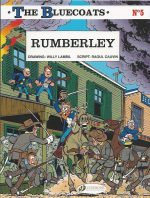
The Bluecoats volume 5: Rumberley


By Willy Lambil & Raoul Cauvin, translated by Erica Jeffrey (Cinebook)
ISBN: 978-1-84918-108-2

The myths and legends of the filmic American West have fascinated Europeans virtually since the actual days of owlhoots and gunfighters. Hergé and Moebius were passionate devotees and the wealth of stand-out Continental comics series ranges from Italy’s Tex Willer to such Franco-Belgian classics as Blueberry and tangential children’s classics such as Yakari. Even colonial dramas such as Pioneers of the New World and Milo Manara & Hugo Pratt’s Indian Summer fit the broad-brimmed bill.

As devised by Louis “Salvé” Salvérius & Raoul Cauvin – who has scripted every best-selling volume – Les Tuniques Bleues (or as we know them The Bluecoats) debuted at the end of the 1960s, specifically created to replace Lucky Luke when the laconic gunslinger defected from weekly anthology Spirou to rival publication Pilote.

The substitute swiftly became one of the most popular bande dessinée series in Europe.

Salvé was a cartoonist of the Gallic big-foot/big-nose humour school, and when he died suddenly in 1972 his replacement, Willy “Lambil” Lambillotte slowly introduced a more realistic – but still overtly comedic – illustrative tone and manner. Lambil is Belgian, born in 1936 and, after studying Fine Art in college, joined publishing giant Dupuis as a letterer in 1952.

Born in 1938, scripter Cauvin is also Belgian and before entering Dupuis’ animation department in 1960 studied Lithography. He soon discovered his true calling – comedy writing – and began a glittering and prolific career at Spirou. In addition to Bluecoats he has written dozens of long-running, award winning series including Cédric, Les Femmes en Blanc and Agent 212: more than 240 separate albums. The Bluecoats alone has sold more than 15 million copies of its 60 (and counting) album series.

As translated for English audiences, our sorry, long-suffering protagonists are Sergeant Cornelius Chesterfield and Corporal Blutch; a pair of worthy fools in the manner of Laurel & Hardy: hapless, ill-starred US cavalrymen posted to the wild frontier and various key points of fabled America during the War Between the States.

The original format featured single-page gags set around an Indian-plagued Wild West fort, but from the second volume Du Nord au Sud (North and South) the sad-sack soldiers went back East to fight in the American Civil War (a tale was rewritten as 18th album Blue rétro to describe how the chumps were drafted during the war).

Every subsequent adventure, although often ranging far beyond America and taking in a lot of thoroughly researched history, is set within the timeframe of the Secession conflict.

Blutch is your run-of-the-mill, whinging little-man-in-the street: work-shy, mouthy, devious and especially critical of the army and its inept commanders. Ducking, diving, even deserting whenever he can, he’s you or me – except sometimes he’s quite smart and heroic if no other (easier) option is available.

Chesterfield is a big burly professional fighting man; a career soldier who has passionately bought into all the patriotism and esprit-de-corps of the Military. He is brave, never shirks his duty and wants to be a hero. He also loves his cynical little troll of a pal. They quarrel like a married couple, fight like brothers and simply cannot agree on the point and purpose of the horrendous war they are trapped in…

Rumberley was the fifth translated Cinebook album (chronologically the 15th Franco-Belgian volume) and a far darker affair than usual. After a horrific battle Union and Confederate forces are spent and exhausted, although the Blues have advanced far into the South as a result of the sustained slaughter. However, with dwindling food and little ammunition the Generals decide to fall back and re-supply with fresh troops and munitions.

The only problem is what to do with the wounded. After all, bringing them back to safety would only slow down the rearward advance…

Then one bright privileged spark has the notion of just billeting the unfit Union soldiers on the nearest – albeit enemy – town…

Amongst the dead and dying are grievously injured Chesterfield and war-crazy Captain Stark. Even Blutch is there, although his leg wound might be minor, self inflicted or possibly even utterly bogus…

Their reception by the women, children, aged and infirm of Rumberley is hostile to say the least, but the Union dregs have no place else to go and no strength left to leave anyway. Forcibly appropriating the livery stable as a field hospital, Blutch and Chesterfield aid the exhausted doctors and surgeons as best they can but the simmering tension and occasional assaults by the townsfolk indicates that there is real trouble brewing and this kettle is about to boil over very soon…

And then the townsfolk start drifting away and rumours spread that a Confederate force is approaching Rumberley. The doctors opt to move their charges out, and Blutch finds himself in the uncanny position of staying behind as rearguard when Chesterfield decides to buy them time to get away…

When it comes, the battle is a bizarre affair. The Rebs are fit but have little ammunition so the Bluecoats give a good accounting of themselves, but are almost done for when Stark unexpectedly leads a life-saving cavalry charge of the Union wounded to save them. During the insane clash the town buildings are set afire and the citizens of Rumberley rush back to save their home and possessions…

And then something strange happens: the killing stops and Blues, Greys and civilians work together to save rather than destroy…

Here is another hugely amusing anti-war saga targeting younger, less world-weary audiences. Historically authentic, and always in good taste despite an uncompromising portrayal of violence, the attitudes expressed by the down-to-earth pair never make battle anything but arrant folly and, like the hilarious yet insanely tragic war-memoirs of Spike Milligan, these are comedic tales whose very humour makes the occasional moments of shocking verity doubly powerful and hard-hitting.

Funny, thrilling, beautifully realised and eminently readable, Bluecoats is the sort of war-story and Western which appeals to the best, not worst, of the human spirit.
© Dupuis 1979 by Lambil & Cauvin. English translation © 2011 Cinebook Ltd. All rights reserved.

Yakari and River of Forgetfulness (volume 10)


By Derib & Job, coloured by Dominque, translated by Erica Jeffrey (Cinebook)
ISBN: 978-1-84918-140-2

Win’s Christmas Gift Recommendation: Cartoon Perfection… 10/10

Children’s magazine Le Crapaud à lunettes was founded in 1964 by Swiss journalist André Jobin who then wrote for it under the pseudonym Job. Three years later he hired fellow French-Swiss artist Claude de Ribaupierre who chose the working name “Derib”. The illustrator had begun his own career as an assistant at Studio Peyo (home of Les Schtroumpfs/The Smurfs), working on Smurfs strips for venerable weekly Spirou. Together they created the splendid Adventures of the Owl Pythagore before striking pure comics gold a few of years later with their next collaboration.

Launched in 1969, Yakari detailed the life of a young Oglala Lakota boy on the Great Plains; sometime after the introduction of horses by the Conquistadores but before the coming of the modern White Man. This year has been a landmark one. The 39th album was released – a testament to the strip’s evergreen vitality and the quality of its creators – and Job announced his retirement. Further albums will be written by Joris Chamblain.

Overflowing with gentle whimsy, Yakari enjoys a largely bucolic existence; at one with nature and generally free from strife. For the sake of our delectation, however, the ever-changing seasons are punctuated with the odd crisis, generally resolved without fuss, fame or fanfare by a little lad who is smart, compassionate, brave… and can converse with all animals…

Derib – equally at home with enticing, comically dynamic “Marcinelle” cartoon style yarns and devastatingly compelling meta-realistic action illustrated action epics – went on to become one of Europe’s most prolific and revered creators. It’s a crime that such groundbreaking strips as Celui-qui-est-né-deux-fois, Jo (the first comic on AIDS ever published), Pour toi, Sandra and La Grande Saga Indienne) haven’t been translated into English yet, but we still patiently wait in hope and anticipation…

Many of Derib’s stunning works over the decades feature his beloved Western themes, magnificent geographical backdrops and epic landscapes and Yakari is considered by fans and critics to be the feature which first led him to deserved mega-stardom. Continentally released in 1989, La rivière de l’oubli was the 15th European album (and now Cinebook’s tenth translated tome): a compellingly rendered, superbly suspenseful yarn offering dazzling wonder and guaranteed enjoyment from a minimum of foreknowledge…

Whilst riding on his valiant pony Little Thunder, Yakari spots a bear cub in distress over a waterfall and rushes in to save it. The noble act ends in disaster as both are washed away in the rushing torrent. Then the little boy sustains a hard blow to the head in the foaming waters…

Some time later he washes ashore far downstream and is picked up by a distressed, confused she-bear who has lost her cub. When the battered little one in her arms calls her “momma” she makes a potentially tragic assumption and carries Yakari off to her den…

Little Thunder meanwhile has traced the river to the spot where his friend emerged. Finding nothing, the wonder pony returns to the camp and informs Yakari’s human friends Rainbow and Buffalo Seed of the accident. After all three have exhausted every avenue of search, they dejectedly call off the search.

Back in the cave the strange cub finally awakes. His head hurts and he can’t remember his name or anything really, so is understandably relieved when the bear tells him she’s his mother. Apparently, her playful, wayward Honeycomb was lost and had an accident and the Great Spirit changed his scent and appearance, but now that mother has found him again all will be well…

The next day she begins teaching him how to be a bear again, but this oddly transformed cub is just so weak and feeble. Conversely, he begins to wonder if there has been some kind of terrible mistake…

As his friends continue their hunt for him, “Honeycomb” greets another new day with growing anxiety. He’s failing every simple task mother sets him, and all too soon her patience is exhausted. Everything changes when she gives the cub a light cuff that sends him flying across a clearing. When his head stops spinning, Yakari instantly realises what’s happening and is soon consoling a heartbroken mother who now realises her son is gone.

Yakari is not so sure though, and whilst searching near the river stumbles upon Rainbow and Buffalo Seed riding Little Thunder. Joyously reunited, they renew their efforts to bring Momma bear and Honeycomb back together…

Whilst maintaining gripping tension, Job’s joyously inventive tale is a stripped down marvel of restraint, allowing Derib’s beguiling artwork and boisterous pacing to carry the tale to its inevitable happy ending: another visually stunning, seductively smart and happily heart-warming saga to delight young and old alike.

Yakari is one of the most unfailingly entertaining all-ages strip every conceived and deserves to be in every home, right beside Tintin and Asterix.
Original edition © Le Lombard (Dargaud- Lombard S. A.) 1989 Derib + Job. English translation 2012 © Cinebook Ltd.

Lucky Luke volume 9: The Stage Coach


By Morris & Goscinny, translated by Luke Spear (Cinebook)
ISBN: 978-1-905460-40-3

Win’s Christmas Gift Recommendation: Classic Seasonal Adventure… 9/10

One could quite convincingly argue that the USA’s greatest cultural export has been the Western. Everybody everywhere thinks they know what Cowboys and Indians are and do, but the genre has migrated and informed every aspect or art and literature all over the planet. Comics particularly have benefited from the form, with Europe continuing to produce magnificent works even in these latter years when sagebrush sagas are less dominant in America than they have been for decades.

This side of the pond, westerns were a key component in every nook and cranny of popular fiction from the earliest days. Newspapers were packed with astoundingly high quality strips ranging from straight dramas such as Gun Law and Matt Marriott to uniquely British takes like Bud Neill’s outrageous spoof Lobey Dosser, whilst our weekly anthology kids comics abounded with the episodic exploits of Texas Jack, Desperate Dan, Colorado Kid, Davy Crockett, Kid Dynamite and more.

As previously mentioned, Europe especially embraced the medium and expanded the boundaries of the genre. In Italy Tex (Willer) remains as vital as ever as it approaches its 70th anniversary, far outdistancing later revered and much-exported series such as Captain Miki, Il Grande Blek, Cocco Bill,  Zagor, Larry Yuma, Ken Parker, Magico Vento and Djustine.

The Franco-Belgian wing also has a long tradition and true immortals amongst its ponderosa Pantheon: from all ages-comedic treats such as Yakari, OumPah-Pah, Chick Bill or The Bluecoats to monolithic and monumental mature-reader sagas like Jerry Spring, Comanche, Sergeant Kirk, La Grande Saga Indienne, Buddy Longway or the now-legendary Blueberry…

Topping them all in terms of sales and fame however is a certain laconic lone rider…

Lucky Luke is seventy years old this year: a rangy, good-natured, lightning-fast quick-draw cowboy who roams a fabulously mythical Old West on his super-smart horse Jolly Jumper, having light-hearted adventures and interacting with a host of historical and legendary figures of the genre.

He’s probably the most popular Western star in the world today. His unbroken string of laugh-loaded exploits has made him one of the best-selling comic characters in Europe (83 albums selling well in excess of 300 million copies in 30 languages at the last count), with spin-off toys, computer games, animated cartoons and even a passel of TV shows and live-action movies.

As alluded to above he was dreamed up in 1946 by Belgian animator, illustrator and cartoonist Maurice de Bévère (“Morris”) for that year’s Seasonal Annual (L’Almanach Spirou 1947) of Le Journal de Spirou, before launching into his first weekly adventure ‘Arizona 1880’ on December 7th 1946 in the famed weekly comic.

Prior to that, Morris had become acquainted with future comics super-stars Franquin and Peyo while working at the CBA (Compagnie Belge d’Actualitiés) cartoon studio and by contributing caricatures to weekly magazine Le Moustique. He quickly became one of “la Bande des quatre” (The Gang of Four) comprising creators Jijé, Will and Franquin: all leading proponents of the loose, free-wheeling art-style dubbed the “Marcinelle School” which dominated Spirou in aesthetic contention with the “Ligne Claire” style used by Hergé, EP Jacobs and other artists in rival magazine Tintin.

In 1948 the Gang (all but Will) visited the USA, meeting American creators and sightseeing. Morris stayed for six years, encountering fellow Franco-tourist René Goscinny and scoring some work from newly-formed EC sensation Mad whilst making copious notes and sketches of the swiftly vanishing Old West.

That research resonates on every page of his life’s work.

A solo act until 1955, Morris produced another nine albums worth of affectionate parody before formally teaming up with Goscinny, who became the cool cowboy’s regular wordsmith. Luke rapidly attained the dizzying heights of superstardom, commencing with ‘Des rails sur la Prairie’ (Rails on the Prairie), which began serialisation in Spirou with the August 25th 1955 edition.

In 1967 the six-gun straight-shooter switched sides, transferring to Goscinny’s own magazine Pilote with ‘La Diligence’ (The Stagecoach). Goscinny & Morris produced 45 albums together before the author’s death in 1977, after which Morris continued both singly and with fresh collaborators.

Morris passed away in 2001, having drawn fully 70 adventures, plus launching the spin-off comics careers of Rantanplan (“dumbest dog in the West” and a charming spoof of cinema canine Rin-Tin-Tin). The immortal franchise was left to fresh hands, beginning with Achdé, Laurent Gerra, Benacquista & Pennac who have carried on the undying tradition.

Curiously, apart from the initial adventure, Lucky (to appropriate a quote applied to the thematically simpatico Alias Smith and Jones) “in all that time… never shot or killed anyone”. He did however smoke prodigiously, like all the cool cowboys and – if the stereotype still applies – most Frenchmen…

Lucky Luke was first seen in Britain syndicated to weekly comic Film Fun, then reappeared in 1967 in Giggle, renamed Buck Bingo. In all these venues – as well as the numerous attempts to follow the English-language successes of Tintin and Asterix albums from Brockhampton and Knight Books – Luke had a trademark cigarette hanging insouciantly from his lip, but in 1983, Morris – no doubt amidst both pained howls and muted mutterings of “political correctness gone mad” – substituted a piece of straw for the much-travelled dog-end, which garnered him an official tip of the hat from the World Health Organization.

Unquestionably, the most successful attempt at bringing Lucky Luke to our shores and shelves is the most recent. Cinebook – who have rightly restored the foul weed to his lips on the interior pages, if not the covers – have translated 60 albums thus far with the 61st scheduled for a December release.

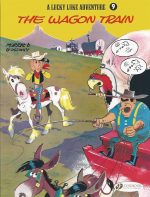
The Wagon Train was their ninth – still readily available both on paper and as an e-book – and first published on the Continent in 1964 as Lucky Luke – La Caravane: the 24th European release and Goscinny’s fifteenth collaboration with Morris. It’s also one of their most traditional tales; playing joyously with the tropes and memes of the genre and clearly having as much fun as the future readers were going to…

In begins in dusty Nothing Gulch as a bedraggled procession of “Prairie Schooners” limp into town. Expedition head Andrew Boston is arguing with unscrupulous guide Frank Malone who is demanding even more money before completing his commission to bring the hopeful settlers to California. When heated words are replaced with gunplay, a dusty observer ends the fracas before blood is shed…

Boston has heard a lot about Lucky Luke and promptly starts a multi-pronged charm offensive to get the Sagebrush Stalwart to take over guiding the party to the fabled Golden State. Our hero is flattered but not interested, until Boston wheels out his big guns and has the kids ask in their own unique ways…

Despite being prepared to use children to emotionally twist the cowboy’s arm, the twenty or so wagon-loads of pioneers are an affable if odd bunch from all over the world and soon Luke is leading them across prairies and through deserts and mountains.

However as the days pass an exceedingly large number of accidents and mishaps occur and before long it cannot be denied that somebody is clearly attempting to sabotage the expedition…

As close calls and near-death escapes mount Lucky splits his attention between blazing a trail and playing detective but the list of suspects is just so large. Anybody from the undertaker in his hearse to the inventor in his constantly evolving horseless converter-car (there’s more than a passing similarity to TV’s Whacky Races here!); the suspiciously French Barber/Surgeon, creatively foul-mouthed mule driver or even the no-nonsense School Marm could be the culprit. But then again there are so many others who act out of the ordinary…

Nevertheless, the voyage proceeds and as the would-be homesteaders survive the temptations of bad towns and other dens of vice and iniquity, bad food, and inclement weather a sense of community builds. Sadly that’s soon tested to the limit when word comes of that Sioux Chief Rabid Dog is on the warpath…

Despite all these traditional trials and tribulations Luke persists and before long the Promised Land is reached and a vile villain is finally exposed…

Cleverly barbed, wickedly ironic and joyously packed with classic cowboy set-pieces, this splendidly slapstick spoof of a crucial strand of the genre is another grand old hoot in the tradition of Destry Rides Again and Support Your Local Sheriff (maybe Paint Your Wagon, Evil Roy Slade or Cat Ballou are more your style?), superbly executed by master storytellers for any kids who might have missed the romantic allure of an all-pervasive Wild West that never was…

And in case you’re worried, even though the interior art still has our hero chawin’ on that ol’ nicotine stick, trust me, there’s very little chance of anyone craving a quick snout, but quite a strong probability that they’ll be addicted to Lucky Luke Albums…
© Dargaud Editeur Paris 1971 by Goscinny & Morris. © Lucky Comics. English translation © 2007 Cinebook.

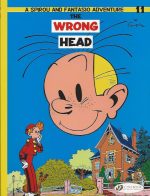
Spirou and Fantasio volume 11: The Wrong Head


By André Franquin, translated by Jerome Saincantin (Cinebook)
ISBN: 978-1-84918-313-0

Win’s Christmas Gift Recommendation: Classic Madcap Mirth and Melodrama… 9/10

Spirou (which translates as both “squirrel” and “mischievous” in the Walloon language) was created by French cartoonist François Robert Velter using his pen-name Rob-Vel for Belgian publisher Éditions Dupuis in direct response to the phenomenal success of Hergé’s Tintin for rival outfit Casterman.

Thus, a soon-to-be legendary weekly comic entitled Spirou launched on April 21st 1938 with a rival red-headed lad as lead in an anthology which bears his name to this day.

The eponymous boy was originally a plucky bellboy/lift operator employed by the Moustique Hotel (a sly reference to the publisher’s premier periodical Le Moustique) whose improbable adventures with pet squirrel Spip gradually evolved into high-flying, far-reaching and surreal comedy dramas.

Spirou and his chums have spearheaded the magazine for most of its life, with a phalanx of truly impressive creators carrying on Velter’s work, beginning with his wife Blanche “Davine” Dumoulin who took over the strip when her husband enlisted in 1939. She was assisted by Belgian artist Luc Lafnet until 1943 when Dupuis purchased all rights to the property, after which comic-strip prodigy Joseph Gillain (“Jijé”) took the helm.

In 1946 Jijé’s assistant André Franquin assumed the creative reins, gradually sidelining the well-seasoned short gag vignettes in favour of epic adventure serials; introducing a broad, engaging cast of regulars and eventually creating phenomenally popular magic animal the Marsupilami to the mix.

First seen in Spirou et les héritiers in 1952, the elastic-tailed anthropoid eventually spun-off into his own strip series; becoming also a star of screen, plush toy store, console games and albums. Franquin continued concocting increasingly fantastic tales and spellbinding Spirou sagas until his resignation in 1969.

He was followed by Jean-Claude Fournier who updated the feature over the course of nine stirring adventures which tapped into the rebellious, relevant zeitgeist of the times: offering tales of environmental concern, nuclear energy, drug cartels and repressive regimes.

By the 1980s the series seemed outdated and without direction: three different creative teams alternated on the feature, until it was at last revitalised by Philippe Vandevelde – writing as Tome – and artist Jean-Richard Geurts AKA Janry, who adapted, referenced and in many ways returned to the beloved Franquin era.

Their sterling efforts revived the floundering feature’s fortunes and resulted in fourteen wonderful albums between 1984 and 1998. As the strip diversified into parallel strands (Spirou’s Childhood/Little Spirou and guest-creator specials A Spirou Story By…) the team on the core feature were succeeded by Jean-David Morvan & José-Luis Munuera, and in 2010 Yoann & Vehlmann took over the never-ending procession of amazing adventures…

Cinebook have been publishing Spirou & Fantasio’s exploits since 2009, alternating between Tome & Janry’s superb reinterpretations of Franquin and earlier efforts from the great man himself.

André Franquin was born in Etterbeek, Belgium on January 3rd 1924. Drawing from an early age, he only began formal art training at École Saint-Luc in 1943. When war forced the school’s closure a year later, he found work at Compagnie Belge d’Animation in Brussels. There he met Maurice de Bévère (AKA Lucky Luke creator “Morris”), Pierre Culliford (Peyo, creator of The Smurfs) and Eddy Paape (Valhardi, Luc Orient). In 1945 all but Peyo signed on with Dupuis and Franquin began a career as a jobbing cartoonist and illustrator; producing covers for Le Moustique and Scouting magazine Plein Jeu.

In those early days Franquin and Morris were tutored by Jijé – the main illustrator at Spirou. He turned the youngsters and fellow neophyte Willy Maltaite AKA Will (Tif et Tondu, Isabelle, Le jardin des désirs) into a smooth creative bullpen known as the La bande des quatre or “Gang of Four”.

They later reshaped and revolutionised Belgian comics with their prolific and engaging “Marcinelle school” style of graphic storytelling…

Jijé handed Franquin all responsibilities for the flagship strip part-way through Spirou et la maison préfabriquée, (Spirou #427, June 20th 1946) and the new guy ran with it for two decades; enlarging the scope and horizons until it became purely his own. Almost every week fans would meet startling new characters such as comrade/rival Fantasio or crackpot inventor and Merlin of mushroom mechanics the Count of Champignac.

Spirou and Fantasio became globe-trotting journalists, travelling to exotic places, uncovering crimes, exploring the fantastic and clashing with a coterie of exotic arch-enemies such as Zorglub and Fantasio’s rascally cousin Zantafio.

In a splendid example of good practise, Franquin mentored his own band of apprentice cartoonists during the 1950s. These included Jean Roba (La Ribambelle, Boule et Bill), Jidéhem (Sophie, Starter, Gaston Lagaffe) and Greg (Bruno Brazil, Bernard Prince, Achille Talon, Zig et Puce), who all worked with him on Spirou et Fantasio over the years.

In 1955 contractual conflicts with Dupuis droved Franquin to sign up with rival outfit Casterman on Tintin. Here he collaborated with René Goscinny and old pal Peyo whilst creating the raucous gag strip Modeste et Pompon. Although Franquin soon patched things up with Dupuis and returned to Spirou – subsequently co-creating Gaston Lagaffe in 1957 – Franquin was now contractually obliged to carry on his Tintin work too…

From 1959 on, co-writer Greg and background artist Jidéhem increasingly assisted Franquin but by 1969 the artist had reached his limit and resigned.

His later creations include fantasy series Isabelle, illustration sequence Monsters and bleak adult conceptual series Idées Noires, but his greatest creation – and one he retained all rights to upon his departure – is Marsupilami.

Plagued in later life by bouts of depression, Franquin passed away on January 5th 1997. His legacy remains; a vast body of work which reshaped the landscape of European comics.

Originally serialised in Spirou # 840-869 in 1954 and subsequently released on the continent in 1957 as hardcover album Spirou et Fantasio 8La mauvaise tête, this sinister yarn begins as Spirou visits his short-tempered pal Fantasio and finds the house a shambles. The intrepid reporter has ransacked his home in search of missing passport photos but his insensate fury abates a bit after Spirou convinces him to come play paddleball.

However, whilst looking for a lost ball in the woods, Spirou finds one of the missing photos but thinks nothing of it…

That evening strange events begin: Spirou sees Fantasio acting oddly in town and when a jeweller is robbed, a brutalised merchant identifies Fantasio as the smash-and-grab thief…

Seeds of suspicion are sown and Spirou doesn’t know what to think when a solid gold Egyptian mask is stolen on live TV. The bandit is clearly seen to be his best pal…

Spirou is still trying to reason with Fantasio when the police arrive and, with nobody believing the reporter’s ridiculous story of being in Paris on a spurious tip, watches with helpless astonishment as the accused makes a bold escape bid…

Still astounded, Spirou wanders to the ramshackle house where he found the missing photo and finds a strange set-up: a plaster cast of Fantasio and weird plastic goo in a mixing bowl…

His snooping is suddenly disturbed by screams and sounds of a struggle. Following the cacophony he finds one man holding the stolen gold mask and another on the floor. The standing man is too quick to catch and drives away with a third stranger, but as Spirou questions the beaten victim he learns that the loser of the fight is a sculptor who was hired to make astounding life-like masks of a certain journalist…

Soon Spirou is hot on the trail of the criminal confederates and uncovers a diabolical scheme to destroy Fantasio by an old enemy they had both discounted and almost forgotten…

Fast-paced, compellingly convoluted and perfectly blending helter-skelter excitement with keen suspense and outrageous slapstick humour, the search for The Wrong Head is a terrific romp to delight devotees of easy-going adventure.

As if the criminal caper and its spectacular courtroom drama climax is not enough, this tome also includes a sweet early solo outing for the marvellous Marsupilami as ‘Paws off the Robins’ finds the plastic pro-simian electing himself guardian of a nestful of newborn hatchlings in Count Champignac’s copious gardens, resolved to defend the chicks from a marauding cat at all costs…

Stuffed with fabulously fun, riotous chases and gallons of gags, this exuberant tome is a joyous example of angst-free action, thrills and spills. Easily accessible to readers of all ages and drawn with beguiling style and seductively wholesome élan, this is pure cartoon gold: an enduring comics treat, certain to be as much a household name as that other kid reporter and his dog…
Original edition © Dupuis, 1957 by Franquin. All rights reserved. English translation 2016 © Cinebook Ltd.

Glenn Gould – A Life Off Tempo


By Sandrine Revel, translated by Montana Kane (NBM)
ISBN: 978-1-68112-065-2

Win’s Christmas Gift Recommendation: A Classical Interlude with real Artistic Appeal… 10/10

Publisher NBM have struck a seam of gold with their growing line of European biographies and their latest is one of the most impressive and thought-provoking to date.

Glenn Gould – A Life Off Tempo has been lovingly crafted by Sandrine Revel, author, cartoonist and comics artist (Jouvence la Bordelaise, Sorcellerie et dependences, Résurgences, Femmes en voie de resociabilisation, Le Jardin Autre Monde) as well as journalistic press illustrator for Sud Ouest Dimanche, Milan Presse and other magazines.

She’s also a devoted and passionate fan of the star of this elegiac and beguiling book: so much so that she’s also provided a menu of Appendices at the back to augment your appreciation and understanding of an archetypal troubled genius…

Painted in a number of extremely welcoming and effective styles, A Life Off Tempo offers up snippets from the strange, solitary and woefully short life of a Canadian musical child prodigy who hit the heights, changed the scene and left the world early as all revelatory, game-changing artists seem to do…

As you’ll see here, Gould – dubbed “the JD Salinger of the classical music world” – died in 1982 as the result of a stroke, nearly fifty years after his birth, and it’s as he dies that we share moments of his clearly difficult life, all deftly woven into a non-chronological narrative, dotted with observation from the paltry few people he allowed to get close to him.

You may or may not know he was a classical pianist with a unique style and manner who revolutionised how certain pieces were played and heard…

…Or how he opened up the Soviet Union to Western cultural arts tours despite playing less than 200 concerts in his entire career…

…And that he was either crippled by hypochondria ore suffered from a number of physical and psychological ailments as well as what might well have been undiagnosed Asberger’s Syndrome – or an ASD, to use today’s terminology. He certainly loved animals, despised cruelty and always bundled up as if he were freezing to death…

At the height of his fame Gould abandoned live performance to write music and experiment in recording techniques. He became a critic and broadcaster and invented pseudonymous identities so that he could savage his own recordings.

He was clearly a difficult man and beloved mystery to those around him, and this graphic account astutely gives you the how if not always the why…

The deliciously oversized (280 x 208 mm) full-colour, resoundingly substantial hardback is not a formal history or biography text, even though we meet Gould at various stages of his life and share key events and intimate moments.

You obviously won’t feel how his interpretations of hallowed pieces by Bach, Beethoven, William Byrd, Orlando Gibbons, Mozart and more shook up the musical world – although if you follow the aforementioned ‘Appendices’ at the back and listen to the suggested playlist, track down the recordings cited in the ‘Glenn Gould Discography’ or use the ‘Further Reading’ and ‘Further Viewing’ lists to get a firm grip on the maestro’s output you’ll experience the innovation and won’t be at all disappointed…

Impassioned, enchanting and marvellously moving, this enigmatic engagement with a singular creative individual is a fabulous treat for lovers of comics and music and will stay for all time in your head like a favourite tune.
© Dargaud 2016 © 2016 NBM for the English translation.

Glenn Gould – A Life Off Tempo will be released on December 1st 2016. It can be pre-ordered now. It is also available wherever e-books are sold.
For more information and other great reads see http://www.nbmpub.com/

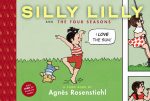
Silly Lilly and the Four Seasons


By Agnès Rosenstiehl (Toon Books/Raw Junior)
ISBN: 978-0-9799238-1-4 (HB)                    978-1-935179-23-8 (PB)

Win’s Christmas Gift Recommendation: Sheer Delight from First to Last… 10/10

Kids love to read and will do so for their entire lives if you start them off with the right material. Thankfully, after too many years without, the bookshelves and digital stores are stuffed with just such graphic narrative treasures. This particular award-winning cartoon treat for the very young comes from the magnificently prolific and talented Agnès Rosenstiehl, who has been one of France’s greatest kids’ authors for decades.

Rosenstiehl was born in 1941 to an artistic Parisian family, and, after attending Conservatoire national supérieur de musique et de danse à Paris and the Sorbonne, has been enchanting European nippers with her efforts since 1968. I lost count at 159 books. There are probably more…

Her most popular and ubiquitous character is an adventurous tyke named Mimi Cracra (48 tomes thus far) who in 2008 hopped the pond and landed as Silly Lilly in a supremely engaging selection of vignettes showing the tot learning about and exulting in the ever-changing planetary cycle…

Crafted as mini-tales for very young and emerging readers, the explorations begin in playful callisthenics in Spring and ‘Silly Lilly at the Park’; moves on to Summer and ‘Silly Lilly at the Beach’; shuffles on in sensible warm clothes to Fall and ‘Silly Lilly and the Apples’, romps in Winter as ‘Silly Lilly Plays in the Snow’ before inexorably coming around to Spring again with ‘Silly Lilly and the Swing’.

Toon Books/Raw Junior was established by Art Spiegelman and Françoise Mouly as an imprint of the groundbreaking alternative comics magazine to provide high-quality comics stories which would entice pre-schoolers and starter-readers into a lifelong love affair with strips in particular and reading in general.

Released as a child-sized (236 x 152 mm) landscape package, this magically compelling full-colour 32-page picture treat is available in both hardback and softcover: the kind of comforting illustrated exploration that opens young eyes to all the world’s wonders and will be read over and to again.
© 2008 RAW Junior, LLC. All rights reserved.

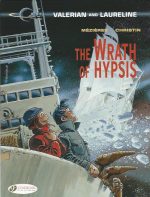
Valerian and Laureline volume 12: The Wrath of Hypsis


By Méziéres & Christin, with colours by Evelyn Tranlé; translated by Jerome Saincantin (Cinebook)
ISBN: 978-1-84918-304-8

Valérian: Spatio-Temporal Agent debuted in weekly Pilote #420 (9th November 1967) and was an instant smash-hit. The feature soon became Valérian and Laureline as his feisty distaff sidekick rapidly developed into an equal partner and scene-stealing star through a string of fabulously fantastical, winningly sly and light-hearted time-travelling, space-warping romps.

Packed with cunningly satirical humanist action, challenging philosophy and astute political commentary, the stellar yarns struck a chord with the public and especially other creators who have been swiping, “homaging” and riffing off the series ever since.

Initially Valerian was an affably capable yet unimaginatively by-the-book space cop tasked with protecting the official universal chronology (at least as it affects humankind) by counteracting and correcting paradoxes caused by incautious time-travellers.

When he travelled to 11th century France in debut tale Les Mauvais Rêves (Bad Dreams and still not yet translated into English), he was rescued from doom by a tempestuously formidable young woman named Laureline whom he had no choice but to bring back with him to Galaxity: the 28th century super-citadel and administrative capital of the Terran Empire.

The indomitable female firebrand crash-trained as an operative and accompanied him on subsequent missions – a beguiling succession of breezy, space-warping, social conscience-building epics. This so-sophisticated series always had room to propound a satirical, liberal ideology and agenda (best summed up as “why can’t we all just get along?”), constantly launching telling fusillades of commentary-by-example to underpin an astounding cascade of visually appealing, visionary space operas.

The Wrath of Hypsis is the twelfth Cinebook translation: concluding a landmark tale and marking a turning point in the ongoing epic. Initially every Valérian adventure began as a serial in Pilote before being collected in album editions, but after this adventure from 1985, the publishing world shifted gears. From the next tale and every one thereafter, the mind-bending sagas were released as all-new complete graphic novels. The switch in dissemination affected all popular characters in French comics and almost spelled the end of periodical publication on the continent…

(One clarifying note: in the canon, “Hypsis” is counted as the twelfth tale, due to the collected albums being numbered from The City of Shifting Waters: the second actual story but the first to be compiled in book form. When Bad Dreams was finally released as a European album in 1983, it was given the number #0.)

Les Foudres d’Hypsis originally appeared in then-monthly Pilote #M128-135, spanning January to September 1985: an action-packed trenchant romp that reset a growing paradox that had been slowing building since The City of Shifting Waters…

In previous volume The Ghosts of Inverloch the immensity of Galaxity was eradicated from reality by agents unknown, leaving only the Chief of the Spatio-Temporal Service to plunge back in time to 1986: the chronal crisis-point which triggered the disaster.

Spatio-Temporal partners-in-peril Valerian and Laureline joined him by extremely convoluted paths after gathering a trio of Shingouz traders and Ralph – an affable aquatic super-mathematician – from different eras and galactic backwaters.

They all rendezvoused at Inverloch Castle, far from escalating petty crises and a mounting unrest afflicting Earth which would peak with the melting of the polar ice-caps, destruction of modern human civilisation and consequent birth-pangs of Galaxity.

The Scottish citadel was home to British intelligence supremo Lord Seal, his brilliant wife Lady Charlotte and her current guest Mr. Albert: Galaxity’s volubly jolly, infuriatingly unrushed and always tardy 20th century information gatherer/sleeper agent.

This distinguished, exceptional band had gathered to prevent Earth’s devastation but Galaxity’s sudden disappearance added even greater urgency to the mission…

The tale continues here as the strange crew review the worsening situation. Nuclear powers across the planet are experiencing inexplicable and potentially fatal malfunctions. Alien objects keep appearing in random locations and – thanks to the extraterrestrial input of Seals visitor’s – they can lay the blame upon the machinations of Hypsis: an enigmatic planet which constantly perambulates from system to system, quadrant to quadrant…

Seal’s contacts have narrowed down the potential crisis point to one of a number of ships in the Arctic. Soon the odd allies are covertly heading north in British weather ship HMS Crosswinds…

Thanks to Ralph’s talents and growing friendship with a pod of Orcas, the maritime search is gradually narrowed down and before long Crosswinds closes in on a quaint schooner named Hvexdet… and none too soon.

The time-lost Chief has locked himself in his cabin, Valerian is wracked by nightmares of vanished Galaxity and numerous doomed Earths whilst the gambling-addicted Shingouz have almost won or traded everything aboard ship not bolted down or welded on…

Cornering the Hvexdet in a field of pack ice, dauntless Captain Merryweather gives orders to ram, spooking the schooner into blasting off into space and instituting devastating retaliation. It’s what the Chief has been waiting for. With Crosswinds sinking and the crew heading for the lifeboats, he orders Valerian, Laureline, Seal, Albert, the Shingouz and Ralph to join him in the astroship: following the invaders’ flight to find nomadic Hypsis…

Pursuit is erratic and convoluted until Valerian has the idea of linking Ralph to the ship’s systems and predicting Hvexdet’s final destination. The scheme works perfectly and before long the astroship touches down on a strange, rocky world with immense towers dotting the landscape.

And that’s where things get really strange as Valerian learns why Earth was scheduled for nuclear meltdown, meets the incredible true owners of the troubled birthplace of humanity and watches in astonishment as Albert, Laureline and the Shingouz negotiate an unbelievable deal which saves Earth, but not (necessarily) his beloved and much-missed home Galaxity…

Astute fans will realise that this ripping yarn was writer Pierre Christin and artist Jean-Claude Méziéres; way of rationalising the drowned Earth of 1986 (as seen in their 1968 adventure The City of Shifting Waters) with the contemporary period that they were now working in. It also gave them an opportunity to send Valerian and Laureline in a new direction and uncharted creative waters…

To Be Continued…

Smart, subtle, complex and frequently hilarious, this sharp trans-time tale beguilingly blended outrageous satire with blistering action and deft humour with cosmic apostasy to completely reenergise what was already one of the most thrilling sci fi strips in comics. The Wrath of Hypsis is one of the most memorable romps Méziéres & Christin ever concocted, and heralded the start of a whole new way to go back to the future…
© Dargaud Paris, 1985 Christin, Méziéres & Tranlệ. All rights reserved. English translation © 2016 Cinebook Ltd.

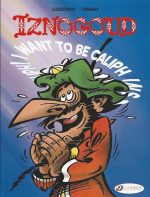
Iznogoud volume 13: I Want to be Caliph Instead Of the Caliph


By Goscinny & Tabary, translated by Jerome Saincantin (Cinebook)
ISBN: 978-1-84918-260-7

For the greater part of his far-too-short lifetime René Goscinny (1926-1977) was one of the world’s most prolific and widely-read writers of comic strips. He still is.

Amongst his most popular and enduring comic collaborations are Lucky Luke, Le Petit Nicolas, Signor Spaghetti and, of course, Asterix the Gaul, but there were so many others, such as the despicably dark deeds of a dastardly usurper whose dreams of diabolical domination perpetually proved to be ultimately no more than castles in the sand…

In the rueful aftermath of the Suez crisis, the French returned – by way of comics, at least – to the hotly contested Arabian deserts as Goscinny teamed with hugely gifted Swedish émigré Jean Tabary (1930-2011) – who numbered Richard et Charlie, Grabadu et Gabaliouchtou, Totoche, Corinne et Jeannot and Valentin le Vagabond amongst his previous hit strips – to deliriously detail the innocuous history of imbecilic Arabian (im)potentate Haroun el-Poussah.

However, as is so often the case, it was the strip’s villainous foil – power-hungry vizier Iznogoud – who totally stole the show… possibly the conniving little rogue’s only successful coup.

The first kernel of inspiration came as a piece of background shtick in early 1960s kids’ cartoon book Les Vacances du Petit Nicholas (which we Brits all saw as Nicholas on Holiday). A fuller formation and development came with Les Aventures du Calife Haroun el Poussah, created for Record: debuting in the January 15th issue of 1962.

A petite hit, the feature subsequently jumped ship to Pilote – a new comic created and edited by Goscinny – where it was artfully refashioned into a starring vehicle for the unpleasant little upstart who had been hogging all the laughs and limelight.

The Vile Vizier went from strength to strength. According to the brief introduction in this volume, the unwieldy catchphrase “I want to be Caliph instead of the Caliph!” quickly became part of casual French idiom and, in October 1974, the wee rascal won his own socio-political commentary column in newspaper Journal du Dimanche.

Insidious Iznogoud is Grand Vizier to Haroun Al Plassid, the affable, easy-going Caliph of Ancient Baghdad, but the sneaky little second-in-command has loftier ambitions, or as he is always declaiming “I want to be…”

The retooled rapscallion resurfaced in Pilote in 1968, quickly becoming a huge hit, resulting in 29 albums to date (17 by dream team Goscinny & Tabary), his own solo comic, a computer game, animated film, TV cartoon show and even a live-action movie.

Like all great storytelling, Iznogoud works on two levels: for youngsters it’s a comedic romp with adorably wicked baddies invariably hoisted on their own petards and coming a-cropper, whilst older, wiser heads can revel in pun-filled, witty satires and superbly surreal antics.

Following Goscinny’s death in 1977, Tabary began scripting the turbulent tales, switching to book-length complete adventures rather than the short, snappy vignettes which typified his collaborations. Upon his own passing, Tabary’s children Stéphane, Muriel and Nicolas took over the franchise.

The deliciously malicious whimsy is resplendent in its manic absurdity, cleverly contemporary cultural critiques, brilliantly delivered creative anachronisms and fourth-wall busting outrages which serve to keep the assorted escapades bizarrely fresh and hilariously inventive.

Je veux être calife à la place du calife was originally released in 1978; wracking up a baker’s dozen deliciously daft album compilations, and proffering a potently engaging quintet of trend-setting tales with our ambitious autocrat as ever scheming to seize power from his good but gullible Lord and Master.

Following a brief background-building Introduction and preface page reintroducing our constant cast and their craven motivations, the merry madness kicks off with ‘The Inspection Spectre’ as Iznogoud and long-suffering hench-oaf Wa’at Alahf learn of an abandoned palace with a resident ghost who drives to derangement any Caliph crazy enough to spend the night.

It takes Herculean effort to get indolent Haroun into the ramshackle pit but when the miracle occurs it causes a mood swing nobody saw coming…

More mundane madness is the order of the day when vile Vizier meets scurrilous palace official Leguenn-Scandales whose job is sniffing out nepotism and corruption. The old ferret believes everybody has a secret that will destroy them and offers – for eye-watering remuneration – his unique gift to uncover a ‘Scandal in Baghdad’ that will depose the Caliph and leave the position open for a clean-living successor…

It all goes perfectly too: it’s just a shame the incumbent Caliph has a unique way of dealing with public shame and disapprobation…

After opening a ‘Wax Museum’ in the centre of town, its devious magician owner offers to resurrect and reanimate his exhibit of killers past and future for Iznogoud. Sadly the malign mannequins awake with ideas of their own and the Vizier pays the price for their manic meltdown, after which Tabary scripts as well as illustrates a story of killing with kindness as the devilish deputy obtains an ultra-soft hedonistic treat to remove the infernally idle Haroun al Plassid.

Typically, his timing couldn’t be worse and deploying ‘The Voracious Cushion’ only leads to his own unforgettably uncomfortable experience…

Goscinny is back for the final usurping exploit as Iznogoud determines to bribe the entire army to stop protecting the Caliph. Luckily, a recent acquaintance knows of a gold-producing ostrich, and the epic pursuit of her results in a colossal bullion stockpile in the shape of ‘The Eggs of Ur’.

If only the Vizier hadn’t ruined a perfect plan with his usual exacting imbecility…

Such convoluted witty, fast-paced hi-jinks and exotically engaging comedy set-pieces have made this series a household name in France where “Iznogoud” has become the accepted term for a certain kind of politician: overly ambitious, unscrupulous and frequently deficient in stature.

Desiring to become “Caliph in the Caliph’s place” is a popular condemnation in French, targeting those perceived as overly-ambitious, and since 1992 the Prix Iznogoud is awarded annually to “a personality who failed to take the Caliph’s place”.

Nominees are chosen from prominent French figures who have endured spectacular defeats in any one year and been given to the likes of Édouard Balladur (1995) and Nicolas Sarkozy (1999). Politician and jury panel chief André Santini had to award himself one in 2004 after failing to become president of Île-de-France in regional elections.

When first released in Britain during the late 1970s (and latterly in 1996 as a periodical comicbook) these tales made little impression on British audiences, but at last this wonderfully beguiling strip-saga has deservedly found an appreciative audience among today’s more internationally aware, politically jaded comics-and-cartoon savvy connoisseurs…

Buy ’em now: I gotta tell ya, they’ll all be yuge…
Original edition © 2012 IMAV éditions by Goscinny & Tabary. All rights reserved. English translation © 2016 Cinebook Ltd.

The Adventures of Blake and Mortimer: The Francis Blake Affair


By Jean Van Hamme & Ted Benoit (Cinebook)
ISBN: 978-1-905460-63-2

Belgian Edgard Félix Pierre Jacobs (1904-1987) is one of the founding fathers of the Continental comics industry. Although his output was relatively modest compared to many of his iconic contemporaries, Jacobs’ landmark serialised life’s work – starring scientific troubleshooters Professor Philip Mortimer and Captain Francis Blake – practically formed the backbone of the modern action-adventure comic in Europe.

His splendidly adroit, roguish yet thoroughly British adventurers were conceived and realised for the very first issue of Le Journal de Tintin in 1946, and quickly became a crucial staple of life for post-war European kids – much as Dan Dare was in 1950s Britain.

After decades of fantastic exploits the series apparently ended with the eleventh album. The story had been serialised between September 1971 and May 1972 in Tintin but after the first volume was completed the author simply abandoned his story due to failing health and personal issues.

Jacobs died on February 20th 1987 before completing extended adventure Les 3 formules du professeur Satō.

The concluding volume – Mortimer contre Mortimer – was only released in March 1990 after veteran cartoonist Bob de Moor (Bart de Scheepsjongen, Monsieur Tric, Balthazar, Barelli and many others) was commissioned by the Jacobs family and estate to complete the tale from the grand originator’s pencils and notes.

The long-postponed release led to a republishing of all the earlier volumes, followed in 1996 by new adventures from two separate creative teams hired by the Jacobs Studio…

The first was the L’Affaire Francis Blake by Jean Van Hamme (Thorgal, XIII, Largo Winch) & Thierry “Ted” Benoit (Bingo Bongo et son Combo Congolais, Ray Banana) which settled itself into a comfortably defined and familiar mid-1950s milieu whilst unfolding a rousing tale of espionage and double-dealing.

The tale also controversially omitted the fantastic elements of futuristic fiction and fringe science which had characterised Jacobs’ creation. The story also focused on the cool, suave MI5 officer rather than bombastic, belligerent boffin and inveterate scene-stealer Professor Mortimer…

It all begins in the highest echelons of the government’s security services as news of a mole reaches the press and creates a scandal. MI5 chief Francis Blake carefully explains how difficult tracking the infiltrator has become, but none of the great men in the room have any patience for excuses…

Blake explains the dilemma to Mortimer at their Club that evening, but events are unfolding which will soon curtail their cosy get-togethers. British surveillance operatives may be slow but they are inexorably steady and when a photograph of a drop-off reveals that Blake himself is the traitor, MI5 moves quickly to arrest their disgraced leader. Unmasked, the spy master only escapes detention through a spectacular fast getaway across London, leaving shocked friends and associates in his wake.

Despite a mountain of damning evidence, Mortimer cannot believe his greatest ally against evil is a money-hungry villain and begins his own investigations, despite also being the subject of an MI5 watch team. The scientist is also keenly aware that in regard of man with all the secrets like Blake, death is preferable to capture as far as his pursuers are concerned.

Ditching his government shadows Mortimer also goes on the run…

Naturally Captain Blake is completely innocent, and has been playing his own deep game. Now, having has shaken loose the real traitor, our cunning hero has gone straight to the mastermind behind the infiltration of the security services. Sadly that human devil has not been fooled for a moment and acts accordingly…

Mortimer meanwhile has trailed his friends through some skilfully laid clues and breadcrumbs; uncovering Blake’s secret army of off-the-books, utterly loyal sleeper agents who render him every assistance as he closes in on Blake and the true masterminds behind an unbelievably bold plot…

With the country in an uproar, Mortimer heads ever-northward, having deduced Blake’s intended final destination and the incredible real motive behind all the cloak-&-dagger skulduggery. He arrives just in time for a grand reunion with his old comrade and a blistering battle against the forces of evil and subversion threatening our way of life…

Strongly founded upon and in many ways a loving tribute to John Buchan’s classic thriller The Thirty-Nine Steps, this is a devious and convoluted spook show to delight espionage aficionados and a solidly entertaining addition to the canon of the Gentleman Adventurers.
Original edition © Editions Blake & Mortimer/Studio Jacobs (Dargaud-Lombard S. A.) 1996 by Ted Benoit & Jean Van Hamme. All rights reserved. English translation © 2008 Cinebook Ltd.

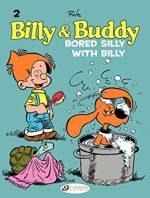
Billy & Buddy volume 2: Bored Silly with Billy


By Jean Roba, translated by Luke Spear (Cinebook)
ISBN: 978-1-84918-049-8

Known as Boule et Bill on the Continent (or more accurately in the French speaking bits, as the Dutch and Flemish call them Bollie en Billie), this timeless and immensely popular cartoon story of a boy and his dog debuted in the Christmas 1959 edition of multinational, multilingual Spirou.

The perennially popular strip was the result of Belgian writer-artist Jean Roba (Spirou et Fantasio, La Ribambelle) putting his head together with the magazine’s Artistic Director/Ideas Man Maurice Rosy – who had also ghosted art and/or scripts on Jerry Spring, Tif et Tondu, Bobo and Attila during his decades-long, astoundingly productive career at the legendary periodical.

Intended as a European answer to Charles Schulz’s Peanuts, Boule et Bill would quickly go its own way and carve out a unique personality all its own, becoming Rosa’s main occupation for the next 45 years.

He tirelessly crafted more than a thousand pages of gag-strips in a beguiling, idealised domestic comedy about a little lad and his rather clever Cocker Spaniel before – in 2003 – surrendering the art-chores to his long-term assistant Laurent Verron.

The substitute subsequently took over the writing too after Roba died in 2006.

Jean Roba was born in Schaerbeek, Belgium on July 28th 1930 and grew up reading mostly American newspaper strip translations and reprints. He was particularly fond of Rudolph Dirks and Harold H. Knerr’s Katzenjammer Kids and after the War began working as a jobbing illustrator before adopting the loose, free-wheeling cartooning style known as the “Marcinelle School” and joining the Spirou crew.

He followed Uderzo on Sa majesté mon mari and perfected his craft under Franquin on Spirou et Fantasio before launching Boule et Bill as a mini-récit (a 32-page, half-sized freebie insert) in the December 24th 1959 Spirou.

Like our own Dennis the Menace in The Beano, the strip was incredibly popular from the start and for 25 years held the coveted and prestigious back-cover spot. Older British fanboys might also recognise the art as early episodes – wittily retitled It’s a Dog’s Life – ran in Fleetway’s Valiant from 1961 to 1965…

A cornerstone of European life, the strip has generated a live-action movie, animated TV series, computer games, permanent art gallery exhibitions, sculptures and even postage stamps. Like some select immortal Belgian comics stars, Bollie en Billie have a commemorative plaque and a street named after them in Brussels….

Large format album editions began immediately, totalling 21 volumes throughout the 1960s and 1970s. These were completely redesigned and re-released in the 1980s, supplemented by a range of early reader books for the very young. Comics collections have been translated into fourteen languages and sold in excess of 25 million copies of the 32 albums to date.

Renamed Billy and Buddy, the strip debuted en Angleterre in enticing Cinebook compilations from 2009 on: introducing a standard late 20th century sitcom nuclear family consisting of one bemused, long-suffering and short-tempered dad, a warm, compassionate but painfully flighty mum, a smart but mischievous son and his genius dog who has a penchant for finding bones, puddles and trouble…

Ras le Bill was the 19th collection in Europe, but here simply serves to further explore the timeless relationships for our delight and delectation.

Comprised of a constant stream of rapid-fire gags, quips and jests, the progress and behaviour of seven-year old Billy is measured by carefree romps with four-footed friend Buddy: dodging fractious magpies, avoiding baths, building up a treasure trove of bones, putting cats in their place, causing accidents, and costing money; with both kid and mutt equally adept at all of the above.

Buddy is the perfect pet for an imaginative boy, although he’s overly fond of bones and rather protective of them. He also does not understand why everyone is so keen to constantly plunge him into foul-tasting soapy water, but it’s just a sacrifice he’s prepared to make to be with Billy…

The dog also has a fondly paternal relationship with tortoise Caroline which is explored at length in this collection, and a suspicious knack for clearing off whenever dad has one of his increasingly common meltdowns over the cost of canine treats and repair bills. At least Buddy can make himself useful by helping mum in her self-indulgent fashion purchases…

Gently-paced and filled with wry wit and potent sentiment, these captivating gag-pages run the gamut from heart-warming to hilarious, silly to surreal: a charming tribute to and lasting argument for a child for every pet and vice versa. This is a splendidly enticing and rewarding family-oriented bunch of comics no one keen on introducing youngsters to the medium should be without.
Original edition © Studio Boule & Bill 2008 by Roba. English translation © 2010 Cinebook Ltd.