Pandora’s Box volume 2: Sloth


By Radovanović & Alcante, coloured by Usagi and translated by Jerome Saincantin (Cinebook)
ISBN: 978-1-84918-006-1

Pandora’s Box is the impressive conception of Belgian author Didier Swysen under his nom de plume Alcante (Jason Brice, Rani, La Conjuration de Cluny). The format is a sequence of eight stand-alone stories, all informed by burgeoning ethical issues we’re daily dealing with and each revealing the ultimate cost of succumbing to one of the “Seven Deadly Sins” that have afflicted humanity since that fabled box was first breached…

Each headline haunted epic blends Cassandra-toned contemporary societal concerns with technological extrapolation, framed in modern terms and images against a backdrop of a tale from classical mythology offered as foreboding metaphorical prognostications to the political and plutocratic powers-that-be…

Utilising disturbingly familiar yet widely disparate hot-button topics, the stories are linked only by the fact that each individual protagonist is accosted and warned by an arcane and peculiar bag-lady prior to the denouement…

Each tale is illustrated by one of a truly international pantheon of different artists. Second saga Pandora Box – La pareses references the fall of Troy and was deftly delineated by Serbian illustrator Vujadin “Vuja” Radovanović (ÄŒuvari zaboravljenog vremena, Džo XX, Candide ou l’optimisme, de Voltaire) and coloured by Usagi, recounting how a magnificent hero responds to the passing of time, the failure of his powers and fading of his cherished glory…

Paris Troy has been the fastest man alive for a decade: a multi-gold medal winning Olympian and pristine example of all that is honourable and magical about sporting endeavour. Now as the sprinter recovers from a thigh injury in preparation for the next Great Games, an obnoxious rival is all over the media, baiting the runner and winning races, edging ever closer to Troy’s cherished world record.

The thought of someone like Ace Achean stealing his place in the world disgusts Paris, but is it the only reason he finally listens to his brother’s loathsome suggestions?

Hector Troy might well have been even faster than his sibling, but since he was caught doping and barred from competition, no one will ever know for sure. Now, with his confidence ebbing due to the injury or perhaps some psychological block, and Achean baiting him and threatening to take his sponsorship deals, Paris turns his back on a lifetime of proudly clean living and succumbs to Hector’s temptations.

It doesn’t hurt so much after he learns that his supplier is also helping Ace keep his edge…

And then, with the Olympics open and Troy doped to the gills, the once noble sportsman discovers he’s been lured into a moral maze and inescapable trap by someone who has hated him for years…

With his life, fortune, reputation and legacy all at stake and nothing but shame, humiliation and disdain in his future, Paris seems to have no way out…

Stark, powerful and expressive, this tale of great temptation not resisted shows how a good man can be pushed to despicable extremes and is a potent metaphor for so much that’s wrong with the modern word of intoxicating celebrity and quick fixes…

A powerful fable with an uncompromising message, Pandora’s Box – Sloth is as much a salutary warning to ponder as a story to enjoy.
© Dupuis, 2005 by Radovanovic & Alcante. All rights reserved. English translation: © 2009 Cinebook Ltd.

Pandora’s Box volume 1: Pride


By Pagot & Alcante, coloured by Christophe Araldi and translated by Jerome Saincantin (Cinebook)
ISBN: 978-1-905460-81-6

European comics have never been afraid of progressive ventures or ruffling feathers and have a wonderful way of confronting headline-grabbing issues in a manner certain to keep a broad assortment of readers intrigued and engaged.

Pandora’s Box is the ambitious brainchild of Belgian author Didier Swysen – under his nom de plume Alcante (Jason Brice, Rani, La Conjuration de Cluny) – and boldly blends Doomwatch-style contemporary scientific, imminent society-changing concerns and carefully calculated technological extrapolation. These are then framed against a metaphorical backdrop of classical mythology and delivered as foreboding warnings to the political and plutocratic powers-that-be…

Couched in evocatively near-to-now science fiction terms, the series comprises eight self-contained tales, all informed by burgeoning ethical issues we’re daily dealing with and each revealing the ultimate cost of succumbing to one of the “Seven Deadly Sins” that have afflicted humanity since that fabled box was first breached…

Each tale features a different illustrator. Initial tome Pandora Box – L’orgueil was deftly and subversively rendered in the superbly understated line-work of Didier Pagot (La Dame qui est une Rivière, Les Traine-Ténèbres, Transgénèse) and coloured by Christophe Araldi, recounting how a man with a mission compromises his ethics and endangers his soul for the sake of a putative legacy…

In a secret location a heavily-pregnant woman is rushed into the emergency room and delivers a very special baby. After checking the newborn boy, Dr. Mathias Turpin dismisses the attending staff so that they never learn what becomes of the exhausted mother…

It’s election year in America and incumbent President Narcissus Shimmer is in the fight of his life for a second term. His reforming programs, the American People and his immortal legacy depend on another four years to finish his grand work…

Less than a week before the crucial vote, polls have finally put Shimmer ahead of his ruthless opponent Costner and the challenger has resorted to desperate tactics: hiring private detective Ron Grubb to dig up dirt which will end the President’s campaign…

Although less than keen, the money offered is irresistible and Grubb quickly uses his formidable intellect, infallible instincts and vast network of resources to uncover a potential scandal. For some reasons Shimmer has been given billions in campaign contributions from the biotechnology industries. A potential bribe…?

Moreover, even in these crucial final days, POTUS keeps slipping his Secret Service detail and fanatical, brilliant campaign manager Claire Dale to visit Geo-Center: a small, expensively discreet gynaecology and maternity hospital.

The first thought is that Shimmer has fathered a child on a mistress: a tempting possibility for a straight-laced straight-shooter famously estranged from his drug-addict son and standoffish wife…

Further digging reveals Geo-Center is run by Mathias Turpin: a maternity specialist whose real life’s work is cloning. Of course, human cloning is illegal but…

With an horrific notion forming, certainty comes after Grubb secures a clandestine blood sample from Shimmer and has it tested.

The President has been sterile for decades and is dying. Only a bone marrow donation can save him. Has his drive to complete his life’s work pushed the dedicated humanitarian into compromising all his principles and breaking the law? If so, how much further will he go to achieve victory and keep his secrets?

Rather than reporting his latest suspicions to the vile Costner, Grubb opts to get his own hands dirty and infiltrate Geo-Center, but events there are already spiralling out of control and a bloody confrontation leads to a horrific conflagration and one final test of all the key players’ moral fibre…

Dark, bleak, painfully astute and fearfully prophetic, this examination of the depths men will stoop to in pursuit of their “destinies” also shows how heroes come in many guises and, that for almost everyone, there is an ethical Rubicon they cannot cross…
© Dupuis, 2005 by Pagot & Alcante. All rights reserved. English translation: © 2008 Cinebook Ltd.

Marie Antoinette: Phantom Queen


By Rodolphe & Annie Goetzinger translated by Peter Russella (NBM)
ISBN: 978-1-68112-029-4

As I’ve previously stated, like so much European art and culture, French language comics (I’m controversially including Belgium and Swiss strips in this half-baked, nigh-racist, appallingly sweeping statement) often appear as a triumph of style over content.

That doesn’t mean they’re bad – far, far from it – but rather that sometimes the writing and plotting isn’t as important to the creators – or readers – as the way it looks on a page and in a book, and complex characterisation isn’t always afforded the same amount of room that scenery, players, fighting or sex gets.

That is not the case in this sublimely evocative and eerily placid episode by eminent Bande Dessinée scenarist Rodolphe D. Jacquette (Le Conservateur, Raffini, Cliff Burton) and former fashion artist turned comics creator supreme Annie Goetzinger (Girl in Dior, Casque d’Or, Aurore, L’Agence Hardy) which seamlessly blends the tone and timbre of two iconic eras in French history in a tale of mystery, imagination and rather indolent intrigue…

First seen in 2011 as Marie Antoinette, La Reine Fantome the translated wonderment follows an enlightening Introduction from Rodolphe, describing the origins and provenance of the story before co-writer and sole illustrator Goetzinger introduces us to artist Maud as she sits in the gardens of the Petit Trianon at Versailles.

It’s October 5th 1934 and her sketching of the scene is a brief yet welcome escape from her problems. Her beloved but far older husband is recently dead, leaving her a vast fortune which her stepson son covets.

Remy constantly pesters her to marry him, but she knows he’s as likely to kill as wed her to get his hands on the inheritance…

Things take a strange turn when her dog breaks loose and scampers away. He is quite the hit with the ladies of the Court when he bounds into a grand building, just as a frantic footman warns Queen Maria Antoinette that they must all retreat to the castle before the peasants besieging Versailles find them. It is still October 5th, but also so very long ago…

As her stepson’s attentions become more obnoxious and intolerable, Maud’s dreams are hunted by potent, tangible glimpses of the dead queen’s final days and close friends Suzy and Maggie convince her to try an oh-so-fashionable séance.

Also attending the affair is attractive psychiatrist Dr. Maurice D’Octrobre, a man of great charm and learning, possessed of a remarkably open mind…

Good thing too, as the ceremony allows Marie Antoinette to manifest, imploring Maud to find her remains and re-inter her so that the tragic queen might rest at last…

And so begins an utterly beguiling and entrancingly sophisticated, classically constructed ghost story with clever plot twists, genteel suspense and even a vile villain who sees his stepmother’s unsuspected psychic gifts as a stepping stone to having her committed and stealing her fortune…

Maud’s path is unswerving and her triumph never in doubt, but she never expected that in addition to the satisfaction of a job well done and a soul saved there would be such tangible rewards for her good deed…

Eerily comfortable and superbly satisfying; balancing melancholy shades of The Ghost and Mrs Muir with the poesy of Daphne Du Maurier’s Rebecca, Marie Antoinette: Phantom Queen is a superb step back into a lost world of elegant mystery and imagination: one no fantasy lover or mature comics reader should miss.
© Dargaud 2011. All rights reserved.

Marie Antoinette: Phantom Queen will be released on August 18th 2016. It can be pre-ordered now and is also available in all e-book formats.For more information and other great reads see http://www.nbmpub.com/

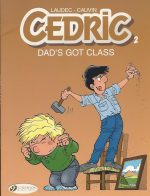
Cedric volume 2: Dad’s Got Class


By Laudec & Cauvin with colours by Leonardo and translated by Erica Jeffrey (Cinebook)
ISBN: 978-1-84918-003-0

Raoul Cauvin is one of Europe’s most successful comics scripters. Born in Antoing, Belgium in 1938, he joined publishing giant Dupuis’ animation department in 1960 after studying the dying – and much-missed – print production technique of Lithography.

Happily, he quickly discovered his true calling – comedy writing – and began a glittering, prolific career at Spirou where he devised (with Salvérius) the astoundingly successful Bluecoats as well as dozens of other long-running, award winning series such as Sammy, Les Femmes en Blanc, Boulouloum et Guiliguili, Cupidon, Pauvre Lampil and Agent 212: cumulatively shifting more than 240 separate albums. Bluecoats alone has sold in excess of 15 million copies thus far.

His collaborator on sharp, witty yet kid-friendly family strip Cédric is Italian born, Belgium-raised Tony de Luca who studied electro-mechanics and toiled as an industrial draughtsman until he could make his break into comics.

Following a few fanzine efforts in the late 1970s, Laudec landed soap-style series Les Contes de Curé-la-Fl’ûte at Spirou in 1979. He built it into a brace of extended war-time serials (L’an 40 in 1983 and Marché Noir et Bottes à Clous in 1985) whilst working his way around many of the title’s other strips.

In 1987 Laudec united with Cauvin on the first Cédric shorts and the rest is history… and science and geography and PE and…

We have Dennis the Menace (the Americans have one too but he’s just not the same) whilst the French-speaking world has Cédric: an adorable lovesick rapscallion with a heart of gold and an irresistible streak of mischief dogging his heels. Collected albums of the variable-length strips – ranging from a ½ page to half a dozen – began appearing in 1989 (with 29 released so far) and are always amongst the most popular and best-selling on the Continent, as is the animated TV show spun off from the strip.

This second Cinebook translation – from 2009 and originally continentally released as Cédric 4: Papa a de la classe – hauls straight in to the action as the little lout is invited to a party at the palatial home of posh-boy and romantic rival The Right Honourable Alphonse Andre Jones-Tarrington-Dupree…

Previously, overly-imaginative Cedric had been utterly enamoured of his teacher Miss Nelly but once new girl Chen joined the class Cedric’s life changed forever. She’s different; her skin isn’t the same colour as everybody else’s and she talks really funny. He just can’t stop thinking about her…

All’s fair in love and war as ‘Milady and the Geisha’ finds Dupree tricking Cedric into wearing the most embarrassing fancy dress costume imaginable, only to see his devilish scheme badly backfire, after which ‘There are Flakes, and then there are Flakes…’ reveals how not everything falling from the sky is snow, before ‘Cats, Cats, Cats…’ sees Cedric and best pal Christian try to extort extra New Year’s gifts from feline fancier Aunt Jean only to fall at the first hurdle…

A young man’s first encounter with grooming products and cologne is always a heady experience and the ‘The A-Scent of Man’ shows the result of Cedric’s lack of impulse control whilst the grown-ups take centre stage in ‘A Story That’ll Make Your Hair Stand Up Straight’ as Grandpa starts dangerously criticising his useless son-in-law’s visit to a tonsorial stylist, after which ‘To Each His Own’ renews the simmering war after each tries and fails to hang a picture on the living room wall…

When Chen gets ill, Cedric goes to extreme efforts to be with and be like her in ‘Love, Love, Love’ before ‘Tails of All Sorts’ finds Cedric and Grandpa checking out each other’s romantic fascinations…

Kicking and screaming, Cedric is forced into the local Cub Scout group, and even after yomping all over the countryside in ‘Valderee, Valderah’ uses every opportunity to sabotage the experience. Just as he’s being kicked out, however, the Girl Guides march past with little Chen happily with them in line.

When she becomes obsessed with her headphones, Cedric decides to record a message for darling Chen, but his delivery is no match for his heartfelt enthusiasm in ‘Message Not Received’ and, after Mum and Dad have one of those blazing row over nothing, Grandpa has to explain a few painful facts of life about ‘The Big Scene’ to the appalled kid…

‘Hair Apparent’ deals with the 8-year-old’s first attempt at shaving whilst ‘A Tough Choice’ finds the cash-strapped kid having to choose between a present for Mum or Chen before the episodic antics close on a slapstick high note as another Cubs camping trip is disrupted as ‘A Man Misses His Calling’ sees Cedric seemingly lost in the woods…

Rapid-paced, warm and witty, the exploits of this painfully keen, adorably amorous scallywag are a charming example of how all little boys are just the same and infinitely unique. Cedric is a splendid family-oriented strip perfect for enticing youngsters and old folk alike…
© Dupuis 1991 by Cauvin & Laudec. All rights reserved. English translation © 2009 Cinebook Ltd.

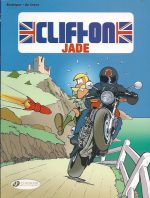
Clifton Volume 5: Jade


By Rodrigue & de Groot, translated by Luke Spear (Cinebook)
ISBN: 978-1-905460-52-6

An infallible agent of Her Majesty’s assorted security forces, Clifton was created by Raymond Macherot (Chaminou, Les croquillards, Chlorophylle, Sibylline) for the weekly Tintin. Our doughty exemplar of Albion debuted in December 1959, just as a filmic 007 was preparing to set the world ablaze and get everyone hooked on spycraft…

After three albums worth of strip material – all compiled and released in 1959-1960 – Macherot left Tintin for arch-rival Spirou and his bombastic buffoon was benched.

Tintin revived him at the height of the Swinging London scene and aforementioned spy-boom, courtesy of Jo-El Azaza & Greg (Michel Régnier). Those strips were subsequently collected as Les lutins diaboliques in French and De duivelse dwergen for Dutch-speakers in 1969.

Then it was back into retirement until 1971 when – Greg – with artist Joseph Loeckx – took another shot. He toiled on the True Brit until 1973 when Bob De Groot & illustrator Philippe “Turk” Liegeois fully regenerated the be-whiskered wonder. They produced ten more tales after which, from 1984 on, artist Bernard Dumont (AKA Bédu) limned de Groot’s scripts before eventually assuming the writing chores as well. The series concluded in 1995.

…But Never Say Never Again…

In keeping with its rather haphazard Modus Operandi and indomitably undying nature, the Clifton experience resumed yet again in 2003, crafted now by De Groot & Michel Rodrigue for four further adventures. Although the humorous visual vein was still heavily mined in these tales, the emphasis was subtly shifted and the action/adventure components strongly emphasised…

Originally released in 2003, Jade was Rodrigue & De Groot’s first collaboration and signalled a fresh start with all the fans’ favourite bits augmented by a stunning new partner for the old war-horse…

Bob de Groot was born in Brussels in 1941, to French and Dutch parents. As a young man he became art assistant to Maurice Tillieux on Félix, before creating his own short works for Pilote. A rising star in the 1960s, he drew 4 × 8 = 32 L’Agent Caméléon where he met Philippe “Turk” Liegeois, and consequently began making a slow transition from artist to writer. Together they created Archimède, Robin Dubois and Léonard before eventually inheriting Raymond Macherot’s moribund Clifton.

In 1989 de Groot – with Jacques Landrain – devised Digitaline, a strong contender for the first comic created entirely on a computer, and co-created Doggyguard with Michel Rodrigue, even whilst prolifically working with the legendary Morris on both Lucky Luke and its canine comedy spin-off Rantanplan.

He’s still going strong with strips such as Leonard in Eppo, Père Noël & Fils and Le Bar des acariens (both published by Glénat) and much more.

Michel Rodrigue really, really likes Rugby. He was born in Lyon in 1961 and eventually pursued higher education at the National School of Fine Arts, where he also studied medieval archaeology.

From 1983-85 he was part of the French Rugby team and in 1987 designed France’s mascot for the World Cup. He made his comics debut in 1984 with sports (guess which one) strip Mézydugnac in Midi Olympique. After illustrating an adaptation of Edmond Rostand’s Cyrano de Bergerac in 1986 he and collaborator Jean-Claude Vruble produced a volume of La Révolution Française, scripted by Patrick Cothias.

Rodrigue then joined Roger Brunel on Rugby en B.D., Du Monde dans la Coupe!, Concept, Le Rugby en Coupe and La Foot par la Bande.

For Tintin he drew Bom’s Les Conspirateurs and produced Rugbyman, the official monthly of the French Rugby Federation, amongst a welter of other strips. Along the way he began scripting too, and after working with de Groot on Doggyguard joined him on the revived Clifton.

He also remains astonishingly creatively occupied, working on Ly-Noock with André Chéret, Brèves de Rugby, La Grande Trambouille des Fées for René Hausmann, Futurama comics, Cubitus with Pierre Aucaigne, and many more…

Pompous, irascible Colonel Sir Harold Wilberforce Clifton is ex-RAF, a former officer with the Metropolitan Police Constabulary and recently retired from MI5. He has a great deal of difficulty dealing with being put out to pasture in rural Puddington and takes every opportunity to get back in the saddle, assisting the Government or needy individuals as an amateur sleuth whenever the opportunity arises. He occupies his idle hours with as many good deeds as befit a man of his standing and service…

In his revived incarnation the balance between satirical comedy, blistering adventure and sinister intrigue is carefully judged and this re-introductory tale begins with the old soldier and his contentiously fiery, multi-talented housekeeper Mrs. Partridge preparing for a camping trip.

Clifton is taking the local scout troop to Wales, but a few last-minute minor catastrophes are testing his patience and turning the air blue with extremely imaginative invective. The unflappable Mrs. P is able to offset them all – thanks to a family connection in the army surplus business – and soon the Colonel is ready to set off.

Plans change at the very last minute when a shadowy figure leaves a letter. That enigmatic messenger is painfully unaware that it is being carefully observed by another…

The message is in code, but once again la Partridge is up to the task, and Clifton adapts his plans. When the scouts board the lorry the colonel has secured, they learn that they are now heading for Devon…

Arriving at scenic Snooze-on-Pillow, Clifton gets the lads to set up camp but is soon accosted by an unctuous stranger who takes him to meet an old enemy fallen upon ignominious times…

Otto von Kartoffeln was one of Hitler’s greatest assets in the war, but now he is a feeble wreck in an old folks’ home bullied by a monster of a nurse. He doesn’t just want to talk over old times, however. The shrunken old remnant wants to share the secret location of a submarine full of Nazi treasure.

Over tea, served by a rather attractive young lady, the old soldiers’ minds go back to their earliest encounters. The tale unfolds of a U-Boat once commanded by Kartoffeln which sank off Scotland at the end of the war. He would happily have left it there forever, if not for the fact that a gang of neo-Nazis are trying to recover it and start up the Fuhrer’s madness all over again…

The old men have no conception that their teapot is bugged and avid young ears are listening with shock and awe and something else…

All too soon the restless old warrior is hurtling north: dodging bombs and ducking bullets beside an unlikely new partner. Determined on scotching a sinister plot, scuppering a vast submarine base and stopping the rise of the Fourth Reich, Clifton is aware that – as always – there are plots within plots, and amidst the frenetic death-defying action he has to keep one eye on his deadly foes and another on the people claiming to be his allies…

Still, with nothing to lose and civilisation to save, Clifton naturally does his utmost…

Funny, fast and furiously action-packed, Jade gives our Old Soldier a subtle overhaul and fresh start in a cunningly-conceived adventure romp in the grandly daft Get Smart! and Austin Powers manner; sufficient to astound and delight blockbuster addicts whilst supplying a solid line in goofy gags for laughter-addicts of every age to enjoy.
Original edition © Les Editions du Lombard (Dargaud-Lombard SA) 2003 by Rodrigue & De Groot. English translation © 2008 Cinebook Ltd.

Yakari and the Coyote


By Derib & Job, coloured by Dominque, translated by Jerome Saincantin (Cinebook)
ISBN: 978-1-84918-101-3

Children’s magazine Le Crapaud à lunettes was founded in 1964 by Swiss journalist André Jobin who then wrote for it under the pseudonym Job. Three years later he hired fellow French-Swiss artist Claude de Ribaupierre who chose the working name “Derib”. The illustrator had begun his own career as an assistant at Studio Peyo (home of Les Schtroumpfs), working on Smurfs strips for venerable weekly Spirou. Together they created the splendid Adventures of the Owl Pythagore before striking pure comics gold a few of years later with their next collaboration.

Launched in 1969, Yakari detailed the life of a young Oglala Lakota boy on the Great Plains; sometime after the introduction of horses by the Conquistadores and before the coming of the modern White Man. This year the 39th album was released: a testament to the strip’s evergreen vitality and the quality of its creators.

Overflowing with gentle whimsy, Yakari enjoys a largely bucolic existence; at one with nature and generally free from strife. For the sake of our delectation, however, the ever-changing seasons are punctuated with the odd crisis, generally resolved without fuss, fame or fanfare by a little lad who is smart, compassionate, brave… and can converse with all animals…

Derib – equally at home with enticing, comically dynamic “Marcinelle” cartoon style yarns and devastatingly compelling meta-realistic action illustrated action epics – went on to become one of the Continent’s most prolific and revered creators. It’s a crime that such groundbreaking strips as Celui-qui-est-né-deux-fois, Jo (the first comic on AIDS ever published), Pour toi, Sandra and La Grande Saga Indienne) haven’t been translated into English yet, but we still patiently wait in hope and anticipation…

Many of Derib’s stunning works over the decades feature his beloved Western themes, magnificent geographical backdrops and epic landscapes and Yakari is considered by fans and critics to be the feature which first led him to deserved mega-stardom. Originally released in 1986, Yakari et le coyote was the twelfth European album (and Cinebook’s ninth translated tome), but – as always – is both stunningly simple and effectively timeless; offering certain enjoyment from a minimum of foreknowledge…

One bright sunny day, the boy brave is playing by the river, when his trusty chums the beavers bring him a present. They have found a dilapidated birch-bark canoe and hope Yakari can repair it so they can have some real fun…

Next morning finds the lad and his human friends Rainbow and Buffalo Seed hard at work. Before long the vessel is seaworthy again and the trio are ready for their maiden voyage. As befits a proper hunter, Buffalo Seed insists on bringing his bow and arrows with him…

The current soon catches them and the kids get a huge thrill shooting roaring rapids with no more than a few bumps and a thorough soaking. They continue on in exhilarated contentment, but no one notices that the bellicose little hunter’s moccasins have vanished…

Feeling hungry, they paddle ashore far downstream and begin gathering food, where Rainbow’s search ends in a happy surprise as her foraging uncovers three coyote cubs playing tug-of-war with Buffalo Seed’s shoes. She then endures a far scarier shock when she runs into the cubs’ snarling mother…

Fleeing in terror Rainbow calls for Yakari to explain, but the pups’ magnificent father has already interceded and calmed down his over-protective mate. Admitting to swiping the footwear, the crafty one then invites the children back to meet the family and his great friend and fellow trickster crow…

After a wonderful afternoon of play the children head back to the canoe and Coyote goes hunting, but the humans now have a new problem: Buffalo Seed is missing…

In the morning Rainbow and Yakari are awoken by Coyote, who has news. Their cocky companion tried to hunt a cougar and now the bad-tempered, unreasonable, hungry beast has the human boy trapped in a cave. The foolish hunter had made the great mistake of getting too close to the big cat’s cubs…

Normally, Coyote would handle things, but cougars are their greatest rivals, and this situation needs careful handling…

Leaving Rainbow to watch mother coyote teaching her babies useful survival tricks, Yakari, Crow and Coyote – only stopping infrequently to play a few harmless jests on other animals – pick their way up a rocky cliff face where an extremely irate cat patiently waits for his elected prey to come out of the hole he’s barricaded himself in…

Back at the Sioux encampment, Yakari’s faithful steed Little Thunder had grown concerned. With the children gone for days, the pony broke out of the corral and started tracking them down. Now in the woods below far below, the wonder steed finds Rainbow and the coyote family. However Yakari and the wily papa are elsewhere, facing a rather dangerous impasse…

The irate cougar will not be reasoned with and is determined to kill Buffalo Seed. Thus, unable to overpower the brute, the new companions have devised a risky plan that should draw him away from the cave entrance long enough for the boy to get out. Sadly, even with Coyote and crow distracting the already-angry cat, the real problem will be getting away from the fast-moving hunter, once he notices he’s been fooled…

And then Yakari hears the drumming of hoofbeats…

Superbly suspenseful, joyously inventive and offering a hilarious twist to counter the tension, this is another visually stunning, seductively smart and happily heart-warming saga to delight young and old alike.

Yakari is one of the most unfailingly entertaining all-ages strip every conceived and deserves to be in every home, right beside Tintin and Asterix.
Original edition © Le Lombard (Dargaud- Lombard S. A.) 2000 Derib + Job. English translation 2011 © Cinebook Ltd.

Billy & Buddy volume 1: Remember This, Buddy?


By Jean Roba, translated by Luke Spear (Cinebook)
ISBN: 978-1-905460-91-5

Known as Boule et Bill on the Continent (or more accurately in the French speaking bits, as the Dutch and Flemish call them Bollie en Billie), this timeless and immensely popular cartoon story of a boy and his dog debuted in the Christmas 1959 edition of multinational Spirou.

It was the result of Belgian writer-artist Jean Roba (Spirou et Fantasio, La Ribambelle) putting his head together with the magazine’s Artistic Director/Ideas Man Maurice Rosy – who had also ghosted art and/or scripts on Jerry Spring, Tif et Tondu, Bobo and Attila during his decades long, productive career with the legendary periodical.

Intended as a European answer to Charles Schulz’s Peanuts, Boule et Bill would quickly go its own way and carve out a unique personality all its own, becoming Rosa’s main occupation for the next 45 years.

He tirelessly crafted more than a thousand pages of gag-strips in a beguiling idealised domestic comedy about a little lad and his rather clever Cocker Spaniel before – in 2003 – handing the art-chores over to his long-term assistant Laurent Verron. The substitute subsequently took over the writing too after the originator died in 2006.

Jean Roba was born in Schaerbeek, Belgium on July 28th 1930 and grew up reading primarily American reprint strips. He was particularly fond of Rudolph Dirks and Harold H. Knerr’s Katzenjammer Kids. After the War he began working as a jobbing illustrator before adopting the loose, free-wheeling cartooning style known as the “Marcinelle School” and joining the Spirou crew.

He followed Uderzo on Sa majesté mon mari and perfected his comics craft under Franquin on Spirou et Fantasio before launching Boule et Bill as a mini-récit (a 32-page, half-sized freebie insert) in the December 24th 1959 Spirou.

Like our own Dennis the Menace in The Beano, the strip was incredibly popular from the start and for 25 years held the coveted and prestigious back-cover spot. Older British fanboys might also recognise the art as early episodes – retitled It’s a Dog’s Life – ran in Fleetway’s Valiant from 1961 to 1965…

A cornerstone of European life, the strip has generated a live-action movie, animated TV series, computer games, permanent art gallery exhibitions, sculptures and even postage stamps. Like some select immortal Belgian comics stars, Bollie en Billie have a commemorative plaque and a street named after them in Brussels….

Large format album editions began immediately, totalling 21 volumes throughout the 1960s and 1970s. These were completely redesigned and re-released in 1980s, supplemented by a range of early reader books for the very young. Comics collections have been translated into fourteen languages and sold in excess of 25 million copies of the 32 albums to date.

Renamed Billy and Buddy, the strip debuted en Angleterre in enticing Cinebook compilations from 2009 on: introducing a standard sitcom nuclear family consisting of one bemused and long-suffering father, a warm, compassionate but painfully ditzy mother, a smart son and his genius dog which has a penchant for finding bones, puddles and trouble…

The majority of this book – Tu te rappelles, Bill? – was originally the sixth collection before being cut down and reissued as volume 17 in Europe, but here acts as the ideal vehicle to set up the characters and settings for our delight and delectation.

Inside you’ll see a non-stop parade of quick-fire quips and jests as seven-year old Billy enjoys carefree romps with four-footed friend Buddy: digging up treasure on the beach, chasing cats, learning tricks to be useful around the house and generally baffling and annoying grown-ups.

Buddy is the perfect pet for an imaginative boy, although he’s overly fond of bones and rather protective of them. He also does not understand why everyone is so keen to constantly plunge him into foul-tasting soapy water, but it’s just a sacrifice he’s prepared to make to be with Billy…

Gently-paced and filled with wry wit and potent sentiment, these captivating vignettes range from heart-warming to hilarious: a charming tribute to and argument for a child for every pet and vice versa. This is a solid, family-oriented collection of comics no one trying to introduce youngsters to the medium should be without.
Original edition © Studio Boule & Bill 2008 by Roba. English translation © 2009 Cinebook Ltd.

Blake and Mortimer: Professor Satō’s Three Formulae Part 2 – Mortimer versus Mortimer


By Edgar P. Jacobs & Bob De Moor with colours by Paul-Serge Marssignac, translated by Jerome Saincantin (Cinebook)
ISBN: 978-1-84918-303-1

Belgian Edgard Félix Pierre Jacobs (March 30th 1904-February 20th 1987) is rightly considered one of the founding fathers of the Continental comics industry. Although his output was relatively modest compared to many of his iconic contemporaries, Jacobs’ landmark serialised epic starring scientific adventurers Professor Philip Mortimer and Captain Francis Blake practically formed the backbone of the modern action-adventure comic in Europe.

His splendidly adroit, roguish yet thoroughly British adventurers were conceived and realised for the very first issue of Le Journal de Tintin in 1946, and quickly became a crucial staple of life for post-war European kids – in exactly the same way Dan Dare was for 1950s Britain.

Jacobs was born in Brussels, a precocious child perpetually drawing, but even more obsessed with music and the performing arts – especially opera. He attended a commercial school but loathed the idea of office work, so instead avidly pursued arts and drama on his graduation in 1919.

A succession of odd jobs at opera-houses (scene-painting, set decoration and even performing as both an acting and singing extra) supplemented his private performance studies, and in 1929 Jacobs won an award from the Government for classical singing.

His dreamed-of operatic career was thwarted by the Great Depression. When arts funding suffered massive cutbacks following the global stock market crash, he was compelled to pick up whatever dramatic work was going, although this did include more singing and performing.

Jacobs switched to commercial illustration in 1940, winning regular work in the magazine Bravo, as well as illustrating short stories and novels. He famously took over the syndicated Flash Gordon strip after the occupying German authorities banned Alex Raymond’s quintessentially All-American Hero and the publishers desperately sought someone to satisfactorily complete the saga.

Jacobs’ ‘Stormer Gordon’ lasted less than a month before being similarly embargoed by the Occupation fun-police, after which the man of many talents simply created his own epic science-fantasy feature in the legendary Le Rayon U: a milestone in both Belgian comics and science fiction adventure.

During this period Jacobs and Tintin creator Hergé got together, and whilst creating the weekly U Ray strip, the younger man began assisting on Tintin, colouring the original black and white strips of The Shooting Star (originally run in newspaper Le Soir) for an upcoming album collection.

By 1944 Jacobs was performing similar duties on Tintin in the Congo, Tintin in America, King Ottokar’s Sceptre and The Blue Lotus. He was also contributing to the drawing too, working on the extended epic The Seven Crystal Balls/Prisoners of the Sun.

After the war and liberation, publisher Raymond Leblanc convinced Hergé, Jacobs and a few other comicstrip stars to work for his proposed new venture. Founding publishing house Le Lombard, Leblanc also commissioned Le Journal de Tintin, an anthology comic with simultaneous editions in Belgium, France and Holland to be edited by Hergé and starring the intrepid boy reporter supplemented by a host of newer heroes.

Beside Hergé, Jacobs and writer Jacques van Melkebeke, Le Journal de Tintin featured Paul Cuvelier’s ‘Corentin’ and Jacques Laudy’s ‘The Legend of the Four Aymon Brothers’.

As revealed in an enticing, photo-packed essay closing this Cinebook volume, Blake and Mortimer were a lucky compromise. Jacobs had wanted to create a period historical drama entitled Roland the Bold but changed genres due to an overabundance of such strips…

Laudy had been a friend of Jacobs’ since their time together on Bravo, and the first instalment of the epic thriller serial ‘Le secret de l’Espadon’ starred a bluff, gruff British scientist and an English Military Intelligence officer closely modelled on Laudy himself…

The initial storyline ran from issue #1 (26th September 1946) to September 8th 1949) and cemented Jacobs’ status as a star in his own right.

In 1950, with the first 18 pages slightly redrawn, The Secret of the Swordfish became Le Lombard’s first album release, with the concluding part published three years later. The volumes were reprinted nine more times between 1955 and 1982, in addition to a single omnibus edition released in 1964.

Hergé and Jacobs purportedly suffered a split in 1947 when the former refused to grant the latter a by-line on new Tintin material they had collaborated on, but since the two remained friends for life and Jacobs continued to produce Blake and Mortimer for the weekly comic, I think it’s fair to assume that if such was the case it was a pretty minor spat. I rather suspect that the Eccentric Englishmen were simply taking up more and more of the diligent artist’s time and attention…

In 1984 The Secret of the Swordfish was reformatted and repackaged for English translation as three volumes with additional material (mostly covers from the weekly Tintin added to the story as splash pages): part of a push to win some of the lucrative Tintin and Asterix market here. Sadly the tall tomes failed to find an audience and ended after seven magnificent if under-appreciated volumes.

Now happily Cinebook have finally made the Gentleman Heroes a bankable proposition, releasing all 23 extant albums with the most recent – due to the quirks of publishing – being the original twelfth and the last one that Jacobs was involved with.

For further details please check out yesterday’s review, but suffice to say that the concluding instalment of Professor Satō’s Three Formulae was a long time coming …

Les 3 formules du professeur SatōMortimer contre Mortimer was a tragically extended affair and only credited Jacobs as writer and layout artist. The eleventh album had been serialised between September 1971 and May 1972 in Tintin after which the author simply abandoned his story due to failing health and other issues.

He died on February 20th 1987 and soon after veteran cartoonist Bob de Moor (Bart de Scheepsjongen, Monsieur Tric, Cori le Moussaillon, Balthazar, Barelli and so many others) was commissioned by his family and estate to complete his final tale from Jacob’s pencils and notes.

The concluding album was finally released in March 1990, leading to a republishing of all the earlier exploits and eventually new adventures from a variety of creative teams…

Rather than make you wait eighteen years for the conclusion, here’s E.P Jacobs’ final foray starring the beloved tour de force scientific investigators.

As described yesterday, boisterous boffin Mortimer was in Japan when urgently contacted by robotics pioneer and cyberneticist supreme Professor Akira Satō. That savant had accomplished miracles in the mass-production of highly specialised mechanoids and androids, but his discoveries – parsed down into three crucial processes and deposited in three separate banks – were being targeted by a ruthless gang led by Blake and Mortimer’s greatest enemy.

The villains had infiltrated Satō‘s home and laboratory and tried to murder Mortimer numerous times before creating a robot duplicate of the British scientist, but had been unable to stop a summons for help going out to his Secret Service ally. Now, with Blake imminently expected, the gang had to radically move up their timetable…

Captain Blake is watched from the moment he disembarks at Haneda Airport and the hidden enemies are already in place at the hotel where he is staying. The MI5 chief has the suite next to Mortimer’s, and although his old comrade is missing, finds plenty of clues as to what has happened to him. The diligent search also uncovers the video surveillance gear infesting both rooms and sets his watchers running for the exits in panic…

A hasty pursuit only leads to his own capture but, with fortune ever favouring the brave, Blake turns the tables on his foes in a deadly clash in the hotel garages and sends them all fleeing for their lives.

By the time he has connected with Police Superintendent Hasumi and briefed Colonel Mitsu of the Japanese Public Security Intelligence Agency, the assailants have vanished, but Blake is building a picture of what is going on. To end the Englishman’s threat forever, a diabolical and desperate scheme is devised: creating a second Mortimer robot to assassinate Blake…

Turncoat assistant Kim is nervous. Although he’s happy to use Professor Satō‘s incredible inventions to detain Mortimer and his former employer, the traitor is not conversant enough with the production procedures to guarantee success. Nevertheless, soon a deadly doppelganger of the British Professor is despatched to kill Blake…

Meanwhile, the real Mortimer has not been idle. With Satō‘s aid he has escaped the lab prison and rushes to intercept the android assassin, but is unaware that behind him, unqualified hands have meddled with the duplication processes and a legion of horrific misfit mechanoids are tumbling off the conveyor belts…

What follows is a succession of spectacular chases, frantic battles and a final shattering showdown between Blake, Mortimer and the man who has bedevilled their lives since the days of the Swordfish case – a fitting end to the epic adventures and, thanks to the graphic efforts of De Moor, a perfect, revitalising stepping stone for other creators to renew and continue the feature…

Rocket-paced, suspenseful and cathartically action-packed, this is an enthralling changing-of-the-guard building to an explosive conclusion and satisfying final flourish, resulting in another superbly stylish blockbuster to delight every adventure addict.

As well as the aforementioned historical overview – ‘Jacobs: 1946, the Swordfish, starting point of a masterful work’ – this Cinebook edition also includes excerpts from two other Blake & Mortimer albums plus a short biographical feature and publication chart of Jacobs’ and his successors’ efforts.
Original edition © Editions Blake & Mortimer/Studio Jacobs (Dargaud-Lombard s. a.) 1990 by E.P. Jacobs & Bob De Moor. All rights reserved. English translation © 2016 Cinebook Ltd.


Blake and Mortimer: Professor Satō’s Three Formulae Part 1 – Mortimer in Tokyo


By Edgar P. Jacobs, with colours by Paul-Serge Marssignac, translated by Jerome Saincantin (Cinebook)
ISBN: 978-1-84918-292-8

Pre-eminent fantasy raconteur Edgar P. Jacobs devised one of the greatest heroic double acts in pulp fiction: pitting his distinguished scientific adventurers Professor Philip Mortimer and Captain Francis Blake against a broad variety of perils and menaces in a sequence of stellar action-thrillers which merged science fiction scope, detective mystery suspense and supernatural thrills. The magic was made perfect through his stunning illustrations, rendered in the timeless Ligne Claire style which had made intrepid boy-reporter Tintin a global sensation.

The Doughty Duo debuted in September 1946; gracing the pages of the very first issue of Le Journal de Tintin. This was an ambitious international anthology comic with editions in Belgium, France and Holland, edited by Hergé, with his eponymous, world famous star ably supplemented by a host of new heroes and features for the rapidly-changing post-war world…

Les 3 formules du professeur Satō was a tragically extended affair and Jacob’s last hurrah. What became the eleventh album was serialised between September 1971 and May 1972 in Tintin, after which the author abandoned his story due to failing health and other personal issues.

Edgard Félix Pierre Jacobs died on February 20th 1987 and soon after Bob de Moor was commissioned by his family and estate to complete his final tale from Jacob’s pencil roughs and script notes. The concluding album was finally released in March 1990. This led to a republishing of all the earlier exploits and eventually fresh adventures from a variety of creative teams…

Here however the action opens at Haneda Airport, Tokyo where Air Traffic Controllers experience a unique problem as a UFO disrupts their carefully plotted flight courses. With disaster imminent two Starfighter jets are scrambled to pursue the meteoric anomaly and, just before they are destroyed, the pilots radio back they are being attacked by a dragon…

As the news filters around the world, renowned cyberneticist Professor Akira Satō argues with his assistant Dr. Kim, deeply remorseful that his latest breakthrough has been the cause of such tragedy. Kim only barely dissuades his Sensei from turning himself in to the authorities but is utterly unable to convince or prevent Satō from involving visiting colleague Philip Mortimer in his crisis of conscience…

The British Professor is in Kyoto attending a succession of scientific conferences, but when an ominous outsider hears of Satō’s intentions through hidden surveillance methods, the reaction is both explosive and potentially murderous…

The first Mortimer knows of the problem is when a gang of gunmen attempt to kidnap him off the streets, but after fighting them off and escaping the old warrior returns to his hotel and finds a telegram waiting for him…

An urgent request to join old friend Satō immediately seems impossible to accomplish due to stringencies of train timetabling, but an accommodating journalist overhears and offers a speedy compromise…

Mortimer is suspicious of the happy accident… but not suspicious enough…

Surviving another assassination attempt by sheer force of will, the professor is then lost in the wilds of Japan but eventually manages to battle his way to Satō’s lab outside Tokyo where he witnesses a series of astonishing sights.

His host has worked miracles in the fields of robotics – including the dragon which so recently and horrifically malfunctioned – but is at a loss to explain how his incredible creations have gone wrong at such a late stage.

Worldly-wise Mortimer soon deduces the causes: espionage and sabotage…

As the British boffin sends for his old comrade-in-arms Captain Blake, Satō is comforted by the fact that the key formulae for producing his mechanical marvels have been divided and deposited at three different banks in Tokyo. The Sensei breathes even easier after arranging that only Mortimer can retrieve them but this only prompts their hidden enemy to accelerate his plans and reveal himself as one of Mortimer’s greatest foes…

Unable to induce or force Mortimer to retrieve the scientific goldmine, the mastermind has an android double constructed to visit the banks but the rush-job breaks down before the task is completed. Now the vile villain has only more card to play before the formidable Blake arrives…

This Cinebook edition then concludes with excerpts from two other Blake & Mortimer albums (The Time Trap and a tantalising glimpse of Professor Satō’s Three Formulae Part 2) plus a short biographical feature and publication chart of Jacobs’ and his successors’ efforts to whet the appetite for further treats in store… Cunning and convoluted, this devilishly devious tale unfolds with potent authenticity and ever-escalating tension, building to an explosive conclusion which eventually took eighteen years to conclude. At least we don’t have to wait that near life-time for the epic denouement…
Original edition © Editions Blake & Mortimer/Studio Jacobs (Dargaud-Lombard S. A.) 1977 by E.P. Jacobs. All rights reserved. English translation © 2016 Cinebook Ltd.

Yoko Tsuno volume 5: The Dragon of Hong Kong


By Roger Leloup translated by Jerome Saincantin (Cinebook)
ISBN: 978-1-84918-041-2

Indomitable intellectual adventurer Yoko Tsuno debuted in Spirou in September 1970 and is still delighting regular readers and making new fans to this day. These astounding, all-action, excessively accessible exploits of the slim, slight Japanese technologist-investigator are amongst the most intoxicating, absorbing and broad-ranging comics thrillers ever created.

The globe-girdling, space-&-time-spanning episodic epic was devised by monumentally multi-talented Belgian maestro Roger Leloup who began his solo career after working as a studio assistant on Herge’s Adventures of Tintin.

Compellingly told, superbly imaginative and – no matter how implausible the premise of any individual yarn – always solidly grounded in hyper-realistic settings and underpinned by authentic, unshakably believable technology and scientific principles, Leloup’s illustrated escapades were at the forefront of a wave of strips changing the face of European comics in the mid-1970s.

That long-overdue revolution featured the rise of competent, clever and brave female protagonists, all taking their places as heroic ideals beside the boys and uniformly elevating Continental comics in the process. Happily, most of their exploits are as timelessly engaging and potently empowering now as they ever were, and none more so than the trials and tribulations of Yoko Tsuno.

Her very first outings (the still unavailable Hold-up en hi-fi, La belle et la bête and Cap 351) were mere introductory vignettes before the superbly capable engineer and her valiant but less able male comrades Pol Paris and Vic Van Steen properly hit their stride with premier full-length saga Le trio de l’étrange in 1971 with Spirou‘s May 13th issue…

Yoko’s exploits generally alternate between explosive escapades in exotic corners of our world, time-travelling jaunts and sinister deep-space sagas with the secretive, disaster-prone alien colonists from planet Vinea. However, for the majority of English translations thus far, the close encounters have been more-or-less sidelined in favour of intriguing Earthly exploits such as this gloriously gargantuan ground-shaker with hidden depths.

There have been 27 European albums to date. This tale was first serialised in 1981 (Spirou #2244-2264) and collected the following year as 16th album Le Dragon de Hong Kong. Due to the quirks of publishing it reached us Brits as Yoko’s fifth Cinebook outing: a delicious homage to monster movies displaying the technomantic trouble-shooter’s softer sentimental side…

In the years before China regained control of Hong Kong, Yoko is visiting a distant Chinese branch of the family when the boat she is travelling on is attacked by a colossal reptile. The beast is driven off but Yoko finds a claw fragment imbedded in a gunwhale and takes it to a local lab for analysis. The results are startling…

The boffin in charge declares the talon is from a creature which has been biologically manipulated. He’s seen other such samples recently, all provided by a seller in the harbour fishmarket…

On questioning the vendor, Yoko learns the oversized produce on offer comes from an abandoned typhoon-wrecked aquaculture farm on Lantau Island, but by the time she reaches the desolate area the sun is setting.

It’s a lucky break. With the growing darkness, a little girl with a lantern appears amongst the broken pens and enclosures and starts playing a flute. As Yoko watches, the scene becomes even more incredible as the sounds summon the monstrous lizard, which the child joyously addresses as Dai Loon…

Astonished, Yoko watches the girl feed the beast and make it perform tricks, but the uncanny sight becomes deadly serious when a masked man in a motorboat roars in and tries to kidnap the little miss…

Yoko’s prompt and dynamic action drives off the thug and soon the sodden wanderer is sitting in front of fire whilst little Morning Dew‘s grandfather relates the bizarre history of the scaly wonder.

It all began when a researcher from the Chinese mainland rented the enclosures from Dew’s father to use as test-beds for his experiments…

They varied in success, but when the storm came all the subjects escaped. The elderly guardian cannot explain the strange connection between the dragon and the child but worries for her safety and future as his own days are surely numbered…

Three days later, Yoko and Morning Dew are shopping in Kowloon before meeting the recently arrived Pol and Vic at the airport. The canny inventor has a few ideas about tracking the dragon and wants their technical assistance with the details…

The scheme garners almost instant rewards and the three friends are actually gently guiding the vast creature into their custody when both boat and beast are simultaneously attacked by another – even larger – sea dragon… and this one shoots fire…

And thus kicks off a spectacular and cunningly devised mystery monster-fest as our heroes uncover a cruel and deadly get-rich-quick scheme which endangers the entire region. There will be terror, destruction and tragedy before the villain is brought to book, and before the case is closed Yoko will assume one of the greatest and most rewarding responsibilities of her young life…

Complex, devious and subtly suspenseful, this fresh look at a classic plot crackles with electric excitement and delivers a powerfully moving denouement conclusion, again affirming Yoko Tsuno as a top flight troubleshooter, at home in all manner of scenarios and easily able to hold her own against any fantasy superstar you can name: as triumphantly able to apprehend swindlers and wrangle marauding monsters, aliens, mad scientists or unchecked forces of nature…

As always the most effective asset in these breathtaking tales is the astonishingly authentic and staggeringly detailed draughtsmanship and storytelling, which superbly benefits from Leloup’s diligent research and meticulous attention to detail.

The Dragon of Hong Kong is a stunning mystery mash-up which will appeal to any devotee of Holmes, Professor Challenger or Tintin.
Original edition © Dupuis, 1986 by Roger Leloup. All rights reserved. English translation 2010 © Cinebook Ltd.