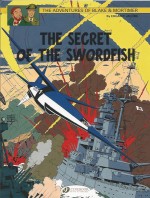
Blake and Mortimer volume 17: The Secret of the Swordfish Part 3 – SX1 Strikes Back!


By Edgar P. Jacobs, coloured by Philippe Biermé & Luce Daniels translated by Jerome Saincantin (Cinebook)
ISBN: 978-1-84918-174-7

After three years of stunning intrigue mystery and action, E.P. Jacobs’ groundbreaking saga of a battle for world peace and universal liberty concluded in a spectacular duel below the Earth and in the skies of the embattled world.

The saga concludes in SX1 Strikes Back!: a tension-drenched race against time as

Blake, Mortimer and the shattered dregs of Great Britain’s military forces prepare for a last ditch strike using the Professor’s greatest inventions to win freedom for the oppressed peoples of the world…

Brussels-born Edgar P. Jacobs was a prodigy who drew from an early age and was besotted by music and the performing arts – especially opera. After graduating commercial school in 1919, he rejected safe office work and instead avidly pursued his passions drama on his graduation.

A succession of odd jobs at opera-houses (which included everything from scene-painting to set decoration and even performing as both an acting and singing extra) supplemented private performance studies, and in 1929 Jacobs won an award from the Government for classical singing.

His dream of operatic glory was crushed by the Great Depression, and when arts funding dried up following the global stock market crash he was forced to pick up whatever dramatic work was going, although this did include more singing and performing. He moved into illustration in 1940, with regular work for Bravo magazine and some jobs for short stories and novels, and when the occupying Nazi authorities in Belgium banned Alex Raymond’s quintessentially All-American Hero Flash Gordon Jacobs famously took over the syndicated strip to complete the saga.

His ‘Stormer Gordon’ lasted less than a month before being similarly embargoed by the Occupation dictators, after which the man of many talents simply created his own epic science-fantasy feature in the legendary Le Rayon U, a milestone in both Belgian comics and science fiction adventure.

During this period Jacobs and Tintin creator Hergé got together, and whilst creating the weekly U Ray strip the younger man began assisting on Tintin, colouring the original black and white strips of The Shooting Star (originally run in newspaper Le Soir) for an upcoming album collection.

By 1944 Jacobs was performing similar duties on Tintin in the Congo, Tintin in America, King Ottokar’s Sceptre and The Blue Lotus. He was also contributing to the drawing too, working on the extended epic The Seven Crystal Balls/Prisoners of the Sun.

Following the Liberation, publisher Raymond Leblanc convinced Hergé, Jacobs and a few other comicstrip masters to work for a new venture. Founding publishing house Le Lombard, Leblanc also commissioned Le Journal de Tintin, an anthology comic with editions in Belgium, France and Holland, edited by Herge and starring the intrepid boy reporter plus a host of newer heroes.

Beside Hergé, Jacobs and writer Jacques van Melkebeke, Le Journal de Tintin featured Paul Cuvelier’s ‘Corentin’ and Jacques Laudy’s ‘The Legend of the Four Aymon Brothers’.

Laudy had been a friend of Jacobs’ since their time together on Bravo, and the epic thriller serial ‘Le secret de l’Espadon’ starred an English Military Intelligence officer closely modelled on Laudy, who worked with bluff, gruff British Boffin: Captain Francis Blake and Professor Philip Mortimer…

The premiere serial ran from issue #1 (26th September 1946 to September 8th 1949) and cemented Jacobs’ status as a star in his own right. In 1950, with the first 18 pages slightly redrawn, The Secret of the Swordfish became Le Lombard’s very first album release with the concluding part published three years later. The volumes were reprinted nine more times between 1955 and 1982, supplemented in 1964 by a single omnibus edition.

Hergé and Jacobs purportedly suffered a split in 1947 when the former refused to grant the latter a by-line on new Tintin material, but since the two remained friends for life and Jacobs continued to produce Blake and Mortimer for the weekly comic, I think it’s fair to say that if such was the case it was a pretty minor spat. I rather suspect that The Secret of the Swordfish was simply taking up more and more of the diligent artist’s time and attention…

In 1984 the story was repackaged for English translation as three volumes as part of a push to win some of the lucrative Tintin and Asterix market, but failed to find an audience. The venture ended after seven magnificent if under-appreciated volumes.

Cinebook has been publishing the later Blake and Mortimer tales since 2007 and recently completed a triptych of the very first adventure…

In The Incredible Chase and Mortimer’s Escape a hidden cabal in the Himalayas launched a global Blitzkrieg at the command of Basam-Damdu, malign Emperor of Tibet. The warlord’s arsenal of technological super-weapons were wielded by an army of the world’s wickedest rogues – such as diabolical Colonel Olrik – and their lightning sneak almost accomplished all his ambitions in one fell swoop.

Happily, English physicist Philip Mortimer and MI5 Captain Francis Blake were aware of the threat and when the attack came they narrowly escaped destruction in a devastating bomber raid…

Mortimer’s breakthrough Golden Rocket launched just as Olrik’s bombers attacked and easily outdistanced the rapacious Empire forces, leaving ruined homes behind them as they flew into a hostile world now brutally controlled by Basam-Damdu…

Seeking out British Middle East resistance forces, the fugitives’ flight ended prematurely when the Rocket crashed in the rocky wilds between Iran and Afghanistan. Parachuting to safety, Blake and Mortimer survived a host of perils and escaped capture more than once as they slowly, inexorably made their way to the distant rendezvous, before meeting British-trained native Sergeant Ahmed Nasir.

The loyal Indian had served with Blake during the last war and was delighted to see him again, but as the trio laboriously made their way to the target site, Olrik had already found it and seized their last hope…

Using commando tactics the heroes escaped in the Colonel’s own Red-Wing super-jet, but were again shot down – this time by friendly fire as anti-Lhasa rebels saw the stolen plane as an enemy target…

Surviving this crash too, the trio were ferried by the apologetic tribesmen to the enemy-occupied town of Turbat and sheltered by a friendly Khan administrator. However a faithless servant recognised the Englishmen and the Britons were ambushed…

Sending Nasir away, Blake tried valiantly frantically to save Mortimer whilst a platoon of Empire soldiers rapidly mounted the stairs to their exposed room…

Mortimer’s Escape saw the heroes initially avoid capture and flee Turbat, which was torn apart by a furious spontaneous rebellion but, unknown to the fugitives, the spy Bezendjas was hard on their heels. Moreover with the city in flames and fighting in every street the callous Colonel Olrik abandoned his own troops to pursue Nasir, Blake and Mortimer into the wastes beyond the walls…

After days of relentless pursuit they reached the rocky coastline where Blake realised that he had lost precious plans and documents he have been carrying since they fled England…

Knowing that somebody must reach the British resistance at their hidden Eastern base, the comrades split up, with Blake and Nasir going onwards whilst Mortimer returned for the plans. Finding them was sheer good fortune, but being found by Olrik’s troops was not. Despite a Horatian last stand the scientist was taken prisoner… but only after first successfully hiding the priceless documents…

Months later Olrik was called to account by Basam-Damdu’s ruling council, increasingly incensed with the Colonel’s lack of progress in breaking the captive scientist and even more infuriated by a tidal-wave of sabotage and armed rebellion throughout their freshly-conquered territories.

Olrik’s realised that his days as an agent of the Yellow Empire might be numbered…

Given days to make Mortimer talk, the Colonel returned to his base just as another rebel raid allowed Nasir to infiltrate the HQ. Blake was also abroad, having joined British resistance forces in the area.

A British submarine was roving the area, launched from a vast atomic-powered secret installation under the Straits of Hormuz, where the Royal Navy were preparing for a massive counter-attack. With daring raids freeing interned soldiers all the time, the ranks of scientists, technicians and soldiers were swelling daily…

Meanwhile, Nasir was working to free Mortimer, who was still adamantly refusing to talk of the mysterious “Swordfish” Olrik’s agents continually heard rumours of…

When devious Doctor Sun Fo arrived to interrogate him, the Professor explosively escaped into the fortress grounds during an earth-shattering storm. Trapped in a tower with only a handgun, he was determined to sell his life dearly, but was rescued by Blake and Nasir in a Navy Helicopter.

Using the storm for cover the heroes evaded jet pursuit and a naval sweep to link up with the British sub and escape into the night…

The final chapter opens with a stunning reprise of past events – cunningly compiled from a succession of six full page illustrations and presumably original covers from the weekly Le Journal de Tintin – after which a daring commando raid liberates a trainload of British prisoners.

Brought to a fabulous subterranean secret base, the assorted scientists and engineers discover an underground railway, factory, armaments facilities and even an atomic pile, all furiously toiling to complete the mysterious super-weapon dubbed “Swordfish”.

The former prisoners all readily join the volunteers, blithely unaware that supremely capable scoundrel Olrik is amongst them in a cunning disguise.

Days pass and as preparations for the Big Push produce satisfactory results, a series of disastrous accidents soon leads to one inescapable conclusion: there is a saboteur in the citadel…

Eventually Olrik becomes overconfident and Mortimer exposes the infiltrator in a crafty trap, but after a fraught confrontation the Colonel escapes after almost causing a nuclear catastrophe. Fleeing across the seabed, the harried spy narrowly avoids capture by diver teams and even a hungry giant octopus…

The flight takes its toll upon Olrik and he barely reaches land alive. Luckily for him Bezendjas had been checking out that region of coastline and finds the exhausted villain trapped in his stolen deep-sea diver suit. After a lengthy period the dazed desperado recovers and delivers his hard-won information. Soon Imperial forces are converging on the British bastion…

As air and sea forces bombard the rocky island and sea-floor citadel, Olrik dispatches crack troops to break in via a concealed land entrance, resulting in a staggering battle in the depths of the Earth.

They were almost in time…

After months of desperate struggle, Mortimer and his liberated scientists have rushed to complete the incredible Swordfish: a hypersonic attack jet with uncanny manoeuvrability and appallingly destructive armament.

Astoundingly launched from beneath the sea, the sleekly sinister plane single-handedly shoots the Empire jets out of the skies before sinking dozens of the attacking naval vessels. Ruthlessly piloting SX1 is Francis Blake; and even as he wreaks havoc upon the invading force he is joined by SX2 – a second equally unstoppable super-jet…

Soon the Yellow Empire is in full retreat and a squadron of Swordfish is completed. With the once-occupied planet in full revolt, it’s not long before Lhasa gets a taste of the flaming death it callously inflicted upon a peaceful, unsuspecting and now most vengeful world…

They were only just in time: the insane and malignant Emperor was mere moments away from launching a doomsday flight of atomic missiles to every corner of the planet he so briefly owned…

Gripping and fantastic in the truest tradition of pulp sci-fi and Boy’s Own Adventures, Blake and Mortimer are the very epitome of dogged heroic determination; always delivering grand, old-fashioned Blood-&-Thunder thrills and spills in timeless fashion and with astonishing visual punch. Despite the epic body count and dated milieu, any kid able to suspend modern mores and cultural disbelief (call it alternate earth history or bakelite-punk if you want) will experience the adventure of their lives… and so will their children.

This Cinebook edition also includes a fascinating illustrated essay ‘Jacobs: 1946, The Swordfish, starting point of a masterful work’ first seen in The World of Edgar P. Jacobs, a tantalising preview of new adventure The Oath of the Five Lords (by Yves Sente & André Juillard) plus a biographical feature and chronological publication chart of Jacobs’ and his successors’ efforts.

Original editions © Editions Blake & Mortimer/Studio Jacobs (Dargaud – Lombard s.a.). © 1986 by E.P. Jacobs. All rights reserved. English translation © 2013 Cinebook Ltd.

Good-Bye and Other Stories


By Yoshihiro Tatsumi (Catalan Communications)
ISBN: 0-87416-056-1

Don’t believe your loved ones: sometimes size really does make a difference.

Shuffling along my seemingly infinite shelves the other day I spotted a graphic album I haven’t really looked at in years.

It was an album-sized (275x210mm) black-&-white collection of Japanese human-interest dramas translated into English from a Spanish compilation and was, when I bought it, my first introduction to the incredible creative force that is Yoshihiro Tatsumi.

Since then I’ve become familiar with most of his translated works but the other day was the first time that I’ve actually compared the scale of his art in traditional manga formats with the big, bold nigh-abstract expansions of a really expansive page.

The sheer emotional power delivered by going large is just incomprehensible…

Beginning in the 1950s, compulsive storyteller Yoshihiro Tatsumi worked at the edges of the burgeoning Japanese comics industry, toiling for whoever would hire him, whilst producing an absolutely vast canon of deeply personal, agonisingly honest and blisteringly incisive cartoon critiques.

These dissections, queries and homages remorselessly explored the Human Condition as endured by the lowest of the low in a beaten nation and shamed culture which utterly, ferociously and ruthlessly re-invented itself during his lifetime.

Tatsumi was born in 1935 and after surviving war and the reconstruction of Japan he devoted most of his life to mastering – if not inventing – a new form of comics storytelling, now known universally as Gekiga or “Dramatic Pictures”.

This was in contrast to the flashy and fancifully escapist entertainment of Manga – which translates as “Irresponsible” or “Foolish Pictures” – and specifically targeted children in the years immediately following the cessation of hostilities.

If he couldn’t find a sympathetic Editor, Tatsumi self-published his darkly beguiling wares in Dōjinshi or “Vanity projects” where his often open-ended, morally ambiguous, subtly subversive underground comics literature gradually grew to prominence; especially as those bland funnybook-consuming kids grew up in a socially-repressed, culturally-occupied country and began to rebel.

Topmost amongst their key concerns were Cold War politics, the Vietnam War, ubiquitous inequality and iniquitous distribution of wealth and opportunity, so the teen upstarts sought out material that addressed their maturing sensibilities and found it in the works of Tatsumi and a growing band of deadly serious cartoonists with something to say…

Since reading comics beyond childhood was seen as an act of rebellion – like digging Rock ‘n’ Roll a decade earlier in the USA and Britain – these kids became known as the “Manga Generation” and their growing influence allowed comics creators to grow beyond the commercial limits of their industry and tackle adult stories and themes in what rapidly became a bone fide art form.

Even “God of Comics” Osamu Tezuka eventually found his mature author’s voice in Gekiga…

Tatsumi uses art as a symbolic tool, with an instantly recognisable repertory company of characters pressed into service over and again as archetypes and human abstracts of certain unchanging societal aspects and responses. Moreover, he has a mesmerising ability to portray situations with no clean or clear-cut resolution: the tension and sublime efficacy revolves around carrying the reader to the moment of ultimate emotional crisis and leaving you suspended there…

Narrative themes of sexual frustration, falls from grace or security, loss of heritage and pride, human obsolescence, claustrophobia and dislocation, obsession, provincialism, impotence, loneliness, poverty and desperate acts of protest are perpetually explored by a succession of anonymous bar girls, powerless men, grasping spouses, ineffectual loners, wheedling, ungrateful family dependents and ethically intransigent protagonists through recurring motifs such as illness, forced retirement, disabled labourers and sexual inadequacy all lurking in ramshackle dwellings, endless dirty alleyways, tawdry bars and sewers too often obstructed by discarded lives and dead babies…

Following an expansive discourse on ‘Japanese Comics’ by José Mariá Carandell, the well-travelled dramas begin with ‘Just a Man’ as, at the end of his working life, Mr. Manayana is sidelined by all the younger workers: all except kind Ms. Okawa whose kindly solicitousness rekindles crude urgings in the former soldier and elderly executive. With his wife and daughter already planning how to spend his pension, Manayana rebels and blows it all on wine, women and song, but even when he achieves the impossible manly dream with the ineffable Ms. Okawa, he is plagued by impotence and guilt…

‘The Telescope’ then brings a crippled man too close to an aging exhibitionist who needs to be seen conquering young women, leading only to recrimination and self-destruction…

In ‘Life is So Sad!‘ a junior and senior bar girl clean up after the night’s toil, but young Akemi is clumsily preoccupied…

It’s time to visit her husband in prison. He is a changed, fierce and brutalised man and doesn’t believe she has kept herself for him all these years. When he threatens to become her pimp after his release, she is reluctantly forced to take extreme action…

Down in ‘The Sewers’ whilst daily unclogging the city’s mains, a harassed young man finds himself no longer reacting to the horror of what the people above discard: baskets, boxes, babies… even when the deceased detritus is his own…

‘Just Passing Through’ sees Kyoko return to her husband and mother-in-law after an unexplained 2-year absence. Nothing has changed. Her forgiving man froze time on the day she vanished: even the calendar has not moved a single day.

As he patiently rejoices in her return Kyoko realises the horrific passive-aggressive nature of his gesture and heads once more for the door…

‘Progress is Wonderful!’ sees an over-worked sperm donor foolishly allowing his latest “inspiration” to get too close with catastrophic results, after which the semi-autobiographical and eponymous ‘Good-Bye’ describes the declining relationship between prostitute “Maria” – who courts social ignominy by going with the American GI Joes – and her dissolute father; once a proud soldier of Japan’s beaten army, now reduced to cadging cash and favours from her.

Her dreams of escape to America are shattered one day and in her turmoil she pushes her father too far and he commits an act there’s no coming back from…

‘Unwanted’ brings the volume to conclusion by relating the inevitable fate of a placard carrier advertising a seedy massage parlour. Why can he get on with tawdry prostitutes of the street but not his own wife, with her constant carping about her unwanted pregnancy? Why is murder the only rational option?

This epic volume was, it transpires, wholly unauthorised but I was blown away by the seductive and wholly entrancing simplicity of Mr. Tatsumi’s storytelling and bleak, humanist subject matter.

Now that I know just when these stark, wry, bittersweet vignettes, episodes and stories of cultural and social realism were first drawn (between 1969-1977) it seems as if a lone voice in Japanese comics had independently and synchronistically joined the revolution of Cinéma vérité and the Kitchen Sink Dramas of playwrights and directors like John Osborne, Tony Richardson and Lindsay Anderson – not to mention Ken Loach and Joe Orton – which gripped the West in the 1960s and which have shaped the critical and creative faculties of so many artists and creators ever since.

Tatsumi, like Robert Crumb and Harvey Pekar, worked for decades in relative isolation producing compelling, bold, beguiling, sordid, intimate, wryly humorous, heartbreaking and utterly uncompromising strips dealing with uncomfortable realities, social alienation, excoriating self-examination and the nastiest and most honest arenas of human experience. They can in fact be seen as brother auteurs and indeed inventors of the “literary” or alternative field of graphic narrative which, whilst largely sidelined for most of their working lives, has finally emerged as the most important and widely accepted avenue of the comics medium.

These are stories no serious exponent or fan of comics can afford to miss… and they’re even better printed bigger…
© 1987 Yoshihiro Tatsumi. All Rights Reserved.

Blake and Mortimer volume 16: The Secret of the Swordfish Part 2 – Mortimer’s Escape


By Edgar P. Jacobs, coloured by Philippe Biermé & Luce Daniels translated by Jerome Saincantin (Cinebook)
ISBN: 978-1-84918-161-7

Belgian Edgard Félix Pierre Jacobs (March 30th 1904-February 20th 1987) is rightly considered to be one of the founding fathers of the Continental comics industry. Although his output is relatively modest compared to most of his iconic contemporaries, the landmark serialised epic he created practically formed the backbone of the straight action-adventure comic in Europe, and his splendidly adroit yet roguish and thoroughly British adventurers Blake and Mortimer, conceived and realised for the very first issue of Le Journal de Tintin in 1946, swiftly became an crucial staple of post-war European kids’ life, in exactly the same way that Dan Dare was in 1950s Britain.

Edgar P. Jacobs was born in Brussels, a precocious child who was always drawing but was even more obsessed with music and the performing arts – especially opera. He attended a commercial school but loathed the idea of office work and instead avidly pursued the arts and drama on his graduation in 1919.

A succession of odd jobs at opera-houses (scene-painting, set decoration and even performing as both an acting and singing extra) supplemented his private performance studies, and in 1929 Jacobs won an award from the Government for classical singing.

His dreamed-of operatic career was thwarted by the Great Depression. When arts funding suffered massive cutbacks following the global stock market crash, he was compelled to pick up whatever dramatic work was going, although this did include more singing and performing.

Jacobs switched to commercial illustration in 1940, winning regular work in the magazine Bravo, as well as illustrating short stories and novels. He famously took over the syndicated Flash Gordon strip when the occupying German authorities banned Alex Raymond’s quintessentially All-American Hero and the publishers desperately needed someone to satisfactorily complete the saga.

Jacobs’ ‘Stormer Gordon’ lasted less than a month before being similarly embargoed by the Occupation dictators, after which the man of many talents simply created his own epic science-fantasy feature in the legendary Le Rayon U, a milestone in both Belgian comics and science fiction adventure.

During this period Jacobs and Tintin creator Hergé got together, and whilst creating the weekly U Ray strip, the younger man began assisting on Tintin, colouring the original black and white strips of The Shooting Star (originally run in newspaper Le Soir) for an upcoming album collection.

By 1944 Jacobs was performing similar duties on Tintin in the Congo, Tintin in America, King Ottokar’s Sceptre and The Blue Lotus. He was also contributing to the drawing too, working on the extended epic The Seven Crystal Balls/Prisoners of the Sun.

After the war and liberation, publisher Raymond Leblanc convinced Hergé, Jacobs and a few other comicstrip aristocracy to work for his proposed new venture. Founding publishing house Le Lombard, Leblanc also commissioned Le Journal de Tintin, an anthology comic with simultaneous editions in Belgium, France and Holland, edited by Hergé and starring the intrepid boy reporter plus a host of newer heroes.

Beside Hergé, Jacobs and writer Jacques van Melkebeke, Le Journal de Tintin featured Paul Cuvelier’s ‘Corentin’ and Jacques Laudy’s ‘The Legend of the Four Aymon Brothers’.

Laudy had been a friend of Jacobs’ since their time together on Bravo, and the first instalment of the epic thriller serial ‘Le secret de l’Espadon’ starred a bluff, gruff British scientist and an English Military Intelligence officer (who was closely modelled on Laudy): Professor Philip Mortimer and Captain Francis Blake…

The initial storyline ran from issue #1 (26th September 1946 to September 8th 1949) and cemented Jacobs’ status as a star in his own right. In 1950, with the first 18 pages slightly redrawn, The Secret of the Swordfish became Le Lombard’s first album release with the concluding part published three years later. These volumes were reprinted nine more times between 1955 and 1982 in addition to a single omnibus edition released in 1964.

Hergé and Jacobs purportedly suffered a split in 1947 when the former refused to grant the latter a by-line on new Tintin material, but since the two remained friends for life and Jacobs continued to produce Blake and Mortimer for the weekly comic, I think it’s fair to say that if such was the case it was a pretty minor spat. I rather suspect that The Secret of the Swordfish was simply taking up more and more of the diligent artist’s time and attention…

In 1984 the story was reformatted and repackaged for English translation as three volumes with additional material (mostly covers from the weekly Tintin added to the story as splash pages) as part of a push to win some of the lucrative Tintin and Asterix market here, but failed to find an audience and ended after seven magnificent if under-appreciated volumes.

Now happily Cinebook has finally released the tale – albeit after publishing many later adventures first – and this second instalment carries the tale of the struggle against world domination to next epic level…

Although all the subsequent Blake and Mortimer sagas have been wonderfully retranslated and published by Cinebook in recent years, this initial epic introductory adventure and its concluding two volumes remained frustratingly in the back-issue twilight zone, possibly due to their superficial embracing of the prevailing prejudices of the time.

By having the overarching enemies of mankind be a secret Asiatic “Yellow Peril” empire of evil, there is some potential for offence – unless one actually reads the books to find that any presumed racism is countered throughout by an equal amount of “good” ethnic people and “evil” white folk, so please if you have any doubts please quell them and get these books….

Here and now, however, let’s recap The Incredible Chase, wherein a clandestine clique in the Himalayas launched a global Blitzkrieg at the command of Basam-Damdu, malign Emperor of Tibet. The warlord ruled a secret cabal of belligerent conquerors, whose arsenal of technological super-weapons were wielded by an army of the world’s wickedest rogues such as the diabolical Colonel Olrik who dreamed of ruling the entire Earth, and his sneak attack almost accomplished all his schemes in one fell swoop.

Happily however, English physicist Philip Mortimer and MI5 Captain Francis Blake were aware of the threat and were already racing to finish the boffin’s radical new aircraft at a hidden British industrial complex.

When the attack came the old friends swung into immediate action and narrowly escaped destruction in a devastating bomber raid…

The Golden Rocket launched just as Olrik’s bombers attacked and easily outdistanced the rapacious Empire forces, leaving ruined homes behind them as they flew into a hostile world now brutally controlled by Basam-Damdu…

Seeking to join British Middle East resistance forces, the fugitives’ flight ended prematurely when the Rocket crashed in the rocky wilds between Iran and Afghanistan. Parachuting to safety, Blake and Mortimer survived a host of perils and escaped capture more than once as they slowly, inexorably made their way to the distant rendezvous, before meeting a British-trained native Sergeant Ahmed Nasir.

The loyal Indian had served with Blake during the last war and was delighted to see him again, but as the trio laboriously made their way to the target site, Olrik had already found it and seized their last hope…

Using commando tactics to infiltrate the enemy camp and stealing the villainous Colonel’s own Red-Wing super-jet, the heroes made their way towards a fall-back point but were again shot down – this time by friendly fire as anti-Lhasa rebels saw the stolen plane as an enemy target…

Surviving this crash too, the trio were ferried in relative safety by the apologetic tribesmen to the enemy-occupied town of Turbat and sheltered by a friendly Khan administrator. However the man’s servant, a spy of the Empire-appointed Wazir, recognised the Englishmen and Nasir realised far too late the danger they all faced…

Sending his loyal Sergeant away, Blake tried valiantly frantically to save Mortimer whilst a platoon of Empire soldiers rapidly mounted the stairs to their exposed room…

The frantic action resumes here in Mortimer’s Escape with soldiers bursting into an empty chamber before being themselves attacked by the Khan. After a bloody firefight the Englishmen emerge from their cunning hiding place and flee Turbat, which has been seized by a furious spur-of-the-moment rebellion.

Unknown to the fugitives, the devious spy Bezendjas is hard on their heels and soon finds an opportunity to inform Olrik. With the city in flames and fighting in every street the callous colonel abandons his own troops to pursue Nasir, Blake and Mortimer into the wastes beyond the walls…

On stolen horses the heroes endure all the ferocious hardships of the desert but cannot outdistance Olrik’s staff-car. After days of relentless pursuit they reach the rocky coastline and almost stumble into another Empire patrol, and whilst ducking them Blake almost falls to his doom. Narrowly escaping death, the trio continue to climb steep escarpments and it is dusk before the Intelligence Officer realises that he has lost the precious plans and documents they have been carrying since they fled England…

Realising that somebody must reach the British resistance at their hidden Eastern base, the valiant comrades split up. Blake and Nasir continue onwards whilst Mortimer returns to the accident site. Finding the plans is a stroke of sheer good fortune, immediately countered by an ambush from Olrik’s troops.

Despite a Herculean last stand the scientist is at last taken prisoner but only after successfully hiding the lost plans…

Three months later Olrik is called to account in the exotic city-fortress of Lhasa. Basam-Damdu’s ruling council are unhappy with the Colonel’s lack of progress in breaking the captive scientist, and even more infuriated by a tidal-wave of sabotage and armed rebellion throughout their newly-conquered territories. Even Olrik’s own spies are warning him that his days as an agent of the Yellow Empire might be numbered…

Given two days to make Mortimer talk, the Colonel returns to his base in Karachi just as another rebel raid allows Nasir to infiltrate the Empire’s HQ. Blake is also abroad in the city, having joined British forces in the area.

With less than a day to act, the MI5 officer rendezvous with a British submarine and travels to a vast atomic-powered secret installation under the Straits of Hormuz, where the Royal Navy are stoically preparing for a massive counter-attack on the Empire. With raids liberating interned soldiers all the time, the ranks of scientists, technicians and soldiers are swelling daily…

Meanwhile, Nasir has begun a desperate plan to free Mortimer, who is still adamantly refusing to talk of the mysterious “Swordfish” Olrik’s agents continually hear rumours of…

Aware of his danger and the Sergeant’s efforts, Mortimer instead cunningly informs Nasir of the lost plans’ location, even as the impatient Emperor’s personal torturer arrives from Lhasa…

Always concerned with the greater good, Blake and a commando team secure the concealed plans and are met by Nasir who has been forced from Karachi after realising the spy Bezendjas has recognised him. It appears that time has run out for their scholarly comrade…

Mortimer, however, has taken fate into his own hands. When the devious Doctor Sun Fo begins his interrogation, the Professor breaks free and escapes into the fortress grounds during an earth-shattering storm. Trapped in a tower with only a handgun, he is determined to sell his life dearly, but is rescued by Blake and Nasir in a Navy Helicopter.

Using the storm for cover the heroes evade jet pursuit and an enemy naval sweep to link up with a British sub and escape into the night…

To Be Concluded…

Gripping and fantastic in the best tradition of pulp sci-fi and Boy’s Own Adventures, Blake and Mortimer are the very epitome of True Brit grit and determination; always delivering grand, old-fashioned Blood-&-Thunder thrills and spills in tried and true timeless fashion and with staggering visual verve and dash. Despite the high body count and dated milieu, any kid able to suspend modern mores and cultural disbelief (call it alternate earth history or bakelite-punk if you want) will experience the adventure of their lives… and so will their children.

This Cinebook edition also includes a tantalising preview of the next volume as well as excerpts from stand-alone adventure S.O.S. Meteors, plus a biography feature which offers a chronological publication chart of Jacobs’ and his successors’ efforts and a handy comparison and chronological publishing order of the Cinebook releases.

Original editions © Editions Blake & Mortimer/Studio Jacobs (Dargaud – Lombard s.a.) 1985 by E.P. Jacobs. All rights reserved. English translation © 2013 Cinebook Ltd.

Dalton City: Lucky Luke volume 3


By Morris & Goscinny, translated by Frederick W. Nolan (CineBook)
ISBN: 978-1-905460-13-7

It’s hard to think of one of Europe’s most beloved and long-running comics characters being in any way controversial, but when the changing times caught up with the fastest gun in the West (“so fast he can outdraw his own shadow”) and the planet’s most laconic cowboy moved with them, the news made headlines all over the world.

Lucky Luke is a rangy, good-natured, lightning-fast cowboy who roams the fabulously mythic Old West, having light-hearted adventures with his horse Jolly Jumper and interacting with a host of historical and legendary figures of the genre.

His continued exploits over nearly seventy years have made him one of the best-selling comic characters in Europe (78 collected books and more than 300 million albums in 30 languages thus far), with spin-off toys, computer games, animated cartoons and even a plethora of TV shows and live-action movies.

He was created in 1946 by Belgian animator, illustrator and cartoonist Maurice de Bévère (“Morris”) for the 1947 Annual (L’Almanach Spirou 1947) of Le Journal de Spirou, before launching into his first weekly adventure ‘Arizona 1880′ on December 7th 1946.

Prior to that, while working at the CBA (Compagnie Belge d’Actualitiés) cartoon studio, Morris met future comics super-stars Franquin and Peyo, and worked for weekly magazine Le Moustique as a caricaturist – which is probably why (to my eyes at least) his lone star hero looks uncannily like the young Robert Mitchum who graced so many memorable mid-1940s B-movie Westerns.

Morris quickly became one of “la Bande des quatre” – The Gang of Four – which comprised creators Jijé, Will and his old comrade Franquin: the leading proponents of the loose and free-wheeling artistic style known as the “Marcinelle School” which dominated Spirou in aesthetic contention with the “Ligne Claire” style used by Hergé, EP Jacobs and other artists in Tintin Magazine.

In 1948 said Gang (all but Will) visited America, meeting US creators and sightseeing. Morris stayed for six years, meeting fellow traveller René Goscinny, scoring some work from the newly-formed EC sensation Mad and making copious notes and sketches of the swiftly vanishing Old West.

That research would resonate on every page of his life’s work.

Working solo until 1955, Morris produced another nine albums worth of affectionate sagebrush parody before reuniting with Goscinny, who became the regular wordsmith as Luke attained the dizzying heights of superstardom, commencing with ‘Des rails sur la Prairie’ (Rails on the Prairie), which began in Spirou on August 25th 1955.

In 1967 the six-gun straight-shooter switched teams, transferring to Goscinny’s own magazine Pilote with ‘La Diligence’ (The Stagecoach). Goscinny produced 45 albums with Morris before his death, from whence Morris continued both singly and with fresh collaborators.

Morris died in 2001 having drawn fully 70 adventures, plus the spin-off adventures of Rantanplan (“dumbest dog in the West” and a charming spoof of cinema canine Rin-Tin-Tin), with Achdé, Laurent Gerra, Benacquista & Pennac taking over the franchise, producing another five tales to date.

Moreover, apart from that very first adventure, Lucky (to appropriate a quote applied to the thematically simpatico Alias Smith and Jones) “in all that time… never shot or killed anyone”…

Lucky Luke first appeared in Britain syndicated to weekly comic Film Fun and again in 1967 in Giggle where he was renamed Buck Bingo. In all these venues – as well as the numerous attempts to follow the English-language successes of Tintin and Asterix albums from Brockhampton and Knight Books – Luke had a trademark cigarette hanging insouciantly from his lip, but in 1983 Morris, no doubt amidst both pained howls and muted mutterings of “political correctness gone mad”, substituted a piece of straw for the much-travelled dog-end, which garnered him an official tip of the hat from the World Health Organization.

The most recent attempt to bring Lucky Luke to our shores and shelves comes from Cinebook (who have rightly restored the foul weed to his lips on the interior pages if not the covers…) and Dalton City was the third of 50 albums (and counting), available both on paper and as e-book editions.

It was the 34th comic cowboy chronicle and Goscinny’s 25th collaboration with Morris, originally appearing in 1969 and featuring the first appearance of that most stupid of do-gooding doggy sidekicks Rantanplan. You have been warned…

The saga commences in Fenton Town, a city of utter depravity and villainy run by and for crooks, badmen and owlhoots by the cunning mastermind Dean Fenton; a mean man with the unsavoury hobby of collecting Sheriff’s stars… from their bullet-riddled bodies…

The night a lean, laconic lone rider ambled into town the murderous gambler’s fortunes changed forever, and when Luke spectacularly delivered the gang boss to justice, Fenton got 1223 years hard labour at Texas penitentiary, an imposing edifice already crammed with dozens of other varmints who failed to take Lucky Luke seriously.

And that’s where the trouble really starts…

Amongst the inmates are stupid sandbagging scallywags Averell, Jack and William Dalton and their smart, psychotic, bossy and short brother Joe, who had made things hot for our hero in the past. As they all crack rocks together the Dalton Gang are particularly influenced by Fenton’s tales of his little kingdom.

Contentedly ambling away from the prison, Luke and Jolly Jumper have no idea that an idiotic, incompetent telegraph operator is about to make their lives impossibly difficult. Handed a mis-transcribed message from the Governor to free inmate Joe Milton for Good Behaviour, the baffled Warden forcibly ejects the furiously insulted Dalton head honcho. Eventually calming down – at least as much as Joe Dalton ever can – the wily skunk promptly blows up an outer wall to liberate his scurrilous simpleton siblings and they all make tracks for the now-deserted Fenton Town.

Search parties of course trail them, but when vain, friendly and exceedingly dim prison hound Rin Tin Can absently-mindedly forgets himself and joins his quarry, the shame-faced guards have to return empty-handed…

Regretfully the Warden sends a telegram to Lucky Luke – again appallingly garbled – and the normally unflappable gunhawk is less than amused. It takes the pleadings of the Governor of Texas himself to convince him to go after his old enemies…

In the renamed DaltonCity, Joe and the boys have big plans. They’re going to operate a Mecca for all the criminals in the state: a safe place for badmen to hide and spend their stolen loot. Joe will be in charge, Jack will operate the hotel, William the stables and Averell will run the restaurant.

He even has faithful, omnivorous Rin Tin Can to test all his recipes on…

After much unlikely and unfamiliar had work the place is starting to come together when they get an even bigger boost by capturing their nemesis Lucky Luke spying on them. The hero had forgotten how stupid Rin Tin Can could be…

The hapless prisoner is then put to work testing their wares: surely if the service is good enough for Luke it will be perfect for the scum of the West? However the boys make the foolish mistake of listening to his suggestions for improvement…

The beginning of the end comes when Joe writes off to hire a singer and troupe of dancing girls. When the bombastic virago Lulu Breechloader and her associates Belle, Sugar Linda and Pearl arrive Lucky has all he needs to drive an amorous wedge into the solidarity of the felonious fellowship and, as an army of bandits and killers steadily roll into town looking for sanctuary and entertainment, they are invited to the wedding of the century…

The only persons unaware of the impending – and hard-fought for – nuptials of Joe Dalton and Lulu are the bride herself and her blithely unaware piano-playing husband…

In the ensuing chaos and explosive gunplay it isn’t hard for a smart cowboy crusader to make the biggest capture of wanted criminals in Texas’ history and ride off into the sunset with a new four-footed canine companion…

Once again the masterful wit and wicked deviousness of the indomitable hero triumphs in a splendidly intoxicating blend of all-ages action, seductive slapstick and wry cynical humour.

This is a grand old hoot in the tradition of Destry Rides again and Support Your Local Sheriff (or perhaps Paint Your Wagon, Evil Roy Slade or Cat Ballou are more your style?), superbly executed by master storytellers, and a wonderful introduction to a unique genre for modern kids who might well have missed the romantic allure of the Wild West that never was…

And in case you’re worried, even though the interior art still has our hero chawin’ on that ol’ nicotine stick, trust me, there’s very little chance of anyone craving a quick snout, but quite a high probability that they’ll be addicted to Lucky Luke Albums…

© Dargaud Editeur Paris 1969 by Goscinny & Morris. © Lucky Comics.

English translation © 2006 Cinebook Ltd. This is the new 4th printing, 2014.

Kiddo


By Antoine Cossé (Records Records Records Books)
ISBN: 978-0-9566330-1-9

Since Britain grew up and joined the rest of the world in accepting comics as a valid and viable art form, the shelves of Albion have been positively groaning with a wealth of superbly fascinating graphic narratives of all types; especially since a number of bold new publishers have either picked up and translated Asian and European material or confidently released new stuff from creators around the world.

Antoine Cossé is a French graphic storyteller living in London. He left Paris to study at Camberwell College of Arts and graduated in 2006 with a degree in illustration. He then began a seemingly non-stop barrage of moody, funny and evocative strips catering to his own need to explore the absurd, the fanciful and the unexpected lurking behind the humdrum passage of everyday lives and kindly invited a growing fan-base to join him in his explorations.

Following a number of short strips, features and collaborations, in 2012 he produced his debut graphic novel – Kiddo – for British outfit Records Records Records Books: an enigmatic, helter-skelter cartoon progression practically devoid of words which combines elements of epic dystopian science fiction with unceasing kinetic forward motion redolent in tone – if not style and content – to the ceaselessly energetic strip works of André Barbe.

Lavishly packaged as a black and white hardback (comfortingly reminiscent of those classily sturdy children’s books of my youth) the stark events unfold as a solitary man plunges through jungles and wastelands, seeking who knows what in a scary big world.

Encountering beasts, a woman, hardship, hunger, booze, a giant monster dog, war, strange phenomena and the encroaching remnants – or perhaps discards – of civilisation, he moves ever onward to a chaotic closing conundrum…

Deeply sly, beguiling reductive and intoxicatingly Primitivist, Kiddo is an irresistible  surge of purely visual drama and a mystery for its own sake which will delight all aficionados of the medium who value comics for their own sake and don’t need answers spoon-fed to them.
© 2012 Antoine Cossé. © & ℗ Records Records Records Books.

566 Frames


By Dennis Wojda (Borderline Press)
ISBN: 978-0-99269-720-4

Every now and then – but typically, not nearly often enough – the global comics scene throws out a project with the potential to redefine the industry.

Tintin, A Contract with God, Ghost World, Fun Home, Watchmen, Love and Rockets, Lone Wolf and Cub, From Hell, Fax from Sarajevo, Persepolis, Maus and some few others reached vast non comics-reading audiences in their time, serving to justify and legitimise a narrative discipline that had claimed since its creation to be an actual Art Form.

By all accounts author Dennis Wojda – already an established star of the Polish comics establishment – one day decided to do something to creatively stretch himself and opted to turn snippets of his family history into a daily cartoon on his web-page, scheduled to run for the classically significant “a year and a day”.

It proved immensely popular, so much so that publishers expressed interest in a book, but 366 panels weren’t really enough.

No problem: families always have plenty more history…

As you’ll see when you read the book, Wojda was actually born in Stockholm on March 13th 1973, before returning to Poland to become a writer, designer and graphic artist.

He’s appeared in Gazeta Wyborcza, AktiviÅ›cie, Exklusiv, Bravo, Skate, Ha! Arcie, Arena Comics and Jabber, winning plenty of praise and a few awards for such series as Mikropolis (with artist Krzysztof Gawronkiewicz: collected in two volumes as The Tourist Guide and Mohair Dreams), Chair in Hell, The Supernaturals: Miss Hofmokl’s Shoe (with Krzysztof Ostrowski), A European on the Road (written by J. Sanecka) and Ghost Kids: the Ribbon (illustrated by Sebastian Skrobol) amongst others.

At the end of 2013 British publisher Borderline Press sagely added the now expanded 566 Frames to its burgeoning stable of titles, giving English readers the opportunity to see one of the most beguiling and lyrical examples of comics autobiography ever produced…

Mixing time frames and viewpoints – including many wise pronouncements and predictions from his own time as a foetus in the womb – the tale begins and ends with the birth of the author.

In between then Dennis smoothly skips up and down the family tree, describing his pregnant mother’s drive to Sweden so that he could be born with his absent-and-working-abroad father (who was hedonistically trapped being a wandering, semi- failed pop star in Swinging Scandinavia), and the sort-of psychic grandmother who knew how, when and where to meet her…

There are memories – his and his ancestors’ – of little moments and huge crises, parties and pogroms and many, many conquests – both romantic and geopolitical – as an odd assortment of branches and buds thrive and survive under a variety of invaders and overlords from Tsarist Russians to Hitler’s Nazis to Soviet Russians: always finding that whatever may happen, the music of life plays on…

Don’t be fooled, however. This is no idle panegyric about the good old days. There’s a formidable amount of sex, death, struggle, fear, privation, terror, envy and heartbreak to season the surreal whimsy, diverted daydreams, folksy philosophy and chatty monologue…

And music: everything from Polkas to Jazz to Jimi Hendrix…

With only 566 Frames Wojda has worked his own brand of visual Magic Realism (as previously best expressed in English language comics by Gilbert Hernandez) and this wondrous, mesmerising, intoxicating invitation to share a slice of other lives and times is a book no lover of the medium or citizen of the world should miss.
© Dennis Wojda. All rights reserved.

Snowpiercer volume 2: The Explorers


By Benjamin Legrand & Jean-Marc Rochette, translated by Virginie Selavy (Titan Comics)
ISBN: 978 -1-78276-136-5

Like the times that produced it, the Franco-Belgian comics classic Le Transperceneige was a troubled and ill-starred beast. The tale was originally conceived by prolific veteran scripter and occasional cartoonist Jacques Lob to be illustrated by his Superdupont collaborator Alexis (Dominique Vallet) but the artist’s untimely death on 7th September 1977 stalled the project until 1982 when painter, comics artist and book illustrator Jean-Marc Rochette (Pinocchio, Le petit poucet, Le chat botté, Candide, Le Dépoteur de Chrysanthèmes, Edmond le Cochon, Requiem Blanc) came aboard.

The delayed apocalyptic epic then ran in À Suivre in 1982 and 1983, with a collected edition published in 1984.

Although popular the sequel was not forthcoming until long after Lob died in 1990, whereafter Benjamin Legrand took up the concept with Rochette, producing two more epic tales of the Last Train to Nowhere…

No stranger to comics, Legrand (Lone Sloane, White Requiem, Gold & Spirit) is also a major mainstream prose author and French-language translator of such luminaries as Milton Caniff, R. Crumb, Robert Ludlum, Tom Wolfe, John Grisham and Nelson DeMille amongst many others. This varied background brought an edgy thriller-writing sensibility to the austere high concept of the original dystopian tomorrow mix…

With the imminent UK release of the movie Snowpiercer, Titan Comics (whose other translated offerings include The Hunting Party, Blueberry and other assorted classics by Enki Bilal, Moebius and others) have brought the entire three album masterpiece to our parochial Anglo-centric attention in two lavishly luxurious monochrome hardbacks. Both of Legrand & Rochette’s cool collaborations are here combined into a stunning collection of bleak and chilling End of the World turmoil: in one stunning, sturdy volume, as a companion to Snowpiercer book 1: The Escape.

In that original tale a new Ice Age had instantaneously descended over Earth and a microcosm of humanity rushed onto a vast vacation super-train repurposed as an ever-running ark of survival. As that monolithic futuristic engine began a never-ending circumambulation on tracks originally designed to offer the idle rich the ultimate pleasure cruise, the people rich, lucky or ruthless enough to secure a place quickly settled into their old pre-disaster niches and original divisive social stratifications.

Life continued for decades in this manner until a bold outcast named Proloff escaped from the sealed nether-end carriages, travelling the length of the 1001 cars pulled by the mysterious miracle of modern engineering. He acquired a romantic companion, clashed with the Military and Elite’s hierarchies, inadvertently sowing deadly discord until he reached the Engine herself and discovered the uncanny secret of the machine called “Olga”…

The drama now resumes in Snowpiercer book 2: The Explorers (originally serialised as Le Transperceneige: L’arpenteur in 1999) with a stunning revelation.

Soon after that train first sealed itself from the world and departed, a second, better equipped life-preserving cortège took off after it. Perpetually trailing the original, the denizens of the second Snowpiercer have also devolved into a far-from-homogeneous society: one also crippled by the overwhelming fear that they will inevitably smash into their forerunner one day…

Snowpiercer 2 has many modifications missing from the original. Designed as an icebreaker, the train also boasts radar detection systems, one-man short-hop flying modules and is able to brake and stop, allowing the hardiest individuals to debark and briefly scavenge amongst the frozen ruins of the world that’s gone…

There’s also a far more savvy autocracy in charge; scrupulously managing the disparate elements of the rolling society. Carefully constructed hologram adventures and TV shows placate passengers of all classes, an oligarchic Council manages every aspect of existence, a religion has been created to dole out hope, passive acceptance and guilt as required and the rulers run a gambling racket which provides a safe outlet for the lowest of the low…

Explorers have a short life expectancy and are highly expendable, but generally bring back far more flashy trinkets for the wealthy than salvaged food, drugs or technology for the masses.

The constant fear of collision has produced malcontents, cynics, terrorists, a huge need for anti-depressants and increasing incidents of a deranged group psychosis in many carriage dwellers. “Cosmosians” are gripped by a sure and certain belief that the entire vehicle is actually a spaceship hurtling through hard vacuum, rather than a wheeled entourage braving mere minus-130 degree wind and snow.

The terrifying panic which resulted from the first test-braking 15 years previously still scars most psyches but life on the rails is generally improving. Council head Kennel is delighted to learn that surface temperatures outside are slowly rising again (-121 in some places!), the birth rate is still successfully and voluntarily restricted whilst recycling, meat and agriculture output are at record levels.

Moreover his own daughter Val is constantly coming up with new and exciting Virtual Environment programs for the winners of the ubiquitous gambling contests to enjoy: histories, fantasies and adventures all enthral the Proles and keep them slavishly betting in hope of winning new and stimulating diversions…

Her latest idea is a bit of a shocker though: she wants to reproduce what the Explorers experience when they leave the train…

Despite her father refusing the request Val decides to go ahead anyway and sneaks back to the carriages where Reverend Dicksen is administering the blessing of Saint Loco upon the suicidal scavengers in preparation for their next foray.

As she spies on them she is accosted by the increasingly unstable Metronome – spiritual leader of the breakaway Cosmosian sect – but ignores his warnings, set on learning more about the anonymous stalwarts who risk their lives for medicines for the masses.

Explorer Puig Vallès is not an idealist. As the third-class grunt fatalistically trudges back from a deep-frozen museum, he is one of only four survivors of yet another art raid, stealing useless treasures for the coffers of the elite “Fronters”. His surly rebelliousness and smart mouth soon get him into hot water and he is arrested…

Uncaring of the trouble he’s in or the cheap price of lower class life, Puig is intercepted by Val, whose status and family connections allow her to do almost anything she desires – even interviewing a disgraced Explorer.

Fate seems to be against her, though, as Puig is promptly announced as a winner in the Lucky Lady lottery. His prize is not a virtual vacation, but the “honour” of piloting one of the deteriorating fliers on an exploratory (AKA suicide) mission to see if Snowpiercer 1 is stalled on the tracks up ahead…

And in a dark and gloomy carriage, Metronome and his acolytes finish a bomb that will divert the hurtling spacecraft from its present course and towards the “promised planet”…

Puig knows he’s been set up to die and breaks free, stealing a gun and running for he knows not where, but is captured after a ferocious fire-fight. Val, meanwhile, has discovered that the train’s archives and historical records have been doctored: there’s evidence of anti-fertility drugs being added to the water, and that momentous day 15 years ago when she personally witnessed the death of Puig’s parents has been somehow deleted…

Near the front, the eternally vigilant “Radarists” have spotted a crisis which needs confirmation. A vast bridge pings back as damaged, but on-site inspection is vital to avoid disaster. Val clandestinely confers with Puig, just before the disgraced Explorer is subjected to a kangaroo court and charged with causing the deaths of the other Explorers in his team.

His guilt a foregone conclusion, he is sentenced to Community Service and ordered to fly a flimsy, malfunctioning scout plane to inspect the failing span ahead of the train.

His terrifying sortie confirms the radar data, and the train frantically brakes to avoid disaster. However, by the time Puig turns the plane back, the Icebreaker has switched to full reverse and is speeding away. Determined not to die, he gives chase in the dying flier, and miraculously travels through a brief burst of sunlight.

Shocked and galvanised he nurses the plane onward, even avoiding anti-aircraft fire from the train and discovers that his rolling home has a super engine at each end…

He threatens to crash the plane into the retreating cars and, as the Council deliberate the potential harm he might cause, Val – listening in on tapped lines – broadcasts the conversation to the entire populace.

Consummate politician Councillor Kennel does the only thing possible: regaining public support by proclaiming Puig a hero and taking him fully into the elite’s confidence by sharing all the Train Elite’s secrets with him.

As a Councillor, the rebel anarchist has no choice but to become a co-conspirator and in a horrifying moment of revelation meets an elderly Explorer who describes how the first “braking” was actually the collision everyone has dreaded for years. The original Snowpiercer is now the rear end of their own vastly snaking train. Every moment of fear and anticipation since than has been manufactured to control the people…

The chilling triptych concludes in the immediately-following Snowpiercer Book 3: The Crossing (serialised in 2000 as Le Transperceneige: La traversée) as Puig chafes under a burden of secrets and his new role as Councillor, but one with far less power than the established members.

At least he no longer fears a collision that can never happen, but his sense of threat has not diminished, but rather widened…

When Metronome’s fanatics finally detonate their bomb at the North End of Upper Second-Class, the explosion wrecks the train braking system. Naturally Puig leads a reconnaissance expedition, allowing adversarial Councillors Reverend Dicksen and fellow hardliner The General opportunity to assassinate the Explorer upstart whilst he is occupied cutting free the destroyed cars, effectively chopping the train – and humanity – in half.

As frantic evacuation procedures take effect, the Reverend dispatches fanatical cold-resistant children he’s been training to dispatch the despised enemy, but even clinging to roof of a rocketing carriage in lethal freezing winds Puig is far harder to kill than anybody realised…

With an Engine at either end, the two halves of the train are quickly separated by frozen miles whilst Puig covertly rejoins wife Val and leads a coup. With Dicksen and the General incarcerated and resources impossibly scant for the people crammed into their half of the train, Kennel then reveals one last piece of potentially life-changing news.

The Radarists have for some time been receiving radio transmissions from across the frozen sea. Perhaps somewhere other pockets of human civilisation exist…

Even if the rails hold firm and bridges are still passable, eventually the truncated train will collide head on with its severed other half if the passengers don’t starve, freeze or kill each other first.

With Councillor Kennel on-side and determined to preserve some vestige of the human race, the Explorer, tantalised by an impossible hope, decides to employ the train’s never-tested Snow Chain technology to leave the tracks completely and take everybody out across the ice-locked, frozen ocean in search of the originators of that beguiling transmission…

Unfortunately the bold strike into the unknown is far less dangerous than the fanatics still riding within, and even the despondent, electronic phantom of Proloff, psychically bonded to the original Snowpiercer engine as a cerebral ghost within the machine, can’t help against the bloody religious uprising fomented by Dicksen, Metronome and the General…

And there are even more deadly revelations and surprises awaiting them in the cold, dark unknown across the sea…

This harsh exploration of society in crisis is a gripping tale depicting different kinds of survival values no reader of fantasy fiction could possibly resist, and one long overdue for major public recognition.

And by reading this volume, you’ll see far more than the movie adaptation could possibly cover…
Transperceneige/Snowpiercer and all contents are ™ and © 2013 Casterman.
Snowpiercer volume 2: The Explorers is scheduled for release on February 25th 2014

Snowpiercer volume 1: The Escape


By Jacques Lob & Jean-Marc Rochette translated by Virginie Selavy (Titan Comics)
ISBN: 978- 1-78276-133-4

All science fiction is social commentary and, no matter when, where or how set, holds up a mirror to the concerns of the time of its creation. Many stories – in whatever medium – can go on to reshape the culture that spawned them.

20,000 Leagues Under the Sea, War of the Worlds, Metropolis, Brave New World, 1984, Dan Dare, Day of the Triffids, Star Trek, Thunderbirds, Dune, Star Wars, Stranger in a Strange Land, Solaris, Alien, Neuromancer and so many others escaped the ghetto of their genre to change the cognitive landscape of the world, and hundreds more such groundbreaking and worthy efforts would do the same if we could get enough people to read or see them.

There’s a reason why the Soviets proscribed many types of popular writing but actively encouraged (certain flavours of) Science Fiction…

And most importantly, when done well and with honesty, all such stories are also incredibly entertaining.

All over the world comics have always looked to the stars and voyaged to the future. Europe especially has long been producing spectacularly gripping and enthralling “Worlds of If…” and Franco-Belgian graphic storytelling in particular abounds with undiscovered treasures.

For every Blake & Mortimer, (Tintin’s) Destination Moon or Barbarella, Valérian & Laureline, The Airtight Garage, Jeremiah, Lone Sloane or Gods in Chaos there is an impossible hidden wealth of others, all perched tantalisingly out of reach for everybody unable or unwilling to read nothing but English.

Now however, with the imminent UK release of the movie Snowpiercer, Titan Comics (whose previous translated offerings include Storm, Towers of Bois-Maury, The Magician’s Wife and assorted classics by Enki Bilal and Moebius amongst others) have brought another long-overlooked masterpiece to our parochial Anglo-centric attention.

The original comics series – a stunning example of bleak Cold War paranoid fantasy – is released in a superb two-volume monochrome hardback set, the first of which is available now.

The original tale was serialised in 1982 in À Suivre and collected two years later as Le Transperceneige, written by Jacques Lob (Ténébrax, Submerman, Superdupont, Blanche Épiphanie, Roger Fringan and more) and rendered by painter/illustrator Jean-Marc Rochette (Le Dépoteur de Chrysanthèmes, Edmond le Cochon, Requiem Blanc, Carla, Les Aventures Psychotiques de Napoléon et Bonaparte, etc.) and the driving central conceit is brilliant and awesome.

In the near future life is harsh, oppressive and ferociously claustrophobic. As eternal winter almost instantaneously descended upon the Earth, fugitive remnants of humanity boarded a vast vacation super-train and began an eternal circumambulation of the iceball planet on railway tracks originally designed to offer the idle rich the ultimate pleasure cruise.

Due to lax security as the locomotive started its unceasing circuit of the globe, rogue elements of the poor managed to board the vehicle, but were forced by the military contingent aboard to inhabit the last of 1001 cars pulled by the miracle of engineering.

Now decades later the self-contained and self-sustaining Engine hurtles through unending polar gloom in a perpetual loop, carrying within a raw, fragmented and declining microcosm of the society that was lost to the new ice age…

All contact with the Tail-enders of the “Third Class” has been suspended ever since they tried to break through to better conditions of the middle and front carriages. Their frantic “Wild Rush” was repelled by armed guards and the survivors – who know that event as “the Massacre” – were kicked back to their rolling slums and sealed in to die…

The story proper begins as Lieutenant Zayim is called to an incident in a toilet. Somehow an individual has survived the minus 30 degree chill, climbed along the outside of the train and broken in to the centre carriages. The desperate refugee should be killed and ejected but the stunned officer receives instruction from his Colonel that the indigent – named Proloff – is to be interviewed by the leaders up in First Class.

Before that, however, the invader must be quarantined as the carriage doctor has no idea what contagions must proliferate in the squalor of the rear. But whilst Proloff is isolated, young idealistic activist Adeline Belleau forces her way into the car.

She is with a humanitarian Aid Group agitating to integrate the abandoned Tail-enders with the rest of the train, but is unceremoniously confined with the Tail-Rat and suffers the same appalling indignities as her unfortunate client…

After a “night” in custody Proloff and Adeline are cautiously escorted by Sergeant Briscard and his men through the strange and terrifying semi-autonomous carriages: each a disparate region of the ever-rolling city, contributing something to the survival of all. Travelling through each car during their slow walk, Proloff sees how humanity has uniquely adapted to the journey to nowhere, but that each little kingdom is filled with people scared, damaged and increasingly dangerous.

In one car they are even attacked by bandits…

He also begins to pick up things: a religion that worships the unlimited life-bestowing power of Saint Loco, rumours that the train is slowing down, reports that a plague has begun in the carriage he broke into. Even Adeline has picked up a cold from somewhere…

As they slowly approach the front, Proloff and Adeline grow closer, uniting against the antipathy of the incrementally better off passengers who all want the Powers-That-Be to jettison the dragging carriages packed with filthy Tail-enders…

When they at last reach the luxurious “Golden Cars” the outcasts are interviewed by military Top Brass and the President himself.

He confirms that the train is indeed slowing down and that the furthest carriages will be ditched, but wants Proloff to act as an emissary, facilitating the dispersal of the human dregs throughout the rest of the train.

Billeted with Al, the timidly innocuous Train Archivist, Historian and Librarian, Proloff quickly confirms his suspicion that he is being played. Whilst deftly avoiding the grilling regarding conditions at the train’s tail, he swaps some theories about how the ice age really began and just how coincidentally lucky it was that this prototype vacation super-train was set up, ready and waiting to save the rich and powerful… and only accidental selections of the rest of humanity…

Stoically taking in the decadent debauchery of the First Class cars, Proloff is ready to die before going back, and when word of plague and revolution provokes an attack by the paranoid autocrats, he and Adeline decide to go even further forward, to see the mighty Engine before they die.

What they find there changes everything for everyone, forever…

This incisive exploration of a delicately balanced ostensibly stable society in crisis is a sparkling allegory and punishing metaphor, playing Hell and poverty at the bottom against wealth in Heaven at the top, all seen through the eyes of a rebel who rejects both options in favour of a personal destiny and is long overdue for the kind of recognition bestowed on that hallowed list of SF greats cited above.

At least with this volume, even if the movie adaptation doesn’t do it, you’ll still have the comics source material to marvel at and adore…
Transperceneige/Snowpiercer and all contents are ™ and © 2013 Casterman.

Betty Blues


By Renaud Dillies, translated by Joe Johnson (NBM/ComicsLit)
ISBN: 978-1-56163758-4

Renaud Dillies belongs to that cool school of European artists who are keenly aware of the visual power imbued by using anthropomorphic characters in grown up stories – a notion we’ve all but lost here in Britain and one primarily used for kiddie comics and pornography in the USA and Asia.

Dillies was born in Lille in 1972, the inveterate dreamer, artist and storyteller in a brood of five kids. Music was a big part of his parents’ lives: British Pop – especially The Beatles and John Lennon – and Jazz, mostly Big Band, Swing and Satchmo, and the lad listened and learned…

After college – studying Humanities, Graphic and Decorative arts at Saint-Luc School of Fine Arts in Tournai – he began his comics career, like so many others, at Spirou, drawing backgrounds for prolific cartoonist Frédéric Jannin (Rockman, Germain et Nous and many more) and also inking Frédéric “Clarke” Seron on sorceress comedy Mélusine.

The young author blended his twin passions for comics and music in his first solo work and Betty Blues – published by Paquet in 2003 – took the “Best Debut” award at that year’s Angoulême Comics Festival.

He followed up with Sumato, Mister Plumb (with Régis Hautière) and Mélodie du Crépuscule (Melody of Twilight) before moving to Darguad in 2009 to and create Bulles et Nacelle with Christophe Bouchard (available in English as Bubbles and Gondola) and, in 2011, Abélard (again with Hautière and also available in translation from NBM/ComicsLit).

During this period he still toiled as a jobbing Bande Dessinées creator. Under the pen-name “Jack” he drew comedy sports features Les Foot Maniacs and Tout sur le Rugby for Bamboo and illustrated some Arboris’ erotic short stories for the series Salut les coquinas.

Coming from the same dark place and cultural sources as Benoît Sokal’s wry, bleak and witty Inspector Canardo detective duck tales, Betty Blues is both paean and elegy to the unholy trinity of Modern Cool and Shattered Idealisms: Noir, Jazz and Lost Love, all focused through the mythologizing lens of cinematic Fifties Americana.

The tragic, flawed star of this intoxicating fable is Little Rice Duck, possibly the greatest bird ever to blow a trumpet in the seedy clubs and wild environs of the West Wood. Starring at the nightspots and making music are his life but his hot girlfriend Betty is getting pretty tired playing second fiddle to his art.

She’s a pretty bird who needs lots of loving attention, the Good Life and Expensive Champagne, so on one more tedious night when Rice is deep in the spotlight blowing hot and loud, she calamitously listens to an unctuous, sleazy fat cat at the bar who offers her plenty of all three before sneaking off with him…

Her disappearance hits Rice as hard as he subsequently hits the bottle, and his too-late regrets shake him to the core. Going downhill fast, the always-angry little guy throws his magnificent trumpet – which has cost him true love – off a high bridge and hops a train heading “anywhere but here”…

The Horn hits a boat-riding sap and thus begins to affect the lives of a succession of other poor schnooks whilst, elsewhere uptown, Betty begins to reconsider her hasty decision as the downsides of being a rich guy’s trophy – or pet – start to become apparent…

For Rice, the end of the line finds him deep in a forested nowhere-land dubbed “Kutwood” where he is befriended by the owl Bowen who is both lumberjack and radical environmental terrorist.

Slowly he is drawn into the affable agitator’s world of violence, sabotage and anti-capitalist polemic, but all he is really thinking about during so many late night conversations is the tatty old trumpet nailed high up out of reach on Bowen’s cabin wall…

And Jazz: sweet, hot Jazz music…

Back in city Betty starts to fear for life, soul and sanity on the chubby arm of her mercurial plutocrat-cat, as the portentous trumpet begins to reshape the lives of many ordinary folk innocent and venal. And then one day Betty meets an old friend of Rice’s who tells her he’s gone missing…

Sad, grim, brooding and surprisingly suspenseful, this captivating riff on complacency, ill-considered aspirations and lost chances is beguilingly constructed and subtly realised, with a smart undercurrent of bleakly cynical humour counter-pointing the Noir flavour and motif of inescapable doom.

Betty Blues will delight mature readers with a well-honed sense of the absurd and an abiding taste for the dark…
© 2003 Editions Paquet. English translation © 2013 NBM.

Quick and Flupke: Fasten Your Seat Belts


By Hergé, translated by David Radzinowicz (Egmont UK)
ISBN: 978-1-4052-4742-9

Georges Prosper Remi, known all over the world as Hergé, created a genuine masterpiece of graphic literature with his tales of a plucky boy reporter and his entourage of iconic associates. Singly, and later with assistants including Edgar P. Jacobs, Bob de Moor and other supreme stylists of the select Hergé Studio, he created 23 splendid volumes (originally produced in brief instalments for a variety of periodicals) which have since grown beyond their popular culture roots and attained the status of High Art.

Globally renowned for his magnificent Tintin adventures, Hergé also did much to return comics to the arena of mass entertainment, a position largely lost after the advent of television, video-recording and computer games.

However the bold boy and his opinionated dog were by no means his only creation. The author was a prodigious jobbing cartoonist in the years before Tintin finally assured him immortality and produced a minor pantheon of other topical strips and features such as Tim the Squirrel in the Far West, The Amiable Mr. Mops, Tom and Millie and Popol Out West.

Among the best of the rest were the tales of Jo and Zette Legrand and their chimpanzee Jocko – in much the same wholesome action vein as Tintinand the episodic, all-ages shenanigans of a pair of mischievous ragamuffins in pre-WWII Belgium.

In 2005 Egmont translated three escapades of Jo, Zette and Jocko into English (although there are more just sitting out there, all foreign and unreadable by potential fans too lazy to learn French or any of a dozen other civilised languages…) and in 2009 tried again with two collections of the Master’s second most successful creation: the rambunctiously subversive, trouble-making working-class rapscallions Quick and Flupke.

The two scallywags (precursors and thematic contemporaries of such beloved British boy acts as The Bash Street Kids, Winker Watson, Roger the Dodger et. al.) had for more than a decade – January 1930 to May 1940 – rivalled the utterly irresistible Tintin in popularity and almost certainly acted as a rehearsal room for all the humorous graphic and slapstick elements which became so much a part of future Tintin tales.

In 2009 Egmont had a brief stab at reviving the likely lads and it was only the general public’s deplorable lack of taste and good sense which stopped the kids from taking off again…

On leaving school in 1925 Hergé began working for the Catholic newspaper Le XXe Siécle where fell under the influence of its Svengali-like editor Abbot Norbert Wallez. A dedicated boy-scout himself, Remi produced his first strip series The Adventures of Totor for Boy Scouts of Belgium monthly magazine the following year, and by 1928 he was in charge of producing the contents of Le XXe Siécle‘s children’s weekly supplement Le Petit Vingtiéme.

He was unhappily illustrating The Adventures of Flup, Nénesse, Poussette and Cochonette, written by the staff sports reporter, when Abbot Wallez asked him to create a new adventure series. Perhaps a young reporter who would travel the world, doing good whilst displaying solid Catholic values and virtues?

Having recently discovered the word balloon in imported newspaper strips, Remi decided to incorporate the innovation into his own work. He would produce a strip both modern and action-packed – and most importantly heavily anti-communist. Beginning January 10th 1929, Tintin in the Land of the Soviets appeared in weekly instalments in Le Petit Vingtiéme running until May 8th 1930.

At about this time the cartoonist also began crafting weekly 2-page gag strips starring a pair of working class rascals in Brussels who played pranks, got into good-natured trouble and even ventured into the heady realms of slapstick and surrealism: the sort of yarns any reader of Dennis the Menace (ours, not the Americans’) would find fascinatingly familiar.

Originally running in black and white in Le Petit Vingtiéme the lads larked about for over a decade until the war and mounting pressures of producing Tintin meant they had to go. They were rediscovered in 1985 and their collected adventures ran to a dozen best-selling albums.

Fasten Your Seat Belts contains a superbly riotous celebration of boyish high spirits beginning with hose-pipe pranks in ‘The Big Clean’, before a rare good deed leads to strife with ‘A Poor Defenceless Woman’ and a day ‘At the Seaside’ ends up in another round of boyish fisticuffs whilst their arch-foe the policeman succumbs to the irresistible temptations of a catapult in ‘Everyone Gets a Turn’.

Quick – the tall one in the beret – then learns to his cost ‘How Music Calms the Nerves’ and discovers the drawback of ‘Pacifism’, whilst portly Flupke tries tennis and finds himself far from ‘Unbeatable’.

‘Advertising’ then proves to be a dangerous game and an annoying insect meets its end in ‘Instructions for Use’ after which ‘Quick the Clock Repairer’, proves to be something of an overstatement and ‘Football’ just another reason for the pals to fall out…

Although unwelcome ‘At the Car Showroom’, some Eskimos seem happy to share in ‘A Weird Story’ whist Hergé himself turns up in ‘A Serious Turn of Events’, even as the kids are disastrously ‘At Odds’ over a funny smell.

Then ‘Quick the Music Lover’ cleverly deals with a annoying neighbour, Flupke goes Christmas Skiing in ‘That’s How It Is’ and another good turn goes bad in ‘All Innocence’ before a sibling spat gets sorted through ‘Children’s Rights’ and Quick cocks up cuisine with ‘The Recipe’…

A ‘Yo-yo’ causes traffic chaos and a milk run goes spectacularly awry in a buttery ‘Metamorphosis’ before this magical blast from the past concludes with cleverly appealing ‘Tale Without a Tail’.

Still happily available, this book and the simple, perfect gags it contains show another side to the supreme artistry and sheer addictiveness of Hergé – and no lover of comics should consider his life complete without a well-thumbed copy of their own…

Now we’ve got them, available for folk too lazy to learn French (or Dutch or German or…) in a glorious full-colour make-over and they are the perfect light read for kids of all ages.
© Hergé – Exclusivity Editions Casterman 1991. All Rights Reserved. English translation © 2009 Egmont UK Limited. All rights reserved.