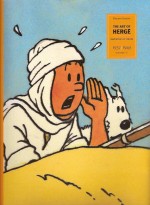
The Art of Hergé – Inventor of Tintin: volume 2 1937-1949


By Philippe Goddin (Last Gasp)
ISBN: 978-0-86719-724-2

Georges Prosper Remi, known all over the world as Hergé, created a genuine masterpiece of graphic literature with his tales of a plucky boy reporter and his entourage of iconic associates. Singly, and later with assistants including Edgar P. Jacobs, Bob de Moor and other supreme stylists of the select Hergé Studio, he created twenty three splendid volumes (originally produced in brief instalments for a variety of periodicals) that have grown beyond their popular culture roots and attained the status of High Art.

On leaving school in 1925 he worked for the Catholic newspaper Le XXe Siécle where he fell under the influence of its Svengali-esque editor Abbot Norbert Wallez. A devoted boy-scout Remi produced his first strip series The Adventures of Totor for the monthly Boy Scouts of Belgium magazine the following year, and by 1928 he was in charge of producing the contents of Le XXe Siécle’s weekly children’s supplement Le Petit Vingtiéme.

He was illustrating The Adventures of Flup, Nénesse, Poussette and Cochonette, written by the staff sports reporter when Wallez asked him to create a new adventure series. Perhaps a young reporter who roamed the world, doing good whilst displaying solid Catholic values and virtues?

The rest is history, and for such a pivotal figure who better to recount it than Philippe Goddin, friend and acclaimed expert and the man who directed the Hergé Studio research and archives for a decade?

This intermediate volume of three follows the artist’s progress week by week and year by year through the heady successes of his major creations, diarising key events, clarifying the various tasks of a jobbing periodical cartoonist and noting the key personal moments of the man’s life – such as his affair with a friend of his wife Greg and the moment he discovered his agent had been embezzling from him.

Liberally illustrated with original art, printed and retouched pages and frames, copies of the comics and magazines the strips first appeared in and many photographs this is a fascinating insight into the working process of a graphic genius. The hundreds of pencil drawing and layouts alone are priceless to anyone with aspirations of a career in comics. If only other artists had been as scrupulously meticulous in preserving the many stages of their creations!

Beginning in 1937 the chapters follow the progress and output of all five Jo, Zette and Jocko tales from The Secret Ray through to Valley of the Cobras, new Tintin from The Broken Ear and Black Island to Land of Black Gold (ten albums), and the slapstick japes of Belgian urchins Quick and Flupke (twelve volumes), plus all the revision to the previous output that kept his work fresh – and available – to his growing legion of fans.

Covering the tumultuous war years, his temporary ostracising as a “collaborator”, his depression, breakdown and return to success and popularity this is a book that no fan can be without and no would-be storyteller can fail to profit from.

Art © Hergé/Moulinsart 2009. Text © Moulinsart 2009. All rights reserved.

The Man From Harlem


By Guido Crepax, translated by Tom Leighton (Catalan)
ISBN: 0-87416-040-5

Born in Milan in 1933 the son of a noted cellist, Guido Crepax grew in an environment flooded with art and music (his closest childhood friend was the noted musician and conductor Claudio Abado). Inevitably the boy became a creative artist. Whilst studying architecture in the 1950s he freelanced as a graphic designer, illustrator and printmaker, producing book, medical texts and magazine covers, posters and record sleeves most notably for Classical and Jazz musicians ranging from Charlie Parker and Fats Waller to Domenico Modugno.

He won acclaim and advertising awards, but still felt the urge to do more. In 1963 he began drawing comics, and two years later created his most famous character Valentina for the second issue of Linus. She was initially the lead character’s girlfriend, but whereas superhero Neutron soon lost the interest of readers, the sexy, psychedelic, culturally bold and accessible distaff evolved to become an evocative, fantastic, sophisticated, erotic zeitgeist of the 1960s and far, far beyond.

Although noted – if not always revered – for his strongly erotic female characters, Crepax was an astute and sensitive tale-teller and examiner of the human condition, and all his varied works vibrate with strong themes of charged sexuality and violence. There can also be seen a deep understanding of history and moment, particularly in regard to the popular arts. In The Man from Harlem (based I strongly suspect on the old Cab Calloway standard) a young black musician in 1946 New York City faces the biggest dilemma of his life and is forever changed…

Little Johnny Lincoln was just like any other young negro in a white man’s world, but now with the war over, that world has changed, and in certain areas black people are finally getting a chance to show what they can do. Leaving the Stadium where Joe Louis has once more defended his World Heavyweight title, he stumbles into a fracas and knocks out a white man chasing a white woman.

She is just street trash, a hooker, but somehow the musician is drawn to the abrasive desperate young woman and tries to protect her. She claims to have seen her pursuer murder a man, but Lincoln is still determined to shield her – even from the disapprobation of his own kind, as well the guns of the mob who want her silenced…

White gangsters are trying to move in on the Harlem action: a mob war is brewing and even the club where Lincoln plays is smashed up in the turf-battles. Polly becomes a virtual prisoner in his home; she knows that she is bringing trouble to Lincoln and his family, but can’t find the nerve to run or testify to the cops until she has a bitter confrontation with Lincoln’s girlfriend Bessie. Knowing there’s no place for her anywhere Polly heads for the local police station. She doesn’t make it…

Pushed to the edge of endurance, seeing the pitifully few advances and freedoms blacks have won being taken away again, Little Johnny Lincoln picks up a gun and with visions of the Klan blazing in his head goes out to take a White Man’s vengeance…

For anybody else this would be an impressive Noir tale of human dignity, intolerance and justice, but Crepax, ever-experimental, went beyond the twists and turns of his plot (and don’t imagine you’ve guessed the ending: it’s a real surprise) and by innovative design and sharp intercutting with shots of hot Jazz numbers turned the art into an entrancing freeform, tension-building visual soundtrack (much as Bill Sienkiewicz attempted a little later in the Moon Knight tale ‘Hit It!’).

This is a powerful saga magnificently told, using the language, terms and racial epithets prevalent in the 1940s. If the “N” word is going to offend you don’t seek out this superb adult thriller, depicted in a truly unique style and manner: everybody else with their senses of drama, history and perspective intact should go ahead and enjoy a brilliant tale: one desperately in need of reprinting…
© 1978, 1987 Editoriale CEPIM, Milan. English translation © 1987 Catalan Communications. All rights reserved.

Lone Sloane: Delirius


By Philippe Druillet (Dragon’s Dream/Heavy Metal)
ISBN: 2-205-00632-0

The seminal fantasy icon Lone Sloane revolutionised graphic fiction not so much in his own country but in Britain and America when his adventures began appearing in the adult fantasy magazine Heavy Metal, which combined original material with the best that European comics had to offer. In 1975 French comics collective Les Humanoides Associes began publishing the groundbreaking magazine Métal Hurlant, but one of their visual mainstays had begun nearly a decade earlier…

Philippe Druillet, born in Toulouse in 1944, and raised in Spain, is a photographer and artist who started his comics career in 1966 with an apocalyptic science fiction epic Le Mystère des abîmes (The Mystery of the Abyss) which introduced a doom-tainted intergalactic freebooter and wanderer called Lone Sloane in a far distant future: a tale heavily influenced by HP Lovecraft and A.E. Van Vogt. Later influences included Michael Moorcock’s doomed anti-hero Elric (and I’m pretty sure I can see some Barry Windsor-Smith also tinting the mix…)

He began working for Pilote in 1969, and revived his cosmic and deeply baroque star-rover in a number of short pieces which were gathered together in 1972. Prior to the large scale (310mm x 233mm) 1991 collection from NBM (see The Six Voyages of Lone Sloane) this cool and memorable album was the only place they could be found in an English translation, and yet they are merely a prelude for the fantastic fantasy that makes up the rest of Lone Sloane: Delirius.

So by way of recapitulation those Six Voyages were ‘The Throne of the Black God’ wherein Sloane is captured by a demonic chair and dumped on a desolate world to await possession by a cosmic god of chaos, whilst in ‘The Isle of the Doom Wind’ he thwarts space pirates. In ‘Rose’ he is trapped on a world of robotic junk and faces oppressive piracy in ‘Torquedara Varenkor: the Bridge over the Stars’.

In ‘O Sidarta’ Sloane regained control of his long-lost super-spaceship and began a quest to return to Earth and overthrow the despotic Imperium, a quest that culminated in startling revelations of his destiny in ‘Terra’: a portentous prelude before the main event…

‘Delirius’ was scripted by celebrated comics writer Jacques Lob (Jerry Spring, Ténébrax, Blanche Épiphanie and Superdupont among others) and in a jarring cacophony of visual Sturm und Drang pitched the intergalactic vagabond into the midst of a power struggle between the Imperator of all Galaxies and his own clergy, the deeply fundamentalist Red Redemption.

Delirius was a useless mudball until the supreme overlord found a way to make it pay. By converting the entire world into a highly-taxed cash-cow of legal debauchery “The Planet of a Hundred Thousand Pleasures” became a perfect way to placate the populace and generate revenue for further conquests. Now the priests have approached Sloane with a perfect plan to steal all the cash and thereby remove the planetary governor: but priests can’t be trusted, nothing can be planned for on a world of utter licentious chaos and Sloane always has his own agenda…

This is a graphic odyssey of truly Byzantine scale and scope: the twists and turns, the visual syntax and tone created here dictated the shape of science fiction – especially in movies – for the next two decades. Character and plot were winnowed to bare essentials so that Druillet could fully unleash the startling graphic innovations in design and layout that seemed to churn within him, and which exploded from his pen and brain.

As the scheme went inevitably, utterly awry the sheer energy of the artist’s cosmic Armageddon achieved levels of graphic energy that only Jack Kirby has ever equalled. This is a tale crying out for re-release in large format and with all the bells and whistles modern technology can provide, but until then this book will have to do – and do very well. Luckily for you it’s still widely available and remarkably inexpensive…
© 1972, 1973 Philippe Druillet/Dargaud Editeur.

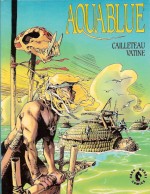
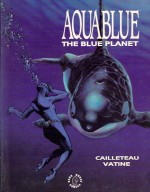
Aquablue & Aquablue: the Blue Planet


By Cailleteau & Vatine; translated by Randy & Jean-Marc Lofficier (Dark Horse)
ISBNs: 978-1-87857-400-8 and 1-87857-404-3

I’m tempted to file these little crackers under “unfinished business” as these slim translated French albums feature the first two instalments of a classy, stylish science fiction saga that sadly hit a reef before its conclusion, despite being one of the most long-lived and impressive epics from a country that seems to specialize in successfully exporting edgy, clever comic fantasies.

In Aquablue the Starliner Silver Star is lost due to a meteor strike and in the rush to the life pods a baby is left behind. Rescued by a robot the boy is reared in space until, eight years later, he finds a planet. The world only has 3% landmass, but is inhabited by a primitive, amiable race of humanoids, and incredibly huge marine species.

In ten years the boy grows to manhood and as Tumu-Nao, becomes a valued member of the tribe. He is even betrothed to the chief’s daughter, Mi-Nuee, and the natives believe him blessed by their god, a gigantic whale-like creature called Uruk-Uru. Unfortunately Nao’s idyllic life forever alters when an Earth survey ship lands and Terran Ethnologist Maurice Dupre discovers that the young man is Wilfred Morgenstern: lost heir to Earth’s greatest financial empire, the United Energy Consortium.

However, that Consortium has already enacted a shady deal to turn Aquablue into a vast hyper-station, which will result in the watery globe becoming a gigantic ice-ball, and they certainly don’t need a naive boss who has gone native to queer their big score. Nao’s own aunt puts out a hit on the rediscovered heir, but nobody realises that his connection to the “gods” of Aquablue is real and shockingly powerful…

The Blue Planet finds Nao returning to Earth not so much to claim his birthright as to safeguard his adopted homeworld from human incursion. While he is away the Consortium has resorted to the same tactics European imperialists used as they absorbed indigenous Earth cultures – destroying them with free booze and cheap baubles.

Noa’s father-in-law organizes a resistance movement, fleeing with the entire tribe to the polar regions, but on Earth Nao/Wilfred is having trouble resisting the allure of technological civilisation, until Mi-Nuee, who had stowed away on a starship, rises like a gleaming message from Uruk-Uru out of the Ocean swell. With the help of Dupre they return in time for the final battle against the Consortium forces that have hunted the natives into the frozen wastelands…

And that was that.

Thierry Cailleteau & Olivier Vatine first teamed to produce the outlandishly comedic Adventures of Fred and Bob but really hit their peak on these superb eco-thrillers, based tellingly on the colonial outrages of Western Civilisation: especially in their treatment of Polynesian cultures. The series continued for another nine volumes with artists Ciro Tota and Stéphane Brangier replacing Vatine from the fifth book, moving beyond the original storyline into fascinating areas of conservation and space opera!

Although these slender pearls are worth a look just for the superb quality of art and narrative I’m plugging them here in the greedy hope that with so much European material finally crossing the channel into English, somebody will pick up and complete the translation of this delicious adventure series. Cross your fingers…
© 1988, 1990 Guy Delcourt Productions. English translation © 1989, 1990 Dark Horse Comics. All Rights Reserved.

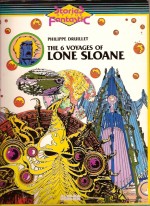
The Six Voyages of Lone Sloane


By Philippe Druillet, translated by Jean-Marc & Randy Lofficier (NBM)
ISBN: 0-918348-97-8

Comics and fantasy story-telling took a huge leap forward in 1975 when French comics collective Les Humanoides Associes began publishing the groundbreaking magazine Métal Hurlant. However one of their visual mainstays had begun nearly a decade earlier.

Philippe Druillet was a photographer and artist who had started his comics career in 1966 with an apocalyptic science fiction epic Le Mystère des abîmes (The Mystery of the Abyss) which introduced a doom-tainted intergalactic freebooter and wanderer called Lone Sloane in a tale heavily influenced by HP Lovecraft and A.E. Van Vogt.

Druillet was born in Toulouse in 1944, and raised in Spain, and his comics work is panoramic, cosmic and deeply baroque. He began working for Pilote in 1969, and revived his star-rover in a number of short pieces gathered together as The Six Voyages in 1972. This collection from 1991 presents them in English and perfectly captures the Gothic intensity of the saga which inspired so many artists.

In ‘The Throne of the Black God’ Sloane’s ship is destroyed by a demonic chair that kidnaps him to a desolate world to await possession by a cosmic god of chaos, whilst in ‘The Isle of the Doom Wind’ the throne-riding sidereal vagabond thwarts space pirates. In the macabre romance ‘Rose’ he is trapped on a world of robotic junk and the occasional series leapt into interstellar overdrive with the oppressive battle-thriller ‘Torquedara Varenkor: the Bridge over the Stars’.

In ‘O Sidarta’ Sloane recaptured his long-lost super spaceship and began a quest to return to Earth and overthrow the despotic Imperium, a quest that culminated in startling revelations of his destiny in ‘Terra’: all of which were simply preludes for his next ambitious epic ‘Delerius.’

The stories here are mere skeletons for the high-concepts which fascinate the artist, and their true appeal lies in the startling graphic innovations in design and layout Druillet seemed to let explode from his pen and brain. Moreover the sheer energy of his work scintillates when reproduced on extra-large pages (310mm x 233mm). This is book every art lover of fan of the fantastic simply must have. Surely it’s time for another luxury collection to be released?
© Humanoides Associes 1991. English Translation © 1991 Dark Horse.

Bernet


By Jordi Bernet & various, edited by Manual Auad (Auad Publishing)
ISBN: 978-0-96693-812-8

¡Perfect Christmas Present Alert! For him or her if they’re “Of Age”

When you’re a thrill starved kid enchanted by comics the first stage of development is slavishly absorbing everything good, bad and indifferent. Then comes the moment that you see subtle nuances which inexplicably makes some features favourites whilst others become simply filler.

I first recognised Jordi Bernet’s work on The Legend Testers. By “recognised” I mean the very moment I first discerned that somebody actually drew the stuff I was adoring, and that it was better than the stuff either side of it. This was 1966 when British comics were mostly black and white and never had signatures or credits so it was years before I knew who had sparked my interest.

Jordi Bernet Cussó was born in Barcelona in 1944, son of a prominent and successful humour cartoonist. When his father died suddenly Jordi, aged 15, took over his father’s strip Doña Urraca (Mrs. Magpie). A huge fan of Alex Raymond, Hal Foster and particularly the expressionist genius Milton Caniff he yearned for less restrictive horizons; he left Spain in the early 1960s and moved into dramatic storytelling.

He worked for Belgium’s Spirou, Germany’s Pip and Primo, before finding work on English weeklies. Bernet worked for British publishers between 1964 and 1967, and as well as the Odhams/Fleetway/IPC anthologies Smash, Tiger and War Picture Library he also produced superlative material for DC Thomson’s Victor and Hornet.

He even illustrated a Gardner Fox horror short for Marvel’s Vampire Tales #1 in 1973, but mainstream America was generally denied his mastery (other than a few translated Torpedo volumes and a Batman short story) until the21st century reincarnation of Jonah Hex – where he still occasionally works.

His most famous strips include thrillers Dan Lacombe (written by his uncle Miguel Cussó), Paul Foran (scripted by José Larraz) the saucy Wat 69 and spectacular post-apocalyptic barbarian epic Andrax (both with Cussó again).

When General Franco died Bernet returned to Spain and began working for Cimoc, Creepy and Metropol, collaborating with Antonio Segura on the sexy fantasy Sarvan and the dystopian SF black comedy Kraken, and with Enrique Sánchez Abulí on the gangster and adult themes tales that have made him one of the world’s most honoured artists, and which culminated on the incredibly successful crime saga Torpedo 1936.

This magnificent commemoration of his career thus far spans those years when he first echoed his father’s style through to the sleek minimalist, chiaroscuric, emphatic line economy that bores into readers hindbrains like hot lead from a smoking 45. Also on view as well as the violence there’s ample example of his sly, witty (and just as hot!) sex comedy material: Bernet is an absolute master of the female form and his adult material – created with Carlos Trillo – such as Custer, Clara De Noche and Cicca is truly unforgettable.

This glorious deluxe hardback gathers together a vast quantity of covers, book illustrations, sketches, drawings, pin-ups and studies, advertising work, and that Batman stuff, with a separate chapter on Bernet’s Beauties, a biography (which could, I must admit, have done with one last proof-read before going to press) and full check-listing of his works and awards. There are heartfelt artistic contributions and tributes from some of his vast legion of fans: Will Eisner, Joe Kubert, Jordi Langaron, Carlos Nine, Josep M. Bea, Luca Biagnini. Al Dellinges, Josep Toutain, Eduardo Risso, Horacio Altuna, Carlos Gimenez, Sergio Aragonés, Carlos Trillo, Juan Gimenez and Hobie MacQuarrie, but the true delights here are the 16 complete stories: Torpedo 1936, Sarvan, Custer, Clara De Noche, and Kraken as well as westerns, war stories, comedies and crime thrillers.

This is an incredible tribute to an incredible creator, and one no artist with professional aspirations can afford to miss: but parents be warned – there’s lots of nudity and violence beautifully depicted here – so be sure to read it yourselves first, Just in case…

All art and characters © 2009 their respective copyright holders. All Rights Reserved.

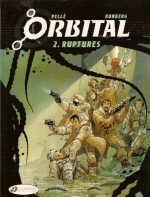
Orbital volume 1: Scars & volume 2: Ruptures


By Serge Pellé & Sylvain Runberg, translated by Jerome Saincantin (Cinebook)
ISBN: 978-905460-61-8 & ISBN: 978-905460-61-8

The truest thing that can be said about French science fiction is that it always delivers amazing style and panache even when the plots may be less than original. In Serge Pellé and Sylvain Runberg’s beautiful Orbital series a seemingly mismatched pair of Peacekeeper agents are dispatched to quell an incipient brushfire war – just like marshals in a western – but the tale is delivered with such skill and artistry that it’s as fresh as the first time I encountered the notion.

After years of galactic exclusion Earth in the 23rd century has finally been allowed to join a vast confederation of interstellar civilisations despite grave concerns about humanity’s aggressive nature and xenophobic tendencies. A militant isolationist faction on Earth had moved from politics to horrific terrorism in the immediate run-up to joining, committing atrocities both on Earth and distant worlds where they had developed colonies and mining bases, but ultimately they failed to prevent humanity’s inclusion in the pan-galactic union.

One particular Confederation worry was the way humans had treated aliens like the Sandjarrs, whose world was invaded in Earth’s all-consuming drive for territory and exploitable resources. The subsequent atrocities almost exterminated the stoic, pacifistic desert creatures…

Interworld Diplomatic Office agents are assigned in pairs to troubleshoot throughout the galaxy, defusing crises before they can become flashpoints. Now Caleb, IDO’s first human operative, is teamed with Mezoke, a Sandjarr, a situation clearly designed as a high-profile political stunt, as is their initial mission: convincing an Earth mining colony to surrender their profitable operation back to the aliens who actually own the moon it’s situated on…

Moreover, even though Earth is a now a member of the Confederation, with humans well placed in all branches of interstellar service, the Isolationist cause is still deeply cherished by many, needing only the slightest spark to ignite…

In Scars Caleb and Mezoke, still learning to cope with each other, are too-quickly dispatched to the ghastly mud-ball moon Senestam to convince belligerent human colonists to pack up and leave quietly. The naked hostility they meet is transformed to sheer terror when the situation escalates and monstrous beasts begin attacking. An armada of rapacious creatures capable of boring through rock and steel are likely to eat every sentient in town before the IDO agents can broker any kind of deal…

The crisis takes a decidedly tricky turn in the concluding album Ruptures when the marauding beasts are discovered to have been lured into attacking the colonists. The crisis has been manufactured as part of a greater scheme: but who really profits from this developing tragedy?

Sabotage and murder are swiftly added to the miners’ woes, and whilst Caleb and Mezoke desperately seek a solution satisfactory to all sides, an anti-human faction of the Confederation makes its first move to oust Earth from the interstellar alliance. Perhaps they’re not misguided though, since an Isolationist coup is also kicking off in the torrential skies above Senestam…

Fast-paced, action-packed, gritty space-opera with delightfully complex sub-plots fuelled by political intrigue and infighting elevates this tale for older readers to lofty heights, and although Caleb and Mezoke come off a little less than fully rounded characters in this initial tale, Orbital looks like a being a series to watch closely.

© 1968 Dargaud Editeur Paris by Goscinny & Tabary. All Rights Reserved.

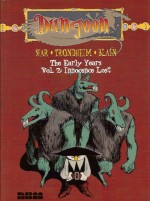
Dungeon: The Early Years volume 2: Innocence Lost


By Joann Sfar & Lewis Trondheim, art by Christophe Blain, translated by Joe Johnson (NBM)
ISBN: 978-1-56163-564-1

This slim tome is another part of the eccentric, raucous and addictively wacky franchise that adds a starkly adult whimsy to the fantastic worlds of fantasy fiction. This second volume of Early Years fills in some historical gaps that might have puzzled readers of Dungeon Parade, Zenith, Monstres and Twilight. There’s this magic castle, in a fantastic land of miracles, see, and it’s got a dungeon…

But before that Castle was built there was the debauched, bureaucratised and grimly frenetic urban hellhole of Antipolis. In it Dungeon Keeper-to-be Hyacinthe prowls the night as masked vigilante The Night Shirt but his midnight adventures are being seriously curtailed by his unrequited love for the fair Gabrielle, not to mention the unpleasant and lingering aftereffects of some prior requiting with the serpentine lady-assassin Alexandra…

When Gabrielle is falsely arrested by over-officious rabbits Hyacinthe must engineer her release, which involves leaving the relative comfort zone of the City for the wilds of rabbit-infested frontier town Zedotamaxim and the charnel hamlet of Necroville…

A second story After the Rain is set many years later when the now dissolute Hyacinthe is a middle-aged, unhappily married roué. Set in his ways and unhappy the former Night Shirt is enticed into making a comeback by the clever Doctor Cormor who must battle greed and the establishment itself to stop a subway being dug through the unstable pile of detritus that forms the very bedrock of the city. Perhaps it is less the noble quest than the return of slinky Alexandra that fires up the weary hero, but when inevitable disaster strikes will Hyacinthe be ready or able to cope?

The inhabitants of this weirdly surreal universe include every kind of anthropomorphic beast and bug as well as monsters, demons, mean bunnies, sexy vamps and highly capable women-folk who know the true (lack of) worth of a man. This is an epic saga played as an eternal and highly amusing battle of the sexes, with tongues planted firmly in cheeks – and no, I won’t clarify…

Comprising two translated French albums ‘Une Jeunesse Qui S’Enuit’ and ‘Apres La Pluie’ this is a delightfully surreal, earthy, sharp, poignant and brilliantly outlandish contemporary comedy that’s a joy to read with vibrant, wildly eccentric art moody as Dark Knight and jolly as Rupert Bear.

Definitely for grown-ups with young hearts, Dungeon is a near-the-knuckle, illicit experience which addicts at first sight, but for a fuller comprehension – and added enjoyment – I’d advise buying all the various incarnations.
© 2001-2006 Delcourt Productions-Tronfheim-Sfar-Blain. English translation © 2009 NBM. All Rights Reserved.

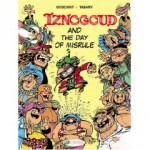
Iznogoud and the Day of Misrule (Book 3)


By Goscinny & Tabary, translated by Anthea Bell & Derek Hockridge (Cinebook)
ISBN: 978-1-905460-79-3

In his lifetime (1926-1977) René Goscinny was one of the most prolific, most read, writers of comic strips the world has ever seen. He still is. Among his most popular series are Lucky Luke, Le Petit Nicolas and of course Asterix the Gaul. In 1962, scant years after the Suez crisis, the French returned to the deserts when he teamed with the superb Jean Tabary to produce imbecilic Arabian (im)potentate Haroun el-Poussah, but it was villainous foil, power-hungry vizier Iznogoud that stole the show – possibly the conniving little devil’s only successful scheme.

Les Aventures du Calife Haroun el Poussah was created for Record with the first instalment appearing in the January 15th issue in1962. A minor hit, it jumped ship to Pilot: a magazine created and edited by Goscinny where it was refashioned into a starring vehicle for the devious little rat-bag who had increasingly stolen the show.

Iznogoud is Grand Vizier to Haroun Al Plassid, Caliph of Ancient Baghdad, but the sneaky little toad has loftier ambitions, or as he is always shouting “I want to be Caliph instead of the Caliph!” The revamped series, Iznogoud, started in Pilote in 1968, becoming a huge favourite, with 27 albums so far, a TV cartoon show and even a live action movie. When Goscinny died in 1977 Tabary assumed the scripting as well as the superbly stylish illustration, moving to book-length complete tales, rather than the compilations of short punchy stories that typified their collaborations.

This third translated album was actually the eighth French volume (released in 1972 as Le jour des fous) and features the best of both worlds. The eponymous lead feature is a whacking great 20 page epic, following the vile Vizier’s best chance to usurp the throne when a festival dictates that for one day masters and servants swap roles. All Iznogoud has to do is ensure that the Caliph isn’t around to reclaim his position at the end of the day: simples no? Apparently not…

This is followed by a delightful 8 page slice of whimsy entitled ‘The Challenge’ wherein the Vizier attempts to embroil his royal boss in a duel with the usual insane outcome and ‘The Labyrinth’ demonstrates the creators solid grasp of classic slapstick as an unbeatable maze proves no match for the Caliph’s incredible luck, and the book concludes with a sharp political spoof that also takes a good-natured poke at unions.

In ‘Elections in the Caliphate’ we discover that only the Caliph can vote; but when Iznogoud gets the notion that he can get a fakir or magician to make Haroun Al Plassid vote for absolutely anybody and not just himself as usual, it opens a truly chaotic can of worms – which is quite handy since on polling day most of Baghdad goes fishing…

Like all the best storytelling, Iznogoud works on two levels: as a comedic romp with sneaky baddies coming a cropper for younger readers, and as a pun-filled, witty satire for older, wiser heads, much like its more famous cousin Asterix – and also translated here by the master translators Anthea Bell & Derek Hockridge who made the indomitable little Gaul so very palatable to the English tongue. Here their famed skills recall the best – and least salacious – bits of the legendary “Carry On films” as well as some peculiarly Tommy Cooper-ish surreal, absurdity…

Snappy, fast-paced hi-links and gloriously agonising pun-ishing (see what I did there?) abound in this mirthfully infectious series: is a household name in France where “Iznogoud” became common parlance for a certain type of politician: over-ambitious, unscrupulous – and often of diminutive stature.

When originally released here in the 1970s, these tales made little impression but hopefully this snappy, wonderfully affable strips can finally find an audience among today’s more internationally aware comics-and-cartoon savvy British Kids Of All Ages.

I love ’em – and remember – annual end-of-year gift-giving season is nearly upon us…
© 1972 Dargaud Editeur Paris by Goscinny & Tabary. All Rights Reserved.

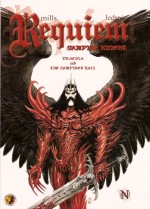
Requiem Vampire Knight Tome 2: Dracula and The Vampires Ball


By Pat Mills & Ledroit (Panini Books UK)
ISBN: 978-1-84653-438-6

The second double compilation of Pat Mills and Olivier Ledroit’s darkly spectacular masterpiece of nihilistic anti-heroism intensifies the decadent horrors with the next two translated volumes that created such a storm when first released in France. Dracula and The Vampire Ball resumes the tale of Heinrich Augsburg, a Nazi soldier doomed to unlive his life as a vampire warrior in a macabre inverse world of evil, which began in Requiem Vampire Knight Tome 1: Resurrection and Danse Macabre.

Resurrection is a brooding, blood-drenched world of eternal strife and warfare: a grim, fantastic mirror of Earth with the seas and land-masses reversed, where time runs backwards, populated by all the worst sinners of Earth reincarnated as monsters of myth – a realm where the ranked dead expiate or exacerbate the sins of their former lives.

This tome further explores the deeds that brought Heinrich (now called Requiem) to the very apex of the hell-world’s hierarchy as a full knight at the court of Dracula, trapped in a spiral of bloodletting, debauchery and intrigue. His position is not secure. Not only has he earned the enmity of the treacherous faction of elite Nosferatu led by Lady Claudia Demona, Lord Mortis and Baron Samedi, but it appears that he may be a returned soul…

Long before Augsberg died on a frozen battlefield, killed by a Russian he was trying to rape, the Templar Heinrich Barbarossa had committed such atrocities in the name of Christianity that he was guaranteed a place in Dracula’s inner circle when he inevitably reached Resurrection. But soon this new Vampire Knight Thurim committed an unpardonable crime and was excised from the court and Resurrection itself.

But now Requiem, already plagued by memories of his doomed affair with the Jewess Rebecca, is the subject of dangerous talk. Far too many vampires are remarking how similar to the disgraced Thurim the newcomer seems…

And what’s worse for him is that as the interminable battles (incredibly realised by the epic mastery of Ledroit) with such foes as the Gods of Limbo, the arcane order of Archaeologists, Lamias, Werewolves, Ghouls and others, Requiem discovers that Rebecca too is on Resurrection and the only way she can find peace is to “expire” the one responsible for her being there…

Blending decadent, opulent, Machiavellian dalliance with the wildest dreams – and grim, black wit – of a new De Sade, the tensions of the palace even outstrip the constant eye-popping action on myriad battlefields, so this book ends far too quickly on yet another cliffhanger when Rebecca is first captured by the Vampires only to escape with the still besotted and now wildly off-reservation Requiem. And their headlong flight has catapulted the doomed ex-lovers straight into the mouth of a cosmic dragon storm…

Supplemented by a gallery of the artist’s series paintings this astonishing, captivating work for the Goth within is an adult fantasy fan’s darkest dream come true. More please and soon…

© 2000, 2001, 2009 Nickel, Mills, Ledroit. All rights Reserved.