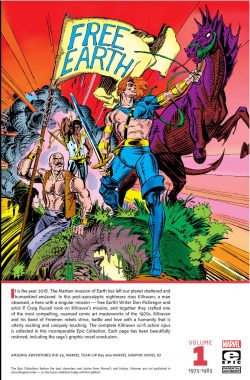
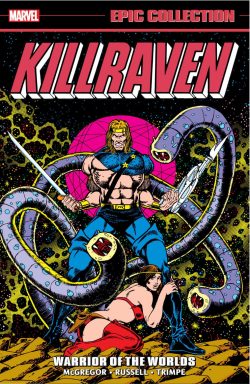
Killraven Epic Collection: Warrior of the Worlds 1973-1983


By Don McGregor & P. Craig Russell, with Roy Thomas, Gerry Conway, Marv Wolfman, Bill Mantlo, Neal Adams, Howard Chaykin, Herb Trimpe, Rich Buckler, Gene Colan, Keith Giffen, Sal Buscema & various (MARVEL)
ISBN: 978-1-3029-3216-9 (TPB/Digital)

Win’s Christmas Gift Recommendation: Epically Evergreen Faux Future Fun… 9/10

When the first flush of the 1960s superhero revival started fading at the end of the decade, Marvel – who had built their own resurgent renaissance on the phenomenon – began casting around for new concepts to sustain their hard-won impetus. The task was especially difficult as the co-architect of their success (and greatest, most experienced ideas-man in comics) had jumped ship to arch-rival National/DC, where Jack’s Kirby’s Fourth World, The Demon, Kamandi, Last Boy on Earth, OMAC and other innovations were opening new worlds of adventure to the ever-changing readership.

Although a global fascination with the supernatural had gripped the public – resulting in a huge outpouring of mystery and horror comics – other tried-&-true genre favourites were also revived and rebooted for modern sensibilities: westerns, war, humour, romance, sword & sorcery and science fiction…

At this time Stan Lee’s key assistant and star writer was (former-English teacher and lover of literature) Roy Thomas. As he accrued editorial power, Thomas increasingly dictated the direction of Marvel: creating new concepts and securing properties that could be given the “Marvel Treatment”. In a decade absolutely packed with innovative trial-&-error concepts, the policy had already paid huge dividends with the creation of Tomb of Dracula, Monster of Frankenstein and Werewolf by Night, whilst the brilliantly compelling Conan the Barbarian had quickly resulted in a whole new comicbook genus…

This complete compilation collects the bold and mercurial science-fiction thriller from Amazing Adventures #18-39, a guest appearance in Marvel Team-Up #45 and the saga’s notional conclusion in Marvel Graphic Novel #7: an eclectic and admittedly inconsistent hero-history that has at times been Marvel’s absolute best and strong contender for worst character, in a sporadic career spanning May 1973 to 1983. The feature struggled for a long time to carve out a solid identity for itself, but finally found a brilliantly effective and stridently lyrical voice when scripter Don McGregor arrived – and stayed – slowly recreating the potential epic into a perfectly crafted examination of contemporary American society in crisis; proving the old adage that all science fiction is about the Present and not the Future…

He was ideally complimented in his task by fellow artisan P. Craig Russell whose beautifully raw yet idealised art matured page by page over the long, hard months he illustrated the author’s increasingly powerful and evocative scripts. The tone of those times is scrupulously recalled in McGregor’s Introduction before Marvel’s most successful Future Past opens…

The dystopian tomorrow first dawned in Amazing Adventures #18, where Marvel’s loosely-based iteration began. Conceived by Thomas & Neal Adams – before being ultimately scripted by Gerry Conway – a ‘Prologue: 2018 A.D.’ introduces a New York City devastated by invasion and overrun by mutants, monsters and cyborgs all scavenging for survival.

The creative process was a very troubled one. Adams left the project in the middle of illustrating the debut episode, leaving Howard Chaykin & Frank Chiaramonte to flesh out the tale of how, at the turn of the 20th century, a refugee mother sacrifices her life defending her two young sons from terrifying alien Tripods and vile human turncoats who had early switched allegiance to their revolting, human-eating new masters…

Nearly two decades later, escaped gladiator Killraven overcomes all odds to kill monstrous genetic manipulator The Keeper and save his brother Joshua, only to discover his sibling long gone and his despised tormentor grateful for the release of death.

The elderly scientist had been compelled to perform countless mutagenic experiments for his alien masters but had secretly enacted a Machiavellian double-cross, imbuing Jonathan Raven with hidden powers that might eventually overthrow the conquerors. All the boy had to do was survive their horrific arena games until old enough to rebel against the Martians who have occupied Earth since 2001…

With his dying breath, Keeper provides his uneducated murderer with the history of ‘The War of the Worlds!’: of Free Mankind’s furious futile, atomic last stand and how the alien conquerors had possessed the shattered remnants of Earth…

The dying tech reveals how gladiatorial training and scientific abuses shaped Killraven into the perfect tool of liberation and retribution, even to the warrior’s recent escape and first attempts at raising a resistance movement. However, just as the story ends, the designated-liberator realises he has tarried too long and mutant monsters close in…

The adventure resumed in #19 as Killraven narrowly escapes the psionic snares of ‘The Sirens of 7thAve.’ (by Conway, Chaykin & Frank McLaughlin) and the other myriad terrors of the devastated metropolis to link up with second-in-command M’Shulla and strike a heavy blow against the alien butchers by destroying two hulking mechanical Tripods.

Newly elevated by the conquerors to the status of genuine threat, the rebel and his followers plan a raid on a New Jersey base but are instead captured by the mesmerising Skarlet, Queen of the Sirens, who hands them over to the Martian governing the city…

Forced to fight a mutated monstrosity in the alien’s private arena, Killraven unexpectedly turns the tables and drives off the gelatinous horror before boldly declaring he is the guardian of Mankind’s heritage and will make Earth free again…

Amazing Adventures #20 was written by Marv Wolfman, with Herb Trimpe & Frank Giacoia illustrating ‘The Warlord Strikes!’, wherein the Freemen raid a museum and acquire weapons and armaments, and create a brand-new look for Killraven…

Easily overcoming the traitorous lackeys of the Martian Masters, the rebels are blithely unaware that the carnivorous extraterrestrial devils have deployed their latest tool: a cruelly augmented old enemy who hunts them down and easily overcomes their primitive guns, swords and crossbows with his own onboard cyborg arsenal…

The ambitious new series was already floundering and dearly needed a firm direction and steady creative hands, so it’s lucky that the concluding chapter in #21 (November 1973) saw the debut of Don F. McGregor: a young ambitious and poetically experimental writer who slowly brought depth of character and plot cohesiveness to a strip which had reached uncanny levels of cliché in only three issues.

With Trimpe & “Yolande Pijcke” illustrating, ‘The Mutant Slayers!’ began the necessary task of re-establishing the oppressive hopelessness and all-pervasive horror and loss of Well’s original novel. Determined to translate the concept into modern terms for the new generation of intellectual, comics-reading social insurgents, McGregor also took the opportunity to introduce the first of a string of complex, controversial – and above all, powerful – female characters into the mix…

Carmilla Frost is a feisty, sharp-tongued geneticist and molecular biologist ostensibly faithful to her Martian masters, but she takes the first opportunity to betray their local human lieutenant and help Killraven and his Freemen escape the Warlord’s brutal clutches. For her own closely-guarded reasons, she and her bizarrely devoted monster anthropoid Grok the Clonal Man join the roving revolutionaries in their quest across the shattered continent…

In AA #22 (art by Trimpe & Chiaramonte), the motley crew arrive in America’s former capital and encounter a ‘Washington Nightmare!’

After defeating a band of slavers led by charismatic bravo Sabre, Killraven forms an uneasy alliance with local rebel leader Mint Julep and her exclusively female band of freedom-fighters. The green-skinned warrior woman has also battled Sabre and cautiously welcomes Killraven’s offer of assistance in rescuing her captured comrades from the literal meat-market of the Lincoln Memorial, where flesh-peddling mutant horror Abraxas auctions tasty human morsels to extraterrestrial patrons.

The raid goes badly and Killraven is on the conquerors’ menu in ‘The Legend Assassins!’, before the resistance fighters unite in a last-ditch attempt to save their tempestuous leader from The High Overlord. The captured leader, meanwhile, has become main course in a public propaganda-feeding/execution: to be devoured by vermin-controlling freak Rattack…

The hero’s faithful followers – including gentle, simple-minded strongman Old Skull and embittered Native American Hawk – arrive just in time to join the furious fray in #24’s spectacular ‘For He’s a Jolly Dead Rebel!’ (inked by Jack Abel), but their escape is only temporary before they are quickly recaptured. Their valiant example impresses more than one disaffected collaborator, however. When former foes led by Sabre unite in battle against the Martian Overlord, the result is a shattering defeat for the once-unbeatable oppressors…

A returning nemesis for the charismatic rebel and his freedom fighters debuted in Amazing Adventures #25. ‘The Devil’s Marauder’ (art by Rich Buckler & Klaus Janson) sees Killraven inconclusively clash with cyclopian Martian flunky Skar. During the battle, the hard-pressed human is unexpectedly gripped by a manifestation of hidden psychic power – granting him visions he cannot comprehend…

Travelling across country, the rebels stumble onto another forgotten glory of Mankind’s past in the state once called Indiana. The race circuit of the Indianapolis 500 is now a testing-ground for new terror-tripods and thus a perfect target for sabotage. However, when the fury-filled Killraven tackles human-collaborators and Skar resurfaces, the incensed insurgent steps too far over ‘The Vengeance Threshold!’…

Gene Colan & Dan Adkins illustrated #26’s ‘Something Worth Dying For!’ as the Freemen reach Battle Creek, Michigan and Killraven encounters a feral snake/horse hybrid he simply must possess…

Soon after the band is ambushed by human outlaws guarding a fabulous ancient treasure at the behest of petty tyrant Pstun-Rage the Vigilant…

Since the place was once the site of America’s breakfast cereal empire and this wry yarn is filled with oblique in-jokes – many of the villains’ names are anagrams of Kellogg’s cereals – you can imagine the irony-drenched secret of the hoard the defenders give their lives to protect and pragmatic Killraven’s reaction to it all…

The drama kicks into spectacular high gear with AA #27 and the arrival of P. Craig Russell (inked by Abel) for the start of a dark epic entitled ‘The Death Breeders’.

Whilst crossing frozen Lake Michigan in March 2019, the band is attacked by monstrous lampreys and Grok suffers a wound which will eventually prove fatal. McGregor loathed the notion of simplistic, problem-solving, consequence-free violence which most entertainment media slavishly thrived upon. He frequently tried to focus on some of the real-world repercussions such acts should and would result in…

The heroes head to what was once Chicago: now a vast industrialised breeding-pen to farm human babies for Martian consumption. En route, they met pyrokinetic mutant Volcana Ash, who has her own tragic reason for scouting the ghastly palaces of Death-Birth…

As the new allies undertake an explosively expensive sortie against the Death Breeders, in the far-distant halls of the Martian Kings of Earth, the Warlord is tasking recently-repaired Skar with a new mission: hunt down Killraven and destroy not only the man, but most importantly the legend of hope and liberation that has grown around him…

In #28 (pencilled, inked and coloured by Russell in the original) Ash reveals her horrific origins and the purpose of her quest as the Freemen battle monsters thriving in the chemically compromised lake. Elsewhere, chief butcher The Sacrificer watches his depraved boss Atalon live up to his decadent reputation as ‘The Death Merchant!’: emotionally tenderising the frantic “Adams and Eves” whose imminent newborns will be the main course for visiting Martian dignitaries…

Everything changes during Killraven’s fateful raid to liberate the human cattle. When the disgusted hero skewers one of the extraterrestrial horrors, he experiences severe psychic feedback and realises at last his debilitating, disorienting visions are an unsuspected ability to tap into Martian minds. And in the wastelands, Skar murderously retraces the Freemen’s route, getting closer and closer to a final showdown…

With Amazing Adventures #29 the series was rebranded Killraven: Warrior of the Worlds and ‘The Hell Destroyers’ reveals the rebel leader’s greatest victory, inspiring thousands of freshly-liberated earthlings by utterly destroying the temple of atrocity before gloriously escaping into the wilderness and a newborn mythology…

The pace of even a bi-monthly series was crippling to perfectionist Russell, and ‘The Rebels of January and Beyond!’ in #30 was a frantic 6-page melange from him, Adkins, Trimpe, Chiaramonte & Abel, all graphically treading water as The Warlord “reviewed” (admittedly beautiful) fact-file pages on Killraven, M’Shulla and Mint Julep.

The saga resumed in #31 on ‘The Day the Monuments Shattered’, wherein McGregor & Russell close the Death Breeders story in stunning style. Pursued by Atalon and Sacrificer into the icy wilds between Gary, Indiana and St. Louis, the broken Earth outcasts hide.  As Twilight People, they take refuge in a cavern, allowing an accompanying Eve to give birth in safety, but only leads to assault by a monolithic mutant monster just as their pursuers find them. The battle changes the landscape and ends three ghastly travesties forever…

In #32, ‘Only the Computer Shows Me Any Respect!’ (art by Russell & Dan Green) sees the reduced team in devastated Nashville, where Killraven, M’Shulla, Carmilla, Old Skull and Hawk wander into leftover holographic fantasy programs conjuring both joy and regret, even as Skar’s tripod brings him ever closer to a longed-for rematch. Things get nasty when Hawk’s painful memories of his father’s addiction to fictive detective Hodiah Twist manifest as realised threats and the malfunctioning program materialises a brutally solid savage dragon…

AA #33 was another deadline-busting fill-in. Written by Bill Mantlo with art from Trimpe & D. Bruce Berry, ‘Sing Out Loudly… Death!’ finds the Freemen sheltering from the elements in a vast cave: discovering a hostile tribe of refugee African Americans who had returned to tribal roots in the aftermath of invasion. The hidden wild men observe only one rule – “Kill all honkies” – but that changes once Killraven saves them from a marauding giant octo-beastie…

The long-delayed clash with Skar occurred in #34 as the cyborg ambushes the wanderers when they reach Chattanooga, Tennessee resulting in ‘A Death in the Family’ (McGregor & Russell) – two, actually – before the heartbroken, enraged Warrior of the Worlds literally tears his gloating nemesis to pieces…

Killraven fully entered Marvel Universe continuity – albeit on a branch line – with a crossover appearance by Spider-Man: courtesy of a time-and-space spanning multi-parter in Marvel Team-Up which saw the Amazing Arachnid lost and visiting the past and a number of alternate tomorrows. From MTU #45, ‘Future: Shock!’ – by Mantlo, Sal Buscema & Mike Esposito – saw the weary Wallcrawler wash up in this particular furious future just as Killraven is cornered by killer tripods, offering arachnid assistance as the liberators stumble into an hallucinogenic nightmare. Immediate problem solved, the chronologically adrift Arachnid continued his time-tossed travels…

Amazing Adventures #35 follows the family tragedy as the battered survivors stumble into Atlanta, Georgia and ‘The 24-Hour Man’ (McGregor & Russell & Keith Giffen & Abel), meeting an addled new mother and instant widow, even as Carmilla is abducted by a bizarre mutant with an irresistible and inescapably urgent biological imperative…

Illustrated by Russell & Sonny Trinidad, ‘Red Dust Legacy’ focuses on Killraven’s growing psychic powers with the charismatic champion gaining unwelcome insights into the Martian psyche, even as The Warlord travels to Yellowstone, taunting the rebel leader with news that his long-lost brother Joshua still lives. The hero has no idea it is as an indoctrinated slave codenamed Death Raven…

The self-appointed defender of humanity then invades a replica Martian environment in Georgia, shockingly destroying the Martians’ entire next generation by contaminating their incubators. Inked by Abel, #37 reveals the origins of affable Old Skull in ‘Arena Kill!’ when the wanderers discover a clandestine enclave of humans in the Okefenokee Wildlife Preserve before one final fill-in – by Mantlo, Giffin & Al Milgrom – appeared in #38. ‘Death’s Dark Dreamer!’ sees Killraven separated from his team and stumbling into a wrecked but still functional dream-dome to battle the materialised fantasies of its ancient occupant. His pre-invasion, memories-fuelled attacks reconstitute oddly familiar defenders patterned after Iron Man, Man-Thing, Dr. Strange and almost every other Marvel hero you could think of…

The beautiful, troubled and doomed saga stopped – but did not end – with Amazing Adventures #39 (November 1976) as McGregor & Russell introduced the decimated Band of Brothers to an incredible new life-form in ‘Mourning Prey’. This beguiling meeting of vastly different beings pauses the voyages on a satisfyingly upbeat note, with understanding and forgiveness winning out over suspicion and ingrained violence for once…

And that’s where the gloriously unique, elegiac, Art Nouveau fantasy vanished with no comfortable resolution until 1983 when Marvel Graphic Novel #7 featured an all-new collaboration by McGregor and Russell starring Killraven: Warrior of the Worlds.

That painted full-colour extravaganza is reproduced here and commences after a catch-up Prologue and 6 pages of character profiles to bring readers old and new up to speed…

‘Last Dreams Broken’ opens in February 2020 at Cape Canaveral where Killraven connects again to a distant consciousness and sets off for Yellowstone in search of answers to his inexpressible questions. Along the way the rebels meet 59-year-old Jenette Miller – probably the last surviving astronaut on Earth – as ‘Cocoa Beach Blues’ finds her teaching the warrior wanderers some history and human perspective in between the constant daily battles, whilst in ‘Blood and Passion’ The Warlord prepares his deadliest trap for his despised antagonist as Killraven is finally reunited with Joshua. The drama runs its inevitable course in ‘Let it Die Like Fourth of July’ as all the hero’s hopes and fears are cataclysmically realised…

McGregor’s long-anticipated conclusion did not disappoint and even set up a new future…

With covers by John Romita, Trimpe, Rich Buckler, Klaus Janson, Gil Kane, Jim Starlin, Russell, Keith Pollard & Marie Severin, this time-tossed compilation also includes the introductory editorial page from Amazing Adventures #18 – a fascinating insight into Thomas’ expectations of what became a landmark of visual narrative poetry that was far beyond its time and mass audience’s taste. These are house ads, original art pages, sketches and covers by Romita, Russell, and working materials – notes, photos, plots and more – from McGregor’s copious files plus a Russell pin-up from Marvel Fanfare #45, a Killraven- wraparound cover from The Official Marvel Index to Marvel Team-Up #3 by Sandy Plunkett & Russell, and pages from The Official Handbook of the Marvel Universe: Update …

Confused, convoluted, challenging, controversial (this series contained the first ever non-comedic interracial kiss in American comics – in 1975 if you can believe it!), evocative, inspirational and always entertaining, this is graphic narrative no serious fan or fantasy addict should miss. Do it now: the future is not your friend and Mars needs readers…
© 2021 MARVEL
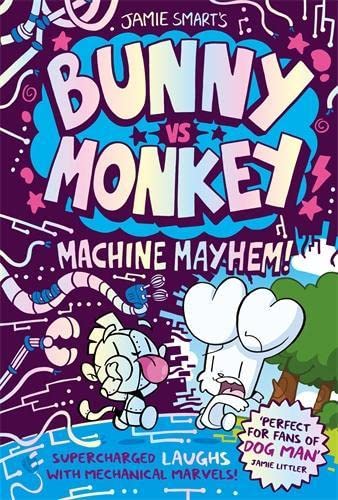
Bunny vs Monkey: Machine Mayhem!


By Jamie Smart, with Sammy Borras (David Fickling Books)
ISBN: 978-1-78845-285-4 (Digest HB)

Win’s Christmas Gift Recommendation: Madcap Mega-Meta Magnificence… 10/10

Bunny vs. Monkey has been a staple of The Phoenix since the very first issue in 2012: recounting a madcap vendetta gripping animal arch-enemies set amidst an idyllic arcadia masquerading as more-or-less mundane but critically endangered English woodlands.

Concocted with gleefully gentle mania by cartoonist, comics artist and novelist Jamie Smart (Fish Head Steve!; Looshkin; Flember), his trendsetting, mind-bending yarns have been wisely retooled as graphic albums available in remastered, double-length digest editions such as this one.

All the tail-biting tension and animal argy-bargy began yonks ago after an obnoxious little beast plopped down in the wake of a disastrous British space shot. Crashlanding in Crinkle Woods – scant miles from his launch site – lab animal Monkey believed himself the rightful owner of a strange new world, despite all efforts from reasonable, sensible, genteel, contemplative forest resident Bunny to dissuade him. For all his patience, propriety and good breeding, the laid-back lepine just could not contain the incorrigible idiot ape, who was – and is – a rude, noise-loving, chaos-creating loutish troublemaker…

Problems are exacerbated by the other unconventional Crinkle creatures, particularly a skunk called Skunky who has a mad scientist’s attitude to life and a propensity to build extremely dangerous robots and super-weapons…

Here – with artistic assistance from design deputy Sammy Borras – the war of nerves and mega-ordnances appears to be over. The unruly assortment of odd critters cluttering up the bucolic paradise had finally picked sides and the battles ended. They even seemingly forgot the ever-encroaching Hyoomanz…

Following a double-page pin-up of our odd and ever-expanding cast, this magnificent hardback archive of insanity opens in the traditional manner: divided into seasonal outbursts, and starting slowly with a querulous teaser tale as the cold retreats and Spring begins in ‘D.I.Whyyyy?’

As the animals all gather to help Bunny repair his much-abused house, universal innocents Weenie squirrel and Pig Piggerton are more keen than skilled, with no idea that cheese is not a suitable substitute for wallpaper paste, plaster or cement…

Despite the subsequent collapse, times are good and very peaceful since the anarchic ape went away and Ai acts quickly to keep it that way when Bunny feels nostalgic for the old days. Sadly, somebody’s listening and brings in a ‘Makeshift Monkey!’ – until the real deal returns in ‘The Little Monkey Who Cried…’

It isn’t long before Skunky is back too and everyone’s fleeing for their lives from deadly underground tentacles, but life quickly resumes its old pattern until obsolescence rears its ugly head and cyborg gator Metal Steve is pronounced ‘Out of Warranty’ and left to wither on Skunky’s scrapheap…

Back and still bad, Monkey briefly inflicts himself on Bunny and wrecks the joint again in ‘The Housemate’ after which the mercurial monochrome megamind constructs a replacement for the gone gator and triggers a ‘Robot Rampage’ when infinitely superior mechanoid Metal E.V.E. decides to lay down her law…

Falling foul of another near-lethal prank the silly simian is scientifically resurrected and evolved in ‘Curse of the Monkey’ only to trip on his own incompetence and barely escape a fishy final fate in ‘Toilet Run!’

A close call with humans in ‘Bunny vs Monkey Jellybeans!’ precedes Weenie and Pig going on ‘A Dangerous Voyage’ as pirates, before Monkey endures his own Fantastic Voyage. Skunky is “The Most Brilliant Animal in the Woods” and convinces his erstwhile ally to shrink down and explore the inner cerebellum of brain-battered, bewildered former stuntman Action Beaver in search of ‘The Lost Memory’ of a misplaced ultimate weapon, which is what probably inspires him to make his own after entering a competition and prematurely unleashing his ‘Winning Entry’…

Metal E.V.E. is forming her own plans but they have to wait a bit as she’s ‘Keepin’ Busy’ with some domestic chores in Skunky’s lab, but’s not long until Summer begins and the woods are imperilled by subterranean invasion from new menace ‘Roland T. Mole’…

Hijinks in parallel dimensions herald the arrival of doomsayer ‘Skunky?’ whilst the forgotten stuntman stumbles onto his ancestral homeland in ‘Beaverville’ with catastrophic consequences even as Monkey creates unexpected carnage but precious little terror with super-cute kaiju ‘Rofl Axolotl’ before being painfully reminded how dangerous the woods can be in ‘So Beautiful’…

After a brief and deceptive flirtation with ‘The Dark Arts’ the hairy halfwit returns to science and creates little golden minions, but his ‘Gloobs’ prove too smart for servitude, so he instead embraces high fashion in ‘C’est Chic!’ Utterly uncaring, Weenie and Pig go about their business until a ‘A New Friend’ almost breaks up the partnership. The swiftly-developing relationship of ‘Weenie and Winnie’ seems set to end the good old days but another robotic invasion sets the world to rights in ‘Just Checking’…

A reality-altering beast threatens in ‘Wishful Thinking’ and the entire woods go all French just as aliens invade in ‘L’Honk Honk’ before Monkey and Skunky explore artisanal dining in ‘Eat Up!’ with appalling consequences for their customers, after which Ai and Monkey discover uncanny ‘Night Lights’ in the deep dark woods…

The eventful season concludes as Metal E.V.E. gets ahead by installing some crucial ‘Upgrades’ and inadvertently making contact with an unsuspected predecessor just as Autumn opens with ‘Bumblesnatch’ as the pig and squirrel enjoy some super-powers-inducing chewing gum and Crinkle Woods is catapulted into a different kind of chaos when broached by pet dog ‘Fluffy’…

When ‘The Summoning’ invokes some pretty indifferent forest gods, Skunky lodges with over-accommodating Bunny who is soon sucked into unwanted adventure ‘Down Below’ and unearths E.V.E.’s brave new world and hopeless old ally as Metal Steve runs amok with nano-bots and spawns the unlikely armageddon beast ‘Pig-Kira!’

Once that menace vanishes into vapour, the mostly organic animals unite and formulate ‘Some Kind of Plan’ to fight E.V.E. – except ‘Nurse Monkey’ who’s keen to explore other lifestyles – until reenlisting in ‘Roll Up! Roll Up!’ with a barmy spinning machine which has no chance of easing their plight but will probably end their lives before she does…

The crusade pauses for Weenie’s birthday and the hunt for ‘The Best Present in the World’ but starts again when E.V.E. crashes the party with ‘Something to Say’ about the “rise of the machines” and end of all flesh…

Skunky’s obvious response is another monster, but giant mecha-hedgehog ‘Thunderball!’ is easily overcome, and as so-distractable Monkey goes wild among the fallen leaves in ‘Leaf it Alone’, the machine rise begins in ‘Nahhhhh!’ Sadly, Metal E.V.E. makes a big mistake then, spilling Monkey’s drink and kicking the conflict to an unprecedented new level…

Pausing for Weenie, Pig, Ai and Bunny to share some ‘Scary Stories’ around a night time campfire, the crisis enters a new phase when the ghost of local legend Fantastic Le Fox, manifests, even as the manic simian is captured and transformed into E.V.E.’s ‘Metal Monkey’…

Le Fox is ‘An Old Friend’ resolved to help the animals survive, and his strategic advice is welcome, but the turning point comes in ‘Clash of the Robots’ as Metal Monkey and Steve duel, even as their mecha-mistress takes charge, unleashing DNA-altering microbots that put the fleshy freedom fighters to flight in ‘Uh-Oh-Nano!’

Winter sets in and hostilities suddenly cease as all concerned succumb to the temptation of chucking ‘Snowballs’ after which the end gets nigher in a wave of robotic attacks triggered by ‘Metal Mania’. Yet again everything pauses as Christmas gives the heroes a moment to unwrap ‘Presents’ but, drenched in seasonal spirit, ‘An Unlikely Hero’ dares to bring the message of the moment right to the robot queen: unwittingly changing the course of history in the woods, and leaving only some ‘Tidying Up’ to restore everything to what passes for normal in the sylvan glade…

The animal anarchy might have ended for now there’s more secrets to share thanks to detailed instructions on ‘How to Draw Metal Steve’ and ‘How to Draw Metal E.V.E.’ to wind down from all that angsty furore…

The zany zenith of absurdist adventure, Bunny vs Monkey is weird wit, brilliant invention, potent sentiment and superb cartooning all crammed into one eccentrically excellent package. These tails never fail to deliver jubilant joy for grown-ups of every vintage, even those who claim they only get it for their kids. This is the kind of comic parents beg kids to read to them. Shouldn’t that be you?
Text and illustrations © Jamie Smart 2022. All rights reserved.

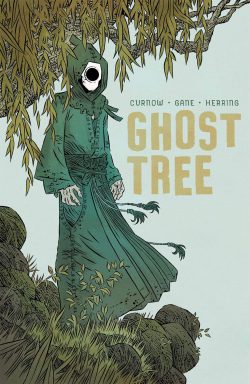
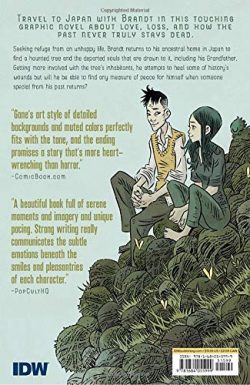
Ghost Tree


By Bobby Curnow & Simon Gane; coloured by Ian Herring & Becka Kinzie and lettered by Chris Mowry (IDW)
ISBN: 978-1684055999 (TPB) eISBN: 978-68406-810-4

The innate sadness and intense incompleteness of the spiritual world is something we tend to sideline in modern fiction, but once upon a time the melancholia of both the quick and the dead was far more important than scaring the pants off a thrill-seeking audience.

That old world approach is wonderfully revived in Ghost Tree, where author Bobby Curnow (Night of 1000 Wolves; My Little Pony; Battle Beasts; Teenage Mutant Ninja Turtles), illustrator Simon Gane (They’re Not Like Us; Godzilla; Northlanders; Unfollow; Paris) and primary colour artist Ian Herring (Minor Threats; Ms Marvel; Nova: Resurrection; Junior Citizens) examine loss, legacy and duty. It’s all deftly done through a slowly unfolding search for self in its protagonist, and meaning or closure in the myriad spirits he is unwillingly connected to…

Despite growing up in the USA, Brandt was always close to his Japanese grandfather. However, the gentle old man also had other concerns and seemed to split his time. One day when the boy was visiting the old country, his beloved Ojii-chan wandered deep into the forests around the old ancestral home.

Curiously following, the boy stopped at a strangely twisted willow tree where the old man asked him to make a promise. A dutiful, diligent, loving – but uncomprehending – grandson, Brandt swore to return to this spot ten years after Ojii-chan died…

Decades later, the man Brandt is heading back to Japan. Grown up and married, he’d all but forgotten that day. Now with his world disintegrating and Alice leaving, he’s flying to the ancestral homestead where his widowed grandmother still lives. Cousin Mariko and her new baby meet him at the airport. She’s worried stubborn, headstrong Obaa-chan is not doing well…

Grandmother is as blunt and feisty as ever, hectoring the new generation on how they should live. It’s a little too much and Brandt has to step outside. Reminiscing about those carefree childhood days, he thinks he sees something at the edge of the woods…

Restless and jetlagged, his sleep is also disrupted as he thinks of what might have been if he had stayed here with Arami rather than living in America…

Unaware that he’s under keen scrutiny, Brandt tries to make peace with grandma, and learns that the happy family was anything but. Shocked by revelations of his forebears’ lives lived at odds, he wanders off into the woods. He might have forgotten that Ojii-chan has now been dead for a decade, but everything comes flooding back when he finds the old man waiting for him by that certain willow…

As they chat under the ghost tree, the dead man explains that for generations some family members have been able to see kami and talk to spirits. Moreover, certain places are attractors, and lost souls are drawn to them. They are usually, angry, confused and despairing, haunted by things left unsaid or not done…

Whilst they sit, dozens of dead people and stranger things draw closer. Grandfather explains they expect Brandt to intercede for them and help deal with their unfinished business…

The old man wants him to avoid the family’s burden and nor repeat his own mistakes: to live a life among the living. His advice is wasted and worthless as Brandt has seen his first love Arami is one of the clamorous phantoms…

Soon the mortal is counselling revenants and carrying out minor missions on their behalf, but the renewed activity around the tree has drawn some of the worst horrors of Japanese mythology, and Brandt learns that the Zero – a traditional guardian defender – is slowly fading.

With Grandfather urging him to forsake the dead and spend time with his family, and Arami looking for reasons to stay or pass on, the conflicted man of two worlds is clearly avoiding making decisions, when the choice is taken from him.

With the safety of the living also threatened by encroaching demons, Brandt must confront uncomfortable home truths before devising a solution to satisfy all parties and safeguard both worlds. Then it’s time to tackle the hard job: fixing his marital situation and getting on with life…

Powerful, sensitive, heartwarming and uncompromising, this very human drama offers echoes of classic movie fantasies such as A Matter of Life and Death (1948) and The Ghost and Mrs Muir (1947), suggesting that the dead are always with us and that – unlike families – it’s nothing to be scared of…
Ghost Tree. November 2019. © 2019 Curnow. Gane. Herring. © 2019 Idea and Design Works, LLC.

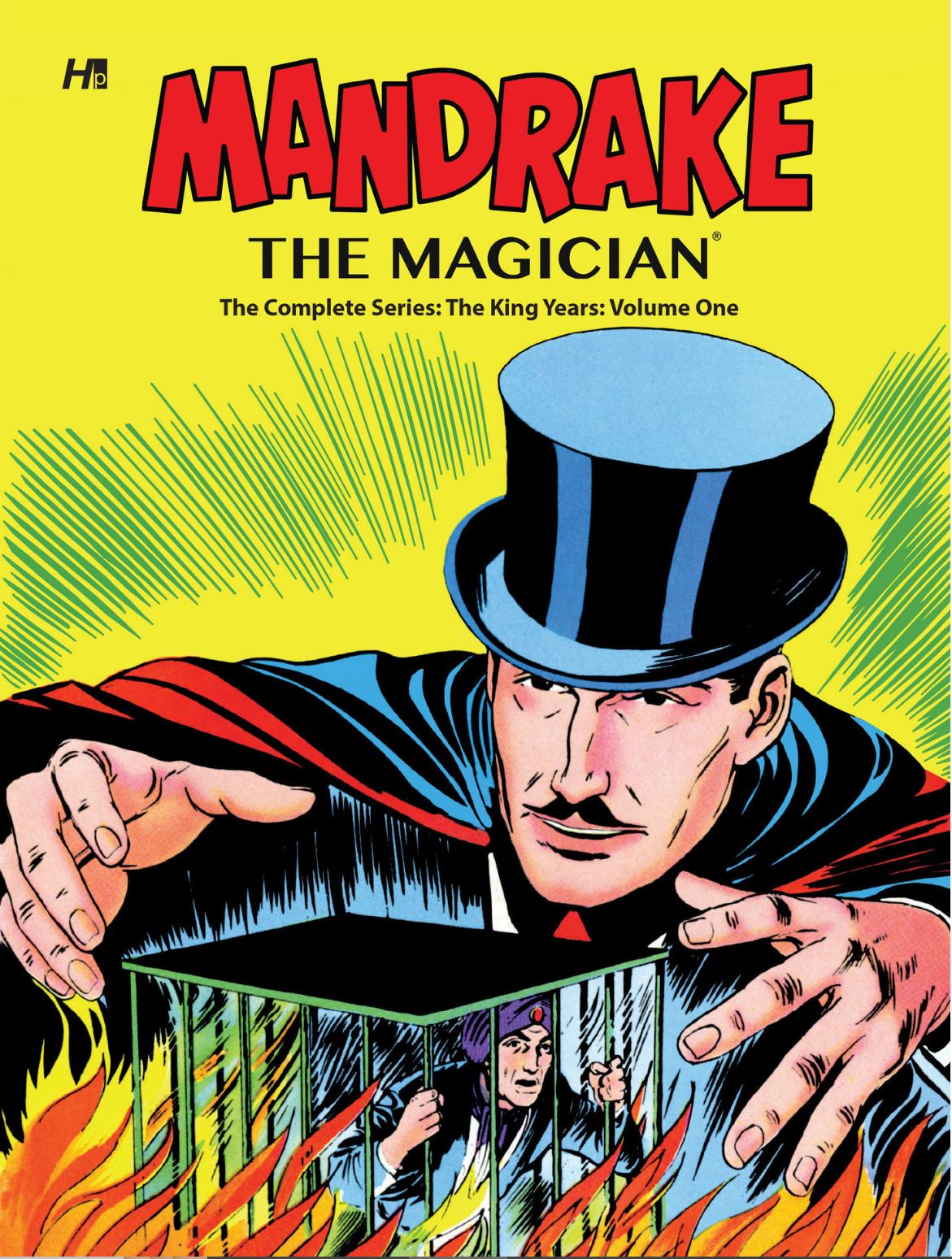
Mandrake the Magician®: The Complete King Years volume 1


By Lee Falk & Phil Davis, Fred Fredericks, Don Heck, Andre LeBlanc & various (Hermes Press)
ISBN: 978-1-61345-098-7 (HB/Digital edition)

Win’s Christmas Gift Recommendation: A Vintage Magical Mystery Masterpiece… 9/10

Regarded by many as comics’ first superhero, Mandrake the Magician debuted as a daily newspaper strip on 11th June 1934 – although creator Lee Falk had first tried to sell the strip a decade previously. Initially drawing the strip too, Falk soon replaced himself, allowing the early wonderment to materialise through the effective understatement of sublime draughtsman Phil Davis. An instant hit, it was soon supplemented by a full-colour Sunday companion page which launched on February 3rd 1935.

Falk sold Mandrake to King Features Syndicate years earlier as a 19-year old college student, but asked the monolithic company to let him finish his studies before dedicating himself to the strip full time. Schooling done, the 23-year-old master raconteur settled in to begin his life’s work: entertaining millions with his astounding tales.

Falk – who also created the first costumed superhero in moodily magnificent manhunter The Phantom – spawned an entire comicbook subgenre with his first creation. Most Golden Age publishers boasted at least one (and usually many) nattily attired wizards in their gaudily-garbed pantheons: all roaming the world making miracles and crushing injustice with varying degrees of stage legerdemain or actual sorcery.

Characters such Mr. Mystic, Ibis the Invincible, Sargon the Sorcerer, and an assortment of … the Magician such as Zanzibar, Zatara, Kardak ad infinitum all borrowed heavily and shamelessly from the uncanny exploits of the elegant, enigmatic man of mystery who graced the pages of the world’s newspapers and magazines.

In the Antipodes, Mandrake was a suave stalwart regular of Australian Women’s Weekly and also became a cherished icon of adventure in the UK, Italy and Scandinavia. As seen and described in Eileen Sabrina Herman’s ‘Introduction: The Magic behind Mandrake’ the Magician was a major star of page & screen, pervading every aspect of global consciousness. This erudite appreciation also includes tantalising merchandise and memorabilia and movie posters plus original art by not just by Falk, Davis, Ray Baily, Don Heck, and Fredericks but also a stunning Phantom team-up pic from Don Newton.

Over decades he’s been a star of radio, movies, chapter-serials, a theatrical play, television animation (as part of the cartoon series Defenders of the Earth). With that came the usual merchandising bonanza of games, toys (including magic trick kits), books, comics and more…

Falk worked on Mandrake and “The Ghost who Walks” until his death in 1999 (on his deathbed he was laying out one last story), but also found a few quiet moments to become a renowned playwright, theatre producer and impresario, as well as an inveterate world-traveller. However, even he couldn’t keep up with the demand, which is where this collection comes in…

Between 1966 and 1967, King Features Syndicate dabbled with a comic book line of their biggest stars – Popeye, Flash Gordon, The Phantom and Mandrake – developed after the characters had enjoyed newsstand stardom under the broad and effective aegis of veteran licensed properties publisher Gold Key Comics.

Mandrake was no stranger to funnybooks, having featured in the David McKay Company’s 1939 Magic Comics (1939-1949 and Dell’s Four Color #752, as reformatted strip reprints and in new material. He was also a major player for child-friendly Big Little Books.

This initial archival full-colour volume gathers the pertinent contents of Mandrake the Magician #1-5, spanning September 1966 to May 1967, plus back-up material from Flash Gordon #1-3, and also includes a wealth of unseen art and candid photos.

As part of a cross-selling policy at that period, King Comics revived the ancient practise of adding short story vignettes of other stars to their publications. The Magician regularly added mystery and imagination to the line-up of Earth’s greatest interstellar explorer…

Those in the know are well aware that Mandrake was educated at the fabled College of Magic in Tibet, thereafter becoming a famous, suave globe-trotting troubleshooter: always accompanied by faithful African partner Lothar and beautiful companion (eventually, in 1997, bride) Princess Narda of Cockaigne. Together forever, they faced the uncanny, solved crimes and fought evil.

With covers by Don Heck & Mike Peppe, André LeBlanc and Fred Fredericks, all these stories are scripted by Dick Wood before Gary Poole takes over with the second story in #4. The show begins with a monochrome inside front cover feature from then-current strip artist Fred Fredericks who shared secrets of Mandrake’s mountaintop home in ‘Danger Drive to Xanadu’. Harold “Fred” Fredericks had taken over art production when Davis died in 1965, and assumed full creative duties when Falk himself passed on in 1999.

Here, however, Wood, Don Heck & André LeBlanc open festivities by detailing ‘Menace of the City Jungle!’, wherein Mandrake and Lothar volunteer to clean up a crime-infested park and its extended locality by playing hapless bait for an army of bandits and muggers. The combination of illusion, hypnotism and brute force is so successful, the duo then have to devise a scheme to stop the cops feeling slighted and inadequate!

Werner Roth & LeBlanc then expose ‘The Flying Phantom!’, as the city is plagued by an uncanny plunderer employing magic carpets and winged horses until Mandrake steps in to foil the thief and spoil the trick…

Fredericks then concludes his monochrome travelogue of ‘The House of Wonders’ for the inside back cover, after which the November cover-dated, all Wood & LeBlanc second issue opens with a truly tense sci fi drama. All Earth can hear the increasingly panicked pleas and threats of an alien space craft hurtling to its doom, but no tool of mankind seems able to see or save ‘The Spectre from Space’. Thankfully, Mandrake is around and able to apply his wisdom to the crisis…

A far more plebian police problem is solved when gangster Lucky Larry Yates opens his law-defying gamblers palace, and Mandrake is called in to exorcise ‘The Phantom Casino’…

Mandrake the Magician #3 (January 1967) addressed global politics after despondent British nuclear scientist Dr. Andrew Crane decides to save the world from itself by allowing enemy agents to use his ultimate weapon in a deterrence demonstration. Of course, foreign spies can’t be trusted and the free world needs Mandrake’s talents to save ‘The Doomsday Man’ from himself and everybody else from utter annihilation…

A sudden change of pace brings the magician and Lothar way out west to expose a rowdy ghost terrorising a frontier town. However, when brazen “bandito” Pancho Valdez proves immune to Mandrake’s gifts, the cunning conjuror simple switches to brain power to stop ‘The Terror of the Haunted Desert’…

Crime was the spur for Wood’s last outing as a magician’s convention is threatened by ‘The Black Wizard!’ who mimics the signature tricks of many magnificent showmen – until Mandrake and Lothar expose the mastermind behind the crimewave – after which Gary Poole joins LeBlanc to detail an insidious impersonator targeting High Society. This malign malcontent even puts Mandrake in jail before the magician can foil ‘The Frame-Up’… or does he?

Ray Bailey illustrated #5 (May 1967) beginning with a nautical campaign as Mandrake and Lothar spectacularly dismantle a ultra-modern pirate band in ‘Cape Cod Caper’, after which ‘The Fear Mongers’ sees warring kingdoms pacified and their (intimately related) rulers reconciled after a bizarre faux alien invasion…

Those aforementioned backup stories begin with Wood, Heck & LeBlanc’s ‘Midnight with Mandrake’ from Flash Gordon #1 (September 1966) as a gang of thieves unleashes sleeping gas on a city crowd, only to have Mandrake change it from soporific to an hallucinogen…

‘The Laughing Clown Caper’ then pits the wanderers against a malevolent mountebank seeking to wreck a rival’s career, whilst ‘The Little Giant’ sees the worldly wizard give an undersized fight promoter a psychological boost to deter local bullies and fight-fixing thugs. As an added bonus, the original art for this entire uncredited story (maybe Wood and Frank Springer?) is also included here, preceding a lavish and fascinating look at the strip and comic book career of an artistic legend as Spike Barkin conducts a copiously illustrated and informative ‘Focus: Interview with Fred Fredericks’.

This thrilling tome offers exotic locales, thrilling action, spooky chills and sheer elegance in equal measure. These stories have lost none of their impact and only need you reading them. Sprinkled liberally with original art pages, this a delicious, nostalgia-drenched triumph is perfect for the Halloween season: straightforward, captivating eerie action-adventure that has always been the staple of comics fiction. If that sounds like a good time to you, that’s Magic!
Mandrake the Magician® © 1966-1967 and 2015 King Features Syndicate, Inc.; Hearst Holdings, Inc. Reprinted with Permission. All rights reserved.

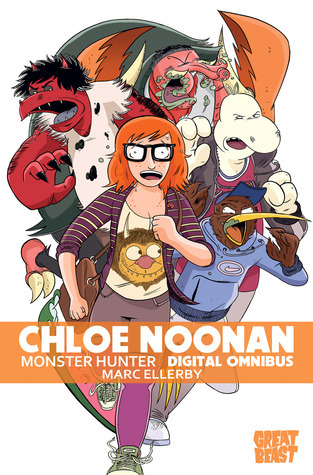
Chloe Noonan: Monster Hunter Digital Omnibus


By Mark Ellerby, with additional colours by Adam Cadwell (Great Beast Books)
ISBN: 978-1-78845-285-4 (Digest HB)

When the TV show Buffy the Vampire Slayer debuted, its mix of sassy teen culture, wry humour, scary adventure, soap opera group dynamics and supremely quotable zingers utterly revolutionised popular entertainment – but not as much as the kick-ass star who proved once and for all that girls could be action heroes.

In the wake of the phenomenon, cartoonist Marc Ellerby (Love the Way You Love, Phonogram: The Singles Club, Ellerbisms, Rick and Morty, Regular Show, Doctor Who) deployed the sarcastic whimsical contrariness we Brits are so grievously afflicted with and belatedly devised a wry riposte to the saga of the mystically superpowered American “Chosen One” and her dedicated team of troubleshooters…

Between 2009 and 2014, Ellerby self-published five issues (and a few extra bits) of Chloe Noonan: Monster Hunter – the sublimely daft exploits of a plucky, determined and utterly normal girl who splits her time between going to college and holding back the malign forces of darkness lurking all around us.

In 2012, the majority of these Kitchen Sink/School Daze/Eldritch Exploits were coloured and gathered in a Digital Omnibus. Here you can comfortably enjoy a jolly jump back in time and space to see how the nuts and bolts of saving humanity works with hilarious hits from Chloe Noonan #1-4, Chloe Noonan Halloween Special 2012, Chloe Noonan Christmas Special 2012 and material from Paper Science #5 and Solipsistic Pop #2-3.

The preternatural perils are preceded by ‘Just a quick word! An introduction from the author’ wherein we learn the origins of the feature and how and why it was remastered, before we finally meet the snarky, sarky, brittle “plain Jane” B-lister who’s nobody’s first choice to save the world…

As well as benefitting from added colour, these terror tales have been chronologically adjusted so keep your wits about you as Chapter 1/ Chloe Noonan #1 takes us to a chip shop in Raven Dale where two students are chatting. Chloe is reluctantly revealing she’s in a band to ingenuous hottie Zoe Fox, when the dowdy, meek-seeming redhead gets an urgent call. For reasons she cannot understand, Noonan suddenly breaks protocol – and her oath of secrecy – and invites Zoe to come along as she tackles a rampaging monster. Her duty is onerous, unpaid and voluntary, so they have to take the bus…

It’s a long ride, made truly interminable by having to disabuse her new friend of ridiculous TV-fuelled notions of the job’s glamour, innate magic powers and skill with ancient weaponry, but eventually they locate the beastly Dahgul. It is not willing to come along quietly…

Forced to consult irascible mentor Professor Lemon Barley, the increasingly pissed off Chloe resorts to her favourite solution – nets and really big bombs – but is then stuck babysitting the beast while she plays a gig with the band…

Issue #2 opened with an inconclusive clash against drunken lobster-horror Pinchy, before another tedious day at Raven’s Dale College commences. Watching guys – especially cute but gormless Doug Stonebridge – hitting on Zoe does nothing to lift her mood, especially after her new self-elected BFF blurts out Cloonan’s monster-hunting sideline. More grief about her failures from Barley follows, and the absolute end comes when Pinchy – AKA Skaldjur – invades the college looking for girls, booze and a rematch and sparking a riot. Chloe might be merely human – and not very fit – but the brute has turned up just when she really needed to hit something and gets just what he deserves…

She’s barely regained her composure when the top secret clean-up crew show up, delivering pat disinformation and trying to impress pretty little Zoe…

Chapter 3 comes from Paper Science #5: a brief encounter with band nerds and ice creams, before Chloe Noonan #3 reveals how bandmate Zach pilfers arcane lore from Chloe’s bag and enhances the latest gig by summoning arcane armageddon in the form of an awakened Kraken…

Thankfully, a full-on angry rant seems to be Chloe’s private superpower…

A brace of shorts from Solipsistic Pop #3 and #2 reveals how Chloe & Zoe deal with a gang of monster-seeming Chavs and annoying girl band Pozzy Pops before chapter 7 presents the full-length fun of Chloe Noonan #4 with the “Nooners”, Zoe and Doug spending an unpleasant night clubbing, only to find that even supernal haunts crave a good time, cheap drinks and ear-splitting beats. However, when Chloe tries to lay down the law, she gets an unlikely schooling in monster politics…

Chloe Noonan #3 delivers the next instalment as drunken Doug falls foul of supernatural Chavs (think Devil-Moomins) in a deserted playground, and Zoe drags her “Nooners” out of a well-earned sleep to save his undeserving ass after which ‘Trick or Treat’ (from Chloe Noonan Halloween Special 2012) sees awestruck Zoe dressing up as her hero for a spot of fancy-dress, door-to-door begging on October 31st. Of course, prowling darkened streets with a happier, prettier, sexier version of herself is everything Chloe dreaded it would be, and she’s in no mood to dick about when the real monsters turn up to celebrate “their” special day…

Wrapping up the spooky selection is the Chloe Noonan Christmas Special 2012 with the surly supernaturalist and Professor Barley dutifully and pointlessly hunting an unknown antagonist and enduring ‘A Very Noony Christmas’ whilst everybody else is getting outrageously inebriated at a major college party…

Accompanying the morose mirth is a ‘Cover Gallery’ (fronts and backs!) including a spiffy art print; a selection of ‘Fan Art’ by Will Kirkby, Tom Humberstone, Liz Prince and Luke Pearson and a fulsome (29 pages) and fascinating dip into the author’s ‘Annotated Sketchbook’ as well as a ‘Biography’ of the creator.

Fun, funny, fiercely foolish and fabulously entertaining, this ancient arcane artefact is as fresh and festive as it ever was. Forget the Chosen One and just choose Chloe Noonan.
™ & © 2009-2012, 2020 Marc Ellerby. All rights reserved.

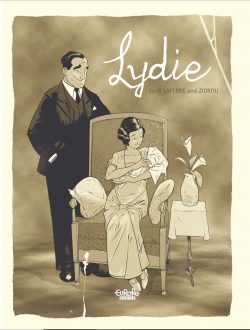
Lydie


By Zidrou & Jordi Lafebre, translated by Mercedes Claire Gilliom (Europe Comics)
No ISBN: digital edition only

Win’s Christmas Gift Recommendation: Lyrical, Lovely, Unforgettable… 10/10

It’s the season for spirits and spectres and we all love a good, healthy scare, but it’s wise to remember that ghost stories aren’t just about revenge, unfinished business or unreasoning irrational terror. So often, what’s at play is feeling of duty and ineffable loss…

As you’d expect, our Continental cousins are exceeding adept at exploring humanity’s softer sides through the medium of comics, and Lydie is a masterclass in emotive, evocative, ruthlessly sensitive storytelling to delight our senses by quietly affirming our better natures.

Be warned though: this tale is funny, heartwarming and sad. No one (at least nobody even borderline human) will scoff or sneer if you need tissues to get you to the end.

Lydie was originally released in 2012, courtesy of empathetically enthralling scripter Zidrou (Benoît Drousie) and illustrator Jordi Lafebre. Drousie is Belgian, Brussels born in 1962 and until 1990 a school teacher – prior to quitting marking books to instead make them. His primary successes include school dunce series L’Elève Ducobu, Petit Dagobert, Scott Zombi, La Ribambelle, Le Montreur d’histoires, African Trilogy, Shi, Léonardo, a revived Ric Hochet and so many more. His most celebrated and beloved stories are the Les Beaux Étés sequence (translated by Europe Comics as Glorious Summers) – and this stand-alone saga. Both are illustrated by Spanish artist Jordi Lafebre.

The sublimely gifted illustrator and art teacher was born in Barcelona in 1979 and has been a comics professional since 2001 – initially for magazines like Mister K, where he limned Toni Font’s El Mundo de Judy. Lafebre found regular work at Le Journal de Spirou, creating the romance Always Never and collaborating with Zidrou on La vieille dame qui n’avait jamais joué au tennis et autres nouvelles qui font du bien, and La Mondaine.

Even for such gifted creators and in-tune collaborators, Lydie is something special: A combination of semi-tragic feel-good fable and genteel working class ghost story, this is a beguiling confection dealing out potent emotional punches one after another – so be braced with plenty of hankies. Nevertheless, it still manages to find the good and the laudable in us, even in the lowest moments and worst of aspects of our natures: enrobing what should be crushing tragedy in the uplifting actions of a community looking out for all of its members, no matter how flawed or forgotten they might become…

It starts sometime in the last century with a little enclave of an ordinary district in the kind of town that used to be everywhere. The crowded cul-de-sac of Baron Van Dick Court is a tiny, independent world of its own, where everyone knows everyone – and most of their personal business. However, since kids will be kids, when a little bit of mischief occurred, the place became irrevocably and foreverafter “Mustachioed Baby Court”…

The denizens live piled up on each other and are a typical bunch: hard-working, industrious, painfully practical and all eking out a living as best they can, but one night something rather extraordinary happens…

It truly started some time earlier. Down in the backyard, poor, hard-up Victor Lefort was again forced to destroy his cat’s beautiful kittens, even as upstairs Doctor “Fables” Fabian was failing to save a baby. Perhaps it was for the best. Distressed mother-to-be Camille Tirion is painfully simpleminded, and had been cruelly taken advantage of by some vile anonymous sinner, so what possibly life could her child have had?

Camille – and her poor father Augustin – were subject of much gossip in the local general store/bar. Despite being a train driver and often away overnight, he has done his best raising his afflicted daughter all on his own… at least until this…

Camille’s mother also died in childbirth and now cruel fate has struck the family again…

The event affects everyone in the Court and many parents must explain to their own children how – if not why – Camille’s baby has gone and must live in a tiny wooden box under the ground in the church graveyard…

However, once all the necessary ceremonies have taken place and life in the Court moves back towards normal, something happens. It begins when Augustin finds his bereft child crumpled under the little statue of the Madonna that’s been overlooking the court for who knows how long, and continues the next day when Camille dashes joyously into the store, ecstatically telling all inside that her baby has come back.

Of course, little Lydie is invisible now…

Her joy is infectious, and no one wants to disabuse the poor simpleton of her fanciful notion, but things take a stranger turn after the feral and prolific delinquent Ayhard brothers brutally tease the “new mother “and her swaddled, intangible infant. When aged Madame Paris helps distraught Camille comfort the latest addition to the Court, the community rallies around, and before long even the most curmudgeonly dweller in Mustachioed Baby Court is playing along: from crusty shopkeeper Théophile Lefort to acid-tongued sot Madame Malisse. The priest is even cajoled into performing a special baptism for the unseen infant…

…And gradually, with everyone contributing to the fantastic lie for decades, it all seems to come fantastically true…

From this point on, the story takes on a life of its own too, so please for the sake of soul and all the lost joy modern life has stripped from you, find and read this glorious fable dedicated to the miraculous strength of imagination, power of love and irresistible force of humanity united in a grand cause…
© 2018 DARGAUD BENELUX (Dargaud-Lombard s.a.) – Jordi Lafebre and Zidrou. All rights reserved.

Evil Emperor Penguin: Antics in Antarctica


By Laura Ellen Anderson, with Kate Brown (David Fickling Books)
ISBN: 978-1-78845-282-3 (Digest PB)

Win’s Christmas Gift Recommendation: Outrageous Acts and Brilliant Buffoonery… 8/10

In 2012 Oxford-based family publisher David Fickling Books launched an “old school” weekly comics anthology aimed at girls and boys between 6 and 12. It revelled in reviving the good old days of British picture-story entertainment intent whilst embracing the full force of modernity in its style and content. This comprised comic strips, humour, adventure, quizzes, puzzles and educational material in a joyous parade of cartoon fun and fantasy.

In the years since its premiere, the periodical has gone from strength to strength, its pantheon of superbly engaging strips generating a line of superbly engaging graphic novel compilations, the latest of which is this riotous romp starring a gloriously malign arch-wizard of scientific wickedness to delight all readers with a profound sense of mischief and unbridled imagination…

Conceived and created by illustrator and author Laura Ellen Anderson (Kittens, Snow Babies, My Brother is a Superhero, Amelia Fang!, Rainbow Grey, I Don’t Want…), these are the revived ad remastered exploits of Evil Emperor Penguin!

He lives in a colossal fortress beneath the Antarctic, working tirelessly towards total world domination, assisted by his stylish, erudite administrative lackey Number 8 and cutely fuzzy, passionately loyal Eugene. The latter is an endlessly inventive little abominable snowman clone. EEP had whipped up a batch of 250, but none of the others are quite like Eugene…

The Penguin appointed the hairy, bizarrely inventive tyke his Top Minion, but somehow never managed to instil him with the proper degree of evilness. He is, however, a dab-hand with spaghetti hoops, so it’s not a total loss…

Following a pin-up of the ‘Fridge of Evil’ and an info-packed double-page map of the Evil Underground Headquarters disclosing all you’ll need to know, an assortment of vile vignettes begins with ‘A Stitch in Time’ wherein the cape-draped malcontent megalomaniac unleashes his Evil Emperor-bot of Icy Doom at the annual World Leaders’ Picnic.

Unfortunately, due to a totally typical cock-up with the plans by oafish underlings, the titanic tin-can terror’s ice-laser eyes have somehow been replaced by instant knitting machines…

The next nasty invention doesn’t even get out of the lab before malfunctioning. ‘Have No Fear’ finds a dire device that manifests personal terrors running amok in the lab, unleashing EEP’s domineering mother and sweet Eugene’s incredible, ghastly secret phobia before the inventors can reach the Emergency Self-Destruct Button…

‘Cat-astrophe’ introduces a terrifying rival in the Word Domination stakes who infiltrates the bad bird’s base as a cute and fluffy feline pet for Number 8…

When EEP’s giant spider robot immobilises the entire Earth in its ‘World-Wide-Web’, even Evil Cat is caught off guard, and only Eugene’s incomprehensible preoccupation with shiny, sparkly unicorns prevents total disaster.

The top-hatted, moustachioed, perfidious puss then attempts amnesty in ‘The Truce’ but the fuzzy fiend is, of course, shamming friendship. The floral gift he proffers is actually a deadly animated booby-trap which is only just defeated thanks to Eugene’s inherent ineptitude.

Would-be World Dictators are not a particularly forgiving bunch and when the fuzzy tyke accidentally unleashes the full force of EEP’s Ferocious And Really Terrible machine, ‘The Stinking Truth’ is released in a Nuclear Stench Cloud and prompting the penguin peril to fire his Top Minion. EEP’s loss is Evil Cat’s gain though, and Eugene soon settles in with a Malign Master who really appreciates him.

‘Please Alight for the Domination Station’ finds them quashing the chilly Caped Fiend’s scheme to transform Britain’s seat of government into the Houses of Penguinment (which I’m pretty sure we’d all vote for this week), but a pitched battle between super-science cat and ghastly gadget bird swiftly escalates beneath London streets before Eugene’s cuteness-filled ultimate weapon sadly takes out his new boss by mistake…

As a result of that debacle, the little snowman is briefly evaporated by Evil Cat and ends up floating wistfully over Antarctica as a ‘Head in the Clouds’ even as Evil Emperor Penguin faces his greatest challenge when his little sister Ruth – she prefers “Ruth-less” – pays a visit, sees what big bro is up to and decides that she too is going to rule the world in ‘Sibling Rivalry’…

Things get even worse after Evil Cat interferes, holding Ruth-less hostage until everybody involved has foolishly forgotten that tiny turncoat Eugene is afflicted with niceness and a powerful conscience…

The exploration of  cartoon evil and daft depravity amplifies and intensifies in an epic exploit detailing ‘The Return’ when sweet-natured Eugene’s continual bodges at last force Evil Cat to fire him with extreme prejudice. Hopeless, homeless and homesick, the shaggy savant is on his last legs when he’s adopted by jolly unicorn Keith, who nurses him back to health and flies him to Antarctica just in time for them both to become embroiled in a final fateful clash between Penguin and Cat.

Naturally such devoted do-gooders can only get stuck in and engineer some marvellously magical reconciliation…

More nefarious nonsense unfolds in extended thriller-chiller ‘I Will Crèche You’ wherein EEP’s incredible De-Ageifying “Youth Juice” wreaks the now-customary havoc after insidious rival Evil Cat breaks into the citadel and everybody gets a rejuvenating soaking…

Undaunted, the Penguin of Perfidy attempts to increase his own stature with a growth ray but doesn’t consider that his top menial might wander in and accidentally become ‘Hugene’…

More trouble arrives when the Barmy Bird decides to digitise and upload himself into the global data net via his Super Computer of Evil. Believing supreme power is in his feathered grasp once he becomes ultimate virus ‘X-Treme Evil’, EEP is ambushed in virtual reality by digital demon virus Trojan the Hunk. Luckily, Eugene is a dab paw with computer games and comes to his master’s rescue… sort of…

Back in the physical world once again the Emperor is next subjected to a terrifying surreal assault by feathered scavengers and finds himself ‘Pigeon Holed’…

Everybody loves cute kittens, which is what Evil Cat’s cousin Debra counts on when she uses soppy Eugene to infiltrate the fortress and steal all the Spaghetti Hoops in ‘What’s New Pussycat’. With the team – even Evil Cat – trapped and helpless, they must surrender all pride and dignity and call on jolly unicorn Keith to save them…

Without their favourite food, Christmas seems drab and dreary for the entire ice-bound army but when Eugene finds ‘The One Hoop’ it unleashes a torrent of unexpected emotion to tide the Evil Emperor over, even though it ultimately leads to deprivation mania in ‘A New Hoop’…

Deranged and desperate, EEP is only saved after Eugene and Number 8 track down Debra and steal back the vast cache of spaghetti tins. Good thing too, as she wasn’t planning on eating them but needed them to power her world-destroying machine…

After all that drama, ‘Eugene’s Day Off’ is an unremitting stream of great experiences for the faithful servitor, but for the Penguin Potentate – forced to put up with substandard substitute Neill – a string of catastrophic and painful disasters. Thus, it’s no surprise and a total tragedy when EEP’s top flunky is lost on a melting ’berg after watching the pretty sunset ‘On Thin Ice’…

Happily, the unthinkable occurs as the cape-clad malcontent megalomaniac teams up with scintillating Keith the Unicorn to save Eugene from dire deep sea doom…

‘Pop Goes the Easel’ finds the putrid penguin planning an attack on world leaders through the medium of art, but sadly, turning his victims into paintings proves to be a double-edged sword with unexpected repercussions, especially after Eugene tries to help…

This gag-filled grimoire of bird-based bombast concludes in high style as a sinister scheme to flood the world with scented candles of distilled Ultimate Evil is thwarted once ‘Essence of Eugene’ is added to the wax mixer, resulting in a global outpouring of warm, fuzzy euphoria…

Rocket-paced, hilariously inventive, wickedly arch and utterly determined to be silly when it most counts, this tome of terror also has educational merit as it offers lessons on ‘How to Draw Eugene’. Evil Emperor Penguin: Antics in Antarctica is a captivating cascade of smart, witty funny adventure, which will delight readers of all ages.
Text and illustrations © Laura Ellen Anderson 2022. All rights reserved.

Rork: The Ghosts


By Andreas, coloured by Isa Cochet and translated by Montana Kane (Europe Comics)
No ISBN: digital edition

Born in January 1951, Andreas Martens is an incredibly versatile artist from East Germany (and from a time when that meant another country, not a different location). He trained at the Academy of Fine Arts in Düsseldorf and the Saint-Luc Institute/comics school in Brussels. His work appeared in college magazine Le 9e Rêve, À suivre, Heavy Metal and Le Journal de Tintin where – in conjunction with his teacher Eddie Paape – he created the seminal Udolfo.

Relocating to France, Andreas adapted the works of Francois Rivière (collected in 1980 as Révélations Posthumes) and produced a graphic edition of Charlotte Brontë’s Jane Eyre for Je Bouquine.

Stand-alone works include La Caverne du Souvenir, Coutoo, Dérives and Aztèques, but his reptation was earned through gripping original series such as Raffington Detective, Cyrrus, Arq and others. His entire oeuvre is steeped in classical style, draped in period glamour and drenched in visual tension. Many are thematically linked. However, before all these, he created one of the most stylish and memorable “Challengers of The Unknown” in horror fiction: enigmatic psychic savant Rork.

His pale and moody period hero, (who first appeared in Le Journal de Tintin in 1978) draws on the tone, time and sometimes even “homaged” content of dark-fantasists August Derleth, H. P. Lovecraft and especially the Carnacki stories of William Hope Hodgson. Spiritual nomad Rork wanders the world and great beyond, unravelling mysteries and discovering startling wonders, not for fame or glory, but because he must…

In the early 1990s Dark Horse Comics serialized his adventures in their superb anthology of European comics Cheval Noir, and those translations formed the basis of a little seen or remarked upon series of albums from NBM.

After too long in absentia – that’s past Neverland, a little to the left of Narnia but not as far as The House on the Borderland – the mystic marvel returned in 2017, courtesy of digital-only publishing collective Europe Comics who kicked off what I still hope will be a complete revival by translating into English the final book in the sequence.

Released in 2012, Les fantômes is a prequel tale, regarded by devotees as volume #0, despite its being preceded by seven spooky tomes and crossovers with other Andreas concepts…

By this time, readers had learned that the snowy-haired enigma was a wizard from another dimension, compelled to solve supernatural mysteries even as he sought the secret of his own origins: twin quests that carried him all over creation and into scary battles beside many of the author’s other uncanny warriors of justice…

In this tale – vividly coloured by Isa Cochet (and I make this point as most Rork exploits have appeared in starkly stunning monochrome, in the manner and style of visual pioneers Bernie Wrightson and Jim Starlin) – the wanderer is consulted by Samuel, who has been the channel by which unquiet spirits informed the living of missing (and ultimately dead) persons…

Somehow linked to trees and forests, phantoms came to him ,and Samuel made his living helping others until the day he met Daphne and her son Cary. These living seekers’ search for a husband and father was for greed, not love or closure, and soured the diviner’s relationship with his ghosts. Now decades later, Samuel convinces Rork to intercede for him…

It’s not all altruism, though. The haughty, stubborn finder has been compelled to seek aid since ruthless treasure hunter Tryan has begun to threaten torture and worse unless Samuel uses his gifts to unearth hidden wealth. However, when the white wizard uses his own ability to converse with the departed, he hears a subtly different story and realizes he’s being played for a fool…

Andreas is fascinated by levels of reality and states of comprehension, so Rork tales always come layered with allegorical symbolism, abstract interpretation and trenchant pictorial clues pointing towards deeper meaning. As this story progresses, the mage draws Samuel into verbal duels whilst gradually removing him from the arcadian forests that harbour his ghosts: leading them to an arid desert of the American west where a godlike being offers hints to a greater truth, and where sinister pursuer Tryan falls into a cunning trap…

Ultimately, Rork divines the truth beneath strata of lies and self-deception and the mystery of Samuel is revealed for all to see…

For me, a great comic strip begins with the simple line. The greatest drawing is always about the power of black against white. Colour enhances but it seldom creates in our business. Andreas is one of the best line artists in the modern business so I’m delighted to confirm that there’s a stunning ‘Rork Gallery’ of seven breathtaking images closing his book.

Exotic, eccentric, chilling and lyrically beguiling, the traditional mysticism and otherworldly dread of these tales is a heady and captivating brew, especially with the intense, linear illustration and stark design of Andreas to mesmerize and shock your widened eyes.

Come see for yourselves why this series should be at the top of the list of books to re-release…
© 2017 ÉDITIONS DU LOMBARD (DARGAUD-LOMBARD S. A.) – ANDREAS. All rights reserved.

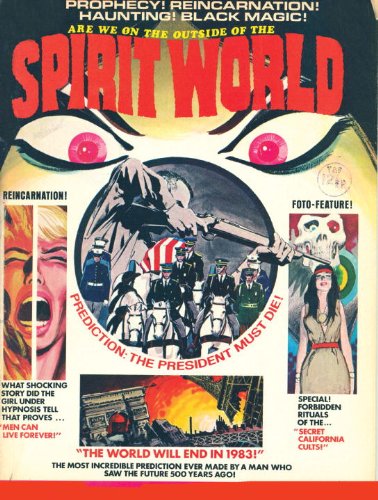
Jack Kirby’s Spirit World


By Jack Kirby with Mark Evanier, Steve Sherman, Sergio Aragonés, Vince Colletta, Mike Royer & various (DC Comics)
ISBN: 978-1-4012-3418-8 (HB)

Jack Kirby was – and remains long after his passing – the master imagineer of American comics. His collected works provide a vast rich trove of astounding narrative delights for any possible occasion. An ideal and seasonably timely tome is this magnificent compendium re-presenting the complete “King’s Canon” of one of his least known, most misunderstood and mishandled DC creations. Regrettably, it’s still not a book you can read digitally, but hope springs eternal…

Famed for larger than life characters and gigantic, cosmic imaginings, Kirby was an astute, spiritual man who had lived through poverty, gangsterism, the Depression, World War II and the rise and stall of the Space Age. He’d seen and survived Post-War optimism, Cold War paranoia, political cynicism and birth and death of peace-seeking counter-cultures. Above all else, he was open-minded and utterly wedded to the making of comics stories on every imaginable subject.

On returning from valiant service in World War II, Jack – reunited with long-term creative partner Joe Simon – began producing genre material for older audiences and famously invented the genre of Romance comics. Amongst the dynamic duo’s other concoctions for Prize/Crestwood/Essankay Publications was a noir-esque anthology, supernatural-themed and psychologically underscored, reflecting the tone and trends of those rapidly-changing, globally Post-Traumatic times.

Black Magic (and short-lived companion title Strange World of Your Dreams) eschewed traditionally gory, heavy-handed morality plays and simplistic cautionary tales seen in other comics and concentrated on deeper, stranger fare. They were – until EC comics hit their peak – far and away the best horror and mystery titles on the market.

Changing tastes and an anti-crime, anti-horror witch-hunt quashed the comics industry, so under a doctrinaire, self-inflicted conduct code, publishers stopped innovating and moved into more anodyne areas. This established holding pattern persisted until the rebirth of superheroes and triggered the demise of many smaller publishers…

From 1956, at a little outfit using the name “Atlas”, Kirby partnered with Stan Lee and, when superheroes were revived, changed the world with a salvo of new concepts and characters that revitalised if not actually saved the comics business. Kirby always understood the fundamentals of pleasing an audience and toiled diligently to combat the appalling prejudice about the word-&-picture medium – especially from insiders and professionals who despised the “kiddies’ world” they felt trapped in.

However, after a decade or so, costumed characters began to wane again as public interest in the supernatural grew. With books, television and movies all exploring The Unknown in gripping and stylish new ways, the Comics Code Authority sought to slacken its censorious choke-hold on horror titles, hoping to save the industry from implosion when the superhero boom busted…

Experiencing increasing editorial stonewalling and creative ennui at Marvel, in 1970 Kirby (after breaking ground with a few horror shorts for the House of Ideas’ new anthology titles) accepted a long-standing offer from arch rival DC Comics…

Promised freedom to innovate, one of the first projects he tackled was a new magazine format carrying material targeting adult readerships. For the full story of how that worked out, you can read Mark Evanier’s acerbic article at the centre of this glorious – but inexplicably still not available in digital editions – oversized (282 x 212 mm) hardback compilation. He was there and knows a lot of the secrets…

Reflecting and rechannelling the mature experimentation of Black Magic in a superb yet poorly received – and largely undistributed – monochrome magazine, Spirit World #1 and only launched in the summer of 1971, but, as happened all too often, editorial cowardice and back-sliding scuppered the project before it could get going. At least when the original 1940s-1950s Black Magic was revived as a DC reprint anthology in 1973, it got a few years to properly test the waters…

Material from a second, never-to-be published, Spirit World issue eventually appeared in various colour comic books, but with most of his ideas misunderstood, ignored or side-lined by the company, Kirby opted to return to more traditional formats.

Never truly defeated, he cannily blended his belief in the marketability of supernature with flamboyant super-heroics to create another unique and lasting mainstay for the DC universe: one that lesser talents later made a pivotal figure of the company’s continuity: Etrigan the Demon. There’s a complete Kirby compendium of the Hellish hero’s deeds out there too if you’re interested, as well as many subsequent reinterpretations by creators infernally inspired by the original…

The eerily eclectic Spirit World collection, however, eschews costume continuity in favour of plot and mood-driven tales, opening with the published premier issue: combining primarily comics tales (because DC wouldn’t spring for colour photography illustrations) with prose and black-&-white “Foto-Features”, all driven by the King’s voracious, questing imagination and unique perspectives…

Printed in spooky blue tones, the arcane explorations unfold with Jack & Vince Colletta’s pictorial investigation of the power of precognition. Preceded by a stunning 3-page Kirby photo-collage, ‘The President Must Die!’ – narrated by erudite host/parapsychologist Dr. E. Leopold Maas – recounts and interprets the chilling dreams of an unnamed woman in the days leading up to the assassination of JFK.

Again sporting a collage intro, ‘House of Horror!’ grippingly relates what happened when Dr. Maas was invited to visit the phantom-plagued Calder House…

‘Children of the Flaming Wheel!’ is a fumetti-work (photographic comic strips that were huge in Europe and an area of storytelling Jack was desperate to develop) depicting the astral journey of a supposed modern cultist, after which tireless Dr. Maas shares his discoveries on the nature of reincarnation by opening ‘The Lorca File!’

As “transcribed” by Kirby’s editorial assistants Steve Sherman & Mark Evanier, ‘The Spirit of Vengeance!’ relates in a terse prose piece Maas’ interaction with a most unquiet and petty revenant before Kirby & Colletta illuminate the astounding accomplishments and warnings of ‘Nostrodamus!’ – including all those predictions still pending confirmation…

The magazine concluded with a page of ‘Weird Humor’ strips by Sergio Aragonés (and possibly Dave Manak) and came with a free wallposter. It’s included here for veracity’s sake and because they’re still pretty damn cool…

Following that tell-all article from Evanier, the majority of the proposed second issue follows in standard monochrome. The strips are taken from their eventual last resting place in DC’s anthologies Forbidden Tales of Dark Mansion #6 and Weird Mystery Tales #1-3, and still have insets and copy from other hosts such as Destiny (yes!… latterly of the Endless!), but the art, plots and most of the scripting is pure Kirby…

With Mike Royer inking all these later yarns, ‘Horoscope Phenomenon or The Witch Queen of Ancient Sumeria’ opens the fearsome festivities as a bizarre regal apparition visits many modern men and women to change their fates forever, after which the lugubrious Dr. Maas probes a primordial artefact and speculates upon the barbaric life and cataclysmic demise of ‘Toxl, the World Killer’ – a rousing fantasy warrior yarn co-plotted and scripted by Evanier.

Accompanied by photomontage inserts, ‘The Burners’ confounds Maas with a spate of deaths by spontaneous combustion and possible alien incursion – before the mystery-&-imagination moments culminate with uncanny cases of ‘The Psychic Bloodhound’. Co-plotted by Evanier & Sherman, this graphic fictionalisation of a detective with extra-sensory perception is probably based on the exploits of controversial Dutch celebrity sleuth Peter Hurkos…

Jack Kirby remains a unique and uncompromising artistic force of nature: his words and pictures an unparalleled, hearts-&-minds grabbing delight no comics lover could resist. If you’re not a fan or simply not prepared to see for yourself what all the fuss has been about then no words of mine will change your mind.

That doesn’t alter the fact that Kirby’s work from 1937 to his death in 1994 shaped the entire American scene and indeed the entire comics planet – affecting the lives of billions of readers and thousands of creators in all areas of artistic endeavour for generations. He’s still winning new fans and apostles, from the young and naive to the most cerebral of intellectuals. Jack’s work is instantly accessible, irresistibly visceral, deceptively deep whilst simultaneously mythic and human.

Wherever your tastes take you, his creations will be there ready and waiting. So, if fear and mystery are your meat, you can wonderfully upset your complacent equilibrium with this classy classic…
© 1971, 1972, 2012 DC Comics. All Rights Reserved.

Mélusine volume 3: The Vampires Ball


By Clarke & Gilson, coloured by Cerise and translated by Jerome Saincantin (Cinebook)
ISBN: 978-1905460694 (Album PB/Digital edition)

Witches – especially cute and sassy teenage ones – have a long and distinguished pedigree in fiction. One of the most engaging first appeared in legendary Belgian magazine Le Journal de Spirou in 1992. Mélusine is actually a sprightly 119-years old and spends her days – and many nights – working as an au pair/general dogsbody to a most ungracious family of haunts and horrors inhabiting a vast monster-packed, ghost-afflicted chateau. It pays her bills whilst she diligently studies to perfect her craft at Witches’ School…

The long-lived much-loved feature is presented in every format from one-page gag strips to full-length comedy tales, all riffing wickedly on supernatural themes and detailing her rather fraught life, filled with the demands of the appallingly demanding master and mistress of the castle and even her large circle of exceedingly peculiar family and friends.

The strip was devised by writer François Gilson (Rebecca, Cactus Club, Garage Isidore) and cartoon humourist Frédéric Seron – AKA Clarke – whose many features for the all-ages LJdS and acerbic adult humour publication Fluide Glacial include Rebecca, Les Cambrioleurs, Durant les Travaux, l’Exposition Continue… and Le Miracle de la Vie.

Under pen name Valda, Seron also created Les Babysitters and as Bluttwurst Les Enquêtes de l’Inspecteur Archibaldo Massicotti, Château Montrachet, Mister President and P.38 et Bas Nylo.

A former fashion illustrator and nephew of comics veteran Pierre Seron, Clarke is one of those insufferable guys who just draws non-stop and is unremittingly funny. He also doubles up as a creator of historical and genre pieces such as Cosa Nostra, Les Histoires de France, Luna Almaden and Nocturnes – apparently he is free from the curse of having to sleep…

Collected editions began appearing annually or better from 1995, with the 27th published in 2019. Thus far five of those have transformed into English translations thanks to the fine folk at Cinebook.

Originally released on the Continent in 1996, Le bal des vampires was the second Mélusine album, setting the scene delightfully for newcomers as the majority of content is comprised of 1- or 2-page gags starring the sassy sorceress who makes excessive play with fairy tale and horror film icons, conventions and themes.

When brittle, moody Mélusine isn’t being bullied for her inept cleaning skills by the matriarchal ghost-duchess running the castle, ducking cat-eating monster Winston, dodging frisky vampire The Count or avoiding unwelcome and often hostile attentions of horny peasants and over-zealous witch-hunting priests, the domestic enchantress can usually be found practising spells or consoling and coaching inept, un-improvable and lethally unskilled classmate Cancrelune.

This sorry sorceress-in-training is a sad case: her transformation spells go awfully awry, she can’t remember incantations and her broomstick-riding makes her a menace to herself, any unfortunate observers and even the terrain and buildings around her…

At least Mel’s boyfriend is a werewolf, so he only troubles her a couple of nights each month…

This turbulent tome features the regular procession of slick sight gags and pun-ishing pranks but also features some longer jocular jaunts such as the fate of a rather rude knight in armour, a brush with what probably isn’t a poltergeist in the Library and Mel’s unfortunate experience with daunting dowager Aunt Adrezelle’s patented Elixir of Youth…

Wrapping up a barrage of ghostly gaffes, ghastly goofs and grisly goblin gaucheries is the sordid saga of the eternal elite at their most drunkenly degenerate, as poor Mélusine is not only expected to organise and cater ‘The Vampires’ Ball’ but has to stick around and handle the explosive clean-up for those especially intoxicated Nosferatus who tend to forget why the revelry has to die down before dawn…

Wry, sly, fast-paced and uproariously funny, this compendium of arcane antics is a great taste of the magic of European comics and a beguiling delight for all lovers of the cartoonist’s art. Read before bedtime and don’t eat any hairy sweets…
Original edition © Dupuis, 2000 by Clarke & Gilson. All rights reserved. English translation 2007 © Cinebook Ltd.