Sheets


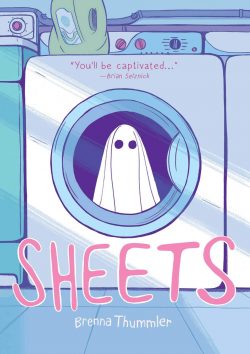
By Brenna Thummler (The Lion Forge/Cub House/Oni Press)
ISBN: 978-1-941302-67-5 (TPB/Digital edition)

Win’s Christmas Gift Recommendation: Spirited Fun for All… 9/10

Gloom, doom and death cling to Marjorie Glatt like static. The weary youngster is bullied at school and harassed at home. That’s because she spends every waking moment trying to keep the family business going under ever-escalating pressure. The laundromat was her mom’s refuge, dream and legacy, where they all lived safe, happy and warm above the washers and driers.

…And then Mom drowned.

Situated on a quiet bend of the coast, Finster Bay is like any other small town: everybody lives for themselves and is only concerned with what they want and need, and no one sees how 13-year-old Marj is daily being sucked ever-downwards. Since the funeral she’s now stuck with school, keeping a home and even feeding the family since dad had his breakdown and withdrew from reality.

The Glatts are deep in debt and Marj’s little brother Owen is a typical boy brat who won’t help unless he’s bribed…

The rich mean girls have singled her out for special attention and nasty yoga guy Nigel Saubertuck keeps breaking in, terrorising her by sabotaging all her attempts to turn Glatt’s (formerly Delaway’s) Laundry around. He even smugly boasts of it, saying he’ll take their prime location for his proposed spa centre and make them all work for him folding towels…

That’s not even worst of it, either. Adding to Marj’s woes is the distraction of inexplicably attentive cute boy Colton possibly?/perhaps?/maybe/surely it can’t be? liking her: a novelty that consequently attracts more the full venom fand disdain of obnoxious classmate Tessi Waffleton.

The fact that Marjorie is developing a full blown compulsive aversion to water after seeing her mother drown is mere icing on the cake, but as the floundering girl slowly sinks under impossible adult responsibilities, her stressed teen’s life gets even more complicated after Wendell starts causing trouble…

Finster Bay is a town doubly populated. Existing alongside the self-obsessed adults and kids is an unseen legion of dead people. The Bay is a “Land of Ghosts” and Wendell is having a hard time adjusting to not being alive anymore. A determined and inspired fabulist liar, the little apparition refuses to interact in the support group (DYE: Dead Youth Empathetics), hasn’t read the Book of Ghost Law he was given and won’t even keep clean the standard-issue white shroud which confines and contains all that’s left of him.

He also died in water, and has an unrecalled deep connection to Marjie…

When Mr. Saubertuck makes his big move, surreptitiously adding red dye to the Glatt washers, he’s thinks he’s finally driven Marjorie to surrender. However, he’s shockingly confronted by Wendell! The slimy schemer hasn’t reckoned on an army of spooks coming to her aid, even as she at last realises the free-floating annoyance that has immensely added to her distress…

In the meantime, Marj has been doing some deep diving at the Library and has deduced that the overly-familiar little spectre is the little kid who saved her when she was lost years ago…

Wistful, charming, sadly poignant and unafraid to address both lighter and the darkest issues, Sheets is a sweetly refreshing tale of determination, discovery and enduring friendship, with illustrator-turned-author Brenna Thummler (Anne of Green Gables) delivering a remarkable and enchanting modern fable that has already spawned a sequel, and should be a favourite for generations to come.

This book was released by Lion’s Forge in 2018, and is available in digital formats, but is also schedule for re-release in January 2023 from Oni Press.
© 2018 Brenna Thummler. All rights reserved.

Mystery Girl


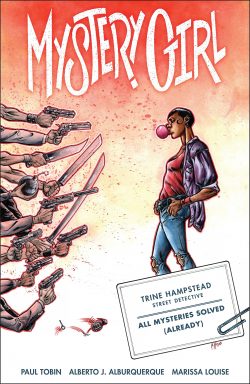
By Paul Tobin, Alberto J. Albuquerque, Marissa Louise & Marshall Dillon (Dark Horse Books)
ISBN: 978-1-61655-959-5 (TPB/Digital edition)

There are many fabulous smartly entertaining stand-alone comics collections on the market these days, offering readers a single done-in-one hit of graphic entertainment without the grief of buying into massive back-history or infinite cross-continuity.

One of the best I’ve ever seen compiles a fierce, frenetic and funny 4-issue miniseries from 2015, starring the most infallible detective of all time. No sequel yet, but I live in hope, which is a rather apposite thing to say here…

As crafted by American author Paul Tobin (Marvel Adventures Spider-Man, Plants vs. Zombies, Bandette, Colder) and Spanish artist Alberto Jimenez Albuquerque (Les Fugitifs de l’Ombre, Letter 44, Generation X, Wakanda Forever) – with colours by Marissa Louise and letters from Marshall Dillon – this slim, sleek, slick yarn simply screams for more enigmas to be excitingly unravelled by this sleuthing star in waiting.

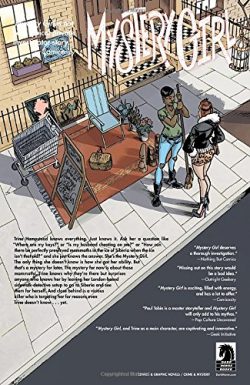
Like any ancient city, London has its fair share of unique characters and unsolved mysteries, but that’s never the case whenever Trine Dorothy Hampstead sets up her “office” on the pavements and begins chatting…

The effusive, ebullient young woman has an incredible gift. She knows the answer to any question she’s asked. Instantly and infallibly. “Where are my keys?” “Did Dad leave a will?” “Where is my missing son’s body…?”

All inquiries get an instant response and every answer is correct!

Trine is a local celebrity in her community, not only for the fact that she’s never judgemental or exploits her gift, but also because everyone knows there’s only one mystery the poor lass can’t solve: how she got her uncanny power…

Trine has an immense taste for life at full throttle and abiding desire to help those in need: regularly consulting with local private eye Alfie and aiding her perpetually sceptical boyfriend Ken Bloke – a Metropolitan police constable – in his work, even though he refuses to believe in her gift…

Her already extraordinary life takes a big step into the unknown when ancient DNA specialist Jovie Ghislain comes to Trine with a fascinating query. The biologist had been researching a 1930’s expedition to the wild Sakha region of Siberia. In the notes of the fabled Weimar-Steinberg trek, the explorers detailed how they uncovered a frozen mammoth carcass so perfectly preserved that the meat was still fresh and edible. Their records are tragically incomplete and Ghislain – desperate to secure viable DNA from the deceased giant – wants to know where the rest of the body is now…

The answer is not immediately forthcoming. In fact, Trine refuses to say anything unless she can join Jovie’s new expedition to personally show the scientists where it is.

Trine thrives on new experiences and this time her gift pays a huge dividend. As preparations are made, she shrugs off all questions from friends and acquaintances, but does confide in her pet budgie Candide. The reason that mammoth meat was so fresh is obvious. It hadn’t been dead long. Now she’s off to see its kin in the only place on earth where the mighty beasts still live…

Sadly, the original expedition – and its journals – are also the subject of a search by wealthy and far less friendly folk. However, when a mystery billionaire commissions a psychopathic hitman to find and secure all the original journals and stop the new expedition, even deadly Linford is taken with Trine. Foregoing his usual callous efficiency, the murdering mercenary takes his time, insinuating himself into the life of all her friends. It’s all working out just fine until the Mystery Girl is asked about her pal’s latest boyfriend and suddenly “knows” all about the new beau – including his actual profession.

Miss Hampstead’s plan to deal with him is shockingly effective, but doesn’t go nearly far enough…

Believing the coast clear, Trine and Jovie head for the Arctic Circle, blissfully unaware that their trail is being dogged by Linford’s sinister paymaster or that the killer himself is down, but not out. Instead, he has devised a cunning method to turn his opponent’s gift against her…

Even so, the obsessive hitman has underestimated Trine’s power, ingenuity and ruthless resolve. However when finesse fails, he can always fall back on overwhelming firepower and direct action…

With the steadfast explorers nearing their frozen El Dorado, the bad guys make their move, revealing what’s actually behind all the death and destruction. Now it no longer matters if Trine is asked the right question or not…

As the ghastly truth of the Weimar-Steinberg expedition is exposed, their heirs and inheritors prove willing to commit mass murder to keep the bloody secret covered up. Happily, Trine asks herself a different question and a life-saving solution pops into her head…

Fast-paced, spectacularly action-packed, witty and superbly balanced as hero and villain play cat-&-mouse around the world, Mystery Girl is funny, imaginative and savagely uncompromising: a superb introduction to a potent and engaging new female character who seems destined for greatness.

Also included are satisfyingly informative bonus features including a copious and heavily annotated Sketchbook section with commentary from Tobin & Albuquerque; concept to finished art examples; cover roughs: designs and unused cover art, all revealing the masses of effort that went into making this such a treat.

Don’t ask why you weren’t in at the beginning of her climb to stardom: get Mystery Girl and become someone with (some of) the answers…
Mystery Girl ™ & © 2015, 2016 Paul Tobin and Alberto J. Albuquerque. Mystery Girl and all prominently featured characters are trademarks of Paul Tobin and Alberto J. Albuquerque.

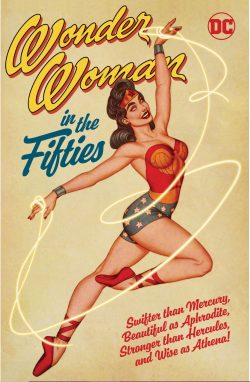
Wonder Woman in the Fifties


By Robert Kanigher, John Broome, Harry G. Peter, Ross Andru & Mike Esposito, Frank Giacoia, Arthur Peddy & Bernard Sachs & various (DC Comics)
ISBN: 978-1-779507-624-6 (TPB/Digital edition)

In the early years of this century, DC launched a series of graphic archives intended to define DC’s top heroes through the decades: delivering magnificent past comic book magic from the Forties to the Seventies via a tantalisingly nostalgic taste of other – arguably better, but certainly different – times. The collections carried the cream of the creative crop, divided into subsections, partitioned by cover galleries, and supplemented by short commentaries; a thoroughly enjoyable introductory reading experience. I prayed for more but was frustrated… until now…

Part of a trade paperback trilogy – the others being Superman and Batman (thus far, but hopefully Aquaman, Green Arrow and Martian Manhunter are in contention too, as they have become such big shot screen stars these days) – the experiment was recently re-run, with even more inviting samples from the company’s vintage, family-friendly canon.

Gathered here is a menu of deliciously dated delights starring Earth’s most recognisable Female Heroic Ideal, heralded by a time-&-tone-setting Introduction from historian, author and columnist Andy Mangels augmenting each context-stuffed chapter text piece.

With Robert Kanigher as primary writer of record throughout the book, the contents here originated in Sensation Comics #97, 100; Wonder Woman #45, 50, 60, 66, 72, 76, 80, 90, 94-95, 98-105, 107, 108, 750; and All-Star Comics #56, 57 spanning the entire decade whilst attempting to reconcile an indomitable symbol of female emancipation and independence with a post-war world determined to turn them back into docile brood mares and passive uber-consumers…

Wonder Woman was created by polygraph pioneer William Moulton Marston – apparently at the behest of his remarkable wife Elizabeth and their life partner Olive Byrne. The vast majority of the outlandish early adventures were limned by illustrator Harry G. Peter.

The Astounding Amazon debuted in All Star Comics #8 (cover-dated December 1941, and top-selling home of the Justice Society of America) just before launching in her own solo series and cover-spot of new anthology Sensation Comics the following month. She was an instant hit, and gained her own eponymous title in late Spring of that year (Summer 1942).

Using the nom de plume Charles Moulton, Marston & Co scripted all her many and fabulous exploits until his death in 1947, whereupon Kanigher officially took over the writer and editor’s role. The venerable Peter continued until his own death in 1958. Wonder Woman #97 – in April of that year – was his last hurrah and the end of an era.

Supported by a factual briefing, the comics classics commence with The (Many) Origins of Wonder Woman, and the first adjustments to the classic origin tale…

For purposes of comparison, the 1940s saga stated that on a hidden island of immortal super-women, American aviator Steve Trevor of US Army Intelligence crashed to Earth. Near death, he was nursed back to health by young, impressionable Princess Diana.

Fearing her growing obsession with the creature from a long-forgotten, madly violent world, her mother Queen Hippolyte shared the hidden history of the Amazons: how they were seduced and betrayed by men, but rescued by goddess Aphrodite on condition they isolated themselves from the world, devoting their eternal lives to becoming ideal, perfect creatures.

However, when Athena and Aphrodite subsequently instructed Hippolyte to despatch an Amazon with the American to fight for global freedom and liberty and against oppression and barbarism, Diana overcame all other candidates in a brutal open competition to became their emissary – Wonder Woman.

On arriving in America, she purchased the identity and credentials of lovelorn Army nurse Diana Prince, elegantly allowing the Amazon to be close to Steve and the heartsick medic to wed her own fiancé in South America. Diana also joined Army Intelligence as secretary to General Darnell, ensuring she would always be able to watch over her beloved. She little suspected that, although painfully shallow Steve only had eyes for the dazzling Amazon superwoman, the General had fallen for mousy yet superbly competent Lieutenant Prince…

As the decade turned it was deemed time for a refurbished origin and – illustrated by Harry G. Peter – WW #45 (cover-dated January/February 1951) delivered ‘The Wonder Woman Story!’

This found childhood rivals vying for the journalistic kudos of publishing the Amazon’s backstory. However, after a hard-won trip to Paradise Island led to Mary Ellen learning the details of it all – Hercules’s ancient ‘Act of Treachery!’ and how the Princess defied authority for love – all manner of trouble emerged…

Cunning competitor John Lane had bugged Mary’s jewellery and craftily followed her to the Amazon homeland, causing a major upset…

Back then Wonder Woman’s artists were astonishingly faithful and true, staying with her for pretty long hauls. Peter and his uncredited team of female assistants served nearly 20 years before he was let go mere weeks before dying. His replacements Ross Andru & Mike Esposito drew her adventures from 1958 to the middle of 1967 (#98 – 171), and limned this breakthrough tale from WW #105 (April 1959)

The issue debuted Wonder Girl in the ‘‘The Secret Origin of Wonder Woman’, revealing how centuries ago Olympian divinities bestowed unique powers on the daughter of Queen Hippolyta and how – as a mere teenager – the indomitable Diana brought the Amazons to Paradise Island. Continuity – let alone consistency or rationality – were never as important to Kanigher as strong story or breathtaking visuals, and this eclectic odyssey is a great yarn that simply annoyed the heck out of a lot of fans – but not as much as the junior Amazon would in years to come after these teen tales spawned an actual junior Amazon as sidekick to Diana…

That ball started rolling in #107 (July 1959) and proved that the high fantasy exploits of the minor had clearly caught somebody’s editorial fancy. Follow-ups came thick and fast after ‘Wonder Woman Amazon Teen-Ager!’ saw the youngster ensnare an unwanted romantic interest in merboy Ronno, whilst dutifully undergoing a quest to win herself a superhero costume…

Fronted by an article on her legendary kit and illustrated throughout by H.G. Peter, Fashion as Armor: The Equipment List shares some of Kanigher’s frequent and often contradictory exposés on the source and powers of Wonder Woman’s combat gear. It begins with ‘The Secret Story of Wonder Woman’s Lasso!’ (WW #50, November/December 1951), depicting how the princess undertakes three divine tasks to ensure the rope gains magical traits of unbreakability, infinite elasticity and truthful compulsion. Along the way she uses it against crooks, spies, other Amazons, submarines, dinosaurs and a Roc…

That mythological bird, another dinosaur and aliens play a major role in ‘The Talking Tiara!’ (#66, May 1954) as Steve learns how Diana belatedly won possession of her headpiece, a “Linguagraph Tiara” capable of translating any language past present or future, whilst ‘The Secret of Wonder Woman’s Sandals’ (#72, February 1955) reveals some odd characteristics of the footwear as she performs incredible feats (sorry!) to confirm her worthiness…

Cover-dated February 1956 ‘The Origin of the Amazon Plane!’ featured in Wonder Woman #80, recalling a trio of tasks undertaken to collect separated sections of her faithful, invisible robot conveyance before #95 (January 1958) offered ‘The Secret of Wonder Woman’s Tiara!’: this time in the form of a tale told to toddlers, revealing how the hat was a gift from aliens given in thanks for saving them from marauding Phenegs…

Moving on to highlight the Amazon’s noteworthy collaborations, One of the Team offers a trio of tales. The section is a somewhat “Marmite” moment that fans will either love or hate…

The majority of the chapter is devoted to a brace of tales starring the Justice Society of America and, whilst I’m never going to complain about seeing such classics where new readers can discover them, it’s a lot of pages to hand over to a group who had Wonder Woman serving coffee and taking notes as “Club Secretary” for years. At least here, in the last of the original run, she’s graduated to being an leading participant in their adventures…

After the actual invention of the superhero via the 1938 Action Comics debut of Superman, the most significant event in our industry’s history was the combination of individual stars into a like-minded group. Thus, what seems blindingly obvious to us with the benefit of four-colour hindsight was proven: consumers can’t get enough of garishly-hued mystery men, and combining a multitude of characters inevitably increases readership. Plus, of course, a mob of superheroes is just so much cooler than one…or one-and-a-half if there’s a sidekick involved…

The creation of the Justice Society of America in 1941 utterly changed the shape of the budding industry. Following the runaway success of Superman and Batman, both National Comics and its separate-but-equal publishing partner All-American Comics went looking for the next big thing whilst frantically concentrating on getting anthology packages into the hands of a hungry readership. Thus All Star Comics: conceived as a joint venture affording characters already in their respective stables an extra push towards winning elusive but lucrative solo titles.

Technically, All Star Comics #3 (cover-dated Winter 1940-1941 and released in December 1940) was the kick-off, but the mystery men merely had dinner and recounted recent cases and didn’t actually go on a mission together until #4, which had an April 1941 cover-date.

The merits of the marketing project would never be proved: rather than a runaway favourite graduating to their own starring vehicle as a result of the poll, something radically different evolved. For the third issue, prolific scribe Gardner Fox apparently had the bright idea of linking all the solo stories through a framing sequence with the heroes gathering to chat about their latest exploits. With that simple notion that mighty mystery men hung out together, history was made and it wasn’t long before they started working together…

However, after WWII ended, superheroes gradually declined, and most companies had shelved them by 1950. Their plummet in popularity led to a revival in genre-themed titles and characters, and it was a stripped-down team (Flash, Green Lantern, Hawkman, The Atom, Black Canary, Dr. Mid-Nite and Wonder Woman) in contemporarily tailored crime and science fiction sagas before the title abruptly changed into All Star Western with #58.

Both JSA stories were written by John Broome and illustrated via alternating chapters by Frank Giacoia and Arthur Peddy & Bernard Sachs. Leading off is All-Star Comics #56 (December 1950/January 1951) and ‘The Day the World Ended!’ wherein a future scientist goes to extraordinary lengths to recruit the 20th century stalwarts to save Tomorrow’s World from shapeshifting invaders. Issue #57 was the JSA’s last hurrah with ‘The Mystery of the Vanishing Detectives!’ pitting them against criminal mastermind The Key after he abducts Earth’s greatest criminologists in advance of a spectacular robbery spree. Both are great yarns that deserve their own archival volume, but the Amazon’s contributions are barely visible in both…

Of more interest is the Kanigher & Peter tale from Wonder Woman #72 (November 1957). ‘The Channel of Time’ begins as an unashamed plug for The Adventures of Superman TV show, with the Amazon eagerly enjoying the latest episode when interference turns the screen into an SOS through time, displaying old ally Robin Hood in existential peril…

An initial iteration of the legendary archer had debuted in New Adventure Comics #23 (January 1938), and National/DC also acquired Quality Comics’ Robin Hood Tales title. That version had begun in February 1956, with DC continuing the run from #7 (cover-dated February 1957) as well as featuring the hero in Kanigher’s The Brave and the Bold from #5 (May 1956). That was (coincidentally?) the same month The Amazing Amazon first met the Sentinel of Sherwood Forest, who here requires assistance against a dragon, wicked foemen and a shark-infested moat safeguarding evil Prince John…

Seeing Double then highlights the hero’s tendency to encounter copies of herself – everything from evil doppelgangers from parallel universes to weirdly exact robot facsimiles…

When Showcase #4 rekindled the readership’s imagination and zest for masked mystery-men with a second, brand-new iteration of The Flash in 1956, the fanciful floodgates opened wide once more. As well as re-inventing Golden Age stars like Green Lantern and Hawkman, the company consequently updated many hoary survivors like Green Arrow and Aquaman. Also included in the revitalising agenda were the High Trinity: Man of Steel, Caped Crusader and the ever-resilient Princess of Power…

Andru & Esposito had debuted as cover artists 3 issues earlier, but with Wonder Woman #98 they took over the entire comic book as Kanigher reinvented much of the old mythology and tinkered with her origins in ‘The Million Dollar Penny!’ After Athena visits an island of super-scientific immortal women, informing Queen Hippolyta that she must send an emissary and champion of justice to crime-ridden “Man’s World”, the sovereign declares an open competition for the job.

She isn’t surprised when her daughter wins and is given the task of turning a penny into a million dollars in one day – all profits going to children’s charities, of course…

Just as the new Wonder Woman begins her coin chore, American airman Steve Trevor bails out of his malfunctioning jet high above the magically hidden isle, unaware that should any male set foot on Amazon soil the immortals would lose all their powers. Promptly thwarting impending disaster, Diana and Steve then team up to accomplish her task, encountering along the way ‘The Undersea Menace’ before building ‘The Impossible Bridge!’

Following that epic comes the lead from landmark issue #100 (August 1958): a spectacular battle saga commencing with ‘The Challenge of Dimension X!’ as an alternate Earth Wonder Woman competes with the Amazing Amazon for sole rights to the title: all culminating with a deciding bout in ‘The Forest of Giants!’…

No celebration of the fifties could be complete without an exploration of the outdated concept of gainful female employment. With art by Peter, Working 9 to 5: The Careers of Wonder Woman offers a quick peek of typical opportunities beginning with Sensation Comics #97 (May 1950). ‘Wonder Woman, Romance Editor’ sees the Amazon agree to a task no male journalist can handle, solving the woes of lovelorn women seeking husbands, whilst her own duties prevent her giving in to Steve’s increasingly urgent demands to settle down… Cover-dated November 1950, Sensation Comics #100 showcases ‘Wonder Woman, Hollywood Star!’ as the Amazon and Steve endure peerless perils making a movie one crazed glamour queen is determined only she should star in, after which two millionaires make a bet that propels the Amazon into a string of crazy roles culminating in her shepherding an infant T-Rex as ‘Wonder Woman, Amazon Baby Sitter!’ (WW #90, May 1957)…

As you’ve probably ascertained, much of Kanigher’s oeuvre depended on the Princess of Paradise undergoing tasks and tests for a variety of reasons and this voyage of rediscovery concludes with some of the most noteworthy, gathered as The Trials of Wonder Woman…

Leading off is Peter-rendered classic ‘The Secret Olympics!’ (WW #60, July 1953) as Diana justifies her legendary brief as “beautiful as Aphrodite, wise as Athena, swifter than Mercury (sic) and stronger than Hercules”…

 Issue #76 (August 1955) introduces ‘The Bird Who Revealed Wonder Woman’s Identity!’ before Diana devises a way to undermine a gabby Mynah’s proclamations before Andru & Esposito assume the art duties for the remainder of the book, beginning with ‘Top Secret!’ from Wonder Woman #99 (July 1958).

Introducing the Hellenic Hero’s new covert identity as Air Force Intelligence officer Lt. Diana Prince the tale opens a decade of tales with Steve perpetually attempting to uncover her identity and make the most powerful woman on Earth his blushing bride, whilst his bespectacled, glorified secretary stands unnoticed, exasperated and ignored right beside – or slightly behind – him…

Here that means attempting to trick her into marriage with a rigged bet – a tactic the creep tried a lot back then – after which ‘Wonder Woman’s 100th Anniversary!’ (WW #100 again) deals with the impossibility of capturing the far-too-fast and furious Amazon’s exploits on film for Paradise Island’s archives…

In #101 (October 1958), ‘Undersea Trap!’ sees Steve tricking his “Angel” into agreeing to marry him if she has to rescue him three times in 24 hours (just chalk it up to simpler times, or you’ll pop a blood vessel, OK?) after which January 1959 and WW #103 spotlight ‘The Wonder Woman Album!’ returning to the previously explored “impossible-to-photograph” theme, before we close on ‘Wanted… Wonder Woman’ (#108, August 1959), as Flying Saucer aliens frame her for heinous crimes as a precursor to a planetary invasion but are not smart enough to realise when they are being played…

Also including a selection of breathtaking covers by Irwin Hasen & Sachs, Irv Novick, Peddy and Andru & Esposito plus a Bonus Cover Gallery by the latter pair, this is a fascinating but potentially charged tome. By modern standards these exuberant, effulgent fantasies are all-out crazy, but as examples of the days when less attention was paid to continuity and concepts of shared universes and adventure in the moment were paramount, these outrageous romps simply sparkle with fun, thrills and sheer spectacle -a s long as you keep in mind the outrageous undercurrent of blatant sexism underpinning it all. This was a period when – officially – only men could tell the tales of the Amazing Amazon…

Wonder Woman is rightly revered as a focal point of female strength, independence and empowerment, but the welcoming nostalgia and easy familiarity of these costumed fairy tales remain a delight for all open-minded readers with the true value of these exploits being the incredible quality of entertainment they provide.
© 1950, 1951, 1953, 1954, 1955, 1956, 1957, 1958, 1959, 2020, DC Comics. All Rights Reserved.


Luisa: Now and Then


By Carole Maurel, adapted by Mariko Tamaki & translated by Nanette McGuiness (Humanoids/Life Drawn)
ISBN: 978-1-59465-643-9 (TPB/Digital edition)

Win’s Christmas Gift Recommendation: Beguiling Fantasy Unwrapped… 9/10

The concept of time travel is infinitely appetising and irresistibly seductive. The literary conceit offers limitless potential for stories ranging from colossal cosmic Armageddons to last-chance salvation gambits; all of history and the imagination as playground and stage; the use of past and future as a Petrie dish for social satire and cultural exploration, and even fantastical magical quests course-correcting lives and providing deeply personal, painfully intimate second chances for the confused, bewildered or simply lovelorn.

Luisa, Ici et là is one of the latter: a compelling and beguiling small story and little miracle by Carole Maurel that first appeared in 2016 and finds us English-speakers courtesy of Humanoid’s Life Drawn imprint.

It’s a sweet and oft-told tale given a stylish and welcoming contemporary gloss thanks to its wonderfully engaging lead character(s) who transforms a regulation coming-of-age parable into a heart-warming plea for understanding and – where necessary – forgiveness.

It begins as 15-year old Luisa Arambol gets off a bus. Exhausted and frustrated by discord at home in Chartres, she’s fallen asleep, missed her stop and awoken in Paris. She’s not aware of it yet, but she’s also journeyed from 1995 to 2013…

Across town, 33-year old Luisa Arambol is bitching to friend and workmate Farid. He’s heard it all before: the job sucks, she’s getting old, she drinks too much and has accomplished nothing. Worst of all, yet another man didn’t work out…

After panicking whilst trying to buy a phonecard – even the money is different here and everyone has a phone in their pocket now! – young Luisa is rescued by concerned observer Sasha who tries to help out the increasingly distressed kid. The child wants to ring her mother but cannot get through and is spiralling…

Hearing her talk and seeing what she’s wearing and carrying, Sasha soon suspects something incredible has occurred. After all, what teenager doesn’t recognise a computer tablet?

A quiet chat stabilises the kid long enough for Sasha to learn that Luisa has an aunt living in the same building she’s just moved into. It turns out Aurelia Arambol’s fifth floor flat is directly opposite Sasha’s new home, but it’s no longer occupied by the odd, ostracised single lady nobody back home will ever talk about. Little Luisa gets a big shock when that door opens and she meets her world-weary, dream-crushed, spinster older self.

Moreover, both versions instantly and instinctively realise who the other is…

Once upon a time an ambitious schoolgirl had dreams of being an art photographer but life has whittled that dream down to something far more mundane. Full grown her was left the flat by Aurelia – for reasons she still can’t fathom – and her spiky, frosty, naturally defensive state is inexplicably heightened by Sasha. Despite herself, older Luisa can’t stop staring at her new neighbour, even taking covert pictures of her, and is deeply troubled by an erotic dream featuring her…

When the object of her fascination is abruptly called away, Luisa reluctantly takes charge of the underage runaway and the situation worsens. Shared stories of mutual pasts and futures take a wild turn as aspects of their so-different personalities begin to transfer. Now-Luisa rediscovers her endless, long-vanished joie-de vivre and party spirit – and even 20-20 vision – and seems to look younger every day, just as Then-Luisa becomes sullen, responsibility-burdened, grey-haired, morose and short-sighted. Moreover, when they touch, their bodies seem to merge and coalesce…

And so begins a clash of wills and resolution of long-unfinished business found to have started on the day teen Luisa cruelly spurned an innocently impulsive overture from “out” and persecuted classmate Lucy.

That event was exacerbated by increased bullying at school and brutally reinforced at home by her own mother’s rigorous rejection of such shocking deviant behaviour as utterly unnatural, sparking a decades-long crusade to find Luisa a man…

Confused and upset, little Luisa acted up, got on a bus and ended up now while her older self just lived a lie for years…

The merging and trading of characteristics lends urgency to affairs before a long-deferred and dreaded confrontation with the Luisas’ mother generates surprising revelations about Aurelia, exposes the unknown fate of Lucy and prompts a complete revision of those attitudes that have shaped and repressed the modern-day doppelganger…

Addressing her family’s ingrained bigotry and intolerance and at last acknowledging and accepting she doesn’t just like boys or have to settle for a man is merely the first step in Luisa’s reunification and readjustment, auguring massive changes for all and forever that will begin when her fresher self at last boards a bus for home…

Refreshingly honest, charmingly blunt and captivatingly funny whist maintaining a sensitive neutrality of opinion – or prejudice – over sexuality and choices, Luisa: Now and Then sparkles with wit and charm: a sophisticated yet simple saga of self-examination that will delight all who read it, embracing the fanciful whimsy of cinema classics like The Enchanted Cottage or the Peter Ustinov’s 1948 film Vice Versa.
Luisa, Ici et là © 2016 La Boîte à Bulles et Carole Maurel. All rights reserved.

Adam Eterno – A Hero for All Time


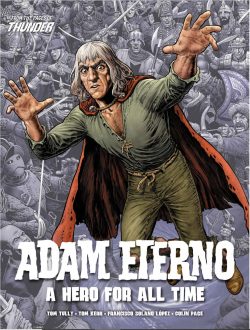
By Tom Tully, Tom Kerr, Colin Page, Francisco Solano López, Eric Bradbury Ted Kearon, Rex Archer & various (Rebellion)
ISBN: 978-1-78108-869-2 (TPB/Digital edition)

British comics had a strange and extended love affair with what can only be described as “unconventional” (for which feel free to substitute “creepy”) heroes. So many of the stars and potential role models of our serials and strips were just plain “off”: self-righteous, moody voyeurs-turned vigilantes like Jason Hyde, sinister masterminds like The Dwarf, deranged geniuses like Eric Dolmann, so many reformed criminals like The Spider or just outright racist supermen like Captain Hurricane…

…And don’t get me started on our legion of lethally anarchic comedy icons or that our most successful symbol of justice is the Eagle-bedecked jack-booted poster boy for a fascist state. Perhaps that explains why these days we can’t even imagine or envision what a proper leader looks like and keep on electing clowns, crooks and oblivious privileged simpletons…

All joking aside, British comics are unlike any other kind and simply have to be seen to be believed and enjoyed. One of the most revered stars of the medium has finally begun to be collected in archival editions, and perfectly encapsulates our odd relationship with heroism,  villainy and particularly the murky grey area bridging them…

Until the 1980s, comics in the UK were based on an anthological model, offering variety of genre, theme and character on a weekly – or sometimes fortnightly – basis. Humorous periodicals like The Beano were leavened by thrillers like Billy the Cat or General Jumbo and adventure papers like Lion or Valiant always included gag strips such as The Nutts, Grimly Feendish, Mowser and a wealth of similar quick laugh treats.

Thunder and Jet were amongst the last of this fading model. Fleetway particularly was shifting to themed anthologies like Shoot, Action and Battle, whilst venerable veterans like Lion, Valiant and Buster hung on and stayed fresh by absorbing failing titles. Thunder ran for 22 weeks before merging into Lion & Thunder, bringing with it Black Max, The Steel Commando, The Spooks of Saint Luke’s and Adam Eterno. With Steel Commando, Adam would survive and thrive, as the comic later merged into Valiant & Lion (June 1974) until 1976. He also appeared in numerous Annuals and Specials thereafter.

Eterno was initially devised by Thunder assistant editor Chris Lowder and editor Jack Legrand, with top flight artist Tom Kerr (Monty Carstairs, Rip Kerrigan, Kelly’s Eye, Charlie Peace, Captain Hurricane, Steel Claw, Kraken, Mary-Jo, Tara King/The Avengers, Billy’s Boots) initially designing and visualising the frankly spooky antihero and drawing the first episode.

The feature was scripted by equally adept and astoundingly prolific old hand Tom Tully (Roy of the Rovers, Heros the Spartan, Janus Stark, Dan Dare, The Wild Wonders, Johnny Red, The Leopard from Lime Street) but after he left in 1976 Kerr, Donne Avenell, Scott Goddall and Ted Cowan would write Adam’s later adventures for star turns like Joe Colquhoun, John Catchpole, Eric Bradbury, Page, Carlos Cruz and others to illustrate.

Gathering the debut and all episodes from Thunder (October 17th 1970 – 13th March 1971 plus material from Thunder Annual 1972, 1973 & 1974, the chronal calamities and dark doings are preceded by ‘A Hero in Time’: an editorial reminiscence by artist Colin Page.

Delivered in stark, moody monochome, and further illustrated by Page, Francisco Solano López (and his family studio), Bradbury, Ted Kearon and Rex Archer, these tales are the earliest exploits of the tragic immortal chronal-castaway Adam Eterno who began life as a 16th century apprentice to alchemist Erasmus Hemlock…

When his master perfects an immortality serum, headstrong impatient Adam samples the potion against the sage’s command, precipitating the ancient’s death and a fiery conflagration that destroys the house. The alchemist last act is to curse his disobedient student to live forever and “wander the world through the labyrinths of time”. His only surcease would come from a mortal blow struck by a weapon of solid gold…

The curse is truly effective and as centuries pass, Adam becomes a recluse: his unchanging nature driving him away from superstitious mortals and denying him over and over again simple contact with humanity. He fought in all of Britain’s wars, but combat comradeship always ended when a seemingly fatal blow of wound left him unharmed…

Everything changed and the second part of the alchemist’s curse came true in 1970 when the traumatised, barely sane 421-year-old tramp staggered into a bullion robbery and was shot by the thieves. Realising their victim is invulnerable, the bandits attempt to use him in a raid on the Bank of England, but when that fails, Adam slowly starts to regain his wits – just in time to be struck by the fully-gold-plated limousine of a speeding millionaire…

The impact would be fatal for any other being, but for Adam Eterno it is the beginning of redemption as the shock hurls him into the time stream to land over and again in different eras…

With Page (D-Day Dawson, Paddy Payne) at the helm, his first jaunt lands Adam on a sailing ship in 1770, inadvertently saving seagoers from murderous pirate Barnaby Shark, before joining the buccaneer to steal his solid gold dagger to end his twice-lived life…

When that ploy fails, Adam is whisked away to rematerialize in Texas. The year is 1872 and the gold rush has ended a decade since, but evil still abounds as local cattle baron Bret Logan seeks to drive settlers away. When Adam sides with them, the rancher hires deadly gunslinger The Yellowstone Kid, a killer with guns of gold. It seems like Adam would finally get his wish, but sadly the bullets are simply lead.

And so it goes: Adam comes tantalisingly close on every arrival, seemingly drawn to terror and injustice with each event linked to some sort of potential auric armageddon. In Victorian London he battles masked madman the Flying Footpad as the villains seeks to steal a golden turban; foils contemporary South American dictator and war criminal General Carlos Cabeza despite the threat of another golden dagger and returns to World War I’s Western Front and confronts seemingly indestructible German General Von Gruber and his golden sabre in extended multi-chapter exploits.

Returning to modern days, Eterno joins treasure-hunting divers facing an apparent ghost guarding a sunken galleon: battling brutal thug dubbed Hammerhand (because of his gold prosthesis). Courtesy of the magnificent Solano López (Kelly’s Eye, Janus Stark, Master of the Marsh, Raven on the Wing), a voyage to Dark Ages England to stave off a Viking invasion, segues into Saxon times (by Colin Page) in the wake of the Norman conquest and a small war against wicked golden knight Baron de Gride before a turning point and further facts on the enigmatic wanderer arrives when he land in a 20th century reconstruction of the house where he served and was cursed by Erasmus Hemlock…

Limned by Solano-López, the tale discloses how modern crooks seek to use the house to swindle a rich American until “dissuaded” by the original occupant, who then fetches up in Africa during the Boer War, with Page detailing how he saves English troops from brutal Afrikaans tactical mastermind The Butcher. This time, the weapon to watch is a gold-tipped bullwhip…

Solano López returns for a Roman holiday as Adam saves a gladiator from assassination and becomes embroiled in a plot by wicked Odius Limpus to make himself even more wealthy. Such a shame it’s happening in Pompeii’s arena in August, 79 AD…

This spectacular yarn closed Adam Eterno’s run and indeed the comic Thunder, but this collection holds more gleaming extras in the form of a quintet of tales from Thunder Annuals. The first is from the 1972 edition, rendered by British national treasure Eric Bradbury who depicts a snowy drama in a German town circa 1598, where “the Old Man of Vartzberg” is again terrorising the populace with his sudden manifestations. In situ – prior to becoming lost in time – is English Witchfinder Adam Eterno, on a personal crusade to wipe out alchemists and other mystic dabblers. When he roots out the wizard he is damned by a prophecy to beware a golden sword… but the crisis point only happens in 1943 when British commando Eterno leads a team against Nazi-held Vartzberg…

Next comes a brace of tales from 1973, beginning with an adventure illustrated by Rex Archer. Here, after Merlin seals the Goblin Crown of the Dark Gods in his Golden Tower, Adam is plucked from Limbo to battle a dragon and duped by vile Sir Mordrac into fetching the artefact out again. Thankfully, King Arthur’s mage had made contingency plans…

In accompaniment is a prose tale with spot illustrations from Ted Kearon, wherein Adam saves enslaved Saxons from Vikings and is forced to prove his unkillable nature over and over again.

The following year Solano-López opened proceedings as the Man Who Could Not Die arrived in the Americas just in time to aid privateer captain Francis Drake in his legendary raid on Panama, but only after Adam clears out a host of giant mutated monsters created by a crazed Spanish Don-turned-alchemist.

Bradbury then added two-toned images (red & black) to another prose saga as Adam arrived in London fog in 1896: avoiding the police whilst tracking a murderous “Leaping Terror” with a strong resemblance to a giant bat…

Closing with biographies on the many creatures featured herein and dotted with covers and teaser visuals, Adam Eterno – A Hero Out of Time is potently thrilling and rewarding romp to delight readers who like their protagonists dark and conflicted and their history in bite-sized bursts.
© 1970, 1971, 1972, 1973, & 2021 Rebellion Publishing IP Ltd. All Rights Reserved.

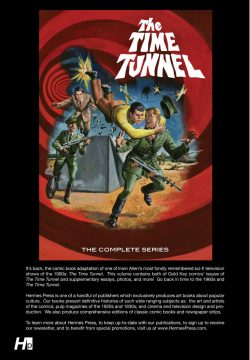
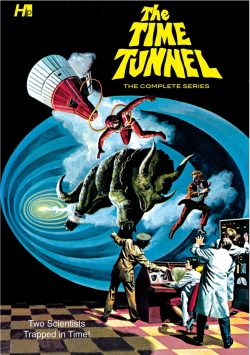
The Time Tunnel: The Complete Series


By Paul S. Newman & Tom Gill & various (Hermes Press)
ISBN: 978-1-932563-33-4 (TPB/Digital edition)

The Time Tunnel debuted in America for the Fall season of 1966: the third family sci fi thriller in producer Irwin Allen’s incredibly successful string of TV fantasy series which also included Lost in Space, Voyage to the Bottom of the Sea and Land of the Giants.

The show generated 30 episodes between September 9th 1966 and April 7th 1967 and became a cult classic via syndication re-runs for decades after. The show spawned a Viewmaster 3D reel, book, numerous games, colouring books and toys, Pinball games, plus a brace of excellent novels by pulp Sci Fi legend Murray Leinster and the comic book series that drew us here today…

The series’ premise is relatively straightforward and set two years in the future: the US government had spent a decade exploring the mechanics of time travel in top secret Project Tic-Toc and now have a prototype device in a vast underground military complex in Arizona. Directors Dr. Douglas Phillips, Dr. Anthony Newman and Lt. General Heywood Kirk, with a number of specialists, are making crucial advances to the operation when US Senator Leroy Clark visits, intent on ending the vast spending he can see no point to.

When he demands an immediate successful time journey and return or complete closure, Newman impetuously projects himself through the infinite tunnel and is lost. Without hesitation, Phillips goes after him, but once they make contact they are constantly and randomly hurled to different points in history and even into the future.

Tic-Toc is quickly repurposed to retrieve them, but other than occasional instants where the technicians can move them up or down the time stream, the project is reduced to helpless observation as Tony and Doug bounce from one momentous moment to another, meeting the likes of Custer, Marie Antoinette, Ulysses, Billy the Kid, Robin Hood and Rudyard Kipling and surviving catastrophes such as the Titanic sinking, the Alamo, Pearl Harbor, the eruption of Krakatoa and even alien attacks and invasions…

Gold Key licensed the property for a short-lived but entertaining run spanning cover-dates February and July 1967, with eye-catching painted covers by George Wilson and interiors attributed to the company’s adaptation warhorses – prolific scripter Paul S. Newman (Turok, Son of Stone, Lone Ranger, 77 Sunset Strip, Buck Rogers) and meticulous illustrator Tom Gill (Flower Potts, Lone Ranger, Land of the Giants).

Collected in this archival edition, the accidental chrononauts’ odyssey is preceded by an effusive photo-and ephemera-filled Introduction: ‘Time Travel in the 1960s’ by Alan J Porter in which he rapidly revisits roughly contemporary shows such as Star Trek, Doctor Who and Time Slip (plus later shows like Sapphire and Steel, Quantum Leap and others) all dabbling in temporal hijinks, and also explores the unlikely sub-genre’s literary antecedents.

Porter goes on to plug the many modern ways to vie the source material and revisit the untapped potential of the series’ perennial attempts at a reboot…

The comics cases open with The Time Tunnel #1 and ‘The Assassins’ as the patriotic lost boys arrive in advance of the murder of President Abraham Lincoln. Those of us now well versed in decades of entertainment dogma regarding time travel know better than to meddle, but in the show and here, attempts to change history were almost mandatory, but at the Ford Theatre on April 14th 1865 our heroes again fail to thwart a national tragedy and barely escape with their own lives as the Tic-Toc techs “switch them out” of that time period…

They materialise in a gladiatorial arena ready to face ‘The Lion or the Volcano’. The date is August 24th in AD 79 and the location is Pompeii…

Although the safeguarding observers again manage to time transfer the embattled duo – but only after a terrific struggle against beasts, panicked Romans, fireballs and poison gases – there is an unconventionally high body count here. That’s because by never signing up to the draconian and bowdlerizing Comics Code Authority, Dell/Gold Key became the company for life and death thrills, especially in traditional adventure stories.

If you were a kid in search of a proper thrilling gore instead of flimsy flesh wounds you went for Tarzan, Zorro, M.A.R.S. Patrol, Tom Corbett and their ilk. That’s not to claim that the West Coast outfit were gory, exploitative sensationalists – far from it – but simply that their writers and editors knew that fiction – especially kids’ fiction – needs a frisson of danger and honest high stakes drama to make it work.

The initial outing concludes with a swift jaunt to the future as ‘Mars Count-down’ sees Tony and Doug alight aboard a 1980 one way test flight to the Red Planet, and forced to jury rig a return trip to earth before Tic-Toc can lock on and dump them back into the roiling time stream…

The premier issue’s back cover was a photo still of the Time Tunnel from the show and segues neatly into another Wilson masterpiece on #2, with ‘The Conquerors’ finding Tony and Doug in a Nazi base in 2068 where an Aryan elite are perfecting their own time machine to change the outcome of the 1944 D-Day landing. Using the new device to follow the time saboteurs, the Americans spoil the scheme and destroy the insane Fuhrer II, only to become chronal castaways again, fetching up in 1876 and – as ‘The Captives’ – failing again to stop arrogant tyrant George Armstrong Custer from being wiped out at the Little Big Horn…

Issue #2’s photo portrait cover leads to more stills and an essay on ‘The Artists of Time Tunnel’ with Daniel Herman outlining the careers of Wilson and Gill before a captivating selection of ‘Artwork, concepts, Photos, and Collectibles’ offers context and behind the scenes snippets taken from a 1967 TV Guide; 20th Century Fox production art; even more stills; episode storyboards and tantalizing glimpses of the aforementioned merchandise – games, bumper stickers, buttons, the Viewmaster kit.

TV themed compendia of screen-to-page magic were an intrinsic part of growing up for generations and still occur every year with only the stars/celebrity/shows changing, not the package. The show itself has joined the vast hinterland of fantasy fan-favourites. immortalised in DVD and streamed all over the world but if you want to see more, this sparkling tome is a treat you won’t want to overlook.
The Time Tunnel® is © 1966, 1967 and 2009 Irwin Allen Properties, LLC and Twentieth Century Fox Film Corporation. All Rights Reserved. The Time Tunnel® and its indicia, characters and designs are trademarks of Irwin Allen Properties, LLC; licensed by Synthesis Entertainment.

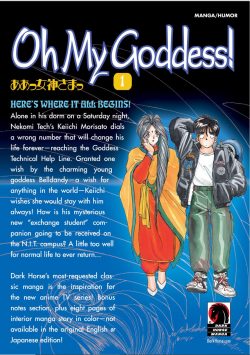
Oh My Goddess! volume 1


By K?suke Fujishima, original translation by Dana Lewis, Alan Gleason & Toren Smith (Dark Horse Manga)
ISBN: 978-1-59307-387-9 (tank?bon TPB) eISBN: 978-1-62115-755-7

Talking of school – as we were the other day – college days also offer plenty of opportunities for comics creativity and, as is usually the case, manga has been there first and explored avenues you never even realised existed.

Fujishima K?suke was born in Chiba, Japan on July 7th 1964, and after completing High School, got a job as an editor. His plans to be a draughtsman had foundered after failing to secure a requisite apprenticeship, and he instead joined Puff magazine in that backroom role. Life began looking up after he became assistant to manga artist Tatsuya Egawa (Be Free, Golden Boy, Magical Taluluto)…

Fujishima graduated to his first solo feature in 1986: writing and illustrating police series You’re Under Arrest until 1992. In 1988, he began a consecutive second series: a fantasy comedy that would reshape his life forever. Although he would work on other manga like Paradise Residence and Toppu GP over the decades, Aa! Megami-sama – alternatively translated as Ah! My Goddess and Oh My Goddess! became his signature work and one that has made him a household name in Japan.

The series began in the September 1988 issue of Kodansha’s seinen (“young males”) manga periodical Monthly Afternoon. The strip ran until April 2014, generating enough stories for 48 tank?bon volumes, a spin-off series and spawning anime, special editions, numerous TV series, musical albums, games and all the attendant spin-offs and merchandise such popular success brings.

In 2020 there were 25 million physical copies of the editions in circulation and an unguessable number of digital sales. OMG! has won awards, been translated across the globe in print and on screens and has a confirmed place in comics history…

Oh My Goddess! is a particularly fine example of a peculiarly Japanese genre of storytelling combining fantasy with loss of conformity and embarrassment. In this case, and as seen in opening chapter ‘The Number You Have Dialled is Incorrect’ nerdy engineering sophomore Keiichi Morisato dials a wrong number one night and inadvertently connects to the Goddess Technical Help Line.

When the captivatingly beautiful and cosmically powerful minor deity Belldandy materialises in his room offering him one wish, he mockingly asks that she never leave him. This rash response effectively traps her on Earth, unable even to move very far beyond his physical proximity. Her powers are mighty but also come with a bucketload of provisos and restrictions. The most immediate and terrible repercussion manifests quickly as he is ejected from his student residence for having a girl in his room…

Belldandy’s profligate use of her divine powers, utter naivety and tendency to attract chaos and calamity make their search for a new home a fraught exercise, but finally second chapter ‘Lair of the Anime Mania’ finds Keiichi trying the apartment of old friend Sada. He was not a preferred choice because he is addicted to anime: a living zombie of fannishness who welcomes the refugees in without even noticing them …or letting go of the TV and video remotes…

All too soon however, and again thanks to the Goddess’ gifts, Sada notices Belldandy’s similarities to his cartoon fantasies and they have to move again…

After a night on the freezing streets, providence smiles on them when a Buddhist priest welcomes them into his dwelling. An individual prone to conclusion-jumping, the holy man’s eventual deduction of her true nature prompts him to undertake a pilgrimage of rediscovery, bequeathing them custody of his earthy abode in ‘A Man’s Home is His… Temple?’

With accommodation secured, the hapless student needs to get back to his education, and in a structured society like Japan there’s plenty of scope for comedy when a powerful and beautiful female seemingly dotes on a barely average male, especially as Keiichi’s new girlfriend seems unwilling to even leave his side…

The solution is to use her powers to “enrol” at his school – the Nekomi Institute of Technology. However, when the clearly “European” newcomer becomes a ‘College Exchange Goddess’ she can’t help but draw unwelcome attention, particularly from Keiichi’s macho, petrolhead fellow students and creepy lecturer Dr. Ozawa. The lifelong rival of Morisato’s favourite teacher “Doc” Kakuta has his suspicions aroused when all his students switch to the classes Belldandy audits and he begins a covert campaign to get rid of her…

More trouble materialises in ‘Those Whom Goddess Hath Joined Together, Let No Woman Put Asunder’ as thoroughly unlikeable campus queen and predatory Mean Girl Sayoko Mishima realises the new kid is a threat to her social supremacy and sets her destructive sights and wealth on Belldandy’s hapless chump. The goddess is more aware of the interlopers inadvertent mystical bad mojo and takes kind, gentle but firm retaliatory action…

College is a series of crucial interconnections and – other than Belldandy – Morisato is closest to his colleagues in the Nekomi Institute of Technology Motor Club: a gang of overbearing, bullying gear-head maniacs, always spending his money, eating his food and getting him into trouble…

However, the earthbound divinity’s role is to aid those in need and when she detects chief brute Otaki is enduring unrequited love she plays matchmaker in ‘Single Lens Psychic: The Prayer Answered’ and sets off a chain of domestic shock and awe…

This mainly monochrome compendium is peppered with brief full colour sections and one such opens ‘Lullaby of Love’ as Morisato finally summons the nerve to move beyond the painfully platonic life sentence he’s been locked into. Sadly, books like Going Steady for Dummies can get him no closer to even kissing his goddess and their first stab at an intimate dinner date turns into a disaster further compounded in ‘The Blossom in Bloom’ as financial shortfalls presage the introduction of Morisato’s little sister Megumi: a gossip spreader and imaginative tale teller. What family furore she will make of him living with a gorgeous exotic foreigner cannot be allowed…

She causes chaos from the start: bearing enough cash to tide them over but only if Keiichi boards her for a week while she takes some important entrance exams. There’s no way the kid won’t expose Belldandy’s supernatural nature to the world…

What big brother should have fretted over was the actual tests, as Megumi aces he exams and is admitted to Nekomi Tech. Now Morisato is plagued with ‘Apartment Hunting Blues’ as he hunts for a decent place to house her. It’s a good thing that Belldandy accompanies the siblings as – once they find the perfect place – the goddess has to exorcise and transform the evil spirit haunting it …the true reason it was so cheap in the first place…

Following the comics comes a text feature by editor Carl Gustav Horn. ‘Letters to the Enchantress’ details the strip’s history and evolution to an English language series, and is supplemented by ‘Editor’s Commentary on Vol. 1’: an expansive collection of footnotes clarifying everything from explaining untranslated background kanji and graphics to detailing significant cultural clues that might bypass most readers.

Oh My Goddess! is a beguiling, engaging and eminently re-readable confection, at once frothy fun and entrancing drama. Think of it as a Eastern take on Bewitched or I Dream of Genie, especially as the romance develops: one that both mortal and immortal protagonists are incapable of admitting to. Throw in the required supporting cast of friends, rivals, insane teachers and interfering entities and there’s plenty of light-hearted fun to be found in this bright and breezy manga classic.
© 2005 by Kosuke Fujishima. All Rights Reserved. This English language edition © 2005 Dark Horse Comics.

One Beautiful Spring Day


By Jim Woodring (Fantagraphics Books)
ISBN: 978-1-68396-555-8 (TPB/Digital edition) 978-1-68396-588-6 (slipcased HB)

There have always been uniquely gifted, driven comics creators who defy categorisation… or even description. My picks for that elite pantheon of artisans includes Kirby, Ditko, Segar, Hergé, Herriman, Will Eisner, Osamu Tezuka, Robert Crumb, Daniel Clowes, Franquin, Frank Bellamy, Basil Wolverton, Mort Meskin, Kim Deitch, Joe Kubert, Carmine Infantino, Eric Bradbury, Frank Hampson, Tony Millionaire, Alex Niño, Neal Adams, Richard Corben, Wally Wood and a few others who all brought something utterly personal and universally influential to their work just beyond the reviewer’s skills (mine certainly) to elucidate, encapsulate or convey.

They are all perfect in their own way and so emphatically wonderful that no collection of praise or analysis can do them justice. You just have to read their stuff for yourself.

Arguably at the top of that distinguished heap of graphic glitterati sits Jim Woodring. It’s a position he has maintained for years and appears capable of holding for generations to come.

Woodring’s work has always been challenging, funny, spiritual, grotesque, philosophical, heartbreaking, beautiful and extremely scary. Moreover, even after reading and believing that sentence you will still be absolutely unprepared for what awaits the first time you encounter any of his books – and even more so if you’ve already seen everything he’s created.

Celebrated as a cartoonist, animator, fine artist, toy-maker and artistic Renaissance man, Woodring’s eccentric output has delighted far too small and select an audience since 1980 and his official mini-comics forays. Born in Los Angeles in 1952, Woodring suffered delusions and hallucinations as a child and regularly believed his parents wanted to kill him.

These traumas seemingly sensitized and attuned him to symbolism and pictorial expression as well as opening him to assorted philosophies and belief systems. The young lad managed his “apparitions” by drawing them as strips in the waking world where he had control of them. Overcoming problems with school, drugs and alcohol, Woodring was eventually diagnosed with autism and prosopagnosia, but by then he had a discovered the power of Art.

He turned his life around through his own determination and by the inspiration of comics masters like Kirby, Ernie Bushmiller, Gil Kane and Crumb, classical fantasists such as Pieter Brueghel, Hieronymus Bosch and particularly Salvador Dali, and the animations of the Fleischer Brothers, Tex Avery and Walt Disney.

Woodring found surcease from a lifetime of punishing dreams by pictorializing nightmares and through following Buddhism, Taoism and the Hindu philosophy of Vedanta. After working as a farm labourer, garbageman and TV cartoon animator – with occasional comics side jobs like colouring the Roy Thomas/Gil Kane adaptation of the Ring of the Nibelungs, illustrating 1997’s Smokey the Bear, Friend of the Forest, and scripting stints on Aliens and Star Wars – Woodring began fully sharing the messages from his subconscious. He had begun self-publishing his autobiographical, “autojournal” comics in 1980, and seven years later was picked up by Fantagraphics Comics and thereafter all of us…

Readers who avidly adored his groundbreaking, oneirically autobiographical magazine Jim and its notional spin-off series Frank (with graphic novel Weathercraft winning The Stranger 2010 Genius Award for Literature) were joined by fans of Tantalizing Stories, Seeing Things or more mainstream features like his Star Wars and Aliens tales for Dark Horse Comics but, always, there was the promise of greater surprises in his next story…

An accomplished storytelling technician these days, Woodring grows rather than constructs solidly surreal, abstractly authentic, wildly rational, primal cartoon universes, wherein his meticulous, clean-lined, sturdily ethereal, mannered blend of woodblock prints, R. Crumb landscapes, expressionist dreamscapes, religious art and monstrous phantasmagoria all live and play …and far too often, eat each other.

His stories follow a logical, progressional proto-narrative – often a surging, non-stop chase from one insane invention to the next – layered with multiple levels of meaning yet totally devoid of speech or words, boldly assuming the intense involvement of the reader will complete the creative circuit.

This compelling collection is available digitally but works best as the spiffy vellum-cased archival paperback or limited edition boxed hardback: each iteration a superbly recomposed compilation combining earlier segments of his constantly unfolding and refolding saga, now justifiably treated as a treasured artefact… and ideal gift…

Gathered – or maybe corralled – here are the previously-published contents of Congress of the Animals, Fran and Poochytown, all deftly rearranged and supplemented by a hundred pages of new and previously unseen material.

Set in the general environs of Woodring’s wickedly warped other place – “The Unifactor” – here is a wild, weird and welcome return to a land of constant change and intense self-examination, where all motives are suspect and all rewards should be regarded as a trap. And here cheerfully upbeat Frank goes for another exceptionally eventful walk in the sunshine…

Laminating this vertiginous vehicle with an even crueller patina is lovelorn tragedy and loss as Fran adds to the ongoing tribulations of dog-faced Frank: her own perilous perambulations of innocence lost displays pride, arrogance, casual self-deceit, smug self-absorption and inflated ego as big as her former beau’s and leads to a shattering downfall just as punishing.

Put bluntly, Fran was Frank’s wonderful girlfriend and through mishap, misunderstanding, anger and intolerance he lost her. Now, no matter what he does or wheresoever he wanders with his faithful sidekicks at his side, poor Frank just can’t make things right and perfect and good again. Through madcap chases, introspective exploration and the inevitable direly dreadful meetings and menacings in innumerable alternate dimensions, True Love takes a kicking …and all without a single word of dialogue or description.

Here, the drawn image is always king, even if the queen has gone forever – or is it just a day?

Many Woodring regulars return, as both Krazy Kat-like ingénues work things out on the run through a myriad of strange uncanny places. There are absolute mountains of bizarre, devilish household appliances, writhy clawing things, toothy tentacle things and the unspeakable Thingy-things inhabiting the distressingly logical traumic universe.

Jim Woodring’s work is not to everyone’s taste or sensibilities – otherwise why would I need to plug his work so earnestly? – and, as ever, these drawings have the perilous propensity to repeat like cucumber and make one jump long after the book has been put away, but he is an undisputed master of graphic narrative and affirmed innovator, always making new art to challenge us and himself. His is a dreamscape of affable terror and he is can make us love it and leave us hungry for more.

Are you feeling peckish yet…?
© 2022 Jim Woodring. This edition © 2022 Fantagraphics Books. All rights reserved.

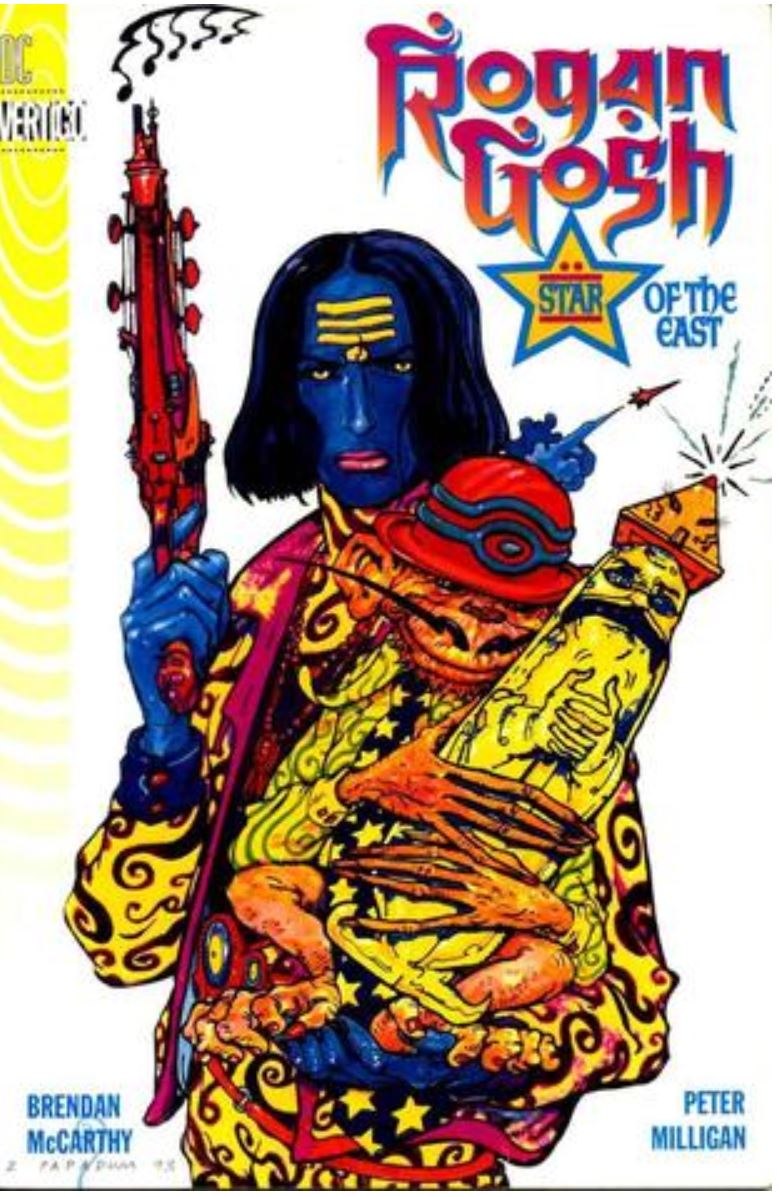
Rogan Gosh: Star of the East


By Pete Milligan & Brendan McCarthy with Tom Frame (Vertigo/Little, Brown & Co)
ISBN: 978-1-56389-143-4 (Vertigo TPB) 1-85386-253-3 (Little, Brown PB)

It feels like a cop-out and total dereliction of duty, but none the less true that some graphic novels simply defy categorisation and defeat the reviewers’ dark arts: they just have to be read, experienced and judged on a personal basis. We could stop there and it’s over to you…

However, should you require more…

Rogan Gosh is a short serial by Pete (Skin; John Constantine, Hellblazer; Strange Days; The Human Target; Batman; Red Lanterns; Shade, the Changing Man; Enigma; The Extremist; X-Statix; Johnny Nemo, Bad Company) Milligan and Brendan (Dream Gang; Mad Max: Road Fury; Judge Dredd; Spider-Man: Fever; ReBoot; Zaucer of Zilk; Skin; Swimini Purpose; Strange Days; Sometime Stories) McCarthy with notable contributions from letterer/colourist Tom Frame.

It first appeared in short-lived, controversial, cutting edge, experimental British comic magazine Revolver – specifically issues #1-6 spanning July-December of the Fleetway Publication. It was later collected into a graphic album by DC/Vertigo in 1994. I’m pretty sure there was also a Fleetway collection, but if so, it’s nigh impossible to find now, and that was a lifetime ago, so I might be dreaming of another reality…

Like companion/precursor title Crisis, Revolver’s brief was to make comics for people who had outgrown funny picture stories and adults who claimed to have never read them. It was supposed to be political, fashionable, contemporary and contentious, and it succeeded over and over again, in strips like Dare, Purple Days, Happenstance and Kismet, God’s Little Acre, Pinhead Nation and Plug Into Jesus.

For many, the jewel in the crown was a bizarre and beautiful, sardonically surreal saga incorporating English curry houses, karmic renewal and exploration, science fiction iconography, cultural commentary and (in)appropriation, ferociously irreverent satirical comedy, and – apparently – concealed creator autobiography. It referenced Indian philosophy and religions, British colonial history and modern urban street life in an onrushing miasma of visual and ideological concepts that blew the mind and generated outrageous belly laughs. There were loads of guns and rockets and tons of sex too…

Like many Milligan & McCarthy creations the strip is often described as “post-modern psychedelia”, evolving from channelled childhood experiences of two white art school kids who had grown up amidst the burgeoning fallout of the Desi Diaspora. That’s when families from the countries of the Asian sub-continent – specifically Pakistan, Bangladesh and India – migrated to western countries like Britain, bringing new thought, music, fashions, scents and especially food to broaden and enrich an evolving multiculture. There were even comics unlike any we’d ever seen before when cruising the streets of Southall or Brick Lane…

Proud products of such an environment and rising superstars thanks to 2000AD, writer Milligan and co-plotter/illustrator McCarthy had planned to deliver a kind of “Bollywood Blade Runner”, but the story sort of got away from them… as is often the case with passion projects…

I’m feeling truly redundant trying to precis the plot, but for the sake of form, try this…

The universe exists on many levels and at all times. In Raj-era India Rudyard Kipling has shamed himself with a native houseboy and now roams the streets of Lahore, seeking a holy man to save his sanity and reputation by putting him in touch with the fabled Karmanauts.

His quest succeeds and the author is – via drugs and magic and ancient wisdom – elevated to a state where he witnesses a future where laddish London oaf Dean Cripps escapes stroppy girlfriend Mary Jane to go for a curry at the magnificent Star of the East in Stoke Newington.

When Dean feels a frisson of connection with beautiful waiter Raju Dhawan, the energy unleashes time-travelling wonder warrior Rogan Gosh just in time to defend enlightenment and all realities from the clandestine attacks of destructive Kali and her malign vampiric agent the Soma Swami…

It all gets a bit strange after that, what with audacious experimental love, devastation and recreation, Karma Kops, and that pest monkey god Hanuman, but rest assured that by the end, what you presume to be the regulation natural universe is back near where it belongs…

Although the story and events might bewilder, what is beyond question is the astounding art by Brendan McCarthy: utilising a blend of pen, paint and early digital technology to create a lush and vibrant homage to the startlingly bright colours of the subcontinent and plush décor of favourite London curry houses and tapping the wellsprings of a fevered and sublimely seasoned imagination to beguile the eyes. This stuff is just so damn pretty…

Hard to find in its original form, the entire trip is reprinted in 2013 anthology The Best of Milligan & McCarthy beside lots of other great stuff like Freakwave, Paradax! and Skin. The collection (which is on my to-do list…) is also available in digital format so there’s no need to wait.

Your destiny awaits, you only have to choose to embrace it…
™ & © 1990, 1994, 2013 Peter Milligan & Brendan McCarthy. All rights reserved.

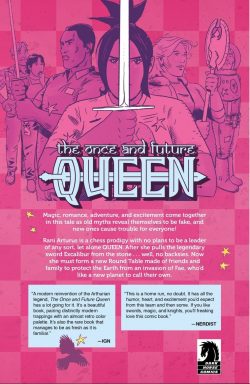
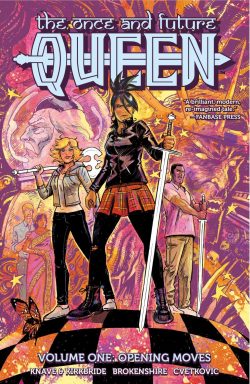
The Once and Future Queen volume 1: Opening Moves


By Adam P. Knave & D. J. Kirkbride, Nick Brokenshire, Frank Cvetkovic & various (Dark Horse Books)
ISBN: 978-1-50670-250-6 (TPB) eISBN: 978-1-63008-793-7

Critics and creative writing lecturers would have you believe all of drama can be reduced to Seven Basic Plots, and all else is mere garnish. Having, in my far-too-long and not-quite-sedentary-enough life, been both (teacher and critic, not edible decoration), I can only say “I can neither deny nor confirm…”

What does happen – a lot! – is that vastly popular and memorable myths, stories and legends are continually reinterpreted and remodelled for new generations. Go reread or see Gilgamesh, Beowulf and Person of Interest or the biblical story of David, Cinderella, Jayne Eyre, Tiger! Tiger!/The Stars My Destination or Slumdog Millionaire… then go play some more on your own. We have pressing business here…

One of the most comforting and potent of these recurring themes is that of a great king or hero waiting to return and redeem us. We probably see it most often in riffs on King Arthur, which are everywhere. If you like such works as Alan Garner’s Brisingamen trilogy (The Weirdstone of Brisingamen, The Moon of Gomrath and Boneland). newspaper strip Buck Rogers, TV’s Adam Adamant and even Camelot 3000, you’ll probably also love this wry, witty and sublimely inclusive spin on the old standard.

Crafted by writers Adam P. Knave & D. J. Kirkbride and illustrated by Nick Brokenshire (the team behind the magical Amelia Cole adventures), The Once and Future Queen features a mixed race (multi-ethnic?), bisexual (or is it non-binary?) girl revealed as destiny’s child and rightful sovereign of England as well as foreordained saviour of the world. No pressure, then…

It begins in Portland Oregon, where youthful chess prodigy Rani Arturus is panicking over her imminent flight to Cornwall for an important tournament. For her dad William, it’s a trip to the “old country” and mum Durga is American by way of India, so it counts as her and her daughter’s roots, too. Rani has no idea how incredibly accurate and life-changing that assessment is…

The tournament is a disaster. All her planning and strategizing go out the window when Rani is distracted by – and fatally attracted to – a pretty blonde girl in the audience. It’s not just her clearly reciprocated attentions: the chess master is convinced she somehow knows her …

Rani doesn’t make it past the first round, and ashamed and furious at the waste of time, money, failure and her own previously unsuspected feelings, walks a scenic Cornish clifftop when a misstep sends her over the edge and into a hidden cave…

Meanwhile, on the clifftop she just disastrously vacated, the subject of Rani’s ruminations is absentmindedly tracing her footsteps. Gwen was irresistibly fascinated by the American contestant, but is used to having instant crushes on girls by now. What is new is how familiar this one seemed, so when she spots the object of her desires entering a cave with glowing light coming from it, she follows…

Rani is beguiled. The cave is an obvious tourist trap and contains a sword stuck in a stone anvil, but she finds herself compelled to tug on it anyhow. As Gwen watches, a flash of light transforms the American into an armoured vision and an old geezer in a space suit appears…

Merlin is time adrift and pretty confusing, but adamantly insists Rani is the long-awaited “Arthur foretold”: the Once and Future Queen (Ruler?) destined to unite the world.

It’s just in time too, as long-exiled magical monster race the Fae are running out of room and resources and are ready eager to return and conquer Earth…

Rani is not convinced. She knows all the stories about King Arthur and the Knights of the Round Table, and knows what a hero should be. However, according to the wizard, lots of things got lost in translation and that guy was simply a well-meaning fraud: a place holder dragged in to cope with a momentary crisis in lieu of the big event kicking off just about now…

Gwen has already impetuously left for Portland by the time Rani’s incredulous parents are brought up to speed and when the girls finally meet in a park, they head for a diner to get to know each other, only to discover their server Lance went to school with Rani and, like Gwen, is also part of the magic revival. In a corner booth sits world-renowned and beloved fantasy author Morgan Pari: also a key actor in the replaying saga, but before the celebrity-struck kids can get near her, a squad of War Fae materialise and savage battle for Earth is joined…

Merlin’s magic has made Excalibur and Rani’s armour instantly accessible and also imparts warrior skills to the Queen. Shockingly, the same is true for Gwen and Lance who at last realise they are physical echoes of past legendary beings too…

Having survived their trials by combat, the heroes reborn are whisked away by Merlin who tells them the true story of the human history and the war against the  malign King in Shadow to prepare them for the forthcoming greatest fight in human history…

Sadly, as they train and repeatedly skirmish with the Fae, what’s also inescapably repeating is the romantic triangle that destroyed the Camelot they all draw their preconceptions from…

Not all is written in stone. As the heroes move their already-targeted loved ones to a safe space, and strategize their next moves, a key component of the Fae army goes off-script, splitting the enemy’s forces and resolve, but also sparking a brutal, highly public clash that serves to put blinkered humanity on terrified high alert…

Now, with everything to play for, the endgame has become utterly new territory and all the reborn champions can do is ready themselves for anything…

To Be Continued…

Fast-paced, action-packed, bright, breezy and slyly funny, The Once and Future Queen: Opening Moves is a delight to read, with this opening chapter augmented by extras including a design sketchbook with commentary from all concerned; cover concept roughs; selections from the minicomic used to pitch the series to Dark Horse; colour palette roughs and an alternate ending. If you’re in the mood for something familiar that enticingly fresh and new, your quest ends and begins here…
The Once and Future Queen™ & © 2017 Adam P. Knave, D. J. Kirkbride & Nick Brokenshire. All rights reserved.