


Adapted by Gou Tanabe, with lettering and touch-up by Steve Dutro & translated by Zack Davisson (Dark Horse)
ISBN: 978-1-50674-140-6 (Tank?bon TPB), 978-1-50674-644-9 (Digital edition)
This book includes Discriminatory Content used for dramatic effect.
As it’s now officially cold and dark at night… or at least dark if not actually cold… it’s an apposite moment to reflect that this year is technically the 100th anniversary of a world-changing classic of literature. Moreover, if you’re one of those people who’s STILL never read a manga tale, or who’s been tempted but discouraged by the terrifying number of volumes such sagas can run to, here’s a delicious feast of fearsome fantasy exploiting centenary and an unmissable opportunity thanks to the killer pedigree of an astounding adaptation. Complete in one eerie epistle, this displays all that’s best about comics out of the East in one darkly digestible big gulp.
Most manga can be characterised by a fast, raucous, even occasionally choppy style and manner of delivery but this volume of emphatically eerie adaptations is atmospheric, suitably scary and marvellously moody: just as you’d hope when recreating classic tales by the undisputed master of supernal terror…
Howard Phillips Lovecraft was frail, troubled and remarkably ill-starred. Born August 20th 1890, he was truly and tragically afflicted with a drive to write, but only achieved any degree of success after he died (in March 1937) closing a brief life of desperate penury. Other than disappointment and despondency, his end came from complications of intestinal cancer that ate him from inside. Once he was gone, his literary star swiftly ascended, and posthumous publications pushed by his many friends and writing colleagues made him a household name who changed the face of fiction forever.
His stories have deeply – often life-changingly! – affected generations across and around the world. One person particularly moved is international literary specialist Gou Tanabe. He previously adapted works of Maxim Gorky and Anton Chekov to manga form. During a career lull in 2005 he was introduced to the works of Lovecraft and began assiduously adapting them between his regular commitments, with The Outsider completed in 2007.
Perfectly capturing the relentlessly oppressive and inescapably sombre sense of inexorably approaching fatality permeating most of Lovecraft’s potent prose, ‘The Call of Chthulu’ was done in 2019, transforming the legendary novella which written in mid-1926, but first published three years later in the February issue of pulp magazine Weird Tales. The story has become a foundational document of the subgenre and mythopoeia (shared universe) called The Cthulhu Mythos: frequently referenced and added to across a plethora of media from comics to games as well as constantly accessed by dozens of authors.
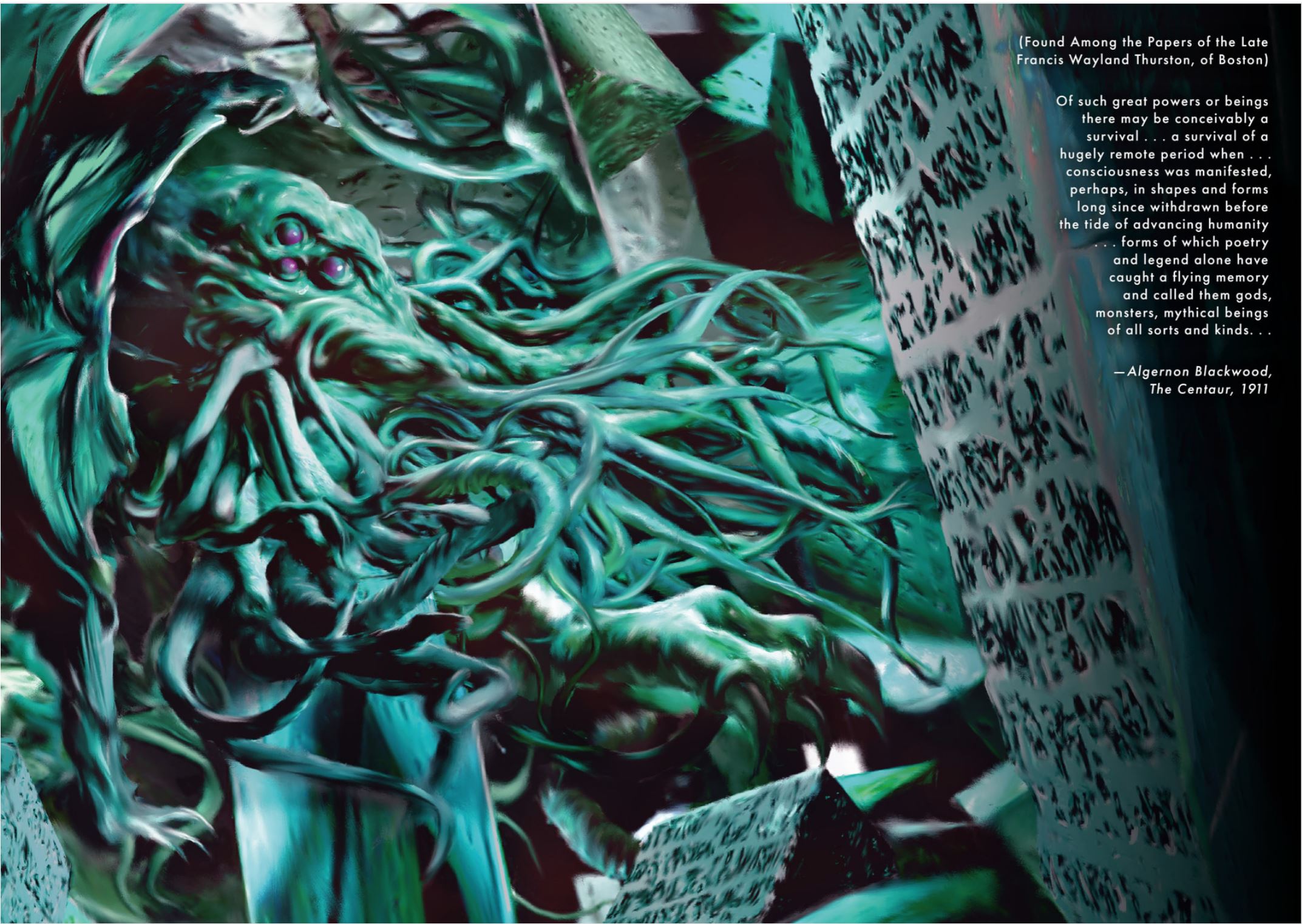
Accomplished in stark and staggering monochrome tinged with a palette of morbid grey textures and triggered by an explosive bursts of creepy colour, the saga opens in multihued torrent of horror ‘A Foreword…’ before first chapter ‘The Horror in Clay’ traces the progress of dutiful nephew Francis Wayland Thurston as he unpicks the trail of his recently deceased grand-uncle George Gammell Angell. That deceased historian, scholar and linguistics professor had become increasingly obsessed by artefacts and elements of an apparently lost civilisation and was seemingly aware of his impending death, and now his heir is similarly tormented by nightmares and deeply disturbed by an clay tablet.
It was made by modern sculptor H.A. Wilcox, a troubled soul also afflicted by pervasive night terrors, who had sought out Professor Angell after entering fugue states, seeing visions of human blood, dank mountains and towers rising from the sea. He heard bizarre sounds like alien words that stayed with him in the waking world and had created a clay tablet with a monstrous thing and phrases in an unknown language on it, all while sleeping…
Thurston had first become intrigued and ensnared at his grand-uncle’s funeral in Providence, Rhode Island, and by the time his patron’s effects had been shipped to Thurston’s home in Boston, the young man was caught and drawn ever inwards to something impossible…
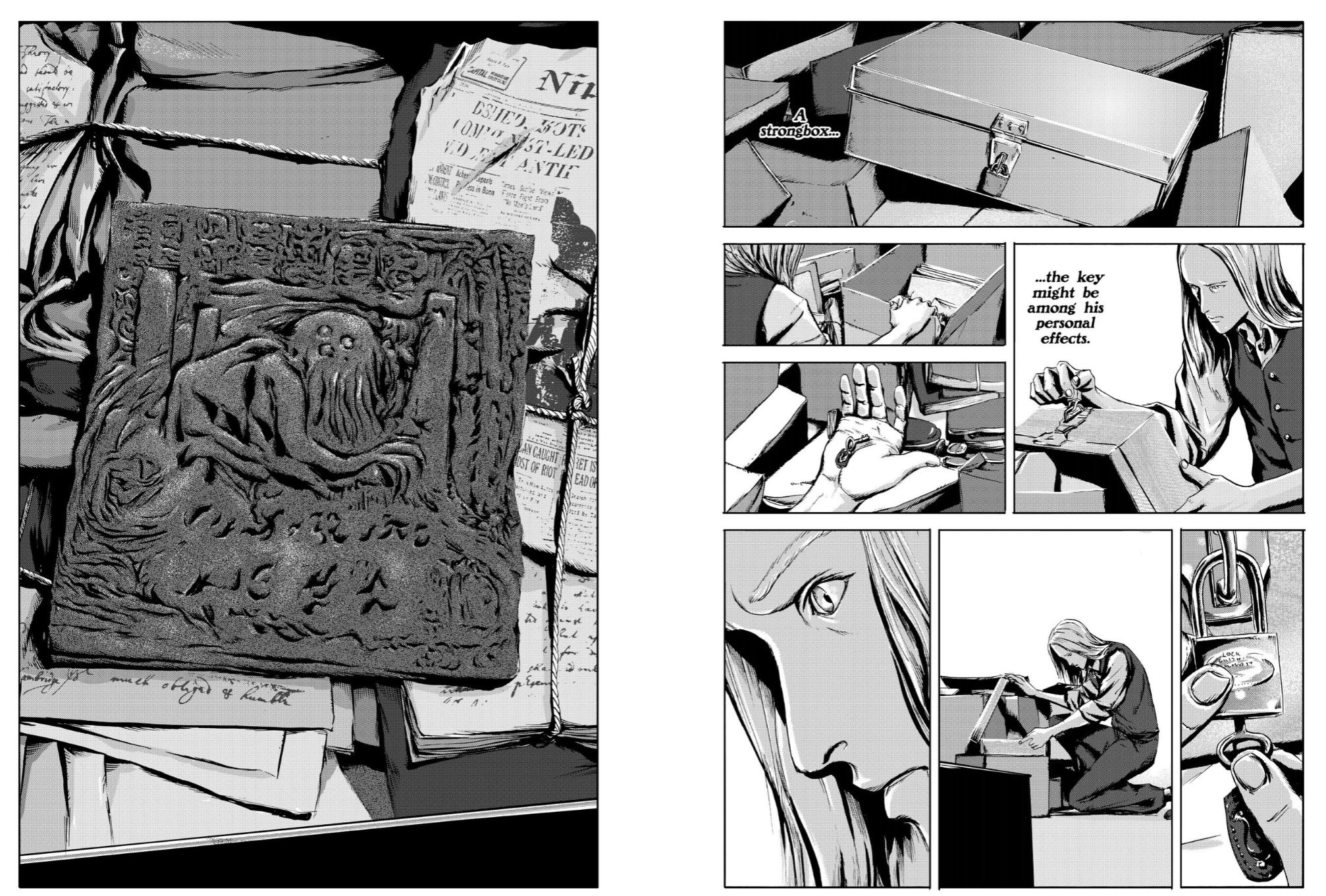
Angell’s papers described something ancient called the Cthulhu Cult and cited early findings by an anthropologist studying rural natives in Western Greenland, whilst Wilcox’s tablet and its inscription depicted something beyond comprehension yet irresistibly beguiling. The phrases “Cthulhu fhtagn” and “R’Lyeh” were all over the files, but what really seduced the researcher was a 1908 report provided by a New Orleans policeman…
Angell’s researches had been surprisingly fruitful and responses – so many of them – came from his learned colleagues and other interested parties from all over the world. Many concerned old aboriginal outposts and enclaves, or brutal, spontaneous bloodlettings and mob violence, savage outrages or suicides of fringe religious groups. There was a high incidence of madness and death amongst overly-sensitive creative artists. Often the mantra “Ph’nglui mglw’nafh Cthulhu R’lyeh wgah’agl fhtagn” – translated as “in his house at R’Lyeh dead Cthulhu waits dreaming” – was connected to such incidents.
The investigations takes a solidly chilling turn when Angell hears ‘The Tale of Inspector Legrasse’ who had survived a manic battle with murder cultists in the Louisiana swamps, uncovered appalling atrocities and confiscated a small greenish-black stone idol of a many eyed tentacled thing…
This raid had utterly crushed the vile ‘Cthulhu Cult’ but in the aftermath, when grilling smug unshakable Castro, the spiritual leader of the killers told Legrasse a fantastic tale of interstellar empires ruled by cosmic gods: beings death could not hold and who – sustained by human sacrificial blood offered by those who worshipped them – waited in the dark cold places of the world for their moment to return. Their lord was a supernal force answering to the name Cthulhu…
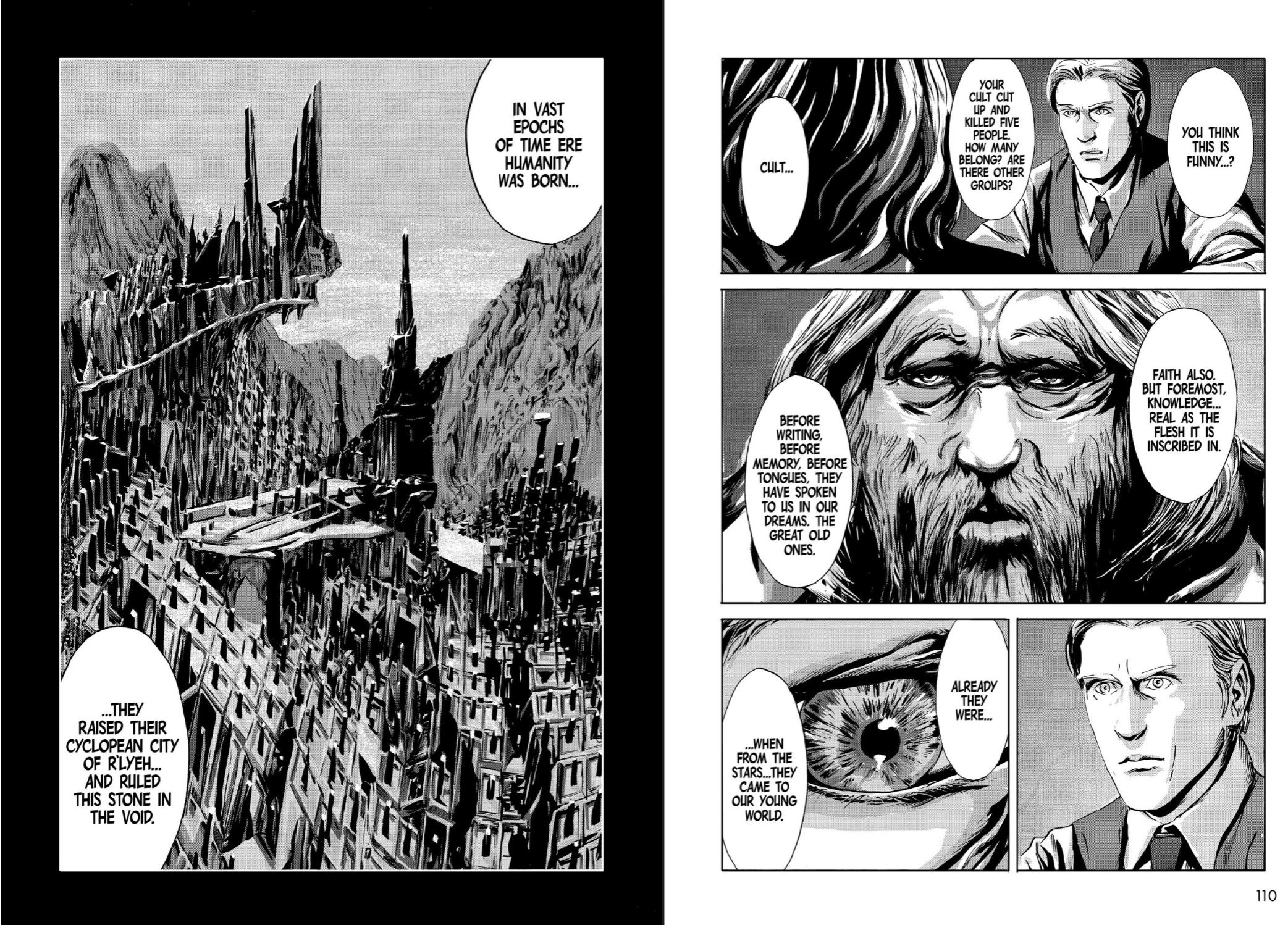
The weary cop wanted Professor Angell to help him weed out other instances of the cult but time caught up with them. Now, nearly twenty years later Thurston resolves to follow up and begins by tracking down Wilcox. The artist has become fully immersed in the cult and is clearly an enemy, and may have been the cause of Angell’s sudden death…
Thus Thurston locates and interviews Legrasse himself and, with reports of mass hysteria mounting across the world, takes possession of ‘The Terrible Statue’ the cop has kept all this time. Fired up and now fully obsessed, Thurston follows reports and scours global news outlets and finds a likely case in Australia where a salvaged vessel was found carrying a statue similar to the one Legrasse held, clutched in the arms of sole survivor Gustaf Johansen. He had claimed to have lived through a bizarre sea battle in the South Pacific Gyre….
Piecing events together, Thurston deduces the assault coincided with a recent massive earthquake that shook the world and increased cult incidents, and seeks to interview the repatriated mariner. The journey is convoluted but ultimately lands him in Norway… but too late. From the newly widowed Fru Johansen, Thurston learns that her husband arrived back broken and increasingly raving, only to be recently killed in a unlikely accident…
Thankfully, she has compiled all his papers and log books and wants the shocked scholar to read them…
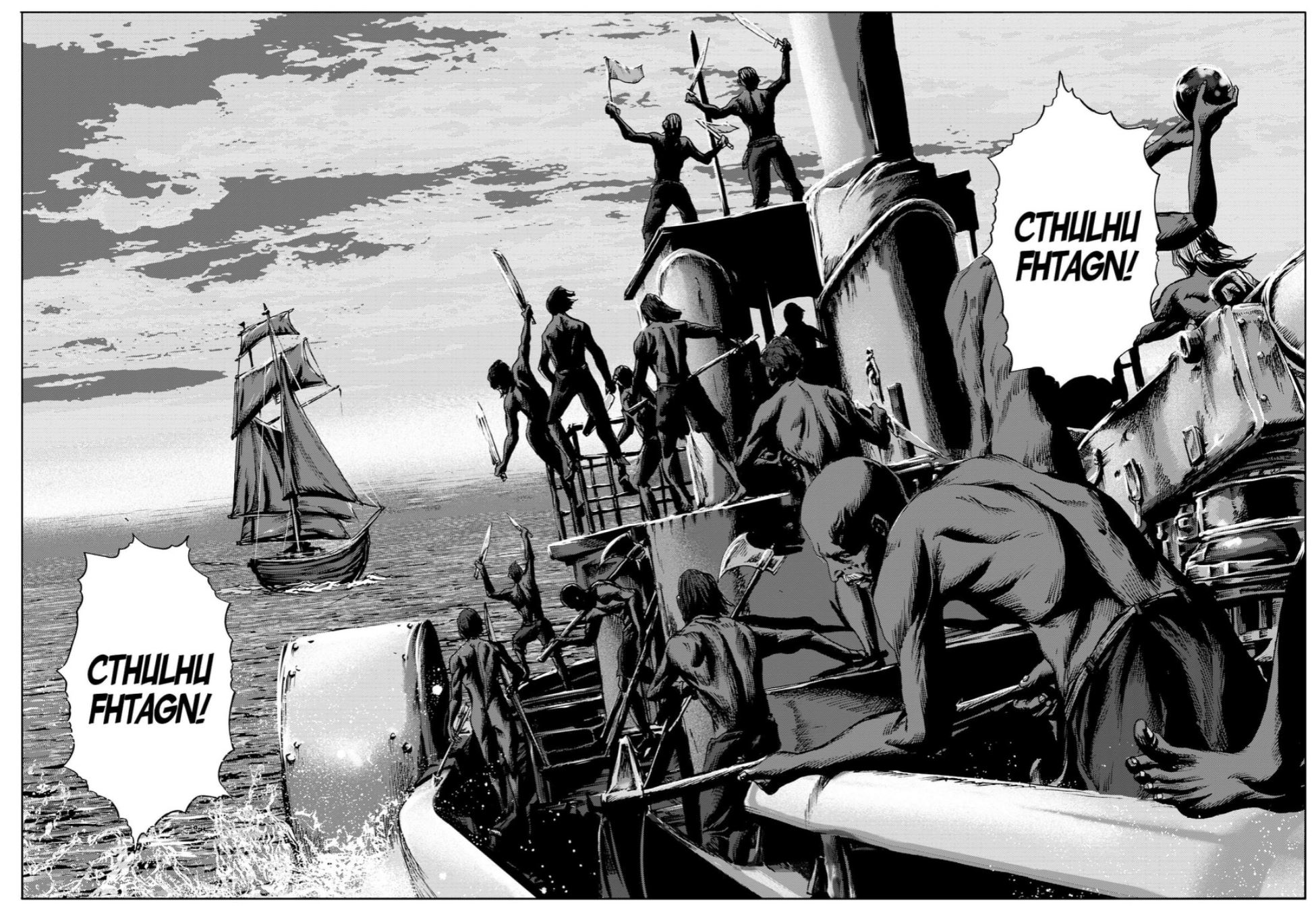
The tale therein is one of utter insanity, detailing how the tragic complement of schooner Emma succumbed to ‘The Madness from the Sea’ after a monumental storm and maelstrom threw the vessel onto a newly arisen island in the Gyre. Their doom was sealed when Emma was attacked by heavily-fortified steam yacht Alert, manned by piratical barbarians who worshipped a stone idol and screamed the chant “Cthulhu fhtagn”. A protracted battle resulted in the destruction of these maniacs but also the loss of Emma, whose handful of survivors commandeered Alert and washed ashore on the foreboding island.
It was a place of studied horror and ancient terrors, bleak, dark and soul-crushing, where incomprehensibly ancient, uncomfortably warped buildings and structures overwhelmed their senses. This was ‘R’Lyeh’ and their fate was confirmed when vast doors opened to unleash the city’s sleeping guardian. It made short work of the pitiful human wretches and only Second Mate Johansen and Able Seaman William Briden made it back to the barely seaworthy Alert.
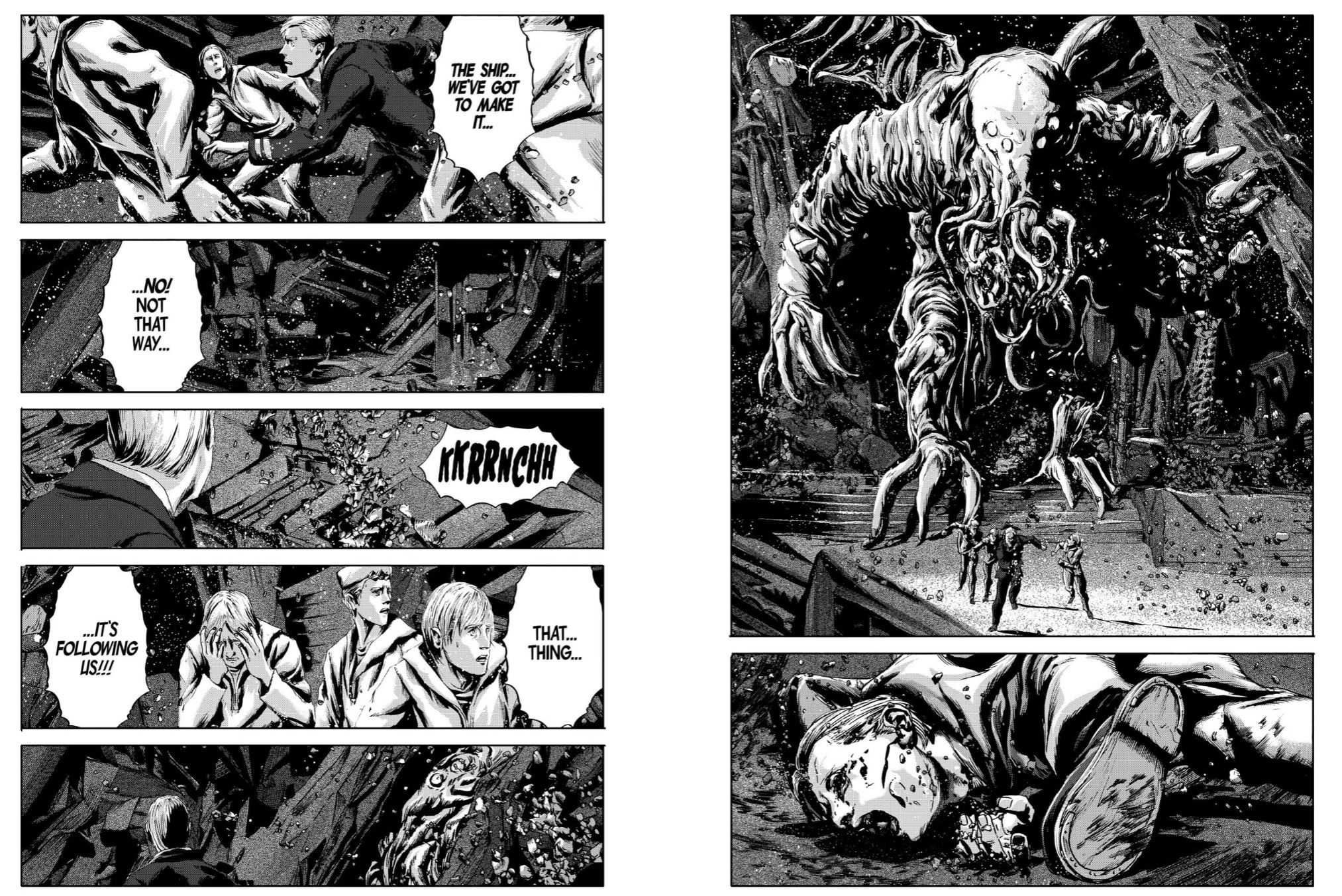
However, as seen in Final Chapter ‘Great Old Ones’, some things simply cannot be deterred or avoided, a painful recognition finally accepted by Thurston himself as he closed his investigation and prepared for the inescapable fate remorselessly approaching him…
Tapping into the modern vogue for arcane exploratory adventure (as also favoured and perfected by the likes of literary horrorist brethren Seabury Quinn, Clark Ashton Smith, and latterly August Derleth and Robert E. Howard and popularised by contemporary media from video games to MMORPGs) here Lovecraft delivered what most feel to be his most perfect and potent story. Moreover it has never been better interpreted than by Gou Tanabe – and you can learn more about both through the text feature ‘About the Creators’ that closes this book.
Enthralling, understated and astoundingly effective, this supernatural saga is a milestone of horror fiction, reverently adapted and packaged in manner that will delight avowed aficionados and beguile fear-loving newcomers alike.
CTHULHU NO YOBIGOE LOVECRAFT KESSAKUSHU © 2019 Gou Tanabe. All rights reserved. This English-language edition © 2024 Dark Horse Comics, LLC.
Win’s Christmas Gift Recommendation: Ideal Dread for Dark Nights… 9/10