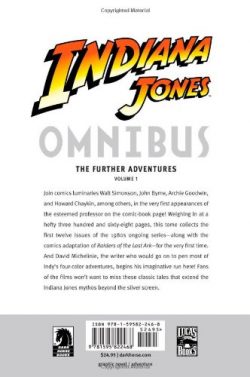
Indiana Jones: The Further Adventures Omnibus volume 1


By Walt Simonson, Denny O’Neil, David Michelinie, Howard Chaykin, Archie Goodwin, John Buscema, John Byrne, Gene Day, Richard Howell, Ron Frenz, Kerry Gammill, Dan Reed, Luke McDonnell, Terry Austin, Mel Candido, Danny Bulanadi, Sam de La Rosa, & various (Dark Horse/Titan Books)
ISBN: 978-1-59582-246-8 (Dark Horse TPB) 978-1-84576-808-9 (Titan TPB)

This book includes Discriminatory Content produced in less enlightened times. This book also includes Discriminatory Content included for dramatic and literary effect.

Win’s Christmas Gift Recommendation: What Blockbuster Really Means… 8/10

Next June sees the 45th anniversary of the release of Raiders of the Lost Ark. Who knows if we’ll still be here then, so in lieu of biblical smiting or the end coming courtesy of the babies, nitwits and monsters giving all the orders right now, here’s a rowdy recollection that’s fun to read and where Nazis at least have the chutzpah to admit it…

Although dormant for the moment, Dark Horse Comics have held the comics-producing franchise for Indiana Jones since 1993: generating thousands of pages of material, much of it excellent and some not quite. It might be construed as heretical to say it, but dedicated film fans aren’t all that quality conscious when it comes to their particular fascination, whether it’s games about finding Atlantis or the latest watered-down kids’ interpretation or whatever.

The Dark Horse Omnibus line was a wonderfully economical way to keep older material in print for such fans by bundling old publications into classy, full-colour digests. They were slightly smaller than US comic-books but larger than a standard tank?bon manga book, running about 400 pages per tome, but not all of them were available in digital editions. The entire format carried over when Marvel reacquired the Star Wars franchise and has been used since for their Alien and Predator lines.

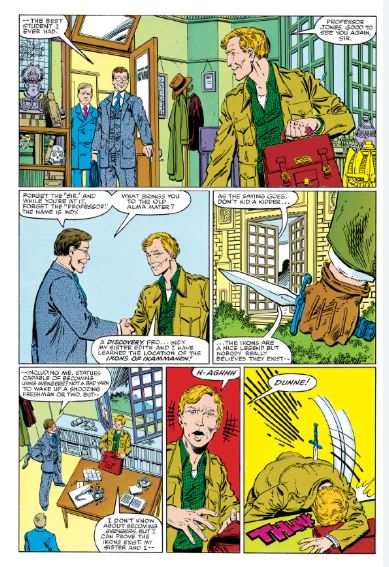
This initial Indy volume (of three) chronologically re-presents the first dozen Marvel Comics (the original license holder) interpretations which followed the film Raiders of the Lost Ark as well as including the 3-issue miniseries adaptation by Walt Simonson, John Buscema & Klaus Janson that preceded that celluloid landmark. I’m being this specific because the comic version was also released as a single glossy, enhanced-colour magazine in the Marvel Super Special series (#18: Indiana Jones and the Raiders of the Lost Ark if you’re curious).

So – just in case you’re the one who hasn’t seen the film… Set in the days before World War II, Hitler’s paranormal investigation division gathers occult artifacts from around the planet and soon crosses swords with a rough & ready unconventional archaeology professor from a New York university. Soon the far-from-esteemed Doctor Indiana Jones is scammed by the US government into tracking down his old tutor: a savant who might have knowledge of the biblical and mystically potent Ark of the Covenant…

Although Abner Ravenwood has since died, his daughter Marion possesses clues Jones needs. Unfortunately, she’s also an old flame he abandoned and would rather burn in hell than help him. However, when Nazis turn up and try to torch her in the Nepalese bar she washed up in, Marion joins Jones in a breakneck chase across the world from Cairo to the lost city of Tanis to a secret Nazi submarine base on a tropical island, fighting natives and Nazis every step of the way until the ancient artifact separates the just from the wicked in a spectacular and terrifying display of Old Testament style Wrath…

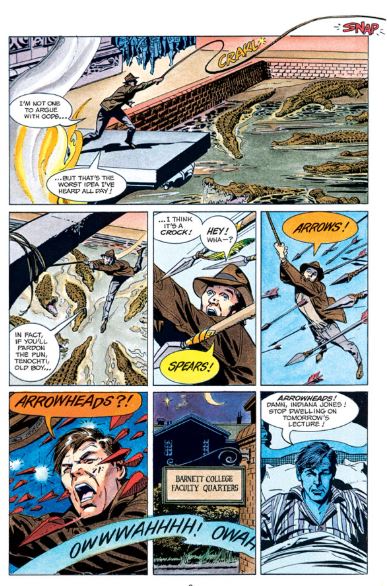
The movie’s format – baffling but breakneck search for a legendary object, chased or anticipated by utterly irredeemable antagonists, exotic locales, non-stop action, outrageous fights and just a hint of eldritch overtones – became staples for the comic book series that followed. It opened in impressive manner with ‘The Further Adventures of Indiana Jones’: a 2-part yarn from Jack-of-all-genres John Byrne, assisted by Terry Austin, with veteran scripter Denny O’Neil pitching in for the concluding ‘22-Karat Doom!’

When an old student is murdered before his eyes, Indy swears to complete the lad’s research, subsequently trekking through Africa in search of a mythical tribe who turn men to gold. He is never more than one step ahead of a maniac millionaire with no love of mysteries or antiquities, but possessed by a deep and abiding love of profit…

That adventure ends with our hero plunging out of a doomed plane and into issue #3’s US-set adventure ‘The Devil’s Cradle’ (by O’Neil, Gene Day, Richard Howell, Mel Candido & Danny Bulanadi) wherein Indy lands in a hillbilly wilderness where a rogue US Army Colonel and band of witch-burning yokels are separately hunting a 400-year-old alchemist with all the secrets of the ages at his fingertips…

David Michelinie, Ron Frenz & Bulanadi’s ‘Gateway to Infinity!’ sees our archaeological adventurer en route to Stonehenge, courtesy of the US government, as a ring of Nazi spies again fail to kill him. Hitler’s spies and parapsychologists are still hunting preternatural artifacts and the crystal cylinder uncovered at the ancient monument definitely qualifies. English professor (of antiquities not ENGLISH English) Karen Mays dates it to the Triassic period, millions of years before Man evolved, so the murderous Aryans will stop at nothing to make it theirs…

Luckily for Jones and Mays – but not the Reich – the spies eventually succeed. However, to their eternal regret their vile machinations unleash ‘The Harbingers’, and only Indy’s swift reactions prevent a horror beyond time escaping into our world…

Jazz Age mastermind Howard Chaykin joins Austin to illustrate wonderfully classy ‘Club Nightmare’ (plotted by Archie Goodwin & scripted by Michelinie) wherein Marion opens a swanky Manhattan nightspot, only to run afoul of mobsters – and worse – before it even opens. With Indy on hand to save the day though, the situation swiftly goes from tricky to calamitous to disastrous…

Michelinie, Kerry Gammill & Sam de La Rosa soon have our hero globetrotting again in ‘Africa Screams’ as a tussle in Tuscany with tomb-robber Ian McIver provides a solid clue to an even deeper mystery. Following an old map, Indy & Marion are soon on their way to the Dark Continent in search of the legendary Shintay; a tribe of pale giants, outcast from and last survivors of fabled Atlantis. Unfortunately, McIver and those ever-eager Nazi scavengers are also on the trail and in ‘Crystal Death’ the Shintay’s vast power almost eradicates half of Africa…

Issues #9 & 10 find our tomb hunter target of a sinister plot by German spies and Aztec wannabees in ‘The Gold Goddess: Xomec’s Raiders’ (Goodwin, Michelinie, Dan Reed & Bulanadi), prompting death-defying battles in the lofty heights of the Big Apple and depths of the Brazilian jungle…

We conclude in epic style with a breathtaking global duel and brand-new villain as Indy is seduced by nefarious antiquities collector Ben Ali Ayoob into investigating persistent Biblical myth ‘The Fourth Nail’. In ‘Blood and Sand’ Jones travels from Australian Outback to Barcelona trying to find the unused final spike that should have ended Christ’s suffering on the Cross, but his quest is dogged by bad luck, Arabian ninjas, guardian “gypsies”, immense insane bandits and irascible bulls looking for a handy matador to mangle…

The perilous pilgrimage reaches an inevitable conclusion in ‘Swords and Spikes’ (with additional art from Luke McDonnell & Mel Candido), a cavalcade of carnage, breakneck action and supernatural retribution…

With a covers gallery from such ably diverse hands as James T. Sherman, Walt Simonson, Terry Austin, Byrne, Howell & Armando Gil, Frenz, Mike Gustovich, Chaykin, Gammill, Bob Wiacek & Bob McLeod, this is a splendid slice of simple escapist fun: buried treasures any fan of any age would be delighted to unearth and rejoice over.
™ & © 1981, 1983, 2009 Lucasfilm Ltd. All rights reserved.

Today in 1920 comic book legend Dan Spiegle was born. Where are those Lost in Space, Crossfire or Blackhawk archive editions!?

In 1921 equally legendary artist Matt Baker was born. Go look him up too like we did in Invisible Men – The Trailblazing Black Artists of Comic Books. You could even try and find Teen Angst: A Treasury of ’50’s Romance

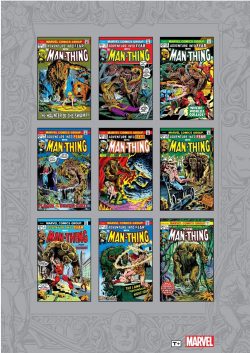
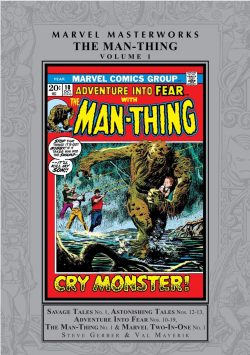
Man-Thing Marvel Masterworks volume 1


By Steve Gerber, Roy Thomas, Len Wein, Gerry Conway, Val Mayerik, Gray Morrow, Rich Buckler, John Buscema, Neal Adams, Howard Chaykin, Jim Starlin, Gil Kane, Dan Adkins, Jim Mooney, Frank Bolle, Chic Stone, Frank McLaughlin, Sal Trapani, Joe Sinnott, Frank Brunner, Mike Ploog & various (MARVEL)
ISBN: 978-1-3029-5547-2 (HB/digital edition)

This book includes Discriminatory Content produced in less enlightened times. This book also includes some Discriminatory Content included for dramatic and literary effect.

Win’s Christmas Gift Recommendation: Timeless, Remorseless, Evergreen Scary Stuff to Make You Think… 9/10

At the end of the 1960s American comic books were in turmoil, much like the youth of the nation they targeted. Superheroes had dominated for much of the decade; peaking globally before explosively falling to ennui and overkill. Older genres such as horror, westerns and science fiction returned, fed by radical trends in movie-making, where the kids who had grown up with Marvel now fulfilled the bulk of their young adult entertainment needs.

Inspiration isn’t everything. In fact as Marvel slowly grew to a position of market dominance in the wake of the losing their two most innovative and inspirational creators, they did so less by experimentation and more by expanding proven concepts and properties. The only real exception to this was the hasty hyper-generation of multiple horror titles in response to the industry down-turn in super-hero sales – a move vastly expedited by a rapid revision in the wordings of the increasingly ineffectual Comics Code Authority rules.

The switch to supernatural stars had many benefits. Crucially it brought a new readership to Marvel comics, one attuned to the global revival in spiritualism, Satanism and all things sinisterly spooky. Almost as important, it gave the reprint-crazy company an opportunity to finally recycle old 1950s horror stories that had been rendered unprintable and useless since the Code’s inception in 1954.

A scant 15 years later the Comics Code prohibition against horror was hastily rewritten – amazing how plunging sales can affect ethics – and scary comics came back in a big way with a new crop of supernatural heroes and monsters popping up on the newsstands to supplement the ghosts, ghoulies and goblins already infiltrating the once science-only scenarios of the surviving mystery men titles. In fact lifting of the Code ban resulted in such an en masse creation of horror titles (both new characters and reprints from the massive boom of the early 1950s) that it probably caused a few more venerable costumed crusaders to (temporarily, at least) bite the dust.

Almost overnight nasty monsters (and narcotics – but that’s another story) became acceptable fare on four-colour pages and whilst a parade of pre-code reprints made sound business sense, the creative aspect of the contemporary buzz for bizarre themes was catered to by adapting popular cultural icons before risking whole new concepts on an untested public. As always in entertainment, the watch-world was fashion: what was hitting big outside comics was to be incorporated into the mix as soon as possible.

The first fan-sensation of the modern era, (now officially enshrined as the Bronze Age of US comic books) Swamp Thing had powerful popular fiction antecedents and in 1972 it was seemingly a concept whose time had come again. Prime evidence was the fact that Marvel were also working on a man-into-mucky, muddy mess character at the very same time. Both Swampy and the Macabre Man-Thing were thematic revisions of Theodore Sturgeon’s classic novella It, and bore notable resemblances to a hugely popular Hillman Comics star dubbed The Heap.

He/it sloshed through the back of Airboy Comics (née Air Fighters Comics) from 1943 until the end of the Golden Age, and my fanboy radar suspects Roy Thomas’ marsh-monster The Glob (Incredible Hulk #121-November 1969 & #129-June 1970) either inspired both DC and Marvel’s creative teams, or was part of that same zeitgeist. It must also be remembered that in the autumn of 1971 Skywald – a very minor player with big aspirations – released a monochrome magazine in their Warren knock-off line entitled The Heap.

For whatever reason, by the end of the 1960s superhero comics were in another steep sales decline, again succumbing to a genre boom led by a horror/mystery resurgence. A swift rewriting of the Comics Code Authority augmented the changeover and at National/DC, veteran EC comics star Joe Orlando became editor of House of Mystery and sister title House of Secrets. These were short story anthologies embracing gothic mystery scenarios, taking their lead from TV triumphs like Twilight Zone and Rod Serling’s Night Gallery, but a horror themed lead meant a focus on character not plot, tragedy and empathy over twist endings and most precious of all, continuity…

No one was expecting satire and social commentary but that came along for the ride too!

Remarkably soon after the Comics Code prohibition against horror being amended, scary comics returned in force and a fresh crop of supernatural superheroes and monsters began appearing on newsstands to supplement the ghosts, ghoulies and goblins already infiltrating the once science-only scenarios of the surviving Fights ‘n’ Tights titles.

In fact, the lifting of the Code ban resulted in such an avalanche of horror titles in response to the industry-wide downturn in superhero sales, that it probably caused a few more venerable costumed crusaders to – albeit temporarily – bite the dust.

When proto-horror Morbius, the Living Vampire debuted in Amazing Spider-Man #101 (cover-dated October 1971) and the sky failed to fall in, Marvel moved ahead with a line of shocking superstars. They began with a traditional werewolf and a vampire before chancing something new: a haunted biker who tapped into both Easy Rider’s freewheeling motorcycling chic and the prevailing supernatural zeitgeist: the all-new Ghost Rider (in Marvel Spotlight #5, August 1972). He had been preceded by western hero Red Wolf in #1 and the aforementioned Werewolf by Night in #2-4. From these beginnings spooky floodgates opened to such an extent there was even room for non-white stars like The Living Mummy and ultimately today’s star turn…

This quirky compendium collects the earliest exploits of Marvel’s muck monster, and not at all coincidentally traces the rise of a unique comics voice. Steve Gerber was a sublimely gifted writer with a ferocious social conscience who combined a deep love of Marvel’s continuity minutiae with dark irrepressible wit, incisive introspection, barbed cultural criticism, a barely reigned-in imagination and boundless bizarre surrealism. His stories were always at the extreme edge of the company’s intellectual canon and never failed to deliver surprise and satisfaction, especially when he couched his sardonic sorties as thinly veiled attacks on burgeoning cultural homogenisation and commercial barbarity. Via material from Savage Tales #1, Astonishing Tales, #12-13, Adventure into Fear #10-19, The Man-Thing #1 & Marvel Two-In-One #1 (communally spanning May 1971 to January 1974) we’ll see how Marvel increasing became the voice of a lost and dissatisfied liberality…

The revolution begins after an erudite Introduction by authorial everyman Steve Orlando (Scarlet Witch, Wonder Woman, Ben 10, Heavy Metal Magazine), before we trudge back to very different times and the beginning of a new kind of comics experience and Marvel’s continued experiments with the monochrome, mature reader marketplace…

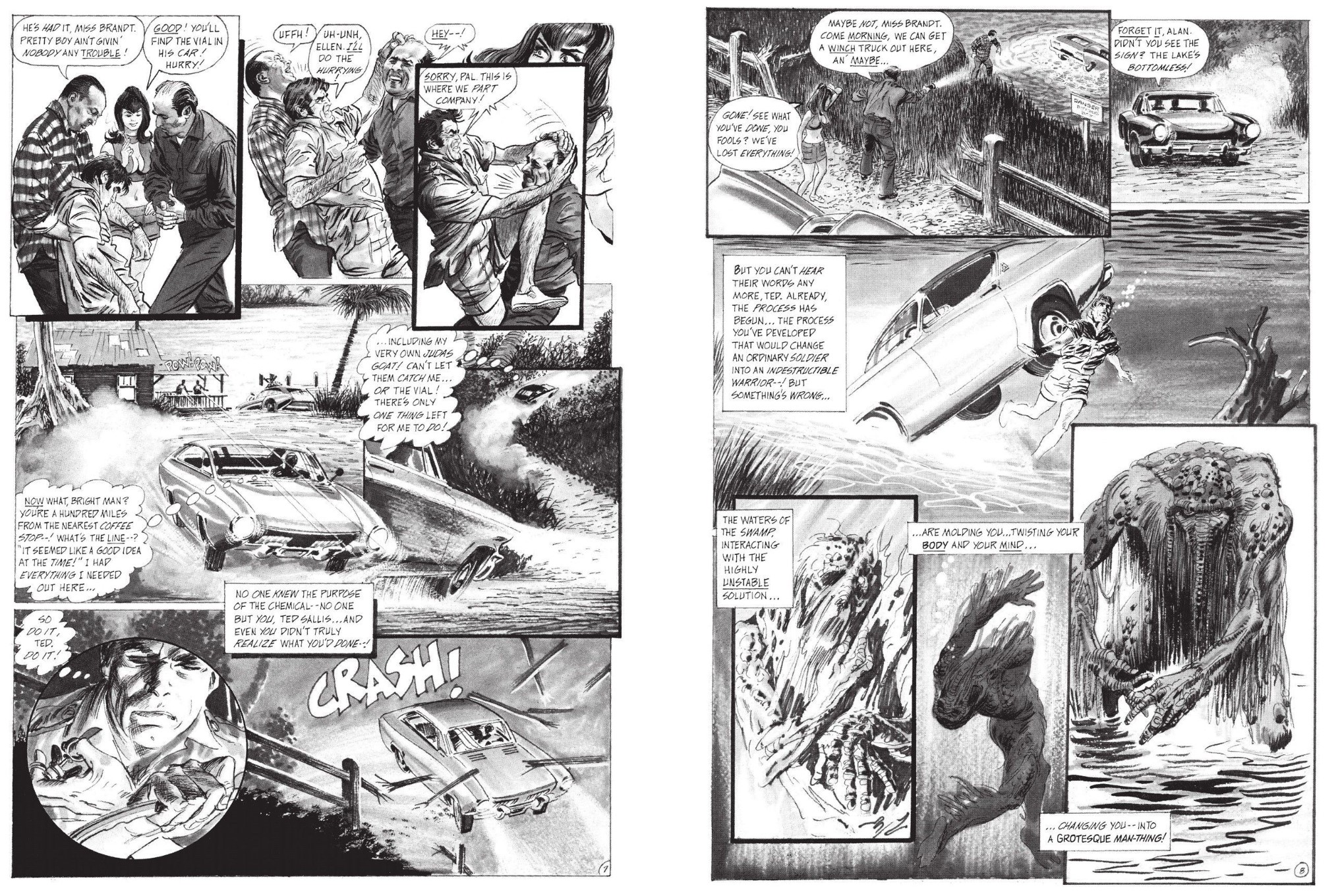
Ranged amidst the grittier-than-usual adult-oriented material (that meant partial nudity and more explicit violence back then) Savage Tales #1 (cover-dated May 1971) was a mixed bag of sword & sorcery, sci fi, crime and horror stories featuring Conan, Ka-Zar and more. That line-up included a powerfully enthralling horror yarn entitled ‘Man Thing!’ Scripted by Gerry Conway & Roy Thomas, it offered a fairly traditional spooky story elevated to sublime heights by Gray Morrow’s artwork. It related how government biochemist Ted Sallis was hiding out in the swamps whilst finishing a new/recreated iteration of the much-prized Super-soldier formula that had created Captain America

Sadly, his live-in lover Ellen is an agent for the opposition and when she and her minions made a play for the formula, Ted is wounded and flees into the murky mire. To preserve the only sample of his life’s work, the desperate, possibly dying boffin injects himself with it… and the bog mingles with the mix to spawn something tragic and uncanny…

Barely conscious or sentient, a shambling muck-monster emerges, apparently set on justice or vengeance…

Savage Tales was not a success and who knows how many manic Marvelites actually saw the anthology, but creators are stubborn brutes who can’t let things lie, so some months later the muck monster shambled back via a tenuous mainstream comic book connection…

Cover-dated June 1972, Astonishing Tales #12 sees the Savage Land’s self-appointed Sovereign Ka-Zar – and morphologically unsubstantiated primaeval saber-cat Zabu – abruptly relocating to Florida in pursuit of S.H.I.E.L.D. agent Barbra “Bobbi” Morse only to find that ‘Terror Stalks the Everglades!’ Here Thomas, John Buscema & Dan Adkins deftly recast the Jungle King as a freelance “consultant” for the superspy network, assisting aging biologist Dr. Wilma Calvin – who just happens to be Morse’s mentor – in tracking down a missing scientist named Ted Sallis.

What Ka-Zar doesn’t know is that the project all of them are working on is the recreation of the super-soldier serum that created Captain America and what nobody (technically) alive knows is that Sallis succeeded before he vanished. However, when Advanced Idea Mechanic agents tried to steal it. Sallis had injected himself and the chemicals reacted with the swamp’s magical energies to create a mindless shambling monster.

Readers are clued in thanks to a lovely unused interlude intended for Savage Tales #2, with Wein & Neal Adams providing a chilling recap sequence detailing the macabre Man-Thing’s previous relationship with Calvin, before back in the now, AIM attacks, trapping Ka-Zar with the bog-beast…

In AT #13 (Thomas, J. Buscema, Rich Buckler & Adkins), the mystery grows as the Jungle Lord escapes the ‘Man-Thing!’ to focus on the real monsters, subsequently routing out a traitor and defeating AIM… for now. With the attention-grabbing overlap with mainstream Marvel done for the moment the path was clear if muddy for a new horror hero to forge ahead, but what was needed was the right tone of voice…

Steve Gerber was a uniquely gifted writer who combined a deep love of Marvel’s continuity minutiae with dark irrepressible wit, incisive introspection, barbed socio-cultural criticism, a barely reigned-in imagination and boundless bizarre surrealism. His stories were always at the extreme edge of the company’s intellectual canon and never failed to deliver surprise and satisfaction, especially when he couched his sardonic sorties as thinly veiled attacks on burgeoning cultural homogenisation and commercial barbarity. With Man-Thing he held up a peculiarly scummy mirror to many cordoned-off and taboo subjects and made history – and enemies – over and over again. However before him, Conway & Morrow returned, aided by Howard Chaykin as the bog beast won its own series, beginning in (Adventure into) Fear #10. Cover-dated October 1972, ‘Man Thing!’ (Say it again! Again!) saw the monster defy all odds to return an abandoned baby to a daddy who just did not want him… and would not take no for an answer…

After that conceptual interlude Gerber, Buckler & Jim Mooney opened an extended mystic parable in Fear #11 on the ‘Night of the Nether-Spawn!’ Gerber’s take was that the beast was empathic and all-but-mindless, reacting and responding to those in its vicinity, but having practically no personal volition. Here that relationship draws in teenagers Jennifer Kale and her little brother Andy who are about to get into all sorts of trouble because they stole something from their grandpa. Sadly, when you play with a magical tome belonging to an ancient cult, handed down over eons to the latest in a long line of guardian wizards, sinister stuff is likely to happen…

The upshot is that a demonic force comes looking for little Miss Kale and its evil emanations make it a painful intrusion the maddened muck monster cannot abide. With diabolical Thog the Nether-Spawn thus preoccupied battling the bonkers bog-brute all through small-town Citrusville, Andy & Jennifer are free to try to fix what they broke. All appearances and happy endings to the contrary, it’s too little, too late…
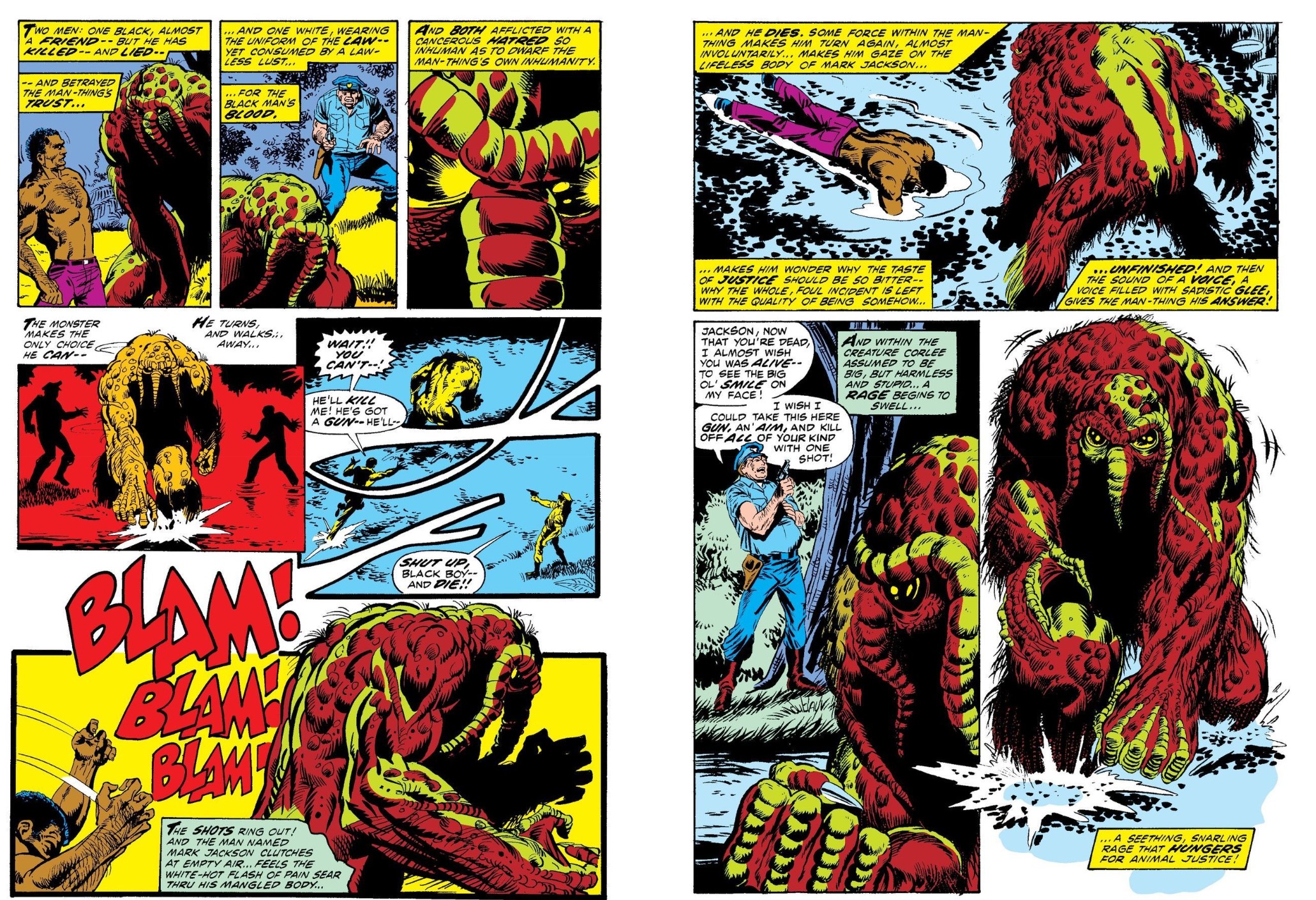
The nation’s racial tensions boiled over into Fear #12 as Gerber, Jim Starlin & Buckler discovered ‘No Choice of Colors!’ after the moss-heap slurped into a far-too-personal vendetta linking racist white sheriff Wallace Corlee and fugitive black murder suspect Mark Jackson. After initially and instinctively saving the wounded runner, Man-Thing is helpless against the literally paralysing hatred of both men: one condemned for loving the wrong shade of woman and the just other happy to have a legal reason to kill another “coloured man”…

Only after one of the enraged obsessives is no more can the swamp beast freely act against the other…

In #13, Val Mayerik begins his fruitful association with the series as – inked by Frank Bolle – ‘Where Worlds Collide!’ finds Gerber in universe-building mode: introducing Jennifer Kale’s Grandpa Joshua as high priest of a cult that has thrived secretly since Atlantis sank beneath the waves. They have safeguarded the world for eons, handing down the sacred Tome of Zhered-Na, but now Jennifer’s meddling as she innocently answered the call of her heritage has opened a portal to infernal terror that begins by taking Jen’s not-boyfriend Jaxon and opening pathways to devil-infested dimensions. When the Man-Thing follows, he finds a place where Ted Sallis is made manifest again and where Thog offers to make it permanent if the human will betray his world…

Ted’s violent refusal coincides with Joshua and the grandkids showing up and, in the flush of frantic battle and escape to consensus reality, the Kales discover Jennifer’s uncanny link to the mindless (again) monster…

Veteran Chic Stone inks #14’s ‘The Demon Plague!’ as, all over America, hate and insanity blossom. Everywhere, humans attack those nearest, dearest or even largely indifferent to them; and the deluge of violence even affects the wildlife in Florida’s swamps with Man-Thing pitilessly assaulted by everything that walks or hops or crawls or swims…

Joshua Kale soon determines that the not properly sealed dimensional portal is permitting demons to pass and possess mortals, and convenes a cult ceremony to close it from within the swamp – which just happens to be the Nexus of All Realities…

Despite best efforts the ritual goes awry and, curiously spying on them, Jennifer and the bog-beast are abducted from existence by a major mage dubbed Dakimh the Enchanter. Forced into gladiatorial actions to retain the sacred tome that only Jennifer knows no longer exists, everybody underestimates the shambling compost heap with flamethrower hands, and the Earthlings are promptly returned without giving away any more arcane secrets…

With Frank McLaughkin as guest inker this time, Gerber & Mayerik probe ‘From Here to Infinity!’ in Fear #15. With chaos gripping the entire planet, the Man-Thing seemingly killed by invading demons and no sacred tome to consult, Joshua Kale visits ancient Atlantis, seeing how mystic Zhered-Na personally dealt with the last such incursion, learning of an eternal war between divine realms – shining Therea and dark Sominus…

As the current cult leader views how his inspiration met her end, elsewhere Dakimh recruits promising potential sorceress Jennifer, revives the bog-beast and takes them both an a trans-dimensional voyage to save reality and stop the sorcerous shooting war…cat least for now and at the cost of the link to the swamp totem…

Abruptly switching tack and tone, Fear #16 ‘Cry of the Native!’ (inked by Sal Trapani) explores themes of Native American rights, ecological barbarism and callous capitalism run amok, when developer F A Schist attempts to drain the swamp and relocate its Indian occupants to facilitate his new airport complex. Complex issues of new jobs versus already broken treaties and promises lead to sabotage, riots and civil unrest, but what concerns the Kales most is how the disruption might affect the shaky barriers holding back the hungry hordes of Sominus…

This time, however, simply human pride, greed, bigotry and love of violence – all agonising felt by mindless, empathic Man-Thing – is enough to spark riot and butchery, and stall the project. In the aftermath (and with Trapani sticking around as inker) #17’s ‘It Came Out of the Sky!’ offers dark, wry parody as the bog-beast curiously opens a long-submerged space capsule buried in the hidden mire. Within is a super-powered baby sent from a world believed by one scientist/loving father to be on the imminent edge of extinction due to environmental collapse…

The capsule had fed and sustained the godlike being within for 22 years, but when Wundarr emerged to immediately imprint on the Man-Thing, nothing could convince the educationally and emotionally challenged – and fully-grown – waif that the unthinking moss-mass was not his mother. The rejection and indifference proved unbearable and the violent tantrums that resulted almost destroy the airport construction site and Citrusville…
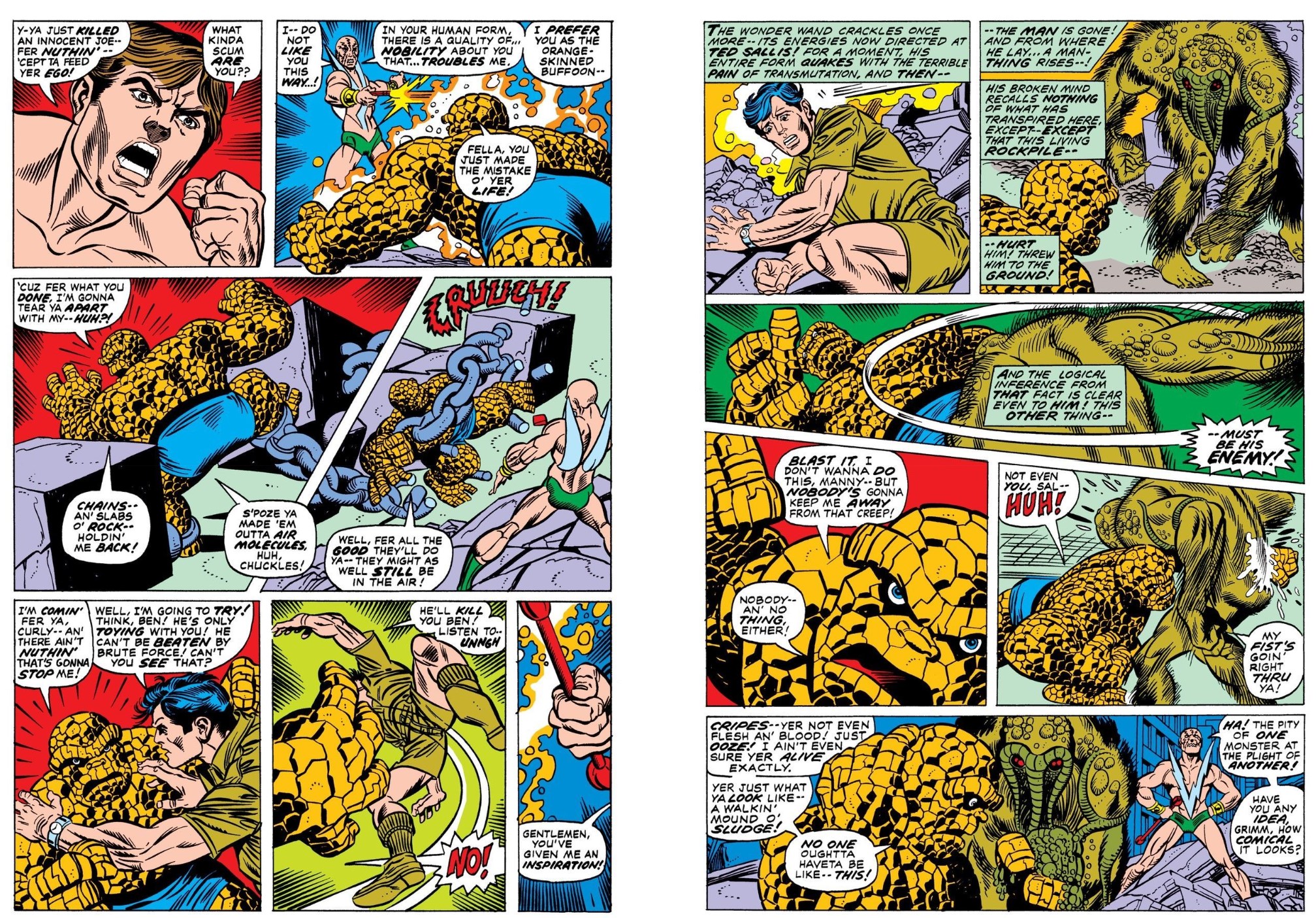
The story notionally carries over into debuting superhero team-up book Marvel Two-In-One #1 (cover-dated January 1974) where, after a desert clash with Thanos, Fantastic Four stalwart Ben Grimm accidentally and improbably ends up in Florida for the premier issue of his own title. Crafted by Gerber, Gil Kane & Joe Sinnott, the ‘Vengeance of the Molecule Man!’ sees The Thing learn some horrifying home truths about what constitutes being a monster when battling with and beside ghastly, grotesque anti-hero Man-Thing after the essence of the reality-warping villain starts possessing bodies in the swamps

Back in Fear #18, Gerber, Mayerik & Trapani resume straight terror tropes and real-world controversy in ‘A Question of Survival!’ as a bus load of ordinary people and a drunk driver catastrophically intersect on a highway through the Everglades. Drawn to the emotional turmoil, the mire monster becomes unwilling witness and unintentional guide as the survivors learn about each other (this at a time when women and minorities were still legally second-class citizens, and pacifists & warhawks violently clashed over Vietnam) whilst trekking back to civilisation and medical treatment. Sadly, one of them really needs to be the only survivor and is not averse to more killing…

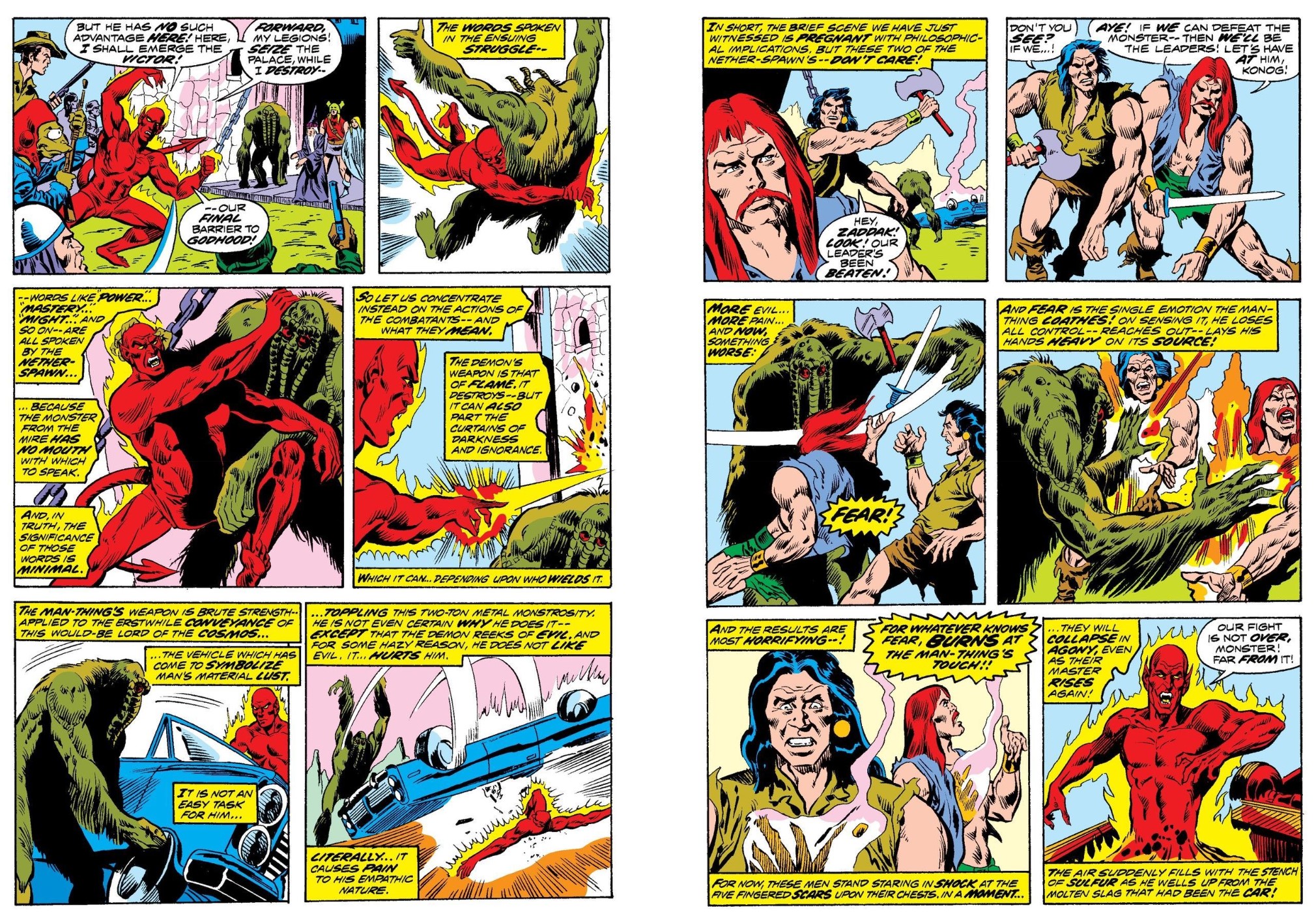
The series truly hit its innovative stride with its final appearance in (Adventure into) Fear #19 – cover-dated December 1973 – wherein Thog makes his grand move to conquer all realities and destroy the benign over-gods of Therea. That’s when Jennifer Kale officially becomes ‘The Enchanter’s Apprentice!’ (Gerber, Mayerik & Trapani) and joins another trans-planar trek as the formerly regulated realms of existence begin to collide, clash and combine. First task is to gather the heroes needful to the task and her far-from-united party rapidly expands to include tutor Dakimh, the mindless Man-Thing, a burly barbarian (Korrek, Warrior Prince of Katharta!) and a brusquely cynical talking mallard who calls himself Howard

Hounded by Thog’s forces, their task is to traverse the twisting paths of existence and save the gods with the chase leading directly into The Man-Thing #1 (January 1974) and a world-shattering ‘Battle for the Palace of the Gods!’ Along the way, Howard is an early casualty, lost in a plunge through cascading universes and the chaos even briefly encompasses baffled heroes Daredevil and Black Widow; and all seems lost when the malign Congress of Realities smashes into seemingly undefended Therea. However, there are forces at play that are beyond even demons and devils, and the mysterious Man-Thing is their unknowing yet willing tool; and ultimately realties are rebalanced and life goes on…

With covers by John Buscema, Buckler, Morrow, Adams, Starlin, Kane, John Romita Snr., Alan Weiss, Frank Brunner, Sinnott, Frank Giacoia, Herb Trimpe & Ernie Chan, the extras in this moody tome of terror and extrospection also include – from November 1970 – Thomas’ original plot for the short story in Savage Tales #1; an original grey-toned art page by Morrow; more by Buscema & Adkins, Buckler, Mooney, Weiss, Brunner, Mayerik & McLaughlin. For your perusal, Gerber’s plot for Fear #16 follows, with lettering notes and Brunner’s cover for #17. More original art includes Romita’s cover for #18 plus interior art by Mayerik & Trapani. The cover art for #19 by Kane & Chan opens another gallery before segueing into house ads, Adams’ cover for Monsters Unleashed #3 and a cover gallery for reprint title Book of the Dead #1-3 (1993-1994) by Tennyson Smith & Morrow, and Ariel Olivetti’s cover to the 2012 Man-Thing Omnibus.

We – me especially – apply the terms milestone, landmark and groundbreaking as guarantors of quality that change the way comics are perceived and even created. It has never been more true or accurate than with these game-changing, socially aware horror yarns. These are stories you must not miss…
© 2024 MARVEL.

Today in 1894 the magnificent Elzie Segar was born. Go read some Popeye or even Thimble Theatre if you can find it.

In 1980 Berke Breathed chose the day to begin his almost-as-magnificent Bloom County strip, as we last saw in Bloom County: Real, Classy, & Compleat 1980-1989. Some of that last factoid is made up by me, but it could have happened…

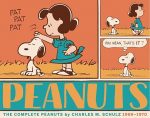
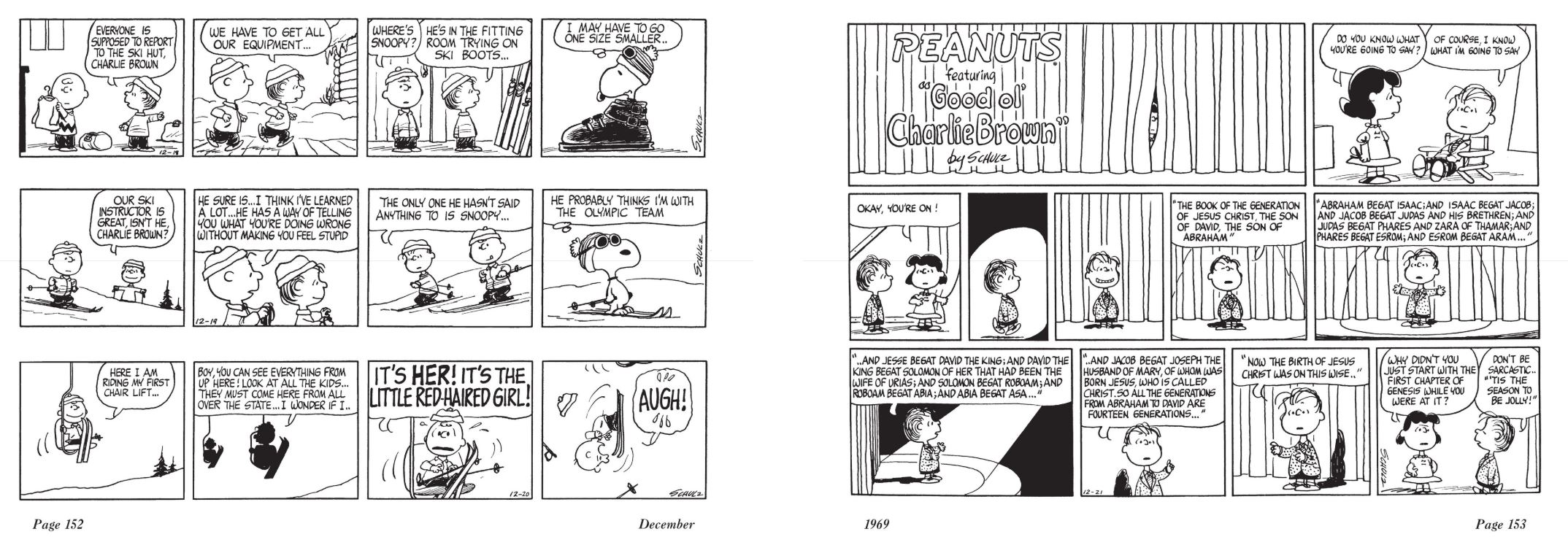
The Complete Peanuts volume 10: 1969-1970


By Charles M. Schulz (Fantagraphics Books/Canongate Books UK)
ISBN: 978-1-68396-126-0 (US TPB) 978-0857862143 (Cannongate HB)

This book includes Discriminatory Content produced in less enlightened times.

Win’s Christmas Gift Recommendation: Towering Monumental Tradition Writ (and Drew) Large… 10/10

Peanuts is unequivocally the most important comic strip in the history of graphic narrative. It is also the most deeply personal. Cartoonist Charles M Schulz crafted his moodily hilarious, hysterically introspective, shockingly surreal philosophical epic for half a century: 17,897 strips spanning October 2nd 1950 to February 13th 2000. He died – from complications of cancer – the day before his last strip was printed.

At its height, Peanuts ran in 2,600 newspapers, in 21 languages and75 countries. Many of those venues still run it as perpetual reprints, and have done ever since “Sparky” passed. During his lifetime, book collections, a merchandising mountain and television spin-offs had made the publicity-shy doodler an actual billionaire at a time when that really meant something…

None of that matters. Peanuts – a title Schulz loathed, but one the syndicate forced upon him – changed the way comics strips were received and perceived: proving cartoon comedy could have edges and nuance and meaning as well as too-soon-forgotten pratfalls and punchlines.

We begin with an effusive and enthusiastic foreword from author/animator/illustrator Mo Willems (Don’t Let the Pigeon Drive the Bus!, Knuffle Bunny, Sheep in the Big City) expressing his debt to the strip.

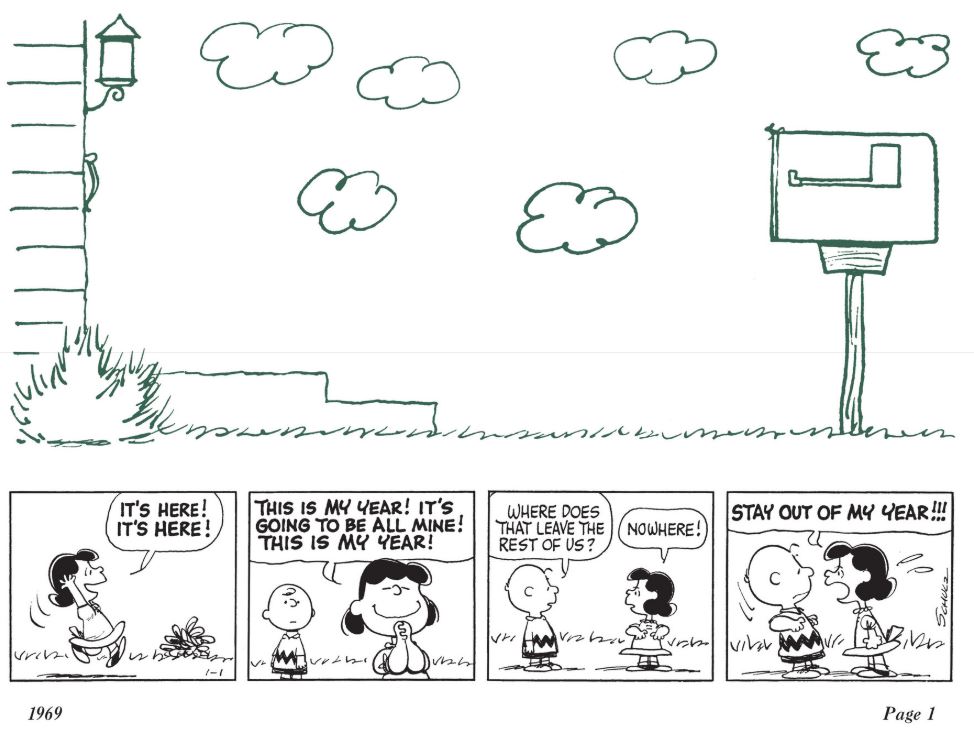
On the pages, this period heralds a true renaissance probably triggered by headlines in an era of swiftly shifting changes in social attitudes and rampant cultural exploration. Notionally, our focus and point of contact remains quintessentially inspirational loser Charlie Brown who, despite slowly taking a few steps behind fanciful, high-maintenance mutt Snoopy, remains squarely at odds with the mercurial supporting cast. They are still hanging out doing what at first sight seems to be Kids Stuff in an increasingly hostile and intrusive universe of perverse happenstance. Except perhaps that Lucy Van Pelt kid. She’s not like the others…

Neatly interspersed with daily doses of gloom, the Peanuts Sunday page first debuted on January 6th 1952: a standard half-page slot offering more measured fare than 4-panel dailies. Thwarted ambition, sporting failures, crushing frustration abound, alternating with Snoopy’s inner life of aviation and war stories, star gazing, shooting the breeze with bird buddies, weather woes and food fiascos. These and other signature sorties across the sabbath indulgences afforded Schulz room to be his most imaginative, whimsical and provocative…

Regular tentpole moments to relish include more Snoopy v Lucy deathmatches/ambush snogs/dance offs; Charlie Brown’s food feud with the beagle, an assortment of night terrors; Lucy’s emphatically simple solutions to complex questions; doggy dreams; the power of television; sporting endeavours and the sharply-cornered romantic triangle involving Lucy, Schroeder & Beethoven – albeit wedded to “sophisticated” fallout when pushy Frieda decides she also wants to play…

Always, gags centre on play, varying degrees of musicality, pranks, interpersonal alignments, the mounting pressures of ever-harder education, mass media lensed through young eyes and a selection of sports in their season. All are leavened by agonising teasing, naked contempt, kindled and crushed hopes, the making of baffled observations and occasionally acting a bit too much like grown-ups. However, in this tome, themes and tropes that define the entire series (especially in the wake of many animated TV specials) become mantra-like yet endlessly variable, but focus less on Charlie and more on those around him. Also, the outside grown-up world considerably encroaches, as when Lucy declares herself a “ New Feminist” although no one looking can see any difference to any presumably previously un-enlightened Miss van Pelt…

Human interactions still find the boy a pitiable outlier. Mean girl Violet, musical prodigy Schroeder, self-taught psychoanalyst/dictator-in-waiting Lucy, her brilliantly off-kilter little brother Linus and dirt-magnet “Pig-Pen” are fixtures honed and primed to generate joke-routines and gag-sequences around their signature foibles, but some early characters have faded away in favour of fresh attention-attracting players. Newcomers sidle in and shuffle off without much flurry or fanfare but in our real world the use of “Minority” characters José Peron of New Mexico and African American Franklin drew much attention and controversy – because, I guess, there will always be gits and arseholes – especially if the oblivious readers elected them…

The most significant expansion is that weird upside bird bugging the beagle gets a name – Woodstock (as revealed on June 22, 1970) – and a job as his dogsbody – secretary, actually – whilst shock near-cripples the round-headed kid when he discovers that the “little red-haired girl” he almost plucked up the nerve to talk to moves to a new city. It’s a blow he’s still reeling from when this book ends two years later, and one only Linus really understands. After all, his teacher Miss Othmar is gone after the teacher’s strike…

There is much more madcap politically-tinged material, including repeated riffs on a recently inaugurated new real-world president (Richard Milhous Nixon on January 20, 1969) as seen when Snoopy briefly becomes the most powerful mutt in the Free world after being chosen as the new Grand Beagle…

At least the Brown boy’s existential crisis/responsibility vector/little sister Sally has grown enough to become just another trigger for relentless self-excoriation. As she grows, pesters librarians, forms opinions and propounds steadfastly authoritarian views, Charlie is relegated to being her dumber, but eternally protective, big brother especially as her biggest bugbear is starting school and Charlie is such an expert on all things scholastic…

Resigned to – but far from uncomplaining about – life as a loser in the gunsight of cruel and capricious fate, the boy Brown is helpless meat in the clutches of openly sadistic Lucy. When not sabotaging his efforts to kick a football, she monetises her spiteful verve via a 5¢ walk-in psychoanalysis booth (although supply and demand economics also affects this unshakeable standard), ensuring that whether at play, in sports, kite-flying or just brooding, the round-headed kid truly endures the character-building trials of the damned.

One deliciously powerful constant that grows more abundant is the boy’s utter inability to fly that kite. Here war with wind, gravity and landscape reaches absurdist proportions, as the tree haunts Charlie Brown’s adored pastime with vicious, violent and malign venom. Moreover, other kids are aware of its growing power. After one terse musical interlude with Schroeder, Lucy lobs our reluctant lover-boy’s beloved piano into the voracious carnivorous conifer…

By now, the beagle is the true star of the show, with his primary quest for more and better playing out against an increasingly baroque inner life, wild encounters with birds, sports, dance marathons and skating trysts (especially the close-order combat called ice hockey!), philosophical ruminations, and ever-more-popular catchphrases. Here, burgeoning whimsy leads to more glimpses of the interior world: his WWI other life, peppered with dogfights against the accursed Red Baron, but also careers as an astronaut, a sports coach, a prairie dog and a detective seeking his lost mother. That tragic obscured past as an alumni of the Daisy Hill Puppy Farm leads to constant introspection… and dancing… lots and lots of dancing…

Naturally, Snoopy soon subverts all that misery and curiosity to fuel his creative side and begins the Great American Novel that will change literature forever… but that’s before the Browns go on vacation and leave the dog with the Van Pelts. Naturally, Lucy has an idea about finally fixing the pooch. It doesn’t end well…

As always, timeless episodes of play, peril, peewee psychoanalysis and personal excoriation are beards for some heavy topics. Rendered in marvellous monochrome, there are crucial character introductions, plot developments and creation of more traditions we all revere to this day. Of particular note is the growing role of Patricia Reichardt – AKA tomboy Peppermint Patty – who heartbreakingly deals with the so-early discovery that she will never be pretty or beautiful. Even Snoopy’s most concerted efforts can’t quite salve that sting…

Another trenchant continued gag-series resumes Lucy obsessive attempts to “cure” Linus of his blanket dependency by again playing him off against Grandma who will give donations to charities if the boy grows up…

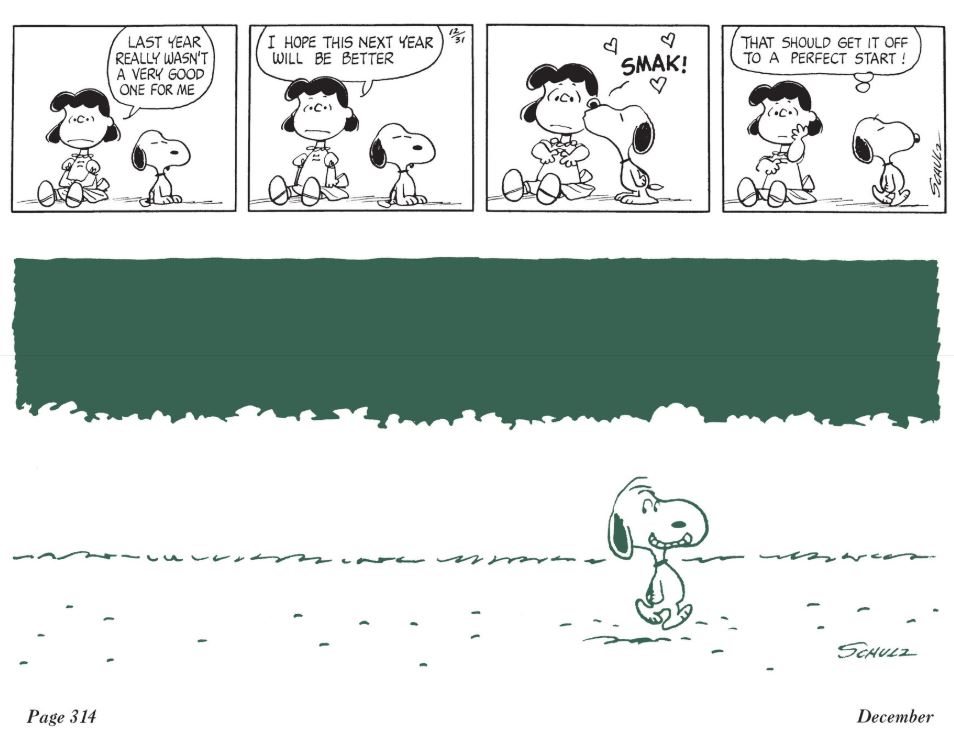
Snoopy is the only force capable of challenging if not actually countering Lucy. Over these two years, her campaign to curb that weird beagle, cure her brother of blanket addiction and generally reorder reality to her preferences reaches astounding heights and appalling depths, but the dog keeps trying and scores many minor victories. As always the book opens and closes with many strips riffing on snow, food, movie-going and television – or the gang’s responses to it – becoming ever more pervasive. And as always, Lucy constantly, consistently sucks all the joy out of the white wonder stuff and the astounding variety offered by the goggle-box. Perpetually sabotaged, and facing abuse from every female in their life, Brown and Snoopy endure more casual grief from smug, attention-seeking Frieda, who champions shallow good looks over substance. At least Linus is growing: hardened inside by what happened to teacher Miss Othmar, but Lucy’s amatory ambitions for Schroeder grow ever more chilling and substantive. She will never move on…

Schulz established way points in his year: formally celebrating certain calendar occasions – real or invented – as perennial shared events: Mothers and Fathers’ Days, Fourth of July, National Dog Week strips accompanied in their turn yearly milestones like Christmas, St. Valentine’s Day, Easter, Halloween/Great Pumpkin Day and Beethoven’s Birthday were joined this year by a return to another American ritual as many of the cast return to summer camp. At least there is unbridled joy when Brown’s baseball team hits a winning streak and Charlie meets his all-time sporting idol – except of course they’re not quite the boons they first appear…

Sports loom large and terrifying as ever, but star athlete Snoopy is more interested in new passions than boring old baseball or hockey. Even Lucy finds far more absorbing pastimes but still enjoys crushing the spirits of her teammates in whatever endeavour they are failing at. Anxiety-wracked Brown even steps down from the baseball team to ease his life, but that only intensifies his woes, and does nothing to help his kite wielding or football kicking…

Linus endures more disappointment in two Great Pumpkin seasons and before you know it, there’s the traditional countdown to Christmas and another year filled with weird, wild and wonderful moments…

Wrapping it all up, Gary Groth celebrates and deconstructs the man and his work in ‘Charles M. Schulz: 1922 to 2000’, preceded by a copious ‘Index’ offering instant access to favourite scenes you’d like to see again…

Available in multiple formats, this volume guarantees total enjoyment: comedy gold and social glue metamorphosing into an epic of spellbinding graphic mastery that still adds joy to billions of lives, and continues to make new fans and devotees long after its maker’s passing.
The Complete Peanuts: 1969-1970 (Volume Ten) © 2008 Peanuts Worldwide, LLC. The Foreword is © 2008, John Waters. “Charles M. Schulz: 1922 to 2000” © 2008 Gary Groth. All rights reserved.

Today in 1946 Lucky Luke “debuted” in the Spirou Alamanch Annual – except if you read Lucky Luke: The Complete Collection Volume One you’ll know that ain’t necessarily so…

And in 1970 the incredible Rube Goldberg shuffled off this mortal coil. It was probably one he had designed in his masterful cartoons. Go google Rueben Awards

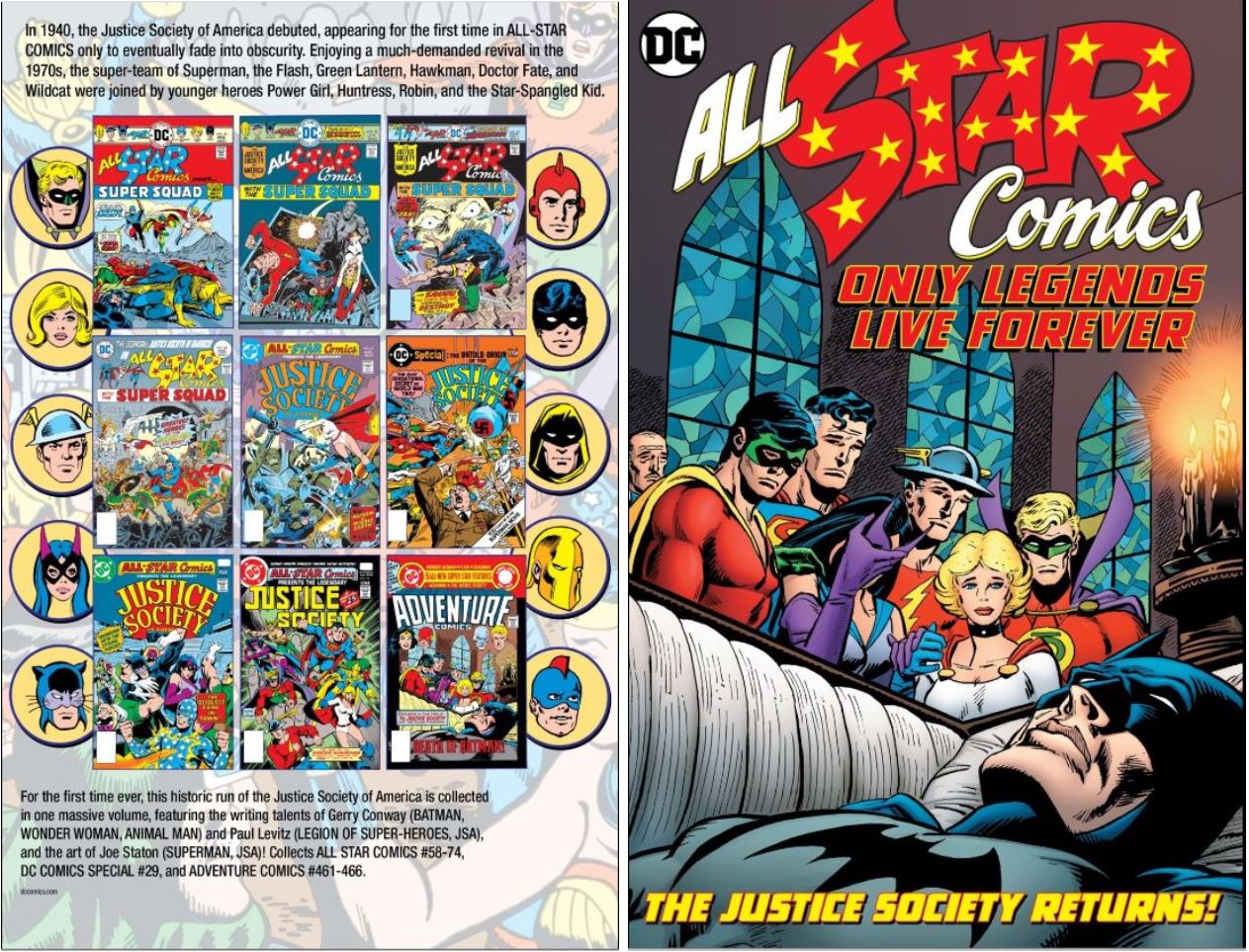
All-Star Comics: Only Legends Live Forever


By Gerry Conway, Paul Levitz, Ric Estrada, Wally Wood, Keith Giffen, Joe Staton, Bob Layton, Joe Giella, Dave Hunt, Dick Giordano, Brian Bolland, Jim Aparo & various (DC Comics)
ISBN: 978-1-7795-0071-7 (HB/Digital edition)

This book includes Discriminatory Content produced in less enlightened times.

Win’s Christmas Gift Recommendation: Ageless Evergreen Super-Sensationalism… 8/10

In the torrid and turbulent 1970s many of the comics industry’s oldest publishing ideas were finally laid to rest. The belief that characters could be “over-exposed” was one of the most long-lasting (after all, it never hurt Superman, Batman or the original Captain Marvel), garnered from years of experience in an industry which lived or died on that fractional portion of pennies derived each month from pocket-money and allowances of kids that wasn’t spent on candy, toys or movies.

By the end of the 1960s, comic book costs and retail prices were inexorably rising and a proportion of titles – especially newly resurrected horror stories – were consciously being produced for older readerships. Nearly a decade of organised fan publications and letter writing crusades had finally convinced publishing bean-counters what editors already knew: grown-ups avidly read comics too. Avidly. Passionately. Obsessively. They would happily spend more than kids and, most importantly, wanted more, more, more of what they particularly loved.

Explicitly: If one appearance per month was popular, extras, specials and second series would be more so. By the time Marvel Wunderkind Gerry Conway was preparing to leave The House of Ideas, DC was willing and ready to expand its variegated line-up with some oft-requested/demanded fan-favourite characters…

Paramount among these was the Justice Society of America, the first comic book super-team and a perennial gem whose annual guest-appearances in the Justice League of America had become an inescapable and beloved summer tradition. Thus in 1976 Writer/Editor Conway marked his second DC tenure (he had first broken into the game writing horror shorts for Joe Orlando) by reviving All Star Comics with number #58. In 1951, as the first Heroic Age ended, the key title had transformed overnight into All Star Western, with that numbering running for a further decade as home cowboy crusaders like Strong Bow, Trigger Twins, Johnny Thunder (a new “masked” do-gooder, not the Golden Age costumed idiot with a genie) and Super-Chief.

If you’re interested, among the other revivals/introductions in “Conway’s Corner” were perennial star Plastic Man, Blackhawk, The Secret Society of Super-Villains, Freedom Fighters, Kobra, Blitzkrieg – and many more.

In case you need reminding in their anniversary year: All Star Comics #3 (cover-dated Winter 1940-1941 and released in November 1940) is the officially cited kick-off for all Superteam tales, even if the assembled mystery men merely had dinner and recounted recent cases. They didn’t actually go on a mission together until ASC #4, which had an April 1941 cover-date and hit newsstands on February 7th.

Set on the parallel world of Earth-2, and in keeping with the editorial sense of ensuring the series be relevant to young readers too, Conway reintroduced a veteran team, leavened with a smattering of teen heroes, combined into a contentious, generation-gap fuelled Super Squad. These young whippersnappers included Robin (already a JSA-er since the mid-1960s and Justice League of America #55); Sylvester Pemberton AKA The Star-Spangled Kid (in actuality a boy-hero from the 1940s lost in time for decades) and – it must shamefully be said – a busty young thing who quickly became the feisty favourite of a generation of growing boys.

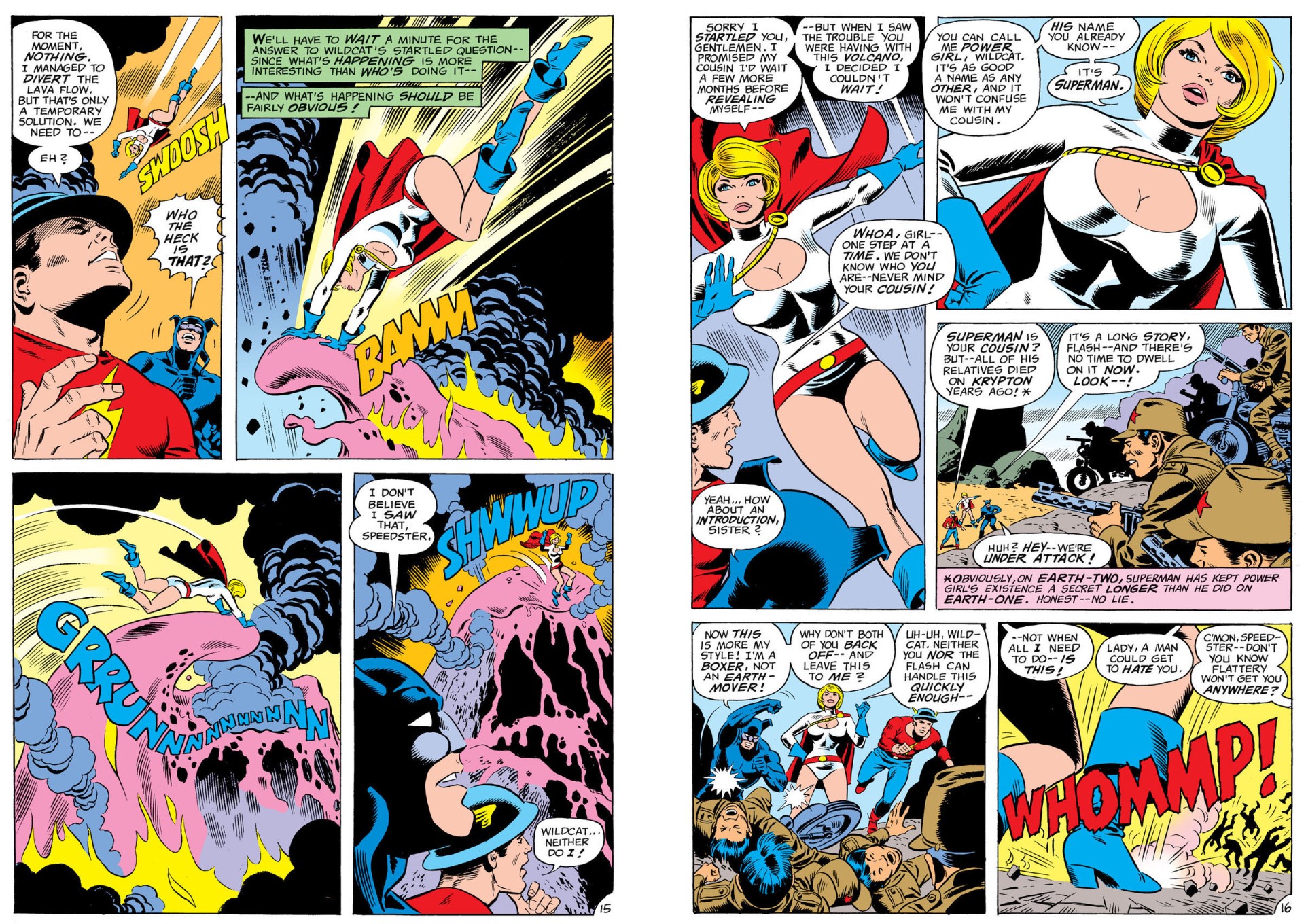
Kara Zor-L was attention grabbing in all the right and wrong ways and would soon become infamous as the “take-charge” pushy feminist dynamo Power Girl.

This titanic hardback and digital collection volume gathers that 4-year run of the JSA from the late 1970s into a sublime showcase of so-different, ever-changing times via All-Star Comics #58-74, plus the series’ continuation and conclusion from epic anthology title Adventure Comics (#461-466), and includes the seminal saga from DC Special #29 which, after almost four decades, finally provided the team with an origin…

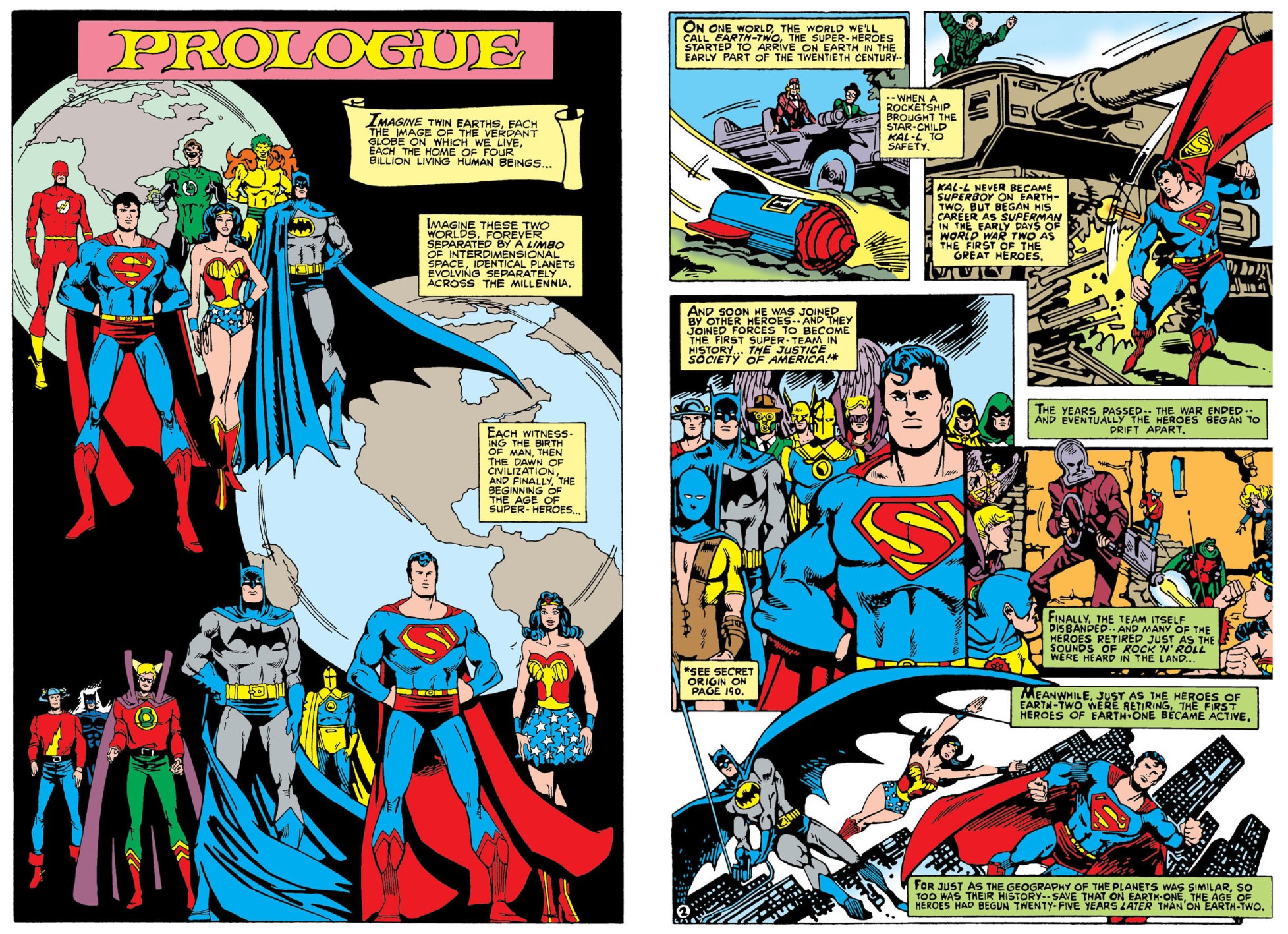
Without preamble, the action begins with ‘Prologue’: a 3-page introduction/recap/summation of the Society’s history as well as the celestial mechanics of Alternate Earths, as crafted by Paul Levitz, Joe Staton & Bob Layton and first seen in Adventure #461, January/February 1979. This outlines the history and workings of DC’s parallel continuities, after which the first half of the 2-part debut tale from All-Star Comics #58 (January/February 1976 by Conway, Ric Estrada &Wally Wood) finds newly-inducted Pemberton chafing at his time-lost plight and revelling in new powers after being given a cosmic-energy device by retired JSA veteran Starman.

When a crisis propels him and elder heroes Flash, Dr. Mid-Nite, Wildcat, Green Lantern, Hawkman and Dr. Fate into a 3-pronged calamity devastating Seattle, Cape Town and Peking (which you youngsters now known as Beijing). With man-made natural disasters, everywhere the elder statesmen split up but are overwhelmed, giving the new kids a chance to shine in ‘All Star Super-Squad’. With abrasive, impatient Power Girl in the vanguard, the entire team is soon on the trail of old foe Degaton and his mind-bending ally in #59’s conclusion ‘Brainwave Blows Up!’

Keith Giffen replaced Estrada in #60 whilst introducing a psychotic super-arsonist who attacks the Squad just as the age-divide starts grating and PG begins ticking off (or “re-educating”) the stuffy, paternalistic JSA-ers in ‘Vulcan: Son of Fire!’. Closing instalment ‘Hellfire and Holocaust’ finds the flaming fury fatally wounding Fate before his own defeat, just as a new mystic menace is stirring…

Conway’s last issue as scripter was #62. ‘When Fall the Mighty’ highlights antediluvian sorcerer Zanadu who devastatingly attacks, even as the criminal Injustice Gang open their latest vengeful assault using mind-control to turn friend against friend. The cast subsequently expands with the return of Hourman and Power Girl’s Kryptonian mentor, but even they prove insufficient to prevent ‘The Death of Doctor Fate’ as written by Paul Levitz. Assaulted on all sides, the team splinters. Wildcat, Hawkman and the Kryptonian cousins tackle the rampant super-villains whilst Flash & Green Lantern search Egypt for a cure to Fate’s condition, and Hourman, Mid-Nite & Star-Spangled Kid desperately attempt to keep their fallen comrade alive.

When they fail Zanadu renews his assault, almost adding the moribund Fate’s death-watch defenders to his tally… until the archaic alien’s very presence calls Kent Nelson back from beyond the grave…

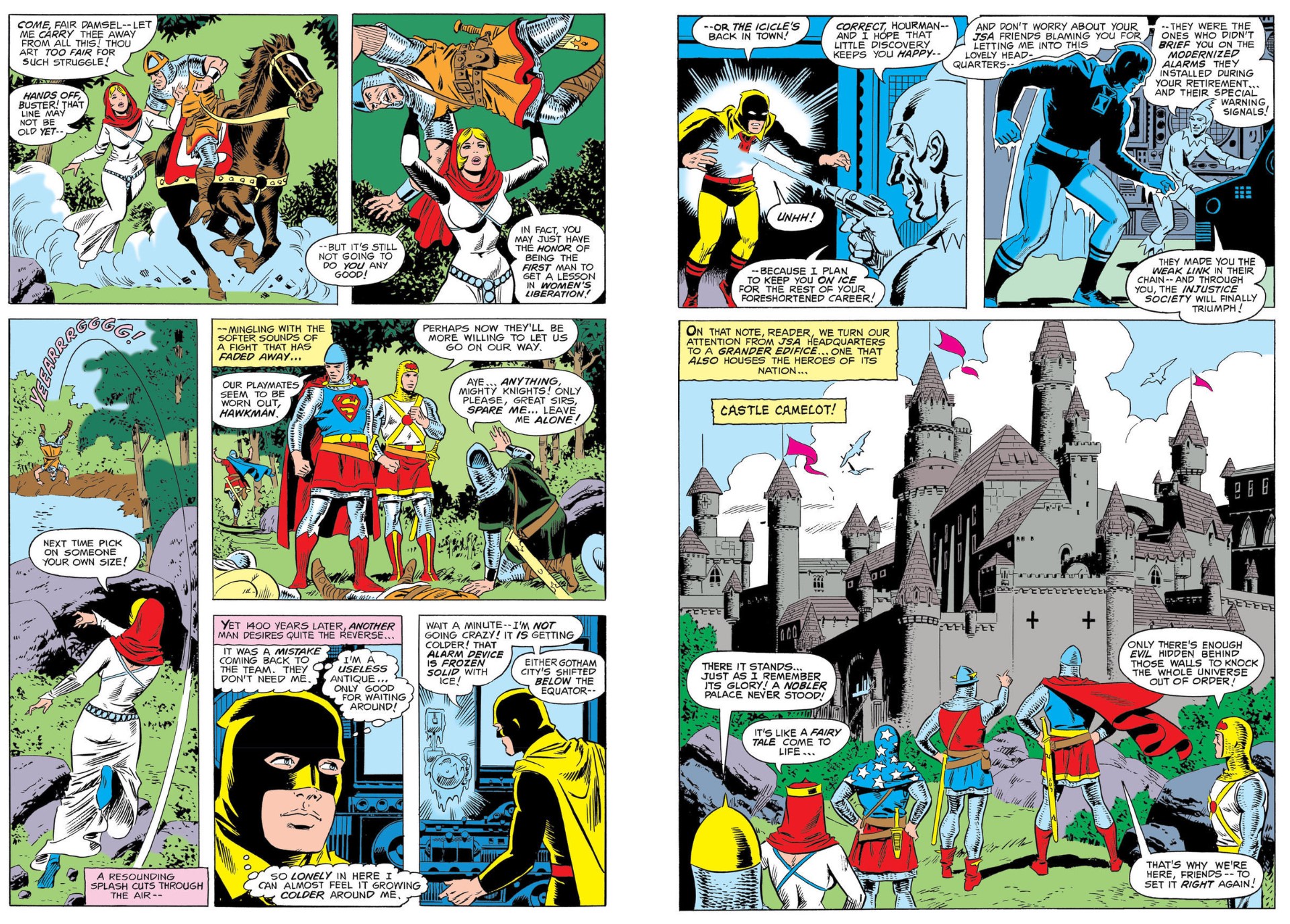
With that crisis averted, Superman makes ready to leave but is embroiled in a last-minute, manic time-travel assassination plot (Levitz script, and fully illustrated by inimitable Wally Wood) which drags the team and guest-star The Shining Knight from an embattled Camelot in ‘Yesterday Begins Today!’ to the far-flung future and ‘The Master Plan of Vandal Savage’: a breathtaking spectacle of drama and excitement that signalled Woody’s departure from the series.

Joe Staton & Bob Layton took the unenviable task of filling his artistic shoes, beginning with #66 as ‘Injustice Strikes Twice!’ wherein the reunited team – sans Superman – fall prey to ambush by arch-enemies, whilst emotion-warping Psycho-Pirate starts twisting GL Alan Scott into an out-of-control menace determined to crush Corporate America beneath his emerald heel. This subsequently leads to the return of Earth-2’s Bruce Wayne, who had previously retired his masked persona to become Gotham’s Police Commissioner. In ‘Attack of the Underlord!’ (All-Star Comics #67, July/August 1977), the Injustice Society’s monstrous allies are revealed as subterranean conquerors who nearly end the team forever. Meanwhile, Wayne’s plans near fruition. He wants to shut down the JSA before their increasingly destructive exploits demolish his beloved city…

Contemporary continuity pauses here as the aforementioned case from DC Special #29 (September 1977) discloses ‘The Untold Origin of the Justice Society’ in an extra-length epic set in 1940. Here Levitz, Staton & Layton reveal previously classified events which saw Adolf Hitler acquire the mystical Spear of Destiny and immediately summon mythical Teutonic Valkyries to aid in the invasion of Britain. Alerted to the threat, US President Franklin Delano Roosevelt – hampered by his country’s neutrality – unofficially asks a select band of masked mystery-men to lend their aid as non-political, private citizens.

In a cataclysmic escalation, the struggle ranges from the heart of Europe throughout the British Isles and even to the White House Oval Office before ten bold costumed champions finally – albeit temporarily – stymy the Nazis’ plans…

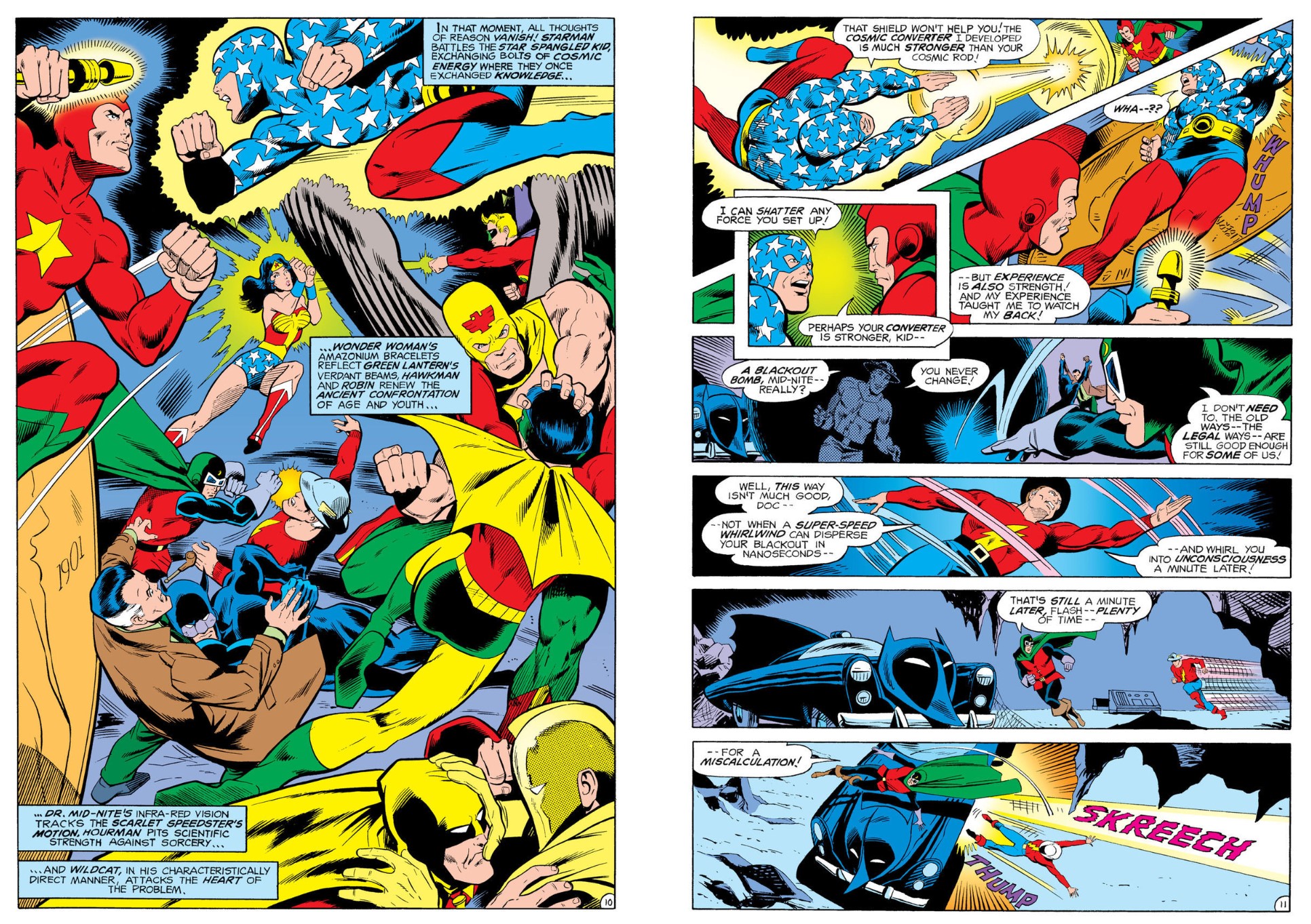
Back in All Star #68 (October 1977) the Kryptonian Kid was clearly becoming top star of the show. ‘Divided We Stand!’ (Levitz, Staton & Layton) concludes the Psycho-Pirate’s scheme to discredit and destroy the JSA, and sets the scene for her first solo outing in Showcase #97-99 (which is not included here). Meanwhile GL resumes a maniacal rampage through Gotham and Police Commissioner Wayne takes extreme measures to bring the seemingly out-of-control JSA to book. With ASC #69’s ‘United We Fall!’, he reunites in his own team of retired JSA stars to arrest the rogue squad, resulting in a classic fanboy dream duel as Dr. Fate, Wildcat, Hawkman, Flash, GL & Star-Spangled Kid battled the original Batman, Robin, Hourman, Starman, Dr. Mid-Nite and Wonder Woman. It’s a colourful catastrophe in waiting until PG & Superman intervene to reveal the true cause of all that unleashed madness.

… And in the background, a new character was about to make a landmark debut…

With order restored ‘A Parting of the Ways!’ spotlights Wildcat and Star-Spangled Kid as the off-duty heroes stumble upon high-tech super-thieves Strike Force. These bandits initially prove too much for the pair – and even new star The Huntress – but with a pair of startling revelations in ‘The Deadliest Game in Town!’ the trio finally triumph. In the aftermath, the Kid resigns and the daughter of Batman & Catwoman replaces him…

All-Star Comics #72 reintroduces a brace of classic Golden Age villainesses in ‘A Thorn by Any Other Name’ – wherein the psychopathic floral fury returns to poison Wildcat, leaving Helena Wayne to battle the original 1940’s Huntress for an antidote and rights to the name. With Joe Giella taking over the inker’s role, concluding chapter ‘Be it Ever So Deadly’ sees the whole team deployed as Huntress battled Huntress whilst Thorn and The Sportsmaster do their deadly best to destroy the heroes and their loved ones. Meanwhile in Egypt, Hawkman & Dr. Fate stumble upon a deadly ancient menace to all of reality…

The late 1970s was a perilous period for comics, with exponentially rising costs inevitably resulting in drastically dwindling sales. Many titles were abruptly cancelled in a “DC Implosion” and All-Star Comics was one of the casualties. Issue #74 was the last, pitting the reunited Society against a mystic Armageddon perpetrated by a nigh-omnipotent Master Summoner who orchestrated a ‘World on the Edge of Ending’ before the JSA triumphantly dragged victory from the jaws of defeat…

Although the book was gone, the series continued in 68-page anthology title Adventure Comics, beginning in #461 (January/February 1979) with the first half of a blockbuster tale originally intended for the anniversary 75th issue. Drawn & inked by Staton, ‘Only Legends Live Forever’ details the Batman’s last case as the Dark Knight comes out of retirement to battle a seeming nonentity who has mysteriously acquired god-like power. Adventure #462 delivered the heartbreaking conclusion in ‘The Legend Lives Again!’ before AC #462’s ‘The Night of the Soul Thief!’ sees Huntress, Robin and assembled Society members deliver righteous justice to the mysterious mastermind who actually orchestrated the death of the World’s Greatest Detective…

For #464, an intriguing insight into aging warrior Wildcat reveals ‘To Everything There is a Season…’ as Ted Grant embraces his own mortality and begins a new career as a teacher of heroes, before ‘Countdown to Disaster!’ (inked by Dave Hunt) finds Flash, Green Lantern, Hawkman, Power Girl, Huntress & Dr. Fate hunting a doomsday device lost amidst Gotham’s teeming masses. It would be the last modern outing of the team for years to come…

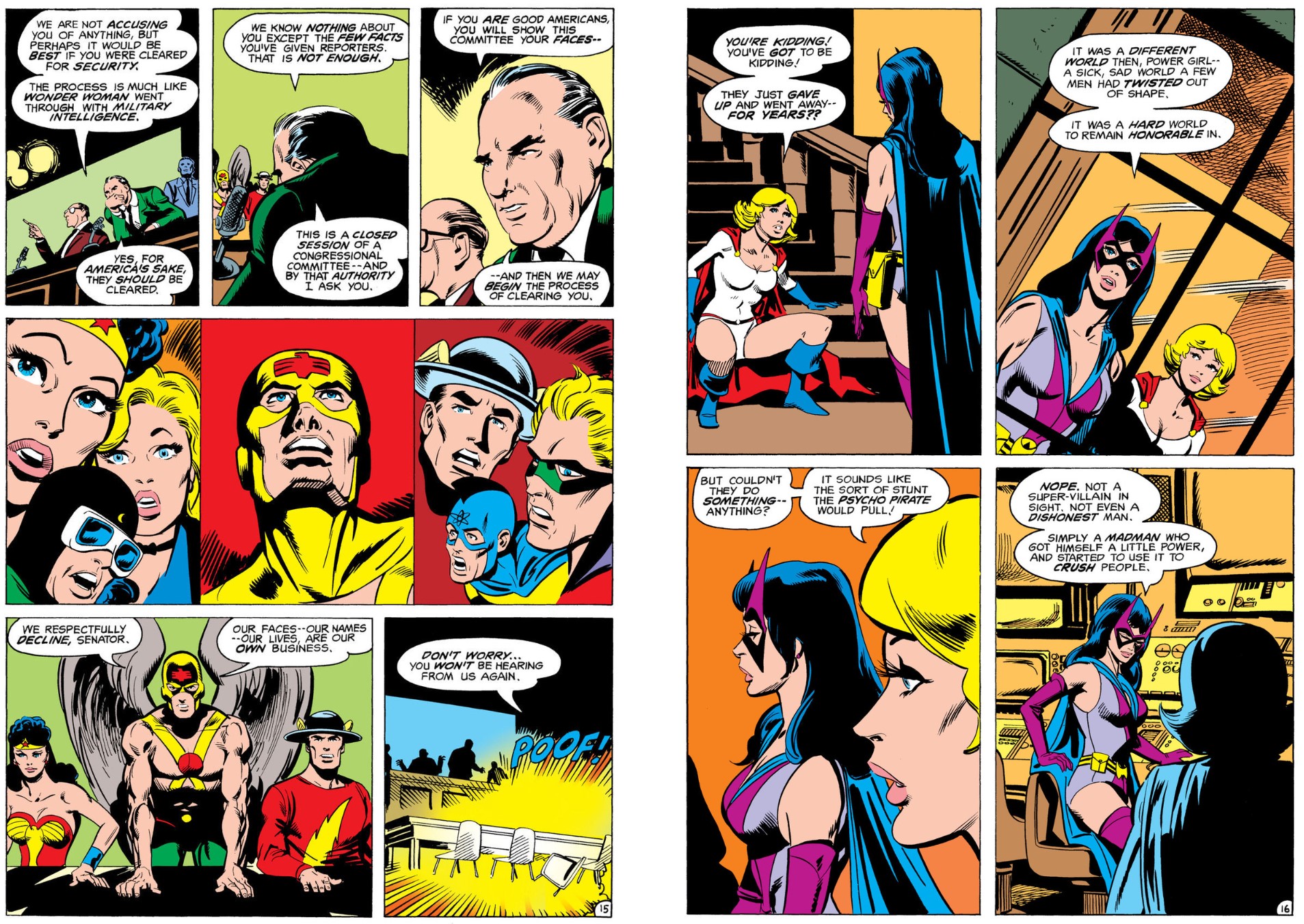
But not the last in this volume: that honour falls to another Levitz & Staton landmark: a little history lesson wherein they expose the reason why the team vanished at the beginning of the 1950s. From Adventure #466, ‘The Defeat of the Justice Society!’ shows how the US Government had cravenly betrayed their greatest champions during the McCarthy witch-hunts: provoking the mystery-men into voluntarily withdrawing from public, heroic life for over a decade… until the costumed stalwarts of Earth-1 started the whole Fights ‘n’ Tights scene all over again…

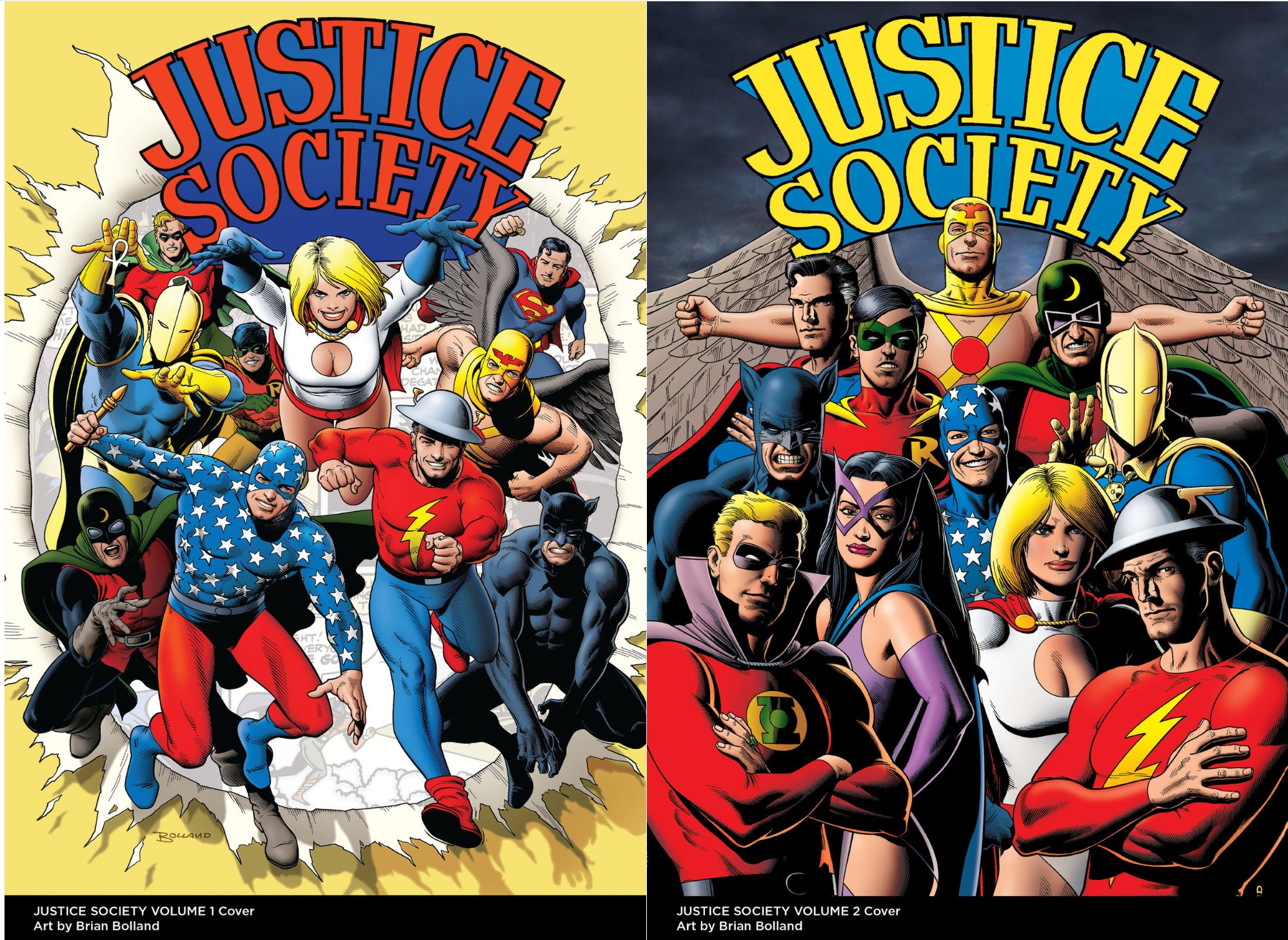
Upping the gaudy glory quotient, a team pin-up by Staton & Dick Giordano and two earlier collection covers from Brian Bolland cap off the costumed dramas.

Although perhaps a tad dated now, these exuberant, rapid-paced, imaginative yarns perfectly blend the naive charm of Golden Age derring-do with cynical modern sensibilities. Here you will be reassured that no matter what, in the end our heroes will always find a way to save the day. Such classic spectacles from simpler times are a glorious example of traditional superhero storytelling at its finest: fun, furious, ferociously engaging, excitingly written and beguilingly illustrated. No Fights ‘n’ Tights fan should miss these marvellous sagas.
© 1976, 1977, 1978, 1979, 2019 DC Comics. All Rights Reserved.

Today in 1912 Cliff Sterrett’s astounding strip Polly and Her Pals ran in US papers for the first time, and in 1921 artist Art Saaf was born – someone else you’ve probably enjoyed without even knowing it, so go learn about him too.

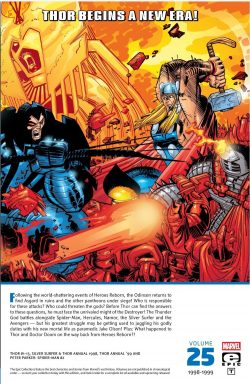
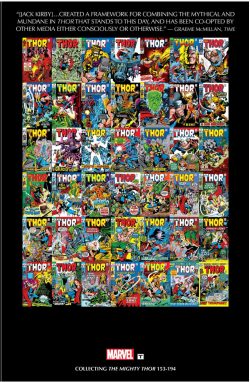
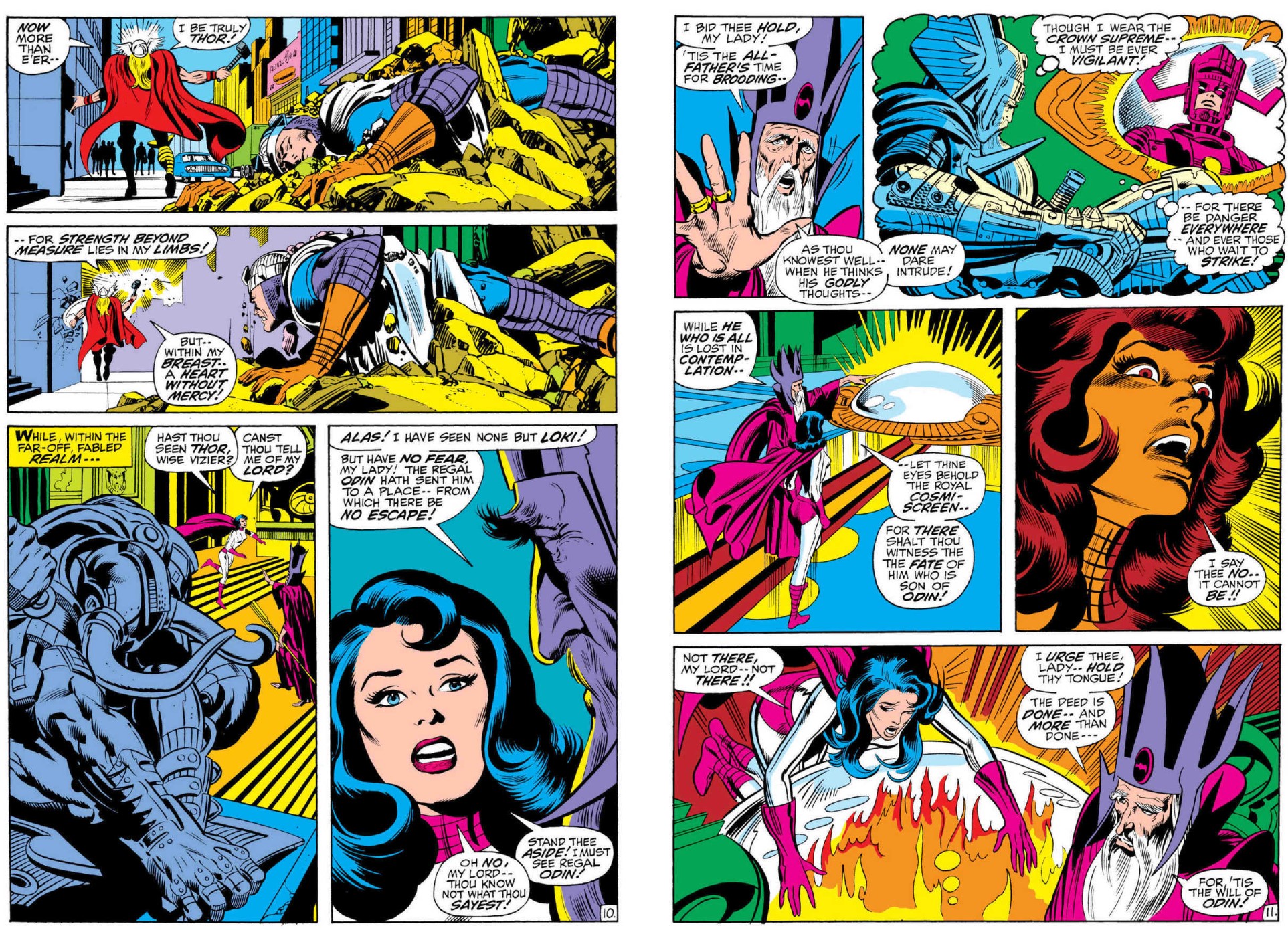
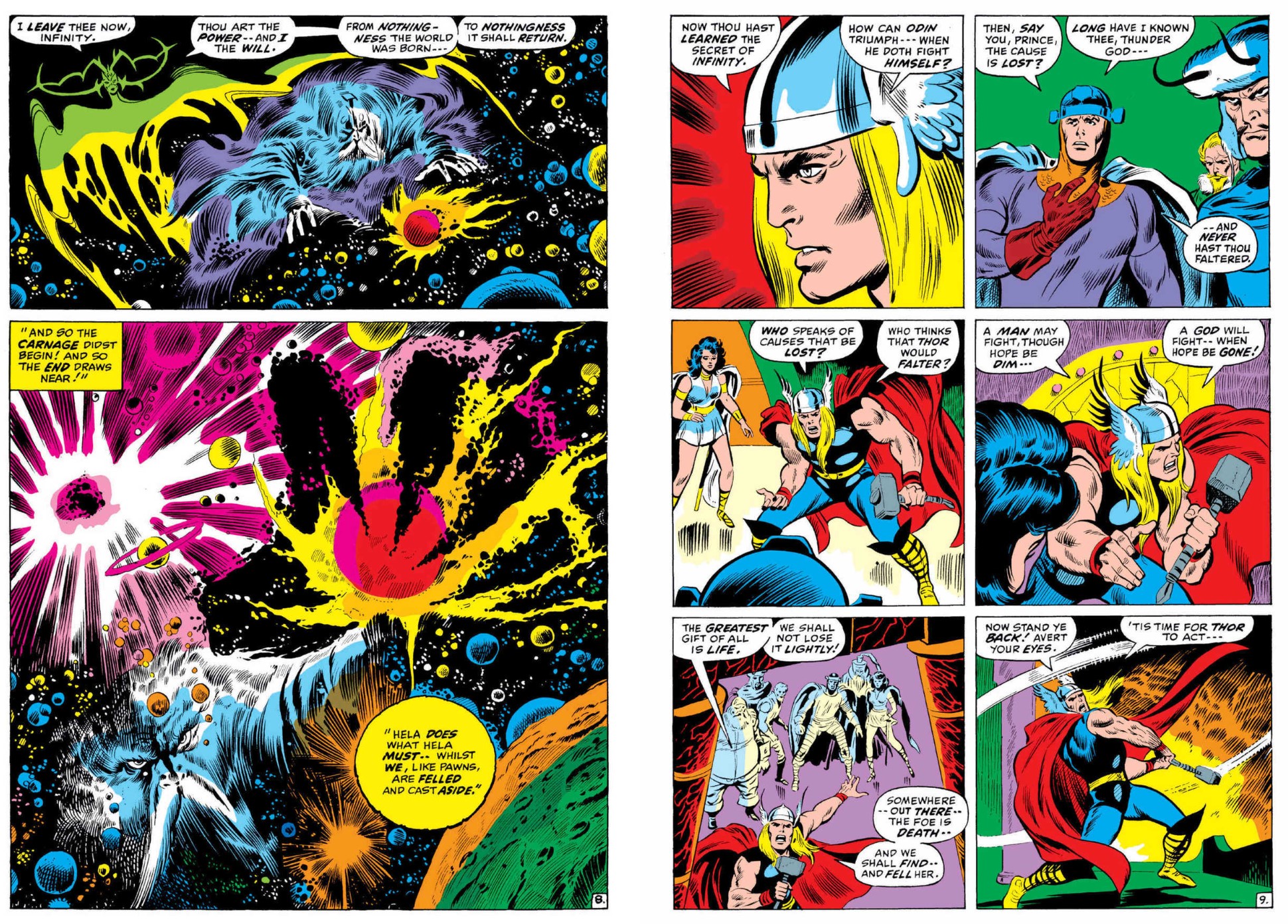
The Mighty Thor Epic Collection volume 25: The Dark Gods (1998-1999)


By Dan Jurgens & John Romita Jr., Tom DeFalco, Howard Mackie, J.M. DeMatteis, Klaus Janson, John Buscema, Ramon Bernado, Klaus Janson, Mark Pennington, Scott Hanna, Jerry Ordway & various (MARVEL)
ISBN: 978-1-3029-6411-5 (TPB/Digital edition)

This book includes Discriminatory Content produced in less enlightened times.

Win’s Christmas Gift Recommendation: Punch-Punch! Smite-Smite! Gosh Wow!… 8/10

In the middle of 1962, Stan Lee & Jack Kirby launched their latest offbeat superhero creation in anthology monsters-and-mysteries title Journey into Mystery #83. The edifying epic introduced meek, disabled American doctor Donald Blake who took a vacation in Norway only to encounter the vanguard of an alien invasion. Fleeing in terror, he was trapped in a cave and found an old, gnarled walking stick. When, in helplessness and frustration, he smashed the cane into a huge boulder obstructing his escape, his insignificant frame was transformed into the hulking and brawny Norse God of Thunder, Thor!

The series grew from formulaic beginnings battling aliens, commies and cheap thugs into a vast, breathtaking cosmic playground for Kirby’s burgeoning imagination with Journey into Mystery inevitably becoming The Mighty Thor. After years of celestial adventuring, the peculiarities and inconsistencies of the Don Blake/Thor relationship were re-examined – as well as his doomed romance with his nurse Jane Foster – and all was finally clarified and explained regarding how an immortal godling could also be frail Dr. Blake.

The saga took the immortal hero back to his long-distant youth, ultimately revealing that the mortal surgeon was no more than an Odinian deception: a living shell designed to teach the Thunder God humility and compassion…

Time passed, Kirby left and the Thunderer’s fortunes waxed and waned. During the troubled mid-1990’s the title vanished, culled with The Avengers, Iron Man, Captain America and Fantastic Four and subcontracted out to Image creators Jim Lee & Rob Liefeld during 1996-1997 in a desperate attempt to improve sales after Marvel’s apocalyptic Onslaught event.

In 1998 Heroes Return and Heroes Reborn saw those properties rejoin the greater Marvel Universe, relaunched with new first issues. The Thunder God reappeared a few weeks later as in July, Mighty Thor volume 2 launched. This compendium gathers # Mighty Thor #1-13, plus Silver Surfer & Thor Annual 1998; Thor Annual ’99 & Peter Parker, Spider-Man #2 spanning July 1998 to July 1999.

It begins with ‘In Search of the Gods’ by Dan Jurgens, John Romita Jr. & Klaus Janson, finding the Thunderer back on Midgard after more than a year away from the home cosmos, and instantly involved in a desperate hostage situation. Acting immediately, he ends the crisis only to discover the perpetrator is a currently-powerless Guardian God Heimdall. Recently in contemporaneously relaunched Avengers #1, Thor had found Asgard devastated and deserted and now that shocking mystery has been further compounded on Earth…

Elsewhere, Death Goddess Hela and Volla the Prophetess conspire in anticipation of cosmic calamity and desires finally reaching fruition, even as a military shipment goes badly awry at New York’s docks where EMT/paramedic Jake Olsen gets the call to assist…

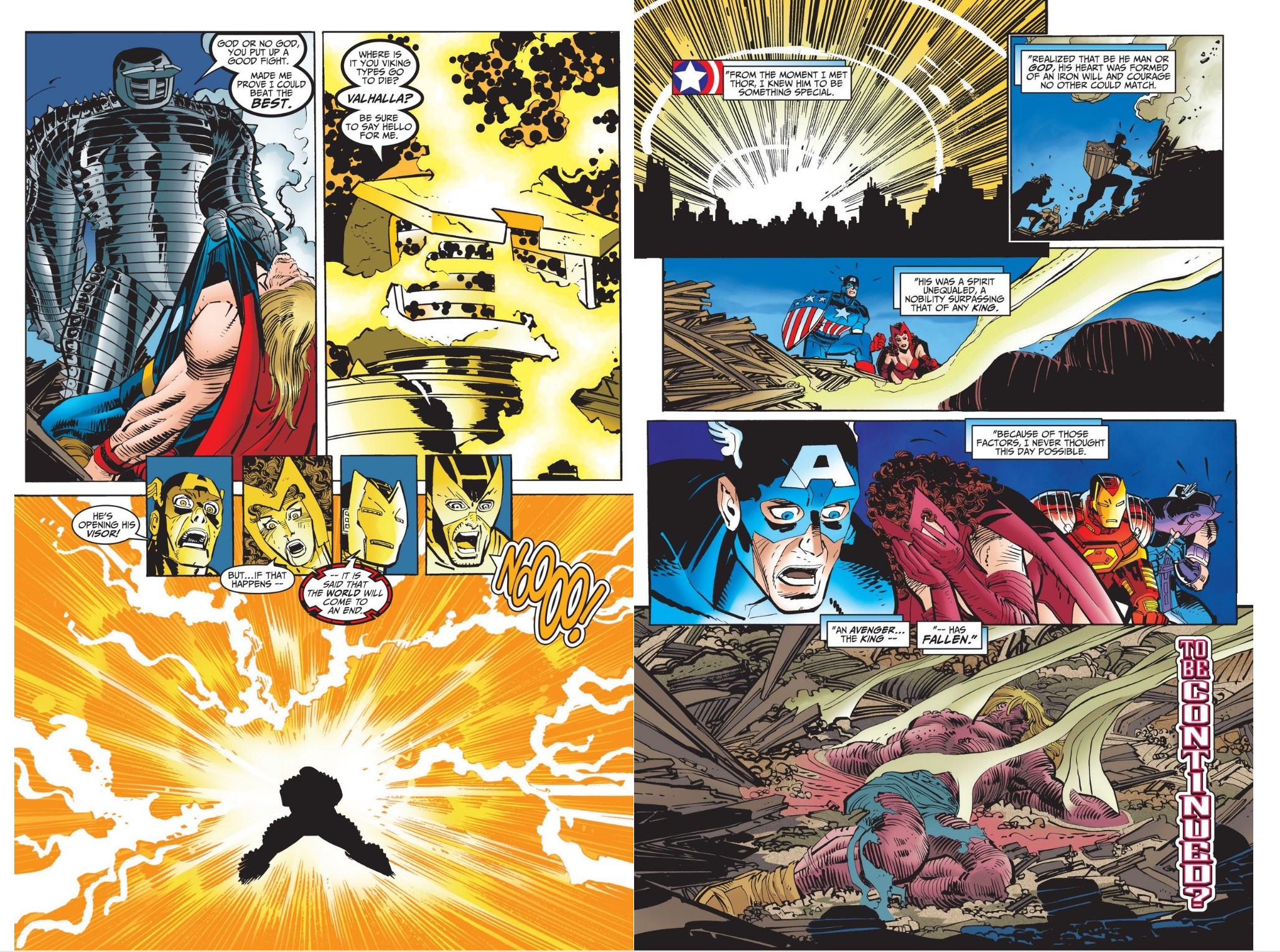
Before leaving Heimdall with (now) Doctor Jane Foster, Thor and the sentinel Asgardian explored shattered Asgard again, inadvertently liberating an unknown horror from ancient captivity, but all that is forgotten as the docks situation worsens and Thor joins the hard-pressed Avengers in battling reawakened Odinian ultimate weapon The Destroyer

Despite the best efforts of the World’s Mightiest Heroes, the carnage is shattering and people die. People like Olson… and Thor…

Thor’s story nevertheless continues as his journey to Hela’s realm is interrupted by disturbing new cosmic entity Marnot who claims the Thunderer’s soul and returns it to the living world, bound to equally-miraculously resurrected Olsen in a reprise of the spell that created Don Blake… and just in time to stop The Destroyer. However, the new-old arrangement will prove to be a true ‘Deal with the Devil!’

Reborn as ‘God and Man’ in #3, the Storm Lord again walks the Earth – but only as the dormant-until-summoned alter-ego of another frail mortal host with a painfully complex personal life. It makes battling the sea-monsters of beguiling sea-goddess Sedna beside former Avenger Namor the Sub-Mariner a far from friendly reunion in ‘From the Ashes’

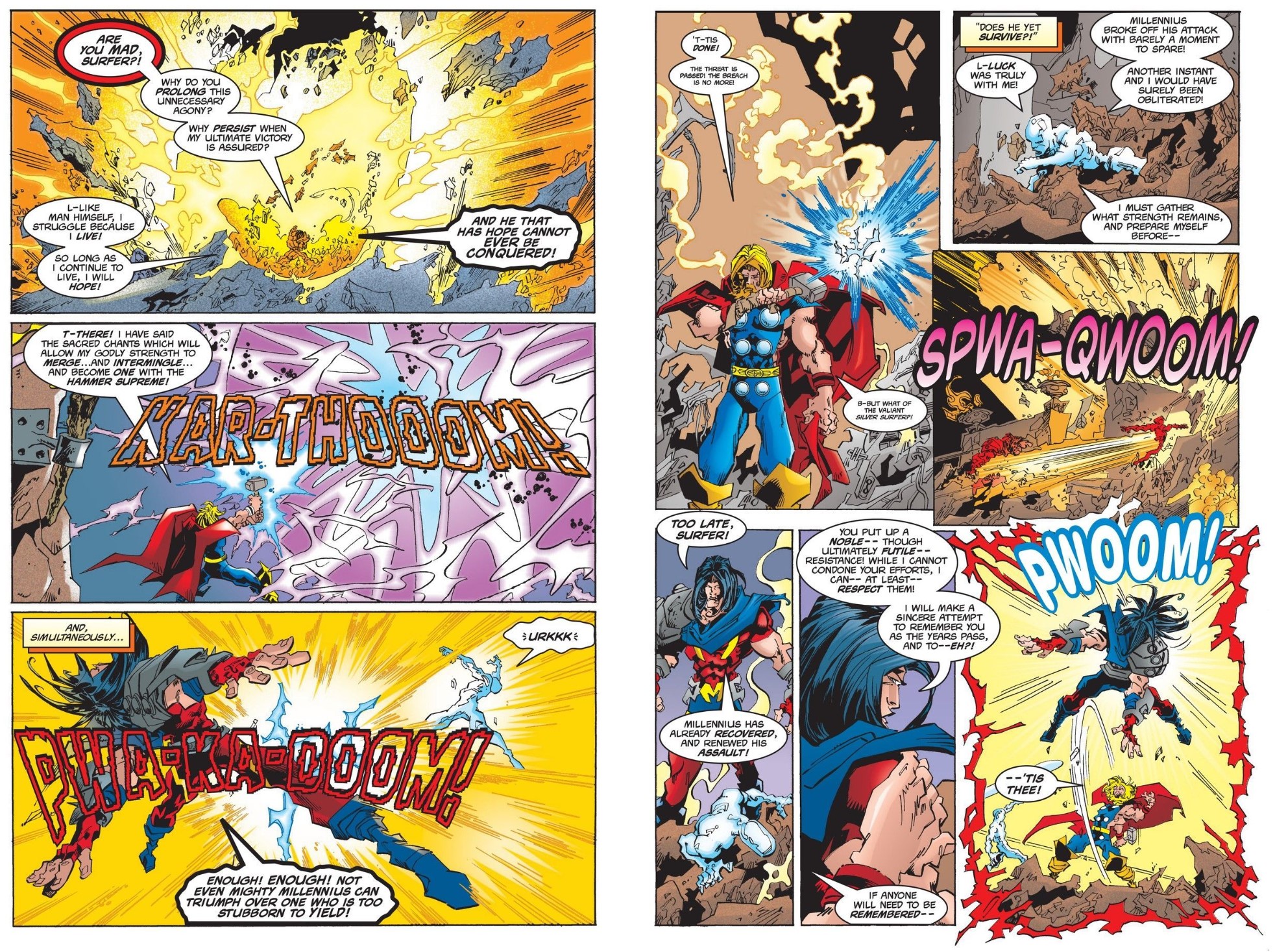
Next comes a notional prequel tale from Silver Surfer & Thor Annual 1998, courtesy of Tom DeFalco, Ramon Bernado & Mark Pennington. ‘Millennius!’ finds the Silver Surfer beset by frost giants that have somehow escaped the confines of Asgard. After thrashing and returning them whence they belong, investigation beside the stormy Prince uncovers a plot by an exiled vengeful if not utterly deranged primal god determined to wreak havoc upon the modern universe and resume reshaping what remains to his dark whims. Thanks to the valour of the heroes he does not succeed…

TMT #5 finds the Thunderer still acclimating to his personal new normal and the decidedly different requirements of mortal crimes and crises. This somehow leads to Mjolnir rebelling after Thor’s take-charge personality overrules Olsen’s legal authority when the still readjusting godling compels his paramedic self to perform illegal surgery to save a life in ‘Heroes’

The wreckers of Asgard and Marnot have been manoeuvring in the background throughout and following a flashback to Asgardian childhood, ‘What’s a God to Do?’ sees Thor edging closer to the truth after another pointless clash with best pal Hercules. Once the dust has settled, Thor finds his people have been framed for attacking Olympus even as in Asgard, the fate of the vanquished All-Father is revealed. However, this ‘Deception’ has proven effective, and Thor & Hercules are attacked by the entire outraged Hellenic pantheon…

The true architects of most of this mayhem are a pantheon of previously unknown Dark Gods – Perrikus, Adva, D’Chel, Slottoth, Tokkots and Majeston Zelia – so powerful that they have managed to take possession of the fallen Fabled Realm, consistently attacking Thor since his return; now barring him entirely from reaching his sundered home…

We diverge briefly for Mighty Thor Annual ‘99 which at last revealed why Thor arrived back in our universe so much later than his Avenging Allies. Written and pencilled by Jurgens with inks from Janson, ‘The Tears of a God’ found Thor visiting The Fantastic Four and describing the dimensional rip which left him partially amnesiac and filled with ineffable sadness, before – for our eyes only – the story is fully disclosed…

After battling Doctor Doom in the void between worlds, Thor and the Iron Dictator were cast onto an alien planet where the wounded Thunderer was nursed to health by a mysterious outcast named Ceranda. Somehow unable to leave the desolate world, the lost scion of Asgard grew slowly closer to the beautiful hermit, whilst elsewhere Doom was taking control of a subterranean society: co-opting their technology and resources to his selfish needs…

The last thing the Lord of Latveria needed for escape was Thor’s dimension-spanning hammer and he knew the true reason why it wasn’t working. This tale of dark desire and selfish love ended badly all round so perhaps its best that after the battle and return to Earth Thor had no memory of weeks spent with bewitching Ceranda…

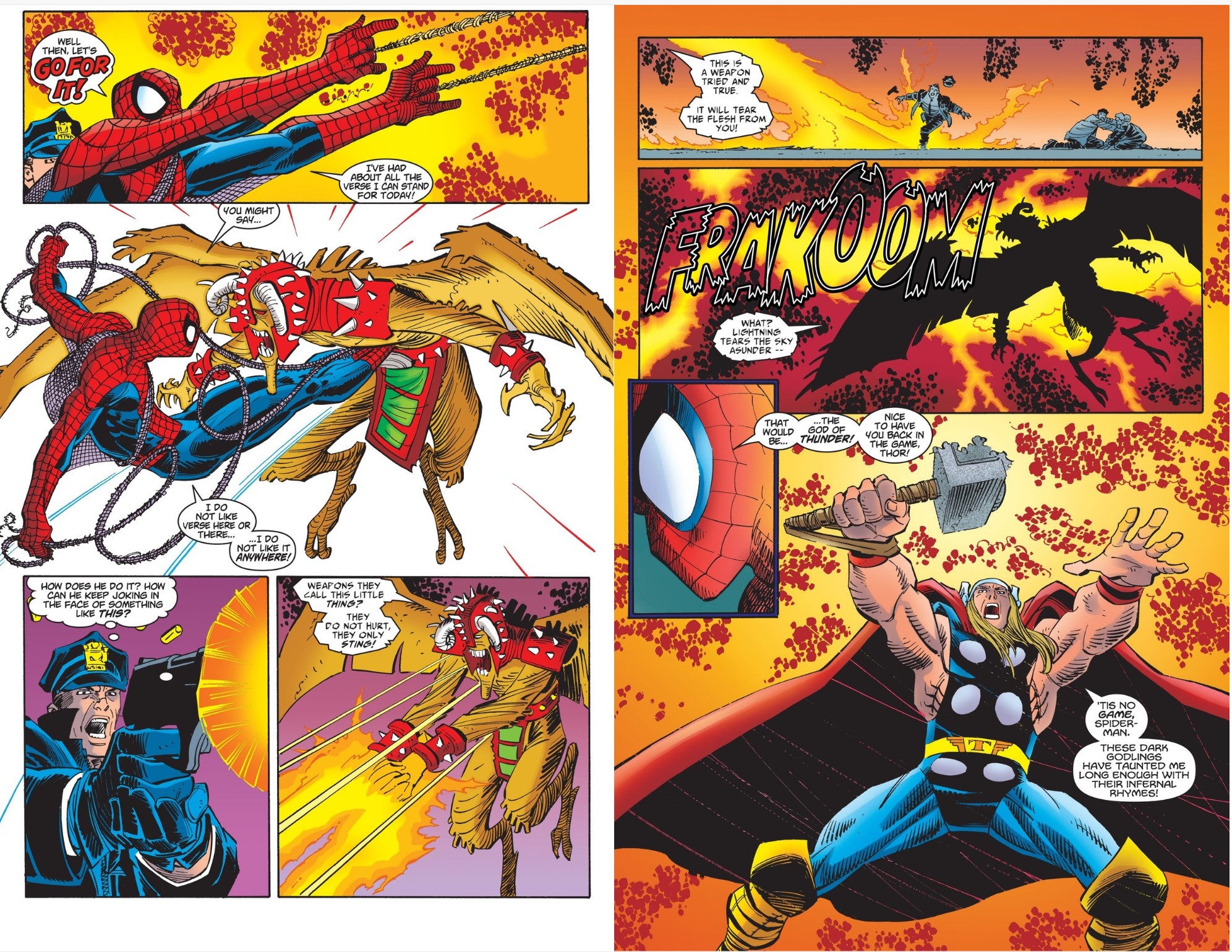
Back at now, a stellar crossover between hammer-hurler and webspinner opens in Thor #8 as the Thunder God encounters the astounding arachnid as Tokkots goes on an Earthly rampage in ‘…and the Home of the Brave!’ prior to being spectacularly defeated and despatched to enslaved Asgard in ‘Plaything of the Gods’ (as seen in Peter Parker, Spider-Man #2, by Howard Mackie, Romita Jr. & Scott Hanna).

The end of the reinvigorated Storm Lord’s first extended story-arc comes with ‘Answers’ by regular writer Jurgens and guest illustrators John Buscema & Jerry Ordway when a vintage robotic menace returns. Here a couple of young punks luck into the operating system for android bandit Replicus and whilst the earthbound Thunder God is taking care of business in Asgard, dark usurpers are crowing over the ravaged, tortured bodies of his best friend Balder, eternally betrothed Lady Sif and mighty sire Odin, all the while scheming how to destroy the last remaining free Asgardian…

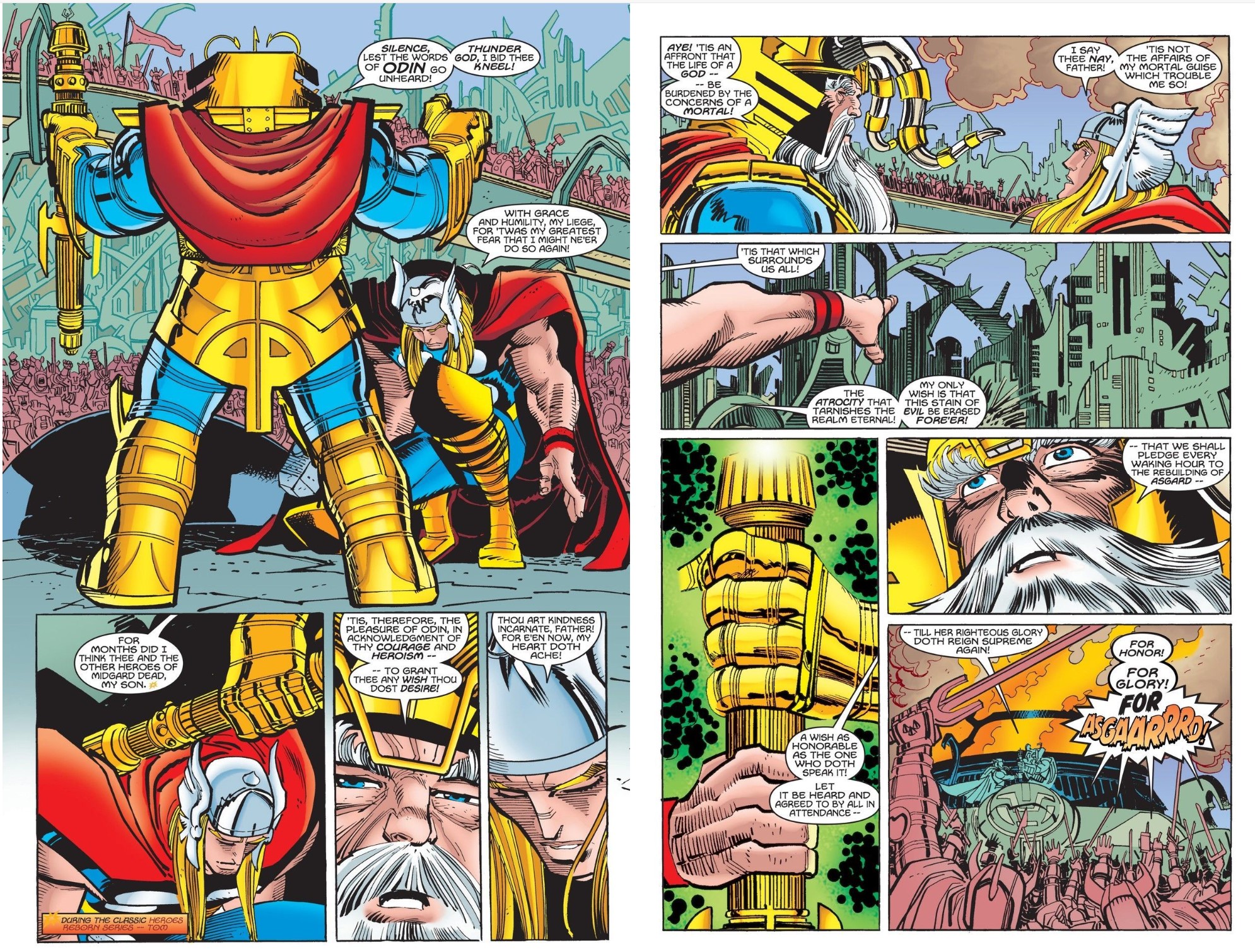
Thor is just as keen on facing his elusive tormentors and finally gains insight from enigmatic Marnot, who teasingly reveals a long-ago day when the early Asgardians encountered a rival pantheon: happily cruel gods dominating and enslaving the realm of Narcisson and just begging to begin a brutal all-out war with new foes. Against all logic the Narcissons won and were on the verge of eradicating the Asgardians until a juvenile Thor turned the tide, enabling Odin and his surviving warriors to carry the day. With these Dark Gods routed and captive, the All-Father wiped the memories of his own triumphant warriors to spare them the trauma and loss of so many comrades and loved ones. Now, however, the Narcisson gods were somehow free and had at last conquered the Eternal Realm. Armed with knowledge, Thor began to prepare for the invasion and liberation of Asgard…

The final campaign began in the three chapter saga ‘The Dark Wars: part I’, by Jurgens, Romita Jr. & Janson as human Jake Olsen frantically starts setting his complex human affairs in order. The conjoined hero is utterly unaware that colleague Dr. Foster has deduced his godly secret and that an unknown mortal enemy is setting him up to take the fall for selling stolen hospital drugs…

Before the exiled prince is ready to act, Perrikus attacks New York City, demanding a duel with the Odin-son and threatening to kill Lady Sif if the Thunderer doesn’t show. With the gateway to Asgard clear, Thor’s rapid response finds the city as bad as ever and his loved ones broken toys of the Dark Gods. Enraged, he attacks but the blockbusting battle sees his magic mallet cloven in half and he feels himself impossibly transforming back into mortal Jake…

Taking cover in a sewer, Olsen discovers an horrific underworld beneath the shattered city and is taken by trolls to the very bowels of Asgard. Soon, the frail human is being worked to death whilst far above the black pantheon are unable to detect any trace of vanished Thor. However, the broken hero feels untrammelled hope and joy when he discovers many of his missing Asgardian comrades are also enslaved in the noisome pits…

Sadly, before Olsen can even attempt to rescue them, vile Tokkots appears and whisks him back to the throne-room and the waiting Narcissons. Perrikus is furious that he cannot battle his true enemy, only a mortal shell, but everything changes when the broken, battered Midgardian falls on the remnant of Mjolnir and is mystically metamorphosed into a fighting mad Storm Lord…

Unexpectedly, Thor flees into inter-dimensional space, realising that pride and fury are not enough and that what he really needs are potent allies…

The fearsome finale comes in ‘The Dark Wars: part III’ as the conflicted champion convinces the deadly Destroyer and Hercules to raid his once-Golden Realm in a blistering last charge against the Dark Ones and their massed minions whilst he raids the depths to free Asgardian survivors and activates a cleverly concealed ally. Soon Odin, Sif and Balder are free and the fall of the Narcissons is seemingly assured – but the malignant invaders still have one last nasty card to play…

It proves not enough and eventually the brutalised Asgardians are triumphant, after which epilogue ‘The Work of Odin’ answers many questions; such as the identity of manipulative schemer Marnot, the ultimate fate of the human trapped within the deadly Destroyer’s shell and the future of both light and dark gods…

Backed up by a wealth of covers and variants by Romita Jr., Janson, Hanna, Bernado, Jurgens Joe Jusko & Mark Farmer; developmental sketches; house and trade press ads (from Marvel Vision, Marvel Catalog, Marvel Monthly, Wizard #80) supplemented with interviews & previews – ‘Juggling with Jurgens’, ‘Dan Jurgens’ and ‘Working the Second Shift with John Romita Jr.’ – the extras also include the cover to rushed-out reprint Thor: Resurrection by Romita Jr., Janson & Gregory Wright and editor Tom Brevoort’s Afterword from it, before closing on Thor #7’s stunning original art cover.

This almost excessively action-packed if plot light chronicle is an all-out, rocket-paced return to comic book basics, and, whilst perhaps not to everyone’s taste (it’s woefully short of anything even approaching a funny moment), is a blistering epic to delight the Fight’s ‘n’ Tights faithful, with the artwork undeniably some of the best of the modern Marvel Age. If you want your pulses to pound and your graphic senses to swim, this is the ideal item for you.
© 2025 MARVEL.

Today in 1921 Len Dworkins was born. He took over drawing the Buck Rogers newspaper strip in 1949 and also handled aviation standard Skyroads from 1939 using nom de plume Leon Gordon. More significantly, today is the anniversary of The Dandy’s debut in 1937, which I’ve gone on about incessantly for the last few months. Feel free to scroll back and check…

In 1961 cartoonist Don “Megaton Man” Simpson was born and in 1984 the UK saw the last War Picture Library comic digest released into newsagents, sweetshops and railway kiosks. It was #2103 if you’re counting…

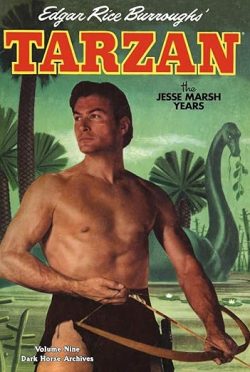
Edgar Rice Burroughs’ Tarzan: The Jesse Marsh Years Volume Nine


By Gaylord DuBois & Jesse Marsh (Dark Horse Books)
ISBN: 978-1-59582-649-7 (HB)

This book includes Discriminatory Content produced in less enlightened times.

Win’s Christmas Gift Recommendation: Primal fantasy Adventure… 8/10

I don’t know an awful lot about Jesse Marsh, other than that he was born on 27th July 1907 and died far too young: on April 28th 1966 from diabetic complications at the height of a TV Tarzan revival he was in large part responsible for. What I do know, however, is that to my unformed, pre-fanboy, kid’s mentality, his drawings were somehow better than most of the other artists and that every other kid who read comics in my school disagreed with me.

There’s a phrase we used at 2000 AD that summed it up: “Artist’s artist”, which usually meant someone whose fan-mail divided equally into fanatical raves and bile-filled hate-mail. It seems there are some makers of comic strips that many readers simply don’t get.

It isn’t about the basic principles or artistic quality or even anything tangible – although you’ll hear some cracking justifications: “I don’t like his feet” (presumably the way he draws them) and “it just creeps me out” being my two favourites. Never forget in the 1980s DC were told by the Comics Code Authority that Kevin O’Neill’s entire style and manner of Drawing was unacceptable to American readers!

I got Jesse Marsh. He was another Disney animator (beginning in 1939) who moved sideways – in 1945 – to become a full-time narrative illustrator for the studio’s comic book licensee Whitman Publishing. Marsh never looked back and became the go-to guy for other ERB adaptations such as John Carter of Mars.

Situated on the West Coast, Western’s Dell/Gold Key imprints rivalled DC and Marvel at the height of their powers, and the licensee famously never capitulated to the wave of anti-comics hysteria that resulted in the crippling self-censorship of the 1950s. No Dell Comics ever displayed a Comics Code Authority symbol on the cover – they never needed to…

Marsh jobbed around adapted movie properties – mostly westerns like Gene Autry – until 1948 when Dell introduced the first all-new Tarzan comic book. The newspaper strip had run since 1929 and all previous funnybook releases had featured expurgated and modified reprints of those adventures. That all changed with Dell Four Color Comic #134 (February 1947) which featured a lengthy, captivating tale of the Ape-Man scripted by Robert P. Thompson, who also wrote both the Tarzan radio show and the aforementioned syndicated strip (as you can see in Tarzan and the Adventurers).

The comic was very much in the Burroughs tradition: John Clayton, Lord Greystoke and his friend Paul D’Arnot aid a young woman in rescuing her lost father from a hidden tribe ruled over by a monster. The engrossing yarn was made magical by the simple, underplayed magic of a heavy brush line and absolutely unmatched design sense. Marsh was unique in the way he positioned characters in space, using primitivist forms and hidden shapes to augment his backgrounds, and as the man was a fanatical researcher, his trees, rocks, and constructions were 100% accurate. His animals and natives, especially children and women, were all distinct and recognisable; not the blacked-up stock figures in grass skirts even the greatest artists so often resorted to.

He also knew when to draw big and draw small: the internal dynamism of his work is spellbinding. His Africa became mine, and of course the try-out comic book was an instant hit. Marsh and Thompson’s Tarzan returned with two tales in Dell Four Color Comic #161, cover-dated August 1947. This was a remarkable feat: Four Colour was a catch-all title showcasing in rotation literally hundreds of different licensed properties, often as many as ten separate issues per month. So rapid a return engagement meant pretty solid sales figures…

Bolstered by a healthy and extremely popular film franchise and those comics strips, within six months, bimonthly Tarzan #1 was released (January/February 1948). It was a swansong for Thompson, but another unforgettable classic for Marsh – and the first of an unbroken run that would last until 1965: over 150 consecutive issues. Moreover there were also spin-offs featuring other ERB character adaptations and gigantic specials like the Annual that opens this collected volume.

Prior to that, the collection – reprinting material from 1953 from Edgar Rice Burroughs’ Tarzan #44-46 and monumental bonus book Tarzan’s Jungle Annual #2 – opens with Foreword ‘Looking for Jesse Marsh’: a heartfelt appreciation and appraisal of the secretive genius by publisher Dan Nadel, packed with information about the enigmatic master. Then, cover-dated August 1953 and on sale from 16th July, that colossal bonus book delivers a painted cover by Morris Gollub (not featuring then current big screen Tarzan Lex Barker) in advance of a beguiling trip to an Africa that never was…

A monochrome Jungle World frontispiece revels in an idyllic quiet moment for the Ape-Man and faithful pachyderm pal Tantor, before main event ‘Tarzan in the Valley of Towers’ transports the Jungle Lord and pilot/scientist Professor Alexander MacWhirtle to a distant unexplored region in aid of a girl who sent a plea for help in a tiny parachute woven from spider-webs…

As always this yarn (and everything else including puzzles) was written by Gaylord DuBois. Editor and prolific scripter (Lone Ranger, Lost in Space, Turok, Son of Stone, Brothers of the Spear and many more) he was Marsh’s creative collaborator for nearly 20 years.

Flying into the great desert, Tarzan and “Professor Mac” soon find Heather Day laid out as a sacrifice on a towering limestone altar, left for giant carnivorous bats by debased humans who have turned themselves into flying/gliding predators in their image. The battle to overthrow the petty tyrants of the sky takes them from the highest peaks to deepest subterranean depths, but inevitably Tarzan triumphs and returns Hearther to the outer world.

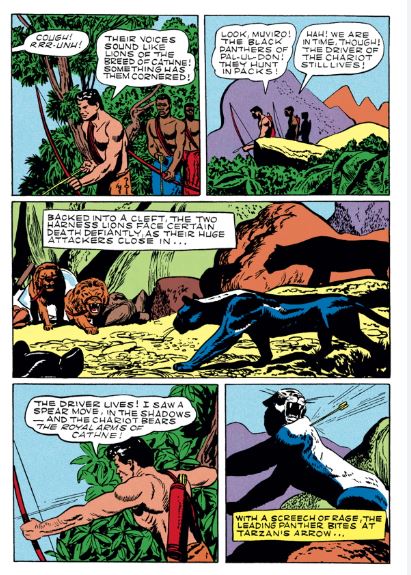
Back then, entertainment was full on and informative, so this Annual was packed with fact and activity features. First up, and still all Marsh in vision, is potted travelogue ‘Jungle Trails’ augmented by a simple method for ‘Making Maps’ and a clever rebus message from Tarzan to his ‘Jungle Village’. Then it’s back to action as ‘Tarzan and the Cannibals of Kando-Mor’ finds the Ape-Man and his Waziri friend Chief Muviro traversing the fearsome Great Swamp when the party is captured by man-eating men. Their escape brings the wanders fully into Burroughs’ rich fantasy-scape as they discover another isolated and embattled outpost of lost land Pal-Ul-Don (introduced in 8th novel Tarzan the Terrible) and befriend the buffalo-worshipping Gallugos. The event is quite timely as the ever-encroaching cannibals have almost completed their extended scheme to eliminate the cow-lovers…

Almost…

Illustrated sheet music provides long-distance lessons for ‘Dancing Feet’ to cavort at a ‘Moonlight Marriage’ ceremony, whilst ‘Happy Warrior’ shares the secrets of kite-making before ‘Boy Stands by a Friend’ offers another intimate peek at the formative years of Greystoke’s African family when Boy – later called Korak – and ape pal Zorok stow away on a riverboat and nearly end up as zoo exhibits. ‘Letters from Boy’ to the readers feature next, as ‘Jungle Hunt’ details how to make an inner tube popgun and water canteens, prior to an adventure with elephants as ‘The Troubles of Tantor’ seen the herd patriarch go to extraordinary lengths to rescue wayward calves captured by angry farmers.

Picture essays detail the secrets of MacWhirtle’s plane and the domain of dinosaurs in ‘Boys Air Adventure to the Valley of Monsters’ after which a touch of old-fashioned racial profiling describes native characteristics in ‘Jungle Tribes’ and ‘Jungle Woman’ before embracing romance as final story ‘Tarzan Trails the Brothers of the Barracuda’ sees the Ape-Man reunite shipwrecked and separated young lovers by hunting down the slave traders who have seized and sought to sell her…

Wrapping up with a load of lexicons, ‘Jungle Language: Swahili-English’ and ‘Jungle Language: Ape-English’ provides illustrated dictionaries that come in handy for the puzzle pages and crossword, before monochrome endpiece ‘Jungle World’ explores the violent existence of bugs and minibeasts.

Cover-dated May 1953, Edgar Rice Burroughs’ Tarzan #44 sees the Jungle Lord enjoying a quiet ride over vast hidden Pal-Ul-Don on his giant eagle Argus when he saves a tiny shepherd from a vulture as big as the mighty raptor Tarzan rides. In ‘Tarzan and the Little Spearmen’ this good deed soon sours. Coro of Saparta is grateful and desperate and happy in turn as the benevolent giant and his equally immense pal Muviro hunt down the ferocious carrion feeders who find living little people more tasty than corpses. Sadly, the interaction sparks civil war between the farming fraternity and now-unemployed spearman clan who used to defend them, especially after Tarzan teaches them the high-tech marvel of archery…

Pathos and nostalgia hit hard in second saga ‘Tarzan and the Strange Balu’ as a she-ape finds a human baby and replaces her own dead newborn with him. Poor, grieving Kalahari will not surrender the infant, leaving the Ape-Man in a double bind: finding the child’s real family and saving the mother surrogate from heartbreak…

The task is made even harder but more gratifying when Tarzan discovers vile slavers have been transporting a white woman to market…

The issue ends with a stunning pinup of Argus and a GIANT-giant vulture and contemporary house ad before ERBT #45 (June 1953) opens with ‘Tarzan and the Haunted Plantations’ wherein the Ape-Man visits old friend Chief Buto and learns his warrior comrade is plagued by devils and ghosts. A little careful investigation then reveals the fields where his people hire out as croppers are coveted by a bandit with knowledge of unexploited resources beneath that fruitful dirt, and Razan devises a sneaky scheme…

‘Boy and the Shamba Raider’ again focuses on the exploits of Korak-to-come as the kid and his pal Dombie take executive action to trap rogue water buffalo raiding crops and attacking workers. They wouldn’t have had to if the adult warriors had listened to them in the first place…

Epic fantasy follows in ‘Tarzan Returns to Cathne’ when the Jungle Man and Waziri’s Pal-Ul-Don explorations bring them into conflict with sabretooth tigers attacking the war-lions of Queen Elaine of Cathne. The staunch friend and ally is a fugitive now as her husband King Jathon is gone and usurper Timon rules. The madman is unstoppable and seeks to conquer sister city Athne, but Tarzan has other ideas and the wits to implement them…

The issues closes with another house ad and ‘Tarzan’s World’ pinup of the Dangina (Cape Hunting Dog) before we segue into final entry Tarzan #46 .

Dated July 1953 it begins with ‘Tarzan Defends a City’ as the Ape-Man and not-dead Jathon (surprise!) trek back to Cathne with super-colossal war lion Goliath, only to find the citadel under siege by crocodile-riding Terribs from the Great Swamp. Things look bleak until the Gallugos – freshly fled from the cannibal Kando-Mors – arrive and turn the muddy tide. All they want in return is land to build their new city…

Back in regular Africa, ‘Boy Faces the Fangs of the Mamba’ after Matusi witchdoctor Ungali – having failed to kill Tarzan – frames his annoying spawn Boy for theft and orchestrates a lethal trial by snake. Sadly for the villain, Ape-Man arrives just in time…

This titanic tome terminates with whimsical mystery ‘Tarzan and the Treasure of the Apes’ as brutal unscrupulous white hunters discover the great apes dubbed “mangani” are all bedecked in priceless jewels. Ruthlessly stalking the vain bedazzled beasts the safari killers even manage to wound Tarzan, before he convinces the apes to surrender their “pretty stones” in favour of something better: something edible.

The Jungle King then delivers a unique judgement that might not look like justice but truly is nothing but…

Although these are tales from a far-off, simpler time they have lost none of their passion, inclusivity and charm, whilst the artistic virtuosity of Jesse Marsh looks better than ever. Perhaps this time a few more people will “get” him…
Edgar Rice Burroughs® Tarzan®: The Jesse Marsh Years volume 9 © 1953, 2011, Edgar Rice Burroughs Inc. Tarzan ® Edgar Rice Burroughs Inc. All rights reserved.

In 1952 Jack of all comics trades Keith Giffen was born. We haven’t reviewed Ambush Bug, Legion of Super-Heroes or his Doom Patrol yet, so why not recall gleeful glory days with Justice League International volume 1?

In 1978 screen writer and comics luminary Robert Kirkman was born. You probably know him best for Walking Dead volume 1: Days Gone Bye.

DC Finest Green Lantern (volume 2) – Earth’s Other Green Lantern


By Gardner F. Fox, John Broome, Bob Haney, Gil Kane, Carmine Infantino, Ramona Fradon & Charles Paris, Murphy Anderson, Joe Giella, Frank Giacoia, Sid Greene & various (DC Comics)
ISBN: 978-1-79950-326-2 (TPB)

This book includes Discriminatory Content produced in less enlightened times.

Win’s Christmas Gift Recommendation: Pure & Superhero Sensationalism… 9/10

After a hugely successful revival and reworking of Golden Age all-star The Flash, DC (National Periodical Publications as they were then) built on a resurgent superhero trend. Cover dated October 1959 and on sale from July 28th, Showcase #22 hit newsstands at the same time as the fourth issue of the new Flash comic book (#108) and once again the guiding lights were Editor Julie Schwartz and writer John Broome. Assigned as illustrator was action ace Gil Kane.

Brash, cocky test pilot Hal Jordan was in California when an alien cop crashed on Earth. Mortally wounded, Abin Sur commanded his ring – a device which could materialise thoughts – to find a replacement officer: one both honest and without fear. Scanning the planet, the wonder weapon selected Jordan, whisking him to the crash-site. The dying alien bequeathed his ring, lantern-shaped Battery of Power and his profession (patrolman of Sector 2814) to the astonished Earthman.

In 6 pages the story established characters, scenario and narrative thrust of a series that would become the spine of all DC continuity. With the concept of the superhero being re-established among the buying public, there was no shortage of gaudily clad competition. Better books thrived by having something a little “extra”. With Green Lantern that was primarily the superb scripts of John Broome & Gardner Fox and astounding ever-evolving drawing of Gil Kane (ably abetted by a string of top inkers) whose dynamic anatomy and dramatic action scenes were maturing with every page he drew. Happily, the concept itself was also a provider of boundless opportunity.

Other heroes had extraterrestrial, other-dimensional and even trans-temporal adventures, but the valiant champion of this series was also a cop: a lawman working for the biggest police force in the entire universe.

This fabulous compilation gathers Green Lantern #40-61 (October 1965 -June 1968) plus contemporary guest appearances in The Flash #168, Detective Comics #350 and The Brave and the Bold #69. It all gets started without fanfare and opens with GL #40 which went on sale on August 26th 1965.

Conceived and delivered by Broome, Kane & Sid Greene (with conceptual input as always from editor Schwartz, ‘The Secret Origin of the Guardians!’ was a landmark second only to game-changing ‘Flash of Two Worlds’ (see DC Finest: The Flash – The Human Thunderbolt) as the Emerald Gladiator with his Earth-2 counterpart Alan Scott have to stop obsessed Oan scientist Krona, whose misguided attempts to discover the origins of the universe had introduced evil into our pristine reality billions of years ago. His actions forced his immortal brethren to become protectors of life and civilisation in an unending act of group contrition – the Guardians of the Universe.

Now he was back and still asking the wrong question, with his efforts also endangering a parallel earth. Happily for creation, that world had its own vastly experienced Emerald Avenger, who pitched in, and was so good at crisis management that the Guardians offered him Hal’s job…

Simultaneously high concept and all-action, the tale became a keystone of DC cosmology and a springboard for all those mega-apocalyptic publishing events such as Crisis on Infinite Earths. It has seldom been equalled and never bettered…

Gardner Fox scribed GL #41, spotlighting twisted romance in ‘The Double Life of Star Sapphire!’ as an alien power-gem again compels Jordan’s boss/true love Carol Ferris to subjugate and marry her sometime paramour Green Lantern. Fox also wrote another cracking magical mystery to end the issue as extraterrestrial wizard Myrwhydden triggered ‘The Challenge of the Coin Creatures!’

Next came ‘The Other Side of the World!’ wherein Fox continued a long-running experiment in continuity with a superb tale of time-lost civilisations and an extra-dimensional invasion by the Warlock of Ys co-starring peripatetic quester Zatanna the Magician as perfectly pictured by Kane & Greene.

At that time the top-hatted, fish-netted sorceress appeared in a number of Schwartz-edited titles, hunting her long-missing father Zatarra: a magician-hero in the Mandrake mould who had fought evil in the pages of Action Comics for over a decade, beginning with the very first issue. In true Silver Age “refit” style, Fox concocted a young, equally empowered daughter, promoting and popularising her in guest-team ups with superheroes he was currently scripting. If you’re counting, these tales appeared in Hawkman #4, Atom #19, Green Lantern #42 and an Elongated Man back-up strip in Detective Comics #355 as well as a slick piece of back writing to include the high-profile Caped Crusader via Detective #336. It all concluded after this GL segment in Justice League of America #51. You can enjoy the entire early epic by tracking down Justice League of America: Zatanna’s Search

The Flash shared the spotlight in #43: a high-energy tussle with a debuting tectonically terrifying new supervillain for Fox’s ‘Catastrophic Crimes of Major Disaster!’ and the next issue provide two tales – an increasing rarity as book-length epics became the action-packed norm.

Second-class postage discounts had for years dictated the format of comic books: to qualify for cheaper rates periodicals had to contain more than one feature, but when the rules were revised single, complete tales not divided into “chapters” soon proliferated. Here though are two reasons to bemoan the switch; Fox’s ‘Evil Star’s Death-Duel Summons’ and Broome’s “Jordan Brothers” adventure ‘Saga of the Millionaire Schemer!’, offering high-intensity alien supervillain action and a heady, witty comedy-of-errors mystery as Hal visits his family and is embroiled in new sister-in-law Sue’s hare-brained scheme to prove that her husband Jim Jordan is actually Green Lantern!

Crossovers were becoming increasingly common as shared continuity expanded and heroes popped up out of their regular jurisdiction. One brilliantly executed example follows…

Back in 1963 Schwartz had assumed editorial control of Batman & Detective Comics, allowing him space for a character who had been lying mostly fallow ever since his debut as a very long-legged walk-on in the April/May 1960 Flash. The Elongated Man was Ralph Dibny: a circus-performer who discovered an additive in popular soft drink Gingold which gave certain rare people increased muscular flexibility. Intrigued, Dibny isolated and refined the chemical and developed a serum granting him the ability to stretch, bend and compress his body to an incredible degree. From Detective #350 (April 1966) comes ‘Green Lantern’s Blackout!’ wherein Hal’s best friend Thomas Kalmaku seeks out the Stretchable Sleuth to solve the riddle of the hero’s abrupt disappearance – an entrancing, action-packed team-up with a future Justice League colleague by Fox & Carmine Infantino.

Scripted by Broome, Earth-2’s ring wielder returns for another power-packed pairing in Green Lantern #45’s fantasy & fisticuffs romance romp ‘Prince Peril’s Power Play’. The author raised the dramatic stakes with the hero’s first continued adventure in the following issue. GL #46 opens with Fox’s delightfully grounded crime-thriller ‘The Jailing of Hal Jordan’, before – preceded by a spectacular Kane pin-up – ‘The End of a Gladiator!’ details the murder of Sector 2814’s GL by old foe Dr. Polaris, concluding with his honour-laden funeral on Oa, home of the Guardians!

Broome was on fire at this time: the following issue and concluding chapter sees the hero’s corpse snatched to the 58th century and revived in time to save his occasional future home from a biological infection of pure evil in the spectacular triumph ‘Green Lantern Lives Again!’ Bizarrely garbed goodies and baddies were common currency at this time of incipient TV-generated Batmania, so when gold-plated mad scientist Keith Kenyon returned it was as a dyed-in-the-wool costumed crazy for Fox’s ‘Goldface’s Grudge Fight Against Green Lantern!’: a brutal clash of opposites. Sadly, Broome’s showbiz scoundrel Dazzler didn’t quite set the world afire in #49’s ‘The Spectacular Robberies of TV’s Master Villain!’ but the yarn was still a shocker, as Hal Jordan quit his job as a Coast City test pilot and went on the first of his vagabond quests across America…

Green Lantern had been the first hero to co-headline with Batman in The Brave and the Bold #59 (April/May 1965): a tale which became the blueprint of the title’s next 20 years as two colleagues joined forces for a specific case. There devious criminal scientist John Starr tricked Bruce Wayne into clearing his name and stole the Emerald Crusader’s power to fuel a chronal assault on Gotham as the Time Commander. Here and now, Win Mortimer joins scripter Bob Haney as Gotham Gangbuster and Green Knight endure a fractious reunion in B&B #69’s ‘War of the Cosmic Avenger’ (December 1966-January 1967) as John Starr repeats his tactic to unleash star-powered golem Cosmo upon the world, utterly unaware that the monster might have its own sinister agenda. Luckily, our heroes are smarter than the brilliant but bad time bandit…

With Green Lantern #50 Kane began inking his own art (probably in preparation for his forthcoming independent publications Savage and Blackmark), lending the proceedings a raw, savage appeal. The fight content in the stories was also ramped up, as seen in Broome’s murder-mystery treasure hunt ‘The Quest for the Wicked Queen of Hearts!’, complimented by an extragalactic smack-fest in Fox’s ‘Thraxton the Powerful vs Green Lantern the Powerless’, prior to Broome bringing the Emerald Crusader back to the 58th century to battle ‘Green Lantern’s Evil Alter Ego!’ in #52. Meanwhile, across the editorial aisle in The Flash #168 (cover-dated March 1967 but on sale from January 19th) Broome delivered a full-length thriller for Infantino & Sid Greene in which the Guardians of the Universe seek out the Scarlet Speedster after finding ‘One of our Green Lanterns is Missing!’ Bafflingly, as the Vizier of Velocity hunts for his missing best buddy, he is constantly distracted and diverted by a gang of third-rate thugs who have somehow acquired futuristic super weapons…

Back in GL #52, Broome & Kane have Alan Scott and comedy sidekick Doiby Dickles pop over from Earth-2 to aid against returning arch nemesis Sinestro in frankly peculiar ‘Our Mastermind, the Car!’, before finding far less outré plot or memorable foe for #53’s ‘Captive of the Evil Eye!’ wherein an alien giant stealing Earth’s atmosphere is ferociously foiled. The same issue sees Infantino & Greene step up to illustrate Broome’s thrillingly comedic Jordan Brothers back-up ‘Two Green Lanterns in the Family!’ as Hal finds employment as an investigator for the Evergreen Insurance company…

Broome & Kane reunite for positively surreal, super-scientific saga ‘Menace in the Iron Lung!’ (GL #54), with a manic shut-in orchestrating a deadly remote war against the Viridian Avenger followed by an all-out attack on the Guardians and their operatives in ‘Cosmic Enemy Number One’. The trans-galactic assassinations conclude in ‘The Green Lanterns’ Fight for Survival!’ and the appointment of a second Earthling to the now depleted Corps.

For #57, Fox scripts a sparkling Fights ‘n’ Tights duel in ‘The Catastrophic Weapons of Major Disaster!’ with the walking extinction event simultaneously tapping into and depowering the power ring before #58’s gripping psycho-thriller ‘Peril of the Powerless Green Lantern’ sees our hero seemingly suffering from debilitating combat fatigue. Sid Greene returned to inking with this yarn, staying on to embellish another continuity landmark.

In Green Lantern (volume 2 #59, March 1968) Broome introduced ‘Earth’s Other Green Lantern!’ in a rip-roaring cosmic epic of what-might-have-been. When dying Abin Sur originally ordered his ring to select a worthy successor Hal Jordan wasn’t the only candidate, but simply the closest of two. Here thanks to Guardian technology Hal sees what would have occurred if the ring had chosen his alternative Guy Gardner instead¦?

Action lovers and fans of fantasy fiction couldn’t find a better example of everything that defines superhero comics, but by the time of these later stories began DC was a company in transition – as indeed was America itself – with new ideas (for which, in comic-book terms, read “new, young writers”) granted greater headway than ever before: in turn generating an influx of new kids unseen since the very start of the industry, when excitable young artists and writers ran wild with imagination. Green Lantern #60 (April 1968), however, was an all-veteran outing as Fox, Kane & Greene introduced a fantastic new foe in ‘Spotlight on the Lamplighter!’, a power-packed, crime-busting morality play inadvertently foreshadowing a spectacular Green team-up classic in the next issue.

We end as we began for the last tale in this collection, wherein Mike Friedrich pens ‘Thoroughly Modern Mayhem!’ Mercifully the story is as wonderful as the title is not, since it cut to the quick of a problem many a kid had posited. If the power ring was so powerful why not just command it to end all evil? When the old and world-weary Emerald Crusader of Earth-2 does just that, it takes both him and his Earth-1 counterpart to remedy the shocking consequences to all of humanity…

Augmented with covers by Kane, Murphy Anderson, Jack Adler, Infantino, Greene & Joe Giella, these costumed drama romps are in themselves a great read for most ages, but when also considered as the building blocks of all DC continuity they become vital fare for any fan keen to make sense of the modern superhero experience. This blockbusting book showcases the imaginative and creative peak of Broome, Fox & Kane: a plot driven plethora of action sagas and masterful thrillers that literally reshaped the DC Universe. If you love superheroes you will never read better…
© 1965, 1966, 1967, 1968, 2025 DC Comics. All Rights Reserved.

Today in 1908 key comics personage, DC editor, writer and media intermediary Whitney Ellsworth was born, and in 1970 so was Mexican maestro Humberto Ramos who has excelled on everything from Amazing Spider-Man to Young Justice.

You’ve probably never heard of her, but Dorothy Woolfolk shattered a bunch of glass ceilings and was DC’s first woman editor. We lost her today in 2000, but her legacy lives on.

Mighty Thor Omnibus volume 3


By Stan Lee & Jack Kirby, Larry Leiber, Gerry Conway, John Buscema, Neal Adams, Vince Colletta, Joe Sinnott, George Klein, Bill Everett, John Verpoorten, Sam Grainger, Jim Mooney, Sal Buscema, John Romita Sr., Art Simek, Sam Rosen & various & various (MARVEL)
ISBN: 978-1-3029-0381-7 (HB/Digital edition)

This book includes Discriminatory Content produced in less enlightened times

Win’s Christmas Gift Recommendation: A Epic Jewel of Historic Import… 9/10

We all still love superheroes right? Here’s another bunch of yarns thou shouldst not miss…

The Mighty Thor was the title in which Jack Kirby’s restless fascination with all things Cosmic was honed and refined via dazzling graphics and captivating concepts. The King’s career-defining string of signature superheroic fantasies and power-packed pantheons all stemmed from a modest little fantasy/monster title called Journey into Mystery where – in the summer of 1962 – a tried-&-true comic book concept (feeble mortal remade as god-like hero) was revisited by fledgling Marvel Comics to add a Superman analogue to their growing roster of costumed adventurers.

It is lettered throughout by unsung superstars Art Simek &Sam Rosen, and hued by an unjustly anonymous band of colourists. As well as a monolithic assortment of nostalgic treats at the back, this mammoth tome is dotted throughout with recycled Introductions – ‘God and Mangog’ by Arlen Schumer, ‘The Beginning of the End’ by Jon B. Cooke, ‘Legendary Tales’ by Will Murray and ‘Asgard Forever!’ by Stan Lee, from previous Marvel Masterworks editions, and also includes editorial announcements and ‘The Hammer Strikes!’ news and letters pages for each original issue to enhance overall historical experience…

This blockbusting era-defining, full-colour third tome offers Asgardian exploits from Thor #153-194, collectively covering June 1968 to December 1971 as the Universe Jack built slowly began to succumb to the weight and stricture of Marvel’s abiding continuity, and the King sought ever more challenging innovation and spectacle…

Once upon a time lonely, lamed American doctor Donald Blake took a vacation in Norway only to encounter the vanguard of an alien invasion. Entombed in a cave, Blake found a gnarled old walking stick, which, when struck against the ground, turned him into the Norse God of Thunder! Without any hesitation or preamble the reborn godling was soon defending the weak and smiting the wicked. Months swiftly passed and rapacious extra-terrestrials, Commie dictators, costumed crazies and cheap thugs gradually gave way to a vast panoply of fantastic worlds and incredible, mythic menaces. Eventually the magnificent warrior’s ever-expanding world of Asgard was a regular feature and mesmerising milieu for the hero’s earlier adventures, heralding a fresh era of cosmic fantasy to run almost tangentially to the company’s signature superhero sagas.

The action begins here with the conclusion of another calamitous clash involving wicked stepbrother Loki. In the wilds of Asgard, Ulik the Troll had attacked Karnilla, Queen of the Norns and brave lovestruck god Balder offered to be her champion if she freed Thor’s beloved Sif from the awesome Destroyer armour her spirit was trapped in, and which had forced her to kill her briefly de-powered beloved.

Resurrected and triumphant, Thor united with his lost companions against Ulik, only to lose his newly re-energised hammer to Loki, who fled to Earth with it. In hot pursuit, the heroes followed and Sif was gravely wounded…

Now in ‘…But Dr. Blake Can Die!’ the Thunderer reverts to his mortal guise to surgically operate on the dying goddess – an opportunity for further mayhem that Loki cannot resist, but which our hero’s courage and ingenuity manage to frustrate…

Vanquished and hurled into an inter-dimensionally bottomless pit, furious Ulik saves himself whilst accidentally releasing an ancient unstoppable beast in #154’s ‘…To Wake the Mangog!’ A creature imprisoned by Odin in his ancient prime, the monster – embodying the power and spirit of a billion, billion predatory warriors – emerges incandescent at his long incarceration and, brutally laying waste to everything in its path, rampages towards the heart of Asgard to trigger Ragnarok in ‘Now Ends the Universe!’ All of the Golden Realm’s martial resources are unable to slow the deadly march to doom in ‘The Hammer and the Holocaust!’ but their valiant delaying tactics, depicted in unimaginably powerful battles scenes from a genius on fire Kirby resulted in a last-minute save in #157’s ‘Behind Him… Ragnarok!’

Although short on plot development, the astounding struggle to save Asgard is a masterful expression of the artist’s hunger for bigger stories, and might well have underpinned his later Fourth World series at DC…

The peculiarities of the Blake/Thor relationship were examined and finally clarified next; beginning with ‘The Way it Was!’ – a framing sequence by regular creative team Stan Lee, Kirby & Vince Colletta – that book-ended a reprint of the Thor debut story from Journey into Mystery #83, ‘The Stone Men of Saturn’ (scripted by Larry Leiber and inked by Joe Sinnott). This memory moment neatly segues into ‘The Answer at Last!’ taking the immortal hero back to his long-distant youth to reveal Blake as an Odinian construct designed to teach the Thunderer humility and compassion by living amongst mortals as one of them…

With his true nature re-established, Thor answers a call from the galaxy-roving Colonisers of Rigel, plunging into the depths of space to face a cosmic menace. ‘And Now… Galactus!’ reintroduced old AI companion The Recorder whilst pitting the Devourer of Worlds against living planet Ego: a clash concluded with the Thunderer’s heavy-handed aid in ‘Shall a God Prevail?’ The cosmic wonderment then escalates in ‘Galactus is Born!’ as Asgardian magic finally reveals a tantalising fragment of the terrifying space god’s origins…

Pausing briefly for text interlude ‘The Beginning of the End’ by Jon B. Cooke, we then storm onwards into a sci-fi-fuelled two-parter. In #163 & 164 Thor is summarily despatched to Earth to battle an invasion from a ghastly dystopian future. ‘Where Demons Dwell!’ sees his lover Lady Sif investigating a bizarre energy vortex until captured by Mutate monsters led by rogue Greek god Pluto. The reunited Asgardians decimate the horrors from tomorrow ‘Lest Mankind Fall!’ and as valiant comrade Balder rejoins them in cataclysmic combat, a mysterious cocoon hatches a man-made god…

‘Him!’ (Thor #165) and its conclusion ‘A God Berserk!’ see the creature created by evil scientists to conquer mankind – and who would eventually evolve into tragic cosmic saviour Adam Warlock – wake amidst the turmoil of the battle and, seeing Sif, decide it is time he took a mate…

Trailing the naive artificial superman across space and assorted dimensions with the outraged Thor, Balder witnesses his gentle comrade’s descent into brutal “warrior-madness”, resulting in a savage beating of Him. By the time the Thunderer regains his equilibrium, he is a shaken, penitent and guilt-ridden hero, eager to pay penance for his unaccustomed savagery.

In ‘This World Renounced!’ (sporting a cover by John Romita: the first ever not drawn by Kirby) almighty Odin punishes his son for succumbing to Warrior Madness by exiling him to deep space, where he must atone by locating enigmatic world-devourer Galactus. However, just before departure, the Prince of Asgard clears up some outstanding old business, including another confrontation with his stepbrother Loki…

Superb George Klein came aboard as inker for ‘Galactus Found!’ with Balder and the Warriors Three (Fandral, Hogun & Volstagg) babysitting Earth as Thor roams the heavens on his lonely mission. By the time a new threat emerges in Red China, in the deep unknown Galactus meets to Thor to disclose ‘The Awesome Answer!’ to his origins: a dose of pure Kirby Kosmology of truly staggering proportions. Meanwhile back home, the terrifying Thermal Man is making things far too hot for both his Chinese creators and the Lands of the Free…

With comics legend Bill Everett assuming inking chores, Thor #170’s ‘The Thunder God and the Thermal Man’ finds the star-lost hero on Earth with mission accomplished, to discover New York besieged by a walking atomic nightmare. Tumbling straight into cataclysmic combat beside his Asgardian comrades against the unstoppable mechanoid menace, Thor is suddenly deprived of his allies at the height of the struggle when Balder, Hogun, Fandral & Volstagg are arcanely abducted to Asgard by Loki and the Norn Queen. Nevertheless, the turbulent Thunder God triumphs…

Alone on Earth, Thor next faces a series of single-issue situations: confronting ‘The Wrath of The Wrecker!’ to crush the Norn-empowered bandit before foiling the body-swapping plot of billionaire Kronin Krask in ‘The Immortal and the Mind-Slave!’ after which Will Murray’s text treatise on ‘Legendary Tales’ offers a breather prior to our godly hero overcoming the earthbound fury of ‘Ulik Unleashed!’ after the titanic troll succumbs to the mesmeric wiles of old Thor adversaries The Circus of Crime

The Thunderer continues punching down after a strength-stealing robot runs amok in ‘The Carnage of the Crypto-Man!’ before the last great epic of the Kirby-era begins, behind a Marie Severin cover as ‘The Fall of Asgard!’ (Lee, Kirby & Everett) sees valiant Balder and the Warriors Three barely escape the clutches of lovestruck Karnilla to confront the assembled hordes of giants and trolls marching on the Home of the Gods. With All-Father Odin incapacitated by his annual Great Sleep, perfidious Loki has seized the throne, forcing war-goddess Sif to summon Thor home for perhaps the Last Battle…

Inked by Colletta, ‘Inferno!’ reveals the usurper’s folly as fire-demon Surtur sunders his ancient Odinian captivity to instigate his pre-ordained task of burning down the universe. With everything appearing ‘To End in Flames!’, Loki flees to Earth, having first hidden Odin’s comatose form in the life-inimical Sea of Eternal Night. As Thor leads a heroic Horatian last stand, Balder penetrates the Dimension of Death to rescue the All-Father just as Surtur fires up for his fulminating final foray. It’s a close call but is not yet the end…

Thor #178 (July 1970) was a shock and is a landmark: the first issue without Jack Kirby since the strip’s formative days. Clearly a try-out or hasty fill-in yarn, ‘Death is a Stranger’ – by Lee, John Buscema & Colletta – sees the Thunderer snatched away from Asgard by the nefarious Abomination and duped into clashing with the Stranger: an extra-galactic alien powerhouse who collects unique beings for scientific study…

Inked by John Verpoorten, the interrupted epic riotously resumed in #179 with ‘No More the Thunder God!’ as Thor, Sif & Balder are sent to Earth to arrest fugitive Loki. The issue was Kirby’s last: he left the entire vast unfolding new mythology on a monumental cliffhanger just as the Thunder God is ambushed by his wicked step-brother. Using arcane magic, the Lord of Evil switches bodies with his noble sibling and gains safety and the power of the Storm whilst Thor is doomed to endure whatever punishment Odin decrees…

More than any other Marvel strip Thor was the feature where Kirby’s creative brilliance matched his questing exploration of an Infinite Imaginative Cosmos: dreaming, extrapolating and honing a dazzling new kind of storytelling graphics with soul-searching, mind-boggling concepts of Man’s place in the universe.

Although what followed contained the trappings and even spirit of that incredible marriage, the heart, soul and soaring, unfettered wonderment just were not there any longer: nor would they truly return until 1983 when Walt Simonson assumed creative control with #337.

Here, then ‘When Gods Go Mad!’ introduces the radically different style of hot property Neal Adams, inked by comfortably familiar Joe Sinnott, as the true Thunderer is sent to Hell and the tender mercies of Mephisto, whilst on Earth Loki uses his brother’s body to terrorise the UN Assembly and declare himself Master of the World. In #181’s ‘One God Must Fall’ Sif leads the Warriors Three on a rescue mission to the Infernal Realm as Balder struggles to combat the power of Thor merged with the magic and malice of Loki until Mephisto is thwarted. Then, a cataclysmic battle of brothers on Earth subsequently sets the world to rights…

The new Post-Kirby era truly began with Thor #182, as John Buscema took up the artistic reins and began his own epic run as illustrator with ‘The Prisoner… The Power… and… Dr. Doom!’ Here the Storm Lord becomes entangled in Earthly politics when a young girl entreats him to rescue her father from the deadly Iron Monarch of Latveria. The godling cannot refuse, especially as the missing parent is an expert on missile technology and capable of making Doom the master of ICBM warfare…

The decidedly down-to-Earth and rather mismatched melodrama concludes with Don Blake ‘Trapped in Doomsland!’ until Thor can retrieve his recently misappropriated mallet, but even after his deadly mission of mercy is accomplished, tragedy is his only reward…

Preceded by Stan Lee’s text piece ‘Asgard Forever!’ the first epic of the new age sees Lee, Buscema & Joe Sinnott crafting their own ambitious cosmic saga, opening with #184, exploring ‘The World Beyond!’ wherein an implacable, sinister force devours the outer galaxies, with psychic reverberations of the horrific events impacting and unravelling life on Earth and in Asgard. With all creation imperilled, Odin departs to combat the enigmatic threat alone…

Sam Grainger inked ‘In the Grip of Infinity!’, as universal calamity intensifies and the All-Father falls to an enigmatic, seemingly all-consuming invader before ‘Worlds at War!’ exposes a hidden architect behind the encroaching armageddon. That revelation leads to a desperate last-ditch ploy, uniting the forces of Good and Evil in ‘The World is Lost!’ before one final clash – inked by Jim Mooney – answers all the questions before celebrating ‘The End of Infinity!’ Although vast in scope and drenched in powerful moments highlighting the human side of the gods in extremis, this tale suffers from an excess of repetitive padding and a rather erratic pace. Without pause, though, we plunge on as Thor #189 sees sepulchral goddess Hela come calling, demanding Thor feel ‘The Icy Touch of Death!’ to pay for all the souls she didn’t get in the recent sidereal showdown…

After a big chase around planet Earth she is finally dissuaded in ‘…And So, To Die!’, but the distraction has meanwhile allowed ever-opportunistic Loki to seize the Throne of Asgard and unleash ‘A Time of Evil!’ This typically tyrannical behaviour results in the deranged despot using Odin’s stolen power to manifest an unstoppable artificial hunter/killer dubbed Durok the Demolisher. Unleashing his merciless engine of destruction on Earth, Loki gloats at the ‘Conflagration!’ (Grainger inks) he has callously instigated…

Completing the retiring of the Old Guard, Gerry Conway came aboard as writer for double-length tale ‘What Power Unleashed?’ (#193, with Sal Buscema augmenting & inking brother John) to conclude the epic tale. Prevented by vows from taking up arms against Loki’s puppet, Balder and Sif sagely enlist the Silver Surfer to aid the embattled Thunderer as Asgard totters on the brink of total destruction. Free to act against the real enemy, Thor then retaliates with staggering power and ‘This Fatal Fury!’: occupying the usurper’s full and furious attention until All-Father Odin finally resumes his rightful place.

To be Continued…

Kirby’s Thor will always be a high point in graphic fantasy, all the more impressive for the sheer imagination and timeless readability of the tales. With his departure the series foundered for the longest time before finding a new identity, yet even so the stories in this volume still offer intrigue and action, magnificently rendered by illustrators who, whilst not possessing Kirby’s vaulting visionary passion, were every inch his equal in craft and dedication.

With covers by Kirby, Colletta, Romita, John & Sal Buscema, Everett, Klein, Severin, Adams, Sinnott & Chic Stone, this book also includes the covers to Thor Annuals #3 & 4, pertinent house ads and a huge selection of original artwork plus unedited and unused images and story pages by Kirby, Buscema, Everett, Verpoorten, Grainger, and Mooney. Also on view are the covers to Tales of Asgard #1 (1968 by Kirby) and the 1984 re-release with a Simonson frontage, as well as Super-Villain Classics #1 (Bob Layton) recycling Galactus’ origins as seen in Thor between #160 &168… and it’s 1996 re-release with Steve Epting on the cover.

Other potent pictures include interlocking covers by Olivier Coipel, Mark Morales & Laura Martin from the 2009 Tales of Asgard series, re-re-re-printing Lee & Kirby’s Asgardian back-ups.

This is unmissable fantasy action and an absolute must for all fans of the medium, and all disciples of the modern Norse gods.
© 2022 MARVEL.

Today in 1916 stellar DC inker Stan Kaye was born. Two years later Frank King’s Gasoline Alley began – the longest-running current strip in US, and second-longest running strip of all time. It certainly outlasted Ham Fisher’s boxing strip Joe Palooka, which began in 1930 and ended today in 1984. Two years later, Al Smith died. He had inherited and sustained Bud Fisher’s Mutt and Jeff from 1932 to 1980.

Bone Broth


By Alex Taylor (SelfMadeHero)
ISBN: 978-1-91422-432-4 (TPB)

Win’s Christmas Gift Recommendation: Tasty Treats for Comics Fan-Addicts… 9/10

Here’s a quick, short review of a big, utterly fulfilling, extremely entertaining new confection from queer visual artist Alex Taylor. Winner of the First Graphic Novel Award for 2023, Bone Broth is set in contemporary London – literally underneath the arches! – and compellingly addresses modern living via the oldest traditions of mystery thriller writing…

Ash ia young transmaculine artist who almost nearly properly grown up. All that’s missing is to make enough money to pay rent, buy supplies and secure the meds supporting still- ongoing surgeries. That ideal opportunity knocks when crusty old coot/ramen sensei Bug adds the weedy-seeming new guy to the remarkable staff at his traditional noodle bar.

That highly popular haven of exotic eats and affordable takeouts is located off a dingy alley with trains roaring and clattering above at all times. It reminds me of Brixton, but of course, other rail lines, vibrant cross-cultural districts and eateries are available…

Business is brisk and Ash gets acquainted with floor maneger Honey, Sock, Blue, and burly Japanese broth-engineer Creamy – who philosophically monitors and stirs the industrial scale tonkotsu that is basis of all the dishes – whilst scrambling to learn the ropes. The work is intense, fast, complicated, relentless and – just like in any specialist enteprise (like a comic shop for instance ) – sticky, clammy, cloying and jampacked with weirdoes individualists on both sides of the till.

Nevertheless, Ash is immediatly part of the family, trading history and opinions, sharing moments and learning to live with the miasmic funk of entire pig carcasses perpetually becoming soup 24/7. It’s the kind of toil that quickly builds bonds that feel decades old so it’s no wonder everybody kicks back for celebratory drinks occaiosnally. Like the End-of-Year staff do when Bug drinks so much that he just goes to sleep on the floor and everybody took selfies with him.

Of course, Bug wasn’t unconcious and they all have to try and make rational decisions whilst being that drunk. Deleting recents posts is easy and logical but voting to lose the sensei in the body-rending broth doesn’t seem like such a great idea now…

Draped in biological hues and mired in literally organic imagery, Bone Broth’s motifs accentuate an unfolding comedy of errors: deftly mirroring the surgical progress of changing gender whilst reflecting on whatever beneficial butchery is involved in resculpting and crafting a human form with secret knowledge is exposed to those willing to look and think instead of react and revolt. This is a tale that some people will never countenance and that’s sad for them, because its also great stuff demanding second helpings…

Wryly subversive, tantalisingly warming and definitely NOT for little kids, this potent parable is seasoned with buddy film tropes and garnished with a delicious twist that will hit the spot for anyone with a taste for the out-of-the-ordinary fodder. Also included are a heartfelt ‘Thanks’ section and look at the artist’s ‘Process’ to deliver a multi-layered trifle you’d be fool to turn your nose up at.
Text and images © 2025 Alex Taylor. All rights reserved.

Today in 1951 Bob Smith (Super Friends, Superman, Plastic Man, Archie Comics) was born, as was Northampton’s Finest Alan Moore two years later. In 1985 Bill Watterson’s enfant terrible et big buddy Calvin and Hobbes launched. 1991 today saw UK comics stalwart Reg Parlett leave us. All of these optical miracles should be scrutinised at great length, so please go do that…

I Hate Fairyland volume 1: Madly Ever After


By Skottie Young, Jean-Francois Beaulieu, Blambot®’s Nate Piekos & various (Image Comics)
ISBN: 978-1-63215-685-3 (TPB/Figital edition)

This book contains Discriminatory Content included for comedic effect.

Win’s Christmas Gift Recommendation: Sugar & Spice & Everything Nicely Reimagined… 10/10
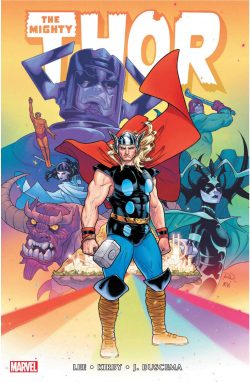
It feels like we haven’t had a good laugh in ages. Oh wait, here’s one now…

We grow up with fairytales all around us. They’re part of the fabric of our lives. Some people generally outgrow them whilst others take them to heart and make them an intrinsic aspect of their lives…

Have you met Skottie Young?

He’s a guy with feet firmly planted in both camps and well able to alternatively embrace the enchantment of imagination and give it a hilariously cynical mean-spirited drubbing at the same time. Hopefully you’ll have seen his glorious, multi-award-winning interpretation of Baum’s Oz books produced by Marvel and his spectacular run on Rocket Raccoon (and Groot!); or perhaps just his gut-bustingly funny baby superhero covers. Maybe you’re aware of his collaboration with Neal Gaiman on Fortunately the Milk?

If not, there’s so much more in store for you after enjoying this particular slice of vintage mirthful mayhem…

I Hate Fairyland is a truly cathartic little gem: a mind-buggering romp of deliciously wicked simplicity and one I heartily recommend as a palate-cleanser for anyone overdosing on cotton candy, wands and glitter, or spandex and slicked-back pecs.

Once upon a time little Gertrude wished she could visit the wonderful world of magic and joyous laughter. Her wish was inexplicably granted and she met happy shiny people: fairies, elves, giants, talking animals and animated trees, rocks, stars, suns and moons; Gert just loved them all…

Resplendent Queen Cloudia made her an Official Guest of Fairyland and invited her to play a game. When she wanted to go back to her own world the bedazzled six-year-old simply had to find a magic key and open the door to the realm of reality. The fabulous Fairy Queen even gave Gertrude a quaintly talking bug as guide and helpmeet, plus a magic map of all the Known Lands…

That was 27 years ago and although Gert’s body has not aged a day her mind certainly has. It’s also gotten pretty pissed-off at the interminable insufferable task and just wants it all to end.

Of course, as an Official Guest of Fairyland Gert can’t die and has taken to expressing her monumental frustration in acts of staggering violence and brutal excess as she continues hunting for that fluffer-hugging key…

With no other choice, Gert and dissolute bug Larrigon Wentsworth III toil ever onward in search of the way home, regularly enduring horrific – but non-fatal – injuries and taking out their spleen (and often other peoples’) on whoever gets in her way.

After all this time, however, Even Queen Cloudia has had enough. Sadly, she can’t do anything about it whilst Gert is “OFG” (Official Guest of Fairyland, keep up!): a privilege that simply cannot be revoked.

Subtle hints of vast rewards to barbarians and assassins and evil witches all prove worthless too. Between the protection spell and Gert’s own propensity for spectacular bloodletting, there’s nothing in the incredible kingdoms to stop her.

… And then someone has a really amazing idea. Why not invite another sweet little girl to Fairyland and offer her the same deal? When she finds the key, wins the game and goes back, Gert will lose her OFG status and they can be rid of her at last!

Of course, that all goes swimmingly, just like Cloudia hoped and everybody but Gert lives happily ever after.

No, it really, really doesn’t work out like that…

To Be Continued…
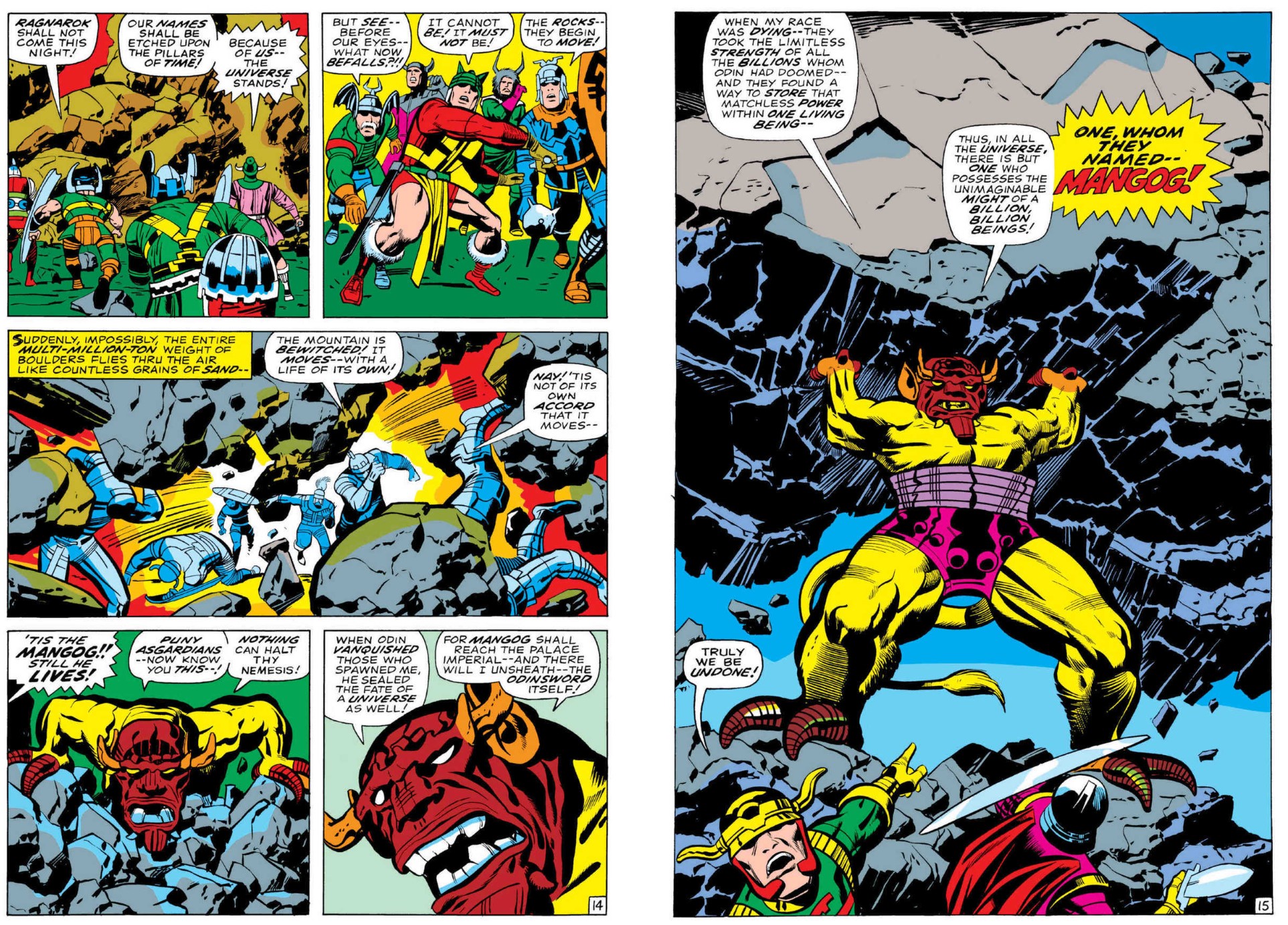
Collecting the first five issues of the Image Comic series from October 2015 – February 2016 by Young, colourist Jean-Francois Beaulieu and letterer Nate Piekos of Blambot®, this sublimely outrageous treat offers hilariously over-the-top cartoon violence and the most imaginative and inspired use of faux-profanity ever seen in comics.

This is an unmissable wakeup call for everybody whose kids want to be little princesses and proves once and for all that sweet little girls (and probably comics artists) are evil to the core if you push them too far…
© 2016 Skottie Young. All rights reserved.

Today in 1911, cartoonist Clarence Gray was born. Sadly, there isn’t much of his wonderful Brick Bradford strip around to review. Far more readily represented is Alberto Giolitti whose art can be seen on loads of licensed features books we’ve covered like Star Trek: Gold Key Archives volume 1, and who would be 102 today if he still lived…
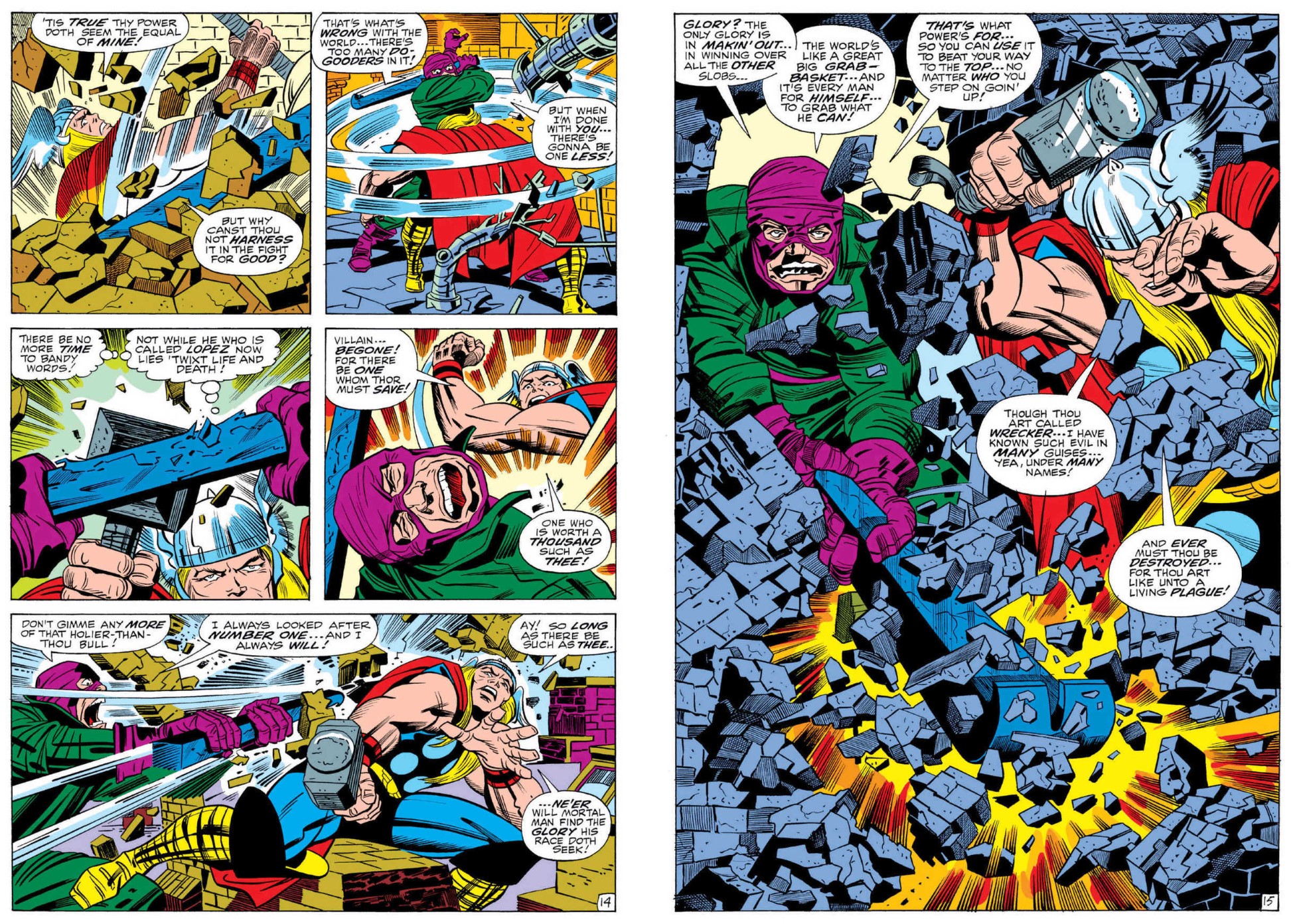
In 1941 French star fantasist Caza was born, whilst Superman scribe Elliot S! Maggin joined us in 1950 and FF artist Carlos Pacheco was born in the same year they were: 1961…